Death In Honduras: The Coup, Hillary Clinton And The Killing Of Berta Cáceres

dt.common.streams.StreamServer.cls

By Media Lens

Source: Dissident Voice

On February 28, Hillary Clinton told an audience from the pulpit of a Memphis church: ‘we need more love and kindness in America’. This was something she felt ‘from the bottom of my heart’.

These benevolent sentiments recalled the national ‘purpose’ identified by President George H.W. Bush in 1989, shortly before he flattened Iraq. It was, he said, ‘to make kinder the face of the nation and gentler the face of the world’.

Clinton, of course, meant North America, specifically the United States. But other places in America are short on love and kindness, too. Consider Honduras, for example.

On June 28, 2009, the Honduran President Manuel Zelaya was kidnapped at gunpoint by masked soldiers and forced into exile. Since the ousting, the country ‘has been descending deeper into a human rights and security abyss’ as the military coup ‘threw open the doors to a huge increase in drug trafficking and violence, and… unleashed a continuing wave of state-sponsored repression’. In 2012, Honduras had a murder rate of 90.4 per 100,000 population, then the highest rate in the world. In 2006, three years before the coup, the murder rate had stood at 46.2 per 100,000.

The years since 2009 have seen ‘an explosive growth in environmentally destructive megaprojects that would displace indigenous communities. Almost 30 percent of the country’s land was earmarked for mining concessions, creating a demand for cheap energy to power future mining operations. To meet this need, the government approved hundreds of dam projects around the country, privatizing rivers, land, and uprooting communities.’ In 2015, Global Witness reported that Honduras was ‘the most dangerous country to be an environmental defender’.COPINH

Berta Cáceres, a mother of four children, was co-founder and general coordinator of the COPINH (Consejo Cívico de Organizaciones Populares e Indígenas de Honduras) group opposing this state-corporate exploitation. Last year, Cáceres was awarded the Goldman Environmental Prize, the world’s leading award recognising grassroots environmental activists, for her work opposing a major dam project. Many of COPINH’s leaders have been murdered in recent years. In 2013, Cáceres said:

The army has an assassination list of 18 wanted human rights fighters with my name at the top. I want to live, there are many things I still want to do in this world. I take precautions, but in the end, in this country where there is total impunity I am vulnerable. When they want to kill me, they will do it.

Last week, on the night of March 3, armed men burst through the back door of Cáceres’s house and shot her four times, killing her in her bed. US media watch site Fairness and Accuracy in Reporting (FAIR) commented:

There was widespread outcry and grief over her death, and the story was covered by major media in the United States. But there was a glaring problem with the coverage: Almost none of it mentioned that the brutal regime that likely killed Cáceres came to power in a 2009 coup d’état supported by the United States, under President Barack Obama and then-Secretary of State Hillary.

Confidential – The Embassy Perspective

Following the 2009 coup, the United Nations, the Organization of American States (OAS) and the European Union all condemned Zelaya’s removal as a military coup. A confidential US Embassy cable, later published by Wikileaks, commented:

The Embassy perspective is that there is no doubt that the military, Supreme Court and National Congress conspired on June 28 in what constituted an illegal and unconstitutional coup against the Executive Branch… There is equally no doubt from our perspective that Roberto Micheletti’s assumption of power was illegitimate.

That was behind closed doors. In public, fifteen US House Democrats urged the US regime to ‘fully acknowledge that a military coup has taken place and… follow through with the total suspension of non-humanitarian aid, as required by law’. Writing for the Common Dreams website, Alexander Main supplied some detail:

Ann-Marie Slaughter, then director of Policy Planning at the State Department, sent an email to [Secretary of State] Clinton on August 16 [2009] strongly urging her to “take bold action” and to “find that [the] coup was a ‘military coup’ under U.S. law,” a move that would have immediately triggered the suspension of all non-humanitarian U.S. assistance to Honduras.

This, Hillary Clinton’s State Department refused to do, thus implicitly recognising the military takeover. As FAIR noted, Clinton makes clear in her memoirs that she had no intention of restoring President Zelaya to power:

In the subsequent days [after the coup] I spoke with my counterparts around the hemisphere, including Secretary Espinosa in Mexico. We strategized on a plan to restore order in Honduras and ensure that free and fair elections could be held quickly and legitimately, which would render the question of Zelaya moot.

In September 2009, US State Department officials blocked the OAS from adopting a resolution that would have rejected the legitimacy of Honduran elections carried out under the dictatorship, thus giving the coup the final US seal of approval.

Ousted former president, Manuel Zelaya, said last year:

Secretary Clinton had many contacts with us. She is a very capable woman, intelligent, but she is very weak in the face of pressures from groups that hold power in the United States, the most extremist right-wing sectors of the U.S. government, known as the hawks of Washington. She bowed to those pressures. And that led U.S. policy to Honduras to be ambiguous and mistaken.

Zelaya added:

President Obama has not wanted to hear our peoples. He has turned a deaf ear on the cry of the people. First we protested in the opposition. A few months ago, they physically removed me from the Congress, the National Congress, because our party mounted a peaceful protest. The military removed us, using tear gas in the Congress. They expelled us, beating us with batons, beating us into the street. This is the government that President Obama supports, a government that is repressive, a government that violates human rights, as has been shown by the very Inter-American Commission on Human Rights of the Organization of American States. It has shown this to be the case.

Alexander Main concluded:

A careful reading of the Clinton emails and Wikileaked U.S. diplomatic cables from the beginning of her tenure, expose a Latin America policy that is often guided by efforts to isolate and remove left-wing governments in the region.

An assertion supported by the increase in US military assistance to Honduras even as state-corporate violence has massively escalated. Noam Chomsky explained the logic:

Zelaya was moving somewhat tentatively towards the kinds of social reforms that the United States has always opposed and will try to stop if it can.

A Local Matter – The Media Response

Corporate politics and media, of course, never tire of proclaiming the West’s ‘responsibility to protect’ in places like Iraq, Libya and Syria. So how did these same humanitarians respond to the murder of a compassionate, respected and awesomely courageous activist in Honduras? FAIR commented on the overwhelming evidence of US support for the coup:

One wouldn’t know any of this reading US reports of Cáceres’ death. The coup, and its subsequent purging of environmental, LGBT and indigenous activists, is treated as an entirely local matter… The Washington Post, Guardian, NBC, CNN and NPR didn’t mention the 2009 coup that brought to power Cáceres’ likely murderers, let alone the US’s tacit involvement in the coup.

On the same day FAIR’s report was published, the first and only reference to these hidden truths in the UK press recorded by the Nexis media database was supplied by Jonathan Watts in the Guardian:

But Washington’s role is also controversial because the US backed the current government, which took power after a 2009 coup that ousted the democratically elected president Manuel Zelaya. The US is now providing fund [sic] for the Honduran police force.

Watts quoted International Rivers, an NGO that worked with Cáceres:

We must note that during the 2009 military coup in Honduras, the US government, with Hillary Clinton as secretary of state, worked behind the scenes to keep Honduras’ elected government from being reinstated. Additionally, the US government continues to fund the Honduran military, despite the sharp rise in the homicide rate, political repression, and the murders of political opposition and peasant activists.

While hardly exhaustive, this is the only mention of these issues we have found in the UK corporate press. A more recent piece by the Guardian’s Washington correspondent, David Smith, mentioned the coup but not US involvement. With touching naivety, Smith observed that ‘the US, determined to stop the flow of illegal immigrants from Central America, has been pouring money into Honduras’s security apparatus’.

The Times – so vocal in promoting Western ‘intervention’ to ‘protect’ human rights from Official Enemies – printed 68 words on the killing penned by the Associated Press. The Telegraph gave the story a single mention. In the Independent, Phil Davison wrote of Cáceres:

As if anyone needed reminding, her murder brought back to Honduras the dark days of the 1980s Central American guerrilla wars, in which they and their neighbours fought to rid themselves of dictators backed by the US.

But in stark contrast to the courage of Cáceres and so many others in Honduras, Davison was not able to bring himself to mention that the tyranny in Honduras is today being backed by the region’s great superpower. Also in the Independent, Caroline Mortimer made no mention of US complicity in the coup. Nor, unsurprisingly, did the BBC in two pieces here and here on the killing.

As ever, ‘mainstream’ ‘compassion’ turns out to be rooted in rather more ‘pragmatic’ concerns. If an Official Enemy had been responsible for Cáceres’s death, the cries of outrage, horror and denunciation would have blazed from our corporate front pages and TV screens. Action would have been demanded, perhaps even ‘intervention’. But when the horror is committed by a faithfully corrupt and brutal servant of Empire aided and abetted by the ‘Leader of the Free World’, none of the buttons on the vast, high-tech propaganda machine are pressed and the story is quickly buried along with the victim.

Needless to say, awareness of the kind offered here threatens to jam a spanner in the conditionally ‘compassionate’ propaganda waterworks and must be scrupulously ignored or, at best, ridiculed.


Media Lens is a UK-based media watchdog group headed by David Edwards and David Cromwell. The second Media Lens book, Newspeak: In the 21st Century by David Edwards and David Cromwell, was published in 2009 by Pluto Press. Read other articles by Media Lens, or visit Media Lens’s website.

Related Article: Before Her Assassination, Berta Cáceres Singled Out Hillary Clinton for Backing Honduran Coup (Democracy Now)

Rent Strikes: ‘together we can defeat the housing market’

Rent-Strikers-1

By Matt Broomfield

Source: RoarMag.org

As they revive a long-dormant form of protest, rent strikers in London and San Francisco must learn lessons from the great strikes of the 20th century.

When you can no longer afford to pay your rent, only one course of action remains: stop paying it. On both sides of the Atlantic, tenants are militating against the unbearable pressure of the housing market via the only locus of power available to them — going on rent strike.

Midtown Apartments, San Francisco

Jose LaCrosby was an African-American hair stylist to the stars. Nina Simone, James Brown and Miles Davis all frequented his San Francisco salon. Terminally ill at the age of 89, LaCrosby was told by his doctors that he should return to die among his friends in Midtown Apartments.

But the City of San Francisco had just hiked rents by up to 300 percent. If the Korean War veteran wanted to move back in to a ground-floor apartment it would now cost him $3700 a month. LaCrosby had lived in Midtown for two decades, but he spent the last 7 months of his life under fluorescent lights in an anodyne hospice ward, unable to afford the grossly inflated rent.

LaCrosby’s treatment is symptomatic of the way Midtown is being used as an asset to be stripped for cash, says long-time resident and Save Midtown organizer Jay Majitov. “This community is being displaced by the greed and avarice of property pimps preying on the weak and the disenfranchised,” he explains. Many of Majitov’s neighbors moved into Midtown after being socially cleansed from other areas of San Francisco in the 1960s, on what they understood was a rent-to-buy agreement.

But though Midtown paid off its collective mortgage in 2007, the city reneged on its agreement to hand the building over to the tenants. Instead, Midtowners were hit with a threefold increase in rent, far outstripping the maximum increase set by San Francisco rent controls. Appalled by this betrayal of trust, the tenants of 65 Midtown apartments have been withholding their rent increase since August 2015.

University College London

On the face of it, LaCrosby’s working-class neighbors in Midtown have little in common with the primarily middle-class, primarily white students of University College London. But the price of UCL accommodation has risen by 56 percent in the last six years, and the university extracts £16 million annually in pure profit from their residences. The halls remain shabby, cramped and infested with cockroaches.

As a result, around 150 students are currently striking for a 40 percent rent decrease. “UCL call residents in halls customers, not students,” says David Dahlborn of UCL, Cut The Rent (UCL-CTR). “It’s sheer exploitation.”

There have been rumblings about wider rent strikes across the British left for months, while US activists in Portland and elsewhere are now looking to copy Midtown’s example. Yet until a couple of years ago, no one was talking about rent strikes at all.

The problem(s) with rent strikes

Once a cornerstone of tenants’ rights activism, since the 1980s the rent strike has largely been absent from the arsenal of the left. The most famous rent strike in history occurred in 1915, when the fear of a Bolshevik insurrection forced the UK government to appease strikers in Glasgow by introducing rent controls. As the Communist threat faded after the second Red Scare, so too did the need to form housing policy with one eye on the Kremlin, and the government’s attitude toward rent strikers hardened accordingly.

Given that many rent strikes occurred in mutual relation with industrial strikes, their decline in popularity can partially be ascribed to the decimation of workers’ right to strike by Thatcher and her successors. The UK now loses a tenth as many days to industrial action as it did in the 1980s, and “strike” has become a politically toxic term. (UCL-CTR advise their activists to avoid the word altogether when door-knocking.) The fragmentation of the left and the castration of the trade unions have left Britain without left-wing superstructures capable of amplifying wildcat rent strikes into a broader social movement.

There are also delocalized issues inherent in the mode of protest. The vulnerable people who stand to gain the most from a reduction in rent are also those most imperiled by eviction: working-class people, people of color, single mothers and the disabled, often living in social housing. According to Jay Majitov, many Midtowners will be forced out of state or onto the street if their strike is broken. There is no legal protection for rent strikers in the UK or the USA.

Recrimination can be brutal: after the arrest of rent strikers in Kings’ Cross in 1960, crowds of protesters were baton-charged and violently dispersed by mounted police. Mary Barbour and her army of Glaswegian housewives were forced to fight off heavy-handed bailiffs with wet clothes, rotten food and flour-bombs. Barbour would stomp round the tenements whirling a football rattle to summon her troops as the “factor” moved in.

Midtown property managers Mercy Housing have kept up an aggressive campaign of intimidation, towing residents’ cars for minor infractions and muscling into pensioners’ homes. “They came in as an occupying force, a colonizer. There’s no regard for cultural sensitivity or the long-term tenants,” says Majitov. Tenants have been told they face eviction if their grandchildren visit more than twice a week, or if they hold barbecues on their own property. “I’m sorry, man, but barbecues are what we do,” Majitov adds.

Making rent strikes work

An industrial striker does no work and so loses her pay, but rent strikers actually save money while they agitate, as astronomic rents stop crippling working people and start depreciating from the profits of housing companies. The more unbearable the financial burden on the renters, the keener the loss suddenly felt by the landlord, in an efficacious reversal of power dynamics.

Last year, UCL-CTR organized students from UCL and SOAS in a successful strike, securing £400,000 compensation after the university conceded it had left students in unlivable conditions among cockroaches, rats and incessant building works. London’s first genuine rent strike for 40 years only involved 50 students, but each individual striker made a tangible, measurable impact on the university’s finances. Glasgow 1915 and UCL-SOAS 2015 are century-spanning testaments to the fact that a well-executed rent strike can be devastatingly effective.

Historically, successful mass rent strikes have benefited from a united left providing the infrastructure to exponentially increase the strike’s effect across multiple homes and into the industrial sphere, rather than leaving isolated strikers at the mercy of the bailiffs. A New York strike in 1907 relied on the backing of a strong, active Socialist Party, and the Glasgow strikes would not have succeeded without union support.

As noted above, the male-dominated superstructures traditionally capable of supporting mass direct action have diminished in size and power. If they want to achieve this vital escalation, 21st century rent strikers must look to alternative, grassroots networks of activists.

Alternate support networks

Most successful rent strikes have been led by women. The distinction between rent strikes and industrial strikes should not be collapsed into a crude dichotomy between the male public sphere and the female domestic sphere. In 1907, 16-year-old Pauline Newman led strikes which secured rent reductions for 2000 New York families. She worked till 9pm in a textile factory before campaigning all night in the slums of Manhattan. Working-class women have always worked formally in the marketplace, as well as informally (and unpaid) in the home.

But Newman, the “East Side Joan of Arc”, was supported by housewives who spent the day going from tenement to tenement urging other families to join the strike. Working-class shop-floor networks intermeshed with female-dominated domestic networks. The Glasgow rent strike was sparked by landlords seeking to cow women into submission while their husbands were away fighting in the war. Again, Mary Barbour and her army rapidly spread information through the slums whenever the factor descended, militating via a social infrastructure which their landlords grossly underestimated.

Half of all British housing benefit recipients are single women. The average female flat-sharer in London earns £4236 less than her male counterpart, and twice as many women as men spend over half their salary on rent. Women have a disproportionate stake in the housing crisis, and male politicians continue to underestimate their ability to organize and resist. Though not a rent strike per se, the success of the Focus E15 mothers in resisting eviction attempts by Newham Council illustrates the continued power of localized, female, working-class support networks.

Interlocking working-class communities and communities of color have proven similarly capable of disseminating information and resistance. Rent strikers in 1930s Peckham relied on a rolling guard of unemployed laborers to defend their homes while successfully agitating for an improvement in living conditions. Majitov repeatedly emphasizes the importance of working-class solidarity in Midtown: “We don’t build apps, we don’t code. We drive buses and we deliver mail. And if this working-class community of color hadn’t stood together we would have been out a long time ago. ”

African-American Jean King (another woman) secured rent controls in St Louis after a year-long strike in 1969, while Majitov proudly notes that Save Midtown has the support of civil rights luminary Andrew Young, who successfully organized a rent strike alongside Martin Luther King in 1960s Chicago. Just like in Glasgow in 1907, Save Midtown have appointed tenant organizers with responsibility for contacting strikers across the development, and they are now reaching out to other African-American communities being abused by Mercy to launch a nationwide class action against the housing company.

The university bubble

A rent strike is a very different proposition for students, who are typically more privileged than the general population — a state of affairs maintained by the inaccessible rent conditions UCL-CTR are striking against. Many students have family homes to return to, and this can be leveraged against universities.

David Dahlborn explains: “When nothing had happened by the end of summer 2015, the international students who were on strike said ‘well, fuck it, I’m going home’. The university realized they couldn’t really send bailiffs to Mexico.” UCL capitulated soon after. Again, rent strikes reverse a power dynamic familiar to anyone who has tried to secure the return of a deposit from a suddenly evanescent landlord.

Students can also leverage the disjuncture between the public face of the academic university and its profit-making operations. “They say they’re concerned with education,” says UCL striker Aleksandra Tomaszewska. “But they’ve cut funding and bursaries while raising rent and tuition fees.”

Where housing companies are not hugely concerned with positive public relations, university authorities are at pains to emphasize that they provide a caring, nurturing environment. It would be a PR disaster for UCL to forcibly evict white, well-spoken, middle-class students. As with much student activism, student rent strikers can trade on their privilege to enjoy a much greater degree of security than their counterparts in council housing.

Universities constitute a ready-made network for the expansion of a strike. A successful rent strike at Sussex University in 1972-3 rapidly spread to 23 other universities. UCL-CTR is sharing advice and materials with student activists from SOAS, Imperial and Goldsmiths, as they seek to expand the current rent strike across the capital.

“Anyone could do it,” says Dahlborn, who repeatedly emphasizes the lateral organization of UCL-CTR. “Everybody on the strike is a potential organizer.” Students have more free time than workers; they have access to condensed bodies of left-leaning tenants paying vastly excessive rent; and they are keyed in to networks of information exchange between these bodies.

Rent strikes for the 21st century

Paradigms established by 20th century rent strikers could be instructive for those on the radical left wrangling about their relationship with Momentum and Jeremy Corbyn’s Labour Party. Newman and Barbour instigated their strikes alone, but willingly worked alongside hierarchical, party-rooted structures to replicate these actions on a wider scale.

But as Dahlborn argues, a successful general rent strike must ultimately emerge from coordinated grassroots action, as multiple localized organizations “replicate and generalize” tactics that have worked well elsewhere. An emphasis on the dispersal of power underpins much recent left-wing strategizing, and rent strikes can operate particularly effectively through decentralized, lateral organization.

“Together we are powerful, and united we can defeat the market,” Dahlborn says. The unity he describes is not monolithic but dispersed, varied and multiple. Strikes should be generated through grassroots networks, not mandated by top-down frameworks.

Networks of university activists provide one such structure. London’s Radical Housing Network, which unites housing co-ops, community action groups and union representatives, is another. (This organization could also facilitate liaison between university students and working-class activists).

Roger Hallam’s concept of “Conditional Commitment” involves assuring potential strikers that a strike will only go ahead once a certain number of other tenants have committed to the action. Successfully implemented by UCL-CTRE, this system of collective responsibility would function well in enabling dispersed networks of rent strikers to operate in unison.

Industrial strikes expose the gulf between the evaluated worth of employees’ labor and the evaluated worth of the products they manufacture. The fact that a rent strike is even tenable as a concept illustrates the fact that tenants, like workers, are treated as profit-making organs.

Historically, the establishment has therefore reacted ferociously to rent strikes, which expose the cruelty of market logic. A general rent strike called by a hypothetical national tenants’ union would likely meet with overwhelming opposition. But it would be much more difficult for the establishment to defeat a network of localized, coordinated strikes breaking out on university campuses and council estates across the country.

Meet the Indigenous Eco-feminists of the Amazon

In Ecuador, indigenous Kichwa women are resisting corporate interests that threaten their land.

By Lindsey Weedston

Source: Yes! Magazine

For episode two of A Woman’s Place, Kassidy Brown and Allison Rapson traveled to Ecuador and ventured deep into the Amazon rainforest. There, issues of indigenous rights and the rights of women intersect in many ways. Corporate exploitation of indigenous land directly affects women who rely on natural resources for important aspects of their culture and daily lives.

This is one reason why Brown and Rapson sought out Nina Gualinga, a member of the Ecuadorian Kichwa tribe, internationally known for her indigenous rights activism. “In every episode we tried to address a different angle of feminism and a different way that it could be expressed,” Rapson said. For Brown and Rapson, Gualinga represented the power of eco-feminism, which combines environmentalism with feminist theory.

“We were struck by lots of things, but really it was just understanding her relationship to Mother Earth,” Rapson explained. “It’s a very personal relationship, and fighting for the planet, for them, is like fighting for a really powerful woman who needs their protection.”

The episode explains how, after oil companies began exploiting their land for fossil fuels, the Kichwa people protested, sued the government, and convinced the Inter-American Court of Human Rights to force oil companies out of Kichwa territory. But even though Kichwa women stood up to Big Oil and won, they still have to be vigilant. For Gualinga, and other Ecuadorian women interviewed for this episode, the capitalist system that threatens their land is also a key element of the modern patriarchy.

“It’s the kind of capitalism where big oil is coming in with a very masculine approach,” said Brown. “With the worst form of masculinity—aggressive, not listening to the community leaders, and not hearing what the people want.”

“All people have both feminine and masculine attributes. It’s not that all men are bad and it’s not that all masculine expression is bad,” Rapson said. “It’s that we are living with the remnants of an outdated and antiquated system.”

Gualinga says another obstacle indigenous women face is the stereotype that their communities are “primitive.” So when she brought Brown and Rapson to her village of Sarayaku, Gualinga showed them how Kichwa people have mixed modern technology with ancient traditions. The village uses solar panels for electricity—and Rapson explained that they even have their own “tech center”—while things like traditional teas and beauty products are still made by hand.

“It’s incredible to walk around the forest with Nina. She would pull this flower and tell us about how this oil would clear up your skin,” said Brown. “Then she would pull another thing that I would never recognize out of the rest of the foliage and say ‘This is great for your hair, it will make it longer and stronger.’ They have what they need there.”

This is part of the reason protecting their land is so important to the Kichwa.“It’s kind of like someone coming into your town and saying ‘I’m going to destroy your grocery store and your bank and your beauty salon,’” explained Rapson. “‘I’m going to literally take every aspect of your life—everything involved in how you live every day-to-day moment—and I’m going to get rid of all of that.’” Because when Gualinga and her fellow tribe members talk about protecting their environment, it’s more than just land. It’s protecting their history, their traditions, and their culture.


Lindsey Weedston wrote this article for YES! Magazine. Lindsey is a Seattle-based feminist blogger with a creative writing degree that everyone told her would be useless. She spends her time writing about various human rights and social justice issues on her blog Not Sorry Feminism and dabbles in video game reviews and commentary. Find her on Twitter at @NotSorryFem.

Saturday Matinee: Ms. 45

yeDpzSxdRvu5WhgOpjbLVmTtvTs

Synopsis by Danny Peary from “Cult Movies 2”:

Thana works as a seamstress in New York’s garment district. She is friends with Laurie and two other female coworkers, but lives a lonely existence in a small apartment in Clinton Gardens. She doesn’t enjoy her job because her boss Albert always is yelling at his female employees or is acting patronizingly toward her. Each day the four women must march past men who line the streets and fling obscene remarks at them. Laurie protests vehemently, but Thana must remain silent because she is a mute.

Returning from work one night, Thana is raped in an alley. She stumbles into her apartment. It is being robbed. The thief rapes her. She grabs her iron and smacks him on the head. She kills him and places him in the bathtub. The next day, she cuts his body up into little pieces, which she places in bags. She puts the bags in the refrigerator and gets rid of them one by one throughout New York. The newspapers begin reporting the discovery of parts of an unknown body. When a man retrieves one of Thana’s bags and without examining the contents goes after her to return it, Thana runs away. He catches up to her in an alley. She turns and fires the gun she took off the dead rapist. The man falls dead. Thana has trouble concentrating. At home, her nosy landlady and her yapping runt of a dog, Phil, get on her nerves. She gives Phil some of the rapist’s body to eat. At work, her boss complains that she’s not making her best effort. He wants her to come to the office’s costume party. She tells him she’ll let him know. The four seamstresses eat lunch at a hamburger joint. A man and woman neck nearby. When the woman leaves, the cocky man tries to flirt with the four women. Laurie tells him “Fuck off” and he backs away. But when Thana is alone, he coaxes her to come back to his beautiful studio. As soon as they enter what turns out to be a cheap studio, Thana shoots and kills him. At night, Thana dresses like a hooker and goes out. She kills a pimp who is beating a prostitute. She goes into Central Park. Gang members surround her as she wanted them to. She shoots them all down. A sheik picks her up. She kills him and his chauffeur. She meets an unhappy man. Her gun misfires. He places it against his own head and kills himself.

Thana continues to dispose of parts of the rapist’s body. She gets annoyed at Phil’s barking and sniffing and takes him for a walk. She ties him to a post near the East River.

Thana goes to the costume party. The landlady enters her apartment and finds a head. She calls the police. Thana wears a nun’s habit, boots, and much lipstick. Albert flirts with her. When he crawls under her habit, he spots the .45 in her corset. She kills him. Thana begins to shoot all the men at the party. Laurie stops her by fatally stabbing her in the back. Thana screams, the only time anyone has heard her utter a sound. She points her gun at Laurie, who backs up in terror. But Thana does not wish to harm her.

The landlady mourns for her missing dog. But Phil is not dead. He runs up the stairs and scratches at the door.

I caught up with Ms. 45 about a year after its release, when it had received fine reviews, and a few months after it played briefly as a Midnight Movie. It was second-billed to Amin: The Rise and Fall (1982) at a sleazy 42nd Street theater, not far from the garment district where Thana is employed. For the uninitiated: the legendary 42nd Street theaters, in which so many film fanatics grew up, have so deteriorated that with the exception of diehard movie buffs the only people who dare enter the darkness are pimps, pushers, alcoholics, addicts, and assorted degenerates who want to get off their feet or elude the police for a couple of hours. In the non-porno theaters, the fare of the day is bloody horror, kung fu, and sex and strong violence pictures because with such a dangerous clientele (almost exclusively men sitting alone), theater owners know better than to risk showing a dull film. (Hermann Hesse adaptations never play 42nd Street.) When not yelling at each other, the men excitedly talk back to the screen, cheering brutality (as was the case with Amin) and, misogynists all, directing lewd comments at every female character. Predictably, when Thana is being raped at the beginning of Ms. 45, an unsympathetic soul cackled: “How does it feel, baby?” I would guess that the feminists who attacked this film — some feminist critics voiced support — were angry with the male filmmakers for subjecting Thana to rape, not once but twice, and filming these scenes in such a way, with a gun in the frame, that violent men would want to identify with the rapist. But something fascinating happens. Once these men identify with the rapist, the filmmakers have Thana conk him on the head with an iron and kill him. Then she chops him up into little slabs and stores his parts in the refrigerator. Unexpectedly, the men who had whooped all through Amin and the obscenely gory previews of Dr. Butcher (1982), whimpered worrisomely “Oh, my God” and slumped in their seats and shut up. Never has a 42nd Street theater been so quiet and disciplined as when Thana went through her rounds and murdered every offensive male who crossed her path. Had the men in this audience witnessed their own possible fates if they continued to relate to women as they did? Certainly they could all identify with the foul-mouthed men Thana and her female coworkers must pass between each day in the garment district as if they were walking the gauntlet; could they also see themselves as the pimps, gang members, and pickup artists that Thana does in? The criminal element could enjoy such grotesqueries as The Last House on the Left (1973), in which two teen-age girls are kidnapped and tortured, and Maniac (1981), in which a psychopath scalps his female victims, but Ms. 45‘s director Abel Ferrara and screenwriter Nicholas St. John didn’t want to satisfy the sick men in the audience — they wanted to chastise them for being so revolting toward women and to scare them off. In an early scene, Thana starts to unbutton her blouse. Experts of exploitation films expect her to unbutton it all the way, look at her nude image in the mirror for a while, and then take a shower so men can get an eyeful. At the 42nd Street theater I could sense the anticipation. But just as Thana is about to disrobe, an imaginary hand shoots under her blouse, accompanied by a frightening blast of music, and the rapist’s cadaver suddenly appears behind her. It is a shocking scene — Thana stops disrobing — and has a strange effect on the audience: the men worry that if she starts to strip again, they will end up being scared again; consequently, they’d rather have Thana keep on her clothes and do without nudity. So in a way, Ms. 45 works as an odd form of therapy.

In a recent interview, Ferrara told me that “There was no conscious decision not to have nudity in the film. Zoë Tamerlis was willing to do it. It was just a flash decision to not have it. We were aiming at a cold sexuality, a violent tone. Roman Polanski is an influence on all my work.” While Ferrara points to Polanski’s Macbeth (1971) as the film which most influenced the tone of his first two films, Driller Killer (1379) and Ms. 45, the plot and thematic elements of Ms. 45 seem patterned after Polanski’s Repulsion (1965).

Catherine Deneuve is another beautiful, sexually confused young woman. While Thana works in a subordinate position as a seamstress, Deneuve is a beautician’s aide. Both suffer sexual harassment going to and coming from work. Both kill men who force themselves on them sexually. While corpses rot in their apartments, both continue to go to work for a time, both lapse into a temporary shock state while at work, both begin missing work. Like most Polanski characters, Deneuve and Thana both are subjected to meddling neighbors (and their dogs) that intrude on their privacy and their thinking — in Driller Killer, the maniac finally goes off the deep end when a loud punk-rock group moves into his building. The two women become increasingly isolated, but they go in different directions: Deneuve becomes paranoid and kills all men who come after her in her apartment; Thana breaks free of her initial paranoia and goes out into the city after men before they have the chance to come after her. Deneuve goes crazy — but Thana, though acting “crazy,” remains rational: she does not kill her lesbian friend Laurie, who has fatally stabbed her, and she does not kill her batty landlady’s dog Phil, despite how much he annoys her. “The public had a lot of trouble with the character,” says Ferrara. “Thana isn’t clearly defined. At times I think her sympathetic, and at other times, fascistic. It shook up people to see an innocent person like themselves suddenly become a wanton murderer.” Since many people loved the vigilante-justice character played by Charles Bronson in Death Wish (1974) — which professes that it’s okay to kill scum — it’s a relief that these exploitation filmmakers created a vigilante who, despite having sympathetic motivation for her actions, scares the living daylights out of all of us.

The mute Thana represents all the women of the world who don’t speak out against the daily outrages they are subjected to from men (bosses, boyfriends, strangers): a constant barrage of come-ons, orders, insults, patronizing conversation. “I just wish they would leave me alone,” she writes, but she hasn’t the nerve or the capacity to tell men to “Fuck off” like the brave Laurie. She is the passive female — her job is sewing — who kills a man with an iron, symbol of the stereotypical unliberated woman, signifying that woman’s passivity is not insurmountable. She picks up the rapist’s gun (obviously a phallic symbol) — she will use their weapon to destroy them. Thana, who had been the epitome of the desperate, faceless lone woman in New York, now becomes an angel of vengeance (Angel of Vengeance was the film’s foreign title as distributed by Warner Bros.). As she methodically, savagely, and silently avenges her abuse, she becomes far more intriguing than other cinema women who have retaliated for their own rapes: Raquel Welch in Hannie Calder (1971) and Margaux Hemingway in Lipstick (1976), to name just two. Ferrara credits Tamerlis, then a seventeen-year-old with an otherworldly resemblance to Nastassia Kinski, Simone Simon, and Bianca Jagger, for “giving the character more complexity than there was in the script. Zoë herself is complex.” And a fine actress, who, Ferrara says, is trying to make it in California after acting in films in Italy[*]. Thana never speaks, but Tamerlis gives her remarkable presence. Considering that she was a high school student who hadn’t been in films previously, she is extremely composed. I’m surprised no studio scout has taken an interest in her, because as we can see when she dresses up in a nun’s habit with heavy makeup, high boots, and her .45 stuck in her garter, she has astounding sex appeal.

What really distinguishes Ms. 45, in addition to Tamerlis’s fine performance, is the gifted direction by Abel Ferrara. Foremost, the picture is highly stylized. Witness the bizarre costume party massacre scene filmed in slow motion; it is truly surrealistic. Ferrara often uses a wide-angle lens to good effect (“I like using the wide angle when I film on location”); particularly impressive is the scene in which the guy chases Thana down the alley and runs toward the camera, which distorts his image at the precise moment Thana’s bullet smashes him in the skull and sends him reeling over backward. I also like the scene in which Thana studies herself in the mirror and keeps pretending to shoot in different directions: it is downright eerie seeing her dressed in the habit, wearing lipstick, and acting like a cowboy or Belmondo’s gangster in Breathless (1961) (as he drives along and aims his finger and makes shooting noises) while Ferrara uses slow motion and adds a sproingy noise on the soundtrack. I’m also impressed by the way Ferrara incorporates his music. He uses horns and drums, not just a synthesizer, which is utilized in many low-budget films. Thus the music adds to the feel of the film (and the New York City locales), i.e, the pulsating, heartbeat music before Thana shoots the photographer in his heart; the sleazy music (sax riffs) when Thana dresses like a hooker to go hunting for pimps and gang members; the blaring sound as Thana does away with the sheik and his chauffeur.

Ferrara inserts much humor into his morbid storyline. I also got a kick out of all Ferrara’s weird characters. Of landlady Editta Sherman, The New York Times wrote, “There hasn’t been a screen performance so hair-raising since Frances Faye played a madam in Pretty Baby (1978).” (In typical exploitation film fashion, the blurb the filmmakers attributed to the Times about the film as a whole was “Hair-raising!”) The landlady’s a great movie character, who wears a hat over long stringy gray hair and keeps pictures of both her husband and dog Phil on her mantel. All the other characters are memorable as well. Since this film was made by men, it’s amazing that every male character (including Phil) is obnoxious. Even when we only get to hear them say one or two lines, we can deduce their awful personalities: one partygoer talks about paying three hundred dollars to screw a virgin; another tells his girl he’s changed his mind about having a vasectomy. Put these men together in the world’s power elite with boss Albert (who’s always yelling at his seamstresses or putting the make on Thana), the conceited photographer (who smooches with his girl, then flirts with Thana the moment she leaves), the gang members, the sheik, the rapists, and the rude men who line the streets, and what’s a girl to do?

Headline News: US Congress Member Speaks the Truth on CNN

maxresdefault

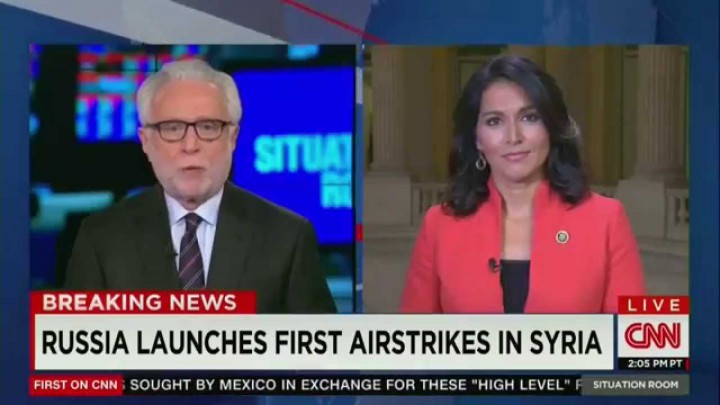
In a time when politicians are expected to lie and corporate news networks more often than not self-censor (if/when covering actual news), it’s indeed a headline story when a member of congress speaks the truth on a corporate cable news program. Not surprisingly for those who’ve followed her career, the refreshingly honest words came from Rep. Tulsi Gabbard.

Gabbard was one of the first female combat veterans and became the youngest woman elected to a U.S. state office (as Representative for for Hawaii’s 42nd House District ) at age 21 in 2002. In 2004, Gabbard deployed with her Hawaii Army National Guard unit for a 12-month tour in Iraq where she served in a field medical unit as a specialist with a 29th Support Battalion medical company. Upon her return from Iraq in 2006 Gabbard served as a legislative aide for U.S. Senator Daniel Akaka in Washington, DC. During this time she attended the Accelerated Officer Candidate School at the Alabama Military Academy and finished as the distinguished honor graduate in March 2007  (a first for a woman in the Academy’s 50-year history). From 2011 and 2012 Gabbard served in the Honolulu City Council and in 2012 became the first American Samoan and Hindu member of the US Congress. On October 12, 2015 Captain Gabbard was promoted to Major at a ceremony at the National Memorial Cemetery of the Pacific, the same day she was disinvited by the DNC from the Democratic presidential debate for publicly stating she wanted to see more debates. Gabbard has been politically outspoken as a pro-choice and same-sex marriage supporter and has advocated for alternative energy, Native Hawaiian rights and a return of the Glass-Steagall Act. She has also opposed the use of drones to kill U.S. citizens.

As cynical as most of us should be about politics and government in this day and age, it’s promising when individuals who seem to have the honesty, intelligence and work ethic to be a true leader rise through the ranks. It’s especially hopeful for those who’d like to see more women in positions of power (other than Hillary, Palin, Fiorina, etc), regardless of whether improved leadership does anything significant to fix the current system.

Statements from Gabbard in the CNN segment that may startle those who habitually get news from corporate media include:

“The U.S. and the CIA are working to overthrow the Syrian government of Assad…

…while Russia, a long-time ally of Assad for decades now, is working to defend or uphold the Syrian government of Assad, and this puts us in a position of a possible direct head-to-head conflict with Russia as long as the U.S. and CIA continue down this path.”

(H/T: Truthstream Media)

Saturday Matinee: Freeway

index

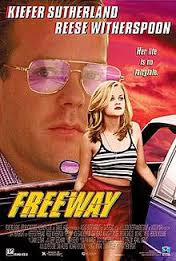
“Freeway” (1996) is a satisfyingly dark retelling of Little Red Riding Hood written/directed by Matthew Bright and featuring excellent performances by Reese Witherspoon as the protagonist, a seemingly stereotypical “white trash” teen, and Keifer Sutherland as the “wolf”, a secretly psychopathic high school guidance counselor. While the film works on the level of a traditional exploitation film, it provides much welcome commentary on racism, sexism, class-ism and societal hypocrisy.

(Video may not stream on some portable devices.)


Saturday Matinee: Kamikaze Girls

3046198-kamikaze-girls-still02

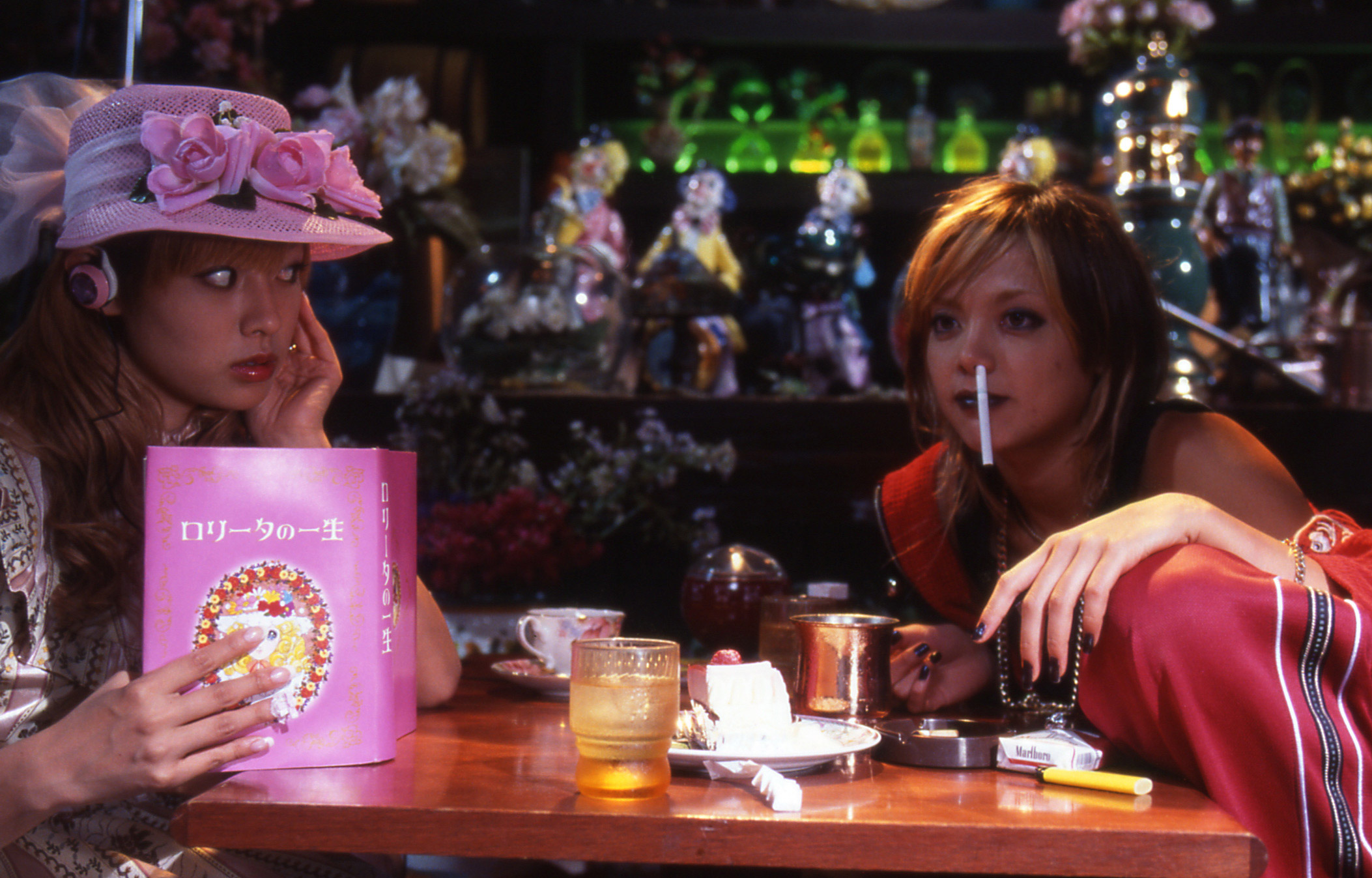
“Kamikaze Girls” (2004) is a film adaptation of the novel and manga “Shimotsuma Story” directed by Tetsuya Nakashima. It’s about the unlikely friendship between girls of vastly different subcultures; one a “Lolita” obsessed by Rococco-era French fashions and the other a member of a “Yanki” biker gang modeled after 1950’s American rock and rollers. Besides the underlying theme of friendship transcending cultural differences, it’s also a coming-of-age story with a positive message about the importance of pursuing one’s dreams, rejecting conformity, and thinking/acting independently. Similar to Nakashima’s other films such as “Memories of Matsuko” and “Paco and the Magical Book” (as well as Jeunet’s “Amélie”) the viewing experience of Kamikaze Girls is enhanced by surrealistic touches such as over-saturated colors and inventive camera/editing work.

Update: no longer on YouTube but still available with subtitles here.

Don’t forget Malala Yousafzai’s appeal to Obama: end the drone war

M_Id_429009_Malala_Yousafzai

By Zack Beauchamp

Source: Vox.com

On Friday morning, 17 year-old Pakistani activist Malala Yousafzai won the Nobel Peace Prize. Yousafzai’s prize is well-deserved: she’s been a prominent campaigner for girls’ education for years, and survived a Taliban assassination attempt for her efforts.

But women’s education isn’t Malala’s only cause. She’s also waged a prominent campaign on a topic Americans aren’t talking much about nowadays: the drone war in Pakistan.

In characteristically bold fashion, Yousafzai brought these concerns up in a meeting with President Obama back in October 2013 — one that had originally been held to celebrate her commitment to education.

“I thanked President Obama for the United States’ work in supporting education in Pakistan and Afghanistan and for Syrian refugees,” Yousafzai said in a statement after the meeting — before turning to drones. “I also expressed my concerns that drone attacks are fueling terrorism. Innocent victims are killed in these acts, and they lead to resentment among the Pakistani people. If we refocus efforts on education it will make a big impact.”

The White House statement on its meeting with Yousafzai left that bit out.

The US drone campaign in Pakistan peaked back in 2010, but that hardly justifies forgetting about it in 2014. We should remember it because we still have no idea if the targeted killings are actually reducing militant violence in Pakistan. We should remember it because it may not actually weaken al-Qaeda in the long run. And, most of all, we should remember it because it’s killed hundreds, if not thousands, of Pakistani civilians:

Screen_Shot_2014-10-10_at_11.02.13_AM.0

Drone war casualties, civilian and militant. (New America Foundation)

In other words: Yousafzai was pointing to exactly the right issues. We don’t know if drone strikes are weakening al-Qaeda, but we definitely know that they’re killing people — including innocents.

Nowadays, the American public is more focused on the US military campaign against ISIS than they are on the campaign in Pakistan. Part of that is that the ISIS war is newer and more intense. Another part is that, for the first half of 2014, the US wasn’t hitting any targets in Pakistan. In fact, Peter Bergen, an expert on the drone war at the New America Foundation, said that “the program [in Pakistan] appears to have ended.”

Yet on June 11, the US began bombing Pakistan again. According to New America data, there have been five strikes in October 2014 alone.

So as Yousafzai gets her deserved accolades for her peace work, it’s worth remembering her concerns about one of America’s quieter wars. That’s especially true as the US government is ramping up another air campaign against an jihadi group that’s expected to last for years.