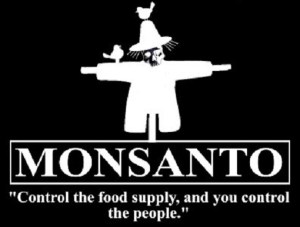
What They’re Not Telling You About Monsanto’s Role in Ukraine

MOnsanto-Blackwater

Will This be a Takeover of Ukraine’s Farmland?

By Christina Sarich

Source: Natural Society

The World Bank and International Monetary Fund (IMF) is helping biotech run the latest war in Ukraine. Make no mistake that what is happening in the Ukraine now is deeply tied to the interests of Monsanto, Dow, Bayer, and other big players in the poison food game.

Monsanto has an office in Ukraine. While this does not shout ‘culpability’ from every corner, it is no different than the US military’s habit to place bases in places that they want to gain political control. The opening of this office coincided with land grabs with loans from the IMF and World Bank to one of the world’s most hated corporations – all in support of their biotech takeover.

Previously, there was a ban on private sector land ownership in the country – but it was lifted ‘just in time’ for Monsanto to have its way with the Ukraine.

In fact, a bit of political maneuvering by the IMF gave the Ukraine a $17 billion loan – but only if they would open up to biotech farming and the selling of Monsanto’s poison crops and chemicals – destroying a farmland that is one of the most pristine in all of Europe. Farm equipment dealer, Deere, along with seed producers Dupont and Monsanto, will have a heyday.

In the guise of ‘aid,’ a claim has been made on Ukraine’s vast agricultural riches. It is the world’s third largest exporter of corn and fifth largest exporter of wheat. Ukraine has deep, rich, black soil that can grow almost anything, and its ability to produce high volumes of GM grain is what made biotech come rushing to take it over.

As reported by The Ecologist, according to the Oakland Institute:

“Whereas Ukraine does not allow the use of genetically modified organisms (GMOs) in agriculture, Article 404 of the EU agreement, which relates to agriculture, includes a clause that has generally gone unnoticed: it indicates, among other things, that both parties will cooperate to extend the use of biotechnologies.

There is no doubt that this provision meets the expectations of the agribusiness industry. As observed by Michael Cox, research director at the investment bank Piper Jaffray, ‘Ukraine and, to a wider extent, Eastern Europe, are among the most promising growth markets for farm-equipment giant Deere, as well as seed producers Monsanto and DuPont’.”

The nation WAS Europe’s breadbasket – and now in an act of bio-warfare, it will become the wasteland that many US farmlands have become due to copious amounts of herbicide spraying, the depletion of soil, and the overall disruption of a perfect ecosystem.

The aim of US government entities is to support the takeover of Ukraine for biotech interests (among other strategies involving the prop-up of a failing cabalistic banking system that Russia has also refused with its new alignment with BRICS and its own payment system called SWIFT). This is similar to biotech’s desired takeover of Hawaiian islands and land in Africa.

The Ukraine war has many angles that haven’t been exposed to the general public – and you can bet that biotech has their hands in the proverbial corn pie.


Maui is winning the war against Monsanto

hawaiians_against_gmo_720_375

By Michelle Kennedy Hogan

Source: Inhabitat

Maui is winning the war against Monsanto, according to an attorney for the Sustainable Hawaiian Agriculture for the Keiki and the Aina (SHAKA) Movement. On November 4, Maui voters approved a measure that would ban GMOs in Maui County. But earlier this year, Hawaii Judge Barry Kurren ruled that only states, not counties, can ban GMOs, saying that county laws are pre-empted by state law so they are “invalid.” Monsanto, Dow and others sued to stop the legislation, hoping that Kurren would rule the same after the Maui initiative passed, but Kurren decided to pass the case onto Chief Judge Susan Oki Mollway after public pressure mounted against him. Now the Maui ban on GMOs can move forward, marking a definitive win for the people of Maui.

According to the Natural Society, “until at least the fall of 2011, Judge Kurren’s wife, Faye, was a trustee of The Nature Conservancy (TNC), a 6-billion-dollar environmental group.” TNC specializes in working with mega-corporations, who donate major money, in return for receiving TNC’s “good housekeeping seal of approval” as friends of the environment. “In 2011, TNC leveraged a blockbuster deal with Dow Chemical. Dow pledged a $10 million donation. In exchange, Dow could forthwith use the TNC logo on its site and all its products. Among TNC’s council are businesspersons from Monsanto, Coca Cola, and of course, Dow. Among TNC’s corporate funders are again – Dow, Coke, DuPont, and Pepsi,” according to Natural Society.

In addition to striking down GMO bans, Kurren also recently struck down Ordinance 960 – a pesticide and GMO regulatory bill – in Kauai. Kurren was to be the presiding judge in the Maui County case, but knowing that Kurren has multiple ties to Big Agriculture, the people of Maui County pushed back. Many thought that the case could not be won, given Kurren’s past rulings and Big-Ag ties, and that Maui county would not be able to uphold the ban on GMOs on their island.

RELATED: How Monsanto is turning an island paradise into a GMO wasteland

Originally, the SHAKA Movement agreed to allow a magistrate judge to preside over the case – in this case, it was Kurren. Once the SHAKA Movement found out Kurren would be in charge of their case, they withdrew their approval. Kurren then relinquished the position to Chief Judge Susan Oki Mollway.

Having a different judge – a judge without known ties to the financial dealings of Monsanto and Dow Chemical – could have huge implications for the GMO ban and lead Maui to a win over Monsanto. The ruling further allows Maui County to file their own motions and respond to motions filed by the plaintiffs, according to SHAKA attorney Michael Carroll. If the law stands as voted, only the Maui County Council will be able to lift the ban on GMOs in their county.

Genetically Modified Organisms (GMO): Profit, Power and Geopolitics

monsanto

By Colin Todhunter

Source: GlobalResearch.ca

Genetically modified organisms (GMOs) are not essential for feeding the world [1,2], but if they were to lead to increased productivity, did not harm the environment and did not negatively impact biodiversity and human health, would we be wise to embrace them anyhow?

The fact is that GMO technology would still be owned and controlled by certain very powerful interests. In their hands, this technology is first and foremost an instrument of corporate power, a tool to ensure profit. Beyond that, it is intended to serve US global geopolitical interests. Indeed, agriculture has for a long time been central to US foreign policy.

“American foreign policy has almost always been based on agricultural exports, not on industrial exports as people might think. It’s by agriculture and control of the food supply that American diplomacy has been able to control most of the Third World. The World Bank’s geopolitical lending strategy has been to turn countries into food deficit areas by convincing them to grow cash crops – plantation export crops – not to feed themselves with their own food crops.” Professor Michael Hudson [3].

The Project for a New American Century and the Wolfowitz Doctrine show that US foreign policy is about power, control and ensuring global supremacy at any cost [4,5]. Part of the plan for attaining world domination rests on the US controlling agriculture and hijacking food sovereignty and nations’ food security.

In his book ‘Seeds of Destruction’, William Engdahl traces how the oil-rich Rockefeller family translated its massive wealth into political clout and set out to capture agriculture in the US and then globally via the ‘green revolution’ [6]. Along with its big-dam, water-intensive infrastructure requirements, this form of agriculture made farmers dependent on corporate-controlled petroproducts and entrapped them and nations into dollar dependency and debt. GMOs represent more of the same due to the patenting and the increasing monopolization of seeds by a handful of mainly US companies, such as Monsanto, DuPont and Bayer.

In India, Monsanto has sucked millions from agriculture in recent years via royalties, and farmers have been compelled to spend beyond their means to purchase seeds and chemical inputs [7]. A combination of debt, economic liberalization and a shift to (GMO) cash crops (cotton) has caused hundreds of thousands of farmers to experience economic distress, while corporations have extracted huge profits [8]. Over 270,000 farmers in India have committed suicide since the mid to late nineties [9].

In South America, there are similar stories of farmers and indigenous peoples being forced from their lands and experiencing violent repression as GMOs and industrial-scale farming take hold [10]. It is similar in Africa, where Monsanto and The Gates Foundation are seeking to further transform small-scale farming into a corporate controlled model. They call it ‘investing’ in agriculture as if this were an act of benevolence.

Agriculture is the bedrock of many societies, yet it is being recast for the benefit of rich agritech, retail and food processing concerns. Small farms are under immense pressure and food security is being undermined, not least because the small farm produces most of the world’s food [11]. Whether through land grabs and takeovers, the production of (non-food) cash crops for export, greater chemical inputs or seed patenting and the eradication of seed sharing among farmers, profits are guaranteed for agritech corporations and institutional land investors.

The recasting of agriculture in the image of big agribusiness continues across the globe despite researchers saying that this chemical-intensive, high-energy consuming model means Britain only has 100 harvests left because of soil degradation [12]. In Punjab, the ‘green revolution’ model of industrial scale, corporate dominated agriculture has led to a crisis in terms of severe water shortages, increasing human cancers and falling productivity [13]. There is a global agrarian crisis. The increasingly dominant corporate-driven model is unsustainable.

More ecological forms of agriculture are being called for that, through intelligent crop management and decreased use of chemical inputs, would be able to not only feed the world but also work sustainably with the natural environment. Numerous official reports and scientific studies have suggested that such policies would be more appropriate, especially for poorer countries [14-16].

When on occasion the chemical-industrial model indicates that it does deliver better yields than more traditional methods (a generalization and often overstated [17]), even this is a misrepresentation. Better yields but only with massive chemical inputs from corporations and huge damage to health and the environment as well as ever more resource-driven conflicts to grab the oil that fuels this model. Like the erroneous belief that economic ‘growth’ (GDP) is stimulated just because there becomes greater levels of cash flows in an economy (and corporate profits are boosted), the notion of improved agricultural ‘productivity’ also stems from a set of narrowly defined criteria.

The dominant notions that underpin economic ‘growth’, modern agriculture and ‘development’ are based on a series of assumption that betray a mindset steeped in arrogance and contempt: the planet should be cast in an urban-centic, ethnocentric model whereby the rural is to be looked down on, nature must be dominated, farmers are a problem to be removed from the land and traditional ways are backward and in need of remedy.

“People are perceived as ‘poor’ if they eat food they have grown rather than commercially distributed junk foods sold by global agri-business. They are seen as poor if they live in self-built housing made from ecologically well-adapted materials like bamboo and mud rather than in cinder block or cement houses. They are seen as poor if they wear garments manufactured from handmade natural fibres rather than synthetics.” Vandana Shiva [18]

Western corporations are to implement the remedy by determining policies at the World Trade Organization, IMF and World Bank (with help from compliant politicians and officials) in order to  depopulate rural areas and drive folk to live in cities to then strive for a totally unsustainable, undeliverable, environment-destroying, conflict-driving, consumerist version of the American Dream [19,20].

It is interesting (and disturbing) to note that ‘developing’ nations account for more than 80% of world population, but consume only about a third of the world’s energy. US citizens constitute 5% of the world’s population, but consume 24% of the world’s energy. On average, one American consumes as much energy as two Japanese, six Mexicans, 13 Chinese, 31 Indians, 128 Bangladeshis, 307 Tanzanians and 370 Ethiopians [21].

Despite the environmental and social devastation caused, the outcome is regarded as successful just because business interests that benefit from this point to a growth in GDP. Chopping down an entire forest that people had made a living sustainably from for centuries and selling the timber, selling more poisons to spray on soil or selling pharmaceuticals to address the health impacts of the petrochemical food production model would indeed increase GDP, wouldn’t it? It’s all good for business. And what is good for business is good for everyone else, or so the lie goes.

“Corporations as the dominant institution shaped by capitalist patriarchy thrive on eco-apartheid. They thrive on the Cartesian legacy of dualism which puts nature against humans. It defines nature as female and passively subjugated. Corporatocentrism is thus also androcentric – a patriarchal construction. The false universalism of man as conqueror and owner of the Earth has led to the technological hubris of geo-engineering, genetic engineering, and nuclear energy. It has led to the ethical outrage of owning life forms through patents, water through privatization, the air through carbon trading. It is leading to appropriation of the biodiversity that serves the poor.” [22]

The ‘green revolution’ and now GMOs are ultimately not concerned with feeding the world, securing well-rounded nutritious diets or ensuring health and environmental safety. (In fact, India now imports foods that it used to grow but no longer does [23]; in Africa too, local diets are becoming less diverse and less healthy [24].) Such notions are based on propaganda or stem from well-meaning sentiments that have been pressed into the service of corporate interests.

Biotechnological innovations have always had a role to play in improving agriculture, but the post-1945 model of agriculture has been driven by powerful corporations like Monsanto, which are firmly linked to Pentagon and Wall Street interests [25]. Motivated by self-interest but wrapped up in trendy PR about ‘feeding the world’ or imposing austerity to ensure prosperity, the publicly stated intentions of the US state-corporate cabal should never be taken at face value [26,27].

In India, Monsanto and Walmart had a major role in drawing up the Knowledge Initiative on Agriculture [28]. Monsanto now funds research in public institutions and its presence and influence compromises what should in fact be independent decision and policy making bodies [29,30]. Monsanto is a driving force behind what could eventually lead to the  restructuring and subjugation of India by the US [31]. The IMF and Monsanto are also working to ensure Ukraine’s subservience to US geopolitical aims via the capture of land and agriculture [32]. The capture of agriculture (and societies) by rich interests is a global phenomenon.

Only the completely naive would believe that rich institutional investors in land and big agribusiness and its backers in the US State Department have humanity’s interests at heart. At the very least, their collective aim is profit. Beyond that and to facilitate it, the need to secure US global hegemony is paramount.

The science surrounding GMOs is becoming increasingly politicized and bogged down in detailed arguments about whose methodologies, results, conclusions and science show what and why. The bigger picture however is often in danger of being overlooked. GMO is not just about ‘science’. As an issue, GMO and the chemical-industrial model it is linked to is ultimately a geopolitical one driven by power and profit.

Notes

1] This report indicates the root causes for global food shortages:  http://www.cban.ca/Resources/Topics/Feeding-the-World/Will-GM-Crops-Feed-the-World

2] Citing official reports and data sources, references in this article indicate agricultural productivity in India was better in 1760 and 1890 and that India does not require chemical-industrial agriculture let alone GMOs: http://www.globalresearch.ca/india-genetically-modified-seeds-agricultural-productivity-and-political-fraud/5328227

3] http://michael-hudson.com/2014/10/think-tank-memories/

4] http://www.informationclearinghouse.info/article1665.htm

5] http://www.informationclearinghouse.info/article40093.htm

6] Arun Shrivastava reviews and summarizes Engdahl’s book here: http://www.globalresearch.ca/seeds-of-destruction-the-hidden-agenda-of-genetic-manipulation-2/9379

7] http://www.countercurrents.org/shiva180614.htm

8]  Based on the findings of a report by researchers at Cambridge University in the UK: http://www.cam.ac.uk/research/news/new-evidence-of-suicide-epidemic-among-indias-marginalised-farmers

9] Official figure quoted by the BBC as of 2013: http://www.bbc.co.uk/news/magazine-21077458

10]http://www.theecologist.org/News/news_analysis/2267255/gm_crops_are_driving_genocide_and_ecocide_keep_them_out_of_the_eu.html

11] Official report released by GRAIN: http://www.grain.org/article/entries/4929-hungry-for-land-small-farmers-feed-the-world-with-less-than-a-quarter-of-all-farmland

12] Farmers Weekly quotes a report by researchers at the University of Sheffield in the UK: http://www.fwi.co.uk/news/only-100-harvests-left-in-uk-farm-soils-scientists-warn.htm

13] Newspaper report quoting official statistics and research findings: http://www.deccanherald.com/content/337124/punjab-india039s-grain-bowl-now.html

14] Official UN report: http://unctad.org/en/PublicationsLibrary/tdr2013_en.pdf

15]http://www.srfood.org/en/official-reports# and http://www.plantpartners.org/agroecology-reports.html

16] http://www.tandfonline.com/doi/full/10.1080/14735903.2013.806408#tabModule

17] http://phys.org/news/2014-12-crops-industrial-agriculture.html

18] http://www.organicconsumers.org/btc/shiva112305.cfm

19] Food policy analyst Devinder Sharma outlines the motives of Western corporations in India: http://www.bhoomimagazine.org/article/cash-food-will-strike-very-foundation-economy

20] Arundhati Roy discusses the erroneous notion of ‘progress’ being applied in India and the conflict and violence that has followed: http://www.guernicamag.com/features/we-call-this-progress/

21] http://public.wsu.edu/~mreed/380American%20Consumption.htm

22] http://www.spaziofilosofico.it/numero-07/2959/economy-revisited-will-green-be-the-colour-of-money-or-life/

23] Vandana Shiva describes how the ‘green revolution’ and ‘free trade’ have turned India into a net importer of foods it used to be self sufficient in: http://www.aljazeera.com/indepth/opinion/2013/09/201398122228705617.html

24] Article describing the plight of agriculture in Africa: http://www.globalresearch.ca/behind-the-mask-of-altruism-imperialism-monsanto-and-the-gates-foundation-in-africa/5408242

25] http://www.globalresearch.ca/monsantos-gmo-food-and-its-dark-connections-to-the-military-industrial-complex/5389708

26] Article providing factual historical insight into Monsanto and its wrongdoings: http://www.globalresearch.ca/the-complete-history-of-monsanto-the-worlds-most-evil-corporation/5387964

27] Analysis of Wall Street’s fraudulent practices in recent times and the complicity of the entire political and economic system: http://www.wsws.org/en/articles/2012/03/pers-m15.html

28]http://www.democracynow.org/2006/12/13/vandana_shiva_on_farmer_suicides_the

29]  http://dissidentvoice.org/2009/07/monsanto-a-contemporary-east-india-company-and-corporate-knowledge-in-india/

30] http://www.thehindu.com/opinion/lead/nip-this-in-the-bud/article5012989.ece

31] http://www.countercurrents.org/todhunter031114.htm

32] http://www.oaklandinstitute.org/food-security-hostage-wall-street-and-us-global-hegemony

The CIA-engineered oil glut to bring down Putin and Maduro

Russian President Vladimir Putin shakes hands with his Venezuelan counterpart Nicolas Maduro during a signing ceremony at the Kremlin in Moscow

By Wayne Madsen

Source: Intrepid Report

John Brennan’s long familiarity with Saudi Arabia, owing to the time he spent there as the CIA station chief in Riyadh in the 1990s and his knowledge of Saudi oil operations, has paid off. WMR has learned that Brennan’s agents inside Saudi Aramco convinced the firm’s management and the Saudi Oil Ministry to begin fracking operations to stimulate production in Saudi Arabia’s oldest oil fields.

By pumping salt water into older wells, some at a depth of 3 to 6 thousand feet, an inordinate amount of pressure was built up. The CIA’s oil industry implants knew what would occur when the fracking operations began. Due to the dangerously high water pressure, the Saudis were forced continuously pump oil until the pressure became equalized. That process is continuing. If the Saudis ceased pumping oil, they would permanently lose the wells to salt water contamination. In the current “pump it or lose it” situation, the Saudis are forced to pump at a rate that may take up to 5 years before they can slow down production rates.

The net result of the CIA-inspired fracking operations, which the Saudis were warned not to pursue by petroleum engineers working for some foreign-based firms like Schlumberger, is that there will be an oil supply glut for the next 5 years. The glut will be followed by a reduction in Saudi oil production unless new oil fields are brought on line. There is now a major push by U.S. and Canadian oil companies to bring the Keystone XL pipeline from Canada to the United States to offset the expected sharp rise in oil prices in five years.

The CIA operation to frack Middle Eastern oil fields was not only limited to Saudi Arabia. WMR has learned from oil industry sources that similar fracking caused overproduction problems in Kuwait and Iraq.

The result of the sudden decline in oil prices has resulted in heavy damage to the economies of the CIA-targeted countries of Russia, Iran, and Venezuela. Brennan and his economic warfare operatives banked on the Saudi overproduction to harm the economies of all three countries and the CIA has not been disappointed. The CIA figures that the governments of Vladimir Putin in Russia, Ayatollah Ali Khamenei in Iran, and Nicolas Maduro in Venezuela will have long since collapsed and been replaced by pro-Western regimes within 5 years.

Already, from his base in Switzerland, exiled Russian tax evader billionaire Mikhail Khodorkovsky has called for Putin’s overthrow and even his assassination. Meanwhile, the U.S. Congress and the Obama administration have taken cues from the CIA to impose devastating economic sanctions on both Russia and Venezuela. Similar congressional legislation to increase sanctions on Iran is pending.

Russia has been harmed the most by the CIA’s Saudi oil production scheme. The Russian ruble fell 56 percent in value against the U.S. dollar while Russian interest rates climbed to 17 percent. The price of shares of Russia’s largest lending bank, Sberbank, fell 18 percent. Although the Russian economic collapse has resulted in financial ripples around the world, with Austrian and French banks losing their stock values and the value of the Polish zloty and Hungarian forint falling against the dollar, the Obama administration says that there will be no easing on economic sanctions imposed on Russia over Ukraine. Obama has put the investments of American holders of Russian bonds in dire jeopardy.

The Pacific Investment Management Company’s (PEBIX) Emerging Markets Bond Fund, which holds over $800 million in Russian bonds, has lost almost 8 percent in value in the past few weeks.

Russian Central Bank Vice Chairman Sergei Shvetsov said, “What is happening is a nightmare that we could not even have imagined a year ago.”

Meanwhile, basic staples in Venezuela, including cooking oil, rice, and corn flour, are becoming hard to obtain. The U.S. dollar has jumped 1,700 percent in value against the Venezuelan bolivar on the black market. The CIA is using the financial collapse to push for an undemocratic overthrow of the Venezuelan government.

Iran, which has been under punitive Western economic sanctions for a number of years over its nuclear power program, is probably best able to weather the storm. Iran has built up a rather impressive domestic food production, telecommunications, and oil industry infrastructure to survive the sanctions. However, Iranian President Hassan Rouhani appears very aware of the Saudi role in the conspiracy to drive down oil prices.

Rouhani recently said, “The main reason for [the oil price plunge] is [a] political conspiracy by certain countries against the interest of the region and the Islamic world and it is only in the interest of some other countries . . . Iran and people of the region will not forget such conspiracies, or in other words, treachery against the interests of the Muslim world.”

Brennan’s and the CIA’s industrial sabotage of the Saudi and other Middle East oil industries will continue to have far-reaching effects on the world economy. Oil industry insiders fear that the CIA has unleashed something that may deal a devastating blow to the global economy.

Hacking the Planet: What Could Go Wrong?

geoengineer

By Dale Lately

Source: The Baffler

You remember this science fiction story, right? Faced with the threat of extinction on a warming planet, an advanced race flies gigantic mirrors into the stratosphere to create a giant “space umbrella” that will bounce the sun’s rays back into the cosmos. But it doesn’t work. Undeterred, the race devises a huge artificial volcano to spew ash into the atmosphere, in order to create a permanent fog in the sky that will dampen the damage from the rays. That doesn’t work either. Desperately, the stricken race pours millions of tons of iron filings into the sea, hoping that it will stimulate phytoplankton to suck the warming gases out of the atmosphere….

You remember that? No, me either. That’s because it wasn’t sci-fi–the above is actually a selection of serious proposals being made to “geo-engineer” our way out of global warming. These proposals are gaining increasing political ground and regularly discussed at symposiums such as the 2014 Berlin Climate Engineering Conference. The bizarre-sounding ideas being discussed include creating giant mechanical honeycombs or seaweed farms to fertilize the oceans (through a process of carbon dioxide reduction, or CDR), and more grandiose projects such as building cloud-spewing ocean drones and space mirrors (through solar radiation management, or SRM—like a dimmer switch for the sun).

The planet hackers are getting busy. Start-ups and patents already abound–as do their creators. Nathan Myhrvold, founder of “Intellectual Ventures,” proposes a “garden hose to the sky,” which aims to fight pollution with more pollution by spewing sulfur into the stratosphere. Russ George is the guerrilla geo-engineer who thoughtfully dumped 100 tons of iron sulfate into the sea in 2012 to try and save the oceans. Lowell Wood’s previous atmospheric tinkering credits include the Star Wars program. But the idea on the SRM side currently gaining most traction seems to be that of a “Giant Sunshade,” which would simulate the cooling effects of a volcanic eruption like Pinatubo back in in 1991 by giving the stratosphere a sulfur injection to bounce back warming rays. In other words, it’s like a giant volcano in the sky. What could possibly go wrong?

Er…how about everything? A project like this risks causing vast droughts and food shortages for billions of people (mostly suffered in the developing world of course), as climatologist Alan Robock found when he made a computer model of the sulfur injections of such a “volcano on tap” in 2008. Once begun, the sulfur-spewing would have to be continuous, since cutting off the supply would cause sudden and lethal re-warming. In other words, it would be akin to putting the planet on permanent life-support. Moreover, the sky might be left forever hazy, which would of course–oh, the irony–diminish solar power.

Besides the physical risks involved, there’s also the moral hazard to consider. Just as the implied promise of a financial bailout encouraged recklessness from the banks, the idea that centuries of environmental abuse can be reversed by a few clever tweaks, a sticking-plaster for Big Oil, suggests that the party can go on forever. This line of thinking would certainly explain all the fossil fuel dollars flowing into geo-engineering. One of the first formal gatherings for the movement was convened in 2008 by BP’s chief scientist Steve Koonin, while CDR start-up Carbon Engineering has backing from the Canadian tar sands business. And think tank American Enterprise Initiative, generously funded by the oil sector, launched a department in 2008 called the Geoengineering Project. Ever the entrepreneur, Nathan Myhrvold had the bright idea of using the yellow sulfur waste from tar sand extraction to shield the sun so we can go on polluting forever. Party on!

This is magical thinking par excellence: wreck the planet for everybody, and then turn up the global air-con. The planet hacking men (and they are mostly men) represent techno-evangelism raised to unprecedented new levels–a macho belief in humanity’s right and ability to tame nature, rather than our responsibility to learn to live within our natural limits. Talk is already moving from “if” to “how,” from discussing testing to discussing governance, and GE may supersede GM as the next bogey of the environmental Left. Frankencrops will seem like small fry compared to a Frankenplanet, one where glacial melt may be lessened by SRM, but where acidification, deforestation, and species obliteration will march merrily on.

But then, do the wealthy elites supporting these schemes really care, when, as Naomi Klein points out in This Changes Everything, they’re already talking of abandoning Earth altogether? That is, of course, the logical conclusion of geo-tinkering–planet hacking awaits its cosmic Ark, an escape pod for the lucky few, just in the same way that the body hackers hope for immortality. In this comforting salvation narrative, the oil tycoons and airline moguls can watch the planet they polluted disappear from a porthole window as they sail away forever–leaving those on the ground to fend for themselves beneath, as Klein puts it, “a milky, geo-engineered ceiling gazing down on a dying, acidified sea.”

Alternatively, we could try something less gee-whizz: rather than turning down the sun for everybody on earth, we could force the fossil fuel industry to comply with emissions targets. But perhaps regulating big oil–unlike space mirrors or volcanoes in the sky–just sounds too much like science fiction.


Dale Lately writes about culture and communications and has contributed to the Guardian, 3:AM Magazine, OpenDemocracy, Litro and Pop Matters. His regular musings can be found at @dalelately and www.dalelately.blogspot.com.


Roundup of Disturbing Roundup Statistics

74481_1667968857660_1190475812_1810124_6476601_n

Source: Washington’s Blog

Roundup is found in 75% of air and water samples.  Indeed, some farmers drench crops with Roundup right before harvest.

Roundup is linked to a number of diseases.

A study from the Journal of Organic Systems includes the following 12 charts which show the correlation between Roundup (technically known as “glyphosate”) and disease:

Thyroid cancer and GMOs
Renal disease deaths and GMOs

Urinary and bladder cancer and GMO
Hypertension and GMOs

Monsanto Sues Maui for Direct Democracy, Launches New PR Campaign

maui monsanto protest

By Rebekah Wilce

Source: PR Watch

Residents of Maui County, Hawai’i voted on November 4 to ban the growing of genetically modified (GMO) crops on the islands of Maui, Lanai, and Molokai until scientific studies are conducted on their safety and benefits. Monsanto and Dow Chemical’s unit Mycogen Seeds have sued the county in federal court to stop the law passed by the people.

In Vermont, the Grocery Manufacturers Association (GMA, of which Monsanto and Dow were recently listed as members) has sued the state over its law requiring GMO labels. And Monsanto has a history of suing to prevent consumer labeling regarding its products. The company sued a number of dairies in the 1990s and 2000s for labeling milk free from recombinant bovine growth hormone (rBGH), which Monsanto developed and marketed as Posilac® (sold to Eli Lilly in 2008), the only commercially approved form. Vermont itself is no stranger to such suits. The International Dairy Foods Association sued Vermont for passing a law requiring labeling of milk containing rBGH (Monsanto wrote an amicus brief in support of the plaintiff, and GMA was a plaintiff-appellant) — and it won in federal court.

On the same day that Monsanto said it would challenge the decision of Maui’s citizens to regulate their own land and environment in court, the company also launched a new national advertising campaign as part of an effort to improve the image of the widely reviled company.

The glossy ads portray families of many cultures sitting down to eat gorgeous foods, invoking images more often seen in the pages of Saveur than in the hallways of one of the world’s largest chemical companies.

In addition to print ads in several national magazines and TV ads airing on national cable networks and several local stations in coastal cities, the campaign includes a slick new website launched in September, Discover.Monsanto.com.

The website invites questions from the public. The vast majority are skeptical, if not hostile. Others sound like they were written by Monsanto staff. Predictably, some of the hardest questions, like the one posed by Tim H., “In 2013, how much money has Monsanto spent on lobbyists in DC? What laws were these lobbyists attempting to create/amend and why?” are given short shrift.

Monsanto’s pretty TV ads target moms and millenials, according to the company’s corporate brand lead, Jessica Simmons. Monsanto has even hired a new “director of millenial engagement,” Vance Crowe, 32. He represented the company at a recent South by Southwest Eco conference in Austin, where revelations that Monsanto had paid for a panel of farmers to attend and present generated some excitement, as Tom Philpott reports in Mother Jones.

Crowe told NPR‘s “The Salt” blog, “[T]he challenge with something like SXSW Eco is that it doesn’t do anybody any good if people are so passionate that they’re yelling. The challenge is how can we enter the conversation so that people don’t feel like they have to yell to be heard?” Apparently, Crowe hopes to “enter the conversation” one party at a time. He enthusiastically describes how he and a gay colleague attended sessions on “sustainable fashion” and got invited to parties where they won fans and accolades.

Coincidentally, the front page of Discover.Monsanto.com contains, under “Here’s where we work,” a picture of corn crops being tended in Maui, with the text, “Hawaii’s unique climate allows for three to four growing seasons a year, reducing the time it takes us to develop new products. Our island roots go back more than 45 years.”

The marketing text may indicate the issue at the heart of Monsanto’s lawsuit against Maui. Those multiple growing seasons mean that “about 90 percent of all corn grown in the U.S. is genetically engineered and has been developed partially at Hawaii farms,” according to the Associated Press. Monsanto and the rest of the seed crop industry reap $146.3 million a year in sales from their activities in the state, according to a 2009 USDA report. Now Monsanto would have to substantially downsize its activity in Maui County in order to follow the new law, according to its lawsuit.

Monsanto’s new PR campaign seeks to make its brand approachable to the American consumer. Yet, with 92 percent of Americans demanding that GMO foods be labelled, according to a new Consumer Reports poll, Monsanto and its new millenial hires have their work cut out for them.

Consumer Reports recently put out a study on where GMOs are hiding in your food, including in packages labeled “natural.” You can access the report here.

Rebekah Wilce is a reporter and researcher who directs CMD’s Food Rights Network project.

Beyond Palliative Care

130517cntower

By arranjames

Source: Synthetic Zero

Not all that long ago the curators of this blog started talking about the possibility of the palliative care of the Earth. Recently dmf posted up a podcast dealing with the same topic. I haven’t listened to it yet so won’t be drawing on it in this post. I wanted to take a few minutes to experiment with the senses of the phrase “palliative care of the Earth”.

First of all, what is palliative care? Like all attempts at sense it is a contested battleground rife with bullet holes and no-man’s lands with various armies massed and pressing on it. One such army is the global institutional Roman legion that is the World Health Organisation. The WHO loves definitions. One could almost assume it employed nothing but glossophiliacs who spent their days and night writing endless variations on definitions who, in their frenzied madness, ended up trying to murder the words they were seeking to play midwife to. The WHO definition is long. And vague. You can read it here. Operationalising a little we can extract the fundamentals: palliative care seeks to make life as liveable as possible for the dying body and for the bodies who will mourn it.

The Earth as a system of ecosystems, an ecological metasystem, is considered as a body composed of bodies that play habitat and inhabitant, catalyst and anticatalyst, metabolism and metabolite, and so on, to one another [1]. Not all of these bodies are living but as with any machinic assemblage this Earth emerges as a necessarily heterogenetic improvisation (the imposition of unpredictability) that depends on both organic and machinic kinds [2]. A cyborg of a different order than Robocop the Earth is more akin to the Half-Faced Man, a machine that wants to be human. This isn’t to say the Earth wants to be human, or that it wants anything in any way we’d recognise as desire, although interspecies sexuality clearly indicates a queer promiscuity among nonhuman organisms, but that the Earth has assembled in such a way that the organic has come out of the inorganic. From a certain perspective: so what? It’s all just interlocking mechanism. Well, fine. But its dying is what.

But the Earth won’t die. Not yet. Far more likely- and if we stop being so anthropophobic- we’re talking about ourselves. It is us that is dying. It is the palliative care of the human that we should really consider. We open with a discussion of the dying Earth because it is this dying that is killing us: a vicarious species-suicide? These are dark thoughts that imply a loathing so great in our species that we’d take out everything else just to slit our own throats once and for all. But we’re not that grand, we’re all too limited, all too human still. Like smokers in the 1950s we didn’t know what we were doing, then we did and did nothing about it, then everyone said it was too late. We’re not quite sure of the periodicity. We don’t know if it is too late. What we do know is that we’ve had a mass terminal diagnosis and there is no consensus on the prognosis. What are we dying of then, if not some anthropathology [3]?

Does the species have a body? Or is the species also a hallucination? Hallucinations can die too- ask a “schizophrenic” on Clozapine. The WHO is an ensemble of equipment and technique in the same way Guattari once spoke of the unconscious. It is almost as if the WHO invented health (“a total state”) and must administer it. What is it that the WHO wants to say about palliative care? It has things to say about the reduction of suffering; the affirmation of life and death; it seeks neither the hastening nor the postponing of death; it looks to psychology and spirituality; produces support systems; is multidisciplinary; is life enhancing; it’s never too early to start.

How does this map onto humanity? We’re just scale in a sense, where “humanity” stands in for “person”. So it is the reduction of the suffering of species and the enhancement of its existence. This follows nicely from Lacanian ideas that we live both by the reality-principle and jouissance, by both aversion and hedonics. We’re also not talking about killing ourselves off, so no reproductions of Zapffe’s conclusion to ‘The Last Messiah’- we aren’t about to go forth to be fruitless and let the Earth be silent after us (as if it would be). I think it’s safe to say fuck Messiahs, especially last ones.

We’re also looking to the psychology and spirituality of humanity? Doesn’t this translate quite well to looking at the cognitive biases and metacognitive illusions and the affects and emotions in their normativity and pragmatics? Support systems like what? New technologies and alternative energy sources? Sure. But it can’t be limited to that- what if extinction is much closer than this than we think? Well think about it for a second. The process has already begun. And I’m not just talking about Tim Morton’s plutonium, or irreversible glacial melting, or any other particular doomsday protocol. If we’ve been paying attention to the three ecologies then we should have spotted multiple extinctions have been in process for a long time now. Systems of systems have been disintegrating within whatever it is- or was- that we called the human for decades. By 2050 or so even the strange hominid form will have been eradicated, recorded in images that no creature surviving us will care much about.

So palliative care is about easing our way into dying off. It is about quietly doing our best to assemble societies in which we can humanely coexist with wild being until our time’s really up. That was certainly my feeling two years ago when I wrote a post on extinction. Back in 2012 I declared that

Any post-nihilistic pragmatics will require that we operate consciously within catastrophic time and that we surrender the impossible task of removing precariousness from the human condition. These are the same project in fact, given that the former reveals to us the anthropocentrism of the latter…the benign revelation that precariousness is the condition of all things. IF this garners the accusation of privelging the perspective of extinction and heat death then this is a necessary part of the pragmatic ethics of a self-management of extinction. As I have said before, the task now is to think the ethics of palliative care for the species. The dream of species-being is realised at last.

Today I wonder at the sadness of that post. At the time I’d thought of it as realistic, hard-headed, unsentimental. All that. But ultimately, I think it was a depressive position. If 2050 is the time limit then maybe it is too late, and maybe we should be looking at harm-reduction and palliation. But for me this could lead us to a politics of the worst in which we try to stave off the ‘least of all possible evils’, a mode of thought that Eyal Weizman has convincingly shown to be at work in some of the worst atrocities in modern history. In trying to create the conditions of the least possible harm the scale of the species we might actually end up with a resigned sigh in the face of forces we might be able to do something about. As such, the only way to “self-manage our extinction” has to be truly palliative in that it doesn’t just avoid suffering but also seeks jouissance. In fact, I’d concretise the program into what David Roden has been talking about in terms of a speculative posthumanism in which posthuman beings that emerge out of the human bear as much intuitive relation to us as we do to our ancestral forebears. The jouissance of this is less Lacanian and more about a sweeping mutative recombinatory innovation in the normativity of posthumanity.

In fact the pessimist and transhumanist programs belong together when we view harm reduction without the depressive targeting system, when in fact we dare to accelerate palliative philosophy into a praxis of assisted dying. What is born from the uneven unity of these programs is what I’m (stupidly; deliriously; in a state of panic) calling transpessimism: the speculative conviction that humanity must become extinct by becoming something else.

[1] From wikipedia:

System of systems is a collection of task-oriented or dedicated systems that pool their resources and capabilities together to create a new, more complex system which offers more functionality and performance than simply the sum of the constituent systems. Currently, systems of systems is a critical research discipline for which frames of reference, thought processes, quantitative analysis, tools, and design methods are incomplete.[1] The methodology for defining, abstracting, modeling, and analyzing system of systems problems is typically referred to as system of systems engineering.

[2] I’ve stolen the term “heterogenetic improvisation” from David Malvinni’s study of Roma music: “heterogenic improvisation…the divided interval where improvisation orginates out of otherness while identifying with itself…grows out of a desire for a purely involved performance, a symbiosis of listener and sound, via an identification of the same with its unpredictable mutation” (p. 47-48).

[3] The term “anthropathology”, a neologism of the “anthro” pertaining to the human and “pathology” pertaining to disease, was coined in 2007 by a practicing counselor and counselling theorist, Colin Feltham, turned pessimist philosopher. Feltham defines the condition of anthropathology at length in his book treatment of the “condition”- as valid as most psychopathological categories- but also presents a condensed definition as follows:

‘the marked, universal tendency of human beings individually and collectively towards suffering deceptiveness, irrationality, destructiveness and dysfunction,including an extreme difficulty in perceiving and freeing ourselves from this state’ (What’s Wrong With Us? The anthropathology thesis. 2007. p.256).