
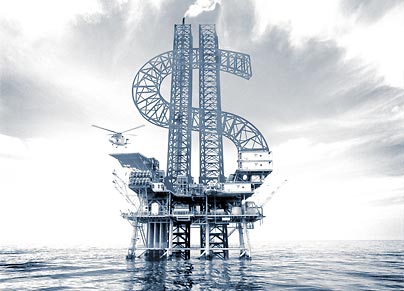
Oil and Money – Lessons Learned

petrodollar-systemThis is a concluding post for an excellent 7 part long-form series featured on the Hipcrime Vocab blog. While this serves as an adequate synopsis of what was covered, I highly recommend the series for it’s depth and scope starting with the introduction.

Source: Hipcrime Vocab

The first thing I learned is that I bit off more than I could chew, lol. I was intending a simple book review, and it turned into a lot more than I intended to write. I also learned how difficult and thankless a task blogging can be. I’m glad at least a few of you chimed in to let me know you enjoyed it.

One major thing I learned (which I already sort-of knew) is how much real resources have to do with the economy, and economic history, despite economists’ insistence that land, labor and capital are all that matter. In fact, real resources appear to be the MAJOR driver of our economic fortunes. Even Forbes magazine had to admit: The Recessions of 1973,1980,1991,2001,2008 Were Caused By High Oil Prices. Energy doesn’t matter, huh?

I was really taken aback at how recent this all is. I was somewhat aware the historic problem with oil was that there was too much of the stuff.  Eric Roston, in The Carbon Age, writes, “Gasoline was a throwaway by product of kerosene refining until the early 1900s, used sometimes in solvents or as fuel for stoves. In 1892, two cents a gallon was a decent price. For another thirty years, apothecaries were the makeshift filling stations.”

But I had no idea just how much of a glut there was and how people thought it would last forever. That it was so cheap we needed the Texas Railroad Commission to hold back production so that the prices would be high enough. I mean, this substance contains the equivalent of ten to eleven years of human labor (1750 Kilowatt hours of human labor), for crying out loud! And it is a non-renewable resource! I was amazed at how far we went in coming up with new uses for the stuff, to the point destroying perfectly good and workable infrastructure just so we could use more of it. Can anything be more insane?

The long boom was driven by the exploitation of oil as a resource. This led to the dominance of the ICE (Internal Combustion Engine). All of the knock-on effects of the ICE were behind the post-war boom. I mean, you could write a book about all the economic development caused by cars and trucks. In fact, truck driver/delivery is still the most common job in most states to this day! The ability to deliver goods cheaply anywhere had so many knock-on effects, from the creation of whole new cities to the rise of big-box retailers. Let’s not forget that everything in that big-box retailer is made from plastic which is made from petroleum feedstocks. Kunstler calls the suburbs the greatest misallocation of resources in human history. It’s easy to see how that’s true.

I didn’t know that it was only as late as 1959 that petroleum overtook coal to be more than 50 percent of our energy use. I didn’t know that coal only became the world’s predominant energy source after 1900. Before that, we were still essentially in a wood/biofuel economy. As I wrote before, that’s pretty recent – less than three generations.

 We think of the 19th century as the era of coal, but as the distinguished Canadian energy economist Vaclav Smil has pointed out, coal only reached 5% of world energy supply in 1840, and it didn’t get to 50% until about 1900.

The modern oil industry began in 1859, but it took more than a century for oil to eclipse coal as the world’s No. 1 source. “The most important historical lesson,” Dr. Smil says, is that “energy resources require extended periods of development.”

The Power Revolutions (WSJ)

Peak oil ideas made it sound like oil (specifically petroleum) was the only resource that matters to the economy, so that once oil production stops growing, the economy will collapse. That’s clearly not the case (oil is 36 percent of the world’s energy). There are lots of other fuels in the mix. However, things like fracking, tar sands, and offshore drilling clearly mean that cheap, easy-to-get oil is on the wane. Oil is cheap now because of fracking – not the tight oil itself, but rather because the fear of it is keeping prices low by the Saudis. That will change. I’m always amazed at the people who run out and buy SUVs the minute the oil price goes down. Do they expect it to be cheap forever or do they expect to drive their car for only a year? It’s also cheap because our economy is in the crapper.

Forget who the candidates are and all the campaigning and the billions of dollars spent– If oil prices are high, the economy is in recession, and the incumbent party will lose power. You can pretty much predict any presidential election by this fact alone. Two-thousand is the only one that sort-of breaks the mold, and that was such a bizarre election between the hanging chads, the voting fraud and the Supreme Court. In other words, it’s not just the economy driven by energy prices – it’s the political world too. Everything else is just meaningless fluff.

At the end of the day, whether a president presides over a good economy or a bad economy is almost entirely down to oil prices.

The other thing that strikes you is the “Groundhog Day” nature of the situation. Oil prices get high, we get worried about the environment, and there’s a great boom in alternative energy, energy efficiency, environmental impacts, worries about the economy and supply chains, and so forth. Then oil prices go down and we forget all about alternative energy and all the inherent problems with relying on a finite resource. All the progress toward getting off of oil stagnates, and people assume oil will be cheap forever. Then they get high again, and suddenly it all becomes important again, and we have to go back to square one (compare the EV-1 to Tesla, for example. Heck, Edison built an electric car!). Charles Mann had a great line along the lines of “The human propensity to see flukes of good fortune as never coming to an end,” or something like that.

Given the manipulation of oil prices, it’s hard to see natural economic factors as ever being able to do the right thing when it comes to energy. When prices get high, new supply comes online and alternatives are pursued. But then oil prices crush the economy, demand falls more in line with supply, the price falls, and the initiatives are halted. It feels like the invisible hand is attached to an idiot. Maybe this time we’ll finally get serious.

Prices are temporary conditions. Peak oil is permanent.

The drug dealer analogy of us being addicted to oil is shopworn, but it is just so accurate. It was only once we were addicted to the product that they could jack up the price, and then we HAD to pay what they demanded. But like a drug that devastates the lives of its users, when you hit rock-bottom you try to get on the twelve-step program and get your life back. Then, the dealers will lower the price to keep you addicted, and the cycle begins again. Plus, every dealer wants to be your dealer, so they need to be just a little bit cheaper than the next guy. Barring that, they will bind together with the other dealers to keep the price high and protect their “turf.” The economics of drug dealing and oil are eerily similar. I wonder if anyone’s formally studied this.

In the past each new energy source was added on to the previous ones. Now we are talking about substitution – a totally different ballgame. That is, new energy sources will replace old. That’s substitution, not expansion.

Cheap oil combined with the opening up of China drove globalization. There is no way we could build the largest moving structures ever built to transport goods if we didn’t have a fuel source cheap enough to make it worthwhile. A single ship can move 19,000 containers, enough to move 300 million tablet computers.

That oil played a role in foreign policy shouldn’t be a surprise, but looking at exactly how it led to the invasions of Afghanistan and Iraq, the civil war in Syria, the removal of Qaddafi, the propping up or removing of dictators, and the positioning of armies around the globe was still eye-opening. So much foreign policy is dictated by access to oil. So much…

I was actually unaware of the Eurodollar and how I caused the fall of Bretton Woods. As Smith illustrates, going back to the gold standard is practically impossible (sorry libertarians). I was unaware of the role that Petrodollar recycling played in the Latin American debt crisis. I was aware of how the Petrodollars funded terrorism. I’m sure readers of Dmitry Orlov were familiar with the role oil and grain prices played in the fall of the Soviet Union. Again, this made Reagan look like a genius.

What I really wanted to describe is how the oil price crisis came about and how it led directly to the rise of Neoliberalism. I also wanted to show how Jimmy Carter’s “failure” and Ronald Reagan’s “success” was based mostly on oil prices. Some people would take issue with that, but it’s hard to separate one from the other. Is it 100 percent? Maybe not, but what percentage was oil prices? Seventy? Fifty? Twenty-five? Surely it played a role.

The problem is that it made Neoliberalism look like a success. People came to believe that unions were evil, and tax cuts for the rich and corporations, deregulation, and speculation were the magic keys to prosperity. But throughout the Neoliberal reign, oil prices were either stable or crashing. When that wasn’t the case, as in 2007-2008, the system came apart. The rise of China also made Neoliberalism appear to work. But it was smoke and mirrors – cheap uneducated labor, overinvestment, state-controlled enterprises, artificially cheap currencies, entire cities built with no people in them, etc. It was a Potemkin’s village on the scale of a nation. Globalization is a Ponzi scheme.

But now Neoliberalism is literally tearing the world apart. Some major reasons:

1.) Turning the speculators loose. The oil price rise and the food price rise seem to be mainly problems of market speculations (i.e. greed and fear, always the real movers of markets, not supply and demand). This has, in turn, led to political turmoil as we saw in the Arab Spring. If speculation continues to cause price rises for essentials like food, fuel and water to pad the fortunes of speculators, expect more chaos and collapse. Even in the U.S., the actions of Enron and “Kenny-boy” lay caused serious harm to economies, not expansion. And we spent enough on the bailouts to give every unemployed person a job and every homeless person a home, with billions left over. Is this how economies should be run?

2.) The suppression of worker wages has caused massive hardship around the world. The abandonment of full employment as a policy goal has led to a worldwide unemployment crisis that is destabilizing the world. Unemployed people have nothing to lose. People with nothing to lose tend to revolt (see above). The gutting of social services and welfare safety nets has also led to poverty and desperation all around the world. It calls into question the ability of capitalism to deliver broad increases in living standards everywhere. We are clearly not seeing that. We’ve been in reverse for some time. Shouldn’t an economic system make us ALL richer, rather than provide winners and losers? If it can’t, what kind of system is it?

3.) Globalism spreads not only the wealth around, but the poverty too. Some countries, notably Western Europe, have attempted to defend their citizens, while others like the United States, did nothing to insulate its workers from third-world wages and working conditions (and even encouraged them). Rising living standards in China and India are one thing, but falling living standards in formerly wealthy countries make the rich capitalists richer, but cause anger and consternation which is easily exploited by the unscrupulous and power-hungry. This is also destabilizing. Just look at all the anger in the U.S. today searching for a scapegoat.

4.) Austerity and the straitjacketing of governments has led to wealthy, industrialized countries “undeveloping.” The United States is a nation of private affluence and public squalor, with one-third of its children living in poverty, entire cities abandoned and crumbling, urban areas too expensive for median income workers, the infrastructure of a banana republic, poor access to education and healthcare, pockets of poverty, ghettoes, etc. Greece is being gutted as an example to the West. This is leading to rise of right-wing parties in Europe, again redolent of the run-up to the Second World War.

5.) The faith in Markets to solve all problems is especially disastrous with an ongoing environmental crisis. Instead of rationing or capping, instead we get easily gamed “cap and trade” markets to reduce emissions. Nature is just “natural capital,” and every drop of water, tree leaf, and grain of sand must be assigned an owner and a price. In other words, all of nature must be subsumed into the market, because markets are the only way we can solve our problems! This is a Neoliberal idea. Look at how the United States responded to the crisis in the seventies by contrast.

6.) Debt crises have caused massive hardship around the world. As I learned, Mexico’s reputation as a haven for poverty, prostitution, drug gangs, etc. was only after the Latin American debt crisis of 1982. That, in turn, led the massive influx of Latin American refugees into the United States turning America into a Latin country overnight.  Prior to 1979, places like Afghanistan, Iran, Lebanon, Egypt, Iraq, Algeria, Syria and Libya were stable, secular, relatively prosperous places (See this. And this). Now look at them. Yes, they had dictators and human rights violations. But compare it to today. Latin America has fared somewhat better, largely by finding a way to reject or bypass Neoliberalism. Africa has not fared well, either. Note that you only heard about collapse and famine after the 1980’s (remember Ethiopia?). Yes, Africa was poor before then, but it seemed to be heading in the right direction. Not any more.

7.) People from these wrecked countries are heading to the Western industrialized countries in massive waves of migration–Latin America for the United States and Canada, and the Middle East and Africa for the European Union. This has driven down wages and caused the rise of nativist parties. Everyone is heading for the lifeboats as more and more countries become failed states. There is simply not enough room for all. But rebuilding these countries would mean abandoning the Neoliberal paradigm, forgoing debt and putting into place quasi-socialist policies. Then again, the rich can always retreat to floating offshore islands (and eventually space colonies).

It’s clear that much of the money that has not been collected by governments has gone not only into speculation as opposed to productive activity, but in purchasing political representation. This has led to democracies devolving into oligarchies and a mistrust of democracy in general. The buying of politicians and the media blocks any attempts to deal with collapsing systems. We’ve seen ever greater instability and ever greater bubbles under Neoliberalism now that government has been “contained” and workers have been “disciplined.”

The answer to our problems should be clear: abandon Neoliberalism and return to the mixed economy. Stop hamstringing governments. End speculation. Tax the rich. Close offshore tax shelters. Raise tariffs. Defend domestic industries. Write down the debts. Pursue full employment policies such as a job guarantee, reduced working hours and an basic income guarantee. Distribute essential social services through the government, and let the market handle non-necessities. Regulate to deal with externalities. Impose limits on natural resource extraction. Decarbonize energy.

All of this used to be common-sense. Now it beyond the pale.

The problem is, it’s a ratchet effect. We cannot go back, because TPTB will not allow it. And since the 1970s, they learned they had to not only control the government, but the information we imbibe day after day, otherwise we would instruct our government to do something the powerful may not want. Instead, we had to be convinced that Neoliberalism is the only valid economy – hence the think tanks, talk radio, publishing mills, Fox news, etc. Any sense of common purpose or solidarity is evil “socialism.” As we learned, even “liberal” news sources are fully dedicated to defending this paradigm at all costs, even at the cost of credibility. And the funding of the political classes by the wealthy will ensure that anything that threatens the fortunes of the oligarchs will be a non-starter, even if people do see past the media rhetoric.

The change in economics swallowed the hope of the sixties. How much does it have to do with Neoliberalism, and how much with oil prices? A lot of commenters say, “Hey, the oil is gone, we just need to learn to be peasants.” They point out that American wages stopped growing in 1973, around the time domestic oil production peaked in the U.S. But I think that’s simplistic. American wages stopped growing, not everyone else’s–not what we’d expect in an energy descent scenario. Rather, I think it was the wealth transfer of the seventies, and the politics it engendered, that was the primary culprit. The oil shock opened the door for globalized Neoliberalism, and that is the primary cause of our misfortune. By using oil as an excuse to be politically passive, we remove any chance at creating an economy that works better for all and play into the hands of the powerful.

I think old economy Steve puts it best. Or shall we say, “mixed economy” Steve:

OY4w945

Why Russia is Serious About Fighting Terrorism and the US Isn’t

obama_on_isis_10-1-2015_8-50-53_am

By Maram Susli

Source: New Eastern Outlook

Russia in the few days it has been of fighting terrorism in Syria has achieved far more than the US coalition. According to the New York Times, Russia’s fighter jets are conducting nearly as many strikes in a typical day as the American-led coalition has been carrying out each month this year, a number which includes strikes conducted in Iraq – not just Syria.

Whilst the US has been bombing ISIS for over a year, ISIS has only grown and gained more ground in Syria. A few months ago ISIS took over the ancient city of Palmyra in Syria, a UNESCO world heritage-listed site.

In spite of the fact that the US government acknowledged ISIS cannot be defeated without ground troops, they have refused to work with the Syrian military, the only force on the ground commanded by the only UN-recognized government in the country, and the only force capable and willing to fight ISIS.

On the other hand Russia is coordinating with the Syrian military on the ground, assisting Syrian troops in gaining ground against terrorism. The discrepancy shows a lack of honesty on the part of the US when it comes to its real agenda in Syria vs its proclaimed goal of fighting terrorism. The US is capable of more, the US military is the most powerful and technologically advanced force in the world. It is logical to conclude that they are willfully throwing the fight against terrorism in Syria and the reasons for that should be examined.

ISIS Serves US Geopolitical Interests, Threatens Russia’s

It has become clear that the US’s main objectives in Syria is not their expressed goal of ‘fighting ISIS’, but regime change, isolating Russian influence, the Balkanization and the creation of failed states. US presidential candidate and former Secretary of State Hillary Clinton herself stated that ‘removing Assad is the top priority”.

The US sees the Syrian state as one of the last spheres of Russian influence beyond the borders of the former Soviet Union, and a threat to its Israeli ally in the region. The presence of ISIS and other terrorists groups serves these interests. The US has a history of using terrorism to topple governments friendly to Russia. Al Qaeda itself was borne of the US objective to topple the Soviet friendly government of Afghanistan. The dismemberment of Russian-friendly Serbia and the creation of Kosovo was done via the same means.

More recently ISIS was a direct result of the US’s intervention in Iraq, and have only arrived in Libya and Syria in the wake of overt US-backed regime change efforts there. Although Libya and Iraq did not have relations with Russia as strong as Syria’s, Russia was still their main weapons supplier. It is therefore not surprising that since Russia entered the war in Syria, Saudi clerics and the Muslim Brotherhood – both US state assets – declared ‘jihad’ on Russia.

The former Defence Intelligence Agency (DIA) Chief Michael Flynn said in an interview that he believed the US had made a willful decision to allow ISIS to grow in Syria. A 2012 declassified DIA report, wrote if the US and its allies continued to destabilize Syria by arming extremist insurgents “there is the possibility of establishing a declared or undeclared Salafist principality in eastern Syria… and this is exactly what the supporting powers to the opposition want, in order to isolate the Syrian regime.”

The CIA had trained thousand of ‘rebels’, not to fight ISIS, but admittedly to fight the Assad government and Syrian military – showing once again that the real objective behind the US’ involvement is regime change. Media across the West has even admited this, including the Washington Post which would report:

…the CIA has since 2013 trained some 10,000 rebels to fight Assad’s forces. Those groups have made significant progress against strongholds of the Alawites, Assad’s sect.

Russia Has More to Gain by Truly Fighting Terrorism 

On the other hand Russia has clear geopolitical interests behind defending the Syrian state against terrorism. Syria has been an ally of Russia for decades, and it hosts Russia’s only Mediterranean naval base. Russian Foreign Minister Lavrov stated that Russia is entering Syria to prevent ‘another Libyan scenario,’ or in other words – to prevent it from turning into a failed state as the US had done to Libya.

Furthermore Russian interests in fighting terrorism are tied directly to Russia’s own national security. Russia has had problems in the past with terrorism within their own borders and in particular, Chechnya. Chechen fighters who have joined ISIS in Syria, have now threatened to take the fight to Moscow. Jabhat Al Nusra, Syria’s Al Qaeda faction, have also called for terror attacks in Russia. In an interview with 60 minutes, Russia’s President Vladimir Putin stated that it is better to fight terrorists in Syria than wait until they return to Russia.

Terrorism poses far greater risks to Russia’s national security than it does to the US. Not only is their proximity closer, but terrorists in Russia have the potential to cleave off part of the state and overrun entire Russian towns. This is not the case for the US, whose only risk to national security would be civilian deaths due to bombings, and that is not necessarily something that the US government would find a real ‘problem,’ and in fact, might even see as a possible opportunity.

The US Seeks Only to Contain ISIS

The US only wants to contain ISIS within Syria and Iraq’s borders indefinitely – not to defeat them. This was admitted to by a member of the current US government and party, Democratic Rep. Adam Smith to CNN who stated:

…we need to find partners that we can work with in Syria to help us contain ISIS. So it is a difficult problem to figure out the best strategy. I agree, they have safe haven there in parts of Syria and that will have to be part of the strategy for containing ISIS. 

Chairman of the U.S. House Intelligence Committee, Rep. Devin Nunes told CBS news:

 I think we are containing ISIS within the borders of Iraq and Syria. Outside of that we’re not doing much.

US President Barack Obama himself stated that he would like to like to:

…continue to shrink ISIL’s sphere of influence, its effectiveness, its financing, its military capabilities to the point where it is a manageable problem.

This suggests that President Obama wants to maintain ISIS sphere power to a contained manageable circle, like a diseases that is treated but never cured. Obama perhaps got his policies on the advice of the Brooking Institute think-tank, which stated:

Should we defeat ISIS? Rather than defeat, containing their activities within failed or near-failing states is the best option for the foreseeable future.

The US is Not Actually Bombing ISIS

The US bombing of ISIS has been mostly nominal, an exercise in perception management. Although the US Defense Intelligence Agency makes regular claims to have bombed specific targets, rarely is video evidence of the bombing strikes published. On the other hand the Russian military regularly releases video of most of the strikes on Russia Today. It was also leaked that the US had forbade its fighter jets from targeting a long list of ISIS training camps, which turn out thousands of fighters a month.

Award winning journalist Robert Fisk told the Australian program Lateline that the US could have bombed a convoy of ISIS militants who were taking over Palmyra, but instead allowed them to take over a Syrian military post as well as the ancient City which they have now begun to destroy. When the US has dropped bombs on ISIS run territory they have used the opportunity to primarily destroy Syria’s oil infrastructure. Likewise the US has largely avoided bombing ISIS and Al Qaeda targets in the Syrian district of North Hama in an attempt to prevent Syrian troops from gaining ground.Russia is now striking these targets long the benefactors of US-granted impunity.

The US Has ‘Forgotten’ its War with al Qaeda, Now Protects It

Perhaps the most ironic development of Russia’s involvement in Syria’s fight against terror, is the anger expressed by the US government and its media at Russia’s bombing of Al Qaeda (Jabhat Al Nusra) targets.

Former US National Security Adviser Zbigniew Brzezinski, the man largely responsible for the creation of Al Qaeda, expressed his frustration with the fact that Russia was targeting Al Qaeda as well as ISIS through his twitter account. Pro-NATO media has all but forgotten its war with Al Qaeda, and avoids any mention of its existence preferring to concentrate on ISIS instead. They have especially tried to avoid bringing to light the fact that Russia is bombing Al Qaeda in Syria where the US has largely avoided doing so including Homs, Hama, Idlib, and around Aleppo.

In the same CNN article which accuses Russia of not targeting ISIS but rather‘Syrian rebels”, two maps displayed from the Institute for the Study of War shows a very telling story. The first shows the areas in which Jabhat al Nusra controls or jointly controls with its allies – the so called moderate rebels receiving US-backing – but on a map showing locations of Russian strikes, Jabhat al Nusra territory can scarcely be seen, obstructed by highly concentrated Russian strikes – in other words – it is finally being wiped out of these areas.

The US is Continuing to Fund and Arm Terrorists

The map further illustrates how US-backed ‘moderate rebels’ working alongside Al Qaeda has become such common knowledge. In the past, commanders of rebel groups labeled ‘moderate’ by the US government have fought alongside ISIS, and reiterated their support of ISIS in satellite news interviews.

Recently “moderate rebels” from the so-called “Free Syrian Army” Division 16 joined Al Nusra in their attacks against the Kurdish city of Sheikh Maqsud in Aleppo. Pro-NATO media has even been reduced to calling the rebels ‘relatively moderate’. Relative to Al Qaeda and ISIS?

In any case, ‘moderate’ has always been a relative term, unlike the word secular which is the US run media dares not use to describe the US backed insurgency. Last week the US abandoned a Pentagon program to train rebels to fight ISIS, after all but five defected to Al Qaeda taking their weapons and training with them. Past attempts by the US to arm ‘vetted rebels’ has resulted in TOW anti-tank missiles ending up in the hands of Al Qaeda. But instead of admitting to the fact that ‘moderate rebels’ do not exist and ceasing the illegal armament of extremist insurgents, the US government has instead chosen to openly back “established rebel groups” who have close ties to Al Qaeda. The US is now sending yet another shipment of TOW missiles to these extremist groups through its ally Saudi Arabia.

Al Qaeda is not the only terrorist group the US has been accused of arming. This month, footage filmed by the Iraqi military of an oil refinery that had been captured by ISIS, shows US supply crates full of food and weapons having been delivered to Islamic State militants by parachute. In 2014, footage of another US supply drop to ISIS in Kobane Syria also emerged online. Only a few days ago the US airdropped 50 tons of ammunition into Hasake region of Syria, where there has been a lot of ISIS activity. Most of the weaponry used by ISIS is US made. In January this year, an Iraqi MP Majid al-Ghraoui publically accused the US of supplying ISIS with weapons through airdrops.

Iraq Trusts Russia More Than the US in a Real Fight Against Terrorism

The Iraqi government has become increasingly suspicious of the US’ lack of real commitment in fighting ISIS. On the other hand, Russian strikes have thus far been so effective against ISIS that the Iraqi government has asked Russia to take on a bigger role against ISIS than the US.

Russia has in turn signaled that it may start bombing ISIS in Iraq as well as Syria, with the permission of the Iraqi government. Unlike the US, Russia has not broken international law and has sought permission to enter Iraq and Syria from each respective state’s legitimate government.

With these actions Russia has called the US’ bluff on fighting ISIS, and is effectively forcing the US to do a better job of convincing the Iraqi government that it is truly fighting ISIS. If Russia does enter Iraqi airspace, it will more easily cross into Syrian airspace to provide supplies to the Syrian government, since the US has bullied many countries in the region to close their airspace to Russian aircraft. Furthermore, if Iraq asks Russia to enter, it is a scenario that would reverse any of the influence the US had gained in Iraq throughout its lengthy occupation of the country since 2003.

The US has been backed into a corner, and in doing so, has exposed itself and its allies as the source of terrorism, not champions truly fighting it. Terrorism has always been a means by which the US has sought to deconstruct Russian spheres of influences. Ironically over the last decade it has also simultaneously perpetuated the myth that it is actually fighting a war against terror. However as its allied states grow increasingly tired of this game, how long can the US continue to juggle this duplicity, before the entire deck of cards crumbles?

Maram Susli also known as “Syrian Girl,” is an activist-journalist and social commentator covering Syria and the wider topic of geopolitics. especially for the online magazineNew Eastern Outlook”.


Follow the trail of facts, hints, and allegations—connect the dots

images

By Edward Curtin

Source: Intrepid Report

“There were incidents and accidents/there were hints and allegations.—Paul Simon

Children love to trace, to connect the dots, to make connections, but often the connections they make frighten adults who try to ignore their points or offer some ridiculous circumlocutions. Maybe we adults are much like children in our desires to make connections, but the thought of it frightens us.

Suppose we could for a while calm those fears and concentrate long enough to trace through the dim glimmerings of a faded pattern a clarifying story that would jolt us into an awareness that could change our lives and society. I offer here an arc of history that you may consider tedious. Try patience. I could yell, I could scream, I could try all the classical argumentation and logic that comes “naturally” to me. I could be a wise guy, amuse you, try to provoke you, curse, sing a song, stomp my feet—even write post-modern gibberish. As Andre Vltchek says, it’s hard—I’m putting it nicely—to get through, to have an impact that counts. We desperately want to believe in a world where we really are children and BIG Daddy (apologies to Burl Ives) has told the truth. Obviously I have reached some stern conclusions, but I think the conclusions follow from the facts. See what you think.

  • 1957, Massachusetts Senator John Kennedy delivers a Senate speech in support of the Algerian liberation movement, in support of African liberation generally, and against colonial imperialism. The speech causes an international uproar, and Kennedy is harshly attacked by Eisenhower, Nixon, John Foster Dulles, and even liberals such as Adlai Stevenson. He is praised in the third world.
  • 1959, George H. W. Bush moves his oil company—Zapata Offshore—to Houston, Texas. One of Zapata’s drilling rigs, Scorpion, having been moved from the Gulf of Mexico the previous year, is now operating 54 miles north of Cuba
  • 1960. On March 17, President Eisenhower approves the Bay of Pigs project.
  • 1961. On January 17, in anticipation of Kennedy’s inauguration in three days, the Belgian government in complicity with the CIA assassinates Congolese nationalist leader Patrice Lumumba. On February 13, a devastated Kennedy receives a belated phone call informing him of Lumumba’s murder.
  • 1961, April. More than a week before the CIA led Bay of Pigs invasion of Cuba—code-named the Zapata Operation—the CIA discovers that the Soviets have learned the date of the invasion and informed Castro. Knowing the invasion is doomed in advance, the CIA Director Allen Dulles doesn’t tell Kennedy. When the invasion fails, the CIA blames JFK who angrily says he wants “to splinter the CIA into a thousand pieces and scatter it to the winds.” Kennedy fires Dulles.
  • 1962. On June 13, Lee Harvey Oswald, ex-Marine and alleged traitor, returns from the Soviet Union with a loan from the State Department that also arranges for him, together with his Russian wife, to be met at the dock in Hoboken, New Jersey by Spas T. Raikin, an official of an anti-communist organization with extensive intelligence connections. Oswald soon moves to Dallas, Texas where, at the behest of the CIA, he is chaperoned around by CIA asset and George H. W. Bush’s old friend, George de Mohrenschildt.
  • 1963, June 10. JFK delivers his famous American University address calling for an end to “a Pax Americana enforced on the world by American weapons of war.”
  • 1963. On October 11, Kennedy issues National Security Action Memorandum 263 calling for the withdrawal of 1,000 American troops from Vietnam by the end of 1963 and all of them by the end of 1965.
  • 1963, November 2. At the last minute JFK cancels his trip to Chicago to attend the Army-Air Force football game when it is learned that a four-man rifle team has plotted to assassinate him. The four are never charged or named, but an alienated ex-Marine scapegoat with CIA connections, Thomas Arthur Vallee, is arrested on a pretext. Vallee works in a building overlooking a dog-leg turn where JFK’s car was to pass.
  • 1963, November 22. JFK is shot in Dallas on a dog-leg turn at 12:30 P.M. and dies at 1 P.M. At 1:38 P.M. Walter Cronkite makes the first public announcement of the president’s death. At 1:45 P.M. George H. W. Bush, who is in Tyler, Texas an hour and a half southeast of Dallas, telephones Houston FBI agent Graham W. Kitchel to inform him that he’s heard gossip that a Houston man, James Parrot, has been talking about killing Kennedy when he comes to Houston (JFK had been in Houston the day before). Parrot is questioned and deemed harmless. Bush tells the FBI agent that he’ll be going to Dallas in the evening, though he fails to mention that he was there the night before. At 1:50 PM the Dallas police arrest Lee Harvey Oswald in the Texas theatre and charge him with the murder of Dallas police Officer J.D. Tippett. A few minutes after Oswald’s arrest and his exit out the front door to waiting police cars, a second Oswald is arrested in the theatre and surreptitiously taken out the back door. Later in the day Oswald is charged with also killing President Kennedy from behind from the 6th floor of the Texas School Book Depository. But the fatal shot to Kennedy’s head comes from the left front.
  • 1963. Two days later, Ruby kills Oswald, who claimed he was a patsy, in the Dallas police building. That same afternoon LBJ tells Henry Cabot Lodge that “I am not going to lose Vietnam.”
  • 1963, November 29. LBJ announces the formation of the Warren Commission whose key member is Allen Dulles, the former CIA Director fired by Kennedy.
  • 1963. On December 24, Johnson tells the Joint Chiefs of Staff: “Just get me elected, and then you can have your war.”
  • 1964, August. The fraudulent Tonkin Gulf Incidents and Tonkin Gulf Resolution. Johnson orders the bombing of North Vietnam. The Vietnam War starts in earnest.
  • 1964 ,September. The Warren Commission findings are made public. Oswald is declared the lone assassin with the magic bullet explanation being the key.
  • 1967. Martin Luther King delivers his Riverside Church speech—“A Time to Break Silence”—denouncing the Vietnam War and calling for opposition to it, while linking it to social and economic oppression at home.
  • 1968, April 4. Martin Luther King is assassinated in Memphis. The authorities blame it on James Earl Ray, a petty criminal loner.
  • 1968. On June 6 in Los Angeles, Senator Robert Kennedy. On the cusp of becoming the Democratic nominee for president, is assassinated. The accused lone assassin, Sirhan Sirhan, was standing in front and to the left of RFK. The autopsy shows Kennedy was killed by a bullet from behind and below that entered his head behind his right ear. Sirhan is subsequently convicted as the lone crazed gunman, despite many witnesses seeing a girl, in a polka dot dress, with a male companion, running down the back stairs of the hotel, shouting. “We shot him! We shot him! We shot Senator Kennedy.”
  • 1972, June 17. Five CIA employees and veterans of the Bay of Pigs operation are arrested inside the Watergate offices of the Democratic National Committee. Together with H. Howard Hunt (CIA) and G. Gordon Liddy, they are later indicted. The burglars are caught by a security guard who notices that these skilled undercover operatives have taped locks open from the outside so that the tape is showing.
  • The Watergate story is primarily reported by reporters Bob Woodward and Carl Bernstein who work at the Washington Post under Editor Ben Bradlee. Woodward had earlier served in Naval Intelligence, as had Bradlee, while Bradlee and the Washington Post have deep ties to the CIA and intelligence communities.
  • 1974, August 9. Nixon is forced to resign. He is the second president in eleven years to be removed from office. Gerald Ford, a former member of the Warren Commission assumes the presidency. Dick Cheney is named White House Chief of staff and Donald Rumsfeld, Secretary of Defense.
  • 1976, January 30. Having been nominated by Ford, George H. W. Bush assumes the directorship of the CIA, despite critics arguing that he has no intelligence experience. He serves in that capacity for 365 days.
  • 1976. George de Mohrenschildt, Oswald’s CIA chaperone and George H. W. Bush’s old friend, writes a letter to CIA Director Bush begging for help “we are being followed everywhere. . . .”
  • 1977, March 27. George de Mohrenschildt, about to be questioned by the House Select Committee on Assassinations, allegedly commits suicide in Florida.
  • 1979, November 4. Fifty-two Americans are taken hostage in the U.S. Embassy in Tehran.
  • 1980. Ronald Reagan is elected president and George H. W. Bush, vice-president. It is later alleged that Bush, CIA officer Robert Gates, and CIA Director William Casey met secretly with Iranian officials in Paris before the election and made a secret deal to insure Reagan/Bush an election victory by not releasing the hostages before the vote. The hostages were subsequently released a few minutes after Reagan and Bush were sworn in on January 20, 1981.
  • 1985-88. The Iran-Contra scandal plays out as it is discovered that the Reagan administration was secretly selling arms to Iran in exchange for hostages and using the proceeds to illegally arm the anti-Sandinista rebels in Nicaragua in violation of the Boland amendment. Oliver North becomes the public face of the secret machinations while Reagan and Bush plead ignorance. Many are indicted, while Bush, when running for president in 1988, claims he was “out of the loop.”
  • 1988, July 16. In the midst of the presidential campaign pitting Bush against Dukakis, the Nation magazine publishes an article by Joseph McBride, “The Man Who Wasn’t There, ‘George Bush,’ CIA Operative.” The article centers around a newly discovered memo from FBI Director J. Edgar Hoover, dated November 29, 1963, concerning the JFK assassination and an oral briefing the bureau had given on November 23 regarding the assassination to “Mr. George Bush of the Central Intelligence Agency.” A Bush spokesman denies it was candidate Bush.
  • 1988, July 3. The USS Vincennes shoots down in Iranian airspace civilian Iran Flight 655 killing 299, including 66 children. Vice President Bush says, “ I will never apologize for the U.S. I don’t care what the facts are . . . I’m not an apologize-for-America kind of guy.”
  • 1988. George H. W. Bush is elected president.
  • 1990-91. President Bush attacks Iraq, called the Gulf War, public and congressional support for which is given a huge boost on the testimony of a nurse who claims she witnessed Iraqi soldiers in Kuwait City hospital grabbing babies out of incubators and throwing them on the floor to die. It is later discovered that the “nurse” in question was the daughter of the Kuwaiti ambassador to the United States and that she hadn’t lived in Kuwait at the time. Her story had been hatched by the Hill and Knowlton public relations firm and was a lie—a successful lie.
  • 1991, May 19. A few weeks after filming had begun on Oliver Stone’s movie, JFK, the Washington Post’s national security reporter George Lardner, Jr., writes a scathing review of the film based on a stolen copy of the first draft of the screenplay.
  • 1991, December 20. Stone’s film, JFK, is released.
  • 1991,0n December 24, President Bush grants pardons to six former members of the Reagan/Bush administration facing prosecution in the Iran-Contra scandal.
  • 1993-2000. President Bill Clinton bombs Iraq, Yugoslavia, Afghanistan, Sudan . . . killing untold numbers of people, while maintaining economic sanctions on Iraq.
  • 1996, May 12. On CBS’s Sixty Minutes, Clinton’s Secretary of State Madeleine Albrecht says that the deaths of over 500,000 Iraqi children as a result of the sanctions are worth it.
  • 1997. The Project for the New American Century, a neoconservative enterprise, three of whose signatories are Dick Cheney, Donald Rumsfeld, and Jeb Bush, is launched. Among other things, they call for the overthrow of Saddam Hussein in Iraq. Ten signees of the statement of principles go on to serve in the George W. Bush administration.
  • 1999. On April 26, CIA headquarters was named the George Bush Center for Intelligence in honor of former president George H.W. Bush who served as CIA Director for 357 days.
  • 1999. A jury in Memphis, Tennessee returns a verdict in a civil trial brought by Martin Luther King’s family concluding that King was killed, not by James Earl Ray, but by a conspiracy involving agencies of the U. S. government and the Memphis police.
  • 2000, September. The Project for the New American Century releases a position paper, “Rebuilding America’s Defenses,” stating that the United States will not be able to enforce its will on Iraq, Iran, Syria, and Afghanistan and maintain a Pax Americana “absent some catastrophic and catalyzing event—like a new Pearl Harbor.” The paper introduces a new word to refer to the United States of America—“the homeland.”
  • 2000, November. George W. Bush is elected president after a disputed ballot count and the intervention of the Supreme Court. Dick Cheney becomes vice-president and Donald Rumsfeld is named secretary of defense.
  • 2001, May 1. George W. Bush gives a major foreign policy speech at the National Defense University and says that the U.S.A. must be willing to “rethink the unthinkable,” giving public notice that the U. S. planned to withdraw from the ABM treaty. He warns against “weapons of mass destruction” and “weapons of terror” in the hands of rogue actors. The speech closely follows the reasoning of the PNAC paper of the previous year in urging an aggressive foreign policy. Cheney and Rumsfeld are in the audience.
  • 2001, June 22-23. Exercise Dark Winter takes place at Andrews Air Force base. The scenario involves anonymous threatening letters sent to mainstream media. The letters threaten more letters to come with anthrax. Judith Miller, author of Germs, and a notoriously deceptive Iraq war hawk for The New York Times, participates, playing Judith Miller of the New York Times.
  • 2001, September 11. The terrorist attacks in NYC and Washington, D.C. occur. The media immediately starts referring to them as another Pearl Harbor, a new Pearl Harbor. CBS News reports that before going to bed at night George W. Bush wrote in his diary, “The Pearl Harbor of the 21st century took place today.” The site of the Twin Towers is first referred to as “ground zero,” a nuclear war term, by Mark Walsh, identified as a freelancer for Fox News by the Fox News interviewer on the street of lower Manhattan. Presciently anticipating the official explanation for the buildings collapse, Walsh adds that the towers obviously collapsed “mostly due to structural failure since the fires were too intense.”
  • 2001, September 12. The New York Times headlines a story: “Personal Accounts of a Morning Rush that Became the Unthinkable.” Another headline under the byline of future editor Bill Keller, Iraq war hawk, reads, “America’s Emergency Line: 9/11.” The endless emergency and war on terror begin. Henceforth, for the first time in American history, a very important day is referred to by numbers, not by name—an emergency phone number.
  • 2001, September 22. Tom Ridge is named director of the newly created Homeland Security and becomes in charge of politically motivated terror alerts.
  • 2001 September-October. Real and fake anthrax attacks occur. A sham investigation follows with the FBI eventually accusing government scientist Bruce Ivins on little to no evidence, resulting in Ivins alleged suicide.
  • 2001. Throughout the first three weeks of October the major media use the word “unthinkable” repetitively, echoing its association with nuclear war, just as the World Trade Center site is similarly referred to as “ground zero,” another nuclear term. A phony “anthrax” letter containing a harmless white powder, postmarked in St. Petersburg, Florida. On September 20, is sent to Tom Brokaw of NBC. The letter, not made public until October 22, after the media’s repeated use of the word “unthinkable,” begins: “The Unthinkabel” Sample Of How It Will Look. Judith Miller of the New York Times receives an anthrax threat letter also sent from St. Petersburg.
  • 2001, October 7. The U.S.A attacks Afghanistan.
  • 2001 October 27. The Patriot Act is passed.
  • 2001, December 4. George W. Bush says when he was outside the classroom in Florida on September 11, he “had seen this plane fly into the first building. There was a TV set on. . . .” Problem: No one saw the first plane hit the North Tower since it wasn’t televised live. Much later a tape someone had made was shown on television.
  • 2002, October 2. At the Cincinnati Museum Center President Bush gives a speech linking Saddam Hussein to the September 11 attacks and says that “we cannot wait for the final proof—the smoking gun—that that could come in the form of a mushroom cloud.” He urges the disarming of Iraq.
  • 2002-10. Regular color-coded terrorist alerts.
  • 2003, February. Secretary of State Colin Powell gives false testimony at the U.N., asserting that Iraq possesses chemical and biological weapons of mass destruction and must be confronted.
  • 2003, March. The U. S. attacks Iraq based on lies.
  • 2003-8. Bush wages war on Iraq, Afghanistan, etc. Homeland “security” leads to indefinite detention, black sites, torture, spying on Americans, the loss of constitutional rights, etc.
  • 2007, February 10. Barack Obama, having been a U.S. Senator for 2 years, 1 month, announces he is running for president.
  • 2008, September. An international financial meltdown occurs. The government claims it was unforeseen. The Bush administration bails out the big banks and financial institutions.
  • 2008, November. A seriously inexperienced Senator from Illinois, Barack Obama, comes out of nowhere to be elected president on a populist platform of “hope” and “change.” He receives more backing from Wall Street than his Republican rival. Liberals and progressives go wild for joy. Hope and change is proclaimed.
  • 2009. Lawrence Summers, former CEO of Goldman Sachs, takes up his position as head of Obama’s economic team. Timothy Geithner, former head of the New York Federal Reserve, whose father, Peter Geithner, oversaw the Ford Foundation’s programs in Indonesia developed by Obama’s mother, becomes secretary of the Treasury. And Robert Gates, former CIA Director and George W. Bush’s Secretary of Defense continues in that position for Obama.
  • 2009, March. Obama meets with the CEOs of fifteen big banks and tells them that “my administration is the only thing between you and the pitchforks. . . . I’m not out there to go after you. I’m protecting you.”
  • 2009. Obama intensifies the war on Afghanistan.
  • 2009, October 9. Obama is given the Nobel Peace Prize.
  • 2009, December. Obama sends 30,000 more American troops to Afghanistan, saying this “will bring this war to a successful conclusion.”
  • 2010. Obama vows to carry forward the Bush tax cuts for the richest Americans.
  • 2010 and ongoing. Obama chooses his drone war kill list every Tuesday; says the killing of American citizen Anwar al-Awlaki “is an easy one.”
  • 2011. Obama and partners attack Libya and brutally kill Muammar Gaddafi. Libya descends into chaos.
  • 2009 and ongoing. Obama attacks Afghanistan, Iraq, Syria, Yemen, Libya, Sudan, Somalia, etc. Does nothing to stop the Israeli slaughter of Palestinians. Supports and arms terrorists in Syria and other countries. Engineers a coup d’etat in Ukraine and supports neo-Nazi forces attacking eastern Ukraine. Encircles Russia with NATO troops and military exercises. Starts a new Cold War. Maintains military commissions and indefinite detention. Prosecutes more whistleblowers than all previous American presidents combined, but does not prosecute any banksters or torturers. Charges Edward Snowden, Thomas Drake, Jeffrey Sterling, Chelsea Manning, John Kiriakou, et al of violating the 1917 Espionage Act. Acquiesces in the military coup against the democratically elected leader of Egypt, Mohamed Morsi and his subsequent imprisonment. Spies on Americans and other countries. Maintains a national state of emergency and the Patriot Act with minor adjustments. Prosecutes “the war on terror” initiated by George W. Bush. Rules over a technological, computerized war of killing all over the globe and a technological, computerized spying apparatus here at home. And does all this and more with a smile.

It should be clear from this small portion of events over the years that there is a connecting link, that there is a bloody thread running through them connecting key players and the obvious ongoing presence of a secret structure that recruits its team to maintain this oppressive system. To see it should be gutsy child’s play. It is not an issue of either/or; we can’t explain how we have come to this terrifying situation of rule by a murderous, militarized national security apparatus serving the wealthy elites by concentrating on either individuals or structures. People such as Barack Obama, the Bushes, et al don’t emerge from thin air (though in Obama’s case it seems that way, and some have speculated on his CIA links). These people grow out of a system that has cultivated and nurtured them. They become spokesmen for the secretive and powerful monied forces some call the Deep State. (The scholar Peter Dale Scott sees a hidden link between the JFK assassination, Watergate, Iran-Contra, and 9/11.) Spokesmen, yes, but executive spokesmen; they are not innocent victims; they are free executioners. People and ongoing structures are intertwined. Individuals count, but so do structures. We are now living within a structure of non-stop and almost total propaganda that individuals, with the help of alternative structures of communication such as alternative media, can penetrate and understand, but only if they are willing to trudge through history that will allow for context and the connecting of dots. In the end, it takes desire and work. Many individuals concluding alike can lead to change. Connect and be outraged.

The psychiatrist Allen Wheelis once wrote a brilliant little book, called How People Change. His “childish” conclusion was that they change because they want to. Simple but true.

Edward Curtin is a sociologist and writer who teaches at Massachusetts College of Liberal Arts and has published widely.

Living in a PNAC World: The Toxic Legacy of 9/11

pnac-criminals-2-1

By Chris Floyd

Source: Empire Burlesque

In September 2000, an advocacy group called “Project for New American Century,” led by Jeb Bush, Dick Cheney, Donald Rumsfeld, Paul Wolfowitz and others — published a “blueprint” for “transforming” America’s future. PNAC acknowledged that the “revolutionary” changes it envisaged could take decades to bring about — unless, they said, the United States was struck by “some catastrophic and catalyzing event – like a new Pearl Harbor.” One year later, after the disputed election of George W. Bush, came the “catalyzing” event of the 9/11 attacks — which indeed “transformed” America’s future in many “revolutionary” ways.

Here are some of the changes PNAC called for in 2000, all of which came about after the “new Pearl Harbor” they had hoped for: An attack on Iraq. Vast increases in military spending. Planting new American bases all over the world. Embracing the concept of “pre-emptive war” and unilateral action as cornerstones of national strategy. Developing sophisticated new technologies to “control the global commons of cyberspace” by closely monitoring communications and transactions on the Internet. Pursuing the development of “new methods of attack – electronic, ‘non-lethal, biological…in new dimensions, in space, cyberspace and perhaps the world of microbes.”

Oddly enough, although “regime change” in Iraq was clearly a priority for PNAC, it had little to do with Saddam Hussein and his brutal rule. Instead, removing Saddam was tied to the larger goal of establishing a permanent U.S. military presence in the Persian Gulf in order to “secure energy supplies” and preclude any other power from dominating the vital oil regions of the Middle East and Central Asia. The PNAC report puts it quite plainly:
“The United States has for decades sought to play a more permanent role in Gulf regional security. While the unresolved conflict with Iraq provides the immediate justification, the need for a substantial American force presence in the Gulf transcends the issue of the regime of Saddam Hussein.”

This is why the Bush Administration offered a constantly shifting menu of rationales for the impending attack on Iraq: because the decision to remove Saddam was taken long ago, as part of a larger strategic plan, and had little to do with any imminent threat from the broken-backed Iraqi regime, which at that time was constantly bombed, partially occupied (with U.S. forces already working in the autonomous Kurdish territories) and swarming with UN inspectors. If the strategic need for the attack “transcends the issue of the regime of Saddam Hussein,” then almost any rationale will do.

The same desire to “secure energy supplies” and prevent any other power from gaining dominance in the oil regions also underlies current and recent US policies in Libya, Syria, Yemen and elsewhere. That’s why we see the same shifting rationales, see policies that on the surface seem to make no sense: we fight al Qaeda in Iraq, we support al Qaeda in Yemen and Syria; we say defeating ISIS is of supreme global importance, but we prevent other countries (Iran, Russia) from joining the fight; we push “regime change” to “liberate” Libya and Syria while partnering with one of most repressive, extremists nations on earth, Saudi Arabia, and arming other dictators like Sisi in Egypt. We are “fighting” terrorism while turning whole nations (Iraq, Libya, Syria) into swamps of ruin and violence where terrorism can breed. None of these contradictory rationales make sense on the surface. But viewed as part of an ongoing, bipartisan agenda of securing American dominance of economically strategic lands — and of “discouraging advanced industrial nations from challenging our leadership or even aspiring to a larger regional or global role” (as an earlier Cheney-Wolfowitz document put it) — it becomes easier to see a pattern in today’s howling chaos.

This is not “conspiracy theory.” These motives and agendas are out in the open, and always have been. Our bipartisan leaders eagerly trumpet them, and declare that it is our right and our duty to dominate the world in this way. What’s more, any actions we take to accomplish this — wars, regime change, intrusive surveillance, drone campaigns, death squads, torture, killing thousands of innocent people (mere “collateral damage”), fomenting more hatred and extremism, breaking our own laws, turning our own people into fearful cowards ready to throw away their liberties to “stay safe,” etc. — are automatically just and righteous, because we are “exceptional.”

So yes, the “transformations” wrought in American policy — and the American psyche — since that “new Pearl Harbor” have indeed been “revolutionary.” Post-9/11, we are all living in a PNAC world.

Note: The above post was adapted (and updated) from a much more detailed piece originally written in 2002, which can be found here.


The Superpower Conundrum

The Rise and Fall of Just About Everything

By Tom Engelhardt

Source: TomDispatch.com

The rise and fall of great powers and their imperial domains has been a central fact of history for centuries.  It’s been a sensible, repeatedly validated framework for thinking about the fate of the planet.  So it’s hardly surprising, when faced with a country once regularly labeled the “sole superpower,” “the last superpower,” or even the global “hyperpower” and now, curiously, called nothing whatsoever, that the “decline” question should come up.  Is the U.S. or isn’t it?  Might it or might it not now be on the downhill side of imperial greatness?

Take a slow train — that is, any train — anywhere in America, as I did recently in the northeast, and then take a high-speed train anywhere else on Earth, as I also did recently, and it’s not hard to imagine the U.S. in decline.  The greatest power in history, the “unipolar power,” can’t build a single mile of high-speed rail?  Really?  And its Congress is now mired in an argument about whether funds can even be raised to keep America’s highways more or less pothole-free.

Sometimes, I imagine myself talking to my long-dead parents because I know how such things would have astonished two people who lived through the Great Depression, World War II, and a can-do post-war era in which the staggering wealth and power of this country were indisputable.  What if I could tell them how the crucial infrastructure of such a still-wealthy nation — bridges, pipelines, roads, and the like — is now grossly underfunded, in an increasing state of disrepair, and beginning to crumble?  That would definitely shock them.

And what would they think upon learning that, with the Soviet Union a quarter-century in the trash bin of history, the U.S., alone in triumph, has been incapable of applying its overwhelming military and economic power effectively?  I’m sure they would be dumbstruck to discover that, since the moment the Soviet Union imploded, the U.S. has been at war continuously with another country (three conflicts and endless strife); that I was talking about, of all places, Iraq; and that the mission there was never faintly accomplished.  How improbable is that?  And what would they think if I mentioned that the other great conflicts of the post-Cold-War era were with Afghanistan (two wars with a decade off in-between) and the relatively small groups of non-state actors we now call terrorists?  And how would they react on discovering that the results were: failure in Iraq, failure in Afghanistan, and the proliferation of terror groups across much of the Greater Middle East (including the establishment of an actual terror caliphate) and increasing parts of Africa?

They would, I think, conclude that the U.S. was over the hill and set on the sort of decline that, sooner or later, has been the fate of every great power. And what if I told them that, in this new century, not a single action of the military that U.S. presidents now call “the finest fighting force the world has ever known” has, in the end, been anything but a dismal failure?  Or that presidents, presidential candidates, and politicians in Washington are required to insist on something no one would have had to say in their day: that the United States is both an “exceptional” and an “indispensible” nation? Or that they would also have to endlessly thank our troops (as would the citizenry) for… well… never success, but just being there and getting maimed, physically or mentally, or dying while we went about our lives? Or that those soldiers must always be referred to as “heroes.”

In their day, when the obligation to serve in a citizens’ army was a given, none of this would have made much sense, while the endless defensive insistence on American greatness would have stood out like a sore thumb. Today, its repetitive presence marks the moment of doubt. Are we really so “exceptional”? Is this country truly “indispensible” to the rest of the planet and if so, in what way exactly? Are those troops genuinely our heroes and if so, just what was it they did that we’re so darn proud of?

Return my amazed parents to their graves, put all of this together, and you have the beginnings of a description of a uniquely great power in decline. It’s a classic vision, but one with a problem.

A God-Like Power to Destroy

Who today recalls the ads from my 1950s childhood for, if I remember correctly, drawing lessons, which always had a tagline that went something like: What’s wrong with this picture?  (You were supposed to notice the five-legged cows floating through the clouds.)  So what’s wrong with this picture of the obvious signs of decline: the greatest power in history, with hundreds of garrisons scattered across the planet, can’t seem to apply its power effectively no matter where it sends its military or bring countries like Iran or a weakened post-Soviet Russia to heel by a full range of threats, sanctions, and the like, or suppress a modestly armed terror-movement-cum-state in the Middle East?

For one thing, look around and tell me that the United States doesn’t still seem like a unipolar power.  I mean, where exactly are its rivals?  Since the fifteenth or sixteenth centuries, when the first wooden ships mounted with cannons broke out of their European backwater and began to gobble up the globe, there have always been rival great powers — three, four, five, or more.  And what of today?  The other three candidates of the moment would assumedly be the European Union (EU), Russia, and China.

Economically, the EU is indeed a powerhouse, but in any other way it’s a second-rate conglomeration of states that still slavishly follow the U.S. and an entity threatening to come apart at the seams.  Russia looms ever larger in Washington these days, but remains a rickety power in search of greatness in its former imperial borderlands.  It’s a country almost as dependent on its energy industry as Saudi Arabia and nothing like a potential future superpower.  As for China, it’s obviously the rising power of the moment and now officially has the number one economy on Planet Earth.  Still, it remains in many ways a poor country whose leaders fear any kind of future economic implosion (which could happen).  Like the Russians, like any aspiring great power, it wants to make its weight felt in its neighborhood — at the moment the East and South China Seas.  And like Vladimir Putin’s Russia, the Chinese leadership is indeed upgrading its military.  But the urge in both cases is to emerge as a regional power to contend with, not a superpower or a genuine rival of the U.S.

Whatever may be happening to American power, there really are no potential rivals to shoulder the blame.  Yet, uniquely unrivaled, the U.S. has proven curiously incapable of translating its unipolar power and a military that, on paper, trumps every other one on the planet into its desires.  This was not the normal experience of past reigning great powers.  Or put another way, whether or not the U.S. is in decline, the rise-and-fall narrative seems, half-a-millennium later, to have reached some kind of largely uncommented upon and unexamined dead end.

In looking for an explanation, consider a related narrative involving military power.  Why, in this new century, does the U.S. seem so incapable of achieving victory or transforming crucial regions into places that can at least be controlled?  Military power is by definition destructive, but in the past such force often cleared the ground for the building of local, regional, or even global structures, however grim or oppressive they might have been.  If force always was meant to break things, it sometimes achieved other ends as well.  Now, it seems as if breaking is all it can do, or how to explain the fact that, in this century, the planet’s sole superpower has specialized — see Iraq, Yemen, Libya, Afghanistan, and elsewhere — in fracturing, not building nations.

Empires may have risen and fallen in those 500 years, but weaponry only rose. Over those centuries in which so many rivals engaged each other, carved out their imperial domains, fought their wars, and sooner or later fell, the destructive power of the weaponry they were wielding only ratcheted up exponentially: from the crossbow to the musket, the cannon, the Colt revolver, the repeating rifle, the Gatling gun, the machine gun, the dreadnaught, modern artillery, the tank, poison gas, the zeppelin, the plane, the bomb, the aircraft carrier, the missile, and at the end of the line, the “victory weapon” of World War II, the nuclear bomb that would turn the rulers of the greatest powers, and later even lesser powers, into the equivalent of gods.

For the first time, representatives of humanity had in their hands the power to destroy anything on the planet in a fashion once imagined possible only by some deity or set of deities.  It was now possible to create our own end times.  And yet here was the odd thing: the weaponry that brought the power of the gods down to Earth somehow offered no practical power at all to national leaders.  In the post-Hiroshima-Nagasaki world, those nuclear weapons would prove unusable.  Once they were loosed on the planet, there would be no more rises, no more falls.  (Today, we know that even a limited nuclear exchange among lesser powers could, thanks to the nuclear-winter effect, devastate the planet.)

Weapons Development in an Era of Limited War

In a sense, World War II could be considered the ultimate moment for both the narratives of empire and the weapon.  It would be the last “great” war in which major powers could bring all the weaponry available to them to bear in search of ultimate victory and the ultimate shaping of the globe.  It resulted in unprecedented destruction across vast swathes of the planet, the killing of tens of millions, the turning of great cities into rubble and of countless people into refugees, the creation of an industrial structure for genocide, and finally the building of those weapons of ultimate destruction and of the first missiles that would someday be their crucial delivery systems.  And out of that war came the final rivals of the modern age — and then there were two — the “superpowers.”

That very word, superpower, had much of the end of the story embedded in it.  Think of it as a marker for a new age, for the fact that the world of the “great powers” had been left for something almost inexpressible.  Everyone sensed it.  We were now in the realm of “great” squared or force raised in some exponential fashion, of “super” (as in, say, “superhuman”) power.  What made those powers truly super was obvious enough: the nuclear arsenals of the United States and the Soviet Union — their potential ability, that is, to destroy in a fashion that had no precedent and from which there might be no coming back.  It wasn’t a happenstance that the scientists creating the H-bomb sometimes referred to it in awestruck terms as a “super bomb,” or simply “the super.”

The unimaginable had happened.  It turned out that there was such a thing as too much power.  What in World War II came to be called “total war,” the full application of the power of a great state to the destruction of others, was no longer conceivable.  The Cold War gained its name for a reason.  A hot war between the U.S. and the USSR could not be fought, nor could another global war, a reality driven home by the Cuban missile crisis.  Their power could only be expressed “in the shadows” or in localized conflicts on the “peripheries.”  Power now found itself unexpectedly bound hand and foot.

This would soon be reflected in the terminology of American warfare.  In the wake of the frustrating stalemate that was Korea (1950-1953), a war in which the U.S. found itself unable to use its greatest weapon, Washington took a new language into Vietnam. The conflict there was to be a “limited war.”  And that meant one thing: nuclear power would be taken off the table.

For the first time, it seemed, the world was facing some kind of power glut.  It’s at least reasonable to assume that, in the years after the Cold War standoff ended, that reality somehow seeped from the nuclear arena into the rest of warfare.  In the process, great power war would be limited in new ways, while somehow being reduced only to its destructive aspect and nothing more.  It suddenly seemed to hold no other possibilities within it — or so the evidence of the sole superpower in these years suggests.

War and conflict are hardly at an end in the twenty-first century, but something has removed war’s normal efficacy.  Weapons development has hardly ceased either, but the newest highest-tech weapons of our age are proving strangely ineffective as well.  In this context, the urge in our time to produce “precision weaponry” — no longer the carpet-bombing of the B-52, but the “surgical” strike capacity of a joint direct attack munition, or JDAM — should be thought of as the arrival of “limited war” in the world of weapons development.

The drone, one of those precision weapons, is a striking example.  Despite its penchant for producing “collateral damage,” it is not a World War II-style weapon of indiscriminate slaughter.  It has, in fact, been used relatively effectively to play whack-a-mole with the leadership of terrorist groups, killing off one leader or lieutenant after another.  And yet all of the movements it has been directed against have only proliferated, gaining strength (and brutality) in these same years.  It has, in other words, proven an effective weapon of bloodlust and revenge, but not of policy.  If war is, in fact, politics by other means (as Carl von Clausewitz claimed), revenge is not.  No one should then be surprised that the drone has produced not an effective war on terror, but a war that seems to promote terror.

One other factor should be added in here: that global power glut has grown exponentially in another fashion as well.  In these years, the destructive power of the gods has descended on humanity a second time as well — via the seemingly most peaceable of activities, the burning of fossil fuels.  Climate change now promises a slow-motion version of nuclear Armageddon, increasing both the pressure on and the fragmentation of societies, while introducing a new form of destruction to our lives.

Can I make sense of all this?  Hardly.  I’m just doing my best to report on the obvious: that military power no longer seems to act as it once did on Planet Earth.  Under distinctly apocalyptic pressures, something seems to be breaking down, something seems to be fragmenting, and with that the familiar stories, familiar frameworks, for thinking about how our world works are losing their efficacy.

Decline may be in the American future, but on a planet pushed to extremes, don’t count on it taking place within the usual tale of the rise and fall of great powers or even superpowers. Something else is happening on Planet Earth. Be prepared.

Tom Engelhardt is a co-founder of the American Empire Project and the author of The United States of Fear as well as a history of the Cold War, The End of Victory Culture. He is a fellow of the Nation Institute and runs TomDispatch.com. His latest book is Shadow Government: Surveillance, Secret Wars, and a Global Security State in a Single-Superpower World.


“Good al-Qaeda’s” Air Force: The United States Is At War With Syria

nusra-front-us-weapons-tow

By Jim Kavanagh

Source: The Polemecist

“The President does not have power under the Constitution to unilaterally authorize a military attack in a situation that does not involve stopping an actual or imminent threat to the nation”
candidate Barack Obama, December, 2007

The United States has decided to allow airstrikes to defend Syrian rebels trained by the U.S. military from any attackers, even if the enemies hail from forces loyal to Syrian President Bashar al-Assad, U.S. officials said on Sunday.
—  “U.S. to defend Syrian rebels with airpower, including from Assad,” Reuters, August 3, 2105

The United States just went to war with Syria. With the confirmation today that American planes will shoot down Syrian planes attacking USDA-approved “rebels,” the United States is now overtly engaged in another criminal attack on a sovereign country that poses no conceivable, let alone actual or imminent, threat to the nation. This is an act of war.

Please don’t try any not-really-war “no-fly zone” or “safe zone” bullshit. As the Commander of NATO says, a no-fly zone is “quite frankly an act of war and it is not a trivial matter….[I]t’s basically to start a war with that country because you are going to have to go in and kinetically take out their air defense capability.” Or as Shamus Cooke puts it: “In a war zone an area is made ‘safe’ by destroying anything in it or around that appears threatening.”  Inevitably, “U.S. and Turkish fighter jets will engage with Syrian aircraft, broadening and deepening the war until the intended aim of regime change has been accomplished.”1

Does anybody doubt that this is exactly what’s intended? Perhaps Obama will soothe the discomfort of his purportedly peace-loving progressive fans with some assurance like: “broadening our military mission to include regime change would be a mistake.” He’ll be lying, as he was four years ago when he said that about Libya.

As an aggressive, unprovoked war, this is totally illegal under international law, and all the political and military authorities undertaking it are war criminals, who would be prosecuted as such, if there were an international legal regime that had not already been undermined by the United States.

As an act of war, to be constitutional, it also demands a congressional act of war, and, at the very least, congressional authorization under the War Powers Act. Will Obama ask for this? Will any Democratic or Republican congresscritter demand it? Is the Pope a Hindu?

Would it make any difference? Don’t forget that Obama completely ignored the War Powers Act, the Constitution, Congress, and his own Attorney General and legal advisers,2 and went right ahead with a war on Libya, under the theory that, if we pretend no American troops are on the ground (everybody knows there were, and must be3), it isn’t really a war or “hostilities” at all. So, I guess if the Chinese Air Force starts shooting down American planes in American airspace in defense of the Occupy Wall Street movement’s assault on the White House, China wouldn’t really be engaging in an act of war.

Please don’t complain that the last sentence makes no sense. The U.S. is now officially acting as al-Qaeda’s air force, trying to force a regime change that everybody knows will result in turning Syria into another jihadi playground, Libya 2.0. This makes sense?

Obama is, in fact, now building on the imperial executive arrogance he demonstrated in the Libyan intervention — as Bruce Ackerman said, “betraying the electoral majorities who twice voted him into office on his promise to end Bush-era abuses of executive authority…and the Constitution he swore to uphold,” and asserting the president’s unilateral authority to make war. Per Ackerman: “Nothing attempted by his predecessor, George W. Bush, remotely compares in imperial hubris.”4

It’s impossible to overstate the danger in these executive war-making prerogatives that Obama has now normalized — with the irresponsible connivance of his sometimes-progressive groupies, who pretend not to know where this leads: “I don’t believe at this stage, therefore, if I’m president that we need to have a war powers approval or special authorization for military force. The president has that capacity now,” said Mitt Romney in 2012, and every Republican thereafter.5

It’s also quite clear now, that the War on ISIS is a sham, that ISIS was always just a pretext to get the American military directly involved in attacking the Syrian army and destroying the coherence of the Syrian state. Jihadi horror-show “ISIS” replaced the WMD horror-show “chemical weapons” pretext that Putin so adroitly took off the table in 2013, removing the excuse for the war on Syria Obama was itching to launch then (and earning the lasting enmity of the deep-state neocon cabal). If the U.S. and Turkey wanted to defeat ISIS, they would, besides not sending ISIS arms and fighters, be coordinating their actions with, and not against, the forces who have been most effectively fighting it: the Syrian Arab Army, the Kurds, Iran, and Hezbollah.

Turns out that ISIS and the U.S. have the same enemies. Go figure. Must be some kind of bizarre accident. Doesn’t mean a thing. The U.S. is now even supporting Turkey’s attacks on the Kurds, who have recently won some major victories against ISIS — which is why (Can’t let those Kurds get too uppity.) the Turks are attacking the Kurds!  But really, we’re attacking all of ISIS’s worst enemies in order to defeat ISIS. That the American media pretend there is some credibility to this story reveals… well, at least their utter credulity.

By the way, did you know there’s now a “good Al-Qaeda”? The Wild Ones in the picture above. (They just look like the “bad Al-Qaeda.”) They’re the jihadis our Air Force will be fighting for defending. As Daniel Lazare points out: “After years of hemming and hawing, the Obama administration has finally come clean about its goals in Syria.  In the battle to overthrow Bashar al-Assad, it is siding with Al Qaeda.” And that’s A-OK with the Serious People in Washington: “[R]ather than protesting what is in fact a joint U.S.-Al Qaeda assault, the Beltway crowd is either maintaining a discreet silence or loudly hailing Al Nusra’s advance as ‘the best thing that could happen in a Middle East in crisis.’” Al-Nusra is the official affiliate of Al-Qaeda in Syria. As Lazare says:It is as if 9/11 never happened.” Kiss and make up. New fish to fry, don’t you know.6
The best thing that could happen. You read that right.
As anyone with one eye and half a brain can reckon, the primary goal in creating a “safe zone” is to make a safe redoubt from which al-Qaeda, al-Nusra, ISIS, the Army of Conquest, and all 60 of the U.S.-vetted “moderate” rebels – all jihadi brothers-in-arms against Syrian secular nationalism – can launch their attacks to overthrow the government of Syria.

Really. A total of 60, at $9 million per.7 I can’t make this stuff up.

Syria is now under explicit attack by the armed forces of two states – the U.S. and its NATO ally Turkey (sanctioned by NATO) – along with a panoply of jihadi proxy armies supported by at least two other states – Saudi Arabia and Israel (Oh, yes!8). The Syrian state and its allies, Iran and Russia, have the right to respond, and any military response of theirs will be legitimate self-defense. Turkish soldiers, and American pilots (and any Special Ops soldiers, who will be on the ground) have no right to be in Syria trying to impose regime change by deadly force. The Syrian Army, on the other hand, has every right to stop them with deadly force, and every right to strike back at the American military apparatus, everywhere.

So please, do not pretend to be shocked, shocked, if Syria and its allies fight back, inflicting American casualties. Don’t pose as the morally superior victim when Americans are killed by the people they are attacking. And don’t be preaching about how everyone has to support our troops in a criminal, unconstitutional, aggressive attack on a country that has not threatened ours in any way. Every casualty of this war, however big it gets, is the ethico-political responsibility of the attacking party – US. The first responsibility of every American is not to “support our troops,” but to stop this war. Right now. Before it gets worse.

Three years ago, Col. Lawrence Wilkerson, Colin Powell’s Chief of Staff and another Johnny-come-late (just after he could have made a difference) to the honesty and responsibility party, exhibited either his precognitive powers or the fact that everybody in the deep-state-know has known for a long time what plans were in motion:

I could paint you a scenario where we start a NATO no-fly zone over Syria, and wind up, in a year or two, with a general regional war, and then, within a year or two of that, possibly lots of big players fighting each other, first through surrogates, and then their own troops…I wouldn’t be surprised to see the Russians … begin to sell their most sophisticated air defense missiles to Syria. Then they’re going to start shooting down NATO airplanes; not one or two, but lots of them.9

Yup, because Iran and/or Russia may come to Syria’s defense, as they have every right to do, there is a real danger of this quickly developing into a wider regional war. And this, of course, is something that at least one of the parties targeting Syria would welcome. As I’ve said many times before, those who think all this makes no sense need to understand that there are those for whom it does.10 Israel would love to have the United States and NATO involved in conflict in the region, and would greatly prefer having ISIS/al-Nusra/Army of Conquest/good-or-bad-al-Qaeda misrule Syria, because, as the Association of Arab-American University Graduates said over thirty years ago, commenting on the Yinon plan: “the Zionist hope is that sectarian-based states become Israel’s satellites and, ironically, its source of moral legitimation.”

A plan? Yes, there is a plan, and it’s being followed. It’s getting hard not to notice. In an essay this week, Roger Van Zwanenberg, founder of Zed Press, comes around to noticing. He asks: “So why do the great powers continue with these policies?” He continues: “My question is whether the cock-up theory is really sufficient to explain the chaos that we are witnessing and whether our foreign policies really are conducted by idiots?” And he goes on the notice the Yinon plan, and “how close Israel is to the USA. There is no equal to these nations’ fraternal relations in the world. There is no doubt that American policy toward the Middle East and Israel’s policy in the region are powerfully coordinated.”11

No, the neocons driving American foreign policy are not idiots (although some of the more public frontmen may be), any more than Lawrence Wilkerson or the Arab-American University Graduates are precogs. They all just understand the plan.

Really, who wants a war with Syria? After Iraq and Libya, who wants this? Who thinks it’s a good idea, and for what reasons? Who wants years of conflict between the Caliph, al-Nusra, and the Army of Conquest over the spoils of Damascus and Aleppo? Who wants another five thousand well-trained, victorious jihadis marching off to take down Lebanon and Jordan, and another ten thousand migrants storming the Greek islands and the Chunnel? Did I miss the tens of thousands of people in the streets of America clamoring for it, and for all the benefits it will bring them? (Although I was in the streets with millions of people throughout the world trying to stop a war in 2003, and being ignored.) Or did I just not see – what was not invisible, but was never highlighted, and required some effort at peeking behind the curtain – those inside the foreign policy apparatus of the United States and its special allies arguing and preparing for this, and refusing to give up on it, tirelessly conjuring up pretext after pretext, and pack of lies after pack of lies, until they got what they wanted? These are not rhetorical questions. Because this – the United States going to war on Syria – is not happening by accident. It is only happening because somebody does want it, for some reasons. Go figure.

Really. Think about it.

Any self-identified “liberal” or “progressive” American who spent (and may still spend) their political energy attacking Bush, et. al., for that crazy war in Iraq, and who goes along with this war for a second – who does not recognize, and immediately and energetically denounce it for the criminal and dangerous adventure that it is, and its authors, from Obama on down, for the dangerous criminals they are – is a political hypocrite. Any politician or presidential candidate who does not immediately and energetically denounce it certainly has no right to pretend to be progressive.

Let’s see what Bernie does and what his followers say. A $15 minimum wage and imperialist chaos? We’ll have to go along with that, ‘cause we can’t bother raising the troublesome questions about militarism, exceptionalism, and what constellation of forces is devastating the Middle East?

Hillary? You’re kidding.

Those who wanted a war with Syria in 2013 have finally gotten what they wanted. It will be a dangerous diversion, at least, for the United States, and a certain disaster for the people of the Middle East. And nobody will stop it.

Let’s talk about Donald Trump some more.

1 Breedlove: No-fly zone over Syria would constitute ‘act of war’: Why Obama’s “Safe Zone” in Syria Will Inflame the War Zone

2 Glenn Greenwald. The illegal war in Libya – Salon.com; Charlie Savage, 2 Top Lawyers Lost to Obama in Libya War Policy Debate – The New York Times

3 “The administration promised not to send ground troops into Libya, but Obama secretly authorized covert action by CIA paramilitary officers to aid the rebels.”

Obama the Conservative | Tracking Obama’s abandoning of the progressive agenda, and the disconnect between his words and deeds.

4 Bruce Ackerman, Obama’s Betrayal of the Constitution – The New York Times

5 Conor Friedersdorf,  How Obama Ignored Congress, and Misled America, on War in Libya – The Atlantic

6 Daniel Lazare, Climbing into Bed with Al-Qaeda | Consortiumnews

7 Pentagon Recruits 60 “Moderate” Syrian Rebels, Pays $9 Million to Train Each One | Global Research – Centre for Research on Globalization; In Syria: $36 million to train 60 opposition fighters? – LA Times
8 Israel acknowledges it is helping Syrian rebel fighters | The Times of IsraelTurkey and Israel Are Directly Supporting ISIS and Al Qaeda Terrorists In Syria Washington’s Blog [update on 8/6/2015]

9 Thomas Hedges, War Power Abuse Makes Iran Conflict More Likely – Truthdig

10 America, ISIS, and Syria: We have to bomb the jihadis in order to save them, and other posts on Syria.

11 Middle East chaos: Cock-up or conspiracy? | Middle East Eye

Other Links [update on 8/6/2015]
Tony Cartalucci, US To Begin Invasion of Syria | New Eastern Outlook

Eric Draitser, The Fake War on ISIS: US and Turkey Escalate in Syria | New Eastern Outlook

Mike Whitney, The Brookings Institute Plan to Liquidate Syria

Moon of Alabama – Turkey Lauches War On Islamic State’s Worst Enemies – The Kurds

James Petras, Erodoğan and Netanyahu Declare War

State Dept. ‘frankly doesn’t know’ legal authority behind US airstrikes supporting Syrian rebels — RT USA


25 Signs That The Global Elite’s Ship Is About To Sink

225473091_Rats_300x231_xlarge

By Lance Schuttler

Source: The Mind Unleashed

Make no mistake about it. The tide has turned on the global elite and there will be no going back. A new day is rising for humanity as those who have planned for complete control are now being exposed, cornered and investigated from many different angles. There is no need to buy into the fear-based propaganda the major media and even several alternative media outlets dispense. Very good things are happening and even better things are coming. Let’s take a look at some of the major stories that have occurred in the last 8 weeks alone. Piecing the puzzle together, we see that the jig is up and the events surrounding it are growing in size and speed.

1. 57 Nations approved as founding members of the China-led Asian Infrastructure Investment Bank. Notable countries who signed on June 29th, 2015 include Russia, India, Iran, Switzerland, Germany, France, Saudi Arabia, Australia, Indonesia, the UK, Italy and Austria. Notables who did not join are the U.S. and Japan.

2. May 12th, 2015: Russia asks Greece to join the BRICS Alliance. Notice the BRICS trend in the stories to follow.

3. May 24th, 2015: The Pentagon released documents to Judicial Watch, a government watchdog law firm,
proving that the US Government played a central role in creating ISIL. Interestingly, the mainstream media failed to cover this story. A few weeks later, ex US Intelligence officials confirm the report.

4. May 31st, 2015: Greece’s Prime Minister Alexis Tsipras writes an open letter, warns European leaders they are “making a grave mistake,” and suggests they re-read Hemingways’s “For Whom The Bell Tolls.”

5. June 2nd, 2015: The U.S. Federal Government was hacked as the personal data of 4 million current, former and prospective employees believed to have been breached. 3 weeks later FBI Director James Comey told US Senators the actual number could be 18 million. Some believe the hack was coordinated to gather further evidence
of crimes by certain government officials. More on that further down.

6. June 2nd, 2015: Kentucky Senator Rand Paul calls for the U.S. Government to declassify 28 pages in the 9/11 attack report that the Bush Administration blacked out.

7. June 3rd, 2015: Famous musician Akon announces his Solar Academy will bring solar power to over 600 million people in Africa. A major victory for clean energy and humanity.

8. June 4th, 2015: Whistle-blower Edward Snowden says a “profound difference” had occurred since releasing the NSA documents and that the balance of power has shifted in our world.  Is he referring to the BRICS Alliance?

9. June 5th, 2015: “There Will Be A Reset of The Financial Industry.” The International Monetary Fund says the Chinese yuan is no longer undervalued. This sets the stage for the yuan to be recognized as a global reserve currency, something the U.S. Dollar (which is backed by war and oil) does not like.

10. June 7, 2015: Deutsche Bank, one of the world’s largest banks, co-CEO’s Jain and Fitschen resign. Two days later, German prosecutors raided the Bank’s headquarters in a criminal tax-fraud probe.

11. June 15, 2015: China says the G-7 Summit in Germany was a “gathering of debtors.” They mean this literally as the Bretton Woods western financial system is based on debt. And in fact, the entire western financial system has been running illegally and is technically bankrupt. For more on the real history of Bretton Woods and its connection to JFK, The Global Collateral Accounts and the gold standard, read here.

12. June 17th, 2015 is quite the day with the next four stories all being reported at that time. First, JP Morgan’s number 2, the Vice Chairman Jimmy Lee, suddenly and unexpectedly passes over. Since late 2013, the list of high-level banking officials to have passed over has grown to 70. Clearly, something is happening.

13. June 17, 2015: Russia and China announced that all natural gas and crude oil sales between
the two countries will now be done in Chinese yuan( formerly the U.S. Dollar) and will be convertible into Russian Rubles. The U.S. Dollar hegemony is waning.

14. June 17, 2015: The State of Texas has signed a bill that calls for the repatriation of their gold from the Federal Government. When asked what would happen if the government tried to steal back the gold, State Representative Giovanni Capriglione said this: There is a motto in the office of almost every state legislator in Texas, and it’s a flag that we have [from the Texas Revolution], it’s below a cannon and what the motto says is, “Come and Take it.”

15. June 17, 2015: Greece’s Hellenic Parliament’s Debt Truth Committee released a report stating that the debt Greece “owes” is illegal, illegitimate and odious, according to international law. Further, they stated the IMF and ECB ( European Central Bank) having illegally and knowingly imposed these illegitimate debts upon Greece and other nations. A direct call out to the global banking cartel.

16. June 18th, 2015: Baron David de Rothschild has been indicted by a French court over financial fraud. French police have been ordered by the court to track down Baron. The Rothschild family has long been viewed as the family sitting atop the global financial ponzi scheme. Lawyer Antonio Flores told reporters, ” it’s a real breakthrough moment for everyone involved.”

17. June 18, 2015: In a 2-1 ruling, the 2nd Circuit U.S. Court of Appeals says Bush era officials can be held liable for detaining innocent people after the 9/11 attack. Will this lead to some major arrests?

18. June 19, 2015: While European leaders try to save face on the debt crisis, Greek PM Alexis Tsipras was in Russia and gave a speech at the St. Petersburg Economic Forum, stating that “the economic center of the planet has already shifted” and that new powers are playing an “important role on an economic and geopolitical level.” * Reread story header number 8…BRICS, anyone? Oh, and Greece and Russia signed a €2 billion gas pipeline deal that day too…a strategic economic and geopolitical game-changer.

19. July 5th, 2015: Greece votes “NO” to the creditors’ bailout offer. This is a massive stance for humanity that Greece just took against the banking elite. As of this writing, a “deal” has been reached but is expected to fall apart in the coming days. Kicking the can down the road does not solve the issue, but rather speeds up the revolution mindset of many frustrated Greek citizens. September/October is when many financial experts are saying that some fireworks are to be expected. 

20. July 7th, 2015: The BRICS Bank officially opens for business.

21. July 8th, 2015: On this day, several strange events occurred. The NYSE was taken down for multiple hours, the Wall Street Journal was taken offline just after the stock exchange went down, United Airlines was forced to ground all of its flights nationwide due to computer “issues,” and 2,500 people losing power in Washington D.C. This whistle-blower journalist just wrote that his Pentagon sources said the Pentagon/BRICS Alliance took it down as a “dry run.”

22. July 7th, 2015: Backing up one day we see that the hacking group Anonymous tweeted this on the evening prior to the stock exchange hack: Wonder if tomorrow is going to be bad for Wall Street….we can only hope. 
David Wilcock has previously written a detailed document stating that Anonymous is working with certain patriotic US Military forces to legally take down the banking elite.. This aligns nicely with what the whistle-blower journalist, Benjamin Fulford, just wrote this week about the Pentagon and BRICS Alliance in the previous story.

23. July 14th, 2015: Iran, China, Russia, France, Germany, the U.K. and the U.S. reach a historic deal on Iran’s nuclear program. Entire books could be written on the geopolitical, financial and technological implications of this move. There are also reports that the reality of this situation is that Iran has free energy technology and will be using this to help bring down the banking/political/oil industry elite. This would make sense as the strongest opponents to this deal have been Israel and its Prime Minister and several American politicians like the Bushes, Marco Rubio and Ted Cruz. 

24. July 15th, 2015: Santa Cruz County votes to stop doing business with 5 major banks, including JP Morgan Chase, Barclays, Citigroup, Royal Bank of Scotland and UBS. Watch this set off a chain reaction in those who will follow suit.

25. Now: You are here on the planet at this time to make a wonderful contribution. Please continue playing your role for the benefit of us all.

It is clear that something big is happening. Use this information to move forward with optimism and hope. Share with your friends. Discuss with your friends. Continue to search and dig for the truth. Two people I strongly suggest the reader looking into are Benjamin Fulford, the whistleblower who was the Asia Pacific Bureau Chief for Forbes Magazine and is listed in stories number 21 and 22, and Neil Keenan, who is working with many well connected sources to open up the global collateral accounts. These accounts are what President Kennedy was assassinated over and are what the banking elite does not want the public to know exists. This revolution WILL NOT be televised.

Way to Go Vladimir

vladimir-putin_416x416

Putin Gobsmacks Uncle Sam … Again

By Mike Whitney

Source: Information Clearing House

Here’s the scoop: Two days before the swaggering Sec-Def touched down in Germany, Gazprom announced that it was putting the finishing touches on a massive deal that would double the amount of Russian gas flowing to Germany via a second Nord Stream pipeline. The shocking announcement made it look like the clueless Carter had no idea what was going on and that his efforts to isolate Russia were a complete flop. And, make no mistake; the deal is huge, big enough to change the geopolitical calculus of the entire region. Robert Morley explains what’s going on in a recent article at The Trumpet:

“Once this pipeline is finished, almost all of Eastern Europe can be completely cut out of the gas picture. There will be no need for any gas to transit through Ukraine, Poland, Romania, Belarus, Hungary or Slovakia.” (Gazprom’s Dangerous New Nord Stream Gas Pipeline to Germany, The Trumpet)

Yep, Ukraine is out and Germany’s in, which means that Washington’s plan to extend US hegemony by driving a wedge between Russia and Europe is down the plughole.

Judo expert Putin has done it again; he waited until the eleventh hour to pull the rug out from under the blustery Carter, and now he’s sitting back enjoying the show. Is it any wonder why Carter’s been running around Europe with his hair on fire? Here’s more from the same article:

“Think of the huge leverage this will give Russia…..Germany may not have much in the way of natural resources of its own, but with Russia’s help, it is becoming an energy hub of Europe! Increasing quantities of Russian gas are flowing through Germany before being distributed to countries like the Netherlands, Belgium, France and Britain. In this way Germany leverages the power of Russia. Western Europe also is becoming dependent on Germany for gas supplies too…

Don’t let the current conflict in Ukraine cloud what is happening. Germany and Russia have a history of secret cooperation—even when headline conflict appears to indicate otherwise. That Germany and Russia would push through such a deal when the West is supposedly sanctioning Russia for its actions in Ukraine speaks volumes.” (“Gazprom’s Dangerous New Nord Stream Gas Pipeline to Germany”, The Trumpet)

Talk about sour grapes! The author would like you believe that US motives in Europe are pure as the driven snow, but are they? Is Washington really afraid of Russian aggression or are they trying desperately to keep the unipolar model intact by separating Germany and Russia? Isn’t that what the sanctions are all about? STRATFOR CEO George Friedman summed up it up perfectly in a recent speech he gave at The Chicago Council on Foreign Affairs. He said:

“The primordial interest of the United States, over which for centuries we have fought wars–the First, the Second and Cold Wars–has been the relationship between Germany and Russia, because united there, they’re the only force that could threaten us. And to make sure that that doesn’t happen.”

Bingo. This is Washington’s strategy in a nutshell, preventing German industry from linking up with Russia’s vast natural resources. That’s the lethal combo that will lead to an integrated Eurasian free trade zone that will dwarf US GDP and put an end to the empire. So don’t believe the baloney about “Russian aggression”. What Washington really cares about is an economic rival that could leave it in the dust. And that’s exactly what’s going to happen when Germany becomes Moscow’s biggest gas station.

Naturally, the Gazprom news left Carter in a bit of a crabby mood, which may explain why he’s been dragging himself from one Capital to the next issuing terse warnings to Putin while promising NATO more weapons, more troops, more joint-maneuvers, and more missiles. And for what? To stop the Cossacks from sweeping across the Steppe and into Baltics? Be serious. Putin’s not going to invade Europe. He wants their business, that’s all. Like we’ve been saying from the beginning; Putin just wants to makes some dough. He wants to pull his economy out of recession, and, yes, beef up Gazprom’s profits. Is there a problem with that?

Nope. In fact, that’s the way the US used to do things, y’know, before they decided it was easier to just blow up stuff and steal whatever they could.

But all this whining about Putin is ridiculous, don’t you think? So he sells gas to Europe. So what? Get over it. No one likes a whiner.

The US did everything in its power to sabotage South Stream, and they succeeded too. Score one for Team USA. But did they really think it would end there? Did they really think that that Putin would just fold his tent and go home for a good cry? Did they really think he was going to walk away from his biggest trading partner and move on to China?

Of course not. Any fool could have seen this coming, so why was the Pentagon caught flatfooted? Don’t they have anyone on the payroll who can figure out stuff like this or are they too busy with their damn wargames? And why is Carter talking about tanks and missiles systems when US trade reps should be looking for ways to cut a deal? Isn’t that the way capitalism is supposed to work or has the US degenerated to the point where it has to incinerate anyone it can’t compete with? It’s pathetic! Here’s a clip from Carter in Europe:

“One of [Putin’s] stated views is a longing for the past and that’s where we have a different perspective on the world and even on Russia’s future, Carter said. “We’d like to see us all moving forward, Europe moving forward, and that does not seem to be his stated perspective.”

C’mon, Carter. Can’t you just man-up and admit the US can’t compete anymore so you’ve decided to start a war instead. Is that so hard to say?

Of course Carter has made every effort to sweep the Gazprom story under the rug and pretend that nothing has happened, but anyone who follows these things can figure it out. The fact is, he got his clock-cleaned by Putin, and not just once either. There was another bombshell on Wednesday that just added a little icing to the cake. Check this out from Oil Price.com:

“Russia’s state-run gas company Gazprom says it has taken a step toward building the Turkish Stream pipeline by securing permission from Ankara to begin surveying waters of the Black Sea for the offshore leg of the project…..Alexander Novak, Russia’s energy minister, says he expects Ankara and Moscow will sign an agreement to build Turkish Stream by the end of June.” (Controversial Gazprom Pipeline Clears Hurdle, Oil Price)

That’s what you call the double whammy! Now Putin’s going to be pumping gas into Europe from both directions leaving Uncle Sam out in the cold. Can you feel those Russian pincers starting to tighten around Europe? Now you can understand why Carter’s been running around Europe with his knickers in a twist; it’s because his glorious divide and conquer strategy just exploded in his face. His only option now is to scrap Plan A altogether and go back to drawing board. What a freaking disaster.

There’s another story that broke during Carter’s euro-junket that’s also worth mentioning. This is from Bloomberg:

“Ukraine will miss a bond coupon payment in July, setting off a default on about $19 billion of debt, as a standoff with creditors shows no sign of abating, according to Goldman Sachs Group Inc…

Ukraine is giving creditors a few weeks to accept a proposal that includes a 40 percent writedown to principal before it imposes a debt moratorium, a person familiar with the talks said on June 19.

“Ukraine will not make the July 24 coupon payment and, as a result, will enter into default at that point,” Matheny said of his base-case scenario in the report. “We do not expect the ad hoc committee to accept Ukraine’s latest restructuring proposal.” (Goldman Sees Ukraine Default in July as Debt Standoff Holds, Bloomberg)

Ukraine is busted, are you kidding me? The country that was so critical to US plans for luring Putin into a Vietnam-type quagmire, is headed for bankruptcy? So all that work was for nothing–toppling the government, arming the Nazis, fomenting a civil war, incinerating buildings full of civilians in Odessa, shooting down commercial airliners, and plunging the state into Somalia-like chaotic abyss? It was all just a big miscalculation, a boo-boo; is that it?

Can you see why the United States can’t be trusted as “the guarantor of global security”? Washington destroys everything it touches with its wrecking ball foreign policy; Afghanistan, Iraq, Libya, Syria. Now it’s destroyed Ukraine. Who’ll be next?

Putin has done us all a favor by throwing a wrench in Washington’s plans and helping to bring the era of imperial overreach to a swift and merciful end. We all owe him a debt of gratitude.

Way to go, Vladimir.

Mike Whitney lives in Washington state. He is a contributor to Hopeless: Barack Obama and the Politics of Illusion (AK Press). Hopeless is also available in a Kindle edition. He can be reached at fergiewhitney@msn.com.