Saturday Matinee: Battle Royale 2

“Battle Royale 2: Requiem” (2003) is an under-appreciated yet boldly provocative sequel taking place three years after the events of the first Battle Royale. The protagonists of the previous film have joined other survivors of past Battle Royales to form a terror cell known as Wild 7. After a major bomb attack, a new class of high-schoolers kidnapped by the government are forced to raid Wild 7’s island hideout and assassinate the group within 72 hours. Battle Royale 2 was director Kinji Fukasaku’s final project, who died of cancer shortly after filming began. The majority of the the film was directed by his son Kenta Fukasaku who wrote the screenplays for both films.
Watch the film with English subtitles here.

Aristocracy Deceives Public about the Deep State

deep_state_gears_1088x725

By Eric Zuesse

Source: Strategic Culture Foundation

The «deep state» is the aristocracy and its agents. Wikispooks defines it as follows:

The deep state (loosely synonymous with the shadow government or permanent government) is in contrast to the public structures which appear to be directing individual nation states. The deep state is an intensely secretive, informal, fluid network of deep politicians who conspire to amplify their influence over national governments through a variety of deep state milieux. The term «deep state» derives from the Turkish »derin devlet», which emerged after the 1996 Susurluk incident so dramatically unmasked the Turkish deep state.

Their article is so honest that it continues from there, directly to:

Official Narrative

The official narrative of deep states used to be that they simply do not exist. This position was modified in the last few years to the claim that they don’t exist here. In 2013 the New York Times defined the deep state as «a hard-to-perceive level of government or super-control that exists regardless of elections and that may thwart popular movements or radical change. Some have said that Egypt is being manipulated by its deep state». [1] Since the Times (like the rest of the commercially-controlled media) is more or less a under the control of the deep state, such a mention is very interesting.

However, one of the deep state’s many agents, Marc Ambinder, came out with a book in 2013, Deep State: Inside the Government Secrecy Industry, much praised by others of the deep state’s agents, such as Martha Raddatz, Jeremy Scahill, and Peter Bergen; and it pretends that the ‘deep state’ is only within the official government, not above it and controlling it — not what has been called by some «the money power,» and by others «the aristocracy» (or the «oligarchy» as it was termed — though even that, only indirectly — by the only people who have scientifically established that it exists in America and controls this country: to acknowledge publicly that the U.S. is controlled by an «aristocracy» is prohibited in scholarly publications; it’s too ‘radical’ a truth to allow in print; it is samizdat).

On its third page, Ambinder’s piece of propaganda make clear what he means by ‘deep state’:

This book is about government secrets — how they are created, why they get leaked, and what the government is currently hiding. We will delve into the key elements of the American secrecy apparatus, based on research and unprecedented access to lawmakers, intelligence agency heads, White House officials, and program managers. …

That piece of trash failed even to discuss George W. Bush’s lies in which Bush stated during 2002 and 2003 that he possessed conclusive proof that Saddam Hussein was reconstituting his WMD (weapons of mass destruction) program — what America’s aristocratically controlled ‘news’ media attributed instead to ‘failures of intelligence’ by the Bush Administration — which had supposedly caused the Bush regime to invade Iraq in 2003. That was supposedly an enormous ‘failure of intelligence’, but Ambinder’s book ignored it entirely — and yet there are still suckers who buy that and the aristocracy’s other propaganda (and so who misunderstand even such a basic concept as «the deep state» or «the aristocracy»).

One of the biggest indicators that one is reading propaganda from the deep state is that the government’s lies are not being called »lies» (unless the deep state is losing control over the government, which rarely happens). Instead, they are called by such phrases as ‘failures of intelligence’. But what about when the people who control the government misrepresent what their ‘intelligence’ actually shows and doesn’t show? Lying is attributed, in the ‘news’ media, only to the aristocracy’s enemies. After all: the aristocracy’s enemies can be acknowledged to exist, even if the existence of an aristocracy isn’t being acknowledged.

Another mouthpiece of the deep state is (like virtually all magazines) The Nation magazine, which headlined on 17 February 2017, «What Is the Deep State? Even if we assume the concept is valid, surely it’s not useful to think of the competing interests it represents as monolithic.» Their propagandist, Greg Grandin, asked «What is the ‘deep state’?» and he ignored what wikispooks said, and he asserted, instead, «The problem with the phrase ‘deep state’ is that it is used to suggest that dishonorable individuals are subverting the virtuous state for their private ambitions.» Aside from propagandist Grandin’s having merely assumed there ‘the virtuous state’, which might not even exist at all, in this country, or perhaps in any other, he was trying to, as he said, get «beyond the binds of conspiracy theory,» as if any hierarchical social structure, corporate or otherwise, doesn’t necessarily and routinely function by means of conspiracies — some of which are nothing more than entirely acceptable competitive strategies, often entirely legal. He wants to get beyond accepting that reality? Why would anyone wish to read such absurd, anti-factual, writings as that? Why would anyone hire such deceptive writers as that? Perhaps the answer to the latter question (which raises the problem here to being one about the aristocracy, since this is about the ‘news’ media, which in every aristocratically controlled country are controlled by its aristocracy) is that only writers such as that will pump their propaganda, and will hide such realities as are here being discussed (and, via links, documented).

Nothing that’s alleged here is denying that there are divisions within the aristocracy (or «deep state»). Nothing is alleging that the aristocracy are «monolithic.» It’s instead asserting that, to the extent the aristocracy are united around a particular objective, that given objective will likely become instituted, both legally and otherwise, by the government — and that, otherwise, it simply won’t be instituted at all. This is what the only scientific analysis that has ever been done of whether or not the U.S. is controlled by an aristocracy found definitely to be the case in the U.S.

(And, of course, that’s also the reason why this momentous study was ignored by America’s ‘news’ media, except for the first news-report on it, mine at the obscure site Common Dreams, which had 414 reader-comments within just its first four months, and then the UPI’s report on it, which, like mine, was widely distributed to the major ‘news’ media and rejected by them all — UPI’s report was published only by UPI itself, and elicited only two reader-comments there. Then came the New Yorker’s pooh-poohing the study, by alleging «the politicians all know this, and we know it, too. The only debate is about how far this process has gone, and whether we should refer to it as oligarchy or as something else.» Their propagandist ignored the researchers’ having noted, in their paper, that though their findings were extremely inconsistent with America’s being a democracy, the problem was almost certainly being understated in their findings: «The failure of theories of Majoritarian Electoral Democracy is all the more striking because it goes against the likely effects of the limitations of our data,» and, especially, «our ‘affluent’ proxy is admittedly imperfect,» and so, «interest groups and economic elites actually wield more policy influence than our estimates indicate.»

In fact, their «elite» had consisted not of the top 0.1% as compared to the bottom 50%, but instead of the top 10% as compared to the bottom 50%, and all empirical evidence shows that the more narrowly one defines «the aristocracy,» the more lopsidedly dominant is the ‘elite’s relative impact upon public policies. Then, a month after the press-release on their study was issued, the co-authors were so disappointed with the paltry coverage of it that had occurred in America’s ‘news’ media, so that they submitted, to the Washington Post, a reply to their study’s academic critics, «Critics argued with our analysis of U.S. political inequality. Here are 5 ways they’re wrong.» It was promptly published online-only, as obscurely as possible, so that there are also — as of the present date — only two reader-comments to that public exposure. This is typical news-suppression in America: essentially total suppression of samizdat information — not merely suppression of the officially top-secret information, such as propagandists like Ambinder focus upon. It’s deeper than the state: it is the deep state, including far more than just the official government.)

Another matter that America’s press has covered-up is the extreme extent to which the only scientific analysis of whether America is a democracy or instead an aristocracy, had found it to be an aristocracy; so, here in closing will be directly quoted the least-obscurantist statement of this fact, in the study itself:

The picture changes markedly when all three independent variables are included in the multivariate Model 4 and are tested against each other. The estimated impact of average citizens’ preferences drops precipitously, to a non-significant, near-zero level. Clearly the median citizen or «median voter» at the heart of theories of Majoritarian Electoral Democracy does not do well when put up against economic elites and organized interest groups. The chief predictions of pure theories of Majoritarian Electoral Democracy can be decisively rejected. Not only do ordinary citizens not have uniquely substantial power over policy decisions; they have little or no independent influence on policy at all.

By contrast, economic elites are estimated to have a quite substantial, highly significant, independent impact on policy.

They weren’t allowed to say «aristocracy», nor even directly to say «oligarchy», but they were allowed to say this. So: now, you’ve seen it. But the secret is still a secret; what’s samizdat, stays samizdat (so long as the government isn’t overthrown and replaced — and maybe even after the existing regime does become replaced).

How 90% of American Households Lost an Average of $17,000 in Wealth to the Plutocrats in 2016

By Paul Buchheit

Source: Information Clearing House

America has always been great for the richest 1%, and it’s rapidly becoming greater. Confirmation comes from recent work by Thomas Piketty, Emmanuel Saez, and Gabriel Zucman; and from the 2015-2016 Credit Suisse Global Wealth Databooks (GWD). The data relevant to this report is summarized here.

The Richest 1% Extracted Wealth from Every Other Segment of Society 

These multi-millionaires effectively shifted nearly $4 trillion in wealth away from the rest of the nation to themselves in 2016. While there’s no need to offer condolences to the rest of the top 10%, who still have an average net worth of $1.3 million, nearly half of the wealth transfer ($1.94 trillion) came from the nation’s poorest 90% — the middle and lower classes, according to Piketty and Saez and Zucman. That’s over $17,000 in housing and savings per lower-to-middle-class household lost to the super-rich.

Put another way, the average 1% household took an additional $3 million of our national wealth in one year while education and infrastructure went largely unfunded.

It Gets Worse: Each MIDDLE-CLASS Household Lost $35,000 to the 1% 

According to Piketty and Saez and Zucman, the true middle class is “the group of adults with income between the median and the 90th percentile.” This group of 50 million households lost $1.76 trillion of their wealth in 2016, or over $35,000 each. That’s a $35,000 decline in housing and financial assets, with possibly increased debt, for every middle-class household.

Housing Wealth for the 90% Has Been Converted into Investment Wealth for the Plutocrats

In the 1980s, the housing wealth of the bottom 90% made up about 15 percent of total household wealth (Figure 8 here and Page 41 here).

In the 1980s, the corporate equities owned by the richest .01% made up about 1.2 percent of total household wealth (Figure 8 here).

Housing was 12 times greater than super-rich stock holdings back then. Now they’re nearly equal. The home values of 112,000,000 households have been reduced to just over 5 percent of total wealth, while the stocks and securities of the richest 12,000 households are approaching 5 percent of total wealth. Our homes have turned to dust, and the plutocrats have turned the dust into gold.

Even the Wages of the Poorest Americans Have Been Transferred to the Plutocrats 

It’s bad enough that the poorest 50% of America have no appreciable wealth, but their income has not increased in 40 years (see Table 1 here). More evidence comes from Pew Research.

As Piketty, Saez, and Zucman note, the richest 1% and the poorest 50% “have basically switched their income shares.” They explain, “We observe a complete collapse of the bottom 50% income share in the US between 1978 and 2015, from 20% to 12% of total income, while the top 1% income share rose from 11% to 20%.”

Making America Great for 1% of Us 

In his book, Glass House: The 1% Economy and the Shattering of the All-American Town, Brian Alexander describes today’s America through the lens of his hometown of Lancaster, Ohio, which had been a leading glasswares manufacturer. But the town started falling apart in the 1980s. A major glasswares company was bought up with borrowed money by private equity firms, which then cut jobs and wages, allowed manufacturing facilities to fall into disrepair, stopped contributing to pensions, moved company headquarters out of state, and demanded tax breaks to keep the glassware plant in Lancaster.

Capitalism as usual. Yet 59 percent of Lancaster’s county voted for Trump. Alexander explains that the people of Lancaster “remained captured by an ultra-conservative, anti-tax philosophy that prevented them from raising funds to repair the crumbling streets..”

Delusions persist about the power of the market and the dangers of governing ourselves. The business media has conditioned us to fear the words ‘social’ and ‘public,’ as if they connote evil or ineptitude or anti-Americanism. But the public good depends on cooperation. Society fosters individual accomplishment, not the other way around.

The obscene transfer of wealth and income to the plutocrats won’t end until we demand a return to the Commons, where we work as a society rather than allow predatory plutocratic individuals to control us. There are 112 million households in America that are giving thousands of their hard-earned dollars to the 1%, and we have finally begun to fight back, together, as a massive force of Americans who refuse to let the theft continue.


Paul Buchheit is a writer for progressive publications, and the founder and developer of social justice and educational websites, including: UsAgainstGreed.org, PayUpNow.org, and RappingHistory.org. This article was first published at Common Dreams

‘Conspiracy Theories’ and Clandestine Politics

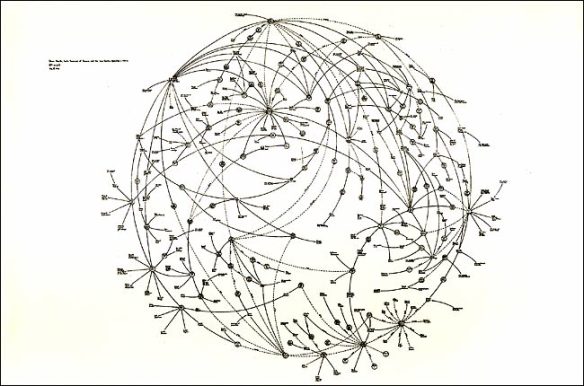
MarkLombardi

By Jeffrey M. Bale

Source: Lobster Magazine

Very few notions generate as much intellectual resistance, hostility, and derision within academic circles as a belief in the historical importance or efficacy of political conspiracies. Even when this belief is expressed in a very cautious manner, limited to specific and restricted contexts, supported by reliable evidence, and hedged about with all sort of qualifications, it still manages to transcend the boundaries of acceptable discourse and violate unspoken academic taboos. The idea that particular groups of people meet together secretly or in private to plan various courses of action, and that some of these plans actually exert a significant influence on particular historical developments, is typically rejected out of hand and assumed to be the figment of a paranoid imagination. The mere mention of the word ‘conspiracy’ seems to set off an internal alarm bell which causes scholars to close their minds in order to avoid cognitive dissonance and possible unpleasantness, since the popular image of conspiracy both fundamentally challenges the conception most educated, sophisticated people have about how the world operates and reminds them of the horrible persecutions that absurd and unfounded conspiracy theories have precipitated or sustained in the past. So strong is this prejudice among academics that even when clear evidence of a plot is inadvertently discovered in the course of their own research, they frequently feel compelled, either out of a sense of embarrassment or a desire to defuse anticipated criticism, to preface their account of it by ostentatiously disclaiming a belief in conspiracies. (1)

They then often attempt to downplay the significance of the plotting they have uncovered. To do otherwise, that is, to make a serious effort to incorporate the documented activities of conspiratorial groups into their general political or historical analyses, would force them to stretch their mental horizons beyond customary bounds and, not infrequently, delve even further into certain sordid and politically sensitive topics. Most academic researchers clearly prefer to ignore the implications of conspiratorial politics altogether rather than deal directly with such controversial matters.

A number of complex cultural and historical factors contribute to this reflexive and unwarranted reaction, but it is perhaps most often the direct result of a simple failure to distinguish between ‘conspiracy theories’ in the strict sense of the term, which are essentially elaborate fables even though they may well be based upon a kernel of truth, and the activities of actual clandestine and covert political groups, which are a common feature of modern politics. For this and other reasons, serious research into genuine conspiratorial networks has at worst been suppressed, as a rule been discouraged, and at best been looked upon with condescension by the academic community. (2) An entire dimension of political history and contemporary politics has thus been consistently neglected. (3)

For decades scholars interested in politics have directed their attention toward explicating and evaluating the merits of various political theories, or toward analyzing the more conventional, formal, and overt aspects of practical politics. Even a cursory examination of standard social science bibliographies reveals that tens of thousands of books and articles have been written about staple subjects such as the structure and functioning of government bureaucracies, voting patterns and electoral results, parliamentary procedures and activities, party organizations and factions, the impact of constitutional provisions or laws, and the like. In marked contrast, only a handful of scholarly publications have been devoted to the general theme of political conspiracies–as opposed to popular anti-conspiracy treatises, which are very numerous, and specific case studies of events in which conspiratorial groups have played some role — and virtually all of these concern themselves with the deleterious social impact of the ‘paranoid style’ of thought manifested in classic conspiracy theories rather than the characteristic features of real conspiratorial politics. (4)

Only the academic literature dealing with specialized topics like espionage, covert action, political corruption, terrorism, and revolutionary warfare touches upon clandestine and covert political activities on a more or less regular basis, probably because such activities cannot be avoided when dealing with these topics. But the analyses and information contained therein are rarely incorporated into standard works of history and social science, and much of that specialized literature is itself unsatisfactory. Hence there is an obvious need to place the study of conspiratorial politics on a sound theoretical, methodological, and empirical footing, since ignoring the influence of such politics can lead to severe errors of historical interpretation.

This situation can only be remedied when a clear-cut analytical distinction has been made between classic conspiracy theories and the more limited conspiratorial activities that are a regular feature of politics. ‘Conspiracy theories’ share a number of distinguishing characteristics, but in all of them the essential element is a belief in the existence of a ‘vast, insidious, preternaturally effective international conspiratorial network designed to perpetrate acts of the most fiendish character’, acts which aim to ‘undermine and destroy a way of life.’ (5)

Although this apocalyptic conception is generally regarded nowadays as the fantastic product of a paranoid mindset, in the past it was often accepted as an accurate description of reality by large numbers of people from all social strata, including intellectuals and heads of state. (6) The fact that a belief in sinister, all-powerful conspiratorial forces has not been restricted to small groups of clinical paranoids and mental defectives suggests that it fulfills certain important social functions and psychological needs.(7)

First of all, like many other intellectual constructs, conspiracy theories help to make complex patterns of cause-and-effect in human affairs more comprehensible by means of reductionism and oversimplification. Secondly, they purport to identify the underlying source of misery and injustice in the world, thereby accounting for current crises and upheavals and explaining why bad things are happening to good people or vice versa. Thirdly, by personifying that source they paradoxically help people to reaffirm their own potential ability to control the course of future historical developments. After all, if evil conspirators are consciously causing undesirable changes, the implication is that others, perhaps through the adoption of similar techniques, may also consciously intervene to protect a threatened way of life or otherwise alter the historical process. In short, a belief in conspiracy theories helps people to make sense out of a confusing, inhospitable reality, rationalize their present difficulties, and partially assuage their feelings of powerlessness. In this sense, it is no different than any number of religious, social, or political beliefs, and is deserving of the same serious study.

The image of conspiracies promoted by conspiracy theorists needs to be further illuminated before it can be contrasted with genuine conspiratorial politics. In the first place, conspiracy theorists consider the alleged conspirators to be Evil incarnate. They are not simply people with differing values or run-of-the-mill political opponents, but inhuman, superhuman, and/or anti-human beings who regularly commit abominable acts and are implacably attempting to subvert and destroy everything that is decent and worth preserving in the existing world. Thus, according to John Robison, the Bavarian Illuminati were formed ‘for the express purpose of ROOTING OUT ALL THE RELIGIOUS ESTABLISHMENTS, AND OVERTURNING ALL THE EXISTING GOVERNMENTS IN EUROPE.’ (8)

This grandiose claim is fairly representative, in the sense that most conspiracy theorists view the world in similarly Manichean and apocalyptic terms.

Secondly, conspiracy theorists perceive the conspiratorial group as both monolithic and unerring in the pursuit of its goals. This group is directed from a single conspiratorial centre, acting as a sort of general staff, which plans and coordinates all of its activities down to the last detail. Note, for example, Prince Clemens von Metternich’s claim that a ‘directing committee’ of the radicals from all over Europe had been established in Paris to pursue their insidious plotting against established governments. (9)

Given that presumption, it is no accident that many conspiracy theorists refer to ‘the Conspiracy’ rather than (lower case)conspiracies or conspiratorial factions, since they perceive no internal divisions among the conspirators. Rather, as a group the conspirators are believed to possess an extraordinary degree of internal solidarity, which produces a corresponding degree of counter solidarity vis-a-vis society at large, and indeed it is this very cohesion and singleness of purpose which enables them to effectively execute their plans to destroy existing institutions, seize power, and eliminate all opposition.

Thirdly, conspiracy theorists believe that the conspiratorial group is omnipresent, at least within its own sphere of operations. While some conspiracy theories postulate a relatively localized group of conspirators, most depict this group as both international in its spatial dimensions and continuous in its temporal dimensions. ‘[T]he conspirators planned and carried out evil in the past, they are successfully active in the present, and they will triumph in the future if they are not disturbed in their plans by those with information about their sinister designs.’(10)

The conspiratorial group is therefore capable of operating virtually everywhere. As a consequence of this ubiquitousness, anything that occurs which has a broadly negative impact or seems in anyway related to the purported aims of the conspirators can thus be plausibly attributed to them.

Fourthly, the conspiratorial group is viewed by conspiracy theorists as virtually omnipotent. In the past this group has successfully overthrown empires and nations, corrupted whole societies, and destroyed entire civilizations and cultures, and it is said to be in the process of accomplishing the same thing at this very moment. Its members are secretly working in every nook and cranny of society, and are making use of every subversive technique known to mankind to achieve their nefarious purposes. Nothing appears to be able to stand in their way–unless the warnings of the conspiracy theorists are heeded and acted upon at once. Even then there is no guarantee of ultimate victory against such powerful forces, but a failure to recognize the danger and take immediate countervailing action assures the success of those forces in the near future.

Finally, for conspiracy theorists conspiracies are not simply a regular feature of politics whose importance varies in different historical contexts, but rather the motive force of all historical change and development. The conspiratorial group can and does continually alter the course of history, invariably in negative and destructive ways, through conscious planning and direct intervention. Its members are not buffeted about by structural forces beyond their control and understanding, like everyone else, but are themselves capable of controlling events more or less at will. This supposed ability is usually attributed to some combination of demonic influence or sponsorship, the possession of arcane knowledge, the mastery of devilish techniques, and/or the creation of a preternaturally effective clandestine organization. As a result, unpleasant occurrences which are perceived by others to be the products of coincidence or chance are viewed by conspiracy theorists as further evidence of the secret workings of the conspiratorial group. For them, nothing that happens occurs by accident. Everything is the result of secret plotting in accordance with some sinister design.

This central characteristic of conspiracy theories has been aptly summed up by Donna Kossy in a popular book on fringe ideas:

Conspiracy theories are like black holes–they suck in everything that comes their way, regardless of content or origin…Everything you’ve ever known or experienced, no matter how ‘meaningless’, once it contacts the conspiratorial universe, is enveloped by and cloaked in sinister significance. Once inside, the vortex gains in size and strength, sucking in everything you touch. (11)

As an example of this sort of mechanism, one has only to mention the so-called ‘umbrella man’, a man who opened up an umbrella on a sunny day in Dealey Plaza just as President John F. Kennedy’s motorcade was passing. A number of ‘conspiracy theorists’ have assumed that this man was signalling to the assassins, thus tying a seemingly trivial and inconsequential act into the alleged plot to kill Kennedy. It is precisely this totalistic, all-encompassing quality that distinguishes ‘conspiracy theories’ from the secret but often mundane political planning that is carried out on a daily basis by all sorts of groups, both within and outside of government. It should, however, be pointed out that even if the ‘umbrella man’ was wholly innocent of any involvement in a plot, as he almost certainly was, this does not mean that the Warren Commission’s reconstruction of the assassination is accurate.

However that may be, real covert politics, although by definition hidden or disguised and often deleterious in their impact, simply do not correspond to the bleak, simplistic image propounded by conspiracy theorists. Far from embodying metaphysical evil, they are perfectly and recognizably human, with all the positive and negative characteristics and potentialities which that implies. At the most basic level, all the efforts of individuals to privately plan and secretly initiate actions for their own perceived mutual benefit –insofar as these are intentionally withheld from outsiders and require the maintenance of secrecy for their success–are conspiracies. Moreover, in contrast to the claims of conspiracy theorists, covert politics are anything but monolithic. At any given point in time, there are dozens if not thousands of competitive political and economic groups engaging in secret planning and activities, and most are doing so in an effort to gain some advantage over their rivals among the others. Such behind-the-scene operations are present on every level, from the mundane efforts of small-scale retailers to gain competitive advantage by being the first to develop new product lines to the crucially important attempts by rival secret services to penetrate and manipulate each other. Sometimes the patterns of these covert rivalries and struggles are relatively stable over time, whereas at other times they appear fluid and kaleidoscopic, as different groups secretly shift alliances and change tactics in accordance with their perceived interests. Even internally, within particular groups operating clandestinely, there are typically bitter disagreements between various factions over the specific courses of action to be adopted. Unanimity of opinioon historical judgements. There is probably no way to prevent this sort of unconscious reaction in the current intellectual climate, but the least that can be expected of serious scholars is that they carefully examine the available evidence before dismissing these matters out of hand.


Footnotes

1. Compare Robin Ramsay, ‘Conspiracy, Conspiracy Theories and Conspiracy Research’, Lobster 19 (1990), p. 25: ‘In intellectually respectable company it is necessary to preface any reference to actual political, economic, military or paramilitary conspiracies with the disclaimer that the speaker “doesn’t believe in the conspiracy theory of history (or politics)”.’This type of disclaimer quite clearly reveals the speaker’s inability to distinguish between bona fide conspiracy theories and actual conspiratorial politics.

2. The word ‘suppress’ is not too strong here. I personally know of at least one case in which a very bright graduate student at a prestigious East Coast university was unceremoniously told by his advisor that if he wanted to write a Ph.D. thesis on an interesting historical example of conspiratorial politics he would have to go elsewhere to do so. He ended up leaving academia altogether and became a professional journalist, in which capacity he has produced a number of interesting books and articles.

3. Complaints about this general academic neglect have often been made by those few scholars who have done research on key aspects of covert and clandestine politics which are directly relevant to this study. See, for example, Gary Marx, ‘Thoughts on a Neglected Category of Social Movement Participant: The Agent Provocateur and the Informant’, American Journal of Sociology 80:2 (September 1974), especially pp. 402-3. One of the few dissertations dealing directly with this topic, though not in a particularly skilful fashion, is Frederick A. Hoffman, ‘Secret Roles and Provocation: Covert Operations in Movements for social Change’ (Unpublished Ph.D. Dissertation: UCLA Sociology Department, 1979). There are, of course, some excellent academic studies which have given due weight to these matters–for example, Nurit Schleifman, Undercover Agents in the Russian Revolutionary Movement: The SR Party, 1902-1914 (Basingstoke: Macmillan/ St. Anthony’s College, 1988); and Jean-Paul Brunet, La police de l’ombre: Indicateurs et provocateurs dans la France contemporaine (Paris: Seuil, 1990)–but such studies areunfortunately few and far between.

4. The standard academic treatments of conspiracy theories are Richard Hofstadter, ‘The Paranoid Style in American Politics’, in Hofstadter, The Paranoid Style in American Politics and Other Essays (New York: Knopf, 1966), pp. 3-40; Norman Cohn, Warrant for Genocide: The Myth of the Jewish World-Conspiracy and the Protocols of the Elders of Zion (Chico, CA: Scholars, 1981 [1969]); J. M. Roberts, The Mythology of the Secret Societies (London: Secker & Warburg, 1972); Johannes Rogallavon Bieberstein, Die These von der Verschwrung, 1776-1945: Philosophen, Freimaurer, Juden, Liberale und Sozialisten als Verschwrergegen die Sozialordnung (Frankfurt am Main: Peter Lang, 1976); and Carl F. Graumann and Serge Moscovici, eds., Changing Conceptions of Conspiracy (New York: Springer, 1987). See also the journalistic studies by George Johnson, Architects of Fear: Conspiracy Theories and paranoia in American Politics (Los Angeles: Tarcher, 1983); and Jonathan Vankin, Conspiracies, Cover-Ups, and Crimes: Political Manipulation and Mind Control in America (New York: Paragon House, 1992).

5. See Hofstadter, ‘Paranoid Style’, pp. 14, 29.

6. Although conspiracy theories have been widely accepted in the most disparate eras and parts of the world, and thus probably have a certain universality as explanatory models, at certain points in time they have taken on an added salience due to particular historical circumstances. Their development and diffusion seems to be broadly correlated with the level of social, economic, and political upheaval or change, though indigenous cultural values and intellectual traditions determine their specific form and condition their level of popularity.

7. As many scholars have pointed out, if such ideas were restricted to clinical paranoids, they would have little or no historical importance. What makes the conspiratorial or paranoid style of thought interesting and historically significant is that it frequently tempts more or less normal people and has often been diffused among broad sections of the population in certain periods. Conspiracy theories are important as collective delusions, delusions which nevertheless reflect real fears and real social problems, rather than as evidence of individual pathologies. See, for example, Hofstadter,’Paranoid Style’, pp. 3-4.

8. See his Proofs of a Conspiracy Against All the Religions and Governments of Europe, Carried on in the Secret Meetings of free Masons, Illuminati, and Reading Societies, Collected from Good Authorities (New York: G. Forman, 1798), p. 14. This exhibits yet another characteristic of ‘conspiracy theorists’–the tendency to over-dramatize everything by using capital letters with reckless abandon.

9. See his ‘Geheime Denkschrift nber die Grundung eines Central-Comites der nordischen Machte in Wien’, in Aus Metternichs nachgelassenen Papieren, ed. by Richard Metternich-Winneburg (Vienna: 1881),vol. 1, p. 595, cited in Rogalla von Bieberstein, These von der Verschwrung, pp. 139-40.

10. Dieter Groh, ‘Temptation of Conspiracy Theory, Part I’, in Changing Conceptions of Conspiracy, p. 3. A classic example of conspiratorial works that view modern revolutionary movements as little more than the latest manifestations of subversive forces with a very long historical pedigree is the influential book by Nesta H. Webster, Secret Societies and Subversive Movements (London: Boswell, 1924). For more on Webster’s background, see the biographical study by Richard M. Gilman, Behind World Revolution: The Strange Career of Nesta H. Webster (Ann Arbor: Insight, 1982), of which only one volume has so far appeared.

11. Kooks: A Guide to the Outer Limits of Human Belief (Portland: Feral House, 1994), p. 191.

12. For more on P2, see above all the materials published by the Italian parliamentary commission investigating the organization, which are divided into the majority (Anselmi) report, five dissenting minority reports, and over one hundred thick volumes of attached documents and verbatim testimony before the commission. Compare also Martin Berger, Historia de la loggia masonica P2 (Buenos Aires: El Cid, 1983); Andrea Barbieri et al, L’Italia della P2 (Milan: Mondadori, 1981); Alberto Cecchi, Storia della P2 (Rome: Riuniti, 1985); Roberto Fabiani, I massoni in Italia (Milan: L’Espresso, 1978); Gianfranco Piazzesi, Gelli: La carriere di un eroe di questa Italia (Milan: Garzanti, 1983); Marco Ramat et al, La resistabile ascesa della P2: Poteri occulti e stato democratico (Bari: De Donato, 1983); Renato Risaliti, Licio Gelli, a carte scoperte (Florence: Fernando Brancato, 1991); and Gianni Rossi and Franceso Lombrassa, In nome della ‘loggia’: Le prove di come lamassoneria segreta ha tentato di impadronarsi dello stato italiano. Iretroscena della P2 (Rome: Napoleone, 1981). Pro P2 works include those of Gelli supporter Pier Carpi, Il caso Gelli: La verita sulla loggia P2 (Bologna: INEI, 1982); and the truly Orwellian work by Gelli himself, La verita (Lugano: Demetra, 1989), which in spite of its title bears little resemblance to the truth.

13. For the AB, see Ivor Wilkins and Hans Strydom, The Super-Afrikaners: Inside the Afrikaner Broederbond (Johannesburg: Jonathan Ball, 1978); and J.H.P.Serfontein, Brotherhood of Power: An Expose of the Secret Afrikaner Broederbond (Bloomington and London: Indiana University, 1978).Compare also B. M. Schoeman, Die Broederbond in die Afrikaner-politiek (Pretoria: Aktuele, 1982); and Adrien Pelzer, Die Afrikaner-Broederbond: Eerste 50 jaar (Cape Town: Tafelberg, 1979).

14. See his Historians’ Fallacies: Toward a Logic of Historical Thought (New York: Harper & Row, 1970), pp. 74-8.

The Illusion of Freedom: The Police State Is Alive and Well

By John W. Whitehead

Source: Battlefield America

“What happened here was the gradual habituation of the people, little by little, to being governed by surprise; to receiving decisions deliberated in secret; to believing that the situation was so complicated that the government had to act on information which the people could not understand, or so dangerous that, even if the people could understand it, it could not be released because of national security… This separation of government from people, this widening of the gap, took place so gradually and so insensibly, each step disguised (perhaps not even intentionally) as a temporary emergency measure or associated with true patriotic allegiance or with real social purposes. And all the crises and reforms (real reforms, too) so occupied the people that they did not see the slow motion underneath, of the whole process of government growing remoter and remoter.”—Historian Milton Mayer, They Thought They Were Free: The Germans, 1933-45

Brace yourself.

There is something being concocted in the dens of power, far beyond the public eye, and it doesn’t bode well for the future of this country.

Anytime you have an entire nation so mesmerized by the antics of the political ruling class that they are oblivious to all else, you’d better beware. Anytime you have a government that operates in the shadows, speaks in a language of force, and rules by fiat, you’d better beware. And anytime you have a government so far removed from its people as to ensure that they are never seen, heard or heeded by those elected to represent them, you’d better beware.

The world has been down this road before.

As historian Milton Mayer recounts in his seminal book on Hitler’s rise to power, They Thought They Were Free, “Most of us did not want to think about fundamental things and never had. There was no need to. Nazism gave us some dreadful, fundamental things to think about—we were decent people‑—and kept us so busy with continuous changes and ‘crises’ and so fascinated, yes, fascinated, by the machinations of the ‘national enemies’, without and within, that we had no time to think about these dreadful things that were growing, little by little, all around us.”

We are at our most vulnerable right now.

The gravest threat facing us as a nation is not extremism—delivered by way of sovereign citizens or radicalized Muslims—but despotism, exercised by a ruling class whose only allegiance is to power and money.

Nero fiddled while Rome burned.

America is burning, and all most Americans can do is switch the channel, tune out what they don’t want to hear, and tune into their own personal echo chambers.

We’re in a national state of denial.

Yet no amount of escapism can shield us from the harsh reality that the danger in our midst is posed by an entrenched government bureaucracy that has no regard for the Constitution, Congress, the courts or the citizenry.

If the team colors have changed from blue to red, that’s just cosmetic.

The playbook remains the same. The leopard has not changed its spots.

Scrape off the surface layers and you will find that the American police state is alive and well and continuing to wreak havoc on the rights of the American people.

“We the people” are no longer living the American Dream.

We’re living the American Lie.

Indeed, Americans have been lied to so sincerely, so incessantly, and for so long by politicians of all stripes—who lie compulsively and without any seeming remorse—that they’ve almost come to prefer the lies trotted out by those in government over less-palatable truths.

The American people have become compulsive believers.

As Nick Cohen writes for The Guardian, “Compulsive liars shouldn’t frighten you. They can harm no one, if no one listens to them. Compulsive believers, on the other hand: they should terrify you. Believers are the liars’ enablers. Their votes give the demagogue his power. Their trust turns the charlatan into the president. Their credulity ensures that the propaganda of half-calculating and half-mad fanatics has the power to change the world.”

While telling the truth “in a time of universal deceit is,” as George Orwell concluded, “a revolutionary act,” believing the truth—and being able to distinguish the truth from a lie—is also a revolutionary act.

Here’s a truth few Americans want to acknowledge: nothing has changed (at least, not for the better) since Barack Obama passed the reins of the police state to Donald Trump.

The police state is still winning. We the people are still losing.

In fact, the American police state has continued to advance at the same costly, intrusive, privacy-sapping, Constitution-defying, relentless pace under President Trump as it did under President Obama.

Police haven’t stopped disregarding the rights of citizens. Having been given the green light to probe, poke, pinch, taser, search, seize, strip, shoot and generally manhandle anyone they see fit in almost any circumstance, all with the general blessing of the courts, America’s law enforcement officials are no longer mere servants of the people entrusted with keeping the peace. Indeed, they continue to keep the masses corralled, under control, and treated like suspects and enemies rather than citizens.

SWAT teams haven’t stopped crashing through doors and terrorizing families. Nationwide, SWAT teams continue to be employed to address an astonishingly trivial array of criminal activities or mere community nuisances including angry dogs, domestic disputes, improper paperwork filed by an orchid farmer, and misdemeanor marijuana possession. With more than 80,000 SWAT team raids carried out every year on unsuspecting Americans for relatively routine police matters and federal agencies laying claim to their own law enforcement divisions, the incidence of botched raids and related casualties continue to rise.

The Pentagon and the Department of Homeland Security haven’t stopped militarizing and federalizing local police. Police forces continue to be transformed into heavily armed extensions of the military, complete with jackboots, helmets, shields, batons, pepper-spray, stun guns, assault rifles, body armor, miniature tanks and weaponized drones. In training police to look and act like the military and use the weapons and tactics of war against American citizens, the government continues to turn the United States into a battlefield.

Schools haven’t stopped treating young people like hard-core prisoners. School districts continue to team up with law enforcement to create a “schoolhouse to jailhouse track” by imposing a “double dose” of punishment for childish infractions: suspension or expulsion from school, accompanied by an arrest by the police and a trip to juvenile court. In this way, the paradigm of abject compliance to the state continues to be taught by example in the schools, through school lockdowns where police and drug-sniffing dogs enter the classroom, and zero tolerance policies that punish all offenses equally and result in young people being expelled for childish behavior.

For-profit private prisons haven’t stopped locking up Americans and immigrants alike at taxpayer expense. States continue to outsource prison management to private corporations out to make a profit at taxpayer expense. And how do you make a profit in the prison industry? Have the legislatures pass laws that impose harsh penalties for the slightest noncompliance in order keep the prison cells full and corporate investors happy.

Censorship hasn’t stopped. First Amendment activities continue to be pummeled, punched, kicked, choked, chained and generally gagged all across the country. The reasons for such censorship vary widely from political correctness, safety concerns and bullying to national security and hate crimes but the end result remained the same: the complete eradication of what Benjamin Franklin referred to as the “principal pillar of a free government.”

The courts haven’t stopped marching in lockstep with the police state. The courts continue to be dominated by technicians and statists who are deferential to authority, whether government or business. Indeed, the Supreme Court’s decisions in recent years have most often been characterized by an abject deference to government authority, military and corporate interests. They have run the gamut from suppressing free speech activities and justifying suspicionless strip searches to warrantless home invasions and conferring constitutional rights on corporations, while denying them to citizens.

Government bureaucrats haven’t stopped turning American citizens into criminals. The average American now unknowingly commits three felonies a day, thanks to an overabundance of vague laws that render otherwise innocent activity illegal, while reinforcing the power of the police state and its corporate allies.

The surveillance state hasn’t stopped spying on Americans’ communications, transactions or movements. On any given day, whether you’re walking through a store, driving your car, checking email, or talking to friends and family on the phone, you can be sure that some government agency, whether it’s your local police, a fusion center, the National Security Agency or one of the government’s many corporate partners, is still monitoring and tracking you.

The TSA hasn’t stopped groping or ogling travelers. Under the pretext of protecting the nation’s infrastructure (roads, mass transit systems, water and power supplies, telecommunications systems and so on) against criminal or terrorist attacks, TSA task forces (comprised of federal air marshals, surface transportation security inspectors, transportation security officers, behavior detection officers and explosive detection canine teams) continue to do random security sweeps of nexuses of transportation, including ports, railway and bus stations, airports, ferries and subways, as well as political conventions, baseball games and music concerts. Sweep tactics include the use of x-ray technology, pat-downs and drug-sniffing dogs, among other things.

Congress hasn’t stopped enacting draconian laws such as the USA Patriot Act and the NDAA. These laws—which completely circumvent the rule of law and the constitutional rights of American citizens, continue to re-orient our legal landscape in such a way as to ensure that martial law, rather than the rule of law, our U.S. Constitution, becomes the map by which we navigate life in the United States.

The Department of Homeland Security hasn’t stopped being a “wasteful, growing, fear-mongering beast.” Is the DHS capable of plotting and planning to turn the national guard into a federalized, immigration police force? No doubt about it. Remember, this is the agency that is notorious for militarizing the police and SWAT teams; spying on activists, dissidents and veterans; stockpiling ammunition; distributing license plate readers; contracting to build detention camps; tracking cell-phones with Stingray devices; carrying out military drills and lockdowns in American cities; using the TSA as an advance guard; conducting virtual strip searches with full-body scanners; carrying out soft target checkpoints; directing government workers to spy on Americans; conducting widespread spying networks using fusion centers; carrying out Constitution-free border control searches; funding city-wide surveillance cameras; and utilizing drones and other spybots.

The military industrial complex hasn’t stopped profiting from endless wars abroad. America’s expanding military empire continues to bleed the country dry at a rate of more than $15 billion a month (or $20 million an hour). The Pentagon spends more on war than all 50 states combined spend on health, education, welfare, and safety. Yet what most Americans fail to recognize is that these ongoing wars have little to do with keeping the country safe and everything to do with enriching the military industrial complex at taxpayer expense.

The Deep State’s shadow government hasn’t stopped calling the shots behind the scenes. Comprised of unelected government bureaucrats, corporations, contractors, paper-pushers, and button-pushers who are actually calling the shots behind the scenes, this government within a government continues to be the real reason “we the people” have no real control over our so-called representatives. It’s every facet of a government that is no longer friendly to freedom and is working overtime to trample the Constitution underfoot and render the citizenry powerless in the face of the government’s power grabs, corruption and abusive tactics.

And the American people haven’t stopped acting like gullible sheep. In fact, many Americans have been so carried away by their blind rank-and-file partisan devotion to their respective political gods that they have lost sight of the one thing that has remained constant in recent years: our freedoms are steadily declining.

Here’s the problem as I see it: “we the people” have become so trusting, so gullible, so easily distracted, so out-of-touch and so sure that our government will always do the right thing by us that we have ignored the warning signs all around us.

In so doing, we have failed to recognize such warning signs as potential red flags to use as opportunities to ask questions, demand answers, and hold our government officials accountable to respecting our rights and abiding by the rule of law.

Unfortunately, once a free people allows the government to make inroads into their freedoms, or uses those same freedoms as bargaining chips for security, it quickly becomes a slippery slope to outright tyranny. And it doesn’t really matter whether it’s a Democrat or a Republican at the helm, because the bureaucratic mindset on both sides of the aisle now seems to embody the same philosophy of authoritarian government.

As I make clear in my book Battlefield America: The War on the American People, this is what happens when you ignore the warning signs.

This is what happens when you fail to take alarm at the first experiment on your liberties.

This is what happens when you fail to challenge injustice and government overreach until the prison doors clang shut behind you.

In the American police state that now surrounds us, there are no longer such things as innocence, due process, or justice—at least, not in the way we once knew them. We are all potentially guilty, all potential criminals, all suspects waiting to be accused of a crime.

So you can try to persuade yourself that you are free, that you still live in a country that values freedom, and that it is not too late to make America great again, but to anyone who has been paying attention to America’s decline over the past 50 years, it will be just another lie.

The German people chose to ignore the truth and believe the lie.

They were not oblivious to the horrors taking place around them. As historian Robert Gellately points out, “[A]nyone in Nazi Germany who wanted to find out about the Gestapo, the concentration camps, and the campaigns of discrimination and persecutions need only read the newspapers.”

The warning signs were definitely there, blinking incessantly like large neon signs.

“Still,” Gellately writes, “the vast majority voted in favor of Nazism, and in spite of what they could read in the press and hear by word of mouth about the secret police, the concentration camps, official anti-Semitism, and so on. . . . [T]here is no getting away from the fact that at that moment, ‘the vast majority of the German people backed him.’”

Half a century later, the wife of a prominent German historian, neither of whom were members of the Nazi party, opined: “[O]n the whole, everyone felt well. . . . And there were certainly eighty percent who lived productively and positively throughout the time. . . . We also had good years. We had wonderful years.”

In other words, as long as their creature comforts remained undiminished, as long as their bank accounts remained flush, as long as they weren’t being discriminated against, persecuted, starved, beaten, shot, stripped, jailed and turned into slave labor, life was good.

This is how tyranny rises and freedom falls.

As Primo Levi, a Holocaust survivor observed, “Monsters exist, but they are too few in number to be truly dangerous. More dangerous are the common men, the functionaries ready to believe and to act without asking questions.”

Freedom demands responsibility.

Freedom demands that people stop sleep-walking through life, stop cocooning themselves in political fantasies, and stop distracting themselves with escapist entertainment.

Freedom demands that we stop thinking as Democrats and Republicans and start thinking like human beings, or at the very least, Americans.

Freedom demands that we not remain silent in the face of evil or wrongdoing but actively stand against injustice.

Freedom demands that we treat others as we would have them treat us. That is the law of reciprocity, also referred to as the Golden Rule, and it is found in nearly every world religion, including Judaism and Christianity.

In other words, if you don’t want to be locked up in a prison cell or a detention camp—if you don’t want to be discriminated against because of the color of your race, religion, politics or anything else that sets you apart from the rest—if you don’t want your loved ones shot at, strip searched, tasered, beaten and treated like slaves—if you don’t want to have to be constantly on guard against government eyes watching what you do, where you go and what you say—if you don’t want to be tortured, waterboarded or forced to perform degrading acts—if you don’t want your children to grow up in a world without freedom—then don’t allow these evils to be inflicted on anyone else, no matter how tempting the reason or how fervently you believe in your cause.

As German theologian and anti-Nazi dissident Dietrich Bonhoeffer observed, “We are not to simply bandage the wounds of victims beneath the wheels of injustice, we are to drive a spoke into the wheel itself.”

Let’s Give the CIA the Credit It Deserves

By Norman Solomon

Source: OpEdNews.com

For months now, our country has endured the tacit denigration of American ingenuity. Countless statements — from elected officials, activist groups, journalists and many others — have ignored our nation’s superb blend of dazzling high-tech capacities and statecraft mendacities.

Fortunately, this week the news about release of illuminating CIA documents by WikiLeaks has begun to give adequate credit where due. And not a moment too soon. For way too long, Russia has been credited with prodigious hacking and undermining of democracy in the United States.

Many Americans have overlooked the U.S. government’s fantastic hacking achievements. This is most unfair and disrespectful to the dedicated men and women of intelligence services like the CIA and NSA. Far from the limelight, they’ve been working diligently to undermine democracy not just overseas but also here at home.

Today, the massive new trove of CIA documents can help to put things in perspective. Maybe now people will grasp that our nation’s undermining of democracy is home-grown and self-actualized. It’s an insult to the ingenious capacities of the United States of America to think that we can’t do it ourselves.

Contrary to all the public relations work that U.S. intelligence agencies have generously done for them, the Russians don’t even rank as peripheral to the obstacles and prospects for American democracy. Rest assured, throughout the long history of the United States, we haven’t needed foreigners to get the job done.

In our current era, can Vladimir Putin take any credit for purging huge numbers of African Americans, Latinos and other minority citizens from the voter rolls? Of course not.

Did Putin create and maintain the barriers that prevented many low-income people from voting on November 8? Only in his dreams.

Can the Kremlin hold a candle to the corporate-owned cable TV channels that gave Donald Trump umpteen free hours of uninterrupted air time for speeches at his campaign rallies? Absolutely not.

Could any Russian operation claim more than a tiny sliver of impact compared to the handiwork of FBI Director James Comey as he boosted Donald Trump’s prospects with a pair of gratuitous announcements about a gratuitously re-opened probe of Hillary Clinton’s emails during the last days of the 2016 campaign? No way.

Is Putin anything but a miniscule lightweight in any efforts to manipulate the U.S. electorate compared to “dark money” American billionaires like the Koch brothers? Give us a break.

And how about the Fourth Amendment of the U.S. Constitution? The Kremlin can only marvel at the way that the CIA, the NSA and the bipartisan leadership in Washington have shredded the Fourth Amendment while claiming to uphold it.

To sum up: The CIA’s efforts to tout Russia add up to jaw-dropping false modesty! The humility of “deep state” leaders in Langley is truly awesome.

Let’s get a grip. Overwhelmingly, the achievements of thwarting democracy in America have been do-it-yourself operations. It’s about time that we give adequate credit to the forces perpetuating this country’s self-inflicted wounds to American democracy.

To loosely paraphrase the beloved comic-strip character Pogo, when the subject is grievous damage to democracy at home, “We have met the ingenuity and it is U.S.” But we’re having a terrible time recognizing ourselves.

Trump proposes huge hike in military and police spending

discretionary_spending_pie_2015_enacted

By Patrick Martin

Source: WSWS.org

The Trump administration sent instructions to federal agencies Monday proposing a $54 billion increase in spending for the Pentagon, the intelligence agencies and the Department of Homeland Security, to be offset by $54 billion in cuts for other agencies, mainly those involved in domestic social services and regulation of business.

Trump’s budget outline sets the stage for his first address to Congress on Tuesday. It provides further evidence that the Trump administration will be dedicated to radically rolling back social spending to finance a dramatic escalation of military operations, both in the neo-colonial wars in the Middle East and against the United States’ ‘great power’ rivals: China and Russia.

Federal departments are being told to file budget requests for the fiscal year that begins October 1, 2017 based on the numbers they were given by the Office of Management and Budget. Each agency will be responsible for working out the cuts required to meet proposed reductions, while the Pentagon, CIA and DHS will propose expanded operations with the additional funds they are to be awarded.

There were no details made public about the exact budget ceilings given to each federal department, but White House officials made it clear that foreign aid programs in the State Department and anti-pollution regulation through the Environmental Protection Agency (EPA) would suffer some of the largest cuts.

The total budget of the EPA is only $9 billion, so many other domestic programs are certain to be hard-hit, involving such departments as Education, Labor, Transportation, Agriculture (which includes food stamps), Housing and Urban Development and Health and Human Services.

The biggest federal social programs, Social Security, Medicare and Medicaid, are not affected by the budget order, which involves only funding for so-called discretionary programs, those financed through annual congressional appropriations. Entitlement programs, where benefits are paid out automatically to those who establish their eligibility, are covered by a separate budget process.

OMB Director Mick Mulvaney appeared at the White House press briefing Monday afternoon to explain the action taken by the Trump administration. He emphasized that setting what he called the “top-line budget number” for each department was only the start of a protracted process.

The OMB will use the figures from each department and agency to prepare a budget outline to be submitted to Congress on March 16. A full budget will not be ready until sometime in May, Mulvaney said. He also indicated that while spending on Social Security, Medicare and Medicaid were not addressed in the action taken Monday, “entitlement reform”—i.e., cuts in these critical programs—would be a subject of discussion with congressional leaders later in the budget process.

Press reports identified the three White House officials who have played the main roles in the initial budgeting: Mulvaney, who was confirmed on February 16 as budget director; National Economic Council Director Gary Cohn, the former president of Goldman Sachs, the huge investment bank; and Stephen K. Bannon, Trump’s chief strategist, the former chief executive of the fascistic Breitbart News site, who exercises increasingly broad sway over all White House policy decisions.

While no details have yet been released of what the $54 billion increase in military-police spending will pay for, the scale of the increase, in and of itself, shows the real character of the Trump administration. This is to be a government of war abroad and mass repression at home.

Trump himself touched on this theme in typically rambling and unfocused remarks to a meeting of the National Governors Association Monday. “We never win a war,” he said. “We never win. And we don’t fight to win. We don’t fight to win. So we either got to win, or don’t fight at all.”

He continued, telling the governors, “My first budget will be submitted to the Congress next month. This budget will be a public safety and national security budget, very much based on those two with plenty of other things, but very strong. And it will include a historic increase in defense spending to rebuild the depleted military of the United States of America at a time we most need it.”

Additional money for the Pentagon is likely to go to a dramatically increased tempo of operations in Iraq and Syria. Defense Secretary James Mattis delivered proposals to the White House Monday for an offensive against Islamic State in Iraq and Syria (ISIS), as required by an executive order issued by Trump last month. No details are available yet, but any acceleration of the bombing campaign, let alone the deployment of significant numbers of the US ground troops, would increase the cost of that war by many billions.

The $54 billion increase would also presumably include funds for the construction of Trump’s planned wall on the US-Mexico border, as well as a massive increase in spending on detention facilities for the hundreds of thousands of immigrants to be rounded up under the executive orders already issued by the White House.

The federal budget is operating under the constraints imposed by the 2011 Budget Control Act, the bipartisan legislation negotiated by the Obama White House, the Republican-controlled House of Representatives, and a Democratic-controlled Senate. This set up the so-called sequester process, under which all discretionary spending is subject to a budget freeze, for both domestic and military programs.

Each year, increased spending for programs under the sequester has been worked out on the basis of roughly equal increases for domestic and military programs. Last year, for fiscal year 2016, Congress approved $543 billion for domestic discretionary programs and $607 billion for the military. The Trump White House plan would thus represent a cut of about 10 percent for domestic programs, and an increase of nearly that amount for the military.

Any significant change in the sequester process would require support from congressional Democrats, particularly in the Senate, where the Republican party holds only a narrow 52-48 edge, and any major legislation would require a 60-vote majority to pass.

Several congressional Republican leaders criticized the White House plan as insufficiently skewed to the military. House Armed Services Committee Chairman Mac Thornberry of Texas issued a statement criticizing the “low budget number” and adding, “The administration will have to make clear which problems facing our military they are choosing not to fix.”

Senator John McCain of Arizona, chairman of the Senate Armed Services Committee, declared that the Trump plan is “a mere 3 percent above President Obama’s defense budget, which has left our military underfunded, undersized and unready.”

For all the statements by Trump and the Republicans bemoaning the supposedly “depleted” state of the US military, the United States spends more on its armed forces than the next 15 countries in the world combined. The military budget is only inadequate if the mission of the US military is assumed to be the conquest of the entire planet and the subduing of all armed resistance from any quarter—which is actually the perspective of the American ruling elite.

Vault 7: CIA Hacking Tools Revealed

Source: WikiLeaks

Press Release

Today, Tuesday 7 March 2017, WikiLeaks begins its new series of leaks on the U.S. Central Intelligence Agency. Code-named “Vault 7” by WikiLeaks, it is the largest ever publication of confidential documents on the agency.

The first full part of the series, “Year Zero”, comprises 8,761 documents and files from an isolated, high-security network situated inside the CIA’s Center for Cyber Intelligence in Langley, Virgina. It follows an introductory disclosure last month of CIA targeting French political parties and candidates in the lead up to the 2012 presidential election.

Recently, the CIA lost control of the majority of its hacking arsenal including malware, viruses, trojans, weaponized “zero day” exploits, malware remote control systems and associated documentation. This extraordinary collection, which amounts to more than several hundred million lines of code, gives its possessor the entire hacking capacity of the CIA. The archive appears to have been circulated among former U.S. government hackers and contractors in an unauthorized manner, one of whom has provided WikiLeaks with portions of the archive.

“Year Zero” introduces the scope and direction of the CIA’s global covert hacking program, its malware arsenal and dozens of “zero day” weaponized exploits against a wide range of U.S. and European company products, include Apple’s iPhone, Google’s Android and Microsoft’s Windows and even Samsung TVs, which are turned into covert microphones.

Since 2001 the CIA has gained political and budgetary preeminence over the U.S. National Security Agency (NSA). The CIA found itself building not just its now infamous drone fleet, but a very different type of covert, globe-spanning force — its own substantial fleet of hackers. The agency’s hacking division freed it from having to disclose its often controversial operations to the NSA (its primary bureaucratic rival) in order to draw on the NSA’s hacking capacities.

By the end of 2016, the CIA’s hacking division, which formally falls under the agency’s Center for Cyber Intelligence (CCI), had over 5000 registered users and had produced more than a thousand hacking systems, trojans, viruses, and other “weaponized” malware. Such is the scale of the CIA’s undertaking that by 2016, its hackers had utilized more code than that used to run Facebook. The CIA had created, in effect, its “own NSA” with even less accountability and without publicly answering the question as to whether such a massive budgetary spend on duplicating the capacities of a rival agency could be justified.

In a statement to WikiLeaks the source details policy questions that they say urgently need to be debated in public, including whether the CIA’s hacking capabilities exceed its mandated powers and the problem of public oversight of the agency. The source wishes to initiate a public debate about the security, creation, use, proliferation and democratic control of cyberweapons.

Once a single cyber ‘weapon’ is ‘loose’ it can spread around the world in seconds, to be used by rival states, cyber mafia and teenage hackers alike.

Julian Assange, WikiLeaks editor stated that “There is an extreme proliferation risk in the development of cyber ‘weapons’. Comparisons can be drawn between the uncontrolled proliferation of such ‘weapons’, which results from the inability to contain them combined with their high market value, and the global arms trade. But the significance of “Year Zero” goes well beyond the choice between cyberwar and cyberpeace. The disclosure is also exceptional from a political, legal and forensic perspective.”

Wikileaks has carefully reviewed the “Year Zero” disclosure and published substantive CIA documentation while avoiding the distribution of ‘armed’ cyberweapons until a consensus emerges on the technical and political nature of the CIA’s program and how such ‘weapons’ should analyzed, disarmed and published.

Wikileaks has also decided to redact and anonymise some identifying information in “Year Zero” for in depth analysis. These redactions include ten of thousands of CIA targets and attack machines throughout Latin America, Europe and the United States. While we are aware of the imperfect results of any approach chosen, we remain committed to our publishing model and note that the quantity of published pages in “Vault 7” part one (“Year Zero”) already eclipses the total number of pages published over the first three years of the Edward Snowden NSA leaks.


Analysis

CIA malware targets iPhone, Android, smart TVs

CIA malware and hacking tools are built by EDG (Engineering Development Group), a software development group within CCI (Center for Cyber Intelligence), a department belonging to the CIA’s DDI (Directorate for Digital Innovation). The DDI is one of the five major directorates of the CIA (see this organizational chart of the CIA for more details).

The EDG is responsible for the development, testing and operational support of all backdoors, exploits, malicious payloads, trojans, viruses and any other kind of malware used by the CIA in its covert operations world-wide.

The increasing sophistication of surveillance techniques has drawn comparisons with George Orwell’s 1984, but “Weeping Angel”, developed by the CIA’s Embedded Devices Branch (EDB), which infests smart TVs, transforming them into covert microphones, is surely its most emblematic realization.

The attack against Samsung smart TVs was developed in cooperation with the United Kingdom’s MI5/BTSS. After infestation, Weeping Angel places the target TV in a ‘Fake-Off’ mode, so that the owner falsely believes the TV is off when it is on. In ‘Fake-Off’ mode the TV operates as a bug, recording conversations in the room and sending them over the Internet to a covert CIA server.

As of October 2014 the CIA was also looking at infecting the vehicle control systems used by modern cars and trucks. The purpose of such control is not specified, but it would permit the CIA to engage in nearly undetectable assassinations.

The CIA’s Mobile Devices Branch (MDB) developed numerous attacks to remotely hack and control popular smart phones. Infected phones can be instructed to send the CIA the user’s geolocation, audio and text communications as well as covertly activate the phone’s camera and microphone.

Despite iPhone’s minority share (14.5%) of the global smart phone market in 2016, a specialized unit in the CIA’s Mobile Development Branch produces malware to infest, control and exfiltrate data from iPhones and other Apple products running iOS, such as iPads. CIA’s arsenal includes numerous local and remote “zero days” developed by CIA or obtained from GCHQ, NSA, FBI or purchased from cyber arms contractors such as Baitshop. The disproportionate focus on iOS may be explained by the popularity of the iPhone among social, political, diplomatic and business elites.

A similar unit targets Google’s Android which is used to run the majority of the world’s smart phones (~85%) including Samsung, HTC and Sony. 1.15 billion Android powered phones were sold last year. “Year Zero” shows that as of 2016 the CIA had 24 “weaponized” Android “zero days” which it has developed itself and obtained from GCHQ, NSA and cyber arms contractors.

These techniques permit the CIA to bypass the encryption of WhatsApp, Signal, Telegram, Wiebo, Confide and Cloackman by hacking the “smart” phones that they run on and collecting audio and message traffic before encryption is applied.


CIA malware targets Windows, OSx, Linux, routers

The CIA also runs a very substantial effort to infect and control Microsoft Windows users with its malware. This includes multiple local and remote weaponized “zero days”, air gap jumping viruses such as “Hammer Drill” which infects software distributed on CD/DVDs, infectors for removable media such as USBs, systems to hide data in images or in covert disk areas ( “Brutal Kangaroo”) and to keep its malware infestations going.

Many of these infection efforts are pulled together by the CIA’s Automated Implant Branch (AIB), which has developed several attack systems for automated infestation and control of CIA malware, such as “Assassin” and “Medusa”.

Attacks against Internet infrastructure and webservers are developed by the CIA’s Network Devices Branch (NDB).

The CIA has developed automated multi-platform malware attack and control systems covering Windows, Mac OS X, Solaris, Linux and more, such as EDB’s “HIVE” and the related “Cutthroat” and “Swindle” tools, which are described in the examples section below.


CIA ‘hoarded’ vulnerabilities (“zero days”)

In the wake of Edward Snowden’s leaks about the NSA, the U.S. technology industry secured a commitment from the Obama administration that the executive would disclose on an ongoing basis — rather than hoard — serious vulnerabilities, exploits, bugs or “zero days” to Apple, Google, Microsoft, and other US-based manufacturers.

Serious vulnerabilities not disclosed to the manufacturers places huge swathes of the population and critical infrastructure at risk to foreign intelligence or cyber criminals who independently discover or hear rumors of the vulnerability. If the CIA can discover such vulnerabilities so can others.

The U.S. government’s commitment to the Vulnerabilities Equities Process came after significant lobbying by US technology companies, who risk losing their share of the global market over real and perceived hidden vulnerabilities. The government stated that it would disclose all pervasive vulnerabilities discovered after 2010 on an ongoing basis.

“Year Zero” documents show that the CIA breached the Obama administration’s commitments. Many of the vulnerabilities used in the CIA’s cyber arsenal are pervasive and some may already have been found by rival intelligence agencies or cyber criminals.

As an example, specific CIA malware revealed in “Year Zero” is able to penetrate, infest and control both the Android phone and iPhone software that runs or has run presidential Twitter accounts. The CIA attacks this software by using undisclosed security vulnerabilities (“zero days”) possessed by the CIA but if the CIA can hack these phones then so can everyone else who has obtained or discovered the vulnerability. As long as the CIA keeps these vulnerabilities concealed from Apple and Google (who make the phones) they will not be fixed, and the phones will remain hackable.

The same vulnerabilities exist for the population at large, including the U.S. Cabinet, Congress, top CEOs, system administrators, security officers and engineers. By hiding these security flaws from manufacturers like Apple and Google the CIA ensures that it can hack everyone &mdsh; at the expense of leaving everyone hackable.


‘Cyberwar’ programs are a serious proliferation risk

Cyber ‘weapons’ are not possible to keep under effective control.

While nuclear proliferation has been restrained by the enormous costs and visible infrastructure involved in assembling enough fissile material to produce a critical nuclear mass, cyber ‘weapons’, once developed, are very hard to retain.

Cyber ‘weapons’ are in fact just computer programs which can be pirated like any other. Since they are entirely comprised of information they can be copied quickly with no marginal cost.

Securing such ‘weapons’ is particularly difficult since the same people who develop and use them have the skills to exfiltrate copies without leaving traces — sometimes by using the very same ‘weapons’ against the organizations that contain them. There are substantial price incentives for government hackers and consultants to obtain copies since there is a global “vulnerability market” that will pay hundreds of thousands to millions of dollars for copies of such ‘weapons’. Similarly, contractors and companies who obtain such ‘weapons’ sometimes use them for their own purposes, obtaining advantage over their competitors in selling ‘hacking’ services.

Over the last three years the United States intelligence sector, which consists of government agencies such as the CIA and NSA and their contractors, such as Booz Allan Hamilton, has been subject to unprecedented series of data exfiltrations by its own workers.

A number of intelligence community members not yet publicly named have been arrested or subject to federal criminal investigations in separate incidents.

Most visibly, on February 8, 2017 a U.S. federal grand jury indicted Harold T. Martin III with 20 counts of mishandling classified information. The Department of Justice alleged that it seized some 50,000 gigabytes of information from Harold T. Martin III that he had obtained from classified programs at NSA and CIA, including the source code for numerous hacking tools.

Once a single cyber ‘weapon’ is ‘loose’ it can spread around the world in seconds, to be used by peer states, cyber mafia and teenage hackers alike.


U.S. Consulate in Frankfurt is a covert CIA hacker base

In addition to its operations in Langley, Virginia the CIA also uses the U.S. consulate in Frankfurt as a covert base for its hackers covering Europe, the Middle East and Africa.

CIA hackers operating out of the Frankfurt consulate ( “Center for Cyber Intelligence Europe” or CCIE) are given diplomatic (“black”) passports and State Department cover. The instructions for incoming CIA hackers make Germany’s counter-intelligence efforts appear inconsequential: “Breeze through German Customs because you have your cover-for-action story down pat, and all they did was stamp your passport”

Your Cover Story (for this trip)
Q: Why are you here?
A: Supporting technical consultations at the Consulate.

Two earlier WikiLeaks publications give further detail on CIA approaches to customs and secondary screening procedures.

Once in Frankfurt CIA hackers can travel without further border checks to the 25 European countries that are part of the Shengen open border area — including France, Italy and Switzerland.

A number of the CIA’s electronic attack methods are designed for physical proximity. These attack methods are able to penetrate high security networks that are disconnected from the internet, such as police record database. In these cases, a CIA officer, agent or allied intelligence officer acting under instructions, physically infiltrates the targeted workplace. The attacker is provided with a USB containing malware developed for the CIA for this purpose, which is inserted into the targeted computer. The attacker then infects and exfiltrates data to removable media. For example, the CIA attack system Fine Dining, provides 24 decoy applications for CIA spies to use. To witnesses, the spy appears to be running a program showing videos (e.g VLC), presenting slides (Prezi), playing a computer game (Breakout2, 2048) or even running a fake virus scanner (Kaspersky, McAfee, Sophos). But while the decoy application is on the screen, the underlaying system is automatically infected and ransacked.


How the CIA dramatically increased proliferation risks

In what is surely one of the most astounding intelligence own goals in living memory, the CIA structured its classification regime such that for the most market valuable part of “Vault 7” — the CIA’s weaponized malware (implants + zero days), Listening Posts (LP), and Command and Control (C2) systems — the agency has little legal recourse.

The CIA made these systems unclassified.

Why the CIA chose to make its cyberarsenal unclassified reveals how concepts developed for military use do not easily crossover to the ‘battlefield’ of cyber ‘war’.

To attack its targets, the CIA usually requires that its implants communicate with their control programs over the internet. If CIA implants, Command & Control and Listening Post software were classified, then CIA officers could be prosecuted or dismissed for violating rules that prohibit placing classified information onto the Internet. Consequently the CIA has secretly made most of its cyber spying/war code unclassified. The U.S. government is not able to assert copyright either, due to restrictions in the U.S. Constitution. This means that cyber ‘arms’ manufactures and computer hackers can freely “pirate” these ‘weapons’ if they are obtained. The CIA has primarily had to rely on obfuscation to protect its malware secrets.

Conventional weapons such as missiles may be fired at the enemy (i.e into an unsecured area). Proximity to or impact with the target detonates the ordnance including its classified parts. Hence military personnel do not violate classification rules by firing ordnance with classified parts. Ordnance will likely explode. If it does not, that is not the operator’s intent.

Over the last decade U.S. hacking operations have been increasingly dressed up in military jargon to tap into Department of Defense funding streams. For instance, attempted “malware injections” (commercial jargon) or “implant drops” (NSA jargon) are being called “fires” as if a weapon was being fired. However the analogy is questionable.

Unlike bullets, bombs or missiles, most CIA malware is designed to live for days or even years after it has reached its ‘target’. CIA malware does not “explode on impact” but rather permanently infests its target. In order to infect target’s device, copies of the malware must be placed on the target’s devices, giving physical possession of the malware to the target. To exfiltrate data back to the CIA or to await further instructions the malware must communicate with CIA Command & Control (C2) systems placed on internet connected servers. But such servers are typically not approved to hold classified information, so CIA command and control systems are also made unclassified.

A successful ‘attack’ on a target’s computer system is more like a series of complex stock maneuvers in a hostile take-over bid or the careful planting of rumors in order to gain control over an organization’s leadership rather than the firing of a weapons system. If there is a military analogy to be made, the infestation of a target is perhaps akin to the execution of a whole series of military maneuvers against the target’s territory including observation, infiltration, occupation and exploitation.


Evading forensics and anti-virus

A series of standards lay out CIA malware infestation patterns which are likely to assist forensic crime scene investigators as well as Apple, Microsoft, Google, Samsung, Nokia, Blackberry, Siemens and anti-virus companies attribute and defend against attacks.

“Tradecraft DO’s and DON’Ts” contains CIA rules on how its malware should be written to avoid fingerprints implicating the “CIA, US government, or its witting partner companies” in “forensic review”. Similar secret standards cover the use of encryption to hide CIA hacker and malware communication (pdf), describing targets & exfiltrated data (pdf) as well as executing payloads (pdf) and persisting (pdf) in the target’s machines over time.

CIA hackers developed successful attacks against most well known anti-virus programs. These are documented in AV defeats, Personal Security Products, Detecting and defeating PSPs and PSP/Debugger/RE Avoidance. For example, Comodo was defeated by CIA malware placing itself in the Window’s “Recycle Bin”. While Comodo 6.x has a “Gaping Hole of DOOM”.

CIA hackers discussed what the NSA’s “Equation Group” hackers did wrong and how the CIA’s malware makers could avoid similar exposure.

Examples

The CIA’s Engineering Development Group (EDG) management system contains around 500 different projects (only some of which are documented by “Year Zero”) each with their own sub-projects, malware and hacker tools.

The majority of these projects relate to tools that are used for penetration, infestation (“implanting”), control, and exfiltration.

Another branch of development focuses on the development and operation of Listening Posts (LP) and Command and Control (C2) systems used to communicate with and control CIA implants; special projects are used to target specific hardware from routers to smart TVs.

Some example projects are described below, but see the table of contents for the full list of projects described by WikiLeaks’ “Year Zero”.


UMBRAGE

The CIA’s hand crafted hacking techniques pose a problem for the agency. Each technique it has created forms a “fingerprint” that can be used by forensic investigators to attribute multiple different attacks to the same entity.

This is analogous to finding the same distinctive knife wound on multiple separate murder victims. The unique wounding style creates suspicion that a single murderer is responsible. As soon one murder in the set is solved then the other murders also find likely attribution.

The CIA’s Remote Devices Branch‘s UMBRAGE group collects and maintains a substantial library of attack techniques ‘stolen’ from malware produced in other states including the Russian Federation.

With UMBRAGE and related projects the CIA cannot only increase its total number of attack types but also misdirect attribution by leaving behind the “fingerprints” of the groups that the attack techniques were stolen from.

UMBRAGE components cover keyloggers, password collection, webcam capture, data destruction, persistence, privilege escalation, stealth, anti-virus (PSP) avoidance and survey techniques.


Fine Dining

Fine Dining comes with a standardized questionnaire i.e menu that CIA case officers fill out. The questionnaire is used by the agency’s OSB (Operational Support Branch) to transform the requests of case officers into technical requirements for hacking attacks (typically “exfiltrating” information from computer systems) for specific operations. The questionnaire allows the OSB to identify how to adapt existing tools for the operation, and communicate this to CIA malware configuration staff. The OSB functions as the interface between CIA operational staff and the relevant technical support staff.

Among the list of possible targets of the collection are ‘Asset’, ‘Liason Asset’, ‘System Administrator’, ‘Foreign Information Operations’, ‘Foreign Intelligence Agencies’ and ‘Foreign Government Entities’. Notably absent is any reference to extremists or transnational criminals. The ‘Case Officer’ is also asked to specify the environment of the target like the type of computer, operating system used, Internet connectivity and installed anti-virus utilities (PSPs) as well as a list of file types to be exfiltrated like Office documents, audio, video, images or custom file types. The ‘menu’ also asks for information if recurring access to the target is possible and how long unobserved access to the computer can be maintained. This information is used by the CIA’s ‘JQJIMPROVISE’ software (see below) to configure a set of CIA malware suited to the specific needs of an operation.


Improvise (JQJIMPROVISE)

‘Improvise’ is a toolset for configuration, post-processing, payload setup and execution vector selection for survey/exfiltration tools supporting all major operating systems like Windows (Bartender), MacOS (JukeBox) and Linux (DanceFloor). Its configuration utilities like Margarita allows the NOC (Network Operation Center) to customize tools based on requirements from ‘Fine Dining’ questionairies.

HIVE

HIVE is a multi-platform CIA malware suite and its associated control software. The project provides customizable implants for Windows, Solaris, MikroTik (used in internet routers) and Linux platforms and a Listening Post (LP)/Command and Control (C2) infrastructure to communicate with these implants.

The implants are configured to communicate via HTTPS with the webserver of a cover domain; each operation utilizing these implants has a separate cover domain and the infrastructure can handle any number of cover domains.

Each cover domain resolves to an IP address that is located at a commercial VPS (Virtual Private Server) provider. The public-facing server forwards all incoming traffic via a VPN to a ‘Blot’ server that handles actual connection requests from clients. It is setup for optional SSL client authentication: if a client sends a valid client certificate (only implants can do that), the connection is forwarded to the ‘Honeycomb’ toolserver that communicates with the implant; if a valid certificate is missing (which is the case if someone tries to open the cover domain website by accident), the traffic is forwarded to a cover server that delivers an unsuspicious looking website.

The Honeycomb toolserver receives exfiltrated information from the implant; an operator can also task the implant to execute jobs on the target computer, so the toolserver acts as a C2 (command and control) server for the implant.

Similar functionality (though limited to Windows) is provided by the RickBobby project.

See the classified user and developer guides for HIVE.

Frequently Asked Questions

Why now?

WikiLeaks published as soon as its verification and analysis were ready.

In Febuary the Trump administration has issued an Executive Order calling for a “Cyberwar” review to be prepared within 30 days.

While the review increases the timeliness and relevance of the publication it did not play a role in setting the publication date.

Redactions

Names, email addresses and external IP addresses have been redacted in the released pages (70,875 redactions in total) until further analysis is complete.

  1. Over-redaction: Some items may have been redacted that are not employees, contractors, targets or otherwise related to the agency, but are, for example, authors of documentation for otherwise public projects that are used by the agency.
  2. Identity vs. person: the redacted names are replaced by user IDs (numbers) to allow readers to assign multiple pages to a single author. Given the redaction process used a single person may be represented by more than one assigned identifier but no identifier refers to more than one real person.
  3. Archive attachments (zip, tar.gz, …) are replaced with a PDF listing all the file names in the archive. As the archive content is assessed it may be made available; until then the archive is redacted.
  4. Attachments with other binary content are replaced by a hex dump of the content to prevent accidental invocation of binaries that may have been infected with weaponized CIA malware. As the content is assessed it may be made available; until then the content is redacted.
  5. The tens of thousands of routable IP addresses references (including more than 22 thousand within the United States) that correspond to possible targets, CIA covert listening post servers, intermediary and test systems, are redacted for further exclusive investigation.
  6. Binary files of non-public origin are only available as dumps to prevent accidental invocation of CIA malware infected binaries.

Organizational Chart

The organizational chart corresponds to the material published by WikiLeaks so far.

Since the organizational structure of the CIA below the level of Directorates is not public, the placement of the EDG and its branches within the org chart of the agency is reconstructed from information contained in the documents released so far. It is intended to be used as a rough outline of the internal organization; please be aware that the reconstructed org chart is incomplete and that internal reorganizations occur frequently.

Wiki pages

“Year Zero” contains 7818 web pages with 943 attachments from the internal development groupware. The software used for this purpose is called Confluence, a proprietary software from Atlassian. Webpages in this system (like in Wikipedia) have a version history that can provide interesting insights on how a document evolved over time; the 7818 documents include these page histories for 1136 latest versions.

The order of named pages within each level is determined by date (oldest first). Page content is not present if it was originally dynamically created by the Confluence software (as indicated on the re-constructed page).

What time period is covered?

The years 2013 to 2016. The sort order of the pages within each level is determined by date (oldest first).

WikiLeaks has obtained the CIA’s creation/last modification date for each page but these do not yet appear for technical reasons. Usually the date can be discerned or approximated from the content and the page order. If it is critical to know the exact time/date contact WikiLeaks.

What is “Vault 7”

“Vault 7” is a substantial collection of material about CIA activities obtained by WikiLeaks.

When was each part of “Vault 7” obtained?

Part one was obtained recently and covers through 2016. Details on the other parts will be available at the time of publication.

Is each part of “Vault 7” from a different source?

Details on the other parts will be available at the time of publication.

What is the total size of “Vault 7”?

The series is the largest intelligence publication in history.

How did WikiLeaks obtain each part of “Vault 7”?

Sources trust WikiLeaks to not reveal information that might help identify them.

Isn’t WikiLeaks worried that the CIA will act against its staff to stop the series?

No. That would be certainly counter-productive.

Has WikiLeaks already ‘mined’ all the best stories?

No. WikiLeaks has intentionally not written up hundreds of impactful stories to encourage others to find them and so create expertise in the area for subsequent parts in the series. They’re there. Look. Those who demonstrate journalistic excellence may be considered for early access to future parts.

Won’t other journalists find all the best stories before me?

Unlikely. There are very considerably more stories than there are journalists or academics who are in a position to write them.