Bust the Trust: Now is the Time to Break Up Amazon

By Andy Laties with additional reporting by Sander Hicks

Source: The New York Megaphone

Standing at the cash register at an Upper West Side independent bookstore I used to run, I once noted the frequent passage of cars painted all over with Amazon’s “And You’re Done” logo. These same-day delivery vehicles were Amazon’s way of pushing back against the resurgence of New York City independent bookselling in progress. Soon, the cars were joined by a Columbus Circle location of the Amazon Books chain. That brick-and-mortar store gave lie to Amazon’s long-standing rhetoric that physical bookstores were doomed.

I have competed with Amazon for twenty years. A couple years ago, we indies were finally winning. 2015 was a great year. More independent stores were opening than closing: Books Are Magic, Greenlight, Word Up, Stories, Archestratus Books & Foods, Astoria Bookshop and Quimby’s. New locations for Book Culture, McNally Jackson, WORD and Books of Wonder were in the works. That trend was mirrored nationally. While our numbers had fallen from 4,000 to 1,500, between 1995 and 2005, now we were pushing 2,000 bookstores again.

Why do indy bookstores matter so much? Well, here’s one way to put it, from the writer Ocean Vuong, “The way I see it, whenever someone walks into a bookstore, they are walking into the future of their cultural and intellectual life. A bookseller collaborates with who you are in order to show you a way forward towards more of yourself, a way you might not have known existed for you–but is still entirely your own. Amazon, with its algorithms, can only show you where you’ve been, can only give you the calcified mirror of your past. In a bookstore, you get a human being who is also a mapmaker of possibility.”


A PEOPLE’S HISTORY OF AMAZON

Amazon itself had started as a New York City project. But retailers don’t collect sales tax on out-of-state shipments. So when hedge fund boy wonder Jeff Bezos rounded up his one million in in start-up capital, he left New York City behind. He launched his company in the lightly-populated Washington State. Bezos planned a national mail-order operation that wouldn’t have to collect sales tax in any other state, especially populous New York and California. Thus, most customers would enjoy a six percent or more cost reduction on each sale.

We indie businesses fought together for twenty years to force Amazon to collect sales tax. And we won. I’m proud of what we fierce indies did to force Amazon to pay sales tax. These taxes fund public services like Medicaid and the local fire department. But Amazon had evolved during the battle, and like that strangling kudzu vine you thought you killed last Fall, it grew back even bigger in the Spring. Instead of dying, Amazon turned into that monster plant from Little Shop of Horrors.

After our victories at the state and national levels, there was no longer any reason for Bezos to base his company in Seattle. That’s one reason Amazon is expanding with a big new HQ2 planned for Crystal City, VA. They recently planned to come back to New York City, but chickened out due to the public criticisms about Amazon’s lucrative tax breaks.

Ten years ago, Amazon used to be an innovative book-seller online. Today, They work for CIA, NSA, they help do facial recognition for ICE. They are bidding to create a “new brain” for the Pentagon, in the little-known “JEDI” program. With Jeff Bezos’s ownership of the Washington Post, they are simultaneously powerful DC lobbyists, defense contractors, spies, and a leading DC media vehicle. Amazon is one juggernaut of unbridled corporate and war-making power.

Amazon developed its Amazon Web Services (AWS), the highly profitable, cloud-hosting division, out of the software and hardware infrastructure that runs its online retail operation. Recent headlines tell the tale of how Amazon monetized AWS. Technology Review reported, “Amazon is the Invisible Backbone Behind ICE’s Immigration Crackdown” And Business Insider let us know that “Amazon is Launching a ‘Secret’ Cloud Service for the CIA.” “‘Alexa, Drop a Bomb’: Amazon Wants in on US Warfare” reveals the plans between Amazon and the Pengaton, for the new JEDI program, as reported by Truthout.

The new Amazon wants to become a leading merchant of death, specializing in robotic drones, while moonlighting as web host for ICE and CIA. Its planned “Washington D.C. footprint” is just across the highway from the Pentagon. The failed effort to come into Queens was offering “twenty-five-thousand jobs.” But who can count how many jobs Amazon has killed, and how many retail stores have closed, due to Amazon artificially lowering prices? (A recent article in Yale Law School journal makes the case that Amazon might be on the road to being a monopoly, since it artificially lowers prices to kill competition.) Amazon promises to add jobs in NYC, but recently committed to making those jobs non-union. Workers at Amazon warehouses complain of onerous conditions at low wages, in which bathroom breaks are rare, and workers sometimes have to urinate into plastic bottles.

Amazon is super convenient. It’s true. But Amazon’s retail customers will feel angst and regret once they learn their dollars pay for robotic drone warfare and racial profiling of immigrants.

Recently, the American Booksellers Association reported that Amazon could be a monopoly. They control 75% of all online retail bookselling, the way that Standard Oil controlled the oil industry, before it was broken up as a monopoly, in 1911.

Let’s resist this new version of the Amazon monopoly. Amazon is an arms dealer and corporate spy. Let’s advocate that the Federal Trade Commission dismember the Amazon octopus. Let’s support a movement that is fired up to do “trust-busting.”

For our safety, it’s time to break up Amazon.


Andrew Laties is the author of Rebel Bookseller: Why Indie Businesses Stand for Everything You Want to Fight For, from Free Speech to Buying Local to Building Communities. He currently co-owns Book and Puppet Company, in Easton, Pennsylvania.

Everyone Has Fallen for the Lies About Venezuela

By Lee Camp

Source: truthdig

There are three things I know for sure in this fanciful, sometimes inglorious experience we call life:

  1. You will never have a safety pin when you need one, and you will have thousands when you don’t need one.
  2. Wild animals are breathtakingly majestic until they’re crawling up your pant leg.
  3. A U.S. presidential administration will never admit that it invaded another country or backed a coup attempt in order to essentially steal the natural resources (oil) of said country.

This is why it was so very shocking last week when members of the Trump administration admitted they were backing a coup attempt in order to essentially steal the natural resources (oil) of another country.

That country is Venezuela. I’ll get back to this in a moment.

Let’s take a second to go over the big three. There are three things that seem to provoke the ornery United States into overthrowing or bringing down a foreign government, no matter how many innocent civilians may die in the process. (If enough die, the perpetrators often get nominated for a Nobel Peace Prize.) If your country has one of these things, the U.S. might screw with you. If your country has two of these things, the U.S. will definitely screw with you. If your country has three of these things, then look behind you, because the U.S. is currently screwing you:

1. Being socialist.

Pretty self-explanatory. If you don’t have the same economic system as we do, we treat it like you have candy and we’re not allowed to have any, so we slip razor blades in yours and tell everyone your candy kills people.

2. Dropping the U.S. dollar.

Iraq dropped the dollar. We invaded.
Syria dropped the dollar. We invaded.
Iran dropped the dollar. We want to invade.
Libya dropped the dollar. We invaded.

Pakistan dropped the dollar in trade with China, and the following day the U.S. added them to the list of countries violating religious freedom. (I guess you could argue they did indeed violate our religion: The dollar.)

Basically, we do NOT take kindly to countries dropping the dollar.

In unrelated news, Venezuela dropped the dollar.

3. Having oil or other natural resources the U.S. needs.

In case you were curious, Venezuela has the largest oil reserves in the known world. (But we haven’t checked northern Wyoming yet, because it’s a long, cold drive with nary a 7-11.)

So these are the three ACTUAL reasons the U.S. has created an attempted coup in Venezuela over the past several weeks. And right now, you are falling into one of two categories. Either you’re saying to yourself, “Of course those are the reasons. Those are the only reasons the U.S. ever tries to bring down governments.” OR you still have some strange, deep-rooted faith in our Pepsi-and-pharmaceutical-owned media outlets, and therefore you’re thinking, “That’s not true. The U.S. supports the opposition in Venezuela because we want to help those poor starving people.” But if that were accurate, we would be tripping over ourselves to help starving and sick people around the world. Instead we (oddly) only seek to help them when they have oil under their feet. And in fact, data has proven this true. A study a few years ago from the Universities of Portsmouth, Warwick and Essex found that foreign intervention in civil conflicts is 100 times more likely if the country has a great deal of oil, versus none.

So who is feeding the average American the idea that our involvement in Venezuela is about helping people? Only EVERY mainstream media channel in America—from MSNBC to Fox News to NPR to Bill fuckin’ Maher. It’s truly mind-numbing to watch so-called “liberals” march in lockstep with the likes of John Bolton, Elliott Abrams, Donald Trump and every neocon not currently in a coma.

These outlets froth at the mouth while presenting segments explaining that the Venezuelan people are starving, but they also purposefully avoid mentioning that a lot of Venezuela’s hardships are due to U.S. sanctions. This isn’t to say Venezuela’s president, Nicolás Maduro, has done an awesome job. But whether he has or not, saying we must sanction them to help them is like if somebody fell through a plate glass window and you said, “Let’s help him! Let’s start cutting the glass shards out of his skin with this rusty flathead screwdriver I found in an abandoned mine! Then we’ll pour Mountain Dew and sewage water in the wounds to help them heal!”

But that’s what our sanctions are designed to do. They’re devised from day one to hurt poor and average people the most, in order to make them angry enough to rebel. Over a year ago, when Rex Tillerson was secretary of state, he publicly said we could tell our sanctions on North Korea were working great because poor fishermen were washing up on the beaches starved to death. (One is perplexed by how difficult it is at times to tell the difference between “helping other countries” and mass murder.)

Sanctions are not smart bombs. They destroy everybody, except the rich—who have enough money to weather the sanctions. Come to think of it, sanctions are kind of like smart bombs. We’re told they’re only going to hit the bad guys, but in fact “smart bombs” kill all kinds of innocent civilians, just like sanctions do.

Furthermore, the U.S. “humanitarian aid” that we claim to be sending is not what it seems. Even NPR took a break from its traditional role as State Department stenographer-in-training to reveal that the “humanitarian aid” is actually meant to create regime change. And McClatchy last week uncovered that the North Carolina-based private freight company 21 Air LLC has made 40 secretive flights to Venezuela from the U.S. in the past month, and the Venezuelan government claimed the flights were filled to the brim with assault weapons and ammunition destined for opposition forces. (Apparently we thought the Venezuelans were going to cook up a fresh pot of bullet stew to ease their hunger pains.) To make matters worse, two executives at the company have ties to an air cargo company that helped the CIA “rendition” supposed terrorists to black sites for “interrogation” (read: torture).

The next piece of propaganda lovingly pedestalled by our mainstream media robot-heads is simply calling Juan Guaidó the “interim president” without mentioning that he was not elected to that position and only 30 out of 200 nations recognize him as such. He just declared himself president. Last I checked, that’s not really how governments work. But if it is—OK, I hereby declare myself governor of … let’s say, Idaho. No one will really notice. I’m pretty sure the current governor is a hedgehog in a bow tie.

There are many other things CNN, MSNBC, Fox News and all the rest don’t want you to know about Juan Guaidó. For example, until he named himselfpresident, 81 percent of Venezuelans didn’t even know who he was, according to a poll conducted by the Venezuela-based firm Hinterlaces. And he only won his own assembly seat with 26% of the vote. In order to win elections in any country, you often need more than 30 percent of the people to have heard of you. Pauly Shore has more name recognition among Venezuelans than Juan Guaidó.

On top of that, Guaidó went to George Washington University. As the Grayzone Project reported, “[In 2007] He moved to Washington, D.C., to enroll in the Governance and Political Management Program at George Washington under the tutelage of Venezuelan economist Luis Enrique Berrizbeitia, one of the top Latin American neoliberal economists. Berrizbeitia is a former executive director of the International Monetary Fund. …”

Guaidó went to GW, trained under Mr. IMF, and then we declared him president of Venezuela. That’s like studying at the WWE, training under Henry Kissinger, and then the U.S. declares you the King of Japan.

But it doesn’t stop there, according to the Grayzone Project:

“Juan Guaidó is the product of a decade-long project overseen by Washington’s elite regime change trainers. While posing as a champion of democracy, he has spent years at the forefront of a violent campaign of destabilization.”

Furthermore, Juan Guaidó has already said he wants to sell Venezuela’s oil to foreign companies and let the IMF back in, which will drown the country in debt.

So he’s an American regime-change pawn who was groomed by the IMF to take over Venezuela and give away their natural resources. What a catch. … But if this is what the Venezuelan people really want, then we should respect their wishes. The corporate media tells us this is what the people want, right?

Except that it’s not.

According to a study conducted in early January 2019 … 86 percent of Venezuelans would disagree with international military intervention,” Grayzone’s Ben Norton reported last month. “And 81 percent oppose the US sanctions that have gravely hurt the nation’s economy.”

So, based on the Hinterlaces poll, most Venezuelans didn’t know Guaidó until recently. Most Venezuelans still support Maduro even if they believe corruption in the government has increased (whether you personally like Maduro or not doesn’t matter), and most Venezuelans don’t want military intervention or U.S. sanctions. Yet CNN and NPR and Fox News and the BBC and every other corporate outlet will have you thinking everyone is starving to death, on their knees begging for America’s democracy bombs to rain down like dollar bills at a strip club.

But maybe I’m wrong. Maybe those people really need our help, and U.S. intervention will work out great—exactly like it did in Syria,
and Yemen,
and Iraq,
and Iran,
and Afghanistan,
and Chile,
and Honduras,
and Haiti,
and Somalia,
and Libya,
and Guatemala,
and Nicaragua,
and Colombia,
and Panama,
and Fraggle Rock,
and those tree forts where the EWOKS LIVED!

Now that we have a general understanding of the situation (and why Anderson Cooper is not keen to remind viewers what happened with Fraggle Rock in the early ’90s), let’s get back to the question of oil.

When I first started writing this, I didn’t have proof the American government wanted Venezuela’s oil; it was just a hunch. Kinda like if you put a balloon in a room with a porcupine, you have a hunch he’ll pop the balloon. But I didn’t have a quote from a top Trump administration official saying, “We’d like to take their oil.”

Then national security adviser and Mustache of Doom John Bolton said, “hold my beer.” While on Fox News he stated clearly, “It will make a big difference to the United States economically if we could have American oil companies invest in and produce the oil capabilities in Venezuela.”

That’s Beltway Speak for “We want their oil.”

For 20 years we’ve been trying to destroy Venezuela, and our government always gives the standard line: “We want to help the people. We care about their democracy. They have a lot of inflation, and that’s why we need to drop our freedom bombs on their heads.” They’ve trotted out that bullshit brigade under Bush, Obama and now Trump. The officials never just say, “Yeah, there’s like, tons of oil there, and we want it.”

Yet, here it is. The disguise of neoliberal world domination has come off. (Ironically, the fake mustache was yanked off to reveal a much larger mustache.)

Also, it’s amazing how monotone and matter-of-fact Bolton is as he speaks. A U.S.-backed coup often ends in terrible violence with tens of thousands of innocent people killed. It’s truly heartbreaking, no matter which side you support. Sometimes it ends up with a brutal military junta taking control. Yet, here is John Bolton discussing it the same way he would analyze whether to have chocolate fudge ice cream or apple pie for dessert. (“Hmmm, possible death of a hundred thousand people? That sounds good—I’ll have that.”)

This is all the more horrifying because these policies are decided by unelected maniacs like Elliot Abrams, Mike Pompeo and John Bolton. Trump just named Abrams special envoy to Venezuela despite the fact the guy has a resume that would make Josef Mengele blush. And what’s even more jaw-dropping is watching the liberati like Rachel Maddow, Bill Maher and nearly every democrat in Congress get in line to support the talking points of right-wing warlords (the belligerati) like Bolton, Abrams, Pompeo, Trump, Hannity and nearly every Republican in Congress. The mountains of propaganda put forward make it hard to breathe (the air is thinner up here).

Worse yet—even the Wall Street Journal stated the U.S. push to oust Maduro is just the first shot in the oligarchy’s plan to reshape Latin America. It turns out sociopathy is addictive. Our American empire knows no bounds to its nation-building (after nation-destroying).

The Venezuelan people deserve self-determination, no matter how you feel about the current government. The absolute last thing they need is to be turned into a neocon / neoliberal parking lot in which America rips all their resources out from under them while calling it “freedom.” Luckily, there are already many signs this U.S.-created attempted coup is failing.

If you think this column is important, please share it. Also you can join Lee Camp’s free email newsletter here.

This column is based on a monologue Lee Camp wrote and performed on his TV show, “Redacted Tonight.”

A Nonviolent Strategy to Defeat a US Military Invasion of Venezuela

By Robert J. Burrowes

To the People of Venezuela

Recently I wrote an article explaining how you could defeat, using nonviolent strategy, the US coup attempt that is taking place in your country. See ‘A Nonviolent Strategy to Defeat the US Coup Attempt in Venezuela’.

I would like to complement that article by now briefly explaining how you can also defeat a military invasion by the United States and any collaborating invaders by using a strategy of nonviolent defense as well.

In making this suggestion, I acknowledge the extraordinary difficulties inflicted on Venezuela by the US sanctions imposed over many years as part of its ‘undeclared war against Venezuela’ (partly designed to destroy its progressive social banking model), explained straightforwardly by Ellen Brown in her article ‘The Venezuela Myth Keeping Us From Transforming Our Economy’ as well as alternative proposals to resolve the crisis, ranging from that by several governments to facilitate dialogue between the Venezuelan government and the opposition – see, for example, ‘Russia Proposes Venezuelan “Peaceful Measures” Initiative to UN’ – to Stephen Lendman’s suggestion that a peacekeeping force be deployed to Venezuela by such countries as Russia, China and non-aligned nations. See ‘Save Venezuelan Sovereignty: Oil Economy Destabilized. Peace-keeping Role by Russia, China, Non-alligned Nations?’

I understand that your first reaction to the idea of a strategy of nonviolent defense might be one of scepticism or even outright disbelief. However, if you are willing to consider what I write below, I will briefly explain why a strategy of nonviolent defense is theoretically and empirically sound, has often been successful in a wide range of contexts in the past, and why I believe it is important and how it can be done.

Of course, I am well aware that this history of successful nonviolent defense is little known because it has been, and still is, suppressed. And yet the history of nonviolent resistance in many diverse contexts clearly demonstrates that a strategy of nonviolent defense has the best chance of defending your country while minimizing the death and destruction in doing so (which does not mean that it would be without cost).

Moreover, if you want to read many carefully documented historical accounts of nonviolent struggles that were successful against military opponents, including those that were ruthlessly violent, you can do so in The Strategy of Nonviolent Defense: A Gandhian Approach. The book also carefully explains why these successes occurred without incurring heavy casualties on the defense, particularly in comparison to military campaigns and guerrilla struggles.

In my view then, the idea of implementing a strategy of nonviolent defense is important to consider for two essential reasons.

First, you are dealing with an opponent that is insane – see ‘The Global Elite is Insane Revisited’ with a more detailed explanation in ‘Why Violence?’ and ‘Fearless Psychology and Fearful Psychology: Principles and Practice’incredibly ignorant – see this interview of US Secretary of State, Mike Pompeo ‘Venezuelan military will realize Maduro’s time is up: Mike Pompeo’ which is critiqued in these articles ‘Pompeo: America “obligated” to fight “Hezbollah” in Venezuela to save “duly elected” Guaido’ and ‘Pompeo Attempts to Link Iran, Hezbollah to Crisis in Venezuela’ – and grotesquely violent – see ‘The History – and Hypocrisy – of US Meddling in Venezuela’ and Killing Hope: US Military and CIA Interventions Since World War II – that, history teaches us, is highly likely to destroy your country to gain the geostrategic advantage and natural resources that control of your country offers, as the people of Iraq and Libya, for example, can testify.

And second: no matter how committed and courageous are the (loyal) members of your military forces and civilian militia (the National Bolivarian Militia of Venezuela), and the military forces of any allies who will stand with you in the defense of Venezuela, even a ‘successful’ outcome, such as that which Syria may be on the verge of ‘celebrating’, will only come at enormous cost in terms of human lives, infrastructure (including national heritage), ecological impact and time, all of which can be far more gainfully employed to continue building Venezuela, including overcoming outstanding problems, as you decide.

The Background

As I know that you are well aware, given the declared interest of the US elite in stealing your natural resources, including oil – see, for example, ‘“Good for business”: Trump adviser Bolton admits US interest in Venezuela’s “oil capabilities”’ and ‘Regime Change for Profit: Chevron, Halliburton Cheer On US Venezuela Coup’ – the US elite has long interfered with – see, for example, ‘US Influence in Venezuela Is Part of a Two Centuries-old Imperial Plan’ – and threatened military invasion of Venezuela to seize control of these resources in clear violation of international law. For recent examples only, see ‘Trump pressed aides on Venezuela invasion, US official says’ and ‘Time for talks “long passed”: US weaponizes aid amid push for regime change in Venezuela’.

Consequently, the US administration has finally used the pretext of an unfair election result in 2018 to call for the overthrow of your government despite the widely accepted result, verified by independent sources, and even the testimony of a former US president that your electoral system is without peer. See ‘Former US President Carter: Venezuelan Electoral System “Best in the World”’.

Moreover, the US puppet Juan Guaidó, anointed by the US to replace your elected President, has effectively indicated his support for US intervention, which clearly reveals where his loyalties lie, his willingness to now provide a pretext for a US invasion, and his complete disregard for the well-being of those Venezuelans who will inevitably be killed, injured and/or dispossessed during an invasion to support the ‘neocon regime-changers’ in Washington. See ‘Venezuela’s self-proclaimed “president” Guaido isn’t ruling out “authorizing” US intervention’ and ‘The Cynicism of Empire: Sen. Rubio Tells Venezuelans to Overthrow Their Government… or Starve!’

This threat of military intervention, as the historical record clearly demonstrates, has every prospect of being carried out. See ‘Before Venezuela: The long history of U.S. intervention in Latin America’ and ‘Overthrowing other people’s governments: The Master List’.

Despite this threat, as you are aware, President Nicolás Maduro has persisted in offering to discuss the issues arising from this conflict while also calling on the international community to ‘“Stop Trump’s insane actions!” Venezuela’s Maduro talks to RT about avoiding war’ and even writing an appeal to the people of the United States which, of course, was ignored by the corporate media so that it does not even reach a wide audience. See ‘An Open Letter to the People of the United States from President Nicolas Maduro’.

While I applaud your President for his persistent calls for dialogue to resolve this issue – for a recent example, see ‘Maduro Asks International Community to End US’s Threats of War’there are simply three realities that make it highly unlikely that his call will be heeded, whether by the US administration that has already rejected such a call – see ‘Time for talks “long passed”: US weaponizes aid amid push for regime change in Venezuela’ – or by the international community, a substantial section of which has already declared their support for the US puppet Juan Guaidó, who has been carefully groomed for a decade for the role he is now playing. See ‘The Making of Juan Guaidó: How the US Regime Change Laboratory Created Venezuela’s Coup Leader’.

These three realities are those I mentioned above: You are dealing with an insane, incredibly ignorant and grotesquely violent opponent: an elite that seeks geopolitical control and endless resources for profit no matter what the cost to fellow human beings and the biosphere, as the record demonstrates.

Moreover, in seeking to secure its objectives, the US elite will endeavour to control the narrative in relation to Venezuela. Hence, as you have noticed, the corporate media is lying prodigiously about Venezuela as it ‘beats the drums of war’. See, for example, ‘Dissecting the jingoistic media coverage of the Venezuela crisis’, ‘Venezuela Blitz – Part 1: Tyrants Don’t Have Free Elections’, ‘Venezuela Blitz – Part 2: Press Freedom, Sanctions And Oil’ and ‘The BBC and Venezuela: bias and lies’.

For you and those of us outside Venezuela who have some knowledge of your country’s history, we are well aware of the enormous gains made by the Bolivarian movement, despite the enormously damaged country that the movement inherited. See, for example, ‘Venezuela: From Oil Proxy to the Bolivarian Movement and Sabotage’.

This progress, of course, does not mean that all problems have been resolved, most of which have been exacerbated by the sanctions imposed in recent years by the United States government. See, for example, the report by Alfred de Zayas on behalf of the United Nations Human Rights Council – ‘Report of the Independent Expert on the promotion of a democratic and equitable international order on his mission to the Bolivarian Republic of Venezuela and Ecuador’ – which identified the crisis the US ‘economic warfare’ was precipitating. See ‘Former UN Rapporteur: US Sanctions Against Venezuela Causing Economic and Humanitarian Crisis’.

Defending Against a US Military Invasion of Venezuela

So, while your effort to defeat the coup attempt continues, even if the United States military invades Venezuela before or after this issue is resolved, you have the powerful option of resisting any invasion effectively by employing a strategy of nonviolent defense.

I have explained the essential points of this strategy on the website Nonviolent Defense/Liberation Strategy. The pages of this website provide clear guidance on how to easily plan and then implement the twelve components of this strategy.

If you like, you can see a diagrammatic representation of this strategy by looking at the Nonviolent Strategy Wheel.

And on the Strategic Aims page you can see the basic list of 30 strategic goals necessary to defeat a military invasion. These strategic goals can easily be adopted, modified and/or added to if necessary, in accordance with your precise circumstances as you decide.

If you want to read a straightforward account of how to plan and conduct a nonviolent tactic so that it has strategic impact, you can do so here: ‘Nonviolent Action: Why and How it Works’.

This will require awareness of the difference between ‘The Political Objective and Strategic Goal of Nonviolent Actions’.

And, to ensure that the military violence directed against you is made as difficult as possible to perpetrate and, in many cases, does not eventuate, you are welcome to consider the 20 points designed to ensure that you are ‘Minimizing the Risk of Violent Repression’ whenever you take nonviolent action to defend yourselves when repression is a risk. This information is useful for both neutralizing violent provocateurs but also to ensure that invading military forces are compelled to deal with complex emotional and moral issues that do not arise against a violent opponent who is threatening them, and which will lead some, and perhaps very many, to desist as the historical record clearly documents. Again, for many examples, see The Strategy of Nonviolent Defense: A Gandhian Approach.

Conclusion

The US government and its sycophantic allies might not invade Venezuela. It may transpire that the diplomatic and other efforts of your government to defeat the coup and avert a US-led military invasion of Venezuela will be successful. There is also a fracturing of the opposition forces within Venezuela, in several ways, which works against the success of ongoing efforts to remove your government. See ‘Venezuela Regime Change “Made in the USA”’.

However, the extensive historical evidence of US interventions in violation of international law, the geostrategic and natural resource advantages that will accrue to the US elite from an invasion that removes your elected government, the anointment of a puppet president of Venezuela, the recent posturing and declarations by key members of the US administration and many US-allied governments, and the manufacture of public acquiescence by the corporate media all point heavily in the direction of invasion. And, as you are well aware, it is wise to treat this possibility seriously.

The elite conducting these preparatory moves is insane and, if it attacks Venezuela, there is a serious risk it will destroy your country as it has destroyed Iraq and Libya, especially if it meets significant military resistance. Their insanity precludes them caring about you, the people of Venezuela (even as they present any intervention as ‘humanitarian’). See ‘Love Denied: The Psychology of Materialism, Violence and War’. They care about nothing more than geostrategic advantage, eliminating progressive elements of your society’s development, and seizing your natural resources from which they can profit enormously.

Nevertheless, a strategy of nonviolent defense would enable you to defend yourselves and enable every last member of your population, irrespective of age and ability, to be strategically involved, as well as any solidarity activists overseas. It would also minimize the loss of life and destruction inflicted on your country.

Importantly, even if you suffer setbacks, unless and until you accept outright defeat, your strategy of nonviolent defense, ongoingly refined to maintain effective strategic coordination and to retain the initiative, will ultimately prevail.

As always, however, whether or not you decide to consider/adopt my suggestion, you have my solidarity.


Biodata: Robert J. Burrowes has a lifetime commitment to understanding and ending human violence. He has done extensive research since 1966 in an effort to understand why human beings are violent and has been a nonviolent activist since 1981. He is the author of ‘Why Violence?’ His email address is flametree@riseup.net and his website is here.

The Stomach-Churning Violence of the Agrochemical Oligopoly

By Colin Todhunter

Source: OffGuardian

As humans, we have evolved with the natural environment over millennia. We have learned what to eat and what not to eat, what to grow and how to grow it and our diets have developed accordingly. We have hunted, gathered, planted and harvested. Our overall survival as a species has been based on gradual, emerging relationships with the seasons, insects, soil, animals, trees and seeds. And out of these relationships, we have seen the development of communities whose rituals and bonds have a deep connection with food production and the natural environment.

However, over the last couple generations, agriculture and food production has changed more than it had done over previous millennia. These changes have involved massive social upheaval as communities and traditions have been uprooted and have entailed modifying what we eat, how we grow our food and what we apply to it. All of this has been driven by geopolitical concerns and powerful commercial interests with their proprietary chemicals and patented seeds. The process of neoliberal globalisation is accelerating the process as farmers are encouraged to produce for global supply chains dominated by transnational agribusiness.

Certain crops are now genetically engineered, the range of crops we grow has become less diverse, synthetic biocides have been poured on crops and soil and our bodies have been subjected to a chemical bombardment. We have arrived at a point where we have lost touch with our deep-rooted microbiological and social connection with nature and have developed an arrogance that has placed ‘man’ above the environment and all other species. One of the consequences is that we have paid an enormous price in terms of the consequent social, environmental and health-related devastation.

Despite the promise and potential of science, it has too often in modern society become a tool of vested interests, an ideology wrapped in the vestiges of authority and the ‘superstition’ that its corporate-appointed priesthood should not be challenged nor questioned. Instead of liberating humankind, it has now too often become a tool of deception in the hands of agribusiness conglomerates which make up the oligopoly that controls what is an increasingly globalised system of modern food and agriculture.

These corporations have successfully instituted the notion that the mass application of biocides, monocropping and industrial agriculture are necessary and desirable. They are not. However, these companies have used their science and propaganda to project certainty in order to hide the fact that they have no real idea what their products and practices are doing to human health or the environment (and in cases when they do know, they do their best to cover it up or hide behind the notion of ‘commercial confidentiality’).

Based on their limited, tainted studies and co-opted version of science, they say with certainty that, for example, genetically engineered food and glyphosate are ‘safe’. And when inconvenient truths do emerge, they will mobilise their massive lobbying resources to evade regulations, they will seek to hide the dangers of their products or they will set out to destroy scientists whose findings challenge their commercial bottom line.

Soil microbiologists are still trying to fully comprehend soil microbes and how they function as anintegrated network in relation to plants. The agrochemical sector has little idea of how their biocides have affected soils. It merely churns out public relations spin that their inputs are harmless for soil, plants and human health. Such claims are not based on proper, in-depth, long-term studies. They are based on a don’t look, don’t find approach or a manipulation of standards and procedures that ensure their products make it on to the commercial market and stay there.

And what are these biocides doing to us as humans? Numerous studies have linked the increase in pesticide us with spiralling rates of ill health. Kat Carrol of the National Health Federation is concerned about the impacts on human gut bacteria that play a big role in how organs function and our neurological health. The gut microbiome can contain up to six pounds of bacteria and is what Carroll calls ‘human soil’. She says that with their agrochemicals and food additives, powerful companies are attacking this ‘soil’ and with it the sanctity of the human body.

And her concerns seem valid. Many important neurotransmitters are located in the gut. Aside from affecting the functioning of major organs, these transmitters affect our moods and thinking. Feed gut bacteria a cocktail of biocides and is it any surprise that many diseases are increasing?

For instance, findings published in the journal ‘Translational Psychiatry’ provide strong evidence that gut bacteria can have a direct physical impact on the brain. Alterations in the composition of the gut microbiome have been implicated in a wide range of neurological and psychiatric conditions, including autism, chronic pain, depression, and Parkinson’s Disease.

Environmental campaigner Dr Rosemary Mason has written extensively on the impacts of agrochemicals (especially glyphosate) on humans, not least during child and adolescent development. In her numerous documents and papers, she cites a plethora of data and studies that link the use of agrochemicals with various diseases and ailments. She has also noted the impact of these chemicals on the human gut microbiome.

The science writer Mo Costandi discusses the importance of gut bacteria and their balance. In adolescence the brain undergoes a protracted period of heightened neural plasticity, during which large numbers of synapses are eliminated in the prefrontal cortex and a wave of ‘myelination’ sweeps across this part of the brain. These processes refine the circuitry in the prefrontal cortex and increase its connectivity to other brain regions. Myelination is also critical for normal, everyday functioning of the brain. Myelin increases a nerve fibre’s conduction velocity by up to a hundred times, and so when it breaks down, the consequences can be devastating.

Other recent work shows that gut microbes control the maturation and function of microglia, the immune cells that eliminate unwanted synapses in the brain; age-related changes to gut microbe composition might regulate myelination and synaptic pruning in adolescence and could, therefore, contribute to cognitive development. Upset those changes, and, As Mason argues, there are going to be serious implications for children and adolescents. Mason places glyphosate at the core of the ailments and disorders currently affecting young people in Wales and the UK in general.

Yet we are still being subjected to an unregulated cocktail of agrochemicals which end up interacting with each other in the gut. Regulatory agencies and governments appear to work hand in glove with the agrochemical sector.

Carol Van Strum has released documents indicating collusion between the manufacturers of dangerous chemicals and regulatory bodies. Evaggelos Vallianatos has highlighted the massive fraud surrounding the regulation of biocides and the wide scale corruption at laboratories that were supposed to test these chemicals for safety. Many of these substances were not subjected to what was deemed proper testing in the first place yet they remain on the market. The late Shiv Chopra also highlighted how various dangerous products were allowed on the commercial market and into the food chain due to collusion between these companies and public officials.

Powerful transnational corporations are using humanity as their collective guinea pig. But those who question them, or their corporate science, are automatically labelled anti-science and accused of committing crimes against humanity because they are preventing their products from being commercialised ‘to help the poor or hungry’. Such attacks on critics by company mouthpieces who masquerade as public officials, independent scientists or independent journalists are mere spin. They are, moreover, based on the sheer hypocrisy that these companies (owned and controlled by elite interests) have humanity’s and the environment’s best interests at heart.

Many of these companies have historically profited from violence. Unfortunately, that character of persists. They directly profit on the back of militarism, whether as a result of the US-backed ‘regime change’ in Ukraine or the US invasion of Iraq. They also believe they can cajole (poison) nature by means of chemicals and bully governments and attack critics, while rolling out propaganda campaigns for public consumption.

Whether it involves neocolonialism and the destruction of indigenous practices and culturesunder the guise of ‘development’, the impoverishment of farmers in India, the twisting and writing of national and international laws, the destruction of rural communities, the globalisation of bad food and illness, the deleterious impacts on health and soil, the hollowing out of public institutions and the range of human rights abuses we saw documented during The Monsanto Tribunal, what we are witnessing is structural violence in many forms.

Pesticides are in fact “a global human rights concern” and are in no way vital to ensuring food security. Ultimately, what we see is ignorance, arrogance and corruption masquerading as certainty and science.

…when we wound the planet grievously by excavating its treasures – the gold, mineral and oil, destroy its ability to breathe by converting forests into urban wastelands, poison its waters with toxic wastes and exterminate other living organisms – we are in fact doing all this to our own bodies… all other species are to be enslaved or driven to extinction if need be in the interests of human ‘progress’… we are part of the same web of life –where every difference we construct artificially between ‘them’ and ‘us’ adds only one more brick to the tombstone of humankind itself.”
from Micobes of the World Unite! by Satya Sager

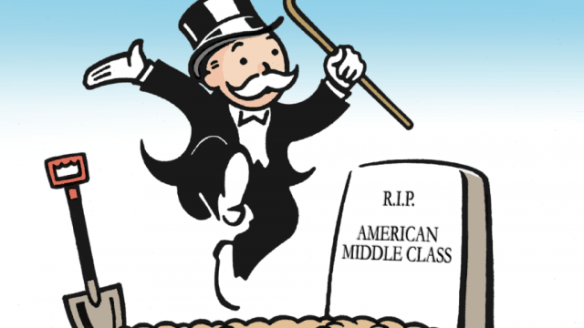
The Erosion of the Middle Class — Why Americans Are Working Harder and Earning Less

By John Liberty

Source: The Mind Unleashed

“I don’t have to tell you things are bad. Everybody knows things are bad. It’s a depression. Everybody’s out of work or scared of losing their job. The dollar buys a nickel’s worth, banks are going bust, shopkeepers keep a gun under the counter. Punks are running wild in the street and there’s nobody anywhere who seems to know what to do, and there’s no end to it.” — Howard Beale

Howard Beale, the main character in the 1976 film Network, became a part of cinematic history when he uttered the line “I’m mad as hell and I’m not gonna take it anymore.” That one line expressed a growing rage among America’s shrinking middle class at a time when Americans were reeling from years of war, political scandals and economic downturn.

In the four decades that have followed, little has improved for the average American. We’re still ‘mad as hell’ and the middle class is being eroded right in front of our eyes. When adjusted for inflation, many Americans are working longer hours and earning less than they did in 1976. So, how have we gone from vibrant middle class to the working poor in a matter of decades?

Median Incomes Are Stagnant

Despite increases in the national income over the past fifty years, middle class families have experienced little income growth over the past few decades. According to U.S. Census datamiddle class incomes have grown by only 28 percent from 1979 – 2014. Meanwhile, a report from the Congressional Budget Office (CBO) shows that the top 20 percent of earners has seen their incomes rise by 95 percent over that same period of time.

Contributing to the stagnation of wages is a notable decrease in the workforce participation rate. According to the Brookings institute, “One reason for these declines in employment and labor force participation is that work is less rewarding. Wages for those at the bottom and middle of the skill and wage distribution have declined or stagnated.” Historical data from the Bureau of Labor Statistics backs up these findings, showing a steady decrease in workforce participation over the last two decades.

The Erosion of the Minimum Wage & America’s Purchasing Power

Anyone who has read a comment thread on the internet about minimum wage laws knows the debate is currently one of the most highly contentious political topics in America. In the halls of Congress, the debate has turned into a nearly decade long impasse. As a result, workers at the low end of the wage scale have watched the purchasing power of their wages decrease from $7.25 in 2009, to $6.19 in 2018 due to inflation. In 2018, you need to perform 47 hours of minimum wage work to achieve the same amount of purchasing power as 40 hours of work in 2009.

The inflation-adjusted minimum wage value has been in steady decline since 1968, when the $1.60 minimum wage was equal to $11.39 (in 2018 dollars). Since then, lawmakers have reduced minimum wage increases relative to the rate of inflation. As Christopher Ingraham reports:

“Recent research shows that the reason politicians — Democrats and Republicans alike — are dragging their feet on popular policies such as the minimum wage is that they pay a lot more attention to the needs and desires of deep-pocketed business groups than they do to regular voters. Those groups tend to oppose minimum wage increases for the simple reason that they eat into their profit margins.”

To be clear, the erosion of the purchasing power of everyday Americans is hardly a new phenomenon. According to data from the U.S. Bureau of Labor Statistics, the purchasing power of the U.S. Dollar has plummeted by over 95 percent since 1913, the year the Federal Reserve was created. The Bureau’s Consumer Price Index indicates that prices in 2018 are 2,436.33% higher than prices in 1913 and that the dollar has experienced an average inflation rate of 3.13% per year during this period.

The Rich Get Richer

While the outlook may be grim for low-wage workers, this is fantastic news for large corporations. Data from the U.S. Bureau of Economics shows that corporate profits are approaching all-time highs. But it’s not just workers who are feeling the effect of growing income inequality. The contrast is also being felt on Main Street. An analysis of the S & P 500 and the Russell 1,000 & 2,000 indexes by Bloomberg revealed a growing gap between America’s largest employers and smaller businesses.

A report from the Institute for Policy Studies entitled Billionaire Bonanza: The Forbes 400 and the Rest of Us echoed these findings when it revealed that America’s 20 wealthiest people — a group that could fit comfortably in one single Gulfstream G650 luxury jet –­ now own more wealth than the bottom half of the American population combined.

Although the Trump administration continues to tout stock market and labor force increases as signs of economic prosperity, numbers show that the wealthiest 10 percent of Americans own 84 percent of all stock. A study conducted by the Economic Policy Institute found that wage growth remains too weak to consider the economy at full employment and that stagnant wage growth has contributed to the growing level of income inequality in America. The study noted that while wages have recovered from the 2008 recession, the gap between those at the top and those at the middle and bottom has continued to increase since 2000. As the study’s author, Elise Gould writes:

“We’re looking at nominal wage growth that is still slower than you would expect in a full employment economy, slower than you would expect if you thought there were any sort of inflation pressures from wage growth.”

The Decimation of the American Dream

Comedian George Carlin once said, “The reason they call it the American Dream is because you have to be asleep to believe it.” For millions of middle class Americans Carlin’s statement has proven eerily accurate. Stagnant wages and decreased purchasing power has put the prospects for middle class children in a tailspin as upward mobility trends have reportedly fallen by over 40 percent since 1950.

A poll conducted by the Pew Research Institute corroborates this claim. According to Pew, only 37 percent of Americans believe that today’s children will grow up to be better off financially than their parents. That means more Americans think that today’s children will be financially worse off than their parents than those who believe they will be better off.

The sentiments expressed by millions of middle class Americans appear to be wholly justified due to the fact that middle class families are becoming more fragile and dependent on two incomes. A report from the Council of Economic Advisors found the majority of the income gains made by the middle class from 1979 to 2013 were a result of increased participation in the workplace by women. The report also noted the fragility of two income families amidst a decline in marriage and a drastic rise in single parent homes in recent years.

As a result of the slow growth in wages, over half of Americans now receive more in Government transfer payments (Medicare, Medicaid, food stamps, Social Security) than they pay in federal taxes. An analysis of all 50 states also found that in 42 states the cost of living is higher than the median income.

The rising cost of healthcare is also putting the pinch on the wallets of many Americans. As Jeffrey Pfeffer noted in his book Dying for a Paycheck, healthcare spending—per capita—has increased 29 fold over the past 40 years, outpacing the growth of the American economy.

While many Americans continue to look to the government to fix problems like wage stagnation, income inequality and rising healthcare costs, the sad truth is that we live in a time when 1 in 3 households has trouble paying energy bills and 40 percent of Americans face poverty in retirement at the exact same time the Federal Government has admitted that they lost $21 trillion. Not only did they lose $21 trillion (yes that’s TRILLION with a T), but the Department of Defense indicated in a press conference that they “never expected to pass” the audit to locate the missing taxpayer money.

John Emerich Edward Dalberg Acton famously proclaimed in 1887:

“Power tends to corrupt, and absolute power corrupts absolutely. Great men are almost always bad men.”

Perhaps it’s time for the millions of Americans who are quietly ‘mad as hell’ to start expressing their rage at the corrupt institutions of power that are decimating their livelihoods rather than expecting those very same institutions to fix the problems they created.


The Five Stages of Collapse, 2019 Update

By Dmitry Orlov

Source: Club Orlov

Collapse, at each stage, is a historical process that takes time to run its course as the system adapts to changing circumstances, compensates for its weaknesses and finds ways to continue functioning at some level. But what changes rather suddenly is faith or, to put it in more businesslike terms, sentiment. A large segment of the population or an entire political class within a country or the entire world can function based on a certain set of assumptions for much longer than the situation warrants but then over a very short period of time switch to a different set of assumptions. All that sustains the status quo beyond that point is institutional inertia. It imposes limits on how fast systems can change without collapsing entirely. Beyond that point, people will tolerate the older practices only until replacements for them can be found.

Stage 1: Financial collapse. Faith in “business as usual” is lost.

Internationally, the major change in sentiment in the world has to do with the role of the US dollar (and, to a lesser extent, the Euro and the Yen—the other two reserve currencies of the three-legged globalist central banker stool). The world is transitioning to the use of local currencies, currency swaps and commodities markets backed by gold. The catalyst for this change of sentiment was provided by the US administration itself which sawed through its own perch by its use of unilateral sanctions. By using its control over dollar-based transactions to block international transactions it doesn’t happen to like it forced other countries to start looking for alternatives. Now a growing list of countries sees throwing off the shackles of the US dollar as a strategic goal. Russia and China use the ruble and the yuan for their expanding trade; Iran sells oil to India for rupees. Saudi Arabia has started to accept the yuan for its oil.

This change has many knock-on effects. If the dollar is no longer needed to conduct international trade, other nations no longer have hold large quantities of it in reserve. Consequently, there is no longer a need to buy up large quantities of US Treasury notes. Therefore, it becomes unnecessary to run large trade surpluses with the US, essentially conducting trade at a loss. Further, the attractiveness of the US as an export market drops and the cost of imports to the US rises, thereby driving up cost inflation. A vicious spiral ensues in which the ability of the US government to borrow internationally to finance the gaping chasm of its various deficits becomes impaired. Sovereign default of the US government and national bankruptcy then follow.

The US may still look mighty, but its dire fiscal predicament coupled with its denial of the inevitability of bankruptcy, makes it into something of a Blanche DuBois from the Tennessee Williams play “A Streetcar Named Desire.” She was “always dependent on the kindness of strangers” but was tragically unable to tell the difference between kindness and desire. In this case, the desire is for national advantage and security, and to minimize risk by getting rid of an unreliable trading partner.

How quickly or slowly this comes to pass is difficult to guess at and impossible to calculate. It is possible to think of the financial system in terms of a physical analogue, with masses of funds traveling at some velocity having a certain inertia (p = mv) and with forces acting on that mass to accelerate it along a different trajectory (F = ma). It is also possible to think of it in terms of hordes of stampeding animals who can change course abruptly when panicked. The recent abrupt moves in the financial markets, where trillions of dollars of notional, purely speculative value have been wiped out within weeks, are more in line with the latter model.

Stage 2: Commercial collapse. Faith that “the market shall provide” is lost.

Within the US there is really no other alternative than the market. There are a few rustic enclaves, mostly religious communities, that can feed themselves, but that’s a rarity. For everyone else there is no choice but to be a consumer. Consumers who are broke are called “bums,” but they are still consumers. To the extent that the US has a culture, it is a commercial culture in which the goodness of a person is based on the goodly sums of money in their possession. Such a culture can die by becoming irrelevant (when everyone is dead broke) but by then most of the carriers of this culture are likely to be dead too. Alternatively, it can be replaced by a more humane culture that isn’t entirely based on the cult of Mammon—perhaps, dare I think, through a return to a pre-Protestant, pre-Catholic Christian ethic that values people’s souls above objects of value?

Stage 3: Political collapse. Faith that “the government will take care of you” is lost.

All is very murky at the moment, but I would venture to guess that most people in the US are too distracted, too stressed and too preoccupied with their own vices and obsessions to pay much attention to the political realm. Of the ones they do pay attention, a fair number of them seem clued in to the fact that the US is not a democracy at all but an elites-only sandbox in which transnational corporate and oligarchic interests build and knock down each others’ sandcastles.

The extreme political polarization, where two virtually identical pro-capitalist, pro-war parties pretend to wage battle by virtue-signaling may be a symptom of the extremely decrepit state of the entire political arrangement: people are made to watch the billowing smoke and to listen to the deafening noise in the hopes that they won’t notice that the wheels are no longer turning.

The fact that what amounts to palace intrigue—the fracas between the White House, the two houses of Congress and a ghoulish grand inquisitor named Mueller—has taken center stage is uncannily reminiscent of various earlier political collapses, such as the disintegration of the Ottoman Empire or of the fall and the consequent beheading of Louis XVI. The fact that Trump, like the Ottoman worthies, stocks his harem with East European women, lends an eerie touch. That said, most people in the US seem blind to the nature of their overlords in a way that the French, with their Gilets Jaunes movement (just as an example) are definitely not.

Stage 4: Social collapse. Faith that “your people will take care of you” is lost.

I have been saying for some years now that within the US social collapse has largely run its course, although whether people actually believe that is an entire matter entirely. Defining “your people” is rather difficult. The symbols are still there—the flag, the Statue of Liberty and a predilection for iced drinks and heaping plates of greasy fried foods—but the melting pot seems to have suffered a meltdown and melted all the way to China. At present half the households within the US speak a language other than English at home, and a fair share of the rest speak dialects of English that are not mutually intelligible with the standard North American English dialect of broadcast television and university lecturers.

Throughout its history as a British colony and as a nation the US has been dominated by the Anglo ethnos. The designation “ethnos” is not an ethnic label. It is not strictly based on genealogy, language, culture, habitat, form of government or any other single factor or group of factors. These may all be important to one extent or another, but the viability of an ethnos is based solely on its cohesion and the mutual inclusivity and common purpose of its members. The Anglo ethnos reached its zenith in the wake of World War II, during which many social groups were intermixed in the military and their more intelligent members were allowed to become educated and to advance socially by the GI Bill.

Fantastic potential was unleashed when privilege—the curse of the Anglo ethnos since its inception—was temporarily replaced with merit and the more talented demobilized men, of whatever extraction, were given a chance at education and social advancement by the GI Bill. Speaking a new sort of American English based on the Ohio dialect as a Lingua Franca, these Yanks—male, racist, sexist and chauvinistic and, at least in their own minds, victorious—were ready to remake the entire world in their own image.

They proceeded to flood the entire world with oil (US oil production was in full flush then) and with machines that burned it. Such passionate acts of ethnogenesis are rare but not unusual: the Romans who conquered the entire Mediterranean basin, the barbarians who then sacked Rome, the Mongols who later conquered most of Eurasia and the Germans who for a very brief moment possessed an outsized Lebensraum are other examples.

And now it is time to ask: what remains of this proud conquering Anglo ethnos today? We hear shrill feminist cries about “toxic masculinity” and minorities of every stripe railing against “whitesplaining” and in response we hear a few whimpers but mostly silence. Those proud, conquering, virile Yanks who met and fraternized with the Red Army at the River Elbe on April 25, 1945—where are they? Haven’t they devolved into a sad little subethnos of effeminate, porn-addicted overgrown boys who shave their pubic hair and need written permission to have sex without fear of being charged with rape?

Will the Anglo ethnos persist as a relict, similar to how the English have managed to hold onto their royals (who are technically no longer even aristocrats since they now practice exogamy with commoners)? Or will it get wiped out in a wave of depression, mental illness and opiate abuse, its glorious history of rapine, plunder and genocide erased and the statues of its war heroes/criminals knocked down? Only time will tell.

Stage 5: Cultural collapse. Faith in “the goodness of humanity” is lost.

The term “culture” means many things to many people, but it is more productive to observe cultures than to argue about them. Cultures are expressed through people’s stereotypical behaviors that are readily observable in public. These are not the negative stereotypes often used to identify and reject outsiders but the positive stereotypes—cultural standards of behavior, really—that serve as requirements for social adequacy and inclusion. We can readily assess the viability of a culture by observing the stereotypical behaviors of its members.

• Do people exist as a single continuous, inclusive sovereign realm or as a set of exclusive, potentially warring enclaves segregated by income, ethnicity, education level, political affiliation and so on? Do you see a lot of walls, gates, checkpoints, security cameras and “no trespassing” signs? Is the law of the land enforced uniformly or are there good neighborhoods, bad neighborhoods and no-go zones where even the police fear to tread?

• Do random people thrown together in public spontaneously enter into conversation with each other and are comfortable with being crowded together, or are they aloof and fearful, and prefer to hide their face in the little glowing rectangle of their smartphone, jealously guarding their personal space and ready to regard any encroachment on it as an assault?

• Do people remain good-natured and tolerant toward each other even when hard-pressed or do they hide behind a façade of tense, superficial politeness and fly into a rage at the slightest provocation? Is conversation soft in tone, gracious and respectful or is it loud, shrill, rude and polluted with foul language? Do people dress well out of respect for each other, or to show off, or are they all just déclassé slobs—even the ones with money?

• Observe how their children behave: are they fearful of strangers and trapped in a tiny world of their own or are they open to the world and ready to treat any stranger as a surrogate brother or sister, aunt or uncle, grandmother or grandfather without requiring any special introduction? Do the adults studiously ignore each others’ children or do they spontaneously act as a single family?

• If there is a wreck on the road, do they spontaneously rush to each others’ rescue and pull people out before the wreck explodes, or do they, in the immortal words of Frank Zappa, “get on the phone and call up some flakes” who “rush on over and wreck it some more”?

• If there is a flood or a fire, do the neighbors take in the people who are rendered homeless, or do they allow them to wait for the authorities to show up and bus them to some makeshift government shelter?

It is possible to quote statistics or to provide anecdotal evidence to assess the state and the viability of a culture, but your own eyes and other senses can provide all the evidence you need to make that determination for yourself and to decide how much faith to put in “the goodness of humanity” that is evident in the people around you.

Prices, plutocrats, and corporate concentration

Would less corporate concentration – and a weaker corporate capacity to raise prices – mean less inequality?

By Sam Pizzigati

Source: Nation of Change

Andrew Leigh, a member of the Australian parliament, has a side gig. He just happens to be a working economist. Other lawmakers may spend their spare hours making cold calls for campaign cash. Leigh spends his doing research – on why our modern economies are leaving their populations ever more unequal.

Leigh’s latest research is making some global waves. Working with a team of Australian, Canadian, and American analysts, he’s been studying how much the prices corporate monopolies charge impact inequality.

The conventional wisdom has a simple answer: not much. Yes, the reasoning goes, prices do go up when a few large corporations start to dominate an economic sector. But those same higher prices translate into higher returns for corporate shareholders.

Thanks to 401(k)s and the like, the argument continues, the ranks of these corporate shareholders include millions of average families. So we end up with a wash. As consumers, families pay more in prices. As shareholders, they pocket higher dividends.

But this nonchalance about the impact of monopolies, Andrew Leigh and his colleagues counter, obscures “the relative distribution of consumption and corporate equity ownership.” Average families do hold some shares of stock, but not many. In the United States, for instance, the most affluent 20 percent of households own 13 times more stock than the bottom 60 percent.

These bottom 60 percent households, as a result, get precious little return from the few shares of stock they do hold, not nearly enough to offset the higher prices they pay on corporate monopoly products.

“On net, that means it’s nearly impossible for the typical U.S. family to make up for higher prices via the performance of their stock portfolio,” notes a Washington Post analysis of the Leigh team research. “When prices rise, low- and middle-class families pay. Wealthy families profit.”

By how much do these affluents profit? Leigh and his colleagues have done the math. The higher prices – and profits – that corporate concentration has generated have shifted 3 percent of national income out of the pockets of poor and middle-class families into the wallets of the affluent.

The larger our corporations become, in other words, the more unequal our societies become.

Now corporations don’t grow larger in the same way as people grow larger. Corporations have no adolescent growth spurts. They don’t mature. They have no real personhood. Corporations only become larger when the executives who run them make them larger, most typically by wheeling and dealing their way through ever grander mergers and acquisitions.

This wheeling and dealing takes up a huge chunk of modern corporate executive time and energy. Why do execs devote so much of their time and energy to getting bigger? Getting bigger pays – for execs.

Indeed, firm size determines how much executives make more than any other factor, as research has shown repeatedly over the years. Executives don’t have to “perform” – make their enterprises more efficient and effective – to make bigger bucks. They just to need to make their enterprises bigger.

Executives, in short, have a powerful incentive to grow their companies, and that powerful incentive, as the latest research from Andrew Leigh and his colleagues shows, isn’t just making these executives richer. It’s leaving our societies much more unequal.

So what can we do to ease the damage? Tougher antitrust enforcement could certainly slow our rates of corporate concentration. But the legislative activities of Andrew Leigh in Australia suggest another promising approach as well.

Leigh serves as a “shadow” minister for the Australian parliament’s Labor Party opposition. This past fall, he announced that his party, if elected to power, will require all major corporations to publicly disclose the ratio between their CEO and worker pay.

A similar disclosure mandate went into effect in the United States last year. As of January 1, 2019, the UK now has a pay-ratio disclosure mandate in effect as well.

Forcing Australian corporations to reveal their CEO-worker pay ratios, Leigh notes, would encourage these corporations “to think about how they are serving all their workers, and society as a whole.” But a growing number of progressives in the United States and the U.K. believe that pay ratios can do more than just “encourage” corporations to better serve their societies.

These progressives are pushing for consequences on CEO-pay ratios, proposing legislation that would deny government contracts and subsidies to corporations with wide gaps between their CEO and worker pay. They’re also calling for higher tax rates on companies with wider CEO-worker pay ratios, and one American city, Oregon’s Portland, already has such an “inequality tax” in effect.

More moves in this direction could significantly reduce the incentive for the executive wheeling and dealing that’s concentrating corporate power in fewer and fewer corporate hands. That wheeling and dealing – in nations with consequences on pay ratios in effect – would no longer guarantee grand windfalls to our corporate executive class.

Less wheeling and dealing, in turn, would mean less corporate concentration – and a weaker corporate capacity to raise prices. And that would mean, as the new Leigh gang’s research so clearly shows, less inequality.

Death Of Russiagate: Mueller Team Tied To Mifsud’s Network

By Elizabeth Vos

Source: Disobedient Media

In April last year, Disobedient Media broke coverage of the British involvement in the Trump-Russia collusion narrative, asking why All Russiagate Roads Lead To London, via the quasi-scholar Joseph Mifsud and others.

The issue was also raised by WikiLeaks’s Julian Assange, just days before the Ecuadorian government silenced him last March. Assange’s Twitter thread cited research by Chris Blackburn, who spoke with Disobedient Media on multiple occasions covering Joseph Mifsud’s ties to British intelligence figures and organizations, as well as his links to Hillary Clinton’s Presidential campaign, the FBI, CIA and the private cyber-security firm Crowdstrike.

We return, now, to this issue and specifically the research of Chris Blackburn, to place the final nail in the coffin of the Trump-Russia collusion charade. Blackburn’s insights are incredible not only because they return us to the earliest reporting on the role of British intelligence figures in manufacturing the Trump-Russia collusion narrative, but because they also implicate members of Mueller’s investigation. What we are left with is an indication of collusion between factions of the US and UK intelligence community in fabricating evidence of Trump-Russia collusion: a scandal that would have rocked the legacy press to its core, if Western establishment-backed media had a spine.

In Disobedient Media’s previous coverage of Blackburn’s work, he described his experience in intelligence:

“I’ve been involved in numerous investigations that involve counter-intelligence techniques in the past. I used to work for the 9/11 Families United to Bankrupt Terrorism, one of the biggest tort actions in American history. I helped build a profile of Osama bin Laden’s financial and political network, which was slightly different to the one that had been built by the CIA’s Alec Station, a dedicated task force which was focused on Osama bin Laden and Al-Qaeda. Alec Station designed its profile to hunt Osama bin Laden and disrupt his network. I thought it was flawed. It had failed to take into account Osama’s historical links to Pakistan’s main political parties or that he was the figurehead for a couple of organizations, not just Al-Qaeda.”

“I also ran a few conferences for US intelligence leaders during the Bush administration. After the 9/11 Commission published its report into the attacks on the World Trade Center and the Pentagon it created a public outreach program. The US National Intelligence Conference and Exposition (Intelcon) was one of the avenues it used. I was responsible for creating the ‘View from Abroad’ track. We had guidance from former Senator Slade Gorton and Jamie Gorelick, who both sat on the 9/11 Commission. We got leaders such as Sir John Chilcot and Baroness Pauline Neville Jones to come and help share their experiences on how the US would be able to heal the rifts after 9/11.”

“The US intelligence community was suffering from severe turf wars and firewalls, which were hampering counter-terrorism efforts. They were concentrating on undermining each other rather than tackling terrorism. I had mainly concentrated on the Middle East, but in 2003 I switched my focus to terrorism in South Asia.”

Counter Terrorism, Not Counter Intelligence, Sparked Probe

In an article published by The Telegraph last November, the paper acknowledged the following:

“It forces the spotlight on whether the UK played a role in the FBI’s investigation launched before the 2016 presidential election into Trump campaign ties to the Kremlin… Mr. Trump’s allies and former advisers are raising questions about the UK’s role in the start of the probe, given many of the key figures and meetings were located in Britain… One former top White House adviser to Mr. Trump made similar insinuations, telling this newspaper: “You know the Brits are up to their neck.” The source added on the Page wiretap application: “I think that stuff is going to implicate MI5 and MI6 in a bunch of activities they don’t want to be implicated in, along with FBI, counter-terrorism and the CIA.” [Emphasis Added]

The article cites George Papadopoulos, who asked why the “British intelligence apparatus was weaponized against Trump and his advisers.” Papadopoulos has also addressed the issue at length via Twitter. In response to the Telegraph’s coverage of the issue, Chris Blackburn wrote via Twitter: “The Telegraph story on Trump Russia acknowledges that activities involving counter-terrorism are at the heart of the scandal…not counter-intelligence. If the [London Centre for International Law Practice] was British state, not private, some Commonwealth countries are going to be seriously pissed off.”

Blackburn spoke with Disobedient Media, saying: “If you factor in the dreadful reporting to discredit Joseph Mifsud and leaks, it is pretty clear something rather strange happened to George Papadopoulos during the campaign while he was shuttling around Europe and the Middle East. He was working with people who have intelligence links at the London Centre of International Law Practice. A recent article in The Telegraph also alludes to MI5, MI6, and CIA using counter-terrorism assets which would tie into the London Centre of International Law Practice (LCILP), and its sister organizations, doing counter-terrorism work for the Australian, UK and US governments. They quote anonymous officials who believe that their intelligence agencies used counter-terrorism personnel to kick start the investigation/scandal.” [Emphasis Added]

Blackburn discussed this differentiation with Disobedient Media: “Counter-terrorism is obviously involved in more kinetic, violent political actions-concerning mass casualty events, bombings, assassinations, poisonings, and hacking. But, the lines are blurring between them. Counter-intelligence cases have been known to stretch for decades- often relying on nothing more than paranoia and suspicion to fuel investigations. Counter-terrorism is also a broader discipline as it involves tactical elements like hostage rescue, crime scene investigations, and explosive specialists. Counter-Terrorism is a collaborative effort with counter-terrorism officers working closely with local and regional police forces and civic organizations. There is also a wider academic field around countering violent, and radical ideology which promotes terrorism and insurgencies. Cybersecurity has become the third major discipline in intelligence. The London Center of International Law Practice, the mysterious intelligence company that employed both Papadopoulos and Mifsud, had also been working in that area.”

Continuing, Blackburn pinpointed the significance of defining counter-terrorism as the starting point of the investigation, saying: “It shows that there is a high probability that intelligence was deliberately abused to make Papadopoulos’ activities look like they were something else. As counter-terrorism and counterintelligence are close in tactics and methods, it would seem that they were used because they share the same skill sets – covert evidence gathering and deception. It’s basically sleight of hand. A piece of theatre would be more precise. However, we don’t know if the FBI knew it was real or make-believe. It’s more likely that the CIA played the FBI with the help of close allies who were suspicious and frightened of a Trump presidency.”

Mueller’s Team And Joseph Mifsud

Zainab Ahmad, a member of Mueller’s legal team, is the former Assistant United States Attorney in the Eastern District of New York. As pointed out by Blackburn, Ahmad attended a Global Center on Cooperative Security event in 2017. In recent days, Blackburn wrote via Twitter: “Zainab Ahmad is a major player in the Russiagate scandal at the DOJ. Does she work for SC Mueller? She was at a GCCS event in May 2017. Arvinder Sambei, a co-director of the [London Centre of International Law Practice], worked with Joseph Mifsud, [George Papadopoulos] and [Simona Mangiante]. She’s a GCCS consultant.”

Blackburn told this author: “Zainab Ahmad was one of the first DOJ prosecutors to have seen the Steele dossier. In May 2017, she attended a counter-terrorism conference in New York with the Global Center on Cooperative Security (GCCS), an organization which Joseph Mifsud, the alleged Russian spy, had been working within London and Riyadh, Saudi Arabia.”

“Richard Barrett, the Former Chief of Counter-Terrorism at MI6, Britain’s foreign intelligence department traveled with Mifsud to Saudi Arabia to give a talk on terrorism in 2017. Ex-CIA officers, US Defense, and US Treasury officials were also there. The London Centre of International Law Practice’s relationship to the Global Center had been established in 2014. The Global Center on Cooperative Security made Martin Polaine and Arvinder Sambei consultants, they then became directors at the London Centre of International Law Practice.”

“The Global Center on Cooperative Security’s first major UK conference was at Joseph Mifsud’s London Academy of Diplomacy (LAD). Mifsud then followed Arvinder Sambei and Nagi Idris over to the London Centre of International Law Practice. Sources have told me that Mifsud was moonlighting as a specialist on counter-terrorism and Islamism while working at LAD which explains why he went to work in counter-terrorism after LAD folded.”

“I don’t think it’s a coincidence that Global Center on Cooperative Security is connected to various elements that popped up in the Papadopoulos case. The fact that a prosecutor on Mueller’s team was at Global Center before Mueller was appointed as special counsel is also troubling.”

Days ago, The Hill reported on Congressional testimony by Bruce Ohr, revealing that when served as a DOJ official, he warned FBI and DOJ figures that the Steele dossier was problematic and linked to the Clintons. Critically, The Hill writes:

“Those he briefed included Andrew Weissmann, then the head of DOJ’s fraud section; Bruce Swartz, longtime head of DOJ’s international operations, and Zainab Ahmad, an accomplished terrorism prosecutor who, at the time, was assigned to work with Lynch as a senior counselor. Ahmad and Weissmann would go on to work for Mueller, the special prosecutor overseeing the Russia probe.” [Emphasis Added]

This point is essential, as it not only describes Ahmad’s role in Mueller’s team but places her at a crucial pre-investigation meeting.

Last year, Blackburn noted the connection between Mifsud and Arvinder Sambei, writing: “LCILP director and FBI counsel, works with Mike Smith at the Global Center. They ran joint counter-terrorism conferences and training with Mifsud’s London Academy. Sambei then brought Mifsud over to the [London Centre of International Law Practice]. [Global Center works with Aussies, UK and US State too.”

Sambei has been described elsewhere as a “Former practising barrister, Senior Crown Prosecutor with the Crown Prosecution Service of England & Wales, and Legal Adviser at the Permanent Joint Headquarters (PJHQ), Ministry of Defence.” [British spelling has been retained]

That Sambei has been so thoroughly linked to organizations where Mifsud was a central figure is yet another cause of suspicion regarding allegations that Joseph Mifsud was a shadowy, unknown Russian agent until the summer of 2016. She is also a direct link between Robert Mueller and Mifsud.

Blackburn wrote via Twitter: “Arvinder Sambei helped to organize LCILP’s counter-terrorism and corruption events. She used her contacts in the US to bring in Middle Eastern government officials that were seen to be vulnerable to graft. Lisa Osofsky, former FBI Deputy General Counsel, was working with her.” Below, Arvinder is pictured at a London Centre of International Law Practice (LCILP) event.

As Chris Blackburn told this author: “Mifsud and Papadopoulos’s co-director Arvinder Sambei was also the former FBI British counsel working 9/11 cases for Robert Mueller. She also runs a consultancy which deals with Special Investigative Measure (SIMs) which is just a posh description for covert espionage and evidence gathering. She has worked for major intelligence and national law agencies in the past. She wore two hats as a director of London Centre and a consultant for the Global Center on Cooperative Security (GCCS), a counter-terrorism think tank which is sponsored by the Australia, Canada, UK and US governments. Alexander Downer’s former Chief of Staff while at the Australian Department of Foreign Affairs and Trade now works for the Global Center. Mifsud was also due to meet with Australian private intelligence figures in Adelaide in March 2016. So. Australia is certainly a major focus for the investigation.” [Emphasis Added]

Below, former FBI Deputy General Counsel Lisa Osofsky is pictured at a London Centre for International Law Practice event. Osofsky also served as the Money Laundering Reporting Officer with Goldman Sachs International. Since 2018, she has served as the Director of the UK’s Serious Fraud Office (SFO).
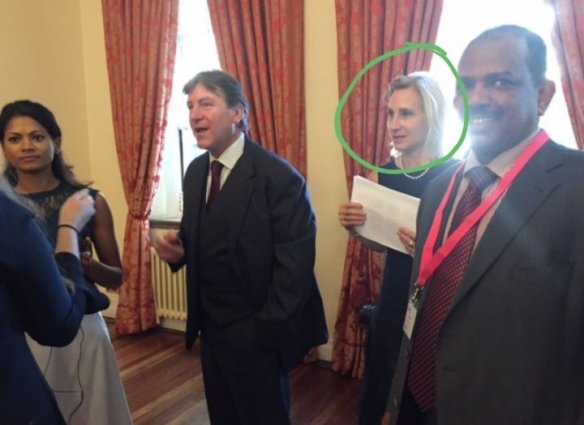
An Embarrassment For John Brennan?

Disobedient Media previously reported that Robert Hannigan, then head of British spy agency GCHQ, flew to Washington DC to share ‘director-to-director’ level intelligence with then-CIA Chief John Brennan in the summer of 2016. This writer noted that “The Guardian reported Hannigan’s announcement that he would step down from his leadership position with the agency just three days after the inauguration of President Trump, on 23 January 2017. Jane Mayer, in her profile of Christopher Steele published in the New Yorker, also noted that Hannigan had flown to Washington D.C. to personally brief the then-CIA Director John Brennan on alleged communications between the Trump campaign and Moscow. What is so curious about this briefing “deemed so sensitive it was handled at director-level” is why Hannigan was talking director-to-director to the CIA and not Mike Rogers at the NSA, GCHQ’s Five Eyes intelligence-sharing partner.”

Blackburn told Disobedient Media: “Former Congressman Trey Gowdy, who has seen most of the information gathered by Congress from the intelligence community concerning the Russia investigation, said that if President Trump were to declassify files and present the truth to the American public, it would “embarrass John Brennan.” I think that is pretty concrete for me, but it’s not definitive. I know the polarization and spin in Washington has become perverse, but that statement is pretty specific for me. If Brennan is involved, it is most probably through Papadopoulos who sparked off the ‘official’ investigation at the FBI. He also made sure the Steele dossier was spread through the US government.”

Blackburn added: “Chris Steele was also working on FIFA projects, and a source has told me that he was working to investigate the Russian and Qatari World Cup bids. The London Centre of International Law Practice has been working with Majed Garoub, the former Saudi legal representative of FIFA, the world governing body for soccer. He’s also been working against the Qatari bid. Steele likes to get paid twice for his investigations.”

“Mifsud has also been associated with Prince Turki the former Saudi intelligence chief, Mifsud and the London Academy of Diplomacy used to train Saudi diplomats and intelligence figures while Turki was the Saudi Ambassador to London. Turki is a close friend of Bill Clinton and John Brennan. Nawaf Obaid was also courting Mifsud and tried to get him a cushy job working with CNN’s Freedom Project at Link Campus in Rome. He also knows John Brennan. Intelligence agencies like to give out professional gifts like this plum academic position for completing missions. In the US, it is widely known that intelligence agencies gift the children of assets to get them into prestigious Ivy League schools.”

At minimum, we can surmise that Mifsud was not a Russian agent, but was an asset of Western intelligence agencies. We are left with the impression that the Mifsud saga served as a ploy, whether he participated knowingly or not. It seems reasonable to conclude that the gambit was initially developed with participation of John Brennan and UK intelligence. Following this, Mueller inherited and developed the Mifsud narrative thread into the collusion soap opera we know today.

Ultimately, we are faced with the reality that British and US interests worked together to fabricate a collusion scandal to subvert a US Presidency, and in doing so, intentionally raised tensions between the West and a nuclear-armed power.