1/11 Guillermo Jimenez and writer/activist Larry Pinkney discuss the recent release of Lynne Stewart in the context of past and present COINTELPRO actions against activists at Traces of Reality:
1/13 On the Black Agenda Report they commemorate the life of Amiri Baraka, discuss the war on poverty, important people-powered movements for 2014, failures of the moderate democrats and the International Criminal Court, the Washington Post as CIA asset, and an update on the Dallas 5:
1/13 Guy Evans and independent journalist Rania Khalek discuss positive aspects and limitations of independent media, the school-to-prison pipeline, Nelson Mandela, the NSA and other topics on Smells Like Human Spirit:
1/15 On the C-Realm Podcast, KMO and David J. Blacker explore the themes of David’s new book, The Falling Rate of Learning and the Neoliberal Endgame. They cover big questions related to technology and economics such as “If public education in the 20th Century was shaped by the needs of capitalist production, what form does education take when what Capitalists really need a growing segment of the population to do is go away?”:
1/16 Another great Smells Like Human Spirit interview featuring former LAPD police officer and whistleblower Michael Ruppert. They discuss JFK, the rise of corporate power, and the future of the surveillance state among other topics:
This cartoon by Gavin Aung Than of Zen Pencil is a creative visualization of an excerpt of a speech by Erica Goldson, who was the 2010 Valedictorian of Coxsackie-Athens High School. Though it was delivered at her graduation ceremony for fellow students it remains relevant to society and especially those who work for positive change. Below is a video of the speech followed by the complete transcript.
Here I Stand
There is a story of a young, but earnest Zen student who approached his teacher, and asked the Master, “If I work very hard and diligently, how long will it take for me to find Zen? The Master thought about this, then replied, “Ten years.” The student then said, “But what if I work very, very hard and really apply myself to learn fast – How long then?” Replied the Master, “Well, twenty years.” “But, if I really, really work at it, how long then?” asked the student. “Thirty years,” replied the Master. “But, I do not understand,” said the disappointed student. “At each time that I say I will work harder, you say it will take me longer. Why do you say that?” Replied the Master, “When you have one eye on the goal, you only have one eye on the path.”
This is the dilemma I’ve faced within the American education system. We are so focused on a goal, whether it be passing a test, or graduating as first in the class. However, in this way, we do not really learn. We do whatever it takes to achieve our original objective.
Some of you may be thinking, “Well, if you pass a test, or become valedictorian, didn’t you learn something? Well, yes, you learned something, but not all that you could have. Perhaps, you only learned how to memorize names, places, and dates to later on forget in order to clear your mind for the next test. School is not all that it can be. Right now, it is a place for most people to determine that their goal is to get out as soon as possible.
I am now accomplishing that goal. I am graduating. I should look at this as a positive experience, especially being at the top of my class. However, in retrospect, I cannot say that I am any more intelligent than my peers. I can attest that I am only the best at doing what I am told and working the system. Yet, here I stand, and I am supposed to be proud that I have completed this period of indoctrination. I will leave in the fall to go on to the next phase expected of me, in order to receive a paper document that certifies that I am capable of work. But I contest that I am a human being, a thinker, an adventurer – not a worker. A worker is someone who is trapped within repetition – a slave of the system set up before him. But now, I have successfully shown that I was the best slave. I did what I was told to the extreme. While others sat in class and doodled to later become great artists, I sat in class to take notes and become a great test-taker. While others would come to class without their homework done because they were reading about an interest of theirs, I never missed an assignment. While others were creating music and writing lyrics, I decided to do extra credit, even though I never needed it. So, I wonder, why did I even want this position? Sure, I earned it, but what will come of it? When I leave educational institutionalism, will I be successful or forever lost? I have no clue about what I want to do with my life; I have no interests because I saw every subject of study as work, and I excelled at every subject just for the purpose of excelling, not learning. And quite frankly, now I’m scared.
John Taylor Gatto, a retired school teacher and activist critical of compulsory schooling, asserts, “We could encourage the best qualities of youthfulness – curiosity, adventure, resilience, the capacity for surprising insight simply by being more flexible about time, texts, and tests, by introducing kids into truly competent adults, and by giving each student what autonomy he or she needs in order to take a risk every now and then. But we don’t do that.” Between these cinderblock walls, we are all expected to be the same. We are trained to ace every standardized test, and those who deviate and see light through a different lens are worthless to the scheme of public education, and therefore viewed with contempt.
H. L. Mencken wrote in The American Mercury for April 1924 that the aim of public education is not
to fill the young of the species with knowledge and awaken their intelligence. … Nothing could be further from the truth. The aim … is simply to reduce as many individuals as possible to the same safe level, to breed and train a standardized citizenry, to put down dissent and originality. That is its aim in the United States. (Gatto)
To illustrate this idea, doesn’t it perturb you to learn about the notion of “critical thinking.” Is there really such a thing as “uncritically thinking?” To think is to process information in order to form an opinion. But if we are not critical when processing this information, are we really thinking? Or are we mindlessly accepting other opinions as truth?
This was happening to me, and if it wasn’t for the rare occurrence of an avant-garde tenth grade English teacher, Donna Bryan, who allowed me to open my mind and ask questions before accepting textbook doctrine, I would have been doomed. I am now enlightened, but my mind still feels disabled. I must retrain myself and constantly remember how insane this ostensibly sane place really is.
And now here I am in a world guided by fear, a world suppressing the uniqueness that lies inside each of us, a world where we can either acquiesce to the inhuman nonsense of corporatism and materialism or insist on change. We are not enlivened by an educational system that clandestinely sets us up for jobs that could be automated, for work that need not be done, for enslavement without fervency for meaningful achievement. We have no choices in life when money is our motivational force. Our motivational force ought to be passion, but this is lost from the moment we step into a system that trains us, rather than inspires us.
We are more than robotic bookshelves, conditioned to blurt out facts we were taught in school. We are all very special, every human on this planet is so special, so aren’t we all deserving of something better, of using our minds for innovation, rather than memorization, for creativity, rather than futile activity, for rumination rather than stagnation? We are not here to get a degree, to then get a job, so we can consume industry-approved placation after placation. There is more, and more still.
The saddest part is that the majority of students don’t have the opportunity to reflect as I did. The majority of students are put through the same brainwashing techniques in order to create a complacent labor force working in the interests of large corporations and secretive government, and worst of all, they are completely unaware of it. I will never be able to turn back these 18 years. I can’t run away to another country with an education system meant to enlighten rather than condition. This part of my life is over, and I want to make sure that no other child will have his or her potential suppressed by powers meant to exploit and control. We are human beings. We are thinkers, dreamers, explorers, artists, writers, engineers. We are anything we want to be – but only if we have an educational system that supports us rather than holds us down. A tree can grow, but only if its roots are given a healthy foundation.
For those of you out there that must continue to sit in desks and yield to the authoritarian ideologies of instructors, do not be disheartened. You still have the opportunity to stand up, ask questions, be critical, and create your own perspective. Demand a setting that will provide you with intellectual capabilities that allow you to expand your mind instead of directing it. Demand that you be interested in class. Demand that the excuse, “You have to learn this for the test” is not good enough for you. Education is an excellent tool, if used properly, but focus more on learning rather than getting good grades.
For those of you that work within the system that I am condemning, I do not mean to insult; I intend to motivate. You have the power to change the incompetencies of this system. I know that you did not become a teacher or administrator to see your students bored. You cannot accept the authority of the governing bodies that tell you what to teach, how to teach it, and that you will be punished if you do not comply. Our potential is at stake.
For those of you that are now leaving this establishment, I say, do not forget what went on in these classrooms. Do not abandon those that come after you. We are the new future and we are not going to let tradition stand. We will break down the walls of corruption to let a garden of knowledge grow throughout America. Once educated properly, we will have the power to do anything, and best of all, we will only use that power for good, for we will be cultivated and wise. We will not accept anything at face value. We will ask questions, and we will demand truth.
So, here I stand. I am not standing here as valedictorian by myself. I was molded by my environment, by all of my peers who are sitting here watching me. I couldn’t have accomplished this without all of you. It was all of you who truly made me the person I am today. It was all of you who were my competition, yet my backbone. In that way, we are all valedictorians.
I am now supposed to say farewell to this institution, those who maintain it, and those who stand with me and behind me, but I hope this farewell is more of a “see you later” when we are all working together to rear a pedagogic movement. But first, let’s go get those pieces of paper that tell us that we’re smart enough to do so!
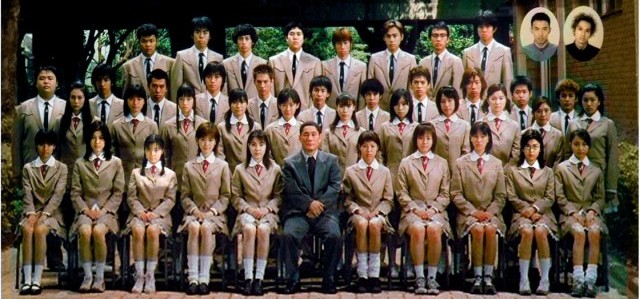
With the recent release of the Hunger Games sequel, it seems fitting to feature a cult classic that may have been the inspiration for that series: “Battle Royale”. Released in 2000, it was Kinji Fukasaku’s final film, a director previously best known for his “Battles Without Honor and Humanity” series of Yakuza films. Kinji died of cancer shortly after filming the first scene of the sequel, “Battle Royale 2: Requiem”, which was completed by his son Kenta in 2003. Battle Royale takes place in a dystopian society whose government regularly forces a class of high school students to participate in a deathmatch on a small island until just one survivor is left. Each student is given a bag containing food, water, a compass, a map of the island, and a randomly selected weapon. The students are also outfitted with surveillance collars that can track their movements and detonate if they wander into “danger zones” or refuse to cooperate.
Though the film is at times physically and emotionally brutal, it works effectively as a parable for the way youth are cynically manipulated by society and the different approaches people take dealing with tyranny. When Kinji Fukasaku first read the novel his film was based on, it resonated with him because of traumatic personal experiences. As he related in a Director’s statement for Battle Royale:
I immediately identified with the 9th graders in the novel, Battle Royale. I was fifteen when World War II came to an end. By then, my class had been drafted and was working in a munitions factory.
In July 1945, we were caught up in artillery fire. Up until then, the attacks had been air raids and you had a chance of escaping from those. But with artillery, there was no way out. It was impossible to run or hide from the shells that rained down. We survived by diving for cover under our friends.
After the attacks, my class had to dispose of the corpses. It was the first time in my life I’d seen so many dead bodies. As I lifted severed arms and legs, I had a fundamental awakening … everything we’d been taught in school about how Japan was fighting the war to win world peace, was a pack of lies. Adults could not be trusted.
The emotions I experienced then–an irrational hatred for the unseen forces that drove us into those circumstances, a poisonous hostility towards adults, and a gentle sentimentality for my friends–were a starting point for everything since. This is why, when I hear reports about recent outbreaks of teenage violence and crimes, I cannot easily judge or dismiss them.
This is the point of departure for all my films. Lots of people die in my films. They die terrible deaths. But I make them this way because I don’t believe anyone would ever love or trust the films I make, any other way.
BATTLE ROYALE, my 60th film, returns irrevocably to my own adolescence. I had a great deal of fun working with the 42 teenagers making this film, even though it recalled my own teenage battleground.
The modern paradigm may still seem insurmountable “because it possesses an outward front, the work of a long past, but is in reality an edifice crumbling to ruin and destined to fall in at the first storm.”
— Gustave Le Bon, The Crowd: A Study of the Popular Mind
The decentralized movement toward freedom is raging across the world. It cannot be stopped. The tipping point is near. Despite the lack of coverage in the mainstream media, actions are springing up on an increasing basis. A wave of transformation is rising. The zeitgeist is shifting in our direction.
At this point, given all the nonviolent direct actions that are currently being planned, it makes strategic sense for us to organize them, in a decentralized way, in a way that the mainstream media cannot ignore. A slightly more coordinated approach is all it will take.
The Awakening Wave
The last time we all rallied together in a loosely knit collective fashion, the Occupy movement was born and the 99% meme brought the corruption of our political and economic system, along with the grotesque inequality of wealth, into mass consciousness in a profound and lasting way. It was the opening act, the awakening wave.
Since the Occupy camps were crushed by brutal police state force, the movement has splintered in many different directions. This is now proving to have been a blessing in disguise. It gave us time to learn from our mistakes, figure out what worked best and forced us back into the autonomous actions that built the movement in the first place. We have now experimented with different tactics and thought through longer-term strategies.
Meanwhile, the repressive conditions that inspired Occupy in the first place have become even more oppressive. Now more than ever, governments no longer have the consent of the governed. A critical mass has lost faith and trust in our existing institutions. The present paradigm has outlived its usefulness. It has been overrun with corruption and rendered obsolete. Our political, economic and legal systems are doing much more to limit our potential than enhance it.
It’s Time For A Worldwide Wave of Transformation
Let’s pick a three-month span, perhaps throughout this coming spring, and unite our collective actions into an unprecedented Worldwide Wave that cannot be ignored by anyone.
Let’s crowdsource a relentless global wave of action that protests the corrupt, while also rallying around and celebrating effective alternatives and solutions to the vast problems we are confronted by. Imagine thousands of nonviolent guerrilla armies swarming corrupt targets and rallying for viable solutions for a sustained three-month cycle. If we begin preparing now, a massive spring offensive can lead to a summer of transformation.
Staying true to the vital nature of the movement, you lead, in your own way. Pick whatever issues concern you most and run with them, knowing that likeminded people throughout the world will also be fighting in solidarity, in whatever way they can, at the same time you are.
Not Focused Enough?
In an attempt to dismiss and undermine us, status quo propagandists will once again criticize us by saying that our message of systemic change is not focused enough or lacks coherent goals. This feeble attempt to keep people from joining in with us will be overcome by our widespread and consistent actions, which will lead by example and inspire the cultural shift in mass consciousness that we urgently need. Our diverse crowdsourced actions will boldly demonstrate our will to expose, fight and overcome tyrannical systems. By rallying around viable solutions and protesting what we are against, the goals and freedoms that we aspire to will organically become self-evident to all.
Throughout history, when people have fought against tyranny and oppression, they didn’t have one perfect utopian model outcome agreed upon beforehand. They just knew that the invading and old systems were detrimental to their wellbeing and had to go. We are now in that position.
Don’t let the propagandists fool you. We do not need corrupt corporations or aristocratic government rulers anymore. They are obsolete. People throughout this interconnected technological world have already come up with much more effective systems to replace the tyrannical one that is currently dominating our lives. There are already many effective solutions to our problems, solutions that are held back by the entrenched forces of shortsighted greed. Once a small percentage of us withdraw our participation from corrupt entities and opt out of tyranny, the old and obsolete systems of rule will quickly fall away.
Extensive empirical evidence demonstrates that nonviolent movements toward freedom result in positive outcomes. Research has proven that it only takes approximately 3% of the population engaging in various forms of nonviolent action to create significant meaningful change, for the betterment of society. We now have the necessary critical mass of aware people who are ready, willing and capable.
Guerrilla Tactics
This time the police state will not be able to crush us. We will not have stationary targets. We will be everywhere, fluid and evasive. The movement will be an unstoppable crowdsourced, decentralized and autonomous revolutionary force.
We will engage in a diversity of nonviolent tactics, from large-scale mobilizations to small daily acts. Most of you already know the actions and tactics that are needed. Without revealing too much strategic information, here are a few basic actions to get a fire going in your mind:
-Mass gatherings, demonstrations;
-Marches, parades;
-Flash mobs, swarms;
-Shutdown harmful corporate and governmental operations;
-Worker Strikes;
-Hunger strikes;
-Sit-ins;
-Strategic defaults, debt strikes;
-Foreclosure prevention;
-Boycotting corrupt corporations;
-Monkeywrench corrupt corporations;
-Move your money out of the big banks and the stock market;
-Use alternative currencies and economic systems;
-Cancel your cable television and support independent media;
-Use independent online tools that don’t sell your info and protect your privacy;
-Online civil disobedience, Anonymous operations;
-Leak information on corruption;
-Use alternative energy;
-Build your own urban and hydroponic farms, or get your food from them;
-Support local businesses;
-Join local community organizations;
-Take part in food banks and help develop community support systems;
-Start or join intentional and autonomous communities;
-Experiment with new governing systems, Liquid Democracy;
-Create Temporary Autonomous Zones
-Host teach-ins;
-Organize socially conscious events;
-Make conscious media;
-Guerrilla theater;
-Guerrilla gardening;
-Guerrilla postering, messages on money;
-Help inspiring groups and organizations spread their message;
-Random acts of kindness and compassion;
-Mass meditations, prayer sessions and spiritual actions.
The list goes on and on. You know what you can do to play a part. Do whatever you feel inspired to do. Amplify what you are already doing. Think about what you are willing to do to be the change that we urgently need to see in the world, and then do it.
Don’t get bogged down in infighting and caught up in negativity. Ignore the saboteurs. Collaborate with people who inspire you. Keep moving forward with an indomitable will, a compassionate spirit and radiate a positive attitude. Moods are contagious. Be passionate and have fun!
Our ability to take part in civil disobedience is multiplied by our ability to easily record the actions on video and spread them throughout the Internet. By flooding social media with these inspiring videos, we will create a positive feedback loop that translates into more action on the ground.
Radical change is urgently needed, so let’s make transforming the world the cool thing to do. Let’s create a culture of transformation. Let’s blaze a contagious nonviolent wave of action through mass consciousness, signaling the end of the old world, ushering in a new paradigm.
Now is the time.
~~*~~
Ride the Worldwide Wave of Transformation
001101000010111000110100001011100011000100110100
#www
Tweak this meme! This is a draft call to action, a work in progress. Feel free to make changes to it and spread it around however you see fit.
I’ve never subscribed to the notion that intelligence is fixed and unchanging. Intelligence (and its opposite) can be taught and reinforced though there may be varying ranges determined by factors such as diet, habits, genetics, personality, environment, time, resources and relationships. There’s also different categories of intelligences that aren’t equally valued by society, but the type of intelligence involved in critical thinking and creative problem solving is what our society seems to need most. On the latest episode of The Bulletproof Executive podcast, host Dave Asprey and researcher/science writer Andrea Kuszewski discuss methods to improve this type of intelligence among other topics including the relationship between extreme altruism and sociopathy.
Listen to the full interview here:
Kuszewski previously expanded on 5 ways to maximize cognitive potential as a guest blogger for Scientific American. Even if one has no need or desire to boost intelligence, they can also be used for sustaining intelligence and preventing cognitive decline associated with aging. Here are the five recommendations and her conclusion:
1. Seek Novelty
It is no coincidence that geniuses like Einstein were skilled in multiple areas, or polymaths, as we like to refer to them. Geniuses are constantly seeking out novel activities, learning a new domain. It’s their personality.
There is only one trait out of the “Big Five” from the Five Factor Model of personality (Acronym: OCEAN, or Openness, Conscientiousness, Extroversion, Agreeableness, and Neuroticism) that correlates with IQ, and it is the trait of Openness to new experience. People who rate high on Openness are constantly seeking new information, new activities to engage in, new things to learn—new experiences in general [2].
When you seek novelty, several things are going on. First of all, you are creating new synaptic connections with every new activity you engage in. These connections build on each other, increasing your neural activity, creating more connections to build on other connections—learning is taking place.
An area of interest in recent research [pdf] is neural plasticity as a factor in individual differences in intelligence. Plasticity is referring to the number of connections made between neurons, how that affects subsequent connections, and how long-lasting those connections are. Basically, it means how much new information you are able to take in, and if you are able to retain it, making lasting changes to your brain. Constantly exposing yourself to new things helps puts your brain in a primed state for learning.
Novelty also triggers dopamine (I have mentioned this before in other posts), which not only kicks motivation into high gear, but it stimulates neurogenesis—the creation of new neurons—and prepares your brain for learning. All you need to do is feed the hunger.
Excellent learning condition = Novel Activity—>triggers dopamine—>creates a higher motivational state—>which fuels engagement and primes neurons—>neurogenesis can take place + increase in synaptic plasticity (increase in new neural connections, or learning).
As a follow-up of the Jaeggi study, researchers in Sweden [pdf] found that after 14 hours of training working memory over 5 weeks’ time, there was an increase of dopamine D1 binding potential in the prefrontal and parietal areas of the brain. This particular dopamine receptor, the D1 type, is associated with neural growth and development, among other things. This increase in plasticity, allowing greater binding of this receptor, is a very good thing for maximizing cognitive functioning.
Take home point: Be an “Einstein”. Always look to new activities to engage your mind—expand your cognitive horizons. Learn an instrument. Take an art class. Go to a museum. Read about a new area of science. Be a knowledge junkie.
2. Challenge Yourself
There are absolutely oodles of terrible things written and promoted on how to “train your brain” to “get smarter”. When I speak of “brain training games”, I’m referring to the memorization and fluency-type games, intended to increase your speed of processing, etc, such as Sudoku, that they tell you to do in your “idle time” (complete oxymoron, regarding increasing cognition). I’m going to shatter some of that stuff you’ve previously heard about brain training games. Here goes: They don’t work. Individual brain training games don’t make you smarter—they make you more proficient at the brain training games.
Now, they do serve a purpose, but it is short-lived. The key to getting something out of those types of cognitive activities sort of relates to the first principle of seeking novelty. Once you master one of those cognitive activities in the brain-training game, you need to move on to the next challenging activity. Figure out how to play Sudoku? Great! Now move along to the next type of challenging game. There is research that supports this logic.
A few years ago, scientist Richard Haier wanted to see if you could increase your cognitive ability by intensely training on novel mental activities for a period of several weeks. They used the video game Tetris as the novel activity, and used people who had never played the game before as subjects (I know—can you believe they exist?!). What they found, was that after training for several weeks on the game Tetris, the subjects experienced an increase in cortical thickness, as well as an increase in cortical activity, as evidenced by the increase in how much glucose was used in that area of the brain. Basically, the brain used more energy during those training times, and bulked up in thickness—which means more neural connections, or new learned expertise—after this intense training. And they became experts at Tetris. Cool, right?
Here’s the thing: After that initial explosion of cognitive growth, they noticed a decline in both cortical thickness, as well as the amount of glucose used during that task. However, they remained just as good at Tetris; their skill did not decrease. The brain scans showed less brain activity during the game-playing, instead of more, as in the previous days. Why the drop? Their brains got more efficient. Once their brain figured out how to play Tetris, and got really good at it, it got lazy. It didn’t need to work as hard in order to play the game well, so the cognitive energy and the glucose went somewhere else instead.
Efficiency is not your friend when it comes to cognitive growth. In order to keep your brain making new connections and keeping them active, you need to keep moving on to another challenging activity as soon as you reach the point of mastery in the one you are engaging in. You want to be in a constant state of slight discomfort, struggling to barely achieve whatever it is you are trying to do, as Einstein alluded to in his quote. This keeps your brain on its toes, so to speak. We’ll come back to this point later on.
3. Think Creatively
When I say thinking creatively will help you achieve neural growth, I am not talking about painting a picture, or doing something artsy, like we discussed in the first principle, Seeking Novelty. When I speak of creative thinking, I am talking about creative cognition itself, and what that means as far as the process going on in your brain.
Contrary to popular belief, creative thinking does not equal “thinking with the right side of your brain”. It involves recruitment from both halves of your brain, not just the right. Creative cognition involves divergent thinking (a wide range of topics/subjects), making remote associations between ideas, switching back and forth between conventional and unconventional thinking (cognitive flexibility), and generating original, novel ideas that are also appropriate to the activity you are doing. In order to do this well, you need both right and left hemispheres working in conjunction with each other.
Several years ago, Dr Robert Sternberg, former Dean at Tufts University, opened the PACE (Psychology of Abilities, Competencies, and Expertise) Center, in Boston. Sternberg has been on a quest to not only understand the fundamental concept of intelligence, but also to find ways in which any one person can maximize his or her intelligence through training, and especially, through teaching in schools.
Here Sternberg describes the goals of the PACE Center, which was started at Yale:
“The basic idea of the center is that abilities are not fixed but rather flexible, that they’re modifiable, and that anyone can transform their abilities into competencies, and their competencies into expertise,” Sternberg explains. “We’re especially interested in how we can help people essentially modify their abilities so that they can be better able to face the tasks and situations they’re going to confront in life.”
As part of a research study, The Rainbow Project [pdf], he created not only innovative methods of creative teaching in the classroom, but generated assessment procedures that tested the students in ways that got them to think about the problems in creative and practical ways, as well as analytical, instead of just memorizing facts.
Sternberg explains,
“In the Rainbow Project we created assessments of creative and practical as well as analytical abilities. A creative test might be: ‘Here’s a cartoon. Caption it.’ A practical problem might be a movie of a student going into a party, looking around, not knowing anyone, and obviously feeling uncomfortable. What should the student do?”
He wanted to find out if by teaching students to think creatively (and practically) about a problem, as well as for memory, he could get them to (i) Learn more about the topic, (ii) Have more fun learning, and (iii) Transfer that knowledge gained to other areas of academic performance. He wanted to see if by varying the teaching and assessment methods, he could prevent “teaching to the test” and get the students to actually learn more in general. He collected data on this, and boy, did he get great results.
In a nutshell? On average, the students in the test group (the ones taught using creative methods) received higher final grades in the college course than the control group (taught with traditional methods and assessments). But—just to make things fair— he also gave the test group the very same analytical-type exam that the regular students got (a multiple choice test), and they scored higher on that test as well. That means they were able to transfer the knowledge they gained using creative, multimodal teaching methods, and score higher on a completely different cognitive test of achievement on that same material. Sound familiar?
4. Do Things the Hard Way
I mentioned earlier that efficiency is not your friend if you are trying to increase your intelligence. Unfortunately, many things in life are centered on trying to make everything more efficient. This is so we can do more things, in a shorter amount of time, expending the least amount of physical and mental energy possible. However, this isn’t doing your brain any favors.
Take one object of modern convenience, GPS. GPS is an amazing invention. I am one of those people GPS was invented for. My sense of direction is terrible. I get lost all the time. So when GPS came along, I was thanking my lucky stars. But you know what? After using GPS for a short time, I found that my sense of direction was worse. If I failed to have it with me, I was even more lost than before. So when I moved to Boston—the city that horror movies and nightmares about getting lost are modeled after—I stopped using GPS.
I won’t lie—it was painful as hell. I had a new job which involved traveling all over the burbs of Boston, and I got lost every single day for at least 4 weeks. I got lost so much, I thought I was going to lose my job due to chronic lateness (I even got written up for it). But—in time, I started learning my way around, due to the sheer amount of practice I was getting at navigation using only my brain and a map. I began to actually get a sense of where things in Boston were, using logic and memory, not GPS. I can still remember how proud I was the day a friend was in town visiting, and I was able to effectively find his hotel downtown with only a name and a location description to go on—not even an address. It was like I had graduated from navigational awareness school.
Technology does a lot to make things in life easier, faster, more efficient, but sometimes our cognitive skills can suffer as a result of these shortcuts, and hurt us in the long run. Now, before everyone starts screaming and emailing my transhumanist friends to say that I’ve sinned by trashing tech—that’s not what I’m doing.
Look at it this way: Driving to work takes less physical energy, saves time, and it’s probably more convenient and pleasant than walking. Not a big deal. But if you drove everywhere you went, or spent your life on a Segway, even to go very short distances, you aren’t going to be expending any physical energy. Over time, your muscles will atrophy, your physical state will weaken, and you’ll probably gain weight. Your overall health will probably decline as a result.
Your brain needs exercise as well. If you stop using your problem-solving skills, your spatial skills, your logical skills, your cognitive skills—how do you expect your brain to stay in top shape—never mind improve? Think about modern conveniences that are helpful, but when relied on too much, can hurt your skill in that domain. Translation software: amazing, but my multilingual skills have declined since I started using it more. I’ve now forced myself to struggle through translations before I look up the correct format. Same goes for spell-check and autocorrect. In fact, I think autocorrect was one of the worst things ever invented for the advancement of cognition. You know the computer will catch your mistakes, so you plug along, not even thinking about how to spell any more. As a result of years of relying on autocorrect and spell-check, as a nation, are we worse spellers? (I would love someone to do a study on this.)
There are times when using technology is warranted and necessary. But there are times when it’s better to say no to shortcuts and use your brain, as long as you can afford the luxury of time and energy. Walking to work every so often or taking the stairs instead of the elevator a few times a week is recommended to stay in good physical shape. Don’t you want your brain to be fit as well? Lay off the GPS once in a while, and do your spatial and problem-solving skills a favor. Keep it handy, but try navigating naked first. Your brain will thank you.
5. Network
And that brings us to the last element to maximize your cognitive potential: Networking. What’s great about this last objective is that if you are doing the other four things, you are probably already doing this as well. If not, start. Immediately.
By networking with other people—either through social media such as Facebook or Twitter, or in face-to-face interactions—you are exposing yourself to the kinds of situations that are going to make objectives 1-4 much easier to achieve. By exposing yourself to new people, ideas, and environments, you are opening yourself up to new opportunities for cognitive growth. Being in the presence of other people who may be outside of your immediate field gives you opportunities to see problems from a new perspective, or offer insight in ways that you had never thought of before. Learning is all about exposing yourself to new things and taking in that information in ways that are meaningful and unique—networking with other people is a great way to make that happen. I’m not even going to get into the social benefits and emotional well-being that is derived from networking as a factor here, but that is just an added perk.
Steven Johnson, author who wrote the book “Where Good Ideas Come From”, discusses the importance of groups and networks for the advancement of ideas. If you are looking for ways to seek out novel situations, ideas, environments, and perspectives, then networking is the answer. It would be pretty tough to implement this “Get Smarter” regiment without making networking a primary component. Greatest thing about networking: Everyone involved benefits. Collective intelligence for the win!
…And I have a departing question for you to ponder as well: If we have all of this supporting data, showing that these teaching methods and ways of approaching learning can have such a profound positive effect on cognitive growth, why aren’t more therapy programs or school systems adopting some of these techniques? I’d love to see this as the standard in teaching, not the exception. Let’s try something novel and shake up the education system a little bit, shall we? We’d raise the collective IQ something fierce.
Intelligence isn’t just about how many levels of math courses you’ve taken, how fast you can solve an algorithm, or how many vocabulary words you know that are over 6 characters. It’s about being able to approach a new problem, recognize its important components, and solve it—then take that knowledge gained and put it towards solving the next, more complex problem. It’s about innovation and imagination, and about being able to put that to use to make the world a better place. This is the kind of intelligence that is valuable, and this is the type of intelligence we should be striving for and encouraging.
Are we naturally good or naturally evil? Cognitive scientist Paul Bloom argues in a new book that we’re both.
In “Just Babies: The Origins of Good and Evil” (Crown), the developmental psychologist and Yale professor takes on the nature of morality and vast research spanning evolutionary biology to philosophy, drawing on everyone from Sigmund Freud to Louis C.K.
His conclusion? Babies have the capacity for empathy and compassion, possess a limited understanding of justice and have the ability to judge. Yet they navigate not along colour lines but as Us versus Them, usually landing squarely in the Us camp.
A conversation with Paul Bloom:
AP: What light do you shed on the “moral sense” of babies?
Bloom: We’re born with this extraordinary moral sense. A sense of right and wrong just comes naturally to humans and shows up in the youngest babies we can study. But this morality is limited. I think tragically limited. So we are morally attuned to those around us, to our kin, to our friends, to those we interact with, and we are utterly cold-blooded toward strangers. To some extent I think babies are natural-born bigots. They are strongly attuned to break the world into Us versus Them and have no moral feelings at all toward the Them, and this shows up all through development.
So in some way, although a lot of morality is inborn, I think the great success of humans … is expanding and transcending this inborn morality. You and I believe that, you know, not only is it wrong to kill somebody, it’s wrong to kill somebody from anywhere around the world. We might also agree that we’re obliged to help people in trouble, even if they look different from us or are from a different land.
We have notions of fairness and equity and justice that, again, extend more broadly, and although we might favour our own group in some ways, consciously or unconsciously, we’re probably not racist. We probably think that racism is wrong, and that a good moral system should treat all humans more or less the same, but none of that is present in the mind of a baby.
AP: Is it a revelation that we create the environments that can transform a partially moral baby into a very moral adult?
Bloom: I think in some sense it is not. I think any good parent knows that you raise a kid into a moral kid not by, you know, imparting moral lessons and making moral pronouncements, but by shaping the environment in ways that bring out our better selves. When you want to make people good people you don’t just say, ‘Oh, try real hard.’ You try to structure their environment so as to bring out their better aspects.
AP: Is that surprising?
Bloom: I think it’s surprising the extent to which it works and the extent to which the alternative fails. So, for instance, many people believe that giving people moral stories, expressing through literature moral values, has a profound effect on people’s lives. The actual evidence says it has no effect at all. It’s just zero. In fact, there are some studies showing that if you give kids stories about being generous and kind it paradoxically makes them a little bit meaner, roughly between the ages of 4 and 10. Preaching in general with kids often backfires.
AP: Where do serial killers come from?
Bloom: Serial killers are very unusual people. … We know that there’s genetic differences in people’s empathy, in people’s compassion and how much they care about other people, in their ability to control violent rages, for example, and I’m sure a serial killer is somebody who has the genetic short end of the stick. Then you toss in certain environments. Your typical serial killer had a very unhappy childhood.
AP: What about being hard-wired at birth?
Bloom: Some people are more likely to be serial killers than other people due to accidents of genes. I am far more likely to be a murderer or a rapist or a serial killer than you are because I’m a man. There’s some evidence that people who turn out to be psychopaths, even murderous psychopaths, have the short end of the genetic stick but there’s all sorts of environmental factors. … Fifty years ago, slapping one’s wife or raping one’s wife would be viewed as comical, legitimate, certainly not a crime. Now it’s the sort of thing that only a monster would do, and so we have tremendous evidence for profound changes that have nothing to do with genes.
AP: You discuss “hodgepodge morality.” Is there such a thing in babies?
Bloom: I think we naturally have multiple moral systems, multiple responses. Some of our responses are created by disgust, some by empathy, some by a sense of justice, some by a sense of fairness, some by self-interest. We respond to kin, to our family members in different ways than we respond to strangers in all sorts of ways that don’t fall into any elegant philosophical theory. And I think this is true for babies, too.
Babies are moral beings but they aren’t moral philosophers. They don’t have some sort of coherent theory. Rather they have a series of gut reactions, a series of moral triggers that they respond to. What we find in our research is all sorts of moral capacities on the part of babies. What we don’t find is some kind of careful, contemplative theory.
AP: Is that a bad thing?
Bloom: It isn’t. It’s the way we are, one way or another, but if you set yourself the task of constructing a society where everybody lives and everybody follows the same rules and adheres to the same notions, then you do want to some degree a consistent and coherent theory.
So it may be a good theory of psychology to say that a white person naturally cares a lot more toward another white person than toward a black person, and that’s an instinctive response that could develop in certain societies, but from the standpoint of constructing a theory of what actually is good, how we should live our lives, we would say, ‘Well that’s too hodgepodge for us. It’s inconsistent. It’s actually a cruel way for the mind to work.’
AP: You write about conflicts in research on racial bias in young children.
Bloom: For kids there’s a lot of evidence that they’re very strongly biased on Us versus Them if you get them to do it on the basis of things like different colored T-shirts, for example, but race and skin colour isn’t an automatic way of dividing up the world. So you take a two- or three-year-old and typically a two- or three-year-old shows no signs of being racist in any way. When you get older, if kids are in an environment when blacks and whites interact and they’re totally mellow with each other and there’s not much conflict, they’ll see black and white but it won’t matter at all. If you’re in an environment where it matters then it will matter.
Children are extremely prone and very ready to divide the world into groups, but the groups that they focus on is determined through learning.
At Orion Magazine, authors William Cronon and Michael Pollan share a stimulating conversation about how language shapes our world. They cover questions such as “what is wild?”, “what is cultivated?”, and “what can these ideas teach us about our relationship to landscape?”. What I found most compelling was the last part of the conversation where they talk about the power and importance of storytelling:
Bill: Right. Ecology, storytelling, history—they all render connections visible. We make that which is invisible visible through story, and thereby reveal people’s relationships to other living things.
Michael: Stories establish canons of beauty, too. There is a role for art in changing cultural norms about what’s worth valuing. One hundred fifty years ago, certain people looked at a farm and saw what you might see if you look today at a nuclear power plant or some other degraded landscape. Part of the reason we tell stories is to create fresh value for certain landscapes, certain relationships.
Bill: And stories make possible acts of moral recognition that we might not otherwise experience. They help us see our own complicity in things we don’t ordinarily see as connected to ourselves.
Michael: Yes, exactly. That recognition can help remove the condescension in so much environmental writing by showing us that, look, these things we abhor are done in our name, and we are complicit in them, and we need to take account of them. It was Wendell Berry’s idea that the environmental crisis is a crisis of character. The big problem is the result of all the little problems in our everyday lives. That can be a guilt trip, but it doesn’t have to be. You can tell that story in ways that empower people.
Storytelling can also help us find hopeful solutions. For example, when I was writing Omnivore’s Dilemma and I went to Joel Salatin’s farm in Virginia, I learned how his grazing worked—intensive rotational grazing—and he explained to me what happens under the surface, how every time the ruminants come through and shear that pasture and reduce that leaf mass, a roughly equivalent amount of root mass is broken down and turned into soil. I learned that he takes vast amounts of food off this pastureland, without subtracting anything. To the contrary, the sun is feeding the grass, and the grass is feeding the ruminants; the ruminants are feeding us, and they’re also feeding the soil.
I suddenly saw a whole other way of conceiving our relationship to nature, that there are systems that exist, and could exist, that are non zero sum. There is a free lunch in nature: it’s solar energy, which means it isn’t necessarily true that for us to feed ourselves we have to diminish the world.
When you tell an audience that story, it fills them with hope and a sense of possibility, and that’s a function of storytelling. But, of course, it isn’t always so neat. There are questions of scale, and if you eat meat, there are problems with cattle. But I’m always looking for stories that refresh this narrative about nature that we’re so stuck in.
Bill: Messy stories invite us into politics. They also invite us to laugh at ourselves. And those things together—the ability to laugh, to experience hope, to be inspired toward action at the personal and political levels—these strike me as the work of engaged storytelling in a world we’re trying to change for the better.
Michael: I do have a lot of faith in the power of stories to do things. My greatest thrill as a writer is when I see people changed by the work, when people tell me that they’ve changed their behavior in some way because of something they’ve read.
One of the things I’ve fought very hard to do with my editors is to talk about alternatives when I talk about problems. For example, if I’m writing an incredibly dark story about industrial meat production and following a cow through the feedlot and slaughterhouse, I really want three paragraphs on the alternative to this system, which is to say, grass-finished beef. Those three paragraphs have more impact than anything else in the piece. And I still hear from ranchers that it was on the day that an article on that topic came out that we began to see the stirrings of a new market for grass-finished beef. “We no longer send them to the auction barn right away,” they tell me. “We’re finishing on grass now.”
Bill: That’s a good story about storytelling.
Michael: You have to pass through the dark wilderness of the feedlot before you can get there, but I think that there’s an appetite for hope that journalists don’t often satisfy.
I’ve met people, in their twenties especially, who really hate the model of the investigative article that tells them how messed up things are and doesn’t point to some alternative. True, the alternative you’re proposing can seem tacked on, and it can be incommensurate with the scale of the evils—but I think people want hope, a course of action they can take. This is something many journalists are missing right now. I think if our writing doesn’t include that dimension in some way, we lose people.
Bill: It strikes me that you’re pointing to a great tradition in the environmental movement, which is the power of good storytelling, going back to Rachel Carson.
Michael: She was incredibly effective rhetorically. Silent Spring is a very sophisticated piece of work.
Bill: It’s stunningly done.
Michael: It’s stunningly done. And it speaks to the power of fictional ideas like wilderness. Carson understood that, even if you’re writing about science, narrative is important. The trick I learned from her is never to talk about “neurotoxins”; instead, you tell the story of the molecule in the cell. Because there’s a narrative everywhere, even at the level of molecules.
Bill: Maybe that’s a good note for us to end on, don’t you think? The poet Muriel Rukeyser once said that “the world is made of stories, not of atoms.” When we lose track of the narratives that human beings need to suffuse their lives and the world with meaning, we forget what makes the world worth saving. Telling stories is how we remember.
On a recent episode of PBS Newshour, Jeffrey Brown hosted a roundtable discussion exploring the dangers of polarized politics for American Governance. The guests were Eric Liu, Steven Hayward and Beverly Gage. Most of the discussion was an analysis of the recent government shutdown from a typical left vs. right perspective, but I thought their view of reactions of average citizens was interesting:
JEFFREY BROWN: And so, Eric Liu, let me ask you, because I know you’re very — you’re trying to engage people in the act of citizenship. What do you see the effect of all of this? Are they more engaged? Are they just more disgusted and turned off?
ERIC LIU: Well, I don’t think those are mutually exclusive. There is disgust.
(LAUGHTER)
ERIC LIU: But, because of the disgust, there’s actually more engagement.
And that’s true on both the left and the right. Look, I think the reality is, when Steven was speaking a moment ago about the kind of encroachment of ever-growing and ever-larger government, we can have reasonable debates in this country about what the proper size and scope of government ought to be, but we ought to regard those debates not as “on/off, yes/no, my way or we shut the whole thing down” kind of debates.
…so people from both left and right watching these last two weeks are ready for something different.
They’re ready to actually hear each other and see one another and not the caricatures of one another, and try to figure out, well, where is it that we can manage to agree on the role of government, and where we can’t agree, how can we recognize that to be a citizen isn’t just a single-shot sudden death game. It’s infinite repeat play, and you’re going to win some, and I’m going to win some.
JEFFREY BROWN: All right, let me ask Steven Hayward to respond to this.
Do you see the result of this as people ready to work together or more divisions that ever more polarizes?
STEVEN HAYWARD: Well, I think there’s two things to think about here.
One is, is we have divided government once again. The voters, God bless them, have a lot of cognitive dissonance. Right? In the last week, what you saw is people say, I don’t like Obamacare, but I don’t want the government shut down. I don’t want it to be a matter of a budget fight the way it’s become. And that’s why Republicans lost this proximate battle.
But if you look at some of the poll numbers right now, I think they ought to be very worrying for everybody, but I think more worrying ultimately for liberals, for this reason. You have seen record high numbers of people who now say — I think 65 percent in one poll — that government is a threat to their rights.
You have seen a long-term trend going back really to the 1960s of the number of people saying they have confidence that the federal government will do the right thing down in 15 percent, 20 percent, when it used to be in the ’50s up around 60 to 70 percent. And to the extent that if you’re liberal and that you believe in political solutions to our social problems or government engagement with our problems, you want the public to have confidence in the federal government’s capacities.
And so it seems to me that, as much as this might have been a train wreck for Republicans, the long-term effect of this might not necessarily play out that way.
JEFFREY BROWN: Well, Beverly, when you look back at political — what could be called political crises of the past, what does it — what happens in terms of public response to those?
BEVERLY GAGE: Well, I think to some degree, Steven’s quite right, in that I would kind of like to subscribe to Eric’s view that we’re going to have a much more serious conversation, a much more bipartisan conversation.
But I think it’s equally possible that you’re actually going to see people throw their hands up and say, oh, it’s all such a mess. I don’t really want to make sense of it. I don’t want to deal with it. And, in that way, it sort of serves an anti-government message, and in some ways, even serves sort of the Tea Party message in ways that maybe were intended and maybe weren’t.
But I think there’s also a danger for the Republican Party in all of this, which is to say that these divisions that we’re seeing right now within the Republican Party between moderates and Tea Party conservatives and also between a sort of establishment business class, which is very, very alarmed about what’s happening, and this more right-wing part of the party, that actually may in fact spell destruction for the Republican Party.
Those are divisions that have been there for a long time. They have often been papered over. But when you’re on the brink of financial catastrophe in the way that we were, we may not see them be papered over, and we may in fact see some sort of political realignment coming out of this.
All three guests made good points, though the views of conservatives and liberals are typically generalized in such discussions and I think issues of most concern to citizens on a grassroots level are often not the ones being debated enough in Washington D.C. There definitely needs to be more political discussion between left and right not just within government but among the general public. Increased communication and education is the best defense against “divide and conquer” tactics but of course this is easier said than done because politics has become a taboo subject for many, mainly due to fear of getting into heated arguments. But perhaps this fear is unwarranted because there’s many issues that the left and right can agree on (though motives and priorities may differ). These are just some of the more topical examples:
End the Wars – As demonstrated by widespread negative reaction to war threats against Syria, people are perhaps becoming more aware of political trickery thus becoming harder to persuade. Also, as living standards drop for more people, the connection between costly foreign policy and the nation’s declining economy and infrastructure has never been more obvious.
Stop the Surveillance State – Privacy is a universal human need. Mass spying on citizens is illegal and unethical whether online or through drones and informants.
End Unjust Trade Agreements – Agreements such as NAFTA and the Trans-Pacific Partnership (TPP) hurt working people and endangers health and safety, the environment, and national sovereignty.
End the Fed – We’ve endured 100 years of a “Federal” Reserve run by private bankers and all we have to show for it is a debt of tens of trillions of dollars. It will never be paid off as long as we continue to use interest-bearing federal reserve notes as currency.
Create Affordable Health Care – It can be argued that Obamacare is an incremental improvement but everyone knows it’s not enough and is far more beneficial for greedy insurance companies than the poor.
End the Drug War – We can all agree the Drug War is a colossal failure (when it comes to the stated purpose of reducing drug addiction). It has only increased incarceration rates while enriching the prison-industrial complex and drug cartels. We need to adopt policies that have proven to be effective such as legalization, decriminalization and harm-reduction.
Stop GMOs – GMOs are unnecessary, physically and economically harmful to farmers, may have potentially catastrophic effects on the ecosystem, and only serves to increase profits for companies like Monsanto.
End Obscene Economic Inequality – Complete economic equality might not be possible, but when economic inequality reaches absurd and unsustainable levels as they have today, obviously something needs to change.
Protect Internet Freedom – Legislation such as the NDAA, SOPA and PIPA indicate that government and corporations are threatened by the internet. Attacks against internet freedom are attacks against freedom of speech, freedom of information and cognitive liberty.
Ignore Corporate News – Another point of agreement between right and left is the corporate news media’s increasing irrelevancy and bias. Today it is not so much a liberal or conservative bias as it is a neoliberal and neoconservative bias.






 After the Crash