The Color Counterrevolution Cometh

color_revolutions

By Dmitry Orlov

Source: Club Orlov

Had Sun Tsu co-authored a treatise on the art of sports with Capt. Obvious, a quote from that seminal work would probably read as follows:

If your team keeps playing an offensive game and keeps losing, eventually it will end up playing a defensive game, and will lose that too.

Stands to reason, doesn’t it? The team I have in mind is the neocon-infested Washington régime, which is by now almost universally hated, both within the US and outside of its borders, and the offensive game is the game that has been played by the Color Revolution Syndicate, with George Soros writing the checks and calling the shots. Having lost ground around the world, it is now turning its attention to trying to hold on to its home turf, which is the US.

Behind the Washington régime stands a group of transnational oligarchs, including many of the richest people in the world, and the game they play is as follows:

1. Saddle countries around the world with unrepayable levels of debt, most of which is stolen as soon as it is disbursed, leaving a population perpetually saddled with onerous repayment terms. This used to be done by the US to countries around the world, and has most recently been done to the US itself.

2. This game often results in rebellion, and the well-bribed national leaders in the rebellious countries are expected to put down the rebellion using any means necessary. But if they fail to suppress the rebellion, or if they side with the rebels, then they need to be regime-changed and replaced with a more subservient leadership, and the Color Revolution Syndicate swings into action.

3. The first ploy is to organize young people into a “nonviolent” protest movement (“nonviolent” is in quotes because mobbing the streets, shutting down commerce and blocking access to public buildings are all acts of violence). Their goal is to erode the boundaries of what’s allowed, until law and order break down and chaos and mayhem take over. At that point, the leadership that is to be regime-changed is supposed to jump on a plane never to be heard from again. But if they fail to do so, the next step in the program is…

4. Mass murder. Snipers are flown in and kill lots of people indiscriminately, while Western media blames the deaths on the soon-to-be-overthrown government. At this point most national leaders, sensing that their lives are at risk, choose to flee. This is what happened with the Ukraine’s Yanukovich. But sometimes, as happened with Egypt’s Hosni Mubarak, they simply retreat to a well-defended residence outside the capital and wait things out. And then a magic thing happens: the revolution chokes on itself. Local self-defense units form to protect neighborhoods; out of them emerges a partisan movement to thwart attempts by foreigners to further destabilize the country; and, after much bloodshed, law and order and a legitimate government return. This could have happened in Egypt, if it weren’t for the efforts of traitors within Mubarak’s own government. But then there is always…

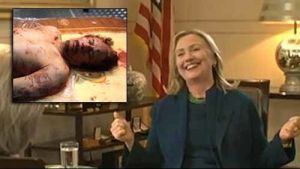
5. Political assassination. If mass murder doesn’t work, it’s time to send in the assassins and physically eliminate the leadership. This has happened in Libya. As Hillary Clinton put it, paraphrasing Julius Caesar, “We came, we saw, he died!” Beware the Ides of March, Hillary!

By this time, it generally has to be conceded that the Color Revolution did not go according to plan, and the Washington régime starts doing its best to pretend that the sad country in question doesn’t exist. If someone manages to make it past face control and has the temerity to point out that it does exist, then the point is made doesn’t matter because it isn’t a vital interest. As Obama just pointed out [paraphrased by Jeffrey Goldberg writing for The Atlantic]: “Ukraine is a core Russian interest but not an American one.” This caused one Zbigniew Brzezinski to spit up all over his shirt. To be sure, there is fine comedy to be had when things don’t go according to plan for the Washington régime.

Recently, things have only been going downhill for the Color Revolution Syndicate. George Soros’s NGOs, which have been used to organize Color Revolutions, have been kicked out of both Russia and China; the silly “Umbrella Revolution” in Hong-Kong went nowhere slowly; Russia used its military training budget to rescue the government in Syria and to thrash ISIS and friends, and then moved on to negotiating a political settlement. And when Soros, in a fit of pique, tried to attack the Chinese currency, the Chinese laughed in his face and beat him about the head and shoulders with a printing press until he retreated.

Not only that, but things haven’t been going so well for the Washington régime either. The fake Democrat/Republican duopoly, which it has been using to simulate democracy and to disguise the fact that it’s all made to order for the same bunch of transnational oligarchs, is in trouble: a barbarian is at the gates. His name is Donald Trump, and he’s had the régime in his sights for many years. And now he is moving in for the kill.

Trump isn’t even that good at it, but this is a super-easy job. As I said, the Washington régime is just as hated within the US as it is around the world, if not more. Trump’s slogan of “Make America great again!” may sound overly ambitious, but what if his promise is to make America great again at exactly one thing—throwing members of the Washington régime on the ground and stomping on their heads until they pop? I am pretty sure that he can get this done.

Moreover, Trump doesn’t even try to be that good, although he is certainly very good at causing people to lose their minds. I came across one commentator who bounced off Carl Jung’s proto-new-age woo-woo on Hitler being a reincarnation of the Norse god Wotan and went on to claim that Trump is a reincarnation of Wotan’s brother Loki the Trickster. But here is a much simpler idea: Trump is an epitome of Trump. He enjoys being himself, and the unwashed multitudes find this aspirational because they are sick and tired of being told how they should think and behave by a bunch of clueless puppets.

Lastly, Trump gets a lot of help—from his enemies. All they have to do for him to prevail is to carry on being themselves—saying politically and perhaps even factually correct things, toeing the party line, carefully distancing themselves from Trump, repeating the talking points fed to them by Washington think tanks and generally being as useless and boring as possible. Then all Trump has to do to win is to distinguish himself from them by being rude, crude, vulgar, crass, obnoxious and raucously fun. Can you figure out on your own which one the people will pick—useless and boring or raucously fun—or will I need to summon Capt. Obvious again?

The Washington régime, and the oligarchs that back it and profit from it, have finally groked all of this, which is why they have been huddling and trying to organize a Color Counterrevolution that can stop Trump in his tracks. Soros and the ‘garchs started throwing around big bags of cash to get the counterrevolution on even before the actual Trump revolution happens. They were initially successful, shutting down a venue in Chicago with the help of Soros-owned Moveon.org. But it seems doubtful that they will prevail in the end. Instead, it seems more likely that they will give rise to a partisan movement.

You see, in the US hatred of the Washington régime runs very deep, with millions of people sick and tired of being swindled by various hated bureaucracies—in government, law, medicine, education, the military, banking… They hate those who took away their jobs and gave them to foreigners and immigrants. They hate those who stole their retirement savings and ruined their children’s futures. They hate the smug university types who keep telling them what to think and how to speak, making them feel inadequate simply for being who they are—salt of the earth Americans, racist, bigoted, small-minded, parochial, willfully ignorant, armed to the teeth and proud of it. There is very little that the régime can ask of these people, because the response to every possible ask is “no, because we hate you.”

And when these people, who are already seething with hatred, look at the political landscape, what do they see? They see the Democrats pushing the candidacy of the banker-crony-crook Clinton, and the only alternative is the full-socialistard “I am from the US government and I am here to help” Sanders who seems to be stuck in some sort of Great Society time warp. (There may be governments that get socialism right; the US government will never be one of them.)

They also see that the Republican establishment, previously so full of pseudorevolutionary puffery, is now so afraid of Trump that it would rather throw the election to the Democrats than support their own candidate, and this fills them with anger and disgust. Take all that seething hatred, mix in lots of anger and disgust, knead it, let it rise, and now you can bake a popular insurgency.

And a popular insurgency, or a partisan movement, is exactly what it takes to defeat the Color Revolution Syndicate. You see, the official authorities, be they the police, the army, the secret service or private security, are limited in the things they can do. In some ways, their hands are tied: if they violate law and order in order to defend law and order, they become mired in self-contradiction, and that just makes it more difficult for them to defend it the next time around.

But the partisans can do anything they want. They can infiltrate the protest movement and commit acts of violence in order to provoke the authorities into taking perfectly justifiable action. They can act to misdirect, demoralize and splinter protest groups. They can use social media to “out” the Color Revolution’s leaders and those who finance them (who, to remain effective, must hide in the shadows). They can liaise with the official authorities and trade favors for information.

If the Color Revolution shows signs of proceeding to the point where the tactics of Massacre and Political Assassination are about to be tried, they can form commando units, to make sure that these tactics lead to some massive unintended consequences, preventing their productive use. And if all else fails, they can form a guerrilla movement which, in order to win, simply has to not lose.

If all goes well then, starting next year, tens of thousands of Washington operatives, along with their friends in various politically connected industries, such as banking, defense, medicine and education, will evacuate to a variety of nonextradition countries (which will no doubt respond by raising the prices of their passports) while thousands more will begin their lengthy sojourns at federal penitentiaries. And thus the crisis will be defused.

And if it doesn’t go well, then we’ll probably be looking at a “deteriorating security environment.” How far it will deteriorate is anyone’s guess, but if you are one of the Washington régime’s stooges then you may want to get yourself a second passport before the prices go up and get out ahead of time.

The Control-Matrix is Crashing because the Truth-Seekers are Winning

36da1558948450f9941d79cffcde69e0

By Phillip J. Watt

Source: The Mind Unleashed

The way the masses view the world is a farce. Every single mainstream perspective is either purposely deceptive, or completely misses the point. Even the people in places of influence who we’re meant to trust have either sold out, or are just plain ignorant to the facts. There’s no need to have a heavy heart though; the matrix of control is crashing because the truth-seekers are dealing heavy blows to the false narratives that have for too long shaped the collective mindset of humanity.

Of course the internet can be celebrated for being the primary mechanism which has amplified the sharing of information across location, race, culture and belief systems. In retrospect, the powers-that-will-no-longer-be would be kicking themselves for not trying harder to institute their insidious plan for humanity prior to the birth and growth of the world-wide-web.

Make no mistake though; they have been very successful on many fronts. For example, try to imagine a world where:

      • most journalists don’t report the real news;
      • the majority of doctors don’t truly understand the causes of poor health and how to legitimately resolve it;
      • a high proportion of politicians don’t know how the money supply works and what the agenda is of those who control it;
      • many so-called expert scientists ‘believe’ in a discredited philosophy which resembles a dogmatic religion;
      • the majority of teachers don’t realize they’re teaching a system of indoctrination that nowhere near gets close to the information and critical thinking that should be afforded our kids; and

the masses are not only ill-informed, divided and feverishly fighting against each other over small and irrelevant topics, but they’re also sleepwalking through one of the most majestic and reverent realities that could have ever been conceptualized.

Well, welcome to our world.

As we begin what we call the 21st Century, every system that should be designed to facilitate the health and vitality of the people has been hacked with lies, deception, dysfunction and disharmony. It’s easy to think that this is an embarrassment for our species because it’s beneath our intelligence and ethical capacity, yet there’s no need to lose faith in the inevitable betterment of humanity, including the way in which we organize and economize our societies.

Why? Because all of this dysfunction has been an effective driver of the collective awakening that is rising in the hearts and minds of humanity.

The inspiring fact is that more and more people are slowly waking up and realizing we all have the opportunity to come to our own, informed opinion on the truth, pertaining to both the spiritual and systemic realities. So many more people now understand the mainstream news is not to be taken seriously as its not where we can find information which is aligned with the deeper truths. They’re also acknowledging that we have the choice on what we decide to personally stand and fight for, as well as the legacy we leave for our children and our future generations.

Beware though; once we exit the matrix of control we’re faced with some serious challenges. We have a lot of inner work to do, such as designing a philosophy that ensures we’re at peace, as well as exercising patience in the quest to take back our liberties and design a legitimate and honorable future for humanity.

That’s why we’ve got to feel for those who have been long aware of the many dysfunctions of our world, especially those who have not learned peace and patience. Slowly they’ve watched:

    • the military-industrial-media-politico-banking complex increase their power and continue their pillage across the world;
    • pharmaceutical monopolies amplifying the drugging of society, as well as keeping many of us sick so that they maximize their profits;
    • movements rise up only to be vilified and disassembled, such as the Occupy Movement;
    • science turned into a corporate institution, as well as further hijacked by an inaccurate and small-minded philosophy of reality;
    • wars purposely created with millions of people dying for the whims of the shadow empire;
    • radical extremists massaged into proxy armies to do dirty work for the collapsing power structure;
    • air, medicine, food and water becoming purposely more toxic;
    • governmental policy increasingly being determined by corporate/elite interests;
    • police being militarized all around the globe;
    • the education model struggling to become less of an indoctrination system; and
    • the agenda of global governance becoming closer to fruition.

Some people have known about much of this for decades, so we should commend them for continuing to fight the good fight. They might have witnessed some disheartening developments, yet as much as all this sounds dire, they’ve also seen millions of people disengage from the propaganda narratives and align themselves with the systemic and spiritual pathways that will be the next stage of our evolution.

The point is that even though we need to be patient and persevere, we should recognize and celebrate the achievements that have been made so far. As I discussed in a previous article called “Whilst the Old System Crashes a New One is Being Built”, there are:

    • economists who want to transform the Keynesian model to legitimate alternatives;
    • teachers who understand the massive holes in the indoctrination system called public education;
    • scientists who want to evolve the way energy is created and shared;
    • health practitioners who see the limits of mechanistic and pharmacological medicine and the need for the reintroduction of natural and plant-based therapies;
    • journalists who demand that the media monopolies need to be disassembled;
    • environmentalists who want to transition the way food is grown and distributed;
    • community leaders who aim to reintegrate them to better support its members;
    • politicians who understand the democratic system has been hijacked by big money;
    • activists who campaign for revolutions in our value systems; and
    • futurists who want to change the systemic template for our societal health and well-being.

There are many beautiful souls who are leading the charge by attempting to redesign our society back into alignment with the natural laws of our universe. We should be one of them, regardless of which way we personally decide to contribute.

To do that, we all need to be super clear within ourselves what we believe and what we want to change. There are many ways to do it too, so finding our passions and strengths is critical to playing our own small part in the shift.

It is simply no longer acceptable to keep our heads in the sand; either we’re a minion of the system or we’re not. Of course its difficult to completely disconnect from the way resources flow through the control channels, yet that needn’t stop us from talking about it, sharing information online and somehow contributing, no matter how small, to local and global movements which aim to transition humanity into the new paradigm of abundance.

After all, the truth is what it is, and it is exposing itself to the world by powerfully flowing through all of us.

Ultimately, we needn’t wait for the zombie apocalypse because its already arrived. Most people are good people, yet the masses have been brainwashed into thinking in ways that are absolutely nowhere near aligned to the truth. They might be sleepwalking through a time where the tipping point for the conscious society builds, but that doesn’t mean they’re not salvageable. That’s why we all have a responsibility to help facilitate waking up the collective so that together we’re more empowered and informed to really bring about a future of justice and honor that we can all be proud of.

To do so, let me give you some advice. Don’t get frustrated, don’t be rude, don’t belittle, don’t condemn. We all had to wake up at one stage so its hypocritical if we are. Instead, be calm, be cool, be real, be articulate. Know the information that you advocate like the back of your hand. If we want to be successful in helping others to face the delusions then we need to ensure their defense mechanisms aren’t raised so they’re more likely to be open and receptive to embrace the truth.

And one more thing; hang in there guys and be patient, we’ve still got a long, arduous way to go but we know all the effort will be worth every second.

ABOUT THE AUTHOR
Phillip J. Watt lives in Australia. His written work deals with topics from ideology to society, as well as self-development. Follow him on Facebook or visit his website.

The Courage to Speak Truth to Power

blunt

By Zoe Blunt

Source: DGR News Service

The more we challenge the status quo, the more those with power attack us. Fortunately, social change is not a popularity contest.

Activism is a path to healing from trauma. It’s taking back our power to protect ourselves and our future.

From a spoken-word presentation in Victoria BC, 2009

Thank you for the opportunity to launch my speaking career. Some of you may know me as a writer and an advocate for social and environmental justice. Others may know me as a cat-sitter, odd-jobber, and temp slave. (Laughter)

I knew when I started out as an activist that I would never be a millionaire and I was right. But I have a certain freedom and flexibility that your average millionaire might envy.

The market demand for social justice advocates is huge right now. It’s a growth industry. And the job security is fantastic – there is no shortage of urgent issues demanding our attention. Experience is not necessary, people come to activism at every age and stage in their lives. It’s that easy!

OK, it’s not actually that easy. (Laughter) But it is a fascinating time to be a “radical.”

There is a great tradition of courage and action here on Vancouver Island. There is potential for even greater future action, so we are doing everything we can to nurture that potential. Building community, linking up networks, teaching, learning, coming together, healing – this is all part of the movement.

For most of my adult life, I suffered from social phobia. I was afraid of authority, filled with self-doubt, paralyzed by anxiety. Getting interviewed live on national TV doesn’t make that go away. But hiding under the covers doesn’t cure it either. So my insecurities and I just have to get out there and do our best.

What compels me is the knowledge that we’re rewriting the script – the one that says, “You don’t make a difference. It is what it is, you can’t fight city hall, the big guys always win.” We can remember that we are not powerless. And when we choose to stand up, it is a huge adrenaline rush – bigger than national TV or swinging from a tree top. That’s the reward – that flood of excitement that comes from taking back our power and using it effectively, for the collective good.

It helps to get love letters from friends and strangers who want to thank me for standing up for what’s important, and who get inspired to take action themselves.

But it’s not all warm fuzzies and celebratory toasts. We face backlash and punishment and threats to our lives and safety.

I led a workshop for new activists this year, and I asked them, “Who are your heroes?”

They named a dozen. Gandhi. Martin Luther King. Tommy Douglas. Rosa Parks. These folks led amazing, heroic movements, but our discussion focused on the ferocious backlash they faced. British media reports on Gandhi when he was challenging the monarchy had the same tone as white Southerners responding to Rosa Parks refusing to give up her seat on the bus. It was vicious. “Uppity and no-good” were some of the polite terms. They were targeted with hate speech and death threats. We hear the same now about whistleblowers. And feminists and environmentalists. It can be terrifying.

The more we challenge the status quo, the more the entrenched powers attack us. The more effective we are, the more they attack us. As Gandhi said: “First the ignore you, then they ridicule you, then they fight you, then you win.”

The fight for justice and liberation won’t be won by popularity contests.

Every campaigner finds their own way of dealing with the counter-attacks. Some laugh it off. Some pray, some cry on their friends’ shoulders. Some go on the counter-offensive, some compose songs, some write long academic papers deconstructing their opponents’ logic. The important thing is, they deal with it, and they don’t give up.

We take care of each other as a community. Because we are all so fragile. Because there is so much trauma and despair everywhere and it affects everyone. But inside that despair, in all of us, there is a solid core of love for the earth and the knowledge that we can act in self-defense. That’s where we find strength.

It’s humbling to note that the economic downturn has done more to preserve habitat and stop climate change than all of our conservation efforts of the past years combined. We take responsibility for recycling and turning down the thermostat, but who is responsible for the scale of destruction from the Tar Sands? That project is the equivalent of burning all of Vancouver Island to the ground. It negates everything we could hope to do as individuals to fight climate change.

How do we deal with that horrible reality? I couldn’t, for the first year of the campaign. I didn’t want to look at the pictures and hear the news stories about the water and air pollution and the rates of illness among the Lubicon Cree people. The scale and the horror of it were too great.

I’ve worked on toxics campaigns and I dread them. Old-growth campaigns are inspiring, because where the action is, the forest is still standing – it’s beautiful and magical and we’re defending nature’s cathedral from the bulldozers and chainsaws. The good earth is here, and the evil destructive forces are over there. It’s clearcut, so to speak. But when a toxics campaign is underway, the damage has been done. The landscape is poisoned and people have cancer and spontaneous abortions, and the birds, the fish, the animals, are dead and dying. It is a scene of despair.

If it sounds traumatizing, it is. And we are all traumatized.

Look at this landscape – concrete, pavement, bricks and mortar, toxic chemicals, but underneath, the earth is still there. We have whole ecosystems slashed and burned without so much as a by-your-leave. We’ve lost whole communities of spruce, marmots, murrelets, arbutus, sea otters, and geoducks. These are terrible losses.

And we humans suffer on every level. Is there anyone here who doesn’t know someone who’s had cancer? Who hasn’t seen the damage caused by diseases of civilization? Who here hasn’t been forced to do without for lack of money? Are there any women here who have never been sexually harassed or raped or assaulted?

(Silence)

Something fundamental has been taken from us here. How do we deal with these losses?

I consider myself fortunate because after a lifetime of abuse from my family and male partners, I participated in six months of Trauma Recovery and Empowerment at the Battered Women’s Support Centre in Vancouver.

And I got to know the stages of trauma recovery:
Acknowledge the loss, understand the loss, grieve the loss.

And the stages of grief:
Denial, anger, bargaining, depression, and acceptance.

These steps are a natural and necessary response to the loss of a loved one, and also to the loss of our humanity and the places we love.

There are people living in national sacrifice zones, people who burn with determination to make change. They are angry, and they have a right to be. I am angry because I’m not dead inside, in spite of all they’ve done to me. Anger is part of the process of grief, and it’s useful. It grabs us by the heart when people are hurting the ones we love.

For me, part of the process is taking action – rejecting helplessness and taking back power. Stopping the bleeding and comforting the wounded.

I fall in love with places and I want to protect them. I fell in love with the Elaho Valley and some of the world’s biggest Douglas Firs in 1997. That forest campaign was a pitched battle, far from the urban centers, against one of the biggest logging companies on the coast at that time.

In the third year of the campaign, I walked into my favourite campsite shaded by majestic cedars. I saw the flagging tape and the clearcut boundaries laid out, and I realized it was all doomed. I could see the end result in my mind’s eye: stumps and slash piles as far as the eye could see, muddy wrecked creeks, a smoldering ruin.

I realized no one was going to come and save this place – not Greenpeace or the Sierra Club, no MP’s private member’s bill, or whatever petition or rally was being planned back in the city. It was as good as gone. All we had to do was stand aside and do nothing, and this incredible, irreplaceable forest would be just a sad memory.

But after that realization, and after the despair that followed, I had a profound sense of liberation. If it is all doomed, then anything we do to resist is positive, right? Anything that stops the logging, even for a minute, or slows it down, or costs the company money, or exposes it to public embarrassment and hurts its market share, is positive – it keeps the future alive for that one more minute, one more hour, one more day. It was a revelation.

Acceptance, for me, meant being able to act to defend the place I loved. It meant standing up to the bullies and refusing to let them take anything more from me.

In the third year of the Elaho campaign, it was just a handful of people rebuilding the blockades, defying the court orders and continuing the resistance. We didn’t quit when the police came, or when we were called “terrorists” and “enemies of BC.” We didn’t quit even after 100 loggers came and burned our camp to the ground and put three people in the hospital.

The attack was a horror show. People were in shock. But a crew was back with a new camp five days later. By then, the raid was national news. And our enemies had nothing left to throw at us. The loggers didn’t know what to do next. Short of killing us, what more could they do?

We had called their bluff.

We didn’t know about the negotiations going on behind the scenes. We didn’t realize that we had already cost the loggers more than they could hope to recoup by logging the entire rest of the valley. (They were operating on very slim profit margins.) We found out when the announcement came that the logging would stop. And it never started again. We won. Now the Elaho Valley is protected by the Squamish Nation — and by provincial legislation — as a Wild Spirit Place.

The violence of the mob showed the level of fear and desperation of the losing side. It was their weapon of last resort and it didn’t work. And they lost.

In the fourth year of the stand for SPAET – the campaign to stop the development and protect the caves, the garry oaks, and the wetlands on Skirt Mountain – we faced the same tactics. We were called “terrorists,” and in 2007, the developers sent 100 goons to rough up people at a small rally. And again, most of our comrades are still in shock. There’s only a handful of us still bashing away at the next phase of development.

We are winning. The other side has thrown everything they have at us and they have nothing left.

There are still sacred sites on SPAET. The cave is still there, buried under concrete.

Meanwhile, the developer’s little empire fell apart, either because of our boycott campaign, bad karma, or because it was operating on the slimmest of shady margins. We took the next phase of development to court. Our campaign, and the economic downturn, turned out to be enough to scare off investors and cancel the project, at least for now.

This work is difficult, painful, and traumatic. So the first step to courage is to acknowledge that pain and loss. We need to name what has been taken from us. Then we can cry, and rage, and grieve. We can name the ones who are doing the damage. We can reach down inside and find our core strength and our truth, and use it. That’s where courage comes from.

Martin Luther King said, “Justice shall roll down like waters, righteousness like a mighty stream.” But I’m impatient. I want to see that mighty stream now – what’s the hold-up? What’s holding us back, when there’s so much to do?

We’re not heroes, actually – none of us is smart enough, or tough enough, or connected enough, to take this on alone. We don’t have superpowers. We are only human, we struggle and suffer and sometimes, we win.

Some folks assume I have some vision, some over-arching game plan, some magic power that gives me an edge. Nope. Most of the time I am just flailing around on the political landscape, taking potshots when I see an opening. Sometimes it’s intuition, and it pays off. When we are right, it is amazing. When we win, it sets a precedent for the future.

In order for evil to prevail, all that’s required is for good people to do nothing. Don’t be one of those good people.

Activism is part of the healing. It’s taking action to protect ourselves and our future.

Thank you for the opportunity to tell these stories today.

(Applause)

Also read how Zoe Blunt moved from “flailing around on the political landscape” to strategic activism: Deep Green Resistance: Words as tactical weapons

Exposing the Libyan Agenda: A Closer Look at Hillary’s Emails

hilary_clinton_laughs_gaddafi_

By Ellen Brown

Source: Web of Debt

Critics have long questioned why violent intervention was necessary in Libya. Hillary Clinton’s recently published emails confirm that it was less about protecting the people from a dictator than about money, banking, and preventing African economic sovereignty.

The brief visit of then-Secretary of State Hillary Clinton to Libya in October 2011 was referred to by the media as a “victory lap.” “We came, we saw, he died!” she crowed in a CBS video interview on hearing of the capture and brutal murder of Libyan leader Muammar el-Qaddafi.

But the victory lap, write Scott Shane and Jo Becker in the New York Times, was premature. Libya was relegated to the back burner by the State Department, “as the country dissolved into chaos, leading to a civil war that would destabilize the region, fueling the refugee crisis in Europe and allowing the Islamic State to establish a Libyan haven that the United States is now desperately trying to contain.”

US-NATO intervention was allegedly undertaken on humanitarian grounds, after reports of mass atrocities; but human rights organizations questioned the claims after finding a lack of evidence. Today, however, verifiable atrocities are occurring. As Dan Kovalik wrote in the Huffington Post, “the human rights situation in Libya is a disaster, as ‘thousands of detainees [including children] languish in prisons without proper judicial review,’ and ‘kidnappings and targeted killings are rampant’.”

Before 2011, Libya had achieved economic independence, with its own water, its own food, its own oil, its own money, and its own state-owned bank. It had arisen under Qaddafi from one of the poorest of countries to the richest in Africa. Education and medical treatment were free; having a home was considered a human right; and Libyans participated in an original system of local democracy. The country boasted the world’s largest irrigation system, the Great Man-made River project, which brought water from the desert to the cities and coastal areas; and Qaddafi was embarking on a program to spread this model throughout Africa.

But that was before US-NATO forces bombed the irrigation system and wreaked havoc on the country. Today the situation is so dire that President Obama has asked his advisors to draw up options including a new military front in Libya, and the Defense Department is reportedly standing ready with “the full spectrum of military operations required.”

The Secretary of State’s victory lap was indeed premature, if what we’re talking about is the officially stated goal of humanitarian intervention. But her newly-released emails reveal another agenda behind the Libyan war; and this one, it seems, was achieved.

Mission Accomplished?

Of the 3,000 emails released from Hillary Clinton’s private email server in late December 2015, nearly a third were from her close confidante Sidney Blumenthal, the Clinton aide who gained notoriety when he testified against Monica Lewinsky. One of these emails, dated April 2, 2011, reads in part:

Qaddafi’s government holds 143 tons of gold, and a similar amount in silver . . . . This gold was accumulated prior to the current rebellion and was intended to be used to establish a pan-African currency based on the Libyan golden Dinar. This plan was designed to provide the Francophone African Countries with an alternative to the French franc (CFA).

In a “source comment,” the original declassified email adds:

According to knowledgeable individuals this quantity of gold and silver is valued at more than $7 billion. French intelligence officers discovered this plan shortly after the current rebellion began, and this was one of the factors that influenced President Nicolas Sarkozy’s decision to commit France to the attack on Libya. According to these individuals Sarkozy’s plans are driven by the following issues:

  1. A desire to gain a greater share of Libya oil production,
  2. Increase French influence in North Africa,
  3. Improve his internal political situation in France,
  4. Provide the French military with an opportunity to reassert its position in the world,
  5. Address the concern of his advisors over Qaddafi’s long term plans to supplant France as the dominant power in Francophone Africa

Conspicuously absent is any mention of humanitarian concerns. The objectives are money, power and oil.

Other explosive confirmations in the newly-published emails are detailed by investigative journalist Robert Parry. They include admissions of rebel war crimes, of special ops trainers inside Libya from nearly the start of protests, and of Al Qaeda embedded in the US-backed opposition. Key propaganda themes for violent intervention are acknowledged to be mere rumors. Parry suggests they may have originated with Blumenthal himself. They include the bizarre claim that Qaddafi had a “rape policy” involving passing Viagra out to his troops, a charge later raised by UN Ambassador Susan Rice in a UN presentation. Parry asks rhetorically:

So do you think it would it be easier for the Obama administration to rally American support behind this “regime change” by explaining how the French wanted to steal Libya’s wealth and maintain French neocolonial influence over Africa – or would Americans respond better to propaganda themes about Gaddafi passing out Viagra to his troops so they could rape more women while his snipers targeted innocent children? Bingo!

Toppling the Global Financial Scheme

Qaddafi’s threatened attempt to establish an independent African currency was not taken lightly by Western interests. In 2011, Sarkozy reportedly called the Libyan leader a threat to the financial security of the world. How could this tiny country of six million people pose such a threat? First some background.

It is banks, not governments, that create most of the money in Western economies, as the Bank of England recently acknowledged. This has been going on for centuries, through the process called “fractional reserve” lending. Originally, the reserves were in gold.  In 1933, President Franklin Roosevelt replaced gold domestically with central bank-created reserves, but gold remained the reserve currency internationally.

In 1944, the International Monetary Fund and the World Bank were created in Bretton Woods, New Hampshire, to unify this bank-created money system globally. An IMF ruling said that no paper money could have gold backing. A money supply created privately as debt at interest requires a continual supply of debtors; and over the next half century, most developing countries wound up in debt to the IMF. The loans came with strings attached, including “structural adjustment” policies involving austerity measures and privatization of public assets.

After 1944, the US dollar traded interchangeably with gold as global reserve currency. When the US was no longer able to maintain the dollar’s gold backing, in the 1970s it made a deal with OPEC to “back” the dollar with oil, creating the “petro-dollar.”  Oil would be sold only in US dollars, which would be deposited in Wall Street and other international banks.

In 2001, dissatisfied with the shrinking value of the dollars that OPEC was getting for its oil, Iraq’s Saddam Hussein broke the pact and sold oil in euros. Regime change swiftly followed, accompanied by widespread destruction of the country.

In Libya, Qaddafi also broke the pact; but he did more than just sell his oil in another currency.

As these developments are detailed by blogger Denise Rhyne:

For decades, Libya and other African countries had been attempting to create a pan-African gold standard.  Libya’s al-Qadhafi and other heads of African States had wanted an independent, pan-African, “hard currency.”

Under al-Qadhafi’s leadership, African nations had convened at least twice for monetary unification.  The countries discussed the possibility of using the Libyan dinar and the silver dirham as the only possible money to buy African oil.

Until the recent US/NATO invasion, the gold dinar was issued by the Central Bank of Libya (CBL).  The Libyan bank was 100% state owned and independent.  Foreigners had to go through the CBL to do business with Libya.  The Central Bank of Libya issued the dinar, using the country’s 143.8 tons of gold.

Libya’s Qadhafi (African Union 2009 Chair) conceived and financed a plan to unify the sovereign States of Africa with one gold currency (United States of Africa).  In 2004, a pan-African Parliament (53 nations) laid plans for the African Economic Community – with a single gold currency by 2023.

African oil-producing nations were planning to abandon the petro-dollar, and demand gold payment for oil/gas.

Showing What Is Possible

Qaddafi had done more than organize an African monetary coup. He had demonstrated that financial independence could be achieved. His greatest infrastructure project, the Great Man-made River, was turning arid regions into a breadbasket for Libya; and the $33 billion project was being funded interest-free without foreign debt, through Libya’s own state-owned bank.

That could explain why this critical piece of infrastructure was destroyed in 2011. NATO not only bombed the pipeline but finished off the project by bombing the factory producing the pipes necessary to repair it. Crippling a civilian irrigation system serving up to 70% of the population hardly looks like humanitarian intervention. Rather, as Canadian Professor Maximilian Forte put it in his heavily researched book Slouching Towards Sirte: NATO’s War on Libya and Africa:

[T]he goal of US military intervention was to disrupt an emerging pattern of independence and a network of collaboration within Africa that would facilitate increased African self-reliance. This is at odds with the geostrategic and political economic ambitions of extra-continental European powers, namely the US.

Mystery Solved

Hillary Clinton’s emails shed light on another enigma remarked on by early commentators. Why, within weeks of initiating fighting, did the rebels set up their own central bank? Robert Wenzel wrote in The Economic Policy Journal in 2011:

This suggests we have a bit more than a rag tag bunch of rebels running around and that there are some pretty sophisticated influences. I have never before heard of a central bank being created in just a matter of weeks out of a popular uprising.

It was all highly suspicious, but as Alex Newman concluded in a November 2011 article:

Whether salvaging central banking and the corrupt global monetary system were truly among the reasons for Gadhafi’s overthrow . . . may never be known for certain – at least not publicly.

There the matter would have remained – suspicious but unverified like so many stories of fraud and corruption – but for the publication of Hillary Clinton’s emails after an FBI probe. They add substantial weight to Newman’s suspicions: violent intervention was not chiefly about the security of the people. It was about the security of global banking, money and oil.

Errata: Sidney Blumenthal is not an attorney, as originally stated in this article. When he earned notoriety as Bill Clinton’s defender against Monica Lewinsky, it was as special adviser for the Clintons.

__________________

Ellen Brown is an attorney and author of twelve books, including the best-selling Web of Debt. Her latest book, The Public Bank Solution, explores successful public banking models historically and globally. Her 300+ blog articles are at EllenBrown.com. Listen to “It’s Our Money with Ellen Brown” on PRN.FM.


Related Podcast:  Progressive Commentary Hour – 03.15.16 James and Joanne Moriarty on the real motives behind the 2011 invasion of Libya.

The Clock Inside Us

time-travel_2

By Eman Shahata

Source: The New Inquiry

Once a weapon to combat idleness, the clock has become a prosthesis, augmenting the human body to override its need for rest

IF time is money, then sleep is theft. Today’s cult of busyness regards sleep as a defect that threatens to render people competitively unfit. In a recent article for the Guardian, Lucy Rock wrote about CEOs’ “competitive sleep deprivation,” with top executives sleeping for a mere three to four hours, mimicking Margaret Thatcher’s four-hour sleep cycle when she was in office. Similarly, Angela Ahrendts, head of retail at Apple and former CEO of Burberry, has claimed she “gets a headache when she sleeps for more than six hours.”

Such enthusiasm for sleeplessness seems to make an executive virtue out of a capitalistic necessity. But it has deep epistemological roots. In the wake of Enlightenment and in tandem with the emergence of capitalism, humans began to view nature as a pool of resources to be tamed, mastered, owned, and directed toward fulfilling human desires. It wasn’t long before this conquest of nature was redirected toward the intransigencies of human nature. Despite all the technological advances that positivistic science yielded, humans were still faced with their own physical limitations. They could build skyscrapers of glass and steel that defied gravity in the name of human reason, yet they could not tame the unreasonable demands of their own body for rest.

The attempt to tame the body of its unprofitable tendency to tire began as an effort to make “saving time” a moral issue. Sixteenth-century moralist and mercantilist discourses already regarded punctuality as a prerequisite for the conception of a modern man, the pinnacle of social development in an imagined context of linear progress. British historian E.P. Thompson points out in “Time, Work-Discipline and Industrial Capitalism” that toward the end of the 17th century, as wage labor relations began to become more prevalent, time began to be conceived as a precious commodity to be spent rather than merely passed. “Those who are employed experience a distinction between their employer’s time and their ‘own’ time,” Thompson notes. “And the employer must use the time of his labor, and see that it is not wasted.” Tolling bells and fines levied by employers taught students and workers that their time was being counted, that it was a regulated and regimented currency.

Moralists urged “time thrift,” and framed the waste of time as summoning divine punishment. As British nonconformist minister Oliver Heywood put it in the 17th century tract Meetness for Heaven, “This is our working day, our market time … O Sirs, sleep now, and awake in hell, whence there is no redemption.” Paternalist and colonialist discourses, whether in addressing the English poor or indigenous people from developing countries, represented idleness as a trait of those who are “naturally inferior.” For instance, as Thompson notes, clergyman John Clayton’s pamphlet “Friendly Advice to the Poor” urges the factory worker, whom he refers to as a “sluggard,” to use his time efficiently and refrain from “dulling his spirit by Indolence.” Similarly, where theories of social evolutionism gained prominence, time discipline was seen as essential for the transition to “mature societies.” Thompson notes how economic-growth theorists viewed Mexican mineworkers as “indolent and childlike people” because of their deficient time discipline.

Parallel to the rise of “time thrift” comes the monumental role of the clock. In 17th century Britain, clocks restructured work habits by materializing the ethic of time thrift, setting a clear demarcation between “work” and “life” and reminding workers of their tasks. The omnipresence of clocks was a guarantor of regulation, it ensured the institution of order in the workspace. The clock’s ubiquity legitimized time discipline and naturalized it, making it banal and commonsensical. It made sure that no one escaped the tempo.

One might say that the clock becomes a subject, with agency in its own right, shaping social customs and subjecting people to its rhythms. As anthropologist Bruno Latour has argued, technology and things are not simply animated by humans but also mediate human action. And as anthropologist Benjamin Snyder argues, clocks served the purpose of training and manipulating the body to accomplish set tasks, thereby “turning it into an inexhaustible source of energy.” The incessant sound of the ticking clock, the mounting anxiety it almost automatically evokes, has come to regulate the body and embed it within the culture of busyness.

If clocks are agents that shape human actions, is it valid to assume that clocks are an “other”? By making sure everyone maximizes their efficiency, clocks address the physical limitations of the human body, becoming a kind of prosthesis that pushes humans closer to reaching an “optimal” state of activity.

This is reflected in the late 19th century emergence of the idea of an “internal clock,” which exemplifies how biological processes can be redefined in terms of prominent material objects. By this means, the ideology of time discipline— inseparable from the clock—becomes seen as a natural imperative. In the wake of the clock’s ubiquity, positivist and scientific rhetoric began to depict the biological clock as an “endogenous” factor that operates according to “innate” biological rhythms, leading to medical advice shaped by the metaphors it employs: “how to reset your internal clock” and so on. Such advice points to the mechanization of the body, which now requires “daily maintenance.”

It may seem as if the presence of a master clock in our brains, which synchronizes and sets sleeping patterns on its own, means we no longer need an outside force to tame our bodies. Our bodies have internalized this systemic regulation, becoming in this sense, machinic. However, what implications arise from this? This mechanization of the body—a precursor and template for the ongoing reconceptualization of the self in terms of quantities alone—reflects how our bodies have become products, rather than agents, of a culture of busyness and rationality that glorifies productivity. Scientific discourses have succeeded in masking the way we’ve been clocked in and can no longer clock out. 

A Warning From the B.I.S.: the Calm Before the Storm?

banker-thief

By Mike Whitney

Source: CounterPunch

The Bank for International Settlements (BIS) is worried that recent ructions in the equities markets could be a sign that another financial crisis is brewing. In a sobering report titled “Uneasy calm gives way to turbulence”  the BIS states grimly: “We may not be seeing isolated bolts from the blue but the signs of a gathering storm that has been building for a long time.”

The authors of the report are particularly concerned that the plunge in stock prices and the slowdown in global growth are taking place at the same time that investor confidence in central banks is waning. The Bank Of Japan’s announcement that it planned to introduce negative interest rates (aka–NIRP or negative interest rate policy) in late January illustrates this point. The BOJ hoped that by surprising the market, the policy would have greater impact on borrowing thus generating more growth. But, instead, the announcement set off a “second phase of turbulence” in stock and currency markets as nervous investors sold off risk assets and moved into safe haven bonds. The BOJ’s action was seen by many as act of desperation by a policymaker that is rapidly losing control of the system. According to the BIS:

“Underlying some of the turbulence of the past few months was a growing perception in financial markets that central banks might be running out of effective policy options.”

This is a recurrent theme in the BIS report, the notion that global CBs have already used their most powerful weapons and are currently trying to muddle-by with untested, experimental policies like negative rates that slash bank profitability while having little impact on lending.

While the BIS report provides a good rundown of recent events in the financial markets, it fails to blame central banks for any of the problems for which they alone are responsible. The sluggish performance of the global economy, the massive debt overhang, and the erratic behavior of the stock market are all directly attributable to the cheap money policies coordinated and implemented by central banks following the Great Recession in 2008.  It’s hard to believe that the BIS’s failure to insert this fact into its narrative was purely accidental.

But the real problem with the BIS report is not that it refuses to assign blame for the current condition of the markets and the economy,  but that it deliberately misleads its readers about the facts. While it’s true that China is facing slower growth, oil prices are plunging, emerging markets have been battered by capital flight, and yields on junk bonds are relentlessly rising, it’s also true that central bank policy is not primarily designed to address these problems, but to ensure the continued profitability of its main constituents,  the big banks and mega-corporations. Keep in mind, the global economy has been sputtering for the last 6 years, but the BIS has only expressed alarm just recently.  Why? What’s changed?

What’s changed is profits are down, and when profits are down,  Wall Street and its corporate allies lean on the central banks to work the levers to improve conditions. Here’s more on the so called “earnings recession” from an article in the Wall Street Journal titled “S&P 500 Earnings: Far Worse Than Advertised”:

“There’s a big difference between companies’ advertised performance in 2015 and how they actually did.

How big? ….S&P earnings per share fell by 12.7%, according to S&P Dow Jones Indices. That is the sharpest decline since the financial crisis year of 2008. Plus, the reported earnings were 25% lower than the pro forma figures—the widest difference since 2008 when companies took a record amount of charges.

The implication: Even after a brutal start to 2016, stocks may still be more expensive than they seem. Even worse, investors may be paying for earnings and growth that aren’t anywhere near what they think. The result could be that share prices have even further to fall before they entice true value investors.” ( “S&P 500 Earnings: Far Worse Than Advertised“, Wall Street Journal)

Profits are down and stocks are in trouble. Is it any wonder why the BIS is running around with its hair on fire?

Also, corporate earnings have dropped for two straight quarters which is a sign that the economy is headed for a slump. Take a look at this clip from CNBC:

“Recessions have followed consecutive quarters of earnings declines 81 percent of the time, according to an analysis from JPMorgan Chase strategists, who said they combed through 115 years of records for their findings.”(CNBC)

“81 percent” chance of a recession?

Yep.

This is what the BIS is worried about.  They could are less about China or the instability they’ve created with their zero rates and cheap money policies. Those things simply don’t factor into their decision-making. It’s all just fluff for the sheeple. Here’s more from Jim Quinn at Burning Platform:

“The increasing desperation of corporate CEOs is clear, as accounting gimmicks and attempts to manipulate earnings in 2015 has resulted in the 2nd largest discrepancy between reported results and GAAP results in history, only surpassed in 2008…..Based on fake reported earnings per share, the profits of the S&P 500 mega-corporations were essentially flat between 2014 and 2015…..earnings per share plunged by 12.7%, the largest decline since the memorable year of 2008….

With approximately $270 billion of “one time” add-backs to income used to deceive the public, the true valuation of the median S&P 500 stock is now the highest in history – higher than 1929, 2000, and 2007. Wall Street’s latest con game, with the active participation of corporate CEO co-conspirators, is a last ditch effort to fend off the inevitable stock market crash….All economic indicators are flashing red for recession. Stocks are poised for a 40% decline faster than you can say Wall Street criminal banks.” (“The Great Corporate Earnings Fraud“, Burning Platform)

Get it? When the profitability of the world’s biggest corporations are at stake, the central banks will move heaven and earth to lend a hand. This was the basic subtext of the discussions at the recent G-20 summit in Shanghai, China. The finance ministers and central bankers wracked their brains for two days to see if they could settle on new strategies for boosting earnings. In fact, the austerity-minded IMF even called on the G-20 to support a coordinated plan for fiscal stimulus to  boost activity and decrease the risks to the equities markets. Unfortunately, finance ministers balked because fiscal stimulus puts upward pressure on wages and shifts more wealth to working stiffs. That’s why the idea was shelved, because the oligarchs can’t stand the idea that workers are getting a leg-up. What they want is a workforce that scrapes by on minimum wage and lives in constant fear of losing their job.  The class war continues to be a top priority among the nations voracious CEOs and corporate bigwigs.

The “failed” G-20 summit was clearly a turning point for the markets. Now that the central banks are out of ammo, the only hope to keep stock prices artificially high rested on Keynesian fiscal stimulus injected directly into the real economy. That hope was extinguished at the meetings. The prospect that equities can continue to climb higher in the face of shrinking profits, tighter credit, slower growth and bigger corporate debtloads is unrealistic to say the least. Just check out this excerpt from a recent article at Bloomberg:

“Companies still have a little time before they must pay down the bulk of $9.5 trillion of debt maturing in the next five years….But it’s not getting any easier for these corporations to borrow, at least not in the U.S. In fact, many of these obligations are becoming harder and more expensive to repay at a time when companies face a historic pile of bonds and loans coming due.

It’s not terribly surprising that companies have a bigger debt load to pay down. They borrowed trillions of dollars on the heels of unprecedented stimulus efforts started by the Federal Reserve at the end of 2008 during the worst financial crisis since the Depression. They kept piling on the leverage as central banks around the world doubled down on low-rate policies and kept purchasing assets to encourage investors to buy riskier securities….”(“Scaling the $9.5 trillion debt wall, Bloomberg)

DB-US-Corp-leverage-close-to-peak

What the author is saying is that central bank policy seduced corporations into borrowing tons of money that they frittered-away on stock buybacks and dividends, neither of which create the revenue streams necessary to repay their debts. So rather than build their companies for the future, (Business investment is at record lows) corporations have been behaving the same way the Wall Street banks acted before the Crash of ’08. They’ve been borrowing trillions from Mom and Pop investors via the bond market, goosing their share prices through stock buybacks, increasing executive compensation, and dumping the money in offshore accounts. Now the bill is coming due, and they don’t have the money to repay the debt or the earnings-potential to avoid default. Something’s gotta give.

unnamed

Corporate red ink is one of many reasons why the BIS thinks “We may not be seeing isolated bolts from the blue but the signs of a gathering storm that has been building for a long time.” Like the gigantic asset-price bubble in stocks, it’s a sign that the economy and the markets are headed for a long and painful period of adjustment.


MIKE WHITNEY lives in Washington state. He is a contributor to Hopeless: Barack Obama and the Politics of Illusion (AK Press). Hopeless is also available in a Kindle edition. He can be reached at fergiewhitney@msn.com.


The Federal Reserve and the Global Fracture

Octopus 1912

An Interview with Finnish Journalist Antti J. Ronkainen

Michael Hudson

Source: The Unz Review

Antti J. Ronkainen: The Federal Reserve is the most significant central bank in the world. How does it contribute to the domestic policy of the United States?

Michael Hudson: The Federal Reserve supports the status quo. It would not want to create a crisis before the election. Today it is part of the Democratic Party’s re-election campaign, and its job is to serve Hillary Clinton’s campaign contributors on Wall Street. It is trying to spur recovery by resuming its Bubble Economy subsidy for Wall Street, not by supporting the industrial economy. What the economy needs is a debt writedown, not more debt leveraging such as Quantitative Easing has aimed to promote. But the Fed is in a state of denial that the U.S. and European economies are plagued by debt deflation.

The Fed uses only one policy: influencing interest rates by creating bank reserves at low give-away charges. It enables banks too make easy gains simply by borrowing from it and leaving the money on deposit to earn interest (which has been paid since the 2008 crisis to help subsidize the banks, mainly the largest ones). The effect is to fund the asset markets – bonds, stocks and real estate – not the economy at large. Banks also are heavy arbitrage players in foreign exchange markets. But this doesn’t help the economy recover, any more than the ZIRP (Zero Interest-Rate Policy) since 2001 has done for Japan. Financial markets are the liabilities side of the economy’s balance sheet, not the asset side.

The last thing either U.S. party wants is for the election to focus on this policy failure. The Fed, Treasury and Justice Department will be just as pro-Wall Street under Hillary. There would be no prosecutions of bank fraud, there would be another bank-friendly Attorney General, and a willingness to subsidize banks now that the Dodd-Frank bank reform has been diluted from what it originally promised to be.


So let’s go back to beginning. When the Great Financial Crisis escalated in 2008 the Fed’s response was to lower its main interest rate to nearly zero. Why?

The aim of lowering interest rates was to provide banks with cheap credit. The pretense was that banks might lend to help the economy get going again. But the Fed’s idea was simply to re-inflate the Bubble Economy. It aimed at restoring the value of the mortgages that banks had in their loan portfolios. The hope was that easy credit would spur new mortgage lending to bid housing prices back up – as if this would help the economy rather than simply raising the price of home ownership.

But banks weren’t going to make mortgage loans to a housing market that already was over-lent. Instead, homeowners had to start paying down the mortgages they had taken out. Banks also reduced their credit-card exposure by a few hundred billion dollars. So instead of receiving new credit, the economy was saddled with having to repay debts.

Banks did make money, but not by lending into the “real” production and consumption economy. They mainly engaged in arbitrage and speculation, and lending to hedge funds and companies to buy their own stocks yielding higher dividend returns than the low interest rates that were available.


In addition to the near zero interest rates, the Fed bought US Treasury bonds and mortgage backed securities (MBS) with almost $4 trillion during three rounds of Quantitative Easing stimulus. How have these measures affected the real economy and financial markets?

In 2008 the Federal Reserve had a choice: It could save the economy, or it could save the banks. It might have used a fraction of what became the vast QE credit – for example $1 trillion – to pay off the bad mortgages and write them down. That would have helped save the economy from debt deflation. Instead, the Fed simply wanted to re-inflate the bubble, to save banks from having to suffer losses on their junk mortgages and other bad loans.

Keeping these debts on the books, in full, let banks foreclose on defaulting homeowners. This intensified the debt-deflation, pushing the economy into its present post-2008 depression. The debt overhead is keeping it depressed.

One therefore can speak of a financial war waged by Wall Street against the economy. The Fed is a major weapon in this war. Its constituency is Wall Street. Like the Justice and Treasury Departments, it has been captured and taken hostage.

Federal Reserve chairwoman Janet Yellen’s husband, George Akerlof, has written a good article about looting and fraud as ways to make money. But instead of saying that looting and fraud are bad, the Fed has refused to regulate or move against such activities. It evidently recognizes that looting and fraud are what Wall Street is all about – or at least that the financial system would come crashing down if an attempt were made to clean it up!

So neither the Fed nor the Justice Department or other U.S. Government agencies has sanctioned or arrested a single banker for the trillions of dollars of financial fraud. Just the opposite: The big banks where the fraud was concentrated have been made even larger and more dominant. The effect has been to drive out of business the smaller banks not so involved in derivative bets and other speculation.

The bottom line is that banks made much more by getting Alan Greenspan and the Clinton-Bush Treasury officials to deregulate fraud than they could have made by traditional safe lending. But their gains have increased the economy’s overhead.


Do you believe Mike Whitney’s argument that QE was about a tradeoff between the Fed and the government: the Fed pumped the new bubble and saved the banks that the government didn’t need to bail out more banks. The government’s role was to impose austerity so that inflation and employment didn’t rise – which would have forced the Fed to raise interest rates, ending its QE program? source: http://www.counterpunch.org/2016/01/15/the-chart-that-explains-everything/]

That was a great chart that Mike put up from Richard Koo, and you should reproduce it here. It shows that the Fed’s enormous credit creation had zero effect on raising commodity prices or wages. But stock market prices doubled in just six years, 2008-15, and bond prices rose to new peaks. Banks left much of the QE credit on deposit with the Fed, earning an interest giveaway premium.

(Richard Koo: “The struggle between markets and central banks has only just begun,”

http://www.businessinsider.com/richard-koo-struggle-between-markets-and-central-banks-has-only-just-begun-2015-9?r=UK&IR=T

The important point is that the Fed (backed by the Obama Administration) refused to use this $4 trillion to revive the production-and-consumption economy. It claimed that such a policy would be “inflationary,” by which it meant raising employment and wage levels. The Fed thus accepted the neoliberal junk economics proposing austerity as the answer to any problem – austerity for the industrial economy, not the Fed’s own Wall Street constituency.


According to a Fed staff report, QE would lower the exchange rate of dollar to the other currencies causing competitiveness boost for the U.S. firms. Former finance minister of Brazil Guido Mantega, as well as the chairman of Central Bank of India Raghuram Rajan, have described the Fed’s QE as a “currency war.” What’s your take?

The Fed’s aim was simply to provide banks with low-interest credit. Banks lent to hedge funds to buy securities or make financial bets that yielded more than 0.1 percent. They also lent to companies to buy their own stock, and to corporate raiders for debt-financed mergers and acquisitions. But banks didn’t lend to the economy at large, because it already was “loaned up,” and indeed, overburdened with debt.

Lower interest rates did spur the “carry trade,” as they had done in Japan after 1990. Banks and hedge funds bought foreign bonds paying higher rates. The dollar drifted down as bank arbitrageurs could borrow from the Fed at 0.1 percent to lend to Brazil at 9 percent. Buying these foreign bonds pushed up foreign exchange rates against the dollar. That was a side effect of the Fed’s attempt to help Wall Street make financial gains. It simply didn’t give much consideration to how its QE flooding the global economy with surplus dollars would affect U.S. exports – or foreign countries.

Exchange rate shifts don’t affect export trends as much as textbook models claim. U.S. arms exports to the Near East, and many technology exports are non-competitive. However, a looming problem for most countries is what may happen when ending QE increases the dollar’s exchange rate. If U.S. interest rates go back up, the dollar will strengthen. That would increase the cost to foreign countries of paying dollar-denominated debts. Countries that borrowed all dollars at low interest will need to pay more in their own currencies to service these debts. Imagine what would happen if the Federal Reserve let interest rates rise back to a normal level of 4 or 5 percent. The soaring dollar would push debtor economies toward depression on capital account much more than it would help their exports on trade account.


You have said that QE is fracturing the global economy. What do you mean by that?

Part of the flood of dollar credit is used to buy shares of foreign companies yielding 15 to 20 percent, and foreign bonds. These dollars are turned over to foreign central banks for domestic currency. But central banks are only able to use these dollars to buy U.S. Treasury securities, yielding about 1 percent. When the People’s Bank of China buys U.S. Treasury bonds, it’s financing America’s dual budget and balance-of-payment deficits, both of which stem largely from military encirclement of Eurasia – while letting U.S. investors and the U.S. economy get a free ride.

Instead of buying U.S. Treasury securities, China would prefer to buy American companies, just like U.S. investors are buying Chinese industry. But America’s government won’t permit China even to buy gas station companies. The result is a double standard. Americans feel insecure having Chinese ownership in their companies. It is the same attitude that was directed against Japan in the late 1980s.

I wrote about this financial warfare and America’s free lunch via the dollar standard in Super Imperialism (2002) and The Bubble and Beyond (2012), and about how today’s New Cold War is being waged financially in Killing the Host (2015).


The Democrats loudly criticized the Bush administration’s $700 billion TARP-program, but backed the Fed’s QE purchases worth of almost $4 trillion during the Obama administration. How does this relate to the fact that officially, QE purchases were intended to support economic recovery?

I think you’ve got the history wrong. My Killing the Host describes how the Democrats supported TARP, while the Republican Congress opposed it on populist grounds. Republican Treasury Secretary Hank Paulson offered to use some of the money to aid over-indebted homeowners, but President-elect Obama blocked that – and then appointed Tim Geithner as Treasury Secretary. FDIC head Sheila Bair and by SIGTARP head Neil Barofsky have written good books about Geithner’s support for Wall Street (and especially for Citigroup and Goldman Sachs) against the interests of the economy at large.

If you are going to serve Wall Street – your major campaign contributors – you are going to need a cover story pretending that this will help the economy. Politicians start with “Column A”: their agenda to reimburse their campaign contributors – Wall Street and other special interests. Their public relations team and speechwriters then draw up “Column B”: what public voters want. To get votes, a rhetorical cover story is crafted. I describe this in my forthcoming J is for Junk Economics, to be published in March. It’s a dictionary of Orwellian doublethink, political and economic euphemisms to turn the vocabulary around and mean the opposite of what actually is meant.


How do TARP and QE relate to the Federal Reserve’s mandate about price stability?

There are two sets of prices: asset prices and commodity prices and wages. By “price stability” the Fed means keeping wages and commodity prices down. Calling depressed wage levels “price stability” diverts attention from the phenomenon of debt deflation – and also from the asset-price inflation that has increased the advantages of the One Percent over the 99 Percent. From 1980 to the present, the Fed has inflated the largest bond rally in history as a result of driving down interest rates from 20 percent in 1980 to nearly zero today, as you have noted.

Chicago School monetarism ignores asset prices. It pretends that when you increase the money supply, this increases consumer prices, commodity prices and wages proportionally. But that’s not what happens. When banks created credit (money), they don’t lend much to people to buy goods and services or for companies to make capital investments to employ more workers. They lend money mainly to transfer ownership of assets already in place. About 80 percent of bank loans are mortgages, and the rest are largely for stocks and bond purchases, including corporate takeovers and stock buybacks or debt-leveraged purchases. The effect is to bid up asset prices, while loading down the economy with debt in the process. This pushes up the break-even cost of doing business, while imposing debt deflation on the economy at large.

Wall Street isn’t so interested in exploiting wage labour by hiring it to produce goods for sale, as was the case under industrial capitalism in its heyday. It makes its gains by riding the wave of asset inflation. Banks also gain by making labour pay more interest, fees and penalties on mortgages, and for student loans, credit cards and auto loans. That’s the postindustrial financial mode of exploiting labor and the overall economy. The Fed’s QE program increases the price at which stocks, bonds and real estate exchange for labour, and also promotes debt leverage throughout the economy.


Why don’t economists distinguish between asset-price and commodity price inflation?

The economics curriculum has been turned into an exercise for students to pretend that a hypothetical parallel universe exists in which the rentier classes are job creators, necessary to help economies recover. The reality is that financial modes of getting rich by debt leveraging creates a Bubble Economy – a Ponzi scheme leading to austerity and shrinking markets, which always ends in a convulsion of bankruptcy.

The explanation for why this is not central to today’s economic theory is that the discipline has been captured by this neoliberal tunnel vision that overlooks the financial sector’s maneuvering to make quick trading profits in stocks, bonds, mortgages and derivatives, not to take the time and effort to develop long-term markets. Rentiers seek to throw a cloak of invisibility around how they make money. They know that if economists don’t measure their wealth and the public does not see it, voters will be less likely to bring pressure to regulate and tax it.

Today’s central economic problem is that inflating asset prices by debt leveraging extracts more interest and financial charges. When the resulting debt deflation ends up hollowing out the economy, creditors try to blame labour, or government spending (except for bailouts and QE to help Wall Street). It is as if debtors are exploiting their creditors.


If there is a new class war, what is the current growth model?

It’s an austerity model, as you can see from the eurozone and from the neoliberal consensus that cites Latvia as a success story rather than a disaster leading to de-industrialization and emigration. In real democracies, if economies polarize like they are doing today, you would expect the 99 Percent to fight back by electing representatives to enact progressive taxation, regulate finance and monopolies, and make public investment to raise wages and living standards. In the 19th century this drive led parliaments to rewrite the tax rules to fall more on landlords and monopolists.

Industrial capitalism plowed profits back into new means of production to expand the economy. But today’s rentier model is based on austerity and privatization. The main way the financial sector always has obtained wealth has been by privatizing it from the public domain by insider dealing and indebting governments.

The ultimate financial business plan also is to lend with an eye to end up with the debtor’s property, from governments to companies and families. In Greece the European Central Bank, European Commission and IMF demanded that if the nation’s elected representatives did not sell off the nation’s ports, land, islands, roads, schools, sewer systems, water systems, television stations and even museums to reimburse the dreaded austerity troika for its bailout of bondholders and bankers, the country would be isolated from Europe and faced with a crash. That forced Greece to capitulate.

What seems at first glance to be democracy has been hijacked by politicians who accept the financial class war ideology that the way for an economy to get rich is by austerity. That means lowering wages, unemployment, and dismantling government by turning the public domain over to the financial sector.

By supporting the banking sector even in its predatory and outright fraudulent behavior, U.S. and European governments are reversing the trajectory along which 19th-century progressive industrial capitalism and socialism were moving. Today’s rentier class is not concerned with long-term tangible investment to earn profits by hiring workers to produce goods. Under finance capitalism, an emerging financial over-class makes money by stripping income and assets from economies driven deeper into debt. Attacking “big government” when it is democratic, the wealthy are all in favor of government when it is oligarchic and serves their interests by rolling back the past two centuries of democratic reforms.


Does the Fed realize global turbulences what its unconventional policies have caused?

Sure. But the Fed has painted itself in a corner: If it raises interest rates, this will cause the stock and bond markets to go down. That would reverse the debt leveraging that has kept these markets up. Higher interest rates also would bankrupt Third World debtors, which will not be able to pay their dollar debts if dollars become more expensive in their currencies.

But if the Fed keeps interest rates low, pension funds and insurance companies will have difficulty making the paper gains that their plans imagined could continue exponentially ad infinitum. So whatever it does, it will destabilize the global economy.


China’s stock market has crashed, western markets are very volatile, and George Soros has said that the current financial environment reminds him of the 2008 crash. Should we be worried?

News reports make it sound as if debt-ridden capitalist economies will face collapse if the socialist countries don’t rescue them from their shrinking domestic markets. I think Soros means that the current financial environment is fragile and highly debt-leveraged, with heavy losses on bad loans, junk bonds and derivatives about to be recognized. Regulators may permit banks to “extend and pretend” that bad loans will turn good someday. But it is clear that most government reports and central bankers are whistling in the dark. Changes in any direction may pull down derivatives. That will cause a break in the chain of payments when losers can’t pay. The break may spread and this time public opinion is more organized against 2008-type bailouts.

The moral is that debts that can’t be paid, won’t be. The question is, how won’t they be paid? By writing down debts, or by foreclosures and distress sell-offs turning the financial class into a ruling oligarchy? That is the political fight being waged today – and as Warren Buffet has said, his billionaire class is winning it.


That’s all for now. Thank you Michael!

Death In Honduras: The Coup, Hillary Clinton And The Killing Of Berta Cáceres

dt.common.streams.StreamServer.cls

By Media Lens

Source: Dissident Voice

On February 28, Hillary Clinton told an audience from the pulpit of a Memphis church: ‘we need more love and kindness in America’. This was something she felt ‘from the bottom of my heart’.

These benevolent sentiments recalled the national ‘purpose’ identified by President George H.W. Bush in 1989, shortly before he flattened Iraq. It was, he said, ‘to make kinder the face of the nation and gentler the face of the world’.

Clinton, of course, meant North America, specifically the United States. But other places in America are short on love and kindness, too. Consider Honduras, for example.

On June 28, 2009, the Honduran President Manuel Zelaya was kidnapped at gunpoint by masked soldiers and forced into exile. Since the ousting, the country ‘has been descending deeper into a human rights and security abyss’ as the military coup ‘threw open the doors to a huge increase in drug trafficking and violence, and… unleashed a continuing wave of state-sponsored repression’. In 2012, Honduras had a murder rate of 90.4 per 100,000 population, then the highest rate in the world. In 2006, three years before the coup, the murder rate had stood at 46.2 per 100,000.

The years since 2009 have seen ‘an explosive growth in environmentally destructive megaprojects that would displace indigenous communities. Almost 30 percent of the country’s land was earmarked for mining concessions, creating a demand for cheap energy to power future mining operations. To meet this need, the government approved hundreds of dam projects around the country, privatizing rivers, land, and uprooting communities.’ In 2015, Global Witness reported that Honduras was ‘the most dangerous country to be an environmental defender’.COPINH

Berta Cáceres, a mother of four children, was co-founder and general coordinator of the COPINH (Consejo Cívico de Organizaciones Populares e Indígenas de Honduras) group opposing this state-corporate exploitation. Last year, Cáceres was awarded the Goldman Environmental Prize, the world’s leading award recognising grassroots environmental activists, for her work opposing a major dam project. Many of COPINH’s leaders have been murdered in recent years. In 2013, Cáceres said:

The army has an assassination list of 18 wanted human rights fighters with my name at the top. I want to live, there are many things I still want to do in this world. I take precautions, but in the end, in this country where there is total impunity I am vulnerable. When they want to kill me, they will do it.

Last week, on the night of March 3, armed men burst through the back door of Cáceres’s house and shot her four times, killing her in her bed. US media watch site Fairness and Accuracy in Reporting (FAIR) commented:

There was widespread outcry and grief over her death, and the story was covered by major media in the United States. But there was a glaring problem with the coverage: Almost none of it mentioned that the brutal regime that likely killed Cáceres came to power in a 2009 coup d’état supported by the United States, under President Barack Obama and then-Secretary of State Hillary.

Confidential – The Embassy Perspective

Following the 2009 coup, the United Nations, the Organization of American States (OAS) and the European Union all condemned Zelaya’s removal as a military coup. A confidential US Embassy cable, later published by Wikileaks, commented:

The Embassy perspective is that there is no doubt that the military, Supreme Court and National Congress conspired on June 28 in what constituted an illegal and unconstitutional coup against the Executive Branch… There is equally no doubt from our perspective that Roberto Micheletti’s assumption of power was illegitimate.

That was behind closed doors. In public, fifteen US House Democrats urged the US regime to ‘fully acknowledge that a military coup has taken place and… follow through with the total suspension of non-humanitarian aid, as required by law’. Writing for the Common Dreams website, Alexander Main supplied some detail:

Ann-Marie Slaughter, then director of Policy Planning at the State Department, sent an email to [Secretary of State] Clinton on August 16 [2009] strongly urging her to “take bold action” and to “find that [the] coup was a ‘military coup’ under U.S. law,” a move that would have immediately triggered the suspension of all non-humanitarian U.S. assistance to Honduras.

This, Hillary Clinton’s State Department refused to do, thus implicitly recognising the military takeover. As FAIR noted, Clinton makes clear in her memoirs that she had no intention of restoring President Zelaya to power:

In the subsequent days [after the coup] I spoke with my counterparts around the hemisphere, including Secretary Espinosa in Mexico. We strategized on a plan to restore order in Honduras and ensure that free and fair elections could be held quickly and legitimately, which would render the question of Zelaya moot.

In September 2009, US State Department officials blocked the OAS from adopting a resolution that would have rejected the legitimacy of Honduran elections carried out under the dictatorship, thus giving the coup the final US seal of approval.

Ousted former president, Manuel Zelaya, said last year:

Secretary Clinton had many contacts with us. She is a very capable woman, intelligent, but she is very weak in the face of pressures from groups that hold power in the United States, the most extremist right-wing sectors of the U.S. government, known as the hawks of Washington. She bowed to those pressures. And that led U.S. policy to Honduras to be ambiguous and mistaken.

Zelaya added:

President Obama has not wanted to hear our peoples. He has turned a deaf ear on the cry of the people. First we protested in the opposition. A few months ago, they physically removed me from the Congress, the National Congress, because our party mounted a peaceful protest. The military removed us, using tear gas in the Congress. They expelled us, beating us with batons, beating us into the street. This is the government that President Obama supports, a government that is repressive, a government that violates human rights, as has been shown by the very Inter-American Commission on Human Rights of the Organization of American States. It has shown this to be the case.

Alexander Main concluded:

A careful reading of the Clinton emails and Wikileaked U.S. diplomatic cables from the beginning of her tenure, expose a Latin America policy that is often guided by efforts to isolate and remove left-wing governments in the region.

An assertion supported by the increase in US military assistance to Honduras even as state-corporate violence has massively escalated. Noam Chomsky explained the logic:

Zelaya was moving somewhat tentatively towards the kinds of social reforms that the United States has always opposed and will try to stop if it can.

A Local Matter – The Media Response

Corporate politics and media, of course, never tire of proclaiming the West’s ‘responsibility to protect’ in places like Iraq, Libya and Syria. So how did these same humanitarians respond to the murder of a compassionate, respected and awesomely courageous activist in Honduras? FAIR commented on the overwhelming evidence of US support for the coup:

One wouldn’t know any of this reading US reports of Cáceres’ death. The coup, and its subsequent purging of environmental, LGBT and indigenous activists, is treated as an entirely local matter… The Washington Post, Guardian, NBC, CNN and NPR didn’t mention the 2009 coup that brought to power Cáceres’ likely murderers, let alone the US’s tacit involvement in the coup.

On the same day FAIR’s report was published, the first and only reference to these hidden truths in the UK press recorded by the Nexis media database was supplied by Jonathan Watts in the Guardian:

But Washington’s role is also controversial because the US backed the current government, which took power after a 2009 coup that ousted the democratically elected president Manuel Zelaya. The US is now providing fund [sic] for the Honduran police force.

Watts quoted International Rivers, an NGO that worked with Cáceres:

We must note that during the 2009 military coup in Honduras, the US government, with Hillary Clinton as secretary of state, worked behind the scenes to keep Honduras’ elected government from being reinstated. Additionally, the US government continues to fund the Honduran military, despite the sharp rise in the homicide rate, political repression, and the murders of political opposition and peasant activists.

While hardly exhaustive, this is the only mention of these issues we have found in the UK corporate press. A more recent piece by the Guardian’s Washington correspondent, David Smith, mentioned the coup but not US involvement. With touching naivety, Smith observed that ‘the US, determined to stop the flow of illegal immigrants from Central America, has been pouring money into Honduras’s security apparatus’.

The Times – so vocal in promoting Western ‘intervention’ to ‘protect’ human rights from Official Enemies – printed 68 words on the killing penned by the Associated Press. The Telegraph gave the story a single mention. In the Independent, Phil Davison wrote of Cáceres:

As if anyone needed reminding, her murder brought back to Honduras the dark days of the 1980s Central American guerrilla wars, in which they and their neighbours fought to rid themselves of dictators backed by the US.

But in stark contrast to the courage of Cáceres and so many others in Honduras, Davison was not able to bring himself to mention that the tyranny in Honduras is today being backed by the region’s great superpower. Also in the Independent, Caroline Mortimer made no mention of US complicity in the coup. Nor, unsurprisingly, did the BBC in two pieces here and here on the killing.

As ever, ‘mainstream’ ‘compassion’ turns out to be rooted in rather more ‘pragmatic’ concerns. If an Official Enemy had been responsible for Cáceres’s death, the cries of outrage, horror and denunciation would have blazed from our corporate front pages and TV screens. Action would have been demanded, perhaps even ‘intervention’. But when the horror is committed by a faithfully corrupt and brutal servant of Empire aided and abetted by the ‘Leader of the Free World’, none of the buttons on the vast, high-tech propaganda machine are pressed and the story is quickly buried along with the victim.

Needless to say, awareness of the kind offered here threatens to jam a spanner in the conditionally ‘compassionate’ propaganda waterworks and must be scrupulously ignored or, at best, ridiculed.


Media Lens is a UK-based media watchdog group headed by David Edwards and David Cromwell. The second Media Lens book, Newspeak: In the 21st Century by David Edwards and David Cromwell, was published in 2009 by Pluto Press. Read other articles by Media Lens, or visit Media Lens’s website.

Related Article: Before Her Assassination, Berta Cáceres Singled Out Hillary Clinton for Backing Honduran Coup (Democracy Now)