The Deepening Deep State

cia-deep-state-inside-washingtons-shadowy-power-elite

By James Howard Kunstler

Source: Clusterfuck Nation

One amusing angle on the news media broadside about Russia “hacking” the US election is the failure to mention — or even imagine! — that the US incessantly and continually runs propaganda psy-ops against every other country in the world. And I’m not even including the venerable, old, out-in-the-open propaganda organs like Voice of America and Radio Free Europe (reminder: the Iron Curtain came down a quarter century ago). Do you suppose that nobody at Langley, or the Pentagon, or the NSA’s sprawling 1.5 million square foot Utah Data Center is laboring night and day to sow confusion among other societies to push our various agendas?

The main offensive started with The Washington Post’s publication on Nov 26 of “The List,” a story calling out dozens of blogs and web news-sites as purveyors of “fake news” fronting for Russian disinformation forces. The list included Zero Hedge, Naked Capitalism, and David Stockman’s blog. There were several whack-job sites mixed in the list for seasoning — The Daily Stormer (Nazis), Endtime.com (Evangelical apocalyptic), GalacticConnection (UFO shit). The rest range between tabloid-silly and genuine, valuable news commentary. What else would you expect in a society with an Internet AND a completely incoherent consensus about reality?

Pretty obviously, the struggle between mainstream news and Web news climaxed over the election, with the mainstream overwhelmingly pimping for Hillary, and then having a nervous breakdown when she lost. Desperate to explain the loss, the two leading old-line newspapers, The New York Times and The Washington Post, ran with the Russia-Hacks-Election story — because only Satanic intervention could explain the fall of Ms. It’s-My-Turn / I’m-With-Her. Thus, the story went, Russia hacked the Democratic National Committee (DNC), gave the hacked emails to Wikileaks, and sabotaged not only Hillary herself but the livelihoods of every myrmidon in the American Deep State termite mound, an unforgivable act.

Also interestingly, these newspapers and their handmaidens on TV, were far less concerned as to whether the leaked information was true or not — e.g. the Clinton Foundation donors’ influence-peddling around arms deals made in the State Department; the DNC’s campaign to undermine Bernie Sanders in the primaries; DNC temporary chair (and CNN employee) Donna Brazille conveying debate questions to HRC; the content of HRC’s quarter-million-dollar speeches to Wall Street banks. All of that turned out to be true, of course.

Then, a few weeks after the election, the US House of Representatives passed H.R. 6393, the Intelligence Authorization Act for Fiscal Year 2017. Blogger Ronald Thomas West reports:

Section 501 calls for the government to “counter active measures by Russia to exert covert influence … carried out in coordination with, or at the behest of, political leaders or the security services of the Russian Federation and the role of the Russian Federation has been hidden or not acknowledged publicly.”

The measure has not been passed by the Senate or signed into law yet, and the holiday recess may prevent that. But it is easy to see how it would empower the Deep State to shut down whichever websites they happened to not like. My reference to the Deep State might even imply to some readers that I’m infected by the paranoia virus. But I’m simply talking about the massive “security” and surveillance matrix that has unquestionably expanded since the 9/11 airplane attacks, creating a gigantic NSA superstructure above and beyond the Central Intelligence Agency, the Department of Defense’s DIA, and the hoary old FBI.

A little paranoia about the growing fascist behavior of the US government is a useful corrective to trends that citizens ought to be concerned about — for instance, the militarization of police; the outrageous “civil forfeiture” scam that allows police to steal citizens cash and property without any due process of law; the preferential application of law as seen in the handling of the Clinton Foundation activities and the misconduct of banking executives; the attempt to impose a “cashless society” that would herd all citizens into a financial surveillance hub and eliminate their economic liberty.

These matters are especially crucial as the nation stumbles into the next financial crisis and the Deep State becomes desperate to harvest every nickel it can to rescue itself plus the cast of “systemically important” (Too-Big-To-Fail) banks and related institutions like Fannie Mae and Freddie Mac, which are about to once again be left holding colossal bags of worthless non-performing mortgages, not to mention the pension funds and insurance companies that will also founder in the Great Unwind that is likely to commence as Trump hangs his golden logo over the White House portico.

Colin Wilson’s “The Outsider”

51el43rwbvl-_sy344_bo1204203200_

(Editor’s note: We’re sharing this article today to commemorate the third anniversary of Colin Wilson’s passing.)

By Gary Lachman

Source: Reality Sandwich

This is an excerpt from my new book, Beyond the Robot: The Life and Work of Colin Wilson. Wilson rose to global fame sixty years ago, when his first book, The Outsider, became a bestseller overnight and sparked the nascent counter culture into a sudden blaze. It thrust the twenty-four year old Wilson into celebrity, and inaugurated the brief craze for the Angry Young Men, a kind of British buttoned-down version of the Beat Generation. Wilson had little in common with his other Angries, who were focused mainly on social issues. Wilson’s concern was the lack of spiritual tension in the modern world, and he quickly became known as Britain’s “homegrown existentialist,” rivaling Sartre, Camus and others on the existential scene with his analysis of the modern predicament. Wilson’s path to success was bumpy. In the years before The Outsider he had worked at dozens of menial jobs, always moving on when he got bored. He survived a suicide attempt, hitchhiked across England and France, hob nobbed with bohemians in London and Paris, and slept rough on Hampstead Heath while writing by day in the British Museum. He died in 2013 at the age of 82.

Wilson’s success was short-lived, and soon after celebrating him the press and the critics, ever fickle, brought him down, the boy genius now persona non grata. Wilson went on to write an enormous number of books, over a remarkable range of subjects, from criminality and sex to the paranormal and mystical experience, as well as many novels, such as Ritual in the Dark, about a modern-day Jack the Ripper, and The Mind Parasites, a phenomenological science fiction thriller about alien psychic vampires in the mind…

This section introduces Wilson’s character of the Outsider, a person who has a hunger for meaning and purpose that the modern world cannot provide, and who must discover the “secret life” within him or face death, madness, or quiet despair.

In The Outsider Wilson made his first attempt at analysing a character he felt was peculiar to our age, a person with a pressing hunger for meaning and spiritual purpose in a world seemingly bent on denying him these. In the past, during the Middle Ages, such an individual could have found a home in the church, which was then the heart of life, and which provided a place, monasteries, where he could work toward his salvation – work, that is, to awaken the spiritual life within him, to grasping his purpose with an unwavering seriousness. That purpose was to become something greater than himself, to work against the laziness and complacency that keeps him second-rate and allows him to be satisfied with being “only human.”

But today, in our modern society, geared toward comfort and security and motivated by purely material aims, there is no place for such a person, and his spiritual seriousness is a liability. His or her desire to be something more than a happy, well-fed animal, puts him at odds with the world around him. This type is driven by needs that the people he knows do not understand. For him the world that they complacently accept is false. He sees “too deep and too much” and his awareness of the illusions that satisfy others brings him to despair. He is not at home in the world, his permanent sense of self-dissatisfaction does not allow him to be. This dissatisfaction cannot be met by any changes to the social or economic system, as Marxists like the theatre critic Kenneth Tynan, one of the Angry Young men, believed. “The question of freedom,” Wilson writes, “is not a social problem.” Only by the long, difficult, personal struggle to self-realization can the Outsider realize his goal. That realization, or actualization, as the psychologist Abraham Maslow, one of Wilson’s earliest readers, called it, requires an “intensity of will” and is fostered by anything that arouses one’s “will to more life.”

This path is difficult. The Outsider at first feels himself a kind of misfit, a “lone nutter,” and his dissonance from the Insiders, those content with the world of the second-rate, leads to neurosis. There must be something wrong with him, he believes, and he may try to “fit in.” Usually he fails, and winds up occupying an uncomfortable middle realm. He cannot accept the world and its triviality, but he is not strong enough to escape from it completely or to impose his own seriousness upon it. This may lead to nothing more than a life of quiet desperation, or the Outsider may smoulder with resentment at the insects around him, and lash out indiscriminately – as Wilson’s explorations of the “criminal” Outsider will show, this can have deadly results. But if he is lucky, there are moments of vision, when a sense of power and meaning comes to him and he sees that he is not a misfit, and that the hunger and dissatisfaction that drives him, and which drove the mystics and saints of the past, are more real than the newspapers, television, and mediocrity he abhors.

It is a vision of “a higher form of reality than he has so far known,” a glimpse of what Wilson calls “the secret life,” that sense of total affirmation that he had experienced more than once by now. But then the vision fades. The Outsider is back on earth and is left wondering what the vision was about and why he must return to the dreary treadmill. The Outsider examines the possibility of restoring the vision, of so strengthening one’s grasp on one’s sense of purpose that it is not weakened or confused by the banality of “life.”

Wilson’s notebooks were full of observations of such figures, of Outsiders who were not able to survive their clashes with the world and who succumbed to illness, suicide or madness, who were not quite strong enough to impose their vision on their contemporaries. What went wrong? Why did giants like Nietzsche, Nijinsky, Van Gogh, T. E. Lawrence, and others fail? To say they failed is not, of course, to diminish their greatness. But Nietzsche and Nijinsky went insane, Van Gogh shot himself, and Lawrence went into a kind of spiritual suicide, burying himself as a private in the RAF at the height of his fame. Why did so many poets and writers of the nineteenth century end in a kind of self-destruction? Shelley, Keats, Poe, Hölderlin, Schubert, Hoffman, Schiller, Kleist, Rimbaud, Verlaine, Lautreamont – this list of nineteenth century geniuses who either died young, went mad, killed themselves or succumbed to alcohol or drug addiction could go on.

Why did it happen? Could it have been prevented? All were infused with the Romantic vision that burst upon western consciousness in the late eighteenth century, the insight that informed the music of Beethoven and the poetry of Blake. This was the sense, lost in the modern age, that human beings are really gods, or at least are meant to be, if only they could overcome their laziness and timidity. The Outsider is an exploration of the psychological and spiritual stresses that these and other men of genius faced in the search for their true selves. “The Outsider,” Wilson tells us, “ is not sure who he is. He has found an ‘I’, but it is not his true ‘I’. His main business is to find his way back to himself.”


The Journey of a Psychedelic Marine

high-res-psymar-683x1024

The following is excerpted from Psychedelic Marine: A Transformational Journey from Afghanistan to the Amazon by Alex Seymour, published by Inner Traditions. This book follows Royal Marine Commando Alex Seymour as he copes with the extremes he’s experienced in the war through ayahuasca ceremonies in the Amazon.

By Alex Seymour

Source: Reality Sandwich


Force is temporary, consumes energy, moves from one location to another. Power is self-sustaining, permanent, stationery and invincible.
David R. Hawkins

We boarded the large motorized canoe that would take us all to where the riverbank met the jungle. The moon shone overhead, the water reflecting its brilliance like a mirror. The air temperature was a comfortable 75˚F. Ten minutes later the boatman killed the motor, and the canoe began to drift toward the riverbank. Waiting on shore to greet us was Alfredo, who prepared the ayahuasca, and his crew of four men, who had already cleared a space in the jungle for the ceremony and would act as a safety team.

We stepped ashore. Torches flicked on, and everyone trod off in single file into the jungle, each person walking quickly and staying close to the person in front. No one wanted to get left behind or stray off the freshly beaten path. We came to the clearing. A quick flick of the torch revealed it to be about twenty meters wide. Standing in the middle were eight tiny Shipibo women. None of these medicine or holy women was taller than five feet and most appeared to be quite old. None flinched as our torchlights passed over their faces, their eyes shining brightly in the swathes of light.

Torchlight was the only light. Insects buzzing, and occasional whispers from group members were the only sounds apart from the gentle footfall of people as they moved around, choosing a place to sit. Twenty thin mattresses had been laid out around the edge of the clearing. The Shipibo shamanas—all trained ayahuasqueros—sat in a row in the middle. César, an elderly man with a wide, beatific smile—the Shipibo master ayahuasquero—was seated on the ground at one end of the line of women. He nodded a welcome to each of us as we settled in.

The mood was somber. We all attended to our own needs, making ourselves comfortable as best we could, aware of the implications of where we were and what we were about to do. Most checked to ensure their torch, water, and other comfort items were close to hand.

Andreas called us all to rise from our mattresses and move toward the middle of the clearing and form a circle. He said “Argonauts . . . happiness is a choice! And know this: it’s also a skill, and with intention you can commit to making that choice and learning that skill.”

He instructed us to face north and hold our arms up toward the sky with hands outstretched. He began an incantation, his voice booming into the darkness: “To the eagle of the north, soar above us. Look out for us and guide us as we journey inside.”

He shuffled his bulk a quarter to the left, and we followed suit. “To the hummingbirds in the west, fly near and protect us, let your wings beat softly over us as we make this journey inside to peace.”

We turned south. “To the spirit of the Anaconda, encircle us with your protective strength as we seek love from the Divine Mother of the forest.”

Facing east. “To the spirit of the jaguar, give us your courage, your agility as we seek a connection to you and the spirit of the forest and of the Earth and the mighty river.”

Turning for the last time back to the center of the clearing, we lowered our arms, completing the calling in of the directions with a loud ho. This ritual would start the ceremony each night.

César began to sing very softly. Andreas called out names in groups of four, and we crept forward to receive a cup from one of the female ayahuasqueros. Each person stoically drank the foul-tasting brew, a few shuddered in disgust as the thick brown gloop made its way from mouth to throat to stomach. We crept back to our mattresses and prepared to journey. Andreas admonished us to remain sitting upright for the next twenty minutes to ensure the ayahuasca sank deep into our stomachs. César stopped singing, and we sat in silence, waiting for the brew to take effect.

Out of nowhere a long swathe of light snaked into my peripheral vision. OK, here we go . . . Within minutes phantasmagorical visions erupted volcanically in cataclysmic sensory overload. I watched multicolored geometrical shapes morph into organic sentient forms. As the visions came on in full force, I steadied myself. You’re grounded, you are sane.Despite the attempt to self-soothe, the sensations escalated to the completely otherworldly.

The eight tiny Shipibo women singing icaros were unbelievable! Their voices harmonized beautifully in layer upon layer of exquisite choral vibration. Each of them was singing an entirely different song, but it was woven into an aural tapestry, a giant sound-shawl gently laid over us. Alien, yet soothing. Pure South American genius.

The singing was the cue for us to lie down flat on our mats. A few people had already started purging into their buckets. I glanced up at the sky and the jungle canopy above. Wow! I could only see a chunk of sky filling one-third of my visual field. The rest was a mass of dark foliage. The jungle was dancing! This was my first session outdoors, and everywhere the branches, shrubs, and vines were bathed in neon light and were in motion in a primordial dance. Through the dancing canopy, stars were shining like I’d never seen light shine before. Luminescence from a thousand fireflies flickered on and off. Seeing them burst here and there, flashing one second, dark the next, it seemed Peter Pan’s Tinkerbell and her friends had come to visit. I extended my arms trying to grab them, like a child reaching for bubbles. Then I lay still, and they landed on my outstretched forearms, lights flickering on and off in concert. This couldn’t be happening! It was too magical!

The visual fireworks began to settle down, and I focused on my intention: show me how to trust. Overwhelmingly the thoughts were of my friend JJ. Over the next hour there wasn’t a minute that went by when I didn’t think of him. Here was that sense of the divine once again. I was feeling interconnected to everything, sensing how life on Earth was about us, the collective, not the individual. It’s our separation that’s causing our dis-ease and war. We are connected! My sense of ego diminished to something infinitesimally insignificant—to practically nothing—and it felt so good. For the first time in my life, I actually felt sensations emanating from my heart—emotions literally becoming heartfelt. Much of this energy was directed toward JJ. I sensed the pain from the catastrophe he had suffered in a way that was far more than empathy. JJ, I feel you—all the way from the Amazon. My God, our God, dear God, I feel you in my soul, brother. I felt comparable to a disciple and sensed that JJ was a true holy man. These were the extraordinarily peculiar thoughts that looped over and over for an hour. I got a sense that JJ had been born before and had been revered. It sounds insane, of course, but if you met him, you would know this was not an entirely insane thought.

My hands moved involuntarily, forming into a prayer position. An energy was controlling the actual physical position of my hands, so much so that when my hands moved away from one another, within a minute they mysteriously drew back together again in the prayer position, fingertips extended, touching lightly. Why did this always happen? I’m not religious but had an overwhelming sense that ayahuasca was teaching me something. JJ is a schoolteacher. I thought that he should come to the Amazon and drink. It was such a natural fit: the plant teacher and the schoolteacher. Together a formidable force for good. JJ come to the Amazon and drink ayahuasca. I recommend it 100 percent. I recommend it 1,000 percent. How ridiculous does that sound? But the same thought spilled over and over and over. I recommend it 1,000 percent. The words refused to go away.

The reverie was disturbed by queer noises coming from the people lying nearby. Until now everyone had remained disciplined and quiet. Occasionally, someone called out for Andreas, and he strode into the middle of the circle, his huge bulk silhouetted against ambient light from the moon and asked, “Who called me?”

When the person identified him- or herself, he went over and solved the problem. During the briefing on the ship, Andreas had told us that if someone appeared to be troubled or in need of assistance, we were to ignore them. He and his team would be on hand immediately to lend any assistance. He asked us to be selfish, to focus only on ourselves, to pay attention only to our intention. Hard as it might be, if someone needed assistance, we should not concern ourselves or take action—no matter how anguished the person seemed to be. “Do not help anyone!” he had explicitly commanded. Taking that instruction to heart had amplified the anticipation of what was to come.

But now exceptionally unusual noises were coming from a woman lying a few mattresses away. She was making a weirdahhh sound, more than a sigh, lasting as it did for five to ten seconds at a time. It started at a low pitch and rose higher and higher, or sometimes the reverse. Initially, rather than a woman in ecstasy, it sounded eerie. But it developed into much more than that—as if she were encountering an entity that possessed majesty so astounding that she was awed to a state where mere words were useless to express its magnificence. It was unnerving, the feeling you’d get from a wolf howling in the wild. She uttered occasional gasps of wonder, although she sounded simultaneously fearful and humbled in her rapture. At times it seemed as if she were on the cusp of either a scream or an uncontrollable laugh. I’d never heard anything like it. The noise must have been involuntary, because Andreas had instructed us to remain silent throughout the ceremony unless we needed his assistance. But as the ceremonies unfolded over the coming nights, this woman continued to make the same sounds.

In between my own intermittent gasps of wonder, introspection reigned. Understanding the significance of being able to detach my self from the ego was as insightful as learning the magnitude of the golden rule as a child. If only I could have parked my ego before now. It was infuriating that the solution to much of life’s angst had always been hidden in plain sight if only the veil could have been lifted. The fights I could have sidestepped, the conflicts and squabbles, the overwhelming enormity of self-inflicted suffering that could have been avoided didn’t bear thinking about. And with new comprehension I realized that it is entirely possible to cruise through life, from birth to death, and never even get out of the third gear of consciousness: asleep, awake, occasionally drunk. Repeat for eighty years. Die. There are men I know who will do this, of that there is no doubt. The unholy triumvirate of laws, beliefs, and culture will tragically exclude them from the psychedelic experience. A psychedelic encounter for many men would be like food to an anorexic—what could nourish them is denied, and denied by their own volition.

When the ceremony ended I lay there for a couple of minutes and watched the scene unfold as people rose up, shook themselves out of their introspection, and began talking. Robert, the heart surgeon, was near the foot of my mattress with Andreas, and I watched them embrace, two giants hugging. They held each other for a long while, an intimate moment. Andreas whispered in Robert’s ear. He listened intently for what seemed like an eternity, then slowly nodded and embraced Andreas again, only this time they placed their hands on each other’s upper arms and stared at each other in deep affection. Then they parted. I smiled, noticing a queue had formed behind Robert of other people who also wanted to thank Andreas. He asked us to thank César and the shamanas. We all clapped appreciatively, and they smiled rather shyly and nodded their heads in acknowledgment.

Back on board the ship, there was a celebratory atmosphere. Everyone seemed relieved that they’d gotten through the ceremony and were safe, sanity intact. Everyone I talked to was still very much feeling the aftereffects of the brew. People laughed, hugged, and kissed, inquiring, “So, how was it for you?”

I sat up on the top deck and shared a cigarette with Josh and Julian, the two young Americans. We were still feeling spaced out and woozy. I was thirsty and went to the dining room to grab a fruit juice. Glancing through the dining-room window, I saw Andreas sitting at the head of the long dining table on a high-backed chair reminiscent of a throne. He held a huge staff in his hand—a silent monarch. Two Australians—Phil and Trey—flanked him, sitting on each side, eyes closed, perhaps meditating. It was comically theatrical. I crashed into the room, breaking their trance. Andreas looked over, unfazed.

“Alex, how are you?” he asked, smiling warmly.

“Feeling supergood!” I gushed.

I got the juice, we said good night, and I trotted off to my cabin. Panos was still not back, and so I went over to the full-length mirror and stared at my reflection. My pupils were dilated. The beard—my first—longer than ever. Stripped to the waist, I could see ribs poking through. A pendulous crystal wrapped in a cross-section of ayahuasca vine hung on a leather cord around my neck. A castaway stared back at me—a grown-up Lord of the Flies survivor.

Panos returned, and we greeted each other like old friends. He looked deeply vulnerable as he described how he had developed what he referred to as a dark energy, a shadow, in his stomach area. He even had a specific name for this darkness—an Erebus, a kind of entity living in him. One of the reasons he had come on this trip was to try to manage his relationship with this Erebus. I surmised that Erebus were common to his part of Europe, a kind of ghoul that took up residence in certain unlucky people. He asked earnestly, “Do you have the same kind of thing where you come from?”

“I really don’t think so.”

Every night when he went to bed, he would liberally sprinkle Agua de Florida around him and tap his stomach with an eagle feather. While waiting to join the group back in Iquitos, he’d purchased the enormous feather, which was two feet long and six inches at its widest. He loved it, so much so that, before going to sleep each night, he gently waved it up and down, tapping the tip of the feather on his midriff, where the Erebus resided, furnishing himself the comfort he needed. The Agua de Florida is a sweet perfume often used by shamans and ayahuasqueros in ceremony to cleanse a person or environment of dark energy. It made our room stink.

Now, with this story of the Erebus, I understood that ritual—and that Panos was very superstitious. Sweet and gentle but plagued with doubts and conflicts exacerbated not only by his inability to see without glasses—to see things as they really are—but also by archaic beliefs about energies that could only be managed with rituals and potions. Then again, the shamans believed in and did the same thing. At the quantum level who really knows exactly what is happening?

In all the time we shared a room, Panos never once inquired about my life outside the Mythic Voyage: where I came from, who I was, if I had a family. I think he just enjoyed using his imagination.

I lay down and began to think about the war and the unorthodox possibility of how ayahuasca could help military men prepare for war and heal from war. If we could give modern combatants a sense of the possibility of an afterlife, as I had had with my very first experience with DMT, based on their own direct mystical experience and not something that was merely taught or dependent on faith, then this had to be worth exploring and a potential source of comfort. I lay there thinking that so much pain is endured by emotionally wounded troops. On returning to the US, more troops were committing suicide each year than were actually killed in Afghanistan. There are many men I know who have returned from serving in Iraq and Afghanistan who have suffered greatly, who are, at the very least, disillusioned. A friend of mine has serious post-traumatic stress disorder, is addicted to nicotine, and has been prescribed strong antidepressant medication for the last three years. Veterans like these are denied legal access to natural substances that can induce mystical states. Many feel misunderstood. Some go rogue and postal. Suicides are rife. Everyone loses. Surely, if a natural psychedelic could inspire me with such renewed optimism and faith in the value of life, then it could conceivably be of benefit to other veterans, too.

A totally unexpected gateway had opened in me to compassion, empathy, and a sense of everlasting life after death. The time for being culturally nudged into the seemingly blunt binary choice of being a religious believer or an atheist was over. This was a new alternative: spiritual. A new third way.

I drifted off to sleep feeling a genuine sense of forgiveness for my father and stepfathers. Once and for all, I had to just let that shit go.

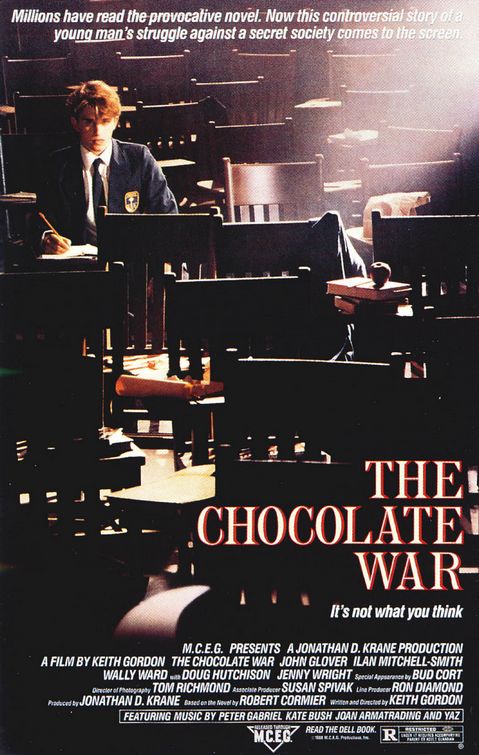
Saturday Matinee: The Chocolate War

Chocolate_war_post

“The Chocolate War” (1988) is the film version of the classic YA novel by Robert Cormier. It was the debut feature film from actor Keith Gordon (The Legend of Billie Jean) who directed as well as wrote the screenplay. The film depicts the rebellion of new student Jerry Renault (Ilan Mitchell-Smith) against his school’s official and unofficial structures of power while coming to terms with his mother’s death. The Chocolate War features solid acting from the entire cast, especially John Glover and Wallace Langham as the main antagonists and Bud Cort (Harold and Maude) in a memorable cameo appearance. The film also features a fine soundtrack of 80s artists such as Yaz, Kate Bush and Peter Gabriel.

Watch the The Chocolate War here.

‘Fake news stories’ eclipse ‘conspiracy theories’ in globalist/Sorosite lexicon

fakenews

By Wayne Madsen

Source: Intrepid Report

The corporate news media, allied with “media watchdog” groups, many financed with global billionaire troublemaker George Soros, have trotted out a new dog whistle to attack their opponents: “fake news stories.” The issue of “fake news stories” was even raised by outgoing President Barack Obama in a news conference in Berlin with German chancellor Angela Merkel. Both leaders cited “fake news stories” as something that threatens international stability.

Of course, there are an ample number of fake news stories that emanate from disreputable and discredited websites, many of them vanity sites intending to serve as “click bait” for the unsuspecting web surfer and even a few professional journalists taken in by alarmist headlines. A number of individuals have been duped by totally fake stories written by “Sorcha Faal,” a pseudonym for David Booth, allegedly a U.S. computer programmer and which may also be a pseudonym for another individual or group of individuals. Faal, Booth, or whatever his name is acts as a cyber version of an arsonist who releases fake stories attributed to Russian intelligence sources and then sits back to assess the impact of his prankster works. The fact that a number of Russian news organizations have re-published Faal/Booth fake articles as actual news leads some to believe that U.S. intelligence plays a role in the obvious disinformation operation. Faal/Booth has a number of competitors in the field of cyber-pranksterism.

However, the most prominent purveyors of fake news stories are the very corporate media entities that decry “fake news.” There are a number of examples of corporate media trafficking in fake news. The following are a few stark examples:

  • In 1981, Washington Post reporter Janet Cooke was awarded a Pulitzer Prize for a story about an 8-year old heroin addict named “Jimmy.” Washington, DC, Mayor Marion Barry was taken in by the story and launched a city-wide effort to search for “Jimmy” and provide him with treatment. Barry claimed “Jimmy” was real but, in fact, Cooke made up the entire story of “Jimmy’s World” and Barry lied about the supposed existence of the boy. Although Cooke’s story was totally fake, Post assistant managing editor Bob Woodward submitted it to the Pulitzer committee for an award for best feature writing. Woodward, who concocted the fictional “Deep Throat” source in his Watergate reporting for the Post, was never sanctioned for advancing a fake story for a supposed serious professional journalism honor. The Post can be attributed to two major “fake news stories”—”Jimmy” the heroin addict and “Deep Throat” the high-level Nixon administration source who was not FBI deputy director Mark Felt.
  • New York Times reporter Jayson Blair wrote a series of fake news stories for the so-called “paper of record.” The following are a few of his fake news headlines that appeared in the Times:


October 30, 2002—”US Sniper Case Seen as a Barrier to a Confession.”
February 10, 2003—”Peace and Answers Eluding Victims of the Sniper Attacks.”
March 3, 2003—”Making Sniper Suspect Talk Puts Detective in Spotlight.”
March 27, 2003—”Relatives of Missing Soldiers Dread Hearing Worse News.”
April 3, 2003—”Rescue in Iraq and a ‘Big Stir’ in West Virginia.”
April 7, 2003—”For One Pastor, the War Hits Home.”
April 19, 2003—””In Military Wards, Questions and Fears from the Wounded.”

Blair made up from whole cloth stories about the DC sniper and Iraq war veterans. In all, 36 of the 73 national stories penned by Blair were fake. However, a number of media outlets, including the Times, reported as fact fake stories about Saddam Hussein’s “weapons of mass destruction,” all of which were false. New York Times reporter Judith Miller reported as fact information from Iraqi exiled leader Ahmed Chalabi alleging that Iraq possessed mobile weapons laboratories. The information was false, as was other U.S. “intelligence” on Iraq that was fed Miller and other reporters that was all bogus, including stories on Saddam Hussein allegedly trying to procure yellow cake uranium from Niger.

  • In May 1998, Stephen Glass of The New Republic wrote an article titled “Hack Heaven” about a 15-year old hacker and a non-existent software firm called “Jukt Micronics.” It was later determined that 27 articles Glass wrote for The New Republic were fabrications.
  • USA Today reporter and Pulitzer nominee Jack Kelly allegedly fabricated a number of stories for the newspaper, including a 1999 story alleging that the Yugoslavian armed forces was ordered to ethnically cleanse an Albanian village in Kosovo.
  • The Dateline NBC story of November 17, 1992, titled “Waiting to Explode” and alleging that poor fuel tank design caused General Motors’ pick-up trucks to explode on impact was based on rigged tests and staged explosions.
  • NBC anchor Brian Williams was suspended after making several false claims about his prior reporting. He claimed to have been riding on board an Army Chinook helicopter that was forced to land in an Iraqi desert after it was hit by a rocket-propelled grenade. The story was false as was another in which Williams claimed to have flown into Baghdad with Navy SEAL Team 6. Williams also falsely claimed to have seen a man commit suicide in the New Orleans Superdome in the aftermath of hurricane Katrina. Williams also claimed to have personally witnessed the Berlin Wall coming down. He was not in Berlin until a day after the wall fell.
  • In 2013, CBS “60 Minutes” interviewed a U.S. security contractor who claimed he witnessed the attack on the U.S. compound in Benghazi, Libya on September 11, 2012. The contractor was not in Benghazi during the attack and the account was bogus.
  • Rolling Stone published a falsified story in 2014 about a University of Virginia gang rape victim named “Jackie” and school administrator Nicole Eramo. The magazine falsely claimed that Eramo covered up rape incidents at the university. A federal jury later found that Rolling Stone libeled Eramo.
  • Several news organizations falsely claimed that security guard Richard Jewell was the chief suspect in the July 27, 1996, bombing of Centennial Olympic Park in Atlanta. Jewell successfully sued CNN, The Atlanta Journal-Constitution (“FBI suspects ‘hero’ guard may have planted bomb”), NBC, and The New York Post for libel.
  • Fox News often featured a commentator named Wayne Simmons, described by the network as a former CIA “operative.” In fact, Simmons never worked for the CIA and he was a fraud. He was later sentenced to 33 months in prison for his fraudulent activities.

The corporate media is legitimized by a very phony “arbiter” of what and what does not constitute accurate news: the very problematic Snopes.com. Snopes traffics in as much fakery in its “debunking” of alternative media articles as does the corporate media in its national and international reporting.

It is clear that Obama, Merkel, the Soros operation, and others are attacking “fake news stories” in order to hide the real target for their invective rhetoric: the alternative media, which does not kow-tow to corporate executives, advertisers, and special interests ranging from Big Pharma to the Israeli Lobby. The alternative media provides the lifeblood for the First Amendment guarantee of freedom of the press. The corporate media is a bloated and deceitful artifice whose time is coming to an end.


Related Videos:

Either Reverse All the Perverse Incentives or the System Will Implode

By Charles Hugh Smith

Source: Of Two Minds

Every perverse incentive is the cash cow for a vested interest or cartel.

I hope it’s not a great shock to discover all the incentives in our status quo are perverse: those who rig the financial system while creating zero real value, jobs, goods or services reap all the big profits; those who take near-zero responsibility for their own health are subsidized by those who take responsibility for their own health; those who try to start enterprises and hire workers are saddled with endless regulations, junk fees and taxes while those who game the system to get welfare (household or corporate) skim the cream for doing nothing for their community or for the nation.

Systems in which all the incentives are perverse implode under their own weight. Those who struggle to pay the mounting costs of Imperial Over-Reach, crony-capitalism and all the skimmers and scammers eventually go bankrupt or quit in disgust, while the army of state dependents and cronies explodes higher.

It has taken decades for the incentives to become so perverse, so we no longer notice the perversity or the pathological consequences.

High-frequency traders and financiers with the ready ear of well-paid political lackeys, stooges, toadies and sycophants run never-lose skimming operations and pay lower tax rates than self-employed and small business owners.

Corporations have increased their share prices not by earning more money by producing more goods and services but by borrowing cheap money from the Federal Reserve and buying back outstanding shares.

Corporations pay less tax if they move production overseas and keep their profits in other countries.

If I wreck one vehicle after another due to reckless irresponsibility, what happens to my insurance premiums? They skyrocket, of course, reflecting the higher risks that result from my behavior and poor choices. Nobody thinks safe drivers should subsidize irresponsible drivers.

But if I wreck my health by recklessly pursuing risky behaviors, I pay the same as people who are careful “drivers” of their health. What sort of incentives does this system generate?

If I want to buy an over-priced home, the system is loaded with incentives to encourage that potentially poor financial decision. But if I want to launch a small enterprise, the incentives are all perverse: steep upfront fees, taxes from the first dollar, and in many cases, fees and taxes on revenues, regardless of whether I am making a profit or losing my shirt.

Corporate profits have soared as financialization and rigging the system have paid much higher returns than risking capital in new goods and services.

corp-profits3-16d

The incentives for home ownership have turned the bottom 90% into debt-serfs in servitude to banks while the top 5% own income-producing assets and businesses.

ownership-assets2-16

Larded with the most perverse incentives possible, the U.S. healthcare system in the final stages of maximum costs, just before it implodes:

US-healthcare4

It’s not hard to design positive incentives. For example:

1. Make preventative care essentially free to everyone ($5 co-pay) but weight the risks and costs created by irresponsible behaviors that ruin health. Reward those who take responsibility for their health by reducing the premiums they pay.

2. Tax all profits on securities held less than a day at 95%. Raise corporate taxes generated by financial activities to 50%, and lower the corporate tax rate on profits earned from producing domestic goods and services to zero.

3. Lower the tax for the first $25,000 earned by small enterprises to zero. Limit total government fees to 5% of revenues for all businesses up to $10 million in annual revenues.

4. Phase out the mortgage interest deduction. Limit mortgage interest deductions to the first $100,000 of mortgage debt.

5. Eliminate the personal income tax (and the need to file a return) for every household with income of $100,000 or less.

6. Automatically sunset every government regulation. Make city, county, state and federal governments renew every regulation every few years via a majority vote or it vanishes from the law books.

7. Make every politician wear a NASCAR-style jacket plastered with the names and logos of their corporate, union and financier contributors. The California Initiative to make this a reality is seeking signatures of registered California voters. Since politicians are owned, let’s make the ownership transparent.

8. Treat drug abuse and addiction as medical conditions rather than crimes.

9. Eliminate the Federal Reserve and its free-money for financiers perverse incentives for debt-serfdom and financial plundering.

10. Eliminate all student loans and debts. Make colleges compete for students on a cash-only basis.

As you no doubt noticed, every perverse incentive is the cash cow for a vested interest or cartel. That’s why the perverse incentives will endure until the system implodes under their pathological weight.

Public School or Prison? Here Are 10 Ways It’s Hard To Tell

sprongg-700x466

By Alice Jones Webb

Source: The Mind Unleashed

Every weekday morning, from September through June, parents across the country get up earlier than they want to, rush like crazy, wrangle kids into appropriate clothing, and wait in exhausting drop-off lines to get their children to school on time. Why? Because punctuality is a virtue? Or because they are afraid of getting in trouble?

In big cities and small communities, the same routine is repeated with minor variations. Small children and near adult adolescents will spend the majority of their waking hours somewhere they would rather not be. But few people question the set-up. Parents send their kids to school with the best of intentions, wanting to produce happy, healthy, productive adults. Public school is supposed to be for their own good. Very few question its necessity and virtue. No one questions the fact that our country’s public schools are looking less and less like places of learning and more and more like places of detention (and I don’t mean The Breakfast Club type either).

When you stop and think about it (which few people actually do), our public schools have more in common with our prison system than any parent would care to admit. Most of us are products of the system and will defend its honor and integrity like sufferers of severe Stockholm Syndrome. So let me break it down into a list of glaring similarities that even those of us who went to public school can easily understand.

1. Both School and Prison Take Away Freedom. To get into prison, a person has to be convicted of a crime (although all of us know that prisons are full of people convicted of pretty bogus crimes… just stick with me). Children in school are only guilty of the crime of being children. Since school attendance is compulsory, children, much like criminal prisoners, don’t get to choose whether they get locked up for seven or more hours a day. They are forced to go to school by strict truancy laws until they are at least 16, at which point their youth has already been squandered inside constrictive cinder block walls.

2. Both School and Prison use Security as a Means of Control. Prisons and public schools both use metal detectors, surveillance cameras, police patrols, drug-sniffing dogs, and lock downs to create a facade of greater security. In most elementary schools, there is an emphasis on moving students from location to location in a rigidly ordered manner. The straight line of silent children walking with hands behind their backs look frighteningly like lines of prisoners. The strict codes of conduct used in the majority of schools, as well as the consistent use of handcuffs and pepper spray on unruly high school students, work together to condition young people to the cultural normalcy of over-policing.

Stay in line. Do as you’re told. Don’t make trouble. These are the messages we send to both our prisoners and our school children. But it’s okay. It’s for their own good.

3. Both Schools and Prisons Serve Undesirable Food. The cafeterias in public schools are scarily similar to prison cafeterias, often even sharing the same menus. Unappetizing, bland, processed meals with little nutritional value are the norm in both institutions. And bringing a lunch from home is banned in many school districts. Add in the armed security guards that patrol most public school lunch rooms and a casual observer might not be able to tell the difference.

4. Both Schools and Prisons Enforce Strict Dress Codes. Like prisons, some schools obligate their students to wear uniforms, limiting self-expression, and encouraging a herd mentality that makes control easier (for safety’s sake, of course). But even in schools without required uniforms, strict dress codes are generally in place. Failure to tuck in a shirt tail can land a student in detention. Donning a blouse that doesn’t adequately cover a girl’s shoulders could get her sent home. Sometimes the dress code guidelines are so arbitrary and so strictly detailed, it seems like they are in place just to get students in trouble. In 2008, Gonzales High School in Texas made the national news for requiring dress code violators to wear actual prison jumpsuits. It’s like officials want the students to seem like criminals. Perhaps it makes the policing of students at their own hands seem more justified.

5. Both Students and Prisoners are Tracked. Many prisons use electronic bracelets or other tracking devices to keep track of prisoners’ locations. Many schools are doing the same thing. ID badges with built-in RFID chips can track the location of a child wherever they are wearing it, and many schools require ID badges to be worn during school hours. Some schools have even started using fingerprints and iris scanners to keep track of their prisoners… I mean students.

6. Both Schools and Prisons Have Armed Guards. Often referred to as SROs (school resource officers), most school buildings are patrolled by armed police officers. They are generally uniformed and carry pepper spray, tasers, and batons that they can use on students should the need arise. These officers police hallways and lunchrooms, administer searches of children’s lockers and school bags, and man the TSA-style checkpoints at the entrances to the buildings our children enter to learn.

7. Both Schools And Prisons do not Allow Anger. Although anger is a justifiable emotion toward constrictive and oppressive political structures, neither students nor prisoners have the power to express their emotions. In prison, angry convicts are locked away in solitary confinement, their movements and small remaining freedoms restricted for safety’s sake. In public school, anger is interpreted as a failing of the individual rather than the system that creates it. There, anger is seen as “disruptive behavior” or “cognitive impairment” or a “social or learning disability”. Often the angry student is marginalized by placement in special education classes, enrolled in “alternative schools”, or medicated to control their disruptions, all of which are just differing forms of confinement.

8. Both Students and Prisoners are Forced to Work. The scene of the prison chain gang in striped clothing, hacking away at rocks and debris is one that most people have seen in old films. Today’s prisoner work force looks a little different, with prisoners wearing orange jumpsuits and doing highway clean-up minus the bulky steel chains. Students are often forced to work, too. Sometimes they are forced to work cleaning up school grounds as a disciplinary action. But in some school systems, volunteer work or “community service” is required each year for a passing grade. Interesting to note that “community service” is frequently doled out as punishment to citizens convicted of minor crimes, but our children are only guilty of being kids.

9. Both Schools and Prisons Follow Strict Schedules. A rigid schedule of walking, eating, learning, exercise, and bathroom use is followed in both institutions. It doesn’t matter when you have to pee, or need to stretch your legs, or want a breath of fresh air. Those things can only be done during allotted times defined by those in authority.

10. Both Schools and Prisons Have Zero-Tolerance Policies. Most public schools now have policies of zero-tolerance when it comes to violence, bullying, drug possession, etc. Interestingly, much of the verbiage in our schools’ disciplinary policies come straight from the nation’s “War on Drugs” (which is directly responsible for the vast majority of our country’s prisoners). Zero-tolerance policies require harsher penalties for sometimes minor classroom offenses and often result in law enforcement being called in to handle school disciplinary actions. The result has been what many refer to as the “School-to-prison pipeline”. The policies make criminals out of students, pushing kids out of the classroom and into the criminal justice system at alarming rates. At least the transition will be easy. Those school children have already spent the majority of their lives in a system that matches the penitentiary where they’ll be spending most of the rest of it.

With such dark and intimidating surroundings, focusing on learning becomes difficult. It’s no wonder most kids don’t want to go to school. When you’re treated like a prisoner, it’s easy to feel like one.

About the Author

Alice Jones Webb is a writer, homeschooling mother of four, black belt, autodidact, free-thinker, avid reader, obsessive recycler, closet goth, a bit of a rebel, but definitely not your typical soccer mom. You can usually find her buried under the laundry and also on Facebook, Twitter, and her blog, DifferentThanAverage.com, where she blogs about bucking the status quo.