Two for Tuesday
Reply

By Dr. Joseph Mercola
Source: The Herland Report
Who Owns the World? A handful of mega corporations — private investment companies — dominate every aspect of our lives; everything we eat, drink, wear or use in one way or another.
These investment firms are so enormous, they control the money flow worldwide.
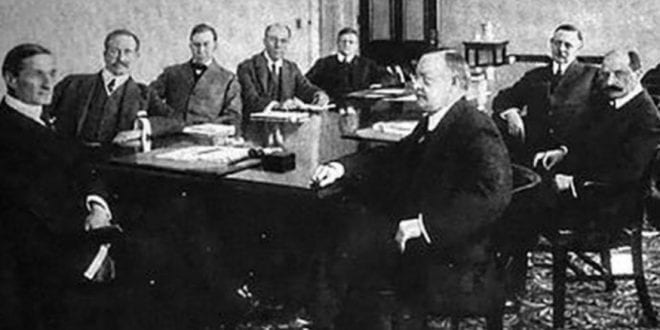
While there appear to be hundreds of competing brands on the market, like Russian nesting dolls, larger parent companies own multiple smaller brands. In reality, all packaged food brands, for example, are owned by a dozen or so larger parent companies. (Feature photo: A rare photo of The Federal Reserve Board of Governors)
These parent companies, in turn, are owned by shareholders, and the largest shareholders are the same in all of them: Vanguard and Blackrock, writes Dr. Joseph Mercola, osteopathic physician, best-selling author and recipient of multiple awards in the field of natural health.
No matter what industry you look at, the top shareholders, and therefore decision makers, are the same: Vanguard, Blackrock, State Street and/or Berkshire Hathaway. In virtually every major company, you find these names among the top 10 institutional investors.
These major investment firms are in turn owned by their own set of shareholders. One of the most amazing things about this scheme is that the institutional investors also own each other.
They’re all shareholders in each other’s companies. At the very top are Vanguard and Blackrock. Blackrock’s largest shareholder is Vanguard, which does not disclose the identity of its shareholders due to its unique structure.
To understand what’s really going on, watch Tim Gielen’s hour-long documentary, “MONOPOLY: Who Owns the World?”
Who Owns the World? Until recently, it appeared economic competition had been driving the rise and fall of small and large companies across the U.S. Supposedly, PepsiCo is Coca Cola’s competitor, Apple and Android vie for your loyalty and drug companies battle for your health care dollars. However, all of that turns out to be an illusion.
Since the mid-1970s, two corporations — Vanguard and Blackrock — have gobbled up most companies in the world, effectively destroying the competitive market on which America’s strength has rested, leaving only false appearances behind.
Indeed, the global economy may be the greatest illusionary trick ever pulled over the eyes of people around the world. To understand what’s really going on, watch Tim Gielen’s hour-long documentary, “MONOPOLY: Who Owns the World?” above.
Who Owns the World? As noted by Gielen, who narrates the film, a handful of mega corporations — private investment companies — dominate every aspect of our lives; everything we eat, drink, wear or use in one way or another. These investment firms are so enormous, they control the money flow worldwide. So, how does this scheme work?
While there appear to be hundreds of competing brands on the market, like Russian nesting dolls, larger parent companies own multiple smaller brands. In reality, all packaged food brands, for example, are owned by a dozen or so larger parent companies.
Pepsi Co. owns a long list of food, beverage and snack brands, as does Coca-Cola, Nestle, General Mills, Kellogg’s, Unilever, Mars, Kraft Heinz, Mondelez, Danone and Associated British Foods. Together, these parent companies monopolize the packaged food industry, as virtually every food brand available belongs to one of them.
These companies are publicly traded and are run by boards, where the largest shareholders have power over the decision making. This is where it gets interesting, because when you look up who the largest shareholders are, you find yet another monopoly.
While the topmost shareholders can change from time to time, based on shares bought and sold, two companies are consistently listed among the top institutional holders of these parent companies: The Vanguard Group Inc. and Blackrock Inc.
Who Owns the World? For example, while there are more than 3,000 shareholders in Pepsi Co., Vanguard and Blackrock’s holdings account for nearly one-third of all shares. Of the top 10 shareholders in Pepsi Co., the top three, Vanguard, Blackrock and State Street Corporation, own more shares than the remaining seven.
Now, let’s look at Coca-Cola Co., Pepsi’s top competitor. Who owns Coke? As with Pepsi, the majority of the company shares are held by institutional investors, which number 3,155 (as of the making of the documentary).
As shown in the film, three of the top four institutional shareholders of Coca-Cola are identical with that of Pepsi: Vanguard, Blackrock and State Street Corporation. The No. 1 shareholder of Coca-Cola is Berkshire Hathaway Inc.
These four — Vanguard, Blackrock, State Street and Berkshire Hathaway — are the four largest investment firms on the planet. “So, Pepsi and Coca-Cola are anything but competitors,” Gielen says. And the same goes for the other packaged food companies. All are owned by the same small group of institutional shareholders.
Who Owns the World? The monopoly of these investment firms isn’t relegated to the packaged food industry. You find them dominating virtually all other industries as well. Take Big Tech, for example. Among the top 10 largest tech companies we find Apple, Samsung, Alphabet (parent company of Google), Microsoft, Huawei, Dell, IBM and Sony.
Here, we find the same Russian nesting doll setup. For example, Facebook owns Whatsapp and Instagram. Alphabet owns Google and all Google-related businesses, including YouTube and Gmail.
It’s also the biggest developer of Android, the main competitor to Apple. Microsoft owns Windows and Xbox. In all, four parent companies produce the software used by virtually all computers, tablets and smartphones in the world. Who, then, owns them? Here’s a sampling:
You can continue going through the list of tech brands — companies that build computers, smart phones, electronics and household appliances — and you’ll repeatedly find Vanguard, Blackrock, Berkshire Hathaway and State Street Corporation among the top shareholders.

Who Owns the World? The same ownership trend exists in all other industries. Gielen offers yet another example to prove this statement is not an exaggeration:
“Let’s say we want to plan a vacation. On our computer or smart phone, we look for a cheap flight to the sun through websites like Skyscanner and Expedia, both of which are owned by the same group of institutional investors [Vanguard, Blackrock and State Street Corporation].
We fly with one of the many airlines [American Airlines, Air France, KLM, United Airlines, Delta and Transavia] of which the majority of the shares are often owned by the same investors …
The airline we fly [on] is in most cases a Boeing or an Airbus. Again, we see the same [institutional shareholders]. We look for a hotel or an apartment through Bookings.com or AirBnB.com. Once we arrive at our destination, we go out to dinner and we write a review on Trip Advisor. The same investors are at the basis of every aspect of our journey.
And their power goes even much further, because even the kerosene that fuels the plane comes from one of their many oil companies and refineries. Just like the steel that the plane is made of comes from one of their many mining companies.
This small club of investment companies, banks and mutual funds, are also the largest shareholders in the primary industries, where our raw materials come from.”
The same goes for the agricultural industry that the global food industry depends on, and any other major industry. These institutional investors own Bayer, the world’s largest seed producer; they own the largest textile manufacturers and many of the largest clothing companies.
They own the oil refineries, the largest solar panel producers and the automobile, aircraft and arms industries. They own all the major tobacco companies, and all the major drug companies and scientific institutes too. They also own the big department stores and the online marketplaces like eBay, Amazon and AliExpress.
They even own the payment methods we use, from credit card companies to digital payment platforms, as well as insurance companies, banks, construction companies, telephone companies, restaurant chains, personal care brands and cosmetic brands.
No matter what industry you look at, the top shareholders, and therefore decision makers, are the same: Vanguard, Blackrock, State Street and/or Berkshire Hathaway. In virtually every major company, you find these names among the top 10 institutional investors.
Who Owns the World? Diving deeper, we find that these major investment firms are in turn owned by their own set of shareholders. One of the most amazing things about this scheme is that the institutional investors — and there are many more than the primary four we’ve focused on here — also own each other. They’re all shareholders in each other’s companies.At the top of the pyramid — the largest Russian doll of all — we find Vanguard and Blackrock.
“Together, they form an immense network that we can compare to a pyramid,” Gielen says. Smaller institutional investors, such as Citibank, ING and T. Rowe Price, are owned by larger investment firms such as Northern Trust, Capital Group, 3G Capital and KKR.
Those investors in turn are owned by even larger investment firms, like Goldman Sachs and Wellington Market, which are owned by larger firms yet, such as Berkshire Hathaway and State Street. At the top of the pyramid — the largest Russian doll of all — we find Vanguard and Blackrock.
“The power of these two companies is something we can barely imagine,” Gielen says. “Not only are they the largest institutional investors of every major company on earth, they also own the other institutional investors of those companies, giving them a complete monopoly.”
Gielen cites data from Bloomberg, showing that by 2028, Vanguard and BlackRock are expected to collectively manage $20 trillion-worth of investments. In the process, they will own almost everything on planet Earth.
Who Owns the World? Bloomberg has also referred to BlackRock as the “fourth branch of government,” due to its close relationship with the central banks. BlackRock actually lends money to the central bank, the federal reserve, and is their principal adviser.
Dozens of BlackRock employees have held senior positions in the White House under the Bush, Obama and Biden administrations. BlackRock also developed the computer system that the central banks use.
While Larry Fink is the figurehead of BlackRock, being its founder, chairman and chief executive officer, he’s not the sole decision maker, as BlackRock too is owned by shareholders. Here we find yet another curiosity, as the largest shareholder of BlackRock is Vanguard.
Who Owns the World? “This is where it gets dark,” Gielen says. Vanguard has a unique structure that blocks us from seeing who the actual shareholders are. “The elite who own Vanguard don’t want anyone to know they are the owners of the most powerful company on earth.” Still, if you dig deep enough, you can find clues as to who these owners are.
The owners of the wealthiest, most powerful company on Earth can be expected to be among the wealthiest individuals on earth. In 2016, Oxfam reported that the combined wealth of the richest 1% in the world was equal to the wealth of the remaining 99%. In 2018, it was reported that the world’s richest people get 82% of all the money earned around the world in 2017.
In reality, we can assume that the owners of Vanguard are among the 0.001% richest people on the planet. According to Forbes, there were 2,075 billionaires in the world as of March 2020. Gielen cites Oxfam data showing that two-thirds of billionaires obtained their fortunes via inheritance, monopoly and/or cronyism.
“This means that Vanguard is in the hands of the richest families on earth,” Gielen says. Among them we find the Rothschilds, the DuPont family, the Rockefellers, the Bush family and the Morgan family, just to name a few.
Many belong to royal bloodlines and are the founders of our central banking system, the United Nations and just about every industry on the planet.
Gielen goes even further in his documentary, so I highly recommend watching it in its entirety. I’ve only summarized a small piece of the whole film here.
Speaking of the central bankers, I recently interviewed finance guru Catherine Austin Fitts, and she believes it’s the central bankers that are at the heart of the global takeover we’re currently seeing. She also believes they are the ones pressuring private companies to implement the clearly illegal COVID jab mandates. Their control is so great, few companies have the ability to take a stand against them.
“I think [the central bankers] are really depending on the smart grid and creepy technology to help them go to the last steps of financial control, which is what I think they’re pushing for,” she said.
“What we’ve seen is a tremendous effort to bankrupt the population and the governments so that it’s much easier for the central bankers to take control. That’s what I’ve been writing about since 1998, that this is a financial coup d’etat.
Now the financial coup d’etat is being consolidated, where the central bankers just serve jurisdiction over the treasury and the tax money. And if they can get the [vaccine] passports in with the CBDC [central bank digital currency], then it will be able to take taxes out of our accounts and take our assets. So, this is a real coup d’etat.”

By Timothy Alexander Guzman
Source: Silent Crow News
Fascism has made its way back into Europe as Austria has become one of the first countries in the world to declare war on the unvaccinated as they recently announced that a lockdown will be in place for those who refuse the experimental injections, but they also decided to do the same for the vaccinated resulting in another lockdown of the country. What is concerning is the fact that the Austrian government first targeted the unvaccinated which brings us back to the days of the Nazi Germany targeting specific people who did not fit the criteria of being a German citizen. The Associated Press published ‘Austria orders lockdown for unvaccinated people as COVID cases soar’ reported that “the Austrian government has ordered a nationwide lockdown for unvaccinated people starting at midnight Sunday to combat rising coronavirus infections and deaths.” What would a lockdown mean for the Austrian people who remain unvaccinated? “The move prohibits unvaccinated people 12 and older from leaving their homes except for basic activities such as working, grocery shopping, going for a walk – or getting vaccinated.” In other words, Austria is in a 1984 Orwellian scenario that’s close to the breaking point of total tyranny. Austrian authorities are “concerned about rising infections and deaths and that soon hospital staff will no longer be able to handle the growing influx of COVID-19 patients” continued “It’s our job as the government of Austria to protect the people,” Chancellor Alexander Schallenberg told reporters in Vienna on Sunday. “Therefore we decided that starting Monday … there will be a lockdown for the unvaccinated.”
At this point, it should not surprise anyone. We saw this coming. Now there are protests taking place not only in Austria but in other countries as well including the Netherlands, Croatia and Italy against government lockdowns and vaccine passports. The point is that the unvaccinated are being targeted. There are even celebrities who are calling the unvaccinated “the enemy” such as former KISS icon Gene Simmons, who in my opinion has no talent. According to TMZ.com Simmons was recently interviewed on Talkshoplive’s Rock ‘N’ Roll Channel said that “the far left and the far right, they are both evil. They both spread all kinds of nonsense. Politics are the enemy” and that “if you’re willing to walk among us unvaccinated, you are an enemy.”
This is just the beginning, but it’s not just about lockdowns or celebrities calling those unvaccinated the enemy, doctors who sold out to Big Pharma and obey government orders are also declaring war on the unvaccinated by denying people healthcare services. RT.com published an article written by Dr. R.M. Huffman titled ‘As a doctor, here’s my message to anyone who thinks it’s OK to deny medical treatment to those unvaccinated against Covid’ said that “some doctors are openly discussing refusal to treat patients who decline, for whatever reason, to get the jab. This would set a dangerous precedent and shatter fundamental tenets of medical practice” and that “An insidious sentiment has begun metastasizing throughout the United States and Britain, expressed by politicians, pundits, and – most disturbingly – by physicians themselves: that the unvaccinated who contract Covid-19 should be denied medical care.” This is clearly a declaration of war on the unvaccinated where doctors themselves are allowing patients to get sick or even die if they are not vaccinated. Huffman sounded the alarm on this disturbing trend in the healthcare industry:
It gets worse. A former US senator from Missouri, Claire McCaskill, also wants the unvaccinated to have their insurance rates raised. Piers Morgan, the British TV personality, demands to his nearly 8 million Twitter followers that the NHS must refuse them hosital beds. An emergency medical physician in Arizona responds to a video clip of people unmasked in a grocery store with a message, “Let ‘em die”. A liver surgeon at Massachusetts General suggests that declining a Covid vaccine should be treated by doctors as a functional Do Not Intubate/Do Not Resuscitate order. These are neither private thoughts nor quiet conversations with overworked colleagues: these are calls to action, shared on social media, intended for public consumption. This should terrify you
They are already denying people medical care because they did not get vaccinated. According to news channel wkyc.com who published ‘Organtransplant surgery canceled due to new Cleveland Clinic policy requiring COVID-19 vaccination’ reported that a man named Mike Ganim was about to receive a life-saving kidney transplant surgery, but his wife Debi said she was notified that the surgery was canceled due to the donor not being vaccinated:
Debi Ganim said they were informed on October 8 that Cleveland Clinic implemented a new safety policy that required both living donors and organ recipients to be vaccinated against COVID-19. Mike is fully vaccinated, but the donor is not
Yet, those who are vaccinated are witnessing breakthrough cases all around the world. Back on July 18th , 2021, the Scottish-based news website The Expose posted an article ‘5,522 people have died within 28 days of having a Covid-19 Vaccine in Scotland according to Public Health Scotland’ showing what Public Health Scotland (PHS) released under the freedom of information request called the Covid-19 Statistical Report admitted the following:
Between 8 December 2020 and 11 June 2021, a total of 5,522 people died within 28 days of receiving a COVID-19 vaccine in Scotland (number of days between vaccine and death is 0-27, where 0 is the day of vaccination, all age groups). A breakdown of these deaths by day and vaccine type is available in the spreadsheet provided along with this report
On August 16th, 2021, science.org published an article on the breakthrough cases coming out of Israel ‘A grim warning from Israel: Vaccination blunts, but does not defeat Delta: with early vaccination and outstanding data, country is the world’s real-life COVID-19 lab’ stated what the reality is for the Israelis who received “the shot”:
What is clear is that “breakthrough” cases are not the rare events the term implies. As of 15 August, 514 Israelis were hospitalized with severe or critical COVID-19, a 31% increase from just 4 days earlier. Of the 514, 59% were fully vaccinated. Of the vaccinated, 87% were 60 or older.
“There are so many breakthrough infections that they dominate and most of the hospitalized patients are actually vaccinated,” says Uri Shalit, a bioinformatician at the Israel Institute of Technology (Technion) who has consulted on COVID-19 for the government. “One of the big stories from Israel [is]: ‘Vaccines work, but not well enough
On November 12th, Dr. Anthony Fauci admitted on The New York Times‘ podcast The Daily on the current data coming in from Israel on the steady rise of “breakthrough infections”:
They are seeing a waning of immunity not only against infection but against hospitalization and to some extent death, which is starting to now involve all age groups. It isn’t just the elderly,” Fauci said. “It’s waning to the point that you’re seeing more and more people getting breakthrough infections, and more and more of those people who are getting breakthrough infections are winding up in the hospital
For those in the United States who are vaccinated also have some bad news heading their way as the Associated Press (AP) has admitted that the vaccinated are the real problem in an article titled ’COVID-19 hot spots offer sign of what could be ahead for US’ reported on the increase of Covid-19 infection rates among the vaccinated:
New Mexico is running out of intensive care beds despite the state’s above-average vaccination rate. Waning immunity may be playing a role. People who were vaccinated early and have not yet received booster shots may be driving up infection numbers, even if they still have some protection from the most dire consequences of the virus
With a 100% vaccination rate, Gibraltar is considered one of the most vaccinated countries on earth has also witnessed an increase of “47 cases per day in the last seven days” as reported by express.co.uk in article titled ‘Gibraltar cancels Christmas celebrations amid Covid spike’ stated the following:
While the government has called upon the public to “exercise their own judgement”, they have “strongly” advised against any social events for at least the next four weeks, discouraging people from holding private Christmas events. Gibraltar has seen a steady increase in active cases of COVID-19 throughout October and November, which has gained pace over the past few days
Now the medical establishment is pushing for never-ending booster shots to give you supposedly added protections. Big Pharma, the World Health Organization (WHO) and various governments who mandated vaccine requirements for federal, state, and local government employees and private businesses are pushing their agenda through the mainstream media with the narrative suggesting that the unvaccinated is becoming a problem. But that is a lie, it’s clearly the vaccinated who are getting sick, many are even dying. In the US today, terrorists are now gun owners, anti-war activists, real journalist organizations such as Wikileaks and other anti-establishment organizations and individuals, soon it will be the unvaccinated. A new enemy has been added to the list and they are called the anti-Vaxxers. It is certain that governments and Big Pharma will launch a fascistic crusade against the unvaccinated. Public television channel C-Span.org published a video by the Atlantic Council who interviewed Pfizer’s CEO Albert Bourla who claimed that his corporation is “getting briefings from the CIA and FBI” on the “spread of misinformation” by what he called “criminals” because “they literally cost millions of lives.” The war on the unvaccinated by fascistic governments and multinational corporations such as Big Pharma has already begun.
How far would they go to get people to roll up their sleeves and take the shot? They are already denying people healthcare and are locking down the unvaccinated in Europe, so what’s next? Will governments start banning people who are unvaccinated from buying food? As they say, you give them the finger then they take your arm. The good news is that there is a resistance against this medical tyranny with people from all walks of life and it will keep growing because many see it as the only way to stop a broader agenda by those who want total control over the world’s healthcare system with Big Pharma moving up on the pyramid of global power. I am optimistic that we will win this battle, I can say with confidence, it’s inevitable.

By Paul Levy
Source: Waking Times
Synchronicity is considered to be one of the most important ideas emerging out of the twentieth century. Jung coined the term synchronicity to describe a category of experience that defied and had an altogether different logic than the widely accepted and virtually unquestioned logic of linear sequential causality (in which a cause precedes an effect in linear time), which was generally thought to be the only kind of causality operating in the universe at the time. Bringing forth the notion of synchronicity was a bold and heretical act by Jung that was a radical departure from and challenged one of the most inviolable, sacrosanct, and seemingly unassailable foundations of the modern scientific materialistic worldview. In his idea of synchronicity Jung was proposing a completely different kind of organizing principle at play in the universe that was quite alien to the widely accepted western worldview of how the universe worked.
In order to break free from and distinguish synchronicity from the limiting logic of linear causality, Jung chose the word “acausal” (calling synchronicities an “acausal connecting principle”) in order to characterize how synchronicities didn’t have to do with causality as it had been generally understood. There was an unforeseen problem, however, that had to do with Jung’s choice of the word “acausal”—and what he meant by this—that has caused a rift and created conflict among a number of theorists, researchers, scientists and psychologists in their accepting Jung’s idea of synchronicity. Some people have even dismissed Jung’s work on synchronicity, thinking his conception of synchronicity is incoherent or flawed.
To cite one example, J. B. Rhine, who is widely considered to be the father of parapsychology, and was one of Jung’s inspirations for his work on synchronicity, couldn’t accept Jung’s idea of synchronicity being “acausal,” and thereby rejected Jung’s understanding of synchronicity. Jung thereby lost an important potential ally in helping him bring forth his concept of synchronicity to the world.
The dictionary definition of the word acausal is “not involving causation or arising from a cause; not causal. Synonym: noncausal.” For example, in describing synchronicities, Jung writes that they are “a modality without a cause, an ‘acausal orderedness.’” Being called an acausal connecting principle therefore implies that there is no causality operating in a synchronicity. Jung was of the opinion that it is our strongly “ingrained belief in the sovereign power of causality” that makes it seem unthinkable that “causeless events” could ever happen. But if events without a cause actually do exist, Jung regarded them as “creative acts” that are “not derivable from any known antecedents.” The type of causation we are dealing with in synchronicities were totally unfamiliar and unknown to the prevailing western scientific mindset of his day. In his theory of synchronicity, Jung was trying to articulate a radically new vision of reality—a new worldview—that was completely out of the box and off the radar of the existing scientific materialistic paradigm.
In his conception of synchronicities as being acausal, it is entirely conceivable that Jung was way ahead of his time and was tapping into, perceiving and pointing at the underlying unified quantum field which is openly hidden (from our spatio-temporally conditioned, dualistic human perception) within the very midst of our physical world. In this unified nonlocal field there is no separation whatsoever, as there are no independent “things” that interact with and hence, have causal effects upon each other. These separate parts are merely mental constructs, just ideas in our mind, human overlays or projections of our own inner state of fragmentation onto an ultimately indivisible field of reality that we then mistakenly take to be made up of separate things. In an undivided realm such as this—that is simultaneously immanent and transcendent—there can be no causality because causality implies separate entities that influence and have effects upon each other.
To illustrate this same point, quantum theorist David Bohm uses the following example: Imagine a fish swimming in a fish tank, with two video cameras at right angles to each other filming the fish’s movements, which are then transmitted to and shown on two different monitors in another room in a way that makes us think we are looking at two different fish. The fish’s movements on these two screens clearly seem related to each other, but we can’t say that the fish’s movement on one of the screens “caused” or influenced in any way the corresponding movement on the other screen. This is because the different images on the two screens are not pictures of independently existing entities that are interacting, but are in reality two images (from different perspectives) of one and the same entity. It would be an error to try to establish a causal relationship between these two images, as the notion of causality simply does not apply in this circumstance. It would therefore make sense to say that the “connecting principle” between the two different images of this single fish (representing the deeper indivisible nature of reality) is acausal. Thus, in describing the nature of a quantum universe such as ours, Bohm characterizes it as having a “non-causal” connection between its elements.
Jung’s usage of the word acausality may therefore have been intentionally referring to this intrinsically unified field which admits no separation. In any case, his choice of the word acausal has nevertheless created a lot of misunderstanding that continues to persist up through our present day that needs to be remedied.
Do synchronicities arise, as Jung seems to suggest, without a cause? Or, is there in synchronistic experiences an unfamiliar kind of causality that is operating in the world in which cause and effect are not taking place over linear sequential time, maybe not even taking place within time itself? If it does exist, how is this unknown type of causality a “connecting principle” between the inner and outer dimensions of our experience?
To address this problem, I thus propose coining and bringing forth the word “simulcausality” as an alternative term to more accurately describe the kind of atemporal causality that might be happening in synchronicities. The notion of ‘simulcausality’ remedies the confusion around the word ‘acausal’ by acknowledging, rather than a linear-sequential or temporal form of causality—or no causality at all—that a new and different kind of simultaneous causality which acts as a ‘connecting principle’ is taking place in synchronicities.
This unfamiliar kind of causality that mysteriously links the inner and outer contents of our experience together is brought into focus through the notion of simulcausality. In synchronicities, these two realms—the inner (subjective) and the outer (objective)—are connected in a way that is not sequentially causal but simulcausal. These two realms—the internal and the external—are what synchronicities act as a connecting principle between. Simulcausality implies that there is a different kind of causality operating than we are accustomed to, but this other kind of causality occurs between the two seemingly distinct realms of mind and matter while taking place outside of time, in no time—i.e., simultaneously!
Introducing the word simulcausal involves, of course, more than the mere changing of a word. Replacing the word acausal with simulcausal is symbolic of shifting into a new, more expansive mode of seeing that previously was unavailable to us because of our unconscious conditioning. With this new kind of vision comes a new way of understanding ourselves and the world that helps us to see how our self-reflecting and potentially self-reflective universe actually operates, rather than how we had been hallucinating that it operates while being conditioned and blinded by the spell of linear time and its natural correlate, linear causality.
We can now redefine synchronicity as “a simulcausal connecting principle” in which causality happens vertically (simultaneously) rather than horizontally (over linear time). Vertical causality refers to a kind of causality that occurs between different dimensions or domains of our experience that are inseparably embedded and inter-nested within each other in the same moment. This perfectly describes the interdimensional relationship between the inner subjective world within us, which takes place in a higher dimension (‘in’ is ‘up’ dimensionally), compared to the lowerdimensions of the seemingly outer 3D world of matter, time and our physical sense perceptions (commonly known as the spacetime continuum).
The higher dimension and the lower dimensions of our experience interpenetrate each other so fully such that there’s an intrinsic connectivity between them—through the simulcausal connecting principle—that allows these two realms to instantaneously influence each other interdimensionally in no time at all. Because this is an interdimensional connection, this process happens simultaneously—in the present now moment—without time being involved whatsoever. Mind and matter are thus connected through a simulcausal interdimensional communication link which takes place outside of and independent from linear time.
These different dimensions (of mind and matter) that are conceived of as influencing each other interdimensionally are, ultimately speaking, not two separate dimensions that are interacting with each other, but rather, a multidimensional continuum that is inseparably one. To recognize this is to begin to see the dreamlike nature of our universe where, just like our dreams at night, the physical world we are experiencing is not separate nor separable from our consciousness.
Synchronicities thus operate through an instantaneous simulcausal resonance or interdimensional coordination between the contents of our inner (higher dimensional) life—our minds—and the outer events taking place in the (lower dimensional) 3D physical universe. These two domains—our inner “subjective” and outer “objective” life—are conventionally thought to be distinct and non-interacting but are in fact inseparably interconnected parts of a unified multidimensional whole system. These two domains—mind and matter—which since Descartes have been traditionally understood in the West to be operating independently and separately from each other are, in synchronicities, revealed to have a mysterious correlation that clearly defies the strict Cartesian dualism that requires mind and matter, the subjective and objective realms, to remain separate and non-interacting.
The coordination between these realms takes place instantaneously in the implicit interdimensional simulcausal dynamics constituting each and every moment of our experience. This accounts for the uncanny correspondences between the inner and the outer worlds that are the central and most notable feature of synchronistic phenomena. Because simulcausality operates instantly, outside of time—in the realm of “no time”—its very existence is easy to miss, which is why it has been left out of the western scientific materialistic worldview, which is more outwardly focused and not as introspective as the eastern worldview.
From the materialistic point of view, synchronicities are inexplicable not only because their cause is unknown, but because, presupposing third-dimensional space and time as being objectively real, their cause, to use Jung’s word, is “unthinkable.” This is to say that we can’t comprehend the unfamiliar type of causality involved in synchronicities if we are stuck in our thinking mind. In other words, synchronicities force us out of our (cognitive, conceptualizing) minds.
Our experience of the world—composed of a combination of both linear causality and simulcausality—can be represented by a symmetric cross that can be called “The Cross of Linear and Simultaneous Causality.” In this image, the horizontal axis of the cross represents the realm of linear time and linear sequential causality in which cause precedes effect, which then becomes the cause of a subsequent effect and so on and so forth. This is the common and conventionally understood “timeline” in which the flow of sequential time moves from left to right with the “past” or earlier events being to the left, the present moment of a linear “now” is a single point in the center and then the “future” lies to the right or ahead of the single point representing the now or present moment. This represents the process of horizontal (linear) causality.
The vertical axis represents the timeless now moment in which there is no linear sequential (horizontal) time occurring, but rather, is the domain in which a timelessly operating simulcausality is at work in a way that connects the inner (higher) and outer (lower) dimensions through a kind of instantaneous interdimensional resonance. Each point on the horizontal timeline has a vertical line (representing the interdimensional axis) that can be drawn perpendicular to it. Each and every point of intersection between the two axes represents a specific moment in linear time that is being influenced by—and is an expression of—the connection between the higher and lower dimensions of our experience (via the simulcausal connecting principle that is operating outside of time through each and every moment).
These two modes of causality—the linear causal and simulcausal—co-exist and interpenetrate in an elegantly integrated harmony that is an expression of the wholeness of our universe (as well as reflecting our own intrinsic wholeness as multidimensional beings).
In suggesting the notion of simulcausality I am merely offering a new possible way of contemplating the nature of synchronistic phenomena that has some novel features and some significant conceptual advantages that bypass the set of problems that Jung’s notion of acausality and “acausal orderedness” brought with them. The notion of simulcausality enables us to describe the way that synchronicities operate in a new way that opens up fresh possibilities for us to envision the nature of our universe (as well as our own nature).
One of the key aspects of this revisioning of our scientific conception of reality is the recognition that reality as a whole is a profoundly nonlinear affair with linear dynamics only comprising a small subset of the total dynamics that make up the cosmos. Since the time that Jung introduced the concept of synchronicity there has been an explosion of new scientific theories and creative maps and models of reality that push our understanding far beyond the logic of linear causality. These new insights have moved the scientific imagination of the world into vast new realms of nonlinearity that are now recognized to be fundamental and essential features of the nature of nature, of the universe and of reality itself. For example, nonlinear whole systems sciences like Chaos Theory—more accurately described as the science of nonlinear order—and Complexity Theory have made many groundbreaking inroads into the nonlinear frontier that have changed our scientific picture of our world and of our understanding of reality in extremely profound and fundamental ways.
Simulcausality is, however, not really anything new at all. It is referred to in multiple esoteric, wisdom traditions across the world throughout recorded history. For example, simulcausality is equivalent to what in Buddhism is called “the simultaneity of cause and effect.” At the very heart of the Buddha’s teachings, the simultaneity of cause and effect points to the dynamic in which we are creating our experience of the seemingly outer world (which is not separate from ourselves), while—at the same time—being influenced by our creation in a reciprocally co-creative feedback loop. Contrary to linear cybernetics, in which feedback loops take place through space and over time, simulcausality is characterized by a process of synchronistic cybernetics in which the feedback loops are beginningless, circular, instantaneous, and timeless.
The principle of simulcausality does not negate the possibility of linear causality, nor does linear causality disallow simulcausality. These two fundamentally different types of causality naturally co-exist with each other. This is reflected in the Buddhist understanding of how the simultaneity of cause and effect (instant karma) does not negate but harmoniously co-exists with linear cause and effect (karma that unfolds over time). Their co-existence produces a much more complete view of reality that recognizes and embraces both types of causality.
The Buddhist teaching of “As Viewed, So Appears” is another example of simulcausality. As Viewed, So Appears can be thought of as the mystic law or a mystic equation describing how we formulate and cocreate reality instantaneously within—and with—our dreamlike universe. Think about the nature of a night dream: it is a reflection—a projection—of the mind that is observing it. In a dream, the very moment we connect the dots on the inkblot of the dream (interpreting and placing meaning on it), the dream has no choice—instantaneously, in no time whatsoever—but to reflect back to us our perception/interpretation (for a dream is nothing other than a reflection of the mind that is dreaming), which then confirms to us the “objective” truth of whatever we happen to be seeing (as we now have all the evidence we need to “prove” that what we are seeing is “true”).
This becomes a self-confirming and (potentially) never-ending instantaneous feedback loop that is self-referential and self-generated by our own mind that (since it is happening in no time and unfolding over time at the same time) continually feeds back into itself until it is seen through. Not seeing how simulcausality operates in our moment to moment lives is one of the main reasons why we are prone to get stuck in insidiously self-reinforcing feedback loops that seemingly trap us in all sorts of self-limiting double binds, self-bewitching spells, infinite regressions and dead ends within our own minds. Becoming conscious of the simulcausality principle that is continually at work crafting our experience (of both ourselves and the world) can prevent us from falling under these maddening self-created spells while, at the same time, immediately puts immeasurable, otherwise unavailable creativity at our disposal.
In essence, we have entranced/hypnotized ourselves—putting ourselves under a spell—through our own creative genius of how we are participating in creating our dream (sleeping or waking). This dynamic—which can be clearly seen in our night dreams—is reflecting and teaching us something about how simulcausality acts as a connecting principle between the inner and outer dimensions of our experience that is intrinsic to how we dream up (and create) not only our sleeping dreams, but our waking life as well.
In our universe everything is simultaneously intercausing (causing and being caused by) everything else in a cybernetic chain that recursively loops back on itself in no time. Everything that manifests is reciprocally co-arising with everything else in a nonlinear and nonlocally coordinated way in the one singular and eternal “now” moment. In Buddhism this process of intercausality (a third type of causality) is called “dependent co-arising” (also known as “interdependent co-origination”), which is considered to be the fundamental dynamic by which empirical reality is continually reconstituted in each and every moment.
At the heart of the Buddha’s realization, the notion of dependent co-arising helps us to awaken from the spell of linear causality and enables us to see how our experience of the world—and ourselves—actually arises (via the process of intercausality) in the present now moment while (at the same time) giving the very convincing appearance that it is unfolding in a linear sequential way. Each new configuration of the outer universe as well as of our inner subjective life in each moment (which is always happening in the same eternal now moment) is thought to be—and subjectively experienced as—another (separate) moment, which gives birth to the idea of a linear sequence of distinct moments that arise one after the other (like a conveyor belt). Emerging out of this way of looking at things is our (illusory) conception of linear sequential time, which as physics has pointed out, is in essence nothing other than a construct(ion)—a creation—of our minds. Jung suggests that what happens successively in and over linear time could be conceived of as occurring simultaneously—all at once—in the mind of God. In fact, based on our experience, we always find ourselves in the one and the same singular unchanging now moment, which is a realization that can’t help but to transform the very consciousness that has realized this.
An expression of the interconnectedness, interdependence and undivided wholeness of the universe (where not only there is no separate self to be found, but no separate things of any sort as well), dependent co-arising is operative all throughout space at any given moment in time as well as in each moment. Simulcausality, on the other hand, operates in a realm outside of time, in that it connects the different dimensions of our experience, such as inner (mind) and outer (matter) in a way that does not take place over time. Transcending linear causality, both intercausality (happening throughout space in any and every moment in time), and simulcausality (happening outside of time altogether) mysteriously come together in a timeless embrace, as they reveal themselves in a singular synchronistic moment in time.
There are a number of phenomena that seem to defy our ordinary sense of spacetime based logic—such as, for example, nonlocality (quantum entanglement), dependent co-arising (intercausality), simulcausality, synchronistic phenomena, and psi phenomena. Because they all appear to violate the third-dimensional laws of space and time, these phenomena tend to mistakenly be conflated as being equivalent, which results in confusion and misunderstanding. They are all somehow related, as they are interconnected aspects of the sentient dreamlike universe that we inhabit, but exactly how they are related has yet to be fully established.
Bringing more and more consciousness to the experience of simulcausality enables us to deepen our understanding of how we are playing a key role in creating ourselves and our experience of the universe in each and every (now) moment. This process is similar to how a dream (in which the seemingly inner and outer realities are unified) is constructed. Dreams are literally revealing to us that the primary dynamic of how we co-create the reality we experience is simulcausal in nature. Sequential (linear) causation can be recognized to be a secondary dynamic that builds upon, extends and transforms through and over time that which has already—and always is—being instantaneously simulcausally created.
The tragic and unnecessary self-confinement of our minds to a linear-sequential logic can be seen as a parallel or symbolic reflection of what has happened to much of humanity as a whole with its fall into an overly rationalistic materialist paradigm. Although granting humanity immense power over the physical universe, our entrainment into the scientific materialistic point of view has sadly also brought about an atrophy of the immensely powerful inner psychic/spiritual faculties of humanity, making many of us into misshapen, one-sided and imbalanced creatures.
Similar to how the unconscious compensates a one-sidedness in us by sending us dreams, Jung considered synchronicity to be an indispensable counterpart to linear causality that is compensatory in nature. As a connecting principle, synchronicity can thus help us to connect back with ourselves and our own creative power. The compensation for the one-sidedness of humanity as a whole must come through the reawakening of these atrophied and dormant inner faculties of our minds.

Bong Joon-ho delivers a biting satirical thriller about class warfare and social inequality
By Prahlad Srihari
Source: Firstpost.
Bong Joon-ho has always been interested in the mechanics of genre cinema. The South Korean director has made a career of subverting established genres in an intelligent, meaningful manner. In The Host and Okja, he took the creature feature and added socio-political subtext to it. The serial killer thriller, Memories of Murder, highlighted police incompetence in South Korea and the Hitchcockian murder mystery, Mother, revealed the cultural divide between men and women in Korean society.
Fortunes change when Ki-woo falsifies his credentials to land a tutoring job with a wealthy couple, Mr Park (Lee Sun-kyun) and his gullible wife Yeon-kyo (Cho Yeo-jeong). While he teaches their daughter Da-hye (Jung Ziso), he learns that their troublesome son Da-song (Jung Hyeon-jun) also needs help improving his drawing skills. Ever the opportunist, he recommends his sister — not revealing her real identity of course. She recommends her father as a driver after getting the previous one fired by setting him up as a sex fiend. Ki-taek then recommends his wife to take over as housekeeper after a scheme involving the most creative use of peaches since Call Me By Your Name. After their clandestine infiltration operation into the Parks’ lives is complete, the story makes so many intense and unexpected twists and turns, it turns into a whole different beast altogether.
The cast of Parasite deliver performances of exceptional psychological acuity and perverse frivolity. Led by Bong’s frequent collaborator Song Kang-ho, they are sure to conjure the loudest of laughs and the strongest of emotional reactions from their audiences.
Bong brilliantly uses the upstairs-downstairs distinction in the Parks’ house to reveal a socially divided society. And the society is not just divided by wealth but also culture. Bong revisits a familiar theme of the proliferation of American values over traditional Korean ones. The Parks are a Westernised family who live in a sleek, modernist home with white picket fences — and who buy toys and gadgets from the US, exemplifing the upper crust. Ki-taek’s family, meanwhile, lives in a sordid apartment in the basement, where cockroaches thrive and drunkards urinate on their windows. So, with Parasite, Bong tries to bring to light this deep, festering malady at the heart of Korean society.
Parasite offers a cleverly paced, thoroughly entertaining blend of sumptuous visuals and wickedly dark humour. The music too makes the plot twists and revelations hit that much harder.
Despite the cultural and language barriers, Parasite is an unforgettable cinematic experience as it speaks to universal ideas, themes and emotions. If Bong Joon-ho’s style of genre filmmaking hasn’t become an adjective already, it sure is time now.
Watch Parasite on Kanopy here: https://www.kanopy.com/product/parasite-2

By Kevin Gosztola
Source: Shadowproof
Whistleblowers in the United States military exposed a strike in Syria that resulted in the massacre of around 70 women and children, according to an investigation by the New York Times.
The command responsible for the strike conceded a war crime may have taken place, but a report by the Office of the Inspector General for the Defense Department removed this opinion.
Officials in the Pentagon impeded an investigation and ensured no one would ever be held accountable for the civilian deaths. They also turned on one of the whistleblowers, forcing them out of their position in the I.G.’s office.
What happened proves once again that going through proper channels can be a fruitless and risky career-ending effort.
Lisa Ling, a former tech sergeant who worked on drone surveillance systems and is a known whistleblower, reacted, “Again, the public is notified of a ‘possible’ war crime by a brave whistleblower who was eventually forced out of their job.”
“This is a pattern that exemplifies the need for robust whistleblower protections especially for the intelligence community so often carved out of them. We need more light shined in these secret spaces so that this doesn’t happen again, and again, and again, without the public knowing what is done in our name.”
As the Times reported, on March 18, 2019, “In the last days of the battle against the Islamic State in Syria, when members of the once-fierce caliphate were cornered in a dirt field next to a town called Baghuz, a U.S. military drone circled high overhead, hunting for military targets. But it saw only a large crowd of women and children huddled against a river bank.”
U.S. military forces launched a double tap strike. An American F-15E “attack jet” dropped a 500-pound bomb. As survivors scrambled for cover, another jet dropped a 2,000-pound bomb that killed “most of the survivors.” A “high-definition drone” recorded the scene prior to the bombing. Two or three men were near a compound. Though they had rifles, neither engaged coalition forces. Women and children were observed in the area.“
At nearly every step, the military made moves that concealed the catastrophic strike. The death toll was downplayed. Reports were delayed, sanitized, and classified,” and the Times added, “Coalition forces bulldozed the blast site.”
The strike was the work of a classified U.S. special operations unit known as Task Force 9. They were responsible for the third-worst “casualty event” in Syria. According to the Times, an unnamed Air Force intelligence officer in the Combined Air Operations Center at Al Udeid Air Base in Qatar contacted Lieutenant Colonel Dean Korsak, who was an Air Force lawyer. They were ordered to preserve video and other evidence from the “F-15E squadron and drone crew.”
Korsak concluded a “possible war crime” was committed that required an independent investigation. He noted that Task Force 9 was “clearly seeking to cover up” incidents like this strike by logging false entries after the fact—for example, the man had a gun.
The Air Force’s Office of Special Investigations was notified. However, as the Times recalled, a major refused to investigate because civilian casualties were only investigated if there was a “potential for media attention, concern with outcry from local community/government, [and/or] concern sensitive images may get out.”
In other words, if the Pentagon needed to get ahead of a potential scandal, they would investigate and craft a narrative that could tamp down outrage. But they did not believe the Baghuz strike would ever make headlines.
Korsak tried once more to convince his superiors to investigate in May 2019. They still refused. So Korsak filed a “hotline complaint” with the I.G.’s office in August 2019.
Gene Tate, a “former Navy officer who had worked for years as a civilian analyst with the Defense Intelligence Agency and the National Counterterrorism Center before moving to the inspector general’s office,” told the Times, “When [Korsak] came to us, he wanted to make it very clear he had tried everything else first. He felt the I.G. hotline was the only option remaining.”
Roadblocks prevented Tate from having any success. He could not find the footage from the task force drone that called in the strike. U.S. Central Command (CENTCOM) removed the war crime finding from a report on the massacre.
In January 2020, according to the Times investigation, the deputy inspector general refused to sign off on a memo that would have alerted authorities to the war crime.
Tate did not hesitate to criticize leadership in the I.G.’s office, and by October 2020, he was forced out of the office.
In May 2021, Tate contacted the Senate Armed Services Committee and sent a 10-page letter that detailed the Baghuz strike. However, as of November 13, he was still waiting for any member of the committee to call him back.
*
To further illustrate how stunning it is that senators on the committee ignored what Tate shared, CIA officers in Syria were so alarmed by the conduct of Task Force 9 that they complained to the I.G.’s office for the Defense Department.
“CIA officers alleged that in 10 incidents the secretive task force hit targets knowing civilians would be killed,” according to one former task force officer quoted by the Times.
The New York Times shared their reporting with CENTCOM prior to publication and asked for official comment. CENTCOM acknowledged “80 people were killed” but insisted the strike was justified.
“The bombs killed 16 fighters and four civilians.”“As for the other 60 people killed, the statement said it was not clear that they were civilians, in part because women and children in the Islamic State sometimes took up arms,” according to CENTCOM.
This is part of the legacy of President Barack Obama’s administration. He developed a method of counting civilian casualties that would not “box him in.”
In 2012, the Times reported all “military-age males in a strike zone” found dead were presumed to be “combatants” unless there was “explicit intelligence posthumously proving them innocent.”
If commanding officers refuse to support an investigation into a massacre, then they never have to worry about an investigation moving deaths in the “combatant” column to the “civilian” column, which would make them look bad.
On November 3, the Air Force released the findings of the investigation into the U.S. drone strike in Kabul on August 29 that killed Zemerai Ahmadi, an aid worker and father, his three sons, two of his nephews, and three girls who were toddlers. They exonerated themselves.
“The investigation found no violation of law including the law of war,” Air Force Inspector General Sami Said declared. “We did find execution errors.” Combined with “confirmation bias” and “communication breakdowns,” that “regrettably led to civilian casualties.”
But Said is undoubtedly implicated in the coverup of countless war crimes committed by Task Force 9 and various other special operations units, which engage in similar bombing attacks.
Meanwhile, drone whistleblower Daniel Hale is in a communications management unit (CMU) at a medium-security federal prison in Marion, Illinois. He is closely monitored by the FBI and Bureau of Prisons officials so they can prevent him from further commenting on the bloodshed caused by U.S. drone strikes.
Reflecting on how the cycle of violence with militant groups continues, Ling stated, “They don’t hate our way of life. They rightfully hate our way of killing. Seventy innocent women and children were needlessly killed in Syria, 10 killed in Afghanistan, and plenty more we will never know about.”
“These are human beings, and we took their lives while using sanitized words with fancy legal footwork to get away with breaking international law. It is wrong. It is terror, and I believe Americans are complicit as long as we remain silent about what is being done in our name.”
“We cannot fight a war on terror with more terror,” Ling concluded.
By Charles Hugh Smith
Source: Of Two Minds
The notion that consequence can be as easily managed as PR is the ultimate artifice and the ultimate delusion.
The consequences of the drip-drip-drip of moral decay is difficult to discern in day-to-day life. It’s easy to dismiss the ubiquity of artifice, PR, spin, corruption, racketeering, fraud, collusion and narrative manipulation (a.k.a. propaganda) as nothing more than human nature, but this dismissal of moral decay is nothing more than rationalizing the rot to protect insiders from the sobering reality that the entire system is unraveling and heading for its final reckoning: collapse.
We’ve become so accustomed to the excesses of marketing that we’ve lost the ability to recognize the difference between “science” that’s been carefully designed to reach a pre-planned conclusion and science that accepts the outcome, even if it harms well-funded interests.
The vast expanses of ignorance greatly aid this artifice. Even though high school physics, chemistry and biology are sufficient to tease apart the vast majority of rigged experiments, trials and studies, few Americans have the interest or fortitude to read Phase III trial results, etc. critically, and so the corporate media can trumpet bogus results without fear of exposure: all the statistical tricks and gimmicks are passed off as “science” to the distracted and gullible.
And if someone dares to examine the results critically, then those benefiting from the ignorance make the results “secret” until the year 2929. And that’s the entire game in a nutshell: maximizing private gain from artifice, PR, spin, corruption, racketeering, fraud, collusion and narrative manipulation, all masked by an putrid spew of virtue-signaling and PR.
Every institution that was once trustworthy has been debauched to maximize private gain: higher education, science, medicine, national defense–the list includes virtually every sector and industry in America. Nothing can be trusted because somebody behind the scenes is spinning the story and data to mask their self-interest, their immense gains and the carefully contrived structure of diverting investigation and eliminating transparency, competition and accountability.
Our technocratic obsession denies the existence of the moral universe, reducing the world to techno-gimmicks (electric air taxis for everyone!), techno-fantasies (fusion reactors on every corner!) and techno-distractions (which billionaire will be the first on Mars?), as if a nation and society hurtling toward moral, social, civic and economic collapse can be saved by some “innovation” that beneath the surface is nothing more than another profiteering monopoly or cartel.
Many people fear collapse, but quality, service and reliability have already collapsed. The washing machine that two generations ago was designed and built to last 25 years now breaks down after a few years–so sorry, the motherboard failed. That will cost you almost as much as new washer, and so the manufacturer, bank and retailer win because the weary, clueless consumer will do the easy thing and buy a new, expensive appliance on credit. The “old” appliance (brand-new by previous standards) is hauled off to the landfill, the ultimate destination of everything in our Landfill Economy of poorly made junk.
Service would be hauled to the landfill as well if it was tangible. Alas, it is simply maddening, as nothing works and Kafkaesque bureaucracies have so much power that they are immune to transparency, competition and accountability. their websites don’t work, they botch the most basic transactions and they perpetuate incorrect information, but too bad–there is no recourse.
Big Tech is equally impervious to transparency, competition and accountability. Your “crime” is never explained, and there is no recourse, for the Machine has no judiciary or human contact: you query the Machine knowing full well that you will never extract anything remotely fair or just from its algorithmic monstrosity.
Technology doesn’t extinguish moral decay or eliminate the stench of self-serving artifice, PR, spin, corruption, racketeering, fraud, collusion and narrative manipulation. Technology only enhances the potential for profiteering under the tissue-thin guise of “innovation,” “technological advance” and the threadbare delusions of a populace that has watched too many contrived narratives in which technology saves the day.
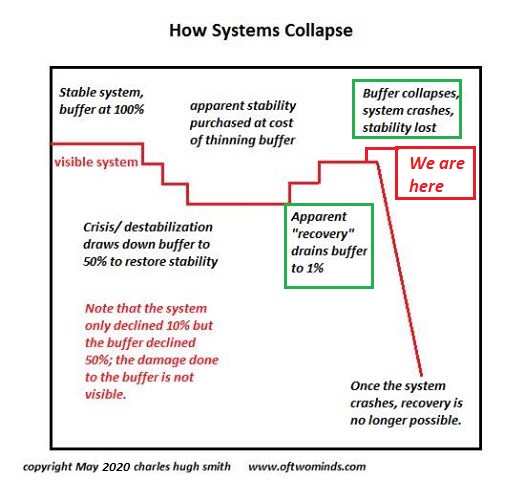
The moral buffers have already thinned; there is nothing left to tap. There is nothing left in what actually matters: social cohesion, moral legitimacy, civic virtue–all stripped, depleted, gone.
Drones and robots won’t save us from collapse. Neither will fusion reactors, electric air taxis, billionaires in space, missions to Mars, algae-based meat or any of the other thousand “innovations” those profiting from moral rot promote in the hopes that the banquet of consequences being served can be swept away by more gimmicks, more artifice, more delusions, more fantasies, more PR, more spin and more narrative control.
Collapse can’t be gimmicked away. The notion that consequence can be as easily managed as PR is the ultimate artifice and the ultimate delusion.

By Kit Knightly
Source: OffGuardian
Yesterday [11/26/21] the WHO labelled the sars-cov-2 variant B.1.1.529 as a “variant of concern” and officially named it “Omicron”.
This was as entirely predictable as it is completely meaningless. The “variants” are just tools to stretch the story out and keep people on their toes.
If you want to know exactly how the Omicron variant is going to affect the narrative, well The Guardian has done a handy “here’s all the bullshit we’re gonna sell you over the next couple of weeks” guide:
We’re already seeing preparations for more “public health measures”, with the press breathlessly quoting “concerned” public health officials. We’re being told that a new lockdown won’t be necessary…as long as we remember to get boosted and wear masks and blah blah blah.
Generally speaking, it’s all fairly boilerplate scary nonsense. Although it is quite funny that the Biden administration has already put a bunch of African nations on a travel ban list, when Biden called Trump a racist for doing the same thing in 2020.
It’s interesting that the new variant has allegedly come from Africa, perhaps “mutating in the body of an AIDS patient”, since Africa has been the biggest hole in the Covid narrative for well over a year.
Africa is by far the poorest continent, it is densely populated, malnourishment and extreme poverty are endemic across many African nations, and it is home to more AIDS patients than the entire rest of the world combined. And yet, no Covid crisis.
This is a weak point in the story, and always has been.
Last Summer, the UK’s virus modeller-in-chief Neil Ferguson attempted to explain it by arguing that African nations have, on average, younger populations than the rest of the world, and Covid is only a threat to the elderly. But five minutes of common sense debunks that idea.
The reason Africa has a younger population, on average, is that – on average – they are much sicker.
There are diseases endemic to large parts of Africa that are all but wiped out in most of the Western world. Cholera, typhus, yellow fever, tuberculosis, malaria. Access to clean water, and healthcare are also much more limited.
And while it has been nailed into the public mind that being elderly is the biggest risk factor for Covid, that is inaccurate. In fact, the biggest risk factor for dying “of Covid” is, and always has been, already dying of something else.
The truth is that any REAL dangerous respiratory virus would have cut a bloody swath across the entire continent.
Instead, as recently as last week, we were getting articles about how Africa “escaped Covid”, and the continent’s low covid deaths with only 6% of people vaccinated is “mystifying” and “baffling” scientists.
Politically, African nations have shown themselves far less likely to buy into the “pandemic” narrative than their European, Asian or American counterparts. At least two “Covid denying” African presidents – Pierre Nkurunziza of Burundi and John Magufuli of Tanzania – have died suddenly in the last year, and seen their successors immediately reverse their covid policies.
So maybe the Omicron Variant is a way of trying to fold Africa into the covid narrative that the other continents have already fully embraced. That will become clear as the story develops.
Of course, it’s also true that being “African” is media shorthand for being scary, relying on the deeply-seated xenophobia of Western audiences. See: “Africanized killer bees”.
But, either way, Africa is the long game. There’s a more obvious, and more cynical, short term agenda here.
Let’s go back to the Guardian’s “Omicron” bullet points, above:
The “new variant” is already being described as potentially resistant to the vaccines, but NOT the new anti-viral medications.
Pharmaceutical giants Merck and Pfizer are both working on “Covid pills”, which as recently as three days ago, were being hyped up in the press:
US may have a ‘game changer’ new Covid pill soon, but its success will hinge on rapid testing
In the US, an emergency use authorisation can only be issued if there is no effective medication or treatment already available, so the vaccines not being proof against Omicron would be vital to rushing the pills onto the US market, at least.
If Omicron is found to be “resistant to the vaccines”, but NOT the pills, that will give governments an excuse to rush through approving the pills on an EUA, just as they did with the vaccines.
So, you bet your ass that testing is gonna be “rapid”. Super rapid. Blink-and-you’ll-miss-it rapid. Rapid to the point you’re not even sure it definitely happened. And now they have an excuse.
Really, it’s all just more of the same.
A scare before the new year. An excuse to make people believe their Christmas could be in peril. An exercise in flexing their control muscles a bit, milking even more money out of the double-jabbed and boosted crowd, now newly terrified of the Omicron variant, and a nice holiday bump to Pfizer’s ever-inflating stock price.
At this point either you can see the pattern, or you can’t. You’re free of the fear machinery, or you’re not.
There is one potential silver lining here: It feels rushed and frantic. Discovered on Tuesday, named on Friday, travel bans on Saturday. It is hurried, and maybe that’s a reaction to feeling like the “pandemic” is losing its grip on the public mind.
Hopefully, as the narrative becomes more and more absurd, more and more people will wake up to reality.
It has been pointed out that “Omicron” is an anagram of “moronic”.
One wonders if that’s deliberate and they’re making fun of us.
INDIAN COUNTRY NEWS
"It is the duty of every man, as far as his ability extends, to detect and expose delusion and error"..Thomas Paine
Human in Algorithms
100% Accurate Google Sheets + KDP Book Formatting | 24hr Delivery
From the Roof Top
I See This
blog of the post capitalist transition.. Read or download the novel here + latest relevant posts
अध्ययन-अनुसन्धानको सार

