Notes Toward a Future of Activism

anonymous_telecomix_2012_5_31

By Micah White

Source: Reconstruction 10.3

<1> Contemporary activism begins from the realization that for the first time in history, a synergy of catastrophes face us. Our physical environment is dying, our financial markets are collapsing and our culture, fed on a diet of junk thought, is atrophying — unable to muster the intellectual courage to face our predicament. While some may caution against immediate action by pointing out that societies often predict perils that never come, what is remarkable about our times is that the apocalypse has already happened.

<2> When we compare the anxiety of our age to that of the Cold War era, we see that what differentiates the two periods is where the threat is temporally located. During the Cold War, the threat of nuclear destruction was always imagined to be in the future. What terrorized the Cold War generation was the thought of life after a nuclear holocaust. Anxiety was therefore centered on what life would be like “the day after” the future event, which was symbolized by the blinding light of a mushroom cloud on the horizon. Thus the post-apocalyptic narrative was deployed in a series of nuclear holocaust science-fiction stories either to mobilize fear in the name of anti-nuke peace — the exemplar of this tactic being the horrifying and scientifically realistic 1984 BBC docudrama Threads in which civilization collapses into barbarism — or, like Pat Frank’s 1959 novel Alas, Babylon, convince a wary public that winning and happily surviving nuclear war is possible, given resourcefulness, discipline and patriotism.

<3> But for those of us alive today, the catastrophic event is not located in the future. There is no “post”-apocalyptic per se because we are already living in the apocalyptic. And although we can anticipate that life is going to get starker, darker and hellish, the essential feature of our times remains that we do not fear the future as much as we fear the present. We can notice this temporal shift in the work of James Lovelock, whose Gaia Hypothesis is gaining traction inside and outside of the scientific community. According to Lovelock’s latest book, The Vanishing Face of Gaia: A Final Warning, even if we were to immediately cease all C02 emissions, sudden and drastic climate change will still occur. In fact, Lovelock argues that a drastic decrease in emissions would trigger climate catastrophe immediately whereas continuing emissions will trigger climate catastrophe eventually and unpredictably. This realization — that the line into a post-climate-change world has already been crossed — fundamentally changes the temporal and spatial assumptions underpinning activist struggles. And the first aspect of activism that must be rethought is our notion of temporality.

<4> The typical activist project is inscribed within the horizon of a modern conception of temporality. The modernist activist acts as if we occupy a present moment that is a discrete point on the linear progression between a mythical, ancient past and an either utopian or dystopian future. But if we accept this model, then the goal of the activist can only be to change the future by preventing the dystopian possibility from being realized. This involves pushing for changes in laws and behaviors in the present that will impact our predictions of how the future will be. But activism based on this temporal model — which as John Foster points out in The Sustainability Mirage: Illusion and Reality in the Coming War on Climate Change underpins “green capitalism” and “sustainable development” — inevitably fails. For one, unable to accurately predict the future, we constantly play the game of basing our actions on rosy predictions while the future grows increasingly gloomier. Another problem with relying on linear temporality is the assumption that time moves in only one direction. Without the freedom to imagine going backwards, we are left the task of steering the runaway train of industrialization without hope of turning around.

<5> Of course, linear time is not the only way to understand temporality and some models can have even worse political consequences. Take for example, the notion that time is cyclical. For the Roman Stoics, time was marked by a series of conflagrations in which the world was razed and a new one formed only to be razed again. In times of adversity when resistance seems impossible, such as the build-up to World War 2, a watered down version of cyclical temporality sometimes enters the cultural consciousness. It infected Nazis who cheered total war and anti-Nazis who used the spurious argument that only by a catastrophic Nazi triumph would a communist state be realized because only then would the people rise up. A similar line of thought was pursued by Martin Heidegger in a letter to Ernst Jünger in which he wondered if the only way to “cross the line” into a new world is to bring the present world to its awful culmination. Unlike the linear conception of time that calls the activist to act in order to realize an alternate future, the cyclical conception is often leveraged to justify inaction or worse, action contrary to one’s ideals.

<6> To escape the problems of linear time and cyclical time, activism must rely on a new temporality. Perhaps the best articulation of this new activist temporality is in the work of Slavoj Žižek. In his most recent book, First as Tragedy, Then as Farce, Žižek blames the failure of contemporary activism on our assumption that time is a one-way line from past to future. He argues that activism is failing to avert the coming catastrophe because it is premised on the same notions of linear time that underpin industrial society. According to Žižek, therefore, a regeneration of activism must begin with a change in temporality. Paraphrasing Jean-Pierre Dupuy, Žižek writes, “if we are to confront adequately the threat of (social or environmental) catastrophe, we need to break out of this ‘historical’ notion of temporality: we have to introduce a new notion of time.” This new notion of time is a shift of perspective from historical progress to that of the timelessness of a revolutionary moment.

<7> The role of the activist should not be to push history in the right direction but instead to disrupt it altogether. Žižek writes, “this is what a proper political act would be today: not so much to unleash a new movement, as to interrupt the present predominant movement. An act of ‘divine violence’ would then mean pulling the emergency cord on the train of Historical Progress.” To accomplish this act of revolutionary violence involves a switch of perspective from the present-looking-forward to the future-looking-backward. Instead of trying to influence the future by acting in the present, Žižek argues that we should start from the assumption that the dread catastrophic event — whether it be sudden climate catastrophe, a “grey goo” nano-crisis or widespread adoption of cyborg technologies — has already happened, and then work backwards to figure out what we should have done. “We have to accept that, at the level of possibilities, our future is doomed, that the catastrophe will take place, that it is our destiny — and then, against the background of this acceptance, mobilize ourselves to perform the act which will change destiny itself and thereby insert a new possibility into the past.” In other words, only by assuming that the feared event has already happened, can we imagine what actions would need to have been taken to prevent its occurrence. These steps would then be actualized by the present day activist. “Paradoxically,” he concludes, “the only way to prevent the disaster is to accept it as inevitable.”

<8> Žižek is right to suggest that activism is at a crossroads; any honest activist will admit that lately our signature moves have failed to arouse more than a tepid response. The fact is that our present is being swallowed by the future we dreaded — the dystopian sci-fi nightmare of enforced consumerism and planet-wide degradation is, day-by-day, our new reality. And thus, activism faces a dilemma: how to walk the line between false hope and pessimistic resignation. It is no longer tenable to hold the nostalgic belief that educating the population, recycling and composting our waste and advocating for “green capitalism” will snatch us from the brink. Likewise, it is difficult to muster the courage to act when the apocalyptic collapse of civilization seems unavoidable, imminent and, in our misanthropic moments, potentially desirable. Žižek’s shift in temporality offers us a way to balance the paralyzing realization that our demise is inevitable with the motivating belief that we can change our destiny. By accepting that as the world is now we are doomed, we free ourselves to break from normalcy and act with the revolutionary fervor needed to achieve the impossible.

<9> The question for would-be activists is therefore not, “how does one engage in meaningful activism when the future is so bleak?” but instead “how does one engage in revolutionary activism when the present is so dark?”

<10> Corresponding to the necessary temporality shift is a spatial change in activism. The future of activism will be the transformation of strictly materialist struggles over the physical environment into cultural struggles over the mental environment. Green environmentalism, red communism and black anarchism will merge into blue mental environmentalism — activism to save our mental environment will eclipse activism to reclaim our physical environment. A key opening to this new form of politics appeared in 1989 with the founding of Adbusters, the internationally distributed anti-consumerism magazine whose subtitle is The Journal of the Mental Environment.

<11> Adbusters is a Situationist inspired offspring of the environmentalism movement. At the time of its formation, there was an active anti-logging movement in British Columbia, Canada. And responding to sagging public support for cutting down old growth trees, the logging industry introduced the “Forests Forever” advertising campaign. As the name suggestions, this campaign argued that the logging industry was not cutting down forests as much as they were protecting forests. It was the kind of disingenuous advertising ploy known as “greenwashing”– a term that, it is worth noting, originated in that same year. Disgusted by what he saw, Kalle Lasn, who was an experimental filmmaker at the time, created a short claymation anti-ad in which an old-growth tree explains to a sapling that a ancient forests are being replaced by tree farms. His intention was to air the anti-ad on the same television stations that the logging industry had used.

<12> When Lasn tried to buy airtime for his anti-ad on the same television station that aired the Forests Forever advertisements, he was refused. That was the founding event of Adbusters: the realization that while corporations can lie to us via the airwaves, we are unable to respond using the same means. But the message of Adbusters goes beyond concerns over the veracity of the information we receive — and here we would do well to follow Jacques Ellul who spoke of the difficulty in distinguishing between information and propaganda. Instead, it is a matter of how the advertisements we see populate our minds with a picture of reality. This picture of reality, our worldview, colors everything we perceive. Thus, the mental environmentalist movement is concerned with the pollution of our minds.

<13> While some may wish to frame this transition in terms of a new development, I think it is just as accurate to view it as an old phenomenon. Hundreds of years ago, for example, “pollution” had an exclusively unscientific, immaterial and spiritual meaning. In the 14th century to pollute meant to desecrate, defile, or contaminate what is sacred such as one’s soul or moral sensibility. Not until the late nineteenth-century did pollution take on the scientific and materialist connotation it has today. The unfortunate consequence is that with the changing meaning of the word pollution, we’ve become increasingly concerned about desecration of our external, natural environment while ignoring the defilement of our internal, mental environment. The future of activism is a return to the early meaning of pollution.

<14> Activism is entering a new era in which environmentalism will cease viewing our mental environment as secondary to our physical environment. No longer neglecting one in favor of the other, we will see a push on both fronts as the only possible way of changing either. This will involve a shift away from a materialist worldview that imagines there to be a one-way avenue between our interior reality and the external reality. Instead, recognition of the permeability of this barrier, an exploration of the mutually sustaining relationship between mindscape and landscape, will open, and reopen, new paths for politics.

<15> This movement toward an activism of the mental environment is based on an ontological argument that can be stated succinctly: our minds influence reality and reality influences our minds. Although simply stated, this proposition has profound implications because it challenges the West’s long standing Cartesian divisions between internal and external reality that serve to ignore the danger of mental toxins. Whereas traditional politics has assumed a static mind that can only be addressed in terms of its rational beliefs, blue activism believes in changing external reality by addressing the health of our internal environment. This comes from an understanding that our mental environment influences which beings manifest, and which possibilities actualize, in our physical reality.

<16> At first it may seem like a strange argument. But the imaginary has been a part of environmentalism since the beginning. Most people trace the lineage of the modern environmentalist movement back to Rachel Carson’s 1961 Silent Spring. Carson’s book argued that the accumulation of toxic chemicals in our environment could work its way up the food chain, causing a widespread die- off. It may not have been the first time the bioaccumulation argument had been made, but it was the first time that it resonated with people. Suddenly, a movement of committed activists and everyday citizens rallied under the environmentalism flag.

<17> Looking back on Carson’s book from the perspective of mental environmentalism, it is significant that it begins, not with hard science as we may expect because Carson was a trained scientist, but with fantasy. The first chapter, entitled “A Fable for Tomorrow,” reads like a fairy tale: “There once was a town in the heart of America where all life seemed to live in harmony with its surroundings.” She then goes on to describe an idyllic, pastoral community known for its abundant agriculture and wild biodiversity. She writes of foxes and deer; laurel, virburnum and alder; wild birds and trout. However, the beauty of the place is not permanent – an evil, invisible malady spreads across the land. Birds die, plants wilt and nature grows silent. The suggestion is that the land has been cursed; if this were a different story perhaps the farmers would have prayed, offered sacrifices to the gods or asked their ancestors for help. Instead, Carson shifts the blame away from transcendental forces and back to the materialist domain of man. “No witchcraft, no enemy action had silenced the rebirth of new life on this stricken world.” Carson concludes, “The people had done it to themselves.”

<18> Some literary critics have argued that the reason “Silent Spring” resonated with the larger public, sparking a movement of everyday people is largely due to this opening fable. They explain that Carson’s story takes Cold War era fears of radioactivity (an invisible, odorless killer) and redirect them into a new fear over environmental pollution that is, likewise, an invisible, odorless killer. This is a compelling interpretation that explains the rhetorical power of Carson’s story but it misses the larger point. Namely, that at its origin, environmentalism was grounded in a mythological story about a cursed land. Faced with a choice over whether to continue in this fantastical, narrative vein or enter the domain of scientific facts, environmentalism tried the latter. Environmentalism has thus become a scientific expedition largely regulated by Western scientists who tell us how many ppb of certain pollutants will be toxic and how many degrees hotter our earth can be before we are doomed. But here we see again the linear temporal model cropping up again which may explain the inability, according to James Lovelock, of the Intergovernmental Panel on Climate Change to predict the rising temperatures we have experienced. In light of the failures of the exclusively scientific approach, it is worth considering another option.

<19> What if Carson had written about how the disappearance of birds was accompanied by the appearance of flickering screens in every home? What if she had drawn a connection between the lack of biodiversity and the dearth of infodiversity? Or the decrease in plant life and the increase in advertised life? To do so would necessitate a new worldview: a blue worldview that acknowledges the interconnection between mental pollution and environmental degradation, spiritual desecration and real-world extinctions.

<20> Keeping one foot within the domain of imagination, environmentalism could speak not only of the disappearance of the wild birds due to physical pollutants but also their disappearance due to mental pollutants. We could wonder at the connection between a culture’s inability to name more than a handful of plants, and the lack of biodiversity in the surrounding nature. And instead of assuming that the lack of biodiversity in external reality caused our poor recognition skills, we would entertain the opposite possibility: that the fewer plants we recognize, the fewer plants will manifest.

<21> Blue activism begins with the realization that internal reality is connected to external reality and then wonders at the relation between pollution of internal reality and the desecration of external reality. The primary pollutant of our mental environment is corporate communication. It is no longer controversial to claim that advertisers stimulate false desires. Any parent knows that after their child watches the Saturday morning cartoons they will suddenly “need” new toys, new treats, new junk. But the effects of advertising go beyond, what the marketers call, “demand generation”. Advertising obliterates autopoesis, self-creation. It is an info-toxin that damages our imagination and our world picture, essential elements of our mental environment. Activists must work on the assumption that there is a connection between the level of pollution in our minds and the prevalence of pollution in our world. At the most basic level, this is because when our minds are polluted, and our imaginations stunted, we are unable to think of a different way of doing things. At a more complex level, it is because our mental environment dictates, to a certain extent, whether certain beings manifest in our physical environment. Naming calls beings into existence and when all the words we know are corporate-speak, the only beings that will manifesto are corporate- owned.

<22> To understand how the pollution of the mental environment can impact the manifestation of beings, consider the story of the Passenger Pigeon. In 1810 one of the great American ornithologists, Alexander Wilson, observed a flock of Passenger Pigeons so plentiful that it blacked out the sun for three days. On another occasion he documented a flock estimated to be two hundred and forty miles long and a mile wide and comprised of over a billion — 1,000,000,000 — birds. A century later, the last passenger pigeon died in the Cincinnati Zoological Garden on September 1, 1914. How do we explain this alarming extinction of the Passenger Pigeon?

<23> If we take a materialist activist position, then we will argue that their sudden demise is due to a combination of forces, all of which are located outside the psyche: overhunting combined with unenforced laws against killing the birds in their nesting places was exacerbated by the telegraph which was used to track the birds over hundreds of miles. The species death of the passenger pigeon is thus interpreted as a tragedy of specific technologies: guns, nets, laws and communication systems. Of course, this account is not wrong; it would be mistaken to argue that these technologies did not play a major factor in their extinction.

<24> But physical environmentalism boils down to conservationism. It is allopathic, only able to treat the symptom, the disappearance of the birds, without considering the root cause. By focusing our attention exclusively on material forces, we are confined to certain activist tactics: a spectrum from reformist gestures of calling for greater enforcement of environmental protection laws, courageous tree sits and militant ELF arsons. And while these actions are commendable, and with open acknowledgment that a diversity of tactics is necessary, the focus on a secular materialist politics is limiting our success. Under this model, Ted Turner is considered a philanthropic hero because he is the nation’s largest landowner and maintains the largest privately owned bison herd. What we do not need is a rich patron of endangered species, but instead a world without endangered species. That requires more than money, it necessitates a paradigm shift.

<25> The unexplainable extinction of the passenger pigeon is a symptom of the state of our mental environment. Species facing extinction can only be saved if we take their disappearance as a symptom and address the root cause of their disappearance. Because of an over-reliance on a secular, materialist conception of politics, scientists dictate the aims of activists. The irony is that our exclusive concern over the physical environment renders us unable to save it.

<26> The curious interplay between our imagination and external reality gives credence to the argument that the struggles over the mental environment are the future of activism. The future of activism begins with the realization that only with a clear mind, a clean mental environment, do we approach the possibility of a clean physical environment.

<27> Dispel immediately the notion that our mental environment is unique to each individual. Just as we share our natural environment, we also share our mental environment, which is crafted through the culture we consume – the television shows we watch, the websites we frequent and the symbols and concepts that comprise our thoughts. Thus, the mental environment is not something entirely within us but is instead something that is outside of our complete control and shared collectively.

<28> Activism of the mental environmentalism is not a politics of solipsism, or an attempt to dodge the imperative of direct action. Instead, developing a politics of anti-consumerism and anti-materialism, places the role of imagination back into the forefront. Denying corporations the right to dominate our mental environment is the most effective long-term strategy of insurrection in the twenty- first century because it directly influences the manifestation of our natural environment. By targeting the mental polluters, vandalizing billboards and blacking out advertisements, we do more than clean up urban blight — we clear a creative space for a revolutionary moment.

Always Low Wages, More Pollution: Why Barack & Michelle Obama Relentlessly Shill For Wal-Mart

walmart-obama-apmichelle_obama_walmart_030311-thumb-640xauto-2467

Democrats in labor unions and figures like former Labor Secretary Robert Reich and others were justly outraged at Barack Obama’s latest wet kiss to Wal-Mart earlier this month. But First Lady Michelle Obama has been in bed with the giant retailer for years. Is this a nasty bug in the Obama presidency, or a corrupt core feature?

By BAR managing editor Bruce A. Dixon

Source: Black Agenda Report

Low Wages, Always: Barack and Michelle Obama Bestow More Wet Kisses on Wal-Mart

“…the willingness of the Obama Administration to do the bidding of Wal-Mart shows just how hollow has become the pretense of elected black Democrats to representing the poor and oppressed…”

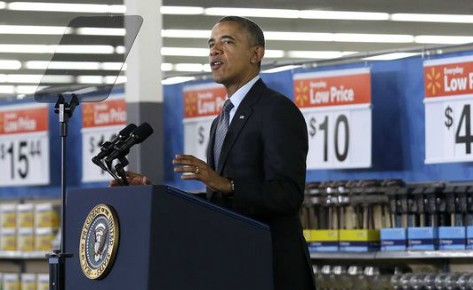
Earlier this month President Obama visited a Bay Area Wal-Mart to praise the world’s largest and most anti-union retailer for its supposed environmental responsibility. The fact is that Wal-Mart’s maintenance of diesel-fueled supply chains between its stores and wherever on the planet wages are lowest and environmental restrictions are totally absent make it a major ongoing contributor to runaway climate change. The president’s appearance therefore, was simply a hypocritical exercise in greenwashing for Wal-Mart.

Though it was an insult to working people and to many of his abject and fervent supporters, it should have been no surprise. It wasn’t President Obama’s first wet kiss to Wal-Mart and with almost three more years in office to go it won’t be his last. Still the willingness of the Obama Administration to do the bidding of Wal-Mart shows just how hollow has become the pretense of elected black Democrats to representing the poor and oppressed.

There was a time when Democrats in the White House did not dare openly shill for the giant retailer. Hillary Clinton served on Wal-Mart’s board of directors through most of the 1980s, while her husband Bill was governor of Arkansas. Even then, Wal-Mart was notorious for overworking and underpaying its workers, violating labor laws to thwart unions, and sopping up prodigious amounts of corporate welfare in the forms of tax breaks and subsidies of all kinds. Being in bed with those crooks wasn’t just an embarrassment, it was a hypocritical affront to Democratic voters, so somewhere on the 1992 road to the White House, Hillary resigned from Wal-Mart’s board. Similarly in 2007 with her husband on the way to the White House, Michelle Obama felt compelled to resign from the board of TreeHouse Foods, a major Wal-Mart vendor. “I won’t shop there,” said presidential candidate Barack Obama when questioned about Wal-Mart at an AFL-CIO labor forum.

Of course labor audiences in 2007 and 2008 were where Obama pledged to renegotiate NAFTA, and immediately raise the minimum wage as soon as he took office. The president never mentioned raising the minimum wage again till about 2012 when Republicans were safely in control of the House of Representatives, and instead of renegotiating NAFTA, President Obama is engaged in secret negotiations to extend it across the Atlantic and Pacific Oceans. Evidently the Obama that promises is a different guy, and far less powerful, than the Obama that acts.

“…The first lady allowed the unscrupulous retailer to leverage her personal image …”

Safely in office, Michelle and Barack Obama have enthusiastically embraced Wal-Mart. The first lady allowed the unscrupulous retailer to leverage her personal image as an advocate of exercise and healthy eating in her “Let’s Move” initiative, and spouting the company line that the best solution to urban “food deserts” is opening more Wal-Mart neighborhood grocery stores. Michelle Obama’s many appearances at and pronouncements around Wal-Mart have done the retailer more good than she and Hillary could ever have done in another decade or two apiece on its board of directors.

Right now Wal-Mart is approaching 30% of the US retail grocery market, with far lower wages, fewer hours, skimpier benefits, and longer and dirtier supply chains than its major competitors. As I said a couple years ago in an article about Michelle Obama’s cynical embrace of Wal-Mart:

Wal-Mart’s business model of corrupting public officials, lying about job creation numbers, rampant sex and race discrimination, relentlessly low wage and benefit levels, and aspirations to monopoly control of local markets across the country make it a bad neighbor, a worse boss, an unfair competitor and sometimes a criminal enterprise.

Wal-Mart has been a leader in the corporate practice of weaponizing its charitable giving, turning it into a lever to open new markets in urban America, to neutralize and isolate opposition, and to curry favor with local political figures. Wal-Mart made it rain on selected charities and ministries in areas like Newark and Chicago when it needed to colonize those new markets. President Obama recognized this “achievement” in the corruption of Democratic party politics in March 2014 by nominating Wal-Mart’s chief of charitable giving to head up his Office of Management and Budget.

Wal-Mart was even allowed, along with McDonalds and other large, low-wage employers, to shape the drafting of regulations governing Obamacare, in ways that exempted the retailer from having to ensure large numbers of its workers for the first several years.

The fiction that elected Democrats represent poor and working people and stand for safeguarding the environment is just that – a fiction. There is a new neoliberal paradigm that allows Democrats to mumble a few words about raising the minimum wage when the other party controls Congress, that claims the moment they took office was the day the oceans stopped rising. If these were curable bugs in the political system, votes and advocacy would wake enough people up to change them. But what if they’re not bugs in the system at all. What if these are its core and immutable features? What then? Isn’t it time to step outside their two-party, capitalist box, to dream and begin to build something else?

Bruce A. Dixon is managing editor at Black Agenda Report and a state committee member of the GA Green Party. He lives and works in Marietta GA and can be reached at bruce.dixon(at)blackagendareport.com.

Memorial Days

By Tom Karlson

they sang and prayed,
naming that day in May,
Decoration day they dis-interred 257 Union men
mass graved, dumped, piled broken bodies twisted,
a Charleston North Carolina Guernica
forgotten men dug up, re-interred
with honor, memory, celebration
by 10,000 in 1866
that first Memorial Day

it is Memorial Day 2010
the Turkish flotilla
bringing aid to Gaza
the attack, nine dead,
Americans, Turks
no aid delivered

Memorial Day 1937,
steelworkers striking Little Steel,
strikers with families march toward the Republic steel mill gate
police-guards open fire
ten dead
thirty shot
one hundred clubbed

today we are at Jones beach
it is Memorial Day
we are fifty souls
remembering our dead, the dead
hundreds of Long Islanders
thousands of North Americans
more than a million Iraqis and Afghanis
families stroll past
some look, others see without vision
all have come to eat, drink
and celebrate that insatiable beast
today the Blue Angles
spin flip dive swoop
begging boys and girls to sign up
the navy, the marines want you
as we call out the named and nameless
let us remember these days
past, present, and future

Tom Karlson is founder of Poets for Peace, Long Island, NY.

A Memorial Day Truth

by Walter Brasch

Source: OpeEdNews.com

It’s the third and final day of the Memorial Day weekend.

Millions of Americans are visiting friends and relatives, perhaps taking a three- or four-day mini-vacation. They may be at pool parties and grilling burgers, hotdogs, veggies, and whatever else appeals to them.

The nation’s politicians are going to Memorial Day rallies. There will be speeches and music. American flags and bunting will drape the stages. The politicians will tell us about the “ultimate sacrifices” American servicemen and women made. They will tell us how wonderful America is, how we are the best country in the world, how we defend freedom and remember those who put their lives on the line to do so. The crowds, whether a few or thousands, will applaud vigorously.

Some will even say that the VA hospitals need a complete overhaul, that Gen. Eric Shinseki–who was wounded and earned three Bronze Stars for bravery, should be fired. These are some of the same politicians who had attacked Shinseki when he was Army chief of staff who warned that it would take hundreds of thousands of Americans, not thousands as the Bush-Cheney cabal had claimed, to successfully invade and control Iraq. For his military knowledge, he was forced into an early retirement. These are the politicians who are outraged that America is treating veterans poorly.

Here’s what the politicians also won’t say. They won’t tell us that 41 Republican senators blocked legislation this past year to provide necessary funding for veterans health. They won’t tell us that during the first years of the Iraq War, the quality of American-based hospitals had deteriorated to the point that it took a major newspaper series to expose what had happened and, finally, with politicians forced to look at despicable conditions, and shamed by their ignorance, there were some measures to improve the care for wounded soldiers after their lives were saved by courageous battlefield medics.

They won’t tell us that members of Congress blocked significant increases in the foodstamp program or that governors and legislatures have not done what they should to care for the homeless. After all, the impoverished and homeless don’t contribute to political campaigns. Of course, the politicians won’t tell us that one-fourth of all adult homeless are veterans.

They won’t tell us about veterans who came home from war, and then lost their jobs or homes during the Great Recession that followed the fraud and greed committed by the bankers and industrial giants who were able to become rich because government did little to protect the people.

With crocodile tears and shallow words, recorded by the news media, the politicians will tell us how much they mourn–but they won’t tell us they are part of the problem, for proudly claiming they voted time after time to block necessary funding and for demanding government not intrude upon the free enterprise system.

The politicians will wave flags and say how much they believe in America and our veterans, and how much they mourn the loss of our soldiers. The crowds will enthusiastically agree–and then go to their barbeques and picnics.

No, they won’t tell us that if we want to reduce these problem–DON’T THUMP YOUR CHESTS, UNFURL YOUR FEATHERS, AND SEND THE YOUTH TO WARS THAT SHOULD NEVER BE FOUGHT.

During the Vietnam War, John Prine recorded “Your Flag Decal Won’t Get You Into Heaven Anymore.” It was true then. It is still true. Please listen.

FBI Agent Who Executed Ibragim Todashev is a Corrupt Ex-Oakland Cop

Ibragim Todashev

By Joanne Potter and Abby Martin

Source: Media Roots

The city of Boston was shaken last year when its marathon was tragically bombed, leaving three people dead and 264 others injured. The alleged mastermind behind the deadly attacks, Tamerlan Tsarnaev, was killed in a shootout with Boston police. His little brother and alleged co-perpetrator, Dzhohar, is now awaiting trial and will potentially face execution.

Amidst the insanity ensuing from last year’s horrors, one story was largely swept under the rug: the bizarre execution of 27 year old Chechan-American Ibragim Todashev. A month after the bombings, Todashev was interrogated by state and federal officials at his Orlando apartment about his alleged association with the Tsarneavs and his purported role in the Waltham triple murders of 2011.

According to official reports, Todashev was in the process of writing a confession to the Waltham homicides when for no apparent reason, he ‘flipped out’ and propelled a coffee table into the air, striking the agent on the back of his head. He then ran to the kitchen area of his apartment and armed himself with a red pole/broom handle. The unnamed FBI agent shot Todashev seven times, once in the head.

Earlier this year, an internal FBI investigation and Florida State Attorney cleared the FBI agent who fatally shot Ibragim Todashev of any wrong doing. Prosecutor Jeffrey L. Ashton ruled the shooting was reasonable in that: ‘the actions of the Special Agent of the FBI were justified in self-defense and in defense of another’.

Aaron McFarlane

Recent unredacted documents reveal the unnamed agent to be Special Agent Aaron McFarlane, an ex-Oakland police officer with quite a controversial record in his short stint on the force.

The ‘Riders’ case was the biggest police corruption scandal ever witnessed by Oakland Police Department. It cost the Department nearly $11 million to settle civil lawsuits by 119 people who claimed they were falsely arrested, beaten, and had evidence falsified against them. The plaintiffs also alleged that Oakland Police Department turned a blind eye to the police misconduct.

Officers Clarence Mabanag, Jude Siapno, and Matthew Hornung stood accused of 26 counts including kidnapping, assault, conspiracy, false arrests and lying in police reports. McFarlane testified in defense of Mabanag, stating that he had always taught him how to write accurate police reports. However, under cross-examination it was alleged that McFarlane had falsified his own reports at the request of the group’s leader. Once he was faced with evidence proving his guilt, McFarlane pled the fifth.

After five years and two mistrials, the charges were dismissed against the three officers. McFarlane was never charged in connection with falsifying police reports or potentially lying on the witness stand. Regardless, he ended up in legal trouble for committing the same types of actions as the riders.

In November 2003, a man named Aaron Girard filed a civil suit against Aaron McFarlane and his Oakland PD colleague, Steven Nowak, for aggravated battery, false arrest, violation of his civil rights and emotional distress. Girard stated he had witnessed McFarlane and Nowak physically beating an individual who had already been subdued in front of a hospital. Girard took a photograph of the incident and when McFarlane and Nowak realized, they attacked him. The plaintiff alleged he was beaten, kicked and punched around the body, suffering injuries to his shoulder, arm, knee and neck. He claimed he was then falsely arrested by McFarlane and Nowak. Neither McFarlane nor Nowak ever faced charges over the incident.

Additionally, both officers were previously sued by a man named Michael Cole, who filed his complaint on March 26 of the same year (2003). The full details of the complaint are unavailable, although the pair were accused of beating the plaintiff with a ‘hand foot and billy club’ before falsely imprisoning him.

After serving only four years in the police force, Macfarlane retired on disability with a leg injury, collecting a pension of more than $52 thousand dollars annually for the rest of his life.

In his short time as an officer, McFarlane had been accused of falsifying police reports, lying under oath, aggravated battery, making false arrests, violating the rights of suspects, assault with a weapon and false imprisonment, yet was never convicted of any charges.

Other than the questionable circumstances surrounding the death of Ibragim Todashev, it is not known if Aaron McFarlane has ever been involved in any other incident after leaving the Oakland Police Department. And it’s not likely to be known, considering the agency’s secrecy surrounding the release of his identity.

According to Carol Rose, executive director of ACLU of  Massachusetts,

“We still don’t know what happened…nor why the explanations from those who were present at the shooting death have been inconsistent, suggesting at various times that Mr. Todashev allegedly threatened agents, including with a knife, a pipe, a stick or pole, an agent’s gun, the deceased’s martial arts training, or even a samurai sword.”

Unfortunately, the investigators on the case weren’t able to interview McFarlane himself about what happened, and had to rely only on prewritten statements.

This alone should prove the report is inconclusive, and prompt the investigation to re-open. However, a New York Times FOIA request reveals that between 1993 and 2011, FBI agents fatally shot about 70 subjects and wounded 80 others, and in every single case, the agent’s use of force was determined to be justified.

When a federal agency coordinates with so many forces to try to suppress the truth, there’s usually something to hide.

**

Watch Abby Martin break down Aaron McFarlane’s track record and the case of Ibragim Todashev starting at 14:45:

Occupy Activist Cecily McMillan Sentenced to 3 Months in Jail, 5 Years Probation

Cecily McMillan being arrested as the NYPD clears Zuccotti Park during a six-month memorial celebration of the Occupy Movement in March 2012

Cecily McMillan being arrested as the NYPD clears Zuccotti Park during a six-month memorial celebration of the Occupy Movement in March 2012

By Dave Lindorff

Source: This Can’t Be Happening

Occupy activist Cecily McMillan, convicted on May 5 of second-degree felony assault of a New York cop whom she and witnesses claimed had grabbed her breast from behind, bruising it, stood her ground before her sentence was rendered, refusing the judge’s insistence that she should “take responsibility for her conduct.”

Risking the possibility that Judge Ronald Zwiebel might sentence her to the maximum seven years for the charge she was convicted of, McMillan would only apologize for what she termed “the accident” of involuntarily throwing back her elbow when grabbed by behind from someone she could not even see. Insisting to the judge that she lived in accordance to the “law of love,” she said, in her pre-sentencing statement, “Violence is not permitted. This being the law that I live by, I can say with certainty that I am innocent of the crime I have been convicted of… I cannot confess to a crime that I did not commit. I cannot throw away my dignity in return for my freedom.”

It was a bold and risky stand for the 25-year-old New School for Social Research graduate student to take, given the high sentencing stakes. In the end, though, the judge, — who during the trial had blocked her defense from presenting key evidence that she had acted in her own defense against being groped by a cop (for example the police officer’s record of brutality and corruption), while allowing the prosecution to present evidence and statements normally not considered permissible in a trial (such as presenting to the jury evidence about an arrest of McMillan that had not yet been tried or adjudicated) — sentenced her to only a short term in jail.

She still has a five-year felony probationary sentence, which leaves her a convicted felon, a serious impediment to employment, and one that could leave her subject to limitations on her freedom of movement for five years.

McMillan’s many supporters nonetheless hailed the short sentence, which could see her released in as little as 60 days, as a victory, one which many attributed to the massive outpouring of support she has received since her arrest, during her trial, and since especially since her conviction. That support has included a jailhouse visit by two members of Pussy Riot, who condemned her conviction and jailing, a letter of of support from the president of the New School, support from five members of the New York City Council (but so far not a word from New York City’s supposedly leftist and former activist Mayor Bill De Blasio), an online petition signed by over 167,000 people, and an unusual letter from nine of the 12 jurors in her case calling on the judge not to sentence her to any jail time.

McMillan’s attorney Martin Stolar, said he was “relieved” that her sentence was not two years, but also said that he had appealed the conviction to the state’s Court of Appeal.

The 5/14 episode of the “This Can’t Be Happening” podcast featuring McMillan’s attorney Martin Stolar and Lucy Parks, a member of her support team at JusticeforCecily.com, who provide more background about the case.

http://s51.podbean.com/pb/731f8f8398fd122e92501fb18648dbdc/537ae434/data1/blogs18/661545/uploads/ThisCantBeHappening_051414.mp3

This American Empire, It Too Will Collapse

Imperial_Overreach

By Dave Lefcourt

Source: RINF.com

Here is my sense; like all empires before it this American one reached its apex after WWII. It’s on a downward trajectory and will eventually fall or be overtaken.

And I believe most Americans will be taken by surprise as in “How could this happen”?

That’s because most Americans are in the words of Paul Craig Roberts “insouciant”, without a care, too passively indifferent, too besotted with technological gadgetry, have feelings of entitlement and believe in American exceptionalism to bother to notice their government has become sinister-which most others in the world recognize, but their governments too intimidated or blackmailed into following us or they will be demonized. Think Iran, Iraq under Saddam-though earlier an ally in his war with Iran in the 80′s-now the newly announced new cold war with Russia and soon to be China.

As for us Americans take an honest look at what passes for our modern American “culture” nowadays-and contributes to maintaining domestic tranquility at all costs. In no particular order:

Consumerism-excessive and beyond all need. And in conjunction with it

Corporatism and commercialization of the public square i.e. the “mallization” of America.

Sports mania, particularly over Pro football and its marketing.

Popular movies featuring gore, crashes, mayhem, aliens, illusion, “virtual” characters replacing real people.

Celebrity gossip as “news”.

Government surveillance by way of technological gadgetry-cell phones, ipods, computers, email, GPS, EZ pass, toll cameras.

MSM becoming complicit in government actions and its propaganda

Addiction with drugs and alcohol

Incarceration-the highest rates of all 1 st world industrialized democraci

Militarization of local and state police

A trillion dollars in college student debt.

Though certainly not contributing to maintaining domestic tranquility, throw in the bailouts of the big banks too big to fail, income inequality worse than the 1920′s and clearly articulated in the 2011 occupy movement that coined the disparity between the 1% and the 99%, no single payer universal health insurance coverage for all, ignoring global warming and the further despoiling of the environment, the demise of domestic manufacturing, the outsourcing of jobs, home foreclosures and bankruptcy stemming from unscrupulous lenders et al and domestically its an America becoming unrecognizable to these old eyes.

As for the policies and actions of our government that unmistakably reveals its true nature, here again in no particular order are:

  • The war industry-the trillion dollar military/corporate/political complex and its revolving door of key players that move seamlessly between each to maintain its control. The other key element is the creation of,
  • “Enemies” contrived such as the “global war on terror”, and the new “cold war” with Russia.
  • Initiating unnecessary and illegal wars and occupations in Afghanistan and Iraq
  • CIA coups, assassinations to create instability to promote endless war
  • NSA surveillance of everyone in the world through “back doors” of computers and software
  • Absolute control of the political agenda and the enacting of laws, regulations oversight and enforcement to the benefit of corporate interests
  • Justice Department lawyers writing memos “legalizing” all executive actions but kept secret for reasons of national security with no oversight by the Congress or the courts
  • Exercise hegemony worldwide, surround Iran, Russia with “allies”, NATO, a thousand military bases worldwide and a floating armada of carrier task forces
  • Initiate cyberwarfare as was done in Iran in 2010 and its enrichment of uranium
  • Engage in extraordinary rendition, indefinite detention and torture of suspects
  • Targeting and prosecuting whistleblowers, hounding Edward Snowden for exposing the NSA‘s illegal surveillance practices.

These domestic and foreign policies and actions are not those of a government that is representative of the people in a democratic republic. These are policies and actions of a plutocracy of oligarchs and an empire willing to go to any length to maintain its hegemony worldwide and control domestically.

Incredibly, what’s propping up this edifice of domestic indulgence and propaganda and foreign villainy is the FED printing money, selling billions in treasury notes to China, Japan, even Russia underpinned by what else, our previous debt in the trillions and all based on the assumption these countries will continue to buy our debt. But it’s a form of blackmail these other countries have accepted, at least for the present. That can’t last forever.

For sure one can’t predict the actual demise of an empire, even the American one. But hubris, American exceptionalism, the sense of entitlement and the idea of it being the “indispensible nation” surely won’t save it from the trash heap of other empires long gone. Such illusions may contribute, even hasten that inevitable collapse.

Dave is the author of “DECEIT AND EXCESS IN AMERICA, HOW THE MONEYED INTERESTS HAVE STOLEN AMERICA AND HOW WE CAN GET IT BACK”, Authorhouse, 2009

Piketty, Meet Orwell: Why Modern Oligarchy MUST Turn Fascist

index

By Patrick Walker

Source: OpEdNews.com

If Frenchman Thomas Piketty, for all his brainiac academic wonkiness, has become a U.S. publishing sensation and economics rock star, it’s not merely due to his high-profile promoters. Granted, Piketty touters like Paul Krugman and Joseph Stiglitz carry high-brow clout (rather justified, given their own economics Nobel Prizes), among both fellow economists and intellectually serious progressives; it’s hardly surprising they help set intellectual fashions. But the deeper reason Piketty crossed the Atlantic so well is his timeliness: he had an economic message America’s most politically aware citizens were desperately waiting to hear.

For me (and, I suspect, for millions like me), the translated Piketty message–and I mean translated not just from French to English, but from economics to political activism, is this: your governance is illegitimate, and you now have the go-ahead signal to REVOLT. Not that many of us weren’t ready to revolt anyway (Occupy Wall Street, the anti-XL pipeline movement, and the food service workers’ strike were among the most prominent foreshocks), but the point is that Piketty gave us a new intellectual legitimacy. All true idealists are at some level truth seekers, and nothing gives us the needed conviction to go overturning the social order (a task people of conscience don’t undertake lightly) than indisputable evidence that the current order is illegitimate–a menace to the common good.

Having been irreversibly persuaded ourselves of the need for revolt, we feel free–in good conscience and citing the same evidence that persuaded us–to spread the message of revolt.

Piketty gave us the needed evidence–and as I mean to argue passionately here, Orwell closes the deal. I mean to say the twentieth-century Brit has “crossed the pond” perhaps even better than Piketty, and that we’ll fail to grasp the truly sinister implications of Piketty if we don’t make Orwell his required intellectual “diet supplement.” All modern oligarchic governance must end, in Orwell’s unforgettable image, in “a boot stamping on a human face forever.” Nothing less is at stake in our call to radical action.

Before proceeding, I wish to make one point of intellectual clarity. Careful readers will perhaps have noted that what I called illegitimate, in light of Piketty, is our governance. Now, I could easily have chosen a more familiar word, like government or system or society, but I fear that in doing so, I would have lost needed precision. Even a qualification like political system might not do the trick. For by governance I mean something wider than government and narrower than society, and wish to avoid (for now) distracting questions about the adequacy or legitimacy of the political system bequeathed to us by this nations’ founders. By governance, I means the whole collection of institutions, organizations, laws, and practices that determine how we are actually governed. So in the term, I very much intend to include the media, police and military, political parties, PACs, and other interest groups. Everything variable, in short, that enters the equation of how our nation is governed. It’s the final result of that equation–summarized in the word governance– that’s now provably illegitimate.

As I feel no shame (but rather, great pride) in saying, I write as a tribal progressive–NOT as a tribal Democrat. In fact, it’s my being a tribal progressive that frees me of the intellectual blinders necessarily entailed by being a tribal Democrat. For no tribal Democrat is intellectually equipped to grasp the illegitimacy of our governance, which is clearly–in a system monopolized by two parties–a bipartisan affair. Not that any sane person would say that both parties share culpability equally; anyone who fails to properly assign greater blame to Republicans has respected, heavyweight constitutional scholars like Thomas Mann and Norman Ornstein–writers long noted for their nonpartisan balance and objectivity–to answer to. Their deservedly popular book It’s Even Worse than It Looks places the lion’s share of the blame for Congressional dysfunction (the piece of the illegitimacy puzzle they deal with) squarely on right-wing extremism. But our governance is scarcely a matter simply of Congress–or of one party. Any thorough analysis of our current illegitimacy would have to include Congressional Democrats, the Supreme Court, President Obama, the “shadow governance” of the Deep State, and the maggot swarms of lobbyists who descend on Washington daily. And that’s just the tip of the iceberg. But it’s hardly my purpose to sort out in depth the agents responsible for our gravely dysfunctional oligarchy, but rather to spotlight its grievous, jackboot-trampling-face consequences. For, as I intend to prove, oligarchs can ultimately rule us in no other way.

Now, my calling myself a “tribal progressive” is something of a joke, modeled of course on the notion of unthinking, party-line-towing tribal Democrats and Republicans. In fact, I also self-identify as an intellectual and truth seeker, and therefore as someone for whom–as for Orwell–there’s something deeply sinister in the notion of a banned or off-limits book. Consequently, I’ve been known to indulge myself in authors and works whose reputation among the politically correct Left is, to put it mildly, dubious. Hence, I’ve read with pleasure Friedrich Hayek’s Road to Serfdom, a thoughtful and thought-provoking work once favorably reviewed by no less a lefty idol than John Maynard Keynes. And I’m now reading Francis Fukuyama’s The End of History and the Last Man, a work bearing even the sulfurous stench of favorable reviews by adoring neocons. Yet, it’s reading Fukuyama that–far from reinforcing my faith in current U.S. governance–has, in conjunction with Piketty, obliterated all sense of its legitimacy. In fact, it’s because of Fukuyama (a learned, thoughtful author unfortunate in his associates and admirers–perhaps culpably) that I consider the whole question raised by Picketty as one of legitimacy.

And it’s the crucial question of legitimacy–the very heart of governance–that forcefully links Piketty to Orwell.

So here we’ve reached the heart of my topic. As Fukuyama deeply understands, the very survival of a political system or government depend on its legitimacy in the eyes of enough of its citizens. Crucially, not all of its citizens, indeed not even a majority, but enough citizens wielding the means of force and control to keep the doubters of its legitimacy in line. Hitler, as Fukuyama for example notes, was never elected by a majority, and probably never even freely supported by one. Little matter; the millions of Nazi supporters he did have were able to acquire near-monopoly of the means of force and control in German society, with the lethal consequences known to history. The complacent, misguided souls who cowishly nod their heads to Sinclair Lewis’s famous title statement “It Can’t Happen Here” probably fail to grasp that fascists’ required legitimacy is a minority matter; they certainly fail to grasp that Lewis himself believed it could. The it of course being U.S. fascism–and I believe it’s not only possible, but largely in place, and inevitable if we don’t soon change course.

Why? This is where Piketty’s strongly argued thesis about the nature of capitalism meets the brutal rubber of Orwell’s fascist road. See, Piketty’s central thesis is that the very nature of capitalism, because rewards to capital owners normally accumulate faster than general economic growth, is to produce oligarchic societies. Unless, says Piketty, extraordinary circumstances or government intervention–like high taxes–bring the rewards to capital in line with everyone else’s benefits from the economy. Now, the extraordinary circumstances, like world wars, are hardly desirable, and even depend for much of their effect on giving society a compelling rationale to tax the very rich. But as Piketty is keenly aware, extraordinary circumstances are by definition rare, and barring them, capital-owning oligarchs possess powerful means for thwarting government correctives to natural capitalist inequality. Like, say, buying the governments that would implement those correctives. Which clearly describes our current U.S. predicament–especially after the Supreme Court, itself an oligarchs’ plaything, has made buying our government infinitely easier.

So where does Orwell come in? The quick-and-dirty answer is, in vividly detailing the thoroughly modern, technology-based methods by which a tiny minority, hell-bent on exploiting a majority, recruits a critical mass of supporters (only a minority–though of millions–is needed) to keep the exploited majority at bay. In other words, as the word supporters clearly implies, the tiny minority (in our case, capitalist oligarchs) recruits just enough people who believe the exploitative governance of a majority by a capitalist minority is legitimate. And uses those millions of recruits to hold the exploited majority in terror. For once the majority gradually awakens to the illegitimacy of their exploitation by a handful of oligarchs, only a sizable minority (say, millions) of brainwashed or paid-off recruits wielding powerful modern weaponry, can keep the awakening majority from turning on the oligarchs. In other words, only a fascist government–one that recruits by technologies of propaganda and reigns by technologies of terror–can ultimately serve the aims of modern oligarchs.

Now, Piketty’s own historic examples might seem to refute the notion of oligarchs needing the modern Orwellian toolkit, but citing such historical counterexamples is shallow, and does not account for the fact that times–and above all, technologies–have changed. The key notion is that Orwellian methods are serving the aims of modern twenty-first century oligarchs, not those of nineteenth century France or England–a golden age for oligarchs Piketty often cites. In fact, today’s oligarchs require an economically richer, better-educated populace of servants than their nineteenth century counterparts; and even where they don’t strictly require it, such a populace is a fact on the ground they simply have to deal with–and control.

So, for example, even your average Walmart or McDonald’s peon needs to be–and in fact is–more literate and economically better off than your average eighteenth-century peon (or factory drudge) pure and simple. While condemning large segments of the population to unthinking drudgery (with no leisure for thoughtful politics) remains a perennial part of the oligarch toolkit, it simply can’t play the same role in population control it did when the drudges weren’t even allowed to vote. And of course, with legions of the unemployed poor, often replaced by cheaper foreign workers or robots, now having leisure for politics (if not necessarily thoughtful politics), the old-timey oligarch trick of denying the franchise is quickly making a comeback. But sadly for oligarchs, big enough segments of the U.S. population consider this trick illegitimate that it can never come anywhere close to being the chief means of control. So again, this is where Orwell comes in–and even building support for denial of the franchise requires massive Orwellian propaganda. Oligarchs must thank God every day for a critical mass of fearful, resentful racists and xenophobes–which clearly describes much of the Republican Party’s base.

Of course, racism and xenophobia are the hardly only Orwellian propaganda tools for recruiting oligarch lapdogs, though it must admitted they have served –and will long continue to serve–Republican oligarchs admirably. Patriotism, especially of the self-interested zero-sum variety where foreigners’ agendas and competition for resources and market share make them a threat to “our way of life,” has admirably served oligarchs from both parties. This has been especially true of fossil fuel oligarchs, who’ve successfully brainwashed Americans on the “energy independence” necessity of fossil fuels–even though our nation has been dramatically affected by the global climate harm these outmoded fuels are causing. And fossil-oligarch propaganda is remarkably adaptable; fossil fuels’ role as geopolitical muscle can be stressed now that large-scale plans for export prove the energy-independence argument was always hogwash.

But neither propaganda nor force exhaust the control tools in the oligarch toolkit; the fact is, there are certain “oligarch support industries” that have distinct trickle-down benefits. Not that trickle-down economists ever worked in the manner its ideologues proposed; in fact, the successful trickle-down depends on Big Government in a way that would have horrified trickle-down economics’ original small-government proponents. Understanding the mechanism involves understanding what I mean by “oligarch support industries”; by and large, I mean the industries, based on force and spying, that either distract attention from oligarchs, or potentially crack skulls on their behalf, once the legitimacy of their governance has been shaken in the eyes of large segments of the population. Offhand, I’d say this constitutes all branches of the U.S. military, mercenaries, and military contractors; government and private surveillance organizations; and police and private security organizations. Now, no one ever went broke serving the needs of the rich; in fact, providing oligarch support industries has become a huge U.S. business sector. But the very hugeness of that sector has swollen well beyond meeting oligarch needs, and can only be attributed to a perverse (perverse because it depends on Big Government) form of trickle-down.

See, precisely because no one ever went broke meeting the needs of the rich–and protecting their sorry asses in case the legitimacy of their governance breaks down is a huge oligarch need–investors in oligarch support industries soon become–if they weren’t already–oligarchs themselves. Now, a standard part of Piketty’s model is that oligarchs spend a portion of their vast wealth to buy government, in order both to protect and expand their already excessive wealth. Unsurprisingly, oligarchs created by oligarch support industries behave in exactly the same way: they invest heavily in lobbying government to support and expand their industries. Now, since the oligarch support industries in question straddle the public and private sectors, the lobbying successfully expands jobs–essentially, spying and potentially cracking skulls, both inside and outside our government. In no other case I can think of has “trickle-down economics” been so wildly successful. And even without oligarch propaganda, the overly swollen leagues of soldiers, spies, cops, rent-a-cops, and surveillance and weapons manufacturers–by now swollen well beyond the original protection needs of their oligarch employers–have a vested interest in serving oligarchs both inside and outside their industries.

And of course–though legally and morally this is not supposed to be the case–one must include many elected officials, elected and unelected judges, and journalists in corporate-owned media–as unofficial members of the oligarch support industries. While Republicans are clearly worse, it’s clear once again that these illegitimate members of the oligarch support industries are bipartisan–as was most recently proved by the eleven Democrat Senators (let’s brand them “the Keystone Eleven”) who were ready to surpass even Obama’s service to fossil fuel oligarchs by taking approval of the environmentally insane Keystone XL pipeline out of his cowardly, dithering election-year hands. Clearly, these Democrats are prepared to use the fascist jackboot against conscientious Americans on behalf of fossil-fuel oligarchs, since thousands of heroic citizens are pledged to civil disobedience against the unconscionable pipeline.

While the “boot stamping a human face” approach, backed by fascist pro-government courts, has already been used against Occupy Wall Street, I suspect approval of the XL pipeline will show us fascism–Orwellian brutality supporting Piketty’s increasingly dominant oligarchs–in its most blatant form. This will be, of course, because enough conscientious citizen have seen through oligarch propaganda to realize oligarch agendas threatens humanity’s very survival. So bipartisan is the push for pro-oligarch fascism that eleven Democrats openly decided noble Keystone protesters deserved Orwellian brutality.

Until we widely disseminate the fact that Orwell is other side of Piketty–that a “boot stamping on a human face forever” is the logical conclusion of runaway economic inequality–we’ll never (until we’re ALL destroyed by climate change) see an end to illegitimate oligarch rule.

Will Ukraine Be NYT’s Waterloo?

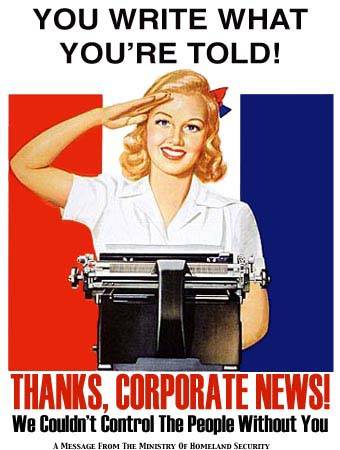
propaganda_corporatenews

By Robert Parry

Source: Consortium News

For Americans interested in foreign policy, the New York Times has become the last U.S. newspaper to continue devoting substantial resources to covering the world. But the Times increasingly betrays its responsibility to deliver anything approaching honest journalism on overseas crises especially when Official Washington has a strong stake in the outcome.

The Times’ failures in the run-up to the disastrous Iraq War are, of course, well known, particularly the infamous “aluminum tube” story by Michael R. Gordon and Judith Miller. And, the Times has shown similar bias on the Syrian conflict, such as last year’s debunked Times’ “vector analysis” tracing a sarin-laden rocket back to a Syrian military base when the rocket had less than one-third the necessary range.

But the Times’ prejudice over the Ukraine crisis has reached new levels of extreme as the “newspaper of record” routinely carries water for the neocons and other hawks who still dominate the U.S. State Department. Everything that the Times writes about Ukraine is so polluted with propaganda that it requires a very strong filter, along with additives from more independent news sources, to get anything approaching an accurate understanding of events.

Screen shot of the fire in Odessa, Ukraine, on May 2, 2014. (From RT video)

From the beginning of the crisis, the Times sided with the “pro-democracy” demonstrators in Kiev’s Maidan square as they sought to topple democratically elected President Viktor Yanukovych, who had rebuffed a set of Western demands that would have required Ukraine to swallow harsh austerity measures prescribed by the International Monetary Fund. Yanukovych opted for a more generous offer from Russia of a $15 billion loan with few strings attached.

Along with almost the entire U.S. mainstream media, the Times cheered on the violent overthrow of Yanukovych on Feb. 22 and downplayed the crucial role played by well-organized neo-Nazi militias that surged to the front of the Maidan protests in the final violent days. Then, with Yanukovych out and a new coup regime in, led by U.S. hand-picked Prime Minister Arseniy Yatsenyuk, the IMF austerity plan was promptly approved.

Since the early days of the coup, the Times has behaved as essentially a propaganda organ for the new regime in Kiev and for the State Department, pushing “themes” blaming Russia and President Vladimir Putin for the crisis. [For details, see Consortiumnews.com’s “Ukraine, Though the US ‘Looking Glass.’”]

In the Times’ haste to perform this function, there have been some notable journalistic embarrassments such as the Times’ front-page story  touting photographs that supposedly showed Russian special forces in Russia and then the same soldiers in eastern Ukraine, allegedly proving that the popular resistance to the coup regime was simply clumsily disguised Russian aggression.

Any serious journalist would have recognized the holes in the story – since it wasn’t clear where the photos were taken or whether the blurry images were even the same people – but that didn’t bother the Times, which led with the scoop. However, only two days later, the scoop blew up when it turned out that a key photo – supposedly showing a group of soldiers in Russia who later appeared in eastern Ukraine – was actually taken in Ukraine, destroying the premise of the entire story.

Soldiering On

The Times, however, continued to soldier on with its bias, playing up stories that made Russia and the ethnic Russians of eastern Ukraine look bad and playing down anything that might make the post-coup regime in Kiev look bad.

On Saturday, for instance, the dominant story from Ukraine was the killing of more than 30 ethnic Russian protesters by fire and smoke inhalation in Ukraine’s southern port city of Odessa. They had taken refuge in a building after a clash with a pro-Kiev mob which reportedly included right-wing thugs.

Even the neocon-dominated Washington Post led its Saturday editions with the story of “Dozens killed in Ukraine fighting” and described the fatal incident this way: “Friday evening, a pro-Ukrainian mob attacked a camp where the pro-Russian supporters had pitched tents, forcing them to flee to a nearby government building, a witness said. The mob then threw gasoline bombs into the building. Police said 31 people were killed when they choked on smoke or jumped out of windows.

“Asked who had thrown the Molotov cocktails, pro-Ukrainian activist Diana Berg said, ‘Our people – but now they are helping them [the survivors] escape the building.’”

By contrast, here is how the New York Times reported the event in its Saturday editions as part of a story by C.J. Chivers and Noah Sneider focused on the successes of the pro-coup armed forces in overrunning some eastern Ukrainian rebel positions.

“Violence also erupted Friday in the previously calmer port city of Odessa, on the Black Sea, where dozens of people died in a fire related to clashes that broke out between protesters holding a march for Ukrainian unity and pro-Russian activists. The fighting itself left four dead and 12 wounded, Ukraine’s Interior Ministry said. Ukrainian and Russian news media showed images of buildings and debris burning, fire bombs being thrown and men armed with pistols.”

Note how the Times evades placing any responsibility on the pro-coup mob for trying to burn the “pro-Russian activists” out of a building, an act that resulted in the highest single-day death toll since the actual coup which left more than 80 people dead from Feb. 20-22. From reading the Times, you wouldn’t know who had died in the building and who had set the fire.

Normally, I would simply attribute this deficient story to some reporters and editors having a bad day and not bothering to assemble relevant facts. However, when put in the context of the Times’ unrelenting bias in its coverage of the Ukraine crisis – how the Times hypes every fact (and even non-facts) that reflect negatively on the anti-coup side – you have to think that the Times is spinning its readers, again.

For those who write for the Times – and the many more people who read it – the question must be whether the Times is so committed to its prejudices here that the newspaper will risk whatever credibility it has left. The coup regime from Kiev may succeed in slaughtering many ethnic Russians in the rebellious east — as the Times signals its approval — but will this bloody offensive become a Waterloo for whatever’s left of the newspaper’s journalistic integrity?


Investigative reporter Robert Parry broke many of the Iran-Contra stories for The Associated Press and Newsweek in the 1980s. You can buy his new book, America’s Stolen Narrative, either in print here or as an e-book (from Amazon and barnesandnoble.com). For a limited time, you also can order Robert Parry’s trilogy on the Bush Family and its connections to various right-wing operatives for only $34. The trilogy includes America’s Stolen Narrative. For details on this offer, click here.