The U.S. Economy In a Nutshell: When Critical Parts Are On “Indefinite Back Order,” the Machine Grinds to a Halt

By Charles Hugh Smith

Source: Of Two Minds

Setting aside the “transitory inflation” parlor game for a moment, let’s look at what happens when critical parts are unavailable for whatever reason, for example, they’re on back order or indefinite back order, i.e. the supplier has no visibility on when the parts will be available.

If the part that blew out is 0.1% of the entire machine, and the other 99.9% still works perfectly, the entire machine is still dead in the water without that critical component. That is a pretty good definition of systemic vulnerability and fragility, a fragility that becomes much, much worse if there are two or three components which are on indefinite back order.

This is the problem with shipping much of your supply chain overseas: you create extreme systemic vulnerability and fragility even as you rake in big profits from reducing costs. Speaking of costs, let’s look at the costs of having a large, costly, complex mechanism sitting idle in a non-functioning state due to some broken element for which there is no substitute available. Whatever productive capacity the mechanism, process, etc. had is now stuck at zero.

Buying a new replacement is extremely costly, and that’s not always available for all the same reasons that parts and components aren’t available. Finding someone to fabricate a new component is not easy due to the wholesale transfer of manufacturing moxie and capability overseas.

You might be able to find someone to weld a replacement strut, but try finding someone to fab a new bicycle derailleur or better yet, a multilayer semiconductor chip. What about 3-D fabrication? Doesn’t that solve this problem? If the part can be “printed,” yes, but there are limits on what can be 3-D fabbed. You can’t 3-D fab a complex thermostat or controller, for example. You can’t 3-D fab a rubber gasket, either, or a great many other bits of petrochemical-based manufacturing.

Scarcities are not limited to parts and components; skilled people can be scarce, too. For example, there is a limited supply of ICU doctors and nurses. The training required to work in an ICU is specialized and experiential; throwing someone with minimal training in is not a substitution that’s going to work. You can’t order an ICU staff from China or print one digitally the way the Federal Reserve creates currency out of thin air. It takes many years to train the staff to function at a high level in ICU.

A great many such labor scarcities exist for skilled workers who cannot be replaced except by someone with the same training and years of experience. This is one reason ICUs can break down: there is no replacement staff available, and no way to “print more.”

It turns out there’s also a scarcity of people willing to do the dirty-work jobs America needs done for wages that haven’t kept up with inflation. As I have explained here, the $1.65 minimum wage I earned in 1970, if factored for real-world inflation, is around $18 per hour, and arguably closer to $20 per hour.

The solution is to raise the pay to levels that attract workers, but then this requires raising prices on the good and services to the point that customers can no longer afford them.

But wait, can’t we automate all work and deliver full-gee-whiz free-money, no-work communism to everyone? I invite everyone who reckons this is in the realm of the do-able to design, program and manufacture an automated robot that can trundle out to the laundry room, pop open a broken clothes dryer, diagnose the problem, manage to find a new controller board, fit it correctly and properly reconnect all the little wiring bits, close it up, test it, lift the dryer back on the washing machine and do all that for the relatively modest cost of a human repairperson. When you accomplish fabricating and programming that robot to do all the work without instruction or oversight, by all means let us all know how much it cost to design, program and manufacture, what the payback of the development and manufacturing process will cost amortized over the (short) life of the robot and how reliable it is in the real world.

The point is, fantasies are nice but reality is far more demanding.

There can also be scarcities of competence. There may be replacements who claim competence, but when reality intrudes on the shuck-and-jive, their competence was illusory, and the net result is the entire institution can be described by President G.W. Bush’s memorable phrase, this sucker’s going down.

There can also be scarcities of institutional infrastructure and capacity. Once the institution, enterprise, state agency, etc. has been stripmined of redundancy, institutional memory and competence, then the first scarcity that cannot be replaced is the first domino that topples all the other dominoes of systemic vulnerability and fragility.

The Federal Reserve can print trillions of dollars and the federal government can borrow and blow trillions of dollars, but neither can print or borrow supply chains, scarce skills, institutional depth or competence. That nice shiny new semiconductor fab you reckon will resolve the chip shortage? You can print the billions of dollars needed in an instant, but the machinery, expertise and time can’t be conjured quite so easily. That fab is years away from completion no matter how many freshly conjured dollars you throw into the air.

When Critical Parts Are On “Indefinite Back Order,” the Machine Grinds to a Halt: that’s the U.S. economy in a nutshell.

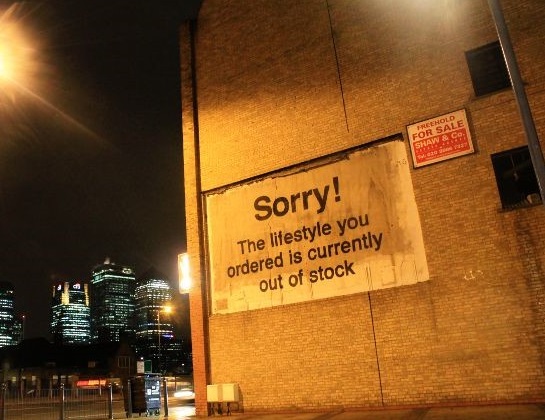
A great many essential components in America are on indefinite back order, including the lifestyle of endless globally sourced goodies at low, low prices. That lifestyle is out of stock and cannot be replaced with financialization fakery.

Hey, Federal Reserve, can you conjure up a non-corrupt financial system, a domestic supply chain, and an economy of open competition, transparency, accountability and competence? If not, you are even more worthless than we feared.

Amazon, “Economic Terrorism” and the Destruction of Competition and Livelihoods

By Colin Todhunter

Source: Off-Guardian

Global corporations are colonising India’s retail space through e-commerce and destroying small-scale physical retail and millions of livelihoods.

Walmart entered into India in 2016 with a US$3.3 billion take-over of the online retail start-up Jet.com. This was followed in 2018 with a US$16 billion take-over of India’s largest online retail platform, Flipkart. Today, Walmart and Amazon control almost two thirds of India’s digital retail sector.

Amazon and Walmart have a record of using predatory pricing, deep discounts and other unfair business practices to attract customers to their online platforms. A couple of years ago, those two companies generated sales of over US$3 billion in just six days during Diwali. India’s small retailers reacted by calling for a boycott of online shopping.

If you want to know the eventual fate of India’s local markets and small retailers, look no further than what US Treasury Secretary Steven Mnuchin said in 2019. He stated that Amazon had “destroyed the retail industry across the United States.”

AMAZON’S CORPORATE PRACTICES

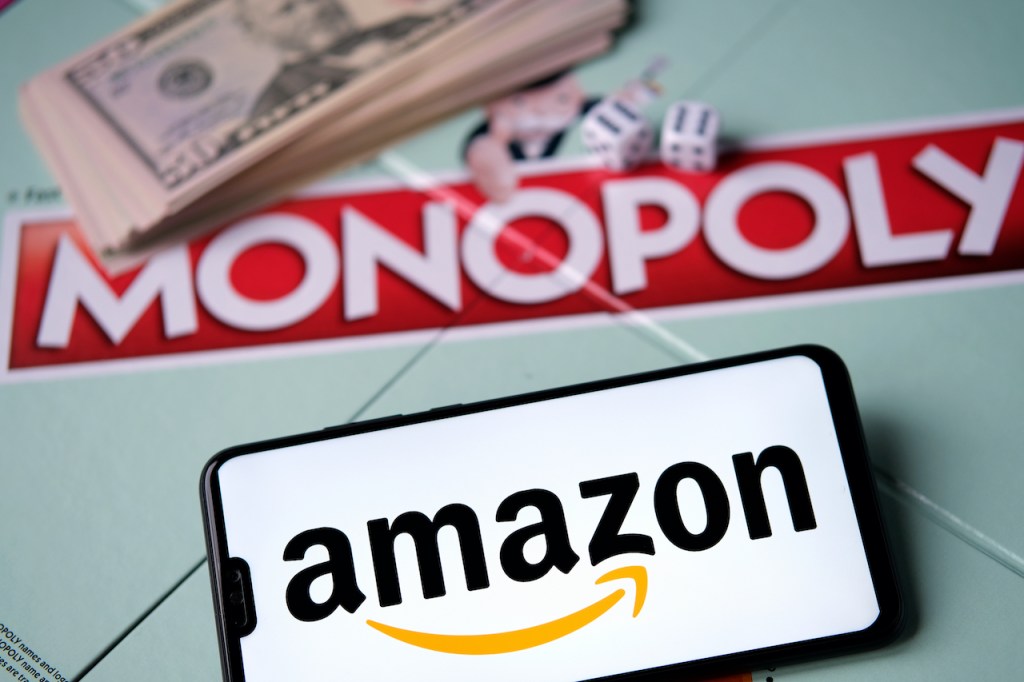
In the US, an investigation by the House Judiciary Committee concluded that Amazon exerts monopoly power over many small- and medium-size businesses. It called for breaking up the company and regulating its online marketplace to ensure that sellers are treated fairly.

Amazon has spied on sellers and appropriated data about their sales, costs and suppliers. It has then used this information to create its own competing versions of their products, often giving its versions superior placement in the search results on its platform.

The Institute for Local Self-Reliance (ILSR) published a revealing document on Amazon in June 2021 that discussed these issues. It also notes that Amazon has been caught using its venture capital fund to invest in start-ups only to steal their ideas and create rival products and services.

Moreover, Amazon’s dominance allows it to function as a gatekeeper: retailers and brands must sell on its site to reach much of the online market and changes to Amazon’s search algorithms or selling terms can cause their sales to evaporate overnight.

Amazon also makes it hard for sellers to reduce their dependence on its platform by making their brand identity almost invisible to shoppers and preventing them from building relationships with their customers. The company strictly limits contact between sellers and customers.

According to the ILSR, Amazon compels sellers to buy its warehousing and shipping services, even though many would get a better deal from other providers, and it blocks independent businesses from offering lower prices on other sites. The company also routinely suspends sellers’ accounts and seizes inventories and cash balances.

The Joint Action Committee against Foreign Retail and E-commerce (JACAFRE) was formed to resist the entry of foreign corporations like Walmart and Amazon into India’s e-commerce market. Its members represent more than 100 national groups, including major trade, workers’ and farmers’ organisations.

JACAFRE issued a statement in 2018 on Walmart’s acquisition of Flipkart, arguing that it undermines India’s economic and digital sovereignty and the livelihoods of millions in India. The committee said the deal would lead to Walmart and Amazon dominating India’s e-retail sector. It would also allow them to own India’s key consumer and other economic data, making them the country’s digital overlords, joining the ranks of Google and Facebook.

In January 2021, JACAFRE published an open letter saying that the three new farm laws, passed by parliament in September 2020, centre on enabling and facilitating the unregulated corporatisation of agriculture value chains. This will effectively make farmers and small traders of agricultural produce become subservient to the interests of a few agrifood and e-commerce giants or will eradicate them completely.

Although there was strong resistance to Walmart entering India with its physical stores, online and offline worlds are now merged: e-commerce companies not only control data about consumption but also control data on production and logistics. Through this control, e-commerce platforms can shape much of the physical economy.

What we are witnessing is the deliberate eradication of markets in favour of monopolistic platforms.

BEZOS NOT WELCOME

Amazon’s move into India encapsulates the unfair fight for space between local and global markets. There is a relative handful of multi-billionaires who own the corporations and platforms. And there are the interests of hundreds of millions of vendors and various small-scale enterprises who are regarded by these rich individuals as mere collateral damage to be displaced in their quest for ever-greater profit.

Thanks to the helping hand of various COVID-related lockdowns, which devastated small businesses, the wealth of the world’s billionaires increased by $3.9tn (trillion) between 18 March and 31 December 2020.

In September 2020, Jeff Bezos, Amazon’s executive chairman, could have paid all 876,000 Amazon employees a $105,000 bonus and still be as wealthy as he was before COVID. Jeff Bezos – his fortune constructed on unprincipled methods that have been well documented in recent years – increased his net wealth by $78.2bn during this period.

Bezos’s plan is clear: the plunder of India and the eradication of millions of small traders and retailers and neighbourhood mom and pop shops.

This is a man with few scruples. After returning from a brief flight to space in July, in a rocket built by his private space company, Bezos said during a news conference:

I also want to thank every Amazon employee and every Amazon customer because you guys paid for all of this.”

In response, US congresswoman Nydia Velazquez wrote on Twitter:

While Jeff Bezos is all over the news for paying to go to space, let’s not forget the reality he has created here on Earth.”

She added the hashtag #WealthTaxNow in reference to Amazon’s tax dodging, revealed in numerous reports, not least the May 2021 study ‘The Amazon Method: How to take advantage of the international state system to avoid paying tax’ by Richard Phillips, Senior Research Fellow, Jenaline Pyle, PhD Candidate, and Ronen Palan, Professor of International Political Economy, all based at the University of London.

Little wonder that when Bezos visited India in January 2020, he was hardly welcomed with open arms.

Bezos praised India on Twitter by posting:

Dynamism. Energy. Democracy. #IndianCentury.”

The ruling party’s top man in the BJP foreign affairs department hit back with:

Please tell this to your employees in Washington DC. Otherwise, your charm offensive is likely to be waste of time and money.”

A fitting response, albeit perplexing given the current administration’s proposed sanctioning of the foreign takeover of the economy, not least by the unscrupulous interests that will benefit from the recent farm legislation.

Bezos landed in India on the back of the country’s antitrust regulator initiating a formal investigation of Amazon and with small store owners demonstrating in the streets. The Confederation of All India Traders (CAIT) announced that members of its affiliate bodies across the country would stage sit-ins and public rallies in 300 cities in protest.

In a letter to PM Modi, prior to the visit of Bezos, the secretary of the CAIT, General Praveen Khandelwal, claimed that Amazon, like Walmart-owned Flipkart, was an “economic terrorist” due to its predatory pricing that “compelled the closure of thousands of small traders.”

In 2020, Delhi Vyapar Mahasangh (DVM) filed a complaint against Amazon and Flipkart alleging that they favoured certain sellers over others on their platforms by offering them discounted fees and preferential listing. The DVM lobbies to promote the interests of small traders. It also raised concerns about Amazon and Flipkart entering into tie-ups with mobile phone manufacturers to sell phones exclusively on their platforms.

It was argued by DVM that this was anti-competitive behaviour as smaller traders could not purchase and sell these devices. Concerns were also raised over the flash sales and deep discounts offered by e-commerce companies, which could not be matched by small traders.

The CAIT estimates that in 2019 upwards of 50,000 mobile phone retailers were forced out of business by large e-commerce firms.

Amazon’s internal documents, as revealed by Reuters, indicated that Amazon had an indirect ownership stake in a handful of sellers who made up most of the sales on its Indian platform. This is an issue because in India Amazon and Flipkart are legally allowed to function only as neutral platforms that facilitate transactions between third-party sellers and buyers for a fee.

UNDER INVESTIGATION

The upshot is that India’s Supreme Court recently ruled that Amazon must face investigation by the Competition Commission of India (CCI) for alleged anti-competitive business practices. The CCI said it would probe the deep discounts, preferential listings and exclusionary tactics that Amazon and Flipkart are alleged to have used to destroy competition.

However, there are powerful forces that have been sitting on their hands as these companies have been running amok.

In August 2021, the CAIT attacked the NITI Aayog (the influential policy commission think tank of the Government of India) for interfering in e-commerce rules proposed by the Consumer Affairs Ministry.

The CAIT said that the think tank clearly seems to be under the pressure and influence of the foreign e-commerce giants.

The president of CAIT, BC Bhartia, stated that it is deeply shocking to see such a callous and indifferent attitude of the NITI Aayog whch have remained a silent spectator for so many years when:

…the foreign e-commerce giants have circumvented every rule of the FDI policy and blatantly violated and destroyed the retail and e-commerce landscape of the country but have suddenly decided to open their mouth at a time when the proposed e-commerce rules will potentially end the malpractices of the e-commerce companies.”

Of course, money talks and buys influence. In addition to tens of billions of US dollars invested in India by Walmart and Amazon, Facebook invested US$5.5 billion last year in Mukesh Ambani’s Jio Platforms (e-commerce retail). Google has also invested US$4.5 billion.

Since the early 1990s, when India opened up to neoliberal economics, the country has become increasingly dependent on inflows of foreign capital. Policies are being governed by the drive to attract and retain foreign investment and maintain ‘market confidence’ by ceding to the demands of international capital which ride roughshod over democratic principles and the needs of hundreds of millions of ordinary people. ‘Foreign direct investment’ has thus become the holy grail of the Modi-led administration and the NITI Aayog.

The CAIT has urged the Consumer Affairs Ministry to implement the draft consumer protection e-commerce rules at the earliest as they are in the best interest of the consumers as well as the traders of the country.

Meanwhile, the CCI probably will complete its investigation within two months.

COMMUNITY VERSUS COMMODITY: THE HIDDEN BATTLE THAT AFFECTS US ALL

By Gary Z McGee

Source: Waking Times

“We abuse the land because we see it as a commodity belonging to is. When we see the land as a community to which we belong, we may begin to use it with love and respect.” ~Aldo Leopold

If, as Krishnamurti said, “It’s no measure of health to be well adjusted to a profoundly sick society,” then it stands to reason that remaining “well adjusted” has kept us in a perpetual state of ecocide.

Our society poisons the air it breathes, the water it drinks, and the food it eats. And then it has the audacity to poison the minds of its citizens by convincing them that this is somehow “progress”.

The problem is that we don’t have a healthy sense of community. What little sense of community we do have is wrapped up in the unhealthy society that we were born into. It’s caught up in the nine-to-five daily grind and the rat-in-a-cage drudgery of a fear-based lifestyle that’s codependent upon a corrupt state. And this is happening on a global scale. You would be hard-pressed to find a healthy society: that is, a society that does not poison its air, water, food, and minds.

It all comes down to perspective—or the lack thereof. We have been conditioned by a sick society to perceive the world as a commodity that belongs to us. In order to cure ourselves, in order to no longer be sick, we must find a way to flip our perspective into perceiving the world as a community to which we belong.

It will require unlearning what we have learned from the profoundly sick society. It will require unwashing the brainwash and reconditioning the cultural conditioning. It will require living a courage-based lifestyle despite the fear-based lifestyle that surrounds us. It will require becoming interdependent from, rather than codependent on, the profoundly sick society. It will require obtaining an eco-centric perspective while rejecting the egocentric perspective that got us into this mess.

This will be an arduously Herculean task. But no battle is more important for the continued survival of our species.

World as Commodity:

“Do not become one of those who only has the courage of other people’s convictions.” ~A. Bartlett Giamatti

What makes it so difficult to flip our perspective? It’s the fact that the sick society keeps us comfortable, safe, and secure while at the same time that it keeps us unhealthy and codependent. The other reason is that it is so much easier to use the world as a commodity.

And that’s the rub. Nobody wants to take responsibility. Nobody wants to be uncomfortable, unsafe, or insecure. Everybody wants to take the easy road. And so the profoundly sick society just keeps on getting sicker.

It’s all too easy to simply rely upon unsustainable corporations that pollute the air and poison the water. In order to keep up with the rat race and keep food on the table, we are forced to rely on corrupt corporations and bureaucratic governments that are dead set on using the world as a commodity while calling it progress. After all, even unhealthy food is better than no food at all. Right?

And even when we do try to become independent and grow our own food or catch our own rainwater, we have overreaching governments with the monopoly on violence coming down on us and slapping us with fines or threatening us with jail time.

The ‘world as commodity’ is an unhealthy snake eating its own tail. Even worse, it gives birth to citizens that are codependent sheep grazing on the unhealthy snake shit and somehow managing to convince themselves it’s food. “Hell! If it’s cheap and easy and keeps me comfortable and safe from government oppression, I might as well eat it. Ignorance is bliss, right?” Right.

And that’s the real kicker. Any awareness of living in a sick society is easily pushed to the side and repressed through the psychosocial convenience of cognitive dissonance. Which usually sounds a little something like this: “It’s uncomfortable for me to believe that I live in a profoundly sick society, even though the evidence is overwhelming. So, rather than think about it, I’ll simply ignore it. After all, there are bills to pay. My kids need to eat (probably McDonald’s or Roundup-laced vegetables). Who do you think I am? Captain Fantastic?”

Satire aside, comfort and convenience are the front lines in the battle against the world as a commodity. If we have any chance of winning this battle, every single one of us will have to win that war at the front line. Which will mean a lot of discomfort and inconvenience.

World as Community:

“We are what we repeatedly do. Excellence, then, is not an act, but a habit.” ~Aristotle

The solution to winning the war against perceiving the world as a commodity is flipping our perspective and perceiving it as a community. Unfortunately, this will require discomfort and inconvenience.

This will require peeling away layer upon layer of cultural conditioning. The first layer is fear of the unknown. It’s the fear of trying something new, of making a healthy lifestyle change. It’s the fear of being ostracized or left out. It’s the fear of some arbitrary authority coming in with some arbitrary power and fining us with some arbitrary law.

So, the first thing we’ll need is courage. But not just any kind of courage. We’ll need a particular flavor of courage that is willing to be “the bad guy,” the maverick, the martyr. It will require the kind of courage that can stand up to codependent peer pressure and take independent leaps of courage, despite goodie-two-shoe conformists and weak-kneed milquetoasts.

The kind of courage that will make the sick society hate you for being healthy; when, really, it just hates itself for remaining sick. It’s the kind of courage that eco-centrically crushes out into healthy interdependence with cosmos, despite the sick society that egocentrically flushes everything away in codependent excess and greed.

The second thing we’ll need is the ability to question the sick society to the nth degree. But not just any kind of questioning. No. We need a particular flavor of questioning that is ruthless, penetrating, interrogating—no-holds-barred.

The kind of questioning that puts unsustainable corporations on blast. The kind of questioning that’s civilly disobedient. The kind of questioning that tears apart the outdated, xenophobic reasoning of the sick society; that reveals the chain-of-command as nothing more than an up-jumped human centipede, blind and poisonous to reason. Indeed. The kind of questioning that has shock value; that won’t allow the sick society to fall back into pretending it’s asleep.

Most of all, it will require us all to practice self-interrogation, self-improvement, and self-overcoming—all of which are exceedingly uncomfortable and inconvenient. Oh well.

When it comes down to it, things will probably get worse before they get better. Transitioning from a sick society that treats the world as a commodity to a healthy society that treats the world as a community will not be an easy task. Things may even slip into anarchy (no masters, no rulers). But even uncomfortable anarchy is healthier than comfortable tyranny, or convenient sickness. Especially when the tyranny and the sickness are ecocidal. Without a healthy planet there can be no healthy people. It really is that critical. Indeed. We may need to sow a little strategic disorder to reap a higher order.

The world can be a community to which we belong, full of compassion, respect, love, and tolerance. But only if we let it. And not if we continue to treat the world like a commodity that belongs to us.

Our tolerance of a ‘profoundly sick society’ can only go so far. Lest we inadvertently end up on the side of the executioners, we must draw the line somewhere. It must be drawn at sickness, at excess, at violence, at greed, and at ecocide. And only free, healthy, courageous individuals will have the wherewithal to draw it.

The Accelerating Destruction Of Earth’s Biodiversity: When Will We Act?

By Robert J. Burrowes

As those individuals aware of it will have observed, presumably with deep regret, the latest ‘International Day for Biological Diversity’passed on 22 May with the bulk of the human population continuing to act in ways that destroy Earth’s biosphere at an ever-accelerating rate.

Unaware that many authors continue to report the ongoing destructionof Earth’s biodiversity, which is under siege on a range of fronts by unchecked human destruction of Earth’s biosphere as well as particular assaults on Earth’s living creatures, responses to this ‘hidden’ path to human extinction continue to waver between non-existent and token.

Consequently, in such circumstances, the destruction of biodiversity might yet become the means by which Homo sapiens is consigned to the fossil record ‘beating’ nuclear war, the climate catastrophe and electromagnetic radiation as the fundamental driver of extinction.

Of course, these drivers are intimately related. Ongoing preparations for nuclear war (requiring the extraction of vast resources from the biosphere), the accelerating climate catastrophe and the ever-expanding electromagnetic contamination of the biosphere are all heavily implicated in driving the destruction of life on Earth and seriously addressing these issues is something only discussed in narrow, genuinely aware circles while official ‘concern’ and that of the human population generally continue to exhibit negligible engagement, perhaps ‘tut-tutting’ the latest news in the corporate media of the extinction of an iconic species. See For Whom the Bell TollsA Report on the State of Planet Earth at Year’s End 2020.

But given that 150-200 species of life on Earth (plants, birds, animals, fish, amphibians, insects, reptiles and microbes) become extinct daily, as noted in 2010 by Ahmed Djoghlaf, the secretary-general of the UN Convention on Biological Diversity who stated that ‘We are losing biodiversity at an unprecedented rate’, and with many biologists having noted that the species extinction rate is nearly 1,000 times the ‘natural’ or ‘background’ rate and ‘is greater than anything the world has experienced since the vanishing of the dinosaurs nearly 65m years ago’ – see ‘Protect nature for world economic security, warns UN biodiversity chief’ – only a delusional individual would argue that this issue is drawing the attention and profound action that is needed to halt this existential crisis.

And given that, back in 2010, the UN was arguing that the ‘economic case for global action to stop the destruction of the natural world is even more powerful than the argument for tackling climate change’ – see ‘UN says case for saving species “more powerful than climate change”’ – there is obviously no doubt that, officially and otherwise, the destruction of biodiversity has been neglected compared to the (admittedly also inadequate) attention given to the climate catastrophe.

So Homo sapiens moves quickly and efficiently to its own extinction, an inevitable consequence of the destruction of the web of life.

An important aspect of the destruction of biodiversity is what precedes the extinction of a species.

In their report compiled in 2017, Professors Gerardo Ceballos, Paul R. Ehrlich & Rodolfo Dirzo recorded that Earth continues to experience ‘a huge episode of population declines and extirpations, which will have negative cascading consequences on ecosystem functioning and services vital to sustaining civilization. We describe this as a “biological annihilation” to highlight the current magnitude of Earth’s ongoing sixth major extinction event.’ Moreover, local population extinctions ‘are orders of magnitude more frequent than species extinctions. Population extinctions, however, are a prelude to species extinctions, so Earth’s sixth mass extinction episode has proceeded further than most assume.’ See ‘Biological annihilation via the ongoing sixth mass extinction signaled by vertebrate population losses and declines’ and ‘Our Vanishing World: Wildlife’.

But, tragically, many additional species are now trapped in a feedback loop which will inevitably precipitate their extinction as well because of the way in which ‘co-extinctions’, ‘localized extinctions’ and ‘extinction cascades’ work once initiated and as has already occurred in almost all ecosystem contexts. See the (so far) six-part series ‘Our Vanishing World’. Have you seen a flock of birds of any size recently? A butterfly?

Why is this Happening?


The accelerating destruction of Earth’s biosphere is driven by one fundamental cause. Over-consumption by humans in industrialized countries. With nearly a billion people living in poverty and about 500 million indigenous peoples living or attempting to live subsistence lifestyles around the world, it is those populations in industrialized countries who are determined to consume more than they actually need and generally live unaware of their ecological impact who are destroying Earth’s biosphere.

Because whether consuming water, energy for household use, fossil fuels for vehicle or airline travel, paper, plastic, metals or meat, only a rare human is keeping track of, and consciously minimizing use of, these ‘end product’ resources which are extracted directly from, or manufactured with resources extracted from, Earth’s biosphere, with a byproduct of this production being a massive amount of waste material, much of it not able to be disposed of in any way that is remotely ecologically benign.

And because the extraction of resources from the biosphere to satisfy consumer demand fundamentally depends on state or private corporations making a profit from the extraction, corporations will exploit anywhere with negligible concern for the local environments destroyed.

To highlight the cost of our endlessly-expanding consumption, one only has to consider a few of the near ‘endless’ list of biosphere assaults adversely impacting the Earth and the species dependent on impacted ecosystems.

Did you know about the planned oil drilling in the staggeringly beautiful and, until now, pristine Okavango Delta in south-west Africa, and what this might mean for the region’s 18,000 elephants and other wildlife (not to mention the human population)? See ‘A Big Oil project in Africa threatens fragile Okavango region’.

Did you know about the ‘massive volumes of fracking waste’ being illegally dumped at Vaca Muerta in northern Patagonia in Argentina?Good for the biosphere and local wildlife do you think? See ‘Argentina’s Illegal Oil and Gas Waste Dumps Show “Dark Side” of Vaca Muerta Drilling, Says Criminal Complaint’.

And while there is a huge number of mines around the world inflicting massive damage on their immediate location – see ‘Environmental Nightmares Created by Open Pit Mines’ – mining is just one way to destroy the biosphere.

Rainforest destruction is another key driver of biosphere degradationin all parts of the world where rainforests are located, notably including the Amazon, Democratic Republic of the Congo, Indonesia and West Papua, and the range of assaults is breathtaking with logging, burning, land clearance to create cattle farms, palm oil and soybean plantations, dam building as well as mining and oil drilling just among the most damaging causes. See ‘Our Vanishing World: Rainforests’.

But, as hinted at above, the emission of ‘greenhouse gases’, notably carbon dioxide, methane and nitrous oxide is destroying the delicate composition of Earth’s atmosphere, to the detriment of the biosphere generally and with catastrophic implications for life on Earth. Despite largely successful efforts by the elite-controlled IPCC to delude people into believing that the global mean temperature has increased by only 1°C, in fact, since the pre-industrial era (prior to 1750)greenhouse gas (GHG) emissions have already caused the global temperature to rise by more than 2°C above this baseline (in February 2020). This occurred despite the Paris climate agreement in 2015 when politicians pledged to hold the global temperature rise to well below 2°C above the pre-industrial level and pledged to try to limit the temperature rise to 1.5°C above this level. See ‘2°C crossed’ and‘Human Extinction by 2026? A Last Ditch Strategy to Fight for Human Survival’.

And electromagnetic radiation is inflicting rapidly increasing damage to all forms of life with the deployment of 5G now in full swing. See ‘Deadly Rainbow: Will 5G Precipitate the Extinction of All Life on Earth?’

Of course, all forms of military violence – invariably done to gain control over biosphere resources – as well as the preparation for it, destroys vast areas of the natural environment (including the creatures that live in it) either deliberately or as ‘collateral damage’. See ‘Ten Reasons Why Militarism is Bad for the Environment’.

As can be readily observed, the destruction of biodiversity is a primary subset of the destruction of the biosphere. Every living organism needs habitat to survive. Every time we destroy part of the biosphere, we destroy the habitat of the organisms that live in it. But we also destroy life and biodiversity directly too. How much longer can the wolf, for example, hold on against the onslaught? See ‘Bill Allowing 90 Percent of Idaho’s Wolves to Be Killed Passes House and Senate’.

Humanity generally is so unconcerned about destruction of the biosphere and the biodiversity cost that goes with it, that we studiously ignore this cost, even when it impacts our closest relatives, human and otherwise. See West Africa’s chimpanzees are on the brink of extinction! and ‘Western Chimpanzee’.

And even the most iconic of species, such as the elephant, are not safe from the human onslaught. From 26 million elephants in 1800, the elephant population of Africa is down to 415,000, thanks to poaching for ivory, ‘trophy hunting’, destruction of habitat and other human causes. The International Union for the Conservation of Nature has now listed the African forest elephant as ‘critically endangered’ and the African savanna elephant as ‘endangered’. See ‘Disappearing Elephants’ and ‘Africa’s elephants now endangered by poaching, habitat loss’.

Of course, destruction of habitat takes an almost infinite variety of forms when it comes to Homo sapiens. The latest farming venture to threaten elephant habitat is just now being created. See ‘From poaching to avocados, Kenya’s elephants face new threat’.

Besides this, assaults on particular species are pushing many endangered species to the brink of extinction. Wildlife trafficking, for example, is worth up to $20 billion each year. Illegal wildlife products include jewelry, traditional medicine, clothing, furniture, and souvenirs, as well as some exotic pets, most of which are sold to unaware/unconcerned consumers in the West although China is heavily implicated too. And to mention elephants again in this context: every 15 minutes an elephant is killed for its tusks. See Stop Wildlife Trafficking.

But if we are not concerned about the iconic species, can you imagine the collective concern for those millions of creatures of which we have never even heard, let alone given a name? And yet, as the work of Professor Gerardo Ceballos and his colleagues cited above clearly suggests, there are many unknown or obscure species that are part of the ‘co-extinctions’, ‘localized extinctions’ and ‘extinction cascades’ that are driving the ‘biological annihilation’ that they have documented.

So What Can We Do?


Well, in theory, we can participate in official responses to this crisis. See ‘Previewing the UN Decade on Ecosystem Restoration’.

But, as history demonstrates, we would be unwise to rely on responses generated by the elite and promulgated through its agents. Such efforts are inevitably designed to subvert effective outcomes, which they do with unrelenting monotony to which the record of uninterrupted destruction readily testifies.

Nevertheless, there is a great deal that we can do, personally, that will make a difference.

As is always the case with threats to biodiversity, the fundamental response to this crisis involves producing and consuming less. A lot less. ‘A difficult ask’ you might say. And more difficult than you probably realize, given the fundamentally dysfunctional emotional state that drives human over-consumption in materialist societies in the first place. See ‘Love Denied: The Psychology of Materialism, Violence and War’.

But for those emotionally equipped for the challenge, you are welcome to join those who recognize the critical importance of reduced consumption and greater self-reliance by participating in The Flame Tree Project to Save Life on Earth which outlines a ‘step by step’ strategy for achieving these ends. In addition, you are welcome to consider signing the online pledge of The Peoples Charter to Create a Nonviolent World.

Of course, you can also campaign to do other things as well. Halting war and all military activity of any kind would save the biosphere enormous resources so effort put into that is worthwhile. If you would like to campaign, strategically, to halt war there is a list of strategic goals for doing so in Campaign Strategic Aims.

In fact, if you wish to focus on strategically resisting any of the four primary threats to human existence – nuclear war, the deployment of 5G, the collapse of biodiversity and/or the climate catastrophe – you can read about nonviolent strategy, including strategic goals to focus your campaigns, on that website too.

Equally fundamentally, if you would like to nurture children to become powerful individuals capable of acting strategically to prevent and respond to violence while able to critique society and elite propaganda, see ‘My Promise to Children’. A child who is emotionally whole does not need to use consumption as a substitute for giving up their unique identity as a survival strategy during childhood, as the ‘Love Denied’ article also explains.

As an aside, if you want a better fundamental understanding of how we reached this point, see Why Violence?Fearless Psychology and Fearful Psychology: Principles and Practice and ‘The Global Elite is Insane Revisited’.

And if the options above seem too complicated, consider committing to:

The Earth Pledge


Out of love for the Earth and all of its creatures, and my respect for their needs, from this day onwards I pledge that:

1. I will listen deeply to children. See ‘Nisteling: The Art of Deep Listening’.

2. I will not travel by plane
3. I will not travel by car
4. I will not eat meat and fish
5. I will only eat organically/biodynamically grown food

6. I will minimize the amount of fresh water I use, including by minimizing my ownership and use of electronic devices

7. I will not own or use a mobile (cell) phone
8. I will not buy rainforest timber
9. I will not buy or use single-use plastic, such as bags, bottles, containers, cups and straws

10. I will not use banks, superannuation (pension) funds or insurance companies that provide any service to corporations involved in fossil fuels, nuclear power and/or weapons

11. I will not accept employment from, or invest in, any organization that supports or participates in the exploitation of fellow human beings or profits from killing and/or destruction of the biosphere

12. I will not get news from the corporate media (mainstream newspapers, television, radio, Google, Facebook, Twitter…)

13. I will make the effort to learn a skill, such as food gardening or sewing, that makes me more self-reliant

14. I will gently encourage my family and friends to consider signing this pledge.

Conclusion


Halting the human rush to extinction through the destruction of biodiversity will require monumental effort. Raising awareness of this rapidly unfolding but still largely-hidden tragedy is, therefore, a high priority. But that is only the start. Enormous effort is required as well.

Of course, for those too terrified to contemplate the reality of ongoing destruction of Earth’s biodiversity and its implications for our own behaviour, denial or delusion are easy ‘psychological retreats’, particularly when our childhood survival largely depended on such tactics.

So it is going to take those who are powerful enough to deal with reality to make a stand.

We are on the cliff-edge of extinction. What will you do?

Biodata: Robert J. Burrowes has a lifetime commitment to understanding and ending human violence. He has done extensive research since 1966 in an effort to understand why human beings are violent and has been a nonviolent activist since 1981. He is the author of ‘Why Violence?’ His email address is flametree@riseup.net and his website is here.

THE HARMONY OF NONCONFORMITY

By Jason Gregory

Source: Waking Times

In a linear world, the external order dictates an artificial way of life to the individual, creating a conformist society and forcing us to relinquish our power to a machine that is unnatural and devoid of life. This passive conformity can be traced back to the origins of the Vedic Hindu caste system and the feudal system under medieval Western Christianity. When a settled agrarian culture such as these is born, it tends to build towns, not only to protect people from outside influences but also to develop a mental framework based on rules and regulations.

The complexity of agrarian culture leads to a division of labour and a division of function. From this division, the ancient Hindus (the Vedic civilisation of Dravidians and Aryans) developed a caste system. The Hindu caste system is made up of the Brahmins (priesthood), Kshatriyas (nobility), Vaishyas (merchants and farmers), and the Shudras (labourers). A direct parallel to the Hindu caste system can be found in medieval Christian society, where we see the priesthood and the church, feudal lords and nobility, farmers and merchants of the commons, and the serfs.

Although we no longer have a caste system, this underlying pattern is still with us today. When we are born into this world, we come out of our mother’s womb (nature) and are taught to submit to the rules of society and culture according to our socioeconomic status. This is the crucifixion of the individual; it is the sacrifice we all make. According to the tyranny of the machine, this crucifixion is for the “common good” or “greater good.” But there is a stark difference between the Hindu and Christian societies of ancient times.

First of all, the function of the Vedic caste system was an act of surrender to Brahman (ultimate reality/godhead). Individuals would crucify their egos and their desires in favour of the lives they had been given by nature. This means they would not seek another path or to try and control their lives according to their interests. Instead, they would abide by the order of society, which helped them diminish their egos so that they could feel the presence of Brahman within themselves. This is dharma as social duty.

The second difference is that, once Hindus have fulfilled their social duties in this life, they are allowed to break away from caste and become renunciate sages in the forest, a practice and title known as vanaprastha in Sanskrit. (This possibility is loathed by Christian society because one is thought of as useless if one does not contribute to the social order.) This breakaway from caste is viewed as a return back to nature and could be thought of as a resurrection. A sage is not part of society and does not conform to its rules. Jesus was a sage in this mould. This is why he was not thought of as a particularly good member of society, and he was actually put to death (if we take the story of Jesus to be real).

Those who submit invariably lose their natural innocence. Conformity is the result of force. When individuals are forced by society and culture into life situations that are against their will, they give away their natural sovereignty in exchange for comfort and servitude and are psychologically reduced to sheep. We developed this sheeplike behaviour as a result of the belief that the morals and ethics forced upon us by society are avenues to success and freedom. This notion is absurd inasmuch as the success and freedom of our world are unnatural. These goals are gauged only by finances. But obviously this is not true success or freedom, as money is empty and void of meaning, and it provides no happiness other than that of acquisition. Happiness cannot be contained in anything that we need to force to happen.

As human life is forced into a sheeplike way of being, happiness is reduced to momentary stimulants of excitement. In such a life we can never express our natural divinity, li, because we are following the model of someone else’s idea of life. Yet conforming to anything other than one’s own innate world destroys us physically, mentally, and spiritually, as te, the virtue of Tao, cannot come through the organic pattern of the individual, li. Anxiety, depression and stress are so prevalent in this day and age partly because we are forced to live such lives. Wars and social unrest then reflect the individual’s anxiety.

Liberated individuals are in alignment with their own nature and with the Tao. They do not benefit the accepted social order and are regarded as useless in the eyes of institutional and organisational power. [Taoist sages] Lao-tzu and Chuang-tzu were treated this way because they could see the unnaturalness of an artificial society. The Buddha and Jesus of Nazareth were two other such sages who could see through the hypnotic veil. A liberated sage understands that anyone who continues to act out the unnatural patterns of conditioning is contributing to chaos and destruction, either consciously or unconsciously. One who is liberated, on the other hand, begins the yoking process until a crystal-clear perception of the Tao in reality can be experienced. In Richard Wilhelm’s translation of the I Ching, he states:

Not every man has an obligation to mingle in the affairs of the world. There are some who are developed to such a degree that they are justified in letting the world go its own way and in refusing to enter public life with a view of reforming it. But this does not imply a right to remain idle or to sit back and merely criticise. Such withdrawal is justified only when we strive to realise in ourselves the higher aims of mankind. For although the sage remains distant from the turmoil of daily life, he creates incomparable human values for the future. (The I Ching or Book of Changes)

Evidence for these “incomparable human values” can be found in the legacy that a sage leaves behind. Lao-tzu is a good example. It has been over 2,500 years since he lived, and yet his wisdom still reverberates within our consciousness today. This is the power of te.

The virtue of te is only available to those who do not seek power, control, or force. Governments, politics, banking, religions, and commerce, on the other hand, are constantly striving for control by forcing the population to their will. This poses a significant hurdle for humanity to overcome. What would it take to bring the individual and the collective back into harmony with the Tao?

The above is an exclusive extract from Jason Gregory’s book Effortless Living: Wu-Wei and the Spontaneous State of Natural Harmony. Gregory outlines the Taoist practice of wu-wei, revealing that when we release our ego and allow life to unfold as it will, we align ourselves more closely with our goals and cultivate skill and mastery along the way. The book is available from all good bookstores.

Where’s Dirk Gently When You Need Him?

By Erik Assadourian

Source: Resilience

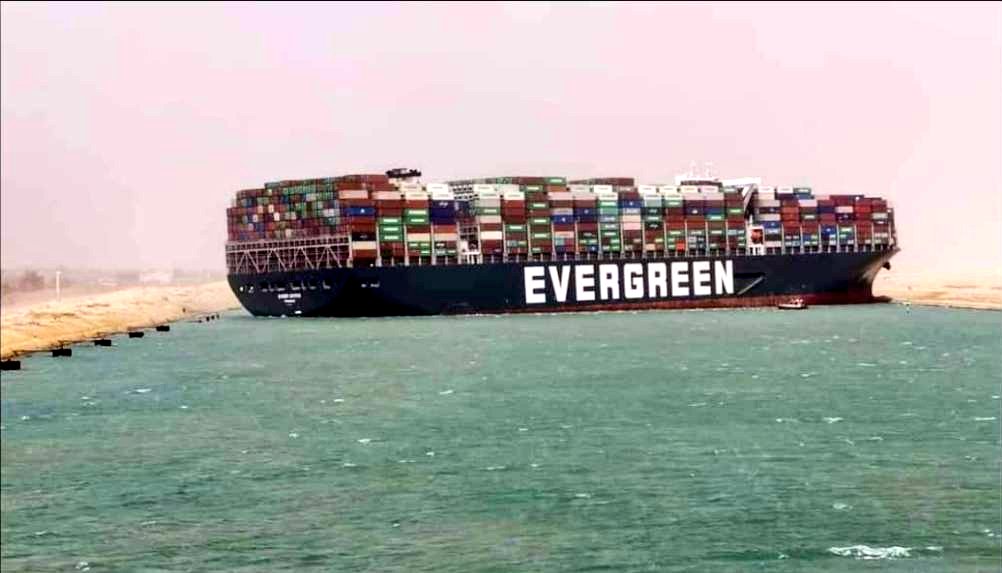
Did you hear? A supersized cargo ship got wedged in the Suez Canal on March 23rd? If you didn’t, you must do pretty well at avoiding the news, social media, and late night TV. But the short of it is: the Ever Given somehow lost control (sandstorm strength winds have been blamed, as have human errors) and crashed into the bank of the canal and lodged itself in.

So what? Is this really news? Or just a sensational story to distract us from the pandemic, which, one might argue, is itself a distraction from the rapid unraveling of Earth’s systems and thus human civilization? Perhaps. But then again perhaps not. Here’s why this incident is worth understanding.

First, a ship single-bowedly disrupted global trade for six days. It was finally freed on March 29th. However, there is now a backlog of over 300 ships while many ships rerouted around the Cape of Good Hope. The Suez Canal is part of a trade route that carries more than 10 percent of global trade, including 7 percent of the world’s oil. Each day 30 percent of the world’s shipping container freight moves through the canal. Thus it created backlogs in shipping (including some 200,000 live animals who could have overheated or run out of food). It raised the price of oil briefly. It created shortages in factories—not just of parts but of shipping containers. And of course, it felt like a freak occurrence. Last year, of the 18,840 ships that moved through the canal, there were no incidents.

But the main reason is because this is an excellent metaphor on how fragile our entire globalized system has become.

It makes you wonder where Dirk Gently is to help straighten all this out. If you haven’t heard of Gently, he is a holistic detective, who uses “the fundamental interconnectedness of all things” to find missing persons (and cats) and solve mysteries. In fact, the novel Dirk Gently’s Holistic Detective Agency includes him trying to figure out how a sofa got “irrevocably stuck” halfway up a staircase.

Similar story here: the Ever Given was jammed in tight—though fortunately with the help of the full moon and tides, unstuck without resorting to time travel (which was needed to free the errant sofa). And while the supernatural wasn’t at the root cause of this mishap as with the couch, instead of focusing just on the bad luck of a sandstorm (which are not uncommon in Egypt) combined with bad piloting, we should still investigate the root causes at play. So let’s peel back the layers one at a time.

Bigger is better!

At the surface, we might simply say the problem stems from the fact that we keep making bigger container ships. The Ever Given is a quarter mile long (one lap around a track or the height of the Empire State Building). And it weighs 220,000 tons and holds 20,000 containers (each 20-40 feet long). High oil prices (especially 2005-8), combined with cheap debt after the 2008 crash led shipping companies to invest in bigger and bigger ships. The Ever Given holds four times the cargo a ship carried in 2000. In fact, these containers were stacked so high that they acted like a giant sail and caught the intense winds that drove the Ever Given into the banks. So, yes, there’s more risk involved, but it’s cheaper to add more containers. To get as much on there as possible. Sometimes that means losing a load of containers to a storm or other incident (about 1600 containers are lost on average each year). Not to mention the fluke canal accident—not that this was a widely recognized risk. (However, this OECD report from 2015 did raise the challenges of burgeoning cargo ship sizes). But now this threat will need to be considered, including terrorists doing this intentionally to disrupt trade.

Now more concentrated!

But of course, looking holistically, let’s ask why do we even need these big ships? So, peeling another layer, we see that we have concentrated our manufacturing to a few major locations and promoted the consumer culture worldwide so we need to get goods of all types to rich Europeans, we need to get oil to run cars and planes in every country, we need to get livestock to the Middle East to feed this affluent desert population. Our globalized system depends on big old cargo ships. Even this incident is a reflection of our extreme globalization: the ship is owned by a Japanese company; run by a Taiwanese company (Evergreen); piloted by Indians; operating under a Panamanian flag; navigating through an Egyptian waterway, shipping brand name goods from all over the globe, and rescued by a Dutch salvage company. That’s kind of neat—a global Kumbaya moment—or a revelation of just how deeply aligned nations are in converting Earth’s forests, lands, water, and life into the latest in consumer products.

But wait, there’s more!

Peeling another layer, we find that the movement of all these consumer goods is driven by a culture fixated on growth, profit, and consumerism. We move factories to exploit cheaper labor, lax environmental rules; we spend $763 billion a year on advertising to convince people they need a new iPhone or a new car or a trip to wherever; we convert landscapes wholesale into resources; and we panic if our economies don’t grow. We’re trapped in a pursuit of material happiness, manipulated by the admen and politicians, driven now by our addictions to sweets, tobacco, alcohol, drugs, social media, and entertainment, to the point we’re “amusing ourselves to death.” But worse, we’re so amused we hardly even notice the death part any longer.

Free disconnect with every purchase!

And arriving at the inner layers of the onion, we find this: that our disconnection from the Earth is so deep, so profound, so complete, that we no longer even consider the planet in our decisions to manufacture items or ship them or buy them. We think instead about expanding our economies, upsizing our homes, upgrading our cars and phones, even stockpiling toilet paper (which again became a thing in the Suez Canal story as wood pulp supplies were potentially delayed). Even as scientists warn of ecological collapse, of cities lost to flooding seas, of regions abandoned due to perpetual drought, to the inevitable violence that all this will cause, to the countless species lost—many of whom we depend on directly for our survival—we focus on making memes, writing essays (guilty), and trying to live slightly-greener-around-the-edges-consumer-lifestyles.

Dealing with this metaphorical couch

Perhaps that’s why the struggling bulldozer became the source of so many memes. Except the most important one: The bulldozer as the environmental movement and the ship as Consumer Capitalism. Ultimately, trying to free the ship, or even convert it to run on green fuels or the latest in sail technology is treating the superficial layers. Instead, we need to dig deeper (yuk yuk). We need to re-regionalize production; reduce production; degrow our economies, find ways to disincentivize and discourage a consumer lifestyle; or better yet, make it clear that this whole culture of consumerism is suicidal and worse, anti-life, and must go in order to prevent future ship jams or far worse global disruptions. And even deeper, we need to reconnect people to the living Earth to make them understand that every sin against the planet, against other creatures, and against other humans who we exploit, we do to ourselves. That if we fail to change paths, we will run head first into the proverbial canal wall. And there will be no one to dig us out.

Desperate Americans Who Can’t Afford Housing Are Becoming “Modern-Day Nomads” …But Not By Choice

By Robert Wheeler

Source: The Organic Prepper

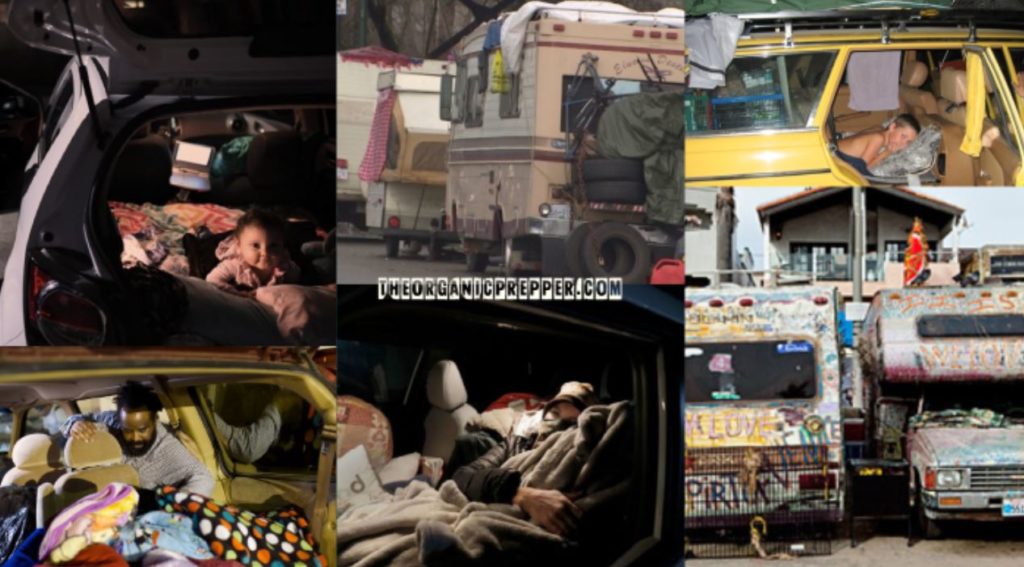
A recent story floating around mainstream media regarding “modern-day nomads” reads like a contemporary article on Henry David Thoreau. It shares stories of people looking to downsize their life and live simply and stories of people who have fallen on hard times, unable to afford rent. 

However, what is lacking is the exposure of the dark underbelly of the “modern-day nomad” culture. In other words, they neglect to mention the fact that the enormous growth of the “modern-day nomad” is rooted in the fact that the world economy has all but collapsed, now mired in a global economic depression of unemployment, low wages, and personal financial catastrophes.

While it sounds romantic, it’s often rooted in desperation.

Nevertheless, some of the stories begin in the following way:

If you look closely on city streets, campgrounds, and stretches of desert run by the Bureau of Land Management, you’ll see more Americans living in vehicles than ever before. It was never their plan.

“I wasn’t prepared when I had to move into my SUV. The transmission was going. I had no money saved. I was really scared,” said April Craren, 52, bundled in blankets atop a cot inside her new minivan, a 2003 Toyota Sienna.

She flipped the camera on her phone to show me the camp stove she uses to make coffee and her view of the sun rising over the Colorado River. She has no toilet, shower, or refrigeration.

After separating from her husband, April found herself homeless in June 2020, exacerbating the depressive disorder for which she receives $1,100 a month in disability benefits.

“I could have gotten an apartment but in a crappy unsafe place with no money to do anything at all,” she explained.

Last year, where April lived in Nixa, Missouri, the average rent for an apartment was $762, slightly less than the national average. Like nearly half of American renters, she would have been crippled by the cost.

It’s not surprising, then, that job loss, divorce, or, say, the sudden onset of global health or financial crisis can push so many over the edge.

Many Americans have found themselves trapped in a spiral of poverty from which they simply can’t recover.

It doesn’t sound so bad to those of us with minimalist persuasions

At 52, April Craren didn’t choose this life. It was thrust upon her by unfortunate life circumstances. Craren couldn’t afford the exorbitant rent that is now average across the country on a fixed income. (Partly due to inflation but mostly due to the housing crash in 2008.)

The coordination of lockdowns and COVID restrictions have plunged the world into a deep depression of which we are only beginning to see. Even Wall Street couldn’t have caused this much damage. 

“If the Great Recession was a crack in the system, Covid and climate change will be the chasm,” says Bob Wells, the nomad who plays himself in the film Nomadland. Thankfully, Wells was able to help Craren adopt her lifestyle so she can now survive as a “nomad” through his Home On Wheels Alliance.

Wells’s lifestyle was a choice. But the newfound interest in the nomadic lifestyle is not a choice for many.

From Yahoo:

Realizing he had something valuable to share, he bought the domain name Cheap RV Living in 2005. He posted tips and tricks about better vehicle-dwelling, but what he was really offering was a road map to a better life.

Four years later, when close to 10 million Americans were displaced after the Great Recession, traffic to his site exploded. Finding himself at the center of a growing online community, he decided to create a meet-up in Quartzsite, Arizona. He dubbed it the Rubber Tramp Rendezvous (RTR), and in January 2011, 45 vehicles showed up. Eight years later, an estimated 10,000 vehicles convened for what was said to be the largest nomad gathering in the world.

The event’s explosive growth is undoubtedly a reflection of America’s increasing interest in van life as an answer to the affordable housing crisis, an idea made accessible by Bob on his YouTube channel, also named Cheap RV Living, created in 2015.

The “increasing interest in van life” that Yahoo News refers to is not some petit-bourgeois fantasy being realized by privileged middle-class white kids, able to go home at any time. It is the necessity of formerly middle class, working-class, and poor people all across America who are out of work or are working but cannot afford housing.

Minimalism is a legitimate lifestyle for some; others have no choice

For many, this culture of minimalism is genuinely how they wish to live. Nomads have a genuine desire to see empty overconsumption come to an end. However, we can not ignore that minimalism is being promoted to prepare the Western population who are used to high living standards to accept those that are much lower.

Why do you think we continually see articles promoting insects as a legitimate dining option? Why are The Great Reset promoters at the World Economic Forum telling the public that they will soon own nothing and learn to love it?

Being a nomad doesn’t mean you can’t be prepared.

For those who are already nomads, whether by choice or forced by economic circumstance, it might be helpful to know that there are many prepping options available to you. There is no need to be left to the mercy of wherever you are right now. 

I highly encourage you to access Daisy Luther’s article, “There’s Another Option Besides Hunkering Down and Bugging Out: Nomadic Living.” It will give you the perspective of someone who has voluntarily experienced and lived the nomadic lifestyle while also the mindset of remaining prepared for anything and everything. 

At the rate the Great Reset is taking shape, many of us may find ourselves embracing the nomadic lifestyle, willingly or not.

Have you considered nomadic living?

Destroying The Web Of Life: The Destruction Of Earth’s Biodiversity Is Accelerating

By Robert J. Burrowes

In August 2010, the secretary-general of the UN Convention on Biological Diversity, Ahmed Djoghlaf, warned that ‘We are losing biodiversity at an unprecedented rate.’ According to the UN Environment Program, ‘the Earth is in the midst of a mass extinction of life’ with scientists estimating that ‘150-200 species of plant, insect, bird and mammal become extinct every 24 hours’ which is nearly 1,000 times the ‘natural’ or ‘background’ rate. Moreover, it ‘is greater than anything the world has experienced since the vanishing of the dinosaurs nearly 65m years ago.’ See ‘Protect nature for world economic security, warns UN biodiversity chief’.

Two months later, at the tenth meeting of the Conference of the Parties to the Convention on Biological Diversity, held from 18 to 29 October 2010, in Nagoya, Aichi Prefecture in Japan, a revised and updated Strategic Plan for Biodiversity, including the Aichi Biodiversity Targets, for the 2011-2020 period was adopted. See ‘Strategic Plan for Biodiversity 2011-2020, including Aichi Biodiversity Targets’.

You can read the 20 Aichi Biodiversity Targets on the Convention’s website. They were ambitious but represented a realistic assessment of what needed to be achieved by 2020 if national governments were to achieve the longer term goal of ‘Living in Harmony with Nature’ by 2050. The 2050 Vision for Biodiversity required ‘a significant shift away from “business as usual” across a broad range of human activities.’ See ‘Global Biodiversity Outlook 5’.

So how have we done in the past ten years?

In 2015, distinguished conservationists Professor Gerardo Ceballos, Anne H. Ehrlich and Professor Paul R. Ehrlich published their book titled The Annihilation of Nature: Human Extinction of Birds and Mammals which tells the story of humanity’s ‘massive and escalating assault on all living things on this planet’ precipitating what is now Earth’s sixth great mass extinction: ‘a time of darkness for our planet’s birds and mammals’.

Noting that the roots of this destruction ‘run deep through time’ with human hunting and other activities responsible for pushing populations of animals to extinction long before the agricultural revolution (which began about 10,000 years ago), they observe that the current collective assault on animals, plants and microbes has reached a level so horrendous that ‘any alarm call we might sound will be too faint to match the tragedy that is unfolding’. But while the decimation of life that is currently underway is being caused by Homo sapiens, the consequences of this decimation will also have impact on humanity itself because the life-forms being annihilated are ‘working parts of life-support systems on which civilization depends’.

Despite the impressive statistics that record the demise of life on Earth and the fundamental threat this extinction crisis poses, Cebellos and the Ehrlichs are well aware that the public and politicians generally are not reacting emotionally to this crisis as do those who are ‘deeply familiar with the impoverishment of nature’. They hope we can relate to the fate of the last Spix’s macaw, a male that searched fruitlessly for a mate until it disappeared from the savannah of northeastern Brazil in 2000.

And did you know that even the iconic African lion may be facing extinction in the wild? In 2015, as a result of decades of hunting, disease and habitat loss, only 23,000 lions remained in Africa’s vast savannahs: less than 10% of what roamed there in 1950. There are fewer lions today.

But separately from species extinctions, Earth continues to experience ‘a huge episode of population declines and extirpations, which will have negative cascading consequences on ecosystem functioning and services vital to sustaining civilization’. In a 2017 report, Professor Ceballos and his coauthors describe what they label ‘a “biological annihilation” to highlight the current magnitude of Earth’s ongoing sixth major extinction event.’ Moreover, local population extinctions ‘are orders of magnitude more frequent than species extinctions. Population extinctions, however, are a prelude to species extinctions, so Earth’s sixth mass extinction episode has proceeded further than most assume.’ See ‘Biological annihilation via the ongoing sixth mass extinction signaled by vertebrate population losses and declines’.

Beyond even this, however, many additional species are now trapped in a feedback loop that will inevitably precipitate their extinction as well because of the way in which ‘co-extinctions’, ‘localized extinctions’ and ‘extinction cascades’ work once initiated and as has already occurred in almost all ecosystem contexts. See the (so far) six-part series ‘Our Vanishing World’.

Have you seen a flock of birds of any size recently? A butterfly?

What Is Driving the Sixth Mass Extinction?

Homo sapiens. And the key tool is always destruction of habitat, whether on land or in the ocean.

Of course, particular human behaviours have a huge impact. Fighting wars (or even just wasting resources to manufacture weapons and other military infrastructure) is one (particularly given that the perpetual war in which the US is engaged is to secure resources and markets), destroying the climate is another and deploying 5G is yet another. But there are many other destructive human behaviours too.

Consider the forests. Just last year, 6.5 million hectares of pristine forest were cut or burnt down for purposes such as clearing land to establish cattle farms so that many people can eat cheap hamburgers, mining (much of it illegal) for a variety of minerals (such as gold, silver, copper, coltan, cassiterite and diamonds) and logging to produce woodchips so that some people can buy cheap paper (including cheap toilet paper). See ‘Our Vanishing World: Rainforests’.

One outcome of this destruction is that 40,000 tropical tree species are now threatened with extinction. In addition, rainforest destruction is also the primary cause of species extinctions globally given the number of species that live in rainforests. See ‘Global Assessment Report on Biodiversity and Ecosystem Services’.

Another outcome is that ‘the precious Amazon is teetering on the edge of functional destruction and, with it, so are we’. See ‘Amazon Tipping Point: Last Chance for Action’.

And in relation to another major habitat that is being destroyed, consider the world’s oceans. In summary, the oceans are warming, acidifying and deoxygenating; being contaminated with nuclear radiation, by offshore oil and gas drilling as well as oil spills; being damaged by deep sea mining; being polluted by industrial (including chemical) and farming wastes while being damaged in a myriad other ways and being overfished.

In short: the oceans are under siege on a vast range of fronts and are effectively ‘dying’. For a comprehensive 18-point summary, see ‘Our Vanishing World: Oceans’.

If you like, you can read comprehensive summaries of the fate of Earth’s birds and insects too. See ‘Our Vanishing World: Birds’ and ‘Our Vanishing World: Insects’.

What Is the State of Play in Early 2021?

In a report published by the Intergovernmental Science-Policy Platform on Biodiversity and Ecosystem Services (IPBES) in May 2020, the authors observe that ‘Nature is declining globally at rates unprecedented in human history – and the rate of species extinctions is accelerating, with grave impacts on people around the world now likely.’ With a total estimated number of animal and plant species on Earth of 8 million (of which 5.5 million are insect species), an accelerating daily extinction rate combined with an ongoing decline in ecosystem health, the report concludes that 1,000,000 species of life on Earth are threatened with extinction. See ‘Nature’s Dangerous Decline “Unprecedented”; Species Extinction Rates “Accelerating”’ and ‘A million threatened species? Thirteen questions and answers’.

And the latest edition of the Convention on Biological Diversity’s flagship publication ‘Global Biodiversity Outlook 5’ was published on 18 August 2020. It reports that ‘Humanity stands at a crossroads with regard to the legacy it leaves to future generations. Biodiversity is declining at an unprecedented rate, and the pressures driving this decline are intensifying. None of the Aichi Biodiversity Targets will be fully met.’

But this is an understatement, to put it politely.

In their commentary on this predicament in November 2020, scholars Ruchi Shroff and Carla Ramos Cortés note that ‘Despite wide-spread international calls to curb the sixth mass extinction, no single goal of the Convention of Biological Diversity’s Aichi Biodiversity Targets, for the second consecutive decade, have been met. In some cases, biodiversity loss has been made worse as no action has been taken to curb pesticide use, pollution, fossil fuels and plastics.’ See ‘The Biodiversity Paradigm: Building Resilience for Human and Environmental Health’.

But the destruction is far worse than suggested by this. Given, as already noted above, the ongoing destruction of rainforests and oceans, not to mention other habitats ranging from wetlands to deserts, the annihilation of life on Earth continues to accelerate with no indicators signaling that this destruction is being slowed in any way.

Therefore, destruction of biodiversity remains one of the four primary paths to human extinction (along with nuclear war, the deployment of 5G and the climate catastrophe).

Is It too Late to Do Anything?

It might be. As mentioned above: Because many species are now trapped in a feedback loop that will inevitably precipitate their extinction because of the way in which ‘co-extinctions’, ‘localized extinctions’ and ‘extinction cascades’ work once initiated, many further extinctions are now inevitable.

However, we can take action to save those individuals and species not yet trapped in a feedback loop and that might yet be saved. But if you wait for governments or corporations to act responsibly, you will wait in vain as the last 20 years has demonstrated.

So you have some powerful options to consider. The first, and most important, is to consider the ways in which you can reduce your own consumption. The planetary environment is only being destroyed so that governments and corporations can respond to consumer demand. Everything from military spending and war to the extraction and burning of fossil fuels are fundamentally driven by what you buy. And each and every item that you buy has a negative environmental impact. There are no exceptions.

If you reduce your own consumption and increase your self-reliance, you will reduce the burden that extraction, transport, manufacture and distribution of resources imposes on the natural environment resulting in the destruction of habitat and the annihilation of biodiversity.

One option to consider is ‘The Flame Tree Project to Save Life on Earth’ which outlines a graduated series of steps for reducing consumption and increasing self-reliance.

If you want to better understand why so many human beings are addicted to endless consumption, see ‘Love Denied: The Psychology of Materialism, Violence and War’. There is more detail on the origins of this behaviour in ‘Why Violence?’ and ‘Fearless Psychology and Fearful Psychology: Principles and Practice’.

If you are inclined to campaign to defend biodiversity in one context or another, whether by campaigning to end war, halt the climate catastrophe, stop the deployment of 5G or end wildlife trafficking for example, consider doing so strategically. See ‘Nonviolent Campaign Strategy’.

You might also consider signing the online pledge of ‘The People’s Charter to Create a Nonviolent World’.

Or, if the options above seem too complicated, consider committing to:

The Earth Pledge

Out of love for the Earth and all of its creatures, and my respect for their needs, from this day onwards I pledge that:

  1. I will listen deeply to children. See ‘Nisteling: The Art of Deep Listening’.
  2. I will not travel by plane
  3. I will not travel by car
  4. I will not eat meat and fish
  5. I will only eat organically/biodynamically grown food
  6. I will minimize the amount of fresh water I use, including by minimizing my ownership and use of electronic devices
  7. I will not own or use a mobile (cell) phone
  8. I will not buy rainforest timber
  9. I will not buy or use single-use plastic, such as bags, bottles, containers, cups and straws
  10. I will not use banks, superannuation (pension) funds or insurance companies that provide any service to corporations involved in fossil fuels, nuclear power and/or weapons
  11. I will not accept employment from, or invest in, any organization that supports or participates in the exploitation of fellow human beings or profits from killing and/or destruction of the biosphere
  12. I will not get news from the corporate media (mainstream newspapers, television, radio, Google, Facebook, Twitter…)
  13. I will make the effort to learn a skill, such as food gardening or sewing, that makes me more self-reliant
  14. I will gently encourage my family and friends to consider signing this pledge.

Conclusion

One species – Homo sapiens – is annihilating life on Earth, driving at least 200 species to extinction each day. In the time it took you to read this article, another species of life on Earth vanished into the fossil record.

This annihilation of life is driven by our over-consumption. As Mahatma Gandhi, already wearing his own homespun cloth, noted more than 100 years ago: ‘Earth provides enough for every person’s need but not for every person’s greed.’

Of course, many people around the world are not responsible for over-consuming; they live life on its margins, with barely enough to eat let alone thrive. And this reflects inequities built into a global economic system that prioritizes profit for the few, not resources for living for all.

So that means that the burden for reducing consumption must fall on those in industrialized societies who benefit from the maldistribution of planetary resources.

Ralph Waldo Emerson once noted that ‘The end of the human race will be that it will eventually die of civilization.’

If we are to prove him wrong, we do not have much time left.

This is because Homo Sapiens is a part of the web of life. And we are ruthlessly destroying that web.


Biodata: Robert J. Burrowes has a lifetime commitment to understanding and ending human violence. He has done extensive research since 1966 in an effort to understand why human beings are violent and has been a nonviolent activist since 1981. He is the author of ‘Why Violence?’ His email address is flametree@riseup.net and his website is here.