State Department Discusses Banning Alternative Media Outlet

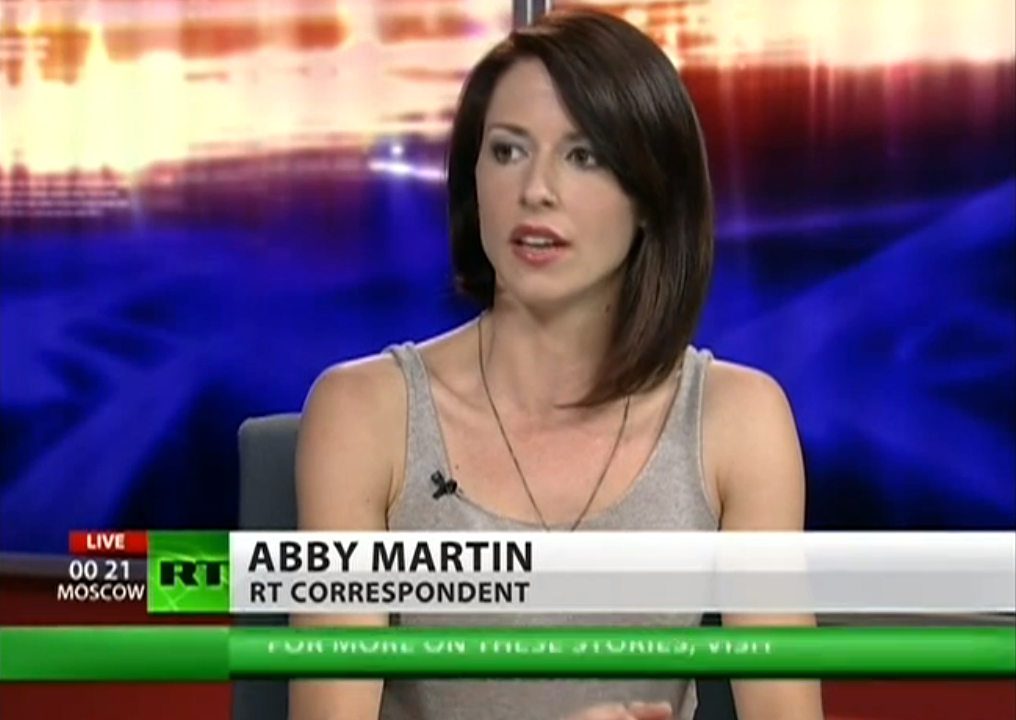
Abby_Martin_RT_correspondent

By Justin King

Source: AntiMedia.org

The US State Department has openly discussed shutting down RT, the Russian news network. Assistant Secretary of State Victoria Nuland was asked about the idea of shutting the company down at a meeting at the Brookings Institute. She said no, paying lip service to the Freedom of Speech, but citing RT’s limited reach as the real reason.

The incident goes to demonstrate exactly how much censorship exists in the United States. RT broadcasts a narrative that is undoubtedly pro-Russian. Now that the pro-Russian narrative is at odds with the Pro-US narrative, the government is willing to openly discuss simply shutting off American access to the network.

This isn’t the first time that RT was targeted by government officials. The Chair of the US Broadcasting Board of Governors equated RT to terrorist groups when he said:

“We are facing a number of challenges from entities like Russia Today which is out there pushing a point of view, the Islamic State in the Middle East and groups like Boko Haram.”

Why would such a question be asked of a State Department official to begin with? Because the US State Department is responsible for large portions of America’s propaganda efforts.

This is the United States of America. We are supposed to have a free press, but if you push a point of view contrary to the government’s, you’re likely to lose your broadcasting license. Regimes in the past held book burnings to remove unfavorable opinions from circulation. The US government doesn’t need to be so boorish. They simply remove the book from libraries or revoke the broadcasting license of the outlet that won’t read the government’s script.

How to Reclaim your Mind and Life from the Cultural Engineers

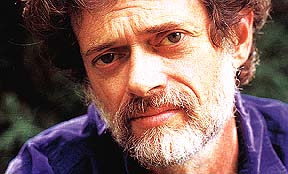
terence_piv

By Paul Fassa

Source: RealFarmacy.com

“We tend to disempower ourselves. We tend to believe that we don’t matter. And in the act of taking that idea to ourselves we give everything away to somebody else, to something else.”
– Terence McKenna [1]

Terence Kemp McKenna (November 16, 1946 – April 3, 2000) was a philosopher, social critic, psychonaut, ethnobotanist, lecturer, writer who authored several books. He examined, deconstructed and expounded on a variety of subjects, including: plant-based entheogens, shamanism, metaphysics, psychedelic drugs, epistemology, alchemy, language, culture, technology and theories about the origins of human consciousness. He created a mathematical theory of time (novelty theory) based on patterns found in the I Ching. [1]

In this short video Terence McKenna explains the necessity reclaiming your mind and creativity from a dying, materialistic consumer oriented society.

“We have to stop consuming our culture. We have to create culture.” –Terrance McKenna [1]

It’s easy to get lost in the noise and hub of the daily grind – dead end jobs, UN-fulfilling careers, relentless consumerism and the constant drone like buzz of the big brother mind control media matrix.

The mass media’s [2] primary purpose and expertise is shaping and programming the “herd” mind with a steady stream of mostly dubious, fear based information overload combined with a cynical parade of buy this NOW advertising.

To say human consciousness has been commercialized is an enormous understatement. Just as day follows night, mass commodification of nature results in the commodification  of human consciousness.

The cultural engineers are obsessed with turning everything into things including people. The predominant value or worth of a person  is based primarily on how many things they can produce directly or indirectly and how many things they own and consume. The sacred intrinsic, non-temporal value of one’s soul is disregarded in favor of the culture’s contrived materialistic value system, which is centered on perishable commodities.

Under these conditions the soul is reified. To reify is to regard (something abstract) as a material or concrete thing. The sacred, inner life of the individual is systemically marginalized and crushed, ensuring  the majority will unblinkingly sell their soul to the externalized value system, which is by design seamlessly interlocked with survival and success on all levels.

“Within this totally jaded society the “individual” had little chance. In fact, his only hope was to escape in some fashion, perhaps into the woods where a person could rediscover the fundamental truths that nature revealed, or into hallucinogenic drugs that pushed the mind past the limitations drilled into it by education and upbringing, or into a completely different lifestyle grounded on more humane and authentic values.” [3]

For those who desire an authentic life created from the inside out and not the other way around, here are some steps that can help you reclaim your mind and life from the cultural engineers.

The burning question is do you really want to reclaim your mind from the gaudy over-commercialized, technological barbarism euphemistically referred to as a consumer oriented society. Are you finally bored with exploitative greed and debt slave materialism? You should be. Why?

“You are a divine being. You matter, you count. You come from realms of unimaginable power and light, and you will return to those realms.”
– Terence McKenna [1]

Assuming you’re ready to leap over the rotting corpse called modern culture and its Kafkaesque matrix society, unfasten your seat-belt and take a deep breath as we take a spin down the road rarely traveled. It’s an esoteric path that takes you back to the source of your creative spirit, intuitive wisdom and your unique connection to all that is or ever will be.

Obviously, a critical first step on this journey into the unknown is to resolutely refuse to be a compliant consumer of ideas, things, and dis-empowering belief systems. Be ready to break the chains of your conceptual prison and be willing to view life from the cracks that exist between ideas. The objective is to have a clear view of reality without the distorting lens of preconceived notions of our “borrowed” reality.

Also, you’ll begin to critically reexamine all the deeply held values that were inserted into your impressionable mind and soul at a very young age before you had the option to critically examine each value in the light and depth of your own consciousness. Unfortunately, at any age the saturation effect of the mass media can instill false values and a substitute reality.

“Personal empowerment means deconditioning yourself from the values and the programs of the society and putting your own values and programs in place.”
– Terence McKenna [1]


The primary tool of the cultural engineers use to control the masses is the media. In fact, for most the media is reality. The media actually creates reality; it does not merely reflect it.

How the media creates our reality:

“… television cultivates a perception of reality among its viewers. . . . “television … has acquired such a central place in daily life that it dominates our symbolic environment, substituting its message about reality for personal experience and other means of knowing about the world.” [2]

2 Simple Methods to Help You Reclaim Your Mind and Your Life:

“My technique is don’t believe anything. If you believe in something, you are automatically precluded from believing its opposite.”
– Terence McKenna [1]


One very practical method for discovering and occupying the unconditioned space between thoughts is by using an ancient Buddhist practice called mindfulness. Jon Kabat-Zinn, PhD, is a scientist, writer, professor, lecturer and meditation teacher who brought mindfulness into the realm of mainstream medicine and society at large.

Zinn’s definition of mindfulness: “Mindfulness means paying attention in a particular way; On purpose, in the present moment, and non- judgmentally.”[3] You cultivate detachment and equanimity of mind regardless of what life throws at you. It really gets interesting when you are finally able to move into the present moment and respond directly to life situations as they occur opposed to reacting to them based on past conditioning.”

With practice, mindfulness enables you to take control of your attention via your intention so you can willfully move your awareness into that clear space of the present moment without interference from the conditioned mind.

Normally our attention automatically drifts and gets stuck in the same ruts and grooves that have already created strong, magnetic like impressions in your mind. This tendency creates a mind lock where the attention is effectively caged in the past and rarely has the opportunity to freshly explore the actual moment that is life that is occurring now. In other words, our attention and thus our life is stuck in the past because where we focus our attention is what our life becomes.

Essentially to break the chains of the past you need to practice anchoring your attention in the present moment. This is when you consciously move beyond your current life “story” perception template into reality directly- moment by moment.

From that operating viewpoint you are free to create your desired reality without dragging the burden of the past or anxiety about the future into the equation. If you ignore the mental noise and turn your attention inward you will eventually discover the expansive space that exists between thoughts.

That space is where the raw, unconditioned power and unfettered freedom to create is found. It’s a timeless reservoir of unlimited possibilities. It’s a no-mind that’s empty with potential. Some refer to it as the quantum mind.

This is where artists go when they want to create something fresh and free from cultural or personal clichés. Sages and shamans are familiar with this space as well. They go there to listen not to think. If they are really good listeners they share what they heard or saw for the benefit of others.

“Half the time you think your thinking you’re actually listening.”
– Terence McKenna [1]

Of course, Terence McKenna primarily relied on various psychedelics and marijuana to help him enter that sacred space beyond the conceptual realm; he was a dedicated psychonaut, but that’s not the only way.

Discover your Imagination

“If you don’t have a plan, you become part of somebody else’s plan.”
– Terence McKenna [1]

The best plan is to first get in touch with reality via direct experience – ditching the ingrained conceptual template your culture indoctrinated into you from birth. That’s when you can really start to harness the true power of your imagination and use it to intentionally create the personal reality you desire to walk into beyond prevailing ideologies. From the perspective of raw imagination there is no past or future, just now. And that is where your essential power lies, in the present moment.

Forget about slavishly following the yellow brick road – create your own experiential road show starting with your imagination. Venture beyond the  current ideological and spiritual constraints and institutionally sanctioned belief systems that tell you what reality is and decide to boldly experience reality directly and journey into terra incognita.

To create a new reality requires skillfully engaging your intention and imagination utilizing all the senses including: visual (seeing), auditory (hearing), kinesthetic (touch), olfactory (smelling) or even gustatory (tasting). Now with your imagination fully engaged, create a subtle imaginary version that exactly reflects your desired intention.  This is basically how one creates a new reality beyond past conditioning.

From a CNN article titled:

The power of perceptions: Imagining the reality you want

“What we are fighting for, Benjamin (Ruha Benjamin, sociology professor) says, is our imagination — the right to imagine a life and relationships and a social world that are happier, less anxious, more harmonious and more just. We are not being diligent enough or deliberate enough about cultivating our imagination. We have to fight, for the ability to imagine the world we want. Because one form of oppression is telling people that they’re not allowed [or can’t] to imagine something better and happier.”

“Either there are no illusions or everything is an illusion,” (…) “And given that we are pretty much all delusional, you might as well choose your delusion.” –  Beau Lotto, neuroscientist and artist[6]

Paul Fassa is a contributing staff writer for REALfarmacy.com. His pet peeves are the Medical Mafia’s control over health and the food industry and government regulatory agencies’ corruption. Paul’s valiant contributions to the health movement and global paradigm shift are world renowned. Visit his blog by following this link and follow him on Twitter here.

Sources:
[1] http://www.endalldisease.com/73-mindblowing-terence-mckenna-quotes/
[2] http://people.missouristate.edu/MichaelCarlie/what_I_learned_about/media.htm NOTE: The term “mass media” refers to the Internet, radio, television, commercial motion pictures, videos, CDs, and the press (newspapers, journals, and magazines) – what are referred to collectively as broadcast and print media.
[3] http://www.shmoop.com/1960s/culture.html
[4] http://www.webmd.com/jon-kabat-zinn (bio)
[5] http://www.wildmind.org/applied/daily-life/what-is-mindfulness
[6] http://www.cnn.com/2012/04/11/health/enayati-power-perceptions-imagination/

Zombie Apocalypse and the Politics of Artificial Scarcity

By Colin Jenkins

Source: The Hampton Institute

cdc_zombie_attacksDystopian narratives have long been an alluring and thought-provoking form of entertainment, especially for those who take an interest in studying social and political structures. From classics like Nineteen Eighty-Four and Brave New World to the current hit, The Hunger Games, these stories play on our fears while simultaneously serving as warning signs for the future.

Their attractiveness within American society is not surprising. Our lives are driven by fear. Fear leads us to spend and consume; fear leads us to withdraw from our communities; and fear leads us to apathy regarding our own social and political processes. This fear is conditioned as much as it is natural. The ruling-class handbook, Machiavelli’s The Prince, made it clear: “Since love and fear can hardly exist together, if we must choose between them, it is far safer to be feared than loved.”

The idea of apocalypse is a central tenet of human society. We’ve been taught about Armageddon, Kali Yuga, Judgement Day, Yawm ad-Dīn, nuclear holocaust, the end times, the four horsemen, and the Sermon of the Seven Suns. Hierarchical societal arrangements leave us feeling powerless. Exploitative systems like capitalism leave us feeling hopeless. And the widespread deployment of fear ultimately keeps us in our place, and out of the business of those who own our worlds.

The last half-century has brought us the zombie apocalypse – a fictional world where the human race has largely been transformed into a brainless, subhuman hoard of flesh-eaters, with only a few random survivors left to carve out any semblance of life they can find in a barren landscape. The emergence and immense popularity of the TV show The Walking Dead is the latest, and perhaps most influential, piece in a long line of narratives centered within themes of survival, human interaction, and scarcity.
Human Nature and Interaction

Behind all political battles, social critiques, and theoretical inquiries lies the most fundamental question: when left to our own accord, how will we interact with one another? How one answers this question usually goes a long way to how one perceives the world, and how issues are viewed and opinions are formed. To our dismay, potential answers are typically presented in dualities. Are we good or evil? Competitive or cooperative? Generous or greedy? Violent or peaceful?

A common theme among religion has been that human beings are “born into sin” and heavily influenced by “evil forces” to do harmful things. One who embraces this theme will tend to have less faith in humanity than one who does not. For, if we really are engaging in a daily struggle to resist the powers of evil, it is reasonable to assume that evil will take hold of many. How can we trust anyone who, at a moment’s notice, could potentially lose the ability to act on their own conscience? The common theme of our dominant economic system – capitalism – is that human beings are inherently competitive and self-centered. When combined, it is easy to see how such ideologies may create intensely authoritative and hierarchical systems. After all, people who are influenced by strong and evil metaphysical forces while also being drawn toward callous, self-interest certainly cannot be trusted with free will.

This lesson is drilled deep into our psyches with each episode of The Walking Dead, where the potential threat of flesh-eating zombie hoards become an afterthought to the clear and present danger of “evil” humans who are out to get one another. Whether it’s a sadistic governor charming an entire town with violent gladiator events, an outlaw gang with the obligatory pedophile, or a pack of hipster cannibals salivating at the thought of eating their next visitor, the intended theme is clear – human beings are not capable of co-existing, even in a world where they rarely interact.

But is this idea accurate? Are we really drawn toward conflict? Must we compete with one another to survive? Is it appropriate to apply Darwin’s evolutionary theories in a social sense where the “fit” are meant to gain wealth and power over the “weak”? Or are we, as Peter Kropotkin theorized in his classic Mutual Aid, more inclined to mimic most other species on Earth, which have been observed over the course of centuries to exhibit “Mutual Aid and Mutual Support carried on to an extent which made me suspect in it a feature of the greatest importance for the maintenance of life, the preservation of each species, and its further evolution?”

There is ample evidence that we are drawn to cooperation. “Caring about others is part of our mammalian heritage, and humans take this ability to a high level,” explains neuroscientist Sandra Aamodt. “Helping other people seems to be our default approach, in the sense that we’re more likely to do it when we don’t have time to think a situation through before acting. After a conflict, we and other primates-including our famously aggressive relatives, the chimpanzees-have many ways to reconcile and repair relationships.” Studies have shown that in the first year of life, infants exhibit empathy toward others in distress. Evolutionary Anthropologist Michael Tomasello has put “the concept of cooperation as an evolutionary imperative to the test with very young children, to see if it holds for our nature and not just our nurture. Drop something in front of a two-year-old, he finds, and she is likely to pick it up for you. This is not just learned behavior, he argues. Young children are naturally cooperative.”

So, if we are truly inclined to cooperate with one another, why is there so much division and turmoil in the world? The answer to this question may be found by assessing not only the mechanisms of capitalism, but more importantly in the creation of artificial scarcity as a means to maintain hierarchies.
Capitalism and Artificial Scarcity

It is no secret that capitalism thrives off exploitation. It needs a large majority of people to be completely reliant on their labor power. It needs private property to be accessible to only a few, so that they may utilize it as a social relationship where the rented majority can labor and create value. It needs capital to be accessible to only a few, so that they may regenerate and reinvest said capital in a perpetual manner. And it needs a considerable population of the impoverished and unemployed – “a reserve army of labor,” as Marx put it – in order to create a “demand” for labor and thus make such exploitative positions “competitive” to those who need to partake in them to merely survive. It needs these things in order to stay intact – something that is desirable to the 85 richest people in the world who own more than half of the world’s entire population (3.6 billion people).

But wealth accumulation through alienation and exploitation is not enough in itself. The system also needs to create scarcity where it does not already exist. Even Marx admitted that capitalism has given us the productive capacity to provide all that is needed for the global population. In other words, capitalism has proven that scarcity does not exist. And, over the years, technology has confirmed this. But, in order for capitalism to survive, scarcity must exist, even if through artificial means. This is a necessary component on multiple fronts, including the pricing of commodities, the enhancement of wealth, and the need to inject a high degree of competition among people (who are naturally inclined to cooperation).

Since capitalism is based in the buying and selling of commodities, its lifeblood is production. And since production in a capitalist system is not based on need, but rather on demand, it has the tendency to produce more than it can sell. This is called overproduction. Michael Roberts explains:

Overproduction is when capitalists produce too much compared to the demand for things or services. Suddenly capitalists build up stocks of things they cannot sell, they have factories with too much capacity compared to demand and they have too many workers than they need. So they close down plant, slash the workforce and even just liquidate the whole business. That is a capitalist crisis.

When overproduction occurs, it must be addressed. There are multiple ways to do this. Marx addressed three options: “On the one hand by enforced destruction of a mass of productive forces; on the other, by the conquest of new markets, and by the more thorough exploitation of the old ones.” Another is through the destruction of excess capital and commodities. Whichever measure is taken, it is paramount that the economy must emerge from a starting point that is different from the ending point where the crisis began. This is accomplished through creating scarcity, whether in regards to labor, production capacity, or commodities and basic needs.

Maintaining scarcity is also necessary for wealth enhancement. It is not enough that accumulation flows to a very small section of the population, but more so that a considerable portion of the population is faced with the inherent struggles related to inaccessibility. For example, if millions of people are unable to access basic needs such as food, clothing, shelter, and healthcare, the commodification of those needs becomes all the more effective. On the flip side, the mere presence of accessibility – or wealth – which is enjoyed by the elite becomes all the more valuable because it is highly sought after.

In this sense, it is not the accumulation of personal wealth that creates advantageous positions on the socioeconomic ladder; it’s the impoverishment of the majority. Allowing human beings access to basic necessities would essentially destroy the allure (and thus, power) of wealth and the coercive nature of forced participation. This effect is maintained through artificial scarcity – the coordinated withholding of basic needs from the majority. These measures also seek to create a predatory landscape – something akin to a post-apocalyptic, zombie-filled world where manufactured scarcity pits poor against poor and worker against worker, all the while pulling attention away from the zombie threat.
Control through Commodification

A crucial part of this process is commodification – the “transformation of goods and services, as well as ideas or other entities that normally may not be considered goods, into commodities” that can be bought, sold, used and discarded. The most important transformation is that of the working-class majority who, without the means to sustain on their own, are left with a choice between (1) laboring to create wealth for a small minority and accepting whatever “wages” are provided, or (2) starving.

In The Socioeconomic Guardians of Scarcity, Philip Richlin tells us that:

“When society deprives any community or individual of the necessities of life, there is a form of violence happening. When society commodifies the bare necessities of life, they are commodifying human beings, whose labor can be bought and sold. Underneath the pseudo-philosophical rationalizations for capitalism is a defense of wage slavery. For, if your labor is for sale, then you are for sale.”

We are for sale, and we sell ourselves everyday – in the hopes of acquiring a wage that allows us to eat, sleep, and feed our families. In the United States, the 46 million people living in poverty haven’t been so lucky. The 2.5 million who have defaulted on their student loans have been discarded. The 49 million who suffer from food insecurity have lost hope. The 3.5 million homeless are mocked by 18.6 million vacant homes. And the 22 million who are unemployed or underemployed have been deemed “unfit commodities” and relegated to the reserve army of labor.

The control aspect of the commodification of labor comes in its dehumanizing effect – an effect that was commonly recognized among 18th and 19th century thinkers. One of those thinkers, Wilhelm Von Humboldt, when referring to the role of a wage laborer, explained “as whatever does not spring from a man’s free choice, or is only the result of instruction and guidance, does not enter into his very nature; he does not perform it with truly human energies, but merely with mechanical exactness, suggesting that “we may admire what he (the laborer) does, but we despise what he is,” because he is essentially not human.

The worker, in her or his role in the capital-labor relationship, exists in a position of constant degeneration. This is especially true with the onset of mass production lines and the division of labor – both of which are inevitable elements within this system. “As the division of labor increases, labor is simplified,” Marx tells us. “The special skill of the worker becomes worthless. He becomes transformed into a simple, monotonous productive force that does not have to use intense bodily or intellectual faculties. His labor becomes a labor that anyone can perform.” As automation and technology progress, such specialized task-mastering even seeps into what was once considered “skilled” labor, thus broadening its reach.

In this role, workers are firmly placed into positions of control within a highly authoritative and hierarchical system.
A World beyond Profit

Dystopian narratives are no longer fiction. From birth, we are corralled into a system that scoffs at free will, stymies our creative and productive capacities, and leaves us little room to carve our own paths. The constructs directed from above are designed to strip us of our inclination to care and cooperate, and make us accept the need to step over one another to get ahead. This is not our nature. Whether we’re talking about Kropotkin’s studies in “the wild” or Tomasello’s experience with children, observable evidence tells us we’ve been duped.

Another world is not just possible; it is inevitable if we are to exist in the long-term. In Post-Scarcity Anarchism, Murray Bookchin offers a glimpse into this world not constructed on labor, profit, and artificial scarcity:

“It is easy to foresee a time, by no means remote, when a rationally organized economy could automatically manufacture small “packaged” factories without human labor; parts could be produced with so little effort that most maintenance tasks would be reduced to the simple act of removing a defective unit from a machine and replacing it by another-a job no more difficult than pulling out and putting in a tray. Machines would make and repair most of the machines required to maintain such a highly industrialized economy. Such a technology, oriented entirely toward human needs and freed from all consideration of profit and loss, would eliminate the pain of want and toil-the penalty, inflicted in the form of denial, suffering and inhumanity, exacted by a society based on scarcity and labor.”

The barren landscape for which we’ve been placed has a future beyond Hershel’s overrun farm, the confines of a prison, the Governor’s creepy town of Woodbury, and the trap known as Terminus. It has a future beyond the artificial constructs of capitalism and hierarchy. Human nature is talking to us… and we’re starting to listen.

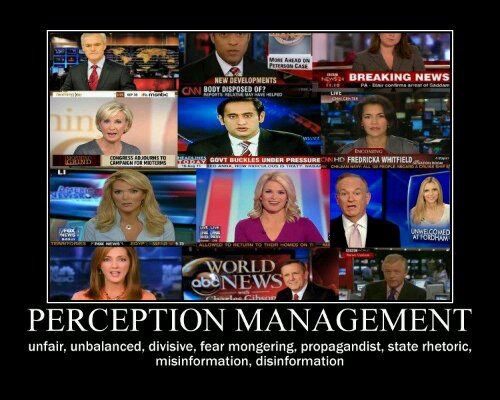
The Victory of ‘Perception Management’

wpid-facebook_-1640825551

By Robert Parry

Source: Consortium News

To understand how the American people find themselves trapped in today’s Orwellian dystopia of endless warfare against an ever-shifting collection of “evil” enemies, you have to think back to the Vietnam War and the shock to the ruling elite caused by an unprecedented popular uprising against that war.

While on the surface Official Washington pretended that the mass protests didn’t change policy, a panicky reality existed behind the scenes, a recognition that a major investment in domestic propaganda would be needed to ensure that future imperial adventures would have the public’s eager support or at least its confused acquiescence.

This commitment to what the insiders called “perception management” began in earnest with the Reagan administration in the 1980s but it would come to be the accepted practice of all subsequent administrations, including the present one of President Barack Obama.

In that sense, propaganda in pursuit of foreign policy goals would trump the democratic ideal of an informed electorate. The point would be not to honestly inform the American people about events around the world but to manage their perceptions by ramping up fear in some cases and defusing outrage in others – depending on the U.S. government’s needs.

Thus, you have the current hysteria over Russia’s supposed “aggression” in Ukraine when the crisis was actually provoked by the West, including by U.S. neocons who helped create today’s humanitarian crisis in eastern Ukraine that they now cynically blame on Russian President Vladimir Putin.

Yet, many of these same U.S. foreign policy operatives – outraged over Russia’s limited intervention to protect ethic Russians in eastern Ukraine – are demanding that President Obama launch an air war against the Syrian military as a “humanitarian” intervention there.

In other words, if the Russians act to shield ethnic Russians on their border who are being bombarded by a coup regime in Kiev that was installed with U.S. support, the Russians are the villains blamed for the thousands of civilian deaths, even though the vast majority of the casualties have been inflicted by the Kiev regime from indiscriminate bombing and from dispatching neo-Nazi militias to do the street fighting.

In Ukraine, the exigent circumstances don’t matter, including the violent overthrow of the constitutionally elected president last February. It’s all about white hats for the current Kiev regime and black hats for the ethnic Russians and especially for Putin.

But an entirely different set of standards has applied to Syria where a U.S.-backed rebellion, which included violent Sunni jihadists from the start, wore the white hats and the relatively secular Syrian government, which has responded with excessive violence of its own, wears the black hats. But a problem to that neat dichotomy arose when one of the major Sunni rebel forces, the Islamic State, started seizing Iraqi territory and beheading Westerners.

Faced with those grisly scenes, President Obama authorized bombing the Islamic State forces in both Iraq and Syria, but neocons and other U.S. hardliners have been hectoring Obama to go after their preferred target, Syria’s President Bashar al-Assad, despite the risk that destroying the Syrian military could open the gates of Damascus to the Islamic State or al-Qaeda’s Nusra Front.

Lost on the Dark Side

You might think that the American public would begin to rebel against these messy entangling alliances with the 1984-like demonizing of one new “enemy” after another. Not only have these endless wars drained trillions of dollars from the U.S. taxpayers, they have led to the deaths of thousands of U.S. troops and to the tarnishing of America’s image from the attendant evils of war, including a lengthy detour into the “dark side” of torture, assassinations and “collateral” killings of children and other innocents.

But that is where the history of “perception management” comes in, the need to keep the American people compliant and confused. In the 1980s, the Reagan administration was determined to “kick the Vietnam Syndrome,” the revulsion that many Americans felt for warfare after all those years in the blood-soaked jungles of Vietnam and all the lies that clumsily justified the war.

So, the challenge for the U.S. government became: how to present the actions of “enemies” always in the darkest light while bathing the behavior of the U.S. “side” in a rosy glow. You also had to stage this propaganda theater in an ostensibly “free country” with a supposedly “independent press.”

From documents declassified or leaked over the past several decades, including an unpublished draft chapter of the congressional Iran-Contra investigation, we now know a great deal about how this remarkable project was undertaken and who the key players were.

Perhaps not surprisingly much of the initiative came from the Central Intelligence Agency, which housed the expertise for manipulating target populations through propaganda and disinformation. The only difference this time would be that the American people would be the target population.

For this project, Ronald Reagan’s CIA Director William J. Casey sent his top propaganda specialist Walter Raymond Jr. to the National Security Council staff to manage the inter-agency task forces that would brainstorm and coordinate this “public diplomacy” strategy.

Many of the old intelligence operatives, including Casey and Raymond, are now dead, but other influential Washington figures who were deeply involved by these strategies remain, such as neocon stalwart Robert Kagan, whose first major job in Washington was as chief of Reagan’s State Department Office of Public Diplomacy for Latin America.

Now a fellow at the Brookings Institution and a columnist at the Washington Post, Kagan remains an expert in presenting foreign policy initiatives within the “good guy/bad guy” frames that he learned in the 1980s. He is also the husband of Assistant Secretary of State for European Affairs Victoria Nuland, who oversaw the overthrow of Ukraine’s elected President Viktor Yanukovych last February amid a very effective U.S. propaganda strategy.

During the Reagan years, Kagan worked closely on propaganda schemes with Elliott Abrams, then the Assistant Secretary of State for Latin America. After getting convicted and then pardoned in the Iran-Contra scandal, Abrams reemerged on President George W. Bush’s National Security Council handling Middle East issues, including the Iraq War, and later “global democracy strategy.” Abrams is now a senior fellow at the Council on Foreign Relations.

These and other neocons were among the most diligent students learning the art of “perception management” from the likes of Raymond and Casey, but those propaganda skills have spread much more widely as “public diplomacy” and “information warfare” have now become an integral part of every U.S. foreign policy initiative.

A Propaganda Bureaucracy

Declassified documents now reveal how extensive Reagan’s propaganda project became with inter-agency task forces assigned to develop “themes” that would push American “hot buttons.” Scores of documents came out during the Iran-Contra scandal in 1987 and hundreds more are now available at the Reagan presidential library in Simi Valley, California.

What the documents reveal is that at the start of the Reagan administration, CIA Director Casey faced a daunting challenge in trying to rally public opinion behind aggressive U.S. interventions, especially in Central America. Bitter memories of the Vietnam War were still fresh and many Americans were horrified at the brutality of right-wing regimes in Guatemala and El Salvador, where Salvadoran soldiers raped and murdered four American churchwomen in December 1980.

The new leftist Sandinista government in Nicaragua also was not viewed with much alarm. After all, Nicaragua was an impoverished country of only about three million people who had just cast off the brutal dictatorship of Anastasio Somoza.

So, Reagan’s initial strategy of bolstering the Salvadoran and Guatemalan armies required defusing the negative publicity about them and somehow rallying the American people into supporting a covert CIA intervention inside Nicaragua via a counterrevolutionary force known as the Contras led by Somoza’s ex-National Guard officers.

Reagan’s task was made tougher by the fact that the Cold War’s anti-communist arguments had so recently been discredited in Vietnam. As deputy assistant secretary to the Air Force, J. Michael Kelly, put it, “the most critical special operations mission we have … is to persuade the American people that the communists are out to get us.”

At the same time, the White House worked to weed out American reporters who uncovered facts that undercut the desired public images. As part of that effort, the administration attacked New York Times correspondent Raymond Bonner for disclosing the Salvadoran regime’s massacre of about 800 men, women and children in the village of El Mozote in northeast El Salvador in December 1981. Accuracy in Media and conservative news organizations, such as The Wall Street Journal’s editorial page, joined in pummeling Bonner, who was soon ousted from his job.

But these were largely ad hoc efforts. A more comprehensive “public diplomacy” operation took shape beginning in 1982 when Raymond, a 30-year veteran of CIA clandestine services, was transferred to the NSC.

A slight, soft-spoken New Yorker who reminded some of a character from a John le Carré spy novel, Raymond was an intelligence officer who “easily fades into the woodwork,” according to one acquaintance. But Raymond would become the sparkplug for this high-powered propaganda network, according to a draft chapter of the Iran-Contra report.

Though the draft chapter didn’t use Raymond’s name in its opening pages, apparently because some of the information came from classified depositions, Raymond’s name was used later in the chapter and the earlier citations matched Raymond’s known role. According to the draft report, the CIA officer who was recruited for the NSC job had served as Director of the Covert Action Staff at the CIA from 1978 to 1982 and was a “specialist in propaganda and disinformation.”

“The CIA official [Raymond] discussed the transfer with [CIA Director] Casey and NSC Advisor William Clark that he be assigned to the NSC as [Donald] Gregg’s successor [as coordinator of intelligence operations in June 1982] and received approval for his involvement in setting up the public diplomacy program along with his intelligence responsibilities,” the chapter said.

“In the early part of 1983, documents obtained by the Select [Iran-Contra] Committees indicate that the Director of the Intelligence Staff of the NSC [Raymond] successfully recommended the establishment of an inter-governmental network to promote and manage a public diplomacy plan designed to create support for Reagan Administration policies at home and abroad.”

During his Iran-Contra deposition, Raymond explained the need for this propaganda structure, saying: “We were not configured effectively to deal with the war of ideas.”

One reason for this shortcoming was that federal law forbade taxpayers’ money from being spent on domestic propaganda or grassroots lobbying to pressure congressional representatives. Of course, every president and his team had vast resources to make their case in public, but by tradition and law, they were restricted to speeches, testimony and one-on-one persuasion of lawmakers.

But things were about to change. In a Jan. 13, 1983, memo, NSC Advisor Clark foresaw the need for non-governmental money to advance this cause. “We will develop a scenario for obtaining private funding,” Clark wrote. (Just five days later, President Reagan personally welcomed media magnate Rupert Murdoch into the Oval Office for a private meeting, according to records on file at the Reagan library.)

As administration officials reached out to wealthy supporters, lines against domestic propaganda soon were crossed as the operation took aim not only at foreign audiences but at U.S. public opinion, the press and congressional Democrats who opposed funding the Nicaraguan Contras.

At the time, the Contras were earning a gruesome reputation as human rights violators and terrorists. To change this negative perception of the Contras as well as of the U.S.-backed regimes in El Salvador and Guatemala, the Reagan administration created a full-blown, clandestine propaganda network.

In January 1983, President Reagan took the first formal step to create this unprecedented peacetime propaganda bureaucracy by signing National Security Decision Directive 77, entitled “Management of Public Diplomacy Relative to National Security.” Reagan deemed it “necessary to strengthen the organization, planning and coordination of the various aspects of public diplomacy of the United States Government.”

Reagan ordered the creation of a special planning group within the National Security Council to direct these “public diplomacy” campaigns. The planning group would be headed by the CIA’s Walter Raymond Jr. and one of its principal arms would be a new Office of Public Diplomacy for Latin America, housed at the State Department but under the control of the NSC.

CIA Taint

Worried about the legal prohibition barring the CIA from engaging in domestic propaganda, Raymond formally resigned from the CIA in April 1983, so, he said, “there would be no question whatsoever of any contamination of this.” But Raymond continued to act toward the U.S. public much like a CIA officer would in directing a propaganda operation in a hostile foreign country.

Raymond fretted, too, about the legality of Casey’s ongoing involvement. Raymond confided in one memo that it was important “to get [Casey] out of the loop,” but Casey never backed off and Raymond continued to send progress reports to his old boss well into 1986. It was “the kind of thing which [Casey] had a broad catholic interest in,” Raymond shrugged during his Iran-Contra deposition. He then offered the excuse that Casey undertook this apparently illegal interference in domestic politics “not so much in his CIA hat, but in his adviser to the president hat.”

As a result of Reagan’s decision directive, “an elaborate system of inter-agency committees was eventually formed and charged with the task of working closely with private groups and individuals involved in fundraising, lobbying campaigns and propagandistic activities aimed at influencing public opinion and governmental action,” the draft Iran-Contra chapter said. “This effort resulted in the creation of the Office of Public Diplomacy for Latin America and the Caribbean in the Department of State (S/LPD), headed by Otto Reich,” a right-wing Cuban exile from Miami.

Though Secretary of State George Shultz wanted the office under his control, President Reagan insisted that Reich “report directly to the NSC,” where Raymond oversaw the operations as a special assistant to the President and the NSC’s director of international communications, the chapter said.

“Reich relied heavily on Raymond to secure personnel transfers from other government agencies to beef up the limited resources made available to S/LPD by the Department of State,” the chapter said. “Personnel made available to the new office included intelligence specialists from the U.S. Air Force and the U.S. Army. On one occasion, five intelligence experts from the Army’s 4th Psychological Operations Group at Fort Bragg, North Carolina, were assigned to work with Reich’s fast-growing operation.”

A “public diplomacy strategy paper,” dated May 5, 1983, summed up the administration’s problem. “As far as our Central American policy is concerned, the press perceives that: the USG [U.S. government] is placing too much emphasis on a military solution, as well as being allied with inept, right-wing governments and groups. …The focus on Nicaragua [is] on the alleged U.S.-backed ‘covert’ war against the Sandinistas. Moreover, the opposition … is widely perceived as being led by former Somozistas.”

The administration’s difficulty with most of these press perceptions was that they were correct. But the strategy paper recommended ways to influence various groups of Americans to “correct” the impressions anyway, removing what another planning document called “perceptional obstacles.”

“Themes will obviously have to be tailored to the target audience,” the strategy paper said.

Casey’s Hand

As the Reagan administration struggled to manage public perceptions, CIA Director Casey kept his personal hand in the effort. On one muggy day in August 1983, Casey convened a meeting of Reagan administration officials and five leading ad executives at the Old Executive Office Building next to the White House to come up with ideas for selling Reagan’s Central American policies to the American people.

Earlier that day, a national security aide had warmed the P.R. men to their task with dire predictions that leftist governments would send waves of refugees into the United States and cynically flood America with drugs. The P.R. executives jotted down some thoughts over lunch and then pitched their ideas to the CIA director in the afternoon as he sat hunched behind a desk taking notes.

“Casey was kind of spearheading a recommendation” for better public relations for Reagan’s Central America policies, recalled William I. Greener Jr., one of the ad men. Two top proposals arising from the meeting were for a high-powered communications operation inside the White House and private money for an outreach program to build support for U.S. intervention.

The results from the discussions were summed up in an Aug. 9, 1983, memo written by Raymond who described Casey’s participation in the meeting to brainstorm how “to sell a ‘new product’ – Central America – by generating interest across-the-spectrum.”

In the memo to then-U.S. Information Agency director Charles Wick, Raymond also noted that “via Murdock [sic] may be able to draw down added funds” to support pro-Reagan initiatives. Raymond’s reference to Rupert Murdoch possibly drawing down “added funds” suggests that the right-wing media mogul had been recruited to be part of the covert propaganda operation. During this period, Wick arranged at least two face-to-face meetings between Murdoch and Reagan.

In line with the clandestine nature of the operation, Raymond also suggested routing the “funding via Freedom House or some other structure that has credibility in the political center.” (Freedom House would later emerge as a principal beneficiary of funding from the National Endowment for Democracy, which was also created under the umbrella of Raymond’s operation.)

As the Reagan administration pushed the envelope on domestic propaganda, Raymond continued to worry about Casey’s involvement. In an Aug. 29, 1983, memo, Raymond recounted a call from Casey pushing his P.R. ideas. Alarmed at a CIA director participating so brazenly in domestic propaganda, Raymond wrote that “I philosophized a bit with Bill Casey (in an effort to get him out of the loop)” but with little success.

Meanwhile, Reich’s Office of Public Diplomacy for Latin America (S/LPD) proved extremely effective in selecting “hot buttons” that would anger Americans about the Sandinistas. He also browbeat news correspondents who produced stories that conflicted with the administration’s “themes.” Reich’s basic M.O. was to dispatch his propaganda teams to lobby news executives to remove or punish out-of-step reporters – with a disturbing degree of success. Reich once bragged that his office “did not give the critics of the policy any quarter in the debate.”

Another part of the office’s job was to plant “white propaganda” in the news media through op-eds secretly financed by the government. In one memo, Jonathan Miller, a senior public diplomacy official, informed White House aide Patrick Buchanan about success placing an anti-Sandinista piece in The Wall Street Journal’s friendly pages. “Officially, this office had no role in its preparation,” Miller wrote.

Other times, the administration put out “black propaganda,” outright falsehoods. In 1983, one such theme was designed to anger American Jews by portraying the Sandinistas as anti-Semitic because much of Nicaragua’s small Jewish community fled after the revolution in 1979.

However, the U.S. embassy in Managua investigated the charges and “found no verifiable ground on which to accuse the GRN [the Sandinista government] of anti-Semitism,” according to a July 28, 1983, cable. But the administration kept the cable secret and pushed the “hot button” anyway.

Black Hats/White Hats

Repeatedly, Raymond lectured his subordinates on the chief goal of the operation: “in the specific case of Nica[ragua], concentrate on gluing black hats on the Sandinistas and white hats on UNO [the Contras’ United Nicaraguan Opposition].” So Reagan’s speechwriters dutifully penned descriptions of Sandinista-ruled Nicaragua as a “totalitarian dungeon” and the Contras as the “moral equivalent of the Founding Fathers.”

As one NSC official told me, the campaign was modeled after CIA covert operations abroad where a political goal is more important than the truth. “They were trying to manipulate [U.S.] public opinion … using the tools of Walt Raymond’s trade craft which he learned from his career in the CIA covert operation shop,” the official admitted.

Another administration official gave a similar description to The Miami Herald’s Alfonso Chardy. “If you look at it as a whole, the Office of Public Diplomacy was carrying out a huge psychological operation, the kind the military conduct to influence the population in denied or enemy territory,” that official explained. [For more details, see Parry’s Lost History.]

Another important figure in the pro-Contra propaganda was NSC staffer Oliver North, who spent a great deal of his time on the Nicaraguan public diplomacy operation even though he is better known for arranging secret arms shipments to the Contras and to Iran’s radical Islamic government, leading to the Iran-Contra scandal.

The draft Iran-Contra chapter depicted a Byzantine network of contract and private operatives who handled details of the domestic propaganda while concealing the hand of the White House and the CIA. “Richard R. Miller, former head of public affairs at AID, and Francis D. Gomez, former public affairs specialist at the State Department and USIA, were hired by S/LPD through sole-source, no-bid contracts to carry out a variety of activities on behalf of the Reagan administration policies in Central America,” the chapter said.

“Supported by the State Department and White House, Miller and Gomez became the outside managers of [North operative] Spitz Channel’s fundraising and lobbying activities. They also served as the managers of Central American political figures, defectors, Nicaraguan opposition leaders and Sandinista atrocity victims who were made available to the press, the Congress and private groups, to tell the story of the Contra cause.”

Miller and Gomez facilitated transfers of money to Swiss and offshore banks at North’s direction, as they “became the key link between the State Department and the Reagan White House with the private groups and individuals engaged in a myriad of endeavors aimed at influencing the Congress, the media and public opinion,” the chapter said.

The Iran-Contra draft chapter also cited a March 10, 1985, memo from North describing his assistance to CIA Director Casey in timing disclosures of pro-Contra news “aimed at securing Congressional approval for renewed support to the Nicaraguan Resistance Forces.”

The chapter added: “Casey’s involvement in the public diplomacy effort apparently continued throughout the period under investigation by the Committees,” including a 1985 role in pressuring Congress to renew Contra aid and a 1986 hand in further shielding the Office of Public Diplomacy for Latin America from the oversight of Secretary Shultz.

A Raymond-authored memo to Casey in August 1986 described the shift of the S/LPD office – where Robert Kagan had replaced Reich – to the control of the Bureau of Inter-American Affairs, which was headed by Assistant Secretary of State Elliott Abrams, who had tapped Kagan for the public diplomacy job.

Even after the Iran-Contra scandal unraveled in 1986-87 and Casey died of brain cancer on May 6, 1987, the Republicans fought to keep secret the remarkable story of the public diplomacy apparatus. As part of a deal to get three moderate Republican senators to join Democrats in signing the Iran-Contra majority report, Democratic leaders agreed to drop the draft chapter detailing the CIA’s domestic propaganda role (although a few references were included in the executive summary). But other Republicans, including Rep. Dick Cheney, still issued a minority report defending broad presidential powers in foreign affairs.

Thus, the American people were spared the chapter’s troubling conclusion: that a secret propaganda apparatus had existed, run by “one of the CIA’s most senior specialists, sent to the NSC by Bill Casey, to create and coordinate an inter-agency public-diplomacy mechanism [which] did what a covert CIA operation in a foreign country might do. [It] attempted to manipulate the media, the Congress and public opinion to support the Reagan administration’s policies.”

Kicking the Vietnam Syndrome

The ultimate success of Reagan’s propaganda strategy was affirmed during the tenure of his successor, George H.W. Bush, when Bush ordered a 100-hour ground war on Feb. 23, 1991, to oust Iraqi troops from Kuwait, which had been invaded the previous August.

Though Iraqi dictator Saddam Hussein had long been signaling a readiness to withdraw – and Soviet President Mikhail Gorbachev had negotiated a withdrawal arrangement that even had the blessings of top U.S. commanders in the field – President Bush insisted on pressing ahead with the ground attack.

Bush’s chief reason was that he – and his Defense Secretary Dick Cheney – saw the assault against Iraq’s already decimated forces as an easy victory, one that would demonstrate America’s new military capacity for high-tech warfare and would cap the process begun a decade earlier to erase the Vietnam Syndrome from the minds of average Americans.

Those strategic aspects of Bush’s grand plan for a “new world order” began to emerge after the U.S.-led coalition started pummeling Iraq with air strikes in mid-January 1991. The bombings inflicted severe damage on Iraq’s military and civilian infrastructure and slaughtered a large number of non-combatants, including the incineration of some 400 women and children in a Baghdad bomb shelter on Feb. 13. [For details, see Consortiumnews.com’s “Recalling the Slaughter of Innocents.”]

The air war’s damage was so severe that some world leaders looked for a way to end the carnage and arrange Iraq’s departure from Kuwait. Even senior U.S. military field commanders, such as Gen. Norman Schwarzkopf, looked favorably on proposals for sparing lives.

But Bush was fixated on a ground war. Though secret from the American people at that time, Bush had long determined that a peaceful Iraqi withdrawal from Kuwait would not be allowed. Indeed, Bush was privately fearful that the Iraqis might capitulate before the United States could attack.

At the time, conservative columnists Rowland Evans and Robert Novak were among the few outsiders who described Bush’s obsession with exorcising the Vietnam Syndrome. On Feb. 25, 1991, they wrote that the Gorbachev initiative brokering Iraq’s surrender of Kuwait “stirred fears” among Bush’s advisers that the Vietnam Syndrome might survive the Gulf War.

“There was considerable relief, therefore, when the President … made clear he was having nothing to do with the deal that would enable Saddam Hussein to bring his troops out of Kuwait with flags flying,” Evans and Novak wrote. “Fear of a peace deal at the Bush White House had less to do with oil, Israel or Iraqi expansionism than with the bitter legacy of a lost war. ‘This is the chance to get rid of the Vietnam Syndrome,’ one senior aide told us.”

In the 1999 book, Shadow, author Bob Woodward confirmed that Bush was adamant about fighting a war, even as the White House pretended it would be satisfied with an unconditional Iraqi withdrawal. “We have to have a war,” Bush told his inner circle of Secretary of State James Baker, national security adviser Brent Scowcroft and Gen. Colin Powell, according to Woodward.

“Scowcroft was aware that this understanding could never be stated publicly or be permitted to leak out. An American president who declared the necessity of war would probably be thrown out of office. Americans were peacemakers, not warmongers,” Woodward wrote.

The Ground War

However, the “fear of a peace deal” resurfaced in the wake of the U.S.-led bombing campaign. Soviet diplomats met with Iraqi leaders who let it be known that they were prepared to withdraw their troops from Kuwait unconditionally.

Learning of Gorbachev’s proposed settlement, Schwarzkopf also saw little reason for U.S. soldiers to die if the Iraqis were prepared to withdraw and leave their heavy weapons behind. There was also the prospect of chemical warfare that the Iraqis might use against advancing American troops. Schwarzkopf saw the possibility of heavy U.S. casualties.

But Gorbachev’s plan was running into trouble with President Bush and his political subordinates who wanted a ground war to crown the U.S. victory. Schwarzkopf reached out to Gen. Powell, chairman of the Joint Chiefs of Staff, to make the case for peace with the President.

On Feb. 21, 1991, the two generals hammered out a cease-fire proposal for presentation to the NSC. The peace deal would give Iraqi forces one week to march out of Kuwait while leaving their armor and heavy equipment behind. Schwarzkopf thought he had Powell’s commitment to pitch the plan at the White House.

But Powell found himself caught in the middle. He wanted to please Bush while still representing the concerns of the field commanders. When Powell arrived at the White House late on the evening of Feb. 21, he found Bush angry about the Soviet peace initiative. Still, according to Woodward’s Shadow, Powell reiterated that he and Schwarzkopf “would rather see the Iraqis walk out than be driven out.”

In My American Journey, Powell expressed sympathy for Bush’s predicament. “The President’s problem was how to say no to Gorbachev without appearing to throw away a chance for peace,” Powell wrote. “I could hear the President’s growing distress in his voice. ‘I don’t want to take this deal,’ he said. ‘But I don’t want to stiff Gorbachev, not after he’s come this far with us. We’ve got to find a way out’.”

Powell sought Bush’s attention. “I raised a finger,” Powell wrote. “The President turned to me. ‘Got something, Colin?’,” Bush asked. But Powell did not outline Schwarzkopf’s one-week cease-fire plan. Instead, Powell offered a different idea intended to make the ground offensive inevitable.

“We don’t stiff Gorbachev,” Powell explained. “Let’s put a deadline on Gorby’s proposal. We say, great idea, as long as they’re completely on their way out by, say, noon Saturday,” Feb. 23, less than two days away.

Powell understood that the two-day deadline would not give the Iraqis enough time to act, especially with their command-and-control systems severely damaged by the air war. The plan was a public-relations strategy to guarantee that the White House got its ground war. “If, as I suspect, they don’t move, then the flogging begins,” Powell told a gratified president.

The next day, at 10:30 a.m., a Friday, Bush announced his ultimatum. There would be a Saturday noon deadline for the Iraqi withdrawal, as Powell had recommended. Schwarzkopf and his field commanders in Saudi Arabia watched Bush on television and immediately grasped its meaning.

“We all knew by then which it would be,” Schwarzkopf wrote. “We were marching toward a Sunday morning attack.”

When the Iraqis predictably missed the deadline, American and allied forces launched the ground offensive at 0400 on Feb. 24, Persian Gulf time.

Though Iraqi forces were soon in full retreat, the allies pursued and slaughtered tens of thousands of Iraqi soldiers in the 100-hour war. U.S. casualties were light, 147 killed in combat and another 236 killed in accidents or from other causes. “Small losses as military statistics go,” wrote Powell, “but a tragedy for each family.”

On Feb. 28, the day the war ended, Bush celebrated the victory. “By God, we’ve kicked the Vietnam Syndrome once and for all,” the President exulted, speaking to a group at the White House. [For more details, see Robert Parry’s Secrecy & Privilege.]

So as not to put a damper on the post-war happy feelings, the U.S. news media decided not to show many of the grisliest photos, such as charred Iraqi soldiers ghoulishly still seated in their burned-out trucks where they had been incinerated while trying to flee. By that point, U.S. journalists knew it wasn’t smart for their careers to present a reality that didn’t make the war look good.

Enduring Legacy

Though Reagan’s creation of a domestic propaganda bureaucracy began more than three decades ago – and Bush’s vanquishing of the Vietnam Syndrome was more than two decades ago – the legacy of those actions continue to reverberate today in how the perceptions of the American people are now routinely managed. That was true during last decade’s Iraq War and this decade’s conflicts in Libya, Syria and Ukraine as well as the economic sanctions against Iran and Russia.

Indeed, while the older generation that pioneered these domestic propaganda techniques has passed from the scene, many of their protégés are still around along with some of the same organizations. The National Endowment for Democracy, which was formed in 1983 under the supervision of Walter Raymond’s NSC operation, is still run by the same neocon, Carl Gershman, and has an even bigger budget, now exceeding $100 million a year.

Gershman and his NED played important behind-the-scenes roles in instigating the Ukraine crisis by financing activists, journalists and other operatives who supported the coup against elected President Yanukovych. The NED-backed Freedom House also beat the propaganda drums. [See Consortiumnews.com’s “A Shadow Foreign Policy.”]

Two other Reagan-era veterans, Elliott Abrams and Robert Kagan, have both provided important intellectual support for continuing U.S. interventionism around the world. Earlier this year, Kagan’s article for The New Republic, entitled “Superpowers Don’t Get to Retire,” touched such a raw nerve with President Obama that he hosted Kagan at a White House lunch and crafted the presidential commencement speech at West Point to deflect some of Kagan’s criticism of Obama’s hesitancy to use military force.

A New York Times article about Kagan’s influence over Obama reported that Kagan’s wife, Assistant Secretary of State Victoria Nuland, apparently had a hand in crafting the attack on her ostensible boss, President Obama.

According to the Times article, the husband-and-wife team share both a common world view and professional ambitions, Nuland editing Kagan’s articles and Kagan “not permitted to use any official information he overhears or picks up around the house” – a suggestion that Kagan’s thinking at least may be informed by foreign policy secrets passed on by his wife.

Though Nuland wouldn’t comment specifically on Kagan’s attack on President Obama, she indicated that she holds similar views. “But suffice to say,” Nuland said, “that nothing goes out of the house that I don’t think is worthy of his talents. Let’s put it that way.”

Misguided Media

In the three decades since Reagan’s propaganda machine was launched, the American press corps also has fallen more and more into line with an aggressive U.S. government’s foreign policy strategies. Those of us in the mainstream media who resisted the propaganda pressures mostly saw our careers suffer while those who played along moved steadily up the ranks into positions of more money and more status.

Even after the Iraq War debacle when nearly the entire mainstream media went with the pro-invasion flow, there was almost no accountability for that historic journalistic failure. Indeed, the neocon influence at major newspapers, such as the Washington Post and the New York Times, only has solidified since.

Today’s coverage of the Syrian civil war or the Ukraine crisis is so firmly in line with the State Department’s propaganda “themes” that it would put smiles on the faces of William Casey and Walter Raymond if they were around today to see how seamlessly the “perception management” now works. There’s no need any more to send out “public diplomacy” teams to bully editors and news executives. Everyone is already onboard.

Rupert Murdoch’s media empire is bigger than ever, but his neocon messaging barely stands out as distinctive, given how the neocons also have gained control of the editorial and foreign-reporting sections of the Washington Post, the New York Times and virtually every other major news outlet. For instance, the demonizing of Russian President Putin is now so total that no honest person could look at those articles and see anything approaching objective or evenhanded journalism. Yet, no one loses a job over this lack of professionalism.

The Reagan administration’s dreams of harnessing private foundations and non-governmental organizations have also come true. The Orwellian circle has been completed with many American “anti-war” groups advocating for “humanitarian” wars in Syria and other countries targeted by U.S. propaganda. [See Consortiumnews.com’s “Selling ‘Peace Groups’ on US-Led Wars.”]

Much as Reagan’s “public diplomacy” apparatus once sent around “defectors” to lambaste Nicaragua’s Sandinistas by citing hyped-up human rights violations now the work is done by NGOs with barely perceptible threads back to the U.S. government. Just as Freedom House had “credibility” in the 1980s because of its earlier reputation as a human rights group, now other groups carrying the “human rights” tag, such as Human Rights Watch, are in the forefront of urging U.S. military interventions based on murky or propagandistic claims. [See Consortiumnews.com’s “The Collapsing Syria-Sarin Case.”]

At this advanced stage of America’s quiet surrender to “perception management,” it is even hard to envision how one could retrace the many steps that would lead back to the concept of a democratic Republic based on an informed electorate. Many on the American Right remain entranced by the old propaganda theme about the “liberal media” and still embrace Reagan as their beloved icon. Meanwhile, many liberals can’t break away from their own wistful trust in the New York Times and their empty hope that the media really is “liberal.”

To confront the hard truth is not easy. Indeed, in this case, it can cause despair because there are so few voices to trust and they are easily drowned out by floods of disinformation that can come from any angle – right, left or center. Yet, for the American democratic Republic to reset its goal toward an informed electorate, there is no option other than to build institutions that are determinedly committed to the truth.

Investigative reporter Robert Parry broke many of the Iran-Contra stories for The Associated Press and Newsweek in the 1980s. You can buy his latest book, America’s Stolen Narrative, either in print here or as an e-book (from Amazon and barnesandnoble.com). You also can order Robert Parry’s trilogy on the Bush Family and its connections to various right-wing operatives for only $34. The trilogy includes America’s Stolen Narrative. For details on this offer, click here.

What the Charlie Hebdo Execution Video Really Shows

 1420643226f4e8b.-big

By Jonathan Cook

Source: Global Research

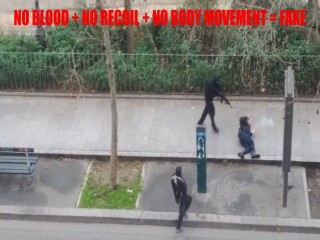
I am well aware that I’m stepping into a hornet’s nest by posting this video, which is going viral. Those who wish to silence all debate have an easy card to play here, accusing me of buying into a conspiracy theory. There’s only one problem: unlike the video-maker, I have few conclusions to draw about what the significance of this video is in relation to the official story. That is not why I am posting it.

But it does, at least to my mind and obviously a lot of other people’s, judging by how quickly it’s spreading, suggest that Ahmed Merabet, the policeman outside the Charlie Hebdo office, was not shot in the head, as all the media have been stating.

That said, it does not prove much more. It doesn’t prove that Merabet did not die at the scene. Maybe he bled to death there on the pavement from his earlier wound. It certainly doesn’t prove that the Kouachi brothers were not the gunmen or that the one who fired missed on purpose. Maybe he just missed.

Nor does the video’s removal from most websites prove that there is some sort of massive cover-up going on. Ideas of good taste, especially in the immediate aftermath of a massacre close to home (ie here in the West), can lead to a media consensus that a video is too upsetting. That can occur even if it does not show blood and gore, simply because of what it implies. Herd instinct in these instances is very strong.

But the unedited video clip does leave a sour taste: because unless someone has a good rebuttal, it does indeed seem impossible that an AK-47 bullet fired from close range would not have done something pretty dramatic to that policeman’s head. And if the video is real – and there doesn’t seem much doubt that it is – it clearly shows nothing significant happened to his head either as or after the bullet was fired.

So what points am I making?

The first one is more tentative. It seems – though I suppose there could be an explanation I have overlooked – that the authorities have lied about the cause of the policeman’s death. That could be for several probably unknowable reasons, including that his being executed was a simpler, neater story than that he bled to death on the pavement because of official incompetence (there already seems to have been plenty of that in this case).

The second point is even more troubling. Most of the senior editors of our mainstream media have watched the unedited video just as you now have. And either not one of them saw the problem raised here – that the video does not show what it is supposed to show – or some of them did see it but did not care. Either way, they simply regurgitated an official story that does not seem to fit the available evidence.

That is a cause for deep concern. Because if the media are acting as a collective mouth-piece for a dubious official narrative on this occasion, on a story of huge significance that one assumes is being carefully scrutinised for news angles, what are they doing the rest of the time?

The lesson is that we as news consumers must create our own critical distance from the “news” because we cannot trust our corporate media to do that work for us. They are far too close to power. In fact, they are power.

Official narratives are inherently suspect because power always looks out for itself. This appears to be a good example – whether what it shows is relatively harmless or sinister – to remind us of that fact.

UPDATE:

I’m still trying to imagine a plausible explanation for the video. I’m no ballistics expert, so I’m firmly in the land of conjecture. But I wonder whether, if the bullet hit the pavement close to Merabet’s head, it might have been possible for bullet fragments to hit him, possibly killing him.

This possibility (assuming it is one) does not invalidate the point of my post. If it was indeed the case, certainly no media outlet has suggested that the gunman missed Merabet and that he died from the exploding fragments.

This isn’t meant to raise technical, or gruesome, details of the case. It is to suggest that western journalists do not report fearlessly and independently when they examine events being narrated by official sources. They mostly regurgitate information on trust, because they trust the authorities to be telling the truth. They do the same when the acts of official enemies are being examined – they again turn to official sources on their side. In short, most journalists have no critical distance from the events they are reporting on our behalf.

That leaves us, ordinary news consumers, in a position of either blindly trusting our own officials too or trying to work things out for ourselves. You would hope that the issues raised by this video get aired by journalists as part of establishing greater trust in our profession and proof of our independence. Instead, I expect it will simply be consigned the “conspiracy theory” bin.


The Dark Soul of American Empire

aa-American-Empire-try-and-stop-us2-300x225

By Mark Weiser

Source: Dissident Voice

Whether or not the soul exists may depend entirely on how it’s being defined, and depending on the definition may also depend on faith, religious or otherwise. The human soul is thought by many as inherently good while the absence of a soul leaves open the possibility to commit and even delight in malicious or evil acts – these destructive actions are also interpreted in terms of being dark. Oddly enough, man’s ego enjoys taking credit for his goodness, while he regularly attributes responsibility for destructive behaviors to outside influences, including at times a supernatural consciousness of evil that influences or provokes harmful human behaviors and thereby takes the soul, either in part or in whole.

Good or evil in any combination can manifest entirely from within any individual for what sometimes are no humanly discernible reasons. At other times the soul is absolutely being influenced by outside forces, including human and the forces of nature. Our definition would not be complete without recognizing that works committed during the physical life, whether good or evil, live on after physical death by affecting those who’ll be living in the future. Even the obscure and long forgotten dead can have a profound impact on our current reality if they ultimately influenced the mind, or perhaps saved the life of someone who was or became influential at some point in history.

We begin life with a non-negotiable soul thought by some to be a blank slate at birth, but I’ll argue here that it’s not blank and certain predispositions are dictated by instincts and genetic code(s) which also affect the workings of the mind. There are studies indicating genetic makeup is a factor in experiencing empathy and compassion, and we can’t deny other differing intellectual abilities and inclinations along with given physical characteristics – all of which shape the soul through our experiences. Theoretically the natural soul uninfluenced by outside forces, could range from pure good to pure evil with most people having the potential for either, at times depending on present circumstances or what they’ve been subjected to. Due to diversity of attributes and handicaps we are all unique, but we can generalize regarding those with similar traits and beliefs which dictate the processes of reasoning and/or irrational thinking that ultimately leads to conclusions and the actions or inactions of any individual.

Because the soul is shaped by events in life, we can define it as: the sum total of all a person is given before birth, combined with the understanding acquired from personal experiences in life, while recognizing a person’s interactions with others and the physical world are determined by the soul or its absence, and will yield benevolent, malevolent or neutral actions – the human soul is alive and real, it affects our actions and interactions with others and how we feel about ourselves as well as others, including the world and life in general – and by affecting others in the immediate sense, it also affects others well into the future.

Our physical bodies and brains are the conduit between the soul and the physical world, with the emphasis being on the brain which controls the willful actions of our bodies. Whether committed or imposed by humans or nature, actions can profoundly shape and mold human souls in either direction. Because our perceptions may not be accurate, at times certain events can fill us with an unjust hatred or even the desire to commit physical violence. Because we’re all different, the same events or circumstances will not have the same impact on the souls of all people, but people do have similar and sometimes nearly universal reactions that are predictable concerning certain events or circumstances.

With no other choice, and given the opportunity, a starving person will likely commit theft and may kill to survive; relatively few would accept starvation without trying to impose on others in some way. An individual with a legitimate means of support certainly has no need, and is much less likely to resort to theft or violence for personal gain. If rising flood waters force a person to abandon their home, their soul may be imprinted with sadness as well as the realization of a destiny beyond their control. Depending on age and other circumstances such an event could be the final straw, leading to a level of despair and shock where the person no longer experiences life in the same way and no longer functions as well as they once did; though this may be defined as weakness, it’s also a sure sign the person is human, as we all have different breaking-points and tolerances. Being subjected to the same ordeal could cause profound personal growth in others, making them stronger with greater understanding and compassion going forward while giving them the real potential for helping or leading others. The essence of the soul does change over time through circumstance and experience and ultimately leads us to our understanding of life and people, and could lead to a complete lack thereof.

When speaking of souls, our understanding includes that groups of people, large and small, have a collective soul based on the same factors that make up the soul of an individual. As with catastrophes caused by nature, the ravages of war are certain to leave an imprint on the soul of emotionally conscious human beings. These imprints take on a different dimension entirely when innocent people are unjustly attacked through wanton aggression. As the most violent people on earth, Americans may have become jaded from all the violence witnessed through television entertainment and news, starting with cartoons at an early age. We’re so used to accepting violence as being justifiable, the idea of our government killing and destroying the lives of innocent others may not register with most of us – in matters of war we’re incessantly told America is always right. All of this brings into question how the collective soul of a relatively few individuals who, as a group, knowingly and unjustly deceived their own country, leading to a wholesale basis of callous, if not gleeful slaughter and mutilation of innocent and weaker members of the human race – including the annihilation of their existing culture – all without any just or legal provocation.

In the case of America attacking a weaker country we’ll look at one of the most egregious events in recent history. Destruction was unleashed by the overwhelming power of the US military in attacking a comparatively defenseless 2003 Iraq. The verdict is in, and we know there were relatively very few Americans who participated in the deceitfulness which ultimately fueled the country’s appetite for attacking without one valid or legal reason – but collectively we still made the conscious choice to destroy, displace, kill and maim while leaving emotional scars and hatred in the large majority of our victims who survived. After having committed wanton aggression, with our own blind ignorance we don’t dare ask ourselves why so many in the Mideast and around the world despise our collective soul – as the truth would be awkward and hard for many to accept or explain. For “civilized people” this post-invasion nonchalant arrogance is every bit as astounding as that which led the initial attack. To be clear, the US invasion of 2003 Iraq was never a true contest of “war”, the word “war” was used as propaganda to make wanton killing and the destruction of people and their civilization look like something other than what it was – all for the perceived benefits of those few who were ultimately responsible for misleading America to back the slaughter of Iraqi citizens among a multitude of other predicted catastrophic results. The carnage we unleashed continues to this day and will effect an untold number for generations to come – it can never be undone – as the depraved collective soul of the few asserted itself supreme over the collective American public’s right to the truth and leaves a forward cutting wake that will forever travel on into the future – at least as long as man is alive.

The influence of Israel and pro-Zionists in Washington D.C. concerning American Mideast policies cannot be overstated. In 2002 the Bush administration created the Office of Special Plans (OSP) run by neocon pro-Zionists who fed the Bush administration “raw intelligence” which proved to be nothing more than propaganda for enabling the attack on Iraq. Lieutenant Colonel Karen Kwiatkowski in the office of the Undersecretary of Defense for Policy at the time, explained how the OSP usurped real expert intelligence assessments to promote the neocon Zionist agenda as stated in the infamous 1996 PNAC policy report. The PNAC policy first advocated removing Saddam Hussein from power, then going on to Syria and Iran which they’re still trying to accomplish – this is no mere coincidence. It’s all part of Israel’s strategy to eliminate any perceived threat in the Mideast and keep everyone around them weak and fighting amongst themselves. Ironically, Israel’s threats result from its own actions beginning with the ethnic cleansing of Palestinian Arabs starting before Israel’s self-declared statehood on those Palestinian lands in 1948 – and the expulsion still continues to this day. Without the undue influence of Israel on U.S. politicians, it is extremely unlikely U.S. public support for the 2003 invasion of Iraq would have materialized. Because the dark soul of America is so influenced by Israel, taking a critical look at the soul of Israel is becoming common and it needs to be recognized for what it is.

The major “news networks” and press operating in the U.S. proved themselves as propagandists, partaking in the policy set by the Bush administration to manipulate the American public during the run-up to the invasion. So persuasive was the propaganda before and after the invasion that some people today still don’t know Iraq had no part in the 9/11/2001 attack on the U.S.; or they simply refuse to accept that our government and mass media would betray America and the world on such a large scale. As far as the press is concerned, they are guilty through aiding and abetting the crime of misleading America into an illegal war – and it was illegal as defined by U.S. and international law. The media people who took part in all of this on any level might as well have lined up all those American soldiers sacrificed and wounded along with all the Iraqi’s killed and maimed while having had the balls to pull the triggers, drop the bombs and fire the missiles to commit the slaughter and devastation themselves.

It’s no secret, huge profits were made by the military-industrial complex (MIC) with the 2003 attack, and they’re still profiting today from Iraq and the overall American Empire strategy. With their connections in Washington, it would be extremely naïve to believe the top individuals in our weapons manufacturing industries didn’t know the reasons given for attacking Iraq were absolutely without credible evidence – while much of those reasons were outright lies. There are a number of choice verbs for describing the condition of those souls among the MIC who knowingly remained silent while the US population sacrificed blood and treasure so they could profit through death and destruction unleashed at will on a relatively hapless Iraq.

Many believe the 2003 invasion was predominantly about securing oil, and it certainly was a contributing factor but no one was pushing more than the pro-Zionist crowd. The petroleum industry had been involved in the pre-war planning for the purpose of dividing the spoils of killing and destruction in terms of barrels of oil. Capitalism as practiced needs oil, and although there are alternative energies available, those making huge profits from oil use their considerable influence to thwart conversion to clean energy.

There’s no legitimate argument against the facts; an undeserved and catastrophic devastation had been levied on the Iraqi people with the 2003 U.S. invasion, conservatively resulting in over half a million Iraqi lives being lost by the time of this writing, with likely millions wounded, and over four million displaced from their homes. To put it in perspective, if it happened to the U.S. with the same percentages across the entire population it would conservatively yield over six million dead, millions more wounded, and roughly fifty million displaced from their homes. Many Americans have a vacancy where a soul should exist as they feel absolutely nothing and no American responsibility for the devastation caused. Other Americans exist with a soul as black as pitch having taken pleasure and profit through the slaughter of Iraqis and their culture. Aside from the U.S. government’s responsibility, these attitudes are largely due to the dark soul of both the U.S. government and media in keeping pertinent facts from the public eye. And if there’s been any remorse or apology from U.S. officials or media it’s been sparse and kept out of sight by the same dark forces which hide from the truth. There are a number of people who could have spoken out before the invasion, and in all fairness some did, though they did not get proportionately heard while the front pages and television news had been reserved for the neocon pro-Zionist mantras to attack Iraq and downplay the ensuing consequences. There were also a few dark traitorous souls operating to dissuade anyone who would speak out while they set an example with the Valery Plame / Scooter Libby affair.

With the invasion of Iraq the U.S. set a new precedent of destructive behavior in motion, which under the pretext of “preemptive defense” has been spread further around the Mideast and now is a matter of historical record and modus operandi. With the U.S. government wreaking havoc at will, killing more innocent civilians than “enemy combatants” – it’s become a very neat and logical self-perpetuating industry of war – creating enemies by killing innocent civilians and thereby creating more revenge-minded combatants to kill – perfect for a world being run by a country of sadistic self-masochistic psychopaths for profit at the expense of the American public and anyone else they choose to victimize. This is not the collective soul of the American people – they have been unwittingly led into the dark by the collective soul of vile depravity. This is, however, a reflection of all those dark souls and their accomplices living in fear of truth and hiding behind the concentrated power at the top of the American political body which now exists predominantly for the sake of personal greed while having unlimited power to unjustly impose on others, domestically and otherwise. It is unfortunate those making the decisions and profits while misleading the country aren’t required to put their own lives, and those that matter to them, on the very front lines; they, being afraid of truth and reality as they are, would be the very first to call an end to the madness.

Education and the “Progressive” Corporate State

anti_public_education_propaganda_by_8manderz8-d5xz1cj

By Kevin Carson

Source: Center for a Stateless Society

Speaking in Knoxville, Tennessee on January 9 US president Barack Obama unveiled an initiative to provide two years of community college tuition-free, nationwide, to anyone meeting attendance and grade requirements. The idea, inspired by a similar program in Tennessee, aims to make two years of college as universal as high school is now. Obama’s proposal is in keeping, in more ways than one, with traditions going back to the origins of the American corporate state 150 years ago.

Since the mid-19th century, a few hundred large industrial corporations and banks have dominated the American economy. And the American state, functionally, has been closely intertwined with the interests of those corporations. One of its functions is to subsidize the corporate bottom line and artificially prop up the rate of profit by socializing provision of a growing share of inputs — among them the cost of reproducing and training human labor power.

The first statewide public school systems were introduced in New England to meet mill owners’ need for a workforce that was docile, obedient and educated to minimal standards; a function supplemented by education in “100% Americanism” at the turn of the 20th century, and a home economics curriculum in the ’20s and ’30s aimed at processing students into good mass consumers.

As recounted by New Left historian David Noble in America by Design, federal government aid to land grant colleges coincided with the national railroad and industrial corporations’ growing need for trained mechanical and industrial engineers. This trajectory carries through the GI Bill and to Obama’s latest proposal.

These institutional developments were accompanied by the rise of a meritocratic legitimizing ideology which replaced earlier American notions of equality and autonomy. Rather than genuine equality based on widespread economic empowerment and self-employment, the new meritocratic ideology treated step hierarchies of wealth, skill and managerial authority as both normal and necessary, but relied on the ideal of universal education to justify the ideology as “democratic.” With the widespread availability of secondary, higher and technical education, the theory goes, the individual’s rise in the managerial-technical hierarchy is limited only by their own willingness to learn and work. This peculiar American religion combines the existence of deep structural inequalities in wealth and power with the moralistic assumption that everyone gets exactly what they deserve.

The official White House happy talk, predictably, takes the corporate state’s assumptions for granted: “In our growing global economy, Americans need to have more knowledge and more skills to compete — by 2020, an estimated 35 percent of job openings will require at least a bachelor’s degree, and 30 percent will require some college or an associate’s degree.” That it’s the place of the “growing global economy” and the corporate HR departments in it to set the “required” qualifications for labor, and the place of the state’s education system to process people to those standards, goes without saying.

Never mind that globalization, concentration of economic power in the hands of a few giant, capital-intensive corporations, and a wage system that separates labor from both ownership and control of work, are none of them natural or inevitable processes. They all result from the deliberate policies of a state in league with capital.

The real irony is that the system of power Obama’s proposal is designed to serve is doomed to extinction. The revolution in cheap small-scale machine tools means an end to the material rationale for the wage system, and to corporate control of production. Coupled with the rise of open-source or pirated textbooks, free online lectures and syllabi and DIY learning networks, it also means an end to control over access to employment by the unholy alliance of big universities and human resources departments. In an economy where a few months’ wages can purchase a garage factory full of open-source tools and the economy is dominated by commons-based peer production and craft production in self-managed shops, credentialing will be largely stackable and ad hoc, negotiated informally to suit the needs of the groups of people working together.

The days of the educational Cult of Moloch and its human sacrifices are numbered.

Related post: Schools are Becoming Privatized Prisons


The Curtain Rises on Another Act in the Continual Global War on Terror Play

hebdo-shooters

By Wayne Madsen

Source: Strategic Culture Foundation

The attacks in Paris on the editorial offices of the weekly satirical journal Charlie Hebdo and a kosher supermarket have, once again, conveniently turned the attention of the world away from the economic turmoil in the European Union and the extreme unpopularity of its major leaders to the seemingly never-ending «global war on terror».

French President Francois Hollande announced that on January 11, he would march in solidarity on the streets of Paris along with German Chancellor Angela Merkel, British Prime Minister David Cameron, Italian Prime Minister Matteo Renzi, Spanish Prime Minister Mariano Rajoy, Belgian Prime Minister Charles Michel, Ukrainian President Pyotr Poroshenko, Irish Prime Minister Enda Kenny, and the ISIL-enabling Turkish Prime Minister, Ahmet Davitoglu. All of these leaders, facing huge popularity problems at home, were able to use the terrorist attacks in Paris to bolster their own flagging electoral profiles. In addition to the unpopular leaders, NATO Secretary General Jens Stoltenberg, European Council President Donald Tusk, and European Commission chief Jean-Claude Juncker were also scheduled to march in Paris in the grandiose «photo op» to help honor a magazine staff that often lampooned many of these leaders with cartoons that were almost always of a sexual nature.

Once again, the alleged perpetrators of the recent attacks, Franco-Algerian brothers Said and Cherif Kouachi, who were said to have murdered 12 people, including the editor-in-chief of Charlie Hebdo, and Franco-Senegalese Amedy Coulibaly, said to have killed hostages at the supermarket, were well-known to the French police and intelligence services. It was claimed by one of the supermarket customers that Coulibaly said proclaimed that he was from Mali and that he supported ISIL and Palestine. The Kouachis’ names were even included on the American «no-fly list».

The fact that the Kouachis had been involved in recruiting and training jihadist volunteers to fight for the Islamic State of Iraq and the Levant (ISIL) in Syria and had earlier been involved in recruitment efforts for jihadist armies in Iraq and Yemen should have placed a surveillance net over the two brothers. But, as in a previous case in France involving an alleged jihadist terrorist who allegedly killed people at random, the Kouachi brothers, as well as Coulibaly, who was also well-known to the police, were permitted to obtain weapons and other materials without tipping off law enforcement. Coulibaly actually met with French President Nicolas Sarkozy in 2009. Coulibaly worked at a Coca Cola plant in the poor «banlieue» of Grigny, outside of Paris. Coulibaly was one of ten workers selected to meet personally with Sarkozy at the Elysee Palace to discuss youth employment issues. As with the U.S. Secret Service and the American president, French security thoroughly vets those who meet with the French head of state, which makes Coulibaly’s selection to meet Sarkozy even more perplexing. «Le Parisien» quoted Coulibaly as being excited over his meeting with Sarkozy and hoped the French president might help him find him a good job. Coulibaly is said to have first met Cherif Kouachi in 2010. However, Coulibaly supposedly converted to radical Islam while serving time in prison in 2005 for armed robbery. It was in prison that Coulibaly became an adherent of Djamel Beghal, said to be a Franco-Algerian member of Al Qaeda who, in 2001, tried to blow up the U.S. embassy in Paris. Out of all the unemployed and under-employed youth in France, the French president’s security team decided to vet a known follower of an Al Qaeda member to enter the Elysee Palace to meet with Sarkozy. As the French say, «incroyable!»

Pre-attack knowledge by the authorities of an alleged perpetrator was certainly the case in the Merah affair in March 2012 when Mohammed Merah, a French national, was killed by French police. Merah was accused of killing three French paratroopers in Montauban and three students and a teacher at a Jewish school in Toulouse. It was later discovered that not only did the French Central Directorate of Internal Intelligence (DCRI) maintain a thick dossier on Merah, but that French intelligence tried to recruit him as an agent. Merah traveled with ease to Afghanistan and Pakistan with the foreknowledge of French intelligence. The then-governing conservatives of President Nicolas Sarkozy and the opposition, now ruling, Socialist Party conspired to cover up Merah’s links to French intelligence.

The Kouachi brothers are said to have returned from Syria this past summer, where the CIA and French intelligence have been backing Islamist guerrilla groups battling the government of President Bashar al-Assad. The similarities of the Kouachis and Coulibaly to Merah are amazing. All were known to French intelligence before they allegedly carried out their terrorist attacks and all had connections with Al Qaeda groups and affiliates.

Ever since the 1980 time-bombing of the Bologna train station that killed 85 and injured over 200, Western European «false flag» operations have become fairly standardized «boiler plate» operations. This was certainly the case with the three-man professional military assault carried out in a precision manner by the alleged Islamist terrorists on the Paris editorial offices of the satirical journal Charlie Hebdo. Although the two Kouachi brothers, killed by police at a warehouse north of Paris, are said to have carried out the attacks on the newspaper, there is still no explanation of what happened to the third gunman. A third suspect in that attack, a brother-in-law of the Kouachis named Mourad Hamyd, voluntarily turned himself in to the police after he heard his name broadcast by the media. However, Hamyd, 18, was in school at the time of the attack on Charlie Hebdo.

The attack on the Bologna train station began the age of modern false flag attacks. Although in 1980 the Italian government and media originally blamed the bombing on leftist radical Italian guerrillas, it was, in fact, carried out by an underground fascist cell that obtained the bomb materials from hidden caches belonging to the secret NATO «stay behind» paramilitary network known as «Gladio».

Gladio was intended to mobilize guerrilla forces to fight the Soviets in the event of a ground war in Europe. Weapons and materials were hidden underground and in caves throughout Western Europe for future guerrilla assaults on occupying Soviet troops. However, Italian rightists and Zionists attempted to use the discredited Mitrokhin Dossier, allegedly obtained from KGB files, to pin the blame for the Bologna attack on the Soviets acting in concert with radical Arabs, including Palestinian groups. It was later discovered that it was the CIA that funded such news stories in a psychological warfare operation against the Soviets and the Arab countries. From his Paris jail cell in 2005, Ilich Ramirez Sanchez, the famed terrorist known as «Carlos,» revealed that it was the CIA and Mossad that carried out the Bologna bombing and that the Mitrokhin Dossier was being used to «falsify history». Other independent accounts have proven Carlos’s allegation.

Ever since Bologna, the tell-tale signs of Western intelligence false flag operations are extremely evident in attack after attack. By sticking to the same doctrine for over 40 years, Western intelligence fingerprints are becoming as clear as day.

One such tell-tale sign of a false flag operation is the convenient discovery by police of evidence linking attacks to the perpetrators, be they unknowing double agents or patsies who believe in whatever cause has been dangled before them.

One sign of a false flag operation is that «evidence» linking the intended perpetrators to the crime scene is always discovered. French police claim they were able to pin the attack on Kouachis, because Said, the eldest brother, left his French identification card in a black Citroen used as a getaway car. Police would not say whose identification card they found. Some French security experts warned that the ID card may have been purposely planted in the car to confuse the police. Police also conveniently found Molotov cocktails and Islamist jihadist flags inside the getaway car. Alleged 9/11 hijacker Mohammed Atta’s passport was supposedly found in pristine condition in the rubble of the World Trade Center.

Often, the true perpetrators of false flag attacks are masked. This was the case with the three reported gunmen who killed the Charlie Hebdo staff.

There are always other attacks in the region to confuse police. For example, while French police were concentrating their search for the gunmen from northern Paris to the Belgian border, a French police woman was shot and killed in Montrouge, south of Paris. French authorities were quick to say the events south of Paris and at Charlie Hebdo were not linked. Later, it was announced that the two events were linked. Some witnesses at the warehouse and at the newspaper office were convinced that the masked men who turned out to be terrorists were actually counter-terrorism special troops. One man at the warehouse who escaped injury said he shook hands with one of the masked terrorists who he believed was a special policeman. At the same time French police launched their hostage-freeing operations at the warehouse and kosher supermarket, a hostage situation at a jewelry store in Montpellier, in the south of France, was being reported. Police soon said that situation was not connected to the events in the Paris region. Nevertheless, the Montpellier situation conveniently added to the fear factor.

The events in France have given a boost to anti-Islam immigration movements throughout Europe, from the PEGIDA movement and Alternative for Germany (AFD) party in Germany, to the National Front in France, and the UK Independence Party in Britain. Coming so soon after France’s UN Security Council vote to recognize Palestine as a state and the rising political fortunes of the pro-Israel National Front, a «price tag» attack on France, masked as a jihadist terrorist operation, cannot be ruled out.


Related Articles:

Paris Shooting Suspects Under French Radar for YEARS

Who Ordered the Attacks Against Charlie Hedbo?