Notes Toward a Future of Activism

anonymous_telecomix_2012_5_31

By Micah White

Source: Reconstruction 10.3

<1> Contemporary activism begins from the realization that for the first time in history, a synergy of catastrophes face us. Our physical environment is dying, our financial markets are collapsing and our culture, fed on a diet of junk thought, is atrophying — unable to muster the intellectual courage to face our predicament. While some may caution against immediate action by pointing out that societies often predict perils that never come, what is remarkable about our times is that the apocalypse has already happened.

<2> When we compare the anxiety of our age to that of the Cold War era, we see that what differentiates the two periods is where the threat is temporally located. During the Cold War, the threat of nuclear destruction was always imagined to be in the future. What terrorized the Cold War generation was the thought of life after a nuclear holocaust. Anxiety was therefore centered on what life would be like “the day after” the future event, which was symbolized by the blinding light of a mushroom cloud on the horizon. Thus the post-apocalyptic narrative was deployed in a series of nuclear holocaust science-fiction stories either to mobilize fear in the name of anti-nuke peace — the exemplar of this tactic being the horrifying and scientifically realistic 1984 BBC docudrama Threads in which civilization collapses into barbarism — or, like Pat Frank’s 1959 novel Alas, Babylon, convince a wary public that winning and happily surviving nuclear war is possible, given resourcefulness, discipline and patriotism.

<3> But for those of us alive today, the catastrophic event is not located in the future. There is no “post”-apocalyptic per se because we are already living in the apocalyptic. And although we can anticipate that life is going to get starker, darker and hellish, the essential feature of our times remains that we do not fear the future as much as we fear the present. We can notice this temporal shift in the work of James Lovelock, whose Gaia Hypothesis is gaining traction inside and outside of the scientific community. According to Lovelock’s latest book, The Vanishing Face of Gaia: A Final Warning, even if we were to immediately cease all C02 emissions, sudden and drastic climate change will still occur. In fact, Lovelock argues that a drastic decrease in emissions would trigger climate catastrophe immediately whereas continuing emissions will trigger climate catastrophe eventually and unpredictably. This realization — that the line into a post-climate-change world has already been crossed — fundamentally changes the temporal and spatial assumptions underpinning activist struggles. And the first aspect of activism that must be rethought is our notion of temporality.

<4> The typical activist project is inscribed within the horizon of a modern conception of temporality. The modernist activist acts as if we occupy a present moment that is a discrete point on the linear progression between a mythical, ancient past and an either utopian or dystopian future. But if we accept this model, then the goal of the activist can only be to change the future by preventing the dystopian possibility from being realized. This involves pushing for changes in laws and behaviors in the present that will impact our predictions of how the future will be. But activism based on this temporal model — which as John Foster points out in The Sustainability Mirage: Illusion and Reality in the Coming War on Climate Change underpins “green capitalism” and “sustainable development” — inevitably fails. For one, unable to accurately predict the future, we constantly play the game of basing our actions on rosy predictions while the future grows increasingly gloomier. Another problem with relying on linear temporality is the assumption that time moves in only one direction. Without the freedom to imagine going backwards, we are left the task of steering the runaway train of industrialization without hope of turning around.

<5> Of course, linear time is not the only way to understand temporality and some models can have even worse political consequences. Take for example, the notion that time is cyclical. For the Roman Stoics, time was marked by a series of conflagrations in which the world was razed and a new one formed only to be razed again. In times of adversity when resistance seems impossible, such as the build-up to World War 2, a watered down version of cyclical temporality sometimes enters the cultural consciousness. It infected Nazis who cheered total war and anti-Nazis who used the spurious argument that only by a catastrophic Nazi triumph would a communist state be realized because only then would the people rise up. A similar line of thought was pursued by Martin Heidegger in a letter to Ernst Jünger in which he wondered if the only way to “cross the line” into a new world is to bring the present world to its awful culmination. Unlike the linear conception of time that calls the activist to act in order to realize an alternate future, the cyclical conception is often leveraged to justify inaction or worse, action contrary to one’s ideals.

<6> To escape the problems of linear time and cyclical time, activism must rely on a new temporality. Perhaps the best articulation of this new activist temporality is in the work of Slavoj Žižek. In his most recent book, First as Tragedy, Then as Farce, Žižek blames the failure of contemporary activism on our assumption that time is a one-way line from past to future. He argues that activism is failing to avert the coming catastrophe because it is premised on the same notions of linear time that underpin industrial society. According to Žižek, therefore, a regeneration of activism must begin with a change in temporality. Paraphrasing Jean-Pierre Dupuy, Žižek writes, “if we are to confront adequately the threat of (social or environmental) catastrophe, we need to break out of this ‘historical’ notion of temporality: we have to introduce a new notion of time.” This new notion of time is a shift of perspective from historical progress to that of the timelessness of a revolutionary moment.

<7> The role of the activist should not be to push history in the right direction but instead to disrupt it altogether. Žižek writes, “this is what a proper political act would be today: not so much to unleash a new movement, as to interrupt the present predominant movement. An act of ‘divine violence’ would then mean pulling the emergency cord on the train of Historical Progress.” To accomplish this act of revolutionary violence involves a switch of perspective from the present-looking-forward to the future-looking-backward. Instead of trying to influence the future by acting in the present, Žižek argues that we should start from the assumption that the dread catastrophic event — whether it be sudden climate catastrophe, a “grey goo” nano-crisis or widespread adoption of cyborg technologies — has already happened, and then work backwards to figure out what we should have done. “We have to accept that, at the level of possibilities, our future is doomed, that the catastrophe will take place, that it is our destiny — and then, against the background of this acceptance, mobilize ourselves to perform the act which will change destiny itself and thereby insert a new possibility into the past.” In other words, only by assuming that the feared event has already happened, can we imagine what actions would need to have been taken to prevent its occurrence. These steps would then be actualized by the present day activist. “Paradoxically,” he concludes, “the only way to prevent the disaster is to accept it as inevitable.”

<8> Žižek is right to suggest that activism is at a crossroads; any honest activist will admit that lately our signature moves have failed to arouse more than a tepid response. The fact is that our present is being swallowed by the future we dreaded — the dystopian sci-fi nightmare of enforced consumerism and planet-wide degradation is, day-by-day, our new reality. And thus, activism faces a dilemma: how to walk the line between false hope and pessimistic resignation. It is no longer tenable to hold the nostalgic belief that educating the population, recycling and composting our waste and advocating for “green capitalism” will snatch us from the brink. Likewise, it is difficult to muster the courage to act when the apocalyptic collapse of civilization seems unavoidable, imminent and, in our misanthropic moments, potentially desirable. Žižek’s shift in temporality offers us a way to balance the paralyzing realization that our demise is inevitable with the motivating belief that we can change our destiny. By accepting that as the world is now we are doomed, we free ourselves to break from normalcy and act with the revolutionary fervor needed to achieve the impossible.

<9> The question for would-be activists is therefore not, “how does one engage in meaningful activism when the future is so bleak?” but instead “how does one engage in revolutionary activism when the present is so dark?”

<10> Corresponding to the necessary temporality shift is a spatial change in activism. The future of activism will be the transformation of strictly materialist struggles over the physical environment into cultural struggles over the mental environment. Green environmentalism, red communism and black anarchism will merge into blue mental environmentalism — activism to save our mental environment will eclipse activism to reclaim our physical environment. A key opening to this new form of politics appeared in 1989 with the founding of Adbusters, the internationally distributed anti-consumerism magazine whose subtitle is The Journal of the Mental Environment.

<11> Adbusters is a Situationist inspired offspring of the environmentalism movement. At the time of its formation, there was an active anti-logging movement in British Columbia, Canada. And responding to sagging public support for cutting down old growth trees, the logging industry introduced the “Forests Forever” advertising campaign. As the name suggestions, this campaign argued that the logging industry was not cutting down forests as much as they were protecting forests. It was the kind of disingenuous advertising ploy known as “greenwashing”– a term that, it is worth noting, originated in that same year. Disgusted by what he saw, Kalle Lasn, who was an experimental filmmaker at the time, created a short claymation anti-ad in which an old-growth tree explains to a sapling that a ancient forests are being replaced by tree farms. His intention was to air the anti-ad on the same television stations that the logging industry had used.

<12> When Lasn tried to buy airtime for his anti-ad on the same television station that aired the Forests Forever advertisements, he was refused. That was the founding event of Adbusters: the realization that while corporations can lie to us via the airwaves, we are unable to respond using the same means. But the message of Adbusters goes beyond concerns over the veracity of the information we receive — and here we would do well to follow Jacques Ellul who spoke of the difficulty in distinguishing between information and propaganda. Instead, it is a matter of how the advertisements we see populate our minds with a picture of reality. This picture of reality, our worldview, colors everything we perceive. Thus, the mental environmentalist movement is concerned with the pollution of our minds.

<13> While some may wish to frame this transition in terms of a new development, I think it is just as accurate to view it as an old phenomenon. Hundreds of years ago, for example, “pollution” had an exclusively unscientific, immaterial and spiritual meaning. In the 14th century to pollute meant to desecrate, defile, or contaminate what is sacred such as one’s soul or moral sensibility. Not until the late nineteenth-century did pollution take on the scientific and materialist connotation it has today. The unfortunate consequence is that with the changing meaning of the word pollution, we’ve become increasingly concerned about desecration of our external, natural environment while ignoring the defilement of our internal, mental environment. The future of activism is a return to the early meaning of pollution.

<14> Activism is entering a new era in which environmentalism will cease viewing our mental environment as secondary to our physical environment. No longer neglecting one in favor of the other, we will see a push on both fronts as the only possible way of changing either. This will involve a shift away from a materialist worldview that imagines there to be a one-way avenue between our interior reality and the external reality. Instead, recognition of the permeability of this barrier, an exploration of the mutually sustaining relationship between mindscape and landscape, will open, and reopen, new paths for politics.

<15> This movement toward an activism of the mental environment is based on an ontological argument that can be stated succinctly: our minds influence reality and reality influences our minds. Although simply stated, this proposition has profound implications because it challenges the West’s long standing Cartesian divisions between internal and external reality that serve to ignore the danger of mental toxins. Whereas traditional politics has assumed a static mind that can only be addressed in terms of its rational beliefs, blue activism believes in changing external reality by addressing the health of our internal environment. This comes from an understanding that our mental environment influences which beings manifest, and which possibilities actualize, in our physical reality.

<16> At first it may seem like a strange argument. But the imaginary has been a part of environmentalism since the beginning. Most people trace the lineage of the modern environmentalist movement back to Rachel Carson’s 1961 Silent Spring. Carson’s book argued that the accumulation of toxic chemicals in our environment could work its way up the food chain, causing a widespread die- off. It may not have been the first time the bioaccumulation argument had been made, but it was the first time that it resonated with people. Suddenly, a movement of committed activists and everyday citizens rallied under the environmentalism flag.

<17> Looking back on Carson’s book from the perspective of mental environmentalism, it is significant that it begins, not with hard science as we may expect because Carson was a trained scientist, but with fantasy. The first chapter, entitled “A Fable for Tomorrow,” reads like a fairy tale: “There once was a town in the heart of America where all life seemed to live in harmony with its surroundings.” She then goes on to describe an idyllic, pastoral community known for its abundant agriculture and wild biodiversity. She writes of foxes and deer; laurel, virburnum and alder; wild birds and trout. However, the beauty of the place is not permanent – an evil, invisible malady spreads across the land. Birds die, plants wilt and nature grows silent. The suggestion is that the land has been cursed; if this were a different story perhaps the farmers would have prayed, offered sacrifices to the gods or asked their ancestors for help. Instead, Carson shifts the blame away from transcendental forces and back to the materialist domain of man. “No witchcraft, no enemy action had silenced the rebirth of new life on this stricken world.” Carson concludes, “The people had done it to themselves.”

<18> Some literary critics have argued that the reason “Silent Spring” resonated with the larger public, sparking a movement of everyday people is largely due to this opening fable. They explain that Carson’s story takes Cold War era fears of radioactivity (an invisible, odorless killer) and redirect them into a new fear over environmental pollution that is, likewise, an invisible, odorless killer. This is a compelling interpretation that explains the rhetorical power of Carson’s story but it misses the larger point. Namely, that at its origin, environmentalism was grounded in a mythological story about a cursed land. Faced with a choice over whether to continue in this fantastical, narrative vein or enter the domain of scientific facts, environmentalism tried the latter. Environmentalism has thus become a scientific expedition largely regulated by Western scientists who tell us how many ppb of certain pollutants will be toxic and how many degrees hotter our earth can be before we are doomed. But here we see again the linear temporal model cropping up again which may explain the inability, according to James Lovelock, of the Intergovernmental Panel on Climate Change to predict the rising temperatures we have experienced. In light of the failures of the exclusively scientific approach, it is worth considering another option.

<19> What if Carson had written about how the disappearance of birds was accompanied by the appearance of flickering screens in every home? What if she had drawn a connection between the lack of biodiversity and the dearth of infodiversity? Or the decrease in plant life and the increase in advertised life? To do so would necessitate a new worldview: a blue worldview that acknowledges the interconnection between mental pollution and environmental degradation, spiritual desecration and real-world extinctions.

<20> Keeping one foot within the domain of imagination, environmentalism could speak not only of the disappearance of the wild birds due to physical pollutants but also their disappearance due to mental pollutants. We could wonder at the connection between a culture’s inability to name more than a handful of plants, and the lack of biodiversity in the surrounding nature. And instead of assuming that the lack of biodiversity in external reality caused our poor recognition skills, we would entertain the opposite possibility: that the fewer plants we recognize, the fewer plants will manifest.

<21> Blue activism begins with the realization that internal reality is connected to external reality and then wonders at the relation between pollution of internal reality and the desecration of external reality. The primary pollutant of our mental environment is corporate communication. It is no longer controversial to claim that advertisers stimulate false desires. Any parent knows that after their child watches the Saturday morning cartoons they will suddenly “need” new toys, new treats, new junk. But the effects of advertising go beyond, what the marketers call, “demand generation”. Advertising obliterates autopoesis, self-creation. It is an info-toxin that damages our imagination and our world picture, essential elements of our mental environment. Activists must work on the assumption that there is a connection between the level of pollution in our minds and the prevalence of pollution in our world. At the most basic level, this is because when our minds are polluted, and our imaginations stunted, we are unable to think of a different way of doing things. At a more complex level, it is because our mental environment dictates, to a certain extent, whether certain beings manifest in our physical environment. Naming calls beings into existence and when all the words we know are corporate-speak, the only beings that will manifesto are corporate- owned.

<22> To understand how the pollution of the mental environment can impact the manifestation of beings, consider the story of the Passenger Pigeon. In 1810 one of the great American ornithologists, Alexander Wilson, observed a flock of Passenger Pigeons so plentiful that it blacked out the sun for three days. On another occasion he documented a flock estimated to be two hundred and forty miles long and a mile wide and comprised of over a billion — 1,000,000,000 — birds. A century later, the last passenger pigeon died in the Cincinnati Zoological Garden on September 1, 1914. How do we explain this alarming extinction of the Passenger Pigeon?

<23> If we take a materialist activist position, then we will argue that their sudden demise is due to a combination of forces, all of which are located outside the psyche: overhunting combined with unenforced laws against killing the birds in their nesting places was exacerbated by the telegraph which was used to track the birds over hundreds of miles. The species death of the passenger pigeon is thus interpreted as a tragedy of specific technologies: guns, nets, laws and communication systems. Of course, this account is not wrong; it would be mistaken to argue that these technologies did not play a major factor in their extinction.

<24> But physical environmentalism boils down to conservationism. It is allopathic, only able to treat the symptom, the disappearance of the birds, without considering the root cause. By focusing our attention exclusively on material forces, we are confined to certain activist tactics: a spectrum from reformist gestures of calling for greater enforcement of environmental protection laws, courageous tree sits and militant ELF arsons. And while these actions are commendable, and with open acknowledgment that a diversity of tactics is necessary, the focus on a secular materialist politics is limiting our success. Under this model, Ted Turner is considered a philanthropic hero because he is the nation’s largest landowner and maintains the largest privately owned bison herd. What we do not need is a rich patron of endangered species, but instead a world without endangered species. That requires more than money, it necessitates a paradigm shift.

<25> The unexplainable extinction of the passenger pigeon is a symptom of the state of our mental environment. Species facing extinction can only be saved if we take their disappearance as a symptom and address the root cause of their disappearance. Because of an over-reliance on a secular, materialist conception of politics, scientists dictate the aims of activists. The irony is that our exclusive concern over the physical environment renders us unable to save it.

<26> The curious interplay between our imagination and external reality gives credence to the argument that the struggles over the mental environment are the future of activism. The future of activism begins with the realization that only with a clear mind, a clean mental environment, do we approach the possibility of a clean physical environment.

<27> Dispel immediately the notion that our mental environment is unique to each individual. Just as we share our natural environment, we also share our mental environment, which is crafted through the culture we consume – the television shows we watch, the websites we frequent and the symbols and concepts that comprise our thoughts. Thus, the mental environment is not something entirely within us but is instead something that is outside of our complete control and shared collectively.

<28> Activism of the mental environmentalism is not a politics of solipsism, or an attempt to dodge the imperative of direct action. Instead, developing a politics of anti-consumerism and anti-materialism, places the role of imagination back into the forefront. Denying corporations the right to dominate our mental environment is the most effective long-term strategy of insurrection in the twenty- first century because it directly influences the manifestation of our natural environment. By targeting the mental polluters, vandalizing billboards and blacking out advertisements, we do more than clean up urban blight — we clear a creative space for a revolutionary moment.

Occupy Activist Cecily McMillan Sentenced to 3 Months in Jail, 5 Years Probation

Cecily McMillan being arrested as the NYPD clears Zuccotti Park during a six-month memorial celebration of the Occupy Movement in March 2012

Cecily McMillan being arrested as the NYPD clears Zuccotti Park during a six-month memorial celebration of the Occupy Movement in March 2012

By Dave Lindorff

Source: This Can’t Be Happening

Occupy activist Cecily McMillan, convicted on May 5 of second-degree felony assault of a New York cop whom she and witnesses claimed had grabbed her breast from behind, bruising it, stood her ground before her sentence was rendered, refusing the judge’s insistence that she should “take responsibility for her conduct.”

Risking the possibility that Judge Ronald Zwiebel might sentence her to the maximum seven years for the charge she was convicted of, McMillan would only apologize for what she termed “the accident” of involuntarily throwing back her elbow when grabbed by behind from someone she could not even see. Insisting to the judge that she lived in accordance to the “law of love,” she said, in her pre-sentencing statement, “Violence is not permitted. This being the law that I live by, I can say with certainty that I am innocent of the crime I have been convicted of… I cannot confess to a crime that I did not commit. I cannot throw away my dignity in return for my freedom.”

It was a bold and risky stand for the 25-year-old New School for Social Research graduate student to take, given the high sentencing stakes. In the end, though, the judge, — who during the trial had blocked her defense from presenting key evidence that she had acted in her own defense against being groped by a cop (for example the police officer’s record of brutality and corruption), while allowing the prosecution to present evidence and statements normally not considered permissible in a trial (such as presenting to the jury evidence about an arrest of McMillan that had not yet been tried or adjudicated) — sentenced her to only a short term in jail.

She still has a five-year felony probationary sentence, which leaves her a convicted felon, a serious impediment to employment, and one that could leave her subject to limitations on her freedom of movement for five years.

McMillan’s many supporters nonetheless hailed the short sentence, which could see her released in as little as 60 days, as a victory, one which many attributed to the massive outpouring of support she has received since her arrest, during her trial, and since especially since her conviction. That support has included a jailhouse visit by two members of Pussy Riot, who condemned her conviction and jailing, a letter of of support from the president of the New School, support from five members of the New York City Council (but so far not a word from New York City’s supposedly leftist and former activist Mayor Bill De Blasio), an online petition signed by over 167,000 people, and an unusual letter from nine of the 12 jurors in her case calling on the judge not to sentence her to any jail time.

McMillan’s attorney Martin Stolar, said he was “relieved” that her sentence was not two years, but also said that he had appealed the conviction to the state’s Court of Appeal.

The 5/14 episode of the “This Can’t Be Happening” podcast featuring McMillan’s attorney Martin Stolar and Lucy Parks, a member of her support team at JusticeforCecily.com, who provide more background about the case.

http://s51.podbean.com/pb/731f8f8398fd122e92501fb18648dbdc/537ae434/data1/blogs18/661545/uploads/ThisCantBeHappening_051414.mp3

May Day

tumblr_mm4ek4kbR81rju234o1_500

May Day has a long history of being a culturally significant day for a number of reasons. In ancient Europe it was a time of Pagan festivities celebrating the first day of summer. It’s the day the Illuminati was founded by Adam Weishaupt in 1776 and happens to be the birthday of radical labor activist Mother Jones (in 1830) and mystical Christian theorist Pierre Teilhard de Chardin (in 1881). May Day continues to be celebrated around the world as a day of struggle for worker’s rights. More facts about the importance of May Day to Labor history and our current situation are presented in the following article:

What’s Left of May Day?

By Nathan Schneider

Source: Al Jazeera

On May 1, 1933, the Catholic journalist and activist Dorothy Day went to New York’s Union Square to distribute copies of the first issue of her newspaper The Catholic Worker. As she made her way through the crowd, she had a ready audience of thousands: men in coats, ties, and hats — as low-wage workers and radicals apparently used to dress — gathered around a maze of signs for labor unions, fraternal societies, and parties representing the various varieties of socialism then on offer. These groups disagreed in every way they could think to, but they shared the square regardless. For decades, in the U.S. and around the world, May Day was International Workers’ Day, commemorating protesters killed in Haymarket Square, Chicago, during the 1886 strike for an eight-hour workday. It also had earlier roots as a spring holiday of maypoles and flower baskets.

Dorothy Day was only one among many at Union Square trying to suggest a way out of the economic crisis of the time. This was well into the Great Depression, when the breadlines and the legions of unemployed people posed an existential threat to American capitalism; skirmishes between fed-up workers and abusive employers were common and often bloody. Day proposed a synthesis of Christian love and communist solidarity, militant pacifism in pursuit of “a society where it is easier to be good.” The Catholic Worker quickly became the script for a new religious and political movement. Within months, circulation grew from a first run of 2,500 copies to 10 times that, and it reached 150,000 before Day’s pacifist convictions caused subscriptions to drop during the lead-up to World War II. Each May Day, New York’s Catholic Workers still celebrate the birth of their movement with a communal supper and singing.

May Day to Law Day

Since the presidency of Grover Cleveland, authorities have made a point of replacing May Day with the more innocuous observance of Labor Day in September — a time for barbecues, sales and last-ditch beach trips. Dwight Eisenhower declared May 1 to be Law Day, an almost universally ignored opportunity to celebrate the rule of law. But immigrants, who still have connections to countries where May Day is celebrated, continue to use the first of May to claim their rights. In 2006, millions took part in the “day without an immigrant” strikes, and it is immigrants — impatient for meaningful reform from Washington — who will rally at Union Square today. But as May Day comes and goes each year, many in the United States don’t even notice.

Two years ago was an exception. In the fall of 2011, Occupy Wall Street captured the world’s attention with its village-like encampments in public squares and slogans against economic injustice. After a wave of police raids evicted nearly all of the encampments in late fall, Occupy activists started planning for the following May Day. They even started talking about a general strike.

The idea of a mass strike was something of a novelty: most of the core Occupy activists, like most young people nowadays, had never had the chance to join a union at work. The fierce kind of labor organizing visible at Union Square in 1933 was long ago repressed or domesticated during the Cold War’s witch hunts. The Occupiers, therefore, had to rely on their imaginations. They studied the history of May Days past and debated what a general strike in the 21st century could look like. The kind of strike they discussed in those meetings in New York was only partly a matter of pickets and labor songs; what they really wanted on the “day without the 99%” was to turn the city (and the Internet) into a canvas, a gigantic work of art painted by everybody — causing chilling economic disruption alongside proof that a better world is possible. “I’m totally in love with the general strike,” one organizer said during a planning meeting in January 2012. “To me, it’s analogous to seeing the face of God.”

Out of reach

When May Day came, pickets swarmed around midtown in the morning by the dozen. They merged with hundreds of guitarists marching south from Bryant Park, playing and singing in unison as an “Occupy Guitarmy,” past the classes of the “Free University” at Madison Square Park. They arrived at Union Square to find fellow activists dancing around a maypole, weaving together ribbons inscribed with the grievances from one of the movement’s early documents. Throughout the square, union members and immigrants’ groups rallied together, thanks to months of marathon planning meetings led by Occupiers. Around 30,000 people marched from Union Square to the financial district, chanting into the exhaust of the NYPD scooters hemming them in on either side. Four police helicopters hovered overhead.

I walked part of the way with an elderly nun, one who’d been going to protests since Dorothy Day was leading them. “When did it become like this?” she kept asking as she marveled at the level of police intimidation at a peaceful march. The day amounted to more than what May Day has typically been, but far short of what the Occupiers had dreamed of. The march did not repeat itself the year after. The world remained untransformed. There was no measurable general strike.

But perhaps there should have been.

The eight-hour day that the Chicago strikers sought in 1886 is still out of reach for many Americans. Many of us are forced to work overtime or multiple jobs just to make ends meet. The economist Thomas Piketty has revealed how profoundly wealth inequality is widening and deepening; a recent study, meanwhile, documents the vastly outsize influence of a wealthy few on U.S. politics — which we see reflected in the absence of policies to confront crises from mass incarceration to climate change.

Replacing May Day with Labor Day was part of a decades-long effort to stifle the vibrancy of populist movements. And Labor Day is not enough. As inequality widens and our democracy weakens, we are losing the spirit of May Day, and suffering the consequences. Occupy’s May Day didn’t catch on as some hoped, but what it aspired to was right: an organized population powerful enough to confront an entrenched elite, and hopeful enough to celebrate democracy in the streets.


Nathan Schneider is the author of “Thank You, Anarchy: Notes From the Occupy Apocalypse” and “God in Proof: The Story of a Search From the Ancients to the Internet.” He has written about religion and resistance for Harper’s, The Nation, The New York Times, The Chronicle of Higher Education and elsewhere, and is an editor of two online publications, Killing the Buddha and Waging Nonviolence.


No Fly List Used by Government to Intimidate Activists and Recruit Informants

03

The idea of a No Fly List has always been a flawed concept as a true terrorism prevention measure. If people are deemed too dangerous to be allowed to board a flight after being searched and/or scanned and having their bags x-rayed, why would it be okay to let them go free to attack somewhere else? If there’s not enough evidence to suggest they’d stage such attacks they should be allowed to fly. Of course preventing terrorism was merely a stated goal used to justify the unconstitutional No Fly List.

New revelations regarding the true purposes of the No Fly List have been revealed as a result of two recent lawsuits. In 2010, Panagacos v. Towery was filed by Julianne Panagacos and six other antiwar activists against government spy John Towery, who infiltrated at least four different organizations in the Northwest, Port Militarization Resistance, Students for a Democratic Society, the Industrial Workers of the World, and Iraq Veterans Against the War. New documents recently came to light as the result of a Public Records Act request which, according to a WSWS.org article, proved:

Towery attended a Domestic Terrorism Conference in 2007 at which “domestic terrorist” dossiers on antiwar and left-wing activists were distributed for police review. These individuals could later be targeted for state repression ranging from preventing them from boarding airplanes (if they were placed on the federal “no-fly” list) to preventive detention in the event of a mass roundup of supposed “terrorists.”

Of course this comes as no surprise to anyone following independent news sources (and especially activists), but it’s rare to see it supported by official documentation. The same article reveals how, like other instances of FBI entrapment, Towery attempted to recruit one of the plaintiffs in the suit as a terrorist patsy:

Crespo described how Towery had sought to entrap him by persuading him to buy guns and learn how to shoot. After seeming to befriend Crespo while attending antiwar meetings, Towery at one point visited him at home and showed him a gun and how to load and unload it. Later, he showed Crespo documents about military tactics and suggested making use of them in “our actions.” Subsequently, he gave Crespo a copy of a proposed article written from the perspective of the 9/11 hijackers. Fortunately, Crespo’s reaction to these approaches—which he described as “the weirdest thing in the world”—was to keep his distance.

Read the full article here: http://www.wsws.org/en/articles/2014/03/01/anti-m01.html?view=article_mobile

In a new article just posted at RT, another lawsuit in a New York federal court has revealed how the No Fly List has been used by the FBI to recruit Muslim informants:

FBI ‘intentionally and unlawfully’ used No Fly List to recruit Muslims as informers

By RT.com

The FBI used a no-fly list to recruit four US Muslims as informants, violating their constitutional rights to freedom of speech, association and religion. That’s the claim being made by four US Muslims in a New York federal court Tuesday.

Muhammad Tanvir, Jameel Algibhah, Naveed Shinwari and Awais Sajjad, who are between them either US residents or permanent US residents, are demanding that the FBI remove them from the no-fly list which contains the names of people who are not permitted to board a commercial aircraft for travel in or out of the United States, according to threat and intelligence reporting.

“This impermissible abuse of the No Fly List has forced Plaintiffs to choose between their constitutionally-protected right to travel, on the one hand, and their First Amendment rights on the other,” says the lawsuit.

One of the plaintiffs, Awais Sajjad, a lawful permanent US resident, learned that he was on a No Fly List in 2012 when he tried to board a flight to Pakistan. The FBI agents questioned Sajjad at the airport before releasing him. Soon they returned with an offer: he could work as an FBI informer and in return the agency would give him citizenship and compensation, the Washington Post reported.

When he refused, the bureau “kept him on the list in order to pressure and coerce Mr. Sajjad to sacrifice his constitutionally-protected rights,” says the lawsuit.

Meanwhile, three other complainants – Tanvir, Algibhah and Shinwari – said they were added to the list immediately after they refused to work as FBI informants for religious reasons.

Shinwari, a legal US resident from Omaha, Nebraska, said that after his arrival from his native country, Afghanistan, in 2012, he was twice detained and questioned by FBI agents who wanted to know if he knew anything about national security threats. He was soon put on the No Fly List, though he has never been convicted of a crime or posed a threat to national security, according to his lawyers.

In one of their visits, FBI agents wanted to know about the “local Omaha community, did I know anyone who’s a threat?” he says.

“I’m just very frustrated, [and I said] what can I do to clear my name?” says Shinwari. “And that’s where it was mentioned to me: you help us, we help you. We know you don’t have a job; we’ll give you money,” The Guardian reported him as saying.

Though Shinwari was allowed to fly within the United States in March, he still fears that if he flies to Afghanistan to see his wife and family, whom he hasn’t seen for at least two years, he might not be able to return.

“Defendants’ unlawful actions are imposing an immediate and ongoing harm on Plaintiffs and have caused Plaintiffs deprivation of their constitutional rights, emotional distress, damage to their reputation, and material and economic loss,” adds the lawsuit.

According to Jameel Algibhah, from the Bronx, New York, the FBI asked him to get access to a Queens mosque and even pose as an extremist in online forums.

“We’re the only ones who can take you off the list,” an unnamed FBI agent told him, Algibhah told The Guardian.

The fourth plaintiff, Muhammad Tanvir, started taking action against the FBI in October 2013, after he refused to spy on his local Pakistani community. Now he can’t visit his ailing mother.

Ramzi Kassem, associate professor of law at the City University of New York, told the Washington Post that “the no-fly list is supposed to be about ensuring aviation safety, but the FBI is using it to force innocent people to become informants.”

Meanwhile, the lawsuit seeks not only the plaintiffs’ removal from the no-fly list but also the establishment of a more robust legal mechanism to contest placement upon it.

“This policy and set of practices by the FBI is part of a much broader set of policies that reflect over-policing in Muslim-American communities,” said Diala Shamas, one of the lawyers for the four plaintiffs.

The FBI has not commented on the lawsuit.

Meanwhile, this is not the first No Fly List-related lawsuit against the FBI. In 2010 the American Civil Liberties Union (ACLU) attempted to sue US Department of Justice and the FBI over their barring of American citizens, including several veterans of the US military, who ended up on the No Fly List and have been denied entry to their own country.

The No Fly List was created by the US government’s Terrorist Screening Center (TSC) after the September 11, 2001 attacks on the United States. In 2012, the list was extended to around 21,000 individuals.

The list, including US citizens and residents as well as foreigners, has been repeatedly criticized on civil liberties grounds, due to ethnic, religious, economic, political and racial discrimination. It has also raised concerns about privacy and government secrecy.

The ACLU called inclusion on a list a potentially “life-altering” experience, adding that “it is not at all clear what separates a ‘reasonable-suspicion-based-on-a-reasonable-suspicion’ from a simple hunch.”

Until March, no one had successfully convinced a court to force authorities to take them off the No Fly List. Rahinah Ibrahim, a Malaysian architect, became the first person ever removed from the notorious list after the managed to force officials to admit she had been placed on the list due to an error by the agency.

Related Podcast: On the 4/21/14 broadcast of the Project Censored radio show, host Mickey Huff is joined by  co-host Dr. Deepa Kumar and Dr. Arun Kundnani, author of The Muslims are Coming! Islamophobia, Extremism, and the Domestic War on Terror. The topic of the show is Islamophobia and the Politics of Empire, from the national insecurity state to drone wars and beyond in the 21st century.

https://s3.amazonaws.com/Pcradiodos/PROJECT-CENSORED-041814.mp3


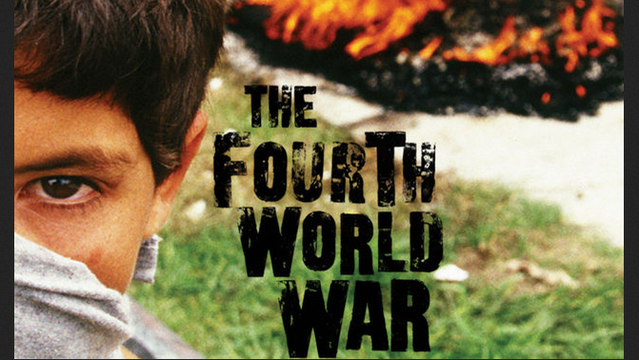
Saturday Matinee: The Fourth World War

the_fourth_world_war

From Big Noise Films:

From the front-lines of conflicts in Mexico, Argentina, South Africa, Palestine, Korea, and the North; from Seattle to Genova, and the War on Terror in New York, Afghanistan, and Iraq, The Fourth World War is the story of men and women around the world who resist being annihilated in this war.While our airwaves are crowded with talk of a new world war, narrated by generals and filmed from the noses of bombs, the human story of this global conflict remains untold. The Fourth World War brings together the images and voices of the war on the ground. It is a story of a war without end and of those who resist.The product of over two years of filming on the inside of movements on five continents, The Fourth World War is a film that would have been unimaginable at any other moment in history. Directed by the makers of This Is What Democracy Looks Like and Zapatista, produced through a global network of independent media and activist groups, it is a truly global film from our global movement.

For English speakers, portions of the film may need translation, activated by clicking on the “CC” button on bottom right corner of the video (on some mobile device browsers the function can be found on the upper right corner).

The System: Deserving Contempt, Resistance and Undermining

You are part of the global uprising

By Rob Kall

Source: OpEdNews.com

Let’s face it, the system is pathologically broken, designed to hurt and exploit the middle class. it is contemptible. The courts are contemptible, the Judges are contemptible, the politicians– almost all of them– are contemptible, the political parties are contemptible. The mainstream media are contemptible. The vast legion of police and police leaders who violate the law or protect lawless cops are contemptible. The laws that are passed by lobbyist-bought or intolerant fundamentalist influenced politicians are contemptible.

So where do we turn to fight back, to bravely move forward towards hope and progress?

First, we don’t put all our eggs in the electoral basket. That is a delusional idea. Okay, so vote, even donate to really strong progressive candidates. But don’t delude yourself into thinking that any effort or donations to electoral activity is enough. Consider electoral action to be comparable to lightly tapping the brakes on a deadly car crash that is already under way.

The fact is the system is not only toxic and broken, it is biting back aggressively at people who speak out in the ways that people fighting for democracy have traditionally fought back.  Chris Hedges says,

” All acts of resistance–including nonviolent protest–have been conflated by the corporate state with terrorism. The mainstream, commercial press has been emasculated through the Obama administration’s repeated use of the Espionage Act to charge and sentence traditional whistle-blowers.”

Hedges wrote, last year, about Jeremy Hammond, before he was convicted and sentenced for hacking:

” He said he is fighting as “an anarchist communist” against “centralized state authority” and “exploitative corporations.” His goal is to build “leaderless collectives based on free association, consensus, mutual aid, self-sufficiency and harmony with the environment.” It is essential, he said, that all of us work to cut our personal ties with capitalism and engage in “mass organizing of protests, strikes and boycotts.” Hacking and leaking, he said, are part of this resistance–“effective tools to reveal ugly truths of the system.”

And further discussing Hammond, Hedges says,

” He said resistance must be a way of life. He intends to return to community organizing when he is released, although he said he will work to stay out of prison. “The truth,” he said, “will always come out.” He cautioned activists to be hyper-vigilant and aware that “one mistake can be permanent.” But he added, “Don’t let paranoia or fear deter you from activism. Do the down thing!”

if you want work towards a positive future– one that supports social, economic and ecological justice, fairness and safety– you must stand up to the system– hack it, whistleblow it, expose it, resist it, defy it, undermine it and do all you can every day to wake people up to the malignant, pathological threat assault THEY and their families and communities are currently being subjected to.

James C. Scott, anarchist scholar and  Sterling Professor of Political Science and Anthropology at Yale University.  writes, in his book,  Two Cheers for Anarchism: Six Easy Pieces on Autonomy, Dignity and Meaningful Work and Play

“One day you will be called upon to break a big law in the name of justice and rationality. Everything will depend on it. You have to be ready. How are you going to prepare for that day when it really matters? You have to stay “in shape” so that when the big day comes you will be ready. What you need is “anarchist calisthenics.” Every day or so break some trivial law that makes no sense, even if it’s only jaywalking. Use your own head to judge whether a law is just or reasonable. That way, you’ll keep trim; and when the big day comes, you’ll be ready.”

Keith Farnish, author of Undermining and Times Up, talks about how the system systematically engages in a plethora of ways to not only disconnect us but that make us forget that we were connected or desperately need to be connected to be fully human. We have to fight back, but he writes,

“…you can’t attack these great systems, these great structures head on, it’s really not going to work, you’re not powerful enough to do that.

“The only way that we’re going to really get to return humanity to a decent way of living is to look at those tools of disconnection and get people to realize what’s going on.  Allow people to be connected again because once you connect people, once you take away all the things that are masking that need that humanity really has to be connected, then you end up with awareness.”

So, to fight disconnection and get people reconnected you have to fight the ways that the system disconnects people from each other and from the positive aspects of community, family and humanity that keep us being fully human.

Farnish says technology  keeps us distracted– that people don’t like to hear that almost everything they’ve ever believed in is wrong and they will do everything in their power to retain those beliefs.

“anyone can be an underminer”

“the  vast majority of the time I am doing community work which is a form of undermining because what that community work does is allow people to appreciate what’s local to them.”

The thing is Farnish’s goal for undermining goes all the way– to the point that the industrial world is totally undermined and no longer working. That would put people in a situation where they depended entirely on local resources. He says that’s necessary .

“… we need to be looking smaller, yes we need to be banding into communities that are self sufficient, there’s no way we can exist in using any form of mass anything, which is destructive.  Therefore we have to start breaking things down into smaller chunks.

We need to be more self controlling.  We need to understand that global government and even national government are only in it for the interests of the greater corporate world.  But once you start getting local, we call it local government, local administration, then you get a lot more control back.  So I can see the argument and that is an inevitable outcome of undermining these great industrial worlds.”

Farnish is not talking about toning things down. He’s talking about shutting them down:

” Greenpeace is saying you can have less damaging technologies, well yes, relatively, 10% less damaging, 20% less damaging, they still screw everything up.  They’re still killing the planet.”

The quotes from Keith Farnish come from my interview with him, here. I said,

” I’ve talked for a couple of years now about the idea that when the dinosaurs died it wasn’t that the little tiny mammals, the little mice, the one-foot high horse, the birds, they didn’t attack the giant dinosaurs and replace them; they out-survived them.  Think in terms of what you’re talking about here,   this dinosaur of industrial corporate civilization.”

Farnish replied,

” Yes, I can see that.  I think it’s a very good metaphor.  We have a situation where these dinosaurs, yep I think that’s a good way of, although saying that, I mean, they were natural beings and they were wiped out in a mass extinction event.  We’re coming to a massive extinction event, I think this is true, but it’s a mass extinction event caused by something that is entirely unnatural.This idea that you’ve got niches that the people can go into in order to create a new world, yes that’s one way of looking at it but as you say those niches weren’t created until the dinosaurs went.  Now, industrial civilization, we can wait for it to collapse if we want.  We can say, okay we’ll wait it out.  But the problem with waiting it out is when it does collapse, there’s nothing left.  It’s done so much damage, there’s already this mass extinction event which is inevitable.

Or we can say industrial civilization is something that we have to get rid of before this mass extinction takes place.  Before the Earth is in a state that we can no longer live there.  Before it collapses while we are totally dependent on it.  That’s another side of things because if we remain dependent upon civilization, when it collapses we’re gone as well.

So we have to learn how to start walking away. We have to become less dependent on it. We have to become connected outside of industrial civilization. So the small mammals, the shrew-like creatures, they didn’t do that. They waited it out. There was a mass extinction event, that mass extinction event actually wiped out the vast majority of the shrew-like creatures as well, fortunately there were a few that managed to survive but who knows what might have come about if that mass extinction hadn’t taken place.

I can guarantee that if humans would have been around at the time, they wouldn’t have survived that mass extinction event either. “

And I threw in another ” another biological metaphor into the conversation.

“There are some insects that plant their eggs in another insect or mammal and then when the egg hatch, they consume the living breathing creature, killing it in the process, and I kind of conceptualize that the way towards a future where corporations and industrial civilization are no longer the dominating destroyers is absolutely not one where there is direct confrontation but rather where we begin building alternative infections that grow into positive structures and constructions where they lead to the acceleration of the death of this industrial civilization.”

Keith Farnish relied,

“Yes, I mean I have used the metaphor on the website of spiders spinning their webs in the eaves or mice making their homes under the floor boards, quietly and industriously.  You’re quite right.  We need to be doing things all the time.  We need to be creating communities, we need to become self-sufficient.  All of these things need to be taking place as a replacement, as a viable replacement for what is going to go and that’s something that we should be starting now.Regardless of whatever we do, because in a way that is both a method by which we can live in the future and also a way we can undermine the system.  So for instance, if you grow your own food, you’re not going to buy your food from the supermarket because you’ll learn to love that food that you’ve grown.  You’ll treasure that, you’ll protect that.  The supermarket becomes something that’s other worldly.  It’s something that other people use.

If people don’t shop at supermarkets then supermarkets close down.  That’s a great lump of civilization gone.  The mass consumerism, this idea that you can only get your food in approved places of mass consumption…. “

I said to Keith Farnish, in our interview,

“… your book on undermining goes into a lot of detail on many many different ways and different approaches on how to undermine, starting with just a black magic marker and changing the message on a poster to blocking the entrances to shopping malls. They can get very risky or they can get minimally risky but a lot of them involve in some ways breaking the law.”

Farnish replied:

“Yeah. The law, I think we’ve got to distinguish between what’s legal and what’s lawful here. Laws in, certainly laws in Western countries are, they are statutes, they are things that have been put there by politicians to control you to make sure that you do whatever the system wants you to do. There are certain things like murder, taking someone’s property although you do question where the property came from in the first place, obviously harming someone directly in some way, taking away their liberty, that kind of thing, these common features of human morality, and that’s what I would consider to be a law and they’re the laws by which humans should live.

Yes breaking the law, if we can use that phrase is something that underminers will inevitably do, and it’s incredibly liberating. It’s a wonderful thing. In the vast majority of cases you’re not going to get in any trouble for it if you’re careful and I do provide some instructions on how to be careful but we are going to have to break the law because the laws are about controlling people.

Laws are about benefiting the corporate world and if we’re going to change things then those legal instruments that are being put in place to control people have to be broken apart. They have to be challenged constantly otherwise nothing will change and that is why we have to distinguish between what is lawful? What is something that is naturally right and moral for humans to do and where that overrides what politicians and corporations have put in place to make themselves rich or make themselves powerful.

If you stop a factory polluting the river you could be breaking the law but morally you’re doing the right thing.

So I say to you. What are you doing with the rest of your life? What can you do to make humanity better? What can you do to make the world a little bit better for your children and your grandchildren?

The answer is, a hell of a lot. My hope is that this article will stretch the boundaries of your imagination. You have the potential for a bigger vision and you’ll have to fight for it. Many of the tools of disconnection that Farnish refers to are built to restrict and limit your imagination. You can do ANYTHING. Some of those anythings may cost you more than you are willing to pay. But at the least, please, please expand your view and think of all the possibilities. Snowden was not the first whistleblower. Neither was Daniel Ellsberg.

And please, don’t try to do this alone. Connect, connect, connect. That’s the way bottom-up change is made to happen.  Simply connecting in new ways to the same or new people in your communities can be revolutionary, can be  undermining can be resistance. Like Jim Scott says. Do something every day.  Raise your voice. Expose the lies of the dominating system. Take public the secrets that the billionaires, the corrupt politicians hold tight. Refuse! Refuse to follow the rules that most people accept as mandatory. A few years back police were arresting people who shot videos or photos of them. But people kept at it, exposing their acts, rejecting their orders to stop, REFUSING to give up their rights. Now, not only has the law made it clear that you CAN videotape police, but the police are beginning to record themselves. I’m sure it will be a battle, getting public access to ALL police recordings. But it could happen.  Stand up and refuse. In his brilliant book, Domination and the Arts of Resistance, James C. Scott says, “Any public refusal, in the teeth of power, to produce the words, gestures, and other signs of normative compliance is typically construed– and typically intended — as an act of defiance.” Scott points out, “ON very rare occasions when what has been orchestrated as a mass public demonstration of domination and enthusiastic consent erupts into a public display of repudiation from below, the ‘formidable shadow of general impotence’ becomes what can only be described as a symbolic rout.”

We’re talking about parades, ceremonies, public events. Even a moment of televised disruption can open the consciousness of millions and expose the lie of of power and the vulnerability of the elites running the performance.  This can be highly planned, like Medea Benjamin did when she interrupted President Obama, or it can be spontaneous, when you discover an unexpected opportunity. I interviewed Medea on how to do it, here.

One last thing. Don’t get stuck with absolutism. You don’t have to change your life completely. Your organization does not have to totally change. Every resistant, undermining, bottom-up step you take as a conscious act contributes to progress. It may take thousands or millions of people doing millions or billions of small acts. But that’s possible. It is the ONLY way that most of the changes in the world happen. Matter of fact, don’t expect your single action will be THE one. Consider your acts to be like drops of water eroding a massive edifice.

Rob Kall is executive editor, publisher and website architect of OpEdNews.com, Host of the Rob Kall Bottom Up Radio Show (WNJC 1360 AM), and publisher of Storycon.org, President of Futurehealth, Inc, and an inventor . He is also published regularly on the Huffingtonpost.com

Listen to over 200 of Rob’s Podcast interviews here.

If there’s no justice, there’s escrache!

escrache

From Wikipedia:

Escrache is the name given in Argentina, Paraguay, Uruguay and Spain to a type of demonstration in which a group of activists go to the homes or workplaces of those whom they want to condemn and publicly humiliate in order to influence decision makers and governments into a certain course of action. This term was born in Argentina in 1995 and has since spread to other Spanish-speaking countries.
In Chile these actions are known as funa. In Peru they are known as roche and are often signed “El roche”.
The word was coined for political usage in 1995 by the human rights group HIJOS, to condemn the genocides committed by members of the PROCESO who were pardoned by Carlos Menem.
By 2013, the term was in wide use in Spain, to define the direct action protests of the Plataforma de Afectados por la Hipoteca.

Origin of the term

The lunfardo term “escracho” has been used for some time in Río de la Plata. It was mentioned by Benigno B. Lugones in 1879 referring to a scam in which a lottery ticket supposedly naming the victim is presented to them and they are asked to pay to receive it, for an amount which is inferior to the amount they have “won” in the lottery. Escrache might also have come from the Genoese synonym for a photo “scraccé”, “scraccé” also passed to mean make a portrait, or more recently to smash someone’s face in. Another proposed origin is the English to scratch (the tickets used in the lottery scam were scratched to modify the number) or the Italian scaracio meaning spit.

The term came into wider use in 1995 by the human rights group HIJOS, when Carlos Menem pardoned members of the Proceso de Reorganización Nacional who were accused of human rights violations and genocide. Using chants, music, graffiti, banners, throwing eggs, street theater, etc., they inform neighbors of the presence of criminals in the neighborhood.

From NewTactics.org:

What we can learn from this tactic:

When perpetrators of abuse are granted impunity, whether by law or de facto, they may go on to lead relatively anonymous lives — sometimes in the same communities as their victims. A group in Argentina decided that, even if perpetrators cannot be prosecuted through the courts, they can be revealed — or “unmasked” — to the general public.

Even though amnesty laws have made it difficult to prosecute some perpetrators, H.I.J.O.S. bypasses political and legal systems to encourage a kind of social ostracism, while making use of humor, theater and other cre­ative demonstrations.

This tactic has some serious risks. People adopting this tactic must be certain that they are targeting the right people and that the demonstrations are not used for other political purposes. Organizers of large demonstra­tions around emotional subjects must have mechanisms in place to prevent the events from degenerating into violence.