Saturday Matinee: Stranger at the Gate

How Many Strangers Are At the Gate?

By David Swanson

Source: Let’s Try Democracy

Spolier Alert: if you want to watch an excellent 30-minute film without knowing what happens, scroll down and watch it before reading any of these words.

We’ve long known that U.S. mass-shooters are disproportionately trained in shooting by the U.S. military. I don’t know whether the same applies to those who kill in the U.S. with bombs. I wouldn’t be surprised if the connection were even greater.

The Oscar-nominated short film Stranger at the Gate tells the story of a man who went from a difficult childhood straight into the U.S. military at 18.

When learning to shoot at paper targets, he had concerns about killing actual people. He recounts being given the advice that if he could look at those he would kill as anything other than human he would have no problems. So, that, he says, is what he did.

But, of course, conditioning people to thoughtlessly kill doesn’t provide them with any way of being unconditioned again, of comfortably ceasing to be self-deceptive murderers.

This guy went off to U.S. wars where he killed people he thought of as Muslims. The characterization of the people killed as belonging to an evil religion, was largely a game of military propaganda. The actual motivations of those picking the wars tended to have more to do with power, global domination, profits, and politics. But bigotry has always been used to sucker the rank and file into doing what’s desired.

Well, this good soldier did his job and returned to the United States believing that he had done his job, and that that job had been to kill Muslims because of the evil of Muslims. There was no Off switch.

He was troubled. He was drunk. The lies didn’t rest easily. But the lies had a tighter grip than the truth. When he saw that there were Muslims in his hometown, he believed he needed to kill them. Yet he grasped that he would no longer be praised for it, that he would now be condemned for it. Even so, he still believed in the cause. He decided that he would go to the Islamic Center and find proof of the evil of the Muslims that he could show everyone, and then he would blow the place up. He hoped to kill at least 200 people (or non-people).

The men and women at the Islamic Center welcomed him and transformed him.

In the United States today one may want to rewrite this line:

“Do not neglect to show hospitality to strangers, for by so doing some people have entertained angels without knowing it.”

in this way:

“Do not neglect to show hospitality to strangers, for by so doing some people have entertained would-be mass-murderers without knowing it.”

How many?

Nobody knows.

Saturday Matinee: The Warriors

By Dante James

Source: Film Threat

Warriors… come out to play! Warriors… come out to play!

One of the most well-known movie chants in cinematic history has passed the 30-year mark.

When The Warriors, starring a bunch unknown actors at the time, made its debut in ‘79, No one could have predicted it would be considered one of the greatest “cult classics” in film history… but here we are.

And if you were to ask any fan of The Warriors why this film has stood the test of time in cult fandom, most will never be able to give you a solid reason other than: “It’s just f*****g cool, man!” But that’s the magic of this movie!

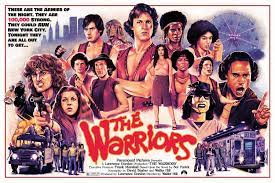
The concept was simple enough. Street gangs from all over New York would come to a truce and unite under the highly respected urban messiah, Cyrus (Roger Hill), Leader of the Grammercy Riffs. A meeting was called in Central Park where they would all hear his message of strength in numbers against the cops. Except, everything goes wrong when Luthor (David Patrick Kelly), leader of Rogues, for no apparent reason other than he was bored, pulls his gun and kills Cyrus from the crowd.

But instead of getting caught, he immediately blamed one of The Warriors, the gang from Coney Island, for the assassination. After violently beating their leader, Cleon (Dorsey Wright), the gangs turned their attention to rest of The Warriors: Swan (Michael Beck), Ajax (James Remar), Rembrandt (Marcelino Sanchez), Vermin (Terry Michos), Cochise (David Harris), Snow (Bryan Tyler), and Cowboy (Tom McKitterick). And from here on out, they have every gang in New York after their a*s as they try to make it back home to Coney.

During this time in cinema (the mid to late 70s), there was an influx of genre movies that were becoming more and more popular. Blaxploitation, gritty cop dramas, and of course, kung fu.

What set The Warriors apart from most films (at the time) was how stylized it was. Starting with how very eccentric and themed all the different gangs were:

The Grammercy Riffs: The biggest and most feared gang made up of Black Kung Fu artist.

The Lizzies: The punk, all-girl gang.

The Boppers: The Harlem crew who looked like 1920s gangsters.

The Turnball AC’s: The skinhead, rabid, “Mad-Max” psychopaths.

The Baseball Furies: The gang dressed like the New York Yankees with facepaint and big bats!

This is just a few of the 20 or more gangs featured in this film. But it was enough to have every 10-year-old boy’s imagination working overtime!

Though there wasn’t a ton of dialogue in the film, the performances were strong all the way through. Especially that of Lynne Thigpen, who plays “The Voice,” a radio DJ who gave the other gangs sightings of The Warriors so they could continue their hunt. And though you never see her entire face in the whole film except for her lips, she brings the much-needed weight that makes the film feel legit.

Deborah Van Valkenburgh, who played the mouthy, tough-girl Mercy who helps The Warriors navigate through the dangerous city, was a stand-out! You go from wanting her to get pushed into ongoing traffic, to loving her by the end. Valkenburgh, though not a household name, has been consistently working in Hollywood even to this day. But her role as Mercy is still the one she gets the most recognition for!

James Remar, who is noted bad-a*s in every movie he’s in, makes Ajax the one Warrior that we all gravitate towards. Even to the point of stealing scenes away from Michael Beck who at this point in the movie, is the actual lead. Ajax’s rumble with The Baseball Furies is still the most memorable fight in the movie!

Another performance that should not go unnoticed is that of Hollywood’s favorite bad guy, David Patrick Kelly who plays Luthor, Leader of The Rogues. From the moment he kills Cyrus, until the end of the film, he delivers on being the scumbag we love to hate. And of course, he’ll always be remembered for his legendary scene in the car as The Rogues have The Warriors cornered at the beach and taunts them by clinking three bottles together on his fingers over and over chanting: “Warriors… Come out to play!” And rumor has it, this scene was completely improvised by Kelly, which makes it even more classic.

The Warriors saw a resurgence in the early 2000s. With not only a video game from developer Rockstar Studios but also with an updated re-release of the film with added footage. People at comic conventions were now cosplaying as The Warriors and all of the different gangs from the film. There have been several reunions with the cast (that are still living), and talks of a reboot.

For many guys in my generation (Gen X), The Warriors has been a constant on most “Best of” list. And for me personally, It’s one film that can’t be redone for the simple fact, there isn’t a living director that can capture what made this movie work!

If you’ve never seen this film, I can’t recommend it highly enough. It’s definitely in my TOP 5 of “All time greatest movies.”  

*Pro-Tip: It’s best watched late at night, completely in the dark, with some beer and popcorn*

____________________

Watch The Warriors on Hoopla here: https://www.hoopladigital.com/title/15742134

The World Wants to Be Deceived

By Edward Curtin

Source: Behind the Curtain

My title comes from a 19th century author whose name does not matter nor would it mean much if I mentioned him.  It’s an old truth that has not changed a bit over the centuries.  I think, however, it would be more linguistically accurate to say that most people want to be deceived, for the world, the earth doesn’t give a damn, as the French poet Jacques Prévert reminds us in “Song in the Blood”:

There are great puddles of blood on the world
where’s it all going all this spilled blood
is it the earth that drinks it and gets drunk
funny kind of drunkography then
so wise . . . so monotonous . . .
No the earth doesn’t get drunk
the earth doesn’t turn askew
it pushes its little car regularly its four seasons
rain . . . snow
hail . . . fair weather
never is it drunk
. . . . . . . . . . . . . . . .
It doesn’t give a damn
The earth

But people, the thinking reeds as Pascal called us, we, who through the support of wars and violence of all sorts, care just enough to want to be deceived as to what we are doing by making so much blood that is inside people get to the outside for the earth to drink.

I could, of course, quote liberally from truth tellers down through history who have said the same thing about self-deception with all its shades and nuances. Those quotations are endless.  Why bother?  At some very deep level in the recesses of their hearts, people know it’s true.  I could make a pretty essay here, be erudite and eloquent, and weave a web of wisdom from all those the world says were the great thinkers because they are now dead and can no longer detect hypocrisy.

For the desire to be deceived and hypocrisy (Greek hypokrites, stage actor, a pretender) are kissing cousins.  I write this to try to say something of value about the mass idiocy of the media’s daily barrage of lies and stupidities that pass for news on the front pages and newscasts of the corporate media.  And the people who believe them.

It is not easy.  No matter how obviously absurd the claims about Chinese “spy” balloons, the shooting down of unidentified flying objects, reports of how Russia is losing the war in Ukraine, all the support for presidents and prime ministers who shill for the war industries, etc. – a list that could be extended indefinitely on a daily basis – these media are relentless in presenting government propaganda juxtaposed with trivia.

When you think they must realize they have gone too far since even a moron could see through their fabrications, they double down.  And I am referring only to what they do report, not what they omit – e.g. how the U.S. has restricted aid to the earthquake victims in Syria or Seymour Hersh’s report on the U.S. blowing up the Nord Stream pipelines, two examples of terror by a terrorist state that must be protected at all costs.  This is the protection racket by omission and commission.

Maybe an anecdote would help. A week ago, I ran into an old friend at a coffee shop.  Hersh’s article, aspects of which I question, had just come out and I asked him if he had seen it.  He said he hadn’t but didn’t know anything about such pipelines being blown up.  I was stunned.  A devout consumer of mainstream media, yet he somehow missed this major September 2022 event in the U.S. war against Russia that was reported widely by the media he relies upon.  Those media went on to suggest that Russia blew up its own pipelines, a claim beyond ridicule but one that was part of its war propaganda narrative.  My friend is a guy who has strong opinions about everything and finds NPR, The Guardian, The New York Times, CNN, etc. to be credible news sources.  How could he have missed one of the major stories of 2022, one that The New York Times, etcwas reporting on into December, still suggesting that Russia did the deed?  How could he have missed the pipeline story whose reverberations spread through all aspects of the U.S. war against Russia via Ukraine when it was referenced in so many reports of gas and oil prices, a cold winter for Europe, and so many other issues?  Its ramifications are manifold and have been reported as such, but he had never heard of it.  I was stunned.

I wanted to quote him Dylan’s facetious words from “The Ballad of the Thin Man”: “’Cause something is happening/And you don’t know what it is/Do you, Mister Jones?”  But I did not.

I have spent a week wondering how it is possible that he didn’t know anything about the pipeline explosions.  I am sure he wasn’t lying to me.  So how explain it?

In the interim, as I have been trying to comprehend these matters, the Super Bowl with its mesmeric half-time spectacle replete with crotch grabbing has come and gone, and I have read an interesting article by Ethan Strauss, a sports journalist, “Why America Needs Football. Even its Brutality” that raises important questions.

Much has been written about football’s violence and the injuries it causes, the most recent example being the near fatal injury to Damar Hamlin of the NFL’s Buffalo Bills that garnered headlines for weeks (even though why he suffered cardiac arrest has been left unanswered since that would raise the COVID vaccine problem, which is also taboo).  Strauss notes the many arguments calling for the banning of football – the war game – because of its violence.  He notes that it is very true that football is very violent but that this is part of its great appeal.  He writes:

And the NFL gives Americans that war, as spectacle, week after week.

Today, at 6:30 p.m., eastern time, begins the biggest spectacle of them all: the Super Bowl, where we channel those ancient animal spirits into a highly commercialized event that ends with fireworks and a shiny trophy.

We should celebrate that.

He doesn’t argue for the celebration of war, which he opposes, but for the war-like game of football.  To Malcolm Gladwell’s statement in support of the banning of football as “a moral abomination” – “This is a sport that is living in the past that has no connection to the realities to the game right now and no connection to American society.” – he responds quite rightly that Gladwell is wrong:

In 2022, 82 of the top 100 TV shows in America were NFL games, and the top 50 most viewed sporting events were football games or events that immediately followed football games. By contrast, in 2016, only 33 of the top 50 were football-related. The country has lost interest in so much else, but football remains a huge draw and, in fact, is gaining relative market share.

Americans love violence, not just the military propaganda that precedes the Super Bowl game, but the smashing hits that players make and take in the games.  It is hard to deny.  Strauss goes on to show how over ninety percent of former NFL players who suffer from daily lifelong pain say they would do it again.  The violence is intoxicating and Americans get drunk on it.  It is the American Way.

I don’t agree with all of Strauss’s points or assumptions, especially his imperative that “we have war within us, whether or not there’s one to wage,” but he clearly is right that despite all the rhetoric about how terrible violence is, there is something about it that Americans love.  D. H. Lawrence’s point a century ago still applies: “The essential America soul is hard, isolate, stoic, and a killer.  It has never yet melted.”

But this killer soul must be hidden behind a wall of deceptions as the U.S. warfare state ceaselessly wages wars all around the world.  It must be hidden behind feel good news stories about how Americans really care about others, but only others that they are officially allowed to care about.  Not Syrians, Yemenis, Russian speakers of the Donbass, Palestinians, et al.  The terrorist nature of decades upon decades of U.S. savagery and the indifference of so many Americans go hand-in-hand but escape notice in the corporate media.  The major theme of these media is that the United States government is the great defender of freedom, peace, and democracy.  Every once in a while, a scapegoat, one rotten apple in the barrel, is offered up to show that all is not perfect in paradise.  But essentially it is one massive deception.

There’s a make-believe quality to this vast spectacle of violent power and false innocence that baffles the mind.  To see and hear the corporate masked media magicians’ daily reports is to enter a world of pure illusion that deserves only sardonic laughter but sadly captivates so many adult children desperate to believe.  This is so even as the propagandists’ trial balloons are popped in the society of the comedic spectacle.

But back to my friend I mentioned earlier. He hates violence in all its forms, is strongly opposed to war, and has a most compassionate heart, yet he remains devoted to the media that have lied us – and continue to do so – into war after war, a media that clearly fronts for the warfare state.  I still can’t explain how he knew nothing about the pipeline explosions.  Nor can I explain his allegiance to the media that lie to him daily.

Even as his government, led by that very media, leads the world toward nuclear annihilation, he remains true to his media informants.

I am stunned.

In the Blood

Born in a normal time,
The periodic slaughter of millions
By the civilized nations of the earth
I grew to adulthood half-crazed
With fear and numbed wonder.

I always wished to believe otherwise,
That people were good at heart,
Wanted to live in mutual peace
And tend the green earth as if
It were a garden
As if pity vivified all living things.

Somehow the blood that was in me
Said otherwise,
Spoke truth to the power
Of my wish,
While everywhere around me lay the lie.

But my blood, this blood that became me
While millions were being butchered
And Bing Crosby crooned I’m dreaming
Of a white Christmas,
This red blood said otherwise.

Do not accept the way they say
“Good Morning”
And the way they nod as they pass,
As though they didn’t want to kill
Each other.

Do not believe their eyes
And the way they pray to the skies
To save them.
Do not believe their beliefs,
All lies woven to deceive.
For at heart they truly hate
The green earth.

Do not believe the way they say
“Good Evening”
For they wish the darkest night
To descend upon us,
The nothingness of their knowledge
To swallow all.

That is what will release them,
That is all.

Thus my blood spoke to me,
A child of a sanguine century,
Born in a normal time,
The periodic slaughter of millions
By the civilized nations of the earth.

And despite all appearances,
I have never believed them.
Never.  Not at all.

Saturday Matinee: In the Mouth of Madness

That Time John Carpenter Went Meta With ‘In the Mouth of Madness’

As always, Carpenter was light years ahead of his time.

By Nick L.

Source: Collider

One of John Carpenter’s more endearing traits is his aversion to self-effacing clowning. This is not at all to suggest that Carpenter’s films aren’t funny — rather, it’s that the living genre legend often opts to play familiar B-movie scenarios completely straight, whether it be a terse gangland standoff rendered as a modern-day Western showdown (Assault On Precinct 13, one of the most influential films of the 20th century) or a masked killer, bereft of any overwrought psychological motive, terrorizing the inhabitants of a sleepy all-American suburb (Halloween, of course). While Carpenter has dabbled in satire (They Live) and high-concept fantasy (Big Trouble In Little China) over the course of his now decades-spanning career, the grounded nature of his approach is often its own reward. The Escape From New York director has all but perfected an economical, tough-minded creative ethos that has gone on to influence an entire generation of filmmakers dabbling in sci-fi, horror, and beyond.

Going Meta Before It Was Cool

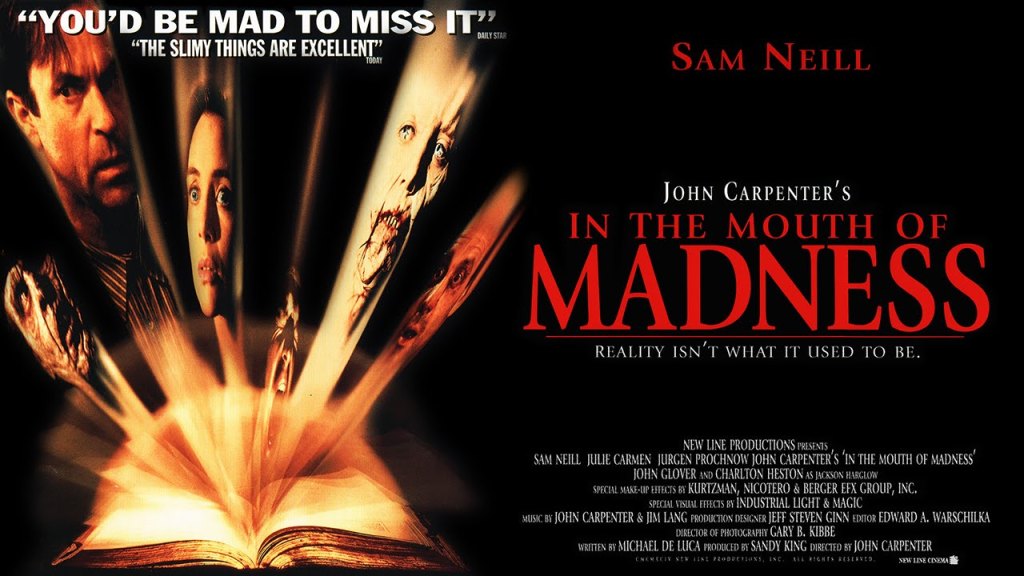
In the Mouth of Madness, Carpenter’s glorious 1994 cult masterpiece, might be the most conspicuous exception to this rule. The story of an insurance investigator who begins losing his grip on reality while probing the mysterious disappearance of a lucratively popular horror author named Sutter Cane, In the Mouth of Madness is an unabashedly meta exploration of the creative act as a form of hypnosis. It is not only a film whose central plot conceit is unique to the moral panic that defined so much of the decade in which it was released (the idea that exposure to certain “corrupt” media could warp one’s brain and possibly even compel one to commit violent acts, etc.), it’s also a cutting cautionary tale about surrendering to artifice and fantasy, and a clever-but-never-obnoxious social lampoon about what it means to be considered the master of a low trade.

Of course, John Carpenter knows a thing or two about being unfairly labeled as the master of a low trade. Carpenter, who is known for his tell-it-like-it-is demeanor, once quipped: “In England, I’m a horror director. In Germany, I’m a filmmaker. In the U.S., I’m a bum.” Films like the Jeff Bridges-starring Starman and the memorably nasty high school bloodbath Christine might be considered totemic cult items today, but many of Carpenter’s more beloved works were initially decried as trash in their time. As such, Carpenter and screenwriter Michael De Luca (yes, that Michael De Luca) turn In the Mouth of Madness’ most important character, Sutter Cane, into the Ernest Hemingway of airport novels. Clearly, the obvious allusion with Cane is Stephen King (or perhaps, to a lesser extent, Clive Barker), right down to the fact that Mouth of Madness eventually makes a narrative detour to Hobb’s End: a kind of bastardized stand-in for King’s own sleepy, creepy fictional borough, Castle Rock.

Third Film of the Apocalypse Trilogy

In The Mouth Of Madness opens with Sam Neil’s John Trent being admitted to a psychiatric hospital. He appears to have gone stark-raving mad, as evidenced by the demented look in his eyes, and the vaguely occult-looking marks he’s scrawled onto his face. In a gesture that feels borrowed from a tale by H.P. Lovecraft (Carpenter’s reverence for Lovecraft is well-documented at this point), Trent begins to recall the tale of how exactly he went mad. We learn that when Trent worked in insurance, his employer (Charlton Heston) tasked him with looking into the matter of Sutter Cane. For all intents and purposes, Cane appears to have vanished off the face of the earth. After its ghoulish prologue, Mouth of Madness settles into a more deliberately routine rhythm, only to disappear further and further down the proverbial rabbit hole as Trent and a colleague, Cane’s editor (memorably played by Julie Carmen), find themselves lost among the otherworldly horrors of Hobb’s End.

In The Mouth Of Madness is the third and final film in John Carpenter’s “Apocalypse Trilogy,” which also includes The Thing and the criminally underappreciated Prince of Darkness. In all three films, evil manifests as a primarily unseen, invisible force, often contorting familiar things like dogs, books, and human bodies into horrifying and hitherto-unseen new shapes. In The ThingKurt Russell and his motley crew of researchers hole up in icy Arctic seclusion, fending off the malevolent energy of a shapeshifting, violently hostile alien parasite. In Prince Of Darkness, a group of college students occupy an incredibly menacing old church, where they proceed to unearth a tube of neon-green liquid that, if mishandled, could unleash the very literal fury of the devil. Both movies are steeped in Lovecraftian imagery and primordial terror, and both amplify the built-in claustrophobia of their settings to phantasmagoric degrees.

In The Mouth Of Madness is a funnier, sillier, more stylistically gonzo effort than its two predecessors in the trilogy, mostly because it purports to stand outside the nuts and bolts of its superficial narrative, to some degree, and actually comment on the art of what it means to scare people for a living. There is something wickedly ingenious about the idea of a popular novel whose contents are so unholy that reading it would cause one to spiral into a kind of monstrous abyss. If that idea alone were all the movie were interested in, In the Mouth of Madness would still rank as one of Carpenter’s more enjoyable late-career works. And yet, as always, the director is keen to dig deeper into the subtextual resonance of his story, turning what might otherwise be a spooky ’90s chiller — the type of thing you might have caught a rerun of on TBS sometime back in the 2000s — into a cheeky, compelling commentary on the horror pantheon itself, and Carpenter’s place in it.

We live in an era where people willingly and enthusiastically sign themselves over to fictional “universes.” Whether it’s MarvelStar Wars, Game of Thrones, or perhaps something more obscure, we now inhabit an epoch in which individuals willingly give themselves up to elaborate forms of corporate mythology. In some cases, this sort of fanboy devotion can swallow you whole. In the Mouth of Madness is concerned with this very subject. It is no wonder the film was greeted with such indifferent critical notices upon its release: as always, Carpenter was light years ahead of his time. The scariest thing about In the Mouth of Madness is that, in the world Carpenter hath created, Sutter Cane himself isn’t even seen as a mere writer of trash books — when he’s finally revealed, he is tellingly and literally depicted as a prophet.

HOW TO DISCOVER YOURSELF THROUGH YOUR OWN PHILOSOPHY

By Mickey Z.

Source: Waking Times

“Be yourself; everyone else is already taken.” ~Oscar Wilde

There are now over eight billion people on the planet. We each have a different psychophysiological reaction to any given stimuli, no matter how minute the difference. From forks to forklifts, spoons to spoonerisms, folklore to philosophy. Every single one of us perceives everything differently.

The way I perceive the concept of something as simple as a tree is fundamentally different than the way every single other person perceives the “same” concept. This is due to our historically unique experiences with “trees.”

The memories we form influence our experience of perceiving trees. I may have fallen out of a tree and broken my arm. You may be blind and can only touch or smell a tree. I may have chopped down twenty trees to build a house. You may have crashed into a tree and totaled your car. The point is, every single historical interaction with a tree has formed a unique interpretation of “tree” in our psychophysiology.

The same thing applies to abstract concepts such as love, God, and philosophy. We each have historically unique experiences regarding these abstract concepts as well.

Which brings me to the point of this article: we should own up to the fact that we each have a devastatingly unique perception of all things, including philosophy. And rather than merely piggyback, kowtow, or place all our eggs into a single historical philosophy forsaking our individuality, we should make our individuality foremost and create our own philosophy out of the mulch, fodder, and compost of past philosophies.

We should double down on our uniqueness and fatten our individuality on the food of philosophies past.

Most people settle upon one established philosophy (religion, ideology, worldview), unaware that they have a unique perception of what that philosophy is. It is already the case that we perceive the concept of philosophy in a fundamentally different way than others do even within the same philosophy. Developing our own unique philosophy is simply becoming aware and honoring our unique perception.

It’s a matter of awareness and honor. Becoming aware of our unique perception of all things puts us into an existential pickle: We either admit it and honor it, or we deny it and dishonor it. If you choose the former, read on. If you choose the latter, not even the one-dimensional philosophy you lean on like a cripple can save you from yourself.

Here are five ways to discover yourself through your own philosophy…

1.) Practice self-inflicted philosophy:

“To go wrong in one’s own way is better than to go right in someone else’s.” ~Dostoevsky

What does it mean to inflict yourself with philosophy? It means being ruthless with your perception of reality. No excuses. No mercy. No self-pity. It means forcing your head over the edge of the abyss. No rose-colored glasses. No pie-in-the-sky delusions. No safety nets. Just you and the eternal darkness. Just you and the rawness of nihilism. Just you and the existential angst.

You’re faced with the bleeding-meat realness of reality, a snarling darkness puking up all things. It forces you into a vital confrontation, demanding you think rather than believe. Full-frontal, no punches pulled, it grabs you by the throat and asks you, point blank, “Are you ready to accept that everything you believed was a lie?”

Self-inflicted philosophy forces you to perceive reality with a clean slate. It gets down to brass tacks. It’s philosophy in action. It digs down to the roots of the human condition. It cuts deep into the pulsing blister of the mortal wound. It reveals the lodestone. It’s your ticket to staying ahead of the curve because it exposes how everything is on the curve. No exceptions.

As Marcus Aurelius said, “All that exists is the seed of what will emerge from it. You think the only seeds are the ones that make plants or children? Go deeper.”

2.) See the world from the shoulders of multiple giants:

“If I have seen further, it is by standing on the shoulders of giants.” ~Isaac Newton

Don’t be afraid of becoming an autodidact. Read a lot. Connect the dots. Stay curious. Seek the shoulders of giants. Seek help, expertise, guidance, and wisdom from others. Become a sponge for higher knowledge. Soak it up. Ring it out. Repeat. Learn; unlearn; relearn.

Don’t cling. Never settle. Putting down roots on a giant’s shoulder is a death knell for your uniqueness. Jump! Take a leap of courage out of faith. Stay loose. Stay flexible. Create a scaffolding between giants. Keep your curiosity ahead of your certainty.

Don’t get caught up in the hype. Don’t allow their destiny to prevent your own. Rather, use their destiny to invigorate your own hero’s journey.

What does this mean? It means staying out of your own way. It means allowing for guideposts, other points of view, and a healthy sense of detachment. It means sojourning, not standing, on the shoulders of multiple giants to see further than they did. It means employing self-interrogation strategies as pivot points in order to better navigate the labyrinth of life.

When you sojourn on the shoulders of giants, you are effectively building a bridge to the Overman. You rise above the outdated past to embrace the updated future.

3.) Interrogate the knowledge:

“As anywhere else in the world, the unwritten law defeated the written one.” ~Herman Hesse

The flipside of sojourning on the shoulders of giants is the ability to be circumspect with the knowledge gained. To truly be original one must be able to “entertain a thought without accepting it (Plato).” This means you must take the knowledge gained and interrogate your perception of it lest you become stuck in a belief.

Human ingenuity, like human evolution, is a flowing process of change and mutation. The key to maintaining the process is to allow reimagination despite past imaginings.

The stale and outdated past must give way to a fresh and updated future. Otherwise, there is only stagnation, devaluation, and de-evolution. Therefore, you must have the wherewithal to question everything you’ve learned to the nth degree.

The best way to do this is to honor what validates Universal Law and discard what doesn’t. A deep enough interrogation of the knowledge you gained from sojourning on the shoulders of giants should reveal its validity in relation to the benchmark of health.

When you use health as a benchmark, you realize that health is not a matter of opinion. Rather, it is dictated by an indifferent universe with universal laws that apply to everyone, despite our interests, biases, opinions, or beliefs. And this applies to everyone not only physically, but mentally and spiritually as well.

But health will only get you so far. It can teach you moderation and temperance. But it won’t get you outside the box, the comfort zone, the domesticated bliss, the indoctrination, the cultural conditioning, or the dogmatic mental paradigm. Only audacity and courage can do that.

It doesn’t take courage to blindly follow the dictates of the giants who came before you (manmade laws), but it does take courage to question them (using universal laws). Be audacious. Be courageous. Interrogate your knowledge.

4.) Blend it all together with your unique soul-signature imagination:

“Your time is limited, don’t waste it living someone else’s life.” ~Steve Jobs

If given a choice between the path most travelled and the path least travelled, choose neither. Choose your own path instead.

Don’t fall into the trap of following someone else’s plan. Deconstruct, analyze, and scrutinize their plan, then improvise it. Infuse it with your own essence. Take the knowledge gained from standing on the shoulders of giants and run it through the sieve of your imagination. Customize your life to your own fitting.

Take this piece from this ideology and that piece from that ideology, but then connect it all to your own unique perspective. Be creative. Think outside the box. Push your culturally prescribed comfort zone as far as it will go. It’s all yours for the making.

You are a pivot with a point of view. You are a wave crashing onto the shores of eternity. You are a unique emergence from the universal interdependent spirit molecule. You are the cosmos becoming aware of itself. And you are vital for the progressive evolution of the interconnectedness of all things, whether you realize it or not.

Don’t let anything else lay your uniqueness low, whether spiritually or psychologically. This is your life. This is your story to tell. As Nietzsche said, “The individual has always had to struggle to keep from being overwhelmed by the tribe. If you try it, you will be lonely often, and sometimes frightened. But no price is too high to pay for the privilege of owning yourself.”

Indeed. No price is too high to pay for the privilege of discovering yourself through your own philosophy. No price is too high to pay for the privilege of self-mastery.

5.) Recycle the mastery:

“To attain knowledge, add things every day. To attain wisdom, remove things every day.” ~Lao Tzu

When it’s all said and done, mastery is just as illusory is it is useful. Don’t allow it to kill your quest for truth. Let the life-death-rebirth process come alive inside you. Resurrect Beginner’s Mind. Keep the flow state flowing. Keep the fountainhead resonating. Keep the Truth Quest always ahead of the “truth.”

As Scott Adams said, “Awareness is about unlearning. It is the recognition that you don’t know as much as you thought you knew.”

For a true seeker there is no settled state, there is no final stage. There is always something more to learn. There is always an answer to question. Mastery is always recyclable. The journey is always the thing, or it is nothing. The sword is always sharpened dullness. The diamond is always pressurized coal. As James Hillman said, “the pearl is also always grit, an irritation as well as a luster.”

Mastery must be discarded on the funeral pyre of muscle memory lest it become the dogma that kills your journey. Feel the mastery, love it, relish being in awe and overwhelmed with gratitude for it. Then let it go. Surrender “mastery” to Cosmos. Practice detachment. When you’re attached to nothing, you’re connected to everything.

Saturday Matinee: The Girl With All the Gifts

By Brian Tallerico

Source: RogerEbert.com

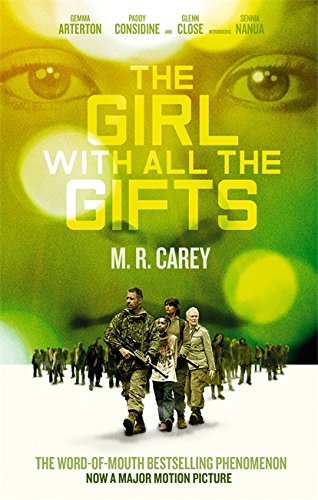
In many ways, Melanie (Sennia Nanua) is just another ordinary girl. She goes to school every day, where she’s grown affection for her teacher Ms. Justineau (Gemma Arterton). And she’s at that age where she’s figuring out what’s important to her, and how to navigate through the world of adults around her. But Melanie is not an ordinary girl. She will soon be a mindless, soulless zombie, a braindead creature who responds only to a desire to kill and eat people around her. In fact, with the right triggers—like if the adults around her forget to wear their scent-disguising lotion—she could become that right now. Just when you thought the zombie genre was out of ideas, along comes Colm McCarthy’s smart and engaging “The Girl with All the Gifts,” a film with echoes of George A. RomeroDanny Boyle, and Robert Kirkman but one that also feels confidently its own creation, a unique take on responsibility, adulthood, and a new chapter in evolution.

Melanie isn’t alone. She lives with a number of other zombie-children like her in a bunker beneath a military facility, where she’s being studied and experimented on by Dr. Caroline Caldwell (Glenn Close), in the hope that they could provide the antidote for what has essentially ended normal human existence. Melanie is one of several second-generation flesh-eaters called “hungries,” babies who literally ate their way out of their parents but are not behaving in precisely the same way as the brain-dead speedsters that have destroyed humanity. Whenever a child is found in the wild, they’re taken to this facility, where Dr. Caldwell can experiment on them and Sgt. Eddie Parks (Paddy Considine) can work to control them. Said control involves leg, arm and head restraints whenever the children are anywhere near that oh-so-enticing human flesh.

But Melanie seems so normal and is clearly learning empathy. The good doctor sees that as well, and even starts to loosen some of the restraints keeping Melanie more of an object than a person. Then one day Dr. Caldwell comes for Melanie, ready to dissect her and see exactly what she can learn from this unique child the hard way. Before Dr. Justineau can save her, all hell breaks loose and the facility is overrun. A small group of survivors is forced to travel to another sanctuary city in the hope that it’s still being run by people who don’t eat flesh. Melanie goes with them, and proves to be pretty useful.

One of the major strengths of “The Girl with All the Gifts” is evident early in McCarthy’s tactile, believable world-building. Much as Romero paid close attention to such details, the set design, costumes, and the world of “Gifts” feels lived-in and genuine. And it’s a nature-based aesthetic (dirt on walls, costumes that look worn, etc.) that continues and even strengthens once this ragtag crew is forced from safety and into the dangerous world. There’s a visceral, emotional impact to the horror and action of “The Girl with All the Gifts” that resonates because the characters and the world they live in feels real to us. It’s hard to overstate how important this to a horror movie, especially one set in a post-apocalyptic world. If we don’t believe the world is genuine, we won’t care what happens in it.

Of course, performance goes a long way to amplify this believability as well, and it’s not often you see a horror film with a cast this strong. Close could have gone showy with her doctor with a heart of ice but she plays it straight, again conveying the believability of the moment more than the B-movie archetype this character could have become. Considine and Arterton perfectly convey authority and warmth, respectively, although they’re good enough to make these people into more than mere plot devices. And Nanua is a find, again never giving her performance with a knowing wink. So she’s a zombie child who could be the evolutionary key to the future—this just happens to be her reality.

The traveling band aspect of “The Walking Dead,” the cities and landscapes empty of human existence of “28 Days Later,” the military aspect of “Day of the Dead”—it’s easy to pick apart the influences of “The Girl with All the Gifts.” But just as Melanie marks something altogether new in this world—a zombie with a conscience—the film about her feels inspired by what came before but also good enough to inspire those that come after.