Two for Tuesday
Reply
By Brian Tallerico
Source: RogerEbert.com
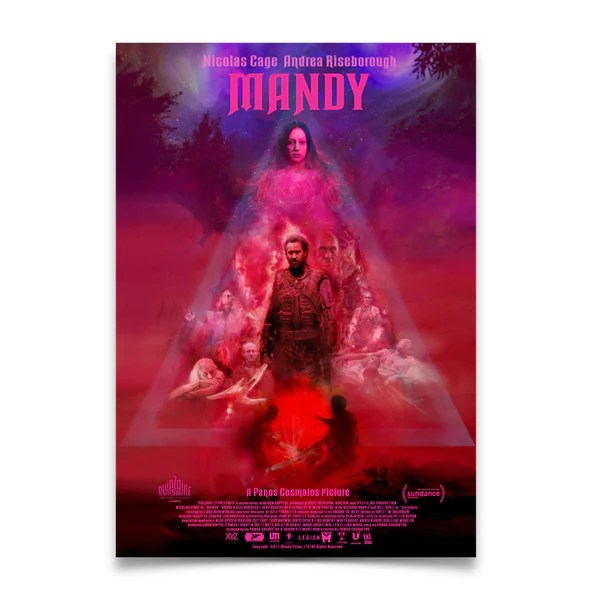
More than most movies, it’s hard to know where to begin with an appreciation or critique of Panos Cosmatos’ “Mandy.” It’s a really difficult film to capture tonally and even narratively in a review, largely because it is such a stylish, visceral experience that it demands you give yourself over to it actively instead of passively analyzing it. On the one hand, it’s a thriller, of sorts, a vengeance piece about a man killing those who destroyed his life. But, man, does that not really capture the experience of this movie. Some have compared it to an ‘80s heavy metal album cover sprung to life, but that’s only part of “Mandy,” and doesn’t convey the emotional depth that saturates every frame. And then there’s the fact that “Mandy” is kind of two movies in one, a slow-burn journey into hell in the first hour and a blood-soaked climb out of it in the second. Did I mention the chainsaw fight yet?
Nicolas Cage stars in “Mandy” as Red Miller, a lumberjack who lives a quiet life in the woods with his girlfriend Mandy, played by Andrea Riseborough. One day, Mandy catches the eye of a cult leader named Jeremiah Sand (Linus Roache), who proceeds to conjure motorcycle-riding demons to steal the girl and make her one of their own. In the process, Red is tortured and nearly killed. The first half of “Mandy” is filled with long, color-saturated takes of impending doom. Even casual behavior like quiet scenes between Mandy and Red have a foreboding nature, and then the film peaks in the middle with a waking nightmare as Red sees something no one should ever see happen to the love of his life. Deeply traumatized, Red is destroyed, and there’s a sequence in which Cage drinks an entire bottle of booze (well he ingests the stuff that isn’t poured on his wounds) while in his underwear, howling like an injured animal. It’s going to be GIF-ed and mocked, but it’s actually a great bit of acting, conveying a man not just mourning or in grief but literally destroyed.
Like a character in a Queensrÿche concept album, Red emerges from this destruction with his plans for vengeance. With a title card that divides the film in half, “Mandy” then becomes the movie that most people will remember in that it’s about Red working his way through both the demons that Jeremiah conjured and, inevitably, the gang itself. The heavy metal comparison is apt not just because the genre often included figures like the nightmarish creations that Jeremiah brought to life but in the very structure of “Mandy,” which unfolds in a very untraditional manner in both halves. Scenes play out like songs on an album, episodically cast in extreme color palettes that amplify the trippy, surreal natures of the entire experience. “Mandy” is a fascinating genre exercise in that it is as untraditional a horror movie as you’ll see this year but also relies on so many classics of the form. It is, at its core, a downright biblical tale of evil and vengeance.
It’s also pretty bad-ass when it comes to stand-out moments, particularly an already-acclaimed fight with two men wielding chainsaws like they’re swords. It’s a perfect blend of the old and new in “Mandy” and a distillation of what the film does well in how it takes a familiar good vs. evil sequence and twists it to fit Cosmatos’ vision.
Having said that, there are times when I felt the length of said vision. “Mandy” runs over two hours, and a little of its style goes a long way. I think there’s a masterful version of this movie that runs notably shorter, but that doesn’t mean there’s not an unforgettable one the way it is right now.
One more thing before you go on this journey with Nicolas Cage: the incredible Johann Johannsson (“Sicario,” “Arrival“) does the best of his career in this, his final film composition. The score here is another character, a series of screeching, violent noises that add to the tone of the film in ways that can’t be overstated. The film simply doesn’t work without it. And, as much as I like other parts of the movie, Johannson’s work alone justifies a viewing. It reminds us how much we lost by his early passing.
Watch Mandy on Hoopla here: https://www.hoopladigital.com/title/12253438

By Edward Curtin
Source: Behind the Curtain
“A treasure stumbled upon, suddenly; not gradually accumulated, by adding one to one. The accumulation of learning, ‘adding to the sum-total of human knowledge’; lay that burden down, that baggage, that impediment. Take nothing for your journey; travel light.” – Norman O. Brown, Love’s Body
These are “heavy” times, colloquially speaking. Forebodings everywhere. Everything broken. People on edge, nervous, filled with anxiety about they know not what since it seems to be everything. The economy, politics, elections, endless propaganda, the war in Ukraine, censorship, the environment, nuclear war, Covid/vaccines, a massive world-wide collapse, the death of democratic possibilities, the loss of all innocence as a very weird and dangerous future creeps upon us, etc. Only the most anesthetized don’t feel it.
The anxiety has increased even as access to staggering amounts of knowledge – and falsehoods – has become available with the click of a button into the digital encyclopedia. The CIA’s MK-Ultra mind control program has gone digital. The more information, the more insubstantial the world seems, but it is not an insubstantiality that connects to hope or faith but to despair. Across the world people are holding their breath. What’s next?
Roberto Calasso, the late great Italian writer, wrote that we live in “the unnamable present,” which seems accurate. Information technology, with its easily available marriage of accurate and fraudulent information, affects people at the fathomless depths of the mind and spirit. Yet it is taken-for-granted that the more such technological information there is available, as well as the ease with which one can add one’s two-cents to it, is a good thing, even as those powerful deep-state forces that control the Internet pump out an endless stream of purposely dissembling and contradictory messages. Delusions of omnipotence and chaos everywhere, but not in the service of humanity. Such chaos plays in chords D and C – Depressing and Controlling.
In the midst of this unnamable present, all of us need to dream of beauty and liberation even as we temporarily rely on digital technology for news of the wider world. For the local news we can step outside and walk and talk to people, but we can’t endlessly travel everywhere, so we rely on the Internet for reports from elsewhere. Even as we exercise great effort to discern facts from fictions through digital’s magic emanations, we hunger for some deeper experiences than the ephemerality of this unnamable world. Without it we are lost in a forest of abstractions.
While recently dawdling on a walk, I stopped to browse through tables of free books on the lawn of my local library. I was looking for nothing but found something that startled me: a few descriptive words of a child’s experience. I chanced to pick up an old (1942), small autobiography by the English historian, A. L. Rowse – A Cornish Childhood. The flyleaf informed me that it was the story of his pre-World War I childhood in a little Cornish village in southwestern England. The son of a china-clay worker and mother of very modest means, Rowse later went on to study at Oxford and became a well-known scholar and author of about a hundred books. In other words, a man whose capacious mind was encyclopedic long before the Internet offered its wares of information about everything from A to Z.
Since my grandfather, the son of an Irish immigrant father and English mother, had spent his early years working in a bobbin factory in Bradford, England, a polluted mill town in the north, before sailing at age 11 from Liverpool to New York City aboard the Celtic with his four younger siblings sans parents, I had an interest in what life was like for poor children in England during that era. How circumstances influenced them: two working-class boys, one who became an Oxford graduate and well-known author; the other who became a NYC policeman known only to family and friends. The words Rowse wrote and I read echoed experiences that I had had when young; I wondered if my grandfather had experienced something similar. Rowse writes this on pages 16-17 where I randomly opened the book:
A little group of thatched cottages in the middle of the village had a small orchard attached; and I remember well the peculiar purity of the blue sky seen through the white clusters of apple-blossom in spring. I remember being moon-struck looking at it one morning early on my way to school. It meant something for me; what I couldn’t say. It gave me an unease at heart, some reaching outwards toward perfection such as impels men into religion, some sense of the transcendence of things, of the fragility of our hold upon life . . . . I could not know then that it was an early taste of aesthetic sensation, a kind of revelation which has since become a secret touchstone of experience for me, an inner resource and consolation. . . . In time it became my creed – if that word can be used of a religion which has no dogma, no need of dogma; for which this ultimate aesthetic experience, this apprehension of the world and life as having value essentially in the moment of being apprehended qua beauty, I had no need of religion. . . . in that very moment it seemed that time stood still, that for a moment time was held up and one saw experience as through a rift across the flow of it, a shaft into the universe. But what gave such poignancy to the experience was that, in the very same moment that one felt time standing still, one knew at the back of the mind, or with another part of it, that it was moving inexorably on, carrying oneself and life with it. So that the acuity of the experience, the reason why it moved one so profoundly, was that at bottom it was a protest of the personality against the realization of its final extinction. Perhaps, therefore, it was bound up with, a reflex action from, the struggle for survival. I could get no further than that; and in fact have remained content with that.
I quote so many of Rowse’s words because they seem to contain two revelations that pertain to our current predicament. One a revelation that opens onto hope; the other a revelation of hopelessness. On the one hand, Rowse writes beautifully about how a patch of blue sky through apple blossoms (and his reading Wordsworth’s Intimations of Immortality) could open his heart and soul to deep aesthetic consolation. Calasso, in discussing “absolute literature” and the Bhagavad Gita in Literature and the Gods, refers to this experience with the word ramaharsa or horripilation, the happiness of the hairs. It is that feeling one has when one experiences a thrill so profound that a shiver goes down one’s spine and one experiences an epiphany. Your hairs and other body parts stand up, whether it’s from a patch of blue, a certain spiritual or erotic/love encounter, or a line of poetry that takes your breath away. Such a thrill often happens through a serendipitous stumbling.
For Rowse, the epiphany was bounded, like a beautiful bird with its wings clipped; it was an “aesthetic experience” that seemed to exclude something genuinely transcendent in the experiential and theological sense. Maybe it was more than that when he was young, but when this scholar described it in his 39th year, this intellectual could only say it was aesthetic.
C. S. Lewis, in the opening pages of The Abolition of Man, echoing Coleridge’s comment about two tourists at a waterfall, one who calls the waterfall pretty and the other who calls it sublime (Coleridge endorsing the later and dismissing the former with disgust), writes, “The feelings which make a man call an object sublime are not sublime feelings but feelings of veneration.” In other words, the sublime nature of a patch of blue sky through apple blossoms in the early morn cannot be reduced to a person’s subjective feelings but is objectively true and a crack into the mystery of transcendence. To see it as a protest against one’s personal extinction and to be content to “get no further than that” is to foreclose the possibility that what the boy felt was not what the man thought; or to quote Wordsworth about what seems to have happened to Rowse: “Shades of the prison house begin to close/Upon the growing boy,” and that is that.
But we are even a longer way gone from when Rowse wrote his remembrances. In our secular Internet age, first society and now its technology, not aesthetics or the religion of art, have replaced God for many people, who, like Rowse, have lost the ability to experience the divine. It embarrasses them. Something – an addiction to pseudo-knowledge? – blocks their willingness to be open to surpassing the reasoning mind. We think we are too sophisticated to bend that low even when looking up. “The pseudomorphism between religion and society” has passed unobserved, as Calasso puts it:
It all came together not so much in Durkheim’s [French sociologist 1858-1917] claim that “the religious is the social,’ but in the fact that suddenly such a claim sounded natural. What was left in the end was naked society, but invested now with all the powers inherited, or rather burgled, from religion. The twentieth century would see its triumph. The theology of society severed every tie, renounced all dependence, and flaunted the distinguishing feature: the tautological, the self-advertising. The power and impact of totalitarian regimes cannot be explained unless we accept that the very notion of society has appropriated an unprecedented power, one previously the preserve of religion. . . . Being anti-social would become the equivalent of sinning against the Holy Ghost. . . . Society became the subject above all subjects, for whose sake everything is justified.
For someone like Rowse, the Oxford scholar and bibliophile, writing in the midst of WW II about his childhood before WW I, an exquisite aesthetic explanation suffices to explain his experience, one that he concludes was perhaps part of an evolutionary reflex action connected to the struggle for survival. Thus this epiphany of beauty is immured in sadness rather than opening out into possible hope. Lovely as his description is, it is caged in inevitability, as if to say: Here is your bit of beauty on your way to dusty death. It is a denial of freedom, of spiritual reality, of what Lewis refers to for brevity’s sake as ‘the Tao,’ what the Chinese have long meant as the great thing, the correspondence between the outer and the inner, a reality beyond causality and the controlling mind.
Now even beauty has been banned behind machine experiences. But the question of beauty is secondary to the nature of reality and our connection to it. The fate of the world depends upon it. When the world is too much with us and doom and gloom are everywhere, where can we turn to find a way forward to find a place to stand to fight the evils of nuclear weapons, poverty, endless propaganda, and all the other assorted demons marauding through our world?
It will not be to machines or more information, for they are the essence of too-muchness. It will not come from concepts or knowledge, which Nietzsche said made it possible to avoid pain. I believe it will only come from what he suggested: “To make an experiment of one’s very life – this alone is freedom of the spirit, this then became for me my philosophy.” And before you might think, “Look where it got him, stark raving mad,” let me briefly explain. Nietzsche may seem like an odd choice to suggest as insightful when it comes to openness to a spiritual dimension to experience since he is usually but erroneously seen as someone who “killed God.” Someone like Gandhi might seem more appropriate with his “experiments with truth.” And of course Gandhi is very appropriate. But so too are Emerson, Thoreau, Jung, and many others, at least in my limited sense of what I mean by experiment. I mean experimenting-experiencing (both derived from the same Latin word, expereri, to try or test) by assuming through an act of faith or suspension of disbelief that if we stop trying to control everything and open ourselves to serendipitous stumbling, what may seem like simply beautiful aesthetic experiences may be apertures into a spiritual energy we were unaware of. James W. Douglass explores this possibility in his tantalizing book, Lightning East to West: Jesus, Gandhi, and the Nuclear Age, when he asks and then explores this question: “Is there a spiritual reality, inconceivable to us today, which corresponds in history to the physical reality which Einstein discovered and which led to the atomic bomb?”
I like to think that my grandfather, although a man not very keen on things spiritual, might have, in his young years amidst the grime and fetid air of Bradford, chanced to look up and saw a patch of blue sky through the rising smoke and felt the “happiness of the hairs” that opened a crack in his reality to let the light in.
Roberto Calasso quotes this from Nietzsche:
That huge scaffolding and structure of concepts to which the man who must clings in order to save himself in the course of life, for the liberated intellect is merely a support and a toy for his daring devices. And should he break it, he shuffles it around and ironically reassembles it once more, connecting what is least related and separating what is closest. By doing so he shows that those needful ploys are of no use to him and that he is no longer guided by concepts but by intuitions.
I have an intuition that there are hierophanies everywhere, treasures to be stumbled upon – by chance. If we let them be.
My eyes already touch the sunny hill,
going far ahead of the road I have begun.
So we are grasped by what we cannot grasp;
It has its inner light, even from a distance –And changes us, even if we do not reach it,
Into something else, which, hardly sensing it, we already are;
A gesture waves us on, answering our own wave. . .
But what we feel is the wind in our faces.– Rainer Maria Rilke, “A Walk”

By Matt Zoller Seitz
Source: RogerEbert.com
In retrospect, it seems hard to believe that director Zhang Yimou didn’t make his first wuxia-influenced historical action film until two decades into his career, after a string of intimate yet visually striking dramas. But the double-hit of “Hero” and “House of Flying Daggers” (both released in 2004 in North America) reinvented him as one of cinema’s foremost directors of intricate mayhem, designed, lit, and edited with such care as to make the cliche comparison between action pictures and musicals feel not just fresh, but deep. Zhang never quite climbed to that peak of global crossover again. His family drama “Coming Home” and his remake of the Coen brothers’ “Blood Simple,” titled “A Woman, a Gun, and a Noodle Shop” were more intriguing than compelling, and his recent big-budget international coproductions (“The Flowers of War” and “The Great Wall“) felt more like ambitious financial undertakings than artistic ones.
“Shadow,” a tale of court intrigue sprinkled with giddy duels and scenes of armored soldiers clashing, isn’t quite a return to form; Zhang’s first two action pictures were so nearly miraculous that it’s hard to imagine them being equalled. But it’s filled with so many remarkable images, particularly in its middle section, that fans of palace intrigue and metaphorically ripe violence will find plenty to like.
Be warned going in that the first half-hour of “Shadow” is a pretty laborious setup: mostly characters walking in and out of rooms and announcing how they are related to each other, in terms of both bloodline and power dynamics. King of Pei (Zhang Kai), a snippy little despot, is still angry that a neighboring city that used to belong to his kingdom is now in the control of a general named Yang (Hu Jun), who won it in a duel. The king wants to get the city back somehow, or at least gain a foothold in it, so he offers his sister Princess Qingping (Guan Xiaotong) as a wife for Yang’s son, only to be insulted by a counteroffer of making her a concubine and presenting a ceremonial dagger as a gift. To further complicate things, the king’s Commander (Chinese star Deng Chao) just returned from challenging the general to a duel without authorization from higher up.
And wouldn’t you know it: the Commander isn’t even really the commander. He’s a double named Jing (also played by Chao) who’s been trained from childhood to take over for the Commander if circumstances demand it. And they do: the Commander is hiding in a secret chamber beneath the royal city, recovering from a grievous wound he sustained in the aforementioned duel with the general that resulted in the other city being lost. The only person who knows about the subterfuge is the Commander’s wife Madam (Sun Li), who quite naturally starts to develop feelings for her husband’s double.
The expository stuff at the front of the film isn’t inherently awful—it’s necessary to understand the large-scale violence that dominates the rest of the story, and the cast does a fine job of balancing simplicity and stylization with psychology. But aesthetically, it doesn’t begin to hint at the splendors that await, and it promises a richness of characterization (particularly among the secondary players) that the movie, which is often pitched at the level of a brilliantly designed video game, doesn’t quite deliver. (Japanese filmmaker Akira Kurosawa—a major influence on Zhang whose works include “Kagemusha,” another historical action/military movie with a secret double at its heart—was better at making the talky bits exciting, too.)
Once the action kicks in, though, “Shadow” is on rails. Zhang, co-screenwriter Li Wei, cinematographer Zhao Xiaoding, production designer Horace Ma, and costumer Chen Minzheng work in seemingly perfect harmony to create a visual scheme that the director has said is based on the brush techniques of Chinese painting and calligraphy. The world they present would read as black and white (and grey) were it not for the flesh tones of the actors’ faces and bodies, and the voluptuous dark blood that splatters the screen whenever swords, knives, arrows, and crossbow bolts start to fly.
It’s impossible to understate how thrilling “Shadow” is during its middle section, when Zhang is crosscutting between the increasingly knotty intrigue in two cities, a second duel that we’ve been building toward for 45 minutes, the romantic tension between the Commander and his wife and his double, and a large-scale military action that’s intended to retake a city.
Confidently showy in a manner that evokes the most dazzling sequences in Zhang’s action classics, the movie takes symbolism that might seem simplistic and overdone (such as the prominent display of the yin and yang symbol in both dialogue and sets) and makes them feel organic to the tale, not in the manner of a novel or play, but an opera or art installation or graphic novel. The true yin and yang of the film is its expressive balance of masculine and feminine elements of design and choreography, especially as they’re expressed in combat.
The bluntly macho shapes of swords and halberds (as swung and thrust by confident, scowling men) are contrasted against razor-edged umbrella weapons deployed with deliberately feminine motions (by men as well as women; when combatants get in touch with their feminine side, the movie suggests, they’re able to achieve their goals in different, often surprising ways). The bearers of these killer umbrellas practically waltz into combat with them, hips swaying demurely, then use them as toboggans to carry them down steep, muddy hills. A sequence where an umbrella battalion tries to retake an occupied thoroughfare during a rainstorm attains a peak of controlled madness reminiscent of some of the wildest scenes in “Kung Fu Hustle,” a classic that wasn’t afraid to go full Looney Tunes. When Zhang crosscuts between a duel on a rainy mountaintop and a zither battle happening in a subterranean chamber, with the zither music providing the sequence’s melody and the clanging blades percussion, the essence of action cinema is distilled.
When the movie decelerates in its third act, the better to resolve all the plot particulars laid out in the first section, it’s hard not to feel let down. It’s like that feeling where you disembark a roller coaster and can still feel vertigo in your belly. But “Shadow” is so masterful during its wilder sections that a bit of tedium eventually seems a rather small price to pay. Zhang’s action is so magnificently imagined—not just in the bigger, more brazen touches, but in grace notes, like the way a weapon’s gory blade grinds as it’s dragged over rainy cobblestones, trailing plumes of muck and blood—that it shames the current industry norm as expressed in Marvel and DC films and most action thrillers post-Jason Bourne, which consist mainly of swinging the camera around and cutting as fast as possible, often (it seems) to disguise the fact that the performers aren’t all that graceful, and the director doesn’t really have a style, just money.
Zhang’s best work here is old-school craft, practiced with the latest filmmaking equipment and processes. The movie knows not just what do to technically, but how to make it resonate with the story and themes, and how to make images sing and dance. In a time of diminished expectations for big screen spectacle, and “content” replacing cinema, it takes a master to remind us of what’s been lost.
____________________
Watch Shadow on Tubi here: https://tubitv.com/movies/649980/shadow

By Sheila O’Malley
Source: RogerEbert.com
The fears and possibilities of Artificial Intelligence have probably lurked in the human brain since human beings started telling stories. Pygmalion and his statue could be seen as members of the AI Universe. So, too, Mary Shelley’s Frankenstein. But A.I. has moved out of science-fiction and into reality, impacting various workplaces in ways which would have seemed far-fetched just a couple of years ago. Franklin Ritch’s “The Artifice Girl” is a thought-provoking film that examines the ethics of A.I., moving into even the existential aspects of the concept of artificial intelligence. Any deep inquiry into A.I. is also an inquiry into what it means to be human. Ritch, who wrote, directed, and also appears in the film, keeps the story tightly controlled, so the sole focus is on the mental and emotional challenges facing us when we’re dealing with our preconceived notions of reality and authenticity.
This calls to mind “Blade Runner,” and its source material, Philip K. Dick’s Do Androids Dream of Electric Sheep? If a memory is implanted into an android’s brain, a “personal” memory of a childhood that never happened, then isn’t that memory a real thing to the android? The android can’t tell the difference. It feels real. At a certain point, what is or is not “real” is irrelevant. This is when things get unsettling, and “The Artifice Girl” sits in that very unsettling place.
Broken up into three sections, each of which is about half an hour long, “The Artifice Girl” starts off in a very small, dark, windowless room, where a man named Gareth (Ritch) has been brought in for questioning. The two agents in charge (Sinda Nichols and David Girard) take a very rough approach, terrifying and intimidating Gareth (who is not as naive as he initially appears). The issue is an ongoing project designed to combat the spread of pedophiles and predators operating online, devising technological ways to lure these perverted creeps out into the open. Their newest tactic is Cherry (Tatum Matthews), a digitally created nine-year-old girl who hangs out in chat rooms, going on live chats, logging her persistent viewers, the ones who show up, who message her. She’s an effective decoy. She has also developed beyond her original programming, beyond the humans who designed her.
“The Artifice Girl” isn’t plot-heavy. Each scene occurs in a single location, making the film extremely claustrophobic. The characters sit or stand, or pace in windowless rooms, grappling with weighty subjects, throwing around references to the Turing Test, game theory, the uncanny valley, and NLP; all while trying to deal with the complications surrounding either the sentience of “Cherry“, or their own perception of her sentience. In one scene, Gareth and the two agents argue over whether or not Cherry, the digitized child, can consent to something. She looks so real. The thought of her in all those chat rooms is horrifying. It’s almost like the “adults” in charge of Cherry have to keep reminding themselves: “She’s not real, she’s not real, she’s not real.”
To speak more about how the story is structured would be to give too much away. Ritch’s script is thoughtful and intense, making “The Artifice Girl” a mentally engaging and challenging work. The small cast is excellent, particularly young Matthews, whose dialogue is dauntingly technical and delivered in a monotone. There’s a lot of dialogue, and yet “The Artifice Girl” doesn’t feel like it’s too “talky” (except for the third and final scene, where the long monologues drag). The issues at hand are intellectual and cerebral as much as emotional. There’s a great moment where Cherry, the A.I., is being questioned about what she feels about something. Cherry replies, in a flat voice, “Human nature is not something I aspire to.” Considering all she has “seen” online, one can’t blame her.
____________________
Watch The Artifice Girl on Hoopla here: https://www.hoopladigital.com/title/16151819
INDIAN COUNTRY NEWS
"It is the duty of every man, as far as his ability extends, to detect and expose delusion and error"..Thomas Paine
Human in Algorithms
From the Roof Top
I See This
blog of the post capitalist transition.. Read or download the novel here + latest relevant posts
अध्ययन-अनुसन्धानको सार
 After the Crash