Two for Tuesday
Reply

By John & Nisha Whitehead
Source: The Rutherford Institute
“But these weren’t the kind of monsters that had tentacles and rotting skin, the kind a seven-year-old might be able to wrap his mind around—they were monsters with human faces, in crisp uniforms, marching in lockstep, so banal you don’t recognize them for what they are until it’s too late.” ― Ransom Riggs, Miss Peregrine’s Home for Peculiar Children
Enough already.
Enough with the distractions. Enough with the partisan jousting.
Enough with the sniping and name-calling and mud-slinging that do nothing to make this country safer or freer or more just.
We have let the government’s evil-doing, its abuses, power grabs, brutality, meanness, inhumanity, immorality, greed, corruption, debauchery and tyranny go on for too long.
We are approaching a reckoning.
This is the point, as the poet W. B. Yeats warned, when things fall apart and anarchy is loosed upon the world.
We have seen this convergence before in Hitler’s Germany, in Stalin’s Russia, in Mussolini’s Italy, and in Mao’s China: the rise of strongmen and demagogues, the ascendency of profit-driven politics over deep-seated principles, the warring nationalism that seeks to divide and conquer, the callous disregard for basic human rights and dignity, and the silence of people who should know better.
Yet no matter how many times the world has been down this road before, we can’t seem to avoid repeating the deadly mistakes of the past.
This is not just playing out on a national and international scale. It is wreaking havoc at the most immediate level, as well, creating rifts and polarities within families and friends, neighborhoods and communities that keep the populace warring among themselves and incapable of presenting a united front in the face of the government’s goose-stepping despotism.
We labor today under the weight of countless tyrannies, large and small, disguised as “the better good,” marketed as benevolence, enforced with armed police, and carried out by an elite class of government officials who are largely insulated from the ill effects of their actions.
For too long now, the American people have rationalized turning a blind eye to all manner of government wrongdoing—asset forfeiture schemes, corruption, surveillance, endless wars, SWAT team raids, militarized police, profit-driven private prisons, and so on—because they were the so-called lesser of two evils.
Yet the unavoidable truth is that the government—through its acts of power grabs, brutality, meanness, inhumanity, immorality, greed, corruption, debauchery and tyranny—has become almost indistinguishable from the evil it claims to be fighting, whether that evil takes the form of terrorism, torture, drug trafficking, sex trafficking, murder, violence, theft, pornography, scientific experimentations or some other diabolical means of inflicting pain, suffering and servitude on humanity.
At its core, this is not a debate about politics, or constitutionalism, or even tyranny disguised as law-and-order. This is a condemnation of the monsters with human faces who walk among us.
Many of them work for the U.S. government.
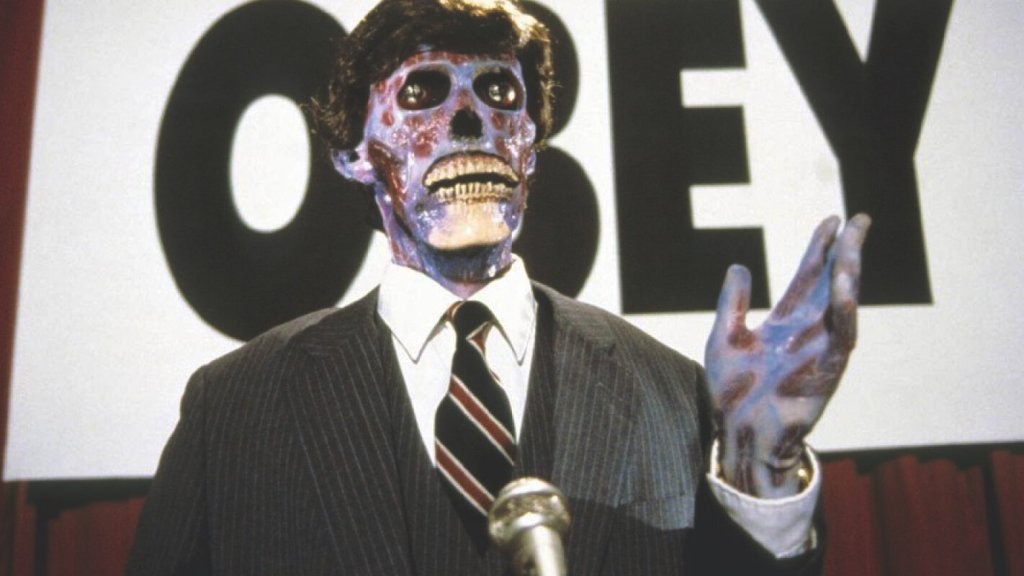
This is the premise of John Carpenter’s film They Live, which was released thirty-five years ago and remains unnervingly, chillingly appropriate for our modern age.
Best known for his horror film Halloween, which assumes that there is a form of evil so dark that it can’t be killed, Carpenter’s larger body of work is infused with a strong anti-authoritarian, anti-establishment, laconic bent that speaks to the filmmaker’s concerns about the unraveling of our society, particularly our government.
Time and again, Carpenter portrays the government working against its own citizens, a populace out of touch with reality, technology run amok, and a future more horrific than any horror film.
In Escape from New York, Carpenter presents fascism as the future of America.
In The Thing, a remake of the 1951 sci-fi classic of the same name, Carpenter presupposes that increasingly we are all becoming dehumanized.
In Christine, the film adaptation of Stephen King’s novel about a demon-possessed car, technology exhibits a will and consciousness of its own and goes on a murderous rampage.
In In the Mouth of Madness, Carpenter notes that evil grows when people lose “the ability to know the difference between reality and fantasy.”
And then there is Carpenter’s They Live, in which two migrant workers discover that the world is not as it seems. In fact, the population is actually being controlled and exploited by aliens working in partnership with an oligarchic elite. All the while, the populace—blissfully unaware of the real agenda at work in their lives—has been lulled into complacency, indoctrinated into compliance, bombarded with media distractions, and hypnotized by subliminal messages beamed out of television and various electronic devices, billboards and the like.
It is only when homeless drifter John Nada (played to the hilt by the late Roddy Piper) discovers a pair of doctored sunglasses—Hoffman lenses—that Nada sees what lies beneath the elite’s fabricated reality: control and bondage.
When viewed through the lens of truth, the elite, who appear human until stripped of their disguises, are shown to be monsters who have enslaved the citizenry in order to prey on them.
Likewise, billboards blare out hidden, authoritative messages: a bikini-clad woman in one ad is actually ordering viewers to “MARRY AND REPRODUCE.” Magazine racks scream “CONSUME” and “OBEY.” A wad of dollar bills in a vendor’s hand proclaims, “THIS IS YOUR GOD.”
When viewed through Nada’s Hoffman lenses, some of the other hidden messages being drummed into the people’s subconscious include: NO INDEPENDENT THOUGHT, CONFORM, SUBMIT, STAY ASLEEP, BUY, WATCH TV, NO IMAGINATION, and DO NOT QUESTION AUTHORITY.
This indoctrination campaign engineered by the elite in They Live is painfully familiar to anyone who has studied the decline of American culture.
A citizenry that does not think for themselves, obeys without question, is submissive, does not challenge authority, does not think outside the box, and is content to sit back and be entertained is a citizenry that can be easily controlled.
In this way, the subtle message of They Live provides an apt analogy of our own distorted vision of life in the American police state, what philosopher Slavoj Žižek refers to as dictatorship in democracy, “the invisible order which sustains your apparent freedom.”
Tune out the government’s attempts to distract, divert and befuddle us and tune into what’s really going on in this country, and you’ll run headlong into an unmistakable, unpalatable truth: what we are dealing with today is an authoritarian beast that has outgrown its chains and will not be restrained.
We’re being fed a series of carefully contrived fictions that bear no resemblance to reality.
Despite the fact that we are 17,600 times more likely to die from heart disease than from a terrorist attack; 11,000 times more likely to die from an airplane accident than from a terrorist plot involving an airplane; 1,048 times more likely to die from a car accident than a terrorist attack, and 8 times more likely to be killed by a police officer than by a terrorist , we have handed over control of our lives to government officials who treat us as a means to an end—the source of money and power.
As the Bearded Man in They Live warns, “They are dismantling the sleeping middle class. More and more people are becoming poor. We are their cattle. We are being bred for slavery.”
We have bought into the illusion and refused to grasp the truth.
From the moment we are born until we die, we are indoctrinated into believing that those who rule us do it for our own good. The truth is far different.
The powers-that-be want us to feel threatened by forces beyond our control (terrorists, pandemics, mass shootings, etc.).
They want us afraid and dependent on the government and its militarized armies for our safety and well-being.
They want us distrustful of each other, divided by our prejudices, and at each other’s throats.
We are little more than expendable resources to be used, abused and discarded.
In fact, a study conducted by Princeton and Northwestern University concluded that the U.S. government does not represent the majority of American citizens. Instead, the study found that the government is ruled by the rich and powerful, or the so-called “economic elite.” Moreover, the researchers concluded that policies enacted by this governmental elite nearly always favor special interests and lobbying groups.
In other words, we are being ruled by an oligarchy disguised as a democracy, and arguably on our way towards fascism—a form of government where private corporate interests rule, money calls the shots, and the people are seen as mere subjects to be controlled.
Rest assured that when and if fascism finally takes hold in America, the basic forms of government will remain: Fascism will appear to be friendly. The legislators will be in session. There will be elections, and the news media will continue to cover the entertainment and political trivia. Consent of the governed, however, will no longer apply. Actual control will have finally passed to the oligarchic elite controlling the government behind the scenes.
Sound familiar?
Clearly, we are now ruled by an oligarchic elite of governmental and corporate interests.
We have moved into “corporatism” (favored by Benito Mussolini), which is a halfway point on the road to full-blown fascism.
Corporatism is where the few moneyed interests—not elected by the citizenry—rule over the many. In this way, it is not a democracy or a republican form of government, which is what the American government was established to be. It is a top-down form of government and one which has a terrifying history typified by the developments that occurred in totalitarian regimes of the past: police states where everyone is watched and spied on, rounded up for minor infractions by government agents, placed under police control, and placed in detention (a.k.a. concentration) camps.
For the final hammer of fascism to fall, it will require the most crucial ingredient: the majority of the people will have to agree that it’s not only expedient but necessary.
But why would a people agree to such an oppressive regime?
The answer is the same in every age: fear.
Fear is the method most often used by politicians to increase the power of government. And, as most social commentators recognize, an atmosphere of fear permeates modern America: fear of terrorism, fear of the police, fear of our neighbors and so on.
The propaganda of fear has been used quite effectively by those who want to gain control, and it is transforming the populace into fearful, compliant, pacified zombies content to march in lockstep with the government’s dictates.
This brings me back to They Live, in which the real zombies are not the aliens calling the shots but the populace who are content to remain controlled.
When all is said and done, the world of They Live is not so different from our own. As one of the characters points out, “The poor and the underclass are growing. Racial justice and human rights are nonexistent. They have created a repressive society, and we are their unwitting accomplices. Their intention to rule rests with the annihilation of consciousness. We have been lulled into a trance. They have made us indifferent to ourselves, to others. We are focused only on our own gain.”
We, too, are focused only on our own pleasures, prejudices and gains. Our poor and underclasses are also growing. Injustice is growing. Inequality is growing. A concern for human rights is nearly nonexistent. We too have been lulled into a trance, indifferent to others.
Oblivious to what lies ahead, we’ve been manipulated into believing that if we continue to consume, obey, and have faith, things will work out. But that’s never been true of emerging regimes. And by the time we feel the hammer coming down upon us, it will be too late.
So where does that leave us?
The characters who populate Carpenter’s films provide some insight.
Underneath their machismo, they still believe in the ideals of liberty and equal opportunity. Their beliefs place them in constant opposition with the law and the establishment, but they are nonetheless freedom fighters.
When, for example, John Nada destroys the alien hypno-transmitter in They Live, he delivers a wake-up call for freedom. As Nada memorably declares, “I have come here to chew bubblegum and kick ass. And I’m all out of bubblegum.”
In other words: we need to get active and take a stand for what’s really important.
Stop allowing yourselves to be easily distracted by pointless political spectacles and pay attention to what’s really going on in the country.
As I make clear in my book Battlefield America: The War on the American People and in its fictional counterpart The Erik Blair Diaries, the real battle for control of this nation is taking place on roadsides, in police cars, on witness stands, over phone lines, in government offices, in corporate offices, in public school hallways and classrooms, in parks and city council meetings, and in towns and cities across this country.
All the trappings of the American police state are now in plain sight.
Wake up, America.
If they live (the tyrants, the oppressors, the invaders, the overlords), it is only because “we the people” sleep.
By Dawn Keetley
Source: Horror Homeroom
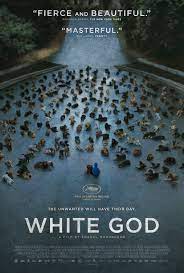
Summary of White God: Thirteen-year old Lili (Zsófia Psotta) moves in with her father who proves unwilling to pay the fees incumbent on the owners of mongrel dogs. He thus forces Lili to abandon her beloved Hagen on the streets of Budapest. The film follows the dual paths of Lili and Hagen as they, finally, find their way back to each other.
I loved White God (I’ll get that out up front), which premiered at the 2014 Cannes Film Festival and recently become widely available in the US. White God is a particularly interesting intervention in the horror genre in that it is the only film I can think of in which the animal (Hagen) becomes the protagonist rather than the antagonist. In all the other natural horror films I’ve seen recently, animals (wolves, sharks, crocodiles, bears) threaten more-or-less sympathetic humans. White God stands alone in showing how profoundly humans threaten animals.
White God is about two-hours long and I’ll warn you up front that it doesn’t become a horror film until about 30 minutes from the end. Only then does the beautifully shape-shifting form of the film end up as a revenge narrative (I couldn’t help comparing it to I Spit on Your Grave [1978]). And while both its human protagonist, Lili, and its dog protagonist, Hagen, are both, in their different ways, abandoned, it’s Hagen who suffers most and who ends up getting his justified revenge.
Up to that point, though, the director brilliantly weaves together resonances of childhood stories like Anna Sewall’s Black Beauty (1877), Sheila Burnford’s The Incredible Journey (1961), filmed in 1963 and again, as Homeward Bound, in 1993, and William H. Armstrong’s Sounder (1969), along with direct references to Jack London’s fiction, notably White Fang (1906).
In fact, White God‘s title is undoubtedly taken from White Fang, as Hagen’s adventures among the uniformly despicable humans that populate Budapest resemble almost exactly a portion of White Fang’s life with a man London pointedly calls the “mad god.” White Fang’s first encounters with humans are with Native Americans—and while they are certainly not positive, their barbarity pales in comparison to the brutality of his first encounters with white men, whom White Fang calls “white gods.” As London writes: “White Fang did not reason it out, did not in his mind make the sharp generalization that the white gods were more powerful.”[i] But so they are—and most of them do not use their power well. The mad “white god” that serves as the clear progenitor to a character Hagen has the misfortune to meet in White God takes White Fang and subjects him to an abusive training program designed to make him a vicious fighter. The training works well, and White Fang goes on to defeat every dog in the Yukon, as well as sundry wolves and a lynx.
Unlike White Fang, Hagen defies his training at a crucial moment, though. At first he goes along with it, acceding to his master’s desire. But then, at the end of his first fight, Hagen looks at his dead rival and has a realization that White Fang does not. Dogs aren’t the enemy.[ii]
From that moment, looking at the bloodied body of the dog he fleetingly thought was his rival, Hagen knows exactly who the enemy really is. He then rounds up all the stray dogs in Budapest, urging them into revolt.
While White God works as a powerful parable of the uprising of animals against their domination and brutalization by humans, it can also be read as an allegory for human oppression. The title, White God, along with the racial hierarchies (of Native Americans and whites) that it imports from White Fang, suggest that the dogs are also stand-ins for those humans who are cast aside because they are not “white,” because they are “mutts” and “half-breeds.” The current crisis in Europe over immigrants, mostly from Syria, and Hungary’s contentious role in that crisis, only intensifies this allegory, as the film has already begun to accrue meanings beyond its moment of inception.
As the dogs stream through Budapest’s streets, exhilarated by their collective power, the film unequivocally becomes a horror film, and the dogs invoke the zombies that streamed through London and Paris in 28 Days Later (Danny Boyle, 2002) and 28 Weeks Later (Juan Carlos Fresnadillo, 2007).
While it is indeed exhilarating to see them, the dogs’ resemblance to zombies infuses these scenes with sadness and dread. Does this resemblance foreshadow their eventual doom? What can dogs do, in the end, in the face of determined human opposition? Do they really have any choice but to submit to their role of our “best friends” as their best means of survival? Despite how bad so many of us are at being their “friend.”
The ending of White God, after Hagen’s glorious and bloody revenge, is ambiguous. Hagen meets Lili again but she’s changed: we’ve seen her shift much more of her allegiance toward humans during the course of her journey (which I found much less gripping than Hagen’s). There’s a scene, which we see right at the opening of the film and then near the end, in which dogs run furiously as Lili pedals her bike. Are they chasing Lili? Is she leading them? Are they both on separate journeys, the dogs indifferent to her? The answer becomes only a bit clearer in the second reiteration of the scene.
The ending presents us with an image that is on all the posters for the film—and its meaning is ambiguous too.
Clearly Lili figures as some kind of “god” figure here, for Hagen and the other dogs: she has become the “white god” of the title. But will she use her power to save the dogs? Or will she merely appease them until others come to destroy them. You can make up your own mind. Me? I’m not hopeful.
R | 121 mins. | Kornél Mundruczó | Hungary | 2014
Grade: A
____________________
Watch White God on Kanopy here: https://www.kanopy.com/en/product/2332130

By Keith Garlington
Source: Keith and the Movies
It’s hard to believe that it has been twelve years since French filmmaker Michel Hazanavicius won his Best Director Academy Award for the Best Picture winning “The Artist”. While it has become somewhat fashionable in some circles to dismiss that brilliant 2011 film as unworthy, I still hold it in incredibly high regard as a delightful ode to a bygone cinematic era.
Hazanavicius’ latest film couldn’t be more different. “Final Cut” is a meta zombie comedy that is an open-armed tribute to cinema, a love letter to genre filmmaking, a celebration of creative collaboration, and just an all-around wacky piece of work. It’s a faithful remake of Shin’ichirô Ueda’s 2017 cult hit “One Cut of the Dead” but with its own French twist. It’s a consistently clever and routinely funny concoction that sees Hazanavicius and his all-in cast having the time of their lives.
Describing “Final Cut” to those who haven’t seen “One Cut of the Dead” is a bit of a challenge because the less you know going in the better. The film’s unorthodox structure plays a big part in making it such a fun experience. It’s a case of a filmmaker showing you one thing and then adding an entirely different perspective later on. I know that’s vague, but suffice it to say Hazanavicius has a field day playing with his audience’s expectations.
The spoiler-free gist of the story goes something like this. Romain Duris plays Rémi Bouillon, a frustrated filmmaker who signs on to direct a low-budget zombie short film for an upstart streaming platform that specializes in B-movies. But there’s a catch. The 30-minute single-take film is to be shot and streamed LIVE! It’s an unheard of undertaking but one the platform’s ownership has already pulled off in their home country of Japan. Now they want to do it in France.
Rémi is hesitant to take the job at first, seeing it as a doomed-to-fail project. But with the encouragement of his wife Nadia (Bérénice Bejo) and with hopes it will rekindle his relationship with his aspiring filmmaker daughter Romy (Simone Hazanavicius) he agrees.
Soon he’s on location dealing with a smug high-maintenance lead actor (Finnegan Oldfield), his inexperienced lead actress Ava (Matilda Lutz), a supporting actor who can’t stay off the bottle (Grégory Gadebois), and the demands of domineering producers who don’t prescribe to the notion of a director’s creative freedom.
As “Final Cut” shifts to the show’s production phase things get crazy and we gain an entirely new perspective on everything we’ve seen up to that point. Hazanavicius drenches his audience in blood, gore, and countless zombie horror tropes which is a big part of the fun. That said, it’s never the slightest bit tense or scary but neither does it try to be. It’s much more of a comedy, full of running gags, fun characters, an infectious B-movie charm, and a surprising level of warmth that I never expected.
Watch Final Cut on Kanopy here: https://www.kanopy.com/en/product/13547325
By Edward Curtin
Source: Behind the Curtain
“Method, Method, what do you want from me? You know that I have eaten of the fruit of the unconscious.” – Jules Laforgue, Moralités légendaires
The other day my wife attended an event at a well-appointed home in town where men in dark suits stood around to provide a sense of security that no harm would come to the visitors, even though the angel of death had visited this house on previous occasions, for it was a funeral home, well-steeped in boxing people up for the journey to the underworld. So to call it a “home” is really a misnomer; that might sound cozy, but it is really a way station for the dead. A layover.
Mistakenly thinking that she was attending a traditional wake and the dead person’s corpse would be there in a coffin, I suggested that she check out the casket and, if she liked its wood and the softness of its velvet liner, to inquire whether they had any sales going on, especially if they had a buy-one-get-one-free sale like the local supermarket often has for English muffins and other goodies.
I think she forgot to ask, but she did tell me that the elderly woman who died had been cremated weeks ago and that her ashes were in a box on a table. Boxes, ah, little boxes.
***
I have long wondered why so many people are enchanted by sunsets, why they travel to see them and gasp in wonder that the sun disappears and night comes on. Colorful yes, but not as glorious as the sunrise, the rosy-fingered dawn of every new day. Why celebrate the death of the day and our journey into the underworld of sleep and the cave of dreams rather than the dawn of our awakening and new life. Jokes aside, morbidity is not life-affirming. The true apocalypse – Greek apokalyptein, uncover, disclose, reveal – is every dawn’s epiphany when we can dream while awake and create.
***
In Apuleius’s Metamorphoses there is the story of Cupid and Psyche, the former being a male god and the latter a female human. Psyche, who has lost her lover Cupid but wants him back, is tricked by the goddess Aphrodite who challenges her, if she wants Cupid back, to take the dangerous journey to the underworld to retrieve a box of beauty cream. Psyche goes and gets the box but is tempted to open it since it would enhance her already beautiful human appearance. When she does, she falls into a deathlike sleep. It’s an old story, forever new. Switch the sexes if you wish. Take 200 vitamin pills a day as many billionaires and other assorted crazies do intent on becoming immortal gods. Good luck. Get uploaded or downloaded into a computer, whichever it is, and live forever. Maybe watch the sun set or perchance wake up. And although Psyche is given a Hollywood ending when she is saved by Zeus and made immortal with the other gods in Olympus, that’s just an old movie. We live by facts these days, not myths. Ah, boxes.
***
The Boxer by Simon & Garfunkel
I am just a poor boy, though my story’s
seldom told
I have squandered my resistance for a
pocketful of mumbles
Such as promises
All lies and jest
Still a man hears what he wants to hear
And disregards the rest, hmm
***
Children love boxes within which they often hide their collections for safekeeping. Give a child a box with a lid and it will be filled in no time. Filled with little things that symbolize for children the vast infinity of secret space that is their hold on time. Children are born poets and philosophers who over time are usually dulled by adults around them from whom they learn to hide their secrets and the questions these secrets raise. The secrets often fester and die, only to live on in repressed lives. I knew a man who collected cigar boxes. They were everywhere in his house when he died. Most were empty. His wife outdid him with her collection of empty boxes: shoe boxes, jewelry boxes, every kind of box imaginable. All empty. Were they waiting to be filled? With what? Secrets? Another woman I knew had a box with an envelope inside marked, “My Father’s Magic Envelope – AKA Miracles.” It was empty. She pictured herself as a boxer in a sketch she drew, a child without a face with boxing gloves. I can only guess at the secrets she was fighting to remember or forget. The experimental method is based on repetition, but so too is trauma. Internment is not just for the dead.
***
Boxed in, boxed up, housed, enclosed. trapped, contained, caged , enveloped, bounded, penned, corralled, trapped: calling from my cell for help? The screen lights up with a concatenation of phantom images that seize the mind, what the Greeks called eidolon.
***
Let’s forget about Pandora’s box, which was actually a jar in the original story. Its last content being hope. I once knew a girl named Hope. She was very seductive. But I sensed she was trouble and escaped when she started to open up about her secrets. I wasn’t very curious, just afraid. So long, Hope, “it’s time that we began to laugh and cry and cry and laugh about it all again.” Thanks, Leonard.
***
There are countless political analyses of what drives the United States’ ruling forces in their systematic, brutal, and remorseless wars of aggression around the world. The perpetual effort to expand an empire originally built on the blood of indigenous people. The refusal to live in peace within national boundaries. The pushing of NATO expansion up to Russia’s borders. It seems insane, which of course it is. But what is behind such madness? The secret may be quite simple. Again the ancient Greeks come to mind as Roberto Calasso writes in The Marriage of Cadmus and Harmony, quoting the historian Jacob Burckhardt, when he wrote of the secret of war-loving Sparta: “But the power of Sparta seems to have come into being almost entirely for itself and for its own self-assertion, and its constant pathos was the enslavement of subject peoples and the extension of its own dominion as an end unto itself.” Power as an end in itself. Realizing this is apocalyptic in the revelatory sense, for it opens the box on the secret nihilism of the U.S. ruling elites.
***
I am waiting
to get some intimations
of immortality
by recollecting my early childhood
and I am waiting
for the green mornings to come again
youth’s dumb green fields come back again
and I am waiting
for some strains of unpremeditated art
to shake my typewriter
and I am waiting to write
the great indelible poem
and I am waiting
for the last long careless rapture
and I am perpetually waiting
for the fleeing lovers on the Grecian Urn
to catch each other up at last
and embrace
and I am waiting
perpetually and forever
a renaissance of wonder– Lawrence Ferlinghetti, “I Am Waiting,”
for jazz accompaniment

By Simon Abrams
Source: RogerEbert.com
Japanese filmmaker Nobuhiko Obayashi was diagnosed with lung cancer in 2016, about three years before he completed “Labyrinth of Cinema,” a trippy anti-war drama about Japanese war movies, of which Obayashi re-creates, parodies, and criticizes in one long movie within his movie. Or really, it’s one long movie marathon within Obayashi’s movie since “Labyrinth of Cinema” takes place at an evening-long war film festival hosted by Setouchi Kinema, a small Hiroshima movie theater that’s putting on one last show before permanently closing.
The plot is simple enough to be irrelevant: three bright young things— teeth-picking film historian Hosuke (Takahito Hosoyamada), enthusiastic film buff Mario (Takuro Atsuki), and aspiring gangster Shigeru (Yoshihiko Hosoda)—chase after chaste 13-year-old Noriko (Rei Yoshida) after she tumbles into the Setouchi Kinema’s movie screen, and becomes part of Obayashi’s unstable meta-narrative. By the way: Obayashi died of lung cancer a year and a half ago. You can tell that his death weighed on him just by watching “Labyrinth of Cinema,” his last movie, a three-hour living will, and a dazzling curtain call.
The movie’s Hiroshima setting gives away its personal nature since Onomichi, Hiroshima is director/co-writer/co-editor Obayashi’s hometown and also the main location for some of his movies, including the 1983 bubblegum-psych fantasy “The Girl Who Leapt Through Time.” Obayashi is best known to American cinephiles as the director of the 1977 day-glo nightmare “House,” a fizzy horror-fantasy that only became an international cause célèbre in 2009 after it screened at the New York Asian Film Festival and a few other noteworthy events. In “Labyrinth of Cinema,” Obayashi (along with co-writers Kazuya Konaka and Tadashi Naito) tries to sum up what he’s learned and tried to convey through filmmaking in a volatile auto-critique of movies as both seductive propaganda and palliative empathy machines.
Obayashi uses green-screen technology and cheap (but effective) computer graphics to dramatize folksy anecdotes about filmmakers like John Ford and Yasujiro Ozu, which he sandwiches between brutal and/or sentimental episodes about local war crimes and counter-cultural resistance. Sometimes Obayashi quotes poetry, particularly by Chuya “Japan’s Rimbaud” Nakahara. Sometimes, a cartoon character or samurai folk hero (Musashi Miyamoto?!) steals a scene or two. A few characters, like the time-traveling authorial stand-in Fanta G (drummer Yukihiro Takahashi), talk about movies as a beautiful, essential lie that’s first used as a balm and a distraction, and then also considered as a runway to a brighter and still unimaginable future. You give Obayashi three hours of your time, and he’ll give you a brilliant headache.
You might watch “Labyrinth of Cinema” and wonder where the hell this all came from. Like Obayashi’s recent war trilogy (2011-2017), and many of his earlier features—and short movies and TV commercials—“Labyrinth of Cinema” constantly reminds you that it’s “A Movie.” Before Obayashi’s movies begin, the words “A Movie” are usually presented on-screen in a frame within the image’s frame. So in “Labyrinth of Cinema,” Obayashi’s characters are often re-framed by small circular frames within the camera’s frame. Sometimes these images flip around on-screen, so that a character who was on the left side of the screen is now upside, or on the right, as if they were in conversation with themselves, the viewer, and anyone else who’s watching. There are also a surprising number of fart jokes and some callbacks to older Japanese movies like “I Am a Cat,” “The Rickshaw Man,” and “Wife! Be Like a Rose.” “Labyrinth of Cinema” is a lot of movie.
Obayashi’s various projects are instantly recognizable, given his usual combination of mistrust and fascination with movies as an expression of wish fulfillment and nostalgia. So it’s not surprising that his view of the past—and the cinematic image—is never really seductive in “Labyrinth of Cinema.” Cheerfully naïve characters get lost in their companions’ comforting, half-remembered memories, and never stop to wonder why one thing inevitably leads to another, and another, and another. They float around on-screen, unmoved by the laws of gravity or physics and unable to hide in whatever photo-booth-quality backdrop surrounds them. Obayashi’s characters all half-know and half-hope that they’ll live to see the next scene, so they take their time learning how to ride the ever-breaking tidal wave of Japanese history according to Nobuhiko Obayashi.
“Labyrinth of Cinema” is tremendously affecting, frequently beguiling, usually exhausting, and on, and on, and on. An indulgent ramble from an innovative surrealist who was always sensitive and even suspicious of his own work’s impact—as a tool for advertising, political whitewashing, and pure sentimental indoctrination. On his out way the door, Nobuhiko Obayashi left us wondering how he got all the way from “House” to here without losing faith in humanity and his art; I don’t know, but “Labyrinth of Cinema” is still there anyway.
INDIAN COUNTRY NEWS
"It is the duty of every man, as far as his ability extends, to detect and expose delusion and error"..Thomas Paine
Human in Algorithms
From the Roof Top
I See This
blog of the post capitalist transition.. Read or download the novel here + latest relevant posts
अध्ययन-अनुसन्धानको सार
 After the Crash