Two for Tuesday
Reply

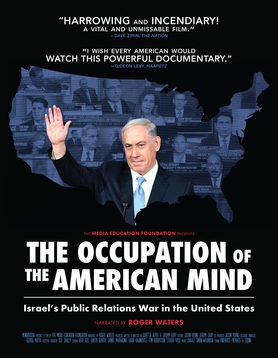
Source: Media Education Foundation
“The Occupation of the American Mind” has been repeatedly attacked and misrepresented by right-wing pressure groups and outright ignored by virtually all mainstream media outlets and North American film festivals.
To help bring context to U.S. corporate media coverage of the Oct. 7 Hamas attacks and Israel’s escalating bombardment of Gaza, we’re releasing this newly abridged, 49-minute version of our 2016 film “The Occupation of the American Mind.” The film places special emphasis on propaganda efforts designed to conceal Israel’s brutal and illegal decades-long occupation of Palestinian land as a root cause of the conflict, and to cast those who speak up for Palestinian human rights as either anti-Semitic or terrorist-sympathizers. Narrated by Roger Waters, and featuring Noam Chomsky, Rashid Khalidi, Yousef Munayyer, Amira Hass, Norman Finkelstein, Phyllis Bennis, Rula Jebreal, Norman Solomon, Max Blumenthal, Rami Khouri, M.J. Rosenberg, Stephen J. Walt, Mark Crispin Miller, Peter Hart, Henry Siegman, and Sut Jhally.
A transcript of this 49 minute version to follow along with is available by going to https://www.youtube.com/watch?v=-jKRwdsq-As
49 MINUTE VERSION (The restriction is because of violent scenes.)
“The Occupation of the American Mind: Israel’s Public Relations War in the United States.” Despite receiving an overwhelmingly positive response from those who have actually seen it,” The Occupation of the American Mind” has been repeatedly attacked and misrepresented by right-wing pressure groups and outright ignored by virtually all mainstream media outlets and North American film festivals. To bypass this campaign of misrepresentation and suppression, we’ve decided to make the film available for FREE online so that people can make up their own minds about its analysis of U.S. media coverage of the Israeli-Palestinian conflict. Please watch and share widely! Support for the free distribution of this film was provided by the Wallace Action Fund of Tides Foundation, advised by Randall Wallace. If you’d like to help support the effort to provide free distribution of The Occupation of the American Mind, please consider a donation. https://www.mediaed.org/donate/
By John & Nisha Whitehead
Source: The Rutherford Institute
“There is something terribly wrong with this country, isn’t there? Cruelty and injustice, intolerance and oppression. And where once you had the freedom to object, to think and speak as you saw fit, you now have censors and systems of surveillance coercing your conformity and soliciting your submission. How did this happen? Who’s to blame?”— V for Vendetta
We have arrived at the dystopian future depicted in the 2005 film V for Vendetta, which is no future at all.
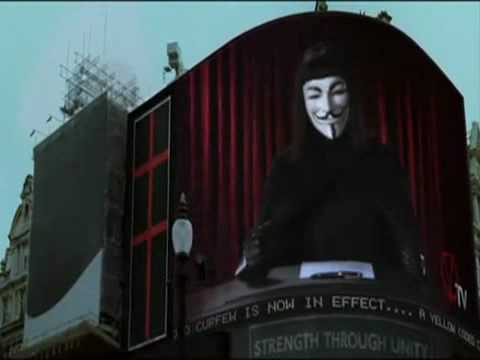
Set in the year 2020, V for Vendetta (written and produced by the Wachowskis) provides an eerie glimpse into a parallel universe in which a government-engineered virus wreaks havoc on the world. Capitalizing on the people’s fear, a totalitarian government comes to power that knows all, sees all, controls everything and promises safety and security above all.
Concentration camps (jails, private prisons and detention facilities) have been established to house political prisoners and others deemed to be enemies of the state. Executions of undesirables (extremists, troublemakers and the like) are common, while other enemies of the state are made to “disappear.” Populist uprisings and protests are met with extreme force. The television networks are controlled by the government with the purpose of perpetuating the regime. And most of the population is hooked into an entertainment mode and are clueless.
With Vendetta, whose imagery borrows heavily from Nazi Germany’s Third Reich and George Orwell’s 1984, we come full circle. The corporate state in V conducts mass surveillance on its citizens, helped along by closed-circuit televisions. Also, London is under yellow-coded curfew alerts, similar to the American government’s color-coded Homeland Security Advisory System.
Sounds painfully familiar, doesn’t it?
As director James McTeighe observed about the tyrannical regime in V for Vendetta, “It really showed what can happen when society is ruled by government, rather than the government being run as a voice of the people. I don’t think it’s such a big leap to say things like that can happen when leaders stop listening to the people.”
Clearly, those we appointed to represent our interests have stopped following the Constitution and listening to the American people.
What will it take for the government to start listening to the people again?
In V for Vendetta, as in my novel The Erik Blair Diaries, the subtext is that authoritarian regimes—through a vicious cycle of manipulation, oppression and fear-mongering—foment violence, manufacture crises, and breed terrorists, thereby giving rise to a recurring cycle of blowback and violence.
Only when the government itself becomes synonymous with the terrorism wreaking havoc in their lives do the people to finally mobilize and stand up to the government’s tyranny.
V, a bold, charismatic freedom fighter, urges the British people to rise up and resist the government. In Vendetta, V the film’s masked crusader blows up the seat of government on November 5, Guy Fawkes Day, while in Erik Blair, freedom fighters plot to unmask the Deep State.
Acts of desperation and outright anarchy are what happens when a parasitical government muzzles the citizenry, fences them in, herds them, brands them, whips them into submission, forces them to ante up the sweat of their brows while giving them little in return, and then provides them with little to no outlet for voicing their discontent: people get desperate, citizens lose hope, and lawful, nonviolent resistance gives way to unlawful, violent resistance.
This way lies madness.
Then again, madness may be unavoidable unless we can wrest back control over our runaway government starting at the local level.
It is time to recalibrate the government.
For years now, we have suffered the injustices, cruelties, corruption and abuse of an entrenched government bureaucracy that has no regard for the Constitution or the rights of the citizenry.
By “government,” I’m not referring to the farce that is the highly partisan, two-party, bureaucracy of the Republicans and Democrats. Rather, I’m referring to “government” with a capital “G,” the entrenched Deep State that is unaffected by elections, unaltered by populist movements, and has set itself beyond the reach of the law.
We are overdue for a systemic check on the government’s overreaches and power grabs.
We have lingered too long in this strange twilight zone where ego trumps justice, propaganda perverts truth, and imperial presidents—empowered to indulge their authoritarian tendencies by legalistic courts, corrupt legislatures and a disinterested, distracted populace—rule by fiat rather than by the rule of law.
The COVID-19 pandemic provided the government with the perfect excuse to lay claim to a long laundry list of terrifying lockdown powers (at both the federal and state level) that override the Constitution: the ability to suspend the Constitution, indefinitely detain American citizens, bypass the courts, quarantine whole communities or segments of the population, override the First Amendment by outlawing religious gatherings and assemblies of more than a few people, shut down entire industries and manipulate the economy, muzzle dissidents, reshape financial markets, create a digital currency (and thus further restrict the use of cash), determine who should live or die, and impose health mandates on large segments of the population.
Crises tend to bring out the authoritarian tendencies in government.
That’s no surprise: power corrupts, and absolute power corrupts absolutely.
Where we find ourselves now is in the unenviable position of needing to rein in all three branches of government—the Executive, the Judicial, and the Legislative—that have exceeded their authority and grown drunk on power.
This is exactly the kind of concentrated, absolute power the founders attempted to guard against by establishing a system of checks of balances that separate and shares power between three co-equal branches: the executive, the legislative and the judiciary.
“The system of checks and balances that the Framers envisioned now lacks effective checks and is no longer in balance,” concludes law professor William P. Marshall. “The implications of this are serious. The Framers designed a system of separation of powers to combat government excess and abuse and to curb incompetence. They also believed that, in the absence of an effective separation-of-powers structure, such ills would inevitably follow. Unfortunately, however, power once taken is not easily surrendered.”
Unadulterated power in any branch of government is a menace to freedom.
There’s no point debating which political party would be more dangerous with these powers.
The fact that any individual—or branch of government—of any political persuasion is empowered to act like a dictator is danger enough.
So, what we can do to wrest back control over a runaway government and an imperial presidency?
It won’t be easy.
We are the unwitting victims of a system so corrupt that those who stand up for the rule of law and aspire to transparency in government are in the minority.
This corruption is so vast it spans all branches of government: from the power-hungry agencies under the executive branch and the corporate puppets within the legislative branch to a judiciary that is, more often than not, elitist and biased towards government entities and corporations.
We are ruled by an elite class of individuals who are completely out of touch with the travails of the average American.
We are viewed as relatively expendable in the eyes of government: faceless numbers of individuals who serve one purpose, which is to keep the government machine running through our labor and our tax dollars. Those in power aren’t losing any sleep over the indignities we are being made to suffer or the possible risks to our health. All they seem to care about are power and control.
We are being made to suffer countless abuses at the government’s hands.
We have little protection against standing armies (domestic and military), invasive surveillance, marauding SWAT teams, an overwhelming government arsenal of assault vehicles and firepower, and a barrage of laws that criminalize everything from vegetable gardens to lemonade stands.
In the name of national security, we’re being subjected to government agencies such as the NSA, FBI and others listening in on our phone calls, reading our mail, monitoring our emails, and carrying out warrantless “black bag” searches of our homes. Adding to the abuse, we have to deal with surveillance cameras mounted on street corners and in traffic lights, weather satellites co-opted for use as spy cameras from space, and thermal sensory imaging devices that can detect heat and movement through the walls of our homes.
That doesn’t even begin to touch on the many ways in which our Fourth Amendment rights are trampled upon by militarized police and SWAT teams empowered to act as laws unto themselves.
In other words, freedom—or what’s left of it—is threatened from every direction.
The predators of the police state are wreaking havoc on our freedoms, our communities, and our lives. The government doesn’t listen to the citizenry, it refuses to abide by the Constitution, which is our rule of law, and it treats the citizenry as a source of funding and little else. Police officers are shooting unarmed citizens and their household pets. Government agents—including local police—are being armed to the teeth and encouraged to act like soldiers on a battlefield. Bloated government agencies are fleecing taxpayers. Government technicians are spying on our emails and phone calls. Government contractors are making a killing by waging endless wars abroad.
In other words, the American police state is alive and well and flourishing.
Nothing has changed, and nothing will change unless we insist on it.
How to do this? It’s not rocket science.
There is no 10-step plan. If there were a 10-step plan, however, the first step would be as follows: turn off the televisions, tune out the politicians, and do your part to stand up for freedom principles in your own communities.
Stand up for your own rights, of course, but more importantly, stand up for the rights of those with whom you might disagree. Defend freedom at all costs. Defend justice at all costs. Make no exceptions based on race, religion, creed, politics, immigration status, sexual orientation, etc. Vote like Americans, for a change, not Republicans or Democrats.
Most of all, use your power—and there is power in our numbers—to nullify anything and everything the government does that undermines the freedom principles on which this nation was founded.
Don’t play semantics. Don’t justify. Don’t politicize it. If it carries even a whiff of tyranny, oppose it. Demand that your representatives in government cut you a better deal, one that abides by the Constitution and doesn’t just attempt to sidestep it.
That’s their job: make them do it.
As I make clear in my book Battlefield America: The War on the American People and in its fictional counterpart The Erik Blair Diaries, all freedoms hang together. They fall together, as well.
The police state does not discriminate. Eventually, we will all suffer the same fate.
By John & Nisha Whitehead
Source: The Rutherford Institute
“But these weren’t the kind of monsters that had tentacles and rotting skin, the kind a seven-year-old might be able to wrap his mind around—they were monsters with human faces, in crisp uniforms, marching in lockstep, so banal you don’t recognize them for what they are until it’s too late.” ― Ransom Riggs, Miss Peregrine’s Home for Peculiar Children
Enough already.
Enough with the distractions. Enough with the partisan jousting.
Enough with the sniping and name-calling and mud-slinging that do nothing to make this country safer or freer or more just.
We have let the government’s evil-doing, its abuses, power grabs, brutality, meanness, inhumanity, immorality, greed, corruption, debauchery and tyranny go on for too long.
We are approaching a reckoning.
This is the point, as the poet W. B. Yeats warned, when things fall apart and anarchy is loosed upon the world.
We have seen this convergence before in Hitler’s Germany, in Stalin’s Russia, in Mussolini’s Italy, and in Mao’s China: the rise of strongmen and demagogues, the ascendency of profit-driven politics over deep-seated principles, the warring nationalism that seeks to divide and conquer, the callous disregard for basic human rights and dignity, and the silence of people who should know better.
Yet no matter how many times the world has been down this road before, we can’t seem to avoid repeating the deadly mistakes of the past.
This is not just playing out on a national and international scale. It is wreaking havoc at the most immediate level, as well, creating rifts and polarities within families and friends, neighborhoods and communities that keep the populace warring among themselves and incapable of presenting a united front in the face of the government’s goose-stepping despotism.
We labor today under the weight of countless tyrannies, large and small, disguised as “the better good,” marketed as benevolence, enforced with armed police, and carried out by an elite class of government officials who are largely insulated from the ill effects of their actions.
For too long now, the American people have rationalized turning a blind eye to all manner of government wrongdoing—asset forfeiture schemes, corruption, surveillance, endless wars, SWAT team raids, militarized police, profit-driven private prisons, and so on—because they were the so-called lesser of two evils.
Yet the unavoidable truth is that the government—through its acts of power grabs, brutality, meanness, inhumanity, immorality, greed, corruption, debauchery and tyranny—has become almost indistinguishable from the evil it claims to be fighting, whether that evil takes the form of terrorism, torture, drug trafficking, sex trafficking, murder, violence, theft, pornography, scientific experimentations or some other diabolical means of inflicting pain, suffering and servitude on humanity.
At its core, this is not a debate about politics, or constitutionalism, or even tyranny disguised as law-and-order. This is a condemnation of the monsters with human faces who walk among us.
Many of them work for the U.S. government.
This is the premise of John Carpenter’s film They Live, which was released thirty-five years ago and remains unnervingly, chillingly appropriate for our modern age.
Best known for his horror film Halloween, which assumes that there is a form of evil so dark that it can’t be killed, Carpenter’s larger body of work is infused with a strong anti-authoritarian, anti-establishment, laconic bent that speaks to the filmmaker’s concerns about the unraveling of our society, particularly our government.
Time and again, Carpenter portrays the government working against its own citizens, a populace out of touch with reality, technology run amok, and a future more horrific than any horror film.
In Escape from New York, Carpenter presents fascism as the future of America.
In The Thing, a remake of the 1951 sci-fi classic of the same name, Carpenter presupposes that increasingly we are all becoming dehumanized.
In Christine, the film adaptation of Stephen King’s novel about a demon-possessed car, technology exhibits a will and consciousness of its own and goes on a murderous rampage.
In In the Mouth of Madness, Carpenter notes that evil grows when people lose “the ability to know the difference between reality and fantasy.”
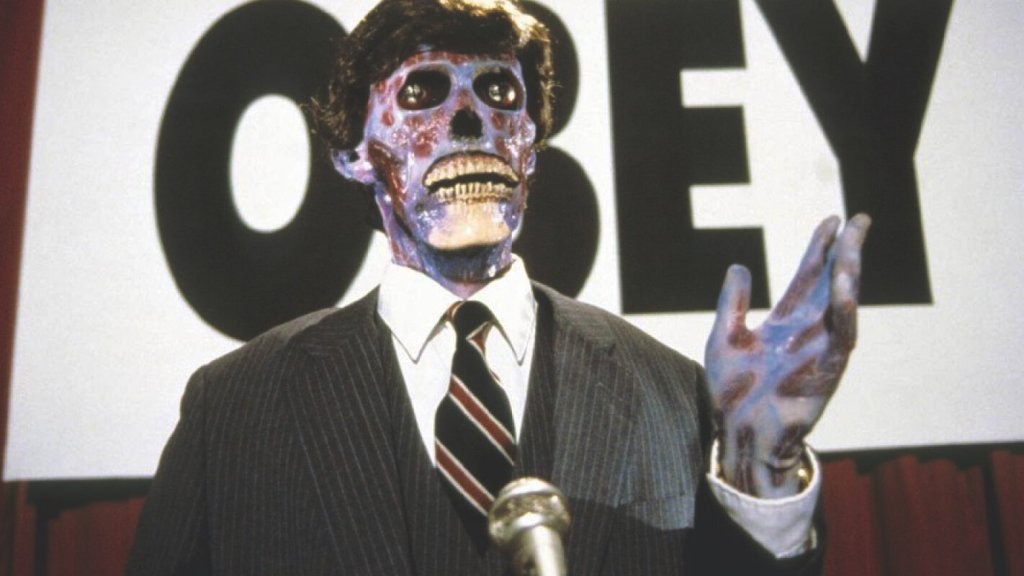
And then there is Carpenter’s They Live, in which two migrant workers discover that the world is not as it seems. In fact, the population is actually being controlled and exploited by aliens working in partnership with an oligarchic elite. All the while, the populace—blissfully unaware of the real agenda at work in their lives—has been lulled into complacency, indoctrinated into compliance, bombarded with media distractions, and hypnotized by subliminal messages beamed out of television and various electronic devices, billboards and the like.
It is only when homeless drifter John Nada (played to the hilt by the late Roddy Piper) discovers a pair of doctored sunglasses—Hoffman lenses—that Nada sees what lies beneath the elite’s fabricated reality: control and bondage.
When viewed through the lens of truth, the elite, who appear human until stripped of their disguises, are shown to be monsters who have enslaved the citizenry in order to prey on them.
Likewise, billboards blare out hidden, authoritative messages: a bikini-clad woman in one ad is actually ordering viewers to “MARRY AND REPRODUCE.” Magazine racks scream “CONSUME” and “OBEY.” A wad of dollar bills in a vendor’s hand proclaims, “THIS IS YOUR GOD.”
When viewed through Nada’s Hoffman lenses, some of the other hidden messages being drummed into the people’s subconscious include: NO INDEPENDENT THOUGHT, CONFORM, SUBMIT, STAY ASLEEP, BUY, WATCH TV, NO IMAGINATION, and DO NOT QUESTION AUTHORITY.
This indoctrination campaign engineered by the elite in They Live is painfully familiar to anyone who has studied the decline of American culture.
A citizenry that does not think for themselves, obeys without question, is submissive, does not challenge authority, does not think outside the box, and is content to sit back and be entertained is a citizenry that can be easily controlled.
In this way, the subtle message of They Live provides an apt analogy of our own distorted vision of life in the American police state, what philosopher Slavoj Žižek refers to as dictatorship in democracy, “the invisible order which sustains your apparent freedom.”
Tune out the government’s attempts to distract, divert and befuddle us and tune into what’s really going on in this country, and you’ll run headlong into an unmistakable, unpalatable truth: what we are dealing with today is an authoritarian beast that has outgrown its chains and will not be restrained.
We’re being fed a series of carefully contrived fictions that bear no resemblance to reality.
Despite the fact that we are 17,600 times more likely to die from heart disease than from a terrorist attack; 11,000 times more likely to die from an airplane accident than from a terrorist plot involving an airplane; 1,048 times more likely to die from a car accident than a terrorist attack, and 8 times more likely to be killed by a police officer than by a terrorist , we have handed over control of our lives to government officials who treat us as a means to an end—the source of money and power.
As the Bearded Man in They Live warns, “They are dismantling the sleeping middle class. More and more people are becoming poor. We are their cattle. We are being bred for slavery.”
We have bought into the illusion and refused to grasp the truth.
From the moment we are born until we die, we are indoctrinated into believing that those who rule us do it for our own good. The truth is far different.
The powers-that-be want us to feel threatened by forces beyond our control (terrorists, pandemics, mass shootings, etc.).
They want us afraid and dependent on the government and its militarized armies for our safety and well-being.
They want us distrustful of each other, divided by our prejudices, and at each other’s throats.
We are little more than expendable resources to be used, abused and discarded.
In fact, a study conducted by Princeton and Northwestern University concluded that the U.S. government does not represent the majority of American citizens. Instead, the study found that the government is ruled by the rich and powerful, or the so-called “economic elite.” Moreover, the researchers concluded that policies enacted by this governmental elite nearly always favor special interests and lobbying groups.
In other words, we are being ruled by an oligarchy disguised as a democracy, and arguably on our way towards fascism—a form of government where private corporate interests rule, money calls the shots, and the people are seen as mere subjects to be controlled.
Rest assured that when and if fascism finally takes hold in America, the basic forms of government will remain: Fascism will appear to be friendly. The legislators will be in session. There will be elections, and the news media will continue to cover the entertainment and political trivia. Consent of the governed, however, will no longer apply. Actual control will have finally passed to the oligarchic elite controlling the government behind the scenes.
Sound familiar?
Clearly, we are now ruled by an oligarchic elite of governmental and corporate interests.
We have moved into “corporatism” (favored by Benito Mussolini), which is a halfway point on the road to full-blown fascism.
Corporatism is where the few moneyed interests—not elected by the citizenry—rule over the many. In this way, it is not a democracy or a republican form of government, which is what the American government was established to be. It is a top-down form of government and one which has a terrifying history typified by the developments that occurred in totalitarian regimes of the past: police states where everyone is watched and spied on, rounded up for minor infractions by government agents, placed under police control, and placed in detention (a.k.a. concentration) camps.
For the final hammer of fascism to fall, it will require the most crucial ingredient: the majority of the people will have to agree that it’s not only expedient but necessary.
But why would a people agree to such an oppressive regime?
The answer is the same in every age: fear.
Fear is the method most often used by politicians to increase the power of government. And, as most social commentators recognize, an atmosphere of fear permeates modern America: fear of terrorism, fear of the police, fear of our neighbors and so on.
The propaganda of fear has been used quite effectively by those who want to gain control, and it is transforming the populace into fearful, compliant, pacified zombies content to march in lockstep with the government’s dictates.
This brings me back to They Live, in which the real zombies are not the aliens calling the shots but the populace who are content to remain controlled.
When all is said and done, the world of They Live is not so different from our own. As one of the characters points out, “The poor and the underclass are growing. Racial justice and human rights are nonexistent. They have created a repressive society, and we are their unwitting accomplices. Their intention to rule rests with the annihilation of consciousness. We have been lulled into a trance. They have made us indifferent to ourselves, to others. We are focused only on our own gain.”
We, too, are focused only on our own pleasures, prejudices and gains. Our poor and underclasses are also growing. Injustice is growing. Inequality is growing. A concern for human rights is nearly nonexistent. We too have been lulled into a trance, indifferent to others.
Oblivious to what lies ahead, we’ve been manipulated into believing that if we continue to consume, obey, and have faith, things will work out. But that’s never been true of emerging regimes. And by the time we feel the hammer coming down upon us, it will be too late.
So where does that leave us?
The characters who populate Carpenter’s films provide some insight.
Underneath their machismo, they still believe in the ideals of liberty and equal opportunity. Their beliefs place them in constant opposition with the law and the establishment, but they are nonetheless freedom fighters.
When, for example, John Nada destroys the alien hypno-transmitter in They Live, he delivers a wake-up call for freedom. As Nada memorably declares, “I have come here to chew bubblegum and kick ass. And I’m all out of bubblegum.”
In other words: we need to get active and take a stand for what’s really important.
Stop allowing yourselves to be easily distracted by pointless political spectacles and pay attention to what’s really going on in the country.
As I make clear in my book Battlefield America: The War on the American People and in its fictional counterpart The Erik Blair Diaries, the real battle for control of this nation is taking place on roadsides, in police cars, on witness stands, over phone lines, in government offices, in corporate offices, in public school hallways and classrooms, in parks and city council meetings, and in towns and cities across this country.
All the trappings of the American police state are now in plain sight.
Wake up, America.
If they live (the tyrants, the oppressors, the invaders, the overlords), it is only because “we the people” sleep.
By Dawn Keetley
Source: Horror Homeroom
Summary of White God: Thirteen-year old Lili (Zsófia Psotta) moves in with her father who proves unwilling to pay the fees incumbent on the owners of mongrel dogs. He thus forces Lili to abandon her beloved Hagen on the streets of Budapest. The film follows the dual paths of Lili and Hagen as they, finally, find their way back to each other.
I loved White God (I’ll get that out up front), which premiered at the 2014 Cannes Film Festival and recently become widely available in the US. White God is a particularly interesting intervention in the horror genre in that it is the only film I can think of in which the animal (Hagen) becomes the protagonist rather than the antagonist. In all the other natural horror films I’ve seen recently, animals (wolves, sharks, crocodiles, bears) threaten more-or-less sympathetic humans. White God stands alone in showing how profoundly humans threaten animals.
White God is about two-hours long and I’ll warn you up front that it doesn’t become a horror film until about 30 minutes from the end. Only then does the beautifully shape-shifting form of the film end up as a revenge narrative (I couldn’t help comparing it to I Spit on Your Grave [1978]). And while both its human protagonist, Lili, and its dog protagonist, Hagen, are both, in their different ways, abandoned, it’s Hagen who suffers most and who ends up getting his justified revenge.
Up to that point, though, the director brilliantly weaves together resonances of childhood stories like Anna Sewall’s Black Beauty (1877), Sheila Burnford’s The Incredible Journey (1961), filmed in 1963 and again, as Homeward Bound, in 1993, and William H. Armstrong’s Sounder (1969), along with direct references to Jack London’s fiction, notably White Fang (1906).
In fact, White God‘s title is undoubtedly taken from White Fang, as Hagen’s adventures among the uniformly despicable humans that populate Budapest resemble almost exactly a portion of White Fang’s life with a man London pointedly calls the “mad god.” White Fang’s first encounters with humans are with Native Americans—and while they are certainly not positive, their barbarity pales in comparison to the brutality of his first encounters with white men, whom White Fang calls “white gods.” As London writes: “White Fang did not reason it out, did not in his mind make the sharp generalization that the white gods were more powerful.”[i] But so they are—and most of them do not use their power well. The mad “white god” that serves as the clear progenitor to a character Hagen has the misfortune to meet in White God takes White Fang and subjects him to an abusive training program designed to make him a vicious fighter. The training works well, and White Fang goes on to defeat every dog in the Yukon, as well as sundry wolves and a lynx.
Unlike White Fang, Hagen defies his training at a crucial moment, though. At first he goes along with it, acceding to his master’s desire. But then, at the end of his first fight, Hagen looks at his dead rival and has a realization that White Fang does not. Dogs aren’t the enemy.[ii]
From that moment, looking at the bloodied body of the dog he fleetingly thought was his rival, Hagen knows exactly who the enemy really is. He then rounds up all the stray dogs in Budapest, urging them into revolt.
While White God works as a powerful parable of the uprising of animals against their domination and brutalization by humans, it can also be read as an allegory for human oppression. The title, White God, along with the racial hierarchies (of Native Americans and whites) that it imports from White Fang, suggest that the dogs are also stand-ins for those humans who are cast aside because they are not “white,” because they are “mutts” and “half-breeds.” The current crisis in Europe over immigrants, mostly from Syria, and Hungary’s contentious role in that crisis, only intensifies this allegory, as the film has already begun to accrue meanings beyond its moment of inception.
As the dogs stream through Budapest’s streets, exhilarated by their collective power, the film unequivocally becomes a horror film, and the dogs invoke the zombies that streamed through London and Paris in 28 Days Later (Danny Boyle, 2002) and 28 Weeks Later (Juan Carlos Fresnadillo, 2007).
While it is indeed exhilarating to see them, the dogs’ resemblance to zombies infuses these scenes with sadness and dread. Does this resemblance foreshadow their eventual doom? What can dogs do, in the end, in the face of determined human opposition? Do they really have any choice but to submit to their role of our “best friends” as their best means of survival? Despite how bad so many of us are at being their “friend.”
The ending of White God, after Hagen’s glorious and bloody revenge, is ambiguous. Hagen meets Lili again but she’s changed: we’ve seen her shift much more of her allegiance toward humans during the course of her journey (which I found much less gripping than Hagen’s). There’s a scene, which we see right at the opening of the film and then near the end, in which dogs run furiously as Lili pedals her bike. Are they chasing Lili? Is she leading them? Are they both on separate journeys, the dogs indifferent to her? The answer becomes only a bit clearer in the second reiteration of the scene.
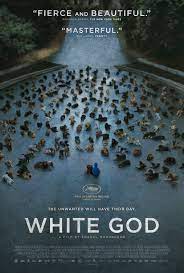
The ending presents us with an image that is on all the posters for the film—and its meaning is ambiguous too.
Clearly Lili figures as some kind of “god” figure here, for Hagen and the other dogs: she has become the “white god” of the title. But will she use her power to save the dogs? Or will she merely appease them until others come to destroy them. You can make up your own mind. Me? I’m not hopeful.
R | 121 mins. | Kornél Mundruczó | Hungary | 2014
Grade: A
____________________
Watch White God on Kanopy here: https://www.kanopy.com/en/product/2332130
INDIAN COUNTRY NEWS
"It is the duty of every man, as far as his ability extends, to detect and expose delusion and error"..Thomas Paine
Human in Algorithms
From the Roof Top
I See This
blog of the post capitalist transition.. Read or download the novel here + latest relevant posts
अध्ययन-अनुसन्धानको सार
 After the Crash