Saturday Matinee: Holiday Double Feature

Star-Wars-Holiday-Special12142006pw

Films and videos don’t always gain a cult following because they’re good. Case in point is the “Star Wars Holiday Special” (1978), the first official spin-off which was only broadcast once and never released on home video. George Lucas was rumored to have been personally involved in keeping it hidden since he considered it such an embarrassment. Because of its rarity and underground status, bootlegs of the original broadcast were long sought after by fans of Star Wars and obscure cinema.

As holiday specials go, it has a fairly standard flimsy narrative that strings together a variety of celebrity cameos, comedic skits and musical numbers. What sets it apart are appearances by all the main characters of the film and the strained attempt to fit them into a 70s holiday variety program. Comedians like Bea Arthur, Art Carny, and Harvey Korman or musicians like Diahann Carroll and Jefferson Starship don’t seem to belong in the same universe of Star Wars much less the same television program. Though much of the comedy and guest appearances fall flat and the production as a whole reeks of crass commercialism and cloying sentimentality, it does have moments of inspired weirdness that might make it worth seeing by hardcore Star Wars fans, paracinephiles, and/or stoners.

This is a 15 minute “fan edit” version of the Star Wars Holiday Special:

In contrast to the Star Wars special, the “Pee Wee’s Playhouse Christmas Special” (1988) is an example of how similar holiday tropes can be used more creatively towards an equally bizarre but more satisfying end result. The campy, self-aware and subtly subversive tone of Pee Wee’s Playhouse is better suited for the “pop culture mash-up” aspect of holiday specials than the more self-contained world of Star Wars. It also helps that Pee Wee’s show is written with more humor and wit and features an eclectic mix of guests who all seem to be having fun.

The roster of celebrities include Annette Funicello, Frankie Avalon, Grace Jones, K.D. Lang, Little Richard, Cher, Magic Johnson, Whoopi Goldberg, Oprah Winfrey, Charo and Laurence Fishburne among others. Like Pee Wee, they’re iconic and have collective appeal that transcends age, race and gender. They’re also perfect guest stars for a throwback to televised holiday events of the past with a postmodern and absurdist sensibility.

The Endarkenment Manifesto

jing-jang-yin-yang-planet-hd-high-definition-fullscreen

While it’s easy to understand arguments for a new Age of Enlightenment, a case can be made for Endarkenment as well. On this eve of Winter Solstice (an Endarkenment holiday) it seems appropriate to share the following manifesto and intro originally posted at Arthurmag.com in 2008:

From ARTHUR MAGAZINE No. 29 (May 2008): Peter Lamborn Wilson’s half-serious proposal for a political movement to uphold and propagate the ideals of Green Hermeticism. Wilson sometimes uses the pen name ‘Hakim Bey.’ He is the author of the Temporary Autonomous Zone concept and manifesto, which, for better or worse, was the original inspiration for the Burning Man festival..

THE ENDARKENMENT MANIFESTO

At least half the year belongs to Endarkenment. Enlightenment is only a special case of Endarkenment—and it has nights of its own.

**

During the day democracy waxes, indiscriminately illuminating all and sundry. But shadowless noon belongs to Pan. And night imposes a “radical aristocracy” in which things shine solely by their own luminescence, or not at all.

**

Obfuscatory, reactionary and superstitious, Endarkenment offers jobs for trolls and sylphs, witches and warlocks. Perhaps only superstition can re-enchant Nature. People who fear and desire nymphs and fauns will think twice before polluting streams or clear-cutting forests.

**

Electricity banished shadows—but shadows are “shades,” souls, the souls of light itself. Even divine light, when it loses its organic and secret darkness, becomes a form of pollution. In prison cells electric lights are never doused; light becomes oppression and source of disease.

**

Superstitions may be untrue but based on deeper truth—that earth is a living being. Science may be true, i.e. effective, while based on a deeper untruth—that matter is dead.

**

The peasants attacking Dr. Frankenstein’s tower with their torches and scythes were the shock troops of Endarkenment, our luddite militia. The original historical Luddites smashed mechanical looms, ancestors of the computer.

**

“Neolithic conservatism” (Paul Goodman’s definition of anarchism) positions itself outside the ponderous inevitability of separation and sameness. Every caveman a Prince Kropotkin, every cavewoman Mrs. Nietzsche. Our Phalanstery would be lit by candles and our Passions avowed via messenger pigeons and hot-air balloons.

**

Imagine what science might be like to day if the State and Kapital had never emerged. Romantic Science proposes an empiricism devoid of disastrous splits between consciousness and Nature; thus it prolongates Neolithic alchemy as if separation and alienation had never occurred: science for life not money, health not war, pleasure not efficiency; Novalis’s “poeticization of science.”

**

Of course technology itself is haunted—a ghost for every machine. The myth of Progress stars its own cast of ghouls and efreets. Consciously or unconsciously (what difference would it make?) we all know we live in techno-dystopia, but we accept it with the deterministic fatalism of beaten serfs, as if it were virtual Natural Law.

**

Technology mimics and thus belittles the miracles of magic. Rationalism has its own Popes and droning litanies, but the spell they cast is one of disenchantment. Or rather: all magic has migrated into money, all power into a technology of titanic totality, a violence against life that stuns and disheartens.

**

Hence the universal fear/desire for the End of the World (or for some world anyway). For the poor Christian Moslem Jewish saps duped by fundamentalist nihilism the Last Day is both horrorshow and Rapture, just as for secular Yuppies global warming is a symbol of terror and meaninglessness and simultaneously a rapturous vision of post-Catastrophe Hobbit-like local-sustainable solar-powered gemutlichkeit. Thus the technopathocracy comes equipped with its own built-in escape-valve fantasy: the Ragnarok of technology itself and the sudden catastrophic restoration of meaning. In fact Capital can capitalize on its own huge unpopularity by commoditizing hope for its End. That’s what the smug shits call a win/win situation.

**

Winter Solstice (Chaos Day in Chinese folklore) is one of Endarkenment’s official holidays, along with Samhain or Halloween, Winter’s first day.

**

Endarkenment stands socially for the Cro-Magnon or “Atlantaean” complex—anarchist because prior to the State—for horticulture and gathering against agriculture and industry—for the right to hunt as against the usurpation of commons by lord or State. Electricity and internal combustion should be turned off along with all States and corporations and their cult of Mammon and Moloch.

**

Despite our ultimate aim we’re willing to step back bit by bit. We might be willing to accept steam power or hydraulics. The last agreeable year for us was 1941, the ideal is about 10,000 BC, but we’re not purists. Endarkenment is a form of impurism, of mixture and shadow.

**

Endarkenment envisages a medicine advanced as it might have been if money and the State had never appeared, medicine for earth, animals and humans, based on Nature, not on promethean technology. Endarkenment is not impressed by medicine that prolongs “life span” by adding several years in a hospital bed hooked up to tubes and glued to daytime TV, all at the expense of every penny ever saved by the patient (lit. “sufferer”) plus huge debts for children and heirs. We’re not impressed by gene therapy and plastic surgery for obscene superrich post humans. We prefer an empirical extension of “medieval superstitions” of Old Wives and herbalists, a rectified Paracelsan peoples’ medicine as proposed by Ivan Illich in his book on demedicalization of society. (Illich as Catholic anarchist we consider an Endarkenment saint of some sort.) (Endarkenment is somewhat like “Tory anarchism,” a phrase I’ve seen used earliest in Max Beehbohm and most lately by John Mitchell.) (Other saints: William Blake, William Morris, A.K. Coomaraswamy, John Cowper Powys, Marie Laveau, King Farouk…)

**

Politically Endarkenment proposes anarcho-monarchism, in effect somewhat like Scandinavian monarcho-socialism but more radical, with highly symbolic but powerless monarchs and lots of good ritual, combined with Proudhonian anarcho-federalism and Mutualism. Georges Sorel (author of Reflections on Violence) had some anarcho-monarchist disciples in the Cercle Proudhon (1910-1914) with whom we feel a certain affinity. Endarkenment favors most separatisms and secessions; many small states are better than a few big ones. We’re especially interested in the break-up of the American Empire.

**

Endarkenment also feels some critical admiration for Col. Qadhaffi’s Green Book, and for the Bonnot Gang (Stirnerite Nietzschean bank robbers). In Islamdom it favors “medieval accretions” like sufism and Ismailism against all crypto-modernist hyperorthodoxy and politics of resentment. We also admire the martyred Iranian Shiite/Sufi socialist Ali Shariati, who was praised by Massignon and Foucault.

**

Culturally Endarkenment aims at extreme neo-Romanticism and will therefore be accused of fascism by its enemies on the Left. The answer to this is that (1) we’re anarchists and federalists adamantly opposed to all authoritarian centralisms whether Left or Right. (2) We favor all races, we love both difference and solidarity, not sameness and separation. (3) We reject the myth of Progress and technology—all cultural Futurism—all plans no matter their ideological origin—all uniformity—all conformity whether to organized religion or secular rationalism with its market democracy and endless war.

**

Endarkenists “believe in magic” and so must wage their guerrilla through magic rather than compete with the State’s monopoly of techno-violence. Giordano Bruno’s Image Magic is our secret weapon. Projective hieroglyphic hermeneutics. Action at a distance through manipulation of symbols carried out dramaturgically via acts of Poetic Terrorism, surrealist sabotage, Bakunin’s “creative destruction”—but also destructive creativity, invention of hermetico-critical objects, heiroglyphic projections of word/image “spells”—by which more is meant (always) than mere “political art”—rather a magical art with actual dire or beneficial results. Our enemies on the Right might call this political pornography and they’d be (as usual) right. Porn has a measurable physiopsychological effect. We’re looking for something like it, definitely, only bigger, and more like Artaud than Brecht—but not to be mistaken for “Absolute Art” or any other platonic purism—rather an empirical strategic “situationist” art, outside all mass media, truly underground, as befits Endarkenment, like a loosely structured “rhizomatic” Tong or freemasonic conspiracy.

**

The Dark has its own lights or “photisms” as Henry Corbin called them, literally as entoptic/hypnagogic phosphene-like phenomena, and figuratively (or imaginally) as Paracelsan Nature spirits, or in Blakean terms, inner lights. Enlightenment has its shadows, Endarkenment has its Illuminati; and there are no ideas but in persons (in theologic terms, angels). According to legend the Byzantines were busy discussing “the sex of angels” while the Ottomans were besieging the walls of Constantinople. Was this the height of Endarkenment? We share that obsession.

Jan. 1, 2008

Saturday Matinee: La Antena

antena372

In “La Antena” (2007), a surreal Argentine parable written and directed by Esteban Sapir, the population of an unknown city is kept under the complete control of Mr. TV through his monopolization of the broadcast system and food supply. Everyone in the city except for a singer, La Voz, has lost their voice (yet are still able to communicate through visual words). With the help of his scientist henchman Dr. Y, Mr. TV kidnaps La Voz in a scheme to take away the last remaining means of communication from the the citizens. A TV repairman gets word of the plan and attempts to foil it using an abandoned antenna in the mountains.

The film is shot in a silent film style reminiscent of the works of Fritz Lang and F.W. Murnau, but also seems to incorporate influences from modern fantasy films such as Dark City and Pan’s Labyrinth. Unfortunately, the only complete version of the film I could find was without subtitles, but those who don’t know Spanish can still enjoy it because the story is conveyed mostly through (beautifully evocative) imagery and doesn’t rely heavily on dialogue.

Saturday Matinee: What to Do in Case of Fire?

3b6ef1ef605e7

“What to Do in Case of Fire?” (2001) opens with a montage of young anarchist squatters fighting police, making propaganda films, and constructing a homemade bomb in Berlin circa 1987. They plan to blow up a vacant mansion but the bomb is a dud, until thirteen years later when it injures a real estate broker and potential buyer in a fluke accident.

Only two of the original members of the anarchist collective, Tim and Hotte, are still squatting in the same communal housing since the 80s and are unable to prevent police from confiscating filmed evidence in a raid triggered by the bomb incident. Because all members of the collective are potentially linked to the bombing, Tim and Hotte scramble to track down former comrades and formulate an action plan before the evidence is examined. The reunion of old friends, including those who’ve settled into traditional family life or sold out for corporate jobs, stirs up a host of interpersonal conflicts which they must resolve in order to work together to remain free.

Though the film does at times seem to fall back on lazy stereotypes of anarchists, it at least puts them in a human light. Even less radical viewers could relate to certain struggles the protagonists are faced with, such as trying to balance freedom and security, being “successful” versus upholding one’s ideals, and coming to terms with friendships that change over time. It would have been interesting had the film delved deeper into Berlin’s anarchist and squatters movements, in my opinion, but it’s nevertheless a charming and fun mix of comedy, drama and heist genres.

Note: to activate English subtitles on the video, click on the Closed Captions (CC) icon on the bottom right corner while video is playing, click on the box that says “Portuguese (Brazil)”, click “Translate Captions”, click on “Afrikaans”, then you should be able to scroll down until you can click on “English”. The subtitle feature might not be available on some portable devices.

Facing Death

Cemetery_PanoramaSharpweb

Jasun Horsley at Omni Reboot recently shared a number of intriguing insights on the topic of death and how it relates to science fiction, culture and transhumanism. He outlines how science fiction, whether utopia or dystopia, are scientific versions of a belief in a spiritual afterlife since they can soothe awareness of mortality and make us feel better about the present.

Horsley cites the work of Sheldon Solomon which shows how culture is a means of denying death via the manufacturing of extensions of the self and the body, including values which are carried by artifacts we create (ie. books, IPods, spaceships, etc.). The technology we create is meant to improve our lives and bring us closer to the utopia of sci-fi fantasies, but more often than not contributes to a dystopian reality. In his opinion, this happens because we’re unconscious of whatever it is within us causing the problems we’re trying to solve. We’re making things worse the more we try and improve them. A classic metaphor for this is Shelley’s Frankenstein which describes how the inability to accept death and the drive to “play God” creates a tragic monster.

According to Horsley, transhumanism is the religion of the (imagined) future, which most of us are already followers of, whether aware of it or not. For those not familiar with transhumanism (also known as extropianism), he provides an accurate and succinct definition in the following excerpt:

Transhumanism is a scientistic movement based on the belief that who (and what) we are can be divorced from biology. In its more extreme camps, Transhumanism divorces human existence from the psyche by suggesting that:

• At least some of the elements of consciousness can be converted to digital information.

• This data will be self-aware.

• It will be a continuation of the biologically-based awareness which it copied.

Horsley is skeptical of this view because it ignores the importance of the unconscious. In his words:

“Who we are” is not a mind-body system but a psyche-body system. We aren’t meat vessels with an internal stream of mental data running through them and animating them. The vast majority of our total “psychosoma” system functions at an unconscious level.

What he sees as a potentially more productive and fulfilling approach is the acceptance of death. Because it’s such an uncharted path (for the majority of us) it’s difficult to imagine the social impact such a paradigm shift would have, but he asks the following speculative questions which encourages further exploration:

Time is supposed to bestow wisdom on human beings. But can there be wisdom without acceptance of death?

How would both our fantasies and our culture be transformed if, instead of conquering death, we learned to accept it?

If death anxiety fuels human progress, maybe accepting death would not only be the end of fantasy, but the end of the fantasy we call “history”?

What it would be the beginning of, however, is anybody’s guess.

On a related note, rest in peace Nelson Mandela.

“Death is something inevitable. When a man has done what he considers to be his duty to his people and his country, he can rest in peace. I believe I have made that effort and that is, therefore, why I will sleep for the eternity.” – Mandela (1996)

Saturday Matinee: The Last Angel of History

moth89

Notes from Icarus Films:

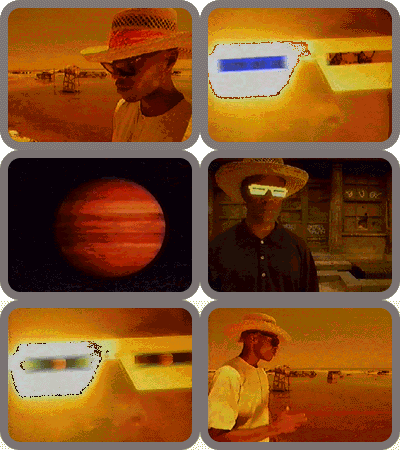
John Akomfrah, director of Seven Songs of Malcolm X, returns with an engaging and searing examination of the hitherto unexplored relationships between Pan-African culture, science fiction, intergalactic travel, and rapidly progressing computer technology.

This cinematic essay posits science fiction (with tropes such as alien abduction, estrangement, and genetic engineering) as a metaphor for the Pan-African experience of forced displacement, cultural alienation, and otherness.

Akomfrah’s analysis is rooted in an exploration of the cultural works of Pan-African artists, such as funkmaster George Clinton and his Mothership Connection, Sun Ra’s use of extraterrestrial iconography, and the very explicit connection drawn between these issues in the writings of black science fiction authors Samuel R. Delaney and Octavia Butler.

Included are interviews with black cultural figures, from musicians DJ Spooky, Goldie, and Derek May, who discuss the importance of George Clinton to their own music, to George Clinton himself. Astronaut Dr. Bernard A. Harris Jr. describes his experiences as one of the first African-Americans in space, while Star Trek actress Nichelle Nichols tells of her campaign for a greater role for African-Americans in NASA. Novelist Ishmael Reed and cultural critics Greg Tate and Kodwo Eshun tease out the parallels between black life and science fiction, while Delaney and Butler discuss the motivations behind their choice of the genre to express ideas about the black experience.

In keeping with the futuristic tenor of the film, the interviews are intercut with images of Pan-African life from different periods of history, jumping between time and space from the past to the future to the present, not unlike the mode of many rock videos or surfing the Internet.