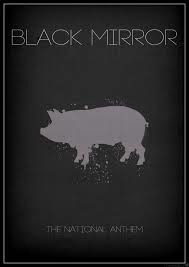
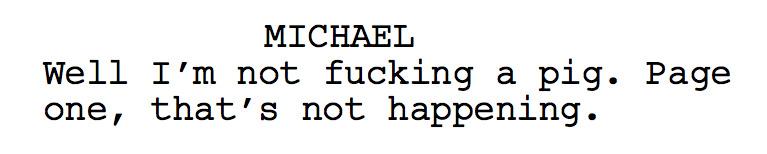
Fans of the superb dystopian series “Black Mirror” (including myself) had our collective minds blown by recent claims (first widely reported by the Daily Mail) that British Prime Minister David Cameron performed a sexual act with a pig carcass as part of a depraved initiation ritual. The story would be very bizarre even had it not mirrored a key plot point of the premiere episode of Dark Mirror. No doubt besieged by questions about the recent news, Dark Mirror creator Charlie Brooker took to Twitter to state: “Just to clear it up: nope, I’d never heard anything about Cameron and a pig when coming up with that story. So this weirds me out.”
These are the most recent statements on the topic from Brooker’s Twitter feed (as of 9/21/15):
Was this a case of insider knowledge, extra sensory perception, retrocausality, premonition, intuition or coincidence? Watch the full episode and judge for yourself.
“High Velocity” (1976) is an obscure b-movie starring Ben Gazzara and Paul Winfield as Vietnam vets hired by a corporation to rescue a CEO kidnapped by an underground resistance group in the Philippines. On one level, it’s an early version of the heroic mercenary film which had a resurgence in the 80s after the success of Rambo and Missing in Action, but it’s also unrelentingly cynical with a surprisingly astute depiction of colonialism, government/corporate corruption and the power elite. The film is further elevated by a great lead performance by Ben Gazzara and atmospheric soundtrack by Jerry Goldsmith (famous for his work on Star Trek). Interestingly, High Velocity was the first film produced by Takafumi Ohashi, who later produced tons of great (and not-so-great) Japanese genre features.
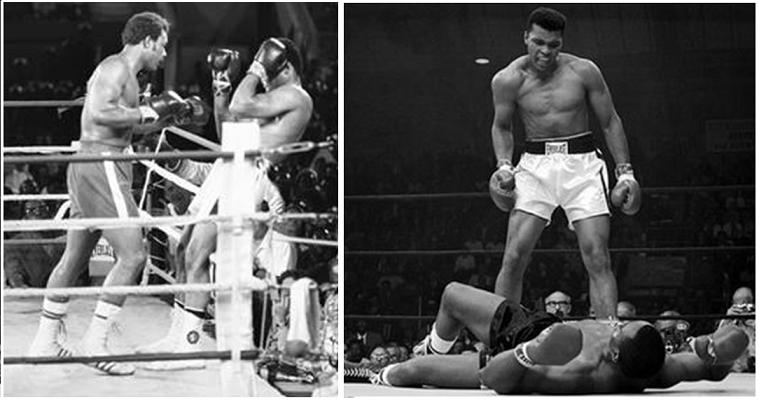
During the second round of the 1974 epic boxing match billed as the Rumble in the Jungle, Mohammad Ali leaned extraordinarily far back upon the ropes as George Foreman relentlessly bludgeoned Ali’s body and arms. It looked much like the devastating beating Ali took at the hands of Joe Frazier in 1971. Foreman’s notoriously powerful punches were sure to do Ali in as he languished on the ropes round after round. But in the eighth — with Foreman’s stamina sapped — Ali got off the ropes, and went on the attack, winning the bout with a knockout. He called it the “rope-a-dope.”
I feel worked over — not knowing if I can keep up the pace of the caffeine infused all-night drift through a world-wide cataloging of every failure of imagination — large and small — the war, disease, simple stupidity, the latest meme designed to bring a smile all the way to your eyes — brought not only into your living room, but also the kitchen, the bedroom. It seems we&rsquo—re always peering deep into our glowing box, trying to sort out the trouble and hop to the next possible potential of some game-changing inspiration in the incessant production-line flow of recycled mediocrity. But the troubles are never through. The work is never done. That breakthrough — that genius sabot insight never comes.
But the metaphor of production-line work — already passé when McLuhan made us aware of so many similarly irrelevant tropes — is based on psychological responses and concepts conditioned by the former technology — mechanization — of the factory. There is something comforting in the nostalgic ease with which Lucille Ball or Charlie Chaplin revealed the absurdity of Fordist efficiency, the worker as a mere appendage of the machine. Although laughable even then — that was a time in which the worker still had a genuine role to play; being more than an option cheaper than automation. That time is gone.
I feel over worked. But I’ve never worked at the mill. I’ve never done a 12-hour stint keeping pace with cogs and conveyer belts. I’m not being over worked. I’m being worked over — as we all are — not by a craftwork mechanized pace that drives us to exhaustion — but by an alluring rhythm — a rhythm that can at once lull us into acquiescence while at the same time keeping us off balance — all the better mobilized for each permutation of familiar themes. We are mesmerized by the rhythm of electrostatic transmissions coded through glitches of the cybernetic network and the fragments of old media. Cycling through neoclassic postmodern motifs destructured and reformulated into predictably surprising combinations — this rhythm — this aesthetic — makes us move —and more importantly, buy. Consumers at heart, the rhythm sucks us in and incorporates us more completely than any machine ever could. Somehow thinking that we are breaking free from the autonomic conditioning of a youthful wasteland, we wait in eager anticipation for the next issue of a magazine devoted to the pure form of advertising —though in its pages there is none to be found. It makes our consumer heart skip a beat. Like Victorians who wouldn’t dare indulge in such an unsavory act — but nonetheless cannot stop talking about it — we swoon, sway and jerk with the rhythm of the spliced (dis)tasteful image juxtaposed by words of a hopeful, anxious, elliptical cant — breakdown and breakthrough.
I get the breakdown. Where’s the breakthrough? We talk and all the while we’re being worked over. And this is no massage. This is a beat down. In the expanded edition of his vintage Politics and Vision, Sheldon Wolin argued that the particular rhythm of our contemporary aesthetic has been put to expert use by the new corporate form of governance he called “inverted totalitarianism.” Perhaps Wolin really put his finger on our fatal flaw when he suggested that the “cascades of ‘critical theory’ and their postures of revolt, and the appetite for theoretical novelty, function as support rather than opposition” to capitalism, because this sort of frenetic, syncopated, decentering only “encourages its rhythms.” Like a prizefighter — agile, yet made of solid, consolidated muscle. The centralized corporate entity gets in step with our fancy footwork — bobs and weaves into every new channel of communication and community, coopts every sophistication of critique, adopts the most non-hierarchical, horizontal stance of organization and deployment — moving with the rhythm — adapting the rhythm to its own purpose — waiting for the opportunity to unload its notoriously devastating punch — coming in on the trash talker of dissent — Muhammad Ali stumbling back on the ropes, body blow after wicked body blow — pummeled — worked over completely.
I don’t want to go down on the ropes. Where’s the rope-a-dope? Where’s the rope-a- dope?!
“Journey to the West” (2013) is writer/director Stephen Chow and Derek Kwok’s film adaptation of the classic 16th century Chinese novel of the same name. It chronicles the portion of the story in which young monk Xuan Zang (Zhang Wen) protects a village from three demons with the help of demon hunter Miss Duan (Qi Shu) and has his first encounter with the Monkey King (Bo Huang). Like Stephen Chow’s other blockbusters Kung Fu Hustle and Shaolin Soccer, Journey to the West features delightfully over-the-top performances and slapstick sensibility, but unlike previous works it also contains a spiritual message about redemption, sacrifice and enlightenment.
Have you noticed—exhortations to indulge yourself are always followed by suggestions? Adherents of doctrines seek footholds to claim territory within you, salesmen grasp for handles to jerk you around . . . from new-age prophets to advertisers, from pornographers to radicals, everyone exhorts you to “pursue your desires,” but the question remains: which ones? The “real” ones? Who decides which those are?
This just makes it clear what’s going on: a war for your soul on every front. And those much talked-about desires are all constructed, anyway—they change, they’re dependent on external factors, culture, the whole context and history of our society. We “like” fast food because we have to hurry back to work, because processed supermarket food doesn’t taste much better, because the nuclear family—for those who still have even that—is too small and stressed to sustain much festivity in cooking and eating. We “have to” check our email because the dissolution of community has taken our friends and kindred far away, because our bosses would rather not have to talk to us, because “time-saving” technology has claimed the hours once used to write letters—and killed all the passenger pigeons, besides. We “want” to go to work because in this society no one looks out for those who don’t, because it’s hard to imagine more pleasurable ways to spend our time when everything around us is designed for commerce and consumption. Every craving we feel, every conception we form, is framed in the language of the civilization that creates us.
Does this mean we would want differently in a different world? Yes, but not because we would be free to feel our “natural” desires—no such things exist. Beyond the life you live, you have no “true” self—you are precisely what you do and think and feel. That’s the real tragedy about the life of the man who spends it talking on his cell phone and attending business seminars and fidgeting with the remote control: it’s not that he denies himself his dreams, necessarily, but that he makes them answer to reality rather than attempting the opposite. The accountant regarded with such pity by runaway teenage lovers may in fact be “happy”—but it is a different happiness than the one they experience on the lam.
If our desires are constructs, if we are indeed the products of our environment, then our freedom is measured by how much control of these environments we have. It’s nonsense to say a woman is free to feel however she wants about her body when she grows up surrounded by diet advertisements and posters of anorexic models. It’s nonsense to say a man is free when everything he needs to do to get food, shelter, success, and companionship is already established by his society, and all that remains is for him to choose between established options (bureaucrat or technician? bourgeois or bohemian? Democrat or Republican?). We must make our freedom by cutting holes in the fabric of this reality, by forging new realities which will, in turn, fashion us. Putting yourself in new situations constantly is the only way to ensure that you make your decisions unencumbered by the inertia of habit, custom, law, or prejudice—and it is up to you to create these situations. Freedom only exists in the moment of revolution.
And those moments are not as rare as you think. Change, revolutionary change, is going on constantly and everywhere—and everyone plays a part in it, consciously or not. “To be radical is simply to keep abreast of reality,” in the words of the old expatriate. The question is simply whether you take responsibility for your part in the ongoing transformation of the cosmos, acting deliberately and with a sense of your own power—or frame your actions as reactions, participating in unfolding events accidentally, randomly, involuntarily, as if you were purely a victim of circumstance.
If, as idealists like us insist, we can indeed create whatever world we want, then perhaps it’s true that we can adapt to any world, too. But the former is infinitely preferable. Choosing to spend your life in reaction and adaptation, hurrying to catch up to whatever is already happening, means being perpetually at the mercy of everything. That’s no way to go about pursuing your desires, whichever ones you choose.
So forget about whether “the” revolution will ever happen—the best reason to be a revolutionary is simply that it is a better way to live. It offers you a chance to lead a life that matters, gives you a relationship to injustice so you don’t have to deny your own grief and outrage, keeps you conscious of the give and take always going on between individual and institution, self and community, one and all. No institution can offer you freedom—but you can experience it in challenging and reinventing institutions. When school children make up their own words to the songs they are taught, when people show up by the tens of thousands to interfere with a closed-door meeting of expert economists discussing their lives, that’s what they’re up to: rediscovering that self-determination, like power, belongs only to the ones who exercise it.
Shout it over the rooftops: Culture can belong to us. We can make our own music, mythology, science, technology, tradition, psychology, literature, history, ethics, political power. Until we do, we’re stuck buying mass-produced movies and compact discs made by corporate mercenaries, sitting faceless and immobilized at arena rock performances and sports events, struggling with other people’s inventions and programs and theories that make less sense to us than sorcery did to our ancestors, shamefacedly accepting the judgments of priests and agony columnists and radio talk show hosts, berating ourselves for not living up to the standards set by college entrance exams and glamour magazines, listening to parents and counselors and psychiatrists and managers tell us we are the ones with the problems, buying our whole lives from the same specialists and entrepreneurs we sell them to—and gnashing our teeth in secret fury as they cut down the last trees and heroes with the cash and authority we give them. These things aren’t inevitable, inescapable tragedies—they’re consequences of the passivity to which we have relegated ourselves. In the checkout lines of supermarkets, on the dialing and receiving ends of 900 numbers, in the locker rooms before gym classes and cafeteria shifts, we long to be protagonists in our own epics, masters of our own fate.
If we are to transform ourselves, we must transform the world—but to begin reconstructing the world, we must reconstruct ourselves. Today all of us are occupied territory. Our appetites and attitudes and roles have all been molded by this world that turns us against ourselves and each other. How can we take and share control of our lives, and neither fear nor falter, when we’ve spent those lives being conditioned to do the opposite?
Whatever you do, don’t blame yourself for the fragments of the old order that remain within you. You can’t sever yourself from the chain of cause and effect that produced you—not with any amount of willpower. The trick is to find ways to indulge your programming that simultaneously subvert it—that create, in the process of satisfying those desires, conditions which foster new ones. If you need to follow leaders, find leaders who will depose themselves from the thrones in your head; if you need to “lead” others, find equals who will help you dethrone yourself; if you have to fight against others, find wars you can wage for everyone’s benefit. When it comes to dodging the imperatives of your conditioning, you’ll find that indulge and undermine is a far more effective program than the old heritage of “renounce and struggle” passed down from a humorless Christianity.
To return, finally, to the original question—yes, we too are making suggestions about which desires you pursue. We would be scoundrels to deny that! But we would be scoundrels not to make these suggestions, not to extol freedom and self-determination in a world that discourages them. Exhorting others to “think for themselves” is ironic—but today, refusing to oppose the propaganda of the missionaries and entrepreneurs and politicians simply means abandoning our society and species to their control. There’s no purity in silence. And liberty does not simply exist in the absence of control—it is something we have to make together. Taking responsibility for our part in the ongoing metamorphoses of the world means not being afraid to take part in the making of our society, influencing and being influenced as we do.
We make suggestions, we spread this propaganda of desire, because we hope by doing so to indulge our own programmed passion for propaganda in a way that undermines an order that discourages all of us from playing with our passions—and so to enter a world of total liberty and diversity, where propaganda and power struggles alike are obsolete. See you on the other side.
Everything is Terrible! is a Chicago-based video blogging website that features clips of VHS tapes from the late 20th century. The project was founded in 2000 by a group of friends while at Ohio University. “Every weekend or free afternoon they get,” according to NPR, they search at thrift stores, garage sales, and “bargain bins” for the worst and most outrageous VHS tapes to share with each other. The website was launched in 2007 in Chicago….In 2009, the website released a video titled Everything is Terrible! The Movie, which featured the same type of VHS clips that would be featured on their website. The A.V. Club called the video “a portal into a world halfway between showbiz and real life—a look at how the people who make entertainment for a living think the rest of us saps actually live”, adding that it’s “simultaneously enlightening, hilarious, and deeply sad”.

 2,262 retweets 2,519 favorites
 3,578 retweets 2,829 favorites
 3,654 retweets 3,063 favorites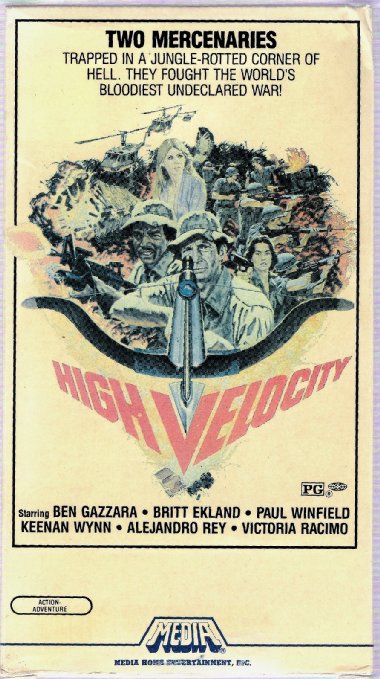



 After the Crash