Fuck You, Dying American Empire: Reflections of an Aging Anti-Imperialist

Credit: JOEL PETT

By Jonah Raskin

Source: CounterPunch

Last year at Jamia Millia Islamia Central University in New Delhi, India I met students and teachers who thought that it was cool that I’d written an anti-imperialist book and that it was still in print nearly fifty years after it was first published. It was easy to be an anti-imperialist at Jamia Millia. After all, the students and the teachers were anti-imperialists and all worked-up about U.S. drones, U.S. air strikes and about the Syrians on the ground who had been battered and bombed.

It was also relatively easy to be an anti-imperialist in the late 1960s and early 1970s when anti-imperialism was a red badge of courage in SDS, the Venceremos Brigade, in anti-war circles and even among the Yippies, who were far more internationalist in their outlook than many on the Left assumed. Once upon a time, Jerry Rubin went to Cuba to check out the revolution, and later to Chile with singer and songwriter, Phil Ochs, to see what Salvador Allende was doing.

But here in the U.S. in 2018, is it still possible to be an authentic anti-imperialist, an anti-imperialist in more than name? I thought about that question recently when a former comrade explained that he was still an anti-imperialist and wondered if I was one, too.

It wasn’t the first time that my politics were questioned. In 1980, soon after Reagan was elected president, Professor Edward Said asked me if I was still on the Left and hadn’t drifted to the right like that former radical, David Horowitz, whom Alexander Cockburn dismissed as a “whiner.” A plain “Yes,” or a “No” answer wouldn’t do, nor a “Maybe.”

Am I now and have I ever been an anti- imperialist? It’s really nobody’s business but my own!

I don’t know anyone in my part of northern California who calls himself or herself an anti-imperialist, though friends and neighbors claim to be against racism, sexism, patriarchy and ageism.

U.S. anti-imperialism has a noble lineage. Mark Twain was an anti-imperialist and so was his friend and fellow writer, William Dean Howells. They both belonged to the American Anti-Imperialist League that was founded in 1898 to oppose the U.S. annexation of the Philippines and whose members included an odd assortment of individuals such as Jane Addams, Josephine Shaw Lowell, Henry James, David Starr Jordan, Grover Cleveland and Andrew Carnegie.

The League, which didn’t oppose U.S. entry into World War I, disbanded in 1920 just as U.S. imperialism was flexing its global muscles more than every before, though from its founding the American republic aimed to go West and become a continental empire.

Then, in the twentieth-century, the nation began to shrink the globe big time, to extract labor from peasants and workers in Asia and Africa and export American light bulbs, American Gatling guns, American lingo—“Kilroy Was Here”—and American movies.

Cultural imperialism always bugged me more than any other aspect of imperialism. I hated to see U.S. cultural commodities supplant indigenous cultures. That sight still rankles me, whether I see it in India, Mexico or the American South West. Every time I see and hear about the survival of ancient myths, legends, dances and music I’m ready to cheer.

Membership in an anti-imperialist league or organization makes sense, but to be an anti-imperialist of one in a sea of California anti-intellectualism and provincialism—“We’re number one”—has little or no meaning to me. Why be an anti-imperialist in name only? No, thanks! I don’t mean to live off past glory, though it was a thrill to meet students in India who had studied The Mythology of Imperialism and who told me it was the first book they’d ever read in which they could hear that the author was angry. That was me! I was pissed.

At 77, it’s not possible to be angry with the same intensity that I was angry at 27 when I wrote my anti-imperialist book in-between rioting in the streets, spray painting slogans at Times Square at midnight, going to jail and having the cops kick the shit out of me. I don’t know of any other way to be an anti-imperialist except the way I was an anti-imperialist during the War in Vietnam.

Indeed, it’s no easy feat to be an old anti-imperialist. Che died at 39, Lenin at 53 and Mark Twain at 74. The author of The Adventures of Huckleberry Finn and A Connecticut Yankee in King Arthur’s Court, which takes a big swipe at weapons of mass destruction, noted near the end of his life, “I am always on the side of the revolutionists, because there never was a revolution unless there were some oppressive and intolerable conditions against which to revolute.” Thanks, Mr. Twain. I’m glad you said that.

Today, there are so many oppressive and intolerable conditions the world over, and so many different imperialisms: the Chinese, the Russian, the India, the Israeli, the Brazilian and the U.S. It was comforting in the 1960s and 1970s to recognize that the American Empire was in decline and that the Soviets, the Vietnamese and the Chinese stood up to the Pentagon. Gratifying, too, that crowds in Paris, Rome, and London denounced the U.S. invasion and occupation of Vietnam, Laos and Cambodia.

Now, who stands up to the White House, the Senate, Google, Facebook and Amazon? Precious few citizens! Empires have proliferated and reinvented themselves. The American Empire is still in decline, though as George Lucas noted in 1980 it did “Strike Back” with Reagan, and later with Bush I, Bush II, Clinton and Obama.

An empire in decline—whether Roman, British, or American—isn’t a pretty thing. It can take decades to fall apart. I saw that when I lived in England. An Empire in decline isn’t really anything to cheer about. Indeed, the fall of empire makes life miserable for migrants, serfs, slaves, refugees, prisoners, pensioners and even for aging anti-imperialists. Maybe it’s a cheap shot. I don’t care. I’ll say it here, “Goodbye and Fuck you, American Empire.”

Learning from Gandhi

By Robert J. Burrowes

Mohandas Karamchand Gandhi was born on 2 October 1869: 150 years ago this year.

There will be many tributes to Gandhi published in 2019 so I would like to add one of my own.

This reflects not just my belief that he gave the world inspiration, ideas and powerful strategies for tackling violence in a wide range of contexts but because my own experience in applying his ideas has proven their worth. This included his awareness that led him to declare that ‘If we are to make progress, we must not repeat history but make new history. We must add to the inheritance left by our ancestors.’ and his encouragement to reflect deeply and listen to one’s ‘inner voice’: ‘you should follow your inner voice whatever the consequences’ and ‘even at the risk of being misunderstood’.

In essence, we can productively learn from history but we can build on it too. And, vitally, this includes dealing more effectively with violence.

So how did Gandhi influence me?

Shortly after midnight on 1 July 1942, my Uncle Bob was killed when the USS Sturgeon, a U.S. submarine, fired torpedoes into the Japanese prisoner of war (POW) ship Montevideo Maru. The ship sank immediately and, along with 1,052 other POWs, Bob was killed.

Apart from his older brother, my father’s twin brother was also killed in World War II. In Tom’s case, he was shot down over Rabaul on his first (and final) mission. He was a wireless air gunner on a Beaufort Bomber. See ‘The Last Coastwatcher: My Brothers’.

My childhood is dotted with memories of Bob and Tom. The occasional remembrance service, war medals and the rare story shared by my father.

In 1966, the year I turned 14, I decided to devote my life to finding out why human beings kill each other and to work out how such killing could be ended. The good news about this ‘decision’ is that, at 14, it all felt manageable! But I wasn’t much older before my preliminary investigations proved that even understanding why humans are violent was going to be a profound challenge. And I intuitively understood that I needed this understanding if any strategy to end violence was to be effective.

In any case, as one might expect, my research into violence and strategies for addressing it led me to nonviolence. I came across virtually nothing about nonviolence during my own studies at school and university but was regularly presented with news reports of people participating in activities – such as demonstrations and strikes – that I later learned to label ‘nonviolent action’.

In 1981 I decided to seek out materials on nonviolence and nonviolent action so that I could learn more about it. I had not been reading for long when the routine reference to Mohandas K. (or Mahatma) Gandhi, about whom I had heard a little and knew of his role in leading the Indian independence struggle, forced me to pay more attention to his life and work. So I sought out his writing and started to read some of his published work. An Autobiography: The Story of My Experiments with Truth was an obvious and early book but there were many others besides. I also read many books about Gandhi, to get a clearer sense of his life as a whole, as reported by his coworkers and contemporaries, as well as documented by scholars since his death. And I spent a great many hours in a library basement poring over The Collected Works of Mahatma Gandhi.

The thing that struck me immediately about Gandhi was that his own interest in tackling violence had a comprehensive ‘feel’ about it. That is, he was not just interested in the violence that occurs when nations fight wars or one person kills or injures another. He was interested in addressing the violence that occurs when individuals and nations exploit other individuals/nations (such as when British imperialism exploited India and Indians) and the violence that occurs when a structure (such as capitalism or socialism) exploits the individuals within it. In his words: ‘exploitation is the essence of violence’. He was interested in the violence that occurs when members of one social group (say, Hindus) ‘hate’ the members of another social group (such as Muslims). He was interested in the violence that occurs when men oppress women or caste Hindus oppress ‘untouchables’. He was interested in the violence that occurs when humans destroy the environment. And he was interested in the violence that one inflicts on oneself.

This comprehensive interest resonated deeply with me because, apart from war, my own childhood and adolescence had revealed many manifestations of violence ranging from the starvation of people in developing countries to the racism in the United States (highlighted by Rev. Martin Luther King Jr. during the 1960s) to the destruction of the environment, each of which had gradually but deeply embedded itself in my consciousness. Tackling violence was a far bigger task than the large one I had originally imagined. Violence is everywhere. Most importantly, it seemed to me, there was enormous violence directed against children in the family home but little was spoken or written about this.

So how did Gandhi explain violence and what was his strategy for addressing it?

Gandhi on Conflict and Violence

For Gandhi, conflict was a perennial condition. He also viewed it positively and considered it desirable. For him, it is an important means to greater human unity precisely because their shared conflict could remind antagonists of the deeper, perhaps transcendental, unity of life, which is far more profound than the bond of their social relationship.

He viewed violence differently, however. And, as might be gleaned from the many configurations of violence that concerned him, as noted above, he considered that violence was built into social structures and not into people.

Fundamentally, as Leroy Pelton characterized it, Gandhi understood that the truth cannot be achieved through violence (‘which violates human needs and destroys life’), because violence itself is a form of injustice. In any case, violence cannot resolve conflict because it does not address the issues at stake.

To reiterate then, for Gandhi there was nothing undesirable about conflict. However, Gandhi’s preoccupation was working out how to manage conflict without violence and how to create new social arrangements free of structural violence. The essence, then, of Gandhi’s approach was to identify approaches to conflict that preserved the people while systematically demolishing the evil structure. Nevertheless, he firmly believed that structural purification alone is not enough; self-purification is also essential.

In other words, in Gandhi’s view, resolving the conflict (without violence) is only one aspect of the desired outcome. For Gandhi, success also implies the creation of a superior social structure, higher degrees of fearlessness and self-reliance on the part of both satyagrahis (nonviolent activists) and their opponents, and a greater degree of human unity at the level of social relationships.

Two Key Questions

Despite the enormous influence that Gandhi had in shaping my own conception of conflict and the precise conception of nonviolence that should be used in dealing with it, I nevertheless remained convinced that two questions remained unanswered: What is the psychological origin of the violent behavior of the individual who perpetrates it? And what theory or framework should guide the application of nonviolent action so that campaigns of all kinds are strategically effective?

The first question is important because even if someone is trapped within a social structure (such as the class system) that is violent, the individual must still choose, consciously or unconsciously, to participate (as perpetrator, collaborator or victim) in the violence perpetrated by that structure or one must choose, consciously, to resist it. Why do so many individuals perform one of the first three roles and so few, like Gandhi himself, choose the role of resister?

The second question is important because while Gandhi himself was an astonishingly intuitive strategic thinker (whose 30-year nonviolent strategy liberated India from British occupation), no one before him or since his death has demonstrated anything remotely resembling his capacity in this regard.

Hence, while nonviolence, which is inherently powerful, has chalked up some remarkable successes, vital struggles for peace (and to end war); to halt assaults on Earth’s biosphere; to secure social justice for oppressed and exploited populations; to liberate national groups from dictatorship, occupation or genocidal assault; and struggles in relation to many other just causes limp along devoid of strategy (or use one that is ill-conceived). So badly are we failing, in fact, that humans now teeter on the brink of precipitating our own extinction. See ‘Human Extinction by 2026? A Last Ditch Strategy to Fight for Human Survival’.

Anyway, having studied Gandhi extensively and learned from his strategic approach to nonviolence (elements of which I was progressively including in nonviolent campaigns in which I was involved myself), I resumed my original research to understand the fundamental origin of human violence and also decided to develop a strategic theory and framework for addressing violence in the campaign context so that Gandhi’s strategic thinking could be readily copied by other nonviolent activists.

It turned out that developing this strategic theory and strategy was simpler than the original aim (understanding violence) and I have presented this strategic thinking on two websites: Nonviolent Campaign Strategy and Nonviolent Defense/Liberation Strategy.

Despite my preliminary efforts in the 1990s to encourage fellow activists to use this framework, it soon became clear that only the rarest of activists has the capacity to think strategically about an issue, even when presented with a framework for doing so.

The Origin of Human Violence

Consequently, the vital importance of understanding the origin of human violence was starkly demonstrated to me yet again because I knew it would answer key supplementary questions such as these: Why to do so many people live in denial/delusion utterly incapable of perceiving structural violence or grappling powerfully with (military, social, political, economic and ecological) violence? Why is it that so many people, even activists, are powerless to think strategically? How can activists even believe that success can be achieved, particularly on the major issues of our time (such as the threats of nuclear war, ecological devastation and climate cataclysm), without a focused and comprehensive strategy, particularly given elite resistance to such campaigns? See ‘The Global Elite is Insane Revisited’.

Hence, in an attempt to answer questions such as these, Anita McKone and I went into seclusion in an endeavor to understand how our own minds functioned so that we might better understand the minds of others. I hoped it would take a few months. It took 14 years.

So what is the cause of violence in all contexts and which, depending on its precise configuration in each case, creates perpetrators of violence, people who collaborate with perpetrators of violence, people who are passive victims of violence, people who live in denial/delusion, people who are sexist or racist, and activists who cannot think strategically (among many other adverse outcomes)?

Each of these manifestations of human behaviour is an outcome of the adult war on children. That is, adult violence against children is the fundamental cause of all other violence.

How does this happen? It happens because each child, from birth, is socialized – more accurately, terrorized – so that they fit into their society. That is, each child is subjected to an unrelenting regime of ‘visible’, ‘invisible’ and ‘utterly invisible’ violence until they offer the obedience that every adult – parent, teacher, religious figure… – demands.

So what constitutes ‘visible’, ‘invisible’ and ‘utterly invisible’ violence?

‘Visible’ violence includes hitting, screaming at and sexually abusing a child which, sadly enough, is very common.

But the largest component of damage arises from the ‘invisible’ and ‘utterly invisible’ violence that we adults unconsciously inflict on children during the ordinary course of the day. Tragically, the bulk of this violence occurs in the family home and at school. For a full explanation, see ‘Why Violence?’ and Fearless Psychology and Fearful Psychology: Principles and Practice.

‘Invisible’ violence is the ‘little things’ we do every day, partly because we are just ‘too busy’. For example, when we do not allow time to listen to, and value, a child’s thoughts and feelings, the child learns to not listen to themSelf thus destroying their internal communication system. When we do not let a child say what they want (or ignore them when they do), the child develops communication and behavioral dysfunctionalities as they keep trying to meet their own needs (which, as a basic survival strategy, they are genetically programmed to do).

When we blame, condemn, insult, mock, embarrass, shame, humiliate, taunt, goad, guilt-trip, deceive, lie to, bribe, blackmail, moralize with and/or judge a child, we both undermine their sense of Self-worth and teach them to blame, condemn, insult, mock, embarrass, shame, humiliate, taunt, goad, guilt-trip, deceive, lie, bribe, blackmail, moralize and/or judge.

The fundamental outcome of being bombarded throughout their childhood by this ‘invisible’ violence is that the child is utterly overwhelmed by feelings of fear, pain, anger and sadness (among many others). However, mothers, fathers, teachers, religious figures and other adults also actively interfere with the expression of these feelings and the behavioral responses that are naturally generated by them and it is this ‘utterly invisible’ violence that explains why the dysfunctional behavioral outcomes actually occur.

For example, by ignoring a child when they express their feelings, by comforting, reassuring or distracting a child when they express their feelings, by laughing at or ridiculing their feelings, by terrorizing a child into not expressing their feelings (for instance, by screaming at them when they cry or get angry), and/or by violently controlling a behavior that is generated by their feelings (for example, by hitting them, restraining them or locking them into a room), the child has no choice but to unconsciously suppress their awareness of these feelings.

However, once a child has been terrorized into suppressing their awareness of their feelings (rather than being allowed to have their feelings and to act on them) the child has also unconsciously suppressed their awareness of the reality that caused these feelings. This has many outcomes that are disastrous for the individual, for society and for the biosphere because the individual will now easily suppress their awareness of the feelings that would tell them how to act most functionally in any given circumstance and they will progressively acquire a phenomenal variety of dysfunctional behaviors, including some that are violent towards themself, others and/or the Earth.

So what do we do?

Well, if you want to make an enormous contribution to our effort to end violence, you can make the commitment outlined in ‘My Promise to Children’. If you need to do some healing of your own to be able to nurture children in this way, then consider the information provided in the article ‘Putting Feelings First’.

If you want to systematically tackle violence against the biosphere, consider (accelerated) participation in the fifteen-year strategy, inspired by Gandhi, outlined in ‘The Flame Tree Project to Save Life on Earth’. This project outlines a simple plan for people to systematically reduce their consumption, by at least 80%, involving both energy and resources of every kind – water, household energy, transport fuels, metals, meat, paper and plastic – while dramatically expanding their individual and community self-reliance in 16 areas, so that all environmental concerns are effectively addressed. As Gandhi observed 100 years ago: ‘Earth provides enough for every person’s need but not for every person’s greed.’

But, critically important though he believed personal action to be, Gandhi was also an extraordinary political strategist and he knew that we needed to do more than transform our own personal lives. We need to provide opportunities that compel others to consider doing the same.

So if your passion is campaigning for change, consider doing it strategically, as Gandhi did. See Nonviolent Campaign Strategy.

And if you want to join the worldwide movement to end all violence against humans and the biosphere, you can do so by signing the online pledge of The Peoples Charter to Create a Nonviolent World.

Gandhi was assassinated on 30 January 1948. But his legacy lives on. You can learn from it too, if you wish.


Biodata: Robert J. Burrowes has a lifetime commitment to understanding and ending human violence. He has done extensive research since 1966 in an effort to understand why human beings are violent and has been a nonviolent activist since 1981. He is the author of Why Violence? His email address is flametree@riseup.net and his website is here.

Robert J. Burrowes
P.O. Box 68
Daylesford, Victoria 3460
Australia

Email: flametree@riseup.net

Websites:
Nonviolence Charter
Flame Tree Project to Save Life on Earth
‘Why Violence?’
Feelings First
Nonviolent Campaign Strategy
Nonviolent Defense/Liberation Strategy
Anita: Songs of Nonviolence
Robert Burrowes
Global Nonviolence Network

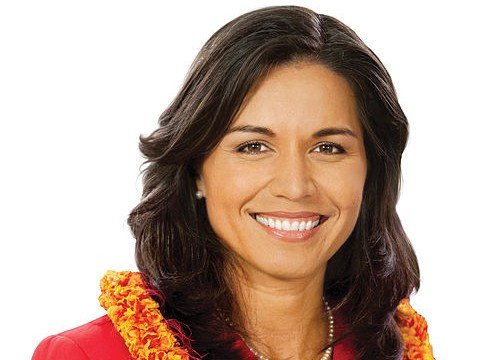
Five Reasons I’m Excited About Tulsi Gabbard’s Candidacy

By Caitlin Johnstone

Source: CaitlinJohnstone.com

Hawaii Representative Tulsi Gabbard has announced her intent to campaign for President of the United States, and the entire political spectrum is shitting bricks about it. Mainstream liberals and neocons are calling her a Putin puppet and Assad’s BFF, leftists and progressives are criticizing her associations with right-wing factions in India and anti-LGBT comments she made in the early 2000s, conspiracy analysts are criticizing her Council on Foreign Relations membership, and the Zionist elements of Trump’s base are openly promising to destroy her candidacy. A lot of others, myself included, got a lot more interested in the 2020 elections when she threw her hat in.

I’m not interested in defending Gabbard from the criticisms that have been leveled at her at this time; many articles have been written toward that end already, and if she’s going to run for the most powerful elected office on the planet it’s fair to scrutinize and question what kind of person she is. I’m also not interested in endorsing anyone for the presidency. What I am interested in is the way Gabbard’s presence in the Democratic presidential primary race is already in January 2019 upsetting the standard establishment script and forcing foreign policy debates that need to happen.

Here are a five thoughts on that subject:

1 – Gabbard will definitely be the most antiwar candidate on the debate stage by a wide margin, except in the highly unlikely event that someone steps up from way out of left field to run like Dennis Kucinich. Being the most antiwar candidate in anything associated with the Democratic Party is a very low bar, but her vocal positions on SyriaIranYemenRussiaNorth KoreaAfghanistanGaza, and previous US regime change interventions set her so far from the establishment orthodoxy that she’ll look as different from the other candidates as Ron Paul looked on the Republican debate stage.

2 – Make no mistake, it is this opposition to significant aspects of the US war machine that is the driving force behind the overwhelming bulk of the shrieking objection to Gabbard’s candidacy, not any of the more valid criticisms. We have learned from the mainstream acceptance of Bernie Sanders and Alexandria Ocasio-Cortez that some criticism of the status quo will be tolerated when it comes to domestic policy, but it’s an excommunicable offense when it comes to foreign policy. The idea that the US should forcefully control world affairs using the carrot of alliance and the stick of military violence is so ubiquitous in both of America’s mainstream parties that it takes a Washington Postcolumnist getting dismembered alive to start a debate about something so self-evidently evil as the Saudi-led destruction of Yemen.

3 – Foreign policy is undeniably the area in which the greater part of US government depravity takes place, and as far as America’s permanent government is concerned it is by far the most important. Forcing a debate on an issue you’re not even supposed to bring up on mainstream media will get a lot of ordinary Americans asking questions that very powerful individuals don’t want asked. The DNC went from scheduling over 20 debates in 2008 to trying to limit it to six in 2016 because they didn’t want Sanders’ excellent domestic policy ideas getting out to the public and making their coronated status quo candidate look bad. Gabbard could have the same impact on foreign policy in an audience that has been aggressively propagandized by MSNBC warmongering.

4 – Gabbard’s progressive positions on issues like Medicare for Allenvironmentalism$15 minimum wageWall Street accountability, the failed war on drugsmarijuana legalizationcriminal justice reform and indigenous water rights will also set her further to the left on domestic policy than anyone on the debate stage besides Sanders should he run. This is a self-evident fact, but a lot of narrative control efforts are being poured into painting her as a right-winger. She will definitely help force the debate to the left, and her position on withdrawing from expensive interventionist war policies answers the “But how are you going to PAY for it??” questions the MSM talking heads are so fond of grilling progressives with on social programs.

5 – For me the most telling thing about Gabbard is the way she resigned from her position as vice chair of the DNC in order to endorse Bernie Sanders in 2016. Other DNC operatives remained inside the Committee and actively schemed to give Clinton every unfair advantage in the primary, but Gabbard showed integrity and refused to advance a biased agenda in violation of the DNC charter. It showed that she’s a real person operating within one of the phoniest places in the world, and that she’s willing to throw a spanner in the works of the machine when it’s in the highest interest. This unwillingness to march to the beat of the establishment drum for such proceedings could lead to some very interesting things as the presidential race heats up.

And that’s good enough for me. She’s not perfect, she’s a major long shot to actually win, but Tulsi Gabbard’s campaign for president will definitely shake things up in all the right places, and good things will come from it. Which is why all the right people are outraged by her bid today.


Reflections on 2018, Forecasting 2019

By Robert J. Burrowes

In many ways it is painful to reflect on the year 2018; a year of vital opportunities lost when so much is at stake.

Whether politically, militarily, socially, economically, financially or ecologically, humanity took some giant strides backwards while passing up endless opportunities to make a positive difference in our world.

Let me, very briefly, identify some of the more crucial backward steps, starting with the recognition by the Bulletin of the Atomic Scientists in January that the year had already started badly when they moved the Doomsday Clock to two minutes to midnight, the closest it has ever been to ‘doomsday’ (and equal to 1953 when the Soviet Union first exploded a thermonuclear weapon matching the US capacity). See ‘It is now two minutes to midnight’.

This change reflected the perilous state of our world, particularly given the renewed threat of nuclear war and the ongoing climate catastrophe. It didn’t even mention the massive and unrelenting assault on the biosphere (apart from the climate) nor, of course, the ongoing monumental atrocities against fellow human beings.

Some Lowlights of 2018

  1. The global elite, using key elite fora such as the Group of 30, the Trilateral Commission, the Bilderberg Group and the World Economic Forum, continued to plan, generate and exacerbate the many ongoing wars, deepening exploitation within the global economy, climate and environmental destruction, and the refugee crisis, among many other violent impacts, in pursuit of greater elite power, profit and privilege.
  1. International organizations (such as the United Nations, the World Bank and International Monetary Fund) and national governments used military forces, legal systems, police forces and prison systems around the world to serve the global elite by defending its interests against the bulk of the human population, including those individuals and organizations audacious enough to challenge elite power, profit and privilege.
  1. $US1.7 trillion was officially spent worldwide on military weapons to kill fellow human beings and other lifeforms, and to destroy the biosphere. See ‘Global military spending remains high at $1.7 trillion’.

However, so out-of-control is this spending that the United States has now spent $US21trillion on its military in the past 20 years for which it cannot even account! That’s right, $US1trillion each year, including 2018, above the official US national budget for killing is ‘lost’. See Army General Fund Adjustments Not Adequately Documented or Supported, ‘Has Our Government Spent $21 Trillion Of Our Money Without Telling Us?’ and ‘The Pentagon Can’t Account for $21 Trillion (That’s Not a Typo)’.

  1. War and other military violence continued to rage across the planet wreaking devastation on many countries and regions, particularly in the Middle East and Africa. If you missed this, read what is happening to Yemen, described as ‘ the world’s worst [humanitarian] crisis in decades’ with ‘three quarters of the entire Yemeni population – 22 million women, children and men – dependent on some form of humanitarian assistance to survive.’ See ‘Yemen: UN chief hails “signs of hope” in world’s worst man-made humanitarian disaster’.
  1. Not content with the nature and extent of the military violence they are inflicting already, during 2018 elites continued to plan how to do it more effectively in future with research and development of artificial intelligence just one manifestation of this: ‘an “arms race in AI” is now underway, with the U.S., China, Russia, and other nations (including Britain, Israel, and South Korea) seeking to gain a critical advantage in the weaponization of artificial intelligence and robotics’ so that ‘artificial intelligence will be applied to every aspect of warfare, from logistics and surveillance to target identification and battle management’. See ‘“Alexa, Launch Our Nukes!” Artificial Intelligence and the Future of War’.
  1. The United States government unilaterally withdrew from the Intermediate Nuclear Forces (INF) Treaty (which limits the deployment of intermediate range nuclear weapons).
  1. Another significant proportion of global private financial wealth – conservatively estimated by the Tax Justice Network in 2010 to already total between $US21 and $US32 trillion – has been invested virtually tax-free through the world’s still-expanding black hole of more than 80 ‘offshore’ tax havens (such as the City of London Corporation, Jersey, Guernsey, the Isle of Man, Bermuda, the Cayman Islands, Hong Kong, Nauru, St. Kitts, Antigua, Tortola, Switzerland, the Channel Islands, Monaco, Cyprus, Gibraltar and Liechtenstein). This is just financial wealth. ‘A big share of the real estate, yachts, racehorses, gold bricks – and many other things that count as non-financial wealth – are also owned via offshore structures where it is impossible to identify the owners.’ See Tax Justice Network.

Controlled by the global elite, Wall Street and other major banks manage this monstrous diversion of wealth under Government protection. ‘Their business is fraud and grand theft.’ Tax haven locations offer more than tax avoidance. ‘Almost anything goes on.’ It includes ‘bribery, illegal gambling, money laundering, human and sex trafficking, arms dealing, toxic waste dumping, conflict diamonds and endangered species trafficking, bootlegged software, and endless other lawless practices.’ See ‘Trillions Stashed in Offshore Tax Havens’.

  1. The world’s major corporations continued to inflict enormous ongoing violence (in a myriad of ways) in their pursuit of endless profit at the expense of living beings (human and otherwise) and Earth’s biosphere by producing and marketing a wide range of life-destroying products ranging from nuclear weapons and nuclear power to junk food, pharmaceutical drugs, synthetic poisons and genetically mutilated organisms (GMOs). These corporations include those involved in the following industries: weapons manufacturers, major banks and their ‘industry groups’ like the International Monetary Conference, asset management firms, investment companies, financial services companies, fossil fuel (coal, oil and gas) corporations, technology corporations, media corporations, major marketing and public relations corporations, agrochemical (pesticides, seeds, fertilizers) giants, pharmaceutical corporations, biotechnology (genetic mutilation) corporations, mining corporations, nuclear power corporations, food multinationals and water corporations. You can see a list of the major corporations in this article: ‘The Global Elite is Insane Revisited’.
  1. More than a billion people continued to live under occupation, dictatorship or threat of genocidal assault. See, for example, ‘500 Years is Long Enough! Human Depravity in the Congo’.
  1. 36,500,000 human beings (mainly in Africa, Asia and Central/South America) were starved to death.
  1. 18,250,000 children were killed by adults in wars, by starving them to death, and in a large variety of other ways.
  1. 8,000,000 children were trafficked into sexual slavery; executed in sacrificial killings after being kidnapped; bred to be sold as a ‘cash crop’ for sexual violation, to produce child pornography (‘kiddie porn’) and ‘snuff’ movies (in which children are killed during the filming); ritually tortured and murdered as well as raped by dogs trained for the purpose. See ‘Humanity’s “Dirty Little Secret”: Starving, Enslaving, Raping, Torturing and Killing our Children’.
  1. Hundreds of thousands of individuals were kidnapped or tricked into slavery, which now denies 46,000,000 human beings the right to live the life of their choice, condemning many individuals – especially women and children – to lives of sexual slavery, forced labor or as child soldiers. See The Global Slavery Index’ and 46 million people living as slaves, latest global index reveals’.
  1. Well over 100,000 people (particularly Falun Gong practitioners) in China, where an extensive state-controlled program is conducted, were subjected to forced organ removal for the trade in human organs. See Bloody Harvest and The Slaughter.
  1. 15,750,000 people were displaced by war, persecution or famine. There are now 68,500,000 people, more that half of whom are children and 10,000,000 of whom are stateless, who have been forcibly displaced worldwide and remain precariously unsettled, usually in adverse circumstances. One person in the world is forcibly displaced every two seconds. See ‘Figures at a Glance’.
  1. Millions of people were made homeless in their own country as a result of war, persecution, ‘natural’ disasters, internal conflict, poverty or as a result of elite-driven national economic policy. The last time a global survey was attempted – by the United Nations back in 2005 – an estimated 100 million people were homeless worldwide. As many as 1.6 billion people lack adequate housing (living in slums, for example). See ‘Global Homelessness Statistics’.
  1. 73,000 species of life (plants, birds, animals, fish, amphibians, insects and reptiles) on Earth were driven to extinction with the worldwide loss of insects, including vital pollinators such as bees, now between 75% and 90%, depending on the species. See ‘Insect Decimation Upstages Global Warming’. Have you seen a butterfly recently?
  1. Separately from global species extinctions, Earth continued to experience ‘a huge episode of population declines and extirpations, which will have negative cascading consequences on ecosystem functioning and services vital to sustaining civilization. We describe this as a “biological annihilation” to highlight the current magnitude of Earth’s ongoing sixth major extinction event.’ Moreover, local population extinctions ‘are orders of magnitude more frequent than species extinctions. Population extinctions, however, are a prelude to species extinctions, so Earth’s sixth mass extinction episode has proceeded further than most assume.’ See ‘Biological annihilation via the ongoing sixth mass extinction signaled by vertebrate population losses and declines’ and ‘Biological Annihilation on Earth Accelerating’.
  1. Wildlife trafficking, worth up to $20 billion in 2018, is pushing many endangered species to the brink of extinction. Illegal wildlife products include jewelry, traditional medicine, clothing, furniture, and souvenirs, as well as some exotic pets, most of which are sold to unaware/unconcerned consumers in the West. See, for example, Stop Wildlife Trafficking.
  1. 16,000,000 acres of pristine rainforest were destroyed (with more than 40,000 tropical tree species now threatened with extinction). See ‘Measuring the Daily Destruction of the World’s Rainforests’, ‘Estimating the global conservation status of more than 15,000 Amazonian tree species’ and ‘Half of Amazon Tree Species Face Extinction’.
  1. Vast quantities of soil were washed away as we destroyed the rainforests, and enormous quantities of both inorganic constituents (such as heavy metals like cadmium, chromium, lead, mercury, nickel and zinc) and organic pollutants (particularly synthetic chemicals in the form of fertilizers, pesticides and herbicides) were dumped into the soil as well, thus reducing its nutrients and killing the microbes within it. We also contaminated enormous quantities of soil with radioactive waste. See Soil-net, ‘Glyphosate effects on soil rhizosphere-associated bacterial communities’ and ‘Disposing of Nuclear Waste is a Challenge for Humanity’.
  1. The TEPCO nuclear power plant in Fukushima, Japan discharged 109,000 tons of radioactive waste into the Pacific Ocean killing an incalculable number of fish and other marine organisms and indefinitely contaminating expanding areas of that ocean. See ‘Fukushima: A Nuclear War without a War: The Unspoken Crisis of Worldwide Nuclear Radiation’.
  1. Human use of fossil fuels to power aircraft, shipping and vehicles (among other purposes) released 10 billion metric tons (gigatons) of carbon dioxide into Earth’s atmosphere, a 2.7% increase over 2017. See ‘Global Carbon Budget 2018’ and ‘Carbon dioxide emissions will hit a record high globally in 2018’. As a measure of their concern elite-controlled governments and corporations around the world are currently planning or have under construction 1,380 new coal plants? That’s right. 1,380 new coal plants. In 59 countries. See ‘NGOs Release List of World’s Top Coal Plant Developers’ and ‘2018 Coal Plant Developers List’.
  1. 90 billion land animals and 60 billion marine animals were killed for human consumption, more than 100 million animals were killed for laboratory purposes in the United States alone and there were other animal deaths in shelters, zoos and in blood sports. See ‘How Many Animals Are Killed Each Year?’

In addition, 40 million animals were killed for their fur. Approximately 30 million of these animals were raised on fur farms and killed, about 10 million wild animals were trapped and killed, and hundreds of thousands of seals were killed for their fur. See ‘How Many Animals are Killed Each Year?’

  1. Farming of animals for human consumption released 7,100,000,000 tonnes of CO2-equivalent into Earth’s atmosphere. About 44% of livestock emissions were in the form of methane (which was 44% of anthropogenic CH4 emissions), 29% as Nitrous Oxide (which was 53% of anthropogenic N2O emissions) and 27% as Carbon Dioxide (which was 5% of anthropogenic CO2 emissions). See ‘GHG Emissions by Livestock’.
  1. Human use of fossil fuels and farming of animals released 3.2 million metric tons of (CO2 equivalent) nitrous oxide (N2O) into Earth’s atmosphere. See ‘Nitrous oxide emissions’.
  1. As a result of previous greenhouse gas (GHG) emissions and the consequent rise of about one degree celsius in the global temperature, causing the melting of Arctic permafrost and undersea methane ice clathrates, an incalculable quantity of methane was uncontrollably released into the atmosphere during 2018 (with the quantity being released getting ever closer to ‘exploding’). See ‘7,000 underground gas bubbles poised to “explode” in Arctic’ and ‘Release of Arctic Methane “May Be Apocalyptic,” Study Warns’.
  1. Ice in the Antarctic is melting at a record-breaking rate, losing 219 billion tonnes of ice in 2018 at a rate that has accelerated threefold in the last five years. See ‘Antarctic ice melting faster than ever, studies show’.
  1. An incalculable amount of agricultural poisons, fossil fuels and other wastes was discharged into the ocean, adversely impacting life at all ocean depths – see ‘Staggering level of toxic chemicals found in creatures at the bottom of the sea, scientists say’ – and generating ocean ‘dead zones’: regions that have too little oxygen to support marine organisms. See ‘Our Planet Is Exploding With Marine “Dead Zones”’.
  1. At least 8 million metric tons of plastic, of which 236,000 tons were microplastics, was discharged into the ocean. See ‘Plastic waste inputs from land into the ocean’ and ‘Plastics in the Ocean’.
  1. Earth’s fresh water and ground water was further depleted and contaminated. These contaminants included bacteria, viruses and household chemicals from faulty septic systems; hazardous wastes from abandoned and uncontrolled hazardous waste sites (of which there are over 20,000 in the USA alone); leaks from landfill items such as car battery acid, paint and household cleaners; the pesticides, herbicides and other poisons used on farms and home gardens; radioactive waste from nuclear tests; and the chemical contamination caused by hydraulic fracturing (fracking) in search of shale gas, for which about 750 chemicals and components, some extremely toxic and carcinogenic like lead and benzene, have been used. See ‘Groundwater contamination’, ‘Groundwater drunk by BILLIONS of people may be contaminated by radioactive material spread across the world by nuclear testing in the 1950s’ and ‘Fracking chemicals’.
  1. The longstanding covert military use of geoengineering – spraying tens of millions of tons of highly toxic metals (including aluminium, barium and strontium) and toxic coal fly ash nanoparticulates (containing arsenic, chromium, thallium, chlorine, bromine, fluorine, iodine, mercury and radioactive elements) into the atmosphere from jet aircraft to weaponize the atmosphere and weather – in order to enhance elite control of human populations, continued unchecked. Geoengneering is systematically destroying Earth’s ozone layer – which blocks the deadly portion of solar radiation, UV-C and most UV-B, from reaching Earth’s surface – as well as adversely altering Earth’s weather patterns and polluting its air, water and soil at incredible cost to the health and well-being of living organisms and the biosphere. See ‘Geoengineering Watch’.
  1. As one outcome of our dysfunctional parenting model and political systems, fascism continued to rise around the world. See ‘The Psychology of Fascism’.
  1. Despite the belief that we have ‘the right to privacy’, privacy (in any sense of the word) was ongoingly eroded in 2018 and is now effectively non-existent, particularly thanks to Alphabet (owner of Google). Taken together, ‘Uber, Amazon, Facebook, eBay, Tinder, Apple, Lyft, Foursquare, Airbnb, Spotify, Instagram, Twitter, Angry Birds… have turned our computers and phones into bugs that are plugged in to a vast corporate-owned surveillance network. Where we go, what we do, what we talk about, who we talk to, and who we see – everything is recorded and, at some point, leveraged for value.’ Moreover, given Google’s integrated relationship with the US government, the US military, the CIA, and major US weapons manufacturers, there isn’t really anything you can do that isn’t known by those who want to know it. In essence, Google is ‘a powerful global corporation with its own political agenda and a mission to maximise profits for shareholders’ and it partly achieves this by expanding the surveillance programs of the national security state at the direction of the global elite. See ‘Google’s Earth: How the Tech Giant Is Helping the State Spy on Us’ and the documentary ‘The Modern Surveillance State’.
  1. The right to free speech was ongoingly eroded in 2018. For just a couple of examples in the United States alone, see ‘Marc Lamont Hill On Getting Fired From CNN, His Remarks On Palestine + More’ and ‘A Texas Elementary School Speech Pathologist Refused to Sign a Pro-Israel Oath, Now Mandatory in Many States – so She Lost Her Job’.
  1. Believing that we know better than evolution, humans created the first gene-edited baby in 2018. See ‘Why we are not ready for genetically designed babies’ and China’s Golem Babies: There is Another Agenda’.
  1. An incalculable amount of junk was added to the 100 trillion items of junk already in Space. See ‘Space Junk: Tracking & Removing Orbital Debris’.
  1. Incalculable amounts of antibiotic waste, nuclear waste, nanowaste and genetically engineered organisms were released into Earth’s biosphere. See ‘Junk Planet: Is Earth the Largest Garbage Dump in the Universe?’
  1. Ongoing violence against children – see Why Violence? and Fearless Psychology and Fearful Psychology: Principles and Practice – ensured that more people will grow up accepting (and quite powerless to challenge) our dysfunctional and violent world, as described above.
  1. The corporate media, education and entertainment industries continued to distract us from reality ensuring that most people remain oblivious to our predicament and their own role in it, let alone what they can do to respond powerfully.

While the above list of the setbacks humanity and the Earth suffered in 2018 is very incomplete, it still provides clear evidence that humanity is rapidly entering a dystopian future far more horrific than the worst novel or film in the genre. The good news is that, at the current rate, this dystopian world will be shortlived as humans drive themselves over the edge of extinction. See ‘Human Extinction by 2026? A Last Ditch Strategy to Fight for Human Survival’.

But so that the picture is clear and ‘balanced’: were there any gains made against this onslaught?

Of course, it goes without saying that the global elite, international organizations (such as the United Nations), governments, corporations and other elite agents continued to live in delusion/denial endlessly blocking any initiative requiring serious action that would cut into corporate profits, or arguing over tangential issues of insignificant consequence to humanity’s future.

In short, I could find no record of official efforts during the year to plan for the development and implementation of a comprehensive, just and sustainable peace, but perhaps I missed it.

Separately from this, there have been some minor activist gains: for example, some western banks and insurance companies are no longer financially supporting the expansion of the western weapons industry and the western coal industry, some rainforest groups have managed to save portions of Earth’s rainforest heritage, and activist groups continue to work on a variety of issues sometimes making modest gains.

In essence however, as you probably realize, many of the issues above are not even being tackled and, even when they are, activist efforts have been hampered by inadequate analysis of the forces driving conflicts and problems, limited vision (particularly unambitious aims such as those in relation to ending war and the climate catastrophe), unsophisticated strategy (necessary to have profound impact against a deeply entrenched, highly organized and well-resourced opponent, with the endless lobbying of elite institutions, such as governments and corporations, despite this effort simply absorbing and dissipating our dissent, as is intended – as Mark Twain once noted: ‘If voting made a difference, they wouldn’t let us do it.’) and failure to make the difficult decisions to promote necessary solutions that are ‘unpopular’.

Fundamentally, these ‘difficult decisions’ include the vital need to campaign for the human population, particularly in the West, to substantially reduce their consumption – by 80% – involving both energy and resources of every kind as the central feature of any strategy to curtail destruction of the environment and climate, to undermine capitalism and to eliminate the primary driver of war: violent resource acquisition from Middle Eastern and developing nations for the production of consumer goods and services for western consumers.

While we live in the delusion that we can simply substitute renewable energy for fossil fuels and nuclear power (or believe such delusions that a 1.5 degrees celsius increase above the preindustrial temperature is acceptable or that we have an ‘end of century’ timeframe to solve the climate crisis), we ignore the fundamental reality that Earth’s biosphere is under siege on many fronts as a result of our endless extraction of its natural resources – such as fresh water, minerals, timber and, again, fossil fuels – for consumer production and the provision of services that go well beyond energy.

In short, for example, we will not save the world’s rainforests because we switch to renewable energy. We must reduce demand for the consumer products that require rainforest inputs. We must stop mining the Earth for minerals that end up in our mobile phones, computers, vehicles, ships and aircraft by not using the products and services these minerals make possible. We must stop eating meat and other animal products. And so the list goes on.

Forecasting 2019

In many ways it is painful to forecast what will happen in 2019 mainly because of the absurd simplicity of doing so: It will be another year when vital opportunities will be lost when so much is at stake.

Given the insanity of the global elite – see ‘The Global Elite is Insane Revisited’ – which will continue to drive the dynamics producing the lowlights mentioned above with the active complicity of their agents in governments and corporations coupled with a human population that is largely terrified, self-hating and powerless to resist – see ‘In Defense of the Human Individual’ – it is a straightforward task to forecast what will happen in 2019.

So let me forecast 40 lowlights for 2019:

  1. See list above.
  2. See list above.
  3. See list above.

.
.

  1. See list above.

So unless you play your part, 2019 and the few years thereafter will simply be increasingly worse versions of 2018 and it will all be over by 2026. See ‘Human Extinction by 2026? A Last Ditch Strategy to Fight for Human Survival’ which cites a wide range of scientific and other evidence which you are welcome to consider for yourself if this date seems premature.

Responding Powerfully

If you already feel able to act powerfully in response to this multifaceted crisis, in a way that will have strategic impact, you are invited to consider joining those participating in The Flame Tree Project to Save Life on Earth, which outlines a simple plan for you to systematically reduce your consumption, by at least 80%, involving both energy and resources of every kind – water, household energy, transport fuels, metals, meat, paper and plastic – while dramatically expanding your individual and community self-reliance in 16 areas, so that all environmental and climate concerns are effectively addressed.

If you are also interested in conducting or participating in a campaign to systematically address one of the issues identified above, you are welcome to consider acting strategically in the way that Mohandas K. Gandhi did. Whether you are engaged in a peace, climate, environment or social justice campaign, the 12-point strategic framework and principles are the same. See Nonviolent Campaign Strategy. And, for example, you can see a basic list of the strategic goals necessary to end war and halt the climate catastrophe. See ‘Strategic Aims’.

If you want to know how to nonviolently defend against a foreign invading power or a political/military coup, to liberate your country from a dictatorship or a foreign occupation, or to defeat a genocidal assault, you will learn how to do so in Nonviolent Defense/Liberation Strategy.

If you are interested in nurturing children to live by their conscience and to gain the courage necessary to resist elite violence fearlessly, while living sustainably despite the entreaties of capitalism to over-consume, then you are welcome to make ‘My Promise to Children’.

To reiterate: capitalism, war and destruction of the environment and climate are outcomes of our dysfunctional parenting of children which distorts their intellectual and emotional capacities, destroys their conscience and courage, and actively teaches them to over-consume as compensation for having vital emotional needs denied. See ‘Love Denied: The Psychology of Materialism, Violence and War’.

If your own intellectual and/or emotional functionality is the issue and you have the self-awareness to perceive that, and wish to access the conscience and courage that would enable you to act powerfully, try ‘Putting Feelings First’.

And if you want to be part of the worldwide movement committed to ending all of the violence identified above, consider signing the online pledge of ‘The People’s Charter to Create a Nonviolent World’.

In summary: if we do not rapidly, systematically and substantially reduce our consumption in several key areas and radically alter our parenting model, while resisting elite violence strategically on several fronts, homo sapiens will enter Earth’s fossil record within a few years. Given the fear, self-hatred and powerlessness that paralyses most humans, your choices in these regards are even more vital than you realize.


Biodata: Robert J. Burrowes has a lifetime commitment to understanding and ending human violence. He has done extensive research since 1966 in an effort to understand why human beings are violent and has been a nonviolent activist since 1981. He is the author of Why Violence? His email address is flametree@riseup.net and his website is here.

Robert J. Burrowes
P.O. Box 68
Daylesford, Victoria 3460
Australia

Email: flametree@riseup.net

Websites:
Nonviolence Charter
Flame Tree Project to Save Life on Earth
‘Why Violence?’
Feelings First
Nonviolent Campaign Strategy
Nonviolent Defense/Liberation Strategy
Anita: Songs of Nonviolence
Robert Burrowes
Global Nonviolence Network
Tomgram: Danny Sjursen, Ringing in a New Year of War

By Tom Engelhardt

Source: TomDispatch.com

On December 9th, the Washington Post covered Donald Trump’s offhand, if long expected, announcement of the ousting of retired Marine General John Kelly from an embattled White House. Its report focused on the chief of staff’s “rocky tenure” there with a nod to his many merits, among them that he “often talked the president out of his worst impulses.” Buried deep in the piece, though, was a single line that caught my eye (and possibly that of no one else on this planet): “Kelly told others that among his biggest accomplishments was keeping the president from making rash military moves, such as removing troops from sensitive zones.”

It was admittedly neither a direct quote, nor attributed to anyone, nor elaborated on in the rest of the piece. So that’s all we know, not whether Kelly took particular pride in stopping the president from removing American troops from, say, Syria, or Iraq, or Afghanistan, or for that matter Niger. But however passing and non-specific that line may have been, it seemed to catch something striking about these last two years, a time when those in the mainstream opposition to the president have come to love so many of the retired generals and former heads of outfits like the National Security Agency and the CIA, and have turned them into the equivalent of security blankets for the rest of us. They were the men (because they were all men) intent on talking Donald Trump out of “his worst impulses” and so, in the phrase of the era, they were the “adults in the room.”

Thanks to the wars and other shenanigans that those “adults” had already been so deeply involved in and the money — more than $5 trillion of it — squandered on them, they were also the men who helped generate the dissatisfaction that gave Donald Trump his opening in the first place. And now, having been part of the problem, they are in full chorus condemnation of Donald Trump’s most recent solution: to withdraw American troops from Syria (and soon evidently from Afghanistan as well).  We — that is, the country whose actions were crucial in creating ISIS in the first place — are now the only “bulwark” against its return.  That goes without saying, of course, among Republicans, Democrats, the national security elite, America’s generals, and that last “adult” in the room, Secretary of Defense James Mattis — or at least it did until, days ago, he resigned in protest.  And as U.S. Army major and TomDispatch regular Danny Sjursen suggests in his year-ending piece, as that one Washington Post line about Kelly indicates, they worked awfully hard to ensure that President Trump wouldn’t withdraw from any part of the mess they made. With that thought in mind and withdrawals about to be under way on an increasingly grim planet, Happy New Year! Tom

The World According to the “Adults in the Room”
A Year of Forever War in Review
By Danny Sjursen

Leave it to liberals to pin their hopes on the oddest things. In particular, they seemed to find post-Trump solace in the strange combination of the two-year-old Mueller investigation and the good judgment of certain Trump appointees, the proverbial “adults in the room.” Remember that crew? It once included Secretary of State Rex Tillerson, the former ExxonMobil CEO, and a trio of active and retired generals — so much for civilian control of the military — including Secretary of Defense Jim Mattis, National Security Advisor H.R. McMaster, and White House Chief of Staff John Kelly. Until his sudden resignation, Mattis was (just barely) the last man standing. Still, for all these months, many Americans had counted on them to all but save the nation from an unpredictable president. They were the ones supposedly responsible for helming (or perhaps hemming in) the wayward ship of state when it came to foreign and national security policy.

Too bad it was all such a fantasy. As Donald Trump wraps up his second year in the Oval Office, despite sudden moves in Syria and Afghanistan, the United States remains entrenched in a set of military interventions across significant parts of the world. Worse yet, what those adults guided the president toward was yet more bombing, the establishment of yet more bases, and the funding of yet more oversized Pentagon budgets. And here was the truly odd thing: every time The Donald tweeted negatively about any of those wars or uttered an offhand remark in opposition to the warfare state or the Pentagon budget, that triumvirate of generals and good old Rex went to work steering him back onto the well-worn track of Bush-Obama-style forever wars.

All the while, a populace obsessed and distracted by the president’s camera-grabbing persona seemed hardly to notice that this country continued to exist in a state of perpetual war. And here’s the most curious part of all: Trump wasn’t actually elected on an interventionist military platform. Sure, he threw the hawkish wing of his Republican base a few bones: bringing back waterboarding as well as even “worse” forms of torture, bombing “the shit” out of ISIS, and filling Guantánamo with “some bad dudes.” Still, with foreign policy an undercard issue in a domestically focused campaign to “Make America Great Again,” most Trump supporters seemed to have little stomach for endless war in the Greater Middle East — and The Donald knew it.

Common Sense on the Campaign Trail

Despite his coarse language and dubious policy positions, candidate Trump did seem to promise something new in foreign policy. To his credit, he called the 2003 Iraq War the “single worst decision ever made” (even if his own shifting position on that invasion was well-documented). He repeatedly tweeted his virulent opposition to continuing the war in Afghanistan and regularly urged President Obama to stay out of Syria. And to the horror of newly minted Cold War liberals, he even suggested a détente with Russia.

Like so much else in his campaign, none of this was from the standard 2016 bullet-point repertoire of seasoned politicians. Sure, Donald Trump lacked the requisite knowledge and ideological coherence usually considered mandatory for serious candidates, but from time to time he did — let’s admit it — offer some tidbits of fresh thinking on foreign policy. However blasphemous that may sound, on certain international issues the guy had a point compared to Hillary, the hawk.

During his presidency, traces of his earthy commonsense still showed up from time to time. In August 2017, for instance, when announcing yet another escalation in the Afghan War, he felt obliged to admit that his original instinct had been to “pull out” of it, adding that he still sympathized with Americans who were “weary of war.”  He sounded like a man anything but confident of his chosen course of action — or at least the one chosen for him by those “adults” of his. Then, last week, he surprised the whole business-as-usual Washington establishment by announcing an imminent withdrawal of U.S. troops from Syria.  Whether he reverses himself, as he’s been apt to do, remains unknown, but here was at least a flash of his campaign-style anti-interventionism.

How, then, to explain the way a seemingly confident candidate had morphed into a hesitant president — until his recent set of decisions to pull troops out of parts of the Greater Middle East — at least on matters of war and peace? Why those nearly two years of bowing to the long-stale foreign policy thinking that had infused the Bush-Obama years, the very thing he had been theoretically running against?

Well, pin it on those adults in the room, especially the three generals. As mid-level and senior officers, they had, after all, cut their teeth on the war on terror. It and it alone defined their careers, their lives, and so their thinking. Long before Donald Trump came along, they and their peer commanders had already been taken hostage by the interventionist military playbook that went with that war and came to define the thinking of their generation. That was how you had to think, in fact, if you wanted to rise in the ranks.

The adults weren’t, for the most part, political partisans. Then again, neither was the militarist playbook they were following. Both Hillary Clinton and Jeb Bush had been selling exactly the same snake oil in 2016. Only Trump — and to some extent Bernie Sanders — had offered a genuine alternative. Nevertheless, the Trump administration sustained that same policy of forever war for almost two full years and the grown-ups in the room were the ones who made it so. Exhibit A was the Greater Middle East.

The Same Old Playbook

While George W. Bush favored a “go-big” option of regime change, massive military occupation, and armed nation-building, Barack Obama preferred expanded drone strikes, increased military advisory missions, and — in the case of Libya — a bit of light regime-changing. In Trump’s first two years in office, the U.S. military seemed to merge aspects of the losing strategies of both of those presidents.

If Trump’s gut instinct was to skip future “dumb” Iraq-style wars, “pull out” of Afghanistan, and avoid regional conflict with Russia, his grown-up advisers pushed him in exactly the opposite direction. They chose instead what might be called the more strategy: more bombing, more troops, more drone strikes, more defense spending, more advisors, more everything. And if a war seemed to be failing anyway, the answer came straight from that very playbook, as in Afghanistan in 2017: a “surge” and the need for yet more time. As a result, America’s longest-ever war grew longer still with no end faintly in sight.

Given such thinking, it’s odd to recall that those adults in the room were, once upon a time, reputed to be outside-the-box thinkers. Secretary Mattis was initially hailed as such an avid reader and devoted student of military history that he was dubbed the “warrior monk.” H.R. McMaster was similarly hailed for having written a book critical of U.S. strategy in Vietnam (though wrong in its conclusions). Both Democrats and Republicans in Washington were similarly convinced that if anyone could bring order to the Trump administration, it would be the ever-responsible John Kelly.

Let’s review, then, the advice that these innovators offered the president in his first two years in office and the results in the Greater Middle East, starting with that presidential urge to pull out of Iraq. You won’t be surprised to learn that U.S. troops are still ensconced there in an ongoing fight against what’s suddenly a growing ISIS insurgency (now that its “caliphate” is no more). Nor has Washington taken any meaningful steps to bolster the legitimacy of the Shia-dominated Baghdad government, which portends an indefinite Sunni-based insurgency of some sort (or sorts) and a possible Kurdish secession.

In Syria, rather than downsize the U.S. military mission in the interest of Trump’s stated wish for détente with Russia and his urge to get the troops out “like very soon,” his administration had more than stayed put. It essentially chose to go with an indefinite American occupation of eastern Syria, including up to 4,000 mainly Special Operations forces backing predominantly Kurdish rebels there. In fact, only recently Mattis and other “senior national security officials” reportedly tried unsuccessfully to talk the president out of his recent tweeted proclamation to end the American role in Syria and withdraw those troops from the country as, it seems, is now happening. In this, he clearly wants to avoid the ongoing risk of war with both Russia and NATO ally Turkey, not to speak of Iran. The Turks continue to threaten to invade the northern Syrian region controlled by those U.S.-backed Kurds, while Russian forces had, alarmingly, exchanged fire with U.S. troops more than once along the Euphrates River buffer zone. The Syrian mission was all risk and no reward, but the adults in the room continued to work feverishly to convince the president that to pull out might create a new “safe haven” not just for ISIS but also for the Iranians.

In Afghanistan, whatever Trump’s “instinct” may have been, after many meetings with his “cabinet and generals,” or what he called his “experts,” the president decided on a new escalation, a mini-surge in that then 17-year-old war. To that end, he delegated yet more decision-making to the very generals who were so unsuccessful in previous years and they proceeded to order the dropping of a record number of bombs, including the first-ever use of the largest non-nuclear ordnance in the Air Force arsenal, the so-called Mother of all Bombs. The results were the very opposite of reassuring. Indeed, the U.S. and its Afghan allies may be headed for actual military defeat, as the Taliban controls or contests more districts than ever, while Afghan government casualties have become, in the phrase of an American general, “unsustainable.”

Now, in a rebuke to those very experts and adults, the president will apparently remove half the U.S. troops in Afghanistan. After so many years of fruitless war, this sensible decision raised immediate alarm among the hawks in Congress and in the rest of the Washington national security establishment.  That decision, plus pulling the plug on the Syrian operation, apparently proved to be a red line for the last adult left standing and Jim Mattis promptly resigned in protest.  For the outgoing secretary of defense, it seems that complicity in Saudi war crimes in Yemen and the murder of Washington Post columnist and Saudi citizen Jamal Khashoggi were passing events.  Trump’s willingness to try to end the American role in two failing, dubiously legal quagmires, however, proved to be the general’s breaking point.

Elsewhere, the Trump team has moved ever closer to a regime-change policy in Iran, especially after the replacement of Tillerson and McMaster by the particularly Iranophobic duo of Mike Pompeo and John Bolton as secretary of state and national security advisor. Still, don’t blame any looming Iran disaster on them. Washington had unilaterally pulled out of the Obama-negotiated nuclear deal with that country well before they arrived on the scene. While the grown-ups might not have been quite as amenable to war with Iran as Bolton and Pompeo, they couldn’t countenance détente for even a second.

And, of course, all those adults in the room supported U.S. complicity in the Saudi-led terror bombing and starvation of Yemen, the poorest Arab country. They also favored sustained ties with Saudi Arabia and its increasingly brutal crown prince, Mohammed bin Salman. Indeed, despite the recent murder and dismemberment of Washington Post columnist and Saudi citizen Jamal Khashoggi in that country’s embassy in Istanbul, Turkey, and the Senate’s increasing disenchantment with the war in Yemen, Mattis remained a vocal supporter of the Saudis. Just before the Senate recently voted to pull U.S. military assistance for the Saudi war, he joined Pompeo in urging that chamber not to abandon Riyadh. In addition, key senators called Mattis’s testimony “misleading” because he “downplayed” the Saudi crown prince’s role in the murder, ignoring the conclusion of the CIA that the prince was indeed “complicit” in it.

So when it comes to outside-the-box thinking about the Greater Middle East almost two years into the president’s first term, the U.S. remains ensconced in a series of distinctly inside-the-box and unwinnable wars across the region.  Trump, however, now appears ready to change course, at least in Syria and Afghanistan, perhaps out of frustration with the ever-so-conventional mess the adults left him in.

A Militarized Planet

Elsewhere, matters are hardly more encouraging. At a global level, the grown-ups have neither tempered the president’s more bizarre policies nor offered a humbler, more modest military approach themselves. The result, as the country enters 2019, is an increasingly militarized planet. Mattis’s own National Defense Strategy (NDS), released in January 2018, represents a blatant giveaway to the domestic arms industry, envisioning as it does a world eternally on the brink of Great Power war.

On that planet of the adults, the U.S. must now prepare for threats across every square inch of the globe. Far from the military de-escalation hinted at by candidate Trump (and suggested again in a recent tweet of his), Mattis’s “2-2-1 policy” has the Pentagon ramping up for potential fights with two “big” adversaries (China and Russia), two “medium” opponents (Iran and North Korea), and one “sustained” challenge (conflicts and terrorism across the Greater Middle East). Few have asked whether such a strategy is faintly sustainable, even with a military budget that dwarfs that of any other power on the planet.

In fact, the implementation of that NDS vision is clearly leading to a new arms race and a burgeoning Cold War 2.0. Washington is already engaged in a spiraling trade war with Beijing and has announced plans to pull out of a key Cold War nuclear treaty with Russia, while developing a new group of treaty-busting intermediate range nuclear missiles itself. In addition, at the insistence of his military advisers, the president has agreed to back an Obama-era “modernization” program for the U.S. nuclear arsenal now estimated to cost at least $1.6 trillion over the next three decades.

So much for a Republican insistence on balanced budgets and decreased deficits. Furthermore, climate-change denial remains the name of the game in the Trump administration and, in this singular case, the adults in the room could do nothing about it. Despite earlier Pentagon reports that concluded man-made climate change presents a national security threat to the country, the Trump administration has ignored such claims. It has even insisted upon substituting the term “extreme weather” for “climate change” in current defense reports. Here, the grown-ups do indeed know better — the military has long been focused on the dangers of climate change — but have dismally failed to temper the president’s anti-science policies.

So, as 2018 comes to a close, thanks to the worldview of those grown-ups and the pliability of Trump’s own ideology (except when it comes to climate change), Washington’s empire of bases, its never-ending war on terror, and its blank-check spending on the military-industrial complex were more firmly entrenched than ever.  It will fall to the president — if indeed he proves to be serious when it comes to a course change — to begin the long work of (modestly) undoing a planet of war.

The Last Adult?

Looking toward 2019 in a world on edge, here are a couple of thoughts on our future. Expect that Robert Mueller’s future report will find many things to focus on, including plenty of collusion with women, but — whatever the Russians did and whatever the desires of those around candidate Trump may have been — no actual collusion of substance with Moscow in election 2016. That will undoubtedly break the hearts of liberals everywhere and ensure — despite the best efforts of a new Democratic House — a full Trump term (or two!). Furthermore, whatever “blue-wave” Democrats do domestically, they are unlikely to present a coherent, alternative foreign-policy vision. Instead, prepare to watch them cede that territory (as always) to Trump and the Republicans. Meanwhile, at least until 2021, they will continue to lament the absence of those “adults in the room” and their supposed ability to preserve a respectable foreign policy, which, of course, would have meant war all the way to the bank.

Maybe it’s time to start thinking of those adults as the tools (and often enough the future employees) of a military-industrial-congressional complex that feeds Americans ample servings of endless war, year after year, decade after decade. In truth, in this century presidents change but the failing policies haven’t.

Call it the deep state, the swamp, or whatever you like, but bottom line: during Trump’s first two years in office, there wasn’t, until now, any serious rethinking of American foreign and military policy, not in terms of peaceableness anyway. Trump’s original adults in the room set the table for endless war. Their replacements clearly intended to devour plentiful helpings of the same dishes. Make no mistake, if it were up to those adults, the United States would be ringing in this New Year with yet another copious serving of militarism.  It still may.

I must admit that I find myself in a lonely spot as 2018 ends. I’ve been serving in the U.S. Army during this period, while dissenting from prevailing foreign policy. After spending 18 years in uniform, including tours of duty in both the Afghan and the Iraq wars, and observing a slew of retired generals and policymakers who oversaw those very wars champion yet more (failed) conventional thinking, forgive me for wondering, from time to time, if I weren’t the last true adult in the room.

Send the Mad Dog to the Corporate Kennel

By Ray McGovern

Source: Consortium News

Outgoing Defense Secretary Gen. James “Mad Dog” Mattis was famous for quipping, “It’s fun to shoot some people.” It remains a supreme irony that Mattis was widely considered the only “adult in the room” in the Trump administration. Compared to whom? John Bolton, the rabid neocon serving as national security adviser? That would be the epitome of “condemning with faint praise.”

With his ramrod-straight image, not to mention his warrior/scholar reputation extolled in the media, Mattis was able to disguise the reality that he was, as Col. Andrew Bacevich put it on Democracy Now! this morning, “totally unimaginative.” Meaning that Mattis was simply incapable of acknowledging the self-destructive, mindless nature of U.S. “endless war” in the Middle East, which candidate-Trump had correctly called “stupid.” In his resignation letter, Mattis also peddled the usual cant about the indispensable nation’s aggression being good for the world.

Mattis was an obstacle to Trump’s desire to pull troops out of Syria and Afghanistan (and remains in position to spike Trump’s orders). Granted, the abrupt way Trump announced his apparently one-man decision was equally stupid. But withdrawal of ground troops is supremely sane, and Mattis was and is a large problem. And, for good or ill, Trump — not Mattis — was elected president.

Marine Wisdom

Historically, Marines are the last place to turn for sound advice. Marine Gen. Smedley Butler (1881-1940), twice winner of the Medal of Honor, was brutally candid about this, after he paused long enough to realize, and write, “War is a Racket”:

“I suspected I was just part of a racket at the time. Now I am sure of it. Like all members of the military profession I never had an original thought until I left the service. My mental faculties remained in suspended animation while I obeyed the orders of the higher- ups. …”

Shortly after another Marine general, former CENTCOM commander Anthony Zinni, retired, he stood by silently as he personally watched then-Vice President Dick Cheney give his most important speech ever (on August 26, 2002). Cheney blatantly lied about Iraq’s (non-existent) WMD, in order to grease the skids for the war of aggression against Iraq. Zinni had kept his clearances and was “back on contract.” He was well read-in on Iraq, and knew immediately that Cheney was lying.

A few years later, Zinni admitted that he decided that his lips would be sealed. Far be it for a Marine to play skunk at the picnic.  And, after all, he was being honored that day at the same Veterans of Foreign Wars convention where Cheney spoke.  As seems clear now, Zinni was also lusting after the lucrative spoils of war given to erstwhile generals who offer themselves for membership on the corporate Boards of the arms makers/merchants that profiteer on war.

(For an earlier critique of senior Marines, see: “Attacking Syria: Thumbing Noses at Constitution and Law.” )

Marine officer, now Sen. Pat Roberts, R, Kansas, merits “dishonorable mention” in this connection. He never rose to general, but did become Chair of the Senate Intelligence Committee at an auspicious time for Cheney and Bush. Roberts kowtowed, like a “good Marine,” to their crass deceit, when a dollop of honesty on his part could have prevented the 2003 attack on Iraq and the killing, maiming, destruction, and chaos that continues to this day.  Roberts knew all about the fraudulent intelligence, and covered it up — together with other lies — for as long as he remained Senate Intelligence Committee Chairman

Scott Ritter on Pat Roberts

Roberts’s unconscionable dereliction of duty enraged one honest Marine, Maj. Scott Ritter, who believes “Semper Fi” includes an obligation to tell the truth on matters of war and peace.  Ritter, former UN chief weapons inspector for Iraq, who in April  wrote in April 2005 “Semper Fraud, Senator Roberts,” based partly on his own experience with that complicit Marine.

Needless to say, higher ranking, more malleable Marines aped Zinni in impersonating Uncle Remus’s Tar Baby — not saying nuttin’.

It is conceivable that yet another sharply-saluting Marine, departing Chairman of the Joint Chiefs of Staff Joseph Dunford, may be tapped by Trump to take Mattis’s job. If that happens, it will add to President Trump’s bizarre penchant for picking advisers hell bent on frustrating the objectives he espoused when he was running for office, some of which — it is becoming quite clear — he genuinely wants to achieve.

Trump ought to unleash Mattis now, and make sure Mattis keeps his distance from the Pentagon and the Military-Industrial Complex, before he is asked to lead an insurrection against a highly vulnerable president — as Gen. Smedley Butler was asked to do back in the day. Butler said no.

And So This Is Christmas

By David Swanson

Source: Let’s Try Democracy

Christmas Day. Very late on this day and into the morning of the 26th in 1776, George Washington led a surprise night crossing of the Delaware River and bloody pre-dawn attack on unarmed hung-over-from-Christmas troops still in their underwear — a founding act of violence for the new nation to proudly remember as the progenitor of either the crimes of its “special” forces all over the globe or of peace on earth, I can never recall which.

A more useful memory is certainly that of the 1914 Christmas truce, which was actually more than one truce that year and in the subsequent years of the Great War. This is a true story of people not just managing to speak to each other but actually becoming friends with not just people they had a disagreement with but people who a moment before and for a longtime running had been trying to murder them. It’s a story of war enemies figuring out that the actual enemy is not any people but war itself. And they did it on Christmas. Maybe we can do something good on Christmas too.

Better still is the memory of Jesus, whether fictional character or real man, stripped of all the magical powers, but understood as an innovative and courageous nonviolent activist, or — if you prefer — engager in active nonviolence. In the account Terrence Rynne gives in Choosing Peace: The Catholic Church Returns to Gospel Nonviolence, edited by Marie Dennis, Jesus lived in a violent time and place, the people around him full of rage at the Roman occupiers and their proxy tyrants. (Maybe I should just say a violent time, as the place is still violent and full of rage at distant occupiers and their proxy tyrants.) Jesus predicted catastrophe if the violence was escalated, and he was not heeded, and he was proved right. But his unheeded advice has often been put to use and can still be put to use.

If an occupying soldier smacks you, you can calmly and courageously and lovingly look him in the eye and offer your other cheek. If he takes your coat, you can expose his cruelty by offering your shirt too. If he forces you to carry his pack for a mile, you can make him see your humanity by offering to carry it a second mile. Those of us in the heart of the empire can block distant operations and ask that only the person who has never done anything wrong fire the first missile. We can confront fictional humanitarian justifications with the principled clarity of Jesus who preferred to be killed rather than condone the use of violence against the Romans. We can reject the morality that places politeness above saving the world from climate chaos or nuclear war, with the righteous loving anger of a nonviolent activist overturning the tables of the oligarchs.

A still better memory, though we don’t quite have it and need to create it, is the memory of the cultures displaced by the war-mad Western culture that adopted Christianity and turned it into a powerful argument for both war and sloppy thinking through just war theory. I’m reading right now a book called Kayanerenko:Wa The Great Law of Peace by Kayanesenh Paul Williams, about the law of peace created among the Mohawk, Oneida, Onondaga, Cayuga, and Seneca who became collectively the Haudenosaunee. There is as much to be learned from cultures that did not invent imperialism as from those that invented both it and ways to resist it.

There is the possibility of something being done for peace. President Donald Trump claims he will remove all U.S. troops from Syria. There is very little correlation between what he says and what he does, but if he does this, we need to be prepared to thank him, to celebrate such an action, and to insist that bombing cease as well, and that actual humanitarian aid and unarmed peace workers replace the military force, and that weapons sales and gifts to the region be ended. Trump needs to be shocked by the support for this act from unexpected places.

The U.S. Congress is making a lot of noise about possibly for the very first time using the 1973 War Powers Resolution to end a war, the war on Yemen. We need to make sure this happens and then celebrate it, while insisting that the law be complied with, that all loopholes in it be closed, and that weapons sales and gifts to the region be ended. Similar talk is beginning about also ending the war on Afghanistan. Our responsibility there is the same.

If any of these wars can be ended, we need to rapidly build on that success to end more wars, and more wars, and the funding of the preparations for wars. The United Nations says that $11 billion per year could end the lack of clean drinking water globally. The United States is building a single ugly boat for $13 billion that has no defensive purpose but is likely to start wars. It’s time to change course.

Three years ago, the Pope said this to the U.S. Congress which stood and cheered for it:

“Being at the service of dialogue and peace also means being truly determined to minimize and, in the long term, to end the many armed conflicts throughout our world. Here we have to ask ourselves: Why are deadly weapons being sold to those who plan to inflict untold suffering on individuals and society? Sadly, the answer, as we all know, is simply for money: money that is drenched in blood, often innocent blood. In the face of this shameful and culpable silence, it is our duty to confront the problem and to stop the arms trade.”

If anyone else had said that — I mean anyone else at all — he or she would have been denounced and mocked by members of Congress and by the corporate communications system in the United States. The Pope was cheered instead (and then ignored rather than heeded) not because he has established himself as a moral leader. It’s not that he hasn’t, so much as that we just don’t have those in U.S. corporate media; it isn’t done. The Pope was cheered and tolerated because he is understood to be speaking as a moral leader and is widely believed to be associated in some way with magical powers.

This makes the project that so many great Catholic peace activists are engaged in of trying to move the Catholic Church toward a complete rejection of war very valuable. It also makes it valuable for us all to use Christmas as an occasion to urge the consideration of morality in the question of war or peace, and to demand an end to weapons dealing and death dealing, base building and occupying, killing and maiming and destroying, and threatening fire and fury, in every corner of the world.

GHW Bush: Honoring a War Criminal

By Stephen Lendman

Source: StephenLendman.org

America honors its worst. Throughout his career as a House member, UN envoy, GOP National Committee chairman, ambassador to China, CIA director, vice president and president, GHW Bush was an unapologetic imperial spear carrier.

He supported all US wars of aggression and launched his own – against nations threatening no one. His actions showed profound indifference to rule of law principles and human suffering.

Countless millions were grievously harmed by an agenda he backed and led as president. Major media shamefully praised what demands condemnation and accountability, even posthumously.

Praising “his leadership and choices on the global stage,” the NYT claimed “historians will almost certainly treat him more kindly than the voters did in 1992” – establishment ones only, not honorable truth-tellers.

A Jeb Bush/James Baker op-ed shamefully said they “never met a man as remarkable as George HW Bush” – a profound perversion of truth.

Wall Street Journal editors praised his war on Iraq, ignoring his naked aggression and genocidal sanctions, the latter responsible for the deaths of around 5,000 Iraqi children under age-five monthly while in force.

He was involved in Washington’s Contra war in Nicaragua. It followed the Sandinista National Liberation Front’s (FSLN) overthrow of US-supported tyrannical Anastasio Somoza’s fascist regime.

As president, he ordered the invasion of Panama on December 20, 1989, aiming to prove his toughness against a defenseless nation no match against America’s military might.

Manuel Noriega was Washington’s man in Panama from December 1983 until yearend 1989, a valued CIA asset until forgetting who’s boss.

No longer being convenient stooge enough for his imperial master led to his downfall.

Bush’s machismo and imperial arrogance bore full responsibility for thousands of Panamanian civilian deaths and injuries, many more thousands displaced.

Residential neighborhoods were destroyed in poorest parts of the country, including by incendiary devices used to torch structures.

Tanks crushed victims. Panamanian defense force members, civilians, journalists, and others were executed in cold blood.

Bush proved his cajones by mass slaughter and destruction. In the aftermath, he shamefully said it was “worth it” – smashing nations a US specialty before and after the rape of Panama.

William Blum earlier called (fantasy) “democracy” America’s deadliest export. Its agenda makes the world safe for Wall Street and other corporate favorites at the expense of ordinary people everywhere.

Commenting on carnage in Panama, Blum said “(t)he invasion and ensuing occupation produced gruesome scenes: People burning to death in the incinerated dwellings, leaping from windows, running in panic through the streets, cut down in cross fire, crushed by tanks, human fragments everywhere.”

Accountability never follows the highest of US high crimes, victims blamed for US wrongdoing every time.

Most Americans know nothing about the so-called 1989 Christmas invasion, why it was launched, the devastation caused, or human toll.

Raping Panama, deposing and arresting Noriega, along with Bush’s Gulf War walkover of Iraq let him crow that “we’ve kicked the Vietnam syndrome once and for all.”

Horrendous Nuremberg-level crimes don’t matter. Noriega fell out of favor for not cooperating with Washington’s contra war on Nicaragua.

Media hysteria vilified him, citing things that didn’t matter when he was Washington’s man in Panama.

When no longer wanted, his fate was sealed, how Washington treats other foreign leaders no longer useful, notably Saddam Hussein.

The January 1991 Gulf War followed imposition of sanctions in August 1990. Enforced for over a dozen years, they were genocidal. A Kuwait-funded PR campaign whipped up public support for naked aggression – ending on February 28.

US forces committed high crimes of war and against humanity, including mass slaughter and destruction of essential to life facilities.

Terror-bombing blasted power plants, dams, water purification facilities, sewage treatment and disposal systems, telephone and other communications, hospitals, schools, residential areas, mosques, irrigation sites, food processing, storage and distribution facilities, hotels and retail establishments.

Transportation infrastructure, oil wells, pipelines, refineries and storage tanks, chemical plants, factories and other commercial operation, civilian shelters, government buildings, and historical sites were also destroyed.

The Panama and Gulf War were two of history’s great crimes. In Iraq, virtually everything needed for normal life was destroyed or heavily damaged.

Genocidal sanctions killed up to two millions Iraqis, two-thirds of them children under age-five. Bush II’s 2003 “shock and awe” blitzkrieg through 2007 took up to 2.0 million more lives, mostly young children.

Two imperial wars of aggression and genocidal sanctions destroyed the cradle of civilization. War and related violence in Iraq continues to this day, the nation occupied as a US colony.

Bush I’s new world order agenda, continued by his successors, including Bush II, features endless wars of aggression, state terror on a global scale, along with growing homeland tyranny, heading toward becoming full-blown.

A special place in hell awaits GHW Bush, Bush II when he passes, and all other US war criminals.

They include everyone supporting Washington’s imperial agenda, including congressional  members authorizing funds without which wars can’t be waged.

An earlier article said the Bush I, II, and entire family dynasty speaks for itself – a crime family for over a century.


Related Articles:

The Amazing GWHB Hagiography

If There’s A Hell Below, That’s Where He’ll Go: The BAR Obituary on George H.W. Bush