
It’s the End of the World as We Know It . . . and He Feels Fine

paul_kingsnorth

By Daniel Smith

Source: NYTimes Magazine

Late one night last August, on the chalk downlands of southern England, Paul Kingsnorth stood in a field beside an old-growth forest, two yurts and a composting toilet. Kingsnorth is 41, tall, slim and energetic, with sweeping brown hair and a sparse beard. He wears rimless glasses and a silver stud in his ear, and he talks with great ardor, often apologizing for having said too much or for having said it too strongly.

On this occasion, Kingsnorth was silent. It was the final night of Uncivilization, an outdoor festival run by the Dark Mountain Project, a loose network of ecologically minded artists and writers, and he was standing with several dozen others waiting for the festival’s midnight ritual to begin. Kingsnorth, a founder of the group, had already taken part in several sessions that day, including one on contemporary nature writing; a panel about the iniquities of mainstream psychiatric care; and a reading from his most recent book, “The Wake,” a novel set in the 11th century and written in a “shadow language” — a mash-up of Old and modern English. He had also helped his two young children assemble a train set while trying to encapsulate his views on climate change and environmental degradation in what Kingsnorth describes as an era of global disruption. The “human machine,” as he sometimes puts it, has grown to such a size that breakdown is inevitable. What, then, do we do?

In the clearing, above a pyre, someone had erected a tall wicker sculpture in the shape of a tree, with dense gnarls and hanging hoops. Four men in masks knelt at the sculpture’s base, at cardinal compass points. When midnight struck, a fifth man, his head shaved smooth and wearing a kimono, began to walk slowly around them. As he passed the masked figures, each ignited a yellow flare, until finally, his circuit complete, the bald man set the sculpture on fire. For a couple of minutes, it was quiet. Then as the wicker blazed, a soft chant passed through the crowd, the words only gradually becoming clear: “We are gathered. We are gathered. We are gathered.”

After that came disorder. A man wearing a stag mask bounded into the clearing and shouted: “Come! Let’s play!” The crowd broke up. Some headed for bed. A majority headed for the woods, to a makeshift stage that had been blocked off with hay bales and covered by an enormous nylon parachute. There they danced, sang, laughed, barked, growled, hooted, mooed, bleated and meowed, forming a kind of atavistic, improvisatory choir. Deep into the night, you could hear them from your tent, shifting every few minutes from sound to sound, animal to animal and mood to mood.

The next morning over breakfast, Dougie Strang, a Scottish artist and performer who is on Dark Mountain’s steering committee, asked if I’d been there. When he left, at 3 a.m., he said, people were writhing in the mud and singing, in harmony, the children’s song “Teddy Bears’ Picnic.” (“If you go down in the woods today, you’re sure of a big surprise.”) “Wasn’t it amazing?” he said, grinning. “It really went mental. I think we actually achieved uncivilization.”

The Dark Mountain Project was founded in 2009. From the start, it has been difficult to pin down — even for its members. If you ask a representative of the Sierra Club to describe his organization, he will say that it promotes responsible use of the earth’s resources. When you ask Kingsnorth about Dark Mountain, he speaks of mourning, grief and despair. We are living, he says, through the “age of ecocide,” and like a long-dazed widower, we are finally becoming sensible to the magnitude of our loss, which it is our duty to face.

Kingsnorth himself arrived at this point about six years ago, after nearly two decades of devoted activism. He had just completed his second book, “Real England,” a travelogue about the homogenizing effects of global capitalism on English culture and character. “Real England” was a great success — the first of his career. All the major newspapers reviewed the book; the archbishop of Canterbury and David Cameron (then the opposition leader) cited it in speeches; Mark Rylance, the venerated Shakespearean actor, adopted it as a kind of bible during rehearsals for his hit play “Jerusalem.” Yet Kingsnorth found himself strangely ambivalent about the praise. “Real England” was a painful book to write. For months he interviewed publicans, shopkeepers and farmers fighting to maintain small, traditional English institutions — fighting and losing. Everywhere Kingsnorth traveled, he saw the forces of development, conglomeration and privatization flattening the country. By the time he published his findings, he was in little mood to celebrate.

At the same time, he felt his longstanding faith in environmental activism draining away. “I had a lot of friends who were writing about climate change and doing a lot of good work on it,” he told me during a break from his festival duties. “I was just listening and looking at the facts and thinking: Wow, we are really screwed here. We are not going to stop this from happening.”

The facts were indeed increasingly daunting. The first decade of the 21st century was shaping up to be the hottest in recorded history. In 2007, the Arctic sea ice shrank to a level not seen in centuries. That same year, the NASA climatologist James Hansen, who has been ringing the climate alarm since the 1980s, announced that in order to elude the most devastating consequences, we’d need to maintain carbon dioxide in the atmosphere at a level of 350 parts per million. But we’d already surpassed 380, and the figure was rising. (It has since reached 400 p.p.m.) Animal and plant species, meanwhile, were dying out at a spectacular rate. Scientists were beginning to warn that human activity — greenhouse-gas emissions, urbanization, the global spread of invasive species — was driving the planet toward a “mass extinction” event, something that has occurred only five times since life emerged, 3.5 billion years ago.

“Everything had gotten worse,” Kingsnorth said. “You look at every trend that environmentalists like me have been trying to stop for 50 years, and every single thing had gotten worse. And I thought: I can’t do this anymore. I can’t sit here saying: ‘Yes, comrades, we must act! We only need one more push, and we’ll save the world!’ I don’t believe it. I don’t believe it! So what do I do?”

The first thing that Kingsnorth did was draft a manifesto. Also called “Uncivilization,” it was an intense, brooding document that vilified progress. “There is a fall coming,” it announced. “After a quarter-century of complacency, in which we were invited to believe in bubbles that would never burst, prices that would never fall . . . Hubris has been introduced to Nemesis.”

The initial print run of “Uncivilization” was only 500 copies. Yet the manifesto gained widespread attention. The philosopher John Gray reviewed it in The New Statesman. Professors included it on their reading lists. An events space in Wales invited Kingsnorth and Dougald Hine, Dark Mountain’s co-founder, to put on a festival; 400 people showed up. Doug Tompkins, the billionaire who started the outdoor-apparel company the North Face, and his wife, Kristine Tompkins, the former C.E.O. of Patagonia, offered financing and invited Kingsnorth and his family to spend two months on land they own in southern Chile.

There were others, however, who saw Kingsnorth’s new work as a betrayal. With waters rising, deserts spreading and resource wars looming, how could his message be anything but reckless — even callous? He and his sympathizers were branded “doomers,” “nihilists” and (Kingsnorth’s favorite epithet) “crazy collapsitarians.” One critic, a sustainability advocate, published an essay in The Ecologist — a magazine Kingsnorth once helped run — comparing Dark Mountaineers to the complacent characters in the Douglas Adams novel “The Restaurant at the End of the Universe”: “Diners [who] enjoyed watching the obliteration of life, the universe and everything whilst enjoying a nice steak.”

Kingsnorth regards such charges with equanimity, countering that the only hope he has abandoned is false hope. The great value of Dark Mountain, he has claimed, is that it gives people license to do the same. “Whenever I hear the word ‘hope’ these days, I reach for my whiskey bottle,” he told an interviewer in 2012. “It seems to me to be such a futile thing. What does it mean? What are we hoping for? And why are we reduced to something so desperate? Surely we only hope when we are powerless?”

Instead of trying to “save the earth,” Kingsnorth says, people should start talking about what is actually possible. Kingsnorth has admitted to an ex-activist’s cynicism about politics as well as to a worrying ambivalence about whether he even wants civilization, as it now operates, to prevail. But he insists that he isn’t opposed to political action, mass or otherwise, and that his indignations about environmental decline and industrial capitalism are, if anything, stronger than ever. Still, much of his recent writing has been devoted to fulminating against how environmentalism, in its crisis phase, draws adherents. Movements like Bill McKibben’s 350.org, for instance, might engage people, Kingsnorth told me, but they have no chance of stopping climate change. “I just wish there was a way to be more honest about that,” he went on, “because actually what McKibben’s doing, and what all these movements are doing, is selling people a false premise. They’re saying, ‘If we take these actions, we will be able to achieve this goal.’ And if you can’t, and you know that, then you’re lying to people. And those people . . . they’re going to feel despair.”Whatever the merits of this diagnosis (“Look, I’m no Pollyanna,” McKibben says. “I wrote the original book about the climate for a general audience, and it carried the cheerful title ‘The End of Nature’ ”), it has proved influential. The author and activist Naomi Klein, who has known Kingsnorth for many years, says Dark Mountain has given people a forum in which to be honest about their sense of dread and loss. “Faced with ecological collapse, which is not a foregone result, but obviously a possible one, there has to be a space in which we can grieve,” Klein told me. “And then we can actually change.”

Kingsnorth would agree with the need for grief but not with the idea that it must lead to change — at least not the kind of change that mainstream environmental groups pursue. “What do you do,” he asked, “when you accept that all of these changes are coming, things that you value are going to be lost, things that make you unhappy are going to happen, things that you wanted to achieve you can’t achieve, but you still have to live with it, and there’s still beauty, and there’s still meaning, and there are still things you can do to make the world less bad? And that’s not a series of questions that have any answers other than people’s personal answers to them. Selfishly it’s just a process I’m going through.” He laughed. “It’s extremely narcissistic of me. Rather than just having a personal crisis, I’ve said: ‘Hey! Come share my crisis with me!’ ”

In 2012, in the nature magazine Orion, Kingsnorth began to publish a series of essays articulating his new, dark ecological vision. He set his views in opposition to what he called neo-environmentalism — the idea that, as he put it, “civilization, nature and people can only be ‘saved’ by enthusiastically embracing biotechnology, synthetic biology, nuclear power, geoengineering and anything else with the prefix ‘new’ that annoys Greenpeace.” Or as Stewart Brand, the 75-year-old “social entrepreneur” best known as the publisher of the ” Whole Earth Catalog,” has put it: “We are as gods and have to get good at it.”

For Kingsnorth, the notion that technology will stave off the most catastrophic effects of global warming is not just wrong, it’s repellent — a distortion of the proper relationship between humans and the natural world and evidence that in the throes of crisis, many environmentalists have abandoned the principle that “nature has some intrinsic, inherent value beyond the instrumental.” If we lose sight of that ideal in the name of saving civilization, he argues, if we allow ourselves to erect wind farms on every mountain and solar arrays in every desert, we will be accepting a Faustian bargain.

When Kingsnorth describes how he came to this way of thinking, he nearly always begins with an ancient chalk hill outside Winchester, not far from the site of the recent Uncivilization festival. It was 1992, and the conservative British government was about to break ground on a vast network of highways across England.

The highways were proposed three years earlier by Margaret Thatcher, whose administration announced that they would constitute the “biggest road-building program since the Romans.” As it happened, they would also cut through areas that had remained unspoiled since the Romans. Direct opposition to the program began at a hill called Twyford Down, through which the government planned to build a six-lane highway. The purpose of the road was to reduce the commute to London by a matter of minutes. In 1992, a small band of radicals calling themselves the Dongas staged a demonstration. Soon road protests were popping up across the country, drawing support from itinerant hippies, the working classes and the nobility.

Students of popular movements often credit the road protests of the 1990s with radicalizing a generation of British youth. This is certainly true of Kingsnorth. While at Oxford, he spent many weekends at Twyford Down — locking arms, waving placards, shouting slogans. He found it intoxicating to put himself on the line for a cause. At Twyford Down, he was arrested for the first time, for chaining himself, along with 50 others, to a bridge. He loved it. (He later sued the police and received a settlement of $5,000.) Kingsnorth was even more intoxicated by the proud impracticality of the protests. The core of the demonstrators’ complaints was not that the new highways would worsen air pollution, cause car accidents or fracture communities; it was that some things, like wilderness and beauty, were — despite, or perhaps because of, their “uselessness” — more important than getting to work on time. The motivation was raw, intuitive and, in its Wordsworthian love of the Arcadian, very, very English. In an essay titled “Confessions of a Recovering Environmentalist,” Kingsnorth wrote that after Twyford Down, he “vowed, self-importantly, that this would be my life’s work: Saving nature from people. Preventing the destruction of beauty and brilliance, speaking up for the small and the overlooked and the things that could not speak for themselves.”

It proved easier to make this vow than to act on it. The chief obstacle was his father: a driven, competitive man who scraped his way up from a working-class background to become the head of a manufacturing firm. Kingsnorth’s father was not without a love of the outdoors, but it was a striving, willful kind of love. He often took Kingsnorth on long, arduous hiking trips, forcing him to carry heavy packs and disappearing far up the trail to teach his son the virtues of independence and struggle.

These trips were both trials and revelations. It was while backpacking with his father on the moors of Cornwall and atop the hills of Northumberland that Kingsnorth had his first cathartic experiences in nature — experiences that were responsible for the direction his life was now taking. But his father wasn’t prone to seeing that as a consolation. “I’d gone off to Oxford as a guy in jeans and a T-shirt,” Kingsnorth says, “then I started wearing tie-dye tops and putting beads in my hair and walking around in big boots, as dudes do.”

Kingsnorth wouldn’t tell his father about his arrest for 10 years. Nor would he find a way to elude the expectations placed on him. His 20s were an awkward — and not very successful — mix of idealism and ambition. At Oxford he was editor of Cherwell, the university’s longest-running student newspaper, whose staff has included Graham Greene, W. H. Auden and (on the business end) Rupert Murdoch. He parlayed this honor into an entry-level position as a researcher at The Independent, in London. He was miserable. He found the work frivolous and his superiors out of touch. In 1995, seven years after the creation of the Intergovernmental Panel on Climate Change and six years after a global treaty regulating CFCs, he had to explain to an editor the difference between global warming and ozone depletion.

Kingsnorth lasted on Fleet Street for less than a year. He stayed in London another two, working for a poorly run nonprofit, writing a protest novel no one wanted to publish and getting increasingly fed up with the congestion and noise. Finally he returned to Oxford, figuring he would freelance. The rent was cheap, and in the late 1990s the pubs were filled with green activists and writers. But Kingsnorth has always found it difficult to stand still — another trait, he says, he inherited from his father. In 2001, hungry to travel, he took his agent’s advice to write a book about the growing anti-globalization movement, which came to prominence two years before when thousands gathered to protest the World Trade Organization in Seattle.

For Kingsnorth, the anti-globalization movement was both opportunity and mission. He attended mass protests in Prague, where he was tear-gassed for the first time, and Genoa, where the police shot and killed a young anarchist two streets from where Kingsnorth was marching. The experiences radicalized him anew. “It was similar to what I’d felt at the road protests,” he told me. “Here’s millions of people who don’t like this way of measuring the world, don’t like this way of living, don’t like this way of seeing the world.” He made reporting trips to four continents, tracing the movement’s roots and common themes.

His timing could not have been worse. His book came out in March 2003, during the first week of the Iraq war. It landed “with an inaudible thud.” He returned to Oxford and spent the next few years writing pamphlets, articles and another novel (for which, again, he could not find a publisher), and he began “Real England.”

In August 2007, as he was picking flowers in the small back garden of his house, he got a call that his father had killed himself. Kingsnorth’s father had been living in Cyprus, in semiretirement. His marriage had fallen apart. He had a nervous breakdown and spent time in a psychiatric hospital. One morning, he wrote a bitter suicide note, got in his car and drove full speed into a parked truck.

Kingsnorth’s reaction to his father’s death was conflicted. He’d often suspected that behind his own drive to achieve — to have his opinions aired on television and his books published by mainstream presses, to lead mass movements — was a need to satisfy his father’s more conventional expectations of him. Now that need was obsolete. He felt a sense of release, as if he’d been given permission to say what he wanted to say, in any way he wanted to say it. He felt he could finally, with a clear conscience, “go to the margins.” All he had to do was figure out what that meant.

“Do you know what the ‘first follower’ is?” Dougald Hine, Dark Mountain’s co-founder, asked me. It was Friday at dusk during the Uncivilization festival, and we had taken our dinners out to the woods to talk. We were sitting on logs, our paper plates balanced on our knees.

The first follower is a concept introduced by the musician and entrepreneur Derek Sivers in a short TED talk titled, “How to Start a Movement.” In the talk, Sivers shows an amateur video that begins with a shirtless man gyrating wildly on a hillside at what seems to be a concert. For a while the man dances alone, swinging his hips and arms as if possessed, or more likely high. Eventually someone joins him, and they hold hands and gyrate together. Before you know it, a full-fledged dance party has broken out.

“The point being,” Hine said, “that the first follower transforms you from a lunatic into someone who’s got the beginning of something.”

For Hine, the equivalent of the lone dancer was a pair of blog posts Kingsnorth wrote in late 2007. The first was a bilious rant announcing his retirement from journalism. (“The media can go hang. I’ve had it. I’m out.”) The second, written after yet another international climate conference sputtered out, expressed his “joyous” abandonment of hope that global warming could be stopped. Hine was just turning 30. A scruffy, bright-eyed man with an unruly mop of hair, he had for years worked, unhappily and off and on, as a radio reporter for the BBC. Like Kingsnorth, he quit in a spasm of disgust. Also like Kingsnorth, Hine experienced a transformation in his feelings about climate change: first an obsessive phase of turning off light switches and idling electronics; then a despondent “Oskar Schindler phase of ‘It’s never enough’ ”; then a point of curious repose. He emailed Kingsnorth and introduced himself. In the fall of 2008, they met at a pub in Oxford to discuss how they might collaborate.

During their first meeting, Kingsnorth and Hine spent most of their time exchanging influences — “showing each other our maps,” is how Hine puts it. Hine talked about his passion for the author and critic John Berger, who for the past four decades has lived and farmed in a small French village, and for the late Austrian priest and polymath Ivan Illich, a fierce critic of Western culture. Kingsnorth, in turn, introduced Hine to the American poet Robinson Jeffers, who quickly became a kind of lodestar for Dark Mountain.

Jeffers is little read today, but he was one of the most celebrated writers of the 1930s and 1940s. A friend of Edward Weston and D. H. Lawrence, he lived, as one critic put it, “like a reclusive movie-star-wizard” in a stone tower overlooking the Pacific, writing hundreds of poems endowed with the spirit of what he came to call Inhumanism — “a shifting of emphasis and significance from man to not-man.” At a time when the Great Depression was destroying millions of lives and Europe was militarizing for a new war, Jeffers saw human history as an inexorable, almost naturally destructive force. “The beauty of modern/Man is not in the persons,” he wrote in “Rearmament,” a poem that became the epigraph for “Uncivilization,’, “but in the/Disastrous rhythm, the heavy and mobile masses, the dance of the/Dream-led masses down the dark mountain.”

Kingsnorth and Hine’s aspirations for their manifesto weren’t revolutionary, but neither were they nihilistic. Each man draws a distinction between a “problem,” which can be solved, and a “predicament,” which must be endured. “Uncivilization” was firm in its conviction that climate change and other ecological crises are predicaments, and it called for a cadre of like-minded writers to “challenge the stories which underpin our civilization: the myth of progress, the myth of human centrality and the myth of separation from ‘nature.’ ”

Writers whose work more or less fit the manifesto’s bill answered Kingsnorth’s and Hine’s call. In 2010, he and Hine published the first in what has become a series of Dark Mountain books — literary journals, essentially — hard-bound and lavishly illustrated. Naomi Klein is by far the best known of the contributors, but the series also includes lengthy interviews with the cultural ecologist David Abram and the social critic Derrick Jensen.

Kingsnorth and Hine consider the books to be the heart of Dark Mountain’s work. Had it not been for the surge of interest that greeted the manifesto, Kingsnorth might have stopped there, retreating into the private life of a father and an artist. Retreat was, after all, what he was after — or what he thought he was after. In 2009, he and his wife, a psychiatrist with the National Health Service, decided to move from Oxford to Cumbria, in the far north of England. Kingsnorth wanted to spend his time writing; taking his children for hikes in the hills, as his father had taken him; and improving his skills on the scythe, a tool he valued for its simplicity and efficiency. (For the past three summers, he has taught scything classes in the area around his home.) Instead he found himself at the head of a burgeoning organization that even its critics might concede was changing the environmental debate in Britain and the rest of Europe. It was a slightly awkward position. Just when Kingsnorth had publicly abandoned faith in movements, he became the leader of one.

On the first night of the Uncivilization festival, in an open-sided shelter made of soft-wood planks and cedar shingles drawn from the surrounding woods, there was a concert. A choral group from London, the Songlines Choir, stood in front of a wide clay fireplace and performed music from Cape Verde and Turkey, as well as a song based on a poem that appeared in the third Dark Mountain book. The song centered on the plaintive, almost pleading refrain, “What matters is already here.” All the performers were dressed in fire-engine red. Later, a singer-songwriter named Marmaduke Dando — he describes himself, alternately, as “a neo-pagan vaudeville crooner” and the “bard of disempire” — sang a bitter and languid ballad titled “Love My Country, Hate My State.”

Watching the concert at the edge of the shelter, I met a young woman, Sarah Thomas, who’d spent the summer backpacking around England. Halfway through the show, we decided to check out an art project by Strang, the Scottish artist, that had emerged as the festival’s most popular draw. It was raining, and we walked up and down hills in the dark until we came to a tiny makeshift hut with a red door and a round wooden sign that read “Charnel House for Roadkill.”

The installation was inspired by a Barry Lopez essay in which he suggests that people pay respect to the lives of animals killed crossing roads and highways. (“You never know,” Lopez writes, “the ones you give some semblance of a burial, to whom you offer an apology, may have been like seers in a parallel culture. It’s an act of respect, a technique of awareness.”) The hut was cramped and eerie, decorated with the bones of small animals in illuminated glass cases. Haunting music was piped in from an iPod. You walked through a curtain, sat down and put on a heavy papier-mâché mask — a badger surrogate. Directly across from you, seated behind a window in the back wall, was another person — a volunteer — also wearing a badger mask. He or she sat silently, except when mirroring whatever movements you made, until, driven by emotion, fatigue, satisfaction or plain discomfort, you left.

Sitting in the hut, the air stale and the light almost nonexistent, I thought of something Hine told me earlier. “People think that abandoning belief in progress, abandoning the belief that if we try hard enough we can fix this mess, is a nihilistic position,” Hine said. “They think we’re saying: ‘Screw it. Nothing matters.’ But in fact all we’re saying is: ‘Let’s not pretend we’re not feeling despair. Let’s sit with it for a while. Let’s be honest with ourselves and with each other. And then as our eyes adjust to the darkness, what do we start to notice?’ ”

Hine compared coming to terms with the scope of ecological loss to coming to terms with a terminal illness. “The feeling is a feeling of despair to begin with, but within that space other things begin to come through.” Yet arriving at this acute state of “awareness of what’s worth doing with the time you’ve got left” isn’t always easy for Dark Mountain’s followers. “Some people come here,” Hine told me, “they get very excited by the fact that people are inspired, and they go: ‘Right! Great! So what’s the plan?’ ” He and Kingsnorth have worked hard to check this impulse, seeing Dark Mountain as a space to set aside what Kingsnorth refers to as “activist-y” urges.

This wasn’t always the case. At the first festival, in 2010, Kingsnorth behaved the way he thought the leader of a new movement ought to behave. He proselytized. He lectured. He gave a talk that he describes as “Here’s what’s wrong with environmentalism, and this is what must change!” But he quickly concluded that a didactic tone was inappropriate for the new group. Dark Mountain had more in common with the anarchism of Occupy Wall Street than with the collectivism of 350.org: everyone was to choose his or her own course of action. Recently, Kingsnorth and Hine decided not to hold any more festivals. They want to focus their limited resources on publishing more books more frequently, but they also don’t want the gatherings to ossify into a predictable program — or worse, an annual party.

For more conventional activists, Dark Mountain’s insistence on remaining impractical can be not only disorienting but also irksome. George Monbiot, one of the England’s most prominent environmental journalists, is among Kingsnorth’s oldest friends. In 2009, after the manifesto was published, he and Kingsnorth held a debate in The Guardian, for which Monbiot writes a column. It was a heated exchange. Kingsnorth argued that civilization was approaching collapse and that it was time to step back and talk about how to live through it with dignity and honor. Monbiot responded that “stepping back” from direct political action was equivalent to a near-criminal disavowal of one’s moral duty. “How many people do you believe the world could support without either fossil fuels or an equivalent investment in alternative energy?” he asked. “How many would survive without modern industrial civilization? Two billion? One billion? Under your vision, several billion perish. And you tell me we have nothing to fear.”

Naomi Klein also sees a troubling abdication in Kingsnorth’s work. “I like Paul, but he’s said rather explicitly that he’s giving up,” she told me. “We have to be honest about what we can do. We have to keep the possibility of failure in our minds. But we don’t have to accept failure. There are degrees to how bad this thing can get. Literally, there are degrees.”

On the surface, it can indeed seem as if Kingsnorth is giving up. Last week, he and his wife made a long-planned move to rural Ireland, where they will be growing much of their own food and home schooling their children — a decision, he explained to me, that stemmed in part from a desire to distance himself from technological civilization and in part from wanting to teach his children skills they might need in a hotter future. Yet Kingsnorth has never intended to retreat altogether. For the past three years, he has spent a good portion of his time trying to stop a large supermarket from being built in Ulverston, in northern England. “Why do I do this,” he wrote to me in an email, anticipating my questions, “when I know that in a national context another supermarket will make no difference at all, and when I know that I can’t stop the trend caused by the destruction of the local economy, and when I know we probably won’t win anyway?” He does it, he said, because his sense of what is valuable and good recoils at all that supermarket chains represent. “I’m increasingly attracted by the idea that there can be at least small pockets where life and character and beauty and meaning continue. If I could help protect one of those from destruction, maybe that would be enough. Maybe it would be more than most people do. “

It’s an ethic reflected in the novel he has just published. When he was a schoolboy, Kingsnorth told me, his teachers described the Norman Conquest, in 1066, as a swift transformation. An army of Norman and French soldiers from across the channel invaded England and swept away Anglo-Saxon civilization. The old ways vanished, and a new world emerged. He was surprised to learn, much later, that a resistance movement bedeviled the conquerors for a full decade. These resisters were known as the Silvatici, or “wild men.” Eventually William the Conqueror drove them from the woods and slaughtered every last one of them. They were doomed from the start, and knew it. But that hadn’t stopped them from fighting.

In Kingsnorth’s telling, it also didn’t stop them from wondering whether they should keep fighting. On the afternoon following the concert, standing in the wooden shelter, he described his novel as being both about the collapse of a civilization and about the collapse of long-cherished certainties about what it means to be civilized. His introductory remarks were lively and entertaining, but nervously so, as if he were reluctant to begin. Later, he told me it was the first time he’d ever read publicly from the book. He read a strange excerpt, a sort of dream vision about a young boy and a stag. “I have no idea which part of my subconscious I dredged this up from,” he later wrote me, “but the conversation they end up having is pretty much the conversation I have with myself at the moment when it comes to what the hell I can possibly do to be of any use at all”:

when will i be free saes the cilde to the stag

and the stag saes thu will nefer be free

then when will angland be free

angland will nefer be free

then what can be done

naht can be done

then how moste i lif

thu moste be triewe that is all there is

be triewe

be triewe

“I hope these ramblings are of some use to you!” he signed off. “I will have a glass of wine now and try not to worry about it.”

Saturday Matinee: if…

sjff_01_img0231“if…” (1968) is one of the all-time classic student rebellion films directed by notorious anarchist Lindsay Anderson. In his first screen role, Malcolm McDowell stars as the oppressed non-conformist Mick Travis who with a few cohorts, stage an armed revolution in their school. According to the film’s Wikipedia entry, shortly before Lindsay Anderson’s death in 1994 he had completed the script for a yet unmade official sequel to “if…” (not to be confused with the other films in the Mick Travis trilogy, “O Lucky Man” and Britannia Hospital”) described as follows:

The sequel takes place during a Founders’ Day Celebration where many of the characters reunite. Mick Travis is now an Oscar-nominated movie star, eschewing England for Hollywood. Wallace is a military major who has lost his arm. Johnny is a clergyman. Rowntree is the Minister of War. In the script Rowntree is kidnapped by a group of anti-war students and saved by Mick and his gang, though not before Mick crucifies Rowntree with a large nail through his palm.

Perceptions of Power

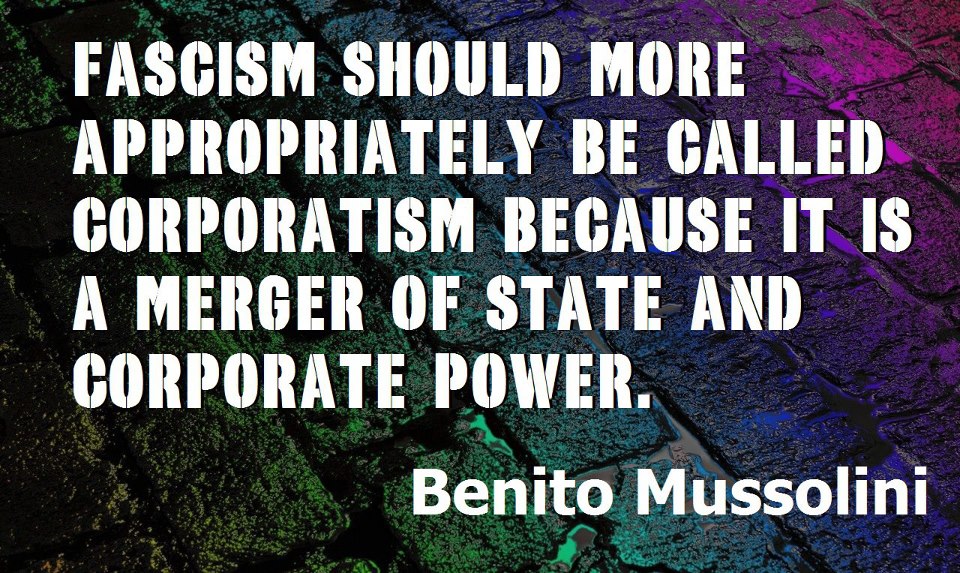
Fascism-s-b-called-Corporatism-Mussolini

By

Source: Center for a Stateless Society

Parsing Political Divides in the Mainstream and in Anarchism

CNBC describes the Corporate Perception Indicator as “a far-reaching survey of business executives and the general population from 25 markets,” “research firm Penn Schoen Berland survey[ing] 25,012 individuals and 1,816 business executives.” The results of the survey show quite unsurprisingly that the general public associates government with words like “corruption,” “lies,” “incompetence,” and “thieves.” As for big business, the words that came to the minds of those surveyed included, again, “corruption” and “thieves,” also “monopoly” and “power.” Interestingly, overall perceptions of both corporations and government appear to be largely negative. In American political discourse, the political right is characterized by a perceptible overpraise of business, devoted to a view of corporations that sees them as essentially free market actors, “creators” and “doers” that give us progress and innovation. Even if this is not true of everyone on the American right, certainly such sentiments are important to the right’s narrative on free markets. The right looks on government, in contrast, as the bungling and inept meddler attempting to hold back our industrious and our productive, the supporter of the lazy and parasitic who would rather live on the government dole than work for a living.

On the left, corporations are perceived as putting profits above people, as willing to do anything to suck more and more of the world’s natural wealth into the hands of a grasping, extravagant one percent. Government, on the other hand, is treated as the agent of “the greater good” or “the public good,” a kind of benevolent, altruistic mother to us all.

In the United States, people who identify themselves as free marketers or libertarians are much more likely to align with the former of these competing narratives, the right’s assertion that the corporation is the home of the movers and the shakers, the creative and energetic champions of free enterprise. This relationship between self-identified libertarians and the American right helps explain the broader anarchist movement’s pardonable reluctance to accept individualist or market anarchists as the genuine article. Further, hostility toward communism has a long history in individualist anarchism, typified by Benjamin Tucker’s frequent denunciations, yet certainly preceding them.[1]

We may observe at this juncture that both the right and the left share the historically and empirically ridiculous theory that government and corporate power are locked in an eternal war. But it is a great politico-economic myth that governments and large corporations operate at variance with one another, that one must align herself in her political commitments with one or the other, never both, never neither. For left wing individualists, surveys which demonstrate dissatisfaction with and negative attitudes toward both actually make perfect sense. That big business should be associated with greed and governments with corruption is hardly astonishing or remarkable. Further, these results underline the problem with seeing corporate power and government power as rivals, rather than seeing them much more accurately as codependent partners in crime, mutually reinforcing components parts of a larger phenomenon we might call a ruling class or power elite.

We needn’t risk the cognitive dissonance that comes with treating the State as the great restraint upon the socially destructive avarice of multinational corporations. For we find, whenever we bother to look, that elites in the business community regularly work with the public sector to create conditions accommodating to monopolism. The ideal of free and open competition, however championed in corporate press releases and political campaigning, is nowhere to be found and indeed never has been. Thus do market anarchists prosecute our laissez faire critique of capitalism. We come from an older tradition of American libertarians, radicals who contemned capitalism as much as any communist, but understood the importance of individual rights and mutually beneficial trade.

It is interesting to witness anarchist communists and syndicalists develop strict, exclusionary criteria for anarchism, particularly insofar as the arguable father of our doctrine, Pierre-Joseph Proudhon, was neither, his mutualism containing many market-friendly if not outright pro-market elements. No less important for anarchism as it developed in America is Josiah Warren, whose first forays into anarchist thought antedate Proudhon. If market or individualist anarchism represents a form of “pseudo-intellectualism,” then some of the anarchist tradition’s brightest lights must apparently be relegated to the dustbin of history. Granting that opposition to not only political but also economic authority is a necessary condition for the true anarchist, individualists like Warren (and his followers such as Benjamin Tucker) more than qualify.

Whether our communist and syndicalist comrades admit it or not, free market ideas figured prominently in fledgling anarchist thought, regarded as perfectly consistent with and a natural outgrowth of, to quote Warren, “the absolute right of supreme individuality.” Considering Warren as an example, many contemporary anarchists may not know that anarchist luminary Peter Kropotkin acknowledged Warren as an inspiration and, in the words of Crispin Sartwell, “a precursor of (and influence on?) Proudhon.” In discussing Warren’s legacy, Sartwell observes one of the major, continuing tensions between the individualist and communist strains of anarchism, the debate on “lifestyle anarchism.” Sartwell argues, quite correctly in the author’s view, that Warren “belongs squarely in what is called by its opponents ‘lifestyle anarchism’: that strain concerned with creating alternatives within the interstices in the existing system rather than arming to overthrow it.” “Peaceful Revolutionist” that he was, Warren emphasized experiments in the creation of practical alternatives to dominant economic and social modalities. To Warren, the whole of life was open to and the subject of reform. This holistic approach, the universality of his critique of the existing state of affairs, he likely inherited from Robert Owen, even while dispensing with other aspects of Owenite thinking. Indeed, Warren’s departure from Owen and his ideas offers us an illuminative proxy for the tensions and debates that still divide individualist from communist elements within anarchism. Warren worried about the overwhelming of the individual within combinations and, paraphrasing Sartwell, imposed a priori schemes. Communists often tend to see the undisciplined “lifestylism” of Warren-type experimentation as essentially bourgeois, outside of or ancillary to genuine class struggle.

Discussing early figures in anarchism such as Warren opens opportunities to reflect on the similarities that unite all anarchists. We can pause to wonder what someone with Warren’s breadth of interests and hopes for reform might think of twenty-first century problems and perceptions thereof.

As all anarchists understand, politics is at bottom conquest, spoliation and rape. Everything else, everything peaceful, voluntary and consensual is something different, throwing the distinction between the “politics means” and the “economic means” once again into sharp relief. The economic means to wealth is defined by the normal, even obvious standards we refer to in interactions with merchants, our friends, and family, the mutually beneficial guidelines we use to cooperate and trade with coequals. The political means, by contrast, is the acquisition of wealth by aggression, by forcible extraction through systematic privilege. The State, being the organization with a monopoly on the legal use of force, is the wellspring of such privilege. As Josiah Warren pointed out in Equitable Commerce:

Theorists have told us that laws and governments are made for the security of person and property; but it must be evident to most minds, that they never have, never will accomplish this professed object; although they have had the world at their control for thousands of years, they have brought it to a worse condition than that in which they found it, in spite of immense improvements in mechanism, division of labor, and other elements of civilization to aid them. On the contrary, under the plausible pretext of securing person and property, they have spread wholesale destruction, famine, and wretchedness in every frightful form over all parts of the earth, where peace and security might otherwise have prevailed. They have shed more blood, committed more murders, tortures, and other frightful crimes in the struggles against each other for the privilege of governing, than society ever would or could have suffered in the total absence of all government whatever.

A deep, principled loathing of both big business and government unites all anarchists. Confronted with the alarming realities of the present moment, its authoritarian repressions and economic maladies, anarchists ought to help one another in peaceful projects to build a freer, better world. Data such as those contained in the Corporate Perception Indicator survey show a world fully primed for our anti-authoritarian, anti-capitalist critiques. It falls upon us to communicate our message, to do the constructive work of inaugurating a new order.

[1] Relatedly, in True Civilization, Josiah Warren wrote, “What is called conservatism has all the time been entirely right in its objections to communism, and in insisting on individual ownership and individual responsibilities both of which communism annihilates; conservatism has also shown wisdom in its aversion to sudden and great changes, for none have been devised that contained the elements of success.”


Lawrence Lessig on Reforming America’s Political System

Lawrence_Lessig_at_ETech_2008

In an April 10 op-ed featured in The Atlantic, Lawrence Lessig argued that the greatest challenge for a movement to reform America’s political system is “the politics of resignation”:

We accept the status quo not because we want it, and certainly not because we don’t care about “process.” To the contrary: We are resigned precisely because we view the very process by which we would effect change as corrupt. We thus steer away from the politics of reform, and focus our (dwindling level of) political attention on other issues instead.

I happen to disagree, because while I think it’s true that many view the process by which we effect change as corrupt, I think that’s less of a problem than the fact that the process actually is corrupt, and that in reality there’s little that the average person can do about it (especially since the average American today is struggling economically and is too busy with work, seeking work, or distracting themselves to avoid work). And why shouldn’t Americans feel cynical after witnessing politician after politician of both major parties break promises to  implement positive and meaningful changes on larger issues of economic and foreign policy?

Regardless, as a solution Lessig proposes a “political moonshot”, a super PAC to end all super PACS, which he describes in further detail in the following passage:

On May 1, May Day (or better “mayday”), we will announce the first steps of an experiment to see if such a machine could be built. Over the past year, we have been working with some of D.C.’s best analysts, to calculate the cost of winning enough seats in 2016 to pass fundamental reform. That battle will begin this year, with a smaller fund targeted in five districts across the country, for the purpose of seeing what works, and what the bigger campaign in 2016 would actually take. That smaller fund will be raised Kickstarter-style, first through small contributions from the bottom up, then matched by a few large contributions from the top down.

While I would like to see such an effort succeed, I can’t see it happening through feeding more money into a system already corrupted by an inordinate concentration of wealth, especially if donations are matched by “a few large contributions from the top down”. An approach I’d rather see (though just as politically unlikely), would be to allocate tax dollars for publicly funded elections with strict limits on “war chests” and advertising. I have no idea how such changes could be made with the current politicians in office and given the current system, how any candidate committed to reducing the influence of money in politics would be nominated, much less get elected. Ever the optimist, Lessig addresses this issue (on a presidential level) arguing:

But if no ordinary candidate makes this the issue, then maybe we should begin to think about an extraordinary one. A public figure with enormous respect—think David Souter or Christine Todd Whitman or Michael Bloomberg—who runs a campaign with a single promise: that if elected, he or she will hold the government hostage until Congress passes fundamental reform; and then once that reform is enacted, will resign—leaving the vice president to become president.

Think of this as president-as-bankruptcy-judge, taking control for the single purpose of reorganizing a government, and once finished, turning it back to the politicians, now free to lead because the kryptonite of special interest money is gone.

Again, while I would like to see such a plan succeed, history shows that money and vested interests are never defeated so quickly and easily. Is it mere coincidence that the two presidents with the greatest potential to fight for the people were Abraham Lincoln and JFK? Anyway, the tentacles of influence extend far deeper into the Washington DC political establishment than just the surface level of electoral politics. Though I may be overly cynical (or optimistic, depending on one’s point of view), I tend to agree more with the approach taken by candidate for class president Tammy in the film “Election” who delivered this short but effective campaign speech:

The Endarkenment Manifesto

jing-jang-yin-yang-planet-hd-high-definition-fullscreen

While it’s easy to understand arguments for a new Age of Enlightenment, a case can be made for Endarkenment as well. On this eve of Winter Solstice (an Endarkenment holiday) it seems appropriate to share the following manifesto and intro originally posted at Arthurmag.com in 2008:

From ARTHUR MAGAZINE No. 29 (May 2008): Peter Lamborn Wilson’s half-serious proposal for a political movement to uphold and propagate the ideals of Green Hermeticism. Wilson sometimes uses the pen name ‘Hakim Bey.’ He is the author of the Temporary Autonomous Zone concept and manifesto, which, for better or worse, was the original inspiration for the Burning Man festival..

THE ENDARKENMENT MANIFESTO

At least half the year belongs to Endarkenment. Enlightenment is only a special case of Endarkenment—and it has nights of its own.

**

During the day democracy waxes, indiscriminately illuminating all and sundry. But shadowless noon belongs to Pan. And night imposes a “radical aristocracy” in which things shine solely by their own luminescence, or not at all.

**

Obfuscatory, reactionary and superstitious, Endarkenment offers jobs for trolls and sylphs, witches and warlocks. Perhaps only superstition can re-enchant Nature. People who fear and desire nymphs and fauns will think twice before polluting streams or clear-cutting forests.

**

Electricity banished shadows—but shadows are “shades,” souls, the souls of light itself. Even divine light, when it loses its organic and secret darkness, becomes a form of pollution. In prison cells electric lights are never doused; light becomes oppression and source of disease.

**

Superstitions may be untrue but based on deeper truth—that earth is a living being. Science may be true, i.e. effective, while based on a deeper untruth—that matter is dead.

**

The peasants attacking Dr. Frankenstein’s tower with their torches and scythes were the shock troops of Endarkenment, our luddite militia. The original historical Luddites smashed mechanical looms, ancestors of the computer.

**

“Neolithic conservatism” (Paul Goodman’s definition of anarchism) positions itself outside the ponderous inevitability of separation and sameness. Every caveman a Prince Kropotkin, every cavewoman Mrs. Nietzsche. Our Phalanstery would be lit by candles and our Passions avowed via messenger pigeons and hot-air balloons.

**

Imagine what science might be like to day if the State and Kapital had never emerged. Romantic Science proposes an empiricism devoid of disastrous splits between consciousness and Nature; thus it prolongates Neolithic alchemy as if separation and alienation had never occurred: science for life not money, health not war, pleasure not efficiency; Novalis’s “poeticization of science.”

**

Of course technology itself is haunted—a ghost for every machine. The myth of Progress stars its own cast of ghouls and efreets. Consciously or unconsciously (what difference would it make?) we all know we live in techno-dystopia, but we accept it with the deterministic fatalism of beaten serfs, as if it were virtual Natural Law.

**

Technology mimics and thus belittles the miracles of magic. Rationalism has its own Popes and droning litanies, but the spell they cast is one of disenchantment. Or rather: all magic has migrated into money, all power into a technology of titanic totality, a violence against life that stuns and disheartens.

**

Hence the universal fear/desire for the End of the World (or for some world anyway). For the poor Christian Moslem Jewish saps duped by fundamentalist nihilism the Last Day is both horrorshow and Rapture, just as for secular Yuppies global warming is a symbol of terror and meaninglessness and simultaneously a rapturous vision of post-Catastrophe Hobbit-like local-sustainable solar-powered gemutlichkeit. Thus the technopathocracy comes equipped with its own built-in escape-valve fantasy: the Ragnarok of technology itself and the sudden catastrophic restoration of meaning. In fact Capital can capitalize on its own huge unpopularity by commoditizing hope for its End. That’s what the smug shits call a win/win situation.

**

Winter Solstice (Chaos Day in Chinese folklore) is one of Endarkenment’s official holidays, along with Samhain or Halloween, Winter’s first day.

**

Endarkenment stands socially for the Cro-Magnon or “Atlantaean” complex—anarchist because prior to the State—for horticulture and gathering against agriculture and industry—for the right to hunt as against the usurpation of commons by lord or State. Electricity and internal combustion should be turned off along with all States and corporations and their cult of Mammon and Moloch.

**

Despite our ultimate aim we’re willing to step back bit by bit. We might be willing to accept steam power or hydraulics. The last agreeable year for us was 1941, the ideal is about 10,000 BC, but we’re not purists. Endarkenment is a form of impurism, of mixture and shadow.

**

Endarkenment envisages a medicine advanced as it might have been if money and the State had never appeared, medicine for earth, animals and humans, based on Nature, not on promethean technology. Endarkenment is not impressed by medicine that prolongs “life span” by adding several years in a hospital bed hooked up to tubes and glued to daytime TV, all at the expense of every penny ever saved by the patient (lit. “sufferer”) plus huge debts for children and heirs. We’re not impressed by gene therapy and plastic surgery for obscene superrich post humans. We prefer an empirical extension of “medieval superstitions” of Old Wives and herbalists, a rectified Paracelsan peoples’ medicine as proposed by Ivan Illich in his book on demedicalization of society. (Illich as Catholic anarchist we consider an Endarkenment saint of some sort.) (Endarkenment is somewhat like “Tory anarchism,” a phrase I’ve seen used earliest in Max Beehbohm and most lately by John Mitchell.) (Other saints: William Blake, William Morris, A.K. Coomaraswamy, John Cowper Powys, Marie Laveau, King Farouk…)

**

Politically Endarkenment proposes anarcho-monarchism, in effect somewhat like Scandinavian monarcho-socialism but more radical, with highly symbolic but powerless monarchs and lots of good ritual, combined with Proudhonian anarcho-federalism and Mutualism. Georges Sorel (author of Reflections on Violence) had some anarcho-monarchist disciples in the Cercle Proudhon (1910-1914) with whom we feel a certain affinity. Endarkenment favors most separatisms and secessions; many small states are better than a few big ones. We’re especially interested in the break-up of the American Empire.

**

Endarkenment also feels some critical admiration for Col. Qadhaffi’s Green Book, and for the Bonnot Gang (Stirnerite Nietzschean bank robbers). In Islamdom it favors “medieval accretions” like sufism and Ismailism against all crypto-modernist hyperorthodoxy and politics of resentment. We also admire the martyred Iranian Shiite/Sufi socialist Ali Shariati, who was praised by Massignon and Foucault.

**

Culturally Endarkenment aims at extreme neo-Romanticism and will therefore be accused of fascism by its enemies on the Left. The answer to this is that (1) we’re anarchists and federalists adamantly opposed to all authoritarian centralisms whether Left or Right. (2) We favor all races, we love both difference and solidarity, not sameness and separation. (3) We reject the myth of Progress and technology—all cultural Futurism—all plans no matter their ideological origin—all uniformity—all conformity whether to organized religion or secular rationalism with its market democracy and endless war.

**

Endarkenists “believe in magic” and so must wage their guerrilla through magic rather than compete with the State’s monopoly of techno-violence. Giordano Bruno’s Image Magic is our secret weapon. Projective hieroglyphic hermeneutics. Action at a distance through manipulation of symbols carried out dramaturgically via acts of Poetic Terrorism, surrealist sabotage, Bakunin’s “creative destruction”—but also destructive creativity, invention of hermetico-critical objects, heiroglyphic projections of word/image “spells”—by which more is meant (always) than mere “political art”—rather a magical art with actual dire or beneficial results. Our enemies on the Right might call this political pornography and they’d be (as usual) right. Porn has a measurable physiopsychological effect. We’re looking for something like it, definitely, only bigger, and more like Artaud than Brecht—but not to be mistaken for “Absolute Art” or any other platonic purism—rather an empirical strategic “situationist” art, outside all mass media, truly underground, as befits Endarkenment, like a loosely structured “rhizomatic” Tong or freemasonic conspiracy.

**

The Dark has its own lights or “photisms” as Henry Corbin called them, literally as entoptic/hypnagogic phosphene-like phenomena, and figuratively (or imaginally) as Paracelsan Nature spirits, or in Blakean terms, inner lights. Enlightenment has its shadows, Endarkenment has its Illuminati; and there are no ideas but in persons (in theologic terms, angels). According to legend the Byzantines were busy discussing “the sex of angels” while the Ottomans were besieging the walls of Constantinople. Was this the height of Endarkenment? We share that obsession.

Jan. 1, 2008

Saturday Matinee: What to Do in Case of Fire?

3b6ef1ef605e7

“What to Do in Case of Fire?” (2001) opens with a montage of young anarchist squatters fighting police, making propaganda films, and constructing a homemade bomb in Berlin circa 1987. They plan to blow up a vacant mansion but the bomb is a dud, until thirteen years later when it injures a real estate broker and potential buyer in a fluke accident.

Only two of the original members of the anarchist collective, Tim and Hotte, are still squatting in the same communal housing since the 80s and are unable to prevent police from confiscating filmed evidence in a raid triggered by the bomb incident. Because all members of the collective are potentially linked to the bombing, Tim and Hotte scramble to track down former comrades and formulate an action plan before the evidence is examined. The reunion of old friends, including those who’ve settled into traditional family life or sold out for corporate jobs, stirs up a host of interpersonal conflicts which they must resolve in order to work together to remain free.

Though the film does at times seem to fall back on lazy stereotypes of anarchists, it at least puts them in a human light. Even less radical viewers could relate to certain struggles the protagonists are faced with, such as trying to balance freedom and security, being “successful” versus upholding one’s ideals, and coming to terms with friendships that change over time. It would have been interesting had the film delved deeper into Berlin’s anarchist and squatters movements, in my opinion, but it’s nevertheless a charming and fun mix of comedy, drama and heist genres.

Note: to activate English subtitles on the video, click on the Closed Captions (CC) icon on the bottom right corner while video is playing, click on the box that says “Portuguese (Brazil)”, click “Translate Captions”, click on “Afrikaans”, then you should be able to scroll down until you can click on “English”. The subtitle feature might not be available on some portable devices.

Anonymous Calls for Worldwide Wave of Action #www

Via: Anonymous

s_500_evolvesociety_org_0_v-for-vendetta-effetto-domino-940x321

The modern paradigm may still seem insurmountable “because it possesses an outward front, the work of a long past, but is in reality an edifice crumbling to ruin and destined to fall in at the first storm.”
— Gustave Le Bon, The Crowd: A Study of the Popular Mind

The decentralized movement toward freedom is raging across the world. It cannot be stopped. The tipping point is near. Despite the lack of coverage in the mainstream media, actions are springing up on an increasing basis. A wave of transformation is rising. The zeitgeist is shifting in our direction.

At this point, given all the nonviolent direct actions that are currently being planned, it makes strategic sense for us to organize them, in a decentralized way, in a way that the mainstream media cannot ignore. A slightly more coordinated approach is all it will take.

The Awakening Wave

The last time we all rallied together in a loosely knit collective fashion, the Occupy movement was born and the 99% meme brought the corruption of our political and economic system, along with the grotesque inequality of wealth, into mass consciousness in a profound and lasting way. It was the opening act, the awakening wave.

Since the Occupy camps were crushed by brutal police state force, the movement has splintered in many different directions. This is now proving to have been a blessing in disguise. It gave us time to learn from our mistakes, figure out what worked best and forced us back into the autonomous actions that built the movement in the first place. We have now experimented with different tactics and thought through longer-term strategies.

Meanwhile, the repressive conditions that inspired Occupy in the first place have become even more oppressive. Now more than ever, governments no longer have the consent of the governed. A critical mass has lost faith and trust in our existing institutions. The present paradigm has outlived its usefulness. It has been overrun with corruption and rendered obsolete. Our political, economic and legal systems are doing much more to limit our potential than enhance it.

It’s Time For A Worldwide Wave of Transformation

Let’s pick a three-month span, perhaps throughout this coming spring, and unite our collective actions into an unprecedented Worldwide Wave that cannot be ignored by anyone.

Let’s crowdsource a relentless global wave of action that protests the corrupt, while also rallying around and celebrating effective alternatives and solutions to the vast problems we are confronted by. Imagine thousands of nonviolent guerrilla armies swarming corrupt targets and rallying for viable solutions for a sustained three-month cycle. If we begin preparing now, a massive spring offensive can lead to a summer of transformation.

Staying true to the vital nature of the movement, you lead, in your own way. Pick whatever issues concern you most and run with them, knowing that likeminded people throughout the world will also be fighting in solidarity, in whatever way they can, at the same time you are.

Not Focused Enough?

In an attempt to dismiss and undermine us, status quo propagandists will once again criticize us by saying that our message of systemic change is not focused enough or lacks coherent goals. This feeble attempt to keep people from joining in with us will be overcome by our widespread and consistent actions, which will lead by example and inspire the cultural shift in mass consciousness that we urgently need. Our diverse crowdsourced actions will boldly demonstrate our will to expose, fight and overcome tyrannical systems. By rallying around viable solutions and protesting what we are against, the goals and freedoms that we aspire to will organically become self-evident to all.

Throughout history, when people have fought against tyranny and oppression, they didn’t have one perfect utopian model outcome agreed upon beforehand. They just knew that the invading and old systems were detrimental to their wellbeing and had to go. We are now in that position.

Don’t let the propagandists fool you. We do not need corrupt corporations or aristocratic government rulers anymore. They are obsolete. People throughout this interconnected technological world have already come up with much more effective systems to replace the tyrannical one that is currently dominating our lives. There are already many effective solutions to our problems, solutions that are held back by the entrenched forces of shortsighted greed. Once a small percentage of us withdraw our participation from corrupt entities and opt out of tyranny, the old and obsolete systems of rule will quickly fall away.

Extensive empirical evidence demonstrates that nonviolent movements toward freedom result in positive outcomes. Research has proven that it only takes approximately 3% of the population engaging in various forms of nonviolent action to create significant meaningful change, for the betterment of society. We now have the necessary critical mass of aware people who are ready, willing and capable.

Guerrilla Tactics

This time the police state will not be able to crush us. We will not have stationary targets. We will be everywhere, fluid and evasive. The movement will be an unstoppable crowdsourced, decentralized and autonomous revolutionary force.

We will engage in a diversity of nonviolent tactics, from large-scale mobilizations to small daily acts. Most of you already know the actions and tactics that are needed. Without revealing too much strategic information, here are a few basic actions to get a fire going in your mind:

-Mass gatherings, demonstrations;
-Marches, parades;
-Flash mobs, swarms;
-Shutdown harmful corporate and governmental operations;
-Worker Strikes;
-Hunger strikes;
-Sit-ins;
-Strategic defaults, debt strikes;
-Foreclosure prevention;
-Boycotting corrupt corporations;
-Monkeywrench corrupt corporations;
-Move your money out of the big banks and the stock market;
-Use alternative currencies and economic systems;
-Cancel your cable television and support independent media;
-Use independent online tools that don’t sell your info and protect your privacy;
-Online civil disobedience, Anonymous operations;
-Leak information on corruption;
-Use alternative energy;
-Build your own urban and hydroponic farms, or get your food from them;
-Support local businesses;
-Join local community organizations;
-Take part in food banks and help develop community support systems;
-Start or join intentional and autonomous communities;
-Experiment with new governing systems, Liquid Democracy;
-Create Temporary Autonomous Zones
-Host teach-ins;
-Organize socially conscious events;
-Make conscious media;
-Guerrilla theater;
-Guerrilla gardening;
-Guerrilla postering, messages on money;
-Help inspiring groups and organizations spread their message;
-Random acts of kindness and compassion;
-Mass meditations, prayer sessions and spiritual actions.

The list goes on and on. You know what you can do to play a part. Do whatever you feel inspired to do. Amplify what you are already doing. Think about what you are willing to do to be the change that we urgently need to see in the world, and then do it.

Don’t get bogged down in infighting and caught up in negativity. Ignore the saboteurs. Collaborate with people who inspire you. Keep moving forward with an indomitable will, a compassionate spirit and radiate a positive attitude. Moods are contagious. Be passionate and have fun!

Our ability to take part in civil disobedience is multiplied by our ability to easily record the actions on video and spread them throughout the Internet. By flooding social media with these inspiring videos, we will create a positive feedback loop that translates into more action on the ground.

Radical change is urgently needed, so let’s make transforming the world the cool thing to do. Let’s create a culture of transformation. Let’s blaze a contagious nonviolent wave of action through mass consciousness, signaling the end of the old world, ushering in a new paradigm.

Now is the time.

~~*~~

Ride the Worldwide Wave of Transformation
001101000010111000110100001011100011000100110100
#www

Tweak this meme! This is a draft call to action, a work in progress. Feel free to make changes to it and spread it around however you see fit.

Source link

Russell Brand on Voting and Revolution

Though I’m not familiar with Russell Brand’s work as an actor, judging from interview clips he’s a pretty good comedian and social critic in the tradition of Bill Hicks. In this excerpt from the BBC program Newsnight he defends his choice not to vote and voices concern for a number of topics not usually discussed on television.

While I understand the position of not voting, I believe in the U.S. there’s still good reason to vote at least for local elections, initiatives or referendums. Voting may be a form of coersion but in some cases it can block the enaction of policies leading to greater coersion. If one uses absentee ballots voting doesn’t take much time and effort and though vote rigging is a problem, not all elections are rigged and voting can in some cases make it more difficult to do. For now in this country, with education and organization, voting can still lead to positive change or prevent things from getting worse, and of course one’s political activity shouldn’t be limited to voting. However, when it comes to presidential elections, low turnouts are one way to send a message of illegitimacy and disgust. Despite political disagreements I’m glad public figures such as Brand use their fame as a platform for thoughtful and substantive ideas not usually found in the world of corporate media. It seems he’s been on a roll lately because just last month he was banned from the GQ Awards for this speech:

And earlier this year he made a mockery of MSNBC’s “Morning Joe” program:

While Brand may have good reason to be annoyed with the hosts, it’s unfortunate that he resorted to lewd jokes near the end. Stooping to their level undermines the effectiveness of his critique, in my opinion.