The Ocean is Broken

Pacific-garbage-patch-map_2010_noaamdp

A recent article from Australia’s Newcastle Herald has been going viral, and for good reason. It’s a chilling and heartbreaking first-hand account of the state of the Pacific Ocean. These observations in particular depict a hellish scenario:

“After we left Japan, it felt as if the ocean itself was dead,” Macfadyen said.

“We hardly saw any living things. We saw one whale, sort of rolling helplessly on the surface with what looked like a big tumour on its head. It was pretty sickening.

“I’ve done a lot of miles on the ocean in my life and I’m used to seeing turtles, dolphins, sharks and big flurries of feeding birds. But this time, for 3000 nautical miles there was nothing alive to be seen.”

In place of the missing life was garbage in astounding volumes.

“Part of it was the aftermath of the tsunami that hit Japan a couple of years ago. The wave came in over the land, picked up an unbelievable load of stuff and carried it out to sea. And it’s still out there, everywhere you look.”

Ivan’s brother, Glenn, who boarded at Hawaii for the run into the United States, marvelled at the “thousands on thousands” of yellow plastic buoys. The huge tangles of synthetic rope, fishing lines and nets. Pieces of polystyrene foam by the million. And slicks of oil and petrol, everywhere.

Countless hundreds of wooden power poles are out there, snapped off by the killer wave and still trailing their wires in the middle of the sea.

“In years gone by, when you were becalmed by lack of wind, you’d just start your engine and motor on,” Ivan said.

Not this time.

“In a lot of places we couldn’t start our motor for fear of entangling the propeller in the mass of pieces of rope and cable. That’s an unheard of situation, out in the ocean.

“If we did decide to motor we couldn’t do it at night, only in the daytime with a lookout on the bow, watching for rubbish.

“On the bow, in the waters above Hawaii, you could see right down into the depths. I could see that the debris isn’t just on the surface, it’s all the way down. And it’s all sizes, from a soft-drink bottle to pieces the size of a big car or truck.

“We saw a factory chimney sticking out of the water, with some kind of boiler thing still attached below the surface. We saw a big container-type thing, just rolling over and over on the waves.

“We were weaving around these pieces of debris. It was like sailing through a garbage tip.

“Below decks you were constantly hearing things hitting against the hull, and you were constantly afraid of hitting something really big. As it was, the hull was scratched and dented all over the place from bits and pieces we never saw.”

Plastic was ubiquitous. Bottles, bags and every kind of throwaway domestic item you can imagine, from broken chairs to dustpans, toys and utensils.

And something else. The boat’s vivid yellow paint job, never faded by sun or sea in years gone past, reacted with something in the water off Japan, losing its sheen in a strange and unprecedented way.

BACK in Newcastle, Ivan Macfadyen is still coming to terms with the shock and horror of the voyage.

“The ocean is broken,” he said, shaking his head in stunned disbelief.

Read the full article here: http://www.theherald.com.au/story/1848433/the-ocean-is-broken/

Large-scale human over-consumption and toxic waste are undoubtedly major factors contributing to a rash of unusual die-offs of Salmon, Herring, Sardines, Starfish, Dolphins, and others.

Why ‘I Have Nothing to Hide’ Is the Wrong Way to Think About Surveillance

verizon-we-can-hear-you-now

A common defense of mass surveillance used by apologists is “if you have nothing to hide, why worry?” Nevermind that there’s many things that are perfectly legal that we might not “hide” but choose not to reveal indiscriminately (ie. credit card numbers, medical records, nakedness, etc.), we may in fact have something to hide but not even know it. As noted by Moxie Marlinspike of Wired.com:

If the federal government can’t even count how many laws there are, what chance does an individual have of being certain that they are not acting in violation of one of them?

For instance, did you know that it is a federal crime to be in possession of a lobster under a certain size? It doesn’t matter if you bought it at a grocery store, if someone else gave it to you, if it’s dead or alive, if you found it after it died of natural causes, or even if you killed it while acting in self defense. You can go to jail because of a lobster.

If the federal government had access to every email you’ve ever written and every phone call you’ve ever made, it’s almost certain that they could find something you’ve done which violates a provision in the 27,000 pages of federal statues or 10,000 administrative regulations. You probably do have something to hide, you just don’t know it yet.

He also makes a compelling argument for why we should have something to hide:

Over the past year, there have been a number of headline-grabbing legal changes in the U.S., such as the legalization of marijuana in Colorado and Washington, as well as the legalization of same-sex marriage in a growing number of U.S. states.

As a majority of people in these states apparently favor these changes, advocates for the U.S. democratic process cite these legal victories as examples of how the system can provide real freedoms to those who engage with it through lawful means. And it’s true, the bills did pass.

What’s often overlooked, however, is that these legal victories would probably not have been possible without the ability to break the law.

The state of Minnesota, for instance, legalized same-sex marriage this year, but sodomy laws had effectively made homosexuality itself completely illegal in that state until 2001. Likewise, before the recent changes making marijuana legal for personal use in Washington and Colorado, it was obviously not legal for personal use.

Imagine if there were an alternate dystopian reality where law enforcement was 100% effective, such that any potential law offenders knew they would be immediately identified, apprehended, and jailed. If perfect law enforcement had been a reality in Minnesota, Colorado, and Washington since their founding in the 1850s, it seems quite unlikely that these recent changes would have ever come to pass. How could people have decided that marijuana should be legal, if nobody had ever used it? How could states decide that same sex marriage should be permitted, if nobody had ever seen or participated in a same sex relationship?

…We can only desire based on what we know. It is our present experience of what we are and are not able to do that largely determines our sense for what is possible. This is why same sex relationships, in violation of sodomy laws, were a necessary precondition for the legalization of same sex marriage. This is also why those maintaining positions of power will always encourage the freedom to talk about ideas, but never to act.

Read the full article here: http://www.wired.com/opinion/2013/06/why-i-have-nothing-to-hide-is-the-wrong-way-to-think-about-surveillance/

The East German STASI regime also put their citizens under mass surveillance allegedly for their own good. The information collected was used as leverage by authorities to force informants to betray friends, neighbors and family members.  Trust throughout the society crumbled and eventually the government itself crumbled.

Obama Picks Terrorist War Criminal To Head Department Of Homeland Security

October 19, 2013

Source: Lee Rogers, Blacklisted News

Barack Obama has nominated Jeh Johnson to head the Department of Homeland Security.  Johnson is actually a perfect choice for the Washington DC war criminals considering his prior track record.  Since 2009 he has worked in the Department of Defense as their general counsel.  In this role he has provided the legal justification for the Obama regime’s foreign military interventions including drone strikes that have killed numerous civilians.  Johnson has also claimed that the Obama regime has the legal authority to kill American citizens if they take up arms with Al-Qaeda.  Through these and other ridiculous legal assertions, Johnson has proven that he himself is a terrorist war criminal.  Considering that the American economy is edging closer and closer to a total collapse they will need someone in charge of Homeland Security who is not afraid to give orders to kill Americans.  Johnson as a terrorist war criminal will fit very nicely into this role.

According to a recent Washington Post article, Johnson was responsible for the prior legal review and approval of all military operations executed by the Obama regime.  This makes Johnson an incredibly evil man.  The Obama regime has been responsible for a number of war crimes including the authorization of drone strikes that have killed many civilians.  Even women and children have been killed by some of these strikes.  It is also worth noting that the Obama regime launched an unprovoked attack against the sovereign nation of Libya which by the standards set after World War II is a war crime.  Of course they almost did the same thing in Syria until it became clear that such an operation had no real support domestically or amongst the international community.  It is hard to believe that anyone could possibly find an appropriate legal justification for such horrible atrocities but apparently if you are a criminal like Johnson this comes easy.

It is no secret that Al-Qaeda is just a brand name used to describe proxy forces of Islamic fanatics run and managed by the United States.  These forces are either used to destabilize foreign governments as we have seen with Libya and Syria or they are used as an excuse for foreign military intervention.  In a sense there is no group officially named Al-Qaeda and any group labeled as such is manufactured for the purpose of expanding American influence.  As stated previously, Johnson believes that the federal government has the authority to kill American citizens if they align themselves with Al-Qaeda.  In other words, if the Obama regime says you are with Al-Qaeda, Johnson believes they have the right to kill you.  Even though the Obama regime runs Al-Qaeda, the legal framework supported by Johnson gives them the ability to link their domestic enemies with Al-Qaeda to justify killing them.  The entire thing is such a sick joke that it defies any sort of rational comprehension.

Previously there has been numerous propaganda stories planted in the corporate press talking about the so-called emergence of a domestic white Al-Qaeda threat.  As the American public becomes increasingly upset with the Obama regime’s criminal policies, we will likely see this type of disinformation revisited.  Obama’s political opponents will be labeled as terrorists.  In fact we have already started to see some of this.  During the recent debt ceiling and government shutdown fiasco some of Obama’s cronies labeled certain Republicans and Tea Party members as such.

The further things get out of control domestically, the more important Johnson’s role could become.  He could eventually be in charge of putting down any sort of domestic rebellion that will inevitably occur as we see America fall further and further into an economic abyss.  His track record at the Pentagon suggests that he will have no problem authorizing deadly force to kill Americans who pose any sort of threat to the Obama regime.  After all, they will just label these people as domestic terrorists.  Under former Department of Homeland Security head Janet Napolitano, the agency purchased all sorts of goodies to wage war against the American people including armored vehicles and billions of bullets.  There is a very good possibility that once Johnson’s nomination is confirmed that he could be the one to ordering the deployment of these assets against regular Americans.

Johnson has even made the ridiculous claim that Martin Luther King would have supported military intervention in Afghanistan and Iraq.  King was staunchly anti-war and strongly opposed the Vietnam War throughout the 1960s.  This type of blatant historical revisionism says all we need to know about this man’s credibility.  He will lie, fabricate or do whatever it takes to legally justify the Obama regime’s criminal policies.

So there you have it.  The Obama regime’s future head of the Department of Homeland Security is nothing more than a terrorist war criminal.  There’s no question that this man is evil and because of that it is pretty much assured that he will have no problem getting approved through the Congressional nomination process.

Building Bridges: Top 10 Issues That 99% Can Agree On

building_bridges

On a recent episode of PBS Newshour, Jeffrey Brown hosted a roundtable discussion exploring the dangers of polarized politics for American Governance. The guests were Eric Liu, Steven Hayward and Beverly Gage. Most of the discussion was an analysis of the recent government shutdown from a typical left vs. right perspective, but I thought their view of reactions of average citizens was interesting:

JEFFREY BROWN: And so, Eric Liu, let me ask you, because I know you’re very — you’re trying to engage people in the act of citizenship. What do you see the effect of all of this? Are they more engaged? Are they just more disgusted and turned off?

ERIC LIU: Well, I don’t think those are mutually exclusive. There is disgust.

(LAUGHTER)

ERIC LIU: But, because of the disgust, there’s actually more engagement.

And that’s true on both the left and the right. Look, I think the reality is, when Steven was speaking a moment ago about the kind of encroachment of ever-growing and ever-larger government, we can have reasonable debates in this country about what the proper size and scope of government ought to be, but we ought to regard those debates not as “on/off, yes/no, my way or we shut the whole thing down” kind of debates.

…so people from both left and right watching these last two weeks are ready for something different.

They’re ready to actually hear each other and see one another and not the caricatures of one another, and try to figure out, well, where is it that we can manage to agree on the role of government, and where we can’t agree, how can we recognize that to be a citizen isn’t just a single-shot sudden death game. It’s infinite repeat play, and you’re going to win some, and I’m going to win some.

JEFFREY BROWN: All right, let me ask Steven Hayward to respond to this.

Do you see the result of this as people ready to work together or more divisions that ever more polarizes?

STEVEN HAYWARD: Well, I think there’s two things to think about here.

One is, is we have divided government once again. The voters, God bless them, have a lot of cognitive dissonance. Right? In the last week, what you saw is people say, I don’t like Obamacare, but I don’t want the government shut down. I don’t want it to be a matter of a budget fight the way it’s become. And that’s why Republicans lost this proximate battle.

But if you look at some of the poll numbers right now, I think they ought to be very worrying for everybody, but I think more worrying ultimately for liberals, for this reason. You have seen record high numbers of people who now say — I think 65 percent in one poll — that government is a threat to their rights.

You have seen a long-term trend going back really to the 1960s of the number of people saying they have confidence that the federal government will do the right thing down in 15 percent, 20 percent, when it used to be in the ’50s up around 60 to 70 percent. And to the extent that if you’re liberal and that you believe in political solutions to our social problems or government engagement with our problems, you want the public to have confidence in the federal government’s capacities.

And so it seems to me that, as much as this might have been a train wreck for Republicans, the long-term effect of this might not necessarily play out that way.

JEFFREY BROWN: Well, Beverly, when you look back at political — what could be called political crises of the past, what does it — what happens in terms of public response to those?

BEVERLY GAGE: Well, I think to some degree, Steven’s quite right, in that I would kind of like to subscribe to Eric’s view that we’re going to have a much more serious conversation, a much more bipartisan conversation.

But I think it’s equally possible that you’re actually going to see people throw their hands up and say, oh, it’s all such a mess. I don’t really want to make sense of it. I don’t want to deal with it. And, in that way, it sort of serves an anti-government message, and in some ways, even serves sort of the Tea Party message in ways that maybe were intended and maybe weren’t.

But I think there’s also a danger for the Republican Party in all of this, which is to say that these divisions that we’re seeing right now within the Republican Party between moderates and Tea Party conservatives and also between a sort of establishment business class, which is very, very alarmed about what’s happening, and this more right-wing part of the party, that actually may in fact spell destruction for the Republican Party.

Those are divisions that have been there for a long time. They have often been papered over. But when you’re on the brink of financial catastrophe in the way that we were, we may not see them be papered over, and we may in fact see some sort of political realignment coming out of this.

You can read the complete transcript here: http://www.pbs.org/newshour/bb/politics/july-dec13/governing_10-17.html

All three guests made good points, though the views of conservatives and liberals are typically generalized in such discussions and I think issues of most concern to citizens on a grassroots level are often not the ones being debated enough in Washington D.C. There definitely needs to be more political discussion between left and right not just within government but among the general public. Increased communication and education is the best defense against “divide and conquer” tactics but of course this is easier said than done because politics has become a taboo subject for many, mainly due to fear of getting into heated arguments. But perhaps this fear is unwarranted because there’s many issues that the left and right can agree on (though motives and priorities may differ). These are just some of the more topical examples:

  1. End the Wars – As demonstrated by widespread negative reaction to war threats against Syria, people are perhaps becoming more aware of political trickery thus becoming harder to persuade. Also, as living standards drop for more people, the connection between costly foreign policy and the nation’s declining economy and infrastructure has never been more obvious.
  2. Stop the Surveillance State – Privacy is a universal human need. Mass spying on citizens is illegal and unethical whether online or through drones and informants.
  3. End Unjust Trade Agreements – Agreements such as NAFTA and the Trans-Pacific Partnership (TPP) hurt working people and endangers health and safety, the environment, and national sovereignty.
  4. End the Fed – We’ve endured 100 years of a “Federal” Reserve run by private bankers and all we have to show for it is a debt of tens of trillions of dollars. It will never be paid off as long as we continue to use interest-bearing federal reserve notes as currency.
  5. Create Affordable Health Care – It can be argued that Obamacare is an incremental improvement but everyone knows it’s not enough and is far more beneficial for greedy insurance companies than the poor.
  6. End the Drug War – We can all agree the Drug War is a colossal failure (when it comes to the stated purpose of reducing drug addiction). It has only increased incarceration rates while enriching the prison-industrial complex and drug cartels. We need to adopt policies that have proven to be effective such as legalization, decriminalization and harm-reduction.
  7. Stop GMOs – GMOs are unnecessary, physically and economically harmful to farmers, may have potentially catastrophic effects on the ecosystem, and only serves to increase profits for companies like Monsanto.
  8. End Obscene Economic Inequality – Complete economic equality might not be possible, but when economic inequality reaches absurd and unsustainable levels as they have today, obviously something needs to change.
  9. Protect Internet Freedom – Legislation such as the NDAA, SOPA and PIPA indicate that government and corporations are threatened by the internet. Attacks against internet freedom are attacks against freedom of speech, freedom of information and cognitive liberty.
  10. Ignore Corporate News – Another point of agreement between right and left is the corporate news media’s increasing irrelevancy and bias. Today it is not so much a liberal or conservative bias as it is a neoliberal and neoconservative bias.

Rushkoff on the Economy

pyramid_of_power

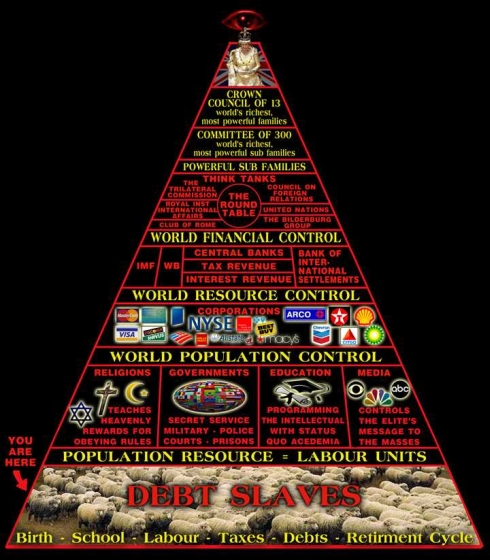
I’ve been reading Douglas Rushkoff’s “Present Shock: When Everything Happens Now” and have by coincidence just reached a chapter of the book covering the topic of currencies and the economy as Washington D.C. attempts to avoid another default. I found similar writings from Rushkoff on the same topic in two articles published by Arthur Magazine. As can be seen from these excerpts, they’re helpful for understanding our current situation:

Local currencies favored local transactions, and worked against the interests of large corporations working from far away. In order to secure their own position as well as that of their chartered monopolies, monarchs began to make local currencies illegal, and force locals to instead use “coin of the realm.” These centralized currencies worked the opposite way. They were not earned into existence, they were lent into existence by a central bank. This meant any money issued to a person or business had to be paid back to the central bank, with interest.

What does that do to an economy? It bankrupts it. Think of it this way: A business borrows 1000 dollars from the bank to get started. In ten years, say, it is supposed to pay back 2000 to the bank. Where does the other 1000 come from? Some other business that has borrowed 1000 from the bank. For one business to pay back what it owes, another must go bankrupt. That, or borrow yet another 1000, and so on.

An economy based on an interest-bearing centralized currency must grow to survive, and this means extracting more, producing more and consuming more. Interest-bearing currency favors the redistribution of wealth from the periphery (the people) to the center (the corporations and their owners). Just sitting on money—capital—is the most assured way of increasing wealth. By the very mechanics of the system, the rich get richer on an absolute and relative basis.

The biggest wealth generator of all was banking itself. By lending money at interest to people and businesses who had no other way to conduct transactions or make investments, banks put themselves at the center of the extraction equation. The longer the economy survived, the more money would have to be borrowed, and the more interest earned by the bank.

[…]Commerce is good. Commerce is not the problem. Monopolies are.

Except in a few rare cases, corporate charters and centralized currency were never intended to promote commerce. They were intended to prevent locals and non-chartered entities from creating and exchanging value. They are not extensions of the free market, but efforts at extracting value from the free market. Corporate monopoly charters were extended to a king’s favorite companies in return for shares. Then, no one else was allowed to do business in that industry. Centralized currency forced businesses to run their revenue through the king’s coffers. Likewise, in its current form, centralized currency is more akin to a ponzi scheme of interest rates, each borrower paying up to the banker above him.

Both of these innovations—corporate charters and centralized currency—tend towards resource exploitation rather than innovation. They are extractive in nature, not productive. And, more importantly, these particular innovations cause wealth to end up being generated through speculation rather than creation. They cause scarcity, not abundance. Over time, it becomes easier to make money by having money than by doing anything. And this was the pure, stated intent of centralized currency and banking in the early Renaissance: to keep the wealthy wealthy, in the face of a rising merchant class.

This isn’t some extremist perspective. It’s just historical fact, though largely forgotten and seemingly refuted by our collective false memory of the Renaissance’s greatness. If you’re interested in finding out more about this, or seeing the evidence on which my research is based, take a look at the best historians writing about the era: Fernand Braudel (The Wheels of Commerce: Civilization and Capitalism: 15th-18th Century, Volume 2, Univ. of California Press, 1992), Carlo M. Cipolla (Before the Industrial Revolution: European Society and Economy, 1000-1700, WW Norton, 1994) or Bernard A. Lietaer, whose book On Human Wealth used to be available for free download off his site, but doesn’t seem to be anymore. In these books, you can find out about the sustainable local economic systems of the Late Middle Ages, learn that the Black Plague actually began after mandated centralized currency had impoverished Europe, and find support of my contention that cathedrals were built with local money before the Renaissance, not Vatican money during the Renaissance.

I highly recommend checking out both articles here (as well as his most recent book “Present Shock”):

http://arthurmag.com/2009/03/16/let-it-die-rushkoff-on-the-economy/

http://arthurmag.com/2009/03/23/hack-money-hack-banking-rushkoff-on-the-economy/

More voices of sanity (Nicole Voss and Laurence Boomert) calling for an overhaul of the monetary system can be heard on the C-Realm podcast :