Getting Inside the Mind of Mainstream Media

Is this the next step of the information war?

By Bernie Suarez

Source: TruthandArtTV.com

Mainstream media lies, deceit, and propaganda are being dramatically exposed in real-time at an alarming rate. Anyone following alternative media knows what I’m talking about. Is it me or does it seem like the MH17 false flag happened years ago? We can see that false flags that are quickly exposed and blown wide open end up dropping to the bottom of mainstream media news. We’re seeing the pattern over and over again, so isn’t it time we sharpen our skills and start predicting the mainstream media lies and propaganda before it happens? For those of us fully awakened, we have to be scratching our heads wondering, what else. What can we do to change and turbo-boost this information war for the better? What creative thing can we do to throw a monkey wrench into the globalist plans? Is it even possible? Let’s examine some ideas.

In all my writings I assert that we have an information and survival battle that is best described as ‘humanity versus the globalists’ or the ‘humanity versus the new world order’ (or other names such as the Illuminati or global elite). We can also call it humanity against the control system. Call it what you want, but understand that if you are not part of the control system, you are part of humanity. Humanity is everyone. We are human, we are on earth and we are not trying to control anyone. We are the pure expression of the species on earth innocently going about our daily lives trying to survive and make the most of it. The globalist control system however, lives and operates for a very different reason. The depth of this truth is gripping when you fully understand it. Imagine for a minute, there is actually a species amongst us who wishes to control you, inflict suffering on you and wishes to diminish or even eliminate your existence.

Many Libertarians and freedom lovers can appreciate this reality. It’s been said, there are two kinds of people on earth; those who want to control you and those who simply want to be left alone. This simple view of life is a very accurate portrayal of reality. Never before have we seen this manifest itself so clearly as it is now. Do you realize that the mainstream media globalist mouthpiece can just as easily encourage humanity, call for peace, reward truth, and honor integrity and what is right? They could do this every day if they wanted to. Even the thought of this seems to all of us as a pipe dream. Instead they (the mass media) take orders from their CFR/CIA masters, they lie, deceive, spread propaganda to promote more wars and condone war crimes in the name of a certain flag or political agenda. And yes, they do this every single day, meaning someone is brainstorming every day on new ways to enslave humanity and keep it oppressed. Think about this. Anyone who runs a website, like I do, knows how much work goes into generating new content every day. It takes work and resources.

These decisions (and the work required) are then being carried out every single day at mainstream media. In real-time the controlled media system gives the final stamp of approval on one lie after another. They say, so what if this next story will pave the road for more wars; So what if this next story is not true and perpetuates an idea that will justify mass murder and war crimes. The soldiers of the western mainstream media lying machine march on into a new day with new ideas on how to sabotage humanity and create more fear and hate. Try to picture their thought process as they implement their lies daily. Let’s get inside their mind for a second.

Is it possible for the rest of humanity to truly grasp the mindset behind this deliberate disinformation system which single-handedly is keeping humanity in slavery? Or is this too far-out of a concept for us to grasp? What if we could actually predict mainstream media narratives before they happen and post them online in a proper predictive forum? Will the so called truth/freedom movement or alternative media ever get to this point? Can we give it a shot?

Last week (from the time of this article) I correctly predicted that the mainstream media would spin the fatal shooting of Michael Brown in Ferguson Missouri as a racial shooting rather than a police state brutality shooting, and I was 100 percent correct. Here’s the thing, I have no background as a psychic or fortune teller. The mainstream media predictably played the race card, so I thought, what if we could do this more often? Naturally we often don’t have a way of predicting what new narrative they are going to spin on the American public (who saw MH370 or MH70 coming?) but we do have a few tools to consider:

a. When a story actually exposes the new world order gangsters, we can observe that the government-media complex often create a new story (or simply shift the attention to) elsewhere to get the attention off of the story that exposes their agenda. Identifying this classic diversion technique can become an effective tool if we focus on what is being said. Many truth seekers are already familiar with this tactic.

b. When something unusual happens (like the downing of MH17) which is related to a crime, we can expect the early formation of accusations and engineered evidence. The accusations will point to the next enemy that the United States wants to bring down, or a small group of villains usually if not always created by the U.S. government and it’s allies. These two scenarios alone account for almost every false mainstream media narrative thrown at the American people over the last 14 plus years (if not 100+ years). Many of us committed to truth and awakening are very familiar with the now common term ‘false flag’ operation. Thankfully over the last few years people all around the world have seen so many false flag examples that the term is known to most people now.

c. The third scenario or tool used by mainstream media is the ‘Wag the dog’ scenario where they suggest ‘preview-like’ accusations that are setting the stage for a future false flag or a future implementation of an agenda. Often they employ CIA “experts” who are invited to all the mainstream media channels to offer their “expert” intelligence advice.

These “experts” are quietly playing a vital role in the (now LEGAL) propaganda being spread by mainstream media and government. Notably, no one is challenging these “experts” and grilling them to expose their link back to CIA or even demonstrate to the world that they in fact are NOT experts at all. Just because someone writes a book doesn’t automatically make them an expert. Yet the status of “author” has been used by the CIA’s mainstream media as the mark of unquestioned “expertise” in almost every issue we can think of.

I’ve written about this specific issue before and many Americans especially conservatives, don’t realize how they are being bamboozled daily by so called “experts” which are nothing more than CIA operatives. These same Americans refuse to connect the dots and realize that CIA took over mainstream media news since at least the late 1940’s (Operation Mockingbird). They fail to realize that mass media was one of the most important things the control system felt it needed to control in order for them to have control of the people.

So while one segment of Americans live in a dream state, not putting thought into these easily verified mechanisms of control and the entities behind it, the other segment, those of us awake and watchful to the new world order plans, have a decent challenge in front of us based on what we know. What if we could predict each narrative the mainstream media puts out, before it actually happens? Yes, this is already happening, but what if we can find a way to make this more known, more glamorized, and more marketable in such a way that we can get inside the mind of mainstream media? What if you could call out a narrative, perhaps wage money on it and make a living guessing right? Would a ‘mainstream media lies prediction’ casino get everyone’s attention? (Pun intended) Okay, perhaps this is not realistic but you get the point. Truth seekers could still come up with a unique, entertaining and convincing platform for predicting mainstream media lies before they are generated.

In the end we’re reminded that we are caught in a dangerous and now predictable information war. The U.S./global government is now trying to exterminate the lives of billions of people world wide and launch World War 3 against Russia. They want to control all the resources on the planet by geoengineering every aspect of life to convert it into profit. From Ebola to GMO’s to chemtrails and engineered drought, they want it all. They also need we-the-people divided and they will do whatever it takes to divide us. (eg… Travon Martin, Ferguson, Bundy Ranch)

Until they get it all, we can expect more synthetic sectarian gangs to be created. The creation of these gangs will always be a secret and a mystery, but the agenda and the chase to terminate them won’t. Whether its Al Qaeda, ISIS or whoever the next group they will create, the process will always be the same- problem, reaction, solution. The solution will always be more war, more murders, more secret prisons and more illegal invasions. OMG, we get it! The script has played itself out too many times and humanity as a whole is primed to get inside the mind of mainstream media because we can.

The CIA/CFR and it’s mainstream media have likely run out of scenarios to fool humanity with. Let’s see this as an opportunity and instead of celebrating victory too soon, let’s see if we can come up with a new idea that involves the embarrassingly easy prediction of mainstream media news. Just an idea I wanted to share with other truth seekers. Do not put limitations on what we (humanity) are capable of. The predictions can be based on not only what we know about what really happened but most importantly based on what we know about how they think and about what their final goals are. It’s the manifestation of true information war. Let’s use all forms of media to play with them.

Finally, I assert that grasping the meaning of life comes from understanding the reality that surrounds us. This reality of the mainstream media and it’s overall goals, intentions, and agenda is as powerful a platform for anyone to focus on and get inside their mind. That is, get inside the mind of the control system if you want to call it that, and correctly predict every move they make in such a way that it waters down the intent of their stories and de-legitimizes everything they say.

I admit it, to some degree all of this is already happening. The information war rages on and as many people realize, truth is winning! Let’s remember, they are not mysterious, their script is limited, they lack creativity, and their agenda is against nature and humanity. That alone gives us an edge over them. Remember, no one ever “wakes up” to the mainstream media narratives but people regularly “wake up” to their lies. This is a function of human nature and everyone should realize that. We (truth seekers of humanity) have nature on our side! At this point in history we have all the weapons of human intuition, awareness, creativity, intelligence and survival instinct we need to get inside the mind of mainstream media predictable lying machine. The question is, can we shift our thinking to view this as a useful and effective paradigm? I can see it that way, is anyone with me?
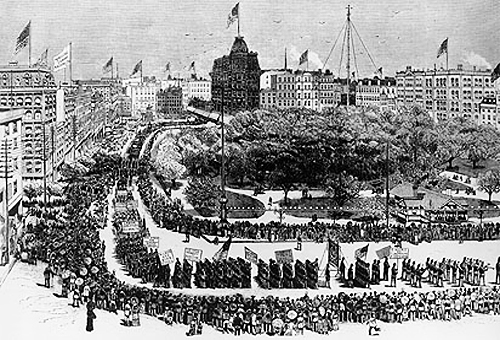
Remember the “Labor” in Labor Day

Labor_Day_New_York_1882

Source: Mickey Z.

With the relentless, ongoing demonization of unions, it’s no surprise that labor history remains obscured and misrepresented and thus, not accessible as a lesson for today’s challenges.

With that in mind, we can choose to view Labor Day as nothing more than the symbolic end of summer and an excuse for more shopping…or we can use it as inspiration to reflect upon some of the brave souls who forged a path of justice and solidarity.

The Lowell Mill Girls

Lowell, Massachusetts was named after the wealthy Lowell family. They owned numerous textile mills, in which the workers were primarily the daughters of New England farmers. These young girls worked in the mills and lived in supervised dormitories. On average, a Lowell Mill Girl worked for three years before leaving to marry. Living and working together often forged a camaraderie that would later find an unexpected outlet.

What had the potential to become a relatively agreeable system for all involved was predictably exploited for mill owners’ gain. The young workers toiled under poor conditions for long hours only to return to dormitories that offered strict dress codes, lousy meals, and were ruled by matrons with an iron fist.

In response, the Lowell mill workers—some as young as eleven—did something revolutionary: the tight-knit group of girls and women organized a union. They marched and demonstrated against a 15 percent cut in their wages and for better conditions…including the institution of a ten-hour workday. They started newspapers. They proclaimed: “Union is power.” They went on strike.

As the movement spread through other Massachusetts mill towns, some 500 workers united to form the Lowell Female Labor Reform Association (LFLRA) in 1844—the first organization of American working women to bargain collectively for better conditions and higher pay.

Sarah Bagley was named the LFLRA’s first president and she promptly led a petition-drive that forced the Massachusetts legislature to investigate conditions in the mills. Bagley not only fought to improve physical conditions, she argued that the female workers “lacked sufficient time to improve their minds,” something she considered “essential for laborers in a republic.”

As with many revolutionary notions, the LFLRA met much opposition in their efforts. Despite their inability to secure the specific changes they demanded, the Lowell Mill Girls laid a foundation for female involvement and leadership in the soon-to-explode American labor movement and must continue to inspire those who stand against injustice today.

Eugene V. Debs

This September 14 marks 96 years since Eugene V. Debs was sentenced to ten years in prison for opposing U.S. entry into World War I. Debs was one of the most prominent labor organizers and political activists of his time. He was also nominated as the Socialist Party’s candidate for president five times. His voting tallies over his first four campaigns effectively illustrate the remarkable growth of the party during that volatile time period:

1900: 94,768

1904: 402,400

1908: 402,820

1912: 897,011

America’s entrance into World War I, however, provoked a tightening of civil liberties, culminating with the passage of the Espionage and Sedition Acts of 1917 and 1918. This totalitarian salvo read in part: “Whoever, when the United States is at war, shall willfully cause or attempt to cause insubordination, disloyalty, mutiny, or refusal of duty in the military or naval forces of the United States, shall be punished by a fine of not more than $10,000 or imprisonment of not more than 20 years, or both.”

Not long after the Espionage and Sedition Acts was voted into law, Debs was in Canton, Ohio for a Socialist Party convention. He was arrested for making a speech deemed “anti-war” by the Canton district attorney. In that speech, Debs declared:

“They have always taught and trained you to believe it to be your patriotic duty to go to war and to have yourselves slaughtered at their command. But in all the history of the world you, the people, have never had a voice in declaring war, and strange as it certainly appears, no war by any nation in any age has ever been declared by the people … Do not worry over the charge of treason to your masters, but be concerned about the treason that involves yourselves. Be true to yourself and you cannot be a traitor to any good cause on earth.”

These words lead to a 10-year prison sentence and the stripping of his US citizenship. While serving his sentence in the federal penitentiary, Debs was nominated for the fifth time, campaigned from his jail cell, and remarkably garnered 917,799 votes.

At his sentencing in 1918, Debs famously told the judge:

“Your honor, years ago, I recognized my kinship with all living beings, and I made up my mind that I was not one bit better than the meanest on earth. I said then, and I say now, that while there is a lower class, I am in it; while there is a criminal element, I am of it; while there is a soul in prison, I am not free.”

To give you an idea of how much work remains for us today, consider that parts of the Espionage Act are still on the books today—just ask Chelsea Manning.

Cesar Chavez

In the late 1960s—thanks to Cesar Chavez and the United Farm Workers (UFW)—deciding whether or not to buy grapes was a political act. Three years after its establishment in 1962, the UFW struck against grape growers around Delano, California…a long, bitter, and frustrating struggle that appeared impossible to resolve until Chavez promoted the idea of a national boycott.

Trusting in the average person’s ability to connect with those in need, Chavez and the UFW brought their plight—and a lesson in social justice—into homes from coast-to-coast and Americans responded. The boycott was an unqualified success as grape growers won signed union contracts and a more livable wage.

Through hunger strikes, imprisonment, abject poverty for himself and his large family, racist and corrupt judges, exposure to dangerous pesticides, and even assassination plots, Chavez remained true to the cause…even if meant, uh…stretching the non-violent methods he espoused.

In 1966, when Teamster goons began to rough up Chavez’s picketers, a bit of labor solidarity solved the problem. William Kircher, the AFL-CIO director of organization, called Paul Hall, president of the International Seafarers Union.

“Within hours,” writes author David Goodwin, “Hall sent a carload of the biggest sailors that had ever put to sea to march with the strikers on the picket lines…There followed afterward no further physical harassment.”

This simple man never owned a house or earned more than $6,000 a year. He left no money for his family when he died yet more than 40,000 people marched behind his casket at his funeral to honor four decades spent improving the lives of farm workers.

The roots of Chavez’ effectiveness lay in his ability to connect on a human level. When asked: “What accounts for all the affection and respect so many farm workers show you in public?” Cesar replied: “The feeling is mutual.”

Today, we face a desperate need to downsize the global culture and economy. It’s never been more important to contemplate the value of small farms and of eating what we grow. Cesar Chavez’ fearless challenges to the industrial status quo and his tireless commitment to the working class stand as inspiration example of the power of solidarity.

I share the above stories as a way of reclaiming our folk tales—the episodes that can inspire us. The conditions and the battles and the urgency have all shifted dramatically, but there is still value in remembering those who stood up to tyranny in the past.

In a society as heavily conditioned as ours, keeping the labor in Labor Day is virtually an act of revolution.

#shifthappens

(Occupy this Book: Mickey Z. on Activism can be ordered here.)

Saturday Matinee: Panther

220px-Panther1995_movie_poster

“Panther” (1995) is an excellent yet underrated historical drama directed by Mario Van Peebles and written by his father Melvin Van Peebles. The film traces the founding of the organization and backlash from the FBI’s COINTELPRO program. Unlike many historical dramas, Panther is engaging, entertaining, and stays close to historical facts. It also features excellent performances from a great cast including Kadeem Hardison, Bokeem Woodbine, Marcus Chong, Angela Bassett, Chris Rock, Joe Don Baker and M. Emmet Walsh.

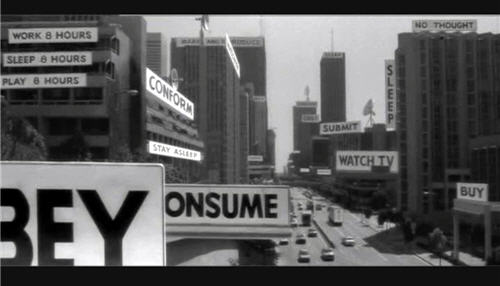
Neither Imitate Nor Hate

they-live

By Micah White

Source: OccupyWallSt.org

As righteous people, how can we live in a world that is poisonous to our souls, harmful to our minds and at odds with our ideals?

Common sense counsels us that we have only two options: either imitate or hate the world. But if we remain stuck within this binary opposition, we will lose ourselves: if we imitate the world we sacrifice our spirit; if we hate the world we succumb to being reactionary and lose the positive passion that grounds our affirmation. What then can we do? This is the question that Seneca, the great Stoic sage, posed nearly two millennia ago. And his answer speaks to today’s struggle of being true to oneself in a corporatist society.

Roman imperial culture was as ruinous to Seneca’s ideals as endgame corporatism is to ours. In a well-known letter to his friend Lucilius, Seneca writes that exposure to crowds and the entertainment they consume ought to be avoided because within the crowd we lose our inner resolve for living a good life. “To consort with the crowd is harmful,” Seneca writes in Letter VII of Epistulae morales ad Lucilium, “[because] there is no person who does not make some vice attractive to us, or stamp it upon us, or taint us unconsciously therewith. Certainly, the greater the mob with which we mingle, the greater the danger.” To prove his point, Seneca tells of his experience watching a gladiator death-match and returning home feeling “more greedy, more ambitious, more voluptuous and even more cruel and inhuman” than before.

In our era, Seneca’s observation will often be rejected on the presumption that his critique of mass culture is based on an aristocratic or antidemocratic philosophy. Proponents of this position will argue that Seneca’s dislike of crowds is due only to a prejudice toward common people and that his position is therefore not worthy of consideration. But this argument misses the deep philosophical insight that Seneca opens for us—there is a correlation between the culture that surrounds us and our inner life. If Seneca is correct then each of us has a legitimate reason to be concerned about involuntary exposure to violence, pornography, and lies because these cultural forms are destructive to our spirit. In other words, Seneca’s stoic philosophy provides another way to understand spiritual insurrection.

The pressing concern is how to resist the dominant culture in such a way that our ideals remain intact and our will to fight stays strong. And it is on this question that Seneca is most articulate. For Seneca, we must be on our guard at all times. He writes: “much harm is done by a single case of indulgence or greed; the familiar friend, if he be luxurious, weakens and softens us imperceptibly; the neighbor, if he be rich, rouses our covetousness; the companion, if he be slanderous, rubs off some of his rust upon us, even though we be spotless and sincere. What then do you think the effect will be on character, when the world at large assaults it!” But Seneca refuses to accept that we ought to either imitate or loathe the world.

Instead, Seneca proposes that we develop a parallel culture in which we commune among ourselves to strengthen our opposition to the dominant culture. Seneca’s counsel is simple: “Withdraw into yourself, as far as you can. Associate with those who will make a better person of you. Welcome those whom you yourself can improve.” While this advice seems simple, it is actually the most difficult to accept because it foregoes the principles of mass participation and mass culture that underlie the majority of contemporary politics.

It would be a mistake to assume that what Seneca has in mind is a politics of neutral moderation. For a stoic, moderation fails to address the root cause of society’s ills. Instead, the art of stoicism is to live within the tension of two extremes without seeking the middle path of unprincipled moderation. Stoicism challenges us to live an affirmation amidst the world as it is, to maintain our inner resolve in the face of temptation and to teach resistance by way of personal example. It is a difficult task for which Seneca offers only one suggestion: decrease your desire.

Seneca writes that the key to attaining happiness, pleasure, riches and anything else of value is, paradoxically, to lower our desires. He relates the story of Epicurus who when asked by Idomeneus how to make his friend Pythocles rich replied, “If you wish to make Pythocles rich, do not add to his store of money, but subtract from his desires.” This wisdom does not only apply to wealth, Seneca argues, and he goes on to give further examples of what Epicurus could have said: “‘if you wish to make Pythocles honourable, do not add to his honours, but subtract from his desires’; ‘if you wish Pythocles to have pleasure for ever, do not add to his pleasures, but subtract from his desires’; ‘if you wish to make Pythocles an old man, filling his life to the full, do not add to his years, but subtract from his desires.’” And I think Seneca would agree if we were to add one of our own to the list and say that if you wish to make a spiritual insurrection, do not wait for many people to join, instead subtract from your desires.

Seneca challenges us to imagine a positive cultural movement that is built on the shared practice of a radical decrease in desire. He suggests that we first build small friendship networks of resistance that are impervious to the influences of mass culture because their highest ideal is a life without consumption. Seneca encourages us to be like the wise man, who when asked why he devotes his life to a philosophy that may reach only a handful of people replied, “I am content with few, content with one, content with none at all.”

— Micah White, PhD lives on the north coast of Oregon. Follow him at @BeingMicahWhite. A version of this article originally appeared in Adbusters

Raising Awareness: Why We Shouldn’t Take It For Granted

THINK_for_yourself_Question_Everything_Anonymous_raising_awareness__113654

By Tim Hjersted

Source: Films for Action


A dangerous thing can occur when you start learning about what’s really going on in the world. The problems start to seem so complex, and you’re just one person, doubts begin to creep in. You sincerely want to help change the world, but from all this knowledge you start to believe that the world is too out of control and too big to change, so you end up not doing anything.


What aspiring change-agents can easily forget is that there is a large amount of meaningful groundwork that still needs to be laid. Many conscious people may take it for granted, but there is still a lot of important information people aren’t aware of yet. A friend recently admitted, “I take for granted that the mainstream media implicitly neglects serious philosophical concerns about the crises we collectively face, as a species, as a unified human family. I apologize for my demeanor in assuming this was common knowledge.”


Yeah. It’s good to remember. All of us at one point in time were not aware of all the knowledge we’re aware of now. All of us were asleep at one point too, and remembering this builds our own empathy and humility when getting into discussions with people. It also helps us remember how important this first step is in the process of building the mass-movement necessary to realize our idealistic dreams.


Just imagine what would happen if an entire city had seen The Corporation. Just imagine what would be possible if everyone in the country was aware of how unhealthy the mainstream media was for our future and started turning to independent sources in droves.


It really does start with getting informed, and there’s lots of subject matter to cover. Our country has to come to terms with the true history of the United States. It has to learn about basic ecology. It needs to understand the basic truths about peak oil, the monetary system, the Federal Reserve, the truth about capitalism and governments. Our society needs a new story to belong to. The old story of empire and dominion over the earth has to be looked at in the full light of day – all of our ambient cultural stories and values that we take for granted and which remain invisible must become visible. And all of this knowledge and introspection, questioning, and discovery is essential for a cultural transformation that addresses root causes. This knowledge is vitally necessary. Taken together, this knowledge, which is documented throughout the 1000 videos on the Films For Action website, will lay the foundation on which the next paradigm will be built, post empire.


After becoming familiar with these understandings over the years, it may be easy to internalize, accept, and then be occasionally shocked at how crazy our culture still is. Lots of ‘givens’ that activists take for granted still need to go mainstream.


That’s where you come in. Don’t complain about the mainstream media failing to inform people. Become the media. Become a walking, talking distro of quality information that your friends can trust. Who needs FOX and CNN, after all, when you’ve got your friends?


Host film screenings, forward articles and videos, buy and burn copies of documentaries to give to your elected officials and school faculty, promote Films For Action. Get the information out in to your community and you will be laying the foundation for a local movement for mass societal, environmental and economic change.


All you have to do (the first easy thing) is plant the seeds. The community (as the seeds grow) will help with watering, weeding, expanding the garden, harvesting and so on. Social change is a social effort, after all, and you won’t be doing this alone. I’ve often said, why struggle working on these issues with a small group of 10 to 15, when we could be working with a collaboration of 15,000? If we lay the foundation, recruit an army of “culture gardeners,” things are going to start happening organically, both organized and spontaneously, all across the cities where we live.


People that are new to this culture of creative activism often ask me, “Yea, I’m on board. I get it. But what can I do?” If we’ve been involved in this work for some time, part of our responsibility is to offer people tangible ways they can plug in. But the second thing we have to convey is: no one can answer this question but you. Everyone is an expert on their own life. What’s your passion? You are the best one to decide the best use of your time and efforts. No one is going to know better than you what your unique gifts and skills are.


And hey, if it takes you some time to figure this out. That’s okay. Simmer on it for a minute. Let it stew. While you’re figuring things out you can always continue disseminating information. I spent about two years learning about this jigsaw puzzle called changing the world before I figured out a path of action that I could really commit myself to. Of all the issues I could work on, I decided that the problem of the media was the number one bottleneck impeding the progress of every other issue. Focus on education and raising awareness. Break this bottleneck and the rest will follow.

A lot of people knock raising awareness as being too abstract. But when you consider it as a strategic first step in the larger picture, taken concurrently with other actions, I don’t think we can underestimate its significance.


Howard Zinn on Optimism for Revolutionary Change

zinnportrait

Today marks the birthday of historian/author/playwright/activist Howard Zinn (8/24/1922 – 1/27/2010). He is best known for his groundbreaking and influential A People’s History of the United States but was also a tireless voice for the oppressed and disenfranchised across the globe for most of his life and beyond (through writings, recorded words and continuing efforts of those he inspired). In honor of his life and work, I’d like to share this inspiring excerpt from his book A Power Governments Cannot Suppress which remains as relevant as ever:

A Marvelous Victory

In this world of war and injustice, how does a person manage to stay socially engaged, committed to the struggle, and remain healthy without burning out or becoming resigned or cynical?

I am totally confident not that the world will get better, but that we should not give up the game before all the cards have been played. The metaphor is deliberate; life is a gamble. Not to play is to foreclose any chance of winning. To play, to act, is to create at least a possibility of changing the world.

There is a tendency to think that what we see in the present moment will continue. We forget how often we have been astonished by the sudden crumbling of institutions, by extraordinary changes in people’s thoughts, by unexpected eruptions of rebellion against tyrannies, by the quick collapse of systems of power that seemed invincible.

What leaps out from the history of the past hundred years is its utter unpredictability. A revolution to overthrow the czar of Russia in that most sluggish of semi feudal empires not only startled the most advanced imperial powers but took Lenin himself by surprise and sent him rushing by train to Petrograd. Who would have predicted the bizarre shifts of World War II-the Nazi-Soviet pact (those embarrassing photos of von Ribbentrop and Molotov shaking hands), and the German army rolling through Russia, apparently invincible, causing colossal casualties, being turned back at the gates of Leningrad, on the western edge of Moscow, in the streets of Stalingrad, followed by the defeat of the German army, with Hitler huddled in his Berlin bunker, waiting to die?

And then the postwar world, taking a shape no one could have drawn in advance: The Chinese Communist revolution, the tumultuous and violent Cultural Revolution, and then another turnabout, with post-Mao China renouncing its most fervently held ideas and institutions, making overtures to the West, cuddling up to capitalist enterprise, perplexing everyone.

No one foresaw the disintegration of the old Western empires happening so quickly after the war, or the odd array of societies that would be created in the newly independent nations, from the benign village socialism of Nyerere’s Tanzania to the madness of Idi Amin’s adjacent Uganda. Spain became an astonishment. I recall a veteran of the Abraham Lincoln Brigade telling me that he could not imagine Spanish Fascism being overthrown without another bloody war. But after Franco was gone, a parliamentary democracy came into being, open to Socialists, Communists, anarchists, everyone.

The end of World War II left two superpowers with their respective spheres of influence and control, vying for military and political power. Yet they were unable to control events, even in those parts of the world considered to be their respective spheres of influence. The failure of the Soviet Union to have its way in Afghanistan, its decision to withdraw after almost a decade of ugly intervention, was the most striking evidence that even the possession of thermonuclear  weapons does not guarantee domination over a determined population.

The United States has faced the same reality. It waged a full-scale war in Indochina, conducting the most brutal bombardment of a tiny peninsula in world history, and yet was forced to withdraw. In the headlines every day we see other instances of the failure of the presumably powerful over the presumably powerless, as in Bolivia and Brazil, where grassroots movements of workers and the poor have elected new presidents pledged to fight destructive corporate power.

Looking at this catalogue of huge surprises, it’s clear that the struggle for justice should never be abandoned because of the apparent overwhelming power of those who have the guns and the money and who seem invincible in their determination to hold on to it. That apparent power has, again and again, proved vulnerable to human qualities less measurable than bombs and dollars: moral fervor, determination, unity, organization, sacrifice, wit, ingenuity, courage, patience-whether by blacks in Alabama and South Africa, peasants in El Salvador, Nicaragua, and Vietnam, or workers and intellectuals in Poland, Hungary, and the Soviet Union itself. No cold calculation of the balance of power need deter people who are persuaded that their cause is just.

I have tried hard to match my friends in their pessimism about the world (is it just my friends?), but I keep encountering people who, in spite of all the evidence of terrible things happening everywhere, give me hope. Wherever I go, I find such people, especially young people, in whom the future rests. And beyond the handful of activists there seem to be hundreds, thousands, more who are open to unorthodox ideas. But they tend not to know of one another’s existence, and so, while they persist, they do so with the desperate patience of Sisyphus endlessly pushing the boulder up the mountain. I try to tell each group that they are not alone, and that the very people who are disheartened by the absence of a national movement are themselves proof of the potential for such a movement.

Revolutionary change does not come as one cataclysmic moment (beware of such moments!) but as an endless succession of surprises, moving zigzag toward a more decent society. We don’t have to engage in grand, heroic actions to participate in the process of change. Small acts, when multiplied by millions of people, can quietly become a power no government can suppress, a power that can transform the world.

Even when we don’t “win,” there is fun and fulfillment in the fact that we have been involved, with other good people, in something worthwhile. We need hope. An optimist isn’t necessarily a blithe, slightly sappy whistler in the dark of our time. To be hopeful in bad times is not being foolishly romantic. It is based on the fact that human history is a history not only of competition and cruelty but also of compassion, sacrifice, courage, kindness.

What we choose to emphasize in this complex history will determine our lives. If we see only the worst, it destroys our capacity to do something. If we remember those times and places-and there are so many-where people have behaved magnificently, it energizes us to act, and raises at least the possibility of sending this spinning top of a world in a different direction. And if we do act, in however small a way, we don’t have to wait for some grand utopian future. The future is an infinite succession of presents, and to live now as we think human beings should live, in defiance of all that is bad around us, is itself a marvelous victory.

Local Police and Much Else Will Be Militarized As Long As Federal Government Is

Outrage In Missouri Town After Police Shooting Of 18-Yr-Old Man

By David Swanson

Source: OpEdNews.com

Groups on the ground in St. Louis are calling for nationwide solidarity actions in support of Justice for Mike Brown and the end of police and extrajudicial killings everywhere.”

As they should. And we should all join in.

But “nationwide” and “everywhere” are odd terms to equate when discussing police militarization. Are we against extrajudicial killings (otherwise known as murder) by U.S. government employees and U.S. weapons in Pakistan? Yemen? Iraq? Gaza? And literally everywhere they occur? The militarization of local police in the United States is related to the militarization of U.S. foreign policy, which has now reached the point that bombing and “doing nothing” are generally conceived as the only two choices available. Local police are being militarized as a result of these factors:

  • A culture glorifying militarization and justifying it as global policing.
  • A federal government that directs roughly $1 trillion every year into the U.S. military, depriving virtually everything else of needed resources.
  • A federal government that still manages to find resources to offer free military weapons to local police in the U.S. and elsewhere.
  • Weapons profiteers that eat up local subsidies as well as federal contracts while funding election campaigns, threatening job elimination in Congressional districts, and pushing for the unloading of weapons by the U.S. military on local police as one means of creating the demand for more.
  • The use of permanent wartime fears to justify the removal of citizens’ rights, gradually allowing local police to begin viewing the people they were supposed to protect as low-level threats, potential terrorists, and enemies of law and order in particular when they exercise their former rights to speech and assembly. Police “excesses” like war “excesses” are not apologized for, as one does not apologize to an enemy.
  • The further funding of abusive policing through asset forfeitures and SWAT raids.
  • The further conflation of military and police through the militarization of borders, especially the Mexican border, the combined efforts of federal and local forces in fusion centers, the military’s engagement in “exercises” in the U.S., and the growth of the drone industry with the military, among others, flying drones in U.S. skies and piloting drones abroad from U.S. land.
  • The growth of the profit-driven prison industry and mass incarceration, which dehumanize people in the minds of participants just as boot camp and the nightly news do to war targets.
  • Economically driven disproportionate participation in, and therefore identification with, the military by the very communities most suffering from its destruction of resources, rights, and lives.

But policing is not the only thing militarized by what President Eisenhower called the “total influence — economic, political, even spiritual” of the military industrial complex. Our morality is militarized, our entertainment is militarized, our natural world is militarized, and our education system is militarized. “Unwarranted influence, whether sought or unsought, by the military industrial complex” is not easily opposed while maintaining the military industrial complex. When Congress Members lend their support to a new war in Iraq while proposing that the U.S. Post Office and a dozen other decent things not be defunded, they are speaking out of both sides of their mouths. The United States cannot live like other wealthy nations while dumping $1 trillion a year into a killing machine.

The way out of this cycle of madness in which we spend more just on recruiting someone into the military or on locking them up behind bars than we spend on educating them is to confront in a unified and coherent manner what Martin Luther King Jr. called the evils of racism, extreme materialism, and militarism. Not racism, extreme materialism, and what the military does to the local police. Not racism, extreme materialism, and what the military does to weapons testing sites. Not racism, extreme materialism, and what the military does to the people of Honduras causing them to flee to a land that then welcomes them with an attitude of militarism. Not any of these partial steps alone, but the whole package of interlocking evils of attitude and mindset.

There is a no-fly-zone over Ferguson, Missouri, because people in the U.S. government view the people of the United States increasingly as they view the people of other countries: as best controlled from the air. Notes the War Resisters League,

“Vigils and protests in Ferguson — a community facing persistent racist profiling and police brutality — have been attacked by tear gas, rubber bullets, police in fully-armored SWAT gear, and tank-like personnel carriers. This underscores not only the dangers of being young, Black, and male in the US, but also the fear of mobilization and rebellion from within racialized communities facing the violence of austerity and criminalization.

“The parallels between the Israeli Defense Forces in Palestine, the Military Police of Rio de Janeiro, the Indian police in Kashmir, the array of oppressive armed forces in Iraq, and the LAPD in Skid Row could not be any clearer. . . .

“This is not happening by accident. What is growing the capacity of local police agencies to exercise this force are police militarization programs explicitly designed to do so. As St. Louis writer Jamala Rogers wrote in an article on the militarization of St. Louis Police this past April, ‘It became clear that SWAT was designed as a response to the social unrest of the 1960s, particularly the anti-war and black liberation movements.’ Federal programs such as DoD 1033 and 1122, and the Urban Areas Security Initiative (UASI), in which St. Louis Police are active participants, provide weapons and training to police departments across the country, directly from the Pentagon. Commenting on the ominous growth of the phenomenon, Rogers continues: ‘and now, Police Chief [of St. Louis Police] Sam Dotson wants to add drones to his arsenal.’

“The events in Ferguson over these last few days demonstrate that the violence of policing and militarism are inextricably bound. To realize justice and freedom as a condition for peace, we must work together to end police militarization and violence.”

The War Resisters League is organizing against Urban Shield, an expo of military weapons for police and training event planned for Oakland, Calif., this September 4-8. The Week of Education and Action will take place in Oakland from August 30-September 5. Read all about it here.

David Swanson is a member of the National Committee of the War Resisters League and wants you to declare peace at http://WorldBeyondWar.org His new book is War No More: The Case for Abolition. He blogs at http://davidswanson.org and http://warisacrime.org and works for http://rootsaction.org. He hosts Talk Nation Radio. Follow him on Twitter: @davidcnswanson and FaceBook.uson

Marcus Garvey (17 August 1887 – 10 June 1940)

200px-Marcus_Garvey_1924-08-05

Many are familiar with Marcus Garvey through numerous references to him in Reggae music since he’s a prophet in the Rastafarian religion. However, those of us in the US who value civil rights should be particularly thankful for Garvey’s legacy, for his life and the ideas he promoted were an influence on Malcolm X and Martin Luther King Jr. among many others and the organization he founded, the Universal Negro Improvement Association and African Communities League, continues his work to this day. This biography is from the Marcus Garvey Foundation:

The Honorable Marcus Mosiah Garvey was born in St. Ann Bay in the parish of St. Ann on the north coast of the island of Jamaica on 17 August 1887. He described it like this, “I was born in the beautiful Parish of St. Ann, near the falls of the Roaring River. I grew up with nature and drank much of her inspiration.” He developed an interest in playing cricket early in life. Apprenticed to his godfather who was a printer, young Marcus early evinced an interest in the printed word. He read widely and was always anxious to discuss current events as well as history. At the age of eighteen he was already a foreman at P.J. Benjamin’s Printing Shop in Jamaica’s capital city of Kingston. He could be seen grounding with his brethren at Victoria Pier on Sunday nights. Garvey joined the printer’s trade union and gained a reputation as courageous, dedicated and highly concerned young leader. At the age of twenty-three he embarked upon a most significant journey that carried him to both Latin America and Europe. He found employment on the docks of London, Liverpool and Cardiff like many West Indians and Africans at the time.

Meeting Duse Mohammed Ali, an Egyptian editor and publisher of the African Times and Orient Review, made a lasting impression on Marcus Garvey. Duse Ali later became active in the UNIA and later a newspaper publisher in Nigeria. Five days after he returned to Kingston, Jamaica, Marcus Garvey founded the Universal Negro Improvement Association, a mass based organization designed to unite people of African ascent around the world. Those who joined Garvey in founding the UNIA shared with him an interest in working hard to overcome conditions of oppression. The organization’s motto is “One God, One Aim, One Destiny.” Seeking the advice and assistance of Booker T. Washington, a well-known leader in the Black world community and at the helm of Tuskegee Institute, Marcus Garvey arrived in the U.S.A. several months after Washington’s death. He traveled from city to city spreading the word of Pan African unity. On May 10, l916, he kicked off the lecture tour at St. Mark’s Roman Catholic Church Hall on 138th Street and reportedly visited 38 states in a year. The cities Garvey visited later were to become major sites of UNIA activity. From those formative years at Liberty Hall on West 138th Street, this mass movement engulfed the African world, increasing from a few to millions worldwide. It wasn’t long before the establishment of the Negro World, Negro Factories Corporation, grocery stores, markets, steamships, and steam laundry companies occurred. The launching of the Black Star Line in 1919 and the successful First International Convention of the Negro Peoples of the World in 1920 catapulted this organization on to the world stage. Between World Wars I and II the UNIA rose and declined, never to be rivaled by another black mass movement.

Currently, the UNIA lives not only in its present form, but also in the memories of so many around the world. It is clear that the Universal Negro Improvement Association and African Communities League served as the model and foundation for 20th century Pan African movements.