Travelers of the Soul

7billion-earth

By Mark Anthony Rockeymoore

Source: Sacred Space in Time

You never know who you’re going to meet.

Other Travelers, along the Way.

How you’re going to affect their lives, or how they will affect yours.

Lives intersect seemingly at random. The person at the grocery store, met eyes and a few pleasantries. The car passed coming out of the driveway, your chance meeting on a road resulting in a pause, a hesitation in their journey. Thousands and millions of souls encountered along your journey, our journey.

Paths crossing, interacting through space and time. The acquaintances and the folks at work, the close friends and family. Greater and lesser degrees of zero-point geometry, non-local interactions of the sacred and profane intermixed, building intricate networks of causality that spiral out in increasingly complex patterns of manifest destiny.

Choices. Mingling bio-energetic auras, the electromagnetic emissions of the heart, body-consciousness of sub-quantum, zero-point interactions, nodal emanations of undetectable energy creating complex relationships between individuals, groups and the greater matrix of our shared reality itself. Each moment, each decision resulting in further permutations, infinite and unknown.

It is no wonder that life is hard. Lifetimes of personality development shape our individual expression and we interact with others based upon who are are at any given moment. The social mask provides the gateway of understanding, of belonging and difference, while the omniscient, omnipresent, omnipotent observes dispassionately through eyes alight with the flames of forever.

Science shows us that steady-state heart resonation displays the most constant state of being as the body’s electromagnetic sheath pulsates with health, wellness and frequencies of peace, joy and happiness. The cacaphonic discord of pain and suffering shapes lives through unrelinquished stress, dwelling on the past, worrying about the future, leads to shortened lives and dis-harmonic states of being.

Cultivate peace of body. Quietude of mind.Those we encounter in our travels find peace in this resonation and conflict can be lessened, leading to more beneficial interactions with all whom we meet. Taming the passions – to those prepared for such a state of being – clarifies intention and action. Simplifying thought simplifies life.

Each moment carries a contest of its own. Through our interactions with others, we meet the challenges of personality and spiritual development. Through our own examination of our inner life we face our own personal demons and angels and choose which way to go. Whichever way that may be, may it express the truest expression of your heart.

Causality in the form of the divine manifest looks mundane. Looks like the daily grind. But it can feel like the pathway to Eternity if you see it that way. Each moment can be a revelation of self-discovery and growth, each interaction with other Travelers, each experience the crowning achievement of a lifetime, spiraling up into the future consciously aware and prepared for whatever comes next, present in the now moment and living according to your deepest held ideals and understandings about the world and your place in it.

WikiLeaks Cables Reveal U.S. Gov’t Planned To “Retaliate and Cause Pain” On Countries Refusing GMOs

monsanto

By Arjun Walia

Source: Collective Evolution

Studies that link Genetically Modified (GM) food to multiple human health ailments are not the only thing that has millions of people questioning the production of GM food. The fact that previously classified secret government documents show how the Bush administration developed ways to retaliate against countries that were refusing to use GM seeds is another. If documents regarding our food are required to be concealed from the public domain, something is not right, and it’s great to have an organization like WikiLeaks shed some light into the world that’s been hidden from us for so many years.

Targeting Certain Countries

The cables reveal that the State Department was lobbying all over the world for Monsanto, and other major biotech corporations. They reveal that American diplomats requested funding to send lobbyists for the biotech industry to meet with politicians and agricultural officials in “target countries.” These included countries in Africa, Latin America and some European countries.

A non-profit consumer protection group called Food & Water Watch published a report showing the details of the partnership between the federal government and a number of biotech companies who have pushed their GMO products on multiple countries for a number of years.

“The United States has aggressively pursued foreign policies in food and agriculture that benefit the largest seed companies. The U.S. State department has launched a concerted strategy to promote agricultural biotechnology, often over the opposition of the public and government, to the near exclusion of other more sustainable, more appropriate agricultural policy alternatives. The U.S. State department has also lobbied foreign governments to adopt pro-agricultural biotechnology politics and laws, operated a rigorous public relations campaign to improve the image of biotechnology and challenged common sense biotechnology safeguards and rules – even including opposing laws requiring the labeling of genetically engineered (GE) foods.” (source) 

HERE is one cable (out of many) from Morocco.

HERE Is a 2008 cable that summarizes a French documentary called “The World According to Monsanto which attacks the U.S. biotech industry and the fact that Monsanto and the U.S. Government constantly swap employees and positions, below is a excerpt from the cable:

Corporations Dictate Government Policy

“The film argues that Monsanto exerted undue influence on the USG. Former Secretary of Agriculture Dan Glickman is interviewed saying he had felt that he was under pressure and that more tests should have been conducted on biotech products before they were approved. Jeffrey Smith, Director, Institute for Responsible Technology, who is interviewed says that a number of Bush Administration officers were close to Monsanto, either having obtained campaign contributions from the company or having worked directly for it: John Ashcroft, Secretary of Justice, received contributions from Monsanto when he was re-elected, as did Tommy Thompson, Secretary of Health; Ann Veneman, Secretary of Agriculture, was director of Calgene which belonged to Monsanto; and Donald Rumsfeld, Secretary of Defense, was CEO of Searle, a Monsanto subsidiary; and Justice Clarence Thomas was a former lawyer for Monsanto.”

This is one example (out of many) that clearly show how giant corporations pretty much dictate government policy. When it comes to these food corporations, they are responsible for forcing independent agriculturists to go out of business, controlling the world’s seed supply and forcing farmers to become dependent on their seed. Monsanto and corporations like them have created this seed, and have prevented farmers from seed saving and sharing, which results in a dependence on Monsanto’s patented GMO seeds.

“The state department sent annual cables to ‘encourage the use of agricultural biotechnology,’ encouraging every diplomatic post worldwide to ‘pursue an active biotech agenda’ that promotes agricultural biotechnology, encourages the export of biotech crops and foods and advocated for pro-biotech policies and laws.” (source)

“The US Department of State is selling seeds instead of democracy. This report provides a chilling snapshot of how a handful of giant biotechnology companies are unduly influencing US foreign policy and undermining our diplomatic efforts to promote security, international development and transparency worldwide. This report is a call to action for Americans because public policy should not be for sale to the highest bidder.” – Wenonah Hauter, Food & Water Watch Executive (source)

One of the most revealing cables is from 2007, with regards to French efforts to ban a Monsanto GM corn variety. HERE is a cable that shows Craig Stapleton, former ambassador to France under the Bush administration, asking Washington to punish the EU countries that did not support the use of GM crops:

“Country team Paris recommends that we calibrate a target retaliation list that causes some pain across the EU since this is a collective responsibility, but that also focuses in part on the worst culprits. Moving to retaliation will make clear that the current path has real costs to EU interests and could help strengthen European pro-biotech voices.” (see source in above paragraph)

The U.S. government was not only working for the biotech industry, they were also threatening other governments who did not comply. Think about that for a moment. Over the years the United States government and Monsanto have collectively pushed their GMO agenda upon the rest of the world. Why? Do you really think it is to help feed the world? This could easily be done if we came together and pooled our resources. The entire planet could easily be fed organic food, and it could be done for free.

The World’s Resistance To GMOs

The past two years alone has seen millions of people from across the globe gather to show their opposition towards Monsanto and similar corporations. The “March Against Monsanto” is clear evidence of this. The people of the world are starting to see through the veil that’s been blinding the masses for years, and our food industry is one small, but large and important area where the veil is being lifted.

Activism and awareness has contributed to the banning of GMO products and the pesticides that go with them in multiple countries across the planet, it’s time for North America to follow suit.

Related CE articles:

New Study Links GMOs To Cancer, Liver/Kidney Damage & Severe Hormonal Disruption.

10 Scientific Studies Proving That GMOs Can Be Harmful To Human Health

For more CE articles on this subject please click HERE. 


Sources:

http://wikileaks.org/cable/2010/01/10RABAT14.html

http://www.cablegatesearch.net/cable.php?id=08PARIS614&q=monsanto

http://www.cablegatesearch.net/cable.php?id=07PARIS4723&q=france%20gm

http://rt.com/usa/wikileaks-monsanto-cables-report-273/

http://www.foodandwaterwatch.org/reports/biotech-ambassadors/


Saturday Matinee: Is That All There Is?

“Is That All There Is?”(1995) was part of a series commissioned by the BBC documenting directors around the world and their surroundings. This episode featuring anarchist director Lindsay Anderson depicts his home life and community in North London and offers a glimpse into his personality and interests. Anderson is best known for his groundbreaking films “If…” and “O Lucky Man”, and this film serves as a final tribute since he passed away shortly after.

Back From the Abyss

1405110494214

Since June 4, Stephen Lendman’s blog has been without updates and his last post indicated he’s been having serious health problems. But just yesterday he returned with an account of his struggle to regain his health and like a true fighter, he devotes more than half of his new post to condemning Israeli war crimes.

Back from the Abyss

By Stephan Lendman

Source: SteveLendmanBlog

I’ve been ill and unable to do what I love best for 2 months. Yesterday, August 6, I came home for the first time since hospitalized on June 4.

At the time, I posted a brief message on my blog site. I expected a few days of treatment. Then home to resume my writing and media work.

Things didn’t turn out that way. I owe my friends, colleagues and readers an explanation.

Multiple problems developed. One rather serious one. Thankfully they were resolved. But it took time – 2 weeks at Northwestern Memorial Hospital followed by 6 weeks at Warren Barr rehab facility.

The experience was life changing. I wondered at times if I’d ever be me again. I still have lots of recovery to go as an outpatient.

I worked very hard with good therapy people helping me daily. I’m deeply grateful to them for taking me from a very low point to going home yesterday.

It never felt so good to walk through my front door. I began emailing friends and colleagues to explain. More emailing coming.

Wonderful responses came. Means so much to this old guy – age 80 in mid-August. Still with so much I want to do – articles, media work and another book or 2 – maybe more as able.

I’ll slowly get back to what I love best. My health, of course, is top priority. Later this morning I have hours of treatment at Northwestern Mem. Hosp and weekly after that for 2 months followed by monthly treatment for a year.

I’m working with wonderful doctors. Some personal friends. They know what I do. They want me back in full swing. Will take time. I’m very patient.

Writing et al will come as able. Important not to overdue it. Yet what i love best is therapeutic – for the mind, soul and body. I’m fully committed to return to a much full health as possible – my top priority.

My great thanks to everyone now wishing me well. I was offline, unconnected with no email addresses so unable to communicate until now.

Physically for a good while I wasn’t in good shape enough to do it.

Now I’m back. My output won’t be my customary 2 articles a day. I’ll do what I can as health and strength permits.

Words can’t explain how wonderful it feels and how deeply grateful i am to be back from a very low point – mostly dependent on others to being near independent again now.

I can do things now we otherwise take for granted – my personal hygiene, cooking, laundry, all chores in my apartment, walk on the street with a walker, ride the bus, take a cab down, shop nearby and more.

Each day begins with an exercise regimen. It’s crucial to my recovery and ability to regain full health and vigor.

It gives me the energy to do my daily tasks. A day at a time I hope will make me fully me again – the me I largely took for granted. Never again.

While absent I couldn’t write on vital issues I’d have focused on daily – Israel’s genocidal, cold, calculated, premeditated aggression, mass murder and destruction of Gaza.

It was and remains one of history’s greatest crimes of war, against humanity, and genocide.

Israel remains unaccountable as always. Cairo talks will achieve nothing for the Palestinians. Israeli agreements when made aren’t worth the paper they’re written on.

They’re systematically and repeatedly violated. Expect nothing different this time.

The Gaza war was much more than against Hamas. It was against millions of Palestinian non-combatant men, women, children, infants, the elderly and infirm. It’s genocide writ large.

It’s supported by Washington with billions of dollars of annual aid, weapons, Security Council vetoes and more.

The international community yawns and lets Israel get away with unspeakable crimes with impunity.

The pattern repeated large and smaller scale since the 1947-48 war taking a horrific toll on the entire Palestinian population.

Expect more of the same ahead. Expect Palestine’s liberating struggle to continue with virtually no help from the international community.

Expect more Israeli initiated mass much and destruction. Expect multiple daily pre-dawn Israeli West Bank incursions, terrorizing Palestinian families.

Expect many more political prisoners in Israel’s gulag. Expect torture, targeted assassinations and land theft to continue unabated.

Expect justice systematically denied as always. Expect Palestinians largely on their own in their struggle for dignity and proper treatment never afforded.

Expect Israeli crimes of war, against humanity and slow-motion genocide to continue unabated.

Expect Hamas and other resistance groups to be unjustly blamed for repeated Israeli crimes – like premeditated shelling UN refuges, civilian neighborhoods, hospitals, schools, mosques, power and other vital infrastructure and more.

Israel is a lawless, rogue, racist, apartheid terror state – uncountable for horrific crimes repeatedly.

Palestinian suffering is beyond words to explain properly. When will it end? How? No time soon for sure.

How many more Palestinians will die unjustly? How many more will have Israeli shells, bombs and missiles dismember their bodies?

How many more families will lose loved ones? How many more communities will be destroyed? How many more orphaned Palestinian children will be on their own?

How many more parents will lose their offspring, homes and all their possessions?

How much longer will injustice prevail? When, if ever, will Israel be held accountable?

When, if ever, will US tax dollars stop funding Israel’s out-of-control killing machine.

Future articles will have much more to say – written as health permits.

And much to say about the war in Ukraine – the democratic freedom fighting struggle against lawless, illegitimate US installed fascism.

Much to say about these and other important issues ahead as health and strength permits.

It’s wonderful being back doing what I love best.


Stephen Lendman lives in Chicago. He can be reached at lendmanstephen@sbcglobal.net. 

His new book as editor and contributor is titled “Flashpoint in Ukraine: US Drive for Hegemony Risks WW III.”

http://www.claritypress.com/LendmanIII.html

Visit his blog site at sjlendman.blogspot.com. 

Listen to cutting-edge discussions with distinguished guests on the Progressive Radio News Hour on the Progressive Radio Network.

It airs three times weekly: live on Sundays at 1PM Central time plus two prerecorded archived programs. 

http://www.progressiveradionetwork.com/the-progressive-news-hour 

Five Questions We’re Asking About the Ebola Scare

Viral-Hemorrhagic-Fever-Erupts-in-Guinea-Caused-by-the-Ebola-Virus-650x433

By Aaron Dykes and Melissa Melton

Source: Truthstream Media

Now that the Ebola situation has hit the 24/7 mainstream media zoo, serious questions are being raised as to why now.

After all, people were dying of Ebola in the hundreds in West Africa before this week. Aid workers and doctors were getting infected before. These things are not new, but the sudden media focus raises lots of questions.

To start…

Why are they shipping Ebola-infected patients onto American soil for the first time?

As many have pointed out, this move seems particularly…ill-advised. The U.S. Centers for Disease Control and Prevention cautioned people not to fly to the affected areas, but our State Department is going to go out of its way to put together heavily publicized, special containment tents inside planes to fly two Americans here while the media in lockstep makes a huge play-by-play deal?

It isn’t exactly level 4 containment all the way, either, as Underground Medic‘s Lizzie Bennett pointed out yesterday: the one guy arrived at the hospital and just got out of the ambulance and walked on in.

Why is Obama amending executive orders about quarantining people infected with Ebola when he already had that power?

The president just amended a G.W. Bush-era executive order 13295 which allows “apprehension, detention, or conditional release of individuals to prevent the introduction, transmission, or spread of suspected communicable diseases.”

Section 1, subjection b has now been replaced with the following:

“(b)  Severe acute respiratory syndromes, which are diseases that are associated with fever and signs and symptoms of pneumonia or other respiratory illness, are capable of being transmitted from person to person, and that either are causing, or have the potential to cause, a pandemic, or, upon infection, are highly likely to cause mortality or serious morbidity if not properly controlled.  This subsection does not apply to influenza.”

Sure sounds like Ebola, doesn’t it?

But in reality, those quarantine powers were already in place. It even says so on this CDC map of U.S. quarantine stations fact sheet the agency released in August 2013.

cdcfactsheetquarantine

Ebola definitely counts under the category “viral hemorrhagic fevers”.

So why make a big deal amending an executive order when the power to detain people who have, or are suspected to have Ebola, already exists?

The CDC also just released a brand new, timely webpage “Infection Prevention and Control Recommendations for Hospitalized Patients with Known or Suspected Ebola Hemorrhagic Fever in U.S. Hospitals” as if it just completely slipped the agency’s mind to disseminate information to medical professionals on how to deal with Ebola before now. Come on. The page does, however, mention guidance for exposure to “contaminated air,” which is odd considering the CDC director has gone out of his way to say that there’s no way an Ebola outbreak could ever happen in the U.S. 

What exactly have Ft. Detrick biowarfare researchers been doing in the Ebola hot zone in West Africa all this time?

Independent investigative reporter Jon Rappaport asked this very same question the day before yesterday, but it seems like a good one. He had several other questions, and they are all good ones:

What exactly have they been doing?

Exactly what diagnostic tests have they been performing on citizens of Sierra Leone?

Why do we have reports that the government of Sierra Leone has recently told Tulane researchers to stop this testing?

Have Tulane researchers and their associates attempted any experimental treatments (e.g., injecting monoclonal antibodies) using citizens of the region? If so, what adverse events have occurred?

The research program, occurring in Sierra Leone, the Republic of Guinea, and Liberia—said to be the epicenter of the 2014 Ebola outbreak—has the announced purpose, among others, of detecting the future use of fever-viruses as bioweapons.

Is this purely defensive research? Or as we have seen in the past, is this research being covertly used to develop offensive bioweapons?

The same day, Navy Times published an article talking about how U.S. biowarfare scientists have been highly interested in Ebola since at least the late 1970s for engineering bioweapons: “mainly because Ebola and its fellow viruses have high mortality rates…and its stable nature in aerosol make it attractive as a potential biological weapon.”

But the article goes on to say that scientists from the U.S. Army Medical Research Institute of Infectious Diseases (USAMRIID) have been working on a vaccine since then, a purely defensive measure. Of course, they can’t come out and say they’re working on offensive weapons. The Biological Weapons Convention went into effect in 1975, supposedly putting an end to the government’s biological weapons program.

Why does the U.S. government own a patent on a novel strain of Ebola that those same Ft. Detrick researchers quietly admitted in a CDC journal article last month may actually be the cause of the current Sierra Leone outbreak, not Ebola Zaire as widely reported?

This one gets tricky.

There are five types of Ebola virus and the newest strain is named Bundibugyo, or Ebobun for short. The U.S. government actually holds a patent on this strain — US 20120251502 A1, for “Human Ebola Virus Species and Compositions and Methods Thereof” related to the Bundibugyo version of the virus.

Last month, the same Ft. Detrick researchers who have been over in the Ebola hot zone published an article in the CDC’s Emerging Infectious Diseases where they discuss the human testing that has been going on over there and down near the bottom of the article, they quietly admit, “Ebolavirus infections in Sierra Leone might be the result of Bundibugyo virus or an ebolavirus genetic variant and not EBOV.”

The kicker?

The Ebobun version of Ebola, which is apparently been found to be “genetically distinct,” as it differs by more than 30% at the genome level from all other known ebolavirus species, apparently has a much lower death rate than the Zaire version the media keeps talking about.

Not that Ebola in any form isn’t dangerous. It’s deadly, period. But Ebobun had a 36% mortality rate at the initial outbreak in 2007, versus 70-90% on average for Zaire.

Additionally, because it is much more unique, researchers have suggested that if a vaccine or treatment is created for Ebola and the Ebobun strain is not taken into account, the resulting treatment or vaccine obviously might not work on it.

Regardless, all the mainstream media seems interested in driving home on repeat these days is that this outbreak is the Zaire strain which has a 90% mortality rate and no cure. Well…even that isn’t entirely true…

A NOVA presentation from 1995 clearly shows survivors and discusses how a nurse named Nicole was given blood transfusions from an infected patient who survived, to build up antibodies. A review sums it up:

After one week, Nicole began to recover. Spurred by this result, the Zairian doctors transfused an additional eight patients. Seven of the eight patients survived, but the Western doctors remain unconvinced. Because the experiment was completely uncontrolled, they argue that we will never know that the transfusion saved the lives of those patients.

That was 20 years ago. Current news stories even discuss how the doctor who was flown here infected with Ebola was given a unit of blood from a 14-year-old who survived Ebola. The female patient flown in was also reportedly given an experimental serum no one seems to elaborate much on.

On top of that, articles from 2008 show a vaccine was highly effective in monkeys and even used experimentally in a human patient with success. Where did those vaccines go? Why aren’t they widely available six years later?

And finally, as with any crisis, who stands to gain from this, and what is it they are ultimately after?

Just asking.

One company Tekmira, who has been performing Phase I clinical trials for an Ebola drug it has been working on in otherwise healthy adult patients has seen its stock skyrocket over the last two weeks, even though its experiments in humans have now been halted due to safety concerns.

Tekmira apparently has a $140 million contract with none other than the USAMRIID to work on this drug, along with a multi-million contract with biotech giant Monsanto for the same technology. The drug was granted FDA fast track status back in March. As the company’s site says, however, the drug is apparently for the Zaire strain of the virus.

So has Tekmira taken the Ebobun strain into account?

In addition, now Reuters is reporting that Ebola vaccines have been fast tracked as well, with human experiments starting as early as next month. Wow, that was fast. Will those vaccines take Ebobun into account?

The last time a vaccine was fast tracked in such a manner, it was for the purposefully overblown swine flu “pandemic” — a created “campaign of panic” basically designed to sell vaccines and grant more emergency powers.

As Aaron Dykes reported in 2010:

Wolfgang Wodarg, head of health at the Council of Europe, claims that the threshold for alert was deliberately lowered at the WHO, allowing a “pandemic” to be declared despite the mildness of the ‘swine flu.’ That designation would force a demand for the vaccine, which was subsequently purchased by governments or health facilities and pushed on the public through a full-scale fear campaign in the media…

Wodarg is focusing on the motives for profit, as well as the ties between the World Health Organization (WHO), the pharmaceutical-industrial complex and research scientists, a nexus which Canada Free Press points out is eerily similar to the Climategate revelations that CRU research scientists fudged data to “hide the decline” in proxy temperatures in order to support global warming claims.

Wodarg made several disconcerting statements to the media, including:

“Never before the search for traces of a virus was carried out so broadly and intensively, besides, many cases of death that happen to coincide with seropositive H1N1 lab-findings were simply attributed to “swine-flu” and used to foster fear.”

“A group of people in the WHO is associated very closely with the pharmaceutical industry.”

“The great campaign of panic we have seen provided a golden opportunity for representatives from labs who knew they would hit the jackpot in the case of a pandemic being declared.”

In fact, that’s what CBS investigative reporter Sharyl Attkisson was set to expose, but her bosses refused to air her story. The mainstream media completely shut her down. Fear sells. The truth, by contrast, doesn’t.

“With the CDC keeping the true Swine Flu stats secret, it meant that many in the public took and gave their children an experimental vaccine that may not have been necessary,” Attkisson said. Read this piece on her 2009 interview with Jon Rappaport for more on how the CDC stopped counting cases of swine flu altogether and hyped the public into a panic that ultimately led to millions of people receiving potentially dangerous, fast-tracked vaccinations.

That’s right. Countries the world over reported many deaths and disabilities suffered in the wake of the fast-tracked H1N1 vaccine, a vaccine people scrambled to get after the hysteria over swine flu was over hyped everywhere, from government agencies to the mainstream media.

But hey, a lot of people in the military-medical-media industrial complex made a lot of money.

Much worse than mere greed, though, is the possibility of martial law and a forced mass vaccination scenario — a scenario where the military is “forced” to step in to contain “bio-threats” (regardless of whether or not those threats are real or made up). For more on that, see DARPA’s “Blue Angel” project.

Talking about something scary isn’t automatically scaremongering — but if the powers that shouldn’t be are scaremongering, we should talk about it.

(Meanwhile, headlines about ‘Ebola fear going viral’ are already screaming at people to be afraid…very very afraid.)


The Real Reasons America Used Nuclear Weapons Against Japan

Hiroshima_Capp

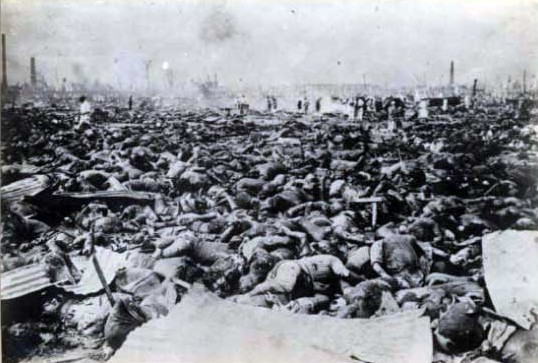
Today marks the anniversary of the atomic bombing of Hiroshima in 1945, an event responsible for the deaths of up to 166,000 lives, most of whom were innocent civilians. This was followed by the use of another atomic bomb (using plutonium instead of uranium) on Nagasaki three days later, claiming at least 80,000 (mostly civilian) lives. As the U.S. continues to kill innocent people through long distance weapons such as drones, it’s more important than ever to question official claims about what they are doing in the name of “freedom” and “democracy” and the real reasons why. Historians such as Howard Zinn have long known that official government justifications for the bombings were lies. The fundamental reasons were economic and geopolitical, and much supporting documentation has been helpfully compiled in the following post.

The REAL Reason America Used Nuclear Weapons Against Japan (It Was Not To End the War Or Save Lives)

Source: Washington’s Blog

Atomic Weapons Were Not Needed to End the War or Save Lives

Like all Americans, I was taught that the U.S. dropped nuclear bombs on Hiroshima and Nagasaki in order to end WWII and save both American and Japanese lives.

But most of the top American military officials at the time said otherwise.

The U.S. Strategic Bombing Survey group, assigned by President Truman to study the air attacks on Japan, produced a report in July of 1946 that concluded (52-56):

Based on a detailed investigation of all the facts and supported by the testimony of the surviving Japanese leaders involved, it is the Survey’s opinion that certainly prior to 31 December 1945 and in all probability prior to 1 November 1945, Japan would have surrendered even if the atomic bombs had not been dropped, even if Russia had not entered the war, and even if no invasion had been planned or contemplated.

General (and later president) Dwight Eisenhower – then Supreme Commander of all Allied Forces, and the officer who created most of America’s WWII military plans for Europe and Japan – said:

The Japanese were ready to surrender and it wasn’t necessary to hit them with that awful thing.

Newsweek, 11/11/63, Ike on Ike

Eisenhower also noted (pg. 380):

In [July] 1945… Secretary of War Stimson, visiting my headquarters in Germany, informed me that our government was preparing to drop an atomic bomb on Japan. I was one of those who felt that there were a number of cogent reasons to question the wisdom of such an act. …the Secretary, upon giving me the news of the successful bomb test in New Mexico, and of the plan for using it, asked for my reaction, apparently expecting a vigorous assent.

During his recitation of the relevant facts, I had been conscious of a feeling of depression and so I voiced to him my grave misgivings, first on the basis of my belief that Japan was already defeated and that dropping the bomb was completely unnecessary, and secondly because I thought that our country should avoid shocking world opinion by the use of a weapon whose employment was, I thought, no longer mandatory as a measure to save American lives. It was my belief that Japan was, at that very moment, seeking some way to surrender with a minimum loss of ‘face’. The Secretary was deeply perturbed by my attitude….

Admiral William Leahy – the highest ranking member of the U.S. military from 1942 until retiring in 1949, who was the first de facto Chairman of the Joint Chiefs of Staff, and who was at the center of all major American military decisions in World War II – wrote (pg. 441):

It is my opinion that the use of this barbarous weapon at Hiroshima and Nagasaki was of no material assistance in our war against Japan. The Japanese were already defeated and ready to surrender because of the effective sea blockade and the successful bombing with conventional weapons.

The lethal possibilities of atomic warfare in the future are frightening. My own feeling was that in being the first to use it, we had adopted an ethical standard common to the barbarians of the Dark Ages. I was not taught to make war in that fashion, and wars cannot be won by destroying women and children.

General Douglas MacArthur agreed (pg. 65, 70-71):

MacArthur’s views about the decision to drop the atomic bomb on Hiroshima and Nagasaki were starkly different from what the general public supposed …. When I asked General MacArthur about the decision to drop the bomb, I was surprised to learn he had not even been consulted. What, I asked, would his advice have been? He replied that he saw no military justification for the dropping of the bomb. The war might have ended weeks earlier, he said, if the United States had agreed, as it later did anyway, to the retention of the institution of the emperor.

Moreover (pg. 512):

The Potsdam declaration in July, demand[ed] that Japan surrender unconditionally or face ‘prompt and utter destruction.’ MacArthur was appalled. He knew that the Japanese would never renounce their emperor, and that without him an orderly transition to peace would be impossible anyhow, because his people would never submit to Allied occupation unless he ordered it. Ironically, when the surrender did come, it was conditional, and the condition was a continuation of the imperial reign. Had the General’s advice been followed, the resort to atomic weapons at Hiroshima and Nagasaki might have been unnecessary.

Similarly, Assistant Secretary of War John McLoy noted (pg. 500):

I have always felt that if, in our ultimatum to the Japanese government issued from Potsdam [in July 1945], we had referred to the retention of the emperor as a constitutional monarch and had made some reference to the reasonable accessibility of raw materials to the future Japanese government, it would have been accepted. Indeed, I believe that even in the form it was delivered, there was some disposition on the part of the Japanese to give it favorable consideration. When the war was over I arrived at this conclusion after talking with a number of Japanese officials who had been closely associated with the decision of the then Japanese government, to reject the ultimatum, as it was presented. I believe we missed the opportunity of effecting a Japanese surrender, completely satisfactory to us, without the necessity of dropping the bombs.

Under Secretary of the Navy Ralph Bird said:

I think that the Japanese were ready for peace, and they already had approached the Russians and, I think, the Swiss. And that suggestion of [giving] a warning [of the atomic bomb] was a face-saving proposition for them, and one that they could have readily accepted.

***

In my opinion, the Japanese war was really won before we ever used the atom bomb. Thus, it wouldn’t have been necessary for us to disclose our nuclear position and stimulate the Russians to develop the same thing much more rapidly than they would have if we had not dropped the bomb.

War Was Really Won Before We Used A-Bomb, U.S. News and World Report, 8/15/60, pg. 73-75.

He also noted (pg. 144-145, 324):

It definitely seemed to me that the Japanese were becoming weaker and weaker. They were surrounded by the Navy. They couldn’t get any imports and they couldn’t export anything. Naturally, as time went on and the war developed in our favor it was quite logical to hope and expect that with the proper kind of a warning the Japanese would then be in a position to make peace, which would have made it unnecessary for us to drop the bomb and have had to bring Russia in.

Alfred McCormack – Director of Military Intelligence for the Pacific Theater of War, who was probably in as good position as anyone for judging the situation – believed that the Japanese surrender could have been obtained in a few weeks by blockade alone:

The Japanese had no longer enough food in stock, and their fuel reserves were practically exhausted. We had begun a secret process of mining all their harbors, which was steadily isolating them from the rest of the world. If we had brought this project to its logical conclusion, the destruction of Japan’s cities with incendiary and other bombs would have been quite unnecessary.

General Curtis LeMay, the tough cigar-smoking Army Air Force “hawk,” stated publicly shortly before the nuclear bombs were dropped on Japan:

The war would have been over in two weeks. . . . The atomic bomb had nothing to do with the end of the war at all.

The Vice Chairman of the U.S. Bombing Survey Paul Nitze wrote (pg. 36-37, 44-45):

[I] concluded that even without the atomic bomb, Japan was likely to surrender in a matter of months. My own view was that Japan would capitulate by November 1945.

***

Even without the attacks on Hiroshima and Nagasaki, it seemed highly unlikely, given what we found to have been the mood of the Japanese government, that a U.S. invasion of the islands [scheduled for November 1, 1945] would have been necessary.

Deputy Director of the Office of Naval Intelligence Ellis Zacharias wrote:

Just when the Japanese were ready to capitulate, we went ahead and introduced to the world the most devastating weapon it had ever seen and, in effect, gave the go-ahead to Russia to swarm over Eastern Asia.

Washington decided that Japan had been given its chance and now it was time to use the A-bomb.

I submit that it was the wrong decision. It was wrong on strategic grounds. And it was wrong on humanitarian grounds.

Ellis Zacharias, How We Bungled the Japanese Surrender, Look, 6/6/50, pg. 19-21.

Brigadier General Carter Clarke – the military intelligence officer in charge of preparing summaries of intercepted Japanese cables for President Truman and his advisors – said (pg. 359):

When we didn’t need to do it, and we knew we didn’t need to do it, and they knew that we knew we didn’t need to do it, we used them as an experiment for two atomic bombs.

Many other high-level military officers concurred. For example:

The commander in chief of the U.S. Fleet and Chief of Naval Operations, Ernest J. King, stated that the naval blockade and prior bombing of Japan in March of 1945, had rendered the Japanese helpless and that the use of the atomic bomb was both unnecessary and immoral. Also, the opinion of Fleet Admiral Chester W. Nimitz was reported to have said in a press conference on September 22, 1945, that “The Admiral took the opportunity of adding his voice to those insisting that Japan had been defeated before the atomic bombing and Russia’s entry into the war.” In a subsequent speech at the Washington Monument on October 5, 1945, Admiral Nimitz stated “The Japanese had, in fact, already sued for peace before the atomic age was announced to the world with the destruction of Hiroshima and before the Russian entry into the war.” It was learned also that on or about July 20, 1945, General Eisenhower had urged Truman, in a personal visit, not to use the atomic bomb. Eisenhower’s assessment was “It wasn’t necessary to hit them with that awful thing . . . to use the atomic bomb, to kill and terrorize civilians, without even attempting [negotiations], was a double crime.” Eisenhower also stated that it wasn’t necessary for Truman to “succumb” to [the tiny handful of people putting pressure on the president to drop atom bombs on Japan.]

British officers were of the same mind. For example, General Sir Hastings Ismay, Chief of Staff to the British Minister of Defence, said to Prime Minister Churchill that “when Russia came into the war against Japan, the Japanese would probably wish to get out on almost any terms short of the dethronement of the Emperor.”

On hearing that the atomic test was successful, Ismay’s private reaction was one of “revulsion.”

Why Were Bombs Dropped on Populated Cities Without Military Value?

Even military officers who favored use of nuclear weapons mainly favored using them on unpopulated areas or Japanese military targets … not cities.

For example, Special Assistant to the Secretary of the Navy Lewis Strauss proposed to Secretary of the Navy James Forrestal that a non-lethal demonstration of  atomic weapons would be enough to convince the Japanese to surrender … and the Navy Secretary agreed (pg. 145, 325):

I proposed to Secretary Forrestal that the weapon should be demonstrated before it was used. Primarily it was because it was clear to a number of people, myself among them, that the war was very nearly over. The Japanese were nearly ready to capitulate… My proposal to the Secretary was that the weapon should be demonstrated over some area accessible to Japanese observers and where its effects would be dramatic. I remember suggesting that a satisfactory place for such a demonstration would be a large forest of cryptomeria trees not far from Tokyo. The cryptomeria tree is the Japanese version of our redwood… I anticipated that a bomb detonated at a suitable height above such a forest… would lay the trees out in windrows from the center of the explosion in all directions as though they were matchsticks, and, of course, set them afire in the center. It seemed to me that a demonstration of this sort would prove to the Japanese that we could destroy any of their cities at will… Secretary Forrestal agreed wholeheartedly with the recommendation…

It seemed to me that such a weapon was not necessary to bring the war to a successful conclusion, that once used it would find its way into the armaments of the world…

General George Marshall agreed:

Contemporary documents show that Marshall felt “these weapons might first be used against straight military objectives such as a large naval installation and then if no complete result was derived from the effect of that, he thought we ought to designate a number of large manufacturing areas from which the people would be warned to leave–telling the Japanese that we intend to destroy such centers….”

As the document concerning Marshall’s views suggests, the question of whether the use of the atomic bomb was justified turns  … on whether the bombs had to be used against a largely civilian target rather than a strictly military target—which, in fact, was the explicit choice since although there were Japanese troops in the cities, neither Hiroshima nor Nagasaki was deemed militarily vital by U.S. planners. (This is one of the reasons neither had been heavily bombed up to this point in the war.) Moreover, targeting [at Hiroshima and Nagasaki] was aimed explicitly on non-military facilities surrounded by workers’ homes.

Historians Agree that the Bomb Wasn’t Needed

Historians agree that nuclear weapons did not need to be used to stop the war or save lives.

As historian Doug Long notes:

U.S. Nuclear Regulatory Commission historian J. Samuel Walker has studied the history of research on the decision to use nuclear weapons on Japan. In his conclusion he writes, “The consensus among scholars is that the bomb was not needed to avoid an invasion of Japan and to end the war within a relatively short time. It is clear that alternatives to the bomb existed and that Truman and his advisors knew it.” (J. Samuel Walker, The Decision to Use the Bomb: A Historiographical Update, Diplomatic History, Winter 1990, pg. 110).

Politicians Agreed

Many high-level politicians agreed.  For example, Herbert Hoover said (pg. 142):

The Japanese were prepared to negotiate all the way from February 1945…up to and before the time the atomic bombs were dropped; …if such leads had been followed up, there would have been no occasion to drop the [atomic] bombs.

Under Secretary of State Joseph Grew noted (pg. 29-32):

In the light of available evidence I myself and others felt that if such a categorical statement about the [retention of the] dynasty had been issued in May, 1945, the surrender-minded elements in the [Japanese] Government might well have been afforded by such a statement a valid reason and the necessary strength to come to an early clearcut decision.

If surrender could have been brought about in May, 1945, or even in June or July, before the entrance of Soviet Russia into the [Pacific] war and the use of the atomic bomb, the world would have been the gainer.

Why Then Were Atom Bombs Dropped on Japan?

If dropping nuclear bombs was unnecessary to end the war or to save lives, why was the decision to drop them made? Especially over the objections of so many top military and political figures?

One theory is that scientists like to play with their toys:

On September 9, 1945, Admiral William F. Halsey, commander of the Third Fleet, was publicly quoted extensively as stating that the atomic bomb was used because the scientists had a “toy and they wanted to try it out . . . .” He further stated, “The first atomic bomb was an unnecessary experiment . . . . It was a mistake to ever drop it.”

However, most of the Manhattan Project scientists who developed the atom bomb were opposed to using it on Japan.

Albert Einstein – an important catalyst for the development of the atom bomb (but not directly connected with the Manhattan Project) – said differently:

“A great majority of scientists were opposed to the sudden employment of the atom bomb.” In Einstein’s judgment, the dropping of the bomb was a political – diplomatic decision rather than a military or scientific decision.

Indeed, some of the Manhattan Project scientists wrote directly to the secretary of defense in 1945 to try to dissuade him from dropping the bomb:

We believe that these considerations make the use of nuclear bombs for an early, unannounced attack against Japan inadvisable. If the United States would be the first to release this new means of indiscriminate destruction upon mankind, she would sacrifice public support throughout the world, precipitate the race of armaments, and prejudice the possibility of reaching an international agreement on the future control of such weapons.

Political and Social Problems, Manhattan Engineer District Records, Harrison-Bundy files, folder # 76, National Archives (also contained in: Martin Sherwin, A World Destroyed, 1987 edition, pg. 323-333).

The scientists questioned the ability of destroying Japanese cities with atomic bombs to bring surrender when destroying Japanese cities with conventional bombs had not done so, and – like some of the military officers quoted above – recommended a demonstration of the atomic bomb for Japan in an unpopulated area.

The Real Explanation?

History.com notes:

In the years since the two atomic bombs were dropped on Japan, a number of historians have suggested that the weapons had a two-pronged objective …. It has been suggested that the second objective was to demonstrate the new weapon of mass destruction to the Soviet Union. By August 1945, relations between the Soviet Union and the United States had deteriorated badly. The Potsdam Conference between U.S. President Harry S. Truman, Russian leader Joseph Stalin, and Winston Churchill (before being replaced by Clement Attlee) ended just four days before the bombing of Hiroshima. The meeting was marked by recriminations and suspicion between the Americans and Soviets. Russian armies were occupying most of Eastern Europe. Truman and many of his advisers hoped that the U.S. atomic monopoly might offer diplomatic leverage with the Soviets. In this fashion, the dropping of the atomic bomb on Japan can be seen as the first shot of the Cold War.

New Scientist reported in 2005:

The US decision to drop atomic bombs on Hiroshima and Nagasaki in 1945 was meant to kick-start the Cold War rather than end the Second World War, according to two nuclear historians who say they have new evidence backing the controversial theory.

Causing a fission reaction in several kilograms of uranium and plutonium and killing over 200,000 people 60 years ago was done more to impress the Soviet Union than to cow Japan, they say. And the US President who took the decision, Harry Truman, was culpable, they add.

“He knew he was beginning the process of annihilation of the species,” says Peter Kuznick, director of the Nuclear Studies Institute at American University in Washington DC, US. “It was not just a war crime; it was a crime against humanity.”

***

[The conventional explanation of using the bombs to end the war and save lives] is disputed by Kuznick and Mark Selden, a historian from Cornell University in Ithaca, New York, US.

***

New studies of the US, Japanese and Soviet diplomatic archives suggest that Truman’s main motive was to limit Soviet expansion in Asia, Kuznick claims. Japan surrendered because the Soviet Union began an invasion a few days after the Hiroshima bombing, not because of the atomic bombs themselves, he says.

According to an account by Walter Brown, assistant to then-US secretary of state James Byrnes, Truman agreed at a meeting three days before the bomb was dropped on Hiroshima that Japan was “looking for peace”. Truman was told by his army generals, Douglas Macarthur and Dwight Eisenhower, and his naval chief of staff, William Leahy, that there was no military need to use the bomb.

“Impressing Russia was more important than ending the war in Japan,” says Selden.

John Pilger points out:

The US secretary of war, Henry Stimson, told President Truman he was “fearful” that the US air force would have Japan so “bombed out” that the new weapon would not be able “to show its strength”. He later admitted that “no effort was made, and none was seriously considered, to achieve surrender merely in order not to have to use the bomb”. His foreign policy colleagues were eager “to browbeat the Russians with the bomb held rather ostentatiously on our hip”. General Leslie Groves, director of the Manhattan Project that made the bomb, testified: “There was never any illusion on my part that Russia was our enemy, and that the project was conducted on that basis.” The day after Hiroshima was obliterated, President Truman voiced his satisfaction with the “overwhelming success” of “the experiment”.

We’ll give the last word to University of Maryland professor of political economy – and former Legislative Director in the U.S. House of Representatives and the U.S. Senate, and Special Assistant in the Department of State – Gar Alperovitz:

Though most Americans are unaware of the fact, increasing numbers of historians now recognize the United States did not need to use the atomic bomb to end the war against Japan in 1945. Moreover, this essential judgment was expressed by the vast majority of top American military leaders in all three services in the years after the war ended: Army, Navy and Army Air Force. Nor was this the judgment of “liberals,” as is sometimes thought today. In fact, leading conservatives were far more outspoken in challenging the decision as unjustified and immoral than American liberals in the years following World War II.

***

Instead [of allowing other options to end the war, such as letting the Soviets attack Japan with ground forces], the United States rushed to use two atomic bombs at almost exactly the time that an August 8 Soviet attack had originally been scheduled: Hiroshima on August 6 and Nagasaki on August 9. The timing itself has obviously raised questions among many historians. The available evidence, though not conclusive, strongly suggests that the atomic bombs may well have been used in part because American leaders “preferred”—as Pulitzer Prize–winning historian Martin Sherwin has put it—to end the war with the bombs rather than the Soviet attack. Impressing the Soviets during the early diplomatic sparring that ultimately became the Cold War also appears likely to have been a significant factor.

***

The most illuminating perspective, however, comes from top World War II American military leaders. The conventional wisdom that the atomic bomb saved a million lives is so widespread that … most Americans haven’t paused to ponder something rather striking to anyone seriously concerned with the issue: Not only did most top U.S. military leaders think the bombings were unnecessary and unjustified, many were morally offended by what they regarded as the unnecessary destruction of Japanese cities and what were essentially noncombat populations. Moreover, they spoke about it quite openly and publicly.

***

Shortly before his death General George C. Marshall quietly defended the decision, but for the most part he is on record as repeatedly saying that it was not a military decision, but rather a political one.

Related Articles:
Truman Knew
The Bombing of Nagasaki August 9, 1945. Unwelcome Truths for Church and State


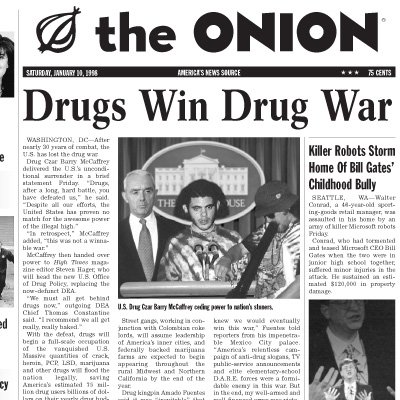
Why We Can’t Wage War on Drugs

drugs-win-war-on-drugs

The war on drugs was always a war against an idea. But ideas have a shelf-life, too, and this one has lost its potency

By Mike Jay

Source: Aeon Magazine

When the US President Richard Nixon announced his ‘war on drugs’ in 1971, there was no need to define the enemy. He meant, as everybody knew, the type of stuff you couldn’t buy in a drugstore. Drugs were trafficked exclusively on ‘the street’, within a subculture that was immediately identifiable (and never going to vote for Nixon anyway). His declaration of war was for the benefit of the majority of voters who saw these drugs, and the people who used them, as a threat to their way of life. If any further clarification was needed, the drugs Nixon had in his sights were the kind that were illegal.

Today, such certainties seem quaint and distant. This May, the UN office on drugs and crime announced that at least 348 ‘legal highs’ are being traded on the global market, a number that dwarfs the total of illegal drugs. This loosely defined cohort of substances is no longer being passed surreptitiously among an underground network of ‘drug users’ but sold to anybody on the internet, at street markets and petrol stations. It is hardly a surprise these days when someone from any stratum of society – police chiefs, corporate executives, royalty – turns out to be a drug user. The war on drugs has conspicuously failed on its own terms: it has not reduced the prevalence of drugs in society, or the harms they cause, or the criminal economy they feed. But it has also, at a deeper level, become incoherent. What is a drug these days?

Consider, for example, the category of stimulants, into which the majority of ‘legal highs’ are bundled. In Nixon’s day there was, on the popular radar at least, only ‘speed’: amphetamine, manufactured by biker gangs for hippies and junkies. This unambiguously criminal trade still thrives, mostly in the more potent form of methamphetamine: the world knows its face from the US TV series Breaking Bad, though it is at least as prevalent these days in Prague, Bangkok or Cape Town. But there are now many stimulants whose provenance is far more ambiguous.

Pharmaceuticals such as modafinil and Adderall have become the stay-awake drugs of choice for students, shiftworkers and the jet-lagged: they can be bought without prescription via the internet, host to a vast and vigorously expanding grey zone between medical and illicit supply. Traditional stimulant plants such as khat or coca leaf remain legal and socially normalised in their places of origin, though they are banned as ‘drugs’ elsewhere. La hoja de coca no es droga! (the coca leaf is not a drug) has become the slogan behind which Andean coca-growers rally, as the UN attempts to eradicate their crops in an effort to block the global supply of cocaine. Meanwhile, caffeine has become the indispensable stimulant of modern life, freely available in concentrated forms such as double espressos and energy shots, and indeed sold legally at 100 per cent purity on the internet, with deadly consequences. ‘Legal’ and ‘illegal’ are no longer adequate terms for making sense of this hyperactive global market.

The unfortunate term ‘legal highs’ reflects this confusion. It has become a cliché to note its imprecision: most of the substances it designates are not strictly legal to sell, while at the same time it never seems to include the obvious candidates – alcohol, caffeine and nicotine. The phrase hasn’t quite outgrown its apologetic inverted commas, yet viable alternatives are thin on the ground: ‘novel psychoactive substance’ (NPS), the clunky circumlocution that is preferred in drug-policy circles, is unlikely to enter common parlance. ‘Legal highs’, for all its inaccuracies, points to a zone beyond the linguistic reach of the war on drugs, that fervid state of mind in which any separation between ‘drugs’ and ‘illegal’ seems like a contradiction in terms. Then again, if that conceptual link breaks down, what does become of the old idea of drugs? When the whiff of criminality finally disperses, what are we left with?

I said ‘old idea’, but the word ‘drug’, at least in the sense that has been familiar throughout our lifetimes, turns out to be a recent coinage, peculiar to the 20th century. The word itself is, of course, centuries old: as a general term for any medication or chemical remedy, it dates back to the 14th century. But its more specific sense – as in ‘drug addict’, ‘drug control’ or ‘drug culture’ – can be dated quite precisely to the years around 1900. And on examination, it proves to be a curious hybrid, bridging two quite separate meanings.

The first is psychoactivity. A ‘drug’ is a substance that acts on the mind, changing the way we think or feel. But this descriptive meaning also carries a strong suggestion of judgment, less easily defined but unmistakably negative. ‘Drug’, in this sense, is a label to be avoided. Thus, according to the industries that produce and promote them, alcohol and tobacco are not drugs; cannabis advocates insist it is not a drug but a herb; and LSD enthusiasts say that it is not a drug but a sacrament. Indigenous users of coca, betel nut or ayahuasca are appalled at the suggestion these substances might be drugs. A cup of tea is psychoactive, but we would only call it a drug if we wished to make a point. An indeterminate white powder bought off the internet, on the other hand, might be legal, but it is undoubtedly still a drug.

Before the 20th century, it would have been difficult to express this idea. Many of today’s ‘drugs’, such as cannabis, cocaine and morphine, were sold in any high-street pharmacy. ‘Heroin’, for instance, emerged in 1898 as Bayer Pharmaceuticals’ new brand of over-the-counter cough medicine. Did the authorities simply turn a blind eye to the dangers that these substances posed? They did not: opium was classified as a poison because of its overdose risk, and cannabis was known to cause mental disturbance in some users. Yet these properties did not confer any exceptional status. And why should they? Even today, there are still plenty of prescription medicines that are toxic, habit-forming or that have deliriant side-effects. What made the drug-drugs special? In the 20th century, they came to be defined by their illegality, but of course they could not have been created by it. Only once certain hostile perceptions about drugs were in place could it make sense to ban them. What caused the perceptions?

We might start with the temperance movement. In the 19th century, alcohol was being recognised as a causal factor in all sorts of social ills, and so temperance campaigns promoted sobriety as the path to personal health, moral virtue and social respectability. Progressive social reformers joined forces with doctors and religious authorities to condemn the habitual intoxication of previous generations. Other intoxicating drugs might not have presented such a widespread problem, but they all got swept up in the same mixture of medical, moral and social opprobrium.

By the late 19th century, consumer groups were campaigning against the heavy doses of opiates and cocaine concealed in patent medicines

Global trade, meanwhile, made imported drugs such as opium and cocaine cheap and abundant; industry refined them into newly potent forms, which an energetic and largely unregulated business sector advertised and distributed to a booming consumer market. At the same time, the hypodermic syringe was transforming medical practice. It allowed doctors – and, increasingly, the general public – to inject large quantities of pure and potentially dangerous opiates such as morphine. This brought a breakthrough in pain relief, but also new risks such as abscesses and blood poisoning and, for some patients, compulsive and self-destructive overuse.

By the late 19th century, consumer groups were campaigning against the heavy doses of opiates and cocaine concealed in patent medicines, and doctors were diagnosing addiction as a medical pathology with serious social consequences. The first uses of ‘drug’ in its modern sense date from this era: in its earliest occurrences, it stood as an abbreviation of phrases such as ‘addictive drug’ or ‘dangerous drug’. Doctors advised governments and the public that injections of powerful narcotics should be confined to professionals. Use without medical supervision was classified as ‘abuse’.

Largely couched in medical terms as it was, the whole notion of ‘drugs’ carried moral and cultural implications from the start. Within the temperance debate, intoxication was an evil in itself and abstinence a corresponding virtue. Also, a good many of the substances that caused concern in the West were associated with immigrant communities: opium in the Chinese districts of San Francisco or London’s docklands, cocaine among the black communities of the southern US. In the racially charged debates of the day, these substances were presented as the ‘degenerate habits’ of ‘inferior races’, a ‘plague’ or ‘contagion’ that might infect the wider population. Such ideas might no longer be explicit, but the drug concept certainly carries a murky sense of the foreign and alien even now. That’s why it rarely applies to the psychoactive substances that we see as part of normal life, whether caffeine in the west, coca in the Andes, or ayahuasca in the Amazon.

During the first years of the 20th century, opium, morphine and cocaine became less socially acceptable, rather as tobacco has in our era. Their use was now viewed through the prism of medical harm, and their users correspondingly started to seem feckless or morally weak. The drugs themselves became, in a sense, ‘legal highs’: not technically prohibited but retreating into the shadows, available only under the counter or from those in the know. And then, once their sale was formally banned in the years around the Great War, ‘drugs’ became a term with legal weight: a specified list of substances that were not merely medically dangerous or culturally foreign, but confined to the criminal classes.

The banning of drugs occasioned strikingly little public debate, certainly compared with the prohibition of alcohol in the US. Then again, the ‘drug problem’ was pretty marginal at that point, and confined to subcultures (ethnic, bohemian, criminal) without a public voice. The only organised resistance to this new language of condemnation came from the pharmaceutical industry, concerned that its legitimate trade was being tarnished by unfortunate associations. What’s now the American Pharmacists Association, pressured by its major corporate sponsors such as Johnson & Johnson, complained about the casual use of terms such as ‘drug evil’, ‘drug fiend’ and ‘drug habit’, and lobbied newspapers to specify the drugs in question as ‘narcotics’ or ‘opiates’.

But ‘drugs’ was too vague and too useful to replace with more precise terms. It conveyed not simply particular chemicals, but a moral position on the use of them by certain people and for certain purposes. This position was eventually enshrined in the legal frameworks that emerged to prohibit them. The 1961 UN Single Convention on Narcotic Drugs, the founding document of the international drug laws, is unique among UN conventions in using the word ‘evil’ to describe the problem it seeks to address.

Legislators celebrated the 1961 Convention as the culmination of a 50-year battle to prohibit drugs, a battle that had begun at the Hague Opium Conference of 1911. Yet with hindsight, 1961 was the moment at which the consensus around the evils of drugs began to fracture. An adventurous postwar generation, the first to be raised as truly global consumers, was awakening to the realisation that alcohol was not the world’s only intoxicant. An international underground was beginning to spread news of hashish-smoking in Morocco and LSD synthesised in Swiss laboratories, as well as Benzedrine pills that propelled truck drivers through the night, and hallucinogenic mushrooms in Mexican mountain villages. For many, the resounding denunciations of drugs as dangerous, foreign and criminal no longer rang quite true. Within a booming youth culture, controlled substances were becoming the talismans of a new morality, an entire view of life that valorised pleasure, experiment and self-discovery.

In a sense, Nixon’s war on drugs was lost before it was even announced. It could have succeeded only by uniting an already polarised society in the belief that drugs were a genuine threat to civilisation, and that there was a genuine possibility of returning to a world without them. These propositions grew ever harder to sell over the intervening decades, as drug use became increasingly normal, while the vast sums of money spent trying to control it not only failed to reduce it, but actually created a global criminal market on a scale that Nixon could never have imagined.

psychiatric diagnoses such as low self-esteem and social anxiety open the door to new ‘feel-good’ drugs designed to enhance confidence and happiness

The problem is not just one of unintended consequences. As the war on drugs has dragged on, the medical, moral and cultural certainties that interlocked so tightly to create the very concept of ‘drugs’ have been drifting out of focus. In medical terms, the category rested on a clear distinction between sanctioned ‘use’ and criminal ‘abuse’. Yet today’s consumers are in practice free to make this distinction themselves. The arrival of online pharmacies means we can all take our chances with the prescription drugs of our choice: generic, pirated, off-label, out of date or semi-legitimately dispensed by doctors and pharmacists on the other side of the world. As a result, the line between pharmaceutical and illicit drugs is blurring. Recent studies in the US have found opiate users moving from prescription drugs such as OxyContin and Vicodin to street heroin and back again, depending on price and availability. As new ‘legal highs’ with opiate-like effects come on-stream, any such line may eventually become impossible to draw.

Within the pharmaceutical industry as a whole, other pressures and trends are conspiring to soften the distinction between recreation and medicine, ‘feeling good’ and ‘feeling better’. Smart drugs and nootropics promise to make us feel ‘better than well’; the broadening of psychiatric diagnoses to encompass conditions such as low self-esteem and social anxiety opens the door to new ‘feel-good’ drugs designed to enhance confidence and happiness. Pop-science catchphrases such as ‘serotonin-booster’ might apply equally to antidepressants or to MDMA. At the cutting edge of brain research, neural network studies are pointing the way towards implants for deep-brain stimulation or brain-embedded fibre-optic cables: a brave new world in which moods and perceptions might be controlled electronically and drugs, good or bad, would be redundant.

At the same time, the cultural landscape in which ‘drugs’ were defined is receding from view. Nixon launched his war on drugs in a country where even cannabis was a profoundly alien substance to almost everybody over the age of 30; today, most Westerners below retirement age recognise drugs, for better or worse, as part of the culture in which they grew up. We have long been comfortable global consumers, seeking out the novel and exotic in everything from food to travel, music to spirituality; our appetite for intoxicants participates in this pursuit of novel sensations, and is explicitly linked to it by corporate advertising that uses the visual lexicon of mind-expanding drugs to sell us everything from energy drinks to smartphones. ‘Drugs’, in its original sense, drew on a reflexive distaste for the culturally alien. This distaste has itself become alien to the inhabitants of the 21st century.

As drugs have swirled into this kaleidoscope of lifestyle and consumer choices, the identity of the ‘drug user’ has slipped out of view. A unitary class of ‘drugs’ depended for its coherence on an identifiable class of users, clearly recognised as deviant. But drug use has long ceased to function as a reliable indicator of class, ethnicity, age, political views or any criminality beyond itself. Plenty of drug users self-identify with confidence these days and, if conspicuous drug ‘scenes’ are easily located, the majority of drug use nevertheless takes place outside them. Buying and selling, the point of greatest visibility and risk for the user, has been rendered virtual: the shady street deals of the past can now be conducted online via PayPal or bitcoin, the incriminating package delivered through the letterbox in an innocuous Jiffy bag.

Though its medical and cultural underpinnings might be shifting, the category of drugs is still firmly defined by the law. At their margins, the drug laws could be starting to reflect the reality of what we might call a post-drug world, but it seems unlikely that they will drive the process. When the drug laws were first passed a century ago, they reflected a cultural shift that had already taken place; we can expect them to be dismantled only after the landscape of a post-drug world is plain for all to see. But even now, it is not hard to discern in outline. Alcohol prohibition, when it eventually collapsed, was superseded by a patchwork of regulatory controls – licensing, insurance, tax – that either existed already or were devised on the basis of pragmatic policy goals.

We can envisage a similar patchwork for a day – however close or distant – when drugs are removed from the ambit of criminal law. In so far as any drug presents medical risks, it requires regulation to minimise them, and a well-established spectrum, from labelling to licensing to prescription, already exists for this purpose. In so far as they constitute a luxury market, we might expect them to be taxed. As with alcohol, in some jurisdictions they might remain illegal by broad popular consent. The prohibition of drugs, including alcohol, was an emergency measure that overrode the logic of pragmatism. The alternative is not another leap in the dark, but a return to the routine regulatory calculus.

But what lies beyond the idea of ‘drugs’ itself? The simple answer is that there is nothing to replace. Behind the term lies a disparate group of chemicals whose varied effects – stimulant, narcotic, psychedelic, euphoriant – offer a more accurate language of description. Value-laden terms, both positive and negative, would doubtless emerge to complement them. A post-drug world would require not a new language but the recovery of an older one. The category of ‘drugs’ was an attempt, characteristic of its historical moment, to separate out good chemicals from bad ones. But as we have known since antiquity, good and evil, virtue and vice are not inherent in a plant or a molecule. Pedanius Dioscorides, the great classical authority on medicine, maintained that no substance is intrinsically good: it all depends on the dose at which it is administered, the use to which it is put, and the intentions behind that use. The Greek term pharmakon could mean both a medicine and a poison: there was no such thing as a harmless remedy, since anything with the power to heal also had the power to harm. All drugs, psychoactive or otherwise, are a technology, a prosthetic that extends our physical and mental reach. Like so many of the other technologies that are transforming our world, their benefits and dangers must ultimately be understood as extensions of ourselves.