Real Rewilding

6ae1ed82e41b1b306efe339273279b5f-565x403

By Glenn Aparicio Parry

Source: Reality Sandwich

In an attempt to circumvent enmity toward genetically modified foods, Danish scientists are proposing what they claim is a precision breeding technique called “rewilding.” It is named rewilding because it mixes current genes from a plant with ancient genes of the same plant (old genes that were either lost or bred out somewhere along the way). The name sounds harmless, even restorative, and would likely be labelled non-GMO in the US because the genes are modified from the same plant. It could even be labelled “organic” if the introduced gene is determined not to be “foreign.” Like most genetic experiments, it is difficult to know the efficacy of this technique or if it ever will be successfully introduced. The outcome of the initiative notwithstanding, I find the name “rewilding” troubling. It reminds me of other similarly deceptive euphemisms, such as “tax relief” for millionaires. Who could be against “tax relief?” It sounds like a laxative, something we need to make it through the day.

Rewilding is exactly what we need—but not through genetic breeding. We need to rewild by reconnecting with what is wild in Nature and within ourselves if we are to save humanity and many of the other species with which we share this planet. Rewilding is a biological imperative.

So, how do we do this? One important way is to use our mind and our thoughts differently, in ways that reconnect us with our wild roots. These ancient ways of instinctual and intuitive thinking are not obsolete, just suppressed, and their recovery could help promote emotional and spiritual healing. We all need a sense of belonging, especially now. But modern abstract thinking has produced the opposite result—separating us from our “environment.” This fosters alienation, depression, and if untreated, violence.

Of course, abstract thinking has its benefits, and is largely responsible for much of high level science. But we would be wrong to assume that modern rationality is the most advanced form of thought. In my view, it has actually degenerated from its roots in ancient Greece. It is true that the Greeks prized rational thinking as the pinnacle of thought, but they also considered it to be the most beautiful form of thought. The key is in the word. “Rational” comes from “ratio,” or a relationship between things. In the right proportions (what the ancient Greeks called divine proportion or the sacred ratio) the relationship between things is beautiful. It is possible to think harmonious and beautiful thoughts that are inspired by and connect us to living nature, and this is what we should aspire to do.

Original Thinking = The Best of Old and New Thought

I find it curious that genetic rewilding seeks to bring modern and ancient genes together because I often support the idea of bringing old and new together, particularly old and new ideas. If an idea is wise, it is timeless. It can be brought back as needed, even if it has fallen out of favor for so long it is forgotten and its reintroduction is misperceived as brand new. The holistic health movement is a prime example of this phenomenon. It is only after we stopped treating people as whole that we rediscovered a need to do so. I recently saw a newspaper story proclaiming “new hospitals” that have fresh air, sunlight, and gardens for the patients to walk in. The concept is actually very old, used in the sanatoriums of the Middle Ages, where people were very much treated as whole (holy), even if the technologies were not as proficient.

I am not necessarily opposed to bringing old and new genes together providing it is something that genuinely helps the plant and if the plant wants it. That’s right. You read correctly. We should ask the plant first. I am opposed to human beings playing with the DNA of other species as if those species have no rights, as if all of nature is here merely to serve us. This is a fundamental flaw in modern Western thinking.

Of course, mainstream science would scoff at the idea of communicating with plants, but this is a self-imposed limitation. As the visionary physicist David Bohm noted, “The strength of science is that it is based in lived experience. The weakness is that it only admits certain kinds of experiences as legitimate.”

In antiquity, we possessed the ability to communicate with plants, as did Goethe, living in the late 18th and early 19th centuries, and Clive Backster (albeit through the medium of a lie detector) living in the 20th century. Contemporary Indigenous peoples (and other people who have reindigenized to the land) are still able to communicate with plants. In my opinion, all of us do this to some extent, even those who think they can’t. And why shouldn’t we be able to talk with plants? After all, plants and animals are so radically interconnected that we are in a literal conspiracy; we conspire, or breathe together, taking in what the other breathes out in a sacred circle of life.

As Paula Underwood, an Oneida elder observed, the development of one ability often disables another. Our capacities to study about nature have closed off the capacity we once had to speak directly with nature. It is also possible that our abilities to experiment upon the natural world only emerged out of necessity after we had lost our ability to listen. This would explain Frances Bacon’s frustrated cry to “put Nature on a rack and torture her” to learn her secrets.

My chief complaint about genetic engineering is that it tinkers with what ought to be left alone. We do this largely because we believe that knowledge must be obtained through trial and error, but this is one of the greatest fallacies of modern mind. We are so certain that trial and error is the only way to obtain knowledge that we have trouble imagining any other way. But there is another way.

Many intact Indigenous cultures have comprehensive knowledge of plant medicine. Ask them how they know this, and they will tell you that they learned (or their ancestors learned) by directly communicating with the spirit of the plants. The rishis of India were said to have written the Vedic texts in the same way. How else could the Native peoples of the Amazon have received the recipe for making ayahuasca? It is necessary to blend two plants together to make the brew, and one of them contains the monooxidase inhibitor necessary for transforming the DMT molecule in the other to be psychoactive. It boggles the mind to predict the odds of coming upon this by trial and error. I choose instead to believe the Indigenous peoples.

Real rewilding opens the possibility of connection, even communion, with other species. We humans have the instinctual capacity to do this. Of course, instinct has become a pejorative word, something we supposedly transcended in favor of free will. But this is misguided. Instinct serves a vital purpose, connecting us with the rest of creation. Ultimately, humans cannot thrive, or even survive, if the water, air, soil, other plants and animals we share this Earth with are not respected and protected.

Humans have free will, but that does not mean we should act in our selfish interest experimenting on the rest of nature willy-nilly. Our task is to first rewild and learn what nature wants to happen, and then use our free will to align with that sacred purpose.

Saturday Matinee: Funky Forest

158820971_af1e3d

Plot synopsis by VIZ Media:

Meet the Harunos, a rather unconventional, but happy and loving family nonetheless. They live in a small town in the mountains just out of Tokyo where life is good and quiet – but that doesn’t mean they don’t have their own little problems.

As 8-year old Sachiko (Maya Banno) tries to get rid of a giant version of herself who seems to pop up everywhere, her older brother Hajime (Takahiro Sato), privately wrestles with his love-struck heart. Meanwhile, their mother Yoshiko (Satomi Tezuka) is working hard, coming out of retirement as an animator, as her husband and professional hypnotist Nobuo (Tomokazu Miura) watches on with slight apprehension. Yoshiko’s brother, Ayano (Tadanobu Asano) is just visiting his hometown and staying with the family, but also has a hidden agenda; he needs to come to terms with a romance that ended years ago. Even Nobuo’s brother and successful manga artist Todoroki has his problems. It’s his birthday soon and he wants to give himself something special. And lastly there’s Grandpa, the most bizarre and perhaps the most perceptive of all, who continues to search for a better way to live life to the full.

Written, directed and edited by Katsuhito ISHII, The Taste of Tea is a unique and gentle family portrait tackling the universal themes of time, people and their lives.


The enduring reality of government by wealth and some of its consequences

Plutocracy-2

By John Chuckman

Source: Intrepid Report

If you really want to understand the world in which we live—its endless wars, coups, interventions, and brutality towards great masses of people—you need to start with a correct understanding of the political machinery at work.

Talk of liberal interventions or fighting for rights, Western values, and democracy are hopelessly naïve and mostly deliberately deceptive. America’s record in such matters is one of securing everything from bananas, copper, and crude oil concessions to, at the very least, foreign governments obedient to its mandates after removing a disliked leader, whether elected or not. There is no concern for principles outside of their being featured in blowhard, insincere political speeches. The interests of America’s government do not match the interests of ordinary people, those in America or anywhere else, and, were the informed consent of the governed genuinely involved in launching bloody adventures, they likely never would happen.

The underlying reality of how people in the West are governed now compared to hundreds of years ago is surprisingly unchanged, much the way the rules governing how chemical bonds form have not changed despite a long and great parade of events and discoveries in the visible world. Despite all the revolts, revolutions, congresses, constitutions, and great movements over the centuries, we are in fact governed in the same essential way, people.

Of course to see this, you have to strip away the forms and rituals we have constructed over the centuries, forms and rituals which create impressive effects much like the green smoke and thunderous voice of the Wizard of Oz, a wizened old man who worked from his curtained control room, pulling levers and hitting buttons to create intimidating effects. Most Americans remain impressed with the smoke and thunder and cheap magic tricks, it requiring some dedicated effort to shake off well-done illusions, and, as I’ve written before, Americans work extremely hard in their jobs or live a kind of marginal life trying to scrape by on low wages or part-time work, either of which situations leaves little time or inclination to question what government is really doing and for whose benefit.

And so long as America remains under the rule of wealth, it is unlikely other states, as in Western Europe, will emerge from it because America’s establishment has such decisive influence—economic, financial, military, and political—over many of them.

What is considered as wealth changes over time and with economic development, and with those changes so do its interests as well as the practices of its power. Great deposits of copper ore or crude oil In the Middle Ages were virtually worthless. Wealth then was land for agriculture, forestry, and hunting, with the family names of owners determined by their estates. The revenue from that natural wealth was converted to great houses and jewels and the implements of war. War, too, was a source of wealth with most wars being little more than adventures for dominance and looting on a grand scale. Again, as in our own day, they were dressed up with slogans about principles or causes which had almost no meaning. The case of the “Christian” Crusades, which continued their pillaging and orgy of killing, on and off, for centuries, springs to mind. Soldiers and sailors, up until modern times, were not motivated by their paltry pay and poor supplies, it being understood as a condition of employment that they would enjoy a share of the bounty looted in any campaign.

Today, the forms wealth are as diverse and complex as is our society, and many of them are not apparent to ordinary people in the way great estates and hunting rights and obligations in war and peace to great lords were apparent in 800. Even as late as, say, 1850, wealth in the form of belching factories employing armies of people was often still quite apparent, but today’s complex banking and securities and financial institutions are not well understood by most people, although they represent immense wealth just as real in its demands and power as estates and obligations of the 9th century. Wealth today also comes from huge global manufacturing concerns of every description often with operations scattered out of sight, great shipping and transportation fleets, or electronic and communications empires. Land itself remains an important form of wealth where it can produce industrial-scale crops or contains deposits of valuable minerals or can generate flows of electricity or has been developed into great cities or resorts. War remains a source of wealth, only on a scale which could not have been imagined a few hundred years ago, but the spoils no longer go to soldiers in professional armies, they go to those responsible for the war, often in forms not easily recognized, as with special rights and concessions and secret arrangements.

As the nature of wealth evolved from the Middle Ages to the Modern Era, outward forms and rituals of government also changed. We have moved from the near-absolute power of kings and autocrats through aristocracies and republics with senates to a great variety of forms, parliaments and congresses, which appear designed to yield, to one degree or another, to the consent of the governed.

But appearances, as in the case of the Wizard of Oz, can be deceiving.

Today, a single wealthy individual cannot make the kind of demands upon ordinary people that marked arrangements in the Middle Ages—although that must be qualified as I’m sure anyone who has become involved in a dispute with a wealthy neighbor or a great corporation will be happy to explain—but the class of wealthy people can indeed make just such demands, and they do so all the time. You will be taxed to pay for the schemes that their lobbying establishes, your water and air will contain the pollution of their manufacturing and mining, your children will be sent to kill and die in their wars, the ethics or morals you were taught as a child will be trampled upon, and virtually all important legislation will deal with the rights and interests of wealth, and not those of the broad mass of people.

In America, once in four years you will be asked to choose between two names, both of which have been closely vetted by the powers that be, to elect as head of government. Not only have they been vetted, but the immense costs of their campaigns in reaching you on television, at rallies, and with opinion polls to regularly fine tune their words will be paid almost exclusively by those whose real interests are at stake in every major election, the wealthy and their important serving institutions of government. The end effect is not really all that different than the old single-candidate Soviet elections at which the press trained Americans to sneer.

Many of America’s founding fathers had dark suspicions about the existence of wealth being secure in the presence of democratic government, and that is why they created forms—mostly adapted from Britain, a place no one regarded as a democracy then—to keep wealth safe. Over a couple of centuries, the original arrangements were modified, the country moving from a tiny one percent or so privileged voters—for perspective, that’s roughly the same as the percent of voters in China’s Communist Party deciding who rules the country—to something approaching universal suffrage, but always arrangements were made to safeguard wealth against the assumed predations of democracy.

In elections for the American Senate, the legislative body with real power, authority, and privilege, you again will be asked to choose between two well-vetted and well-connected candidates. Others may run, but they will be rendered helpless by the vetted candidates’ flood of money and resources, you will never hear their voices, and America’s press—itself an empire of wealth serving wealth—will waste no time on their views. In the case of the Senate, you will be asked once in six years to vote, with the elections staggered so that only one-third of that body faces election at any time—a perfectly-conceived formula for keeping the old bunch in charge despite issues which might have generated election discontent. In fact, you can never “throw the bums out” in America. Anyway, there really isn’t much risk for senators running for re-election, with incumbents winning about 95% of the time. Senate seats are so secure they sometimes become family sinecures, handed down from father to son. After the election, unless you live in a small-population, insignificant state, you will never see or meet your senator, and you will certainly have no opportunity to lobby. Virtually all seeing, meeting, and lobbying will be done by the wealthy sponsors of the successful candidates or by their hired help.

The average American senator is said to spend two-thirds of his or her time securing funds for the next election, and such elections have now been bid-up to unbelievable amounts of money. The huge costs serve as what economists call “a barrier to entry,” a kind of high financial wall which keeps others from entering the political market, or, if somehow they do manage to enter, keeps them from effectively competing. Only the other wealth-vetted and connected candidate will have any hope of collecting a big enough pot of money to threaten an incumbent. The belief that people giving millions of dollars to candidates expect nothing in return is not even worth discussing. What they get—apart from goodies like important and prestigious appointments or valuable government contracts—is access, and access is exactly what most people never enjoy. Intimate access to politicians in high office, people always mindful of the necessity for another overflowing campaign war chest, is genuine power.

It is not impossible to have compatibility between democracy and wealth, but it requires a set of laws and regulations concerned with campaign financing, lobbying, and disestablishing a political duopoly of two privileged parties, laws which simply cannot happen in America over our lifetimes. In America, law makes corporations persons, and the highest court, packed by judges appointed to serve wealth’s interests, has ruled that campaign money is free speech. These are not things easily turned around.

The American system of campaign financing not only assures the secure power of domestic wealth, it assures also the influence of wealthy lobbies serving the interests of foreign states, Israel being the most outstanding example. Other foreign states also exploit this system to varying degrees, but no other state has more than five million American citizens in great part keen to serve its interests. And many of them are successful, affluent, and well-placed people enjoying a connected set of organizations and well-funded lobbies. Other foreign states also do not enjoy having many of their lobbyists in America being dual-citizens, free to move back and forth between the country being lobbied and the country being lobbied for, surely an ethical issue for politics and foreign affairs of the first magnitude. It is a unique situation in many respects, and it has helped create a unique set of problems in the world.

The wealthy interests of America happen to share some important interests with lobbyists for Israel, including securing the Western world’s supply of energy and not permitting the rise of states of any power in the Middle East who disagree with America’s essential views. It is important to keep in mind that “America’s essential views” are not necessarily the views of most of the American people and that many of those “essential views” have never received genuine informed consent. Elections conducted the way America’s high-level elections are conducted are incapable of bestowing meaningful consent, especially in vitally important matters.

The Israeli-American alliance is something of an unholy one because in binding America so closely to Israel, some huge and unresolvable conflicts have been created. Israel is associated with a long series of wars and abuses in the region, and, ipso facto, so is America. Israel, given the nature of its founding, expansion, and practices, is not liked by any neighboring states, although many now cooperate secretly, and sometimes even openly, in areas of mutual interest and have learned to tolerate its existence, the way generally eased by large American bribes or equally large American threats.

Traditionally, states in the Middle East are not democracies. Their often short histories have given limited opportunity for wide-spread development and prosperity creating a strong middle-class, the sine qua non for democracy. With the United States always (insincerely) praising democracy—including Israel’s grotesque contradiction of “democracy for some but not others”—it has been caught in a bind between supporting what it says it opposes and opposing what it says it supports.

Its proposed solution was a huge CIA project, nicknamed “the Arab Spring” by America’s wealth-serving and often dishonest press, a set of manufactured uprisings intended to bring a semblance of democracy to the region. It has been largely a failure, ending with some countries trapped in chaos or civil war and others, notably Egypt, briefly gaining a government Israel hated intensely, the truth being that genuine democracy in virtually any of these countries will not be friendly to Israel’s geopolitical ambitions in the region nor to those of its American promoter and protector. While the “Arab Spring” was allowed to proceed in some states, in others, where it was neither intended nor desired, such as Saudi Arabia or Bahrain, spill-over effects were deliberately and violently suppressed with American assistance. So the American-Israeli relationship now still locks the United States effectively in fighting against democracy in some countries and in supporting absolute monarchs and oligarchs in others, while in still others, such as Syria and Iraq, it is involved literally in smashing them as states, in violation of all international law and long-term good sense.

The entire situation is an ongoing disaster and is almost certainly not sustainable over the long term. How do you insist a huge country like Egypt remain a backwater without democratic rights indefinitely? How can you justify the destruction of an ancient and beautiful country like Syria? How can you justify supporting absolute monarchs and keeping their people in total political darkness? How do you continue supporting Israel in its abuse of millions, depriving them of every human right, or in its constant aggression to secure its hegemony? The drive for regional hegemony is all that is behind Israel’s constant hectoring of Iran, and how is that behavior different to the aggressive wars condemned by the Nuremburg Tribunal? It’s not, of course. Further, destructive, deliberately-induced conflicts like that in Syria, by degrading its economic advance, only slow the day for democracy’s having a real chance to emerge.

So here is America, self-proclaimed land of the free, mired in a vast situation where it works to suppress democracy, supports tyrants, and supports aggressive war because its leaders, with no genuine consent of the governed, have put it there, and this is just one of many unhealthy and destructive consequences of wealth’s rule in the United States. Wealth has no inherent interest in democracy, and it is entirely up to a people anywhere to demand respect for democracy through laws.

John Chuckman is former chief economist for a large Canadian oil company. He has many interests and is a lifelong student of history. He writes with a passionate desire for honesty, the rule of reason, and concern for human decency. John regards it as a badge of honor to have left the United States as a poor young man from the South Side of Chicago when the country embarked on the pointless murder of something like 3 million Vietnamese in their own land because they happened to embrace the wrong economic loyalties. He lives in Canada, which he is fond of calling “the peaceable kingdom.” John’s columns appear regularly on Counterpunch, Media Monitors, Politics Canada, Baltimore Chronicle, Intrepid Report, Scoop (New Zealand), Asian Tribune, Aljazeerah.info, Smirking Chimp, Dissident Voice, and many other Internet sites. He has been translated into at least ten languages and is regularly translated into Italian and Spanish. Several of his essays have been published in book collections, including two college texts. His first book has just been published, “The Decline of the American Empire and the Rise of China as a Global Power,” published by Constable and Robinson, London. Contact him at jc60649@yahoo.com.

 

It’s A War Of Words

d90d9d221dc48be6739092bcee48b1c9

By Pia Massie

Source: Adbusters

It’s the end of the Nation State. It’s the beginning of a whole new chapter in human history: a hinge point, a paradigm shift in consciousness and an astonishing moment to be alive.

We are more connected, deeper in crisis, more adept, faster, more empathic, more afraid and simultaneously more aware than any species has ever been. It’s terrifying or thrilling or mysteriously both depending on your POV and your GPS location.

The fast and furious empire of the US is already in free fall; the signs and signifiers are blaring everywhere. The loot has already been moved offshore. The prison system is booming. Monsanto has patented life and death, mixing them up and street hustling the world in a fatal con of three card Monte. We’ve poisoned our soldiers with depleted uranium and our mothers with toxic plastics. South America is rejecting the yoke of the North. Europe is blocking GMO food, questioning the sanity of its producers and consumers. Asia is steadily gaining ground. And yet American movies tell us that “against all odds,” “what doesn’t kill you makes you stronger,” “the hero never dies.”

In crises people diverge, we either become our best selfless selves: providing food, water, clothing, shelter, comfort, humanity, kindness —rushing in to the quake or paddling in to the flood zone atop a refrigerator or jumping into the burning building— fueled by a fierce love, a deep aha about our interconnectivity, courageous in our vulnerability… OR… we are swallowed up by fear and anxiety shrinking smaller and shirking our responsibilities or still worse biting and clawing over others and killing the planet in the mad wake spewing from the acting out of our deep multi-generational distress.

As multiple systems collapse, escapism becomes harder. The war of words becomes more deadly: traitor, warrior, patriot, egomaniac, spy, dropout, terrorist, freedom fighter, son, partner, friend – each word defines a relationship between people, connecting the framing POV and again the coordinates of where we stand on the map.

It is a real crossroads we are standing at here in this exact moment of our lives. So fuel yourself with love; arm yourself with truth and tenderness; don’t forget to water the garden. Find the courage to tell your own story. Carpe Diem. It is never too late.

— Pia Massie, Vancouver, Canada

Putin Leads BRICS Uprising

0-6-brics-staaten-wollen-in-ufa-engere-partnerschaft-vereinbaren.bffa6cfe

By Mike Whitney

Source: Counterpunch

There’s been a virtual blackout of news from this year’s seventh annual BRICS summit in Ufa, Russia.  None of the mainstream media organizations are covering the meetings or making any attempt to explain what’s going on.  As a result, the American people remain largely in the dark about a powerful coalition of nations that are putting in place an alternate system that will greatly reduce US influence in the world and end the current era of superpower rule.

Let’s cut to the chase: Leaders of the BRICS (Brazil, Russia, India, China and South Africa) realize that global security cannot be entrusted to a country that sees war as a acceptable means for achieving its geopolitical objectives.  They also realize that they won’t be able to achieve financial stability as long as Washington dictates the rules, issues the de facto “international” currency, and controls the main levers of global financial power. This is why the BRICS have decided to chart a different course, to gradually break free from the existing Bretton Woods system, and to create parallel system that better serves their own interests. Logically, they have focused on the foundation blocks which support the current US-led system, that is, the institutions from which the United States derives its extraordinary power; the dollar, the US Treasury market, and the IMF. Replace these, the thinking goes, and the indispensable nation becomes just another country struggling to get by.  This is from the Asia Times:

“Leaders of the BRICS… launched the  New Development Bank, which has taken three years of negotiations to bring to fruition. With about $50 billion in starting capital, the bank is expected to start issuing debt to fund infrastructure projects next year. They also launched a foreign-exchange currency fund of $100 billion.

The two new endeavors are statements that the five largest emerging markets are both looking out for each other and, simultaneously, moving away from the western financing institutions of the World Bank and International Monetary Fund.

“The BRICS states intend to actively use their own resources and internal resources for development,” Putin said, according to Reuters. “The New (Development) Bank will help finance joint, large-scale projects in transport and energy infrastructure, industrial development.”…..Birthing the two initiatives in Russia had been Putin’s top priorities.”

(“Russia’s Putin scores points at Ufa BRICS summit“, Asia Times)

Can you see what’s going on? Putin has figured out the empire’s vulnerabilities and he’s going straight for the jugular.  He’s saying: ‘We’re going to issue our own debt, we’re going to run our own system, we’re going to fund our own projects, and we’re going to do it all in our own currency. Kaboom. The only thing you’re going to be doing, is managing your own accelerating economic decline. Have a good day.’ Isn’t that the gist of what he’s saying?

So can you see, dear reader, why none of this is appearing on the pages of US newspapers or on US television.   Washington would rather you didn’t know how they’ve bungled everything by alienating the fastest growing countries in the world.

The Ufa conference is a watershed moment. While the Pentagon is rapidly moving troops and military hardware to Russia’s borders, and one bigwig after another is bloviating about the “Russian threat”; the BRICS have moved out of Washington’s orbit altogether.  They are following the leadership of men who, frankly speaking, are acting exactly like US leaders acted when the US was on the upswing. These are guys who “think big”; who want to connect continents with high-speed rail, lift living standards across the board, and transform themselves into manufacturing dynamos. What do America’s leaders dream about: Drone warfare? Balancing the budget? Banning the Confederate flag?

It’s a joke. No one in Washington has a plan for the future. It’s all just political opportunism and posturing.  Check this out from The Hindu:

“China and Russia have described BRICS, the Shanghai Cooperation Organisation (SCO) and the Eurasian Economic Union (EAEU) as the core of a new international order…

Russian President Vladimir Putin said… “There is no doubt — we have all necessary premises to expand the horizons of mutually beneficial cooperation, to join together our raw material resources, human capital and huge consumer markets for a powerful economic spurt.”

Russia’s Tass news agency also quoted Mr. Putin as saying that the Eurasian continent had vast transit potential. He pointed to “the construction of new efficient transport and logistics chains, in particular, the implementation of the initiative of the Silk Road economic belt and the development of transportation in the eastern part of Russia and Siberia. This may link the rapidly growing markets in Asia and Europe’s economies, mature, rich in industrial and technological achievements. At the same time, this will allow our countries to become more commercially viable in the competition for investors, for creating new jobs, for advanced enterprises,” he observed.”….

The summit also acknowledged “the potential for expanding the use of our national currencies in transactions between the BRICS countries.”   (“BRICS, SCO, EAEU can define new world order: China, Russia“, The Hindu)

The dollar is toast. The IMF is toast. The US debt market (US Treasuries) is toast.  The institutions that support US power are crumbling before our very eyes. The BRICS have had enough; enough war, enough Wall Street, enough meddling and hypocrisy and austerity and lecturing. This is farewell. Sure, it will take time, but Ufa marks a fundamental change in thinking, a fundamental change in approach, and a fundamental change in strategic orientation.

The BRICS are not coming back,  they’re gone for good, just as Washington’s “pivot to Asia” is gone for good. There’s just too much resistance. Washington has simply overplayed its hand, worn out its welcome. People are sick of us.

Can you blame them?

MIKE WHITNEY lives in Washington state. He is a contributor to Hopeless: Barack Obama and the Politics of Illusion (AK Press). Hopeless is also available in a Kindle edition. He can be reached at fergiewhitney@msn.com.


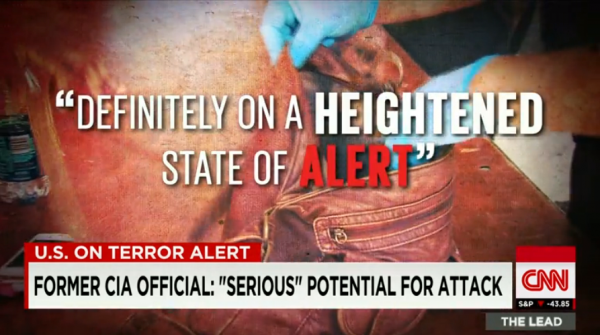
Jade Helm, Terrorist Attacks, Surveillance and Other Fairy Tales for a Gullible Nation

TerrorAlert

By John W. Whitehead

Source: The Rutherford Institute

“Strange how paranoia can link up with reality now and then.” ― Philip K. Dick, A Scanner Darkly

Once upon a time, there was a nation of people who believed everything they were told by their government.

When terrorists attacked the country, and government officials claimed to have been caught by surprise, the people believed them. And when the government passed massive laws aimed at locking down the nation and opening the door to total government surveillance, the people believed it was done merely to keep them safe. The few who disagreed were labeled traitors.

When the government waged costly preemptive wars on foreign countries, insisting it was necessary to protect the nation, the citizens believed it. And when the government brought the weapons and tactics of war home to use against the populace, claiming it was just a way to recycle old equipment, the people believed that too. The few who disagreed were labeled unpatriotic.

When the government spied on its own citizens, claiming they were looking for terrorists hiding among them, the people believed it. And when the government began tracking the citizenry’s movements, monitoring their spending, snooping on their social media, and surveying their habits—supposedly in an effort to make their lives more efficient—the people believed that, too. The few who disagreed were labeled paranoid.

When the government let private companies take over the prison industry and agreed to keep the jails full, justifying it as a cost-saving measure, the people believed them. And when the government started arresting and jailing people for minor infractions, claiming the only way to keep communities safe was to be tough on crime, the people believed that too. The few who disagreed were labeled soft on crime.

When the government hired crisis actors to take part in disaster drills, never alerting the public to which “disasters” were staged, the people genuinely believed they were under attack. And when the government insisted it needed greater powers to prevent such attacks from happening again, the people believed that too. The few who disagreed were told to shut up or leave the country.

Finally, the government started carrying out covert military drills around the country, insisting they were necessary to train the troops for foreign combat, and most of the people believed them. The few who disagreed, warning that perhaps all was not what it seemed, were dismissed as conspiracy theorists and quacks.

By the time the government locked down the nation, using local police and the military to impose martial law, there was no one left in doubt of the government’s true motives—total control and domination—but there was also no one left to fight back.

Now every fable has a moral, and the moral of this story is to beware of anyone who urges you to ignore your better instincts and trust the government.

In other words, if it looks like trouble and it smells like trouble, you can bet there’s trouble afoot.

For instance, while there is certainly no shortage of foul-smelling government activities taking place right now, the one giving off the greatest stench is Jade Helm 15. This covert, multi-agency, multi-state, eight-week military training exercise is set to take place from July 15 through Sept. 15 in states across the American Southwest.

According to official government sources, “Jade Helm: Mastering the Human Domain” is a planned military exercise that will test and practice unconventional warfare including, but not limited to, guerrilla warfare, subversion, sabotage, intelligence activities, and unconventional assisted recovery. The training exercise will take place in seven different southwestern states: California, New Mexico, Colorado, Arizona, Texas, Utah and Nevada.

U.S. Army Special Operations Command will primarily lead this interagency training program but the Navy Seals, Air Force Special Operations, Marine Special Operations Command, Marine Expeditionary Units, 82nd Airborne Division, and other interagency partners will also be involved. Approximately 1,200 troops are expected to participate in these exercises.

The training is known as Realistic Military Training because it will be conducted outside of federal property. The exercises are going to be carried out on both public and private land, with the military reportedly asking permission of local authorities and landowners prior to land usage. The military map listing the locations that will host the exercise shows Texas, Utah, and the southern part of California as “hostile territory.” According to U.S. officials, these three areas are marked as hostile to simulate environments where American troops are viewed as the enemy. The other areas on the map are marked as permissive, uncertain (leaning friendly), or uncertain (leaning hostile).

Military officials claim that the southwestern states were chosen because this exercise requires large areas of undeveloped land as well as access to towns and population hubs. These states purportedly also provide a climate and terrain that is similar to that of potential areas of combat for the United States, particularly Iraq, Iran and Syria.

Now the mainstream media has happily regurgitated the government’s official explanation about Jade Helm. However, there is a growing concern among those who are not overly worried about being labeled conspiratorialists or paranoid that the government is using Jade Helm as a cover to institute martial law, bring about total population control, or carry out greater surveillance on the citizenry.

In the first camp are those who fear that Jade Helm will usher in martial law. These individuals believe that by designating the two traditionally conservative and Republican-dominated states, Utah and Texas, as hostile territory, while more Democratic states like Colorado and California are marked as friendly, the military plans to infiltrate the states with large numbers of gun owners and attempt to disarm them.

Adding fuel to the fire is the mysterious and sudden temporary closures of five Walmart stores in Texas, California, Oklahoma and Florida, two of which are located near Jade Helm training sites. Those in this camp contend that the military is planning to use the Walmart stores as processing facilities for Americans once martial law is enacted.

Pointing to the mission’s official title, “Jade Helm: Mastering the Human Domain,” there is a second camp that fears that the military exercises are merely a means to an end—namely total population control—by allowing the military to discern between friendly civilians and hostiles. This concern is reinforced by military documents stating that a major portion of Jade Helm training will be about blending in with civilians, understanding how to work with civilians, using these civilians to find enemy combatants, and then neutralizing the target.

In this way, the United States military is effectively using psychological warfare to learn how people function and how to control them.

As a study written by military personnel states, mastering the human domain, also known as identity processes, means “use of enhanced capabilities to identify and classify the human domain; to determine whether they are adversarial, friendly, neutral, or unknown.” The study later states that identity processes can be used to “manage local populations during major combat, stability, and humanitarian assistance and/or disaster relief operations.”

While the military has promised that the work they are doing is aimed for use overseas, we have seen first-hand how quickly the military’s weapons and tactics used overseas are brought home to be used against the populace. In fact, some of the nation’s evolutionary psychologists, demographers, sociologists, historians and anthropologists have been working with the Department of Defense’s Minerva Initiative to master the human domain. This security research includes “Understanding the Origin, Characteristics, and Implications of Mass Political Movements” at the University of Washington and “Who Does Not Become a Terrorist and Why?” at the Naval Academy Post Graduate School. Both studies focus on Americans and the different movements and patterns that the government can track to ensure “safety and security.”

The Department of Homeland Security (DHS) is also working to infiltrate churches across the country to establish a Christian Emergency Network, carry out emergency training exercises to prevent and prepare for disasters (active shooter drills and natural disaster preparedness), and foster two-way information sharing, while at the same time instituting a media blackout of their activities. As the DHS continues to establish itself within churches, a growing number of churches are adopting facial recognition systems to survey their congregations, identify and track who attends their events, and target individuals for financial contributions or further monitoring. As the partnership between churches and the DHS grows, their facial recognition databases may be shared with the federal government, if that is not already happening.

Finally, there is the third camp which fears that Jade Helm is merely the first of many exercises to be incorporated into regular American life so that the government can watch, study, and better understand how to control the masses. Certainly, psychological control techniques could be used in the future to halt protests and ensure that the nation runs “smoothly.”

It remains to be seen whether Jade Helm 15 proves to be a thinly veiled military plot to take over the country (one lifted straight out of director John Frankenheimer’s 1964 political thriller Seven Days in May), turn the population into automatons and psychological experiments, or is merely a “routine” exercise for troops, albeit a blatantly intimidating flexing of the military’s muscles.

However, as I point out in my book Battlefield America: The War on the American People, the problem arises when you add Jade Helm to the list of other troubling developments that have taken place over the past 30 years or more: the expansion of the military industrial complex and its influence in Washington DC, the rampant surveillance, the corporate-funded elections and revolving door between lobbyists and elected officials, the militarized police, the loss of our freedoms, the injustice of the courts, the privatized prisons, the school lockdowns, the roadside strip searches, the military drills on domestic soil, the fusion centers and the simultaneous fusing of every branch of law enforcement (federal, state and local), the stockpiling of ammunition by various government agencies, the active shooter drills that are indistinguishable from actual crises, the economy flirting with near collapse, the growing social unrest, the socio-psychological experiments being carried out by government agencies, etc.

Suddenly, the overall picture seems that much more sinister. Clearly, there’s a larger agenda at work here, and it’s one the American people had better clue into before it’s too late to do anything about it.

Call me paranoid, but I think we’d better take James Madison’s advice and “take alarm at the first experiment on our liberties.”


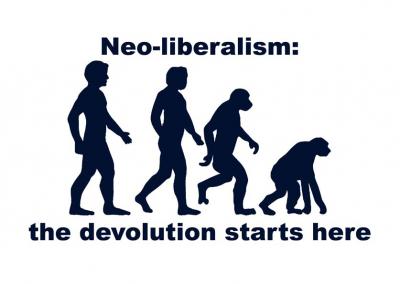
Neoliberalism Is Changing Our World Without Our Even Noticing

neo_liberalism_devolution_via_permanentculturenow.com_

Wendy Brown charts the ‘stealth revolution’ that’s transforming every aspect of society — and now has democracy in its sights.

By Hans Rollmann

Source: PopMatters

‘Neoliberalism’ is a much confused and maligned term these days. Progressive activists deploy it derisively as a general sort of derogatory label; learned professors write articles on the topic without really saying anything more penetrating. It’s as over-used an idiom as globalization (or as capitalism and socialism were 70 years ago). Even Anti-Flag take up the subject in their 2012 track “The Neoliberal Anthem”: “Strap in and watch the world decay!” they proclaim. Blunt, but not inaccurate.

Yet for all its confounded usages, what exactly does it signify?

In a 2013 review essay in the Los Angeles Review of Books that is more useful – if less straightforward – than Anti-Flag, Michael W. Clune described neoliberalism as “an economic doctrine that favors privatization, deregulation, and unfettered free markets over public institutions and government.” (”What Was Neoliberalism?”, 26 February 2013)

But it’s much more than that. Now, in Undoing the Demos: Neoliberalism’s Stealth Revolution, political theorist Wendy Brown contributes a truly useful text on an over-wrought topic, and one which focuses not only on the economic manifestations of neoliberalism, but on its broader effects on our political and social thinking. “Neoliberalism is a distinctive mode of reason, of the production of subjects, a ‘conduct of conduct,’ and a ‘scheme of valuation,’” she writes. It’s a mode of thinking, and the manner in which it emerges can be infinitely varied. We must be alert to neoliberalism’s “inconstancy and plasticity”, she warns, and its ability to reconfigure itself in new guises. Neoliberalism “takes diverse shapes and spawns diverse content and normative details, even different idioms. It is globally ubiquitous, yet disunified and nonidentical with itself in space and over time.” It’s a slippery beast, in other words – hard to define and even harder to see when it’s happening.

Brown’s work is an important and vital contribution at this time insofar as it takes aim at the beating heart of neoliberalism: its insinuation in the very institutions and identities which were hitherto used to limit its spread; institutions which, it was once hoped, would sustain deeper and more profound values implicit to democratic society and human sociality.

Brown is less interested than other scholars in the grim economics of neoliberalism: what she focuses on is its implicit threat to democracy. She opens her book by charting the emergence and contestation between ‘homo politicus’ and ‘homo oeconomicus’; between the human who uses politics to shape their world, and the human who is driven by self-interest and sees the world as always already shaped by economics. French philosopher Michel Foucault discussed this dichotomy in his 1978-79 College de France lectures on the Birth of Biopolitics, and Brown analyzes what Foucault saw – and failed to see – about this early emergence of neoliberal rationality.

In a superb if lamentably short section on gender she also discusses the question: “Does homo economicus have a gender? Does human capital? Is there a femina domestica invisibly striating or supplementing these figures…?” Her point is that “liberalism’s old gender problem is intensified by neoliberalism”, or that neoliberalism impacts women with particular vehemence.

Having discussed Foucault’s early charting of neoliberal political rationality, and expanded on his ideas in light of neoliberalism’s trajectory in the past 30 years, Brown analyzes some modern examples of neoliberalism’s diverse expressions. She looks at how it has insinuated itself in governance – in the notion of building consensus, rather than appreciating contestation; in the depoliticization of government; in the valorization of benchmarking and best practices. All of these deliver destructive blows against democratic political will, against the notion that humans can determine their own destiny and ought to shape their own reality. Instead of making their own decisions, governments appoint ‘external consultants’ to tell them what they should be doing; instead of inventing new ideas and ways of doing things, governments survey ‘best practices’ and see what everyone else is doing. It represents, in many ways, the triumph of mediocrity.

Neoliberal rationality infects law and legal reason, as well. Brown offers an in-depth analysis of the Citizens United case, which protected the right of corporations and the wealthy to dominate democratic elections in the US with their overwhelming power of capital. She also offers one of the best and most thorough analyses of how neoliberal rationality is destroying higher education: the post-WWII dream of an educated and equal society has been twisted into an economistic view, which holds that universities exist only to enhance capital; and that the purpose of an education is not to become better able to contribute to the broader political community, but rather to enhance one’s own ability to generate further capital.

Brown’s book is theoretical yet accessible; it’s an important and vital interjection which reveals and casts bare the neoliberal rationality that increasingly governs our world.

Dismantling Neoliberal Rationality

There’s an implicit warning in Brown’s text, which she addresses briefly but is worth some additional reflection. Audre Lorde famously cautioned against using the master’s tools to dismantle the master’s house, and increasingly this is precisely the direction in which efforts to limit the ravages of neoliberal thinking have turned, using economistic arguments in an effort to preserve institutions and principles that are premised on other-than-economistic values. Some examples serve to illustrate this.

In the ‘80s and ‘90s, public-private partnerships (P3’s) emerged as a neoliberal strategy transferring control and responsibility for public infrastructure – roads, bridges, hospitals, schools – into private hands. The basic argument held that the private sector, not beholden to political interests but rather to principles of efficiency and maximization of cost and utility, would prove more efficient custodians of public infrastructure. This neoliberal argument piggybacked nicely onto the drive to lower taxes. In an environment where lower taxes resulted in reduced state budgets, maximizing cost and efficiency would ensure public dollars stretched as far as possible.

This argument was received sympathetically by a public which had been worked up (by conservative pundits and politicians) into a collective sense of outrage over personal tax obligations and a sense of diminishing consumer power. It struck an affective chord, even though it was not based on any solid research. Yet P3’s became a dominant and accepted approach to building and maintaining public infrastructure and services.

In the past decade, efforts to fight back against public-private partnerships have achieved some limited success and have taken as their point of departure the fact that these partnerships are in fact not very efficient or effective. The private sector, it turns out, is often even more inefficient and ineffective than the public sector, given that it is driven by values such as greed and profit as opposed to public accountability. Analyses of several P3 projects have revealed massive cost over-runs, invariably subsidized by taxpayers to a cost far in excess of what it would have cost the state to produce the infrastructure on its own. (”The Problem with Public-Private Partnerships”, by Toby Sanger and Corina Crawley, CCPA, 1 April 2009) Contractual stipulations often guarantee corporate profits at public expense, requiring the state to assume all the risk, using public funds to rescue projects when private partners fail or walk away, and in some cases even using public funds to top-up corporate profits that fail to meet agreed-upon projections. (”Ontario Auditor breaks new ground with review of public private partnerships methodology”, by Keith Reynolds, Policy Note, 5 January 2015)

All this is true, and revealing the truly ineffective and inefficient nature of P3s has been critical to turning them back in many cases. However, there’s a problem with this. These campaigns against P3s adopt the same economistic principles as were used to promote the notion of P3s in the first place: namely, that efficiency, cost maximization and capital enhancement ought to be the driving principles of the demos, or public state. The implicit argument is that P3s are wrong not because they transfer public ownership into private hands, but because they do so inefficiently and at the expense of the taxpayer. Granted, there is often a reference to P3s being ‘unaccountable’ to the public, but this is rarely interrogated or explored as deeply as it should be. In fact, it ought to lie at the core of public resistance to P3s. Public-private partnerships are wrong simply because the state ought never to allow public goods to fall under private control, even if it might save more money. Economization ought never to hold sway over the values, principles and political power of the public.

Similarly, neoliberal logic has infected other efforts to fight back against neoliberal initiatives. Labour unions – a common target of neoliberalism—are increasingly defended on the basis that they benefit the economy (through ensuring consistent and safe workplace practices as well as strong wages to bolster consumer spending in the community), rather than on the simpler basis that workers deserve the right to control their working conditions. Efforts to reduce tuition fees for out-of-province/state or international students are often predicated on the notion that their economic contribution to the local economy exceeds the value of their fiscal contribution to the university through tuition fees. Nowhere – or rarely – is the argument presented that post-secondary ought to be a public good and universal right in and of itself.

The danger, in other words, is that efforts to resist neoliberalism are increasingly being expressed in such a way that they serve to entrench and legitimize neoliberal values – economization, efficiency, capital enhancement—rather than questioning or challenging the desirability and social and political consequences of those values in the first place.

Brown acknowledges the urgency of the problem. It’s quite possible, she observes, for neoliberal economic policy to be paused or reversed but for “the deleterious effects of neoliberal reason on democracy” to survive, undermining the potential for substantive, entrenched change. Without tackling neoliberal reason, neoliberal economics and governance will inevitably emerge again. It is the ongoing sense of surrender to the inevitability of economics; of the bottom line; of finance as key determiner of what is politically possible, that dooms the political potential of democracy. Although only emerging at the end of the book, this is one of the key lessons it offers: that efforts to resist or reverse the ravages of neoliberal economics are fatally flawed when “NGOs, nonprofits, schools, neighborhood organizations, and even social movements that understand themselves as opposing neoliberal economic policies may nonetheless be organized by neoliberal rationality.”

Fascism’s Forbidden Face

Brown comes close to a forbidden truth in closing. She notes, with great delicacy and hesitation, the similarities between neoliberal rationality and fascism. “This is not to say that neoliberalism is fascism or that we live in fascist times,” comes the inevitable caveat. But what if it is an emerging form of fascism?

One of the troubling trends that’s emerged in recent decades and needs to be challenged more forcefully is the notion that it’s intellectually taboo, inaccurate or excessive to call something ‘fascist’, or to draw analogies to fascist states like Nazi Germany. An example of this taboo is ‘Godwin’s Law’ – the notion that referring to Hitler (or by extension, fascism broadly) destroys the credibility of your argument. It’s a trendy term, but intellectually dangerous. The fact is, fascism was – and is – very real, and the notion that no one should talk about fascism as seriously emerging in the present day is very much a product of our neoliberal era.

In fact we do need to talk about it. The skepticism with which the term ‘fascism’ is treated; the dismissal of arguments which make reference to Nazis, all collaborate in erasing and masking the very real resemblances that exist between historical fascism and contemporary forms of governance like neoliberalism. In its demand for self-sacrifice to the heartless whole – a demand iterated, for instance, in the sacrifice of millions of homeowners and mortgage defaulters in order to save the banks during the subprime mortgage crisis – neoliberal rationality resembles the demand for citizen self-sacrifice that characterized fascism.

George Orwell (in his remarkable book review of Adolf Hitler’s Mein Kampf) warned against underrating the emotional appeal of fascism. While socialism and even capitalism offered a vision of the good life – fewer working-hours, health and education, leisure and pleasure – people appear inevitably lured by the attraction of struggle and self-sacrifice. “Whereas Socialism, and even capitalism in a more grudging way, have said to people ‘I offer you a good time,’ Hitler has said to them ‘I offer you struggle, danger and death,’ and as a result a whole nation flings itself at his feet,” he wrote. The same could easily be said of neoliberalism: people have a remarkable knack of voting for economic tough-guys who promise to make life harder on individuals and communities in order to ‘save the economy’, whatever that’s supposed to mean.

Brown’s book is essential reading not only for academics but for anyone concerned with our collective political future, and with the defense of democratic politics. Her book ends on a grim note: “Despair” is the title of its final section. Brown has eloquently elucidated the problem, and made a profound contribution to understanding the complex nature of neoliberal rationality and its threat to democracy.

So what is the solution? Brown doesn’t have one, but notes there is no alternative but to keep struggling to find an alternative. We have reached a state of “civilizational despair”, she writes; modernism is dead and with it the hope and belief that we can create a better world. How do we counter this despair, and re-inject hope and alternatives into the world? Such a task “is incalculably difficult, bears no immediate reward, and carries no guarantee of success. Yet what, apart from this work, could afford the slightest hope for a just, sustainable, and habitable future?”


Hans Rollmann is a writer and editor based in Eastern Canada. He’s a columnist, writer and opinions editor with the online news magazine TheIndependent.ca as well as editor of Landwash, a journal of literary and creative arts published out of Newfoundland and Labrador. His work has appeared in a range of other publications both print and online, from Briarpatch Magazine to Feral Feminisms. In addition to a background in radio-broadcasting, union organizing and archaeology, he’s currently completing a PhD in Gender, Feminist & Women’s Studies in Toronto. He can be reached by email at hansnf@gmail.com or @hansnf on Twitter.