
Wu Wei, Flow States and the Art of Being a Lazy Fuck

hammock

By Mr. Furious

Source: Disinformation

“…It is when we act freely, for the sake of the action itself rather than for ulterior motives, that we learn to become more than what we were.”

“The psychic entropy peculiar to the human condition involves seeing more to do than one can actually accomplish and feeling able to accomplish more than what conditions allow.”

― Mihaly Csikszentmihalyi, Flow: The Psychology of Optimal Experience

I visibly waffled on several occasions when attempting to begin this article. Literally. I sat down on the couch with my laptop, ready to begin the process of typing this stupid, god-forsaken thing, and I physically shuddered. Each time. And, each time, Missus Furious would gaze at me cock-eyed and ask what the fuck my problem was.

“Nothing,” I’d mumble. “Nothing at all.”

“Ok?” She’d say, skeptically. “But why do you keep doing that?”

“Doing what?”

“Having seizures or whatever it is you’re doing over there. Are you alright?”

“I don’t know what you’re talking about.”

“YOU KEEP SHAKING.”

At that point I just shrugged and shook my head as if she were crazy.

This is what it’s like living with someone as mercilessly moronic as myself.

Anyhow, I did have several episodes of trembling. For a couple of reasons.

• • •

One: The thought of having to type Mihaly Csikszentmihaly’s name a half-dozen or so times made me ill. This sounds like such a minor inconvenience that I must be making it up. But I’m not. You’re reading the work of the type of person who, when trying to watch Rey Mysterio highlights on youtube and an ad pops up, and the button in the corner of the ad says “you can skip this ad in 13 seconds,” I usually just close up the entire browser, get off the computer and go make peanut butter sandwiches or something, instead of waiting the 13 seconds.

Two: There are enough subtleties and nuances to both Csikszentmihalyi’s ideas and my own arguments, that I’m worried a fair number of potential readers are going to miss them. And, as a writer, I feel that if people misunderstand and/or don’t fully comprehend what is going on, it’s my fault, not the reader’s. So I spend an inordinate and irrational amount of time in the midsts of a neurotic episode because I’m convinced I’m not a good enough writer (or thinker) to make some of my ideas clear.

Regardless of how I feel—and regardless of my concerns—here I am. And since I’ve already buried the lede this far, let me just come out and tell you what my thesis is for the rest of the article: that so-called “flow” states are much more easily accessed—and most commonly experienced—when one is being a lazy fuck.

• • •

First off, even though Csikszentmihalyi’s concept of Flow is one of the most popular and discussed ideas produced by psychology in the past 50 years or so, not everybody’s familiar with it. So we have to at least touch on what Flow is. Csikszentmihalyi himself describes the experience of flow as consisting of 6 components, which are:

  1. Intense and focused concentration on the present moment
  2. Merging of action and awareness
  3. A loss of reflective self-consciousness
  4. A sense of personal control or agency over the situation or activity
  5. A distortion of temporal experience, one’s subjective experience of time is altered
  6. Experience of the activity as intrinsically rewarding, also referred to as autotelic experience

All of which sounds incredibly reasonable and probably accurate. My issue is really with how Csikszentmihalyi argues we induce flow states, mostly because Csikszentmihalyi spends a good portion of the his book on the topic—inconceivably entitled Flow: The Psychology of Optimal Experience—discussing his belief that Flow experiences must be stimulated by activities that provide just the right amount of challenge, i.e. not challenging to the point of making one frustrated, but not so devoid of challenge that one finds the activity boring.

Again, this assertion sounds rather reasonable. And it is. But Csikszentmihalyi then expounds on that idea to insist that one cannot be in a passive or lazy mind if one hopes to initiate states of Flow.

He states:

“Contrary to what we usually believe, moments like these, the best moments in our lives, are not the passive, receptive, relaxing times—although such experiences can also be enjoyable, if we have worked hard to attain them. The best moments usually occur when a person’s body or mind is stretched to its limits in a voluntary effort to accomplish something difficult and worthwhile.” (emphasis mine)

He gives, as support to this idea, the example of a European woman who is a scholar and business magnate. She constantly travels, owns a number of homes around the world, is ceaselessly attending business meetings or conferences or concerts. She is so busy and opposed to leisure time that she expects her chauffeur to attend the local art museums in whatever town she finds herself in and give her a run-down of sorts on how the art museum was. To me she sounds insufferable and her life sounds exhausting. The importance of discussing this concept of Flow, as even Csikszentmihalyi admits, is that Flow states are supposed to make us happy. The inability to sit still and enjoy life for being life doesn’t sound like happiness to me. It sounds like distraction.

Either way, the philosopher and author Ed Slingerland agrees. In his book, Trying Not to Try, he takes the concept of Flow and expands and—in my opinion—improves on Csikszentmihalyi’s ideas. Slingerland makes the connection between Flow states and the Chinese philosophical concept of Wu Wei. Wu Wei is typically translated (with numerous, but less influential, exceptions) as “non-action,” “non-doing,” or “actionless action.” There is not really an English equivalent. Anyhow, Slingerland makes a rather convincing argument that Flow states are essentially states of Wu Wei.

This is important, because—even though I disagree with a number of assertions in Slingerland’s book—Slingerland is able to recognize that it’s not effort that is necessary to initiate episodes of Flow, it is a lack of effort that activates such states. Hence the title his book, Trying Not to Try.

Slingerland, though, still has his own aversion to coming out and saying that it’s a certain kind of laziness that induces Flow/Wu Wei states. Most writers who attempt to expound on the concept of Wu Wei exhibit this bizarre anxiety.

• • •

I’ve already written a bit about the virtues of laziness, and I want to emphasize that there’s a big difference between boredom and laziness, two concepts which I think a lot of people conflate. I also want to reiterate a major point from that initial essay of mine, which is: that a healthy laziness (as opposed to an unhealthy laziness, which does exist) is merely the spontaneous act of doing whatever seems most enjoyable to a person at a given moment. For example, a few people I know insist that I’m not lazy because I work 50-plus hours each week and yet I still find time to write and work-out and such things. But I genuinely enjoy writing and exercise. And typically when I am engaging in such activities, I am doing so at times when they’re so enjoyable that they are not taking much actual effort to complete. My 50 hours of work each week are really the only parts of my life that take any kind of effort — well, that and when my wife puts me to work doing some kind of tedious work around the house (for me, although many people like DIY projects). The opposite of laziness is “working hard.” But I think work only becomes hard when we’re not interested in doing it. I have to work hard at work because there are literally thousands of other things I’d rather spend my life doing.

This is my definition of laziness: the doing of things that are enjoyable at times when they are enjoyable. There were times when I was in school that writing was not enjoyable and was full of effort. Even in my series of essays for Disinfo, I believe a keen (or maybe not so keen in some instances) eye can spot those essays that weren’t all that enjoyable to write. They’re full of real effort. I’m the rare writer who believes that one should only write when inspired, and the fact that so many writers force themselves to write is why I find so many novels so unreadable.

All of which is sort of besides the point. The main idea here is that a healthy laziness is being spontaneous and doing enjoyable things at times when they are enjoyable. Sometimes activities we find to be enjoyable aren’t going to be enjoyable (for any of a myriad of reasons) and we shouldn’t do those usually enjoyable things at those times.

If we follow this advice, I believe we will find ourselves to be more often in states of Flow/Wu Wei. I know this is true for me when I write when I feel like writing, when I work-out when I feel like working out, when I socialize when I feel like socializing. I have Flow/Wu Wei watering my garden in cool summer evenings. I have felt it drinking green tea under a full moon while sitting on a rocking chair in my backyard. I have felt it on long walks after work with Missus Furious. I have even felt it lying on the couch and staring at the ceiling while daydreaming about being interviewed by Charlie Rose or about being able to eventually, one day, do a one-armed pull-up. And so on.

Most of those activities don’t meet Csikszentmihalyi’s requirement that flow states must present some kind of challenge, nor did I have to work hard to attain any of those states, contrary to his assertions. Believe me, for example, when I say that it literally takes no effort to imagine one’s self explaining pretentiously to Charlie Rose why one’s novel about drunk college kids puking on each other is really an analog for certain aspects of Taoist philosophy.

What those activities did meet, though, were my requirements: activities should be done when they feel enjoyable to do so.

• • •

Both Csikszentmihalyi and Slingerland recognized that Flow/Wu Wei states are instigated when we are doing things for their own sake. When we sew because we like the act of sewing, not because we’re all that interested in making a beautiful dress. When we cook because we enjoy the process of cooking, not because we’re all that interested in the resulting meal. When we play basketball not because we really want to win, but because playing basketball is fun.

The results of such activities may be rewarding too. Creating a beautiful dress, eating a tasty meal, and winning a basketball game certainly feel good. But there’s a difference, say, between Michael Jordan, who played basketball to feed his own ego, and a person who plays basketball because the activity of playing basketball is enjoyable in and of itself, regardless of outcome. Primarily, Michael Jordan’s efforts were effortful, whereas the other person’s was actually an act of spontaneity, or laziness, as I define it. And if you need proof that one form of playing basketball is superior to the other, all you need to do is look at Jordan or, say, Kobe Bryant, and observe how happy or fulfilled those two are, despite their numerous championships and accomplishments in the sport of basketball.

What Slingerland and Csikszentmihalyi neglect, though, is that the only way to do something for its own sake is to not give a shit about it, at least in the traditional ways we give a shit about things. What I’m talking about is being apathetic about results. If we don’t care about winning the basketball game, then our attention is focused only the joys of playing the game itself. If we’re not concerned about results, then we can focus on the joys of the process, which is where we can be lazy and in which we make ourselves available to Flow/Wu-Wei.

Note: It is inherent in the word “Flow” that a process is occurring. A river cannot flow, for example, once it has reached its end result of entering the ocean or of having been dried up. One can flow making a hamburger or eating a hamburger, but one cannot flow when the hamburger is simply sitting on the plate after the process of having been made, or when it is done being consumed. One can flow playing a game of basketball, but not when one has finished playing and has “won” or “lost” the game. One can flow when sewing a dress, but not when the dress is completed. If this is true for sewing and cooking and playing basketball, how much truer is it for the act (the process) of living life itself?

For if we work too hard, place too much effort in a search for results, instead of simply living life for life’s sake, we close ourselves off from opportunities for experiencing Flow/Wu Wei. And when we spend our lives struggling, striving, working, being effortful for some sort of ultimately meaningless result, we miss all that is enjoyable and worth experiencing… except when we’re in the mood to be effortful.

I’ll end this thing with a long-ish quote from Chuang Tzu via Slingerland that sums all of this up–even though Slingerland doesn’t seem to realize the depth and profundity of just what Chuang Tzu was saying, for Slingerland doesn’t quite recognize the connection between “spontaneity” and “laziness.”

Per Chuang Tzu:

When people are asleep, their spirits wander off; when they are awake, their bodies are like an open door, so that everything they touch becomes an entanglement. Day after day they use their minds to stir up trouble; they become boastful, sneaky, secretive. They are consumed with anxiety over trivial matters but remain arrogantly oblivious to the things truly worth fearing. Their words fly from their mouths like crossbow bolts, so sure are they that they know right from wrong. They cling to their positions as though they had sworn an oath, so sure are they of victory. Their gradual decline is like autumn fading into winter—this is how they dwindle day by day. They drown in what they do—you cannot make them turn back. They begin to suffocate, as though sealed up in a box—this is how they decline into senility. And as their minds approach death, nothing can cause them to turn back toward the light.

– See more at: http://disinfo.com/2015/05/wu-wei-flow-states-art-lazy-fuck/#sthash.g96cFrtS.dpuf

Saturday Matinee: Tribulation 99

movie_259187

Synopsis from Other Cinema:

Upon its release in 1991, Tribulation 99 became an instant counter-culture classic. Craig Baldwin‘s “pseudo-pseudo-documentary” presents a factual chronicle of US intervention in Latin America in the form of the ultimate far-right conspiracy theory, combining covert action, environmental catastrophe, space aliens, cattle mutilations, killer bees, religious prophecy, doomsday diatribes, and just about every other crackpot theory broadcast through the dentures of the modern paranoiac.

A delirious vortex of hard truths, deadpan irony, and archival mash-ups—industrials, graphs, cartoons, movies from Hollywood B to Mexican Z—Tribulation 99 constructs a truly perverse vision of American imperialism.

https://vimeo.com/36739141

They Live, We Sleep: A Dictatorship Disguised as a Democracy

leadtheylive1

By John W. Whitehead

Source: The Rutherford Institute

“You see them on the street. You watch them on TV. You might even vote for one this fall. You think they’re people just like you. You’re wrong. Dead wrong.”—They Live

We’re living in two worlds, you and I.

There’s the world we see (or are made to see) and then there’s the one we sense (and occasionally catch a glimpse of), the latter of which is a far cry from the propaganda-driven reality manufactured by the government and its corporate sponsors, including the media.

Indeed, what most Americans perceive as life in America—privileged, progressive and free—is a far cry from reality, where economic inequality is growing, real agendas and real power are buried beneath layers of Orwellian doublespeak and corporate obfuscation, and “freedom,” such that it is, is meted out in small, legalistic doses by militarized police armed to the teeth.

All is not as it seems.

This is the premise of John Carpenter’s film They Live (1988), in which two migrant workers discover that the world’s population is actually being controlled and exploited by aliens working in partnership with an oligarchic elite. All the while, the populace—blissfully unaware of the real agenda at work in their lives—has been lulled into complacency, indoctrinated into compliance, bombarded with media distractions, and hypnotized by subliminal messages beamed out of television and various electronic devices, billboards and the like.

It is only when homeless drifter John Nada (played to the hilt by the late Roddy Piper) discovers a pair of doctored sunglasses—Hoffman lenses—that Nada sees what lies beneath the elite’s fabricated reality: control and bondage.

When viewed through the lens of truth, the elite, who appear human until stripped of their disguises, are shown to be monsters who have enslaved the citizenry in order to prey on them. Likewise, billboards blare out hidden, authoritative messages: a bikini-clad woman in one ad is actually ordering viewers to “MARRY AND REPRODUCE.” Magazine racks scream “CONSUME” and “OBEY.” A wad of dollar bills in a vendor’s hand proclaims, “THIS IS YOUR GOD.”

When viewed through Nada’s Hoffman lenses, some of the other hidden messages being drummed into the people’s subconscious include: NO INDEPENDENT THOUGHT, CONFORM, SUBMIT, STAY ASLEEP, BUY, WATCH TV, NO IMAGINATION, and DO NOT QUESTION AUTHORITY.

This indoctrination campaign engineered by the elite in They Live is painfully familiar to anyone who has studied the decline of American culture. A citizenry that does not think for themselves, obeys without question, is submissive, does not challenge authority, does not think outside the box, and is content to sit back and be entertained is a citizenry that can be easily controlled.

In this way, the subtle message of They Live provides an apt analogy of our own distorted vision of life in the American police state, what philosopher Slavoj Žižek refers to as dictatorship in democracy, “the invisible order which sustains your apparent freedom.”

We’re being fed a series of carefully contrived fictions that bear no resemblance to reality. The powers-that-be want us to feel threatened by forces beyond our control (terrorists, shooters, bombers). They want us afraid and dependent on the government and its militarized armies for our safety and well-being. They want us distrustful of each other, divided by our prejudices, and at each other’s throats. Most of all, they want us to continue to march in lockstep with their dictates.

Tune out the government’s attempts to distract, divert and befuddle us and tune into what’s really going on in this country, and you’ll run headlong into an unmistakable, unpalatable truth: the moneyed elite who rule us view us as expendable resources to be used, abused and discarded.

In fact, a 2014 study conducted by Princeton and Northwestern University concluded that the U.S. government does not represent the majority of American citizens. Instead, the study found that the government is ruled by the rich and powerful, or the so-called “economic elite.” Moreover, the researchers concluded that policies enacted by this governmental elite nearly always favor special interests and lobbying groups.

In other words, we are being ruled by an oligarchy disguised as a democracy, and arguably on our way towards fascism—a form of government where private corporate interests rule, money calls the shots, and the people are seen as mere subjects to be controlled.

Consider this: it is estimated that the 2016 presidential election could cost as much as $5 billion, more than double what was spent getting Obama re-elected in 2012.

Not only do you have to be rich—or beholden to the rich—to get elected these days, but getting elected is also a surefire way to get rich. As CBS News reports, “Once in office, members of Congress enjoy access to connections and information they can use to increase their wealth, in ways that are unparalleled in the private sector. And once politicians leave office, their connections allow them to profit even further.”

In denouncing this blatant corruption of America’s political system, former president Jimmy Carter blasted the process of getting elected—to the White House, governor’s mansion, Congress or state legislatures—as “unlimited political bribery… a subversion of our political system as a payoff to major contributors, who want and expect, and sometimes get, favors for themselves after the election is over.”

Rest assured that when and if fascism finally takes hold in America, the basic forms of government will remain. As I point out in my book Battlefield America: The War on the American People, fascism will appear to be friendly. The legislators will be in session. There will be elections, and the news media will continue to cover the entertainment and political trivia. Consent of the governed, however, will no longer apply. Actual control will have finally passed to the oligarchic elite controlling the government behind the scenes.

By creating the illusion that it preserves democratic traditions, fascism creeps slowly until it consumes the political system. And in times of “crisis,” expediency is upheld as the central principle—that is, in order to keep us safe and secure, the government must militarize the police, strip us of basic constitutional rights, criminalize virtually every form of behavior, and build enough private prisons to house all of us nonviolent criminals.

Clearly, we are now ruled by an oligarchic elite of governmental and corporate interests. We have moved into “corporatism” (favored by Benito Mussolini), which is a halfway point on the road to full-blown fascism.

Vast sectors of the economy, government and politics are managed by private business concerns, otherwise referred to as “privatization” by various government politicians. Just study modern government policies. “Every industry is regulated. Every profession is classified and organized,” writes economic analyst Jeffrey Tucker. “Every good or service is taxed. Endless debt accumulation is preserved. Immense doesn’t begin to describe the bureaucracy. Military preparedness never stops, and war with some evil foreign foe, remains a daily prospect.”

In other words, the government in America today does whatever it wants.

Corporatism is where the few moneyed interests—not elected by the citizenry—rule over the many. In this way, it is not a democracy or a republican form of government, which is what the American government was established to be. It is a top-down form of government and one which has a terrifying history typified by the developments that occurred in totalitarian regimes of the past: police states where everyone is watched and spied on, rounded up for minor infractions by government agents, placed under police control, and placed in detention (a.k.a. concentration) camps.

For the final hammer of fascism to fall, it will require the most crucial ingredient: the majority of the people will have to agree that it’s not only expedient but necessary. But why would a people agree to such an oppressive regime? The answer is the same in every age: fear.

Fear makes people stupid.

Fear is the method most often used by politicians to increase the power of government. And, as most social commentators recognize, an atmosphere of fear permeates modern America: fear of terrorism, fear of the police, fear of our neighbors and so on.

The propaganda of fear has been used quite effectively by those who want to gain control, and it is working on the American populace.

Despite the fact that we are 17,600 times more likely to die from heart disease than from a terrorist attack; 11,000 times more likely to die from an airplane accident than from a terrorist plot involving an airplane; 1,048 times more likely to die from a car accident than a terrorist attack, and 8 times more likely to be killed by a police officer than by a terrorist, we have handed over control of our lives to government officials who treat us as a means to an end—the source of money and power.

We have allowed ourselves to become fearful, controlled, pacified zombies.

In this regard, we’re not so different from the oppressed citizens in They Live. Most everyone keeps their heads down these days while staring zombie-like into an electronic screen, even when they’re crossing the street. Families sit in restaurants with their heads down, separated by their screen devices and unaware of what’s going on around them. Young people especially seem dominated by the devices they hold in their hands, oblivious to the fact that they can simply push a button, turn the thing off and walk away.

Indeed, there is no larger group activity than that connected with those who watch screens—that is, television, lap tops, personal computers, cell phones and so on. In fact, a Nielsen study reports that American screen viewing is at an all-time high. For example, the average American watches approximately 151 hours of television per month.

The question, of course, is what effect does such screen consumption have on one’s mind?

Psychologically it is similar to drug addiction. Researchers found that “almost immediately after turning on the TV, subjects reported feeling more relaxed, and because this occurs so quickly and the tension returns so rapidly after the TV is turned off, people are conditioned to associate TV viewing with a lack of tension.” Research also shows that regardless of the programming, viewers’ brain waves slow down, thus transforming them into a more passive, nonresistant state.

Historically, television has been used by those in authority to quiet discontent and pacify disruptive people. “Faced with severe overcrowding and limited budgets for rehabilitation and counseling, more and more prison officials are using TV to keep inmates quiet,” according to Newsweek.

Given that the majority of what Americans watch on television is provided through channels controlled by six mega corporations, what we watch is now controlled by a corporate elite and, if that elite needs to foster a particular viewpoint or pacify its viewers, it can do so on a large scale.

If we’re watching, we’re not doing.

The powers-that-be understand this. As television journalist Edward R. Murrow warned in a 1958 speech:

We are currently wealthy, fat, comfortable and complacent. We have currently a built-in allergy to unpleasant or disturbing information. Our mass media reflect this. But unless we get up off our fat surpluses and recognize that television in the main is being used to distract, delude, amuse, and insulate us, then television and those who finance it, those who look at it, and those who work at it, may see a totally different picture too late.

This brings me back to They Live, in which the real zombies are not the aliens calling the shots but the populace who are content to remain controlled.

When all is said and done, the world of They Live is not so different from our own. As one of the characters points out, “The poor and the underclass are growing. Racial justice and human rights are nonexistent. They have created a repressive society and we are their unwitting accomplices. Their intention to rule rests with the annihilation of consciousness. We have been lulled into a trance. They have made us indifferent to ourselves, to others. We are focused only on our own gain.”

We, too, are focused only on our own pleasures, prejudices and gains. Our poor and underclasses are also growing. Racial injustice is growing. Human rights is nearly nonexistent. We too have been lulled into a trance, indifferent to others.

Oblivious to what lies ahead, we’ve been manipulated into believing that if we continue to consume, obey, and have faith, things will work out. But that’s never been true of emerging regimes. And by the time we feel the hammer coming down upon us, it will be too late.

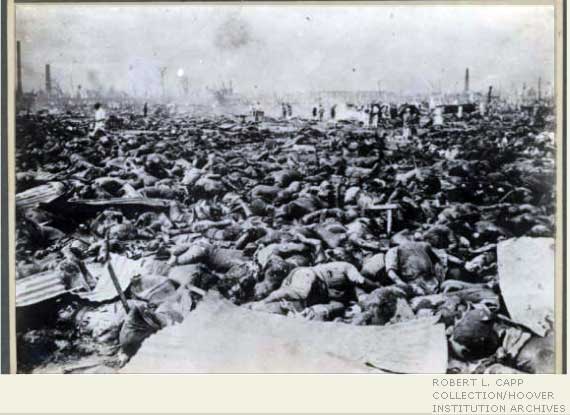
America’s Barbaric Logic of Hiroshima 70 Years On

Hiroshima_Capp

By Finnian Cunningham

Source: Strategic Culture Foundation

Even if we accept that there was a plausible military imperative to drop the atomic bombs on Hiroshima and Nagasaki – to bring about a swift defeat of Japan and thus an end to the Pacific War – the horror of civilian death toll from those two no-warning aerial attacks places a disturbing question over the supposed ends justifying the means.

But what if the official military rationale touted by US President Harry Truman and his administration turns out to be bogus? That is, the real reason for dropping the A-bombs on Hiroshima and Nagasaki 70 years ago on August 6 and 9, 1945, had little to do with defeating imperial Japan and saving the lives of American troops. What if the real reason was the deliberate and cold-blooded demonstration of raw military power by Washington in order to warn the Soviet Union of America’s postwar demarcation of global hegemony?

That leads to the most chilling conclusion – a conclusion far worse than the official American narrative would have us believe. For it means that the act of obliterating up to 200,000 Japanese civilians was an event of premeditated mass murder whose intent was solely political. Or, in other words, an ineffable act of state terrorism committed by the United States.

This conjecture about the ulterior motive for the American atomic bombing of Japan has been around for many years. In January 1995, the New York Times reported: «Indeed, some historians contend that the bombing was not aimed so much at the wartime enemy Japan as at the wartime ally Soviet Union, delivered as a warning against postwar rivalry».

With complacent equivocation, the New York Times did not follow through on the horrendous implications of its own partial admission for why the atomic bombs were dropped. If the official US calculation was indeed «a warning against postwar rivalry» to the Soviet Union, then that makes the act an indefensible political decision that had nothing to do with a moral imperative of promptly ending a war. It was, as noted, a supreme act of terrorism.

Professsor Gar Alperovitz – one of several American historians – has over the decades compiled a compelling case that the Truman administration did in fact make the decision to use the A-bombs as a political weapon against the Soviet Union.

The author of ‘The Decision to Use the Atomic Bomb’ wrote: «Though most Americans are unaware of the fact, increasing numbers of historians now recognise that the United States did not need to use the atomic bomb to end the war against Japan in 1945. Moreover, this essential judgment was expressed by the vast majority of top American military leaders in all three services in the years after the war ended: Army, Navy and Army Air Force».

Alperovitz cites then US Secretary of War Henry L Stimson and such military luminaries as General Dwight Eisenhower and Joint Chiefs of Staff Admiral William D Leahy who were explicitly opposed to using the A-bomb on Japan. Eisenhower said it was»completely unnecessary» while Leahy noted: «The use of this barbarous weapon at Hiroshima and Nagasaki was of no material assistance in our war against Japan. The Japanese were already defeated and ready to surrender».

This points to covert political decision-making during the critical three-week period between the Potsdam conference (July 17-August 2 1945) and the dropping of the A-bombs on Japan. During that period it appears that Truman and his aides decided in secret that the then Soviet wartime ally was to be henceforth made the postwar enemy. The Cold War was being formulated.

Bear in mind that for months before Potsdam, the US and Britain were appealing to Russian leader Josef Stalin to join the Pacific War soon after the defeat of Nazi Germany. Two months after the Third Reich was vanquished in May 1945, the Potsdam conference between the Big Three allies achieved the much-anticipated commitment from Stalin to redeploy the Red Army against Japan. The Soviet Union was scheduled to officially enter the Pacific War on August 15. As it turned out, Stalin ordered the Red Army into Manchuria on August 8, a week ahead of the scheduled offensive.

As Harry Truman gleefully wrote in a private letter during Potsdam this commitment from the Soviet Union meant that «the Japs were finished».

However, the successful testing of the first A-bomb by the United States in the desert of New Mexico on July 16 – only the day before begining the Potsdam summit – was a point of no return. With this awesome new weapon, US planners must have quickly realised that they could finish the war against Japan without the Soviet Union entering the Pacific theatre, by dropping the A-bomb.

But the primary US objective wasn’t to finish the Pacific War per se. American and British military chiefs and intelligence were convinced that the mere entry of Russia into the war against Japan would precipitate the latter’s surrender. And besides the American invasion of mainland Japan was not planned to take place until November 1945.

It seems clear then that the Truman administration rushed ahead to use its new atomic weapon on Japan because its concern was to circumscribe any advance by the Soviet Union in Asia-Pacific. Not only was the Red Army poised to take Manchuria and the Korean Peninsula but mainland Japan as well.

Hiroshima and Nagasaki – two civilian centres of no military value – were thus selected as the venues for demonstrating the most spellbinding act of terror, not to an all but defeated Japan, but to the Soviet Union. The atomic bombing of Japan was therefore not the last act of the Pacific War, as the official American narrative contends, but rather it was the first, brutal act of the nascent Cold War by the US towards Soviet Russia.

That puts the horrific events in an altogether different criminal light. Because the atomic bombings can then be seen as a deliberate act of mass murder for no other strategic reason other than to intimidate a perceived geopolitical rival – Moscow.

Seventy years on, history proves that this barbaric logic of the US ruling elite still holds. After the official end of the Cold War nearly a quarter of a century ago, Washington has evidently no intention of disarming its nuclear arsenal. In fact, the US government under President Barack Obama is planning to spend $355 billion over the next decade to upgrade its stockpile of some 5,000 nuclear warheads – each many times more powerful than the A-bombs that were originally dropped on Japan.

Furthermore, Washington has offiicially declared Russia, along with China, as its top strategic enemy, as recent as this month, according to senior Pentagon figures.

The unilateral withdrawal by the US from the Anti-Ballistic Missiles Treaty in 2002 and the ongoing expansion of US missile systems on Russia’s borders and in the Pacific with provocative reference to China are testimony to the inherent bellicose intent that resides in Washington.

As with the first and only use of nuclear weapons 70 years ago, the US logic that led to the holocaust at Hiroshima and Nagasaki is a barbaric logic than pertains to this day. It is still being aimed at Russia, as it was seven decades ago.

Only the full exposure and eradication of this uniquely American barbaric logic will lead to peaceful international relations.

5 Reasons Why Anarchy Would be an Improvement in Human Governance

goldman-quote

By Gary ‘Z’ McGee

Source: Waking Times

“Give a man a gun and he’ll rob a bank. Give a man a bank and he’ll rob the world.” –Unknown

Give people just a little bit of knowledge and courage and they will track down those greedy-ass bankers and hold them accountable. All we need is just a little courageous anarchy. The problem, the crux, the fly in the ointment: most people are not courageous enough, and most people don’t want to learn anything that attacks their all-too-precious worldview. Yes, the very worldview that is keeping people indebted to an immoral, unhealthy, unsustainable, unjust system of human governance, is precisely the worldview that the majority of people are clinging to. Indeed, most people, even though they would probably say otherwise, would rather be kissed with a lie than slapped with the truth. They would rather deny facts that tarnish their worldview than reject the deceit that upholds it. But as Martin Luther King, Jr. said, “Human progress is neither automatic nor inevitable. Every step toward the goal of justice requires sacrifice, suffering, and struggle; the tireless exertions and passionate concern of dedicated individuals.”

Healthy human evolution requires authentic vigilance. It requires a consistent upheaval of the status quo. This requires proactive human beings who are willing to be authentically vigilant and consistently rebellious. It requires courageous interdependent individuals who dare to recondition the status-quo-junky original condition. It turns out that the wisdom gained from anarchy is precisely the ability to distinguish between sacrifice that is transformative and healthy from mere suffering caused by the state that we’ve allowed because we were too cowardly or too unimaginative to think of a healthier way to live. Like Stefan Molyneux said, “Never, ever underestimate the degree to which people will scatter themselves into a deep fog in order to avoid seeing the basic realities of their own cages. The strongest lock on the prison is always avoidance, not force.”

Here are five reasons why anarchy will improve human governance and thereby cultivate a healthy human evolution.

1.) It Has Inherent Checks and Balances

“Failure shows us the way –by showing us what isn’t the way.” –Ryan Holiday

This one alone is reason enough to give anarchy a try again. The other four are just icing on the cake. I say “again” because human beings lived in hunter-gatherer groups that were characterized by what anthropologists call Fierce Egalitarian Anarchy. They not only shared things, they demanded that things be shared: meat, shelter, and protection… this was simply the best way to mitigate risk in a survival context in a world with limited resources.

Fierce egalitarianism and primal politics (tribal anarchy) worked exceptionally well for the human race for 95% of our existence on this planet. Indeed, it’s one of the only reasons why we’ve survived as long as we have.

In an amazing game theory study by Duéñez-Guzmán-Sadedin on the topic of police corruption, they concluded that once a police system becomes entrenched, nothing can stop it from eventually becoming corrupt, with the result being a population of gullible sheep and hypocritical overlords. But they didn’t stop the study there. They decided to tweak it ever so slightly. In the words of Suzanne Sadedin: “The results were startling. By making a few alterations to the composition of the justice system, corrupt societies could be made to transition to a state called ‘righteousness’. In righteous societies, police were not a separate, elite order. They were everybody. When virtually all of society stood ready to defend the common good, corruption didn’t pay. Similarly, as it turns out, social norms in hunter-gatherer societies are enforced by the whole group rather than any specially empowered individuals.”

This is a critical aspect of anarchy: that everyone is free to be as moral, or as amoral, as they need to be in order to maintain a healthy cosmic, ecological, and social order. Freedom is primary. Health is secondary. Understanding how everything is connected is third. And immorality is not tolerated.

The monumental problem with our Statist society is that we are not taught to be as moral or as amoral as we need to be in order to maintain a healthy cosmic, ecological, and social order. In fact, statism purposefully forces whatever the state decrees to be healthy, as healthy, whether or not it is actually healthy according to cosmic law. This creates an exorbitant amount of problems.

2.) It Would Nullify Debt Slavery and Eliminate Poverty

“When plunder becomes a way of life for a group of men living in a society, they create for themselves in the course of time a legal system that authorizes it and a moral code that glorifies it.” –Frederic Bastiat

How does our legal system authorize plunder? It allows banks to create fiat money out of thin air and then charge interest on it, which keeps the poor wallowing in poverty, and entrenches the rich in corruptible power structures based upon immoderate wealth.

How does our moral code glorify plunder? It pushes militarization, creates profit prisons, creates “war heroes” out of violent psychopaths, and makes war itself a profitable endeavor. It puts profit over people, equity over equality, transforms elections into auctions, and creates a fundamentally unsustainable and unhealthy money first, human heart second, mentality. Like Naseem Nicholas Taleb said, “Those who do not think that employment is systematic slavery are either blind or employed.”

How does anarchy flip the tables on the authorization and glorification of plunder? It prevents plunder from ever becoming possible because anarchy-based modes of governance are engineered in such a way that groups never get to the point of concentrated centers of power. The monopolization of power never gets to the point to where it becomes corrupt, because of controlled leveling mechanisms such as reverse dominance and wealth expiation. Like Jim Dodge said, “Anarchy doesn’t mean out of control; it means out of their control.” Whoever “they” may be: monopolizing corporations, overreaching governments, tyrants.

Self-aware critical thinker beware: political propaganda, especially in regards to war, money, government, and law, are designed to keep you conditioned and brainwashed into believing whoever is in power is being moral and just with their power. But as George Orwell warned, “Political language is designed to make lies sound truthful and murder respectable, and to give an appearance to solidity to pure wind.”

Have no illusions: within the current systems of human governance, poverty is a business. Profits are made on the labor of the poor, the consumption of the poor, and the debt of the poor. Anarchy is a system of human governance built to lift people out of poverty and into freedom. It gives people hope for a more balanced future of human prosperity. Like Raymond Williams advised, “To be truly radical is to make hope possible rather than despair convincing.”

3.) It Would Be Eco-Morally and Ecologically Healthier and More Sustainable

“The best teachers are those who show you where to look, but don’t tell you what to see.” –Alexandra K.Trenfor

Authority tells you what to see, and therefore must be questioned. Authority is telling you that it’s okay to live immoderate, over-indulgent, violent, ecocidal lifestyles. It’s not okay, because it is fundamentally unhealthy and leads to unsustainable devolution. In a system of human governance that is systematically transforming livingry into weaponry, it is the supreme duty of all healthy, moral, compassionate, eco-conscious, indeed anarchist, people to question authority to the nth degree.

Such audacious questioning has the potential to create robust eco-centric communities based upon permaculture, wellness, creativity, and a sacred economy that takes the interconnectedness of all things into deep consideration. It incentivizes individuals who value human flourishing, environmental flourishing, permaculture, sustainable building, alternative education, and nature-based wellness.

The cornerstone of anarchist modes of human governance is the deep understanding of the interdependence of all living things. As Nikola Tesla proclaimed, “Every living being is an engine geared to the wheelwork of the universe. Though seemingly affected only by its immediate surroundings, the sphere of external influence extends to infinite distance.”

An anarchist society divorced from the oppressive Big Brother bitch-slap of Statism, reveals a society that is capable of preserving the moral Golden Mean and the middle-way, as opposed to the immoral, suffocating greed of state politics. It will uncover a society that exemplifies the Golden Ratio of nature, as opposed to the state’s expropriation of nature and nature-based cultures.

4.) It Would Result in the Expiation of Power and Wealth Through an Ethics of Reciprocity

“A freedom that is interested only in denying freedom must be denied.” –Simone De Beauvoir

The ultimate leveling mechanism inherent within anarchist modes of human governance is the ethics of reciprocity combined with the expiation of power.

Anthropologist Christopher Boehm has proposed a social theory that anarchist, egalitarian hunter-gatherers maintained equality through a leveling mechanism he calls Reverse Dominance: a social system of checks and balances that maintains egalitarian ethos while preventing a dominance hierarchy from forming. Reverse dominance hierarchies are broken down into four different leveling mechanisms: public opinion, ridicule, disobedience, and ostracism. These mechanisms work because human beings are social creatures and hugely influenced by peer pressure and social acceptance.

Anarchist modes of human governance are largely based upon shame as a regulatory method. Within such a society individuals are socially, morally, and ecologically compelled to expiate their power and reciprocate wealth because the alternative is the risk of shaming, ridicule, and/or ostracism. Like A.C. Grayling explained it, “The first task is to win something; the second, to banish the feeling that has been won; otherwise it is a burden.” In order for power and wealth not to become a psychological burden within anarchist systems, the powerful and the wealthy must be able to expiate and reciprocate their power and wealth, lest people become oppressed, and entire systems become corrupt.

But this does NOT mean that skill, courage, intelligence and perseverance are not rewarded. Anarchy does not imply socialism. Ours is a cultural problem. We’ve been raised to believe in the false ideal of greed. We’ve been conditioned to own. Our culture has become ego-centric, as opposed to eco-centric. It has become ownership-based, as opposed to relationship-based.

But prestige and merit can still be highly strived for values within an anarchist society that practices expiation of wealth and the ethics of reciprocity.

As I wrote in Breaking out of a Broken System, “Eco-moralism tames capitalism through holistic checks and balances. Ego-moralism jumpstarts communism through proactive citizenry. What we’re left with is a healthy anarchism with an egalitarian ethos which is less about capital and one-upmanship and more about respect for what is borrowed. It is less about ownership and more about relationships. It is ethical, spiritual, and diverse; as opposed to egotistical, religious, and homogenized by nationalism. Eco-moralism helps us pierce through the smoke and mirrors of hyper-reality and into the way reality actually is: interconnected and interdependent. Ego-moralism helps us become more motivated by revealing that our egos are actually tools towards leveraging a healthy balance between cosmos and psyche.”

Anarchists are crazy enough to think they can change the world, which is precisely why they will.

5.) It Would Create Compassionate, Humble, but Courageous Leadership

“To really understand something is to be liberated from it. Dedicating one’s self to a great cause, taking responsibility, and gaining self-knowledge is the essence of being human. A predatory capitalist’s greatest enemy, and humanity’s greatest ally, is the self-educated individual who has read, understood, delays their gratification, and walks around with their eyes wide open.” –The Four Horsemen, documentary

Anarchist modes of human governance create precisely the type of self-educated, autodidactic individual that predatory capitalist’s and pacifist socialist’s fear. As Louis G. Herman wrote, “When individuals try to balance self-interest with a consideration of the bigger picture, they discover, as Socrates did, that deep self-interest actually includes concern for the good of the whole.” An individual (ego) acting on the good of the whole (eco) is a force of nature first, a person second, which provides them the phenomenal power of standing on the shoulders of giants while also wearing a wide array of masks of self-mastery.

If we can combine fierce egalitarian primal politics along with the type of progressive self-interested people who are capable of considering the bigger interdependent picture, then we have a recipe for a healthy, prestigious anarchic leadership. We have a blueprint for authentically venerated and wise leadership that has the potential to transform the currently unlivable human world into a livable one. Like MLK Jr. said, “The hope of a secure livable world lies with disciplined nonconformists, who are dedicated to justice, peace, and brotherhood. The trailblazers in human, academic, scientific, and spiritual freedom have always been nonconformists. In any cause that concerns the progress of mankind, put your faith in the nonconformist.”

Indeed, it is typically the nonconformist who is the one testing the outer limits of the human imagination: stretching comfort zones, shattering mental paradigms, and flattening status quo boxes that those hooked on conformity so desperately try to think outside of. As Henry David Thoreau said, in true anarchist leadership form, “I was not designed to be forced. I will breathe after my own fashion. Let us see who is the strongest.”


Related video – This has to be the best 5 minutes ever aired on Fox News (that may seem like faint praise but it’s a rare treat to find such an on point rant anywhere on cable television):

NATO and the West Just Became Irrelevant

antinato

By F. William Engdahl

Source: New Eastern Outlook

The dual summits that took place in Russia’s Ufa beginning 9 July were anything but routine. In fact it may be seen by future historians as a signal event that marked the definitive decline of the global hegemony of European civilization including North America. This is no small event in human history. It’s the most significant shift in relative global economic relations since the Fourth Crusade in 1204 when the Republic of Venice emerged as a world power following their brutal, disgraceful capture and sacking of Constantinople, marking the demise of the Byzantine Empire.

First a look at what transpired. Russia was host to two overlapping summits of emerging alternative organizations, the annual meeting of the BRICS nations as well as the annual meeting of the Shanghai Cooperation Organization. The larger significance has been all but entirely blacked out by western mainstream media such as the New York Times.

First we look at the results from the BRICS meeting where Brazil, Russia, India, China and South Africa are the five member states. The BRICS formally put their New Development Bank (NDB) into operation. It has world headquarters in Shanghai, China’s banking and financial center with a branch in South Africa to serve the African region.

It is explicitly operating as an alternative to the post-1945 domination of the IMF and World Bank, the heart of Washington’s Dollar System. It has member contributions of $50 billion for infrastructure projects mainly, but not exclusively, in the BRICS states. As well it has created a $100 billion financial defense fund, a so-called Contingent Reserves Arrangement, in event of speculative attacks such as were launched by Washington with the Soros Quantum Fund in 1997 to destroy the independent Asian Tiger economies.

The NDB bank is in business one year after the last BRICS summit agreed to its creation, and the meeting announced that first approved infrastructure projects will begin at the beginning of 2016. That’s an impressive testament to the mutual will to create an alternative to the IMF and World Bank, both of the latter controlled by Washington where they are headquartered. Notably BRICS agreed for the first time to institute formal cooperation with the leaders of the Eurasian Economic Union of Russia, Belarus, Kazakhstan, Armenia and Kyrgyzstan.

As well they agreed to meet the leaders of the Shanghai Cooperation Organization (SCO)–Russia, China, Kazakhstan, Kyrgyzstan, Russia, Tajikistan, and Uzbekistan.

SCO adds major security dimension

For its part, the nations of the SCO–Shanghai Cooperation Organization–in addition to formally admitting both India and Pakistan, agreed to increase its role combating terrorism in the region. The SCO was established in 2001 originally to settle border conflicts between China, Russia, Uzbekistan, Kyrgyzstan and Kazakhstan in the years after the dissolution of the Soviet Union. It is now undergoing an organic metamorphosis into something quite different and, in combination with China’s One Belt, One Road New Economic Silk Road high-speed rail network crisscrossing Russia and all Eurasia, potentially the kernel of an economic region whose growth over the next century and more can pale anything the debt-bloated OECD economies of the west are capable of.

This year the SCO members admitted Pakistan and India as full members, a move that undercuts some seventy years of Anglo-American geopolitics on the Indian Subcontinent by bringing the two bitter enemies into a forum dedicated to resolving border conflicts diplomatically. The Ufa BRICS declaration also stressed the importance of reaffirming the UN Charter and condemned unilateral military intervention, a clear reference to guess who?

That enlargement to include India and Pakistan into the Eurasian SCO has huge implications for China’s New Economic Silk Road high-speed rail infrastructure network across all Eurasia as well as potential gas and oil pipeline routes in the region. Significantly, for an Obama Administration that wants to pit Iran against Russia and China with the signing of the latest nuclear Geneva 6-power deal, Iranian President Hassan Rouhani attended the BRICS/SCO summits and held private talks with Russian President Vladimir Putin. Tehran will likely join the Shanghai Cooperation Organization after the embargo is withdrawn, perhaps as early as 2016, something that will give the SCO a major presence in the Middle East geographically.

With the planned lifting now of US economic sanctions on Iran, this could mean a huge economic deepening of the Eurasian economic space from Shanghai to St. Petersburg to Teheran and beyond, the nightmare scenario of US geopolitical actors like Zbigniew Brzezinski or Henry Kissinger.

Notably, the BRICS final declaration also pledged greater cooperation on combating terrorism and dealing with security problems of member states. This overlaps the Russia-initiated Collective Security Treaty Organization (CSTO), created in 1992 after the collapse of the Soviet Union to provide some semblance of security from rampant CIA monkey business using veterans of the CIA’s Afghani Mujahideen to “stir up” (to use Brzezinski’s term for it) the peoples of former Soviet states with large Muslim populations across Central Asia, especially Azerbaijan and the Caucasus.

Today, the CSTO is emerging as a far more serious organization and a means by which Russia can legitimately provide direct security expertise to weaker states inside the Eurasian Economic Union such as Kyrgyzstan or Armenia, both of whom have been targets of new US-sponsored Color Revolutions to spread chaos across the emerging Eurasian economic space.

What is notable about the joint BRICS-SCO-Eurasian Economic Union summit hosted by Russia’s Putin in Ufa, a city of some one million at the foot of the Ural mountain range near to Kazakhstan, is not only the degree of harmonizing that is taking place among the three vast organizations. It is also the fact that Russia uniquely is a member of all three, facilitating the harmonization of the three in terms of strategic goals. Moreover the member states have everything and everyone necessary to be fully independent of the dollar world and the dying EU with its misbegotten Euro sham.

As The Saker pointed out in a recent perceptive piece, “the full list of BRICS/SCO members will now look like this: Brazil , China , India , Kazakhstan , Kyrgyzstan , Pakistan , Russia , South Africa , Tajikistan and Uzbekistan. The BRICS/SCO will thus include 2 Permanent UN Security Council, 4 countries with nuclear weapons (only 3 NATO countries have nukes!), it’s members account for a full third of the world’s land area: they produce 16 trillion dollars in GDP and have a population of 3 billion people or half of the global world population.”

A new architecture of Eurasia is being formed, something which, were they of a mind to, the nations of the EU, above all Germany, France, Italy, could hugely benefit from cooperating with. Yet, what is the response of Washington and her “vassals” in European NATO, to use the term of Brzezinski?

The NATO Washington response

The response of Washington and NATO to all this is a bleak, pathetic contrast to put it mildly.

The new Obama nominee to become US Joint Chiefs of Staff chairman, Marine Corps General Joseph Dunford, declared Russia to be America’s greatest threat in his Congressional testimony some days ago. Conveniently forgetting all about the “existential threat” from ISIS, an organization US and Israeli intelligence brought into being to spread their chaos, Dunford declared, “If you want to talk about a nation that could pose an existential threat to the United States, I’d have to point to Russia.” The alarming thing is there was scarcely a peep of protest aside from blog remarks by retired Congressman Ron Paul and a few others. The tom-toms of bellicosity are pounding louder along the Potomac these days.

The war rage in Washington goes deeper than just one general. The Pentagon just released its Military Strategy of the United States, 2015. There the focus has clearly shifted away from “non-state actors” such as ISIS as being the greatest threat to the US and refocuses on “state actors” that are “challenging international norms.” The Pentagon strategy document goes on to name Russia, China, Iran, North Korea as the greatest threats. What they do not admit is the “threat” is to the continued sole Superpower hegemony of a United States that insists its will is the only valid one as self-appointed guardian of “democracy” and “human rights,” their New World Order as George Bush senior termed it in 1991.

On the economic front, what is emerging across the vast expanse of Eurasia is the greatest infrastructure investment in real physical infrastructure, which in turn will create new markets where today the remote regions of Siberia or Mongolia remain virtually untouched. By contrast, Obama’s Washington, a once-hegemon that has lost its soul, can only offer the US-dominated secret free trade pact, Trans-Pacific Partnership (TPP), for Asian states absent China, as a way to contain china economically, and the Trans-Atlantic Trade and Investment Partnership (TTIP) that offers the same geopolitical dead end for the economies of the EU. Both trade proposals are a desperate attempt by Washington strategists and their corporate backers in agribusiness such as Monsanto or the pharmaceutical industry to dominate world trade and finance.

Just as an individual can lose themselves through a trauma, so it’s possible for entire nations, even nations as large and apparently mighty as the United States of America, to lose its soul. Once a nation loses its soul, it loses its ability to do good, to be good. That tragically describes America today. The process has been a slow-motion rot from within, much as the Roman Empire in the Third and Fourth centuries AD. The rot has proceeded over decades.

There were many seminal events we as a people let pass without acting. One such over the past century or more was the US Congress’ surrender of the Constitutional responsibility to control the issue of money, handing it over to a private cabal of Wall Street bankers who named it the Federal Reserve. Another was the perfidy of our turning on our wartime allies in Russia and making them the “new Hitler,” so that Nelson Rockefeller’s national security state, complete with a CIA, could be built to justify the devaluation of the essence of the US Constitution. Another was the decision, well, perhaps you can fill in the blanks there are so many, each seemingly minor, but as a cumulative totality toxic to genuine respect for human life and individual freedom. Then, following the events of September 11,2001 we as a nation, crippled by our fear, stood by silently as the Bill of Rights went into the paper shredder of George W. Bush with the misnamed Patriots Act and other police state laws.

Once a people as once-wonderful as the American people lose all that that made them good, it takes a conscious decision and determination to regain that goodness. The first essential step is to become conscious of what is bad in us as a people today. David Rockefeller or George H.W. Bush or Bill Gates or Hillary Clinton or Jeb Bush did not do this. We did, and they merely took the use out of our action. There we must begin if we wish to take ourselves seriously again as a nation and as a people. Seeing ourselves as “victims” regardless of what or whoever is a dead end, literally.

F. William Engdahl is strategic risk consultant and lecturer, he holds a degree in politics from Princeton University and is a best-selling author on oil and geopolitics, exclusively for the online magazine “New Eastern Outlook”.

What?!? Private prisons suing states for millions if they don’t stay full

national-occupy-day-in-support-of-prisoners-022012-by-kevin-rashid-johnson-web

By Terry Shropshire

Source: rollingout.com

The prison-industrial complex is so out of control that private prisons have the sheer audacity to order states to keep beds full or face their wrath with stiff financial penalties, according to reports. Private prisons in some states have language in their contracts that state if they fall below a certain percentage of capacity that the states must pay the private prisons millions of dollars, lest they face a lawsuit for millions more.

And guess what? The private prisons, which are holding cash-starved states hostage, are getting away with it, says advocacy group, In the Public Interest.

In the Public Interest has reviewed more than 60 contracts between private prison companies and state and local governments across the country, and found language mentioning “quotas” for prisoners in nearly two-thirds of those contracts reviewed. Those quotas can range from a mandatory occupancy of, for example, 70 percent occupancy in California to up to 100 percent in some prisons in Arizona.

It is very interesting and telling that so few major national news organization are willing to report on the monstrous, ravenous and criminal system that is devouring hundreds of thousands of black and brown boys. Even those who do not subscribe to conspiracy theories have looked askance at this shocking report.

Welcome to the greatest manifestation of modern-day slavery, ladies and gentlemen.

One of those private prisons, The Corrections Corporation of America, made an offer last year to the governors of 48 states to operate their prisons on 20-year contracts, according to In the Public Interest.

What makes these deals so odious and unscrupulous? Take a look:

1) The offer included a demand that those prisons remain 90 percent full for the duration of the operating agreement. You know what that means: if there are not enough prisoners then there will be an unspoken push for police to arrest more people and to have the courts send more to prison for petty, frivolous and nonviolent crimes. There will also be a “nudge” for judges to hand down longer or maximum sentences to satisfy this “quota.”

2) Private prison companies have also backed measures such as “three-strike” laws to maintain high prison occupancy.

3) When the crime rate drops so low that the occupancy requirements can’t be met, taxpayers are left footing the bill for unused facilities.

The report found that 41 of 62 contracts reviewed contained occupancy requirements, with the highest occupancy rates found in Arizona, Oklahoma and Virginia.

In Colorado, Democratic Gov. John Hinklooper agreed to close down five state-run prisons and instead send inmates to CCA’s three corrections facilities. That cost taxpayers at least $2 million to maintain the unused facilities.

It is getting more difficult to rationalize the societal cost of keeping prisons full just to satisfy private investors who treat prisoners as commodity and cattle .