Two for Tuesday
Reply

By John & Nisha Whitehead
Source: The Rutherford Institute
“But these weren’t the kind of monsters that had tentacles and rotting skin, the kind a seven-year-old might be able to wrap his mind around—they were monsters with human faces, in crisp uniforms, marching in lockstep, so banal you don’t recognize them for what they are until it’s too late.” ― Ransom Riggs, Miss Peregrine’s Home for Peculiar Children
Enough already.
Enough with the distractions. Enough with the partisan jousting.
Enough with the sniping and name-calling and mud-slinging that do nothing to make this country safer or freer or more just.
We have let the government’s evil-doing, its abuses, power grabs, brutality, meanness, inhumanity, immorality, greed, corruption, debauchery and tyranny go on for too long.
We are approaching a reckoning.
This is the point, as the poet W. B. Yeats warned, when things fall apart and anarchy is loosed upon the world.
We have seen this convergence before in Hitler’s Germany, in Stalin’s Russia, in Mussolini’s Italy, and in Mao’s China: the rise of strongmen and demagogues, the ascendency of profit-driven politics over deep-seated principles, the warring nationalism that seeks to divide and conquer, the callous disregard for basic human rights and dignity, and the silence of people who should know better.
Yet no matter how many times the world has been down this road before, we can’t seem to avoid repeating the deadly mistakes of the past.
This is not just playing out on a national and international scale. It is wreaking havoc at the most immediate level, as well, creating rifts and polarities within families and friends, neighborhoods and communities that keep the populace warring among themselves and incapable of presenting a united front in the face of the government’s goose-stepping despotism.
We labor today under the weight of countless tyrannies, large and small, disguised as “the better good,” marketed as benevolence, enforced with armed police, and carried out by an elite class of government officials who are largely insulated from the ill effects of their actions.
For too long now, the American people have rationalized turning a blind eye to all manner of government wrongdoing—asset forfeiture schemes, corruption, surveillance, endless wars, SWAT team raids, militarized police, profit-driven private prisons, and so on—because they were the so-called lesser of two evils.
Yet the unavoidable truth is that the government—through its acts of power grabs, brutality, meanness, inhumanity, immorality, greed, corruption, debauchery and tyranny—has become almost indistinguishable from the evil it claims to be fighting, whether that evil takes the form of terrorism, torture, drug trafficking, sex trafficking, murder, violence, theft, pornography, scientific experimentations or some other diabolical means of inflicting pain, suffering and servitude on humanity.
At its core, this is not a debate about politics, or constitutionalism, or even tyranny disguised as law-and-order. This is a condemnation of the monsters with human faces who walk among us.
Many of them work for the U.S. government.
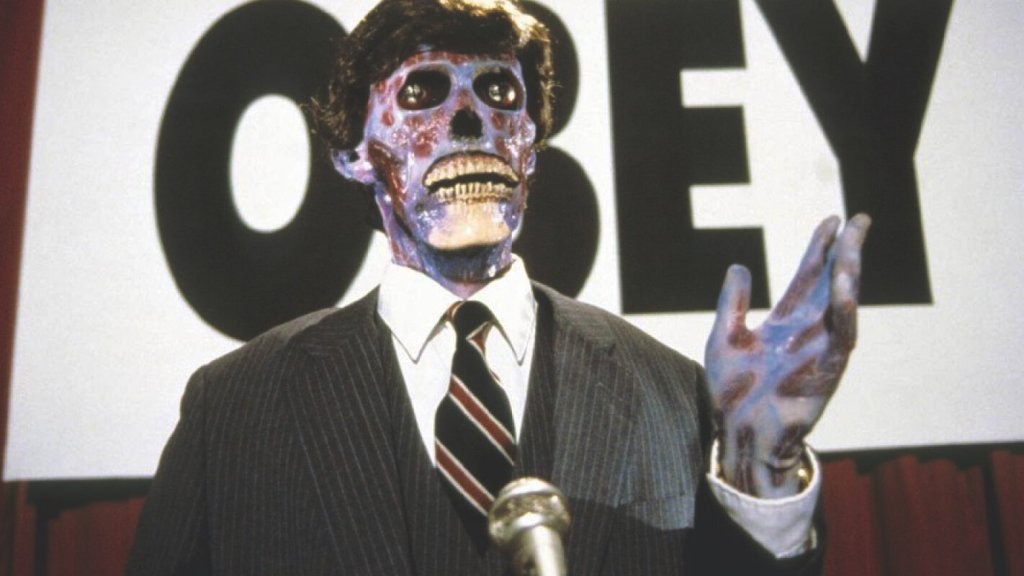
This is the premise of John Carpenter’s film They Live, which was released thirty-five years ago and remains unnervingly, chillingly appropriate for our modern age.
Best known for his horror film Halloween, which assumes that there is a form of evil so dark that it can’t be killed, Carpenter’s larger body of work is infused with a strong anti-authoritarian, anti-establishment, laconic bent that speaks to the filmmaker’s concerns about the unraveling of our society, particularly our government.
Time and again, Carpenter portrays the government working against its own citizens, a populace out of touch with reality, technology run amok, and a future more horrific than any horror film.
In Escape from New York, Carpenter presents fascism as the future of America.
In The Thing, a remake of the 1951 sci-fi classic of the same name, Carpenter presupposes that increasingly we are all becoming dehumanized.
In Christine, the film adaptation of Stephen King’s novel about a demon-possessed car, technology exhibits a will and consciousness of its own and goes on a murderous rampage.
In In the Mouth of Madness, Carpenter notes that evil grows when people lose “the ability to know the difference between reality and fantasy.”
And then there is Carpenter’s They Live, in which two migrant workers discover that the world is not as it seems. In fact, the population is actually being controlled and exploited by aliens working in partnership with an oligarchic elite. All the while, the populace—blissfully unaware of the real agenda at work in their lives—has been lulled into complacency, indoctrinated into compliance, bombarded with media distractions, and hypnotized by subliminal messages beamed out of television and various electronic devices, billboards and the like.
It is only when homeless drifter John Nada (played to the hilt by the late Roddy Piper) discovers a pair of doctored sunglasses—Hoffman lenses—that Nada sees what lies beneath the elite’s fabricated reality: control and bondage.
When viewed through the lens of truth, the elite, who appear human until stripped of their disguises, are shown to be monsters who have enslaved the citizenry in order to prey on them.
Likewise, billboards blare out hidden, authoritative messages: a bikini-clad woman in one ad is actually ordering viewers to “MARRY AND REPRODUCE.” Magazine racks scream “CONSUME” and “OBEY.” A wad of dollar bills in a vendor’s hand proclaims, “THIS IS YOUR GOD.”
When viewed through Nada’s Hoffman lenses, some of the other hidden messages being drummed into the people’s subconscious include: NO INDEPENDENT THOUGHT, CONFORM, SUBMIT, STAY ASLEEP, BUY, WATCH TV, NO IMAGINATION, and DO NOT QUESTION AUTHORITY.
This indoctrination campaign engineered by the elite in They Live is painfully familiar to anyone who has studied the decline of American culture.
A citizenry that does not think for themselves, obeys without question, is submissive, does not challenge authority, does not think outside the box, and is content to sit back and be entertained is a citizenry that can be easily controlled.
In this way, the subtle message of They Live provides an apt analogy of our own distorted vision of life in the American police state, what philosopher Slavoj Žižek refers to as dictatorship in democracy, “the invisible order which sustains your apparent freedom.”
Tune out the government’s attempts to distract, divert and befuddle us and tune into what’s really going on in this country, and you’ll run headlong into an unmistakable, unpalatable truth: what we are dealing with today is an authoritarian beast that has outgrown its chains and will not be restrained.
We’re being fed a series of carefully contrived fictions that bear no resemblance to reality.
Despite the fact that we are 17,600 times more likely to die from heart disease than from a terrorist attack; 11,000 times more likely to die from an airplane accident than from a terrorist plot involving an airplane; 1,048 times more likely to die from a car accident than a terrorist attack, and 8 times more likely to be killed by a police officer than by a terrorist , we have handed over control of our lives to government officials who treat us as a means to an end—the source of money and power.
As the Bearded Man in They Live warns, “They are dismantling the sleeping middle class. More and more people are becoming poor. We are their cattle. We are being bred for slavery.”
We have bought into the illusion and refused to grasp the truth.
From the moment we are born until we die, we are indoctrinated into believing that those who rule us do it for our own good. The truth is far different.
The powers-that-be want us to feel threatened by forces beyond our control (terrorists, pandemics, mass shootings, etc.).
They want us afraid and dependent on the government and its militarized armies for our safety and well-being.
They want us distrustful of each other, divided by our prejudices, and at each other’s throats.
We are little more than expendable resources to be used, abused and discarded.
In fact, a study conducted by Princeton and Northwestern University concluded that the U.S. government does not represent the majority of American citizens. Instead, the study found that the government is ruled by the rich and powerful, or the so-called “economic elite.” Moreover, the researchers concluded that policies enacted by this governmental elite nearly always favor special interests and lobbying groups.
In other words, we are being ruled by an oligarchy disguised as a democracy, and arguably on our way towards fascism—a form of government where private corporate interests rule, money calls the shots, and the people are seen as mere subjects to be controlled.
Rest assured that when and if fascism finally takes hold in America, the basic forms of government will remain: Fascism will appear to be friendly. The legislators will be in session. There will be elections, and the news media will continue to cover the entertainment and political trivia. Consent of the governed, however, will no longer apply. Actual control will have finally passed to the oligarchic elite controlling the government behind the scenes.
Sound familiar?
Clearly, we are now ruled by an oligarchic elite of governmental and corporate interests.
We have moved into “corporatism” (favored by Benito Mussolini), which is a halfway point on the road to full-blown fascism.
Corporatism is where the few moneyed interests—not elected by the citizenry—rule over the many. In this way, it is not a democracy or a republican form of government, which is what the American government was established to be. It is a top-down form of government and one which has a terrifying history typified by the developments that occurred in totalitarian regimes of the past: police states where everyone is watched and spied on, rounded up for minor infractions by government agents, placed under police control, and placed in detention (a.k.a. concentration) camps.
For the final hammer of fascism to fall, it will require the most crucial ingredient: the majority of the people will have to agree that it’s not only expedient but necessary.
But why would a people agree to such an oppressive regime?
The answer is the same in every age: fear.
Fear is the method most often used by politicians to increase the power of government. And, as most social commentators recognize, an atmosphere of fear permeates modern America: fear of terrorism, fear of the police, fear of our neighbors and so on.
The propaganda of fear has been used quite effectively by those who want to gain control, and it is transforming the populace into fearful, compliant, pacified zombies content to march in lockstep with the government’s dictates.
This brings me back to They Live, in which the real zombies are not the aliens calling the shots but the populace who are content to remain controlled.
When all is said and done, the world of They Live is not so different from our own. As one of the characters points out, “The poor and the underclass are growing. Racial justice and human rights are nonexistent. They have created a repressive society, and we are their unwitting accomplices. Their intention to rule rests with the annihilation of consciousness. We have been lulled into a trance. They have made us indifferent to ourselves, to others. We are focused only on our own gain.”
We, too, are focused only on our own pleasures, prejudices and gains. Our poor and underclasses are also growing. Injustice is growing. Inequality is growing. A concern for human rights is nearly nonexistent. We too have been lulled into a trance, indifferent to others.
Oblivious to what lies ahead, we’ve been manipulated into believing that if we continue to consume, obey, and have faith, things will work out. But that’s never been true of emerging regimes. And by the time we feel the hammer coming down upon us, it will be too late.
So where does that leave us?
The characters who populate Carpenter’s films provide some insight.
Underneath their machismo, they still believe in the ideals of liberty and equal opportunity. Their beliefs place them in constant opposition with the law and the establishment, but they are nonetheless freedom fighters.
When, for example, John Nada destroys the alien hypno-transmitter in They Live, he delivers a wake-up call for freedom. As Nada memorably declares, “I have come here to chew bubblegum and kick ass. And I’m all out of bubblegum.”
In other words: we need to get active and take a stand for what’s really important.
Stop allowing yourselves to be easily distracted by pointless political spectacles and pay attention to what’s really going on in the country.
As I make clear in my book Battlefield America: The War on the American People and in its fictional counterpart The Erik Blair Diaries, the real battle for control of this nation is taking place on roadsides, in police cars, on witness stands, over phone lines, in government offices, in corporate offices, in public school hallways and classrooms, in parks and city council meetings, and in towns and cities across this country.
All the trappings of the American police state are now in plain sight.
Wake up, America.
If they live (the tyrants, the oppressors, the invaders, the overlords), it is only because “we the people” sleep.
By Gary D. Barnett
Source: GaryDBarnett.com
“The drive of the Rockefellers and their allies is to create a one-world government combining supercapitalism and Communism under the same tent, all under their control. Do I mean a conspiracy? Yes, I do. I am convinced there is such a plot, international in scope, generations old in planning, incredibly evil in intent.”
~ Rep. Larry P. MacDonald (Note: Lawrence McDonald was killed (likely murdered) on Korean Air Lines 007, 1983, a few months after making this statement.)
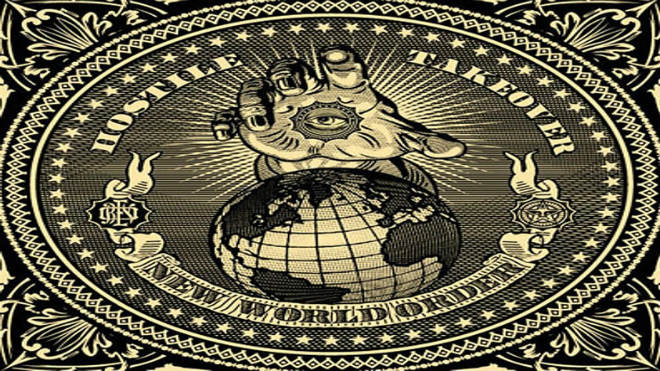
To begin, I will preface my remarks by saying that this is an attempt to explain in simple terms, very complicated financial and economic crimes being used against Americans, and also against the entire world population, in order to create and sustain total control over humanity. This is meant to manifest itself in the concept of one world governance, the ‘Great Reset,’ or the New World Order. This may seem a bold statement; it is not, but once you understand that everything that has happened over many decades is linked, especially since the plotted and premeditated false flag event called ‘9/11,’ you should be able to recognize the massive number of obvious connections that are incredibly evil.
It has recently become more prevalent by mostly alternative news sites and bloggers, to put forth the notion that many are waking up, and that the people are winning the battle for freedom. In my opinion, this is just not so, and in fact is misleading, as false hope is the driving force of this thinking. It is evident that more are claiming to be against government tyranny, but absolutely nothing has been done to reduce or eliminate the power of the State at any level to date. In addition, the nefarious efforts of the State and its controllers continue to expand, and the drive toward more draconian policies is never-ending. In the current environment, it is not known what the reaction by the masses might be considering the vast and imminent array of so-called ’emergencies’ that are certain to arise as this controlling cabal seeks to advance its agendas, but if the past is any indication, compliance should be expected.
The takeover framework of these ruling psychopaths is based always on the prototype of problem-reaction-solution, of which all are fake premeditated events and false emergencies; conspiracies in fact, meant to instill fear, hatred, or confusion, so that the State can pretend to come to the rescue of its hapless slave-class. This strategy has worked most every time it has been tried to date, and the herd continues to simply go along, regardless of the erroneous rhetoric being spewed that this populace is winning. It is not, and so long as the State continues and succeeds in its push to remake and transform society, whether psychologically, financially, or economically, the power of the ruling class and its governing system, will advance its wealth transfers, its monetary monopoly, and its depopulation efforts.
Psychological manipulation and control is necessary in order for the State thugs to accomplish their mission of world takeover, but financial and economic control is mandatory. This brings us to the real question; who owns and controls this world? It is certainly the big banking cartels, including all central banks, the large corporate magnates, the government protected NGO foundations, and of course, the entire global asset industry, which by 2020 controlled well over $100 trillion dollars. But who owns and controls all of these entities? Who has controlling interest in everything on earth? That is Blackrock and The Vanguard Group, and as I explained a year ago:
“There are a few thousand institutional investment firms that own every large bank, every large corporation, every large investment firm, every ‘news’ outlet, every large communication company, every large pharmaceutical company, every large transportation company; in other words, most every large company on earth is owned by these institutional investors. In turn, the small institutional investment firms are owned by larger institutional investment firms, and the larger investment firms, are owned by even larger investment firms. The two institutional investment companies that are the major owners and controllers of all the others in the world are Vanguard Holdings and Blackrock, and Vanguard is the largest shareholder (owner) of Blackrock. What this means is that Vanguard and Blackrock own and control this planet.”
The current CEO of Vanguard is Tim Buckley, and of course, the head and founder of the powerful Blackrock institution is Larry Fink. It should be noted that Fink and Blackrock have attained a position of extreme and almost infinite power over finance and economics, and according to many are now the fourth branch of government. The connections of Fink are incredibly telling of the power wielded by Blackrock. Blackrock effectively has control of the Federal Reserve and the U.S. Treasury, as well as banks around the world. It should be noted that Fink was appointed to the World Economic Forum’s (WEF) Board on August 22, 2019, the onset of the fraudulent ‘covid pandemic,’ which was set up, solidified, and begun, the same month that Fink took his seat on the board of the WEF. To gain a full picture of Fink and Blackrock’s history through today, watch this superb documentary by James Corbett; “How Blackrock Conquered the World.” In it, Corbett explains with full reference in video and text, how the entire ‘covid’ hoax was staged, and was first and foremost a financial takeover coup led by Blackrock. This connection of dots and people is of vital importance.
As I mentioned earlier, this is a very simplistic view of events, but it is necessary to tie a few things together in order that all can be seen to be completely connected; which would indicate a vast conspiracy that has been propagated over a long period of time. All so-called ’emergencies’ since the fraudulent 9/11 inside job, have much in common, and why would they not, as the main agenda of world governing domination was always the goal sought. Consider just three events, but there are many, many more, over that time.
The buildings that came down on 9/11 were turned into powder, an impossibility with fire caused by jet fuel. Consider that cars far away from any fire were burned to nothing, with melted metal, aluminum, windshield glass; all as if by spontaneous combustion. But the same thing happened in the Paradise, California fires in 2018, with many similarities, including the incredible damage to automobiles not even in the path of fires that had to be well above any heat level of a wildfire. The same also just occurred this past month in Lahaina, Hawaii. How could this be? It could not, unless similar or exact methods of destruction were plotted beforehand, and carried out by criminal State (military) means. And this is happening around the world as well, all falsely explained away by the complicit and controlled mainstream media.
One very telling aspect of all these bogus ’emergencies,’ from 9/11 to Maui, is that Wall Street and the financial firms, the institutional asset firms, central banks, defense contractors, and military-controlled tech companies, and of course this includes Blackrock, tended to gain huge profits, capture (steal through land grabs) more property, government contracts, and massive bailout money, while walking away from disaster far richer and more powerful than ever before possible. This happened with 9/11, the 2008 finance and housing collapse, the fake ‘covid’ plot, and now with the ultimate weapon against humanity, the completely illegitimate ‘climate change’ agenda; and this agenda placed Blackrock at the top of the heap worldwide, of this criminal fraud.
Each and every emergency brings about a bigger and more powerful State, more restrictions, more regulation, more mandates, more lockdowns, less travel, and more surveillance and censorship. This is all by design, and never coincidental or accidental, as all is a deliberate plot against humanity. Regardless of political considerations or parties, this assault against us all is ongoing, and forever expanding. Every incident, every manipulation, every ’emergency,’ has been planned far in advance, and the world takeover is now closer at hand.
While the state continues to build its new world order, the general population is consumed by one after another false flag event, claimed ’emergency,’ or new ‘threat,’ as stated by the ruling class bent on taking over the world. While the masses are at each other’s throats, the state continues its drive toward total domination. What this indicates is that the people are complicit in their own slavery due to their inability to see the big picture, while concentrating on every distraction thrown at them by this evil ruling force.
What is being ignored is that this world has already been taken over and is being fully controlled by the very few, and the fighting of one against another is continuing to aid in this takeover plot. By concentrating on each and every tyrannical distraction, the people have left themselves open to dictatorial management, and in the process have lost all ability to stop the totalitarian usurpation of their lives and property at the hands of the financial cabal bent on world rule.
By treating each indiscretion as independent of the real agenda being sought, nothing is being done to stop the state in its efforts to fully control all people on earth. By participating in the political and ‘voting’ process; a process designed and implemented for the single purpose of control, by concentrating on the political side shows, by attempting to use corrupt government courts to gain redress from tyrannical maneuvers, by accepting the ruling system as legitimate, by allowing the Federal Reserve and all banks the ability to monitor and control assets through complete digitization, the lowly people are digging their own graves.
It may already be too late to continue this asinine exercise in futility, as the ruling class few are in control of the systems that will allow them to complete their takeover plot. The only answer to this evil attempt to destroy us in favor of the few most powerful, is to negate all government, to negate and abolish the federal reserve system, to disallow any and all control by the banking cartels, to stop any and all efforts to monopolize the economic and monetary system’s efforts to create and implement any central bank digital currencies, and to not accept any new feigned emergency concerning health, fake ‘climate change,’ war threats, unnatural events, or any other intentional criminal acts meant to cause undue fear among the seemingly helpless proletariat.
The people are not winning; they are losing, but this deadly assault on humanity can still be reversed if even a small majority stand up and take responsibility for their own lives and freedom. If the current trend continues, if the bulk of this population persists in hiding from the truth, if most expect others to save them, all will be lost, but if any true actionable awakening by large numbers becomes evident, the state will fold. This will never happen with any election, and no politician can change the course we are on, as depending on any master participating in this evil governing system, is the epitome of failure, and can only lead to eternal enslavement.
“The one thing man fears is the unknown. When presented with this scenario, individual rights will be willingly relinquished for the guarantee of their well-being granted to them by a World Government, a New World Order.”
~ Henry A. Kissinger

By By John & Nisha Whitehead
Source: The Rutherford Institute
“Man is born free but everywhere is in chains.”—Jean-Jacques Rousseau
Authoritarian control freaks out to micromanage our lives have become the new normal or, to be more accurate, the new abnormal when it comes to how the government relates to the citizenry.
This overbearing despotism, which pre-dates the COVID-19 hysteria, is the very definition of a Nanny State, where government representatives (those elected and appointed to work for us) adopt the authoritarian notion that the government knows best and therefore must control, regulate and dictate almost everything about the citizenry’s public, private and professional lives.
Indeed, it’s a dangerous time for anyone who still clings to the idea that freedom means the right to think for yourself and act responsibly according to your best judgment.
This tug-of-war for control and sovereignty over our selves impacts almost every aspect of our lives, whether you’re talking about decisions relating to our health, our homes, how we raise our children, what we consume, what we drive, what we wear, how we spend our money, how we protect ourselves and our loved ones, and even who we associate with and what we think.
As Liz Wolfe writes for Reason, “Little things that make people’s lives better, tastier, and less tedious are being cracked down on by big government types in federal and state governments.”
You can’t even buy a stove, a dishwasher, a showerhead, a leaf blower, or a lightbulb anymore without running afoul of the Nanny State.
In this way, under the guise of pseudo-benevolence, the government has meted out this bureaucratic tyranny in such a way as to nullify the inalienable rights of the individual and limit our choices to those few that the government deems safe enough.
Yet limited choice is no choice at all. Likewise, regulated freedom is no freedom at all.
Indeed, as a study by the Cato Institute concludes, for the average American, freedom has declined generally over the past 20 years. As researchers William Ruger and Jason Sorens explain, “We ground our conception of freedom on an individual rights framework. In our view, individuals should be allowed to dispose of their lives, liberties, and property as they see fit, so long as they do not infringe on the rights of others.”
The overt signs of the despotism exercised by the increasingly authoritarian regime that passes itself off as the United States government (and its corporate partners in crime) are all around us: censorship, criminalizing, shadow banning and de-platforming of individuals who express ideas that are politically incorrect or unpopular; warrantless surveillance of Americans’ movements and communications; SWAT team raids of Americans’ homes; shootings of unarmed citizens by police; harsh punishments meted out to schoolchildren in the name of zero tolerance; community-wide lockdowns and health mandates that strip Americans of their freedom of movement and bodily integrity; armed drones taking to the skies domestically; endless wars; out-of-control spending; militarized police; roadside strip searches; privatized prisons with a profit incentive for jailing Americans; fusion centers that spy on, collect and disseminate data on Americans’ private transactions; and militarized agencies with stockpiles of ammunition, to name some of the most appalling.
Yet as egregious as these incursions on our rights may be, it’s the endless, petty tyrannies—the heavy-handed, punitive-laden dictates inflicted by a self-righteous, Big-Brother-Knows-Best bureaucracy on an overtaxed, overregulated, and underrepresented populace—that illustrate so clearly the degree to which “we the people” are viewed as incapable of common sense, moral judgment, fairness, and intelligence, not to mention lacking a basic understanding of how to stay alive, raise a family, or be part of a functioning community.
When the dictates of petty bureaucrats carry greater weight than the individual rights of the citizenry, we’re in trouble, folks.
Federal and state governments have used the law as a bludgeon to litigate, legislate and micromanage our lives through overregulation and overcriminalization.
This is what happens when bureaucrats run the show, and the rule of law becomes little more than a cattle prod for forcing the citizenry to march in lockstep with the government.
Overregulation is just the other side of the coin to overcriminalization, that phenomenon in which everything is rendered illegal, and everyone becomes a lawbreaker.
You don’t have to look far to find abundant examples of Nanny State laws that infantilize individuals and strip them of their ability to decide things for themselves. Back in 2012, then-New York Mayor Michael Bloomberg infamously proposed a ban on the sale of sodas and large sugary drinks in order to guard against obesity. Other localities enacted bans on texting while jaywalking, wearing saggy pants, having too much mud on your car, smoking outdoors, storing trash in your car, improperly sorting your trash, cursing within earshot of others, or screeching your tires.
Yet while there are endless ways for the Nanny State to micromanage our lives, things become truly ominous when the government adopts mechanisms enabling it to monitor us for violations in order to enforce its many laws.
Nanny State, meet the all-seeing, all-knowing Surveillance State and its sidekick, the muscle-flexing Police State.
You see, in an age of overcriminalization—when the law is wielded like a hammer to force compliance to the government’s dictates whatever they might be—you don’t have to do anything “wrong” to be fined, arrested or subjected to raids and seizures and surveillance.
You just have to refuse to march in lockstep with the government.
As policy analyst Michael Van Beek warns, the problem with overcriminalization is that there are so many laws at the federal, state and local levels—that we can’t possibly know them all.
“It’s also impossible to enforce all these laws. Instead, law enforcement officials must choose which ones are important and which are not. The result is that they pick the laws Americans really must follow, because they’re the ones deciding which laws really matter,” concludes Van Beek. “Federal, state and local regulations — rules created by unelected government bureaucrats — carry the same force of law and can turn you into a criminal if you violate any one of them… if we violate these rules, we could be prosecuted as criminals. No matter how antiquated or ridiculous, they still carry the full force of the law. By letting so many of these sit around, just waiting to be used against us, we increase the power of law enforcement, which has lots of options to charge people with legal and regulatory violations.”
This is the police state’s superpower: empowered by the Nanny State, it has been vested with the authority to make our lives a bureaucratic hell.
Indeed, if you were unnerved by the rapid deterioration of privacy under the Surveillance State, prepare to be terrified by the surveillance matrix that will be ushered in by the Nanny State working in tandem with the Police State.
The government’s response to COVID-19 saddled us with a Nanny State inclined to use its draconian pandemic powers to protect us from ourselves.
The groundwork laid with COVID-19 is a prologue to what will become the police state’s conquest of a new, relatively uncharted, frontier: inner space, specifically, the inner workings (genetic, biological, biometric, mental, emotional) of the human race.
Consider how many more ways the government could “protect us” from ourselves under the guise of public health and safety.
For instance, under the guise of public health and safety, the government could use mental health care as a pretext for targeting and locking up dissidents, activists and anyone unfortunate enough to be placed on a government watch list.
When combined with advances in mass surveillance technologies, artificial intelligence-powered programs that can track people by their biometrics and behavior, mental health sensor data (tracked by wearable data and monitored by government agencies such as HARPA), threat assessments, behavioral sensing warnings, precrime initiatives, red flag gun laws, and mental health first-aid programs aimed at training gatekeepers to identify who might pose a threat to public safety, these preemptive mental health programs could well signal a tipping point in the government’s efforts to penalize those engaging in so-called “thought crimes.”
This is how it begins.
On a daily basis, Americans are already relinquishing (in many cases, voluntarily) the most intimate details of who we are—their biological makeup, our genetic blueprints, and our biometrics (facial characteristics and structure, fingerprints, iris scans, etc.)—in order to navigate an increasingly technologically-enabled world.
Having conditioned the population to the idea that being part of society is a privilege and not a right, such access could easily be predicated on social credit scores, the worthiness of one’s political views, or the extent to which one is willing to comply with the government’s dictates, no matter what they might be.
COVID-19 with its talk of mass testing, screening checkpoints, contact tracing, immunity passports, and snitch tip lines for reporting “rule breakers” to the authorities was a preview of what’s to come.
We should all be leery and afraid.
At a time when the government has a growing list—shared with fusion centers and law enforcement agencies—of ideologies, behaviors, affiliations and other characteristics that could flag someone as suspicious and result in their being labeled potential enemies of the state, it won’t take much for any of us to be considered outlaws or terrorists.
After all, the government likes to use the words “anti-government,” “extremist” and “terrorist” interchangeably. The Department of Homeland Security broadly defines extremists as individuals “that are mainly antigovernment, rejecting federal authority in favor of state or local authority, or rejecting government authority entirely.”
At some point, being an individualist will be considered as dangerous as being a terrorist.
When anything goes when it’s done in the name of national security, crime fighting and terrorism, “we the people” have little to no protection against SWAT team raids, domestic surveillance, police shootings of unarmed citizens, indefinite detentions, and the like, whether or not you’ve done anything wrong.
In an age of overcriminalization, you’re already a criminal.
All the government needs is proof of your law-breaking. They’ll get it, too.
Whether it’s through the use of surveillance software such as ShadowDragon that allows police to watch people’s social media activity, or technology that uses a home’s WiFi router and smart appliances to allow those on the outside to “see” throughout your home, it’s just a matter of time.
As I make clear in my book Battlefield America: The War on the American People and in its fictional counterpart The Erik Blair Diaries, it’s no longer a question of whether the government will lock up Americans for defying one of its numerous mandates but when.
By Dawn Keetley
Source: Horror Homeroom
Summary of White God: Thirteen-year old Lili (Zsófia Psotta) moves in with her father who proves unwilling to pay the fees incumbent on the owners of mongrel dogs. He thus forces Lili to abandon her beloved Hagen on the streets of Budapest. The film follows the dual paths of Lili and Hagen as they, finally, find their way back to each other.
I loved White God (I’ll get that out up front), which premiered at the 2014 Cannes Film Festival and recently become widely available in the US. White God is a particularly interesting intervention in the horror genre in that it is the only film I can think of in which the animal (Hagen) becomes the protagonist rather than the antagonist. In all the other natural horror films I’ve seen recently, animals (wolves, sharks, crocodiles, bears) threaten more-or-less sympathetic humans. White God stands alone in showing how profoundly humans threaten animals.
White God is about two-hours long and I’ll warn you up front that it doesn’t become a horror film until about 30 minutes from the end. Only then does the beautifully shape-shifting form of the film end up as a revenge narrative (I couldn’t help comparing it to I Spit on Your Grave [1978]). And while both its human protagonist, Lili, and its dog protagonist, Hagen, are both, in their different ways, abandoned, it’s Hagen who suffers most and who ends up getting his justified revenge.
Up to that point, though, the director brilliantly weaves together resonances of childhood stories like Anna Sewall’s Black Beauty (1877), Sheila Burnford’s The Incredible Journey (1961), filmed in 1963 and again, as Homeward Bound, in 1993, and William H. Armstrong’s Sounder (1969), along with direct references to Jack London’s fiction, notably White Fang (1906).
In fact, White God‘s title is undoubtedly taken from White Fang, as Hagen’s adventures among the uniformly despicable humans that populate Budapest resemble almost exactly a portion of White Fang’s life with a man London pointedly calls the “mad god.” White Fang’s first encounters with humans are with Native Americans—and while they are certainly not positive, their barbarity pales in comparison to the brutality of his first encounters with white men, whom White Fang calls “white gods.” As London writes: “White Fang did not reason it out, did not in his mind make the sharp generalization that the white gods were more powerful.”[i] But so they are—and most of them do not use their power well. The mad “white god” that serves as the clear progenitor to a character Hagen has the misfortune to meet in White God takes White Fang and subjects him to an abusive training program designed to make him a vicious fighter. The training works well, and White Fang goes on to defeat every dog in the Yukon, as well as sundry wolves and a lynx.
Unlike White Fang, Hagen defies his training at a crucial moment, though. At first he goes along with it, acceding to his master’s desire. But then, at the end of his first fight, Hagen looks at his dead rival and has a realization that White Fang does not. Dogs aren’t the enemy.[ii]
From that moment, looking at the bloodied body of the dog he fleetingly thought was his rival, Hagen knows exactly who the enemy really is. He then rounds up all the stray dogs in Budapest, urging them into revolt.
While White God works as a powerful parable of the uprising of animals against their domination and brutalization by humans, it can also be read as an allegory for human oppression. The title, White God, along with the racial hierarchies (of Native Americans and whites) that it imports from White Fang, suggest that the dogs are also stand-ins for those humans who are cast aside because they are not “white,” because they are “mutts” and “half-breeds.” The current crisis in Europe over immigrants, mostly from Syria, and Hungary’s contentious role in that crisis, only intensifies this allegory, as the film has already begun to accrue meanings beyond its moment of inception.
As the dogs stream through Budapest’s streets, exhilarated by their collective power, the film unequivocally becomes a horror film, and the dogs invoke the zombies that streamed through London and Paris in 28 Days Later (Danny Boyle, 2002) and 28 Weeks Later (Juan Carlos Fresnadillo, 2007).
While it is indeed exhilarating to see them, the dogs’ resemblance to zombies infuses these scenes with sadness and dread. Does this resemblance foreshadow their eventual doom? What can dogs do, in the end, in the face of determined human opposition? Do they really have any choice but to submit to their role of our “best friends” as their best means of survival? Despite how bad so many of us are at being their “friend.”
The ending of White God, after Hagen’s glorious and bloody revenge, is ambiguous. Hagen meets Lili again but she’s changed: we’ve seen her shift much more of her allegiance toward humans during the course of her journey (which I found much less gripping than Hagen’s). There’s a scene, which we see right at the opening of the film and then near the end, in which dogs run furiously as Lili pedals her bike. Are they chasing Lili? Is she leading them? Are they both on separate journeys, the dogs indifferent to her? The answer becomes only a bit clearer in the second reiteration of the scene.
The ending presents us with an image that is on all the posters for the film—and its meaning is ambiguous too.
Clearly Lili figures as some kind of “god” figure here, for Hagen and the other dogs: she has become the “white god” of the title. But will she use her power to save the dogs? Or will she merely appease them until others come to destroy them. You can make up your own mind. Me? I’m not hopeful.
R | 121 mins. | Kornél Mundruczó | Hungary | 2014
Grade: A
____________________
Watch White God on Kanopy here: https://www.kanopy.com/en/product/2332130

By Pepe Escobar
Source: The Unz Review
You have stolen the orchards of my ancestors
And the land that I cultivated
And you left nothing for us
Except for these rocks…
If I become hungry
The usurper’s flesh will be my food.– Palestinian national poet Mahmoud Darwish
It’s by now confirmed that Egyptian intel warned their Israeli counterparts only 3 days before Al-Aqsa Flood that something “big” was coming from Hamas. Tel Aviv, its multi-billion dollar security apparatus and the IDF, “the strongest army in the world”, chose to ignore it.
That configures two key vectors.
1) Tel Aviv get its “Pearl Harbor” pretext to implement a remixed “war on terror” plus a sort of Final Solution to the “Gaza problem” (already in effect).
2) The Hegemon abruptly changes the narrative away from the incoming, inevitable, cosmic joint humiliation of the White House and NATO in the steppes of Novorossiya – a strategic defeat that configures the previous humiliation in Afghanistan as a masked ball in Disneyland.
The total blockade of “human animals” (copyright Israeli Defense Ministry) in Gaza, in fact a civilian population of 2.3 million, has been imposed this past Monday. No food, no water, no fuel, no essential commodities.
That’s a war crime and a crime against humanity, thrashing the four basic principles of the
Law of Armed Conflict (LOAC) – everything duly applauded or at best completely ignored by NATOstan and its assorted oligarch-controlled mainstream media.
Christians, Muslims, Jews and other ethnic groups lived peacefully in Palestine for centuries until the imposition of the racist Zionist Project – complete with all the Divide and Rule attributes of settler colonialism.
The Nakba is an old memory of 75 years ago. We are now way beyond apartheid – and entering total exclusion and expulsion of Palestinians from their homeland.
In January 2023, Israeli Prime Minister Netanyahu himself stressed, “the Jewish people have an exclusive and unquestionable right to all areas of the Land of Israel.”
Now, the IDF sent no less than an order to the UN to completely evacuate all residents of northern Gaza – 1.1 million people – to southern Gaza, close to Rafah, the only border crossing with Egypt.
This forced mass deportation of civilians would be the prelude to raze all of northern Gaza to the ground, coupled with expulsion and confiscation of ancestral Palestinian land – edging closer to a Zionist Final Solution.
Welcome to Sociopaths United
Netanyahu, a sociopath with a proven track record, can only get away with serial war crimes because of total support by the White House, the “Biden” combo and the State Department – not to mention inconsequential EU vassals.
We just witnessed a U.S. Secretary of State – a low-IQ functionary out of his depth on every single issue – going to Israel to support collective punishment “as a Jew as well”.
He said his grandfather “fled pogroms in Russia” (that was in 1904). Then came the direct – Nazi – connection to “my stepfather survived Auschwitz, Dachau and Majdanek”. Impressive, that’s three concentration camps in a row. The secretary is obviously oblivious to the fact that the USSR liberated all three.
Then came the connection Russia-Nazis-Hamas. At least it’s all clear.
Internally, Netanyahu is only able to stay as Prime Minister because of especially two rabid ultra-Zionist, racist, supremacist coalition partners. He named Itamar Ben-Gvir as National Security Minister and Bezalel Smotrich as Finance Minister – both de facto in charge of proliferating settlements all across the West Bank in industrial scale.
Smotrich has been on the record saying that “there is no such thing as Palestinians because there is no such thing as a Palestinian people”.
Ben-Gvir and Smotrich, in record time, are on their way to double the settler population in the cantons across the West Bank from 500,000 to one million. Palestinians – de facto non-citizens – number 3.7 million. lllegal settlements – not formally approved by Tel Aviv – are popping up all across the spectrum.
In Gaza – where poverty hovers at 60% and youth unemployment is massive – UN agencies desperately warn of an impending humanitarian catastrophe.
Over 1 million people in Gaza, mostly women and children, depend on UN food assistance. Tens of thousands of kids go to UNRWA schools (UNRWA is the agency for Palestinian refugees).
Tel Aviv is now killing them – softly. At least 11 UNRWA workers have been killed this past week (including teachers, a doctor and an engineer), at least 30 kids, plus 5 members of the International Red Cross and Red Crescent.
To top it all up, there’s the Pipelineistan angle – as in stealing Gaza gas.
At least 60% of the vast gas reserves discovered in 2000 along the Gaza-Israel coastline legally belong to Palestine.
A key consequence of the Final Solution applied to Gaza translates as sovereignty over the gas fields switched to Israel – in yet another massive trampling of international law.
The Global Majority is Palestine
Amid the horrifying prospect of Israel depopulating the entire northern half of Gaza, live on TV and cheered on by hordes of NATOstan zombies, it’s not far-fetched to consider the possibility of Turkiye, Egypt, Syria, Iraq, Iran, Lebanon, Yemen and the Gulf monarchies joining together, at various levels, to create overwhelming pressure against the implementation of the Zionist Final Solution.
Virtually the whole Global South/Global Majority is with Palestine.
Turkiye, problematically, is not an Arab nation and has been too ideologically close to Hamas in the recent past. Assuming the current Netanyahu gang would engage in diplomacy, the possible best mediation team would be formed by Saudi Arabia, Qatar and Egyptian diplomacy.
India has just stabbed itself in the head as a leader of the Global Majority: their leadership does seem to get a hard on when facing Israel.
Then there are the Big Sovereigns: the Russia-China strategic partnership.
Russia-Iran are themselves connected by a strategic partnership – including at all state of the art military levels. The Iran-Saudi rapprochement mediated and clinched by China has led, this week, to Mohammad bin Salman and Ebrahim Raisi on the phone, for the first time ever, coordinating their unwavering support to the legitimate rights of the Palestinian people. Syria’s Bashar al-Assad has just visited China, received with full honors.
China’s trademark diplomatic sophistication – way beyond Al-Aqsa Flood – amounts to supporting legitimate Palestinian rights. The whole Arab world and the lands of Islam clearly feel it – while Israel and NATOstan are impervious to nuance.
With Russia we reach heavy metal territory. Earlier this week, Israel’s ambassador to Russia, Alexander Ben Zvi, was finally received, after several attempts by Deputy Foreign Minister Mikhail Bogdanov. It was Israel who practically begged for a meeting.
Bogdanov cut to the chase, bluntly: Ben Zvi was warned that the IDF plan to literally destroy Gaza, expel the indigenous population and practice the ethnic cleansing of those “human animals” was “fraught with the most devastating consequences for the humanitarian situation in the region.”
That advances a quite possible scenario – whose consequences can be equally devastating: Moscow – in collaboration with Ankara – launching a Global South-supported blockade-busting operation against Israel.
It’s no secret – apart from the modus operandi – that Putin and Erdogan have discussed a possible Turkish humanitarian naval convoy to Gaza, which would be protected from an Israeli attack by the Russian Navy out of its Tartous base in Syria and the Russian air Force out of Hmeimim. That would raise the stakes to unforeseen levels.
What’s clear already is that the Hegemon proxy war against Russia in Ukraine and the Israeli “war on terror” remixed in Gaza are just parallel fronts of a single, horrifyingly evolving, global war.
By Chris Hedges
Source: The Chris Hedges Report
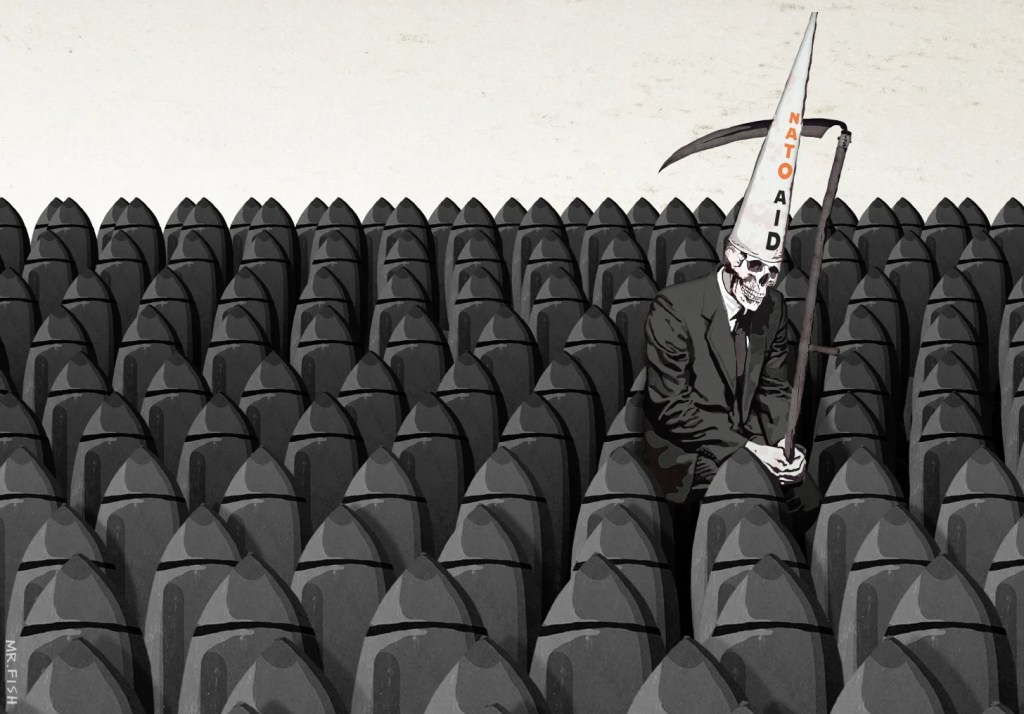
“We came, we saw, he died,” Hillary Clinton famously quipped when Muammar Gaddafi, after seven months of U.S. and NATO bombing, was overthrown in 2011 and killed by a mob who sodomized him with a bayonet. But Gaddafi would not be the only one to die. Libya, once the most prosperous and one of the most stable countries in Africa, a country with free healthcare and education, the right for all citizens to a home, subsidized electricity, water and gasoline, along with the lowest infant mortality rate and highest life expectancy on the continent, along with one of the highest literacy rates, swiftly fragmented into warring factions. There are currently two rival regimes battling for control in Libya, along with an array of rogue militias.
The chaos that followed Western intervention saw weapons from the country’s arsenals flood the black market, with many snatched up by groups such as the Islamic State. Civil society ceased to function. Journalists captured images of migrants from Nigeria, Senegal and Eritrea being beaten and sold as slaves to work in fields or on construction sites. Libya’s infrastructure, including its electrical grids, aquifers, oil fields and dams, fell into disrepair. And when the torrential rains from Storm Daniel — the climate crisis being another gift to Africa from the industrialized world — overwhelmed two decrepit dams, walls of water 20 feet high raced down to flood the port of Derna and Benghazi, leaving up to 20,000 dead according to Abdulmenam Al-Gaiti, Mayor of Derna, and some 10,000 missing.
“The fragmentation of the country’s disaster management and disaster response mechanisms, as well as deteriorating infrastructure, exacerbated the enormity of the challenges. The political situation is a driver of risk,” said Professor Petteri Taalas, Secretary General of the World Meteorological Organization.
Taalas told reporters last Thursday that “most of the human casualties” would have been avoided if there had been a “normally operating meteorological service” which “would have issued the [necessary] warnings and also the emergency management of this would have been able to carry out evacuations of the people.”
Western regime-change, carried out in the name of human rights under the doctrine of R2P (Responsibility to Protect), destroyed Libya – as it did Iraq – as a unified and stable nation. The flood victims are part of the tens of thousands of Libyan dead resulting from our “humanitarian intervention,” which rendered disaster relief non-existent. We bear responsibility for Libya’s prolonged suffering. But once we wreak havoc on a country in the name of saving its persecuted — regardless of whether they are being persecuted or not — we forget they exist.
Karl Popper in “The Open Society and Its Enemies” warned against utopian engineering, massive social transformations, almost always implanted by force, and led by those who believe they are endowed with a revealed truth. These utopian engineers carry out the wholesale destruction of systems, institutions and social and cultural structures in a vain effort to achieve their vision. In the process, they dismantle the self-correcting mechanisms of incremental and piecemeal reform that are impediments to that grand vision. History is replete with murderous utopian social engineering — the Jacobins, the communists, the fascists and now, in our own age, the globalists, or neoliberal imperialists.
Libya, like Iraq and Afghanistan, fell victim to the self-delusions peddled by humanitarian interventionists — Barack Obama, Hillary Clinton, Ben Rhodes, Samantha Power and Susan Rice. The Obama administration armed and backed an insurgent force that they believed would do the bidding of the U.S. Obama in a recent post urged people to support aid agencies to alleviate the suffering of the people of Libya, a plea that ignited an understandable backlash on social media.
There is no official tally of the casualties in Libya that have resulted directly and indirectly from the violence in Libya over the last 12 years. This is exacerbated by the fact that NATO failed to investigate casualties resulting from its seven month bombardment of the country in 2011. But the total figure of those killed and injured is likely in the tens of thousands. Action on Armed Violence recorded “8,518 deaths and injuries from explosive violence in Libya” from 2011 to 2020, 6,027 of which were civilian casualties.
In 2020, a statement published by seven U.N. agencies reported that “Close to 400,000 Libyans have been displaced since the start of the conflict nine years ago — around half of them within the past year, since the attack on the capital, Tripoli, [by Field Marshal Khalifa Belqasim Haftar’s forces] started.”
“The Libyan economy has been battered by the [civil war], the COVID-19 pandemic, and Russia’s invasion of Ukraine,” the World Bank reported in April of this year. “The country’s fragility is having far-reaching economic and social impact. GDP per capita declined by 50 percent between 2011 and 2020 while it could have increased by 68 percent if the economy had followed its pre-conflict trend,” the report says. “This suggests that Libya’s income per capita could have been 118 percent higher without the conflict. Economic growth in 2022 remained low and volatile due to conflict-related disruptions in oil production.”
Amnesty International’s 2022 Libya report also makes for grim reading. “Militias, armed groups and security forces continued to arbitrarily detain thousands of people,” it says. “Scores of protesters, lawyers, journalists, critics and activists were rounded up and subjected to torture and other ill-treatment, enforced disappearances and forced ‘confessions’ on camera.” Amnesty describes a country where militias operate with impunity, human rights abuses, including kidnappings and sexual violence, are widespread. It adds that “EU-backed Libyan coastguards and the Stability Support Authority militia intercepted thousands of refugees and migrants at sea and forcibly returned them to detention in Libya. Detained migrants and refugees were subjected to torture, unlawful killings, sexual violence and forced labour.”
Reports by the U.N. Support Mission to Libya (UNSMIL) are no less dire.
Stockpiles of weapons and ammunition — estimated to be between 150,000 and 200,000 tons — were looted from Libya with many being trafficked to neighboring states. In Mali, weapons from Libya fuelled a dormant insurgency by the Tuareg, destabilizing the country. It ultimately led to a military coup and a jihadist insurgency which supplanted the Tuareg, as well as a protracted war between the Malian government and jihadists. This triggered another French military intervention and led to 400,000 people being displaced. Weapons and ammunition from Libya also made their way into other parts of the Sahel including Chad, Niger, Nigeria and Burkina Faso.
The misery and carnage, which rippled out from a dismembered Libya, was unleashed in the name of democratization, nation-building, promoting the rule of law and human rights.
The pretext for the assault was that Gaddafi was about to launch a military operation to massacre civilians in Benghazi where rebellious forces had seized power. It had as much substance as the charge that Saddam Hussein had weapons of mass destruction, another example of utopian social engineering that left over a million Iraqi dead and millions more driven from their homes.
Gaddafi — who I interviewed for two hours in April 1995 near the gutted remains of his home that was bombed by U.S. warplanes in 1986 — and Hussein were targeted not because of what they did to their own people, although both could be brutal. They were targeted because their nations had large oil reserves and were independent of Western control. They renegotiated more favorable contracts for their nations with Western oil producers and awarded oil contracts to China and Russia. Gaddafi also gave the Russian fleet access to the port of Benghazi.
Hillary Clinton’s emails, obtained via a freedom of information request and published by WikiLeaks, also expose France’s concerns about Gaddafi’s efforts to “provide Francophone African Countries with an alternative to the French Fran (CFA).” Sidney Blumenthal, a longtime adviser to Clinton, reported on his conversations with French intelligence officers about the motivations of French President Nicholas Sarkozy, the chief architect of the attack on Libya. Blumenthal writes that the French president seeks “a greater share of Libyan oil”, increased French influence in the region, an improvement in his domestic political standing, a reassertion of French military power and an end to Gaddafi’s attempts to supplant French influence in “Francophone Africa.”
Sarkozy, who has been convicted on two separate cases of corruption and breach of campaign finance laws, faces a historic trial in 2025 for allegedly receiving millions of euros in secret illegal campaign contributions from Gadaffi, to assist with his successful 2007 presidential bid.
These were the real “crimes” in Libya. But the real crimes always remain hidden, papered over by florid rhetoric about democracy and human rights.
The American experiment, built on slavery, began with a genocidal campaign against Native Americans that was exported to the Philippines and, later, nations such as Vietnam. The narratives we tell ourselves about World War II, largely to justify our right to intervene around the globe, are a lie. It was the Soviet Union that destroyed the German army long before we landed at Normandy. We firebombed cities in Germany and Japan killing hundreds of thousands of civilians. The war in the South Pacific, where one of my uncles fought, was bestial, characterized by rabid racism, mutilation, torture and the routine execution of prisoners. The atomic bombings of Hiroshima and Nagasaki were egregious war crimes. The U.S. routinely destroys democracies that nationalize U.S. and European corporations as in Chile, Iran and Guatemala, replacing them with repressive military regimes. Washington supported the genocides in Guatemala and East Timor. It embraces the crime of preemptive war. There is little in our history to justify the claim of unique American virtues.
The nightmares we orchestrated in Iraq, Afghanistan and Libya are minimized or ignored by the press while the benefits are exaggerated or fabricated. And since the U.S. does not recognize the International Criminal Court, there is no chance of any American leader being held accountable for their crimes.
Human rights advocates have become a vital cog in the imperial project. The extension of U.S. power, they argue, is a force for good. This is the thesis of Samantha Power’s book “A Problem from Hell: America and the Age of Genocide.” They champion the R2P doctrine, unanimously adopted in 2005 at the U.N. World Summit. Under this doctrine, states are required to respect the human rights of their citizens. When these rights are violated, then sovereignty is nullified. Outside forces are permitted to intervene. Miguel d’Escoto Brockmann, the former president of the U.N. General Assembly, warned in 2009 that R2P could be misused “to justify arbitrary and selective interventions against the weakest states.”
“Since the end of the Cold War, the idea of human rights has been made into a justification for intervention by the world’s leading economic and military powers, above all, the United States, in countries that are vulnerable to their attacks,” writes Jean Bricmont in “Humanitarian Imperialism: Using Human Rights to Sell War.” “Until the U.S. invasion of Iraq, [a] large part of the left was often complicit in this ideology of intervention, discovering new ‘Hitlers’ as the need arose, and denouncing antiwar arguments as appeasement on the model of Munich in 1938.”
The creed of humanitarian intervention is selective. Compassion is extended to “worthy” victims while “unworthy” victims are ignored. Military intervention is good for Iraqis, Afghans or Libyans, but not for Palestinians or Yeminis. Human rights are supposedly sacrosanct when discussing Cuba, Venezuela and Iran, but irrelevant in our offshore penal colonies, the world’s largest open air prison in Gaza or our drone-infested war zones. The persecution of dissidents and journalists is a crime in China or Russia, but not when the targets are Julian Assange and Edward Snowden.
Utopian social engineering is always catastrophic. It creates power vacuums that augment the suffering of those the utopianists claim to protect. The moral bankruptcy of the liberal class, which I chronicle in “Death of the Liberal Class,” is complete. Liberals have prostituted their supposed values to the Empire. Incapable of taking responsibility for the carnage they inflict, they clamor for more destruction and death to save the world.
Ignore the fake news. Israel isn’t defending itself. It’s enforcing its right to continue ethnically cleansing Palestinians
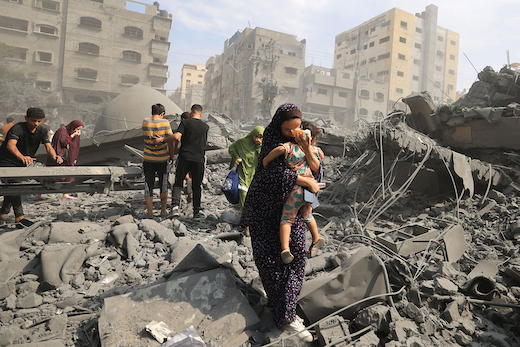
By Jonathan Cook
Source: Jonathan Cook Blog
The missing context for what’s happening in Gaza is that Israel has been working night and day to ethnically cleanse the Palestinian people from their homeland since even before Israel become a state – when it was known as the Zionist movement.
Israel didn’t just cleanse Palestinians in 1948, when it was founded as a Western colonial project, and again under cover of a regional war in 1967. It also worked to ethnically cleanse Palestinians every day between those dates and afterwards. The aim was to move them off their historic lands, and either expel them beyond Israel’s new, expanded borders or concentrate them into small ghettoes inside those borders – as a holding measure until they could be expelled outside the borders.
The ‘settler’ project, as we call it, is a misnomer. It’s really Israel’s ethnic cleansing programme. Israel even has a special word for it in Hebrew: ‘Judaisation’, or making the land Jewish. It is official government policy.
Gaza was the largest of the Palestinian reservations created by Israel’s ethnic cleansing programme, and the most overcrowded. To stop the inhabitants spilling out, Israel built a fence-barrier in the early 1990s to pen them in. Then when policing became too hard from within the prison, Israel pulled back in 2005 to the outer perimeter barrier.
New technology allowed Israel to besiege Gaza remotely by land, sea and air in 2007, limiting the entry of food and vital items like medicine and cement for construction. Automated gun towers shot anyone who came near the fence. The navy patrolled the sea, stopping boats straying more than a kilometre or two off shore. And drones watched 24 hours a day from the sky.
The people of Gaza were sealed in and largely forgotten, except when they lobbed a few rockets over the fence – to international indignation. If they fired too many rockets, Israel bombed them mercilessly and occasionally launched a ground invasion. The rocket threat was increasingly neutralised by a rocket interception system, paid for by the US, called Iron Dome.
Palestinians tried to be more inventive in finding ways to break out of their prison. They built tunnels. But Israel found ways to identify those that ran close to the fence and destroyed them.
Palestinians tried to get attention by protesting en masse at the fence. Israeli snipers were ordered to shoot them in the legs, leading to thousands of amputees.
The ‘deterrence’ seemed to work. Israel could once again sit back and let the Palestinians rot in Gaza. ‘Quiet’ had been restored.
Until, that is, last weekend when Hamas broke out briefly and ran amok, killing civilians and soldiers alike.
So Israel now needs a new policy. It looks like the ethnic cleansing programme is being applied to Gaza anew. The half of the population in the enclave’s north is being herded south, where there are not the resources to cope with them. And even if there were, Israel has cut off food, water and power to everyone in Gaza.
The enclave is quickly becoming a pressure cooker. The pressure is meant to build on Egypt to allow the Palestinians entry into Sinai on ‘humanitarian’ grounds.
Whatever the media are telling you, the ‘conflict’ – that is, Israel’s ethnic cleansing programme – started long before Hamas appeared on the scene. In fact, Hamas emerged very late, as the predictable response to Israel’s violent colonisation project.
And no turning point was reached a week ago. This has all been playing out in slow motion for more than 100 years.
Ignore the fake news. Israel isn’t defending itself. It’s enforcing its right to continue ethnically cleansing Palestinians.
INDIAN COUNTRY NEWS
"It is the duty of every man, as far as his ability extends, to detect and expose delusion and error"..Thomas Paine
Human in Algorithms
From the Roof Top
I See This
blog of the post capitalist transition.. Read or download the novel here + latest relevant posts
अध्ययन-अनुसन्धानको सार
 After the Crash