
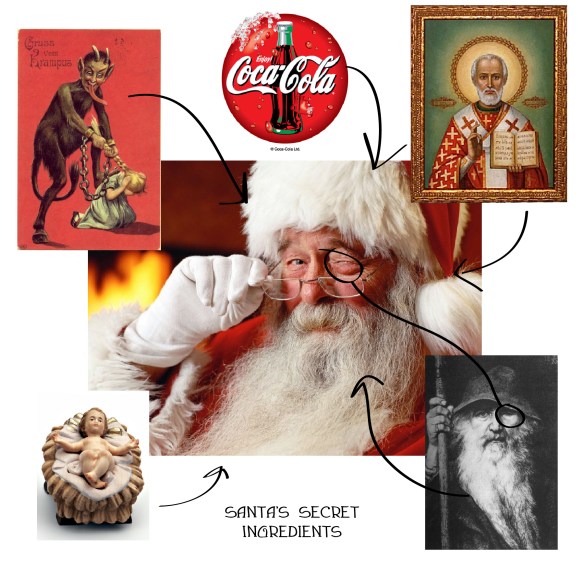
Santa, the Reindeer Shaman

origins-of-santa-claus-01

By Jerry B. Brown Ph.D. and Julie M. Brown M.A.

Source: Reality Sandwich

The following is excerpted from The Psychedelic Gospels by Jerry B. Brown, Ph.D. and Julie M. Brown, M.A., published by Inner Traditions. 

On Christmas Eve, when the streets are all covered with snow and a hush falls over the land, parents recite the story of Santa Claus to wide-eyed children. They discreetly wink as they tell the timeworn tale of a jolly old elf who is dressed all in red and white from his head to his toes. Miraculously, Santa travels around the world in one night, in a sleigh pulled by flying reindeer, stopping at each home to place gifts under the Christmas tree festively decorated in tinsel and colorful ornaments with a star on top.

How improbable! How curious! But what if this snow-white lie, which we dutifully recount each year, was grounded in an ancient reality whose roots reach back thousands of years to the vast forests of Siberia? What if the real story of Santa was even stranger than that of the commercial myth of Saint Nick, the little sleigh driver “so lively and quick”? What if it was stranger than most of us could ever imagine?

It was high in the Cairngorms in the heart of the Scottish Highlands that Julie first heard the true story of Santa Claus and his flying ­reindeer. Driving east from the Isle of Skye, where we spent our twenty-fifth anniversary, Julie and I stopped in Inverness, located at the north end of Loch Ness. From there, we followed route A9 as it twisted and turned up into Cairngorms National Park. After lunch in the alpine resort town of Aviemore, Julie made a few phone calls and found lodging at the Braeriach Guest House. Sitting on the banks of the River Spey in the quaint village of Kingcraig, this two-story stone-walled Victorian inn has five guest rooms, all furnished with wooden sleigh beds. The view from our bedroom window looked out past a flower garden to the fast-moving river, on to a wide pastoral valley dotted with black-and-white cows, and up to the peaks of the snow-capped mountains. Over tea that afternoon, we asked our innkeeper Fiona, a refugee from the hubbub of London, what we should see during our stay.

“Oh, my favorite place would be to visit the wild reindeer. When you return, you can have dinner at the Boathouse Restaurant, only a twenty-minute walk from here through the forest.”

The following morning we drove to the long wooden cabin that housed the Cairngorm Reindeer Center. There we met three other couples and our guides, Beth and William, who would lead us up into the mountains. Beth explained that the “reindeer were reintroduced into Scotland in 1952 by a Swedish reindeer herder, Mikel Utsi. Starting from a few reindeer, the herd has grown in numbers over the years and is currently held at between a hundred and thirty and a hundred and fifty by controlling breeding.”1 About fifty of these reindeer live in a natural environment in the forests and highland plateaus nearby. The region is rich with lichen, the chief food of reindeer.

After the orientation we drove in a car caravan up a steep, curvy road. After parking in a small clearing, everyone donned knee-high Wellington boots. It was a cold day, and the trail was wet and muddy from a drizzling rain. We were excited and a bit apprehensive at the thought of encountering creatures in the wild. As the trail opened onto a large pasture, bordered by a dense dark-green forest, the sun broke through the clouds and the rain lifted. As we shed our rain gear, Will put down the sack of food he had carried on his shoulder and instructed us how to behave around the reindeer—who were still nowhere to be seen. “You can pet them, even touch their noses, but not their antlers. They grow very fast, a couple of inches a week, and are very sensitive.”

Just then, Beth began bellowing loudly. It felt eerie to be huddled together on a chilly hilltop while our guide howled into the wilderness. It took a minute before we realized that she was rounding up reindeer. Suddenly, we saw a huge light-brown stag emerge from the woods. He strode majestically toward us, his giant antlers swaying to and fro. Another reindeer followed and then another, slowly walking toward us, a plodding procession of caribou.

As the males, females, and calves drew closer Beth began calling them by name: Sting, Marley, Cranna, Oryx, Gandhi, Magnus . . . Elvis. As the herd approached, Will opened the sack and scooped pellets of food into our hands, telling us to pick a reindeer and go up to him slowly with outstretched arms. I walked up to a large bull. He nuzzled his warm, silky nose into my palms, gently licking them clean. Julie stood back and observed. Soon, everyone was talking, smiling, and even giggling at the sheer delight of being in the presence of these gentle caribou.

Julie noticed an albino reindeer standing off to the side, away from the herd. She asked Beth why he did not join the group.

“Oh, him. Sircus is his name,” Beth replied. “He only takes food from me or Will. He’s a real loner.”

“Really? Do you know why?” Julie inquired.

“I think it’s because he loves mushrooms so much,” Beth said.

At the mention of mushrooms, Julie’s ears perked up. She glanced over at me with a knowing look. Aha, she thought.

“Now, don’t get me wrong,” Beth continued. “All reindeer love fly agaric, but for Sircus they are his favorite food, even more than lichen. Sometimes, during the summer mushroom season, he eats so many that he just stands there mesmerized, staring into the sun, swaying back and forth. That’s why his face is so blotched and pink. It’s sunburned.”

As Beth finished speaking, Sircus turned toward Julie and without hesitation walked up to her. He placed his soft muzzle into her palms and ate slowly, all the while looking into her eyes. Julie glanced toward me, her face beaming. She stood still for a long while, gently petting Sircus. Then, just as quickly as they had appeared, the reindeer turned and ambled back toward the forest. Sircus followed. Everyone was silent on the downhill walk back to the cars.

“Jer,” Julie said softly to me, taking my hand along the trail, “I swear I had a real connection with Sircus, as if we knew each other. Don’t you think it strange that I could have such a spiritual encounter with a reindeer?”

“Yes, you must be Saint Francis of the animals,” I said.

Julie laughed and nodded her head in affirmation.

Rudolph, the Red-Nosed Reindeer

Once back at the inn, I was tired from our excursion and lay down to take a nap. But when I happened to glance over at the bookshelf next to the bed, I noticed the Field Guide to Mushrooms of Great Britain. Soon, I was turning its richly illustrated pages. After finding Sircus’s favorite, the red-and-white Amanita muscaria, I eventually fell into a deep and restful sleep.

When I awoke, I carried the field guide downstairs, planning to show it to Julie. I found her sitting near a roaring fireplace. She was engaged in animated conversation about our reindeer adventure with the other houseguests: Anne and John, a well-groomed, middle-aged couple from Devon, whose English accent I could understand if I listened carefully, and Bonny and Sid, young punk bikers from Liverpool whom I could barely understand at all. No wonder George Bernard Shaw observed, “England and America are two countries separated by a common language.”

After Julie mentioned that the Reindeer Center rented the caribou out during the Yuletide season to pull sleighs bearing gifts for children across Great Britain, the conversation turned to Christmas and Santa Claus.

“Does anyone know what Santa has to do with Christmas, the birth of Jesus, and this?” I asked, opening the mushroom field guide and showing everyone the photo of the bright red Amanita mushroom covered with snowy white dots.

Before I could finish the sentence, I felt Julie’s two hands firmly tugging on my arm, as she said in her calming therapist’s voice, “Sorry to interrupt, honey, but if we don’t leave now, we won’t be able to walk to dinner and back before dark.”

We strolled under tall trees whose leaves sparkled in the late afternoon sunlight. The air carried a sweet scent of wildflowers. Soon we came to the rustic restaurant on the banks of an alpine lake. After finishing the delectable grilled trout fresh from the lake, Julie asked pointedly, “What were you thinking back there?”

“I was just trying to explain my theory of Santa Claus,” I said defensively.

“I . . .” “Come on. You know what I’m talking about,” Julie objected. “What about our vow of secrecy, the one we made to each other at the beginning of this trip? Right before I escorted you out the door, you were about to blurt out that we were searching for the psychedelic roots of Christianity. I need to know that you won’t go around talking to people about our work while we are on this research trip.”

“Okay, I promise,” I replied.

“Now, tell me,” Julie said with a sigh of relief, “what were you trying to say about Santa back there at the inn?”

“While most people think of Christmas in terms of the quintessential Christian celebration,” I began, “the truth is that nearly all of the symbols associated with Santa Claus are based on the shamanic traditions of pre-Christian Europe.”

“I always thought of shamanism as a tribal religion,” Julie said. “I certainly never thought of Santa as a shaman! What do you mean?”

Archaic Techniques of Ecstasy

The classic anthropological definition of shamanism comes from ­Mircea Eliade (1907–1986), who described it as “archaic techniques of ecstasy.” By “ecstasy” he was invoking the Greek term ekstasis, which literally means “to be outside oneself” and in this context figuratively means “flight of the soul.” In essence, shamanism refers to ancient methods for inducing the flight of the soul, for both the living and the recently deceased. One of the most concise descriptions of the ­universal ­foundations of shamanism is found in Peter Furst’s Hallucinogens and Culture. These foundations include “the skeletal soul of man and animal and the restitution of life from the bones; all phenomena in the environment as animate; [and] separability of the soul from the body during life.”

At the very center of these belief systems stands the persona of the shaman and his or her unique ecstatic experience. With the aid of spirit helpers he can travel to and intercede with the supernatural forces of the Upperworld and Underworld whose mystical geography he has traversed through training and trance. Frequently, although not always, his mastery comes from the use of sacred psychoactive plants, which serve both as a portal to other realms and as a source of transforming power or “soul stuff.” With the concept of “transformation” so fundamental to this worldview, it is easy to see why sacred plants with the power to radically alter consciousness and provide direct access to these supernatural realms would be universally revered in ancient religions. Throughout prehistory the religions of our ancestors were shamanistic.

“But how does shamanism work?” Julie asked.

Seeing a puzzled look on Julie’s face, I searched for an analogy.

“Imagine yourself,” I replied, “as a Koryak reindeer herder living a nomadic existence in the endless boreal forest belt of Siberia. You live in a world without maps, compasses, or clocks and certainly without GPS. Season upon season you travel with your clan and reindeer herd through a seamless landscape of green and brown forests sometimes interrupted by the blues and grays of lakes and rivers. Then one day you watch your favorite reindeer nibble on a bright red-and-white mushroom that popped up out of the moist ground overnight. Suddenly, the reindeer begins to cavort about in a very un-reindeer-like fashion. You try the mushroom and soon find yourself transported through magical landscapes filled with talking spirits who instruct you how to live well and prosper.”

Julie was listening intently as I asked her, “So what would you think about this world?”

“That it was showing me a spirit world that could help me thrive in the natural world,” Julie replied.

“Precisely,” I agreed, “and that’s the point. For tribal peoples, these supernatural realms were accessed through the shamanic flight of the soul. It’s only within the context of shamanism that we can understand the true origins of Santa Claus.”

Mushroom Rock Art of the Chukchi

Often overlooked and certainly overshadowed by Wasson’s cracking of the Soma code in the Rigveda is his equally surprising discovery of an ancient “Siberian fly-agaric complex” among the ancient indigenous peoples of the Arctic Circle. Peering deep into the wellsprings of time long before the Aryan invasion on the Indus Valley,* Wasson traced the roots of Aryan worship of the Soma mushroom back some six thousand years to the semi-nomadic reindeer herders of Eurasia known to anthropologists as the fathers of shamanism. Today there remain some three hundred thousand reindeer herders divided into thirty ethnolinguistic groups.†

*According to the widely accepted Aryan invasion theory, between the fourth and second centuries BCE, several migrations occurred involving different Proto-Indo-Aryan groups from the steppes of central Asia toward the alluvial plains and valleys of northwest India. However, academics continue to debate whether the Indo-Aryans invaded and assimilated the less sophisticated Indus Valley cultures, or whether the Indo-Aryans moved in as the superior Indus Valley civilization was in a state of decline, adopting their mythologies and technologies. †They inhabit three far-flung, forest-belt regions of Russia and Scandinavia. Among them are the Lapps and Nenets in the Far West; the Ostyak, Samoyed, and Vogul of the central tundra and taiga zones; and the Chukchi, Koryak, and Kamchadal who live in the extreme Far East of Russia.

When Wasson published Soma in 1968, he had to rely on secondhand data derived from folk tales and linguistic analysis and on the firsthand accounts of “explorers, travelers, and anthropologists” who visited these remote regions as far back as the late eighteenth century.4 At that time he was unaware of recent Russian archaeological expeditions that had found iconic evidence—dramatic images etched in stone—of the use of psychoactive mushrooms among the ancient Chukchi.

During field expeditions in 1967 and 1968, Russian archaeologist N. N. Dikov discovered numerous mushroom and reindeer petroglyphs (rock carvings dating from 1000 BCE) on the banks of the Pegtymel River in the Far Eastern Chukotka region, located across the Bering Sea from Alaska. These rock drawings graphically reflect the worldview of nomadic herders and their traditional shamanic practice of ingesting Amanita muscaria. Since that initial discovery, Russian researchers have identified more than two hundred similar compositions at rock art centers in northern Russian, mainly in areas inhabited by reindeer herders.

The central images of these carvings are reindeer and an increasing number of “incomparable” anthropomorphic images of people, mainly women, wearing huge mushroom-shaped hats or, in another interpretation, dancing women with mushrooms hovering over or emanating from the crowns of their heads.

The northern region where these figures are found is one where fly agaric thrive. In a later work, observing that these “doubtless” Amanita muscaria “mushrooms were much larger in scale than normal,” certainly when compared to the humanlike figures, Wasson concurs that this suggests “mushroom possession.” A common theme in these visions is the personification of the spirit (wapaq) of the mushroom as “little men or women.” The Koryak believe that the spirits residing in the fly agaric appear in the form of tiny mushroom folk who give instructions to the be-mushroomed person. One observer reports that among the Ob-Ungrians, “the mushroom eater enters the realm of the little people, talks with them, learns from them what he wishes to know—the future, the outlook for a sick person, etc.”

Santa, the Reindeer Shaman

“So are you saying that the story of Santa Claus originated with the reindeer herders?” Julie asked.

“Not at all,” I replied, “simply this: while most people think of Christmas in terms of the classic Christian holiday, the truth is that most of the symbols associated with Santa Claus are based on the religious traditions of pre-Christian Europe. In fact, every major meme of our modern myth of Santa Claus can be found in Wasson’s pioneering description of a Siberian fly agaric–reindeer culture.

“Convince me,” Julie insisted.

“Okay, I will,” I replied.

Flying Reindeer

In Soma, Wasson notes that “reindeer have a passion for mushrooms and especially for the fly-agaric, on which they inebriate themselves. Reindeer have a passion for urine and especially human urine. (When the human urine is impregnated with fly-agaric, what regal cate is there, to be served to a favored reindeer!)”9 In fact, some herders carry sealskins filled with their own urine to lure stray reindeer back to the herd.

Reindeer have a seminal place in the lives of these semi-nomadic herders as the primary source of useful everyday articles and of spiritual significance. Practically, the reindeer provide transporation by sleigh, food and milk, clothing, shelter in the form of skins for yurts, tools, and many other necessities. Spiritually, flying reindeer serve as guides for shamans, transporting them through the spirit world. The hundreds of flying reindeer megaliths found in Siberia and Mongolia offer graphic representations of myths and legends about winged reindeer who transport their ecstatic riders up into the highest branches of the Cosmic Tree, universally revered by ancient peoples as the Tree of Life.

Christmas Tree as Cosmic Tree

In addition to the nearly universal flood myth similar to the story of Noah in the Bible, many tribal cultures have a deep belief in a sacred Cosmic Tree. In the context of shamanism, this tree provides a cosmic axis around which the three planes of the universe revolve. Its roots run deep into the Underworld, its trunk holds Middle Earth, and its branches reach skyward into the Upperworld.

The birch, pine, cedar, and fir trees play a conspicuous role among Siberian cultures and serve as the nodal points for shamanism. But it was Wasson who first pointed out that birches and evergreens play an essential role in the life cycle of the fly agaric. This is because fly agaric has a symbiotic relationship with these trees in that its invisible spores colonize the host trees’ roots prior to the mushroom bursting into view aboveground as an early stage Amanita muscaria, wrapped in a pure white veil. As a result, tribespeople were amazed to witness how these mushrooms apparently sprang from the earth without any visible seeds in what appears to be a virgin birth.

Like the Cosmic Tree, the center point between heaven and earth, the North Star is also considered sacred. Among reindeer herders, it is also known as the “Immobile Star” or the “Pole Star,” because all the stars in the heavens revolve around it. Thus today we symbolically place a star at the tippy-top of the Christmas tree, and for this reason Santa makes his home in the North Pole.

Santa, the Archetypal Shaman

Our contemporary image of Santa Claus as a rotund, jolly, white-bearded fellow in a red suit (or robe) with white fir trim is a modern version of the archetypal Siberian mushroom shaman. In fact, even today some Siberian male shamans and female mushroom gatherers still dress in ceremonial red-and-white trimmed jackets when they go to gather the sacred mushrooms. The biochemical effects of Soma are most pleasant and transformative when the mushrooms are dried before consumption. For this reason, the shaman initially hangs the fresh fungi to dry in the branches of pine trees (like the colorful ornaments that decorate the Christmas tree).

After the mushroom harvest is complete, the shaman collects his gifts in a sack and places them on his sleigh, which a team of reindeer pulls back to his yurt (Santa’s sleigh full of toys, pulled by flying reindeer). A yurt is the nomad’s teepee-like dwelling typically made out of birch branches and reindeer hides. In winter, snow drifts can cover the yurt’s main entrance, so the shaman enters through the smoke hole at the top (Santa coming down the chimney) to deliver his gifts to appreciative clan members. To further dry the mushrooms, they string them up around the fireplace, and in the morning they awaken to a ritual feast of dried magic mushrooms (Christmas gifts placed in stockings over the fireplace). Once they ingest the mushrooms, the celebrants leave the physical plane and are transported to the mystical realms of the Cosmic Tree, guided by spirits that live within the mushrooms (Santa’s helpers, elves that live in the North Pole).

All of these Christmas themes include the image of Santa Claus: the Christmas tree, the flying reindeer pulling Santa’s sleigh, Santa coming down the chimney, the exchange of gifts—even the elves who live in Santa’s workshop at the North Pole.

Dusk was falling as we started to walk back around the lake toward the inn. The Santa Claus conversation had sparked Julie’s inquisitiveness. “What about the Christian Saint Nicholas?”

“To be sure, religious historians argue that many saints were simply Christian versions of earlier pagan gods, adapted by the church to encourage heathens to accept the new religion of Rome. It is said that Saint Nicholas’s legends were created mainly out of folk tales about the Teutonic god Hold Nickar, a malevolent water spirit who tips over boats and torments sailors, or even about Alte Hoerner, which stands for ‘Old Horney.’

Julie smiled at the sexual reference to Santa Claus.

“No, no, it’s not what you’re thinking. In old German, Alte Hoerner literally means ‘old horned one’ and in this case the ‘ancient horned god,’ referring to the headdress of reindeer antlers worn by Eurasian shamans. Later on, when pagan deities were demonized by the medieval church under Pope Gregory, the horned god of shamanism became the devil of Christianity. And ‘Santa’ became ‘Satan.’”

“Rings of Smoke through the Trees”

“Look, look around us!” whispered Julie. A low-hanging cloud was slowly creeping through the woods, completely encircling us in a ring of ghostly white gossamer. The mist moved silent as cat paws, covering the ground and the trunks of the trees in a blanket of clouds. The tops of trees stood bare, silhouetted against the gun-metal sky and the fading sun, silent sentinels of the forest.

“Jer,” Julie spoke, in hushed tones, “this is unearthly. All evening, we’ve been talking about the way of the shaman, portals between the worlds, about how all things are alive with spirit.”

“Look,” I said, patiently, “just because this rare cloud rolls in just as we were discussing shamanism doesn’t mean there’s a connection. You can’t prove that; no one can.”

“No, I can’t prove it,” Julie spoke quietly, “but think about what’s happened today! We came to the mountains for vacation, and I met Sircus, an albino, Amanita-loving reindeer, who walks up to me and peers into my soul. We spend the evening talking about mystical realms. And now all around us the forest is alive, as if the living spirit of nature was welcoming us to the world of the shaman . . . affirming our decision to retrace Wasson’s steps.”

I was about to object, but just then these lines from Led Zeppelin’s “Stairway to Heaven” ran through my head: “There’s a feeling I get when I look to the west/ And my spirit is crying for leaving. In my thoughts I have seen rings of smoke through the trees/ And the voices of those who stand looking. Ooh, it makes me wonder/ Ooh, it really makes me wonder.”

We stood silently in the middle of the mist-filled forest, wondering what the future would bring. At our next stop in Greece, the cradle of Western civilization, we walked among the monumental ruins of Eleusis, where rituals involving entheogens had been practiced for two thousand years.

Saturday Matinee: BoJack Horseman Christmas Special

960

For those not familiar with the animated series “BoJack Horseman”, it’s a satire of Hollywood and celebrity culture centering on BoJack, a washed-out and self-destructive former star of a 90’s sitcom. In the BoJack Horseman Christmas Special: Sabrina’s Wish, BoJack and slacker friend Todd attempt to overcome holiday depression with a viewing of a Christmas episode of his old sitcom “Horsin’ Around”. Features the voices of Will Arnett, Amy Sedaris, Alison Brie, Aaron Paul, Fred Savage and Stanley Tucci.

Watch the full episode here:

‘Then We Will Fight in the Shade’ – A Guide to Winning the Media Wars

screen-shot-2016-12-08-at-9-32-54-am-768x326

By Michael Krieger

Source: Liberty Blitzkrieg

Victorious warriors win first and then go to war, while defeated warriors go to war first and then seek to win.

– Sun Tzu, The Art of War

The ongoing battle between independent, alternative media and legacy corporate-government sponsored propaganda media is in full swing following Donald Trump’s victory in the 2016 election. While I’m no big fan of Trump, his win has so emotionally damaged the U.S. status quo they have begun to lash out in a hysterical and careless manner against those they feel prevented Her Highness, Hillary Clinton, from ascending to the throne.

The escalation of this fight, which I have referred to as “The Media Wars” since the summer, was easy to foresee. As I noted in the post, Questioning Hillary’s Health is No Conspiracy Theory:

As I look at the landscape in 2016 to-date, I observe emergent signs that alternative media is finally beginning to take over from the legacy mainstream media when it comes to impact and influence. The mainstream media (unlike with John McCain in 2008), had decided that Hillary Clinton’s health was not an issue and chose not to pursue it. Many in the alternative media world took a different position, and due to mainstream media’s failure to inform the American public for decades, the alternative media drove that issue to the top of the news cycle. That’s power.

This is an incredibly big deal, and the mainstream media intuitively knows what it means. It means a total loss of legitimately, prestige and power. All of which is well deserved of course.

So here’s the bottom line. 2016 represents the true beginning of what I would call the Media Wars. Alternative media is now capable of driving the news cycle. Mainstream media now has no choice but to fight back, and fight back it will. It will fight back dirty. This is going to get very ugly, but by the time the dust has settled, I think much of the mainstream media will be left as a shell of its former self.

2016 was the year when alternative, independent media went from being merely influential, to affecting the outcome of a Presidential election. As was widely reported, basically every single newspaper in the nation endorsed Hillary Clinton for President. The fact she lost anyway represented the greatest middle finger to the media (and the status quo generally) doled out by the American public in at least a generation.

While genuinely fake Macedonia-based news sites certainly garnered a lot of clicks (and revenue) by inventing ridiculous stories, anyone who really thinks this is what led to Hillary’s defeat is simply in denial. We all know that independent websites taking Hillary to task on her very real and very deplorable track record of being a compulsive liar is what was truly decisive. The mainstream media knows this, which is why they haven’t actually been focusing on censoring provably fake news sites, but rather have been promoting an agenda to lump any non-establishment perspectives within the umbrella of “fake news” in order to destroy their competition and regain an upper hand in the national narrative. If those of us who value independent media want to thwart this nefarious plan, we need to fully understand what these cretins are up to.

To that end, I want to turn your attention to one of the best articles I’ve read on the topic. Published at Counterpunch and titled, Manufacturing Normality, here are a few excerpts (definitely make sure to read the entire thing):

Sometime circa mid-November, in the wake of Hillary Clinton’s defeat (i.e., the beginning of the end of democracy), the self-appointed Guardians of Reality, better known as the corporate media, launched a worldwide marketing campaign against the evil and perfidious scourge of “fake news.” This campaign is now at a fever pitch. Media outlets throughout the empire are pumping out daily dire warnings of the imminent, existential threat to our freedom posed by the “fake news” menace. This isn’t the just the dissemination of disinformation, propaganda, and so on, that’s been going on for thousands of years … Truth itself is under attack. The very foundations of Reality are shaking.

Who’s behind this “fake news” menace? Well, Putin, naturally, but not just Putin. It appears to be the work of a vast conspiracy of virulent anti-establishment types, ultra-alt-rightists, ultra-leftists, libertarian retirees, armchair socialists, Sandernistas, Corbynistas, ontological terrorists, fascism normalizers, poorly educated anti-Globalism freaks, and just garden variety Clinton-haters.

As I suggested in these pages previously, what we are experiencing is the pathologization (or the “abnormalization”) of political dissent, i.e., the systematic stigmatization of any and all forms of non-compliance with neoliberal consensus reality. Political distinctions like “left” and “right” are disappearing, and are being replaced by imponderable distinctions like “normal” and “abnormal,” “true” and “false,” and “real” and “fake.” Such distinctions do not lend themselves to argument. They are proffered to us as axiomatic truths, empirical facts which no normal person would ever dream of contradicting.

In place of competing political philosophies, the neoliberal intelligentsia is substituting a simpler choice, “normality” or “abnormality.” The nature of the “abnormality” varies according to what is being stigmatized. Today it’s “Corbyn the anti-Semite,” tomorrow it’s “Sanders the racist crackpot,” or “Trump the Manchurian candidate,” or whatever. That the smears themselves are indiscriminate (and, in many instances, totally ridiculous) belies the effectiveness of the broader strategy, which is simply to abnormalize the target and whatever he or she represents. It makes no difference whether one is smeared as a racist, as Sanders was during the primaries, or as an anti-Semite, as Corbyn has been, or a fascist, as Trump has relentlessly been, or peddlers of Russian propaganda, as Truthout, CounterPunch, Naked Capitalism, and a number of other publications have been … the message is, they are somehow “not normal.”

Why is this any different from the shameless smear jobs the press has been doing on people since the invention of the press and shameless smear jobs? Well, hold on, because I’m about to tell you. Mostly it has to do with words, especially binary oppositions like “real” and “fake,” and “normal” and “abnormal,” which are, of course, essentially meaningless … their value being purely tactical. Which is to say they denote nothing. They are weapons deployed by a dominant group to enforce conformity to its consensus reality. This is how they’re being used at the moment.

The meaningless binary oppositions that the neoliberal intelligentsia and the corporate media are supplanting traditional opposing political philosophies with (i.e., normal/abnormal, real/fake), in addition to stigmatizing a diversity of sources of non-conforming information and ideas, are also restructuring our consensus reality as a conceptual territory in which anyone thinking, writing, or speaking outside the mainstream is deemed some kind of “deviant,” or “extremist,” or some other form of social pariah. Again, it doesn’t matter what kind, as “deviance” in itself is the point.

Actually, the opposite of deviance is the point. Because this is how “normality” is manufactured. And how consensus reality as a whole is manufactured … and how the manufacturing process is concealed.

The above hits the nails entirely on the head. It also explains why it took the Washington Post two weeks to even address the fact that it published a fake news article about “fake news.” Here’s how The Washington Post is “taking responsibility.”

screen-shot-2016-12-08-at-10-30-16-am

While absolutely pathetic, the editor’s note is equally telling in its sloppiness and arrogance. For instance, the article was a such a gross piece of journalistic malpractice, the only honest, professional move by the paper would be to fully retract the story and apologize; yet The Washington Post didn’t do that. Why?

The reason is because the paper and its editors knew exactly what they were doing with the publication and promotion of this nonsensical fake news hit-piece. Sure, they’re now a bit embarrassed because they were called out by pretty much everybody, but the intent all along was to tie independent media sites with absolutely no connection to Russia, to Russia, in a desperate attempt to recapture the public narrative via blacklists and tech company censorship.

As an aside, for specifics on how the status quo is attempting to use developers and social media companies to censor alternative opinion under the guise of fighting “fake news,” read this excellent article published at Naked Capitalism: Witch Hunt: “Fake News” Software Touted by CBS Smears Naked Capitalism, ShadowProof, TruthDig, Others; Creator Admits He Made Up Who Went on Hit List.

Now that we know what they are up to, how worried should we be? Although I’m extremely optimistic about the future of decentralized, independent media, and the proliferation of individual voices generally, it’s quite obvious legacy media gatekeepers will not go down without a fight. The good news is they are the ones who are on the defensive, not us. They are the ones who are battling on our terms, not the other way around. A great example of this can be seen in how the “fake news” meme has been turned around against the mainstream media to great effect. As I tweeted earlier today:

It is when you get desperate, scared and panicky that you make the biggest mistakes, and the legacy media is currently desperate, scared and panicky.  As Napoleon Bonaparte allegedly said:

“Never interrupt your enemy when he is making a mistake.”

Whether or not he actually said them, those words still ring true. We mustn’t get in the way of the legacy media’s inevitable self-destruction. Part of this means that we do not self-destruct in the process. We need to recognize that there’s a reason independent, alternative media is winning the battle of ideas in the first place. For all the warts, mistakes and bad actors, the emergence of the internet is indeed the historical equivalent of the invention of the printing press on steroids.

Only a clueless self-important elitist actually believes that the smartest, most informed people in America are the pundits on tv and the journalists employed by the mainstream media. With a handful of companies and a few oligarchs in charge, you’d have to be the most naive fool on earth to not understand that legacy media is driven by well defined narratives, and that these narratives are not in your best interest. The rest of us understand that the Internet has served as a much needed countervailing force, and has been an incredible blessing to human knowledge, connectivity and the marketplace of ideas. Just because some people can’t distinguish truth from fiction, doesn’t negate the incredible progress that decentralized information dissemination provides. It is only those who do not wish to engage in public debate on the issues themselves who want to censor stuff. The rest of us are more than happy to have an open discussion.

Many of us have spent years, if not decades, building up our online reputations and we should be careful not to squander all we have gained. There will be attempts at co-option, explicitly and otherwise. Be on guard. There will be hit-pieces and smear attempts. Stay cool and fight back from a position of strength and calm. However, I believe the greatest threat comes from the ever present danger of self-inflicted error. Part of the reason independent, alternative media has been so successful is legacy media has made it easy to look good by being so obviously captured, puerile and propagandistic. We must continue to be better than they are. As such, we must be more honest in our actions, less hypocritical in our analysis of events, and just more ethical overall. Given the competition, this shouldn’t be difficult.

Another way the status quo will fight back is by attacking our means of surviving financially, which means readers must be prepared to donate to your favorite sites more than ever before (you can support Liberty Blitzkrieg here). The other way will be to prevent our content from appearing on social media sites or search engines, or when it does appear, it will come with a warning. If this is the tactic they choose, it’ll be relatively easy to fight back.

Ten years ago it would’ve been hard to counter such a strategy, but not today. The cat is simply too far out of the bag. Too many of us reach too many people, and many of the people we reach are smart and influential. We have already sufficiently infiltrated and influenced the public discourse, so denying us a voice is no longer an option. If Facebook or Google start presenting Liberty Blitzkrieg, Zerohedge, or Naked Capitalism with warning labels, the intelligent amongst us with see right through this tactic and become disgusted.

So let me end this with a warning to Facebook, Google, and all the other tech behemoths. You start this fight at your own risk. Any disingenuous attempt to smear genuine, independent media websites via blacklists and censorship will ultimately harm you more than it harms us. In a misguided attempt to destroy us, you will destroy yourselves. Tread carefully and be on the right side of history.

To everyone else, stay strong. My writing would be irrelevant without you. It is not alternative media writers who will inflict the final blow against legacy media, it will be you, the readers. We are in this together and dependent on each other. Together we will win.

For related articles, see:

Obama Enters the Media Wars – Why His Recent Attack on Free Speech is So Dangerous and Radical

Hillary Clinton Enters the Media Wars

The Death of Mainstream Media

Liberty Blitzkrieg Included on Washington Post Highlighted Hit List of “Russian Propaganda” Websites

Additional Thoughts on “Fake News,” The Washington Post, and the Absence of Real Journalism

If you enjoyed this post, and want to contribute to genuine, independent media, consider visiting Liberty Blitzkrieg’s Support Page.

In Liberty,
Michael Krieger

New Era of Global Collective Psychosis

1449783307-brazil3_t600x332

By Gilbert Mercier

Source: News Junkie Post

Anybody who has been unfortunate to be in a car or plane crash, but lucky enough to survive it and tell the story afterwards knows the inherent paradox: the event occurred in the blink of an eye, but seemed, in retrospect, to have unfolded in a dreadful slow-motion sequence. What can be called the crash time elasticity contradiction is an accurate metaphor for our era. It is the deep dichotomy of an intuitive knowledge that we, as a global collective, are on a deadly collision course while wearing the distorted slow-motion rosy glasses of projection, looking into some fictional eternal future. If time has, by essence, no end, our life span as a foolish megalomaniac species is about to reach an ugly curtain call. While the end times is a religious fiction, our looming apocalypse is entirely man-made and, as such, is a mere by product of ignorance and collective apathy.

For the very few of us still trying to impact the discourse, it has become incredibly challenging not to give in and surrender to the general entropy of crash time. With so many with their heads in the sand, ignoring an imminent systemic collapse, the effort to wake people up has become more than a Herculean task. The overall attention span is so minimal that ideas are almost never transformed into actions but are just ephemeral ripples on the deep water of forgetfulness. The constant media assault with its cacophony of  killing mayhem, spectacles staged as reality, and propaganda passing  for news has thoroughly brainwashed many people into a state of uncomfortable numbness. Meaningful ideas could, not so long ago, make waves and even change the tide of history. Now, the words of complex concepts have been gutted of all significance and served for idea consumption as trending hash tags. The media brainwasher/propagandists have powerful bullhorns and are always hard at work to keep their vast audience either uninformed, anxious, and feeling powerless or entertained. The news cycle has to spin so fast that critical thinking is never an option.

This deliberate aggression on our collective psyche, switching in rapid daily succession, is similar to the sleep deprivation torture technique known to induce psychosis in individuals. As an example, here is a frantic but accurately summarized version of a recent chain of events which was conveniently tucked in between two feel-good big media stories: Euro 2016 in the sports/entertainment division and the Democrats’ convention in the politics/entertainment category. A mass killing in Nice, conveniently justifying a three-month extension of the state of emergency in France; a failed military coup in Turkey, conveniently allowing PM Erdogan to assert a near absolute dictatorship in the country; an attack in Munich allegedly from Islamists, conveniently allowing Chancellor Merkel to reverse her previously generous Syrian migrants asylum policy; the killing of more than 200 Shiites in Kabul, Afghanistan, conveniently ignored by most Western media outlets.

It can reasonably be argued, and easily demonstrated, that a disease afflicting a person usually quickly affects a community. This goes of course for the middle-age plague pandemic called the Black Death which killed an estimated 50 percent of Europe’s population, and more than 120 million people worldwide. Beside its death toll, which reduced  the world population by more than 25 percent during the 14th century, the plague pandemic induced deep collective psychological turmoil in connection with the interpretation that it was God’s punishment on mankind, and the start of the apocalypse. The plague revived the intolerance of religious fundamentalism. The Black Death was a foray into collective psychosis, where affected people were quarantined to die by the million from starvation.

A lot more recently, another form of collective psychosis struck humanity. That one was not a disease brought by rats, contaminated by infected fleas, to the shores of Europe, it was the ideology of  the Nazis in Germany, and their fascist allies in Italy and imperial Japan. During the Weimar Republic, which  spanned from 1919 to 1933, Germany was a culturally vibrant country at the vanguard in art, music, sciences, philosophy and literature. Nobody could have forecast that such an advanced civilization would become literally hypnotized by a mad man like Adolf Hitler. The global collective psychotic episode which engulfed the world between 1939 and 1945 and is called World War II, killed an estimated 72 million people worldwide. When one studies the history of mankind, it appears that mental disease combined with unusual charisma in a leader can be even more contagious than the plague in the middle-age. Contemporary Germans and Japanese suffer, in large part, from a convenient historical amnesia, but the evidence proves that their ancestors living during World War II were, by an overwhelming majority, fanatic supporters of  Hitler and the emperor.

Hitler and the Nazis used the powers of seduction, decorum and elaborate brainwashing strategies to propagate their brand of madness, but in the summer of 1945, across the Atlantic, a seemingly quiet and normal leader did the unthinkable with two criminally insane decisions. On August 6, 1945, unassuming Harry Truman had no moral issue with ordering the killing of 140,000 civilians in Hiroshima, Japan with atomic bombs. Truman coldly did it again three days later and killed another 80,000 in Nagasaki. The quiet little man should be remembered as the lunatic who established terror as state policy. In August 1945, Japan was on its knees. The atomic bombing of Hiroshima and Nagasaki was not about speeding up the end of World War II like American historic propaganda still claims, it was about asserting US hegemony and scaring the world into submission. It is not a coincidence that only the United States of America has used the atomic bomb in warfare; it has been the empire’s ultimate prerogative.

From August 1945 to the present, the biggest collective fear has been nuclear annihilation, but like lab rats are often exposed to unmotivated electric shocks, smaller doses of fear and paranoia are administered to the population almost on a daily basis. Mass killings in some part of the planet or another, have become extremely useful to condition people  into submission. In November, it will be a year since France has been under the boots of a state of emergency. Who would have thought that the country of revolution would have tolerated this? But again, who would have thought that Germany, Rwanda, Cambodia, and Yugoslavia could fall into the darkness of collective psychosis almost overnight? Who would have thought that a little man with the charisma of an accountant could have been mad enough to go on a rampage and kill 220,000 Japanese in August 1945? In a world gone mad, perhaps letting the criminally insane run the asylum is not such a good idea after all.


Gilbert Mercier is the author of The Orwellian Empire.

The Democrats “Russia Hacking” Campaign is Political Suicide

images

By Mike Whitney

Source: CounterPunch

The Democratic Party is doing incalculable damage to itself by shapeshifting into the party of baseless conspiracy theories, groundless accusations, and sour grapes. Hillary Clinton was already the most distrusted presidential candidate in party history. Now she’s become the de facto flag-bearer for the nutso-clique of aspiring propagandists at the CIA, the New York Times and Bezo’s Military Digest. How is that going to improve the party’s prospects for the long term?

It won’t, because the vast majority of Americans do not want to align themselves with a party of buck-passing juveniles that have no vision for the future but want to devote all their energy to kooky witch-hunts that further prove they are unfit for high office.

The reason Hillary Clinton lost the election is because she is a polarizing, untrustworthy warmonger. Period. Putin had nothing to do with it.

And the same rule applies to the major media that has attached itself leech-like to this pathetic fairytale. Here’s a clip from the Times headline story connecting FSB-agent Trump with the evil Kremlin:

“American intelligence agencies have told the White House they have “high confidence” that the Russian government was behind the theft of emails and documents from the Democratic National Committee. …

The attack on the congressional committee’s system appears to have come from an entity known as “Fancy Bear,” which is connected to the G.R.U., the Russian military intelligence service, according to an official involved in the forensic investigation…

Clinton campaign officials have suggested that President Vladimir V. Putin of Russia could be trying to tilt the election to Mr. Trump, who has expressed admiration for the Russian leader.” (Computer Systems Used by Clinton Campaign Are Said to Be Hacked, Apparently by Russians, New York Times)

If there was a Pulitzer Prize for fearmongering innuendo or spurious accusations, the Times would win it hands-down. As it happens, readers have to delve much deeper into the article to find this shocking disclaimer:

“But the campaign officials acknowledge that they have no evidence. The Trump campaign has dismissed the accusations about Russia as a deliberate distraction…..”

“No evidence”???

They got nothing. NOTHING!

All they have is a few anonymous agents who refuse to identify themselves speculating on alleged hacking incidents that (they surmise) were the work of Vladimir P. Strangelove in his remote Soviet Cyber-war bunker. That’s not even enough material for a decent spy thriller.

But, of course, all this bunkum about “Fancy Bear” and  “Russian military intelligence” and the “high confidence” of (unnamed) US intelligence agents is enough to scare the hell out of many readers and leave them with the impression that the Kremlin is up to its old Cold War tricks again.  The Times editors are wise enough to know that it’s quite easy to tap into 40-years of anti-Soviet brainwashing and convince the gullible sheeple that Washington and Moscow are still mortal enemies. It would have been helpful if the Times had given the story a bit of context, that is, pointed out that the US has relentlessly expanded NATO eastward establishing military bases in all of the former Soviet satellite states, toppled the Moscow-friendly regime in Ukraine, and built nuclear weapons sites in east Europe just a few hundred miles from Moscow.

The Times writers might have also noted that this latest propaganda campaign against Russia could very well be the result of Moscow’s triumph over US-backed militants in Syria that are facing a decisive defeat due in large part to Russian involvement. In other words, the Times and the other US propaganda organs are functioning as they always do, whipping up public sentiment against the “evildoers” so Washington can drag the country into another imperial war of expansion. The whole “hacking” mantra fits perfectly with the Pentagon’s hybrid war strategy which manipulates information in order to shape public perceptions and gain support for another round of genocidal violence in some far-flung location. (Raqqa, perhaps?)

Do you think that bloodthirsty Hillary would be on-board with such a plan?

Of course she would. Hillary never met a war she didn’t like.

But let’s cut to the chase: Putin didn’t lose the election for Hillary. Obama did. People wanted change, and they didn’t get it, so they moved on to Door Number 2: Donald Trump. Take a look at these three short clips from a recent survey from PEW Research and you’ll get a feel for what really happened in the election:

“The Republican Party made deep inroads into America’s middle-class communities in 2016. Although many middle-class areas voted for Barack Obama in 2008, they overwhelmingly favored Donald Trump in 2016, a shift that was a key to his victory…..In 2016, Trump successfully defended all 27 middle-class areas won by Republicans in 2008. In a dramatic shift, however, Hillary Clinton lost in 18 of the 30 middle-class areas won by Democrats in 2008…

Overall, Democrats experienced widespread erosion in support from 2008 to 2016. Their share of the vote fell in 196 of the 221 metropolitan areas examined. The loss in support was sufficiently large to move 37 areas from the Democratic column to the Republican column…

Not coincidentally, Democrats also were more likely to have lost ground in manufacturing-dependent areas. Of the 56 communities with a relatively large share of manufacturing jobs, Trump picked up victories in 15 metro areas that had supported Obama in 2008 and held onto another 29, leaving only 12 communities in the Democrats’ column.” (GOP gained ground in middle-class communities in 2016, Pew Research)

Get it? The Dems lost ground everywhere because Obama didn’t deliver the goods. That’s reason number one. Second, Hillary didn’t address the issues that ordinary working people really care about. And what they care about is the economy. Money, security, jobs. Is that hard to understand?

People are afraid because things are getting worse not better. Their standards of living are slipping, they’re worried about their retirement, their jobs, their health care, and the pile of debt their kids have accumulated to go to college. They’ve lost confidence in the media, the congress, the courts and the president who promised change but never lifted a finger for working people his entire time in office.

That’s why Hillary lost, just look at the research.

The Democrats have no vision for the future, and without vision, the party will disintegrate which is precisely what’s happening. The Democratic Party is disintegrating before our very eyes. This latest “Russian hacking” diversion is just speeding along the process.

MIKE WHITNEY lives in Washington state. He is a contributor to Hopeless: Barack Obama and the Politics of Illusion (AK Press). Hopeless is also available in a Kindle edition. He can be reached at fergiewhitney@msn.com.

Five Ways America Is Like a Third-World Country

Some+of+the+90,000+abandoned+and+derelict+homes+of+Detroit

By Nathan Wellman

Source: U.S. Uncut

The United States of America is possibly the wealthiest nation in the history of the world. However, many third-world countries actually surpass America in many of the most vital gauges for measuring human development.

Here are five of the most jaw-droppingly unforgivable ways in which America is lagging behind the rest of the world:

1. America’s criminal justice system is broken

The U.S. represents only 5% of the world’s population, but this one country comprises 25% of the world’s prison population. According to the NAACP, a disproportionate 58% of America’s prisoners are African-American or Hispanic despite these demographics only adding up to about 30% of the U.S. population.

The only nation that imprisons a greater percentage of its citizens than America is North Korea. The U.S. jails 716 people for every 100,000 Americans, according to the International Center for Prison Studies. That’s nearly twice as many as Russia (484 prisoners per 100,000), and far more than Iran (284) or China (121). For context, the U.S. only jailed around 100-200 people per 100,000 citizens in the 1970s, and the incarcerated rate is only getting worse today, even as crime rates fall. A staggering 60% of prisoners are in jail for nonviolent drug charges.

Inside prison, about 600 victims are raped every day, according to an estimate from the Justice Department. An in-depth DOJ investigation found that of the approximate 217,000 prisoners raped each year, 17,000 were juveniles.

2. Gun Violence is an epidemic

America has 20 times more murders when compared to the average rate of the developed world. Even terrorism-plagued Iraq has half the murder rate of the U.S. Over half of the deadliest mass shootings from the last 50 years happened in America, and 79% of those shooters got ahold of their guns legally. Some American cities, particularly New Orleans and Detroit, even surpass many Latin American countries, which suffer from some of the highest gun violence rates in the world.

3. Healthcare costs too much and delivers too little

America is the only developed country that does not ensure healthcare to all of its citizens. Even in the wake of the Affordable Care Act, millions of poverty-stricken Americans have no medical insurance because Republican governors have refused to expand Medicaid, even though the federal government is paying the cost and the simple measure would actually save money for their states.

Life expectancy in many American counties is lower than Nicaragua, Algeria, or Bangladesh. The U.S. is unusual among developed countries in that Americans die in the tens of thousands as a direct result of a lack of health insurance. America also spends twice the percentage of our GDP on healthcare than the average wealthy country for these substandard results.

America also suffers from the highest infant mortality and teen pregnancy rate in the developed world.

4. Inequality is rampant

Researchers have shown that economic inequality directly correlates to public distrust in government representatives, as well as a decrease in health and well-being.

Unfortunately, the U.S. has the worst rates of income inequality in the world, according to the 2015 Global Wealth Report conducted by Allianz. The wealthiest one percent of Americans own nearly half of the nation’s wealth invested in stocks and mutual funds, and the overall gap between rich and poor has only grown since the recession, with almost all income gains going to the top 1% since 2009.

Despite the idea of America being a meritocracy, those born in the poorest 20% of the American population have less than a 3% chance of making it to the top quintile.

5. Infrastructure is crumbling

America is quite literally falling apart.

One study concludes that the U.S. needs to invest $3.6 trillion into infrastructure over the next six years. One out of every nine American bridges (66,405 bridges) have been labeled “structurally deficient.”

Water runs through dilapidated wooden pipes in certain parts of South Dakota, Alaska, and Pennsylvania. Some of Detroit’s sewer lines still used today were originally constructed in the mid-1800s.

A whopping 45% of Americans have no access to public transit, and the construction of the infamously still-incomplete Second Avenue subway line in New York City has been hit with delays dating all the way back to World War II.


America certainly has and continues to achieve greatness in many ways. But if we want to truly earn our oft-proclaimed slogan of “Greatest Country in the World,” these fatal flaws in our system must be acknowledged and addressed. Otherwise, the emperor will continue to parade about with no clothes, and we run the risk of being completely surpassed by a world marveling at our oblivious nakedness.