Let’s start by stipulating the obvious: no one knows the future, and most of the guesses–oops, I mean forecasts–will be wrong. Arguing about the forecasts now won’t make any difference as to which ones are correct and which ones are wrong. Time alone will tell.
That said, here’s a scenario that fits the dynamics I see as most consequential: Core-Periphery and the demise of the waste is growth / financialization / globalization model as the reigning model of how the global economy should work.
Core-periphery dynamics are pretty simple: unraveling starts on the periphery and seeps toward the core. The core actually strengthens in the process as capital and talent seek havens where they’re treated well, and the core became the core by treating capital and talent well.
The periphery responds to the unraveling of financialization / globalization by tightening its grip on whatever capital and talent is still available, incentivizing the flight of capital and talent to the core.
A great many people think there are many core economies. In my analysis, there is only one, due to the qualifying requirements: 1) issues a reserve currency, i.e. not pegged to another currency 2) liquid global markets for securities, debt, commodities, etc., i.e. anyone anywhere can trade in size in the core markets 3) transparent market and governance mechanisms, i.e. no overnight devaluations, expropriations, capital restrictions, etc. 4) diverse economy not dependent on exports or imports for its well-being and 5) ease of flow: capital, talent, enterprises and employees all have essentially unlimited freedom of movement within the core.
We can argue about which nations qualify as core but it won’t change the outcome. Capital and talent will make their own decisions about risk, safety, exposure to devaluation and expropriation and where the odds of being treated fairly are highest. It’s a good exercise to put yourself in the shoes of a manager of a $10 billion fund and go through the decision tree of where to put this $10 billion to preserve its purchasing power first and foremost, and secondarily generate a return.
Would you really gamble $10 billion on a 15% return on the bonds of Timbukthree, whose currency has fallen 20% against the U.S. dollar this year? Or Timbukfour, which is dependent on exports of commodities in a shrinking global economy? Or Timbukfive, which is dependent on imports of commodities and exports of consumer goods in a shrinking global economy?? If you answer “yes,” you’re not actually playing like you are responsible for $10 billion.
As the periphery unravels financially, it also unravels politically and socially. Bordering states are at risk of destabilizing, and any entity with large exposure to the unraveling debt or markets starts unraveling, too. The destabilization spreads to second-tier nations whose exposure to the dynamics of unraveling are structural.
As all these dominoes fall, eventually those closest to the core also crumble, and then core itself is finally destabilized.
Humans have an interesting talent for adjusting to new circumstances, i.e. habituating to new conditions. Those households consuming 14,000 gallons of fresh water a month may well scream that they can’t possibly get by on 12,000 gallons, but then if circumstances change and all the water we have is what we can carry in buckets a kilometer over rough terrain, we find that we can live on the few gallons we can carry a kilometer.
The amount of waste in developed economies is beyond easy measure. It’s estimated 40% of all food in the U.S. is wasted. Energy, food and fresh water have been treated as if low cost and abundance were birthrights rather than brief explosions of excess. While we’re screaming about energy costs, empty buildings are brightly lit, water taps are left running and one individual per idling vehicle in a traffic jam frets about rising costs.
When the 1989 Loma Prieta earthquake closed the Bay Bridge across San Francisco Bay, the main artery between San Francisco and the East Bay, economic doom was predictably predicted. Yet people quickly managed via extra BART (subway) trains that rain beneath the Bay and carpools with four people per vehicle rather than one occupant.
Is it possible that all the predictable predictions of economic doom are somewhat exaggerated by the thrill of sensationalism and projections of past trends, as if people can’t possibly make consequential adjustments to their behaviors and consumption?
Systems have constraints, and so there are limits on what adjustments can be made without altering the structure, but in many cases, we’re far from reaching limits on basic conservation work-arounds.
Is it possible that things will prove less dire than currently expected? It seems little credence is being given to the potential to adjust to new conditions.
Is it beyond conception that the core actually strengthens for a length of time before the unraveling reaches it? In my crystal ball, it seems not just possible but likely. This will be the calm before The Tempest, when the unraveling reaches the core and structural changes are finally required.
The western capitalist axis of domination is responsible for most of the world’s crises. The crisis of legitimacy extends from the UK to Japan, and U.S. imperialism is involved in every new catastrophe.
To say that the West, currently led by the dictates of U.S. imperialism, is in trouble would be an understatement. U.K. Prime Minister Boris Johnson resigned on July 7th amid an escalating political crisis of legitimacy . Three weeks before Johnson announced his departure, Emmanuel Macron’s so-called centrist alliance lost its parliamentary majority in France. U.S. President Joe Biden continues to face his own crisis of legitimacy in the form of declining favorability ratings and public humiliation from Democratic loyalists such as Debra Messing . For the West, political crisis is undergirded by an unprecedented level of system chaos which has given the vast majority of workers and oppressed people little confidence in the future.
That chaos was compounded by the murder of Japan’s former Prime Minister, Shinzo Abe on July 7th. Abe was an imperialist, a neoliberal, and the highest expression of what it means to be a puppet of the American Empire . Abe’s so-called Liberal Democratic Party (LDP) was a literal creation of the Central Intelligence Agency (CIA). Other detestable qualities of Abe include his worship of Japan’s fascist war criminals, his membership in the fascist cult Nippon Kaigi, and his unapologetic defense of Japan’s history of brutalizing and super exploiting “comfort women” from its colonies. Most important to the United States, however, was Abe’s unquestionable loyalty to the New Cold War and the military encirclement of China.
Abe’s murder and the attendant political crises in the West are a clear demonstration that U.S.-led imperialism is the world’s leading purveyor of chaos in the world. At the economic base, the U.S. and the E.U. continue to prolong their proxy war with Russia through massive arms transfers and sanctions that have boomeranged back to spur shortages and inflation. Inflation has come with political costs. Already unpopular capitalist regimes in the West are finding themselves increasingly exposed as incapable of addressing the rising cost of living. It doesn’t help matters that the so-called military superiority of the United States and its imperialist partners is also being challenged by Russia’s successful special military operation in Ukraine.
Thanks to the U.S. obsession with NATO expansion, the future is bleak for Ukraine’s U.S.-backed coup government established in 2014. Russia’s special military operation in Ukraine has made immense progress in the Donbass region. An already fragile and privatized vassal Ukrainian economy can only look forward to more pain once the U.S. and its junior partners in NATO come looking for repayment on its exorbitant aid packages. And Ukraine is just the beginning. The recent admission of Sweden and Finland into NATO is yet another declaration of war with Russia which opens the door to future conflicts even more destructive than the ongoing U.S. proxy war in Ukraine.
It is an undeniable fact that chaos follows U.S. imperialism wherever it goes. In Latin America, stability exists only where leftist governments have secured sufficient sovereignty . In Africa, the spread of the U.S. Africa Command (AFRICOM) has led to widespread destabilization and political insecurity in the aftermath of the U.S.-NATO-AFRICOM invasion of Libya in 2011. In Asia, U.S. militarism has facilitated war in the West and attempted to organize a coalition of vassal states against China in the East. U.S. meddling in Taiwan has created a dumping ground for defense contractors and prompted Joe Biden to articulate on three occasions that the U.S. is willing to militarily intervene to “defend” the island , a guaranteed nuclear exchange scenario.
U.S. militarism is the principal barrier to political stability around the world which is a prerequisite to addressing global challenges such as climate change and poverty. U.S. and E.U. sanctions murder thousands of people in poorer, non-white countries. U.S.-sponsored color revolutions and “soft power” maneuvers are preludes to regime change. So-called U.S. “soft power” strengthens the most reactionary forces in the world. The far right and fascistic Contras in Latin and Central America , ISIS in West Asia, and the Azov Regiment in Ukraine are all outgrowths of U.S. interference disguised as “soft power.”
A dialectical relationship exists between the U.S.’s domestic and foreign policy. U.S. imperialism is an advanced stage in the system of capitalism predicated upon slavery, colonialism, and racism. Jayland Walker’s brutal murder at the hands of Akron police is a near daily occurrence in the United States. Black Americans and Indigenous peoples have been subject to the cruelest forms of racist violence for centuries. The U.S.’s endless wars are an expression of this violence turned toward imperialist ends.
The chickens of chaos have come home to roost. The Euro-American imperialist world order is suffering from terminal contradictions. Political instability reigns supreme. Another economic crisis is said to be looming but is more than likely already here. Imperialist wars no longer hold any prospect for any real “victory” without serious consequences for the war-maker.
While material conditions are pregnant with possibilities, there is no organized and independent left challenge to the supremacy of U.S. capital and its armed guards of the state. That is the task ahead of the people’s movement residing in the belly of the imperialist beast. In the face of the unprecedented chaos produced by its leading purveyor, the United States, this is no doubt the most difficult one that the working class and oppressed in the long and storied history of resistance. But such a task is not a choice. It is forced upon us by the weight of imperialism bearing down on our necks.
We must not rest until we get the boot off by any means necessary.
Danny Haiphong’s work can be followed on Twitter @SpiritofHo and Telegram at The Haiphong Press. You can support Danny on Patreon by clicking this link.You can contact him at haiphongpress@protonmail.com.
Minds that work three dimensionally cannot solve the problems of the world. They can only make them worse.
Those who see themselves as being ‘in charge’ of world events are not able to understand the actual nature of the problems they are supposed to deal with, so obviously they can’t change them for the better.
For example, those trained in banking have a two dimensional thinking process. They can see only ledgers, numbers and material gain.
Those heading leading corporations see only what their corporations can profit from. How to make them ever more profitable. Those who go into politics accept the three dimensional prison that politics is. Anyone thinking outside this box won’t last long in politics. The list goes on – interminably.
But suffice it to say that the great majority of ‘leaders’ of this world come from the above categories. Plus a smattering of billionaires, royals and a handful or two of psychopaths and megalomaniacs.
None of these, quite obviously, come anywhere near fulfilling the need for wisdom or the pursuit of truth and justice. Such values don’t even enter the picture. They are seen as the preserve of those lost in a world of illusion.
So long as this status quo prevails, no change for the better can happen – on the global stage. That place where all attention is focussed, therefore from which all actions emanate. Two/three dimensional actions bereft of insight, wisdom, truth or courage.
Those who believe and follow the edicts of these incapacitated directors of society, live in a prison of their own construction. It’s a dark place of delusional slavery to whatever they hear on ‘The News’. The State uses them to keep its two/three dimensional plans on-track.
In the world we want to become manifest, none of the two/three dimensional thinkers has any part. As we know, if we care to stop and reflect on it, only those with genuine breadth of vision, qualities of humane leadership and a deep devotion to the manifestation of truth, can fulfil the necessary qualities to direct our planet in the way – deep down – we all want and long for.
It’s a surprisingly simple message I am articulating: joining together in refusing to cooperate with those who we know have no qualities capable of improving the health and welfare of humanity and of our planetary ecology – is the only strategy which can end their sterile destructive reign.
We know that only those capable of a deep grasp of life’s challenges and how to set-about confronting them, can put us on the road we all want to be on. Make us feel moved to support the path of liberation from our slave driving oppressors – and from our own weakness – that leads over and over again into submission to their toxic demands.
The path to victory demands dedication. Dedication to listening to our hearts, not our minds. Only to our minds when they are first informed by our hearts and by a sound sense of morality.
We are becoming aware that this is the channel through which victory will be achieved. The only channel. It is the opposite dimension from the destroyers we are up against. They fear it, because they don’t understand it. It is outside their two/three dimensional prison. Yet it is our greatest asset; our wealth as true sentient humans. Our power as spiritual warriors.
It is time to ditch all distractions from this path. Only that which supports our great awakening must be put at the top of our ‘must do’ list from now on. And the further items down that list must all be in support of this great affirmation, this passion for truth.
There is nothing else ‘to do’.
If we fail to listen and act on the voice of our deepest hearts and intuitions, we can never be free. That message, determinedly put into practice in the outside world, will unlock the gates of all barricades erected to disempower us – and will set us free.
If you’ve seen Top Gun or Transformers, you may have wondered: Does all of that military machinery on screen come with strings attached? Does the military actually get a crack at the script? Theaters of War digs deep into a vast new trove of recently released internal government documents to bring the answers to these questions into sharp focus. Traveling across America, filmmaker and media scholar Roger Stahl engages an array of other researchers, bewildered veterans, PR insiders, and industry producers willing to talk. In unsettling and riveting detail, he discovers how the military and CIA have pushed official narratives while systematically scrubbing scripts of war crimes, corruption, racism, sexual assault, coups, assassinations, and torture. From The Longest Day to Lone Survivor, Iron Man to Iron Chef, and James Bond to Jack Ryan, Theaters of War uncovers an alternative “cinematic universe” that stands as one of the great Pentagon PR coups of our time. As these activities gain new public scrutiny, new questions arise: How have they managed to fly under the radar for so long? And where do we go from here?
With the recent political events involving such different parts of the world, but usually for the same reasons: popular dissatisfaction, rising prices, and the like. And these causes arise with the decision-making errors of Western leaders, who end up suppressing popular opinion, in what generates a kind of democratic government in the archetype but doesn’t really care about its people.
The most practical example arises when countries try to enter into military alliances without popular consultation as to whether the people agree with what is at stake. The Nordics in NATO were a very clear example of this.
The politicians who now manage the finances of powers within Europe were clearly not prepared for what is happening, mainly because in the global production chain, which involves Russia, now sanctioned, reflects much more on the sanctioning regional economy than on the sanctioned one. Plus it destroys on many economic fronts the Global South, which directly receives the reflections of these mistakes.
People who have been put through a bureaucracy because economic power has a lot of money and unfortunately are leading Europe into disaster, but without realizing it the entire Western world as we know it. With recent cases of foreign attempts to interfere in legitimately elected governments to try to stop the advance to the multipolar world, which at this point of the championship has no more brakes.
The recent death of Shinzo Abe, former prime minister of Japan (which until then was considered one of the safest countries in the world), proves that even a supposedly quiet and peaceful nation can be the target of serious terrorist attacks like the one mentioned, and this proves that the unipolarity system is disappearing, even if it takes some along the way, unfortunately.
The political debacle unfortunately caused by the cited mistakes of Western leaders such as the sanctions, has generated dissatisfaction to the extreme point of an assassination with a homemade artifact against a prominent leader of the Asian world (many may be wondering why in the reasoning Japan would be characterized as part of the “Western World” despite being in Asia and this is because Japanese diplomacy is strongly influenced by Washington, in which it functions as a kind of diplomacy semi-colonized by the Americans).
It was not avoidable, but it could be delayed
The multipolar world was going to emerge one way or another, but the mistakes of the Western leaders accelerated a process that would still take some years, and it can’t cope since it governs for less than 1 billion people (G7 population). And Operation Z in Ukraine was the trigger for a lack of diplomatic tact and will to war that even caused Ukraine’s allied leaders to fall, such as Boris Johnson.
The bankruptcy of Europe was also imminent, since the various economic dependencies, including on Russian gas, prove that the continent, despite being so-called First World, was unable to generate an economy based on a real production of resources. And all attempts to escape from this dependency would lead to at least 10 years of pipeline works and economic agreements-treaties between other countries and them.
So it’s not like it was easy either to have prevented what was predestined to happen, but it could have been delayed if there was the right diplomacy, since the war was avoidable. But how? Simple. I’ll explain.
What was Putin’s key argument? “Ukraine cannot join NATO!”
And what could the West have done? Generated a document in multilateral coordination with the appropriate entities recognizing that the security of Russia, a member of the UN Security Council, was an important issue and Ukraine would not join the Atlanticist military alliance. Or: they could put 50,000 or 100,000 troops inside Kiev to stand up to the Russians since Biden shortly before the Special Military Operation began, acknowledged that Putin would “invade Ukraine,” so they knew the risks. But they did neither.
They wanted this war but it is not going as planned because the political debacle is happening, with the leaders who support the Atlanticist platforms falling away little by little, leaving the enthusiasts of the multipolar world standing like Putin and Xi Jinping in their proper nuclear strongholds.
Moreover, it is interesting to note how parts of the Global South opposed the various diplomatic and economic sanctions on Russia, showing that they were unwilling to continue functioning as American semi-colonies in diplomatic and other matters.
It was inevitable that a totally new world would emerge out of the totally destroyed old world, because that is the natural way of what comes after destruction: reconstruction or new construction. And that is what is happening to the world at present, in that we see prominent leaders being murdered in the open or resignations due to inability of governance, clear signs of destruction.
And after the destruction will come the construction, of which we don’t know what it will look like yet, but the first bricks have already been laid.
The BRICS+ is the only economic bloc capable of guiding the birth of the multipolar world
The BRICS+ unlike any grouping of countries into an economic bloc, has no regional or cultural limitations. On the contrary, countries from all over the world that are so different are aligned in the same multipolar thinking there, in what is seen different if you consider the G7 or NAFTA, which are limiting organizations in their birth, since they don’t carry the discourse of multipolarism ingrained, besides using destabilizing agents such as NATO for a kind of stick to impose their policies on sovereign countries.
The ability to unite so many enthusiasts of the multipolar world will be the driving force of the industrial revolution that we will see happen, which will bring the world into a state of bonanza again because even war will end one day and sanctions will be seen as useless because integration has already begun to happen. Currency baskets are being considered within the BRICS+ to escape the American monetary hegemony, which is a BIG thing!
So, to close the reasoning, I conclude that the multipolar world was something that was inevitably going to happen, but it was accelerated because of the mistakes of its enemies.
Guilherme Wilbert is a law graduate interested in geopolitics and international law.
The North Atlantic Treaty Organization (NATO), and the arms industry that depends on it for billions in profits, has become the most aggressive and dangerous military alliance on the planet. Created in 1949 to thwart Soviet expansion into Eastern and Central Europe, it has evolved into a global war machine in Europe, the Middle East, Latin America, Africa and Asia.
NATO expanded its footprint, violatingpromises to Moscow, once the Cold War ended, to incorporate 14 countries in Eastern and Central Europe into the alliance. It will soon add Finland and Sweden. It bombed Bosnia, Serbia and Kosovo. It launched wars in Afghanistan, Iraq, Syria and Libya, resulting in close to a million deaths and some 38 million people driven from their homes. It is building a military footprint in Africa and Asia. It invited Australia, Japan, New Zealand and South Korea, the so-called “Asia Pacific Four,” to its recent summit in Madrid at the end of June. It has expanded its reach into the Southern Hemisphere, signing a military training partnership agreement with Colombia, in December 2021. It has backed Turkey, with NATO’s second largest military, which has illegally invaded and occupied parts of Syria as well as Iraq. Turkish-backed militias are engaged in the ethnic cleansing of Syrian Kurds and other inhabitants of north and east Syria. The Turkish military has been accused of war crimes – including multiple airstrikes against a refugee camp andchemical weapons use – in northern Iraq. In exchange for President Recep Tayyip Erdoğan’s permission for Finland and Sweden to join the alliance, the two Nordic countries have agreed to expand their domestic terror laws making it easier to crack down on Kurdish and other activists, lift their restrictions on selling arms to Turkey and deny support to the Kurdish-led movement for democratic autonomy in Syria.
It is quite a record for a military alliance that with the collapse of the Soviet Union was rendered obsolete and should have been dismantled. NATO and the militarists had no intention of embracing the “peace dividend,” fostering a world based on diplomacy, a respect of spheres of influence and mutual cooperation. It was determined to stay in business. Its business is war. That meant expanding its war machine far beyond the border of Europe and engaging in ceaseless antagonism toward China and Russia.
NATO sees the future, as detailed in its “NATO 2030: Unified for a New Era,” as a battle for hegemony with rival states, especially China, and calls for the preparation of prolonged global conflict.
“China has an increasingly global strategic agenda, supported by its economic and military heft,” the NATO 2030 initiative warned. “It has proven its willingness to use force against its neighbors, as well as economic coercion and intimidatory diplomacy well beyond the Indo-Pacific region. Over the coming decade, China will likely also challenge NATO’s ability to build collective resilience, safeguard critical infrastructure, address new and emerging technologies such as 5G and protect sensitive sectors of the economy including supply chains. Longer term, China is increasingly likely to project military power globally, including potentially in the Euro-Atlantic area.”
The alliance has spurned the Cold War strategy that made sure Washington was closer to Moscow and Beijing than Moscow and Beijing were to each other. U.S. and NATO antagonism have turned Russia and China into close allies. Russia, rich in natural resources, including energy, minerals and grains, and China, a manufacturing and technological behemoth, are a potent combination. NATO no longer distinguishes between the two, announcing in its most recent mission statement that the “deepening strategic partnership” between Russian and China has resulted in “mutually reinforcing attempts to undercut the rules-based international order that run counter to our values and interests.”
On July 6, Christopher Wray, director of the FBI, and Ken McCallum, director general of Britain’s MI5, held a joint news conference in London to announce that China was the “biggest long-term threat to our economic and national security.” They accused China, like Russia, of interfering in U.S. and U.K. elections. Wray warned the business leaders they addressed that the Chinese government was “set on stealing your technology, whatever it is that makes your industry tick, and using it to undercut your business and dominate your market.”
This inflammatory rhetoric presages an ominous future.
One cannot talk about war without talking about markets. The political and social turmoil in the U.S., coupled with its diminishing economic power, has led it to embrace NATO and its war machine as the antidote to its decline.
Washington and its European allies are terrified of China’s trillion-dollar Belt and Road Initiative (BRI) meant to connect an economic bloc of roughly 70 nations outside U.S. control. The initiative includes the construction of rail lines, roads and gas pipelines that will be integrated with Russia. Beijing is expected to commit $1.3 trillion to the BRI by 2027. China, which is on track to become the world’s largest economy within a decade, has organized the Regional Comprehensive Economic Partnership, the world’s largest trade pact of 15 East Asian and Pacific nations representing 30 percent of global trade. It already accounts for 28.7 percent of the Global Manufacturing Output, nearly double the 16.8 percent of the U.S.
China’s rate of growth last year was an impressive 8.1 percent, although slowing to around 5 percent this year. By contrast, the U.S.’s growth rate in 2021 was 5.7 percent — its highest since 1984 — but is predicted to fall below 1 percent this year, by the New York Federal Reserve.
If China, Russia, Iran, India and other nations free themselves from the tyranny of the U.S. dollar as the world’s reserve currency and the international Society for Worldwide Interbank Financial Telecommunication (SWIFT), a messaging network financial institutions use to send and receive information such as money transfer instructions, it will trigger a dramatic decline in the value of the dollar and a financial collapse in the U.S. The huge military expenditures, which have driven the U.S. debt to $30 trillion, $ 6 trillion more than the U.S.’s entire GDP, will become untenable. Servicing this debt costs $300 billion a year. We spent more on the military in 2021, $ 801 billion which amounted to 38 percent of total world expenditure on the military, than the next nine countries, including China and Russia, combined. The loss of the dollar as the world’s reserve currency will force the U.S. to slash spending, shutter many of its 800 military bases overseas and cope with the inevitable social and political upheavals triggered by economic collapse. It is darkly ironic that NATO has accelerated this possibility.
Russia, in the eyes of NATO and U.S. strategists, is the appetizer. Its military, NATO hopes, will get bogged down and degraded in Ukraine. Sanctions and diplomatic isolation, the plan goes, will thrust Vladimir Putin from power. A client regime that will do U.S. bidding will be installed in Moscow.
NATO has provided more than $8 billion in military aid to Ukraine, while the US has committed nearly $54 billion in military and humanitarian assistance to the country.
China, however, is the main course. Unable to compete economically, the U.S. and NATO have turned to the blunt instrument of war to cripple their global competitor.
The provocation of China replicates the NATO baiting of Russia.
NATO expansion and the 2014 US-backed coup in Kyiv led Russia to first occupy Crimea, in eastern Ukraine, with its large ethnic Russian population, and then to invade all of Ukraine to thwart the country’s efforts to join NATO.
The same dance of death is being played with China over Taiwan, which China considers part of Chinese territory, and with NATO expansion in the Asia Pacific. China flies warplanes into Taiwan’s air defense zone and the U.S. sends naval shipsthrough the Taiwan Strait which connects the South and East China seas. Secretary of State Antony Blinken in May called China the most serious long-term challenge to the international order, citing its claims to Taiwan and efforts to dominate the South China Sea. Taiwan’s president, in a Zelensky-like publicity stunt, recently posed with an anti-tank rocket launcher in a government handout photo.
The conflict in Ukraine has been a bonanza for the arms industry, which, given the humiliating withdrawal from Afghanistan, needed a new conflict. Lockheed Martin’s stock prices are up 12 percent. Northrop Grumman is up 20 percent. The war is being used by NATO to increase its military presence in Eastern and Central Europe. The U.S. is building a permanent military base in Poland. The 40,000-strong NATO reaction force is being expanded to 300,000 troops. Billions of dollars in weapons are pouring into the region.
The conflict with Russia, however, is already backfiring. The ruble has soared to a seven-year high against the dollar. Europe is barreling towards a recession because of rising oil and gas prices and the fear that Russia could terminate supplies completely. The loss of Russian wheat, fertilizer, gas and oil, due to Western sanctions, is creating havoc in world markets and a humanitarian crisis in Africa and the Middle East. Soaring food and energy prices, along with shortages and crippling inflation, bring with them not only deprivation and hunger, but social upheaval and political instability. The climate emergency, the real existential threat, is being ignored to appease the gods of war.
The war makers are frighteningly cavalier about the threat of nuclear war. Putin warned NATO countries that they “will face consequences greater than any you have faced in history” if they intervened directly in Ukraine and ordered Russian nuclear forces to be put on heightened alert status. The proximity to Russia of U.S. nuclear weapons based in Belgium, Germany, Italy, Netherlands and Turkey mean that any nuclear conflict would obliterate much of Europe. Russia and the United States control about 90 percent of the world’s nuclear warheads, with around 4,000 warheads each in their military stockpiles, according to the Federation of American Scientists.
President Joe Biden warned that the use of nuclear weapons in Ukraine would be “completely unacceptable” and “entail severe consequences,” without spelling out what those consequences would be. This is what U.S. strategists refer to as “deliberate ambiguity.”
The U.S. military, following its fiascos in the Middle East, has shifted its focus from fighting terrorism and asymmetrical warfare to confronting China and Russia. President Barack Obama’s national-security team in 2016 carried out a war game in which Russia invaded a NATO country in the Baltics and used a low-yield tactical nuclear weapon against NATO forces. Obama officials were split about how to respond.
“The National Security Council’s so-called Principals Committee—including Cabinet officers and members of the Joint Chiefs of Staff—decided that the United States had no choice but to retaliate with nuclear weapons,” Eric Schlosser writes in The Atlantic. “Any other type of response, the committee argued, would show a lack of resolve, damage American credibility, and weaken the NATO alliance. Choosing a suitable nuclear target proved difficult, however. Hitting Russia’s invading force would kill innocent civilians in a NATO country. Striking targets inside Russia might escalate the conflict to an all-out nuclear war. In the end, the NSC Principals Committee recommended a nuclear attack on Belarus—a nation that had played no role whatsoever in the invasion of the NATO ally but had the misfortune of being a Russian ally.”
The Biden administration has formed a Tiger Team of national security officials to run war games on what to do if Russia uses a nuclear weapon, according to The New York Times. The threat of nuclear war is minimized with discussions of “tactical nuclear weapons,” as if less powerful nuclear explosions are somehow more acceptable and won’t lead to the use of bigger bombs.
At no time, including the Cuban missile crisis, have we stood closer to the precipice of nuclear war.
“A simulation devised by experts at Princeton University starts with Moscow firing a nuclear warning shot; NATO responds with a small strike, and the ensuing war yieldsmore than 90 million casualties in its first few hours,” The New York Times reported.
The longer the war in Ukraine continues — and the U.S. and NATO seem determined to funnel billions of dollars of weapons into the conflict for months if not years — the more the unthinkable becomes thinkable. Flirting with Armageddon to profit the arms industry and carry out the futile quest to reclaim U.S. global hegemony is at best extremely reckless and at worst genocidal.
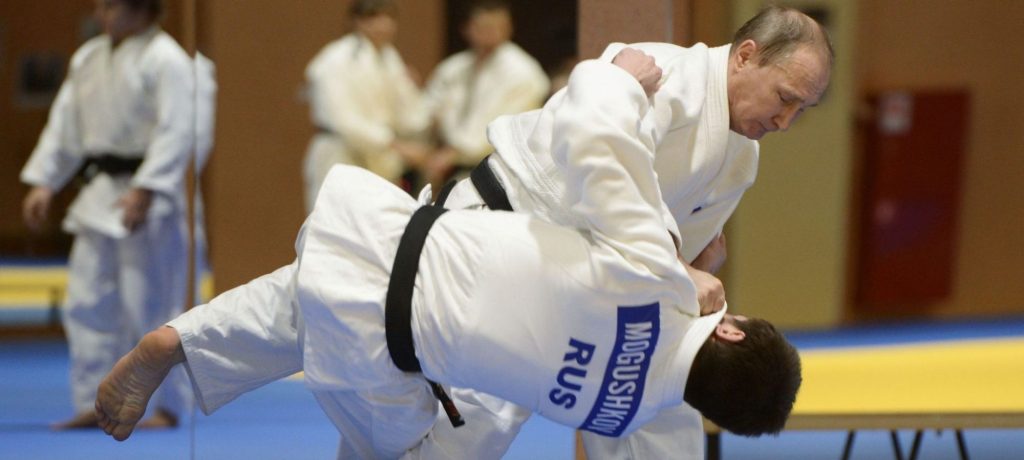
Is Vladimir Putin preparing to cleanse Russia of Big Pharma shills (his entire cabinet)? Some seem to think so and there is certainly evidence that some kind of anti-shill crackdown is coming.
Russian President Vladimir Putin has criticized foreign drug companies for pushing their products through local medical institutions and via doctors in Russia using their deep-pocketed resources.
“Unfortunately, foreign pharmaceutical companies attracted some heads of our medical institutions, and medical workers in 30 regions. And they pushed their medicines [on to the Russian market], paying quite a lot of money for it. We saw that under just one scheme they doled out 500 million [rubles],” he said at a meeting with Yury Chikhanchin, Head of the Federal Financial Monitoring Service.
Putin noted that such practice also exists in the EU and worldwide.
“They do it everywhere. They do it in Europe and overseas too. This is how they operate,” he said.
Chikhanchin responded by saying his agency was working with the FSB to root out gratuitous Big Pharma grifting.
First of all: At the very least Putin deserves a golf clap for saying rude things about Big Pharma. No one loses points for doing that. So we salute you, Vladimir Putin. Keep it up.
At the same time: talk is cheap. If you’re going to launch a Novichok rocket at Big Pharma for “pushing their products through local medical institutions” (as TASS summarized) in 30 regions… this doesn’t exactly sound like the cleansing enema that Russia so desperately needs.
If Putin is sincere about expelling degenerate pill pushers from Russia, how far is he willing to go? Because in order to have a meaningful impact he’ll have to go pretty far. All the way, actually.
You need to cut the head off the snake. And the snake lives in Moscow. The snake has wrapped its slimly reptile-bod around various federal ministries. The snake is suffocating Russia at the highest levels of government.
That’s just a fact.
Maybe it’s time for a “performance review” at the Ministry of Health? (source)
If tomorrow the FSB announces it bagged the deputy director of a village clinic in Potato-Patch, Yakutia, this will not qualify as a successful crackdown on Big Pharma’s nefarious influence in Russia. It will qualify as a massive fail.
So which Big Pharma Strumpets should be Gitmo’d by the FSB? We’re so glad you asked.
All of the Important Russians who partied with Tedros and Big Pharma at the St. Petersburg International Economic Forum — straight to the gulag for some desperately needed rehabilitation.
And of course, no Big Pharma smackdown would be complete without frog-marching Madame Arbidol to the most remote Siberian penal colony. Sorry, we don’t make the rules.
Russia’s largest pharmaceutical firms also need to be put in the crosshairs. As we saw with Sputnik V, Russian drug companies enthusiastically collaborate with western pharmaceuticals to create horrific poisons for the masses. And the Russian government is invested in this gross cooperation — which is slightly discouraging?
Furthermore, the worst medicine-related grifting involves government contracts. And also: a lot of the pill peddling and unethical contracting isdone legally.
Putin demanded action against Western pharmaceutical companies that bribe our doctors. Tsargrad examined the problem and found out that this bribery is most often completely legal. To change the situation, you need to change the laws. […]
The peculiarity of Russia lies in the active participation of the state in the market of medical services. It is more profitable to get a big contract and relax than to work painstakingly with doctors, although this is not neglected either. Therefore, our “favorite” form of illegal cooperation of pharmaceutical companies with the heads of institutions and officials is to ensure victory in the auction.
So, for example, at the end of 2019, the head doctor of the republican oncological dispensary of the Ministry of Health of the Republic of North Ossetia-Alania was caught red-handed while receiving a bribe on an especially large scale. A few days before that, the head physician of the Penza Regional Oncology Center received a five-year sentence (as did the director of the pharmaceutical company who gave him the bribe). There are other precedents, many of them. […]
Of course, the problem raised by Chikhanchin and Putin concerns not only Western companies — the domestic pharmaceutical industry has adopted the worst habits of its “big brothers” and interacts with medical personnel no less successfully.
That sums up the situation pretty well, we think.
We welcome any and all efforts to make Russian healthcare less scammy and more healthy.
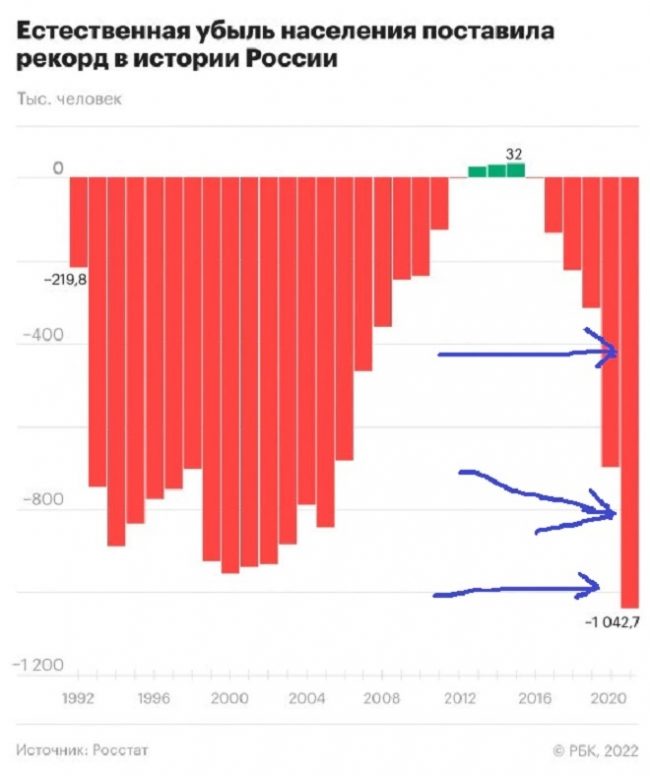
But let’s not forget that after two years of “public health measures” — two years of non-stop grifting and murderous lies — Russia now finds itself in a very, very deep hole — a hole dug by the Russian government. Go figure.
A population decline of more than 1 million people in 2021. The largest decline in decades. (source)
We should add that there are rumors on the Russian interwebz that several high ranking officials are under investigation as part of this alleged Big Pharma crackdown. We haven’t found anything substantial to support this claim but… fingers crossed?
Let’s see what the FSB cooks up. It’s 2022. Anything is possible.
Even atonement.
“I want to wish you success not only in the Russian market, but also in global markets, and express the hope that the new year will be favorable for your company and for solving the problems that we are now talking about,” Putin addressed the head of AstraZeneca.(source)
For those who don’t follow Riley on Telegram, he has recently been purged from PayPal – no doubt because he’s wrong about everything, and no threat to the establishment at all.
Riley Waggaman is your humble Moscow correspondent. He worked for RT, Press TV, Russia Insider, yadda yadda. In his youth, he attended a White House lawn party where he asked Barack Obama if imprisoned whistleblower Bradley Manning (Chelsea was still a boy back then) “had a good Easter.” Good times good times. You can subscribe to his Substack here, or follow him on twitter or Telegram.