
Rebalancing The Masculine & The Feminine For A New Paradigm

In a time of collapse, witnessing the consciousness and paradigm driving our current moment is paramount. A rebalancing of consciousness may be a solution.

By Anne Baring

Source: The Pulse

When the masculine and the feminine are in balance, there is fluidity, relationship, a flow of energy, unity, totality. This fluidity and balance is perhaps best illustrated by the Taoist image of the indissoluble relationship and complementarity of Yin and Yang.

In the broadest terms, the feminine is a containing pattern of energy: receptive, connecting, holding things in relationship to each other; the masculine is an expanding pattern of energy: seeking extension, expansion towards what is beyond.

More specifically, the feminine reflects the instinctual matrix and the feeling (heart) values of consciousness; the masculine reflects the questing, goal-defining, ordering, and discriminating qualities of consciousness, generally associated with the mind or intellect.

For millennia women have lived closer to the first pattern; men to the second. But now, there is a deep impulse to balance these within ourselves and in our culture. There is an urgent need to temper the present over-emphasis on masculine value with a conscious effort to integrate the feminine one.

In the ancient world the feminine principle in the image of the goddess stood for relationship – the hidden connection of all things to each other. Secondly, it stood for justice, wisdom and compassion. Thirdly, and most importantly, it was identified with the unseen dimension beyond the known world – a dimension that may be imagined as a matrix connecting invisible spirit with visible nature.

The word used then to name this matrix was goddess; later it was soul. The feminine principle offered an image of the oneness, sacredness and inviolability of all life; the phenomenal world (nature, matter, body) was regarded as sacred because it was a theopany or manifestation of invisible spirit.

The greatest flaw in civilisation has been the over-emphasis on the masculine archetype (identified with spirit) and the devaluation of the feminine one (identified with nature). This has been reflected in the fact that the god-head has no feminine dimension.

The history of the last 4000 years has been forged by masculine traits – principally the goals of conquest and control. (this is in no sense intended as a criticism; in the context of prevailing belief systems and general level of consciousness, things could not have been different).

However, religion and science – all our cultural ideas and patterns of behaviour – have developed from this unbalanced foundation. Throughout this time, everything designated as “feminine” (nature, body, woman) was devalued and repressed, including the rich diversity of the Pagan legacy of the ancient world.

In the domain of religion, heretics were eliminated; diverse ways of relating directly to the transcendent were lost. Naturally, this has created a deep imbalance in the culture and in the human psyche. It has led finally to the tyrannies of this century where the lives of some 200 million people have been sacrificed to totalitarian regimes.

The modern tyrant is the extreme reflection of a deeply-rooted pathology derived from a long-standing cultural imbalance between the masculine and feminine archetypes.

Where there is no relationship and balance between the masculine and feminine principles, the masculine principle becomes pathologically exaggerated, inflated; the feminine pathologically diminished, inarticulate, ineffective. The symptoms of a pathological masculine are rigidity, dogmatic inflexibility, omnipotence, and an obsession with or addiction to power and control.

There will be a clear definition of goals but no receptivity to ideas and values that conflict with these goals. The horizon of the human imagination will be restricted by an overt or subtle censorship. We can see this pathology reflected today in the ruthless values that govern the media, politics, and the technological drive of the modern world.

We can see the predatory impulse to acquire or to conquer new territory in the drive for global control of world markets, in the ideology of growth, in new technologies such as the genetic modification of food. We see exaggerated competitiveness – the drive to go further, grow faster, achieve more, acquire more, elevated to the status of a cult.

There is contempt for the feeling values grounded in the experience of relationship with others and with the environment. There is a predatory and compulsive sexuality in both men and women who increasingly lose the capacity for relationship. There is continuous expansion in a linear sense but no expansion in depth, in insight. The pressure of things to do constantly accelerates.

What is the result? Exhaustion, anxiety, depression, illness which afflict more and more people.

There is no time or place for human relationships. Above all, there is no time for relationship with the dimension of spirit. The water of life no longer flows. Men and women and, above all, children, become the victims of this harsh, competitive, uncaring ethos: women, in their disorientation, and because the feminine value has no clear definition or recognition in our culture, are drawn to copy the pathological image of the masculine which itself incorporates fear of the feminine.

Because to a large extent, this whole situation arises unconsciously, not much can be done about it until catastrophe intervenes.

Evolutionary Pressure Emerges

I feel we are living in a time of kairos – a mythic time of choice – a time of stupendous scientific discoveries which are enlarging our vision of the universe, shattering the vessel of our old concepts about the nature of reality.

Yet the delicate organism of life on our planet and the survival of our species are threatened as never before by technologies driven by an ethos of the conquest and control of nature, technologies which are applied with an utter disregard for the perils of our interference with the complex web of relationships upon which the life of our planet depends.

The choice is between clinging to an outworn and unbalanced ethos and maturing beyond it towards a more responsible and sensitive capacity for relationship. If we are unable to develop this empathic capacity to relate, we will surely destroy ourselves and the environment that sustains our life.

Bringing Balance

So how could we help to redress the balance between the masculine and feminine in ourselves and in our culture?

First of all, where are we, as individuals out of balance? Where are we driven by the unbalanced cultural ethos of achieving power and control, ignoring our feelings of depression, anxiety or symptoms of the body’s distress?

Are we allowing ourselves enough time for reflection, for relationships, for connection with a deeper dimension of reality?

The priority as I see it is to make the fact of this pathology a matter of public discussion. Shift the emphasis from achieving power to achieving balance.

Secondly, here are some suggestions for strengthening the feminine principle in our society.

  • Free the Imagination from the stranglehold exercised by a controlling minority which excludes the non-rational from inclusion in our understanding of life.
  • Formulate a new image of spirit as the totality of all that is – both seen and unseen. Recover the lost and devalued feminine aspects of spirit: restore nature, matter and the physical body (including sexuality) to the realm of the sacred.
  • Imagine the Soul as a cosmic internet. We belong to an immense field or matrix of relationships. We could imagine the soul in this new way as something we belong to and can develop a relationship with.
  • Religion – Relinquish the dogmatic formulations of the past: Monotheism as Mytheism. (Ravi Ravindra) Recognise the negative effects of deeply rooted beliefs – such as the belief in original sin – on our interpretation of life and its meaning. Welcome the idea of direct individual experience of the sacred and the numinous.
  • Science – Integrate the principle of empathic relationship with what is studied in scientific teaching and practice. In education give children an empathic understanding of their own bodies and of nature rather than the image of the body and the universe as a machine. Help them to become aware of their environment as a great chain of relationships in which their lives are embedded. Nourish their sense of wonder.
  • The psyche: Heal the split between mind and soul. Recognise that feeling is a valid mode of perceiving reality and must be integrated with thinking. The main problem in our society is emotional immaturity.
  • Politics: develop a forum beyond national and international politics where the true problems of the planet can be articulated and addressed. Recognise grandiosity, standardisation, the drive for control, the proliferation of bureaucracy as symptoms of the pathology of an inflated and unrelated masculine principle.
  • Medicine: integrate alternative (complementary) methods of healing with orthodox ones as a deliberate policy. Focus on preventive medicine. The modern GP has no time for an empathic relationship with his or her patient. The pressure of numbers is simply too great. However, in some surgeries and hospitals alternative practises are being integrated with orthodox ones. This integration could be expanded.
  • Agriculture: Focus on increasing the production of organic food. Removal of pesticides, antibiotics and toxins from our food and water.
  • Care of Children: A much higher level of prenatal care. Compared with the rest of Europe, we are way behind (Sweden is the most advanced). Attention to quality of children’s diet and to nourishing the imagination as well as the intellect.
  • Educate Women to be aware of their own specific value and the importance of their contribution to the culture. Articulating feeling values without fear or shame.
  • Educate Adolescents in awareness of the responsibilities of relationships and of the parent towards the child. Teach them the psychology of the child; its dependency; its sensitivity, its potential for emotional growth. Teach them about the complexities of neuroscience so they understand how their emotions affect their bodies and vice-versa. Ask them to invent ways of caring for the environment.
  • Teaching Methods: integrate right-hemispheric consciousness with the linear consciousness of the left hemisphere – opening to the creative power of the image. Balance in the curriculum between developing the capacity for logical thought and creative imagining and participation. This poem by a 12 year old boy at school in Southampton shows how a teacher can provide the environment in which a child can dare to express his true feelings:

I hear my inner voice talking to me,
Explaining, encouraging,
Opening the part of me that I thought was lost.
In this world of cruelty and fear little lights are burning.
Everyone has a flame inside their hearts,
If only they had the courage to find it.
The light can trickle out through a hole in your mind.
When the inside is out
You are transformed and revealed.
There is no need to be afraid,
But be curious
As you will probably never know
where the force is coming from.
 – Daniel Webster

Each of us is called to focus on rebalancing the masculine and feminine in ourselves and in our culture. This could affect a profound alchemy in our lives. Women and men could both participate in a process of transformation which could bring into being a new cultural focus whose emphasis is no longer on power and control but on relationship, balance and connectedness.

The phrase “the conquest of nature” could be replaced by the awareness that humanity and nature participate in a deeper and still unknown reality that embraces them both.

Millions of people have no choice. Those of us who do have a measure of choice could rise to the immense challenge of defining and living a new and responsible role in relation to each other and our planetary home.
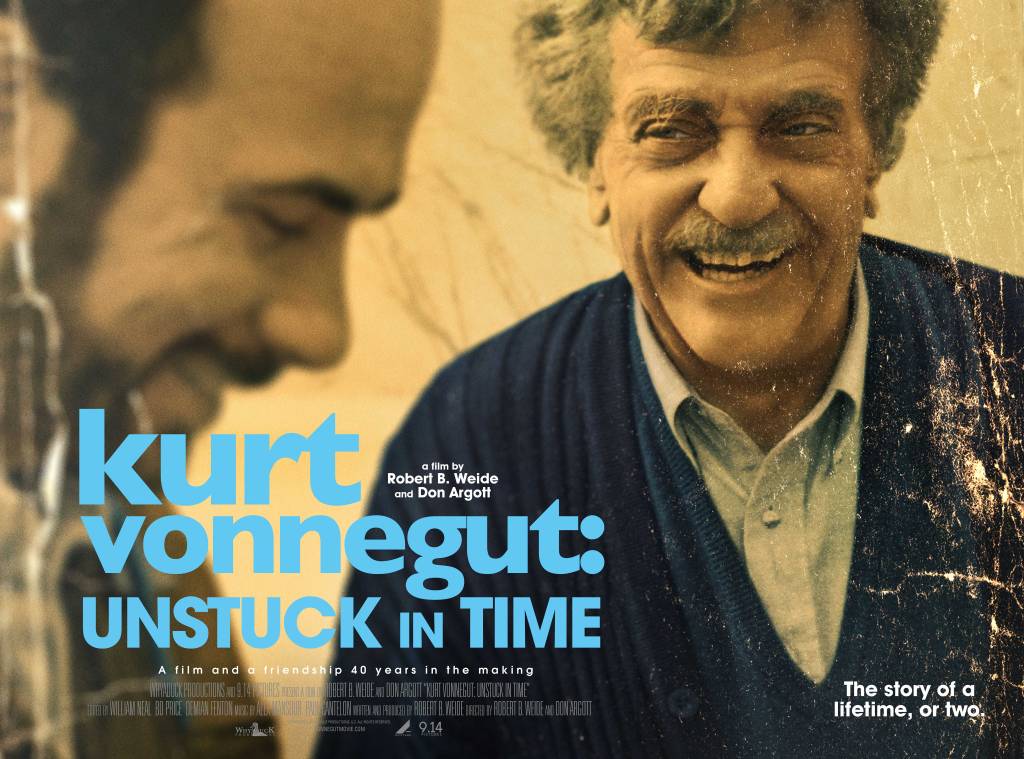

Saturday Matinee: Kurt Vonnegut: Unstuck in Time

By Matt Zoller Seitz

Source: RogerEbert.com

“Kurt Vonnegut: Unstuck in Time” is messy in the way that wakes for dear friends are messy.

Some speakers go on too long, and there are others that you may wish you’d heard from at greater length, or at all. And the raw sentiment coursing through every moment of the affair, however heartfelt, can be overwhelming, especially if you didn’t know the deceased as well as the folks memorializing him. 

The deceased here is Kurt Vonnegut, and the person who planned, executed and hosted this cinematic wake, director Robert B. Weide (a veteran documentarian and an Emmy-winning director for “Curb Your Enthusiasm”), was a friend of Vonnegut’s throughout the final 25 years of his life. This movie, co-directed by Don Argott, runs over two hours. Thematic and structural ideas are introduced, nurtured, forgotten, then reintroduced awkwardly. Weide himself is a major character—as well he should be, considering that Vonnegut essentially made Weide his personal archivist, sending him letters and manuscripts and faxes and video and audio tapes, and this film is as much a portrait of a friendship as it is the warts-and-all record of a great writer’s life—but sometimes the proportions feel off. When Weide disappears for long stretches, I don’t know that it’s exactly a slam to say that you don’t miss him, because people are mainly here for Vonnegut, one of the most important American writers of the 20th century, and a fount of charisma even at his lowest depths of sour narcissism in the 1970s. 

Vonnegut fans know that he specialized in slim, nimbly written books, with short chapters and short paragraphs that jumped wherever Vonnegut’s consciousness happened to take him. “Unstuck in Time” lets us know that it is consciously modeling its structure on Vonnegut’s writing, in particular his widest-read work, the nonlinear novel/memoir “Slaughterhouse Five,” from whence the documentary’s subtitle is drawn (“Billy Pilgrim came unstuck in time,” it starts); and to a lesser extent, Vonnegut’s late-career bestseller “Timequake,” a fragmented, self-aware book that is partly about the difficulty of writing “Timequake.” 

There are also cinematic allusions to Vonnegut’s literary alter-ego, Kilgore Trout, in the way that Weide and Argott and three credited film editors weave together the relationship between Vonnegut and Weide. Weide first meets Vonnegut in 1982 at age 23 after writing him a fan letter inquiring about the possibility of making a documentary about his life, and he holds onto that youthful starstruck quality even in reminiscences shot long after Vonnegut’s death in 2007. Over time, the pupil gains the master’s respect, to the point where Weide writes and coproduces a feature-length adaptation of Vonnegut’s novel “Mother Night,” starring Nick Nolte and directed by actor-filmmaker Keith Gordon, who as luck would have it played Rodney Dangerfield’s son in “Back to School,” a comedy in which Vonnegut played himself.

This may all sound as if it’s articulated more cleanly and effectively than it is. The filmmakers have committed simultaneously and with equal enthusiasm to a couple of filmmaking approaches that are at odds. One is the detached, clinical-mathematical, unsentimental, science-fictional, time-tripping biography, a la “Slaughterhouse Five” and “Timequake,” represented here by inventive cutting from image to image and idea to idea, sometimes lingering on signifiers of creative self-awareness. These include closeups of the timeline on an editor’s computer screen, montages of Vonnegut doing or saying the same thing in different decades of his life, snippets of films based on Vonnegut’s writing, and animated sequences modeled on Vonnegut’s drawings, which were as distinctive as his prose.

The other approach is more straightforward: Weide and Argott are making a straightforward PBS-style documentary about an artist’s life, supervised by a director and fan who knew him intimately, and tghat draws on footage ranging from childhood through old age. The latter might jump around in time in terms of the years in which it was created, but it ultimately tells Vonnegut’s story in a far more conventional way that the movie promises to do in its opening minutes.

This is fine; in fact it’s more than fine, because as Vonnegut and various experts on his work point out, Vonnegut remains readable and relevant in large part because he expressed himself in a direct way, drawing upon what’s described here as a journalistic writing style. Correspondingly, the most moving scenes and moments in “Unstuck in Time” are unmannered accounts of events. These range in emotional character from elating (Vonnegut’s commercial and critical success with “Slaughterhouse Five” after years of financial struggle) to vexing (after that success, he left his first wife, Jane, who’d been by his side during the lean years, moved to Manhattan, and married his mistress) to tragic (Vonnegut’s brother-in-law dying in a train wreck just two days before Vonnegut’s older sister died of cancer) to inspirational (Vonnegut unhesitatingly raising his late sister’s four sons alongside the three kids he had with Jane).

All of this material is fascinating, and articulated in vivid detail thanks to Weide’s trove of material. There are closeups of typewritten revisions of Vonnegut classics, each alteration indicated in pencil or pen, and letters and answering machine messages covering every imaginable life event. The filmmakers lay it all out so elegantly that whenever the movie seems to forget that it’s also about Weide and suddenly interrupts the flow to insert a reference to one of Weide’s own milestone events (such as his wife’s own battle with a debilitating illness and his Emmy win for “Curb,” which seems to be in there so that he can include Vonnegut’s answering machine message congratulating him) it’s awkward because Weide is clearly still grieving, too, and the viewer is torn between wanting to bear witness to Weide’s miseries and triumphs and wanting him to get back to Kurt Vonnegut as quickly as possible.

There is, nevertheless, something to be said for a documentary that tries to do something different and perhaps impossible, even if it doesn’t quite get there. And in the end, any flaws or missed opportunities are subsumed by the movie’s sincerity and wealth of insight. Its analysis of the role that Vonnegut’s World War II experience played in his demeanor as well as his fiction is fascinating and on-point, and the editors bring it all back at the end when Vonnegut, outraged by the second Bush administration’s invasion of Iraq and weaponizing of patriotism, writes a series of columns for “In These Times” magazine that will ultimately be collected in 2005’s “A Man Without a Country,” arguably his last major work.

Weide himself comes across as a sardonic and compassionate witness and guide, often taking the piss out of his own reverence for Vonnegut just when things threaten to get a bit moist. The devotion he displays towards Vonnegut throughout the second half of the writer’s life is as inspiring as Vonnegut’s own high points as a human being. We should all be lucky enough to have a friend who will tell our story.

____________________

Watch Kurt Vonnegut: Unstuck in Time on Kanopy here: https://www.kanopy.com/en/product/13799154

On the Violence in the Middle East…

By Doug “Uncola” Lynn

Source: The Burning Platform

Like most of the world, I have been considering the Israel / Gaza slaughter with fascination and a sense of dread.   Did Israel allow the events of October 7, 2023 to happen? It appears so. Were the savage acts of Hamas sickening? It appears so. Have the ensuing actions of Israel in Gaza been devastating? Yes.

Have the reactions of the general public in nations around the world, and on the internet, become increasingly polarized? Definitely.

Geopolitical expert and former U.N. weapons inspector Scott Ritter has predicted Israel will lose this war, and deservedly so.

At the height of the hysteria during the build-up to Operation Desert Storm®, and in the jingoistic fever of the newly coined War on Terror®, Ritter claimed Saddam Hussein had zero Weapons of Mass Destruction®.  Ritter was right back then, so, now, I pay attention whenever he addresses global tensions.

However, there are many others, including especially some Christians, who believe Israel cannot lose; and, today, as of this writing, The Jerusalem Post has predicted a truce.

Who is right?

I recently viewed a video posted on the Lew Rockwell website entitled: “Bad Theology: Israel, the “Rapture,” and the End Times” and the Bible scholar in that interview claimed modern Israel is a secular nation having nothing to do with Biblical Eschatology.

Of course, other Christians disagree with that conclusion and believe the God of Abraham, Isaac, and Jacob is still dealing with the nations of the world through Israel – and just before the return of Christ.

Apocalyptical interpretations, and misinterpretations, regarding modern Israel are concerning because people act upon what they believe… one way, or another.  Hence the great divide today, as derived from historically ancient faiths; and why supporters of both Israel and Palestine/Gaza are protesting and rallying around the world.

In February 2019, I considered some of the potential interpretations of possible events in an article entitled “As the Games Begin…”:

Some… Christian Zionists believe the entire world would embrace the Psalm 83 war as the Book of Revelation’s “Armageddon” thus setting the stage for planet earth to accept a false messiah; like Islam’s Twelfth Imam, a Talmudic strongman, a fake return of Christ, or possibly even an outer-space alien (i.e. metaphysical demon / fallen angel) as all of the above – and delivering a false peace and prosperity thus fulfilling the “strong delusion” or “great deception” or “falling away” of the Bible’s 2nd Thessalonians, chapter 2, verses 3-12…

…Other Christians claim the Psalm 83 prophecy is credible because none of those nations are named in the Ezekiel 38 and 39 war when Russia, Iran, Turkey and other countries come against Israel or, even later, in the Sixth Trumpet War of Revelation 9 when the Kings of the East (China?) march up the Euphrates river to Israel in the battle just prior to Armageddon.

Crazy, no? Again, don’t kill the messenger. All of this is on the internet and, as some claim, in the Bible.

On the other side of the debate… many folks, including several bloggers and online commenters, believe modern Israel is the de facto “Synagogue of Satan” as referenced in the Bible’s Book of Revelation (Rev 2:9 and Rev 3:9). These verses refer to those “who say they are Jews but are not”.

Correspondingly, a video at StopWorldControl.com about modern Israel, its early formation and sinister benefactors, is quite compelling – just not to those who believe a Psalms 83 War (paired with other Biblical prophecies) will result in the complete destruction of the following nations:

– Gaza (Philistia)

– Egypt (Edom, Ishmaelites, Moab, Hagrites + Isaiah 19:1-25)

– Jordan (Ammon & Amalek + Ezekiel 25 & Jerimiah 49:1-2)

– Iraq (Ammon & Amalek + Babylon in Jeremiah 50 & 51)

– Syria (Assyria & Hagrites + Isaiah 17:1 & Jeremiah 49:23-27)

– And, as some claim:  “Gebal” and “Tyre” will be decimated prior to the conclusion of the Psalm 83 war – with these referring to modern Lebanon and southern Lebanon (Hezbollah), respectively, as well as Turkey.

But others argue Turkey (i.e. “Gomer”, “Meshek”, “Tubal”, & “Beth Togarmah”) won’t meet its fate until the later Ezekiel Chapters 38-39 War involving Russia (Rosh), Iran (Persia), Libya (Put),  Ethiopia (Cush), and the Central Asian nations (Magog) including…but perhaps not limited to… Kazakhstan, Kirghizia, Uzbekistan, Turkmenistan, and Tajikistan.   I say “not limited to” because some interpreters include Afghanistan in the latter group and I’ve also seen Ukraine, the Baltics, and Eastern Europe included under “Gomer” as well.

Anyway, here is the point: Many Bible “scholars” believe ancient scriptures have predicted that modern Israel would defeat wave after wave of military attacks by other countries. First, the surrounding Psalm 83 nations, then, later, the Ezekiel 38-39 war, until, finally, the Sixth Trumpet War of Revelation 9 when the Kings of the East (China?) march up the Euphrates river to Israel in the battle just prior to Armageddon.

All of this, in accordance with other prophecies in the Bible, such as…

… I will make Jerusalem a cup of trembling unto all the people round about, when they shall be in the siege both against Judah and against Jerusalem.

And in that day will I make Jerusalem a burdensome stone for all people: all that burden themselves with it shall be cut in pieces, though all the people of the earth be gathered together against it.

– Zechariah 12:2-3

And

And I will bring again the captivity of my people of Israel, and they shall build the waste cities, and inhabit them; and they shall plant vineyards, and drink the wine thereof; they shall also make gardens, and eat the fruit of them.

And I will plant them upon their land, and they shall no more be pulled up out of their land which I have given them, saith the Lord thy God.

– Amos 9:14-15

Around two weeks ago (as of this writing), Israel’s Prime Minister, Benjamin Netanyahu, referenced Hamas in relation to an ancient tribe of people called “Amalek” in scripture.  He said: “You must remember what Amalek has done to you, says our Holy Bible. And we do remember.

In the Bible’s book of 1st Samuel, in chapter 15, God  commanded (Israel’s) King Saul to “go and smite Amalek, and utterly destroy all that they have, and spare them not; but slay both man and woman, infant and suckling, ox and sheep, camel and ass 

But, not wanting to be overly cruel, King Saul disobeyed God’s command and Israel was eventually given cause to kill others who didn’t deserve to die.  This story, in fact, is said to have inspired the concept of “cruel to be kind”  – thereby instilling this maxim into Jewish culture:

To be lenient when you should be firm is to be cruel when you could be kind.

Or, in other words:  “He who is compassionate to the cruel will ultimately become cruel to the compassionate”.

Or, stated another way: “Destroying evil is perhaps the greatest act of kindness possible.”

Nonetheless, non-Zionist Christians (such as the Bible scholar in the above-embedded “Bad Theology” video/link), as well as pretty much all non-Christians, consider this type of Biblical parsing and cherry-picking of scripture to be completely ludicrous, if not insane; especially as the headlines rage:

Israeli Troops Fighting “In The Heart” Of Gaza City, Hamas Leader Surrounded In A Bunker

Turkey’s Erdogan: Whoever is on Israel’s side, we are against them

Iran Warns Of ‘Inevitable Expansion’ Of War After IDF Conducts Flag-Raising Ceremony In Gaza

US & Israel Poised to Open Lebanon Front:

Israel’s best chance of survival lies in expanding the scope of the war in Gaza into Lebanon — and possibly even into Syria — shoulder-to-shoulder with the Americans.

Will Israel defeat all challengers? Will Iran and the U.S. escalate the war in the Middle East?  Will the Psalm 83 nations of “Gebal”, “the inhabitants of Tyre”, the “Hagrites” (i.e. Lebanon, South Lebanon / Hezbollah, and Syria, respectively), and the nation of Turkey, join the war?

Turkey is a member of NATO. How would that work?

I don’t have the answers to these questions. Yet.  I am just a blogger sharing what I’ve read and viewed online.

But even if the Psalm 83 War came to pass in the days ahead, most of the world would surely call it a coincidence… or Armageddon… or claim it occurred as the result of a deceptive conspiracy using the Bible as a script.

Conversely, if peace suddenly broke out in the Middle East and World War III was narrowly averted, the prophecy experts will likely claim that Armageddon was delayed… but only for a while.

For how long?  I guess we’ll see.  Hence this time-stamped post.