Why We’re Doomed: Our Delusional Faith in Incremental Change

By Charles Hugh Smith

Source: Of Two Minds

Better not to risk any radical evolution that might fail, and so failure is thus assured.

When times are good, modest reforms are all that’s needed to maintain the ship’s course. By “good times,” I mean eras of rising prosperity which generate bigger budgets, profits, tax revenues, paychecks, etc., eras characterized by high levels of stability and predictability.

Since stability has been the norm for 75 years, institutions and conventional thinking have both been optimized for incremental change. This is an analog of natural selection in Nature: when the organism’s environment is stable, there’s little pressure to favor random mutations, as these can be risky.

Why risk big changes when everything’s working fine as is?

Absent any big changes in their environment, organisms’ genetic programming remains stable. Unlike natural selection’s process of generating random mutations and testing their efficacy and advantages over the existing programming, human organizations quickly habituate to stable eras by institutionalizing incremental changes as the only available process for reform / change.

Radical reforms are not just frowned on as 1) unneccesary and 2) needlessly risky, there is no institutionalized process to propose, test and adopt radical changes because there is no need for such a process.

Nature has such a process: punctuated equilibirium. When faced with a rapidly changing environment, organisms face intense evolutionary pressure to adapt or die. Mutations which confer a significant advantage in the new environment become part of the species’ genetic programming as those with the adaptation bear offspring who carry the advantageous adaptation. Those without the advantageous adaptation die and those with the adaptation thrive and multiply.

Once the environment stabilizes in “the new normal,” the evolutionary pressure lets up and the species returns to the stability of relatively few changes in its genetic programming.

Organisms which have lost the ability to adapt to rapid change die off once they encounter instability. Species that constantly face instability and rapid change will selectively favor genetic traits which optimize rapid evolution.

Nature tends to retain a basement closet full of fast-evolution tricks just in case the organism faces novel challenges.

Alas, human organizations and conventional thinking have no such closet of fast-evolution tricks. Rather, human organizations and conventional thinking marshal formidable forces to suppress anything which threatens the status quo, because why risk upsetting the feeding trough unless it’s absolutely necessary?

Therein lies the fatal problem: radical adaptation is never absolutely necessary in human organizations and conventional thinking until it’s too late–and even then, the leadership and conventional thinking will fatalistically accept oblivion rather than opt for a risky strategy of testing every mutation and fast-tracking whatever has promise, even though the odds of failure are high since 1) the challenge is novel and therefore unpredictable and 2) most mutations will fail to provide the radical advantages needed to meet the challenge.

In other words, what’s absolutely necessary to human organizations and conventional thinking is the suppression of potentially dangerous novel ideas because the worst-case scenario is that the novel ideas upset the feeding trough all the insiders have come to depend on.

Unfortunately for human organizations and conventional thinking, novel challenges demand precisely what they’re incapable of: risky rapid evolution. The risks will never seem worth it because some insiders might lose their spot at the feeding trough.

Since this loss is viewed as catastrophic by those at risk, they will fight with everything they have to stymie any radical reforms. Ironically, their resistance to rapid evolution only guarantees the demise of the entire organization / status quo, including the spot at the trough they were so eager to defend at all costs.

As the crisis deepens, the default setting in organizations and conventional thinking is that incremental changes and reforms will be enough, because they’ve been enough for four generations. I call this entirely natural default setting the delusional faith in incremental change because this faith isn’t guided by history or the logic of causality; it’s simply convenient and easy.

Nobody gets fired or demoted for agreeing to do more of what’s failed spectacularly.

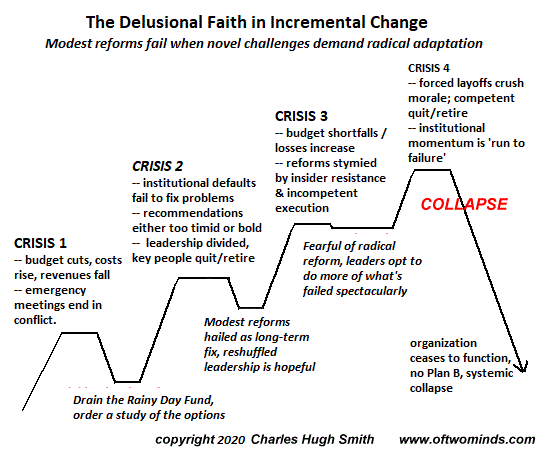
I’ve prepared a chart of the delusional faith in incremental change showing how each new crisis is met by incremental institutionalized defaults that are completely inadequate to the novel challenges that have arisen. The blindness to the need for radical adaption has been institutionalized as well: this is what worked in the past, so it will work nowWhy risk everything when we have procedures that have worked well?

Each stage of the crisis draws whatever conventional response causes the least pain. First, the “rainy day fund” is drained to keep everyone at the feeding trough. Studies of options are funded, and so on.

The recommendations are either too timid and clearly inadequate or they’re too bold and risky. So incremental policy and budget tweaks are adopted as acceptable institutional defaults.

But rifts open in the leadership as the farsighted few demand rapid, radical adaptations and the conventional risk-averse crowd digs in their heels. The farsighted few are pushed out or quit / retire, eliminating the only people who had the ability and experience to actually pull off a radical change of course.

A reshuffling of leadership evokes hope that the modest reforms will work magic. Alas, incremental tweaks only work in eras of stability. They fail miserably in unstable eras of rapidly-evolving challenges.

As everything runs to failure, the only acceptable path is to do more of what’s failed spectacularly, a default to low-risk incrementalism that only accelerates the final inevitable collapse.

The delusional faith in incremental change guarantees systemic failure. Better not to risk any radical evolution that might fail, and so failure is thus assured.

This is why our status quo is doomed:

Not News But A Juicy Collection Of Narratives – How The New York Times Failed Its Readers

By Moon of Alabama

The New York Times star reporter Rukmini Callimachi had been widely criticized for her exaggerated reporting about the Islamic State and terrorism. But her editors kept supporting and promoting her stories. That finally ended when Canada recently indicted one Shehroze Chaudhry, also known as Abu Huzaifa, for falsely claiming to have been an ISIS member. Chaudhry had made up his blood dripping stories. He had never been with ISIS and had never been to Syria or Iraq.

But the unverified stories of Abu Huzaifa al-Kanadi had been the central element of the NYT’s ten part Caliphate podcast by Rukmini Callimachi.

The failure of her reporting finally was so evident that the NYT had to allow its media columnist Ben Smith to write about the issue. Remarkably his reporting was published in the Business section of the paper.

An Arrest in Canada Casts a Shadow on a New York Times Star, and The Times

It is a pretty devastating report about the support Callimachi got from her editors even as an ever growing number of her collogues criticized her over-sensationalized reporting. The root cause of the problem is the way in which the Times, as well as other news media, try to change from news providers to narrative creators:

The crisis now surrounding the podcast is as much about The Times as it is about Ms. Callimachi. She is, in many ways, the new model of a New York Times reporter. She combines the old school bravado of the parachuting, big foot reporter of the past, with a more modern savvy for surfing Twitter’s narrative waves and spotting the sorts of stories that will explode on the internet.

Ms. Callimachi’s approach and her stories won her the support of some of the most powerful figures at The Times: early on, from Joe Kahn, who was foreign editor when Ms. Callimachi arrived and is now managing editor and viewed internally as the likely successor to the executive editor, Dean Baquet; and later, an assistant managing editor, Sam Dolnick, who oversees the paper’s successful audio team and is a member of the family that controls The Times.

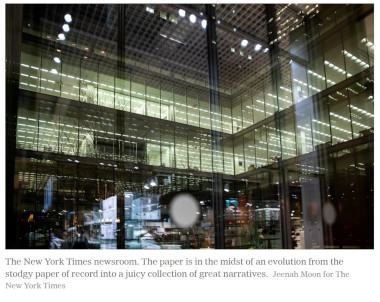
Ms. Callimachi’s approach to storytelling aligned with a more profound shift underway at The Times. The paper is in the midst of an evolution from the stodgy paper of record into a juicy collection of great narratives, on the web and streaming services. And Ms. Callimachi’s success has been due, in part, to her ability to turn distant conflicts in Africa and the Middle East into irresistibly accessible stories.

The highlighted sentence is the essence of the piece. It was even repeated in the caption of a picture accompanying it.

The striving for ‘juicy narratives’ is the biggest mistake of current news media. Their attempt to copy the success of Hollywood dramas by creating narratives has destroyed their credibility. It has put incentives on the wrong aspect of a reporter’s work. Instead of requiring well checked facts the editors are now asking for confirmations of preconceived tales:

What is clear is that The Times should have been alert to the possibility that, in its signature audio documentary, it was listening too hard for the story it wanted to hear — “rooting for the story,” as The Post’s Erik Wemple put it on Friday.

Callimachi is far from the only one guilty of creating fake news to fulfill her editors demand of narratives. The four year long coverage of ‘Russiagate’, the fairytale collection of made up connections between Donald Trump and Russia, was full of such. The editorial push towards narratives is rooted in the desire to create clickbait and to generate a social media echo around the reporting. That may be profitable in the short term but it is also a guarantee for a long term failure.

False of hyped narratives will over time get debunked. People then lose trust in the media that provided them with the fake news. That again will cause a long term loss of readership.

A similar case of falling for ‘narratives’ happened to German magazine Der Spiegel. Its star author Claas Relotius wrote fake stories on a large scale. Whether he wrote about Trump voters in Arizona or about a little girl in Syria, Relotius invented the witnesses to the ‘news’ he provided. He made up ‘facts’ and described himself visiting places he had never been to. For years there had been warnings that many of the detail Relotius provided were wrong. But his editors promoted him because the slick ‘narratives’ he delivered were exactly what they wanted. Der Spiegel, a once universally trusted source of news, is now joked about as ‘the former news magazine’.

The media trend towards providing narratives instead of verified facts also increases the danger of falling for manipulation. Governments as well as political marketing campaigns love to provide ready made tales. It is easier and cheaper for media to pick these up and repeat them instead of digging into the facts and their logic. We thus get false tales about chemical weapon use in Syria and a Skripal poisoning ‘narrative’ that does not stand up to the slightest scrutiny.

Can we please have real news? Just the new facts, with no ‘narrative’ or moral tales attached to them? Facts that are verified and described in the context of the issue they relate to? Do they fit the logic of already known ones? Do they make sense? How may they influence further developments?

To provide the above can easily fill a reporter’s day of work. It is usually enough material to write an 800 words report. Its sufficient for the reader to create his own narrative from it.

Dear news media. Please go back to providing real news. If you do so you will eventually regain my trust. That will be, in the long run, a much more valuable asset than the social media chatter you are currently trying to generate.

Battlefield Social Media: The West’s Growing Censorship

Censorship in the West flourishes as tech giants turn social media back into traditional programmed media. 

By Gunnar Ulson

Source: Land Destroyer

The United States, United Kingdom and the European Union are fond of passing judgement on nations around the globe regarding “free speech.”

While it is increasingly clear to a growing number of people that this “concern” is disingenuous and aimed at merely defending agitators funded and directed by Western special interests in these targeted nations, the West still likes to fashion itself as a sort of champion of free speech.

Yet back home the Internet has been taken over by social media and tech giants like Google, Facebook and Twitter.

Their platforms clearly serve as online public squares where everything is discussed and even election campaigns play out. Yet these companies have, over the years, begun to eliminate voices of dissent against a notion known as “consensus.”

If you are speaking out against “consensus” you are in real danger of disappearing from these platforms. Some of these platforms, like Google-owned YouTube, serve as the livelihood to people who have for years built up their audiences, produced hundreds of videos and when their accounts are deleted for speaking out against the “consensus,” they have their livelihoods destroyed.

In the wake of these incremental “purges” is a chilling effect with content creators self-censoring or even withdrawing entirely from Western social media.

It is the sort of very real censorship the West has crusaded against in fiction around the globe for decades. 

Concensus or Else 

A more recent example is Google’s decision to ban ad revenue for those going against the Coronavirus Disease 2019 (COVID-19) “consensus.”

CNBC in their story “Google will ban ads from running on stories spreading debunked coronavirus conspiracy theories,” would claim:

Google next month will ban publishers from using its ad platform to show advertisements next to content that promotes conspiracy theories about Covid-19. It will also ban ads that promote those theories. In cases where a particular site publishes a certain threshold of material that violates these policies, it will ban the entire site from using its ad platforms.

Those “conspiracy theories” might include questioning the official death rates of COVID-19. Yet even the British government itself has been recently forced to investigate its statistics regarding death rates, vindicating the very sort of people who would have been either forced into silence or forced to give up ad revenue.

The London Guardian in its article, “Matt Hancock orders urgent review of PHE Covid-19 death figures,” would admit:

The UK health secretary, Matt Hancock, is ordering an urgent review of the daily Covid-19 death statistics produced by Public Health England, after it emerged that they may include recovered former sufferers who could have died of other causes.

False reporting over deaths to hype COVID-19, induce greater public panic and pave the way for billions in government handouts to pharmaceutical giants is at the very core of many of these so-called “conspiracy theories” Google seeks to silence through its campaign of financial coercion.

Imagine if this chilling effect was achieved sooner. Would the British government have even bothered investigating its faulty statistics if there weren’t people suspicious of them?

The chilling effect this has over openly discussing something as serious as COVID-19 considering its socioeconomic impact is truly alarming and much more so because it is happening in the so-called “free world” overseen by its self-appointed arbitrators in the US, UK and EU.

A similar campaign was carried out to purge Google, Twitter and Facebook of anyone allegedly connected with “Russia” who also so happened to be anti-war and anti-NATO for waging those wars.

Entire lists are compiled by Western government-funded organizations which are then submitted to these tech giants for purging. The Western media writes accompanying articles announcing, justifying and spinning the purges… but also sending a warning to those left about what is and isn’t going to be tolerated on these platforms.

Social Media Transforming Back into Programmed Media 

Content creators are faced with two decisions; to either self-censor themselves to protect their work, their audiences and their livelihood, or to accept the possibility they will eventually be “purged” (censored) and need to rebuild their audiences from scratch on platforms with far fewer potential readers, viewers and patrons.

Social media, of course, is no longer social media in this sort of environment, but more akin to the sort of programmed media giant Western special interests built their power on over the course of the 20th and early 21st century.

Private Public Squares? 

Of course the defense is that Google, Facebook and Twitter are “private companies”and can do as they please with their platforms. In reality, these companies work in tandem with Western governments whether it is fomenting political destabilization abroad or creating “concensus” at home.

The notion that censorship is “ok” because the US, UK and EU governments launder it through private companies ignores the close relationship these companies have with the government and how their platforms have been transformed into defacto public squares and critical channels of public communication and participation.

The West’s growing overt censorship leaves it with a choice; to either accept that it is in reality as guilty of censorship and manipulating the public as it has claimed its opponents are, or continue pretending it isn’t but at the continued cost of its legitimacy upon the global stage.

There is a very good reason the West is in decline around the globe and why its attempts to leverage notions like “human rights” and “free speech” against nations like China or Russia are increasingly impotent. That reason can be found, at least in part, among the growing number of purge lists, censorship campaigns and calls for “consensus” across Western social media.

Finally, the increasingly overt nature of censorship and controlled narratives promoted by tech giants like Google, Facebook and Twitter should have them facing restrictions and bans around the globe. Why should any nation host a “public square” where discourse is entirely controlled by interests oceans away? Why shouldn’t a local alternative be created instead where the revenue is kept locally and if narratives are to be controlled, controlled in a way that best suits people locally?

It is ironic that, China for example, is condemned for not allowing Google, Facebook and Twitter to operate freely within their information space because it is a violation of “free speech,” even as Google, Facebook and Twitter cudgel free speech on their own respective platforms.

How much longer will the world tolerate these double standards? How long until individuals, organizations and even entire nations begin creating alternatives to Google, Facebook and Twitter to at the very least balance out the lopsided power and influence they have collectively accrued and abused? 

Omnibus Collisions: Coronavirus Policing and Overreach in Victoria

By Binoy Kampmark

Source: Dissident Voice

In her September 17 speech to parliament, the Attorney General of the Australian state of Victoria, Jill Hennessy, explained various provisions of the COVID-19 Omnibus (Emergency Measures) and Other Acts Amendment Bill.  Of most interest was the proposal that would dramatically inflate the scope of public health power in ostensibly preventing a spread of COVID-19.  “The broader class of persons who may be appointed as authorised officers may include public sector employees from Victoria and other jurisdictions.  For example, health services staff, WorkSafe officers such as Inspectors, Victoria Police members and Protective Service Officers.”

The formulation seemed an odd one: health services staff as designated officers to halt transmission perhaps, but unqualified members of the Victoria Police, along with Protective Service Officers?  The Secretary of the Department of Health and Human Services was the proposed appointer; the appointees (“authorised officers”) would be anybody deemed to possess appropriate skills, attributes or experience.  Such elevated, muscularly vested officers would have the power to detain anyone who has tested positive for COVID-19, or anyone who had been in close contact with a positive case, for a period “reasonably necessary to eliminate a serious risk to public health,” provided it was “reasonably believed”  they would fail to comply with a direction of self-quarantine.

Hennessy evaded the severe implications of such a broadly worded provision, arguing for convenience and efficiency, the two traditional hallmarks of the authoritarian mentality. The appointment power would focus upon “individuals with particular attributes, such as connection to particular communities”.  “Contact tracing” would be able to take place in “a culturally safe manner.”  As for any oversight limitations, these appointments would be subject to a “specific instrument” outlining specific authority and limitations authorised by the Secretary and Chief Health Officer.

This was something that did not escape the notice of some members of the Victorian Parliament.  Greens MP Tim Read noted how the Omnibus Bill, in that draft form, gave police, protective services officers and private security guards powers to unilaterally determine who constituted a high risk with little regard to medical expertise.  “Currently only public servants with the relevant skills and experience can make that decision”.  Enforcing directions was a separate function of law enforcement.  “So the bill would allow police to both make health directions on individuals and then to enforce them.”

The Omnibus Bill also saw various legal advocates spring into action. Michael Borsky QC went for understatement in claiming that detaining someone for hypothetical future conduct was a “very unusual legal construct”.  The provision was “open to abuse”.  Nor did impress the legal heads at the Victorian Bar, where there was much head shaking.  The proposed criteria for appointing such officers was deemed too “broad and generic”.  Their lack of precision “potentially opened the door for those who are not trained as health professionals to be appointed ‘authorised officers’.”

Granting such individuals unilateral powers of detention against individuals not abiding by a public health direction was another point of concern. An officer’s “reasonable belief” was a “standard of validation” vast and subjective.  The Victorian Bar also suggested some measure of accountability: that decisions made by such authorised officers be “reviewed by the Chief Health Officer (or senior delegate) within a short, stipulated period (preferably not longer than 24 hours).”

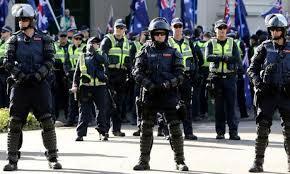
The talents of Victorian policing have already been found wanting during one of the most extreme lockdown measures in the developed world.  Reem Mussa, humanitarian advisor on forced migration to Médicins Sans Frontièresremembered the terror caused by the appearance of five hundred police “on housing estates [in Melbourne], trapping residents inside with no coherent health strategy or plans to keep them safe, fed or with access to medication and essentials.”  23 confirmed cases of COVID-19 had been found on the estates in July.  Panic coursed through the various administrative arms of government.

In September, a very public display of policing mismanagement took place with the arrest of Ballarat resident Zoe Buhler, a pregnant mother apprehended in front of her children and husband in their home for a Facebook post inciting protest against the lockdown rules.  No police officer thought it necessary to explain the offence of incitement, nor accept her offer to remove the offending post.  It was such conduct that prompted Greg Barns of the Australian Lawyers Alliance to argue for limits on police powers when linked to pandemic controls.

The Police Accountability Project, based at the Flemington & Kensington Community Legal Centre in Melbourne, has also been alarmed by the aggressive, untutored policing formula pursued in the state.  “The policing we have seen in Victoria to date and the scale of the policing we have seen [on July 4] and today in Flemington & North Melbourne, has caused and continues to do harm.”

Over the course of the lockdown, the PAP project has noted ten concerns about how harsh Stage 4 restrictions have been enforced.  A few are worth noting.  Police, for instance, were ill trained to make complex assessments about exemptions requiring health expertise.  “Police ignored genuine health based exemptions and continually resorted to lock-down responses because it more closely aligned with their training.”  They had failed to comprehend the public health impacts of their work, and that most pressing of points that policing “undermines public health responses.”  The policing of curfews had been “applied in a discriminatory, abusive and harmful manner.”  With such a stunning resume of faults and blunders, it is a wonder how the drafters in the Attorney-General’s department took leave of their senses.

On October 8, the Victorian government quietly trimmed parts of the proposed bill dealing with detention.  Finding themselves in retreat, a flutter of qualifications were made.  “We have always said we would negotiate in good faith,” claimed a less than chastened Hennessy.  Giving little away, the Attorney-General claims to have made such amendments that will continue “to deliver the temporary, necessary changes we need to respond to the challenges the pandemic presents”.

According to Guardian Australia, the proposed table of changes will still preserve the power to appoint police and protective services officers as authorised officers, but with fewer powers.  They will still be able to exercise considerable discretion in, for instance, searching property without a warrant if “necessary for the purpose of investigation, eliminating or reducing the risk to public health”.  The daft dangers of making police and security personnel pseudo-health officers remain.

MORE PEOPLE WERE ARRESTED FOR CANNABIS POSSESSION THAN ALL VIOLENT CRIMES PUT TOGETHER IN THE US LAST YEAR

By John Vibes

Source: Waking Times

With legal recreational and medical cannabis now available in so many different US states, it is easy to get the impression that the war on cannabis users is over.

However, cannabis users still represent a significant portion of the people who are filling jails and courthouses throughout the country.

According to the FBI’s recent Uniform Crime Report, more people were arrested for cannabis possession last year than for all violent crimes put together.

The data showed that 545,602 people were arrested in the US for cannabis-related crimes last year. Meanwhile, just 495,871 people were arrested for violent crimes.

Furthermore, the vast majority of the people who got arrested for cannabis were not accused of selling or trafficking the substance, but just for simple possession. 500,395 of the total cannabis arrests last year, or about 92%, were for possession, which is still more than the number of people who were arrested for violent crimes.

Erik Altieri, the Executive Director for cannabis advocacy group NORML, says that police across America are still making a cannabis-related arrest every 58 seconds.

“At a time when the overwhelming majority of Americans want cannabis to be legal and regulated, it is an outrage that many police departments across the country continue to waste tax dollars and limited law enforcement resources on arresting otherwise law-abiding citizens for simple m***juana possession,” Altieri told Forbes.

Overall, cannabis arrests have been going down nationwide due to the spread of legalization. Last year, cannabis arrests were down by 18% when compared with 2018.

As suspected, the FBI’s data showed that people were less likely to get arrested for cannabis in states where it was legal or available for medical use, with eastern states seeing far more arrests.

According to the report, roughly 53% of all cannabis arrests last year took place in the northeastern part of the country, where cannabis laws are still catching up with the west.

People of color are also at a greater risk of being targeted for cannabis arrests. According to a report from the ACLU, 2018 data showed that people of color were 3.6 times more likely to be arrested for cannabis possession than white people, despite using the substance at the same rates.

In some states that are known to be especially dangerous for people of color, such as Montana or Kentucky, they are close to ten times more likely to be arrested for cannabis. In a few particular US counties, people of color were 50 times more likely to be arrested for cannabis possession.

In some states where cannabis has been legalized, lawmakers are making efforts to introduce pardons for those who previously broke the law.

Earlier this year, Nevada Governor Steve Sisolak introduced a measure that will pardon more than 15,000 people who were convicted for low-level cannabis possession in the state.

The resolution was unanimously approved by the state’s Board of Pardons Commissioners shortly after it was introduced.

In Colorado, lawmakers passed a bill that will allow the state’s governor to unilaterally pardon people with past convictions for possession of up to two ounces.

Saturday Matinee: How to Operate Your Brain

Source: Open Culture

Speaking at the Human Be-In in January 1967, Timothy Leary uttered the famous phrase borrowed from Marshall McLuhan, “Turn on, tune in, drop out.” It was shorthand for saying experiment with psychedelics and achieve new levels of consciousness.

Almost 30 years later, Leary hadn’t lost his missionary zeal. In 1993 (and only a few years before his death), the former Harvard psychology professor recorded “a public service video” called How to Operate Your Brain. Here, Leary narrates an almost epileptic seizure-inducing video, providing what some consider “a guided meditation” of sorts. I’d prefer to call it an unorthodox “user manual” that tries to impart Leary’s unique sense of enlightenment:

The aim of human life is to know thyself. Think for yourself. Question authority. Think with your friends. Create, create new realities. Philosophy is a team sport. Philosophy is the ultimate, the ultimate aphrodisiac pleasure. Learning how to operate your brain, learning how to operate your mind, learning how to redesign chaos.

As you get deeper into the meditation, you’ll realize one thing. Three decades may have passed since Leary popularized the catchphrase of the counterculture. But he’s still getting his ideas from McLuhan. If you follow the video (or transcript) to the end, you’ll discover that ones and zeros have basically taken the place of LSD. Leary says:

Now we have digital communication. We can create our fantasies. We can create our rhythms, design on screen…. Anyone in any culture watching this screen will get the general picture. It’s one global village. It’s one global human spirit, one global human race. As we link up through screens, linked by electrons and photons, we will create for the first time a global humanity, not separated by words or minds or nationalities or religious biases.

You can find McLuhan meditating on the concept of an Electronic Global Village in another vintage clip.

Working to End Human Violence in the Time of Covid-19

By Robert J. Burrowes

At what is arguably the most important time in human history, with Homo Sapiens confronted by an enormous range of violent challenges that threaten our very survival, the only question of any genuine importance is this:

Can we craft and implement a strategy to end the violence, particularly in each and all of its extinction-threatening dimensions, to ensure that humanity has a chance to thrive on planet Earth indefinitely into the future?

But few are asking that question.

And, unfortunately, if one candidly considers the evidence in several critical domains – notably the threat of nuclear war, the deployment of 5G technology, the collapse of biodiversity and the climate catastrophe – there is little genuine room for optimism. This, of course, is not a reflection on the efforts of those committed to the attempt but it is a measure of the enormity of the task given the almost endless violence perpetrated by so many human inhabitants of Earth.

Moreover, of course, for most of 2020, the ongoing efforts by those committed to working to end violence in one context or another have not only been substantially impeded by the official response – including lockdowns, curfews, social distancing and mask-wearing – to the supposed Covid-19 pandemic, they have also witnessed an explosion of additional violence of many types and in many contexts – see ‘The Elite’s COVID-19 Coup against a Terrified Humanity: Resisting Powerfully’ – that have exacerbated the violence dramatically.

In addition, the combined impacts of the official response have (presumably inadvertently) accelerated the four primary paths to human extinction. See ‘The Elite’s COVID-19 Coup to Destroy Humanity that is also Fast-Tracking Four Paths to Human Extinction’.

Despite the unusual level of impediments, many people have remained steadfast in their efforts to raise awareness of what is at stake, to mobilize an effective response and/or to take action themselves to end the violence in one context or another. This includes individuals and organizations that have committed themselves to this effort by signing the online pledge of ‘The People’s Charter to Create a Nonviolent World’ which has signatories in 105 countries around the world and organizational endorsements in 39 countries.

These committed individuals and organizations include those few briefly discussed below, with some of them particularly focused on averting one of the paths to imminent human extinction.

Jennifer Wood is an architect and writer who developed near fatal toxic shock from the antibiotic Ciprofloxin and over-exposure to 2G wireless radiation when cell tower services were switched from analog to digital technology in 1996-1997. At this time, cell phone sales skyrocketed globally as did radiation and many public health problems according to epidemiologists. Although Jennifer had never used cell phones, she had spent long hours on a computer (surrounded by unnoticed cell towers) writing for the film director, Oliver Stone who had taken an interest in her novel. She has nearly died at a weight of 77 pounds from microwave radiation poisoning three times since that time. Each torturous period has coincided with exposure to upgrades in wireless technologies. During her third bout with death in 2010-2011, she moved to a radio quiet zone near a radio astronomy observatory that bans cell phone towers. Here Jennifer built by hand, without help, a tiny non-electric cabin without running water in the woods where she lived alone, with minimal suffering, for four years, gaining weight and becoming semi-functional.

Since 2011, she has been reviewing thousands of science studies on the health effects of human-generated electromagnetic radiation (EMR) while doing advocacy work. Prior to her illness, Jennifer lived and worked as an architect in Nepal for many years in the 1980s where she married and had two children. Her condition has forced her to live far away from most of her family much of the time since 1996. You can watch Jennifer in this film ‘Wi-Fi Refugees: Nowhere to run: Electrosensitive people try to escape wireless technology’, read about her struggle and see a photo of her cabin in ‘Search for a Golden Cage’, read about a success in having Wifi technology banned in schools in Israel in ‘Israel Wi-Fi Breakthroughs: TV Documentary, School Ban’ and watch videos of a protest rally at the US Supreme Court she co-organized: ‘The Public Has a Right To Know About the Health Risks of 5G Wireless, Cell Phones and the Internet of Things (IoT)’.

Prominent environmental journalist Robert Hunziker, noted for his capacity to track and report truthfully on the ecological health of planet Earth, recently wrote a sobering article highlighting key elements of the recent Living Planet Report 2020 which records ‘an average 68% decrease in population sizes of mammals, birds, amphibians, reptiles and fish between 1970 and 2016 [with a] 94% decline… for the tropical subregions of the Americas.’ With its ‘eye-popping description of the forces of humanity versus life in nature’, Robert noted ‘the report should really be entitled the Dying Planet Report 2020 because that’s what’s happening in the real world. Not much remains alive.’ For some of the detail of this disastrous state of affairs, read ‘The Dying Planet Report 2020’. For another of Robert’s reports on planetary ill-health, see ‘Boundless Dying Trees’. But if you are not horrified already, you should read Robert’s article ‘10C Above Baseline’ to get a clearer sense of where Earth’s climate is headed with extinction for humans at 4C above baseline.

Starting in February 2020, Joana Aboagyewaa of the Splendors of Dawn Poetry Foundation in Ghana reports making valuable contributions to schools in the eastern region through their work as poets and educators under the Foundation’s ‘SUN Project’. This educational project was undertaken in Abirem, Achiase, St Roses Senior High (Akwatia) and Akim Swedru Secondary Schools where teachers taught poetry and art, ‘that is deeply human to secondary school students’, for positive change. ‘In April, The Splendors Performance Team held their National Poetry Month activities to celebrate the importance of poets and poetry in our society and culture.’ Splendors’ ‘Poetry Exchange Day’, with poems wrapped as gifts and mailed to classmates and friends, was held in basic schools in the Greater Accra Region. In addition, Splendors’ ‘Poets in Schools’ project ‘was a huge success because we enrolled a high number of poets in secondary schools, through the poetry awareness campaign, to encourage students to write and read.’ The Covid-19 pandemic ‘has necessitated our coming up with the Splendors of Dawn online “Poets Read out” series. Splendors of Dawn Poetry Foundation, Ghana believes that we can change the world and contribute our quota for its development through poetry.’

The indefatigable Steve Varatharajan, the Vice President but, more importantly, for many years the heart and driving force behind the International Association of Educators for World Peace (IAEWP), headquartered in Malaysia, has recently announced that, at year’s end, he will ‘be stepping down from all my positions in IAEWP as I am having [serious health] problems… [related to] the aggressive 5G telecommunications network building.’ For those who don’t know Steve, it is unlikely that many people have served any global network with the talent, commitment and productivity that Steve has demonstrated within the IAEWP.

Steve has also recently announced the appointment of Dr. Alfredo Sfeir Younis – the Chilean economist, spiritual leader and healer who had a 29-year career at the World Bank including as its first environmental economist – as Executive Vice President of the IAEWP.  In that capacity, Alfredo has already proposed a visionary program to advance IAEWP aims. Separately from this, Dr. Priyaranjan Trivedi, the IAEWP Senior Vice President for Continental Asia and IAEWP Director General of Education, advises that their continental association has just launched a free online buffet of 31 courses. For details, see ‘Online Peace Education, Reconstruction, Accord, Non-Violence and Disarmament Initiative’. These courses are available online for India and the rest of the world.

Liz McAlister and Martha Hennessy are two of seven Catholic nuclear disarmament activists known as the Kings Bay Plowshares 7. The plowshares activists entered Kings Bay Naval Submarine Base in St. Mary’s, Georgia, USA on 4 April 2018, the 50th anniversary of the assassination of Rev. Dr. Martin Luther King Jr. Carrying hammers and baby bottles of their own blood, the seven attempted to convert weapons of mass destruction to make real the prophet Isaiah’s command to ‘beat swords into plowshares’. Apart from impeding the ever-heightening threat of nuclear armageddon as the world’s international legal infrastructure against nuclear war rapidly unravels, they also hoped to call attention to the ways in which nuclear weapons kill every day by their mere existence and maintenance.

The nonviolent activists were subsequently ‘found guilty of trespass, conspiracy and destruction of federal property’ in October 2019. After spending time in prison, on 8 June 2020 Liz – the widow of Phil Berrigan – was sentenced to ‘time served, three years supervised release and for a portion of the restitution for the seven of just over $30,000’. Martha – a granddaugher of Dorothy Day – is due to be sentenced in November. You can read a detailed account of their action, an inspiring biography of each activist and follow the court outcome for Martha and the others at the website above. You can also see an evocative interview of Martha at ‘Martha Hennessy Interview’.

Professor Bishnu Pathak in Nepal continues his substantial research output on a variety of subjects, most notably in the past month on subjects related to the fundamental question of whether international law can be used as an instrument to achieve peace. For insightful commentary on two issues in this field, see ‘Can Former Child Soldiers File a Complaint at the International Court against Nepal’s Maoist Leaders?’ and ‘Nuremberg Tribunal: A Precedent for Victor’s Justice’.

What Can You Do?

If you would like to join those individuals and organizations in 105 countries who have made the commitment to work to end human violence, you can do so by signing the online pledge of ‘The People’s Charter to Create a Nonviolent World’.

If you understand the critical importance of reducing human consumption as the core element of any strategy to preserve a habitable biosphere – encapsulated in Gandhi’s observation that ‘Earth provides enough to satisfy every person’s need, but not every person’s greed’ – then you might consider participating in ‘The Flame Tree Project to Save Life on Earth’ which he inspired as well.

If you would like to nurture children to become Self-aware individuals who are capable of responding powerfully to the challenges in life while reducing violence in the process, consider making ‘My Promise to Children’. For a deeper understanding of the cause and pervasiveness of human violence, see ‘Why Violence?’ and ‘Fearless Psychology and Fearful Psychology: Principles and Practice’.

And if you wish to use nonviolent strategy, as Gandhi developed and employed it, for your campaign or liberation struggle, you will be given clear guidance on how to do so on these websites that draw heavily on his work: Nonviolent Campaign Strategy and Nonviolent Defense/Liberation Strategy.

More simply, if you like, you might consider committing to:

The Earth Pledge

Out of love for the Earth and all of its creatures, and my respect for their needs, from this day onwards I pledge that:

  1. I will listen deeply to children. See ‘Nisteling: The Art of Deep Listening’.
  2. I will not travel by plane
  3. I will not travel by car
  4. I will not eat meat and fish
  5. I will only eat organically/biodynamically grown food
  6. I will minimize the amount of fresh water I use, including by minimizing my ownership and use of electronic devices
  7. I will not own or use a mobile (cell) phone
  8. I will not buy rainforest timber
  9. I will not buy or use single-use plastic, such as bags, bottles, containers, cups and straws
  10. I will not use banks, superannuation (pension) funds or insurance companies that provide any service to corporations involved in fossil fuels, nuclear power and/or weapons
  11. I will not accept employment from, or invest in, any organization that supports or participates in the exploitation of fellow human beings or profits from killing and/or destruction of the biosphere
  12. I will not get news from the corporate media (mainstream newspapers, television, radio, Google, Facebook, Twitter…)
  13. I will make the effort to learn a skill, such as food gardening or sewing, that makes me more self-reliant
  14. I will gently encourage my family and friends to consider signing this pledge.

Conclusion

While most human inhabitants of Earth remain oblivious to the pervasive violence that is destroying us and our world, including the advanced nature of the four primary threats to human existence, there is nevertheless a worldwide network of people deeply aware of this situation who are acting to address these threats.

‘Doomed to fail’, you might believe. ‘Impossible’ even. And perhaps you are right. In fact, there is considerable evidence to support these beliefs.

But as Gandhi noted: ‘Hesitating to act because the whole vision might not be achieved, or because others do not yet share it, is an attitude that only hinders progress.’

Given that some of us, including the people above, are already working to end human violence, the main question remaining is ‘What about you?’


Biodata: Robert J. Burrowes has a lifetime commitment to understanding and ending human violence. He has done extensive research since 1966 in an effort to understand why human beings are violent and has been a nonviolent activist since 1981. He is the author of Why Violence? His email address is flametree@riseup.net and his website is here.