Saturday Matinee: X-Files “My Struggle”

960

Though I was fascinated by the original X-Files in the 90s (especially the myth arc episodes), I had my doubts about the new mini-series until reading this compelling review/analysis of the first episode by esoteric researcher and super fan Christopher Knowles. After a recent viewing I felt he was pretty much on the mark and was glad the show’s creator Chris Carter was able to recapture the chemistry between the lead protagonists while forming an intriguing fictionalized narrative with elements of the parapolitical zeitgeist, just as he did with classic episodes of the past.

Watch the full episode and judge for yourself:

http://www.hulu.com/watch/896936

Gandhi the Anarchist

5e0fc8e70e7f794d27662ed00910928f

Editor’s note: Tomorrow marks the 67th anniversary of the assassination of Mohandas Gandhi. Society often celebrates such influential rebels while forgetting what made them great. Articles such as this help us avoid that trap.

By Jason Farrell

Source: Center for a Stateless Society

A complex man with a controversial legacy, Mohandas Gandhi remains one of the pioneers of civil disobedience as a political weapon and a giant in 20th century anti-colonialism. An individualist anarchist who motivated millions to fight to liberate themselves from British rule, his success showed a potentially powerful application of libertarian ideas during a major political crisis and the ability of those values to inspire positive, peaceful outcomes.

Gandhi’s principles of radical liberation existed within a moral framework that abhorred violence but empowered ordinary people, intellectually and spiritually, to prevail against oppressors and shatter a miserable status quo. According to the research of Erica Chenoweth, Gandhi’s template of non-violent resistance has been immensely successful for later generations around the world in creating lasting improvements in civil rights.

Modern activists and political thinkers shouldn’t discount the essential libertarian qualities of Gandhi’s philosophy, as they were among its most powerful and effective attributes. A commitment to natural law, self-determination, individualism and an abhorrence of government were core to his thinking and largely responsible for his success as an activist.

Gandhi’s Philosophy

Satyagraha, Gandhi’s philosophy of non-violence, which translates to “truth force” or “love force” carries with it some distinctly libertarian ideas. It incorporates elements of both the “knowledge problem” (applied in a moral sense) and the non-aggression axiom, although taken a step further into moral obligation to others — which is more than libertarianism demands. According to Gandhi:

In the application of Satyagraha, I discovered in the earliest stages that pursuit of truth did not admit of violence being inflicted on one’s opponent but that he must be weaned from error by patience and compassion. For what appears to be truth to the one may appear to be error to the other. And patience means self-suffering. So the doctrine came to mean vindication of truth, not by infliction of suffering on the opponent, but on oneself.

Gandhi noted the purpose of Satyagraha was to “convert, not to coerce, the wrong-doer.” Success is thus defined as cooperation towards a just end, rather than a political “win.” He also spoke of means and ends as inseparable, rejecting the use of violence or the “victory, by any means necessary,” mentality of some who have practiced passive resistance in the West. Gandhi knew using violent means would embed injustice in whatever ends are attained, exacerbating the cycle of violence that plagues so many societies. In this way, the practitioner’s authority is rooted in moral force instead of violence, and has the potential to reduce antagonisms within a society without harming the antagonists.

Gandhi developed a set of very particular rules and mores for Satyagrahis to follow, including mandatory spinning, chastity and abstinence from alcohol. With these we are unconcerned, since different disobedience movements employed different particulars in their belief systems. What is interesting and relevant is the commonality among them, and the parallels to libertarian beliefs: The notion of the moral abhorrence of coercion, and the acknowledgement of coercion’s role in perpetuating injustice; the belief in natural rights that oblige disobedience to unjust laws; finally, and most pertinently, the almost mystical ability of this approach to inspire entire populations to mass action is an historical fact.

Foundations of Indian Liberty: Satyagraha in Action

The Jallianwala Bagh massacre of April 13, 1919 (also known as the Amritsar massacre) has been characterized as the turning point in the history of British India, the event that lost Britain her ‘jewel in the crown’ and eventually her empire. The event, condemned by Winston Churchill, nevertheless produced an escalation of tension and insults against Indian subjects and shattered the notion that Indians were British subjects with the same rights as the British themselves, much in the way the Easter Rising created that same clarity for the Irish.

The Tribune of India described the massacre as a

[M]ilestone in the struggle for freedom which brought Mahatma Gandhi on the scene in his capacity as a leader of the masses whose presence inspired millions of people for three decades.

In the annals of our freedom struggle the Jallianwala Bagh massacre occupies an unforgettable place. Overnight, men and women resolved to defy the British might. For Gandhiji, the incident was a turning point. He became a ‘rebel’ and realised the futility of achieving freedom through British cooperation. The seeds of his ‘do or die’ movement were thus sown then and there.

Noted the Tribune:

History bears ample testimony to the fact that the ill-conceived and unwarranted 1919 military operation proved to be a catalyst for bringing the doom of the British Raj as it created an unbridgeable gulf between the British Government and the Indian people, leaving the British with no other option but to transfer power to the Indians.

Gandhi capitalized on the anger against British rule with the first concerted civil disobedience campaigns, the non-cooperation movement that began in the 1920’s. The Salt March of 1930 was among his most famous successes. The march began with a mere 78 people, swelling to throngs of 30,000-50,000 as they marched through four provinces to protest the salt tax. Gandhi went to sea to make illegal salt, a highly symbolic and dangerous act that challenged British authority. The result was widespread support and media attention, and the building of a broad-based movement. That movement contributed to Indian independence from the British in 1947.

Gandhi’s Libertarian Ideology

Though Gandhi the monolithic figure is widely revered, his actual political philosophy is seldom discussed, perhaps because he was an anarchist who believed in a cooperative agrarian economic model that prevented stratification of classes and political power.

It is well known that Gandhi was motivated by a desire to see India gain independence from the British Empire. Beyond that, his experience with governments seemed to have led him to a deep abhorrence of the institution, and an embracing of individualism, self-reliance and spontaneous order, part of a moral system he called the Swaraj, which translates literally to “self-rule.”

According to Swaraj.org:

The call for Swaraj represents a genuine attempt to regain control of the ‘self’ — our self-respect, self-responsibility, and capacities for self-realization — from institutions of dehumanization. As Gandhi states, “It is Swaraj when we learn to rule ourselves.” The real goal of the freedom struggle was not only to secure political azadi (independence) from Britain, but rather to gain true Swaraj (liberation and self-rule).

Gandhi scorned the representative democracy due to its conflict with his deeply held reverence for the rights of the individual, noting “Swaraj will be an absurdity if individuals have to surrender their judgment to a majority.”

Gandhi recognized inequalities would persist. He was, however, deeply skeptical of government as a tool of social improvement:

I look upon an increase of the power of the State with the greatest fear, because although while apparently doing good by minimizing exploitation, it does the greatest harm to mankind by destroying individuality, which lies at the root of all progress. We know of so many cases where men have adopted trusteeship, but none where the State has really lived for the poor.

It is my firm conviction that if the State suppressed capitalism by violence, it will be caught in the coils of violence itself, and will fail to develop non-violence at any time. The State represents violence in a concentrated and organized form. The individual has a soul, but as the State is a soulless machine, it can never be weaned from violence to which it owes its very existence.

Gandhi was a believer in spontaneous order as well: “We find the general work of mankind is being carried on from day to day be the mass of people acting as if by instinct.”

Influenced by Western traditions in part due to the time he spent in Britain in his youth, Gandhi was also a believer in individualism, and the use of reason to underwrite a person’s morality. According to Professor T.N. Madan, Honorary Professor of Sociology at New Delhi University:

One of Gandhi’s outstanding contributions to social and political thought, I suggest, was the conception of altruistic individualism within a cultural setting that was generally considered group-centred … In regarding reason and moral sense as the primary sources of good conduct, Gandhi asserted the right of the individual to arrive at judgments and, if necessary, to defend them against collective opinion, whether traditional or contemporary. His excoriation of the practice of untouchability was not merely an assertion of his own individual right to make moral judgments — indeed he considered this an obligation  but more importantly the assertion of the moral worth of every single human being, irrespective of his or her ascribed social status. Such moral worth is the basic premise of good society; whether it is enhanced or eroded depends on the dialectic of social pressures and individual agency.

Gandhi not only believed in asserting individual rights against the coercion of the state, he evidently believed market processes and private property would best meet man’s needs and scorned the use of parliamentary systems in attempting to achieve social ends. He was hostile to centralized authority of any kind and believed strongly in individualism and self-rule. “If we become free,” he said, “India becomes free and in this thought you have a definition of Swaraj. It is Swaraj when we learn to rule ourselves.”

It is worthwhile to note the relevance of natural law in radical liberation. Like with most governments, the British claim that their colonies enjoyed rights as British subjects was farcical. Whenever conflict arose, those rights seemed to dissolve quickly into coercion and bloodshed as the British fought to maintain unquestioned supremacy. Gandhi, like the Sinn Fein and the American founders before him, used the notion of a higher “natural” law and an emphasis on self-rule to motivate the oppressed to seize their own freedom.

Gandhi angered some by extending his notion of power and Swaraj to the history of colonization. While acknowledging the British Empire’s cynical intentions in India, he placesthe responsibility for the disaster of colonization on the Indian people. “It is truer to say that we gave India to the English than that India was lost … to blame them for this is to perpetuate their power.” Because power resides in the people and they can only lose it by relinquishing it (often through coercion by others), petitions to the government get a new meaning with Gandhi. “A petition of an equal is a sign of courtesy; a petition from a slave is a symbol of his slavery.”

Here again is a similarity with Sinn Fein’s embrace of natural rights — rights don’t come from government, but from within. Therefore, rights continue to exist when they cannot be openly expressed due to coercion. This is a crucial intersection for libertarians. Radical ideologies succeed in part by inculcating oppressed and apathetic populations with a sense of self-worth. The concept of natural rights was important during the colonial period, when colonized people believed rights were rare morsels tossed to them on the whim of their superiors. Gandhi’s philosophy sought to rob Britain of their power to determine the law as a sort of demystification of white rule.

Anarchic India of course, was not to be. Gandhi, not being able to realize his “oceanic villages” system with Indian liberation in 1947, settled on minarchism:

Gandhi recognized that there would be a national government, and his anarchic, oceanic circle would not yet be possible. Nevertheless, he used the terms of nationalism to move towards the ideal of Anarchy. He advocated for a minimal level of State organization to fund some education programs and to promote his economic concept of trusteeship. Hence, Gandhi was a compromising Anarchist.

Gandhi had to compromise his principles in some cases. But of greater import is the fact that his individualist principles caught fire and exploded in popularity in the face of severe oppression. Indian independence was a complicated endeavor, but in the end, Gandhi proved to be on the right side of history. The radical anarchist who had been repeatedly imprisoned, classified as a terrorist by the British parliament and derided as a threat to law and order, was described by former U.S. Secretary of Defense George C. Marshall as “a spokesman for the conscience of all mankind.” With the positive impact non-violent resistance movements have had in the last seven decades, he might also be considered a true political visionary.

Poisoning Black Cities

CYcJy0hWwAAswen

They drowned New Orleans. Now they have poisoned Flint, Michigan. The corporate campaign to ethnically cleanse U.S. cities knows no bounds. Michigan’s emergency financial manager law is “part of Wall Street’s tool kit to starve, bulldoze, redline, over-price, oppressively police, and even poison Black people out of the urban centers.”

By Glen Ford

Source: Black Agenda Report

“Michigan’s emergency financial manager system is the lead-tipped point of the spear that is gutting urban Black America.”

It has taken the poisoning of an entire city of 100,000 people – 52 percent of them Black – to draw national attention to the human effects of systematic corporatization of the public sphere under neoliberal U.S. capitalism. Republican Governor Rick Synder promises to “fix” the ruined water infrastructure of Flint, Michigan, now hopelessly corroded and saturated with lead – a repair that could cost as much as $1.5 billion. But, even if Snyder is forced to resign, as demonstrators demand, or is jailed, as filmmaker Michael Moore would prefer, it won’t fix the irreparably damaged brains of the city’s children or prevent a cascade of Flint-like catastrophes from unfolding across the country.

We are experiencing another Katrina moment, a dreadful epiphany in which the nature of the beast that is preying upon us becomes horrifically clear. Michigan’s emergency financial manager system – a weapon of corporate dictatorship imposed selectively on heavily Black and brown cities and school systems – is the lead-tipped point of the spear that is gutting urban Black America. It is not a unique instrument – and certainly not a Republican invention – but part of Wall Street’s tool kit to starve, bulldoze, redline, over-price, oppressively police, and even poison Black people out of the urban centers.

“A Katrina moment.”

Katrina should have been the wake-up call, a decade ago, but the hegemonic influence of the bankster-infested Democratic Party in Black America muted the warning, that the Lords of Capital were determined to eject Blacks from valuable real estate by any means necessary. After their success in expelling 100,000 Black people from New Orleans under cover of a hurricane, the corporate designers of the New American City stepped up the pace of gentrification, deploying every soft and hard tool available to them. The Black-removal machine was revved up to maximum, erasing Black urban majorities and pluralities with dizzying speed.

Having met little organized resistance, the corporate ethnic cleansers grew bolder. Republicans like Rick Synder get elected by trashing Black people; they hardly need an economic motivation for race-baiting. Corporate Democrats are more subtle. Rick Snyder wasn’t the first governor to disenfranchise Black urbanites in Michigan; his Democratic predecessor, Jennifer Granholm, a reputed “liberal,” appointed emergency managers to lord it over mostly Black Benton Harbor, Highland Park, Pontiac, and the Detroit Public Schools (where teachers have been on a sick-out to protest the ghastly conditions wrought by that bipartisan legacy of plantation-like governance).

“The Black-removal machine is erasing Black urban majorities and pluralities with dizzying speed.”

The Obama administration was a full partner in the deal that finalized the bankrupting of Detroit, providing federal funds to protect prime city assets necessary for future “revitalization” (to benefit anticipated new residents) but uttering not a word in protest of the disenfranchisement of the current, 83 percent Black population. The U.S. Justice Department failed to file a brief in support of the local NAACP’s appeal to the federal courts, that Michigan’s emergency financial manager law is racially selective, sparing financially troubled “municipalities with majority-white populations” from financial oversight while negating the votes of more than half of the state’s Black citizenry. “You do not throw out the right to vote on the basis of economic distress,” said Detroit NAACP president Rev. Dr. Wendell Anthony.

On the contrary, that’s exactly what corporations do when they set an economic or political goal that cannot be achieved at the local ballot box: they disenfranchise the uncooperative voters. In the United States, Black votes are the easiest to nullify, because huge numbers of whites don’t think Blacks are worthy of full citizenship. They take pleasure in bringing Detroit low, and in the enforced shrinking of Black New Orleans, never considering that the weakening of democratic norms will ultimately expose whites to the whims of Capital, as well. It is the oldest story in the United States.

“Corporate tentacles encroach upon the traditional powers of ‘too-Black’ cities until there is little left for the local government to tax or administer.”

White racism thus shapes the corporate model for direct rule by moneyed interests. Typically, the urban disenfranchisement process begins with the public schools, which become overwhelmingly Black and brown ahead of the general population. Locally elected inner city school boards are swept away in favor of state or direct mayoral control, while suburbanites retain the old, hands-on democratic model. (The Michigan legislature took over Detroit’s schools in 1999.) Corporate tentacles encroach upon the traditional powers of “too-Black” cities in ways not visible to ordinary citizens – through regional agencies, special industrial and development zones, targeted tax abatements, etc. – until there is little left for the local Black government to tax or administer except its largely impoverished constituents. Black governance is discredited – even though, in the last stages of urban distress, there are few resources with which to govern. The city writhes in protracted pain until “rescued” by the state for the purpose of corporate makeover (“renaissance”) and repopulation.

The corporate rulers and their minions must be held responsible for all of the pain that is inflicted on the people of intentionally distressed cities, whose residents are stripped of the means to defend themselves against the tortures, humiliations and various poisons of the state.

The Wickedness of [US] Foreign Policy

us-imperialism-nepal-south-asia-revolution

By Sheldon Richman

Source: Center for a Stateless Society

If you want to see how inhumane people can be, just watch those who make and execute foreign policy. We could spend all day discussing the cruelties that politicians and bureaucrats commit against people who live inside the United States. Think how many are caged like wild animals because they manufacture, sell, or consume disapproved substances; gamble where government has forbade it; traded sexual services for money; possessed a gun they weren’t “supposed” to possess; etc. ad infinitum. Naturally, America leads the world in locking up people.

But at least the policy of mass imprisonment gets increasing attention. Subject to far less scrutiny is how America’s (mis)leaders, (mis)representatives and public (self-)servants treat foreigners, especially those with dark skins and a still-unfamiliar religion. When we talk about foreign policy, how easy it is to get wrapped up in abstractions like empire,intervention, nonintervention, and kinetic military action. These are important concepts to understand, of course, but foreign-policy conversations often become sterile examinations of “policy,” when what we need is a full awareness of the harm to individual human beings, the destruction of their families, homes, communities, and societies. These persons are the victims of our rulers’ geopolitical stratagems, which seemly outrank all other considerations. Yet each victim has a story embodying unique relationships and aspirations, a story that is permanently changed by an American cluster bomb, drone-launched missile, or special-ops mission.

The best that can be said of the perpetrators of this carnage and social devastation is that they are guilty of gross negligence. Many of their acts, however, cross into the territory of premeditated murder and the infliction of mayhem with malice aforethought.

One need not look hard for the most egregious examples taking place right at this moment. In Yemen the Obama administration gives indispensable material support to Saudi Arabia’s barbaric war — war ought not to require a qualifier like barbaric, but it seems necessary these days — on the poorest population in the region. The U.S.-facilitated starvation blockade and cluster-bombing take an untold number of Yemeni lives while devastating the social order. Policymakers — a euphemism for the architects of devastation — can rationalize this cruelty in geopolitical terms — the Houthis, who incidentally are fighting al-Qaeda-affiliated jihadis, are (falsely) said to be instruments of Iran — but the fact remains that individual persons who did no harm to anyone are being slaughtered and starved with the help of American politicians and military bureaucrats.

Or how about Syria? U.S. conduct carries out a seemingly incoherent policy of simultaneously targeting the regime of President Bashar al-Assad and one of his chief adversaries, the Islamic State, while helping another Islamist group, al-Nusra Front, that has pledged allegiance to Ayman al-Zawahiri, Osama bin Laden’s successor as head of al-Qaeda, perpetrators of the 9/11 attacks. Estimates of the death total in Syria’s civil war reach as high as 340,000, a number that represents the toll at the hands of both government and rebel forces. (The total is sometimes invidiously attributed to Assad’s military alone.) The injured and refugees are probably uncountable.

What must be understood is that most of these deaths, injuries, and dispossessions would probably not have occurred had the Obama administration — most especially Secretary of State Hillary Clinton — not early on intensified the civil war by declaring Assad’s regime “illegitimate,” demanding that he “go” (i.e., die), and overseeing the transfer weapons and jihadi fighters from Benghazi, Libya. While doing all this, the Obama administration was thwarting promising efforts toward a negotiated settlement, which might have stopped or at least reduced the killing of innocent persons. For details see these three articles by the excellent investigate journalist Jonathan Marshall.

And then there’s Libya itself, which Clinton boasts is an example of “smart power at its best.” In 2011 she had egg on her face because she was on the wrong side of the Arab Spring, having defended Egypt’s military dictator, Hosni Mubarak, as a family friend and trusted world leader to the bitter end while throngs of aggrieved Egyptians were in the streets demanding his exit. Needing to clean up her image (perhaps in preparation for her quest for the presidency), she along with administration national-security VIPs Samantha Power and Susan Rice persuaded a reluctant Obama that the residents of Benghazi had to be saved from Col. Muammar Gaddafi’s alleged genocidal designs. The only problem was that Gaddafi had no genocidal designs. (Also see this and this.) And in a classic exhibition of mission-creep, the U.S.-led NATO air campaign went from protecting Benghazi to changing the regime in Tripoli, prompting Clinton to gloated, “We came. We saw. He died.” (Gaddafi was killed extrajudicially, reportedly in a most gruesome manner.)

Since the U.S. intervention, Libya has been wracked by sectarian civil war — even the Islamic State now holds territory there — prompting many Libyans to flee to Europe, which now has to contend with a growing refugee crisis. As noted, the Libyan power vacuum, featuring the unlocking of Gaddafi’s arsenal of heavy weapons, helped to boost the Islamist rebel militias in Syria, to the delight of U.S. allies Turkey (which fears the Kurds) and Saudi Arabia (which fears Iran and the Shi’ites). After the nightmare in Iraq, one has to wonder what Clinton was thinking. The closest thing we have to an answer is from then-Secretary of War Robert Gates, an opponent of the intervention, who said, “We were playing it by ear.” (And let’s not forget: destabilization itself can be an objective.)

Of course we could point to Iraq, George W. Bush’s invasion of which in 2003 set most of the aforementioned mayhem in motion, and Afghanistan, but the story is largely the same: innocent lives are sacrificed to the politicians’ grand agenda. Little people living small lives can’t be allowed to stand in the way.

When Collapse Is Cheaper and More Effective Than Reform

a-falling-house-of-cards

By Charles Hugh Smith

Source: Of Two Minds

Collapse begins when real reform becomes impossible.

We all know why reforms fail: everyone whose share of the power and money is being crimped by reforms fights back with everything they’ve got.

Reforms that can’t be stopped by the outright purchase of politicos are watered down in committee, and loopholes wide enough for jumbo-jets of cash to fly through are inserted.

The reform quickly becomes “reform”–a simulacrum that maintains the facade of fixing what’s broken while maintaining the Status Quo. Another layer of costly bureaucracy is added, along with hundreds or thousands of pages of additional regulations, all of which add cost and friction without actually solving what was broken.

The added friction increases the system’s operating costs at multiple levels. Practitioners must stop doing actual work to fill out forms that are filed and forgotten; lobbyists milk the system to eradicate any tiny reductions in the flow of swag; attorneys probe the new regulations for weaknesses with lawsuits, and the enforcing agencies add staff to issue fines.

None of this actually fixes what was broken; all these fake-reforms add costs and reduce whatever efficiencies kept the system afloat. Recent examples include the banking regulations passed in the wake of the 2008 meltdown and the ObamaCare Affordable Care Act (ACA).

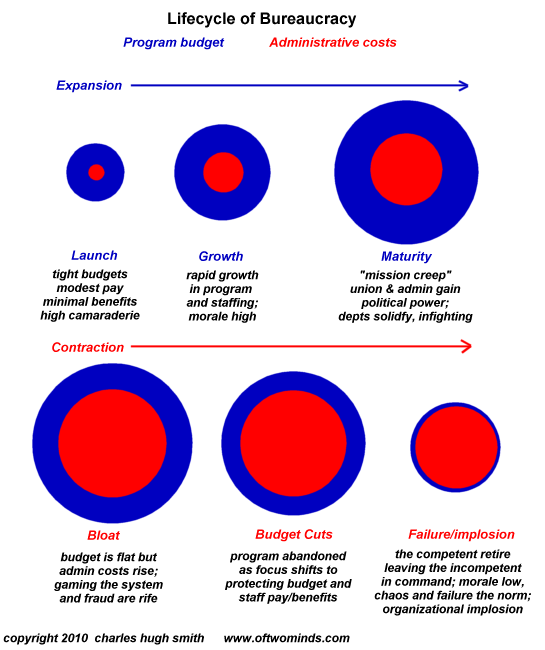
Back in 2010 I prepared this chart of The Lifecycle of Bureaucracy: as bureaucracies expand, they inevitably become less accountable, less efficient, more bloated with legacy staffing and requirements that no longer make sense, etc.

As costs soar, the bureaucracy’s budget is attacked, and the agency circles the wagons and focuses on lobbying politicos and the public to leave the budget untouched.

Since accountability has been dissipated, management becomes increasingly incompetent and larded with people who can’t be fired so they were kicked upstairs. Staff morale plummets as the competent quit/transfer out in disgust, leaving the least productive and those clinging on in order to retire with generous government benefits.

In this state of terminal decline, the agency’s original function is no longer performed adequately and the system implodes from the dead weight of its high costs, lack of accountability, gross incompetence, inability to adapt and staggering inefficiency.

lifecycle-bureaucracy

I’ve covered this dynamic a number of times:

Our Legacy Systems: Dysfunctional, Unreformable (July 1, 2013)

The Way Forward (April 25, 2013)

When Escape from a Previously Successful Model Is Impossible (November 29, 2012)

Complexity: Bureaucratic (Death Spiral) and Self-Organizing (Sustainable) (February 17, 2011)

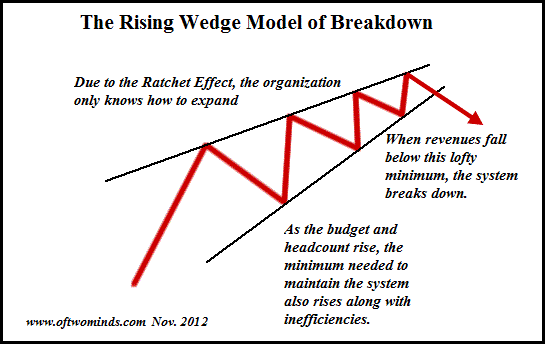
This generates a ratchet effect, where costs increase even as the bureaucracy’s output declines. The ratchet effect can also be visualized as a rising wedge, in which costs and inefficiencies continue rising until any slight decrease in funding collapses the organization.

Dislocations Ahead: The Ratchet Effect, Stick-Slip and QE3 (February 14, 2011)

The Ratchet Effect: Fiefdom Bloat and Resistance to Declining Incomes (August 23, 2010)

rising-wedge

The net result of the Ratchet Effect and the impossibility of reform is this: it’s cheaper and more effective to let the system collapse than squander time and treasure attempting reforms that are bound to fail as vested interests will fight to the death to retain every shred of power and swag.

Since the constituent parts refuse to accept any real reforms, the entire system implodes. We can look at healthcare, higher education and the National Security State as trillion-dollar examples of systems that become increasingly costly even as their performance declines or falls off the cliff.

This is the lesson of history, as described in the seminal book The Upside of Down: Catastrophe, Creativity, and the Renewal of Civilization.

Collapse does not need to be complete or sudden. Collapse tends to be a process, not an event.

Collapse begins when you can’t find any doctors willing to accept Medicaid payments, when the potholes don’t get filled even when voters approve millions of dollars in new taxes, and when kids aren’t learning anything remotely useful or practical despite the school board raising tens of millions of dollars in additional property taxes.

Collapse begins when real reform becomes impossible.

2016 The Year Ahead

winter-solstice-gallery

By Neil Kramer

Source: NeilKramer.com

2016 will rigorously test people’s readiness to embody their truth. Can we live the wisdom and transformation we’ve been cultivating over years of study, journeying, and contemplation? Can we summon the strength to have our outside accurately reflect our inside? Are we ready to run our own world yet?

In many schools of mystical study, polarity is a key principle. The student is taught that everything in life is dual. All phenomena have pairs of opposites, as observed in the primal forces of birth and death, day and night, order and chaos, joy and sorrow. Over time, through experientially mapping and understanding the interplay of each set of polarities in our own lives, we may gradually determine a point of equilibrium that reveals the hidden teachings of these mysterious fluctuations. What we must be careful to avoid, is clinging to just one end of life’s naturally divergent polarizations. And herein lie the trials set forth in the world’s current crises.

At every turn, the synthetic culture of Empire implores us to throw our hearts and minds into unconscious polarization. It wants us to radicalize ourselves to either patriot or terrorist, believer or atheist, white or black, liberal or conservative, strong or weak, and then embark on an endless crusade to reform, condemn, or destroy the other side. This one-way polarization renders all participants impotent, regardless of which side they pick. This subtle but devastating trick deactivates our will and we automatically forfeit our capacity to rule ourselves. Lost in unconscious polarization, we serve Empire.

Nevertheless, whilst Empire’s constant telegraphing of fear can be unsettling, its power to deceive is unquestionably failing to influence legions of honorable humans who refuse to hand over their discernment to the corrupt and compliant media. The sock puppet terror cells and fabricated economic cataclysms are fraying at the edges and their artificial nature is pitifully evident. The official narrative betrays only those who choose to hide from reality. For them we can do nothing, until they do something for themselves.

It is my heartfelt observation that a critical threshold of spiritually alive humans have grown so excellently in confidence and wisdom, that the old hierarchies must resort to ever more vulgar contrivances to preserve their reins of power. Understand then, that the daybreak of a new higher consciousness will be heralded not by gentle awakenings and well-mannered transitions, but by bewildering fragmentation. Just as these patterns of collapse were experienced in many people’s personal lives throughout 2015, so now they are shaking the very foundations of Empire. Towering ramparts that once seemed so impossibly daunting and everlasting, will soon be little more than forlorn ruins.

We are upon the eve of the grand winter solstice of Empire, and the longest darkest night will seem interminably protracted and bone-chillingly cold. But like all things, this too shall pass. And the daylight will lengthen and the new growth that we have envisioned for so long will blossom – if we let it. We made Empire and we must unmake it. As a thing is bound, so it is unbound. Deeds not words. Learn the art of depolarization and nothing can stop you.

People Over Politics: Michigan Militia Joins Michael Moore to Protest Flint Water Crisis

tumblr_inline_nv7i7rf9751r447cy_1280

By Carey Wedler

Source: Anti-Media

The water crisis in Flint, Michigan has inspired an unlikely partnership: a local militia group is coordinating with outspoken liberal filmmaker Michael Moore to demand accountability and clean water for residents.

Moore, a Flint native who first gained notoriety for his his documentary on the town’s economic hardships, has spoken out against the state and local government’s negligent handling of the disaster. The high volume of lead in public water supplies has contaminated children’s blood and led Flint’s mayor to declare a state of emergency.

The crisis has drawn widespread attention and outrage.

At a rally on January 16, Michael Moore said, “I am standing in the middle of a crime scene. Ten people have been killed … because of a decision to save money.” The city’s water supply was changed from Detroit’s water supply to the Flint River in 2014, in spite of the new source’s reputation for being filled with contaminants like raw sewage and tires.

As Anti-Media previously reported, “The shift in supply was a result of failed procedures and negotiations to continue purchasing the water.”

Further, the state’s Department of Environmental Quality has admitted its failure in not requiring that non-corrosive additives be added to the water during treatment to counteract the lead that seeps into water from old pipes. Authorities at the state level reportedly belittled concerns from Flint’s local community about the quality of their water. The national EPA has also been criticized for its involvement (or lack thereof) in the water crisis.

These examples of incompetence and corruption, along with the residents’ ongoing suffering, led Moore to speak out. Meanwhile, the Michigan militia, known as the Genesee County Volunteer Militia, has been working with the Red Cross to deliver clean water door-to-door, making stops that include a senior living facility and an elementary school.  The Detroit Free Press reported that in a news release, the militia said, “It is nothing less than shocking that our elected officials would try to hide the hazards that residents are being subjected to just by drinking a simple glass of tap water!!!” Further, the group demanded more information from the government on who was “involved in a coverup.

Details have emerged that suggest Governor Rick Snyder and his administration ignored  warnings about the looming crisis — and that Snyder has since tried to cover up this prior knowledge. He released emails this week that were largely redacted, and Michael Moore has called for his arrest.

The militia is planning a rally for Sunday at 2pm at the City of Flint Municipal Center, and is working with Moore to ensure voices of dissent are continually heard.

We’re trying to coordinate so the protests don’t stop,” Dave McKellar, a member of the right-wing armed force said. He owns a tree service business in Flint.

McKellar expressed his willingness to work with More in spite of differences of opinion on other matters. “We don’t see eye-to-eye on many things,” said McKellar. “For him to step forward and say something good… this time I agree with him.”

As McKellar said of the militia, “What we are is a constitutional defense force. We protect people who can’t protect themselves in time of disaster, be it man-made or other.” Still, the militia has made it clear its focus is not on weapons, but on the crisis at hand. The group posted on Facebook about its upcoming Sunday protest, noting, “We ask that you only wear side arms and not long rifles, this is not about our 2nd Amendment, this is about the infringement on the good people of Flint.

The alliance between the militia and Michael Moore is admittedly unlikely. One of Moore’s most successful films, Bowling for Columbine, focused on the negative effects of guns in America, and the left’s reaction to the Oregon standoff — including calls to drone strike the so-called “domestic terrorists” have highlighted contentious, long-running divisions between armed protest movements and liberal causes. Animosity between left and right in the United States has reached fever-pitch on countless issues, from healthcare to police brutality to the Syrian refugee crisis.

Nevertheless, the two seemingly conflicting parties have placed the health of their fellow citizens above partisan hatred. Though they do not appear to have established a permanent relationship, Moore and the militia’s collaboration suggests that, perhaps, Americans can share a common cause.

Indeed, a wide variety of groups have stepped up to help residents of Flint. In addition to Michael Moore, the militia, and the Red Cross, an Islamic charity, local activists, and a Native American tribe have committed to helping the struggling community, along with countless Americans across the country.


This article (People Over Politics: Michigan Militia Joins Michael Moore to Protest Flint Water Crisis) is free and open source. You have permission to republish this article under a Creative Commons license with attribution to Carey Wedler and theAntiMedia.org. Anti-Media Radio airs weeknights at 11pm Eastern/8pm Pacific. Image credit: Kai Schreiber. If you spot a typo, email edits@theantimedia.org.