
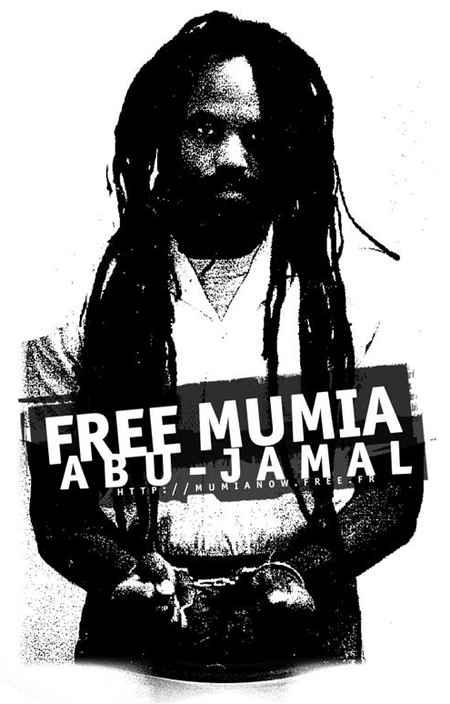
Why Mumia Must Live, and US imperialism Must Die: The Link Between Political Prisoners and the War on Terror

mumia

The so-called War on Terror and the national security state did not emerge full-blown from the rubble of 9/11. Both are products of previous waves of police repression, mainly targeting Black radicals. “The FBI’s counter insurgency war on the Black Panther Party chapters and leaders like Mumia established for local police departments a direct link to Washington’s war and surveillance arsenal.”

By Danny Haiphong

Source: Black Agenda Report

The fear of the Muslim/Arab terrorist rekindles the same fear in white America that the Black liberation movement ignited over four decades ago.”

Political Prisoner and journalist Mumia Abu-Jamal has been subjected to over three decades of torture from the US prison gulag. His political imprisonment has placed his life in serious danger, this time not from state execution but instead from extra-legal medical neglect. The prison state has continuously failed in its efforts to murder Mumia through official means and has thus decided to refuse the former Black Panther adequate medical treatment for diabetes. Meanwhile, Boston residents of all classes await the verdict of whether the alleged “Boston bomber” Dzokhar Tsarnaev will receive the death penalty or life in prison. The event that faithful day remains shrouded in questions , but most of the city has accepted the dominant narrative put forth by the FBI and Boston Police Department. The War on Terror that produced the “Boston Bombing” and Mumia’s struggle against the prison state are intimately connected. For Mumia to live with freedom and dignity, the US imperial order behind the War on Terror must die.

Mumia Abu-Jamal’s existence as a political prisoner has been repressed by the establishment, while the War on Terror is a household name in the US. This is because the War on Terror serves the objectives of imperialism and Mumia does not. Mumia joined the Black Panther Party at fifteen and served as the Philadelphia Chapter’s Ministry of Information. He used his talents in journalism in service of Black people both in the BPP and after. This landed him on J. Edgar Hoover’s COINTEPRO list of Black liberation fighters to watch and suppress. In 1978, Mumia covered the Philadelphia police department’s siege on the MOVE Organization. His critical investigation of the Philly PD’s role in repressing MOVE led to his ouster from the journalism industry. In 1982, Mumia was framed for the murder of police officer Daniel Faulkner and sentenced to death.

He used his talents in journalism in service of Black people both in the BPP and after.”

The context of Mumia’s imprisonment is at the essence of US imperialism’s War on Terror, which could be better named its war of terror. In the film Manufacturing Guilt​ , Mumia’s frame-up is blatantly exposed through court documents and investigations. Yet, Mumia has lived much of his life in prison, mostly in solitary confinement. What explains this injustice and how does it relate to the current War on Terror? In Still Black, Still Strong, Dhoruba Bin-Wahad explains how the FBI’s counter insurgency war on the Black Panther Party chapters and leaders like Mumia established for local police departments a direct link to Washington’s war and surveillance arsenal. Washington’s war on Black liberation fighters precipitated the first SWAT team operation in 1969 and the FBI’s declaration that the Black Panther Party was the “greatest threat to the internal security” of the US. The war on Black freedom that jailed Mumia created the technical capacity for the War on Terror.

The recent bombing of the 2013 marathon, and 9/11 before that, created the conditions for a massive expansion of the surveillance state and police state throughout the US mainland. The hundreds of illegally detained prisoners at Guantanamo Bay, the increased surveillance of Muslims and Black people in the US, and the massive spy program instituted by the Patriot Act and similar legislation are daily reminders of US imperialism’s ever expanding repressive apparatus. Internationally, the US led War on Terror interventions have caused the loss of life of millions of people in the Middle East and Africa alongside the thousands more from US aerial drone strikes and proxy war. All of this has been justified as necessary to “counter” the so-called threat of “terrorism.”

The war on Black freedom that jailed Mumia created the technical capacity for the War on Terror.”

Mumia’s story, one shared by numerous US political prisoners sentenced to die in the cages of the prison state, contains in it the seeds that sprouted the rise of the massive War on Terror. Russell Maroon Shoatz, Oscar Lopez Rivera, Leonard Peltier and scores more faced trumped up charges from the state as part of US imperialism’s counter insurgency war on dissent generally and the Black liberation movement in particular. This war has been expanded to meet the needs of US imperialism, which in its current form has produced a potentially explosive situation domestically and globally. The sharpening contradictions of never-ending war and increasing poverty and privatization wouldn’t last long if the counter insurgency war on Mumia and the Panthers hadn’t provided the blueprints and technical support for the mass expansion of the War on Terror’s primary tools: war and surveillance state.

Mumia Abu-Jamal and the rest of the Empire’s political prisoners are caught in the cross hairs of US imperialism’s war of survival. Not only has the material basis of the counter insurgency war that murdered and imprisoned the Black liberation movement grown, but so too has the racist logic behind the repression. The War on Terror’s racist logic has permeated so deeply into the minds of the US public that the mere questioning of the agenda’s blatant deceit is subject to dismissal or defense by most people living in the US mainland. These conditions have left political prisoners with few fighters on the outside pressuring their release. The War on Terror has attempted to erase the memory of political prisoners by reframing the racist justifications for political imprisonment as common sense in what George Jackson called the “Amerikan mind.”

The War on Terror’s racist logic has permeated so deeply into the minds of the US public that the mere questioning of the agenda’s blatant deceit is subject to dismissal.”

So, even though the justification for each and every War on Terror intervention or policy since 2001 are dubious at best, the fear of the Muslim/Arab terrorist rekindles the same fear in white America that the Black liberation movement ignited over four decades ago. The Black Panther Party and their partners in struggle were deemed criminal in every way and many were falsely charged with the murder of police officers, the highest form of offense in the eyes of white America. The War on Terror built off this strategy by throwing the Muslim community into the racist war on the oppressed as a means to control the dissent of the entire population. That the US imperial machinery is complicit in, and a sponsor of, jihadist terror and proxy war matters as little as the innocence of political prisoners when it comes to preserving the Empire and criminalizing all resistance to its rule.

Mumia Abu-Jamal’s life needs to be saved by any means necessary, but fighting to free him based on his criminal case alone won’t develop the movement we need. One of the primary obstacles to building a concrete movement for the freedom of political prisoners is the privileging of innocence over a movement that links political prisoners to the repression of the imperial state. But Mumia’s innocence teaches us the real purpose of political imprisonment. The War on Terror is a consolidation of the forces that were built by imperialism to suppress the revolutionary ideas of Mumia Abu-Jamal. What we need is a reexamination of those ideas in the service of the freedom of all political prisoners. By studying the War on Terror and the repression of the Black Liberation movement from which it grew, it becomes increasingly clear that imperialism must die for Mumia to truly live.
Danny Haiphong is an organizer for Fight Imperialism Stand Together (FIST) in Boston. He is also a regular contributor to Black Agenda Report. Danny can be reached at wakeupriseup1990@gmail.com and FIST can be reached at bostonfist@gmail.com.

Two Stories the Same Day Show That the U.S. is Rotten to the Core

drone_attacks_281210

By Ted Rall

Source: Ted Rall Blog

Still think the United States is governed by decent people? That the system isn’t totally corrupt and obscenely unfair?

Two stories that broke April 23rd ought to wake you up.

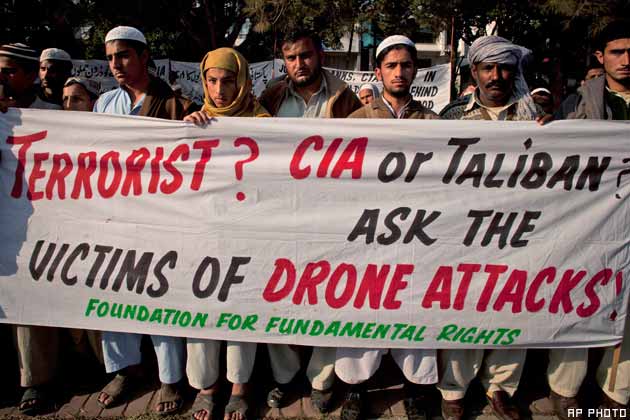
Story 1: President Obama admitted that one of his Predator drones killed two aid workers, an American and an Italian, who were being held hostage by Al Qaeda in Pakistan. As The Guardian reports, “The lack of specificity [about the targets] suggests that despite a much-publicized 2013 policy change by Barack Obama restricting drone killings by, among other things, requiring ‘near certainty that the terrorist target is present,’ the U.S. continues to launch lethal operations without the necessity of knowing who specifically it seeks to kill, a practice that has come to be known as a ‘signature strike.’”

“Lack of specificity” is putting it mildly. According to a report by the group Reprieve, the U.S. targeted 41 “terrorists” — actually, enemies of the corrupt Yemeni and Pakistani regimes — with drones during 2014. Thanks to “lack of specificity,” a total of 1,150 people were killed. Which doesn’t even include the 41 targets, many of whom got away clean.

Obama’s hammy pretend grief was Shatner-worthy. Biting his lip in that sorry/not sorry Bill Clinton way, the president summed up mock sadness for an event that happened back in January. Come on, dude. You seriously expect us to believe you’ve been all weepy for the last three months, except for all those speeches and other public appearances in which you were, you know, laughing and cracking jokes?

Including, um, the same exact day when he pretend-sadded, when he yukked it up with the Super Bowl champion New England Patriots? “That whole story got blown a little out of proportion,” he jibed. (Cuz: “deflate-gate.”) While sad. But laughing.

So. Confusing.

I swear, the right-wing racists are right to hate him. But they hate him for totally the wrong reasons.

Anyway, what took so long for the White House to admit they killed one of our best citizens? “It took weeks to correlate [the hostages’] reported deaths with the drone strikes,” The New York Times quoted White House officials. But in his prepared remarks, Obama said “capturing these terrorists was not possible” — thus the drone strike.

How stupid does the Administration think we are?

The fact that it is possible to find out who dies in a drone fact (albeit after the fact) indicates that there is reliable intelligence coming out of the targeted areas, presumably provided by local police and military sources. If there are cops and troops there who are friendly enough to give us information, then it obviously is possible to ask them to capture the targeted individuals.

Bottom line: the U.S. government is blowing up people with drones willy-nilly, without the slightest clue who they’re blowing up. Which, as political assassinations, are illegal. And which they specifically said was what they were no longer doing. Then they have the nerve to pretend to be sad about the completely avoidable consequences of their actions. They’re disgusting and gross and ought to be locked in prison forever.

Story 2: David Petraeus, former hotshot media-darling general of the Bush and early Obama years, received a slap on the wrist — probation plus a $100,000 fine — for improperly passing on classified military documents to unauthorized people and lying about it to federal agents when they questioned him about it.

Here we go again: more proof that, in the American justice system some people fly first-class while the rest of us go coach.

In this back-asswards world, people like Petraeus who ought to be held to the highest standard because they were entrusted with immense power and responsibility, walk free while low-ranking schlubs who committed the same crime get treated like Al Capone. Private Chelsea Manning, who released warlogs documenting U.S. war crimes in Iraq to Wikileaks, rots in prison for 35 years. Edward Snowden, the 31-year-old systems administrator for a private NSA outsourcing firm who revealed that the U.S. government is reading all our emails and listening to all our phone calls, faces life in prison.

Two years probation. Meanwhile, teachers who helped their students cheat on standardized tests got seven years in prison. To Petraeus, who went to work for a hedge fund, $100,000 is a nice tip for the caddy.

Adding insanity to insult is the fact that Petraeus’ motive for endangering national security was venal: he gave the documents to his girlfriend, who wrote his authorized biography. Manning and Snowden, heroes who in a sane society would receive ticker-tape parades and presidential medals of freedom, weren’t after glory. They wanted to inform the American people about atrocities committed in their name, and about wholesale violations of their basic freedoms, including the right to privacy.

Before he was caught and while he was sharing classified info with his gf, Petraeus had the gall to hypocritically pontificate about a CIA officer who disclosed sensitive information. Unlike Petraeus, the CIA guy got coach-class justice: 30 months in prison.

“Oaths do matter,” Petraeus pompously bloviated in 2012, “and there are indeed consequences for those who believe they are above the laws that protect our fellow officers and enable American intelligence agencies to operate with the requisite degree of secrecy.”

If you’re a first-classer, the consequences are very small.

(Ted Rall, syndicated writer and the cartoonist for The Los Angeles Times, is the author of the new critically-acclaimed book “After We Kill You, We Will Welcome You Back As Honored Guests: Unembedded in Afghanistan.” Subscribe to Ted Rall at Beacon.)

Infuriating Video Shows City Official Calling Vietnam Vet “The Enemy” for His Use of Medical Pot

images

By Matt Agorist

Source: The Free Thought Project

Maricopa County, AZ — A video was submitted to the Free Thought Project Sunday, which illustrates the brutal insanity of the state’s War on Drugs.

The video was taken during a heated debate on whether or not to legalize marijuana in Arizona. Maricopa County Attorney, Bill Montgomery, and Attorney Marc Victor went head to head on the topic of prohibition. Victor advocated to end prohibition and Montgomery held the position to continue locking people in cages for a plant.

At the end of the nearly 2 hour long debate, the two debaters took questions from the audience. That is when Vietnam veteran Don Ream stood up to explain to Montgomery how calling people who use marijuana for medicine, “Pot Heads,” was offensive.

Ream explained how he has been a patient for four years, and he is off all of his pharmaceutical medicine. All he uses for his symptoms is his medical marijuana. He then politely invited Mr. Montgomery to come and learn about the benefits of the substance and how safe marijuana actually is.

As Ream began to close his statement, Montgomery took to the podium ready to fire back.

“There is a difference between medical application of marijuana and recreational use of the substance,” said Montgomery, who is an attorney, not a doctor.

Ream then admitted that he uses his marijuana recreationally as well.

“Well, then you’re violating the law, and I have no respect for you,” Montgomery said. “I have no respect for someone who would try to claim that you served this country and took an oath to uphold the Constitution and protect against all enemies foreign and domestic – because you’re an enemy.”

Montgomery was then met with several “Boos” from the audience.

How exactly does ingesting a plant make you an enemy?

The person who wants to ingest a substance for medical or recreational reasons is not the criminal. However, the person that would kidnap, cage, or kill someone because they have a different lifestyle is a villain on many fronts.

The only “enemy” in the interchange below is the person who would deprive someone of their freedom by using government violence to enforce their personal preference. Shame on you Bill Montgomery.

Freedom – A Condition of the Human Heart

Freedom

By Kingsley L. Dennis

Source: Waking Times

Loving freedom, to me, means having the freedom to love yourself deeply, others deeply, and accepting the never-ending truth of change. It means having the freedom to be happy on your own and happy with others as they come in and out of our lives. It means having the freedom to connect wonderfully with those you meet and deal successfully with those who are difficult to relate to well.” – Owen Fitzpatrick

In my previous ‘Reflections’ article (Toward Synthesis), I noted how the humanistic philosopher Erich Fromm viewed the modern world as suffering from the  contradictory struggle between having and being. The human need to find meaning, well-being, and personal growth was in conflict with a different type of world external to us. For Fromm, the resolution of this conflict was to be found in ‘a radical change of the human heart.’ For me, the issue of personal well-being revolves around the perception and experience of freedom. The ability to recognize, and internalize, well-being is fundamentally linked to how a person experiences their freedom.

Freedom is not simply a condition linked to battlefields, nations, and human rights. On an essential level it concerns the freedom within the self, and our battle to maintain this personal freedom within our everyday life. Erich Fromm himself wrote much on our human fear of freedom[i]. Fromm concluded that our in-born fear of pursuing freedom against social conditioning originates in our human birth process. The helplessness of the newly born child and the need for extra long dependency upon protection continues into adulthood in our need for human security. Fromm views our susceptibility to social conditioning as thus based upon a biological predisposition. This can perhaps explain why we often reach out to an outside authority (parent, teacher, partner/lover) as a power or force to recompense us for a sense of personal isolation. Modern society has exploited this tendency by approving and supporting our dependency upon external social systems. In the same way, our cultures often disapprove of those individuals that show high levels of self-reliance and independence. In a world moving toward greater connectedness, collaboration, and shared compassion, the presence of personal freedom is critical. For too long we have been focused upon the play of freedom as it is exhibited outside of us – by external powers – whilst blinded to the inner restraints of personal freedom. For me, freedom is nothing if it is not a freedom of the heart.

We often talk about freedom, or hear other people talk about it, in terms of having. In this way it becomes a value of possession. We either have it or we don’t; other people have it, or manipulate it, or control it, etc. In our modern understanding of freedom we have turned it into a commodity – a material object that we bargain with. In many situations and for many people this has been true. Also, if a person has been kidnapped, or held in prison/confinement, then freedom becomes a very real physical reality. Yet this is just one manifestation of the essence of human freedom. For my purposes I wish to discuss freedom as a state of being.

On an interior level freedom is not about what we have; it is more about where we are and what we do. It is about having the right attitude and perspective. In this context freedom is a process: we need freedom from something or freedom to something. We don’t have or possess freedom – we do freedom. It is important we create a freedom to move into, otherwise where are we going? We can create our freedom from the past – and even the present – if we wish to move toward a different place or state of being. For example, our past should not define how we wish our present to be. We can learn from it, and develop from its experience; yet if it is no longer useful, or even detrimental, then we need to learn how to leave it behind. We all have this choice of where we want To Be.

If we are unable to create this freedom within ourselves then we become, in the words of Doris Lessing, the ‘prisons we choose to live inside.’[ii] Let us not forget also that our interior freedom goes with us wherever we go. If we feel a lack of true freedom within then this will still travel with us whether we are in a meditation retreat in India, or in the Andes of South America. After all, we cannot escape from our very self. It is thus essential that we have the freedom to deal with the events that affect us on a daily basis. We cannot control what events happen to us, yet we do have the freedom of choice to choose how we respond to them. By progressing through our experiences, and by choosing connections and situations that are aligned with our heart, we can become an intentional traveler rather than a random one. The fundamental question to ask ourselves is: how do we want to live?

For me, how we answer this question is part of what I call the ‘living work’ – the work we do inside ourselves to prepare us and make us better for living in the outer world. This is where both aspects of freedom converge – at the intersection where interior and exterior worlds meet. This is where our image of the world and the physical reality of the world also merge. If we can realize that we only experience the world as ‘we are’, then the freedom we find in the world is but a reflection of the freedom we consciously – or unconsciously – perceive within us. In other words, our sense of freedom is as near or as far away as we make it. It may sound contradictory, yet what we need to achieve is the liberation of our own perceptions of freedom. The reason why many of us do not stop to consider this, or perhaps we don’t see it as necessary, is because we do not yet have the freedom to assess the state of our own freedom! As I stated earlier, freedom is not a possession, it is a process – an action – and therefore something to be worked for, to be involved with. Our own freedom is a participatory process.

Perhaps this process involves the freedom to do the small things that are important for our lives; not necessarily the freedom to ‘save the world’ or make a grand gesture. What we need within ourselves is the freedom to make a choice; to act as we feel best; to create moments of joy that can be shared. Or it could be the freedom to begin making a change by changing one thing at a time. Our lives are part of a grand human, living tapestry. By making one small change we can influence change in many other ways through countless visible and invisible connections. Freedom is about having the choice to make these changes, and to take responsibility for our participation in the living tapestry that is life.

Personal freedom is also an expression of intelligence: not intellectual learning but rather social intelligence, spiritual intelligence, emotional intelligence, and instinctive intelligence. All this is the intelligence of personal freedom. I am reminded of Rumi who wrote of the difference between instinctive and acquired intelligence: ‘There are two kinds of intelligence: One acquired/as a child in school memorizes facts and concepts/from books and from what the teacher says, collecting information from the traditional sciences/……There is another kind/…one already completed and preserved inside you./A spring overflowing its spring box. A freshness/in the center of the chest…/This second knowing is a fountainhead/from within you, moving out.’ This second knowing – our instinctual intelligence – is already within each one of us. As a human being we inherently have this knowing. For me, freedom is being able to connect with this internal knowing – and to act from it. In the end, true freedom is a condition of the human heart.

[i] See his book ‘Fear of Freedom’

[ii] See Doris Lessing, Prisons We Choose To Live Inside (1987)

About the Author

Kingsley L. Dennis, author of The Phoenix Generation: A New Era of Connection, Compassion, and Consciousness. Visit him on the web at http://www.kingsleydennis.com/.


Saturday Matinee: Whatever Happened to Vileness Fats?

VilenessFats

From Wikipedia:

The Residents had begun a movie in 1972 called Vileness Fats. The concept of the movie was to shoot it on a new media form (reel-to-reel video) and tell most of the story through music. The story itself was about a village under siege by bandits stealing the meat supply, forcing the population to exist on vegetables. Unbeknownst to the population, the leader of the bandits is their own spiritual leader. To take care of things, the village hires Siamese twin tag-team wrestlers to be their saviors. Unfortunately their saviors also have other problems, including an Indian princess whose lovers always die.

The film itself, despite over 14 hours of footage, was never finished. In 1984 it was edited to approx. 32 minutes and released on a VHS videocassette titled Whatever Happened to Vileness Fats?; the companion soundtrack was also released the same year. Another re-edited version (approx. 17 minutes) of the footage was released on the Icky Flix DVD in 2002.

HEAD of the FBI’s Anthrax Investigation Says the Whole Thing Was a SHAM

images

Source: Washington’s Blog

Agent In Charge of Amerithrax Investigation Blows the Whistle

The FBI head agent in charge of the anthrax investigation – Richard Lambert – has just filed a federal whistleblower lawsuit calling the entire FBI investigation bullsh!t:

In the fall of 2001, following the 9/11 attacks, a series of anthrax mailings occurred which killed five Americans and sickened 17 others. Four anthrax-laden envelopes were recovered which were addressed to two news media outlets in New York City (the New York Post and Tom Brokaw at NBC) and two senators in Washington D.C. (Patrick Leahy and Tom Daschle). The anthrax letters addressed to New York were mailed on September 18, 2001, just seven days after the 9/11 attacks. The letters addressed to the senators were mailed 21 days later on October 9, 2001. A fifth mailing of anthrax is believed to have been directed to American Media, Inc. (AMI) in Boca Raton, Florida based upon the death of one AMI employee from anthrax poisoning and heavy spore contamination in the building.

Executive management at FBI Headquarters assigned responsibility for the anthrax investigation (code named “AMERITHRAX”) to the Washington Field Office (WFO), dubbing it the single most important case in the FBI at that time. In October 2002, in the wake of surging media criticism, White House impatience with a seeming lack of investigative progress by WFO, and a concerned Congress that was considering revoking the FBI’s charter to investigate terrorism cases, Defendant FBI Director Mueller reassigned Plaintiff from the FBI’s San Diego Field Office to the Inspection Division at FBI Headquarters and placed Plaintiff in charge of the AMERITHRAX case as an “Inspector.” While leading the investigation for the next four years, Plaintiff’s efforts to advance the case met with intransigence from WFO’s executive management, apathy and error from the FBI Laboratory, politically motivated communication embargos from FBI Headquarters, and yet another preceding and equally erroneous legal opinion from Defendant Kelley – all of which greatly obstructed and impeded the investigation.

On July 6, 2006, Plaintiff provided a whistleblower report of mismanagement to the FBI’s Deputy Director pursuant to Title 5, United States Code, Section 2303. Reports of mismanagement conveyed in writing and orally included: (a) WFO’s persistent understaffing of the AMERITHRAX investigation; (b) the threat of WFO’s Agent in charge to retaliate if Plaintiff disclosed the understaffing to FBI Headquarters; (c) WFO’s insistence on staffing the AMERITHRAX investigation principally with new Agents recently graduated from the FBI Academy resulting in an average investigative tenure of 18 months with 12 of 20 Agents assigned to the case having no prior investigative experience at all; (d) WFO’s eviction of the AMERITHRAX Task Force from the WFO building in downtown Washington and its relegation to Tysons Corner, Virginia to free up space for Attorney General Ashcroft’s new pornography squads; (e) FBI Director’s Mueller’s mandate to Plaintiff to “compartmentalize” the AMERITHRAX investigation by stove piping the flow of case information and walling off task force members from those aspects of the case not specifically assigned to them – a move intended to stem the tide of anonymous media leaks by government officials regarding details of the investigation. [Lambert complained about compartmentalizing and stovepiping of the investigation in a 2006 declaration.  See this, this and this]

This sequestration edict decimated morale and proved unnecessary in light of subsequent civil litigation which established that the media leaks were attributable to the United States Attorney for the District of the District of Columbia and to a Supervisory Special Agent in the FBI’s National Press Office, not to investigators on the AMERITHRAX Task Force; (f) WFO’s diversion and transfer of two Ph.D. Microbiologist Special Agents from their key roles in the investigation to fill billets for an 18 month Arabic language training program in Israel; (g) the FBI Laboratory’s deliberate concealment from the Task Force of its discovery of human DNA on the anthrax-laden envelope addressed to Senator Leahy and the Lab’s initial refusal to perform comparison testing; (h) the FBI Laboratory’s refusal to provide timely and adequate scientific analyses and forensic examinations in support of the investigation; (i) Defendant Kelley’s erroneous and subsequently quashed legal opinion that regulations of the Occupational Safety and Health Administration (OSHA) precluded the Task Force’s collection of evidence in overseas venues; (j) the FBI’s fingering of Bruce Ivins as the anthrax mailer; and, (k) the FBI’s subsequent efforts to railroad the prosecution of Ivins in the face of daunting exculpatory evidence.

Following the announcement of its circumstantial case against Ivins, Defendants DOJ and FBI crafted an elaborate perception management campaign to bolster their assertion of Ivins’ guilt. These efforts included press conferences and highly selective evidentiary presentations which were replete with material omissions. Plaintiff further objected to the FBI’s ordering of Plaintiff not to speak with the staff of the CBS television news magazine 60 Minutes or investigative journalist David Willman, after both requested authorization to interview Plaintiff.

In April 2008, some of Plaintiff’s foregoing whistleblower reports were profiled on the CBS television show 60 Minutes. This 60 Minutes segment was critical of FBI executive management’s handling of the AMERITHRAX investigation, resulting in the agency’s embarrassment and the introduction of legislative bills calling for the establishment of congressional inquiries and special commissions to examine these issues – a level of scrutiny the FBI’s Ivins attribution could not withstand.

After leaving the AMERITHRAX investigation in 2006, Plaintiff continued to publicly opine that the quantum of circumstantial evidence against Bruce Ivins was not adequate to satisfy the proof-beyond-a-reasonable doubt threshold required to secure a criminal conviction in federal court. Plaintiff continued to advocate that while Bruce Ivins may have been the anthrax mailer, there is a wealth of exculpatory evidence to the contrary which the FBI continues to conceal from Congress and the American people.

Exonerating Evidence for Ivins

Agent Lambert won’t publicly disclose the exculpatory evidence against Ivins. As the New York Times reports:

[Lambert] declined to be specific, saying that most of the information was protected by the Privacy Act and was unlikely to become public unless Congress carried out its own inquiry.

But there is already plenty of exculpatory evidence in the public record.

For example:

  • Handwriting analysis failed to link the anthrax letters to known writing samples from Ivins
  • No textile fibers were found in Ivins’ office, residence or vehicles matching fibers found on the scotch tape used to seal the envelopes
  • No pens were found matching the ink used to address the envelopes
  • Samples of his hair failed to match hair follicles found inside the Princeton, N.J., mailbox used to mail the letters
  • No souvenirs of the crime, such as newspaper clippings, were found in his possession as commonly seen in serial murder cases
  • The FBI could not place Ivins at the crime scene with evidence, such as gas station or other receipts, at the time the letters were mailed in September and October 2001
  • Lab records show the number of late nights Ivins put in at the lab first spiked in August 2001, weeks before the 9/11 attacks

As noted above, the FBI didn’t want to test the DNA sample found on the anthrax letter to Senator Leahy.  In addition, McClatchy points out:

After locking in on Ivins in 2007, the bureau stopped searching for a match to a unique genetic bacterial strain scientists had found in the anthrax that was mailed to the Post and to NBC News anchor Tom Brokaw, although a senior bureau official had characterized it as the hottest clue to date.

Anthrax vaccine expert Meryl Nass. M.D., notes:

The FBI’s alleged motive is bogus. In 2001, Bioport’s anthrax vaccine could not be (legally) relicensed due to potency failures, and its impending demise provided room for Ivins’ newer anthrax vaccines to fill the gap. Ivins had nothing to do with developing Bioport’s vaccine, although in addition to his duties working on newer vaccines, he was charged with assisting Bioport to get through licensure.

***

The FBI report claims the anthrax letters envelopes were sold in Frederick, Md. Later it admits that millions of indistinguishable envelopes were made, with sales in Maryland and Virginia.

***

FBI emphasizes Ivins’ access to a photocopy machine, but fails to mention it was not the machine from which the notes that accompanied the spores were printed.

FBI Fudged the Science

16 government labs had access to the same strain of anthrax as used in the anthrax letters.

The FBI admitted that up to 400 people had access to flask of anthrax in Dr. Ivins’ lab.  In other words, even if the killer anthrax came from there, 399 other people might have done it.

Moreover, even the FBI’s claim that the killer anthrax came from Ivins’ flask has completely fallen apart. Specifically, both the National Academy of Science and the Government Accountability Office – both extremely prestigious, nonpartisan agencies – found that FBI’s methodology and procedures for purportedly linking the anthrax flask maintained by Dr. Ivins with the anthrax letters was sloppy, inconclusive and full of holes.  They found that the alleged link wasn’t very strong … and that there was no firm link.  Indeed, the National Academy of Sciences found that the anthrax mailed to Congressmen and the media could have come from a different source altogether than the flask maintained by Ivins.

Additionally, the Ft. Detrick facility – where Ivins worked – only handled liquid anthrax.  But the killer anthrax was a hard-to-make dry powder form of anthrax.  Ft. Detrick doesn’t produce dry anthrax; but other government labs – for example Dugway (in Utah) and Batelle (in Ohio) – do.

The anthrax in the letters was also incredibly finely ground; and the FBI’s explanation for how the anthrax became so finely ground doesn’t even pass the smell test.

Further, the killer anthrax in the letters had a very high-tech  anti-static coating so that the anthrax sample “floated off the glass slide and was lost” when scientists tried to examine it.  Specifically, the killer anthrax was coated with polyglass and each anthrax spore given an electrostatic charge, so that it would repel other spores and “float”.   This was very advanced bio-weapons technology to which even Ivins’ bosses said he didn’t have access.

Top anthrax experts like Richard Spertzel say that Ivins didn’t do it. Spertzel also says that only 4 or 5 people in the entire country knew how to make anthrax of the “quality” used in the letters, that Spertzel was one of them, and it would have taken him a year with a full lab and a staff of helpers to do it. As such, the FBI’s claim that Ivins did it alone working a few nights is ludicrous.

Moreover, the killer anthrax contained silicon … but the anthrax in Ivins’ flask did not.  The FBI claimed the silicon present in the anthrax letters was absorbed from its surroundings … but Lawrence Livermore National Laboratories completely debunked that theory. In other words, silicon was intentionally added to the killer anthrax to make it more potent.  Ivins and Ft. Detrick didn’t have that capability … but other government labs did.

Similarly, Sandia National Lab found the presence of iron and tin in the killer anthrax … but NOT in Ivins’ flask of anthrax.

Sandia also found that there was a strain of bacteria in one of the anthrax letters not present in Ivins’ flask. (The bacteria, iron, tin and silicon were all additives which made the anthrax in the letters more deadly.)

The Anthrax Frame Up

Ivins wasn’t the first person framed for the anthrax attacks …

Although the FBI now admits that the 2001 anthrax attacks were carried out by one or more U.S. government scientists, a senior FBI official says that the FBI was actually told to blame the Anthrax attacks on Al Qaeda by White House officials (remember what the anthrax letters looked like). Government officials also confirm that the white House tried to link the anthrax to Iraq as a justification for regime change in that country. And see this.

People don’t remember now, but the “war on terror” and Iraq war were largely based on the claim that Saddam and Muslim extremists were behind the anthrax attacks (and see this and this)

And the anthrax letters pushed a terrified Congress into approving the Patriot Act without even reading it. Coincidentally, the only Congressmen who received anthrax letters were the ones who were likely to oppose the Patriot Act.

And – between the bogus Al Qaeda/Iraq claims and the FBI’s fingering of Ivins as the killer – the FBI was convinced that another U.S. government scientist, Steven Hatfill, did it.  The government had to pay Hatfill $4.6 million to settle his lawsuit for being falsely accused.

Ivins’ Convenient Death

It is convenient for the FBI that Ivins died.

The Wall Street Journal points out:

No autopsy was performed [on Ivins], and there was no suicide note.

Dr. Nass points out:


FBI fails to provide any discussion of why no autopsy was performed, nor why, with Ivins under 24/7 surveillance from the house next door, with even his garbage being combed through, the FBI failed to notice that he overdosed and went into a coma. Nor is there any discussion of why the FBI didn’t immediately identify tylenol as the overdose substance, and notify the hospital, so that a well-known antidote for tylenol toxicity could be given (N-acetyl cysteine, or alternatively glutathione). These omissions support the suggestion that Ivins’ suicide was a convenience for the FBI. It enabled them to conclude the anthrax case, in the absence of evidence that would satisfy the courts.


Indeed, one of Ivins’ colleagues at Ft. Deitrich thinks he was murdered.

Whether murder or suicide, Ivins’ death was very convenient for the FBI, as dead men can’t easily defend themselves.


Game Over

Political_Studies_3798278

The Jargon of Game Theory

By

Source: Soul of the East

While suffering under the information barrage wrought by mass media, a question arises in one’s mind: exactly how many words are there in the media vocabulary? For, when it comes to treatment of serious subjects like the economy and politics, the words in use are reduced to surprisingly few, so that even purported media analysis or commentary comes to resemble a mantra or nursery rhyme. Furthermore, it is notable that this “linguistic drain” occurs precisely at the moment when “serious” matters come into focus, and in spite of all the loftiness of the talking heads – our designated hierophants and media oracles – we are bombarded with rather frivolous terminology. One can only be perplexed at why, for instance, economic and political agents are called players? Why does the philosophy professor speak about the strategy of Nietzsche’s arguments? What exactly does it mean to have a cultural strategy? On what grounds does the literally critic assume that James Joyce employed a narrative strategy?

Why are all those serious things spoken about as if they were some kind of game?

On the face of it, the answer is surprisingly easy to deduce. Game or game-play jargon originates in global epistemic dominance of thought models derived from mathematical game theory. Its various abstract and complex forms (so called ‘models’ or ‘modules’), as well as their global application to all aspects of life, build the spiritual framework of our time to a significant extent, although they are rarely discussed outside of academia. However, game theory is not merely a mathematician’s plaything. If we bear in mind that the world stage – with all those global players – is also the home to all sorts of people who are well aware that they are being played, but have no idea of true nature of those playing them, then it is clear that the fundamentals of game theory should be subjected to critical scrutiny. The task is all the more urgent – and all the easier – if we bear in mind that the peculiarity of game theory, in contrast to other mathematical models, lies in the fact that it is founded on all-encompassing and simultaneously incredibly simple – one could say simple as in ‘dim witted’ – explanation of man and the world in general.

Game theory is a metaphysical doctrine, i.e. its ambition is to encompass everything, both the nature of man and the nature of universe. And there is a one special rule to every game of metaphysics, namely this: when the abstract and esoteric professional language of science is put aside, the game is potentially understandable to all parties – both those who are playing and those who are being played. It is an unspoken rule, an ancient assumption of all world-view con-games: in order for half-truth to hold sway over everybody, it must be spoken in common language. So let us examine, aided by some elementary concepts, what game theory is exactly and what it means for someone who is not a player, only played.

At its core, though, game theory is an explanatory model of decision making. It defines its subject as rational activity whose purpose is an increase in well-being of the deliberating individual or collective. Any behavior seemingly pursuing different purpose is only a roundabout way to achieve this goal more rationally, or it is simply “irrational.” Tertium non datur. Obviously, we are dealing with, broadly speaking, a “liberal” definition of man, although it is in fact the legacy of Ancient Greek Sophists. Bearing in mind that an individual is always in the midst of other individuals and that in order to achieve its goals it must collaborate or come into conflict with them, society must be rationally modelled in order to minimize conflict. That old bogeyman of political philosophy, Thomas Hobbes, conceived such a thing as possible only through the absolute sovereignty of the State, for was convinced that all those self-centered atoms were more prone to play at some iteration of Total War than that of Sims.

Proponents of game theory try to evade this fairly consistent inference of universal war or use it to prove something else: atomized individuals do not strive toward all-out conflict but towards equilibrium. The term denotes a state of conflict turned latent, in the sense of permanent threat or warning, but having ceased to be destructive; it is, in a word, a rational conflict, a war that grew cold. Namely, rational behavior is primarily strategic, i.e. it endeavors to accomplish its objective despite possible resistance by anticipating the strategies of that resistance. The healthy society is the one in which unavoidable conflicts are being channeled into relative harmony, regulated by the rules of the game, because the players realized that relative equality is more expedient than playing an ‘all or nothing’ game. Hence, game theory has a notably militaristic nature, affirmed by its history: it flourished inside military think tanks during the first years of the Cold war, only to be later unleashed on civil societies throughout the West.

The Prisoner’s Dilemma

At this level, some peculiarities are also notable. The term ‘game’ is made distinct but is not clearly defined, i.e. it is obviously artificially narrowed. For instance: since when does the game have to be competitive? Moreover, it is usually understood as a leisure activity, an escape from labor and conflict. Game by its nature doesn’t require winners and losers. It can be – and it usually is – a completely self-sufficient activity. In that sense, dances, visual and linguistic creative activities, fine or liberal arts, are all forms of playing a game. Those are all activities that, deprived of any calculated purpose outside themselves, remain autonomous and, therefore, free. However, game theory, without further clarification, presumes that games are always forms of competition implying conflict, binary division on winners and losers, elements of chance and power relations, domination and submission. So game theory is concerned with power plays. This is best illustrated in that most famous of game theory modules, the “Prisoner’s Dilemma.”

The Prisoner’s Dilemma is an imagined situation that game theoreticians apply to reality, and it has many variations with according levels of complexity. It can be described, using the so-called static model, in the following way:

Two criminals are brought to a police station for questioning. They committed the crime, but if the police fail to get the confession from one or either of them, they’ll walk. They are put in separate rooms and isolated from one another. A confession is demanded from each one. A situation develops in which the rules of the game provide them with a limited number of possible strategies: each one could or could not confess. If both confess, their pay-off is equally small, but if only one confesses, his pay-off is small, but bigger than the pay-off of his accomplice. If neither confesses, the pay-off is equally big for both of them, yet so is the risk of losing everything. Two key factors are in play: the prisoners are completely isolated from one another – they only know the game’s rules and the pay-offs by which they model their respective strategies, and each one only wants to maximize his own pay-off. The game-theory endeavor to use this module to explain real-life situations and foresee the decisions to be made by opponents (for instance, by Soviets in the Cold-War era) or to offer the best course of deliberation to its users. In the dynamic model of The Prisoner’s Dilemma, the main difference is in access to information, because players are allowed to confer before they are isolated.

A striking feature of such models must be noted. More often than not, the agents of decision-making in game theory modules are described as criminals. Sometimes they are jewel thieves, sometimes it’s a fugitive escaping the posse, and one encyclopedia’s game theory module is illustrated by the act of tossing the incapacitated opponent into precipice. It is interesting that the author uses the pronoun he for the victim while the criminal in the dilemma is denoted as she, in strict obeisance to the rules of political correctness. Bearing in mind that victimhood, imaginary or not, proves to gain a rather abundant pay-off, it seems that even the game theoretician is faced with a Prisoner’s Dilemma.

The Game Myth

This feature leads us to key weak point of game theory, i.e. its flimsy definition of rationality. Namely, the “big players”, of whose moving and shaking the media hierophants inform us unceasingly, are implicitly denounced as criminal organizations, and not by the frustrated and confused public – the notion appears incorporated into the very definition of their enterprises. Every player seeks exclusively his own maximal gain, and that which is considered to be “one’s own,” therefore rationally desirable, seemingly private, comes dangerously close to being privative. Bearing in mind that such exclusive economic players are prone to merge with their playmates in politics – which is, after all, the elementary definition of fascism – one must reach the conclusion that in the foundations of seemingly supra-private bodies, be it corporations or governments, not only private but also privative interests are embedded, and that the very process of democracy can be seen as a means of accomplishing this.

In that sense, it is no wonder that what is now called liberalism is a form of strange metaphysics. Namely, it appeals to ‘human nature’ and ‘natural rights’, but has in fact always been infected with an urge for escapism, clearly visible in so-called “state of nature” and “social contract” theories, mythical stories about a historical event that never happened in a historical age that never was, which man escaped by a decision he never made. Game theory metaphysics transforms this myth and enriches it, but it certainly doesn’t dispel it. The myth is sold, against all reason and the wealth of human imagination, as the veritable image of truth, i.e. a valid world-view, the prism through which the entire contemporary landscape is transmitted before our eyes. However, this picture, no matter how coherent and self-sufficient, is in fact rather fragile.

The persuasive power of the myth is proportional to the verity of its images of truth, while the persuasive power of the lie stems from its appellation to weaknesses of thought – to an inertia delighted with the ease of passing flippant judgment. The mythology of the rational playground falls precisely into this second category, because it assumes the pretense of a necessary and all-applicable system, thereby subverting the transcendental, robbing it of its very possibility while replacing it with a simulacrum. However, in moments of crisis – etymologically equal to moments of judgment – its frailty is all the more obvious, and its ability to maintain the illusion ever more inadequate to the task. The notion of man as a ‘selfish information processor’ is in fact a careless distortion of the classical understanding of elementary human solidarity, founded on love of one’s own transferred to another, best explained in Aristotle’s Book VIII of Nicomachean Ethics, where it is defined as ‘friendship’ (filia) in the broadest sense. The progressive concentration of power in the hands of players, at the expense of those who are played is more likely to push the losing side into the irrational decision of giving up on selfishness, of declaring: “I will not play anymore.”

Ghosts in the Machine 

We face the following eventuality: the choice of irrational decision sheds more light on a crucial system error in the definition of man and game that this pseudo-metaphysics imposes on us. The term ‘irrational’ is never really defined in the framework of game theory. And rationality fared only slightly better, though at least it can serve as a foothold for via negativa deduction of what is not irrationality. For the game theoretician, irrational behavior is not behavior at all; it is a pseudo-behavior deprived of deliberation. Bearing in mind that game theory yields a considerable pay-off in microbiology, where genes are conceived as rational players in the game of survival of the fittest, we can’t even say that irrational players are making monkeys of themselves. So how, using this sophisticated net, does one catch this elusive mutant who won’t play games, strategize, steal, or bow to political religion?

Let’s define him. This “ghost in the machine” could be someone whose moral sentiment forces him to irrationally decline profitable professions or profitable occasions, such as employing his talents in mass propaganda or advertising. Furthermore, in order to achieve his objective, perhaps writing a novel penetrating the depths of human condition, for example, he irrationally decides to always be close to death, because only then he can really reach the heart of his subject, while at the same time he knows that the pay-off will probably come after he is long gone. Is there any conceivable rational agent who can assume that he rationally planned all this? Or are all those “whistleblowers” really rational players; people who rationally decided to confront corruption, and now enjoy the pay-off by being unemployed or jailed, crucified between responsibility towards their conscience and their families?

After all, were the lines you now read calibrated for a payoff? “Irrationality” is what you were seeking the entire time.

Game theory views the irrational as its own confinement; the razor wire lining the playground fence or an unforeseen eventuality breaking the rules of game-play, its strict order. Bearing in mind that we are talking about world order – and world-encircling razor wire – the deprecation of the irrational is absolute inasmuch as the myth of the rational is absolute. Endemic, logically indescribable specimens are reduced to occasional noise in communication channels between players. Yet those endemic specimens are in fact the majority of our respectably populated planet, and so the noise grows to permeate our societies. It even begins to obstruct the tranquility of academic think tanks, and we know that devising complex and abstract logical, not to mention mathematical, models demands focus, a certain withdrawal from the world in the isolation of one’s paneled office – that parody of the monk’s cloister. Could it be that the hum of the irrational is evolving into an unpredictable, unbearable roar of chaos whose source is too powerful for even the valiant forces of campus security to subdue?

Is it only rational to predict that a creature of grand scale is much too big for nets weaved from a flimsy conceptual framework, unfit for catching even butterflies? What happens when the net breaks? Because the enemy is irrational, and therefore unthinkable. It is the great Unknown, something equal to an extraterrestrial invasion. Can the controllers’ sorcery of half-truth, half-philosophy, half-culture, and half-living keep our eyes wide shut for much longer? Among the faceless and unprepossessing shall awaken the beast of the irrational, its inner abyss suspending man between the angelic and the infernal. Game over.

See all of Branko Malic’s writings on philosophy, culture, and deep politics at Kali Tribune.