ECOWAS Fiery Talk Towards Niger Loses Its Edge After Biden Talks With Its President

Biden’s little chat with Tinubu says a lot about the realities of what is going to happen and what can happen on the ground.

By Martin Jay

Source: Strategic Culture Foundation

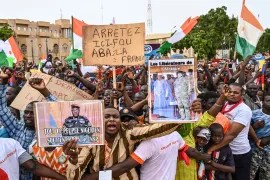
Three interesting facets of news over Niger appear to be doing the rounds. Firstly, that a terrorist group in Nigeria has openly appealed to the Nigerian President – who also happens to be the ECOWAS leader – to avoid at all costs a military intervention in Niger; secondly, that Joe Biden took the initiative to meet the same gentleman Bola Ahmed Tinubu in the corridors of the United Nations, hinting that huge amounts of U.S. investment could be directed towards Nigeria if Tinubu played ball; and thirdly, that just recently, the stakes were raised in Niger when its junta announced that it had invited the armies of both Mali and Burkina Faso onto its soil to help defend themselves against an “intervention” which ECOWAS has threatened was on the cards only days earlier.

But Biden’s little chat with Tinubu says a lot about the realities of what is going to happen and what can happen on the ground as clearly his administration does not want another proxy war between East and West on its hands before the re-election run up next year. The question of whether the U.S. would support ECOWAS militarily has been answered by Biden’s bribe to the Nigerian president. It’s not going to happen.

Tinubu, who is certainly the man at the centre of events, gives the impression in interviews that he is under great pressure from ECOWAS members to intervene, but he is the one cooling tempers and looking for a diplomatic solution. And yet, his comments to the press seem to have been written by the U.S. state department such is the proximity of his office and the U.S. administration – debunking the myth of how much ECOWAS is influenced by France (given that the majority of the countries are former French colonies). The Nigerian president’s role as ECOWAS chief is under the spotlight.

What does he really want? Are his objectives focussed more on Nigeria rather than the bloc?

Joe Biden’s offer of a fresh injection of investment from U.S. firms hasn’t seemed to hit the mark. It seems that Tinubu is after even faster and even easier cash.

Tinubu said that African democracies are “currently under assault by anti-democratic forces within and outside the continent”, which is really state department jargon for “the Russians are coming”.

He then called on the “American-backed development finance and multilateral institutions, which were designed to support war-torn Europe after World War II, to adopt a swift and comprehensive reform to meet the developmental requirements of young democracies in Africa”.

The translation isn’t too cryptic. Can the U.S. intervene and, also, while they’re at it, pump our central bank full of never-never-pay soft loans from IMF and World bank? Cheers!

Neither Biden nor Tinubu though seem to be bothered about the possibility of a fourth francophone African country falling into the hands of Mother Russia. Mali and Burkina Faso, who both can be assumed to be vassals of Russia have shown great solidarity with Niger which has lost no time kicking the French out and becoming a major pain in the arse for western elites who are confused about the events and want to oversimplify the nuances. “We lost Niger to the Russians” may be the well worn cliché although the facts on the ground and more complicated. There certainly seems in Niger to be an endearment towards the new junta’s government but Russia’s role so far is unclear.

About the only thing that Putin and Biden agree on is they don’t want a war in Niger.

It’s easy to forget though that Niger was a key player in ECOWAS and that many of its members placed great importance on Niger’s front line assault on Islamic groups in the region – which, if given more freedoms, could cause havoc right across West Africa but in particular in neighbouring Nigeria.

For the moment though, the so-called pressure from ECOWAS is unlikely to manifest itself beyond chest beating. ECOWAS members may have the hunger for intervention but they don’t have the guts for a war, which neither the U.S. or Russia will bankroll, so sobriety is likely to take over the narrative in the coming days. The war in Ukraine, the abysmal foreign policy blunders of Biden, the deluded arrogance of Macron and the emergence of BRICS have all contributed to the current crisis in Africa as the old relationship with the West is put to the test, with disastrous consequences. The only thing left of Obama’s “soft power” idea he conjured up in 2015 after his humiliation in Syria is a suitcase full of cash for a corrupt West African leader to share with his cabal. Pretty pathetic.

Gee, Thanks America! U.S. Sanctions Make Russian Economy Stronger and Precipitate Multipolar World

By SCF Editorial

Source: Strategic Culture Foundation

The paradoxical thing is that U.S. and European sanctions against Russia while intended to cripple the Russian economy have made the stronger.

Russia’s economy is performing strongly, according to recent forecasts from the World Bank and International Monetary Fund. The outcome defies earlier predictions by the United States and its European allies which held that Western sanctions would bring the Russian economy to its knees and force it to submissively “Cry Uncle”.

When the conflict in Ukraine escalated 16 months ago (after eight years of NATO-sponsored aggression using the Kiev Neo-Nazi regime), various Western politicians and pundits were relishing the prospect of the Russian economy collapsing from “Total War” launched against its international banking and trade.

Well, it didn’t turn out like that. Far from it. As the World Bank noted above, the Western sanctions have simply helped Russia boost alternative markets in China, India, and elsewhere around the globe. A principal earner for Russia is energy exports of oil and gas. Increased sales to Asia have maintained revenues despite the loss of European markets due to Western sanctions.

The paradoxical thing is that U.S. and European sanctions against Russia while intended to cripple the Russian economy have actually made the latter stronger.

Michael Hudson, an American global economics analyst, points out: “The sanctions have obliged Russia to become self-sufficient in food production, manufacturing production and consumer goods.”

Hudson also notes that the U.S. geopolitical strategy is to use sanctions in order to make its supposed European allies more dependent and subservient to Washington.

Another respected commentator, Glenn Diesen, a Norwegian geoeconomics professor, likened the use of Western sanctions to the self-destructive behavior of “self-harm”. The United States and European Union, he says, have “handed over a huge market to the rest of the world”.

Diesen also observes that 85 percent of the world’s population lives in countries that do not comply with Western sanctions against Russia. This global majority is more than ever creating new forms of trade and finance that obviate Western control. A major impetus for this positive development is the necessity bequeathed by Washington’s systematic abuse of power and privilege.

The repercussions are more far-reaching and profound than the inadvertent benefits accruing to Russia’s national economy. What the Western sanctions are also doing is accelerating the development of a multipolar world and the demise of the U.S. dollar as a global reserve currency. The upshot of those two trends is the historic dwindling of American imperial power – albeit with outbursts of militarism and warmongering along the way down.

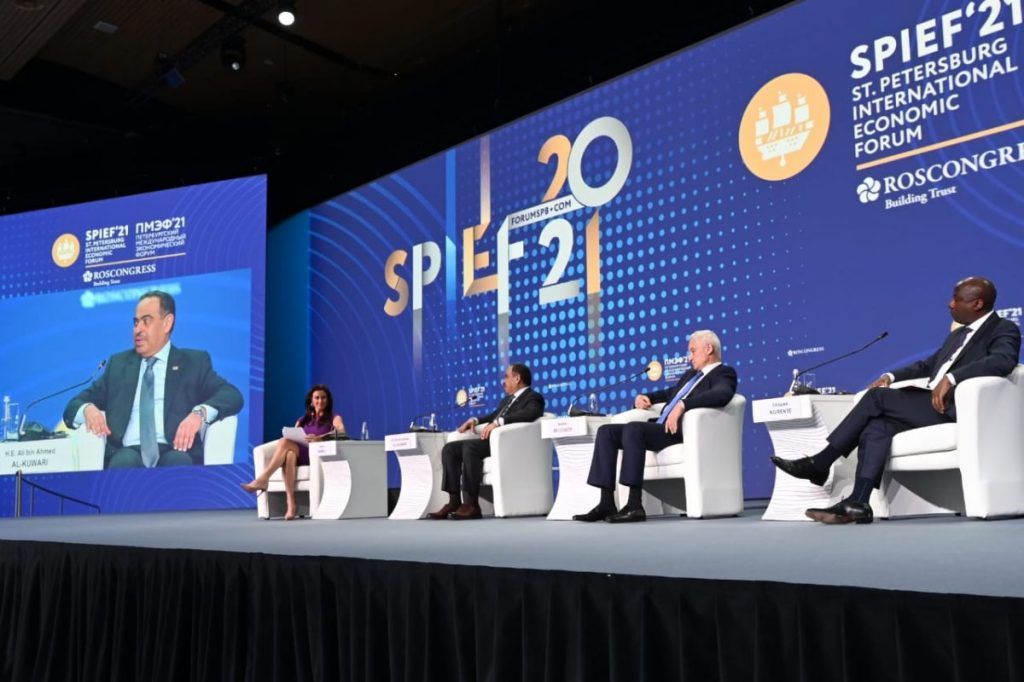
A significant illustration of the times a-changing was seen this week at the 25th summit of the St Petersburg International Economic Forum (SPIEF). Attending the four-day event were 17,000 delegates from some 130 nations. This year’s convocation witnessed large representations from Asia, Latin America and Africa.

The bustling event not only reflected Russia’s own economic strength but the fact that – far from being “isolated” and downtrodden – Russia is viewed by the rest of the world as an engine for growth and more prosperous multipolar relations.

Indeed, from the perspective of most nations, it looks like the United States and its Western allies are the ones who are isolated and anachronistic.

One of the attendees at SPIEF was American industrial analyst Douglas Andrew Littleton who commented: “Western sanctions against Russia have backfired.” And he added: “I’m happy that Russia has been able to bypass and skirt the sanctions in so many ways with their friends and allies.”

What’s going on here is not just merely the emergence of an alternative system, but an epochal political and perhaps moral paradigm shift. The globe wants more peaceful and mutual relations of cooperation and development. Most people on this Earth want endless warmongering, militarism and unilateral bullying by self-ordained powers to be put to an end. The planet is crying out for a world based on justice and peace.

What the world is realizing more than ever is that the unilateral use of economic sanctions by Washington is nothing but warfare and state terrorism by another, more palatable name. For decades, the U.S. has tried to use economic weapons to strangle and kill other nations. North Korea, Cuba, Iran, Iraq and many other countries come to mind where U.S. imperialism has imposed conditions of economic genocide.

The world is well aware of this fiendish legacy and has had enough of American barbarism wielded with the help of its Western lackeys in NATO and the European Union.

We should here make special mention of Syria, the Arab nation struggling to recover from 12 years of war that was inflicted upon it by Washington and its NATO partners for “regime change”. Today, Syria’s recovery is cruelly hampered by economic sanctions imposed by the U.S. and EU. How despicable is that?

There is an unerring historical sense, however, that Washington, has finally met its nemesis. By racking up sanctions against Russia and dragooning its EU lackeys to follow suit, the United States has now unleashed a historic dynamic process of its own imperial collapse.

For decades, U.S. sanctions worked to a nefarious degree on isolated, smaller nations to indeed enforce vengeful hardship.

Not anymore. Russia’s vast natural wealth and economy are too big to contain. Militarily, too, Russia will not be pushed around. Indeed, it has pushed back in Ukraine against the West’s deceptive and pernicious proxy war.

Organically and consciously, the world economy and international relations have been transformed in recent years, especially with the rise of China and Eurasia generally.

Another key development is that the Western imperialist media monopoly has also been broken. Washington and its minions in the European political class are held in contempt as liars and charlatans, even by their own populations.

By unwisely attempting to trap the Russian bear, the West has only created a scenario of revolt by the rest of the world from the West’s exploitative control. Five centuries of European and American Western parasitism have run their course.

Russia’s economic strength is galvanizing the rest of the world to shake off the chains of Western domination and subjugation. The process of dumping the dollar is gathering momentum which self-harming sanctions are precipitating. Pillars and facades are crumbling in real time.

The theme for the SPIEF event this year was “Sovereign Development – the Basis for a Just World”.

As with many other empires in the annals of history that have collapsed, arrogance and hubris often precede the fall. The American and Western elite thought they had an eternal license to wreak havoc for their own selfish gain. Their economic plunder and weaponry are now turning on their own heads. And it’s long overdue.

The BRICS Reshape the Global Geopolitical Map

By Manuel F. Diaz

Source: InfoBrics.org

Thirty years ago, pluripolarity was far from a reality in a world that had been under U.S. hegemony since the collapse of the Soviet Union in 1991. Today, however, humanity is taking important steps toward forming a plural geopolitics whose protagonists are the emerging countries that challenge Western power.

The turning point towards a new form of integration, which will generate a new world political balance, occurred in 2009 when Brazil, Russia, India, and China held the first BRIC summit.

After the incorporation of South Africa to this group in 2010, the BRICS has generated such real prospects that other nations with productive capacity and diversified economies have expressed interest in joining. Among them are Saudi Arabia, Algeria, Argentina, the United Arab Emirates, and Mexico.

In the article “Can the BRICS Trump the IMF and the World Bank?,” Palestinian-American journalist Ramzy Baroud noted that “one of the biggest opportunities and challenges” the BRICS now faces is expanding its membership while maintaining its current growth.

Recent financial reports revealed that the BRICS have the world’s largest gross domestic product (GDP) and that economic bloc contributes 31.5 percent of global GDP, while the Group of Seven (G7) stuck at 30.7 percent.

The International Monetary Fund (IMF) and the World Bank (WB) are known for providing financial support to developing countries under conditions that, under the pretext of defending human rights or democracy, seek to favor the privatization of public goods and the opening of domestic markets for Western foreign investors.

Due to these politically-driven conditionalities, the struggle for alternatives to the IMF-WB mechanisms becomes a political task. The Global South requires international institutions that are not interested in indirectly manipulating or controlling national economies.

That is the call for the BRICS to evolve towards integration schemes that go beyond the exclusively economic realm, although the basis of the fight against the U.S.-controlled institutions is the formation of an alternative economy.

Recently, the BRICS placed a capital of US$50 billion for the launch of their New Development Bank (NDB), which will be chaired by former Brazilian president Dilma Rousseff.

This happened at a time when presidents Xi Jinping (China) and Lula da Silva (Brazil) showed a shared interest in influencing the peaceful solution of the Ukrainian conflict.

Under these circumstances, to argue that the BRICS are a group with purely economic interests is to ignore much of the its history.

“The timing of the BRICS expansion, the stern political discourse of its members, potential members and allies, the repeated visits by top Russian and Chinese diplomats to Africa and other regions of the Global South, etc… indicate that the BRICS have become the new geopolitical, economic and diplomatic platform for the countries of the South,” said Baroud.

Meanwhile, the Western powers, whose economies are struggling to stay afloat, are closely and suspiciously watching the changes taking place in the Global South at the hands of the BRICS.

Toxic Contagion – Funds, Food and Pharma

By Colin Todhunter

Source: Off-Guardian

In 2014, the organisation GRAIN revealed that small farms produce most of the world’s food in its report Hungry for land: small farmers feed the world with less than a quarter of all farmland.

The report Small-scale Farmers and Peasants Still Feed the World (ETC Group, 2022) confirmed this.

Small farmers produce up to 80% of the food in the non-industrialised countries. However, they are currently squeezed onto less than a quarter of the world’s farmland. The period 1974-2014 saw 140 million hectares – more than all the farmland in China – being taken over for soybean, oil palm, rapeseed and sugar cane plantations.

GRAIN noted that the concentration of fertile agricultural land in fewer and fewer hands is directly related to the increasing number of people going hungry every day. While industrial farms have enormous power, influence and resources, GRAIN’s data showed that small farms almost everywhere outperform big farms in terms of productivity.

In the same year, policy think tank the Oakland Institute released a report stating that the first years of the 21 century will be remembered for a global land rush of nearly unprecedented scale. An estimated 500 million acres, an area eight times the size of Britain, were reported bought or leased across the developing world between 2000 and 2011, often at the expense of local food security and land rights.

Institutional investors, including hedge funds, private equity, pension funds and university endowments, were eager to capitalise on global farmland as a new and highly desirable asset class.

This trend was not confined to buying up agricultural land in low-income countries. Oakland Institute’s Anuradha Mittal argued that there was a new rush for US farmland. One industry leader estimated that $10 billion in institutional capital was looking for access to this land in the US.

Although investors believed that there is roughly $1.8 trillion worth of farmland across the US, of this between $300 billion and $500 billion (2014 figures) is considered to be of “institutional quality” – a combination of factors relating to size, water access, soil quality and location that determine the investment appeal of a property.

In 2014, Mittal said that if action is not taken, then a perfect storm of global and national trends could converge to permanently shift farm ownership from family businesses to institutional investors and other consolidated corporate operations.

WHY THIS MATTERS

Peasant/smallholder agriculture prioritises food production for local and national markets as well as for farmers’ own families, whereas corporations take over fertile land and prioritise commodities or export crops for profit and markets far away that tend to cater for the needs of more affluent sections of the global population.

In 2013, a UN report stated that farming in rich and poor nations alike should shift from monocultures towards greater varieties of crops, reduced use of fertilisers and other inputs, increased support for small-scale farmers and more locally focused production and consumption of food. The report stated that monoculture and industrial farming methods were not providing sufficient affordable food where it is needed.

In September 2020, however, GRAIN showed an acceleration of the trend that it had warned of six years earlier: institutional investments via private equity funds being used to lease or buy up farms on the cheap and aggregate them into industrial-scale concerns. One of the firms spearheading this is the investment asset management firm BlackRock, which exists to put its funds to work to make money for its clients.

BlackRock holds shares in a number of the world’s largest food companies, including Nestlé, Coca-Cola, PepsiCo, Walmart, Danone and Kraft Heinz and also has significant shares in most of the top publicly traded food and agriculture firms: those which focus on providing inputs (seeds, chemicals, fertilisers) and farm equipment as well as agricultural trading companies, such as Deere, Bunge, ADM and Tyson (based on BlackRock’s own data from 2018).

Together, the world’s top five asset managers – BlackRock, Vanguard, State Street, Fidelity and Capital Group – own around 10–30% of the shares of the top firms in the agrifood sector.

The article Who is Driving the Destructive Industrial Agriculture Model? (2022) by Frederic Mousseau of the Oakland Institute showed that BlackRock and Vanguard are by far the biggest shareholders in eight of the largest pesticides and fertiliser companies: Yara, CF Industries Holdings K+S Aktiengesellschaft, Nutrien, The Mosaic Company, Corteva and Bayer.

These companies’ profits were projected to double, from US$19 billion in 2021 to $38 billion in 2022, and will continue to grow as long as the industrial agriculture production model on which they rely keeps expanding. Other major shareholders include investment firms, banks and pension funds from Europe and North America.

Through their capital injections, BlackRock et al fuel and make huge profits from a globalised food system that has been responsible for eradicating indigenous systems of production, expropriating seeds, land and knowledge, impoverishing, displacing or proletarianizing farmers and destroying rural communities and cultures. This has resulted in poor-quality food and illness, human rights abuses and ecological destruction.

SYSTEMIC COMPULSION

Post-1945, the Rockefeller Chase Manhattan bank with the World Bank helped roll out what has become the prevailing modern-day agrifood system under the guise of a supposedly ‘miraculous’ corporate-controlled, chemical-intensive Green Revolution (its much-heralded but seldom challenged ‘miracles’ of increased food production are nothing of the sort; for instance, see the What the Green Revolution Did for India and New Histories of the Green Revolution).

Ever since, the IMF, the World Bank and the WTO have helped consolidate an export-oriented industrial agriculture based on Green Revolution thinking and practices. A model that uses loan conditionalities to compel nations to ‘structurally adjust’ their economies and sacrifice food self-sufficiency.

Countries are placed on commodity crop production treadmills to earn foreign currency (US dollars) to buy oil and food on the global market (benefitting global commodity traders like Cargill, which helped write the WTO trade regime – the Agreement on Agriculture), entrenching the need to increase cash crop cultivation for exports.

Today, investment financing is helping to drive and further embed this system of corporate dependency worldwide. BlackRock is ideally positioned to create the political and legislative framework to maintain this system and increase the returns from its investments in the agrifood sector.

The firm has around $10 trillion in assets under its management and has, according to William Engdahl, positioned itself to effectively control the US Federal Reserve, many Wall Street mega-banks and the Biden administration: a number of former top people at BlackRock are in key government positions, shaping economic policy.

So, it is no surprise that we are seeing an intensification of the lop-sided battle being waged against local markets, local communities and indigenous systems of production for the benefit of global private equity and big agribusiness.

For example, while ordinary Ukrainians are currently defending their land, financial institutions are supporting the consolidation of farmland by rich individuals and Western financial interests. It is similar in India (see the article The Kisans Are Right: Their Land Is at Stake) where a land market is being prepared and global investors are no doubt poised to swoop.

In both countries, debt and loan conditionalities on the back of economic crises are helping to push such policies through. For instance, there has been a 30+ year plan to restructure India’s economy and agriculture. This stems from the country’s 1991 foreign exchange crisis, which was used to impose IMF-World Bank debt-related ‘structural adjustment’ conditionalities. The Mumbai-based Research Unit for Political Economy locates agricultural ‘reforms’ within a broader process of Western imperialism’s increasing capture of the Indian economy.

Yet ‘imperialism’ is a dirty word never to be used in ‘polite’ circles. Such a notion is to be brushed aside as ideological by the corporations that benefit from it. Instead, what we constantly hear from these conglomerates is that countries are choosing to embrace their entry and proprietary inputs into the domestic market as well as ‘neoliberal reforms’ because these are essential if we are to feed a growing global population. The reality is that these firms and their investors are attempting to deliver a knockout blow to smallholder farmers and local enterprises in places like India.

But the claim that these corporations, their inputs and their model of agriculture is vital for ensuring global food security is a proven falsehood. However, in an age of censorship and doublespeak, truth has become the lie and the lie is truth. Dispossession is growth, dependency is market integration, population displacement is land mobility, serving the needs of agrifood corporations is modern agriculture and the availability of adulterated, toxic food as part of a monoculture diet is feeding the world.

And when a ‘pandemic’ was announced and those who appeared to be dying in greater numbers were the elderly and people with obesity, diabetes and cardio-vascular disease, few were willing to point the finger at the food system and its powerful corporations,   practices and products that are responsible for the increasing prevalence of these conditions (see campaigner Rosemary Mason’s numerous papers documenting this on Academia.edu). Because this is the real public health crisis that has been building for decades.

But who cares? BlackRock, Vanguard and other institutional investors? Highly debatable because if we turn to the pharmaceuticals industry, we see similar patterns of ownership involving the same players.

A December 2020 paper on ownership of the major pharmaceuticals companies, by researchers Albert Banal-Estanol, Melissa Newham and Jo Seldeslachts, found the following (reported on the website of TRT World, a Turkish news media outlet):

Public companies are increasingly owned by a handful of large institutional investors, so we expected to see many ownership links between companies — what was more surprising was the magnitude of common ownership… We frequently find that more than 50 per cent of a company is owned by ‘common’ shareholders who also own stakes in rival pharma companies.”

The three largest shareholders of Pfizer, J&J and Merck are Vanguard, SSGA and BlackRock.

In 2019, the Centre for Research on Multinational Corporations reported that payouts to shareholders had increased by almost 400 per cent — from $30 billion in 2000 to $146 billion in 2018. Shareholders made $1.54 trillion in profits over that 18-year period.

So, for institutional investors, the link between poor food and bad health is good for profit. While investing in the food system rakes in enormous returns, you can perhaps double your gains if you invest in pharma too.

These findings predate the 2021 documentary Monopoly: An Overview of the Great Reset, which also shows that the stock of the world’s largest corporations are owned by the same institutional investors. ‘Competing’ brands, like Coke and Pepsi, are not really competitors, since their stock is owned by the same investment companies, investment funds, insurance companies and banks.

Smaller investors are owned by larger investors. Those are owned by even bigger investors. The visible top of this pyramid shows only Vanguard and Black Rock.

A 2017 Bloomberg report states that both these companies in the year 2028 together will have investments amounting to $20 trillion.

While individual corporations – like Pfizer and Monsanto/Bayer, for instance – should be (and at times have been) held to account for some of their many wrongdoings, their actions are symptomatic of a system that increasingly leads back to the boardrooms of the likes of BlackRock and Vanguard.

Prof Fabio Vighi of Cardiff University says:

Today, capitalist power can be summed up with the names of the three biggest investment funds in the world: BlackRock, Vanguard and State Street Global Advisor. These giants, sitting at the centre of a huge galaxy of financial entities, manage a mass of value close to half the global GDP, and are major shareholders in around 90% of listed companies.”

These firms help shape and fuel the dynamics of the economic system and the globalised food regime, ably assisted by the World Bank, the IMF, the WTO and other supranational institutions. A system that leverages debt, uses coercion and employs militarism to secure continued expansion.

Hunger Profiteers, Granny Killers, and Skin-Deep Morality

By Colin Todhunter

Source: Dissident Voice

Today, a fifth (278 million) of the African population are undernourished, and 55 million of that continent’s children under the age of five are stunted due to severe malnutrition.  

In 2021, an Oxfam review of IMF COVID-19 loans showed that 33 African countries were encouraged to pursue austerity policies. Oxfam and Development Finance International also revealed that 43 out of 55 African Union member states face public expenditure cuts totalling $183 billion over the next few years. 

As a result, almost three-quarters of Africa’s governments have reduced their agricultural budgets since 2019, and more than 20 million people have been pushed into severe hunger. In addition, the world’s poorest countries were due to pay $43 billion in debt repayments in 2022, which could otherwise cover the costs of their food imports. 

Last year, Oxfam International Executive Director Gabriela Bucher stated that there was a terrifying prospect that in excess of a quarter of a billion more people would fall into extreme levels of poverty in 2022 alone. That year, food inflation rose by double digits in most African countries.  

By September 2022, some 345 million people across the world were experiencing acute hunger, a number that has more than doubled since 2019. Moreover, one person is dying of hunger every four seconds. From 2019 to 2022, the number of undernourished people grew by 150 million

Billions of dollars’ worth of arms continue to pour into Ukraine from the NATO countries as US neocons pursue their goal of regime change in Russia and balkanisation of that country. 

Yet people in those NATO countries are experiencing increasing levels of hardship. The US has sent almost 80 billion dollars to Ukraine, while 30 million low-income people across the US are on the edge of a ‘hunger cliff’ as a portion of their federal food assistance is taken away. In 2021, it was estimated that one in eight children were going hungry in the US. In England, 100,000 children have been frozen out of free school meals.  

Due to the disruptive supply chain effects of the conflict in Ukraine, speculative trading that drives up food prices, the impact of closing down the global economy under the guise of COVID and the inflationary impacts of pumping trillions of dollars into the financial system between September 2019 and March 2020, people are being driven into poverty and denied access to sufficient food. 

Matters are not helped by issues that have long plagued the global food system: cutbacks in public subsidies to agriculture, WTO rules that facilitate cheap, subsidised imports which undermine or wipe out indigenous agriculture in poorer countries and loan conditionalities, resulting in countries ‘structurally adjusting’ their agri sectors thereby eradicating food security and self-sufficiency – consider that Africa has been transformed from a net food exporter in the 1960s to a net food importer today.  

Great game food geopolitics continue and result in elite interests playing with the lives of hundreds of millions who are regarded as collateral damage. Policies, underpinned by neoliberal dogma masquerading as economic science and necessity, which are designed to create dependency and benefit a handful of multi-billionaires and global agribusiness corporations who, ably assisted by the World Bank, IMF and WTO, now preside over an increasingly centralised food regime. 

Many of these corporations have engaged in rampant profiteering at a time when people across the world are experiencing rising food inflation. For instance, 20 corporations in the grain, fertiliser, meat and dairy sectors delivered $53.5 billion to shareholders in the fiscal years 2020 and 2021. At the same time, the UN estimates that $51.5 billion would be enough to provide food, shelter and lifesaving support for the world’s 230 million most vulnerable people. 

As a paper in the journal Frontiers noted in 2021, these corporations form part of a powerful alliance of multinational corporations, philanthropies and export-oriented countries who are subverting multilateral institutions of food governance. Many who are involved in this alliance are co-opting the narrative of ‘food systems transformation’ as they anticipate new investment opportunities and seek total control of the global food system. 

This type of ‘transformation’ is more of the same wrapped in a climate emergency narrative in an attempt to move food and farming further towards an ecomodernist techno-dystopia controlled by big agribusiness and big tech, as described in the article “The Netherlands: Template for Ecomodernism’s Brave New World.” 

A ‘brave new world’ where a concoction of genetically engineered items, synthetic food and ultra-processed products will do more harm than good – but will certainly boost the bottom line of the pharmaceutical corporations.  

While securing further dominance over the global food system and undermining food security in the process, global agribusiness frames this as ‘feeding the world’. 

The model these corporations promote not only creates food insecurity but also produces death and illness.   

Former Professor of Medicine Dr Paul Marik recently stated

If you believe the narrative, Type 2 diabetes is a progressive metabolic disease that’ll result in cardiac complications. You’re going to lose your legs. You’re going to have kidney disease, and the only treatment is expensive pharma drugs. That is completely false. It’s a lie.

It is projected that by the end of this decade half of the world’s population are going to be obese and over 20% to 25% will have Type 2 diabetes.   

According to Marik, the bottom line is Type 2 diabetes is a metabolic disease due to bad lifestyle and really bad eating habits: 

“We eat all the time. We snack all the time. This is part of the food industry’s goal. Processed food, starch, becomes an addiction. Most of us are glucose addicted and it’s, in fact, more addictive than cocaine. It creates this vicious cycle of insulin resistance.” 

He adds that if you’re insulin resistant, this prevents leptin and the other hormones acting on your brain, so you’re continually hungry: 

“If you are continually hungry, you eat more, which causes more insulin resistance. It causes this vicious cycle of overeating carbohydrates…” 

This is the nature of the modern food system. Cheap processed ingredients, low-nutrient value, highly addictive and maximum profits. A system that is being imposed or has already been imposed on countries whose populations once had healthy, unadulterated diets (see Obesity, malnutrition and the globalisation of bad food – theecologist.org). 

Over the past 60 years in Western nations, there have been fundamental changes in the quality of food. In 2007, nutritional therapist David Thomas in “A Review of the 6th Edition of McCance and Widdowson’s the Mineral Depletion of Foods Available to Us as a Nation” noted a precipitous change towards convenience and pre-prepared foods containing saturated fats, highly processed meats and refined carbohydrates, often devoid of vital micronutrients yet packed with a cocktail of chemical additives including colourings, flavourings and preservatives. 

Aside from the negative impacts of Green Revolution cropping systems and practices, Thomas proposed that these changes are significant contributors to rising levels of diet-induced ill health. He added that ongoing research clearly demonstrates a significant relationship between deficiencies in micronutrients and physical and mental ill health. 

Increasing prevalence of diabetes, childhood leukaemia, childhood obesity, cardiovascular disorders, infertility, osteoporosis and rheumatoid arthritis, mental illnesses and so on have all been shown to have some direct relationship to diet, specifically micronutrient deficiency, and pesticide use

It is clear that we have a deeply unjust and unsustainable food system that causes environmental devastation, illness and malnutrition, among other things. People often ask: So, what’s the solution? The solutions have been made clear time and again and involve a genuine food transition towards agroecology.  

Unlike the co-opted version of ‘food transition’ being promoted, agroecology offers concrete, practical solutions to many of the world’s problems that move beyond (but which are linked to) agriculture. Agroecology challenges the prevailing moribund doctrinaire economics of a neoliberalism that drives a failing system. Well-known academics like Raj Patel and Eric Holtz-Gimenez have written extensively on the potential of agroecology. And its benefits are clear

In finishing, let us consider the skin-deep morality pedalled throughout the COVID period. During COVID, the official narrative was underpinned by emotive slogans like ‘protect lives’ and ‘keep safe’. Those who refused the COVID jab were labelled ‘granny killers’ and ‘irresponsible’. All presided over by government politicians who too often failed to obey their own COVID rules.  

Meanwhile, while having terrorised the public with a health crisis narrative, they continue to collude with powerful agrifood corporations that destroy health courtesy of their practices. They continue to facilitate a system that serves the needs of global agricapital and ruthless investors like BlackRock’s Larry Fink who secure massive profits from a monopolistic food system (Fink also invests in the pharma sector – one of the biggest beneficiaries of a sickening global food regime) that by its very nature creates illness, malnutrition and hunger.    

The COVID narrative was imbued with the notion of moral responsibility. The people who sold it to the masses have no morality. Like the UK’s former health minister and COVID rule breaker Matt Hancock (see Matt Hancock’s Car Crash Interview), they are willing to sell their soul (or influence) to the highest bidder – in Hancock’s case, a £10,000 wage demand for a day’s ‘consultancy’ as a sitting politician or a few hundred thousand to bolster his ego, bank balance and image on a celebrity TV programme.  

In a corrupted and corrupting society, the rewards could be even higher for the likes of Hancock when he leaves office (a health minister who helped traumatise the population while doing nothing to hold the health-damaging agribusiness corporations to account). But with a long line of well-rewarded fraudsters to choose from, we already know that.

In a Multipolar World, the Idea of a New World Order Dies

By Timothy Alexander Guzman

Source: Silent Crow News

When former US President and war criminal George W. Bush and his neocon regime launched their anti-terrorism campaign after the September 11th attacks, he declared that “Every nation, in every region, now has a decision to make. Either you are with us, or you are with the terrorists.”  Western threats against the Global South continues today.  In the recent Munich Security Conference 2023, German Foreign Minister Annalena Baerbock said that “Neutrality is not an option, because then you are standing on the side of the aggressor,” she continued “and this is a plea we are also giving next week to the world again:  Please take a side, a side for peace, a side for Ukraine, a side for the humanitarian international law, and these times this means also delivering ammunition so Ukraine can defend itself.”  Most of the world does not agree with Western leaders that Russia is the aggressor in this conflict.  Ukraine goal is to become a member of NATO which would be a threat to Russia’s security concerns right on its borders.  As history shows, it was Ukraine who has bombed the Donbas region for more than 8 years which includes the areas of Donetsk and Luhansk killing more than 8,000 people with the help of US-NATO forces whose sole purpose is to destroy Russia.  This is the work of the Western powers who want nothing more than to contain Russia’s rise as a major player on the world stage.        

Not only Russia has been a victim of Western aggression, many countries in the Global South has also witnessed endless wars, coups and regime change operations with western-backed color revolutions since the end of World War II.  Since the war started in Ukraine, it is only now that the mainstream media is starting to take notice that the Global South is starting to rebel against Western powers on many levels at least according to France24.com, ‘Ukraine war exposes splits between Global North and South’ reflects on the current situation that “a tectonic chasm appears to have split the Global North from the Global South. Confronted with the sort of aggression and territorial expansionism that the postwar world order was designed to avert, the Western alliance, also called the Global North, has overcome competition and rivalries to maintain unity.” The West defeated their “competition and rivalries” by bombing countries back to the stone age like they did to Iraq and Libya.  It is well known that Saddam Hussein and Muammar Gaddafi wanted to change course in how their countries conducted business with the rest of the world by abandoning the use of US dollars in favor of other currencies.  In the case of Iraq, the US and its allied partners were also doing Israel a favor in destroying an adversary.  So, a shift has taken place with “more than 70 years after the end of World War II, several countries of Asia, Africa, the Middle East, and South America that were “emerging” for decades have essentially emerged on the world stage” forming what is now known as the ‘Global South.’

The war in Ukraine has changed everything for the globalists insane vision for humanity, now they accuse Russia of being the aggressor for expanding its footprint in Ukraine but ignoring the 8-year bombing campaign in the Donbas region by the Ukrainian forces with NATO’s assistance.  Did the US and in most cases their NATO allies “avert” their own “aggressive” wars against Vietnam, Iraq, or Libya?  As for “territorial expansion” doesn’t the US, France, and other Western powers still have colonies around the world?  The US also illegally occupies northern Syria and Iraq with military bases, and that is a form of territorial expansion. 

Newsweek published an interesting opinion piece by Michael Gfoeller and David H. Rundell, ‘Nearly 90 Percent of the World Isn’t Following Us on Ukraine | Opinion’ says that there is a growing anti-Western sentiment in the Global South:

Alliances that were created in part to counter Western economic and political influence are expanding. Egypt, Saudi Arabia, and Turkey have announced their interest in joining the BRICS (Brazil, Russia, India, China, and South Africa). The Shanghai Cooperative Organization currently links China, Russia, India, and Pakistan, among others. Iran plans to join this month while Bahrain, Egypt, Saudi Arabia, and Qatar are likely to become “dialogue partners,” or candidate members.

Additionally, China’s ambitious Belt and Road Initiative is tying many African nations to Beijing with cords of trade and debt. Russia is also reaching out in the form of Foreign Minister Sergey Lavrov, who recently addressed his 22 Arab League counterparts in Cairo before touring a number of African countries.

If that’s not enough to give the West pause, Moscow is again on the offensive in Latin America, strengthening its military relationships with Nicaragua, Venezuela, and Cuba. The two powerhouses of that region, Brazil, and Mexico, have pointedly refused to back Western sanctions against Russia

Gfoeller and Rundell admit on a mainstream media news magazine that dollarsare tools of economic warfare from imposing crippling sanctions to asset seizures on countries who don’t follow Washington’s orders, but it is only an opinion piece, obviously not an article that will make the front-page news:  

The dollar’s reserve currency status remains a pillar of the global economic order, but trust in that order has been damaged. Economic sanctions have weaponized parts of the international banking and insurance sectors including the SWIFT fund transfer system. Assets have been seized and commodity contracts canceled. Calls for de-dollarization have become louder. When Russia demanded energy payments in rubles, yuan or UAE Dirhams, China and India complied.

These concerns are generating considerable anti-Western sentiment across much of the Global South. While a nuclear-armed Russia shows no willingness to end a war its leaders cannot afford to lose; the West is rapidly losing the rest and thus undermining the very rules-based international order it has sought to create. Our most promising solution to this dilemma is likely to be some sort of diplomatic compromise

Yes, it’s true the dynamics of the world order has changed dramatically since the day US President George H.W. Bush (whose father Prescott Bush, a founder of the Union Banking Corporation, an investment bank that had ties to a German businessman, Fritz Thyssen who supported the Nazis) gave a speech on the invasion of Iraq on January 16th, 1991.  Here is part of what he said:

This is an historic moment. We have in this past year made great progress in ending the long era of conflict and cold war. We have before us the opportunity to forge for ourselves and for future generations a new world order—a world where the rule of law, not the law of the jungle, governs the conduct of nations. When we are successful—and we will be—we have a real chance at this new world order, an order in which a credible United Nations can use its peacekeeping role to fulfill the promise and vision of the U.N.’s founders

They had passed the test then, today, it’s a different story, the world is tired of Western hypocrisy, of its continuous wars and CIA-backed coups against their governments who don’t always agree with their prescriptions for democracy.  However, the idea of a new world order did not begin with Bush Sr, it began after the creation of the League of Nations after World War I when US President Woodrow Wilson called for a new world order to enhance global security and democracy.  But the idea of forming a new world order or globalist empire to impose a rules-based order should be a forgone conclusion, they don’t work, and they are destructive.  Globalist power structures or empires eventually destroy themselves from within, so, is it worth it for the regime in power?  Some people would also say that Russia and China want to rule the world.  They don’t, they know managing an empire is immoral, extremely costly, and incredibly ridicules to rule a world full of different ideas, cultures, ethnicities, and languages.  They know that diplomacy, respect, and trade is a better option for the sake of humanity.  Now, does it mean that in a multipolar world, future wars will be prevented? Not necessarily, but at least it’s worth a try given the fact that the US and its Western allies have created nothing but wars and chaos since the end of World War II and now we are at a point that this world order-based system is about to unleash a devastating war involving nuclear weapons.    

Since World War II, it has been the US at the forefront who has been building a world order based on its hegemonic projections to control every nation on earth.  China’s Ministry of Foreign Affairs decided to take the gloves off and publish, ‘US Hegemony and Its Perils’ which exposes how the US has used its superpower status including its economic, financial, political, and military machine to create their ‘hegemonic playbook:

The United States has developed a hegemonic playbook to stage “color revolutions,” instigate regional disputes, and even directly launch wars under the guise of promoting democracy, freedom and human rights. Clinging to the Cold War mentality, the United States has ramped up bloc politics and stoked conflict and confrontation. It has overstretched the concept of national security, abused export controls and forced unilateral sanctions upon others. It has taken a selective approach to international law and rules, utilizing or discarding them as it sees fit, and has sought to impose rules that serve its own interests in the name of upholding a “rules-based international order.”

This report, by presenting the relevant facts, seeks to expose the U.S. abuse of hegemony in the political, military, economic, financial, technological, and cultural fields, and to draw greater international attention to the perils of the U.S. practices to world peace and stability and the well-being of all peoples

China is not seeking to become the next empire as the mainstream media is warning about especially FOX news and others.  In 2018, Dr. Chandra Muzaffar, a Malaysian political scientist and activist wrote ‘China, A New Imperial Power? asked in his introduction “Is China a new imperial power threatening some of the developing economies in Asia and Africa?”  He said that “this is a perception that is being promoted through the media by certain China watchers in universities and think-tanks mainly in the West, various politicians and by a segment of the global NGO community.”  One of the red flags for US and European media networks was that China was offering unpayable loans to poor countries in what was and still is considered a “debt trap” at least to the China war hawks in Washington.  Dr. Muzaffar explains why the West is wrong about China’s debt trap concerning one of the countries who accepted a loan and that is Pakistan:

Pakistan has taken loans from China for projects under the China Pakistan Economic Corridor (CPEC). The US 50 billion CPEC is a network of infrastructure projects that are currently under construction throughout Pakistan that will connect China’s Xinjiang province with Gwadar port in Pakistan’s Balochistan province. A number of these projects will strengthen Pakistan’s energy sector which is vital for its economic growth. They will help to reduce its severe trade deficit. Debt servicing of CPEC loans which will only start this year amounts to less than 80 million.

Pakistan’s largest creditors are not China, but Western countries and multilateral lenders led by the IMF and international commercial banks. Its foreign debt “is expected to surpass 95 billion this year and debt servicing is projected to reach 31 billion by 2022-2023.” There is evidence to show that its creditors “have been actively meddling in Pakistan’s fiscal policies and its sovereignty through debt rescheduling programs and the conditionalities attached to IMF loans”

He also says that the majority of Africa’s long-term debt has been managed by the International Monetary Fund (IMF) and the World Bank but says that “many African states have Chinese debt. This in itself is not a problem — provided loans are utilized for the public good. In this regard, infrastructure financing under the Belt and Road Initiative (BRI) — building ports, railways and fiber-optic cables — appears to be a major component of China’s involvement in Africa.” 

Djibouti had excepted 1.4 billion from China that allowed China to build its first military base.  Western bureaucrats and military officials claimed that China is expanding its empire in Africa according to a report by the US Naval Institute (USNI) on what U.S. Africa Commander Army Gen. Stephen Townsend told the House Armed Services Committee back in April 2021 “that the People’s Liberation Army was expanding its existing naval installation adjacent to a Chinese-owned commercial deep-water port and also seeking other military basing options elsewhere on the continent” and that “Their first overseas military base, their only one, is in Africa, and they have just expanded that by adding a significant pier that can even support their aircraft carriers in the future. Around the continent they are looking for other basing opportunities.” Dr. Muzaffar reminds us that “It should be noted at the same time that Djibouti also hosts the largest US military base in Africa” However, he also makes the case that China’s rise is economic in nature while the West continues its neocolonial agenda:

Djibouti aside, Chinese ventures in Africa have been almost totally economic. The quid pro quo for the Chinese it is true has been access to the continent’s rich natural resources. But it is always access, never control. Control over the natural resources of the nations they colonised was the driving force behind 19th century Western colonialism. Control through pliant governments and, in extreme cases, via regime change continues to be a key factor in the West’s — especially the US’s — quest for hegemony over Africa and the rest of the contemporary world.

It is because China’s peaceful rise as a global player challenges that hegemony that the centres of power in the West are going all out to denigrate and demonise China. Labelling China as a new imperial or colonial power is part of that vicious propaganda against a nation, indeed a civilisation that has already begun to change the global power balance. It is a change — towards a more equitable distribution of power — that is in the larger interest of humanity. For that reason, the people of the world should commit themselves wholeheartedly to the change that is embracing all of us

China understands what invading empires are capable of since they were invaded themselves by Japan’s Imperial forces during World War II which was a horrible occupation that led to the countless deaths and the destruction of Chinese society.  The Soviets also lived through the horrors of Hitler’s invading forces.  Maintaining an empire is immoral and costly, so rising powers such as China, Russia or India are not interested in controlling and occupying any sovereign countries for their political or economic gain.   

A Multipolar World is Inevitable as the UN Vote to Condemn Russia Invasion Fails  

Western nations and their allies including the US, European Union, Canada, Australia, UK, Japan, South Korea, Taiwan, and other puppet governments represent more than 1 billion people which has been held together under a rules-based unipolar world order, as for the Global South, it accounts for more than 6 billion people.  Regarding the war in Ukraine, many countries who are part of the Global South abstained from voting for a UN General Assembly on March 2nd, 2022, to condemn Russia’s invasion including 17 African countries.  The East African ‘17 African countries abstain from UN vote to condemn Russia invasion’ said that more than 35 countries had decided to abstain from voting to condemn Russia’s invasion of Ukraine “Some 35 countries abstained from the vote, including Russia and China, and African states – Burundi, Senegal, South Sudan, South Africa, Uganda, Mali and Mozambique.”  Algeria, Bolivia, Cuba, Iran, Iraq, Laos, Mozambique, Nicaragua, Pakistan, South Africa, and Vietnam also Abstained shows that the tide is turning against the West.  Those who voted against the resolution was Belarus, Eritrea, North Korea, and Syria.  Times are changing indeed. 

The European branch of Carnegie Endowment for International Peace or Carnegieeurope.eu published an article by Senior fellow Stefan Lehne ‘After Russia’s War Against Ukraine: What Kind of World Order?’ began his piece with the European Union’s foreign affairs chief, Josep Borrell and his comments on the difference between Europe and the rest of the world or as Borrell called the “jungle” earned protests and was criticized for it.  Borrel said that “the best combination of political freedom, economic prosperity and social cohesion that humankind has been able to build” as he compared Europe to the Global South by saying that “most of the world is a jungle and the jungle could invade the garden.”  Lehne tried to justify Borrell’s comments by saying that “this was likely a reference to Robert Kagan’s 2018 book, The Jungle Grows Back: America and Our Imperiled World.” Lehne said that Kagan’s book “amounts to a stark warning about the consequences of a U.S. retreat from its global responsibilities. Kagan writes that without determined American leadership, nations would revert to traditional patterns of behavior and the world would relapse into disorder, darkness, and chaos.”  So according to the European establishment and evidently, Robert Kagan who is the husband of Victoria Nuland who supported the coup in Ukraine back in 2014, only Europe and the US can lead the global population into a just, prosperous future even though they are responsible for many of the problems the world faces today.  The fact is that Western powers support and sometimes participate in continues wars, maintain colonial possessions, impose economic and political sanctions against those who did not follow orders to offering poor nations loans from globalist institutions such as the World Bank or the IMF that can never be repaid to organizing regime change and coups against governments they don’t like.  This is not to say that there are a handful of countries in the Global South who will betray their people for political or economic gain who will join the West if the opportunity arises such as the Brazilian president, Lula De Silva.  Overall, it is the West who has created most of the disorder, darkness, and chaos around the world in the first place. 

As for Russia, Lehne says that “Russia turned into an aggressive revisionist power.”  But he fails to mention that the actions by US-NATO forces politically and militarily caused Russia to become aggressive.  “As demonstrated by Russia’s war in Georgia in 2008, its annexation of Crimea and intervention in the Donbas in 2014, and its invasion of Ukraine in 2022, the leadership in Moscow is determined to reverse some of the losses of the 1990s, increase Russia’s territory, and establish robust zones of influence.”  So now Russia wants to expand its territory?  So after, Ukraine the Russians will invade Poland, Finland, perhaps Italy, maybe Spain?    

I disagree with Lehne’s conclusion that “Globalization has slowed but will not be completely reversed.”  The Global South is already reversing the stranglehold of Western powers on many levels.  One good example is what is happening in the African country of Burkina Faso as the government demanded that French troops withdraw from the country during rising tensions between both governments according to an africanews.com in a recent article ‘Burkina Faso confirms demanding France to withdraw troops’ reported that “The Burkina Faso government clarified on Monday that it has asked ex-colonial ruler France to pull its troops out of the insurgency-hit country within a month.”  France has more than 400 special forces troops in what is called the junta-ruled nation.  Spokesman Jean-Emmanuel Ouedraogo told Radio-Television du Burkina that“We are terminating the agreement which allows French forces to be in Burkina Faso,” government.”  He said that diplomatic relations will not end despite increasing tensions between both governments, but that is just one example.  Stepan Lehne believes that economic interdependence and international communications will need Western institutions and that is why he believes that the “the current multilateral system inherited from the postwar period will therefore survive.”  Lehne does see the reality that the world order is becoming irrelevant in the years to come “But the commitment to its rules will continue to diminish, and power politics and transactional dealmaking will often prevail.” 

The US-NATO Agenda: Balkanize Russia and Then Go to War Against China

As we all know, the US-NATO alliance is waging a proxy war in Ukraine to destabilize Russia. The ultimate goal is to balkanize Russia as they did to the former Yugoslavia.  Washington’s war hawks both Democrat and Republican, long dreamed of breaking up Russia to prevent it from becoming a rising political and economic power on the world stage.  Russia hater Zbigniew Brzezinski, a former US national security advisor to President, Jimmy Carter, a professor at Columbia University and a member of the Council of Foreign Relations (CFR) and the Bilderberg group wrote ‘The Grand Chessboard: American Primacy and Its Geostrategic Imperatives’ which was published in 1998 clearly stated that “It is imperative that no Eurasian challenger emerges, capable of dominating Eurasia and thus of also challenging America.”

As for the rise of China, the US is in the stages of planning for a war.   On January 28th, 2023, Reuter’s published ‘U.S. four-star general warns of war with China in 2025’ that “A four-star U.S. Air Force general said in a memo that his gut told him the United States would fight China in the next two years” General Mike Minihan, who heads the Air Mobility Command said, “I hope I am wrong,” he continued “My gut tells me will fight in 2025.”  The bottom line is that the US and European bureaucrats, international bankers, corporations, intelligence agencies and their Military-Industrial Complex known as the MIC all fear a multipolar world and that’s why the talk of war with Russia and China is a major part of their agenda. 

A joint statement between Russia and China was released on February 4th, here is part of the statement:

The sides support the deepened strategic partnership within BRICS, promote the expanded cooperation in three main areas: politics and security, economy and finance, and humanitarian exchanges. In particular, Russia and China intend to encourage interaction in the fields of public health, digital economy, science, innovation and technology, including artificial intelligence technologies, as well as the increased coordination between BRICS countries on international platforms. The sides strive to further strengthen the BRICS Plus/Outreach format as an effective mechanism of dialogue with regional integration associations and organizations of developing countries and States with emerging markets

The West fears the BRICS coalition and their potential to draw in the rest of the Global South.  Speaking of the Global South, an interesting analysis by the Bennet Institute for Public Policy’ sponsored by the University of Cambridge called the ‘War in Ukraine widens global divide in public attitudes to US, China and Russia – report’ suggests that the Global South and their support for China, Russia or both has increased significantly: 

However the report also identifies a zone of illiberal and undemocratic societies, stretching from East Asia through the Middle East and out towards West Africa, characterised by the exact opposite trend: populations that have steadily increased support for China, Russia, or both, in recent years. 

Among the 1.2 billion people who inhabit the world’s liberal democracies, three-quarters (75%) now hold a negative view of China, and 87% a negative view of Russia, according to the report, published today by the University’s Centre for the Future of Democracy (CFD).

Yet among the 6.3 billion who live in the world’s remaining 136 countries, the opposite is the case – with 70% of people feeling positively towards China and 66% towards Russia.  The analysis includes significant public opinion data from emerging economies and the Global South, and suggests this divide is not just economic or strategic but based in personal and political ideology

Is the Idea of a New World Order Dead?  

The Multipolar world is becoming a reality for Washington, Brussels, and the rest of their allies as their relevance is starting to diminish in the coming years, but Washington and its NATO lapdogs are willing to launch World War III against Russia and China and whoever they consider an enemy even if it means starting a nuclear war so that their world order remains relevant.  Is the West willing to risk a nuclear war for the sake of their world order even if it kills them in the process?  In the case of a nuclear war, where will the Western bureaucrats, bankers, corporate leaders, and their families run to?  Patagonia, Argentina? perhaps to one of the small islands in the pacific, maybe Fiji?  These Western leaders do not care about their citizens, they are psychopaths who are power hungry, and they will do anything they can to remain in power even if it means that their own lives will be at risk in the event of a nuclear war between the east and the west.  

Hopefully, the West will come to its senses and try to make peace with the rest of the world and abandon its idea of globalism, but from what we see in the war in Ukraine and their saber-rattling with China over Taiwan, they won’t.  Globalist David Rockefeller once said that “We are on the verge of a global transformation. All we need is the right major crisis and the Nations will accept the New World Order!” well, Rockefeller must be rolling in his grave because the world is experiencing a different kind of crisis that is challenging the economic, political, and military landscape that has been in place for centuries.    

Will there be problems and conflicts in a Multipolar world? maybe, anything is possible, but it is fair to say that the world needs something different because from what has happened in the last 500 years with Britain, France, Spain, and the Netherlands and centuries later, the US as global rulers, they only led the world to endless wars and bloodshed, so it’s time for a change.  What the world needs a new system where diplomacy, respect, and trade is the rule of law rather than wars, regime change, economic sanctions, interfering in foreign elections, biological warfare, and political assassinations.  A Multipolar world has the chance to establish a balanced landscape where no Western power can dictate its rules-based order to its former colonies and to the rest of the planet, a new landscape where even the thought of a nuclear war becomes unthinkable, and that’s the kind of world we all want. 

The Elite Coup to Kill or Enslave Us: Why Can’t Governments, Legal Actions and Protests Stop Them?

By Robert J. Burrowes

In 2020, under cover of the ‘virus’/‘vaccine’ narrative, the Global Elite launched its long-planned coup to capture total control of the human population.

Building on a history that dawned with human civilization some 5,000 years ago, and at least 50 years in the final planning, progressive efforts by elites in local, national and now the global context to kill off undesired populations and enslave those left alive are now culminating. See ‘The Final Battle for Humanity: It is “Now or Never” in the Long War Against Homo Sapiens’.

Unfortunately, however, awareness of what is really happening remains extraordinarily low, even among those who are resisting the ongoing destruction of our rights and freedom as well as the rapidly-mounting ‘vaccine’ death toll. See ‘Terrified of Freedom: Why Most Human Beings Are Embracing the Global Elite’s Technotyranny’.

So let me briefly explain, again, exactly what is happening and why the most popular responses – lobbying governments, contesting elections or forming new political parties, legal challenges and protests (in one form or another) – by those concerned cannot succeed. And what we must do, if we wish to defeat this coup.

What is Happening?

If one reads the website of the World Economic Forum as well as primary documents produced by that organization, and listens to the organization’s key spokespeople, such as Klaus Schwab – see ‘Now is the time for a “great reset”’ – and Yuval Noah Harari – see ‘Read Yuval Harari’s blistering warning to Davos in full’ – the elite agenda is quite clear.

Under the overall title of the ‘Great Reset’, the World Economic Forum has launched a series of deeply interrelated agendas which will impose substantial changes on 200 areas of human life for those left alive.

These interrelated agendas include implementation of the elite’s eugenics program – see ‘The Global Elite’s “Kill and Control” Agenda: Destroying Our Food Security’ – along with various programs in relation to the fourth industrial revolution and transhumanism that will deliver them total control of the remaining transhuman population in a world run by technocrats. See ‘Killing Off Humanity: How the Global Elite is using Eugenics and Transhumanism to Shape Our Future’.

These programs include efforts to develop and deploy relevant technologies – including those in relation to 5G (and, soon enough, 6G), military weapons, artificial intelligence [AI], digital identity, big data, nanotechnology and biotechnology, robotics, the Internet of Things [IoT], the Internet of Bodies [IoB], the Internet of Senses [IoS], quantum computing, surveillance and the metaverse – that will subvert human identity, human freedom, human dignity, human volition and/or human privacy. Among other adverse outcomes, these technologies will deprive us of control over our own banking and finances. See ‘Taking Control by Destroying Cash: Beware Cyber Polygon as Part of the Elite Coup’.

To reiterate: The net outcome of these programs will be a substantial human depopulation of Earth and the transhuman enslavement and imprisonment of those left alive, primarily in their ‘smart cities’.

As Mark Steele concluded in his extensive expert report on 5G Directed Energy Radiation Emissions, ‘The prima facie evidence of this globalist depopulation agenda is unequivocal… This is the greatest crime ever to be perpetrated on mankind and all of God’s creation.’ See ‘Expert Report: Fifth Generation (5G) Directed Energy Radiation Emissions in the context of Nanometal-contaminated Vaccines that include Covid-19 with Graphite Ferrous Oxide Antennas’.

Obviously, this is being done without any consultation with those of us who would identify as ‘ordinary’ people.

Who is Orchestrating This?

The coup has been planned by the Global Elite and its primary agents. It is being implemented through elite control of key international organizations (such as the World Health Organization and United Nations), relevant corporations (including those in the technology, pharmaceutical and media industries) and national governments.

The first point to note is simply this: The Global Elite is too wealthy and powerful to bother participating personally in well-known fora such as the World Economic Forum or even those that are less well-known such as the Council for Inclusive Capitalism. The people who ‘front’ organizations of this nature are elite agents. Wealthy and powerful, at one level, and happy to be publicly identified, but not the masters shaping our destinies, even if they work out many of the details. For one discussion of this, see ‘What Is The “Council For Inclusive Capitalism?” It’s The New World Order’.

But because this Global Elite is both insane and criminal, its members have no concept of what it means to experience ‘ordinary’ human life, with its daily struggles and occasional triumphs, its routine fears and simple joys. See ‘The Global Elite is Insane Revisited’. There is more information in ‘Why Violence?’ and ‘Fearless Psychology and Fearful Psychology: Principles and Practice’.

So let me briefly explain, yet again, why governments, legal challenges and protests in their various guises cannot save us from what is happening, although the elite is delighted to have us waste our energy on such efforts, as they intend.

Constitutions, Governments and the Delusion of ‘Democracy’

While so-called democratic processes have long been a sham, even the sham elements of democracies – the constitutional separation of powers (the division of the legislative, executive and judicial functions of government supposedly to limit the possibility of arbitrary excesses by government), respect for human rights (including freedom of speech, assembly and movement), obedience of laws and adherence to legal process – have been ignored by virtually all governments (national, provincial and local) around the world as measures decided by the elite and promulgated through its international organizations such as the World Economic Forum and the World Health Organization have simply been implemented by governments despite violating constitutional provisions in various ways and without so much as a public (or, in many cases, even a parliamentary) debate.

To reiterate this point more bluntly: given the eminent roles being played by elite organizations such as the World Economic Forum and the World Health Organization in the past two-and-a-half years, do you have much sense that governments are adhering to national constitutions and making independent decisions? Or are they just following orders?

And despite supposedly having the right to ‘freedom of speech’, even dissenting politicians attempting to present an alternative view in any mainstream forum, and plenty of ‘progressive’ ones besides, leads to one of a range of outcomes such as, at their most benign, censorship – with corporate and major social media leading the way – or howls of accusation such as ‘conspiracy theorist’ and ‘anti-vaxxer’ to discredit the dissenting voice.

This has happened, of course, because politicians are not beholden to voters, which is why lobbying politicians is a waste of time, unless the issue is of little significance geopolitically, militarily, economically and environmentally. As implied above, the elite controls the political fate of politicians, most of whom are well aware that their political survival has nothing to do with pleasing ordinary voters. Politicians are beholden to the elite that manipulates levers of power such as the corporate media and education systems, employs an army of lobbyists to ensure that elite preference is clearly understood (while using bribes where necessary), and has ready access to removal options such as, at its most basic, withdrawal of preselection endorsement.

Of course, the ultimate sanction, paid by five national presidents so far in this current context, is assassination. See ‘Five Presidents Who Opposed Covid Vaccines Have Conveniently Died, Been Replaced by Pro-Vaxxers’.

And Emanuel Pastreich makes a compelling argument that Shinzo Abe, the powerful immediate-past Prime Minister of Japan, suffered the same fate because of his ongoing resistance to fundamental elements of the Elite agenda. Moreover, there are other key political figures who are probably in this category, not to mention those sidelined rather than assassinated.

Abe was the highest ranking victim so far of the hidden cancer eating away at governance in nation states around the world, an institutional sickness that moves decision making away from national governments to a network of privately-held supercomputer banks, private equity groups, for-hire intelligence firms in Tel Aviv, London and Reston, and the strategic thinkers employed by the billionaires at the World Economic Forum, NATO, the World Bank and other such awesome institutions.

In parallel with the removal or sidelining of non-compliant leaders, elite wealth has long been deployed ‘to create invisible networks for secret global governance, best represented by the World Economic Forum’s Young Global Leaders program and the Schwarzman Scholars program. These rising figures in policy infiltrate the governments, the industries, and research institutions of nations to make sure that the globalist agenda goes forth unimpeded.’ See ‘The Assassination of Archduke Shinzo Abe: When the Globalists Crossed the Rubicon’.

As a result of formal political submission to the elite agenda, supposedly basic human rights – such as freedom of speech, assembly and movement – have been eviscerated under the various lockdown, curfew and martial law measures with many people attempting to exercise these rights quickly discovering that they no longer exist except, perhaps, in the very narrowest of circles or in particular contexts.

But perhaps constitutional lawyer John W. Whitehead, in collaboration with Nisha Whitehead, captures the true depth of what has transpired in these two paragraphs about the United States but equally applicable to other countries:

Not only have the federal and state governments unraveled the constitutional fabric of the nation with lockdown mandates that sent the economy into a tailspin and wrought havoc with our liberties, but they have almost persuaded the citizenry to depend on the government for financial handouts, medical intervention, protection and sustenance.

This past year under lockdown was a lesson in many things, but most of all, it was a lesson in how to indoctrinate a populace to love and obey Big Brother. See ‘After a Year Under Lockdown, Will Our Freedoms Survive the Tyranny of COVID-19?’

But ‘Big Brother’ isn’t the government. It is those elite figures who are largely, or completely, hidden from public view and about whom you hear nothing of substance, if you hear anything at all.

Still, this doesn’t stop their agents, such as those in the Council for Inclusive Capitalism, from telling you what they are doing. It’s just that not many people are paying attention.

As noted by Brandon Smith: ‘Members of the CIC, including the head of Bank of America, openly suggest that they don’t actually need governments to cooperate in order to meet their goals. They say corporations can implement most social engineering without political aid. In other words, it is the very definition of “shadow government” – A massive corporate cabal that works in tandem to implement social changes without any oversight.’ See ‘What Is The “Council For Inclusive Capitalism?” It’s The New World Order’.

If you still believe that we can get out of this mess by lobbying governments or electing a different political party into government, you can read more on how the world really works in ‘Killing Democracy Once and for All: The Global Elite’s Coup d’état That Is Destroying Life as We Know It’.

Legal Challenges

While ‘the law’ and legal processes are shrouded in a delusion suggesting that they play a role in making societies ‘just’, in fact, it has long been known that elite control of governments ensures that laws are written to consolidate predatory corporate control and that elite control over legal systems ensures that they function to maintain elite power, corporate profit and the personal privilege of that tiny minority that benefits enormously from the global system of violence, exploitation and destruction.

In 1748, Baron de Montesquieu penned The Spirit of Laws in which he noted ‘There is no greater tyranny than that which is perpetrated under the shield of the law and in the name of justice.’ Since that time, a notable and diverse series of authors starting well over 100 years ago, including Karl Marx, Leo Tolstoy and Mohandas K. Gandhi, have all written critiques exposing the injustice and violence of legal systems. Despite this, the delusion that the law is a neutral agency that delivers justice still widely prevails.

As a result, enormous time, energy and resources are wasted by fine, well-intentioned people who fail to make the distinction between what they have been led to believe and the truth: The legal system is designed to deliver an occasional win for justice in some relatively minor context in order to maintain the widespread popular delusion that ‘justice prevails’ while functioning to maintain elite social control over the population, oppress exploited constituencies and those who resist, and conceal and defend the vast network of elite and corporate criminality that pervades every facet of planetary life. This delusion is reinforced by films and television programs based on legal settings which often feature the ‘little person’ winning.

And this is why you have never heard the rallying cry ‘Fight for Justice: Abolish Legal Systems’.

If you think the law is really concerned with justice, then ask yourself why poverty and homelessness are not made illegal and those who suffer poverty and homelessness immediately provided with social housing and an adequate income. Of course, this would be easy if military budgets for killing were eliminated (and international conflicts were addressed meaningfully) or the estimated $US32 trillion of illegal wealth hidden in offshore tax havens was made available for the benefit of humanity. See ‘Elite Banking at Your Expense: How Secretive Tax Havens are Used to Steal Your Money’.

The bottom line is simple: The Global Elite operates beyond the rule of law. It will not be contained or held to account, in any way, by legal systems. Ever heard of a Rothschild, a Warburg, a Rockefeller or even a Windsor in court? Or organizations like the World Economic Forum and the United Nations?

And while any investigation will quickly reveal that attempts are sometimes made to hold to account a corporation for some illegal activity in a national context, the record also shows that the predominant outcomes in court cases against corporations are protracted legal battles seeking ways out of, or long delays in, being held accountable, fines that are easily ‘written off’ as a cost of doing business – see ‘Pfizer’s History of Fraud, Corruption, and Using Nigerian Children as “Human Guinea Pigs”’ – as well as refusal to pay fines and/or retribution against complainants and/or their agents. See ‘How the Environmental Lawyer Who Won a Massive Judgment Against Chevron Lost Everything’.

Of course, there is no international legal infrastructure that can hold corporations or international organizations accountable in any meaningful way either.

If you want to read more about this subject, see ‘The Rule of Law: Unjust and Violent’.

Demonstrations, Blockades, Convoys and other Mass Mobilizations

If we do not thoroughly analyze a conflict, it is impossible to develop a sound strategy, which includes identifying the appropriate strategic foci for action, and then planning tactics that address each focus. This inevitably means that we are essentially guessing what to do, not knowing in advance, as we should, the nature of the strategic impact the action will have.

Moreover, guessing what action to take, usually on the basis of what is familiar or what feels good – perhaps because we get out with a bunch of ‘good people’ – virtually inevitably leads to poor choices like organizing a mass mobilization, in one form or another (whether with people, trucks, tractors…), focused on governments. And elite agents love ignoring these, as the long record demonstrates!

As former US Secretary of State Alexander Haig once noted about a massive anti-war demonstration: ‘Let them march all they want, as long as they continue to pay their taxes.’ See Alexander Haig. As a four-star general, Haig, not regarded as the most intelligent Secretary of State in US history, certainly understood the importance of tactical choice. Most activists have no idea.

Which illustrates why demonstrations are notoriously ineffective, as world history’s largest demonstration on 15 February 2003 – involving demonstrations in more than 600 cities around the world, involving up to 30,000,000 people, against the imminent US-led war on Iraq – see ‘The World Says No to War: Demonstrations against the War on Iraq’ – illustrated yet again.

The point is simple: Single actions and numbers are not determinative; strategy is determinative. Obviously, large gatherings, in whatever form they take, could be effective, if they were strategically focused – never on governments though. See ‘Why Activists Fail’.

In essence, if any gathering is to have any strategic value whatsoever, it must be used to raise awareness of strategic means of resistance.

So if we want to take action that will be strategically effective, we must identity an appropriate strategic goal for the context and then plan an action that will achieve that goal. Anything else is guesswork. See ‘Nonviolent Action: Why and How it Works’.

Resisting the Elite Agenda Effectively

If you have the thoughtful courage to strategically resist the ‘Great Reset’ and its related agendas, you are welcome to participate in the ‘We Are Human, We Are Free’ campaign which identifies a list of 30 strategic goals for doing so.

In addition and more simply, you can download a one-page flyer that identifies a short series of crucial nonviolent actions that anyone can take. This flyer, now available in 17 languages (Czech, Danish, Dutch, English, Finnish, French, German, Greek, Hebrew, Hungarian, Italian, Polish, Romanian, Russian, Serbian, Spanish & Slovak) with several more languages in the pipeline, can be downloaded from here: ‘The 7 Days Campaign to Resist the Great Reset’.

If strategically resisting the ‘Great Reset’ (and related agendas) appeals to you, consider joining the ‘We Are Human, We Are Free’ Telegram group (with a link accessible from the website).

And if you want to organize a mass mobilization in some form, at least make sure that one or more of any team of organizers and/or speakers is responsible for inviting people to participate in this campaign and that some people at the event are designated to hand out the one-page flyer about the campaign.

If you like, you can also watch, share and/or organize to show, a short video about the campaign here: ‘We Are Human, We Are Free’ video.

Finally, while the timeframe for this to make any difference is now in doubt, if you want to raise children who are powerfully able to investigate, analyze and act, you are welcome to make ‘My Promise to Children’.

Conclusion

As the elite is well aware, critiques of what it is doing and advice regarding effective strategy to defeat it are not sought by those who aren’t interested in analysis, understanding and strategic impact. And this information is easily suppressed so that few of those who might be interested ever hear of it.

Hence, a primary challenge is getting relevant information to those keen to resist in ways that make a difference.

At the moment, virtually all effort being spent by those opposed to the various mandates and restrictions on our freedom and other rights is, strategically-speaking, wasted.

And the time to resist effectively is running out fast.

So I gently encourage all of you resisting to spend some time evaluating what you are doing and consider participating in the alternative offered just above.

If human beings are to have a future worth living, we must take on the Global Elite directly and undermine their power to impose their agenda upon us. No one else can save us.

Biodata: Robert J. Burrowes has a lifetime commitment to understanding and ending human violence. He has done extensive research since 1966 in an effort to understand why human beings are violent and has been a nonviolent activist since 1981. He is the author of ‘Why Violence?’ His email address is flametree@riseup.net and his website is at http://robertjburrowes.wordpress.com

Watch the new video for “We Are Human We Are Free“:

What Was Covid Really About? Triggering A Multi-Trillion Dollar Global Debt Crisis. “Ramping up an Imperialist Strategy”?

Covid, Capitalism, Friedrich Engels and Boris Johnson

By Colin Todhunter

Source: Global Research

“And thus it renders more and more evident the great central fact that the cause of the miserable condition of the working class is to be sought, not in these minor grievances, but in the capitalistic system itself.” Friedrich Engels, The Condition of the Working Class in England (1845) (preface to the English Edition, p.36)  

The IMF and World Bank have for decades pushed a policy agenda based on cuts to public services, increases in taxes paid by the poorest and moves to undermine labour rights and protections.

IMF ‘structural adjustment’ policies have resulted in 52% of Africans lacking access to healthcare and 83% having no safety nets to fall back on if they lose their job or become sick. Even the IMF has shown that neoliberal policies fuel poverty and inequality.

In 2021, an Oxfam review of IMF COVID-19 loans showed that 33 African countries were encouraged to pursue austerity policies. The world’s poorest countries are due to pay $43 billion in debt repayments in 2022, which could otherwise cover the costs of their food imports.

Oxfam and Development Finance International (DFI) have also revealed that 43 out of 55 African Union member states face public expenditure cuts totalling $183 billion over the next five years.

According to Prof Michel Chossudovsky of the Centre for Research on Globalization, the closure of the world economy (March 11, 2020 Lockdown imposed on more than 190 countries) has triggered an unprecedented process of global indebtedness. Governments are now under the control of global creditors in the post-COVID era.

What we are seeing is a de facto privatisation of the state as governments capitulate to the needs of Western financial institutions.

Moreover, these debts are largely dollar-denominated, helping to strengthen the US dollar and US leverage over countries.

It raises the question: what was COVID really about?

Millions have been asking that question since lockdowns and restrictions began in early 2020. If it was indeed about public health, why close down the bulk of health services and the global economy knowing full well what the massive health, economic and debt implications would be?

Why mount a military-style propaganda campaign to censor world-renowned scientists and terrorise entire populations and use the full force and brutality of the police to ensure compliance?

These actions were wholly disproportionate to any risk posed to public health, especially when considering the way ‘COVID death’ definitions and data were often massaged and how PCR tests were misused to scare populations into submission.

Prof Fabio Vighi of Cardiff University implies we should have been suspicious from the start when the usually “unscrupulous ruling elites” froze the global economy in the face of a pathogen that targets almost exclusively the unproductive (the over 80s).

COVID was a crisis of capitalism masquerading as a public health emergency.

Capitalism  

Capitalism needs to keep expanding into or creating new markets to ensure the accumulation of capital to offset the tendency for the general rate of profit to fall. The capitalist needs to accumulate capital (wealth) to be able to reinvest it and make further profits. By placing downward pressure on workers’ wages, the capitalist extracts sufficient surplus value to be able to do this.

But when the capitalist is unable to sufficiently reinvest (due to declining demand for commodities, a lack of investment opportunities and markets, etc), wealth (capital) over accumulates, devalues and the system goes into crisis. To avoid crisis, capitalism requires constant growth, markets and sufficient demand.

According to writer Ted Reese, the capitalist rate of profit has trended downwards from an estimated 43% in the 1870s to 17% in the 2000s. Although wages and corporate taxes have been slashed, the exploitability of labour was increasingly insufficient to meet the demands of capital accumulation.

By late 2019, many companies could not generate sufficient profit. Falling turnover, limited cashflows and highly leveraged balance sheets were prevalent.

Economic growth was weakening in the run up to the massive stock market crash in February 2020, which saw trillions more pumped into the system in the guise of ‘COVID relief’.

To stave off crisis up until that point, various tactics had been employed.

Credit markets were expanded and personal debt increased to maintain consumer demand as workers’ wages were squeezed. Financial deregulation occurred and speculative capital was allowed to exploit new areas and investment opportunities. At the same time, stock buy backs, the student debt economy, quantitative easing and massive bail outs and subsidies and an expansion of militarism helped to maintain economic growth.

There was also a ramping up of an imperialist strategy that has seen indigenous systems of production abroad being displaced by global corporations and states pressurised to withdraw from areas of economic activity, leaving transnational players to occupy the space left open.

While these strategies produced speculative bubbles and led to an overevaluation of assets and increased both personal and government debt, they helped to continue to secure viable profits and returns on investment.

But come 2019, former governor of the Bank of England Mervyn King warned that the world was sleepwalking towards a fresh economic and financial crisis that would have devastating consequences. He argued that the global economy was stuck in a low growth trap and recovery from the crisis of 2008 was weaker than that after the Great Depression.

King concluded that it was time for the Federal Reserve and other central banks to begin talks behind closed doors with politicians.

That is precisely what happened as key players, including BlackRock, the world’s most powerful investment fund, got together to work out a strategy going forward. This took place in the lead up to COVID.

Aside from deepening the dependency of poorer countries on Western capital, Fabio Vighi says lockdowns and the global suspension of economic transactions allowed the US Fed to flood the ailing financial markets (under the guise of COVID) with freshly printed money while shutting down the real economy to avoid hyperinflation. Lockdowns suspended business transactions, which drained the demand for credit and stopped the contagion.

COVID provided cover for a multi-trillion-dollar bailout for the capitalist economy that was in meltdown prior to COVID. Despite a decade or more of ‘quantitative easing’, this new bailout came in the form of trillions of dollars pumped into financial markets by the US Fed (in the months prior to March 2020) and subsequent ‘COVID relief’.

The IMF, World bank and global leaders knew full well what the impact on the world’s poor would be of closing down the world economy through COVID-related lockdowns.

Yet they sanctioned it and there is now the prospect that in excess of a quarter of a billion more people worldwide will fall into extreme levels of poverty in 2022 alone.

In April 2020, the Wall Street Journal stated the IMF and World Bank faced a deluge of aid requests from scores of poorer countries seeking bailouts and loans from financial institutions with $1.2 trillion to lend.

In addition to helping to reboot the financial system, closing down the global economy deliberately deepened poorer countries’ dependency on Western global conglomerates and financial interests.

Lockdowns also helped accelerate the restructuring of capitalism that involves smaller enterprises being driven to bankruptcy or bought up by monopolies and global chains, thereby ensuring continued viable profits for Big Tech, the digital payments giants and global online corporations like Meta and Amazon and the eradication of millions of jobs.

Although the effects of the conflict in Ukraine cannot be dismissed, with the global economy now open again, inflation is rising and causing a ‘cost of living’ crisis. With a debt-ridden economy, there is limited scope for rising interest rates to control inflation.

But this crisis is not inevitable: current inflation is not only induced by the liquidity injected into the financial system but also being fuelled by speculation in food commodity markets and corporate greed as energy and food corporations continue to rake in vast profits at the expense of ordinary people.

Resistance  

However, resistance is fertile.

Aside from the many anti-restriction/pro-freedom rallies during COVID, we are now seeing a more strident trade unionism coming to the fore – in Britain at least – led by media savvy leaders like Mick Lynch, general secretary of the National Union of Rail, Maritime and Transport Workers (RMT), who know how to appeal to the public and tap into widely held resentment against soaring cost of living rises.

Teachers, health workers and others could follow the RMT into taking strike action.

Lynch says that millions of people in Britain face lower living standards and the stripping out of occupational pensions. He adds:

“COVID has been a smokescreen for the rich and powerful in this country to drive down wages as far as they can.”

Just like a decade of imposed ‘austerity’ was used to achieve similar results in the lead up to COVID.

The trade union movement should now be taking a leading role in resisting the attack on living standards and further attempts to run-down state-provided welfare and privatise what remains.

The strategy to wholly dismantle and privatise health and welfare services seems increasingly likely given the need to rein in (COVID-related) public debt and the trend towards AI, workplace automisation and worklessness.

This is a real concern because, following the logic of capitalism, work is a condition for the existence of the labouring classes. So, if a mass labour force is no longer deemed necessary, there is no need for mass education, welfare and healthcare provision and systems that have traditionally served to reproduce and maintain labour that capitalist economic activity has required.

In 2019, Philip Alston, the UN rapporteur on extreme poverty, accused British government ministers of the “systematic immiseration of a significant part of the British population” in the decade following the 2008 financial crash.

Alston stated:

“As Thomas Hobbes observed long ago, such an approach condemns the least well off to lives that are ‘solitary, poor, nasty, brutish, and short’. As the British social contract slowly evaporates, Hobbes’ prediction risks becoming the new reality.”

Post-COVID, Alston’s words carry even more weight.

As this article draws to a close, news is breaking that Boris Johnson has resigned as prime minister. A remarkable PM if only for his criminality, lack of moral foundation and double standards – also applicable to many of his cronies in government.

With this in mind, let’s finish where we began.

“I have never seen a class so deeply demoralised, so incurably debased by selfishness, so corroded within, so incapable of progress, as the English bourgeoisie…

For it nothing exists in this world, except for the sake of money, itself not excluded. It knows no bliss save that of rapid gain, no pain save that of losing gold.

In the presence of this avarice and lust of gain, it is not possible for a single human sentiment or opinion to remain untainted.” Friedrich EngelsThe Condition of the Working Class in England (1845), p.275