Why People Don’t Want To ‘Work’ Anymore

It’s not that people are lazy, there’s something much deeper going on that requires better questions.
By Joe Martino

Source: The Pulse

Last time I wrote about the increasing mental health crisis happening around the world. I didn’t write it to bring about negativity but more so to bring awareness to the reality of our current moment. Awareness is the first step toward any change.

That piece coupled with a video I did the other day on a collectively felt sense of meaninglessness, I believe these two subjects go hand in hand.

Tied in with both of those subjects is the decade-over-decade increase in the difficulty of surviving financially in our modern world.

More and more younger people have been struggling to buy a home and make ends meet due to the high cost of living and stagnating wages. For many, affording necessities in life has become difficult despite working 40-60 hours per week.

This reality recently drove a viral TikTok video that highlights the frustration younger generations feel and the misconceptions associated with their position.

Before you watch it, conversations I have with people about this issue don’t just exist in the Gen Z and Millenial age group. I’ve spoken to people in their 50s and 60s who have also become completely disenfranchised about the state of work.

Also, Quiet Quitting is a trend on the rise. Simply put, people are going to work and doing the bare minimum to stay employed at greater and greater rates. Gallup estimates that in the US 50% of employees have Quiet Quit and that it’s an increasing crisis. In Japan, 94% of employees report being disengaged at work.

Perhaps unsurprisingly, Gallup blames the trend on poor management. This is where humans really have to start waking up and thinking bigger in my opinion, more on this shortly.

Alright, let’s get to the video.

She makes many good points, and if we take her words to heart, clearly she isn’t lazy and trying to ‘not work.’ She is passionate about her work but sees the gap between salary and the reality of living a comfortable life. She also sees the value in work… just not like how it is today.

Not surprisingly, many have agreed with her while many have attacked her. Let’s explore why she might feel this way about life and work. (Note: There is an element that sometimes people can judge, hate, and avoid work so much that it’s a self sabotage situation, I talk about that here.)

  1. She and the generation she represents, even people like her from other generations, are just lazy or may even grow out of this idea.
  2. She’s lying about enjoying her job and if she were to quit and do something she likes she’d find just enough satisfaction to not care about the fact that she can’t afford to do anything beyond eat, have shelter, and enjoy a few things.
  3. Maybe she’s just permanently unhappy and therefore no matter what she does, she will find a way to frame it as negative and bad.
  4. From a position of common sense and orienting to our current environment, this girl realizes the losing game she is part of and is making the observation that this isn’t a reasonable game to play.

As an extension to number 4, the fact that multiple generations of people not only realize how rigged the game is, don’t want to play the game AND are saying something about it provides an evolutionary pressure for society to address it.

The key is, can we listen vs. sitting in judgment?

Oddly, reaction videos are all the craze on YouTube these days. When people make videos like hers or when something happens, creators turn on their cameras and watch the video while simultaneously reacting to it.

Usually, creators reacting to videos like this from Gen Z’ers are well off themselves or conservatives. Their career often stems around having a ‘hot take,’ creating polarity, and leaning into drama so their content can get a lot of views and thus pay their bills.

Sadly, this dynamic in content creation is often missed by the user, not realizing that the host of the video says what they say primarily because they know it will make them money even if it’s not entirely what they think.

Further, we never get to the bottom of what people bring forth because we are skipping the step of coming to the table in good faith and empathizing with each other’s position. Instead, we get a culture stuck in a debating/debunking/warring mindset. Good luck getting good faith conversation to go viral when most out there are focused on hi-jacking your attention.

Sensing Beyond The Surface

Sensing Beyond The Surface

  1. ‘Working’ is Important – Being part of something, contributing to something, living in a community and having a role, all add meaning and purpose to life.

    Being a creative, productive person is a necessity for human well-being, even if only for a few hours a day. No one is saying let’s sit around and do nothing all day. But should we have to work 40 or 50 hours a week to simply survive? No, that is the result of poor system design. We have advanced our technology incredibly to provide the necessities of life yet we work more than we ever have. Doesn’t something seem wrong there?
    Our cultural idea of needing to work 40 hours a week for most of our lives ‘just to be a contributor’ is rather warped. Many cultures have thrived working a few hours a day, yet look at us – working constantly yet experiencing mental illness, poor health, and meaninglessness at massive rates.
    It would benefit us to have a deeper look at WHY our society is currently producing results no one wants all while destroying our environment and people. Too many discussions about this topic think small and are limited to lazy questions from system protectors or political ideologies. This won’t get us to the root of the issue and why people feel the way they do.
  2. Cost of Living is Too High, But Why? – I’m 36, when my parents were my age one worked a mid-level job in corporate and the other a grocery store. They made enough to buy a fairly big house near Toronto, pay off the mortgage by 40 and raise two kids. These days, they’d need to make $100,000+ each just to buy the same house, and forget about paying off the mortgage by 40. Even when interest rates were 22% back then, things were a lot easier.

    Often, when I talk about mortgage rates with older generations, and how it is becoming hard to afford homes, they say “Back in my day rates were 18% – 22%.” The sense that people aren’t listening to what is being said is palatable. We’re not thinking clearly. In 1945 a US citizen dedicated on average 25% of his salary to pay rent/mortgage. In 2019 it was 47%. It’s higher now. And of course in that time interest rates have come down dramatically. Plain and simple, the cost of living has risen incredibly and wages didn’t climb at anywhere near the same rate.

    This is a losing game, and only set to get worse given the path we’re on. That said, this is what anyone should expect in a system driven by fractional reserve banking. When we understand the design of our system, we understand this isn’t about one political view or another, it’s about bad system design. We have to think deeper.
  3. Evolutionary Pressure – As our society declines more and more, younger people who look ahead to their future see something undesirable. The life their parents lived is no longer possible and they see the game is rigged. They aren’t lazy, they are demoralized.
    A left hemisphere reductionist and othering view, who sees humans as cogs in a system might say “Nah, people are lazy. Grow up. Things are fine.” Yet when we take a step back and include a sense of something sacred, our entire perspective changes. Why are we seeing life and merely working to uphold a rigged economy? Is this really all we are capable of? Why are we always trying to protect societal design producing results we don’t like? Do we realize we made all this up and it can be different?
    Sure, there are aspects of younger generations that I think are immature too, we’ve all been through it, but at the same time, younger people are not buying the rigged game and thus are not dying to play it. They are right. They are smart to speak up.
    And to tie things back to meaninglessness and mental health issues, I think we’re seeing now how this all ties into our current moment. People don’t thrive playing a losing game where basic needs are gated behind 100 foot walls.

    Movements toward system redesign have been around for many many decades. It’s not a new idea to discuss how rigged, limiting, and problematic our existing societal design is, but more people are waking up to it now.
    When I spoke about this stuff in 2009 and 2010, most people laughed at me thinking I was nuts. Now, they mostly agree with me. We’re on fertile ground for something new. For a while, we’ll likely live feeling and sensing the possibility of a new society while living in the old. Feeling that we’re not sure we quite belong to a visible society entirely.
    This is the Metacrisis. This is the shift in consciousness as I’ve always called it. It’s an evolutionary pressure that begs us to look deeper than political ideology and hot takes on why someone we don’t agree with is wrong. It begs us to re-taste the sacred. To examine what it means to be human and why we’re here.
    I believe the speed at which it unfolds is intimately connected to the quality of our attention, consciousness and state of being. The more capacity we have to steward a better world, the more it will unfold.
    Change starts within.

Fooled by What We Measure, Enlightened by What We Don’t Measure

By Charles Hugh Smith

Source: Of Two Minds

Economists and pundits are falling all over themselves to declare the US is chugging along splendidly, and to express their frustration with the public for their curmudgeonly lack of enthusiasm. For example: If this is a bad economy, please tell me what a good economy would look likeWe should acknowledge that things are going well, even as we continue to look for problems to solve and How the Recession Doomers Got the U.S. Economy So Wrong.

My intention is not to slam Noah Smith or Derek Thompson. I follow their work and gain value from their analysis.

The point I want to make is we only manage what we measure, and the reliance on statistics that are overly broad and easily distorted/gamed leads to generalizations that ignore consequential cause and effect: we are fooled by overly broad and easily distorted/gamed statistics and enlightened by looking at what is not measured or measured inadequately.

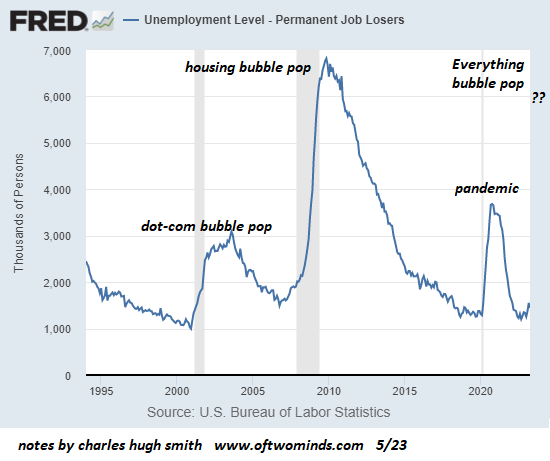
The consensus holds that inflation is declining rapidly and unemployment remains low, so the economy is doing great. Please glance at Chart #1 below to see what enthuses the mainstream: the unemployment rate is near historic lows.

But this measure leaves out a great deal of consequential factors. It’s well-known that the unemployment rate is distorted / gamed by leaving out everyone who is in the workforce but not “actively seeking work.” So what does this official unemployment rate actually measure? Not the percentage of the workforce that has a job.

Nor does it measure underemployment–those working far below their potential–or job insecurity or the percentage of workers being pushed into burnout–all consequential reflections of the real economy. All of these are potentially causal factors in why US productivity has fallen so dramatically.

And speaking of productivity, that’s the ultimate source of prosperity–not speculative bubbles or debt-binging. If productivity is tanking, eventually there are negative economic consequences that will be distributed to some segments of the populace, very likely asymmetrically.

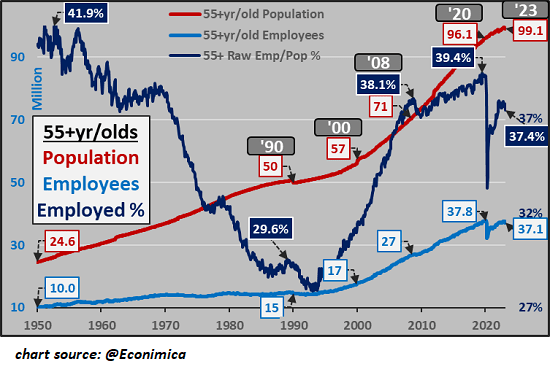
Such a broad-brush measure also ignores the consequences of demographics. Please glance at chart #2 below, of the 55 and over population and workforce. Note that virtually all the 20+ million jobs the US economy added in the past two decades are in this older workforce, which is of course steaming steadily into retirement, even as the percentage of this cohort who continues working has soared.

In other words, virtually all the job growth is the result of older workers working longer. Yes, 70 is the new 50, but try doing the same work at 70 that you did when you were 50. Sure, some people forego retirement because they love their work so much, but we don’t measure how many are still working because they have to for pressing financial reasons.

Have you observed the age of service workers and skilled workers recently? Do you reckon they really love working at Burger King so much that they’re doing it for enjoyment?

What if we measured financial pressures and job insecurity rather than risibly bogus “unemployment”? Would the economy still look so wonderful and resilient?

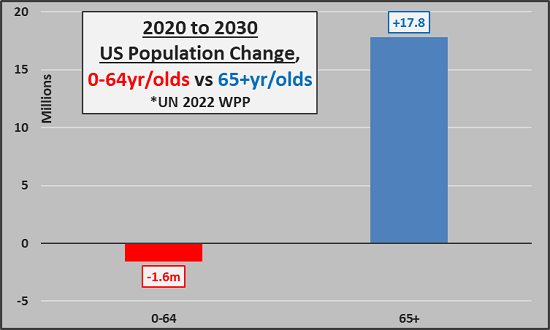
Chart #3 shows that virtually all the population growth ahead is in the cohort of older workers 65+ years old heading into retirement. So the workforce is rapidly aging and the unspoken / unexamined assumption is tens of millions of new workers will enter the workforce with the same skills, motivation, dedication and values as the tens of millions retiring.

But the demographics simply don’t support this breezy assumption.

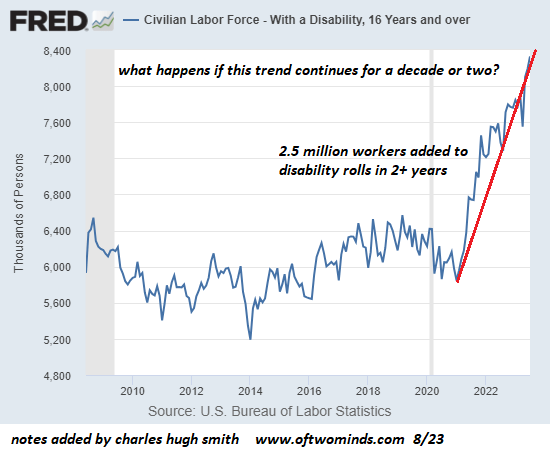
Now glance at chart #4 which depicts the extraordinary rise in the number of workers who are now disabled. The causes of this are being debated (the pandemic obviously plays a role), but 2.5 million workers leaving the workforce in a few years is something that could be consequential if the trend continues. An assumption that this is a one-off is baseless until proven otherwise.

Once again, demographics, productivity and factors such as disability and burnout are not part of the unemployment, GDP and inflation measures currently being touted as proof of economic nirvana.

Item #1 of what’s not even measured is the crapification of goods and services. I addressed this in The “Crapification” of the U.S. Economy Is Now Complete (February 9, 2022) and Stainless Steal (February 26, 2023).

How do we measure the “inflation”–i.e. a loss of purchasing power–when appliances that lasted 20 years a generation ago now break down in 5 years? Where does that 75% decline in utility and durability show up in the official inflation data? How about the tools that once lasted a lifetime now breaking after a few years?

It’s been estimated that America’s food has lost 30% of its nutritive value in the past few decades. Protein per gram has dropped, trace nutrients have dropped, and so on. Rather than pursue sustainably nutrient-rich soil, Big Ag has maximized profits by dumping natural-gas-derived chemical fertilizers on depleted soil to boost production of nutrient-poor, tasteless “product.” A product deemed “organic” offers no guarantee that the soil isn’t depleted of nutrients.

Could this decline have anything to do with the American populace’s increasingly poor health? Nobody knows because these massive declines in quality and value aren’t measured and are certainly not part of the risibly bogus measures of unemployment, GDP and inflation.

The official inflation rate ignores the multi-decade decline in the purchasing power of wages. Rents have soared 25% in a few years, and economists are looking at 5% increases in wages and worrying about the potential inflationary impact of workers’ wages not keeping up with real-world inflation.

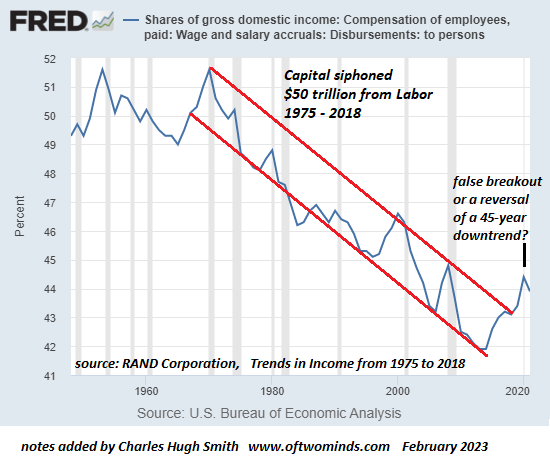
Cheerleading economists and pundits never mention the $50 trillion siphoned from labor by capital over the past 45 years. They also don’t mention the rising trend of loading more work on employees rather than hire more employees, or as a response to not being able to find qualified new hires.

Funny how rosy the picture can be tinted when all the consequential forces are ignored. But this studied ignorance characterizes the American elite, who delight in whining about airfares and travel delays, and finding someone to fix their pool pump. I address our Terminally Stratified Society here:

The Wealthy Are Not Like You and Me–Our Terminally Stratified Society (August 3, 2023)

This protected elite don’t have to put up with the crapified goods and services which generate their capital gains and income. Their wealth and income enable their detachment from the crapified economy the bottom 90% experience. Their experience of the bottom 90% is as service workers, delivery people, etc. who serve their entitled tastes.

Correspondent Tomasz G. provided a telling excerpt from Houellebecq’s The Possibility of an Island:

“… the rich certainly like the company of the rich, no doubt it calms them, it’s nice for them to meet beings subject to the same torments as they are, and who seem to form a relationship with them that is not totally about money; it’s nice for them to convince themselves that the human species is not uniquely made up of predators and parasites… “

As correspondent Ryan R. observed, America’s privileged elites“were born on third, stole home (via asset inflation) and still think they hit that home run.”

We know who the parasites are, but economists and pundits are safely blind to America’s neofeudal aristocracy. After all, who butters the bread of economists and pundits?

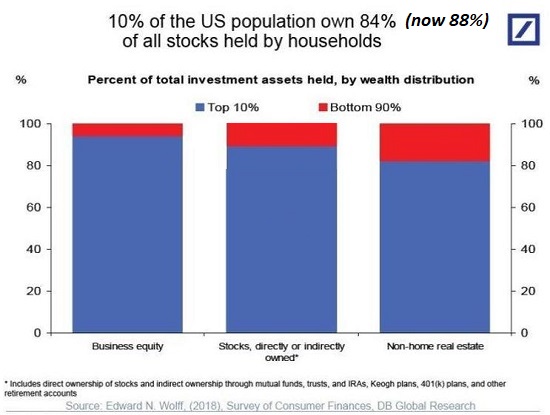
Is it unsurprising there are no measures of neofeudalism or elite privilege? As for the incredible concentration of wealth in the top tiers and the resulting decline in the bottom 90%’s share of the nation’s wealth–nothing to see here, just globalization and financialization doing their thing. What matters is booking my next flight to yet another conference of economists and pundits where we nod our heads and dare not admit all the conferences are nothing but echo chambers of the privileged elites.

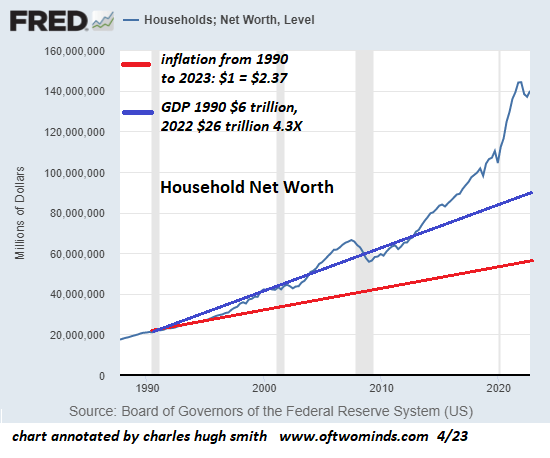
Cheerleading economists and pundits completely ignore the consequences of the system being rigged to favor capital and the already-wealthy who were given the means to buy assets back when they were cheap and affordable to the middle-class. Now that the system generates speculative credit-asset bubbles to create “the wealth effect,” assets such as homes in desirable regions are out of reach of the bottom 90%.

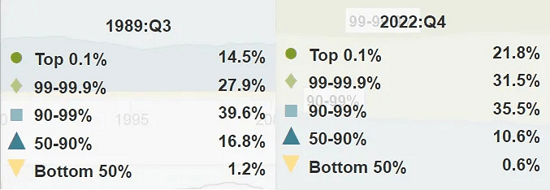
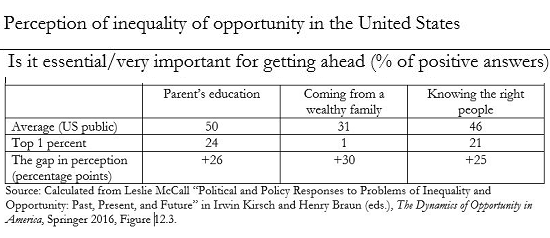
Please study the six charts below of wealth inequality. Try not to laugh out loud when you see that the top 1% reckon that “coming from a wealthy family” has near-zero impact on “getting ahead in America.”

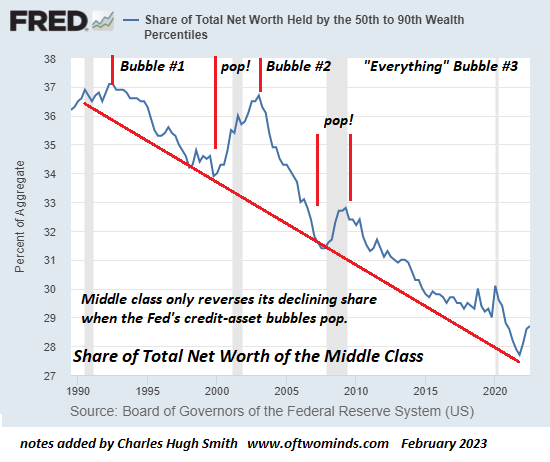
Also note the steady decline in the middle class percentage of national wealth, and how the middle class’s share only rises when the credit-asset bubbles that have enriched the top 10% deflate, a bubble-pop that never lasts longer than a few months thanks to the policies that favor the already-rich at the expense of those who don’t own stocks, rental properties, municipal bonds, etc.

Economists and pundits steer well clear of the eventual social and political consequences of America’s entrenched neofeudal wealth-income inequality. That this neofeudal configuration is inherently destabilizing–never mind, we don’t measure that, look at the wunnerful unemployment and inflation charts!

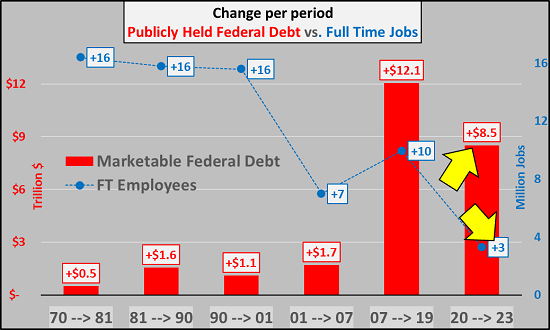
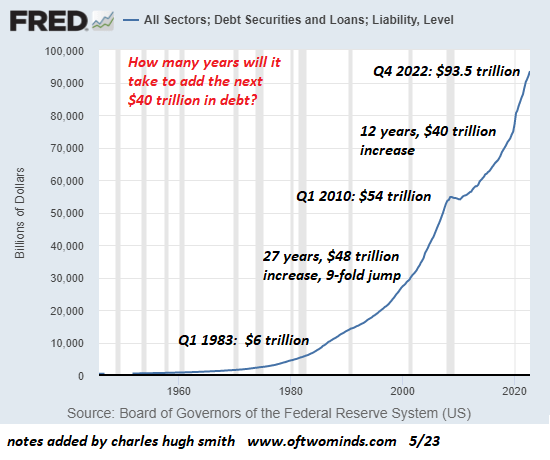
Lastly, consider the skyrocketing federal debt in terms of how many jobs are created in the era of soaring federal spending and debt. (Charts courtesy of CH / Economica) Debt doesn’t matter to economists and pundits, and neither does its diminishing effect on GDP and employment. The same can be said of total debt (public and private), which is skyrocketing (last chart): diminishing returns writ large as higher interest rates are embedded in the policy excesses and neofeudal structure of the past 45 years.

In essence, nothing that is consequential is properly quantified, so the pundit class keeps insisting everything is wunnerful and is mystified why people are so foolishly dissatisfied with our wunnerful economy. The reason why people are not buying the fantasyland story is they have to live and work in the crapified real economy, as serfs serving the economist-punditry-elite aristocracy.

If we want to avoid being led astray by misleading measures, we must seek enlightenment in what isn’t being measured or is cast aside as inconvenient to the “economy is wunnerful” party line.

What Happens When the Competent Opt Out?

By Charles Hugh Smith

Source: Of Two Minds

By this terminal stage, the competent have been driven out, quit or burned out.

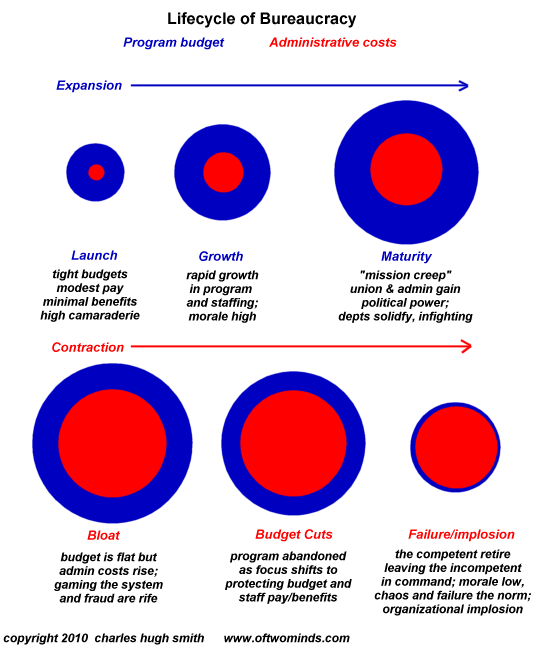
What happens with the competent retire, burn out or opt out? It’s a question few bother to ask because the base assumption is that there is an essentially limitless pool of competent people who can be tapped or trained to replace those who retire, burn out or opt out, i.e. quit in favor of a lifestyle that doesn’t require much in the way of income or stress.

These assumptions are no longer valid. A great many essential services that are tightly bound to other essential services are cracking as the competent decide (or realize) they’re done with the rat-race.

The drivers of the Competent Opting Out are obvious yet difficult to quantify. Those retiring, burning out and opting out will deny they’re leaving for these reasons because it’s not politic to be so honest and direct. They will offer time-honored dodges such as “pursue other opportunities” or “family obligations.”

1. The steady increase in workloads, paperwork, compliance and make-work (i.e. work that has nothing to do with the institution’s actual purpose and mission) that lead to burnout. There is only so much we can accomplish, and if we’re burdened with ever-increasing demands for paperwork, compliance, useless meetings, training sessions, etc., then we no longer have the time or energy to perform our productive work.

I wrote a short book on my experience of Burnout. I believe it is increasingly common in jobs that demand responsibility and accountability yet don’t provide the tools and time to fulfill these demands. Once you’ve burned out, you cannot continue. That option no longer exists.

For others, the meager rewards simply aren’t worth the sacrifices required. The theme song playing in the background is the Johnny Paycheck classic Take this job and shove it.

Healthcare workloads, paperwork and compliance are one example of many. Failure to complete all the make-work can have dire consequences, so it becomes necessary to do less “real work” in order to complete all the work that has little or nothing to do with actual patient care. Alternatively, the workload expands to the point that it breaks the competent and they leave.

2. Loss of autonomy, control, belonging, rewards, accomplishment and fairness. Professor Christina Malasch pioneered research on the causes of burnout, which can be summarized as any work environment that reduces autonomy, control, belonging, rewards, accomplishment and fairness. Despite a near-infinite avalanche of corporate happy-talk (“we’re all family,”–oh, barf) this describes a great many work environments in the US: in a word, depersonalized. Everyone is a replaceable cog in a great impersonal machine optimized to maximize profits for shareholders.

3. The politicization of the work environment. Let’s begin by distinguishing between policies enforcing equal opportunity, pay, standards and accountability, policies required to fulfill the legal promises embedded in the nation’s social contract, and politicization, which demands allegiance and declarations of loyalty to political ideologies that have nothing to do with the work being done or the standards of accountability necessary to the operation of the complex institution or enterprise.

The problem with politicization is that it is 1) intrinsically inauthentic and 2) it substitutes the ideologically pure for the competent. Rigid, top-down hierarchies (including not just Communist regimes but corporations and institutions) demand expressions of fealty (the equivalent of loyalty oaths) and compliance to ideological demands (check the right boxes of party indoctrination, “self-criticism,” “struggle sessions,” etc.).

The correct verbiage and ideological enthusiasm become the basis of advancement rather than accountability to standards of competence. The competent are thus replaced with the politically savvy. Since competence is no longer being selected for, it’s replaced by what is being selected for, political compliance.

It doesn’t matter what flavor of ideological purity holds sway–conservative, progressive, communist or religious–all fatally erode competence by selecting for ideological compliance. Everyone knows the enthusiasm is inauthentic and only for show, but artifice and inauthenticity are perfectly adequate for the politicization taskmasters.

4. The competent must cover for the incompetent. As the competent tire of the artifice and make-work and quit, the remaining competent must work harder to keep everything glued together. Their commitment to high standards and accountability are their undoing, as the slack-masters and incompetent either don’t care (“I’m just here to qualify for my pension”) or they’ve mastered the processes of masking their incompetence, often by blaming the competent or the innocent for their own failings.

This additional workload crushes the remaining competent who then burn out and quit, go on disability or opt out, changing their lifestyle to get by on far less income, work, responsibility and far less exposure to the toxic work environments created by depersonalization, politicization and the elevation of the incompetent.

5. As the competent leadership leaves, the incompetent takes the reins, blind to their own incompetence. It all looked so easy when the competent were at the helm, but reality is a cruel taskmaster, and all the excuses that worked as an underling wear thin once the incompetent are in leadership roles.

By this terminal stage, the competent have been driven out, quit or burned out. There’s only slack-masters and incompetent left, and the toxic work environment has been institutionalized, so no competent individual will even bother applying, much less take a job doomed to burnout and failure.

This is why systems are breaking down before our eyes and why the breakdowns will spread with alarming rapidity due the tightly bound structure of complex systems.

Here’s How We’ll Have Labor Shortages and High Unemployment at the Same Time

By Charles Hugh Smith

Source: Of Two Minds

This is how we’ll end up with severe shortages of truly skilled labor and high unemployment of those who lack the necessary skills.

The labor force and the job market are referred to as if they were monolithic structures. But they’re not monolithic, they are complex aggregates of very different cohorts of age, skills, mobility, education, experience, opportunity, potential and motivation.

As a result, numbers such as the unemployment rate tell us very little about the labor force and the job market in terms of what matters going forward. So what does matter going forward?

1. Demographics–the aging and retirement of key sectors of the work force.

2. Skills and experience that will be increasingly scarce due to mismatched demand for skills that are diminishing as older workers retire.

3. What skills and experience will be demanded by re-industrialization, reshoring and expanding the electrification of the economy.

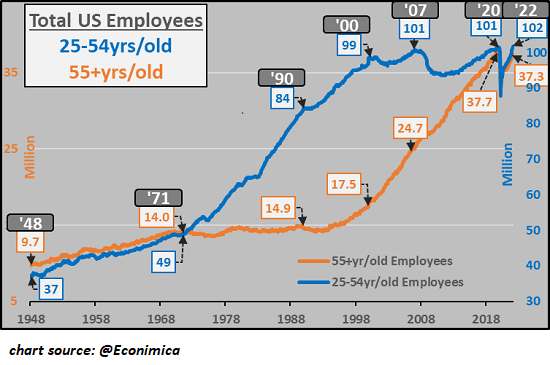
Consider these two charts of the US work force by age. (Courtesy of CH @econimica) In the first chart, Total US Employees, note that the prime working age work force (ages 25-54) has been flatlined for the past 20 years at 101-102 million. In contrast, the 55-and-older cohort of employees soared from 17 million to 37 million. This increase of 20 million accounts for virtually all growth in the employed work force.

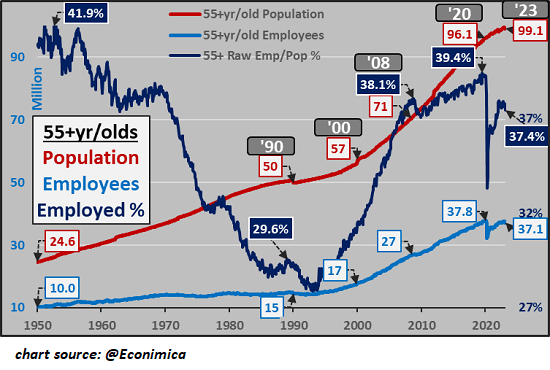
A funny thing happens as workers get old; they retire and leave the work force. Their skills and experience are no longer available to employers or the nation’s economy. The second chart shows the aging of the American populace, as the 55+ cohort increased from 57 million to 99 million since 2000, as the number of older employees skyrocketed from 17 million to 37 million.

While the total US population increased by 18% from 281 million in 2000 to 331 million today, the 55+ cohort increased 74% (from 57 million to 99 million).

The key takeaway here is the number of experienced workers who will retire in the next decade will track the explosive growth in the 55+ cohort. The general consensus is this will not be a problem because there are plenty of younger workers available to fill the vacated slots.

But this overlooks the qualitative and quantitative differences in the millions leaving the work force and those joining the work force. This is especially consequential in real-world jobs, i.e. all those jobs that require engaging real-world materials rather than staring at screens.

Though few analysts and commentators will admit to it, the implicit assumption is that the jobs that matter all involve staring at screens–processing data, finance, entertainment and shaping narrative make the world go round. All the real-world stuff (boring!) will magically get done by tax donkeys who are out of sight, out of mind.

This mindset has it backwards: it’s the real-world work of changing the industrial / energy / energy distribution foundation of the economy that matters going forward, not the staring-at-screens jobs.

What few seem to realize is the work force that’s aging and retiring is the cohort with the real-world skills. It’s a nice idea to remake the entire electrical grid of the nation to transport much larger quantities of electrical power, but who’s going to do all that work? Young people whose career goals are becoming YouTube influencers or day-traders? No. All the ChatAI bots in the world aren’t going to get the real work done, either.

In other words, there is a massive mismatch between the skills available to hire in the young-worker cohort and the skills and experience needed to rebuild the material, real-world foundations of the US economy. It’s well-known but apparently not worth worrying about that the average age of the US farmer is pushing 60 years of age. Nobody left to grow all our food? Hey, isn’t there a ChatAI bot to do all that for us? It can all be automated, right? No? Well, why not? Somebody out there, get it done! Food in super-abundance should be delivered to everyone staring at screens 24/7, it’s our birthright.

The average age of skilled tradespeople is also skewed to the aging work force. There is no easy way to quantify real-world skills gained by on-the-job experience. I suspect it follows a power-law distribution: the newly minted worker just out of school / apprenticeship can handle basic functions, but when tough problems arise, the number of workers with the requisite experience to diagnose and fix the problem diminishes rapidly.

This distribution presents an enormous problem for the economy and employers. Once the super-experienced workers who can solve any problem leave, they cannot be replaced by inexperienced workers. So when the really big problems arise, the systems will break down because those who knew how to deal with the problems are no longer available.

This is how you can have 10 million unemployed workers and 1 million unfilled positions that can’t be filled because few are truly qualified. You want to erect new electrical transmission lines? Nice, but you’re not going to get the job done with green workers accustomed to staring at screens. It takes years of hard labor to acquire even a bare minimum of the skills required. These are not assembly-line jobs that can be filled by unskilled labor, these are jobs in the messy real world, not a distribution center.

As I note in my book on Self-Reliance, individuals with a full spectrum of real-world skills are now extremely rare. Skills that were once common are now performed by specialists. We seem to have all the time in the world to stare at hundreds of cooking programs on TV but how many people actually prepare three meals a day, week in, week out, month in, month out, year in, year out? How many people know how to repair anything, build anything, or maintain a machine?

My direct experience is that many young people don’t know how to put air in the tires of the vehicle Mom and Dad gave them. Young people with graduate-level diplomas don’t know what a green bean plant looks like. (Eeew, gross, it grows in dirt?) The cultural value system that only values wealth, regardless of its source, and minting money from staring at screens has generated a fundamental mismatch between the skills that will be needed going forward and the skills being presented as oh-so-valuable.

Yes, there are many young workers with sharp real-world skills. The question is, are there enough?

This is how we’ll end up with severe shortages of truly skilled labor and high unemployment in the cohort of workers with few real-world skills and a surplus of skills for which there is limited demand. As a real-world experiment, go find a tough old rancher and ask them a series of questions about livestock, machinery, fencing, generators, etc., and then ask the average newly minted college graduate that followed the warped values embedded in our economy the same questions.

Of course the young worker can’t match the experience of the old worker, but do they have any experience at all of a spectrum of essential real-world skills? If not, do they have the requisite physical endurance and commitment needed to acquire real-world skills?

Who’s going to do all the real-world work going forward? A few people talk about it as an abstraction, but it’s not an issue to everyone focused on Federal Reserve policy or GDP. But eventually, the real world will matter more than staring at screens and day-trading, because when the systems break down due to lack of truly qualified employees, we’ll all wake up. But by then it will be too late. We’ll be staring at dead screens begging for somebody somewhere to restore power so we can continue playing with ChatAI to trade zero-day options.

What Was Covid Really About? Triggering A Multi-Trillion Dollar Global Debt Crisis. “Ramping up an Imperialist Strategy”?

Covid, Capitalism, Friedrich Engels and Boris Johnson

By Colin Todhunter

Source: Global Research

“And thus it renders more and more evident the great central fact that the cause of the miserable condition of the working class is to be sought, not in these minor grievances, but in the capitalistic system itself.” Friedrich Engels, The Condition of the Working Class in England (1845) (preface to the English Edition, p.36)  

The IMF and World Bank have for decades pushed a policy agenda based on cuts to public services, increases in taxes paid by the poorest and moves to undermine labour rights and protections.

IMF ‘structural adjustment’ policies have resulted in 52% of Africans lacking access to healthcare and 83% having no safety nets to fall back on if they lose their job or become sick. Even the IMF has shown that neoliberal policies fuel poverty and inequality.

In 2021, an Oxfam review of IMF COVID-19 loans showed that 33 African countries were encouraged to pursue austerity policies. The world’s poorest countries are due to pay $43 billion in debt repayments in 2022, which could otherwise cover the costs of their food imports.

Oxfam and Development Finance International (DFI) have also revealed that 43 out of 55 African Union member states face public expenditure cuts totalling $183 billion over the next five years.

According to Prof Michel Chossudovsky of the Centre for Research on Globalization, the closure of the world economy (March 11, 2020 Lockdown imposed on more than 190 countries) has triggered an unprecedented process of global indebtedness. Governments are now under the control of global creditors in the post-COVID era.

What we are seeing is a de facto privatisation of the state as governments capitulate to the needs of Western financial institutions.

Moreover, these debts are largely dollar-denominated, helping to strengthen the US dollar and US leverage over countries.

It raises the question: what was COVID really about?

Millions have been asking that question since lockdowns and restrictions began in early 2020. If it was indeed about public health, why close down the bulk of health services and the global economy knowing full well what the massive health, economic and debt implications would be?

Why mount a military-style propaganda campaign to censor world-renowned scientists and terrorise entire populations and use the full force and brutality of the police to ensure compliance?

These actions were wholly disproportionate to any risk posed to public health, especially when considering the way ‘COVID death’ definitions and data were often massaged and how PCR tests were misused to scare populations into submission.

Prof Fabio Vighi of Cardiff University implies we should have been suspicious from the start when the usually “unscrupulous ruling elites” froze the global economy in the face of a pathogen that targets almost exclusively the unproductive (the over 80s).

COVID was a crisis of capitalism masquerading as a public health emergency.

Capitalism  

Capitalism needs to keep expanding into or creating new markets to ensure the accumulation of capital to offset the tendency for the general rate of profit to fall. The capitalist needs to accumulate capital (wealth) to be able to reinvest it and make further profits. By placing downward pressure on workers’ wages, the capitalist extracts sufficient surplus value to be able to do this.

But when the capitalist is unable to sufficiently reinvest (due to declining demand for commodities, a lack of investment opportunities and markets, etc), wealth (capital) over accumulates, devalues and the system goes into crisis. To avoid crisis, capitalism requires constant growth, markets and sufficient demand.

According to writer Ted Reese, the capitalist rate of profit has trended downwards from an estimated 43% in the 1870s to 17% in the 2000s. Although wages and corporate taxes have been slashed, the exploitability of labour was increasingly insufficient to meet the demands of capital accumulation.

By late 2019, many companies could not generate sufficient profit. Falling turnover, limited cashflows and highly leveraged balance sheets were prevalent.

Economic growth was weakening in the run up to the massive stock market crash in February 2020, which saw trillions more pumped into the system in the guise of ‘COVID relief’.

To stave off crisis up until that point, various tactics had been employed.

Credit markets were expanded and personal debt increased to maintain consumer demand as workers’ wages were squeezed. Financial deregulation occurred and speculative capital was allowed to exploit new areas and investment opportunities. At the same time, stock buy backs, the student debt economy, quantitative easing and massive bail outs and subsidies and an expansion of militarism helped to maintain economic growth.

There was also a ramping up of an imperialist strategy that has seen indigenous systems of production abroad being displaced by global corporations and states pressurised to withdraw from areas of economic activity, leaving transnational players to occupy the space left open.

While these strategies produced speculative bubbles and led to an overevaluation of assets and increased both personal and government debt, they helped to continue to secure viable profits and returns on investment.

But come 2019, former governor of the Bank of England Mervyn King warned that the world was sleepwalking towards a fresh economic and financial crisis that would have devastating consequences. He argued that the global economy was stuck in a low growth trap and recovery from the crisis of 2008 was weaker than that after the Great Depression.

King concluded that it was time for the Federal Reserve and other central banks to begin talks behind closed doors with politicians.

That is precisely what happened as key players, including BlackRock, the world’s most powerful investment fund, got together to work out a strategy going forward. This took place in the lead up to COVID.

Aside from deepening the dependency of poorer countries on Western capital, Fabio Vighi says lockdowns and the global suspension of economic transactions allowed the US Fed to flood the ailing financial markets (under the guise of COVID) with freshly printed money while shutting down the real economy to avoid hyperinflation. Lockdowns suspended business transactions, which drained the demand for credit and stopped the contagion.

COVID provided cover for a multi-trillion-dollar bailout for the capitalist economy that was in meltdown prior to COVID. Despite a decade or more of ‘quantitative easing’, this new bailout came in the form of trillions of dollars pumped into financial markets by the US Fed (in the months prior to March 2020) and subsequent ‘COVID relief’.

The IMF, World bank and global leaders knew full well what the impact on the world’s poor would be of closing down the world economy through COVID-related lockdowns.

Yet they sanctioned it and there is now the prospect that in excess of a quarter of a billion more people worldwide will fall into extreme levels of poverty in 2022 alone.

In April 2020, the Wall Street Journal stated the IMF and World Bank faced a deluge of aid requests from scores of poorer countries seeking bailouts and loans from financial institutions with $1.2 trillion to lend.

In addition to helping to reboot the financial system, closing down the global economy deliberately deepened poorer countries’ dependency on Western global conglomerates and financial interests.

Lockdowns also helped accelerate the restructuring of capitalism that involves smaller enterprises being driven to bankruptcy or bought up by monopolies and global chains, thereby ensuring continued viable profits for Big Tech, the digital payments giants and global online corporations like Meta and Amazon and the eradication of millions of jobs.

Although the effects of the conflict in Ukraine cannot be dismissed, with the global economy now open again, inflation is rising and causing a ‘cost of living’ crisis. With a debt-ridden economy, there is limited scope for rising interest rates to control inflation.

But this crisis is not inevitable: current inflation is not only induced by the liquidity injected into the financial system but also being fuelled by speculation in food commodity markets and corporate greed as energy and food corporations continue to rake in vast profits at the expense of ordinary people.

Resistance  

However, resistance is fertile.

Aside from the many anti-restriction/pro-freedom rallies during COVID, we are now seeing a more strident trade unionism coming to the fore – in Britain at least – led by media savvy leaders like Mick Lynch, general secretary of the National Union of Rail, Maritime and Transport Workers (RMT), who know how to appeal to the public and tap into widely held resentment against soaring cost of living rises.

Teachers, health workers and others could follow the RMT into taking strike action.

Lynch says that millions of people in Britain face lower living standards and the stripping out of occupational pensions. He adds:

“COVID has been a smokescreen for the rich and powerful in this country to drive down wages as far as they can.”

Just like a decade of imposed ‘austerity’ was used to achieve similar results in the lead up to COVID.

The trade union movement should now be taking a leading role in resisting the attack on living standards and further attempts to run-down state-provided welfare and privatise what remains.

The strategy to wholly dismantle and privatise health and welfare services seems increasingly likely given the need to rein in (COVID-related) public debt and the trend towards AI, workplace automisation and worklessness.

This is a real concern because, following the logic of capitalism, work is a condition for the existence of the labouring classes. So, if a mass labour force is no longer deemed necessary, there is no need for mass education, welfare and healthcare provision and systems that have traditionally served to reproduce and maintain labour that capitalist economic activity has required.

In 2019, Philip Alston, the UN rapporteur on extreme poverty, accused British government ministers of the “systematic immiseration of a significant part of the British population” in the decade following the 2008 financial crash.

Alston stated:

“As Thomas Hobbes observed long ago, such an approach condemns the least well off to lives that are ‘solitary, poor, nasty, brutish, and short’. As the British social contract slowly evaporates, Hobbes’ prediction risks becoming the new reality.”

Post-COVID, Alston’s words carry even more weight.

As this article draws to a close, news is breaking that Boris Johnson has resigned as prime minister. A remarkable PM if only for his criminality, lack of moral foundation and double standards – also applicable to many of his cronies in government.

With this in mind, let’s finish where we began.

“I have never seen a class so deeply demoralised, so incurably debased by selfishness, so corroded within, so incapable of progress, as the English bourgeoisie…

For it nothing exists in this world, except for the sake of money, itself not excluded. It knows no bliss save that of rapid gain, no pain save that of losing gold.

In the presence of this avarice and lust of gain, it is not possible for a single human sentiment or opinion to remain untainted.” Friedrich EngelsThe Condition of the Working Class in England (1845), p.275

The Engineered Stagflationary Collapse Has Arrived – Here’s What Happens Next

By Brandon Smith

Source: Alt-Market.us

In my 16 years as an alternative economist and political writer I have spent around half that time warning that the ultimate outcome of the Federal Reserve’s stimulus model would be a stagflationary collapse. Not a deflationary collapse, or an inflationary collapse, but a stagflationary collapse. The reasons for this were very specific – Mass debt creation was being countered with MORE debt creation while many central banks have been simultaneously devaluing their currencies through QE measures. On top of that, the US is in the unique position of relying on the world reserve status of the dollar and that status is diminishing.

It was only a matter of time before the to forces of deflation and inflation met in the middle to create stagflation. In my article ‘Infrastructure Bills Do Not Lead To Recovery, Only Increased Federal Control’, published in April of 2021, I stated that:

Production of fiat money is not the same as real production within the economy… Trillions of dollars in public works programs might create more jobs, but it will also inflate prices as the dollar goes into decline. So, unless wages are adjusted constantly according to price increases, people will have jobs, but still won’t be able to afford a comfortable standard of living. This leads to stagflation, in which prices continue to rise while wages and consumption stagnate.

Another Catch-22 to consider is that if inflation becomes rampant, the Federal Reserve may be compelled (or claim they are compelled) to raise interest rates significantly in a short span of time. This means an immediate slowdown in the flow of overnight loans to major banks, an immediate slowdown in loans to large and small businesses, an immediate crash in credit options for consumers, and an overall crash in consumer spending. You might recognize this as the recipe that created the 1981-1982 recession, the third-worst in the 20th century.

In other words, the choice is stagflation, or deflationary depression.”

It’s clear today what the Fed has chosen. It’s important to remember that throughout 2020 and 2021 the mainstream media, the central bank and most government officials were telling the public that inflation was “transitory.” Suddenly in the past few months this has changed and now even Janet Yellen has admitted that she was “wrong” on inflation. This is a misdirection, however, because the Fed knows exactly what it is doing and always has. Yellen denied reality, but she knew she was denying reality. In other words, she was not mistaken about the economic crisis, she lied about it.

As I outlined last December in my article ‘The Fed’s Catch-22 Taper Is A Weapon, Not A Policy Error’:

‘First and foremost, no, the Fed is not motivated by profits, at least not primarily. The Fed is able to print wealth at will, they don’t care about profits – They care about power and centralization. Would they sacrifice “the golden goose” of US markets in order to gain more power and full bore globalism? Absolutely. Would central bankers sacrifice the dollar and blow up the Fed as an institution in order to force a global currency system on the masses? There is no doubt; they’ve put the US economy at risk in the past in order to get more centralization.’

The Fed has known for years that the current path would lead to inflation and then market destruction, and here’s the proof – Fed Chairman Jerome Powell actually warned about this exact outcome in October of 2012:

“I have concerns about more purchases. As others have pointed out, the dealer community is now assuming close to a $4 trillion balance sheet and purchases through the first quarter of 2014. I admit that is a much stronger reaction than I anticipated, and I am uncomfortable with it for a couple of reasons.First, the question, why stop at $4 trillion? The market in most cases will cheer us for doing more. It will never be enough for the market. Our models will always tell us that we are helping the economy, and I will probably always feel that those benefits are overestimated. And we will be able to tell ourselves that market function is not impaired and that inflation expectations are under control. What is to stop us, other than much faster economic growth, which it is probably not in our power to produce?

When it is time for us to sell, or even to stop buying, the response could be quite strong; there is every reason to expect a strong response. So there are a couple of ways to look at it. It is about $1.2 trillion in sales; you take 60 months, you get about $20 billion a month. That is a very doable thing, it sounds like, in a market where the norm by the middle of next year is $80 billion a month. Another way to look at it, though, is that it’s not so much the sale, the duration; it’s also unloading our short volatility position.”

As we all now know, the Fed waited until their balance sheet was far larger and until the economy was MUCH weaker than it was in 2012 to unleash tightening measures. They KNEW the whole time exactly what was going to happen.

It is no coincidence that the culmination of the Fed’s stimulus bonanza has arrived right after the incredible damage done to the economy and the global supply chain by the covid lockdowns. It is no coincidence that these two events work together to create the perfect stagflationary scenario. And, it’s no coincidence that the only people who benefit from these conditions are proponents of the “Great Reset” ideology at the World Economic Forum and other globalist institutions. This is an engineered collapse that has been in the works for many years.

The goal is to “reset” the world, to erase what’s left of free market systems, and to establish what they call the “Shared Economy” system. This system is one in which the people who survive the crash will be made utterly dependent on government through Universal Basic Income and one that will restrict all resource usage in the name of “carbon reduction.” According to the WEF, you will own nothing and you will like it.

The collapse is engineered to create crisis conditions so frightening that they expect the majority of the public to submit to a collectivist hive mind lifestyle with greatly reduced standards. This would be accomplished through UBI, digital currency models, carbon taxation, population reduction, rationing of all commodities and a social credit system. The goal, in other words, is complete control through technocratic authoritarianism.

All of this is dependent on the exploitation of crisis events to create fear in the population. Now that economic destabilization has arrived, what happens next? Here are my predictions…

The Fed Will Hike Interest Rates More Than Expected, But Not Enough To Stop Inflation

Today, we are witnessing the poisonous fruits of a decade-plus of massive fiat money creation and we are now at the stage where the Fed will reveal its true plan. Hiking interest rates fast, or hiking them slow. Fast hikes will mean an almost immediate crash in markets (beyond what we have already seen), slow hikes will mean a drawn out process of price inflation and general uncertainty.

I believe the Fed will hike more than expected, but not enough to actually slow inflation in necessities. There will be an overall decline in luxury items, recreation commerce and non-essentials, but most other goods will continue to climb in cost. It is to the advantage of globalists to keep the inflation train running for another year or longer.

In the end, though, the central bank WILL declare that the pace of interest rates is not enough to stop inflation and they will revert to a Volcker-like strategy, pushing rates up so high that the economy simply stops functioning altogether.

Markets Will Crash And Unemployment Will Abruptly Spike

Stock markets are utterly dependent on Fed stimulus and easy money through low interest rate loans – This is a fact. Without low rates and QE, corporations cannot engage in stock buybacks. Meaning, the tools for artificially inflating equities are disappearing. We are already seeing the effects of this now with markets dropping 20% or more.

The Fed will not capitulate. They will continue to hike regardless of the market reaction.

As far as jobs are concerned, Biden and many mainstream economists constantly applaud the low unemployment rate as proof that the American economy is “strong,” but this is an illusion. Covid stimulus measures temporarily created a dynamic in which businesses needed increased staff to deal with excess retail spending. Now, the covid checks have stopped and Americans have maxed out their credit cards. There is nothing left to keep the system afloat.

Businesses will start making large job cuts throughout the last half of 2022.

Price Controls

I have no doubt that Joe Biden and Democrats will seek to enforce price controls on many goods as inflation continues, and there will be a handful of Republicans that will support the tactic. Price controls actually lead to a reduction in supply because they remove all profits and thus all incentive for manufacturers to keep producing goods. What usually happens at that point is government steps in to nationalize manufacturing, but this will be substandard production and at a much lower yield.

In the end, supplies are reduced even further and prices go even higher on the black market because no one can get their hands on most goods anyway.

Rationing

Yes, rationing at the manufacturing and distribution level is going to happen, so be sure to buy what you need now before it does. Rationing occurs in the wake of price controls or supply chain disruptions, and usually this coincides with a government propaganda campaign against “hoarders.”

They will hold up a few exaggerated examples of people who buy truckloads of merchandise to scalp prices on the black market. Then, not long after, they will accuse preppers and anyone who bought goods BEFORE the crisis of “hoarding” simply because they planned ahead.

Rationing is not only about controlling the supply of necessities and thus controlling the population by proxy; it is also about creating an atmosphere of blame and suspicion within the public and getting them to snitch on or attack anyone that is prepared. Prepared people represent a threat to the establishment, so expect to be demonized in the media and organize with other prepared people to protect yourself.

Be Ready, It Only Gets Worse From Here On

It might sound like I am predicting success of the Great Reset program, but I actually believe the globalists will fail in the end. That’s not going to stop them from making the attempt. Also, the above scenarios are only predictions for the near term (within the next couple of years). There will be many other problems that stem from these situations.

Naturally, food riots and other mob actions will become more commonplace, perhaps not this year, but by the end of 2023 they will definitely be a problem. This will coincide with the return of political unrest in the US as leftist factions, encouraged by globalist foundations, demand more government intervention in poverty. At the same time, conservatives will demand less government interference and less tyranny.

At bottom, the people who are prepared might be called a lot of mean names, but as long as we organize and work together, we will survive. Many unprepared people will NOT survive. Understand that the economic conditions ahead of us are historically destructive; there is no way that serious consequences can be avoided for a large part of the population, if only because they refuse to listen and to take proper steps to protect themselves.

The denial is over. The crash is here. Time to take action if you have not done so already.

America Is Now a Kleptocrapocracy

By Charles Hugh Smith

Source: Of Two Minds

I’ve coined a new portmanteau word to describe America’s descent: kleptocrapocracy, a union of kleptocracy (a nation ruled by kleptocrats) and crapocracy, a nation drowning in a moral sewer of rampant self-interest in which the focus is cloaking all the skims, scams, rackets and bezzles in some virtuous-sounding garb, a nation choking on low-quality junk ceaselessly hawked by robocalls, spam, phishing and Big Tech manipulation.

It’s little wonder trust has collapsed in America: the only thing we can trust is whatever’s being pitched is deceptively packaged to mask the self-interest and profiteering of the perps.

The stench from the decomposing carcasses of once-trusted institutions is everywhere. Insiders and the marketers they pay to cloak their grifting are banking bennies at the expense of hapless debt-serfs who fell for the scam. You need these three costly medications, and then when the side-effects kick in, you need six more to counteract the first three, and so on. But trust us; your “health” (heh) is our only concern. Uh, sure.

Why do state universities need to market themselves like a roto-rooter service? Maybe because they’re both working the sewers: state universities are exploiting the student loan sewers, desperate to recruit another batch of debt-serfs who fell for the 3-card monte game in which a lifetime of debt is exchanged for a credential of dubious value.

The competition for the remaining pool of debt-serfs is heating up, so like everything else in America, the game is now all about marketing, virtue-signaling, exploiting Big Tech manipulation, and so on.

Doing something useful is now for chumps. The opportunities in America are all about getting rich by doing, well, nothing: skimming 20% “guaranteed” returns in DeFi, mining cryptos, trading stablecoins, selling volatility, etc.–getting rich and then living large on the sweat of the chumps who are still working (poor deluded fools!).

The obvious goal here is for everyone to get in on trading stablecoins, buying rentals with DeFi, churning meme stocks, etc. Why should anyone lower themselves to doing something useful anymore? Why bother?

Labor has been degraded for decades in speculative-frenzy America. Why work when the Fed has our backs and all those newly issued trillions are up for grabs? Doing something useful is for chumps.

Nobody seems to ask what happens when we’re all minting fortunes off speculative churn and there’s nobody filling potholes, stocking shelves or carrying bags of QuikCrete to customers’ trucks.

And while we’re on the subject of sewage: if America’s security services and Big Tech oligarchies track everything and everyone, why are we drowning in robocalls, spam, SMS-spam (smishing), etc.? Couldn’t the NSA/CIA track the spammers and robo-callers down and rendition them (warrantlessly, of course) to a hellhole camp in an unnamed country?

Of course they could. But the ruination of everyday life is of no concern to the kleptocrats (fly with me to the stars!) or our dysfunctional government, which has become nothing more than an invitation-only auction of favors that elevates the relentless pursuit of self-interest and profiteering to new kleptocratic heights.

Please don’t make the mistake of expecting anything to work properly in America. The components are garbage, the parts are on back-order, the people who knew how to make the kludgy mess function just quit in disgust, and we’ll have to get back to you about your request, as our service staff just left to launch an OnlyFans site.

I don’t want to work, I’m minting money speculating, but gol-darn it, I want everyone else to wait on me and meet my needs for low, low quality goods and services at not-so-low prices, and if I’m not treated well enough by everyone earning chump-change, then I’ll freak out, and if that doesn’t pan out, I’ll blame it all on my meds. Accountability is like work–only for chumps.

Trust me, everything’s going great and we’re all going to get wealthier and wealthier until we won’t be able to take it any more, it will be so great. I hope everyone here is hungry because the banquet of consequences is being served.

The U.S. Economy In a Nutshell: When Critical Parts Are On “Indefinite Back Order,” the Machine Grinds to a Halt

By Charles Hugh Smith

Source: Of Two Minds

Setting aside the “transitory inflation” parlor game for a moment, let’s look at what happens when critical parts are unavailable for whatever reason, for example, they’re on back order or indefinite back order, i.e. the supplier has no visibility on when the parts will be available.

If the part that blew out is 0.1% of the entire machine, and the other 99.9% still works perfectly, the entire machine is still dead in the water without that critical component. That is a pretty good definition of systemic vulnerability and fragility, a fragility that becomes much, much worse if there are two or three components which are on indefinite back order.

This is the problem with shipping much of your supply chain overseas: you create extreme systemic vulnerability and fragility even as you rake in big profits from reducing costs. Speaking of costs, let’s look at the costs of having a large, costly, complex mechanism sitting idle in a non-functioning state due to some broken element for which there is no substitute available. Whatever productive capacity the mechanism, process, etc. had is now stuck at zero.

Buying a new replacement is extremely costly, and that’s not always available for all the same reasons that parts and components aren’t available. Finding someone to fabricate a new component is not easy due to the wholesale transfer of manufacturing moxie and capability overseas.

You might be able to find someone to weld a replacement strut, but try finding someone to fab a new bicycle derailleur or better yet, a multilayer semiconductor chip. What about 3-D fabrication? Doesn’t that solve this problem? If the part can be “printed,” yes, but there are limits on what can be 3-D fabbed. You can’t 3-D fab a complex thermostat or controller, for example. You can’t 3-D fab a rubber gasket, either, or a great many other bits of petrochemical-based manufacturing.

Scarcities are not limited to parts and components; skilled people can be scarce, too. For example, there is a limited supply of ICU doctors and nurses. The training required to work in an ICU is specialized and experiential; throwing someone with minimal training in is not a substitution that’s going to work. You can’t order an ICU staff from China or print one digitally the way the Federal Reserve creates currency out of thin air. It takes many years to train the staff to function at a high level in ICU.

A great many such labor scarcities exist for skilled workers who cannot be replaced except by someone with the same training and years of experience. This is one reason ICUs can break down: there is no replacement staff available, and no way to “print more.”

It turns out there’s also a scarcity of people willing to do the dirty-work jobs America needs done for wages that haven’t kept up with inflation. As I have explained here, the $1.65 minimum wage I earned in 1970, if factored for real-world inflation, is around $18 per hour, and arguably closer to $20 per hour.

The solution is to raise the pay to levels that attract workers, but then this requires raising prices on the good and services to the point that customers can no longer afford them.

But wait, can’t we automate all work and deliver full-gee-whiz free-money, no-work communism to everyone? I invite everyone who reckons this is in the realm of the do-able to design, program and manufacture an automated robot that can trundle out to the laundry room, pop open a broken clothes dryer, diagnose the problem, manage to find a new controller board, fit it correctly and properly reconnect all the little wiring bits, close it up, test it, lift the dryer back on the washing machine and do all that for the relatively modest cost of a human repairperson. When you accomplish fabricating and programming that robot to do all the work without instruction or oversight, by all means let us all know how much it cost to design, program and manufacture, what the payback of the development and manufacturing process will cost amortized over the (short) life of the robot and how reliable it is in the real world.

The point is, fantasies are nice but reality is far more demanding.

There can also be scarcities of competence. There may be replacements who claim competence, but when reality intrudes on the shuck-and-jive, their competence was illusory, and the net result is the entire institution can be described by President G.W. Bush’s memorable phrase, this sucker’s going down.

There can also be scarcities of institutional infrastructure and capacity. Once the institution, enterprise, state agency, etc. has been stripmined of redundancy, institutional memory and competence, then the first scarcity that cannot be replaced is the first domino that topples all the other dominoes of systemic vulnerability and fragility.

The Federal Reserve can print trillions of dollars and the federal government can borrow and blow trillions of dollars, but neither can print or borrow supply chains, scarce skills, institutional depth or competence. That nice shiny new semiconductor fab you reckon will resolve the chip shortage? You can print the billions of dollars needed in an instant, but the machinery, expertise and time can’t be conjured quite so easily. That fab is years away from completion no matter how many freshly conjured dollars you throw into the air.

When Critical Parts Are On “Indefinite Back Order,” the Machine Grinds to a Halt: that’s the U.S. economy in a nutshell.

A great many essential components in America are on indefinite back order, including the lifestyle of endless globally sourced goodies at low, low prices. That lifestyle is out of stock and cannot be replaced with financialization fakery.

Hey, Federal Reserve, can you conjure up a non-corrupt financial system, a domestic supply chain, and an economy of open competition, transparency, accountability and competence? If not, you are even more worthless than we feared.