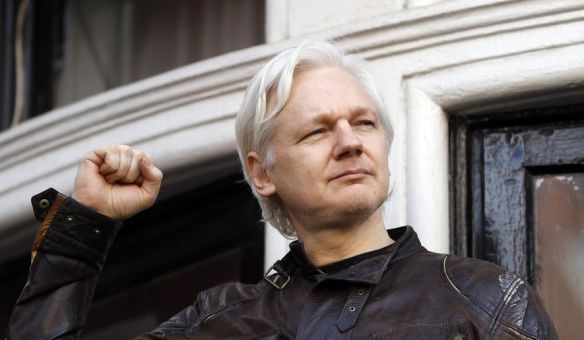
Australian police chief links media raids to US-led “Five Eyes” spy network

By Mike Head

Source: WSWS.org

The Australian Federal Police (AFP) called a news conference on Thursday to justify its raids targeting journalists at two media organisations this week.

Police spent seven hours ransacking a News Corp political reporter’s home in Canberra on Tuesday, and eight hours poring over and seizing files at the Australian Broadcasting Corporation’s (ABC) Sydney headquarters on Wednesday.

In an extraordinary admission, the AFP’s acting commissioner Neil Gaughan blurted out that the real reason for the raids was to protect the information that the Australian police and intelligence agencies receive from their “Five Eyes” counterparts. Five Eyes is a top-level network of intelligence agencies dominated by the US that also includes Britain, Australia, Canada and New Zealand.

“The Australian government, or particularly the Australian enforcement and intelligence communities, rely on secret and top-secret information from our international partners, particularly our Five Eyes partners,” the police chief said. “If we can’t be seen to protect our own internal information, [then] we are concerned that the information flow to us dries up.”

Citing government demands for investigations into leaks of secret information, Gaughan said the AFP received “numerous referrals to us [of leaks] and to be honest we get too many. But the premise of investigating these matters is to ensure the international community knows that we take the leaking of information, sensitive information, seriously.”

In other words, the AFP is under pressure not just from Canberra, but from Washington, to ensure that information, including about criminal actions of governments and its agencies, is kept from public view. This takes place amid the Trump administration’s mounting threats of war against Iran and Venezuela, as well as its escalating confrontation with China.

The AFP search warrants related to leaked documents exposing war crimes perpetrated by the Special Air Service (SAS) in Afghanistan and plans to legalise domestic mass surveillance by the Australian Signals Directorate (ASD), which are both central to Five Eyes operations.

Gaughan’s remarkable declaration went virtually unreported throughout the establishment media in Australia and internationally. His admission vindicates the analysis made by the WSWS on Thursday:

“[I]t is inconceivable that the Australian government would have instigated and pursued the investigation of the ABC and Murdoch media journalists without the agreement, if not urging, of Washington. Both the SAS and the ASD surveillance agency are closely integrated into all the wars and war preparations of the US.”

Gaughan’s statement also underscores the warnings made by the WSWS that the persecution of WikiLeaks founder Julian Assange for exposing the war crimes, mass spying and regime-change operations of Washington and its allies, including Australia, is setting a precedent for the criminalisation of journalism.

By specifically targeting journalists, as well as whistleblowers, the Australian government is following the lead of the Trump administration. The US has charged Assange, a journalist and publisher, with multiple counts under the Espionage Act, for which he faces life imprisonment.

At his press conference, Gaughan refused to rule out laying charges against News Corp journalist Annika Smethurst or ABC reporters Dan Oakes and Sam Clark for publishing alleged “national security” secrets. Such charges against journalists would be without precedent in Australia since World Wars I and II.

In a pointed warning, Gaughan said “no sector of the community should be immune” from police investigations into alleged law-breaking. Gaughan said the police are probing the “publication” of documents marked “secret” and “top secret,” placing journalists and publishers squarely under threat of prosecutions.

The AFP is investigating breaches of the Crimes Act, which criminalises unauthorised disclosures by public servants, and also contains offences that apply to journalists. Journalists, as well as alleged leakers, can be jailed for up to seven years. Dating back to World War I, the legislation outlaws “receiving” information that “prejudices the security or defence” of Australia.

But, asked what was the harm of revealing wrongdoing by Australian troops or plans to extend spying laws, Gaughan said the substance of the reports was “irrelevant.” The mere disclosure of protected information was a crime. He bluntly stated: “The issue of whether or not the public has the right to know is really not an issue that comes into our investigation process.”

The Crimes Act provisions were recently replaced by even more far-reaching measures embedded in the “foreign interference” legislation that the Liberal-National government pushed through parliament at Washington’s urging late last year, supported by the Labor Party. The maximum penalties were increased to 10 years’ imprisonment. However, the new laws could not be applied to the current cases, because the alleged leaks occurred in July 2017 and April 2018.

Gaughan tried to refute accusations that the AFP was acting at the government’s behest. He denied that the police had waited until after the May 18 federal election to execute warrants and claimed no contact had been made with the government since the AFP informed Home Affairs Minister Peter Dutton when the investigations first began.

These claims fly in the face of the facts. The government itself instigated both AFP investigations, and the Labor Party fully supported it in doing so. And Dutton and other government ministers immediately defended the raids. When Prime Minister Scott Morrison was asked at a press conference if he was bothered by police raiding journalists’ homes, he replied: “It never troubles me that our laws are being upheld.”

Above all, as Gaughan himself revealed, the raids were mounted to satisfy the Five Eyes powers, which means the US above all. Successive governments, both Liberal-National and Labor, have committed Australia to be a key partner in this network as part of its military alliance with the United States.

The police raids are part of a global crackdown on freedom of speech, including in the US and other countries, such as France, where governments are taking the Trump administration’s repressive lead.

This assault is targeted directly at the basic right of the working class to know the crimes, war plans and conspiracies of the capitalist ruling elites and the state apparatuses they control. It is being mounted amid growing struggles by workers around the world against soaring social inequality and declining living and working conditions.

The Australian police chief’s open threats highlight the urgency of the worldwide campaign being waged by the WSWS and the Socialist Equality Parties for the defence of Julian Assange and the jailed whistleblower Chelsea Manning. Their plight is a test case in the struggle against the lurch toward war and dictatorial forms of rule.

“Truth ultimately is all we have:” Julian Assange appeals for public supporta

By Oscar Grenfell

Source: WSWS.org

In his first publicly-released comments to supporters since his arrest, WikiLeaks founder and publisher Julian Assange has detailed the repressive conditions he faces in Britain’s Belmarsh prison and called for a campaign against his threatened extradition to the United States.

“I am defenceless and am counting on you and others of good character to save my life,” Assange wrote, adding, “Truth ultimately is all we have.”

Assange’s comments were made in a letter addressed to independent British journalist Gordon Dimmack, who decided to make it public following last Thursday’s announcement by the US Justice Department of additional charges against Assange under the Espionage Act. The WSWS is republishing the letter, with Dimmack’s permission, in full below.

Assange explained that since he was convicted on trumped-up bail charges shortly after his arrest on April 11, he has been “isolated from all ability to prepare to defend myself, no laptop, no internet, no computer, no library so far, but even if I do get access it will be just for half an hour with everyone else once a week.”

The WikiLeaks founder stated that he is allowed “Just two visits a month and it takes weeks to get someone on the call list.”

All of his calls, except those to his lawyers, are monitored and limited to a maximum of ten minutes. There is a window of just 30 minutes per day for phone calls to be made “in which all prisoners compete for the phone.” Assange receives only a few pounds of phone credit per week and is not allowed to receive inbound calls.

The WikiLeaks founder declared that, despite these onerous conditions, he is “unbroken albeit literally surrounded by murderers. But the days when I could read and speak and organise to defend myself, my ideals and my people are over until I am free. Everyone else must take my place.”

The WikiLeaks founder stated that he faced “A superpower” that has “been preparing for 9 years with hundreds of people and untold millions spent” on the case against him.

He warned that “The US government or rather those regrettable elements in it that hate truth liberty and justice want to cheat their way into my extradition and death rather than letting the public hear the truth for which I have won the highest awards in journalism and have been nominated seven times for the Nobel Peace Prize.”

The unveiling of the US charges is a vindication of Assange’s warnings, in the letter and over the past nine years, that he faces a politically-motivated US prosecution for his role in WikiLeaks’ exposures of war crimes, mass surveillance operations and global diplomatic conspiracies.

The 17 counts against Assange carry a combined maximum prison sentence of 175 years. They are an unprecedented attempt to criminalise investigative journalism, and abolish the free press protections of the US Constitution’s First Amendment.

The charges centre on WikiLeaks’ receipt and publication of classified US government documents. These core journalistic practices are presented as criminal activities which “risked serious harm to United States national security to the benefit of our adversaries.”

The documents covered include the Afghan war logs, which exposed the extrajudicial killing of civilians by US-led forces, and other violations of international law.

Assange’s letter further exposes the ongoing political conspiracy against him, which included his illegal expulsion from Ecuador’s London embassy and detention by the British authorities.

The WikiLeaks founder was convicted, within hours of his arrest, on the British charges. The judge dismissed the fact that the offenses were effectively resolved years ago as a result of Assange’s forfeiture of bail monies, his years of arbitrary detention in the small embassy building and his United Nations-upheld status as a political refugee.

Despite the minor character of the bail conviction, Assange has been held in virtual isolation in a maximum security prison. This is a clear attempt to hinder his defence against the Trump administration’s extradition request, and the revived Swedish investigation into allegations of sexual misconduct, which is aimed at blackening his name and creating an alternate route for him to be dispatched to a US prison.

Assange’s call for a campaign in his defence coincides with growing opposition to his persecution and to the Espionage Act charges against him.

In a Tweet shared almost 5,000 times, investigative journalist John Pilger warned that “The war on Julian #Assange is now a war on all. Eighteen absurd charges including espionage send a burning message to every journalist, every publisher… Modern fascism is breaking cover.”

The American Civil Liberties Union branded the charges “an extraordinary escalation of the Trump administration’s attacks on journalism, establishing a dangerous precedent that can be used to target all news organizations that hold the government accountable by publishing its secrets.”

The Freedom of the Press Foundation described them as “the most significant and terrifying threat to the First Amendment in the 21st century.”

In Australia, there are mounting calls for the government to fulfil its obligations to Assange as an Australian citizen and journalist. Former Labor politician Bob Carr yesterday cynically warned that Foreign Minister Marise Payne “needs to protect herself from the charge that she’s failed in her duty to protect the life of an Australian citizen”

Greg Barns, an Australian-based advisor to Assange, declared “Australia does have a role to play here and our view is that the Australian government needs to intervene.” He said the US prosecution of the WikiLeaks founder was aimed at applying US domestic law extraterritorially. This meant that “anyone who publishes information the US deems to be classified anywhere in the world” could be targeted by the US government.

Over the past 18 months, the WSWS and the Socialist Equality Parties (SEP) around the world have played a prominent role in the struggle against the stepped-up persecution of Assange.

The SEP (Australia) has held a series of rallies, demanding that the Australian government secure Assange’s release from Britain and return to Australia, with a guarantee against extradition to the US.

The events, addressed by SEP national secretary James Cogan, and well-known fighters for civil liberties, including Pilger, Consortium News editor-in-chief Joe Lauria and Professor Stuart Rees, have been attended by hundreds of workers, students and young people.

The SEP (Britain) held a powerful public meeting in London on May 12, which brought together 150 defenders of Assange, and featured speakers from around the world. It was streamed live on Dimmack’s YouTube page to an audience of thousands.

On May 18, the Sozialistische Gleichheitspartei held a rally in Berlin, attended by 300 people, under the banner “freedom for Julian Assange.”

Over the coming weeks, the WSWS and the SEP’s will intensify the struggle against Assange’s extradition to the US, and for his complete freedom. We appeal to all supporters of civil liberties to join us in this crucial fight, which is the spearhead of the defence of democratic rights and against imperialist war.

Assange’s next hearing is set for Thursday May 30 at Westminster Magistrates Court in London. We urge all readers of the WSWS in the UK to attend.

Below is the full text of Assange’s letter to Gordon Dimmack:

I have been isolated from all ability to prepare to defend myself, no laptop, no internet, no computer, no library so far, but even if I do get access it will be just for half an hour with everyone else once a week. Just two visits a month and it takes weeks to get someone on the call list and the Catch-22 in getting their details to be security screened. Then all calls except lawyer are recorded and are a maximum 10 minutes and in a limited 30 minutes each day in which all prisoners compete for the phone. And credit? Just a few pounds a week and no one can call in.

A superpower that has been preparing for 9 years with hundreds of people and untold millions spent on the case. I am defenceless and am counting on you and others of good character to save my life

I am unbroken albeit literally surrounded by murderers. But the days when I could read and speak and organise to defend myself, my ideals and my people are over until I am free. Everyone else must take my place.

The US government or rather those regrettable elements in it that hate truth liberty and justice want to cheat their way into my extradition and death rather than letting the public hear the truth for which I have won the highest awards in journalism and have been nominated seven times for the Nobel Peace Prize.

Truth ultimately is all we have.


Related Video

Assange and the Unforgivable Sin of Disemboweling Official Narratives

By Charles Hugh Smith

Source: Of Two Minds

The entire global status quo is on the cusp of the S-Curve decline phase.

There is really only one unforgivable sin in the political realm, and that’s destroying the official narrative by revealing the facts of the matter. This is why whistleblowers who make public the secret machinery of the elaborately artful lies underpinning all official narratives are hounded to the ends of the Earth.

Employees of state entities such as Ellsberg, Manning and Snowden are bound by vows of secrecy and threatened by the promise of severe punishment. Outsiders such as Assange are even further beyond the pale because they can’t be accused of being traitors, as they never took the vows of secrecy required by the Deep State.

The single most damaging revelation to all the elaborate lies that make up official narratives is the truth revealed in official emails, documents and conversations. This is why virtually every document and correspondence is now “classified,” so anyone releasing even a mundane scrap can be sentenced to rot in federal prison.

In a recent C-SPAN interview, author Nomi Prins explained the incredible difficulty of accessing papers in presidential libraries now due to virtually everything being classified. Freedom of Information Act (FOIA) applications must be filed, and researchers must wait years to gain access to routine correspondence that was freely available to all a decade or so ago.

Official paranoia has a 100% correlation with the amount of damage done to official narratives by any leaks of the facts of the matter. What are they so afraid of? Here’s the dynamic in play: the more fragile the narrative, the greater the dependence on half-truths and lies, the greater the official urgency to crush all whistleblowers and maintain a Stasi-like vigilance against any murmurs of dissent or doubt.

If the entire contraption wasn’t so vulnerable to exposure and so dependent on lies, why the infinite paranoia? This paranoia extends past the present system of lies into the past, as exposing the lies in decades past calls into question the official narratives of today.

Any doubt is extremely dangerous, as if even a single thread is pulled loose, the entire fabric of ginned-up statistics, false assurances, half-truths and outright lies unravels. Once the Pentagon Papers revealed the facts of the war in Vietnam, support for the official narrative collapsed essentially overnight.

In the immortal words of Jean-Claude Juncker, when it becomes serious you have to lie, and it’s now serious all the time.

The entire global status quo is on the cusp of the S-Curve decline phase. Hence the vulnerability to disruption of its official narratives and the panicky paranoia of its handlers.


Chelsea Manning, Julian Assange, WikiLeaks, and The Deepwater Horizon

By Greg Palast

Source: GregPalast.com

Five years ago this month, on the 20th of April, 2010, the BP Deepwater Horizon drilling rig blew itself to kingdom come.

Soon thereafter, a message came in to our office’s chief of investigations, Ms Badpenny, from a person I dare not name, who was floating somewhere in the Caspian Sea along the coast of Baku, Central Asia.

The source was in mortal fear he’d be identified ”“ and with good reason. Once we agreed on a safe method of communication, he revealed this: 17 months before BP’s Deepwater Horizon blew out and exploded in the Gulf of Mexico, another BP rig suffered an identical blow-out in the Caspian Sea.

Crucially, both the Gulf and Caspian Sea blow-outs had the same identical cause: the failure of the cement “plug”.

To prevent blow-outs, drilled wells must be capped with cement. BP insisted on lacing its cement with nitrogen gas ”“ the same stuff used in laughing gas ”“ because it speeds up drying.

Time is money, and mixing some nitrogen gas into the cement saves a lot of money.

However, because BP’s penny-pinching method is so damn dangerous, they are nearly alone in using it in deep, high-pressure offshore wells.

The reason: nitrogen gas can create gaps in the cement, allow methane gas to go up the borehole, fill the drilling platform with explosive gas ”“ and boom, you’re dead.

So, when its Caspian Sea rig blew out in 2008, rather than change its ways, BP simply covered it up.

Our investigators discovered that the company hid the information from its own shareholders, from British regulators and from the US Securities Exchange Commission. The Vice-President of BP USA, David Rainey, withheld the information from the US Senate in a testimony he gave six months before the Gulf deaths. (Rainey was later charged with obstruction of justice on a spill-related matter.)

Britain’s Channel 4 agreed to send me to the benighted nation of Azerbaijan, whose waters the earlier BP blow-out occurred in, to locate witnesses who would be willing to talk to me without getting “disappeared”. (They didn’t talk, but they still disappeared.)

And I was arrested. Some rat had tipped off the Security Ministry (the official name of the Department of Torture here in this Islamic Republic of BP). I knew I’d get out quick, because throwing a reporter of Her Majesty’s Empire into a dungeon would embarrass both BP and the Azeri oil-o-crats.

The gendarmes demanded our film, but I wasn’t overly concerned: Before I left London, Badpenny handed me one of those Austin Powers camera-in-pens, on which I’d loaded all I needed. But I did fear for my witnesses left behind in Azerbaijan ”“ and for my source in a tiger cage in the USA: Pvt Chelsea Manning.

Manning could have saved their lives

Only after I dove into deep water in Baku did I discover, trolling through the so-called “WikiLeaks” documents, secret State Department cables released by Manning. The information was stunning: the US State Department knew about the BP blow-out in the Caspian and joined in the cover-up.

Apparently BP refused to tell its own partners, Chevron and Exxon, why the lucrative Caspian oil flow had stopped. Chevron bitched to the office of the US Secretary of State, Condoleezza Rice. (George Bush’s cabinet member should not be confused with the 129,000-tonne oil tanker “Condoleezza Rice”, which Chevron named after their former board member.)

The US Ambassador in Baku got Chevron the answer: a blow-out of the nitrogen-laced cement cap on a giant Caspian Sea platform. The information was marked “SECRET”. Apparently loose lips about sinking ships would help neither Chevron nor the Azeri President Ilham Aliyev, the beneficiary of millions of dollars in payments of oil company baksheesh.

So what about Chelsea Manning?

Manning has been charged with “aiding the enemy” ”“ a crime punishable by death.

But Manning’s sole and only purpose was to get out the truth. It wasn’t Manning who wrote the cover-up memos, she merely wanted to get them to the victims: us.

And since when did the public become “the enemy”?

Had Manning’s memos come out just a few months earlier, the truth about BP’s deadly drilling methods would have been revealed, and there’s little doubt BP would have had to change its ways. Those eleven men could well have been alive today.

Did Manning know about this particular hush-hush cable about BP’s blow-out when she decided she had to become Paul Revere and warn the planet?

That’s unlikely, in the thousands of cables she had. But she’d seen enough evidence of murder and mendacity in other cables, so, as Manning, under oath, told a court, she tried to give it all to the New York Times to have knowledgeable reporters review the cables confidentially for life-saving information.

The New York Times immediately seized on this extraordinary opportunity”¦ to ignore Manning. The Times only ran it when the Guardian was going to scoop ”“ and embarrass ”“ the New York hacks.

Though there are limits. While reporter David Leigh put the story of BP’s prior blow-out on page one of the Guardian, neither the New York Times or any other major US news outlet ran the story of the blow-out and oil industry cover-up. No surprise there, though ”“ the most “prestigious” US news programme, PBS Newshour, was sponsored by”¦ Chevron Corporation.

Hanging their source while taking his applause

As a working journalist, and one whose head is likely to be in the foggy gun-sights of some jet jockey or a dictator’s goon squad, I have more than a little distaste for toffs like New York Times‘ former executive editor, columnist Bill Keller, who used Manning’s documents to cash in on a book deal and land star turns on television while simultaneously smearing his source Manning as, “troubled”, “emotionally fractured”, “vague”, “inchoate” and ”“ cover the children’s ears ”“ “gay”.

Furthermore, while preening about their revelations from the Manning documents, the Times had no problem with imprisoning their source. I do acknowledge that the Times and Keller did editorialise that a sentence of life imprisonment without parole would be “overkill”. How white of them.

When it was mentioned that Manning is no different from Daniel Ellsberg, the CIA operative who released the Pentagon Papers, Keller reassured that the Times also told Ellsberg he was “on his own” and did not object to their source being charged as a spy.

And the Times‘ much-lauded exposure of the My Lai massacre? My late good friend, the great investigative reporter Ron Ridenhour, who gave the story to Seymour Hersh, told me that he and Hersh had to effectively blackmail the Times into printing it.

Manning: aid to the enemy?

Times man Keller writes that Manning, by going to “anti-American” WikiLeaks, threatened the release of, “information that might get troops in the field or innocent informants killed”.

Really?

This is the same Bill Keller who admits that he knew his paper’s reports in 2003 that Saddam Hussein had weapons of mass destruction were completely false, but that he ”“ as editor ”“ covered up his paper’s knowledge their WDM stories were simply bogus. Those stories validated the Bush propaganda and helped tip the political balance to invade Iraq. Four-thousand US soldiers died. I guess the idea is that releasing information that kills troops is criminal, but that dis-information that kills troops is quite acceptable.

Maybe I’m just cranky because I wouldn’t have seen my own sources vanish and my film grabbed if the Times had only run the Manning facts about BP and Caspian when they had the chance.

Look, I’m only picking on the New York Times and PBS Newshour because they are the best in America, God help us.

What other lives could have been saved by the Manning revelations? Lots. Watch this space: I promise more aid to the enemies of the state ”“ which is YOU.


* * * * * * * *

Greg Palast investigated the BP Deepwater Horizon deaths for Channel 4 Television UK . Those dispatches are contained in his highly acclaimed book Vultures’ Picnic, named Book of the Year 2012 on BBC Newsnight Review.


Ecuador Has Been Hit by 40 Million Cyber Attacks Since Assange’s Arrest

By Elias Marat

Source: The Mind Unleashed

The government of Ecuador claims that the country has come under a broad and concerted cyber attack, with approximately 40 million attempts to compromise web portals connected to public institutions ever since the controversial decision to allow UK police to forcibly remove Wikileaks founder Julian Assange from their London Embassy.

Deputy Minister of Information and Communication Technologies Patricio Real told reporters that the wave of attacks began shortly after last Thursday’s arrest of Assange by British authorities. Real said that the attacks “principally come from the United States, Brazil, Holland, Germany, Romania, France, Austria and the United Kingdom, and also from here, from our territory.”

On April 11, Ecuadorian President Lenin Moreno revoked the diplomatic asylum extended to Asange by the South American nation in 2012. In a legally dubious move, Quito also revoked the Ecuadorian nationality granted to Assange in 2017.

Ecuador’s El Comercio reported that the telecommunications ministry’s undersecretary of electronic government, Javier Jara, claimed that following “threats received by these groups related to Julian Assange”–such as the shadowy network Anonymous–the country began suffering “volumetric attacks.

Volumetric attacks are a type of distributed denial of service (DDoS) attack in which servers are flooded with requests in an attempt to overload them with traffic, thus preventing users from accessing the network.

According to AFP, the targets included the foreign ministry, central bank, tax authorities, the office of the president, and a number of other government agencies’ websites. None of the attacks succeeded in destroying or stealing data.

The attacks also come amid the Ecuadorian government’s detention of Ola Bini, a Swedish national and software developer allegedly tied to Wikileaks who was detained last Thursday as he attempted to attend a martial arts event in Japan. Bini, as well as two unidentified Russian “hackers,” are being held for their alleged role in a “hackers’ network” based in the country. Bini, who is accused of having met with Assange 12 times, has also just been accused of playing a role in blackmail attempts targeting President Moreno.

Since 2017, Assange’s relationship with his Ecuadorean hosts sharply deteriorated amid President Lenin Moreno’s attempts to curry favor with international creditors and wealthy governments in the north such as the United States, the United Kingdom and Spain. Moreno began referring to Assange on various occasions as a “miserable hacker,” an “irritant,” and a “stone in the shoe” of his government.

Last year, the London embassy cut off his access to the internet for alleged political meddling following requests by Quito that he stop commenting on affairs in other countries.

Relations took a strong turn for the worse in March following the release of a batch of documents known as the “INA Papers,” which implicated the president in alleged corruption, including money-laundering, offshore bank accounts and a shell company named INA Investment Corporation that is based in Panama and was used by President Moreno’s family to procure furniture, property, and luxury goods.

It is widely speculated that while Wikileaks has still not been directly tied to the release of the INA Papers, President Moreno was enraged after personal photographs were released showing his opulent private life, including photos of the president enjoying lavish lobster breakfast-in-bed and lobster dinners–imagery considered damning by Ecuador’s electorate especially given Moreno’s prior boasting of a poverty diet of eggs and white rice, which he claimed to regularly eat as he rammed through austerity measures that led to thousands of layoffs in the poor yet resource-rich South American country.

Within Ecuador, opinions have been evenly split about Assange, with the country’s right-wing and centrists supporting the decision to end his asylum while the left and supporters of former President Rafael Correa have considered the move a scandalous act of outright prostration before the “imperialists” of the Global North.

As such, social media reactions to the government’s complaints of “cyber attacks” have provoked both outrage and mockery from the Ecuadorian public, with some social media users thanking Assange for releasing the INA Papers and others claiming that the attacks will serve as a convenient smokescreen for the country’s authorities to further plunder the public coffers of the South American country.

A Land Uncharted: the Persecution of Julian Assange

Drawing by Nathaniel St. Clair

By Kenn Orphan

Source: CounterPunch

“The freedom of the press is not safe. It’s over. And I think our republic is in its last days, because unauthorized disclosures of this kind are the lifeblood of a republic.”

– Daniel Ellsberg

The persecution and arrest of Julian Assange is the first and most definitive step toward full blown global fascism. The symbolism of a gravely ill journalist being manhandled by uniformed henchmen is the exact imagery it needed to send a chilling message to whistleblowers and the press. The assault and eventual dismantling of what remains of a free press has always been that first step, and it is what lies on the horizon barring mass dissent. For decades the mainstream media has acquiesced to the demands of the corporate world of high finance that now owns them outright and the military and surveillance state that informs their narrative. To be sure, many of them must be trembling at the events that unfolded in London.

That so many prominent American liberals are cheering this on is hardly surprising. History is replete with examples of how the privileged bourgeoisie are the first to capitulate to fascism. It happened in the 1930’s in Germany, Spain and Italy. It happened in the 1970’s in Argentina and Chile. It is happening now across the supposedly “democratic” western world. The animus they possess for Assange is not over his personal ethics, politics or affiliations, which are indeed open for criticism and debate. Like any human being, he is flawed. It is rooted in sore feelings over Wikileaks exposure of the machinations of the corrupt Democratic Party and their Wall Street favoured war hawk, Hillary Clinton. None of what Wikileaks revealed was untrue, but they blame the failure of their deeply flawed candidate on it nonetheless. They care little about the war crimes the platform helped expose through the courage of Chelsea Manning or the threat his persecution represents to press freedom itself.

That the fascist despot Trump has disavowed Wikileaks is hardly surprising either. After all, he may have used the leaks to his benefit, but the man who has relentlessly demonized the press will undoubtedly use this moment to his benefit again. Wikileaks as an organization isn’t perfect and, like any other media outlet, it is not beyond criticism. But nearly every major news outlet has used and published its material, without appreciation or gratitude, because it provided an unprecedented glimpse into the nefarious activities and guiding principles of the ruling elite. The veil had been finally lifted. But with the arrest of Julian Assange this makes all of those news outlets vulnerable to state or corporate repression and censure.

With the Trump administration chomping at the bit to launch a war against Iran and Venezuela, this must come as welcome news to them. After all, it was Wikileaks that exposed the war crimes of the Bush administration in Iraq, not the corporate media. So they can be assured little reporting, aside from a few courageous citizen journalists or those embedded with the troops who parrot Pentagon talking points, will be done to expose the Empire’s war crimes now.

Indeed, Trump has been given a green light with this one event to continue and expand the American Empire, moribund as it is, without reproach. And like a bloated corpse, it will undoubtedly infect and defile everything it touches. More brutal violations of the global south, more coups against democratically elected governments, and bolder acts of authoritarian cruelty at home. He has made no pretense of this. His minions, Pompeo and Bolton, are working tirelessly constructing the next war. And in the past several weeks he has purged his administration of monsters he deemed “too weak” when it comes to crackdowns against immigrants and asylum seekers. A classic tactic of all tyrants. He has anointed the rabid white supremacist, Stephen Miller, in this 21st century pogrom and has also toyed with the idea of making the military in charge of internment camps for migrants. Only a fool would not find such a thing chilling to the bone.

Indeed fascist leaders around the world, along with the military/surveillance establishment and their neoliberal enablers, are celebrating the silencing of Assange. After all, Wikileaks has represented a major thorn in their sides for a decade. From Netanyahu to Duterte to Bolsonaro to Modi and even Putin, all will be emboldened to expand their own attacks on press freedom. All of them will feel empowered to be even more unrestrained in their brutality.

We are on the eve of a sweeping, global, fascist tyranny. Thanks to the continued proliferation of nuclear arms, endless corporate and military assaults on the life sustaining biosphere, catastrophic climate change and the systematic dismantling of democracy, it is a land uncharted. Journalists, especially those who are independent of the corporate stranglehold, are being routinely and relentlessly persecuted and even murdered around the world. They are a bulwark against fascism we dare not lose. But the arrest of Assange is representative of a free press now under constant threat of annihilation. And it will without a doubt grow even more difficult for them to navigate through the mendacity of a ruthless ruling order that has become utterly unrestrained.

Kenn Orphan is an artist, sociologist, radical nature lover and weary, but committed activist. He can be reached at kennorphan.com.

From Jesus Christ to Julian Assange: When Dissidents Become Enemies of the State

By John W. Whitehead

Source: The Rutherford Institute

“In a time of universal deceit, telling the truth is a revolutionary act.” — George Orwell

When exposing a crime is treated as committing a crime, you are being ruled by criminals.

In the current governmental climate, where laws that run counter to the dictates of the Constitution are made in secret, passed without debate, and upheld by secret courts that operate behind closed doors, obeying one’s conscience and speaking truth to the power of the police state can render you an “enemy of the state.”

That list of so-called “enemies of the state” is growing.

Wikileaks founder Julian Assange is merely the latest victim of the police state’s assault on dissidents and whistleblowers.

On April 11, 2019, police arrested Assange for daring to access and disclose military documents that portray the U.S. government and its endless wars abroad as reckless, irresponsible, immoral and responsible for thousands of civilian deaths.

Included among the leaked materials was gunsight video footage from two U.S. AH-64 Apache helicopters engaged in a series of air-to-ground attacks while American air crew laughed at some of the casualties. Among the casualties were two Reuters correspondents who were gunned down after their cameras were mistaken for weapons and a driver who stopped to help one of the journalists. The driver’s two children, who happened to be in the van at the time it was fired upon by U.S. forces, suffered serious injuries.

There is nothing defensible about crimes such as these perpetrated by the government.

When any government becomes almost indistinguishable from the evil it claims to be fighting—whether that evil takes the form of war, terrorism, torture, drug trafficking, sex trafficking, murder, violence, theft, pornography, scientific experimentations or some other diabolical means of inflicting pain, suffering and servitude on humanity—that government has lost its claim to legitimacy.

These are hard words, but hard times require straight-talking.

It is easy to remain silent in the face of evil.

What is harder—what we lack today and so desperately need—are those with moral courage who will risk their freedoms and lives in order to speak out against evil in its many forms.

Throughout history, individuals or groups of individuals have risen up to challenge the injustices of their age. Nazi Germany had its Dietrich Bonhoeffer. The gulags of the Soviet Union were challenged by Aleksandr Solzhenitsyn. America had its color-coded system of racial segregation and warmongering called out for what it was, blatant discrimination and profiteering, by Martin Luther King Jr.

And then there was Jesus Christ, an itinerant preacher and revolutionary activist, who not only died challenging the police state of his day—namely, the Roman Empire—but provided a blueprint for civil disobedience that would be followed by those, religious and otherwise, who came after him.

Indeed, it is fitting that we remember that Jesus Christ—the religious figure worshipped by Christians for his death on the cross and subsequent resurrection—paid the ultimate price for speaking out against the police state of his day.

A radical nonconformist who challenged authority at every turn, Jesus was a far cry from the watered-down, corporatized, simplified, gentrified, sissified vision of a meek creature holding a lamb that most modern churches peddle. In fact, he spent his adult life speaking truth to power, challenging the status quo of his day, and pushing back against the abuses of the Roman Empire.

Much like the American Empire today, the Roman Empire of Jesus’ day had all of the characteristics of a police state: secrecy, surveillance, a widespread police presence, a citizenry treated like suspects with little recourse against the police state, perpetual wars, a military empire, martial law, and political retribution against those who dared to challenge the power of the state.

For all the accolades poured out upon Jesus, little is said about the harsh realities of the police state in which he lived and its similarities to modern-day America, and yet they are striking.

Secrecy, surveillance and rule by the elite. As the chasm between the wealthy and poor grew wider in the Roman Empire, the ruling class and the wealthy class became synonymous, while the lower classes, increasingly deprived of their political freedoms, grew disinterested in the government and easily distracted by “bread and circuses.” Much like America today, with its lack of government transparency, overt domestic surveillance, and rule by the rich, the inner workings of the Roman Empire were shrouded in secrecy, while its leaders were constantly on the watch for any potential threats to its power. The resulting state-wide surveillance was primarily carried out by the military, which acted as investigators, enforcers, torturers, policemen, executioners and jailers. Today that role is fulfilled by the NSA, the FBI, the Department of Homeland Security and the increasingly militarized police forces across the country.

Widespread police presence. The Roman Empire used its military forces to maintain the “peace,” thereby establishing a police state that reached into all aspects of a citizen’s life. In this way, these military officers, used to address a broad range of routine problems and conflicts, enforced the will of the state. Today SWAT teams, comprised of local police and federal agents, are employed to carry out routine search warrants for minor crimes such as marijuana possession and credit card fraud.

Citizenry with little recourse against the police state. As the Roman Empire expanded, personal freedom and independence nearly vanished, as did any real sense of local governance and national consciousness. Similarly, in America today, citizens largely feel powerless, voiceless and unrepresented in the face of a power-hungry federal government. As states and localities are brought under direct control by federal agencies and regulations, a sense of learned helplessness grips the nation.

Perpetual wars and a military empire. Much like America today with its practice of policing the world, war and an over-arching militarist ethos provided the framework for the Roman Empire, which extended from the Italian peninsula to all over Southern, Western, and Eastern Europe, extending into North Africa and Western Asia as well. In addition to significant foreign threats, wars were waged against inchoate, unstructured and socially inferior foes.

Martial law. Eventually, Rome established a permanent military dictatorship that left the citizens at the mercy of an unreachable and oppressive totalitarian regime. In the absence of resources to establish civic police forces, the Romans relied increasingly on the military to intervene in all matters of conflict or upheaval in provinces, from small-scale scuffles to large-scale revolts. Not unlike police forces today, with their martial law training drills on American soil, militarized weapons and “shoot first, ask questions later” mindset, the Roman soldier had “the exercise of lethal force at his fingertips” with the potential of wreaking havoc on normal citizens’ lives.

A nation of suspects. Just as the American Empire looks upon its citizens as suspects to be tracked, surveilled and controlled, the Roman Empire looked upon all potential insubordinates, from the common thief to a full-fledged insurrectionist, as threats to its power. The insurrectionist was seen as directly challenging the Emperor.  A “bandit,” or revolutionist, was seen as capable of overturning the empire, was always considered guilty and deserving of the most savage penalties, including capital punishment. Bandits were usually punished publicly and cruelly as a means of deterring others from challenging the power of the state.  Jesus’ execution was one such public punishment.

Acts of civil disobedience by insurrectionists. Much like the Roman Empire, the American Empire has exhibited zero tolerance for dissidents such as Julian Assange, Edward Snowden and Chelsea Manning who exposed the police state’s seedy underbelly. Jesus branded himself a political revolutionary starting with his act of civil disobedience at the Jewish temple, the site of the administrative headquarters of the Sanhedrin, the supreme Jewish council. When Jesus “with the help of his disciples, blocks the entrance to the courtyard” and forbids “anyone carrying goods for sale or trade from entering the Temple,” he committed a blatantly criminal and seditious act, an act “that undoubtedly precipitated his arrest and execution.” Because the commercial events were sponsored by the religious hierarchy, which in turn was operated by consent of the Roman government, Jesus’ attack on the money chargers and traders can be seen as an attack on Rome itself, an unmistakable declaration of political and social independence from the Roman oppression.

Military-style arrests in the dead of night. Jesus’ arrest account testifies to the fact that the Romans perceived Him as a revolutionary. Eerily similar to today’s SWAT team raids, Jesus was arrested in the middle of the night, in secret, by a large, heavily armed fleet of soldiers.  Rather than merely asking for Jesus when they came to arrest him, his pursuers collaborated beforehand with Judas. Acting as a government informant, Judas concocted a kiss as a secret identification marker, hinting that a level of deception and trickery must be used to obtain this seemingly “dangerous revolutionist’s” cooperation.

Torture and capital punishment. In Jesus’ day, religious preachers, self-proclaimed prophets and nonviolent protesters were not summarily arrested and executed. Indeed, the high priests and Roman governors normally allowed a protest, particularly a small-scale one, to run its course. However, government authorities were quick to dispose of leaders and movements that appeared to threaten the Roman Empire. The charges leveled against Jesus—that he was a threat to the stability of the nation, opposed paying Roman taxes and claimed to be the rightful King—were purely political, not religious. To the Romans, any one of these charges was enough to merit death by crucifixion, which was usually reserved for slaves, non-Romans, radicals, revolutionaries and the worst criminals.
Jesus was presented to Pontius Pilate “as a disturber of the political peace,” a leader of a rebellion, a political threat, and most gravely—a claimant to kingship, a “king of the revolutionary type.” After Jesus is formally condemned by Pilate, he is sentenced to death by crucifixion, “the Roman means of executing criminals convicted of high treason.”  The purpose of crucifixion was not so much to kill the criminal, as it was an immensely public statement intended to visually warn all those who would challenge the power of the Roman Empire. Hence, it was reserved solely for the most extreme political crimes: treason, rebellion, sedition, and banditry. After being ruthlessly whipped and mocked, Jesus was nailed to a cross.

As Professor Mark Lewis Taylor observed:

The cross within Roman politics and culture was a marker of shame, of being a criminal. If you were put to the cross, you were marked as shameful, as criminal, but especially as subversive. And there were thousands of people put to the cross. The cross was actually positioned at many crossroads, and, as New Testament scholar Paula Fredricksen has reminded us, it served as kind of a public service announcement that said, “Act like this person did, and this is how you will end up.”

Jesus—the revolutionary, the political dissident, and the nonviolent activist—lived and died in a police state. Any reflection on Jesus’ life and death within a police state must take into account several factors: Jesus spoke out strongly against such things as empires, controlling people, state violence and power politics. Jesus challenged the political and religious belief systems of his day. And worldly powers feared Jesus, not because he challenged them for control of thrones or government but because he undercut their claims of supremacy, and he dared to speak truth to power in a time when doing so could—and often did—cost a person his life.

Unfortunately, the radical Jesus, the political dissident who took aim at injustice and oppression, has been largely forgotten today, replaced by a congenial, smiling Jesus trotted out for religious holidays but otherwise rendered mute when it comes to matters of war, power and politics.

Yet for those who truly study the life and teachings of Jesus, the resounding theme is one of outright resistance to war, materialism and empire.

What a marked contrast to the advice being given to Americans by church leaders to “submit to your leaders and those in authority,” which in the American police state translates to complying, conforming, submitting, obeying orders, deferring to authority and generally doing whatever a government official tells you to do.

Telling Americans to march in lockstep and blindly obey the government—or put their faith in politics and vote for a political savior—flies in the face of everything for which Jesus lived and died.

Ultimately, this is the contradiction that must be resolved if the radical Jesus—the one who stood up to the Roman Empire and was crucified as a warning to others not to challenge the powers-that-be—is to be an example for our modern age.

As I make clear in my book Battlefield America: The War on the American People, we must decide whether we will follow the path of least resistance—willing to turn a blind eye to what Martin Luther King Jr. referred to as the “evils of segregation and the crippling effects of discrimination, to the moral degeneracy of religious bigotry and the corroding effects of narrow sectarianism, to economic conditions that deprive men of work and food, and to the insanities of militarism and the self-defeating effects of physical violence”—or whether we will be transformed nonconformists “dedicated to justice, peace, and brotherhood.”

As King explained in a powerful sermon delivered in 1954, “This command not to conform comes … [from] Jesus Christ, the world’s most dedicated nonconformist, whose ethical nonconformity still challenges the conscience of mankind.”

We need to recapture the gospel glow of the early Christians, who were nonconformists in the truest sense of the word and refused to shape their witness according to the mundane patterns of the world.  Willingly they sacrificed fame, fortune, and life itself in behalf of a cause they knew to be right.  Quantitatively small, they were qualitatively giants.  Their powerful gospel put an end to such barbaric evils as infanticide and bloody gladiatorial contests.  Finally, they captured the Roman Empire for Jesus Christ… The hope of a secure and livable world lies with disciplined nonconformists, who are dedicated to justice, peace, and brotherhood.  The trailblazers in human, academic, scientific, and religious freedom have always been nonconformists.  In any cause that concerns the progress of mankind, put your faith in the nonconformist!

…Honesty impels me to admit that transformed nonconformity, which is always costly and never altogether comfortable, may mean walking through the valley of the shadow of suffering, losing a job, or having a six-year-old daughter ask, “Daddy, why do you have to go to jail so much?”  But we are gravely mistaken to think that Christianity protects us from the pain and agony of mortal existence.  Christianity has always insisted that the cross we bear precedes the crown we wear.  To be a Christian, one must take up his cross, with all of its difficulties and agonizing and tragedy-packed content, and carry it until that very cross leaves its marks upon us and redeems us to that more excellent way that comes only through suffering.

In these days of worldwide confusion, there is a dire need for men and women who will courageously do battle for truth.  We must make a choice. Will we continue to march to the drumbeat of conformity and respectability, or will we, listening to the beat of a more distant drum, move to its echoing sounds?  Will we march only to the music of time, or will we, risking criticism and abuse, march to the soul saving music of eternity?

Julian Assange’s life is in danger

By Eric London

Source: WSWS.org

Following Thursday’s arrest of WikiLeaks founder Julian Assange in London, the governments of the US, Britain and Ecuador are engaged in a conspiracy to facilitate the whistleblower’s extraordinary rendition to the US. Julian Assange’s life and liberty is in imminent danger. It is necessary to mobilize all supporters of free speech to prevent him from falling into the hands of the American government.

Over 40 years ago, a Rand Corporation analyst Daniel Ellsberg provided the Washington Post with evidence regarding the US government’s illegal activity in the Vietnam War. Yesterday, Ellsberg issued the following statement:

It’s a very serious assault on the First Amendment. A clear attempt to rescind the freedom of the press…This is the first indictment of a journalist and editor or publisher, Julian Assange. And if it’s successful it will not be the last. This is clearly is a part of President Trump’s war on the press, what he calls the enemy of the state. And if he succeeds in putting Julian Assange in prison, where I think he’ll be for life, if he goes there at all, probably the first charge against him is only a few years. But that’s probably just the first of many.

The official pretext being used to extradite Assange is a transparent lie. In a previously-sealed indictment made public Thursday, the US Department of Justice charged Assange only with violating a federal law against conspiring to break passwords to government computers.

The fact that the crime carries only a 5-year sentence and does not fall under the Espionage Act provides all involved parties with a cover for handing Assange over to the Americans. In particular, the US-UK extradition treaty excludes transfer for “political offenses,” including espionage. Citing the Justice Department document, the British government will claim in courts that Assange’s extradition will not be prevented by this exclusion.

The Ecuadoran government, moreover, claims it could revoke Assange’s asylum because the indictment shows he will not face the threat of the death penalty.

In fact, once Assange is in the hands of the United States, he will quickly confront a series of additional charges, including espionage. The efforts to downplay the threat to the freedom of the press and understate the charge against Assange are aimed at sowing complacency in the population and distracting from the core free speech issues at stake.

The language of the indictment itself makes clear the government is targeting Assange for political reasons, despite the official charge at its conclusion. It asserts: “The primary purpose of the conspiracy was to facilitate [Chelsea] Manning’s acquisition and transmission of classified information related to the national defense of the United States so that WikiLeaks could publicly disseminate the information on its website.”

The indictment notes that the information WikiLeaks released to the public included “approximately 90,000 Afghanistan war-related significant activity reports, 400,000 Iraq war-related significant activities reports, 800 Guantanamo Bay detainee assessment briefs, and 250,000 U.S. Department of State cables. Many of these records were classified pursuant to Executive Order No. 13526,” signed by Barack Obama in 2009. The indictment claims these releases “reasonably could be expected to cause serious damage to the national security.”

This language mirrors the text of the Espionage Act, which bars releasing information “relating to the national defense.” The Espionage Act criminalizes anyone who “communicates, delivers, transmits or causes to be communicated, delivered or transmitted” such information.

Based on the language of the indictment, both Assange and Manning could face criminal persecution under this law. By announcing that Assange is being prosecuted based explicitly on Manning’s activity, the government is demonstrating her future is at risk as well. In fact, the first two words of the indictment are “Chelsea Manning.”

This language also confirms last year’s “inadvertent” release by prosecutors of documents arguing Assange should be extradited because there are “charges”—plural—against him. Prosecutors convened a secret grand jury to investigate Assange at least as far back as 2011, and the US government sought warrants to spy on WikiLeaks employees based on allegations of “espionage” in 2012.

Only the complicit or the naïve could accept that a secret grand jury spent over eight years to charge Assange with just one count of password manipulation.

The response of leading political figures in the US, as well as previous statements, makes clear that the ruling elite is eager to seize Assange and lock him up for life—if not impose worse punishments.

Democratic Senate Minority Leader Charles Schumer tweeted, “I hope he will soon be held to account for his meddling in our elections on behalf of Putin and the Russian government.” Democratic Senator Mark Warner called Assange “a direct participant in Russian efforts to weaken the West and undermine American security. I hope British courts will quickly transfer him to U.S. custody so he can finally get the justice he deserves.”

Prosecuting Assange on the basis of the unfounded allegations of “meddling” would be charges of espionage.

Like a dungeonmaster who has been handed his latest victim, Democratic Senator Joe Manchin declared: “He is our property and we can get the facts and the truth from him.” On the basis of this statement, Assange is being transferred to the US for the purpose of interrogation—which would fall under the category of extraordinary rendition, not extradition.

Assange has also faced open death threats in the press and from the government over the past several years. Rightwing radio personality Rush Limbaugh called for Assange to receive “a bullet to the brain.” Former Fox News host Bill O’Reilly told Assange: “We’re going to hang you.” Former Republican Speaker of the House Newt Gingrich said, “Julian Assange is engaged in terrorism and should be treated as an enemy combatant.” Democratic Vice President Joe Biden called Assange a “high-tech terrorist.” Democratic operative Bob Beckel said, “this guy’s a traitor” and the US should “illegally shoot the son of a b***h.”

Another function of the indictment is to provide the corrupt and lying media with a cover for applauding Assange’s arrest. The New York Times and Washington Post have played a particularly criminal role in downplaying the indictment by claiming the use of a lesser charge means prosecuting Assange poses no threat to free speech.

In an editorial board statement yesterday, the New York Times wrote: “The government charged Julian Assange, founder of WikiLeaks, not with publishing classified government information, but with stealing it, skirting—for now—critical First Amendment questions.”

The single count against Assange, the Times wrote, means the arrest does not pose “a direct challenge to the distinction between a journalist exposing abuse of power through leaked materials—something traditional newspapers like the Times do all the time—and a foreign agent seeking to undermine the security of the United States through theft or subterfuge… The administration has begun well by charging Mr. Assange with an indisputable crime.”

The Washington Post’s editorial is titled, “Julian Assange is not a free-press hero. And he is long overdue for personal accountability.”

The Post wrote, “Mr. Assange’s case could conclude as a victory for the rule of law, not the defeat for civil liberties of which his defenders mistakenly warn.” The Post labeled concerns over Assange’s safety as “pro-WikiLeaks propaganda.” The fact that the indictment does not charge Assange with violating the Espionage Act proves he “had no legitimate fears for his life, either at the hands of CIA assassins or, via extradition, the US death penalty.”

The Post explained that “Britain should not fear that sending him for trial on that hacking count would endanger freedom of the press” because Assange is “unethical” and not a “real journalist” because he “dumped material into the public domain without any effort independently to verify its factuality or give named individuals an opportunity to comment.”

Who are the New York Times and the Washington Post to lecture about “real journalism”? These statements expose the Times and the Post as nothing but government propaganda organs.

The Times is synonymous with peddling the Bush administration’s false claim of “weapons of mass destruction” in Iraq, and the Post is owned by Jeff Bezos, the billionaire CEO of Amazon, which recently reached a $600 million service contract with the Pentagon.

The conspiracy against Assange underscores the collapse of any constituency in the political establishment and corporate media for the defense of democratic rights. If Ellsberg approached the Post today with photocopies of Pentagon-commissioned Rand reports on the war, the Post would call the FBI and have him arrested for threatening “national security.”

The Times and the Post may convince their affluent readers that Assange aided Russia by publishing evidence showing Hillary Clinton received hundreds of thousands of dollars secretly telling audiences of bankers and CEOs she would represent their interests if elected president. Meanwhile, the Democrats have made common cause with the leaders of the military and intelligence agencies responsible for the crimes Assange has revealed. The rightwing character of the Democrats’ opposition to Trump is exposed by the fact that they support his administration’s attacks on Assange.

The defense of Julian Assange, along with Chelsea Manning and Edward Snowden, is now a central political question that confronts the working class. Attitudes toward these whistleblowers break down largely upon class lines. As the ruling class cracks down on free speech and freedom of the press, class conflict is intensifying across the world.

The Socialist Equality Party and the World Socialist Web Site make the broadest appeal to all those who are serious about defending democratic rights to join the fight to defend Assange, Manning and Snowden. Workers and youth internationally must mobilize immediately to defend these class war prisoners. Their lives depend on it.

The fight for Assange’s freedom is the spearhead of the political struggle in defense of democratic rights, against imperialist militarism and capitalism. Only to the extent that the power of the working class can be harnessed can a defense of these whistleblowers be mounted.

As Socialist Equality Party (Australia) National Committee member Nick Beams said at Friday’s emergency rally in Sydney, “the attack on democracy is a symptom of a profound disease. There is no defense of democracy without tackling the problem at its source, that is, the profit system of global capitalism, a system in crisis that has played out its historic role and now has to tear up, trample, defile even the democratic rights that it once stood for. We have to begin as part of this struggle the part for a socialist perspective. Only then can the world be cleansed of all the horrors that it is conjuring up.”