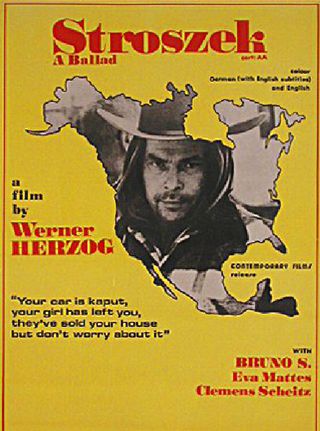
Saturday Matinee: Stroszek

Classic Film Review: Herzog’s take on Germany-and-America-in-the-70s — “Stroszek”

By Roger Moore

Source: Roger’s Movie Nation

Long before he became the German filmmaker whose somber, ironic narrations and bleakly beautiful and humanistic documentaries turned Werner Herzog into a pop culture icon, he was a cult figure among international cinema fans.

In his early years of fame, Herzog’s movies could be dark, naturalistic poetry, or ambitious, cast-and-crew-testing living nightmares. His alter ego in the latter films was the bug-eyed maniac Klaus Kinski (“Aguirre: The Wrath of God,” “Nosferatu the Vampire, “”Woyzeck,” Fitzcarraldo”). Herzog later made a documentary tribute to their difficult working relationship, “My Best Fiend.”

But his co-conspirator/muse for the strange, personal and very human character studies “The Enigma of Kaspar Hauser” and “Stroszek” was the eccentric, troubled forklift driver and self-taught street musician Bruno Schleinstein, known in Herzog’s films and to the film world as simply “Bruno S.”

“Stroszek” is a tone poem of a shattered life that comes to cling to one last broken dream. It’s a statement on the disconnect between 1977 Europe and America, particularly rural America, as seen through a delusional and alcoholic street musician with no visible means of support who moves from Berlin to BFE, Wisconsin in a country where “everybody gets rich” and The American Dream, at least as Cold War-weary Germans saw it, could come true.

It’s bleak and tragic, and funny in the darkest ways. It’s the sort of film that seemed very much of its time in its time, but that inspired generations of indie filmmakers to seek out the unheralded inhabitants of whatever underbelly of life was close at hand, and the sort of eccentrics who might be living in it.

Bruno is a theatrical goofball of inmate who loudly jokes through his entire paroling out of a Berlin jail. Some of his warders want to know, after all the time he’s served, if he’s been “dropped on the head?” The warden hectors him over his “beer” and goes on and on (in German with English subtitles) about how he should “never touch another drop” and “never set foot in a pub.”

Garrulous Bruno seems to agree, right up to the moment he rolls into his neighborhood watering hole on his way home.

A couple of brutish pimps are berating and knocking around Eva (Eva Mattes), whom Bruno sees as his “girl.” He doesn’t even try to defend her. But he invites her to live with him, with hopes of taking care of her. It’s just that his cluttered flat full of musical instruments which he’s taught himself to play, from the piano and accordion to the mellotron and glockenspiel, seems to defy that expecation.

And Eva’s lot gets worse when her pimps drag her out and back to work, and then bring her back, beating Bruno and humiliating him in front of her as they do. Their only way out may be accompanying their elderly neighbor (Clemens Scheitz) to stay with his nephew in Railroad Flats, Wisconsin.

So that’s what they do, losing Bruno’s mynah bird in U.S. customs, buying a used station wagon and trekking cross country to this place they can barely find on a map.

Clayton (Clayton Szalpinski) is a simple Air Force veteran running a garage in a one-stoplight town on the Northern Plains. He scrapes out a living, adds Bruno to his garage staff (Ely Rodriguez already works there) and shows them around a tiny, dead town where “murders” happen, where farmers feuding over a tiny parcel of land between their adjoining farms ride their tractors with a rifle in their spare hand.

But at least there’s a local truck stop where Eva can wait tables. As Bruno and Eva set up housekeeping, buying a new single-wide and a ruinously-expensive Sylvania TV, Eva is almost certain to have to resume her old career if they’re to make ends meet.

“Stroszek” is a leisurely, contemplative character study with music, as Herzog gives Bruno S. room to let us see into his soul through his musicianship, his fondness for playing and singing to no audience in big, echoey, empty courtyards and such. The Country Muzak of guitarist Chet Atkins’ instrumentals underscores many of the North American scenes.

One evokes memories of the Old World, where the buildings and people seem ancient and set on life’s path by their circumstances. Bruno S., playing a version of himself, is an orphan whose prostitute mother didn’t want him. Life in both worlds has its tests but the nature of the struggles are different, with the promise of America, a land of plenty undercut by the never-ending quest and need for money, which the “proletarian” Bruno starts to see as a “conspiracy.”

In its day, “Stroszek” was celebrated as a soulful bolt out of the blue in an American film landscape just turning itself over to the blockbuster. Lore grew up around the film and the seat-of-the-pants way Herzog filmed it (driving scenes with no camera truck/trailer) and scripted it, working around his screwy leading man’s moods, filming much of it Nekoosa and Plainfield, Wisconsin, with a conjured up tourist-trap-in-winter-finale filmed in Cherokee, N.C.

Viewed today, its whimsical charms stand out more than its tragic overtones. Even back then, critics and culture observers were pondering why American cinema made so little effort to find and celebrate the Brunos in our midst.

But documentary filmmakers Errol Morris and Les Blank, early disciples of Herzog and credited in “Stroszek,” are Americans who achieved their first fame for finding and lauding the quirkiness in the vast United States between the coasts.

And then the indie cinema of the ’80s and ’90s came along and amplified queer lives and rural despair, urban struggle and generational angst. By that time, their acknowledged or unacknowledged icon, the pioneering Herzog, had shifted more to the documentary side (“Grizzly Man,” “Cave of Forgotten Dreams”) and become an actor and personality far more famous than the movies that first made him.

But quaint as it sometimes seems now, “Stroszek” remains one of the touchstone films of an era whose very look on screen — grey and gritty and forboding — is as instantly identifiable as its often more sober-minded and cynical subject matter and the inimatable characters inhabiting it.


Watch Stroszek on Tubi here: https://tubitv.com/movies/268904/stroszek

Saturday Matinee: Lessons of Darkness

By Martin Purvis

Source: The Film Sufi

Werner Herzog’s documentary films lie at an extreme distance from the Anglo-American tradition of documentary filmmaking. Part of that distance can be linked to the distinction between two fundamental stances towards the depiction of reality: “Objectivism” and “Interactionism”, which I have discussed in other essays, for example, Avatar (2009), Close-Up (1990), and SiCKO (2007). American documentarians generally align themselves with Objectivism and hold that they are presenting an objective view of reality. An extreme form of this approach is “direct cinema”, which seeks to create the illusion that the filmmaker is an invisible “fly on the wall” and has no impact on the subjects being filmed, thereby supposedly ensuring scientific objectivity. But even in more conventional American documentaries with explicitly polemical content, there is a presumption that objective reality, independent of any observer, is being presented. Continental European documentary filmmakers, on the other hand, have had a tendency to lean towards Interactionism and have made more personal films in which the filmmaker and his or her point of view is a confessed part of the narrative. Herzog is so much on the Interactionist side of the ledger that his documentary films not only include his personal perspective, but seem primarily to be his own personal essays about the world – he, himself, is an implicit focus of the film, and the “reality” depicted is self-consciously Herzog’s own reality. Lessons of Darkness (Lektionen in Finsternis, 1992), which was shot in Kuwait in the immediate aftermath of the First Gulf War (1990-91) is one such example of Herzog’s style.

Although focussed on the harrowing events and ravages that happened in Iraq and Kuwait during that time, Lessons of Darkness has clear-cut affinities with Herzog’s first documentary Fata Morgana (1971), which was shot in Africa. In that earlier film Herzog edited footage that he had (seemingly randomly) shot in the African Sahel and tried to fashion a dark vision about man’s hopeless ineffectiveness, and consequently likely impermanent existence, on the planet – an ephemeral existence like a mirage. Some twenty years later, with Lessons of Darkness, Herzog again collected footage, this time in Kuwait, and then assembled his photographic essay in post-production, and again his vision is one of dark apocalypse and pessimism concerning man’s prospects for a sustainable future. In fact both Fata Morgana and Lessons of Darkness contain vague commentary that suggests that humankind on Earth is being clinically observed, with amazement and horror, by a visitor from another planet. However, in neither film is there any real narrative or sequence of events that could amount to a story – they are both more or less personal essays of despair. But if we assert that they are both cinematic commentaries, we have also to concede that neither of these two films provides an explicit disquisition or argument, or even has a clearly articulated thesis. What we are really presented with is just a suggestive sequence of images, on which the viewer reflectively fills in many of the blanks and faces a greater-than-usual task of constructing his or her own story or vision. This process of placing much of the narrative burden on the viewer essentially fails with Fata Morgana (which was almost a random collection of lurid images of garish and pathetic human folly), but is more successful with Lessons of Darkness, primarily because the viewer in this case is more likely to bring to the film considerable familiarity with what happened during the “First Gulf War”and use that material for his own imaginative reconstructions.

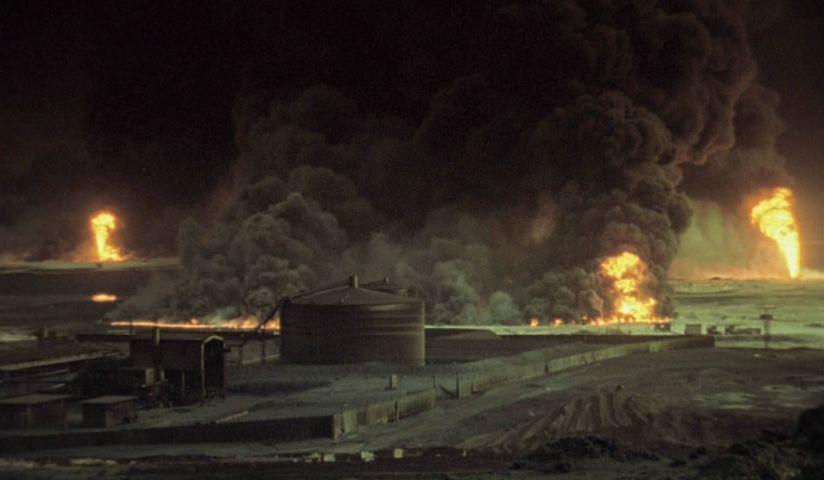
The greater part of Lessons of Darkness consists of lurid scenes of fires in the Kuwaiti oilfields burning out of control and spewing gargantuan clouds of smoke. These images are interspersed with images of devastation, both at the physical and human level, and with human firefighters seemingly overmatched in their efforts to quell the multiple, raging infernos. The images are apparently meant to be abstractly horrific, and there is almost no spoken dialogue and no explicit reference to the Gulf War, or to specific places, or to any historical context. To set some kind of context, Lessons of Darkness opens with images of wasteland and destruction, and the prologue refers to a planet “in our solar system” which evidently has undergone a catastrophic war. So the viewer sees things simultaneously with respect to two overarching narrative perspectives: the real Gulf War and an abstract metaphorical fable of how bizarre humankind’s self-destructive impulses might be to a detached, external observer. The film is then presented partitioned into thirteen chapters, each identified by apocalyptic, perhaps oracular, intertitles which suggest chapters to some sort of apocryphal Book of Revelations.

  1. “A Capital City”. This section features an opening voiceover narration with images of Kuwait City filmed from a low-flying helicopter, ominously suggesting that this doomed city will soon be utterly destroyed by warfare (it wasn’t, and this footage was filmed after the conflict).
  2. “The War”. Here is shown footage of the aerial bombing of Iraq as seen via night-vision video cameras. Although this section is relatively short and no mention of “Operation of Desert Storm” is made, the context is likely to be familiar to a worldwide audience, since it was widely viewed on CNN.
  3. “After the Battle”. Images of war devastation are presented.
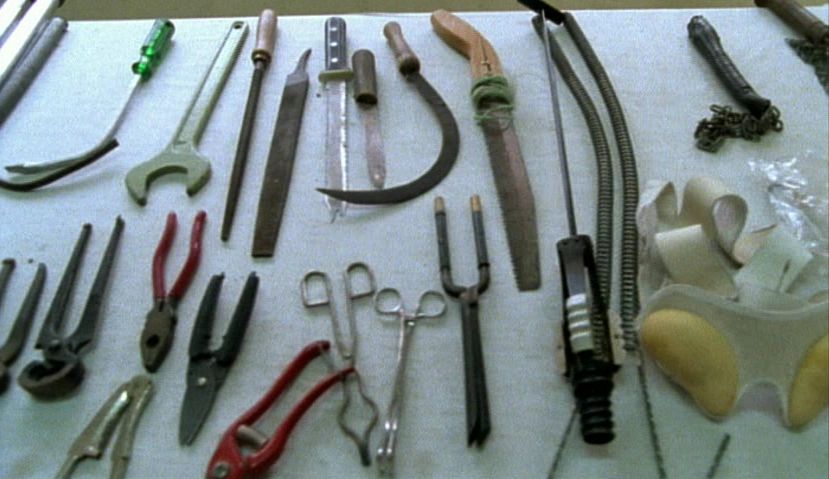
  4. “Torture Chambers”. This thankfully brief section is one of the most memorable, though difficult to bear, sections in the film. First is shown what is apparently the insides of one of the torture chambers run by Saddam Hussein’s government, and it features a mute display of mechanical devices designed to inflict unbearable pain. Then an Arab woman is shown who was been rendered almost permanently speechless by having been forced by the authorities to witness her own sons being tortured to death.
  5. “Satan’s National Park”. Helicopter footage of what seems to be a vast marshland are revealed to be in fact entirely flooded with oil.
  6. “Childhood”. Another Arab mother is shown, this time with a young, disturbed boy who has been rendered speechless by what he has witnessed during the conflict. As with the woman shown earlier, the horror of what happened is not shown, it is only something so unspeakable that one cannot bear to think about it. The viewer’s imagination then fills in the blanks.
  7. “And A Smoke Arose Like The Smoke From A Furnace”. Here, 23 minutes into the film, the raging fires take over the screen. Again, they are filmed from low-flying helicopters.
  8. “A Pilgrimage”. Now the (American) firefighters are shown, sometimes relatively up close and at other times at a distance and dwarfed by the towering flames of the fires that burn endlessly. This section shows the firefighters using explosives to try to put out the fire.
  9. “A Dinosaur’s Feast”. This is more or less a continuation of the previous section showing the firefighters, but now emphasizing some of the huge construction and excavation machines employed in their work. The machinery has monster-like appearances, with arching cranes, serpentine bodies, and huge digging claws.
  10. “Protuberances” – a brief section showing closeups of oil–and-mud swamps bubbling and frothing, and evoking more nightmarish images of Hell.
  11. “The Drying Up of the Wells”. The oil-covered firefighters are shown, often in slow-motion, intensely engaged in the mechanics of their operations. The functional nature of these activities is incomprehensible to the typical viewer, and it all appears perhaps as an abstract Ballet Mécanique from the dark side. The macabre strangeness of it all, and the degree to which these operations seem to be foreign to what we might call normal human intercourse, are worth comparing to Louis Malle’s documentary, Humain, Trop Humain (1974).
  12. “Life Without Fire”. With many of the fires now apparently having been extinguished, the voiceover commentary of the interplanetary visitor expresses wonder as these strange creatures to him (i.e. the firefighters) engage in the baffling act of relighting an extinguished geyser of oil. He comments: “Has life without fire become unbearable for them? . . . . . Others, seized by madness, follow suit. . . . . Now they are content, now there’s something to extinguish again.”
  13. “I am So Weary of Sighing, O Lord, Grant That the Night Cometh”. The final portion returns to the fires, themselves, carrying with it an air of resignation and gloom.

Herzog’s fascination with fire extends to a fascination with its opposite, darkness (hence the title). The demonic forces that lurk inside the hearts of men seem to be beyond civilized understanding or rational control. These issues of cruelty and madness are as elemental as fire, itself, and are not confined to the Middle East [1]. This apparently was Herzog’s project: not to focus on just the particular horror of what happened in one part of the globe, but to fashion a fiction that would portray a more universal damnation. To this end, he opens the film with his own fabricated quotation (“The collapse of the stellar universe will occur, like creation, in grandiose splendor”) which he probably attributes to Blaise Pascal in order to give it the appropriate resonance – Pascal is perhaps not so well-known to English-speaking audiences, but his genius occupies a peculiarly iconic place in the European mind.

The horror that Herzog attempts to convey by his images of man-made Hell is enhanced by its unspeakable nature – it is beyond human articulation. Instead of a deafening roar from the fires drowning out occasional shouts from the firefighters, much of the stoundtrack is filled with funereal, dirge-like orchestral music from Mahler, Prokofieff, Verdi, Wagner, and Arvo Part. The unspeakable nature of this horror is explicitly referenced by the two mothers: one mother is unable to speak comprehensibly, and the child of the other mother has been rendered speechless by rational choice. It is left to our imaginations to fill out these nightmares.

Notes:

  1. For example, consider the use of germ warfare by the Japanese during the Second Sino-Japanese War (1937-45). Here is a quotation from an article on the subject (Judith Miller, “When Germ Warfare Happened”City Journal, (Spring 2010)):

“The methods were brutal. Army trucks dumped gallons of deadly germs alongside roads and railway lines linking Chinese towns so that infections would spread from town to town; planes dropped porcelain bombs containing infected fleas on dozens of villages, causing devastating outbreaks of bubonic plague. The Japanese laced more than 1,000 wells in the area of Harbin with typhoid bacilli. They also inserted typhus into bottles of lemonade that children loved to drink in the summer, Harris reported. In Nanking, they distributed anthrax-filled chocolate and cake to hungry children. The Japanese discovered that packing fountain pens and walking sticks with deadly germs was a particularly effective way of secretly disseminating them. In 1940, Major General Ishii sent a train carrying 70 kilograms of typhus bacterium, 50 kilograms of cholera germs, and 5 kilograms of plague-infected fleas to the city of Hangzhou, a holiday resort favored by Shanghai’s wealthy. From there, the germs were dumped into ponds and reservoirs and spread by aerial spraying, contaminating all life in fields of wheat and millet during the harvest.”

Saturday Matinee: Lo and Behold

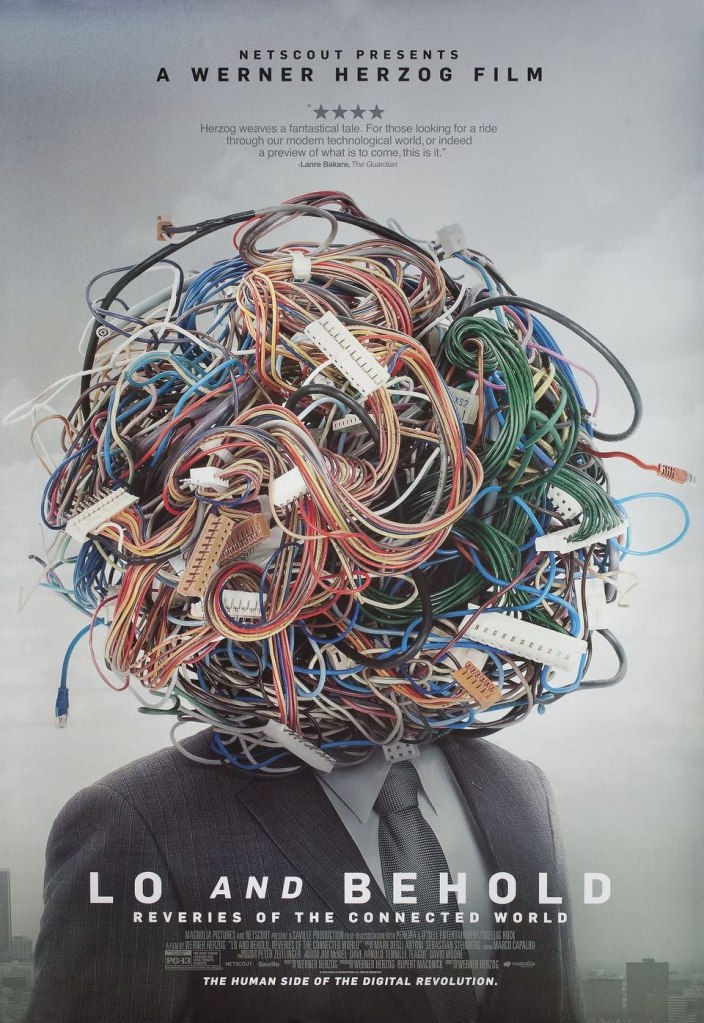
Lo and Behold, Reveries of the Connected World

A bold and multidimensional documentary about the glories and the drawbacks of the Internet.

By Frederic and Mary Ann Brussat

Source: Spirituality & Practice

Werner Herzog is an inimitable documentary filmmaker whose curiosity, wonder and awe for the mysteries and eccentricities of our world is unbounded. One of the hallmarks of his work is his unmistakable voice-overs (with a distinctive German accent) which serve as the narrative threads holding the materials together. Here are five of his most recent documentaries which illustrate the diversity of themes that interest him:

  • Cave of Forgotten Dreams: A 3-D tour of the Chauvet Cave which houses art that is 30,000 years old.
  • Encounters at the End of the World: A visually stunning documentary about the scientists, dreamers, adventurers, philosophers, and creatures of Antarctica.
  • Grizzly Man: A mesmerizing documentary about a young man obsessed with grizzly bears in the Alaskan wilderness.
  • Into the Abyss: A daring examination of capital punishment filled with small and humble human touches.
  • Wheel of Time: An exotic look at a Buddhist ritual held in Bodh Gay, India, and Graz, Austria in 2002 that attracted thousands of pilgrims.

In Lo and Behold, Reveries of the Connected World, Herzog tackles the complex, controversial, and mysterious Internet. He refers to this technological tool as “one of the greatest revolutions” in human history. This bold and multidimensional film is divided into 10 chapters:

  • The Early Days
  • The Glory of the Net
  • The Dark Side
  • Life without the Net
  • The End of the Net
  • Earthly Invaders
  • Internet on Mars
  • Artificial Intelligence
  • The Internet of Me
  • The Future

Here you will discover a breadth of material that ranges from the very serious to the extremely quirky and odd. Herzog begins with a terse history of the Internet’s beginnings at U.C.L.A. during the 1960s. Leonard Kleinrock, a professor of computer science, takes us into the “holy room” where the first Internet computer remains. He recalls his feelings when a message was transmitted from this computer to the Stanford Research Institute on October 29, 1969. Programmers were on the phone confirming that the login was happening. Stanford replied that they had received the “L” and the “o.” Then its computer crashed. So the first Internet message was “Lo.” This documentary chronicles what happened beyond that.

Danny Hillis, another scientist, reminisces about a time when all the users of this technology could be identified in one directory. Now, he states, the global directory would be 72 miles thick. Another statistic which stands out is: “Today, about 3.2 billion people use the internet around the world.” Herzog chimes in that CDs containing a single day’s worth of global data would stretch “to Mars and back.”

Here are some observations made in interviews with computer and robot specialists, hackers, technicians, programmers, gamers, and professors.

  • Elon Musk, the entrepreneur behind Telsa, is now interested in colonizing Mars; he also reflects on cyberwarfare or other earth catastrophes.
  • Kevin Mitnick, a legendary hacker, reveals the mayhem and the mischief that can take place by those who can get into large computer systems; cyberwarfare now puts smaller states on the same level as larger ones.
  • Joydeep Biswas, an engineer who has put together a robotic soccer team, shows how they work together and even reveals his favorite robot player.
  • Sebastian Thrun, an online-learning pioneer, notes that self-driving cars can all learn from the collective experiences of other cars and their mistakes, unlike human drivers.

Also included is an account of abusive cyber behavior ending with a mother calling the Internet “a work of the Devil” after pictures of her dead child were widely circulated online. Herzog talks with several persons who are sensitive to electromagnetic waves and get radiation sickness; they now live in an isolated area totally off the grid. A segment on video-game addicts reveals that many of them have completely stopped being present to the real world; some have developed blood clots in their legs after sitting so long at their computers. Astronomers explain that a large solar flare, which has not happened in many years, could disrupt Internet communication worldwide, affecting all the food supply, water and other systems supporting modern life.

In a telling scene, we see a group of Buddhist monks standing in front of a city skyline and the question is posed, “Have the monks stopped meditating?” We see that they are not bowing their heads in prayer or meditation. All of them are totally focused on their cell phones. Herzog quotes a startling statistic: There will be 31 billion devices connected to the Internet by 2020.

A famous New Yorker cartoon by Peter Steiner shows two dogs by a computer. The caption reads: “On the Internet, nobody knows you’re a dog.” It’s good for a laugh, and it’s also a reminder that Internet technology is raising many spiritual questions. Who are you? Where do you really live? And who are your companions? Don’t miss this thought-provoking documentary!

Saturday Matinee: Bad Lieutenant: Port of Call New Orleans

Review: Bad Lieutenant: Port of Call New Orleans

By Jessica Winter

Source: Film Comment

When is the audience allowed to laugh at a serious movie? How do you gauge whether the laughter expresses surprise, shock, nervousness, disdain, feigned superiority, genuine mirth, or some combination thereof? Take Werner Herzog’s films with his best fiend, Klaus Kinski: at a New York repertory screening of the deranged-conquistador saga Aguirre, Wrath of God a few years back, the patrons might as well have been watching The Hangover. Were they wrong? Or how about Abel Ferrara’s 1992 hell trip Bad Lieutenant: is it wildly inappropriate to laugh when Harvey Keitel’s depraved cop screams “You ratfucker!” at a church lady he mistakes for Jesus Christ? Is it wildly inappropriate not to laugh?

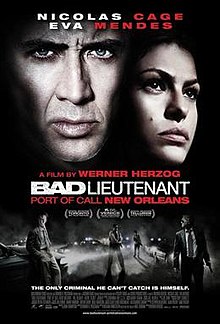
Herzog’s not-a-remake, Bad Lieutenant: Port of Call New Orleans, tacitly addresses this dilemma. Like much of the Herzog-Kinski catalogue, it’s a case study in bug-eyed monomania, and like Ferrara’s original, it’s a descent into the swamplands of the human soul with a drug-addled, quasi-righteous, borderline-insane cop as your tour guide. Unlike either, the reboot appears to be a comedy, or something close to it. BL:POCNO has comedy props: singing iguanas, a “magic crack pipe,” Val Kilmer. It has comic refrains that become funnier with each iteration, including Nicolas Cage’s emphysematic laugh and—for reasons that are tough to explain concisely—the letter “G.” It has punch lines. (“Everything I take is prescription. Except for the heroin.”) It has, for lack of a better term, a Gator Cam. Best of all, it has Cage, a walking sight gag who throws out his back early and spends the rest of the film bathed in a cold sweat of cocaine and Vicodin, lumbering around the post-Katrina landscape like he’s got a jumbo-sized T-square surgically jammed between his shoulder blades.

Cage’s Terence McDonagh comes off as part Kinski-style holy fool, part standard-issue Rogue Cop Who Gets Results. He shuttles crookedly between his adorable coke-whore sweetheart (Eva Mendes), his alcoholic father (Tom Bower), Dad’s beery girlfriend (Jennifer Coolidge, impressively frowsy), and his 24-7 mission pursuing local crack kingpin Big Fate (Alvin “Xzibit” Joiner), who’s possibly the most affable and credulous drug lord in cinema history. (This ambitious lad is happy to show new friend McDonagh the would-be flagship of a future real-estate empire: “waterfront condos” sited on some godforsaken loading dock, where Big Fate’s henchmen currently dump the bodies of their victims.)

But BL:POCNO’s shaggy police procedural (the screenwriter is NYPD Blue and Law & Order alumnus William Finkelstein) is almost an afterthought, always secondary to the Passion of the Cage: stations include a pharmacy meltdown worthy of Julianne Moore in Magnolia, a scary-funny parking-lot shakedown of two club kids out on Daddy’s credit cards, and above all, a feat of witness intimidation involving an electric shaver and a nice old lady’s nasal cannula. Pawing absently at his face, sniffing at bags of evidence (usually pocketing them for later), and huffing crack with anyone who’s holding, McDonagh is a mass of primitive, unexamined desires. In the grip of both addiction and workaholism, he has an appetite but not a will, a brain but not a mind. He is, perhaps, reptile brain incarnate—hence those singing iguanas and surveillance-camera-eyed alligators, not to mention the lone little fish swimming sad circles in a glass in a dead boy’s room.

The Herzog version almost entirely eschews the religious iconography of BL 1.0, but McDonagh does occasionally experience the kind of ecstatic self-forgetting that saints and drug addicts have in common. The dopey bliss that washes over Cage’s face when he glimpses a break-dancing ghost or regales his starry-eyed girlfriend with childhood tales of “buried treasure” is the happiest gift this erratic actor has given us in a long time. Shot in New Orleans largely for the tax break, labeled Bad Lieutenant largely because the producers had rights to the brand name, and starring an actor who, not to put too fine a point on it, makes a lot of crap, Herzog’s movie has expedience and exploitation written all over it. But it’s too weird and unhinged and endearing—and, for all its sordid details, too ingenuous—to be anything but a labor of love.


Watch the film on Hoopla here: https://www.hoopladigital.com/title/12197641