
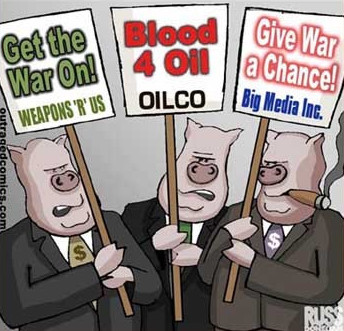
War Profiteers and the Demise of the US Military-Industrial Complex

By Dmitry Orlov

Source: Club Orlov

Within the vast bureaucratic sprawl of the Pentagon there is a group in charge of monitoring the general state of the military-industrial complex and its continued ability to fulfill the requirements of the national defense strategy. Office for acquisition and sustainment and office for industrial policy spends some $100,000 a year producing an Annual Report to Congress. It is available to the general public. It is even available to the general public in Russia, and Russian experts had a really good time poring over it.

In fact, it filled them with optimism. You see, Russia wants peace but the US seems to want war and keeps making threatening gestures against a longish list of countries that refuse to do its bidding or simply don’t share its “universal values.” But now it turns out that threats (and the increasingly toothless economic sanctions) are pretty much all that the US is still capable of dishing out—this in spite of absolutely astronomical levels of defense spending. Let’s see what the US military-industrial complex looks like through a Russian lens.

It is important to note that the report’s authors were not aiming to force legislators to finance some specific project. This makes it more valuable than numerous other sources, whose authors’ main objective was to belly up to the federal feeding trough, and which therefore tend to be light on facts and heavy on hype. No doubt, politics still played a part in how various details are portrayed, but there seems to be a limit to the number of problems its authors can airbrush out of the picture and still do a reasonable job in analyzing the situation and in formulating their recommendations.

What knocked Russian analysis over with a feather is the fact that these INDPOL experts (who, like the rest of the US DOD, love acronyms) evaluate the US military-industrial complex from a… market-based perspective! You see, the Russian military-industrial complex is fully owned by the Russian government and works exclusively in its interests; anything else would be considered treason. But the US military-industrial complex is evaluated based on its… profitability! According to INDPOL, it must not only produce products for the military but also acquire market share in the global weapons trade and, perhaps most importantly, maximize profitability for private investors. By this standard, it is doing well: for 2017 the gross margin (EBITDA) for US defense contractors ranged from 15 to 17%, and some subcontractors—Transdigm, for example—managed to deliver no less than 42-45%. “Ah!” cry the Russian experts, “We’ve found the problem! The Americans have legalized war profiteering!” (This, by the way, is but one of many instances of something called systemic corruption, which is rife in the US.)

It would be one thing if each defense contractor simply took its cut off the top, but instead there is an entire food chain of defense contractors, all of which are legally required, no less, to maximize profits for their shareholders. More than 28,000 companies are involved, but the actual first-tier defense contractors with which the Pentagon places 2/3 of all defense contracts are just the Big Six: Lockheed Martin, Northrop Grumman, Raytheon, General Dynmics, BAE Systems and Boeing. All the other companies are organized into a pyramid of subcontractors with five levels of hierarchy, and at each level they do their best to milk the tier above them.

The insistence on market-based methods and the requirement of maximizing profitability turns out to be incompatible with defense spending on a very basic level: defense spending is intermittent and cyclical, with long fallow intervals between major orders. This has forced even the Big Six to make cuts to their defense-directed departments in favor of expanding civilian production. Also, in spite of the huge size of the US defense budget, it is of finite size (there being just one planet to blow up), as is the global weapons market. Since, in a market economy, every company faces the choice of grow or get bought out, this has precipitated scores of mergers and acquisitions, resulting in a highly consolidated marketplace with a few major players in each space.

As a result, in most spaces, of which the report’s authors discuss 17, including the Navy, land forces, air force, electronics, nuclear weapons, space technology and so on, at least a third of the time the Pentagon has a choice of exactly one contractor for any given contract, causing quality and timeliness to suffer and driving up prices.

In a number of cases, in spite of its industrial and financial might, the Pentagon has encountered insoluble problems. Specifically, it turns out that the US has only one shipyard left that is capable of building nuclear aircraft carriers (at all, that is; the USS Gerald Ford is not exactly a success). That is Northrop Grumman Newport News Shipbuilding in Newport, Virginia. In theory, it could work on three ships in parallel, but two of the slips are permanently occupied by existing aircraft carriers that require maintenance. This is not a unique case: the number of shipyards capable of building nuclear submarines, destroyers and other types of vessels is also exactly one. Thus, in case of a protracted conflict with a serious adversary in which a significant portion of the US Navy has been sunk, ships will be impossible to replace within any reasonable amount of time.

The situation is somewhat better with regard to aircraft manufacturing. The plants that exist can produce 40 planes a month and could produce 130 a month if pressed. On the other hand, the situation with tanks and artillery is absolutely dismal. According to this report, the US has completely lost the competency for building the new generation of tanks. It is no longer even a question of missing plant and equipment; in the US, a second generation of engineers who have never designed a tank is currently going into retirement. Their replacements have no one to learn from and only know about modern tanks from movies and video games. As far as artillery, there is just one remaining production line in the US that can produce barrels larger than 40mm; it is fully booked up and would be unable to ramp up production in case of war. The contractor is unwilling to expand production without the Pentagon guaranteeing at least 45% utilization, since that would be unprofitable.

The situation is similar for the entire list of areas; it is better for dual-use technologies that can be sourced from civilian companies and significantly worse for highly specialized ones. Unit cost for every type of military equipment goes up year after year while the volumes being acquired continuously trend lower—sometimes all the way to zero. Over the past 15 years the US hasn’t acquired a single new tank. They keep modernizing the old ones, but at a rate that’s no higher than 100 a year.

Because of all these tendencies and trends, the defense industry continues to lose not only qualified personnel but also the very ability to perform the work. INDPOL experts estimate that the deficit in machine tools has reached 27%. Over the past quarter-century the US has stopped manufacturing a wide variety of manufacturing equipment. Only half of these tools can be imported from allies or friendly nations; for the rest, there is just one source: China. They analyzed the supply chains for 600 of the most important types of weapons and found that a third of them have breaks in them while another third have completely broken down. In the Pentagon’s five-tier subcontractor pyramid, component manufacturers are almost always relegated to the bottommost tier, and the notices they issue when they terminate production or shut down completely tend to drown in the Pentagon’s bureaucratic swamp.

The end result of all this is that theoretically the Pentagon is still capable of doing small production runs of weapons to compensate for ongoing losses in localized, low-intensity conflicts during a general time of peace, but even today this is at the extreme end of its capabilities. In case of a serious conflict with any well-armed nation, all it will be able to rely on is the existing stockpile of ordnance and spare parts, which will be quickly depleted.

A similar situation prevails in the area of rare earth elements and other materials for producing electronics. At the moment, the accumulated stockpile of these supplies needed for producing missiles and space technology—most importantly, satellites—is sufficient for five years at the current rate of use.

The report specifically calls out the dire situation in the area of strategic nuclear weapons. Almost all the technology for communications, targeting, trajectory calculations and arming of the ICBM warheads was developed in the 1960s and 70s. To this day, data is loaded from 5-inch floppy diskettes, which were last mass-produced 15 years ago. There are no replacements for them and the people who designed them are busy pushing up daisies. The choice is between buying tiny production runs of all the consumables at an extravagant expense and developing from scratch the entire land-based strategic triad component at the cost of three annual Pentagon budgets.

There are lots of specific problems in each area described in the report, but the main one is loss of competence among technical and engineering staff caused by a low level of orders for replacements or for new product development. The situation is such that promising new theoretical developments coming out of research centers such as DARPA cannot be realized given the present set of technical competencies. For a number of key specializations there are fewer than three dozen trained, experienced specialists.

This situation is expected to continue to deteriorate, with the number of personnel employed in the defense sector declining 11-16% over the next decade, mainly due to a shortage of young candidates qualified to replace those who are retiring. A specific example: development work on the F-35 is nearing completion and there won’t be a need to develop a new jet fighter until 2035-2040; in the meantime, the personnel who were involved in its development will be idled and their level of competence will deteriorate.

Although at the moment the US still leads the world in defense spending ($610 billion of $1.7 trillion in 2017, which is roughly 36% of all the military spending on the planet) the US economy is no longer able to support the entire technology pyramid even in a time of relative peace and prosperity. On paper the US still looks like a leader in military technology, but the foundations of its military supremacy have eroded. Results of this are plainly visible:

• The US threatened North Korea with military action but was then forced to back off because it has no ability to fight a war against it.

• The US threatened Iran with military action but was then forced to back off because it has no ability to fight a war against it.

• The US lost the war in Afghanistan to the Taliban, and once the longest military conflict in US history is finally over the political situation there will return to status quo ante with the Taliban in charge and Islamic terrorist training camps back in operation.

• US proxies (Saudi Arabia, mostly) fighting in Yemen have produced a humanitarian disaster but have been unable to prevail militarily.

• US actions in Syria have led to a consolidation of power and territory by the Syrian government and newly dominant regional position for Russia, Iran and Turkey.

• The second-largest NATO power Turkey has purchased Russian S-400 air defense systems. The US alternative is the Patriot system, which is twice as expensive and doesn’t really work.

All of this points to the fact that the US is no longer much a military power at all. This is good news for at least the following four reasons.

First, the US is by far the most belligerent country on Earth, having invaded scores of nations and continuing to occupy many of them. The fact that it can’t fight any more means that opportunities for peace are bound to increase.

Second, once the news sinks in that the Pentagon is nothing more than a flush toilet for public funds its funding will be cut off and the population of the US might see the money that is currently fattening up war profiteers being spent on some roads and bridges, although it’s looking far more likely that it will all go into paying interest expense on federal debt (while supplies last).

Third, US politicians will lose the ability to keep the populace in a state of permanent anxiety about “national security.” In fact, the US has “natural security”—two oceans—and doesn’t need much national defense at all (provided it keeps to itself and doesn’t try to make trouble for others). The Canadians aren’t going to invade, and while the southern border does need some guarding, that can be taken care of at the state/county level by some good ol’ boys using weapons and ammo they already happen to have on hand. Once this $1.7 trillion “national defense” monkey is off their backs, ordinary American citizens will be able to work less, play more and feel less aggressive, anxious, depressed and paranoid.

Last but not least, it will be wonderful to see the war profiteers reduced to scraping under sofa cushions for loose change. All that the US military has been able to produce for a long time now is misery, the technical term for which is “humanitarian disaster.” Look at the aftermath of US military involvement in Serbia/Kosovo, Afghanistan, Iraq, Libya, Syria and Yemen, and what do you see? You see misery—both for the locals and for US citizens who lost their family members, had their limbs blown off, or are now suffering from PTSD or brain injury. It would be only fair if that misery were to circle back to those who had profited from it.

The Struggle for Peace in Afghanistan: Is Community Engagement the Key?

By Robert J. Burrowes

I have just read a superb book by Mark Isaacs, an Australian who has documented several years of effort by a group of incredibly committed young people in Afghanistan to build peace in that war-torn country the only way it can be built: by learning, living and sharing peace.

The book, titled The Kabul Peace House: How a Group of Young Afghans are Daring to Dream in a Land of War, records in considerable detail the struggle, both internal and external, to generate a peaceful future in Afghanistan. Some might consider this vision naive, others courageous, but few would doubt the simple reality: it is slow, daunting, incredibly difficult, often saddening, frightening, infuriating or painful, sometimes uplifting or hilarious and, just occasionally, utterly rewarding.

This is a human story written by a person who knows how to listen and to observe. And because the subject is about a group of ordinary Afghans and their mentor doing their best in the struggle to end one of the longest wars in human history, it is a story that is well worth reading.

This story is embedded in a combination of (brief) historical background on Afghanistan’s longstanding and central role in imperial geopolitics (including during ‘The Great Game’ of the 19th century) and more recent history on the progressive modernity of Afghanistan prior to the Soviet invasion in 1979 which was followed by an ongoing and multifaceted war in which the United States has played the most damaging role since its invasion of the country in 2001. But the background also includes a description of the ethnic diversity throughout the country, the role of religion and gender relations (and the challenges these social parameters present), as well as commentary on the social, economic and political regression as a result of the war’s many adverse impacts. So the book weaves a lot of strands into a compelling story of nonviolent resistance and regeneration against almost overwhelming odds.

However, that is not all. Given that all of the Afghans in this visionary community have each been traumatized by their unique experience of war, the book doesn’t shy away from describing the challenges this presents both to them personally and to the community, including its mentor and even some of the community’s many international visitors.

Most of the community members – whether Pashtun, Hazara, Uzbek, Turkmen, Tajik, Sayyid, Pashai… – have suffered serious loss during the war, especially those members who have had family and other relatives killed, or worse. Worse? you might ask. What is worse than death? Well, after reading this book, you will better understand that the context and the manner of death mean a great deal psychologically. None of the victims of this war died peacefully in their sleep after long and meaningful lives and this is just one part of the psychological trauma suffered by so many in this particular community but also in wider Afghan society.

So what does this community in Kabul do? Well, throughout its evolution and many manifestations, the community has done many things including run a variety of projects intended to foster understanding, cooperation and learning: nurture mutual respect among the diversity of people that constitute its membership, teach some of its members to read and write and facilitate learning opportunities in other contexts, teach the meaning and practice of nonviolence, give street kids the chance to learn skills that will make them employable, make duvets to give to people who go cold in Afghanistan’s freezing winters, teach and practice permaculture, organize protests against the war (including by flying kites instead of drones), and generally working to create a world that is green, equal and nonviolent.

If you think this sounds all good and straightforward, given slowly spreading acceptance of such ideas elsewhere (in some circles at least), then you might have underestimated their radical nature in a society in which ideas about nonviolence, equality and sustainability have, for the most part, not been previously encountered and have certainly not taken root. Isaacs records the observations of the group’s mentor on these subjects: ‘Over the years I have seen how the volunteers have changed within their personal lives, even if it means distancing themselves from the traditions of their own family…. But on a public level it’s much slower.’

This is understandable. As Isaacs notes, even in ordinary conversation and group discussions, ‘the weight of resistance, the taboos and the self-censorship’ made an impact on him. In a culture in which, in 2015, a woman in her twenties was stoned, her body run over by a car and then dumped in a river and set on fire because a mullah falsely accused her of burning the Quran, there is a long way to go.

One of the things that I found most compelling about the book is the occasional ‘biography’ of one of the community’s main characters. Given pseudonyms to avoid possible adverse repercussions, these stories provide real insight into the lives of certain community members and their struggle to leave home (in some cases), to join the community, to find their place within it and gain acceptance by the other members.

Some, like Hojar, are more outspoken and this, for a woman, is unusual in itself. Hojar is deeply aware of the gender inequality and violence against women in Afghanistan and will talk about it. This inspires other women, like Tara, who have not experienced this outspokenness before.

But Hojar’s life had started differently, in the mountains where, as a teenager, she was getting up at 3am to start baking bread for her four snoring brothers before milking the goats and sheep. ‘I am not a woman’, she thought, ‘I am a slave’. Fortunately and unusually, Hojar’s parents supported her desire to not marry at 13 or 15, but to continue her education and follow her dreams. It’s a long, painful, terrifying and fascinating journey but Hojar ended up in this novel community experiment in Kabul where her now college-educated talent was highly valued and put to wonderful use. She has my utmost admiration.

Unlike Hojar, other community members, like Horse, originally a shepherd in the mountains, are more circumspect on gender equality and other issues. But this doesn’t mean that Horse is not active, at times playing roles in the networking team, the accounts team and, particularly, as coordinator of the food cooperative which provided monthly gifts of food to the impoverished families of one hundred children who studied at the community’s street kids school. If you think raising donations to pay for this food was easy, particularly given the community decision to avoid the international aid sector to try to encourage Afghans to help their fellow Afghans, when more than half of the population lived below the poverty line and unemployment was at 40%, you will find it compelling to read how the teenaged Horse struggled with the monumental range of challenges he faced in that particular role. He has my admiration too.

Insaan, a doctor who mentors the community, provides a compelling story as well. Originally from another country, in 2002 a consultation with a patient at his successful medical practice inspired him to depart some time later. After spending more than two years in Pakistan, working with refugees from Afghanistan, he went to Afghanistan in 2004 to work for an international NGO in public health education in its central mountainous region.

His ongoing experience in this role, however, taught him that every problem the villagers faced had its origins in the war. And this underpinned his gradual transformation from health professional to peace activist. He discovered Thoreau, Gandhi and King, among others, and ‘became convinced of the power of love’. By 2008, Insaan had initiated his first multi-ethnic live-in community (although he did not live in it himself) in the mountains but in 2011, when his house was deliberately burned down, he departed for Kabul determined to restart the peace work he had begun in the mountains.

Starting with three young people who accompanied him from the mountains, the first manifestation of a live-in peace community in Kabul was soon underway. Endlessly paying attention, trying to provide guidance, reconcile those in conflict, and even withstanding threats of violence, Insaan’s love has undoubtedly been the glue that has held the growing and evolving community together. But not without cost. At times, Insaan has struggled, emotionally and otherwise, to survive in this perpetual war zone as the key figure holding this loving experiment together. He is a truly remarkable human being.

And it is because of the trauma that he and each of the other community members has suffered, that I hope that, in future, they can somehow dedicate time to their own personal, emotional healing. See ‘Putting Feelings First’ and ‘Nisteling: The Art of Deep Listening’. There is no better investment for any human being than to spend time consciously focusing on feeling the fear, pain, anger and sadness that we are taught and terrorized into suppressing during childhood (so that we become the obedient slaves that our society wants). Given the extraordinary violence that the people of Afghanistan have suffered and are still suffering, the value of making this investment would be even greater.

Anyway, if you want to read an account of the deeply personal human costs of war, and what one community is doing about it, read this book. It isn’t all pretty but, somehow, this remarkable community, through all of its manifestations over many years, its successes and failures, manages to inspire one with the sense that while those insane humans who spend their time planning, justifying, fighting and profiting from wars against people in other countries, those people on the receiving end of their violence are capable of visioning a better tomorrow and working to achieve it. No matter how difficult or how long it takes. Moreover, we can help too. See Nonviolent Campaign Strategy.

So allow yourself to be inspired by a group of young people, each of whom has lived their entire life in a country at war both with itself and with foreign countries, but has refused to submit to the predominant delusion that violence is the way out.


Biodata: Robert J. Burrowes has a lifetime commitment to understanding and ending human violence. He has done extensive research since 1966 in an effort to understand why human beings are violent and has been a nonviolent activist since 1981. He is the author of Why Violence? His email address is flametree@riseup.net and his website is here.

EMPIRES ARE A SECRET UNTIL THEY START FALLING

By Margaret Flowers and Kevin Zeese

Source: Popular Resistance

In the past, we have written about the 2020s as a decade when the United States Empire will end. This is based on Alfred McCoy’s predictions (listen to our interview with him on Clearing the FOG). Sociologist and peace scholar John Galtung believes US Empire will fall much faster, losing world dominance by 2020. Much of what he predicted when he said this in 2016 is happening now. In particular, there is a rise in “reactionary fascism” or a desire to go back to the “good old days,” the cost of maintaining the empire is taking an increasing economic toll and other countries are starting to rebuke the US, both its requests for military assistance and its unfair economic demands.

What this means for people in the United States and around the world depends on whether we can build a mass popular movement with the clarity of vision, skills, and solidarity necessary to navigate what is and will surely be a turbulent period. There are no guarantees as to the outcome. Failure to act could result in a disastrous scenario – at best, that the US will continue to try to hold onto power by waging economic and military warfare abroad weakening the economy at home and undermining necessities such as housing, healthcare, education and the transition to a Green economy. At worst, as Galtung describes, there could be “an inevitable and final war” involving nuclear weapons.

When Empire Is In Decline

Alfred McCoy says that it is only when empires are in decline that people begin to recognize they live in an empire and start to talk about it. While discussion of empire hasn’t broken into the corporate media, it is certainly happening in the independent media. A concerted effort by a popular movement could bring it to the fore, just as Occupy changed the political dialogue about wealth inequality and the power of money. People in the US need to face some stark realities when it comes to declining US global power.

For starters, the United States does not currently have the capacity to wage a “Great Power Conflict” even though that is the goal of the national security strategy. The loss of its manufacturing base and lack of access to minerals necessary for producing weapons and electronics means the US does not have the resources to fight a great war. Much of the US’ manufacturing has been outsourced to other countries, including those targeted by US foreign policy. Resources necessary for weapons and electronics are in China, Afghanistan, the Democratic Republic of the Congo and Venezuela. It’s no surprise that the US is maintaining a military presence in Afghanistan, has increased its presence in Africa through AFRICOM and is struggling to wrest control of Venezuela.

Despite these attempts, the US is not having success. There is no military solution for the US in Afghanistan. As Moon of Alabama explains, the Taliban has taken control of more territory than it has had since the US started the war and has no reason to negotiate with the US. He advises, “The U.S. should just leave as long as it can. There will come a point when the only way out will be by helicopter from the embassy roof.”

Alexander Rubinstein writes the failures in Afghanistan can be attributed to Zalmay Khalilzad, currently the US Special Representative for Afghanistan Reconciliation. Khalilzad has led US foreign policy in Afganistan and Iraq since the presidency of George W. Bush, and before that worked with Carter’s National Security Advisor Zbigniew Brzezinski, who provided crucial support for the Mujahideen to draw the Soviet Union into a quagmire. The writing is on the wall that the US must leave Afghanistan, but that is unlikely to happen as long as people such as Khalilzad and Elliott Abrams, who has a similar ideology, are in charge.

As the US-led coup in Venezuela continues to fail due to a lack of support for it within the country, resilience to the effects of the unilateral coercive economic measures (sanctions) and exposure of attempts to create chaos and terror by paramilitary mercenaries, the US grows increasingly desperate in its tactics. There has already been a failed assassination attempt against President Maduro, a US freight company tied to the CIA has been caught smuggling weapons and the US and its Puppet Guaido have been implicated in a terrorist plot as the failed coup enters a more dangerous phase. This week, the Organization of American States voted to invoke a treaty, the Inter-American Treaty of Reciprocal Assistance (TIAR), which would allow military intervention. Mexico strongly opposed that possibility. This comes as Venezuela has strengthened troops at the Colombian border after discovering terrorist training camps on the Colombian side. With allies such as Russia and China, an attack on Venezuela would not only hurt the region but could go global.

Despite the Asian Pivot under President Obama during his first administration and Secretary of Defense Mark Esper’s comment this week that the US is directing a lot of energy toward China, analysts predict the US will fail to achieve dominance in the Asia-Pacific. China is purchasing weapons from Russia that are superior to US systems, is strengthening its military coordination with Russia through drills and is expanding its global ties through the Belt and Road Initiative. Matthew Ehret writes in Strategic Culture, “Those American military officials promoting the obsolete doctrine of Full Spectrum dominance are dancing to the tune of a song that stopped playing some time ago. Both Russia and China have changed the rules of the game on a multitude of levels….”

Protests in Hong Kong, as we described in a recent newsletter, are being used to stoke greater anti-China sentiment in the US. As often occurs, the sophisticated propaganda arm of US-backed color revolutions excites leftist activists, but each day it becomes clearer just how deep the US’ influence is. K. J. Noh provides a helpful guide – a list of seven signs a protest is not a popular progressive uprising. One sign is Hong Kong protesters are supporting a bill in the US Congress, the so-called “Hong Kong Human Rights and Democracy Act.” The bill would allow the United States to sanction Hong Kong officials.

Andre Vltchek attended a recent protest and interviewed some of the participants. He found the democracy protesters have little grasp on the oppression Hong Kongers faced under British colonization, they attack anyone who disagrees with them and they are destroying public infrastructure. One of the protest leaders, Joshua Wong, is openly meeting with figures connected to US regime change efforts, and NED-backed organizations are planning an anti-China protest in Washington, DC on September 29. Their new propaganda symbol is a Chinese flag with a Swastika on it. No surprise that was evident at the protests in Hong Kong this weekend.

The US is already at war with China with battlefronts on trade and the Asian Pacific. The propaganda around Hong Kong showing prejudice against China is part of manufacturing consent for the conflict between the US and China, which will define the 21st Century. US militarism is also escalating to involve space. This week, the US conducted its first space war game and Putin warned of a space arms race.

Our Tasks as Activists

It was good news this past week that President Trump asked John Bolton, a white supremacist neocon who disrupted any attempts at negotiation, to resign from his position as National Security Adviser. Glen Ford of Black Agenda Report writes, “Every sane person on the planet should be glad to see Bolton go.” But, even with Bolton gone, the US War Machine will rage on with bi-partisan support. Whether Trump starts to live up to his campaign rhetoric of non-intervention remains to be seen. The appointment of Michael Kozak as the new US envoy to Latin America is a bad sign.

Almost two centuries of Manifest Destiny that went beyond North America to spread US Empire across the globe will not end overnight. It will take a concerted effort to build a national consensus against the dominant ideologies of white supremacy and US exceptionalism to change the course of US foreign policy. Fundamental tasks of that effort include education, organizing and mobilizing. Below are some examples of each.

Education:

The Palestinian Great March of Return, a weekly nonviolent protest in Gaza demanding the right of return granted by the United Nations, continues and each week Israelis injure and murder unarmed Palestinians. Abby Martin and Mike Prysner of The Empire Files produced an excellent documentary about it, “Gaza Fights For Freedom,” and are touring the country to raise awareness. Listen to our interview with Abby Martin on Clearing the FOG. Find a showing near you or organize one.

The United States uses unilateral coercive measures (sanctions) that are illegal under international law to wage war on other countries. The Treasury Department currently lists 20 countries sanctioned by the US, but the US also uses threats of sanctions to wield power. Sanctions are warfare, even though they are not commonly viewed that way. They result in the suffering and death of mostly civilians. Kevin Cashman and Cavan Kharrazian explain how sanctions work, why they violate international law and how they threaten global stability.

Organizing:

Alison Bodine and Ali Yerevani encourage activists to avoid the organizing pitfall of getting caught up in debates about the internal politics of countries targeted by US imperialism. Our tasks, as citizens of imperialist countries, are to stop our governments from intervening in the affairs of other countries and demand they respect international law. We also have a task of building solidarity with civilians of other countries. It will require a global mass movement to address major issues such as the climate crisis, wealth inequality, colonization, and violence.

Citizen to citizen diplomacy is critical in building this mass movement and solidarity. Ann Wright, retired from the military and State Department, writes about the challenges of citizen to citizen diplomacy as she tours Russia. Ajamu Baraka, national organizer of Black Alliance for Peace, reminds us that war and militarism are class issues in his address to an international meeting of trade unions held in Syria.

We are strong believers in breaking out of the confines of the narrative presented by corporate media about countries outside the US. Our trips to Iran and Venezuela this year were invaluable learning experiences. We hope to visit more targeted countries. An effort that came out of these trips is the new Global Appeal for Peace, first steps toward creating an international network to complement the more than 120 non-aligned movement countries that are resolved to respect international law and sovereignty and take action to create peace and prevent the catastrophic climate crisis. Sign on to this effort at GlobalAppeal4Peace.net.

Mobilizing:

The People’s Mobilization to Stop the US War Machine and Save the Planet starts next weekend. On Saturday night, Black Alliance for Peace is sponsoring a discussion, “Race, Militarism and Black Resistance in the ‘Americas’” in the Bronx. On Sunday we will rally and march to the UN with Embassy Protectors, Roger Waters and many more. On Monday night, we have a special solidarity night at Community Church of New York. Registration is required as there will be high-level representatives of impacted countries speaking about the challenges they face. Click here to register.

Rage Against the US War Machine will take place October 11 and 12 in Washington, DC. This is the second annual event organized by March on the Pentagon. Click here for details.

We also ask you to join the Embassy Protectors Defense Committee. Sign the petition to drop the Trump administration’s charges against us for protecting the Venezuelan Embassy this spring. We are facing up to a year in prison and exorbitant fines even though it was the US State Department that violated the Vienna Convention by raiding the embassy in May. We will tour Northern California in October and are planning more tours to raise awareness that the struggle to end the US  coup and interventions in Venezuela continues.

John Galtung predicts that the fall of the US Empire could have a devastating impact on domestic cohesion in the United States. As the US loses its position of global supremacy, we have an opportunity to fundamentally reshape what we as a nation represent. We can become cooperative global citizens in a world free of oppression, violence, and poverty if we do the work of joining in international solidarity for these goals.

Freedom Rider: Hollywood Propaganda Attack on Venezuela

By Margaret Kimberly

Source: Black Agenda Report

The US is starving and killing Venezuelans in real life and, for your family’s viewing pleasure, on television screens.

“Imperialism is quite bipartisan and liberal Hollywood never saw propaganda it didn’t want to hype.”

“The military intervention of #Venezuela, put ‘on the table’ by @realDonaldTrump and his gang of fanatic supremacists, is supported by the gringo propaganda machine. Here is a fragment of their ‘cultural offerings.’”— Ernesto Villegas, Venezuela Minister of Culture

Americans are loathe to think of themselves as being propagandized.  The idea is inconsistent with notions of exceptional goodness and superiority that are constantly evoked in this country. But government propaganda does not work in a vacuum. It is bolstered by the corporate media and that includes the entertainment industry.

The latest in the story of fictitious CIA agent Jack Ryan is a case in point. The Ryan character appeared in five different feature films before moving to the small screen via Amazon Prime Video. The new season premieres in November and in this latest incarnation Ryan fights to prevent a nuclear armed Venezuela .

The upside down presentation is typical of the perversion of truth so prevalent in the United State. This country is the only one to have used nuclear weapons and still possesses more than any other. It is the United States that recently withdrew unilaterally from decades old nuclear agreements with Russia. Yet Hollywood has woven a tale of Russia, the country which wanted to keep the non-proliferation agreements, as a villain giving nuclear weapons to Venezuela.

“Government propaganda is bolstered by the entertainment industry.”

Venezuela is the victim of United States aggression in reality and now on the screen. The doctrine of “maximum pressure” has killed 40,000 Venezuelans through sanctions that have deprived that nation of food and medical care. That proof of U.S. aggression is known only to those who access independent media sources. The corporate media, even those who are allegedly liberal, parrot Donald Trump administration talking points, even if they otherwise deride the president and his team. Imperialism is quite bipartisan and liberal Hollywood never saw propaganda it didn’t want to hype.

Of course liberals who are usually overcome by Trump derangement syndrome are happy to go along with aggression schemes. Very few Democrats have expressed opposition to the anti-Venezuelan plots hatched by Trump. There is indeed foreign policy collusion but it doesn’t exist in a relationship with a foreign government. The determination to support American hegemony is an important part of the elite consensus.

That obvious truth is also disappeared and is not to be discussed in what passes for polite and “serious” company. According to myth, America is a classless, post-racial meritocracy and accepting of every political viewpoint. Of course it is anything but. The hierarchies are rigid and tenaciously defended.

“The corporate media, even those who are allegedly liberal, parrot Donald Trump administration talking points.”

Propaganda delivered via popular entertainment plays a particularly insidious role in this process. The goal is to change minds and ensure support for any act the government should choose to make. If this particular iteration of the Jack Ryan story isn’t challenged then no act or aggression will be challenged either.Media imagery is very powerful, that is why governments work so closely with corporate media to present their narratives.

Mace Neufeld  created the Jack Ryan film franchise. In 2014 he received a lifetime achievement award from the Israeli Film Festival. Curiously, the event wasn’t held in Israel at all. Instead Beverly Hills was the venue. Neufeld’s co-honoree was Arnon Milchan, a former Mossad operative who parlayed that career into producing hit films such as Twelve Years a Slave.

Israel isn’t alone in this regard. The CIA and the Pentagon both have film liaison offices . Movie credits often end with thanks to the department of defense. That always means that the plot line is approved by the military and the surveillance state.

“Movie credits often end with thanks to the department of defense.”

This grotesque lying on a mass scale cannot be ignored. The propagandists know that repetition plays a huge role in the process of indoctrination. For years Venezuela has been used as a bogeyman to convince people in this country to act against their own interests. “Socialism doesn’t work, just look at Venezuela,” is a statement made to end discussion of free health care or college education or housing or anything else that people need and want. After the 100th New York Times article which says nothing about the U.S. attack but points out that Venezuelans are hungry, the job has been done. Venezuela is now so thoroughly demonized that only a small number of people will come to its defense or even question their government’s policy against that nation.

“Venezuela is now so thoroughly demonized that only a small number of people will come to its defense.”

In 2002 and 2003 the president, the corporate media, and members of Congress all claimed that Iraq possessed chemical weapons. They wanted to make a case for war and they succeeded. Nearly 20 years later there has been no explanation or apology from the guilty parties. The same people claimed that Syria had chemical weapons and advocated for a larger war there. It isn’t hard to believe that a lie about chemicals or nukes in Venezuela could be used to do the same thing if that is what the establishment desired.

Entertainment isn’t harmless. That is why the ruling clique work together to ensure that they all stay on message. They haven’t spent millions of dollars honing the false message that Venezuela is a failed state with evil leadership for no reason. Venezuela’s culture minister, Ernesto Villegas, hits the nail squarely on the head when he describes this latest insult as “crass war propaganda masquerading as entertainment.”  If the U.S. should take military action or continue its regime change efforts, the plot will have succeeded. A few well informed people will speak out but the masses will either support an atrocity or ignore any horror that their leadership cares to visit upon the Venezuelan people. Washington and Hollywood are still working hand in hand.


Margaret Kimberley’s Freedom Rider column appears weekly in BAR, and is widely reprinted elsewhere. She maintains a frequently updated blog as well at http://freedomrider.blogspot.com . Ms. Kimberley lives in New York City, and can be reached via e-Mail at Margaret.Kimberley(at)BlackAgendaReport.com.

NYT Propaganda War on Syria

By Stephen Lendman

Source: StephenLendman.com

On major issues mattering most, especially geopolitical ones, the NYT is a lying machine, a propaganda machine, an anti-truth telling operation, a virtual state-sponsored ministry of deception, masquerading as real news, information and opinion.

Whenever the US wages preemptive wars of aggression on nonbelligerent states threatening no one, or in their run-up, the Times cheerleads high crimes of war and against humanity instead of denouncing them.

It consistently and repeatedly blames victims of US aggression for high crimes committed against them — Syria one of numerous examples of its abandonment of journalism the way it should be for disinformation, Big Lies and fake news.

The Times falsely accused Syrian forces of attacking hospitals numerous times, a Pentagon terror-bombing specialty it ignores.

An earlier report turned truth on its head, claiming Syrian President “Assad attacks medical facilities to break the will of the people — and to destroy evidence of his war crimes” — a bald-faced Big Lie.

The Times calls US aggression on Syria “civil war.” There’s nothing remotely “civil” about it. US-supported cutthroat killer jihadists are referred to as “rebels.”

Most of their fighters are imported from scores of foreign countries, including Western ones — armed, funded and directed by the US and its imperial partners.

In its latest edition, the Times reported on what it called “a journey through shattered Syria” — ignoring mass slaughter, vast destruction, and widespread human misery caused by US-led aggression, along with using ISIS and other terrorists as proxy foot soldiers.

What’s vital to report, the Times consistently suppresses, substituting managed new misinformation and disinformation instead.

Why Assad’s government granted permission to the Times lying machine to visit the war-torn country was unexplained.

In the Damascus countryside, “there were few young men,” it reported.

Most youths are likely involved in defending their country against US-led aggression and jihadists it supports — what the self-styled newspaper of record suppresses.

Instead it claimed they “died in the war, (were) thrown in prison or scattered far beyond Syria’s borders.”

Many indeed died at the hands of US-supported jihadists or Pentagon terror-bombing. Claiming they were thrown in prison is a bald-faced Big Lie, a Times specialty about the war and all others the US wages.

Three Times propagandists visited Syria to see the devastation firsthand. Saying “infrastructure needs rebuilding” failed to explain its destruction by Pentagon-led terror-bombing and attacks by US-supported jihadists.

The Times lied claiming Assad “presided over the destruction.” It complained about not getting permission “to roam freely,” expressed angst as well that most Syrians met and spoken to expressed support for Assad.

In June 2014, he was overwhelmingly reelected president with an 89% majority — independent international monitors calling the process open, free and fair.

The Times and other Western media falsely claimed otherwise. Syrians want no one else leading them. They’re clearly hostile to the US, other Western, and Israeli interests.

The Jewish state is responsible for terror-bombing the country hundreds of times by its own admission — on the phony pretext of combatting an Iranian threat that doesn’t exist.

Syria and its people are struggling for the country’s soul, victimized by US-led aggression.

War in its 9th year continues with no end of it in prospect because both extremist right wings of the US war party oppose restoration of peace and stability to the country.

Instead of reporting accurately on what’s gone on and continues endlessly, including illegal US occupation of northern and southern Syrian territory — the Times falsely blames Assad for US high crimes committed against the country and its people.

Defending Tulsi From the Programmed War Propagandists

By Kurt Nimmo

Source: Another Day in the Empire

The corporate media, reflecting the talking points of the establishment and the war party, keeps harping on Democrat presidential candidate Tulsi Gabbard about Bashir al-Assad and gas attacks that never occurred. 

Is Assad really a brutal dictator? Is he any worse than Mohammed bin Salman, the princeling known to have his opponents drugged and then cut up into disposable pieces? Or how about Bibi Netanyahu and his Zionist ethnic cleansers blowing up apartment buildings and shooting journalists, medics, and children for protesting against occupation? 

No mention by this CNN windup of the fact the “civil war” (doublespeak for proxy war) in Syria was engineered by the United States, Saudi Arabia, Qatar, Turkey, and Jordan. The jihadi maniacs described as “rebels” by the corporate media were assisted by US Special Forces and also helped along a bloody path strewn with 600,000+ dead by Israel, the UK, and France. 

The liberal “humanitarian interventionist” warmongers and their neocon partners screech about oppressed minorities in Syria and ignore the indisputable fact al-Assad has protected Christians and other religious minorities, the people the Islamic State decapitates while destroying churches. 

Brutal dictator? Is that why al-Assad is the most popular Arab leader in the Middle East according to a CNN and Zogby poll? Is it possible this invented and imagined hatred of Assad is due to Syria’s GDP tripling from 2000 to 2010 and its debt falling from 152.09% to 30.02% of gross domestic product? 

The New York Times is now peddling anti-Assad propaganda and defending the murder of hundreds of thousands of people, but back before the US and its partners unleashed thousands of Wahhabi cutthroats on the country, the newspaper listed Syria as number 7 out of 31 top tourist destinations. In 2010, 8.5 million tourists visited the country. 

The real problem, of course, is Bashir al-Assad’s support for the Palestinians. This support is wholly unacceptable to the land-grabbing ethnic cleansers in Israel. 

This support is why Israel repeatedly and obsessively violates Syria’s national sovereignty and breaks international law by targeting Hezbollah, Iran (both invited by Syria to help fight the Salafists), and the Syrian Arab Army. Israel also protects and offers medical aid to al-Qaeda and its spinoffs. 

The lies and pure fabrication (most notoriously the fake news on chemical attacks) has not only provided dimwitted teleprompter readers with grist for the promotion of forever war, but neocons as well, including the screechy talk radio gasbag Mark Levin.

No, Mark. That’s Israel you’re confusing with Trump. The Donald merely repeats what his neocon and Israel-first handlers tell him. 

Mark pretends he’s “conservative” and a defender of the Constitution, except for Article I, Section 8, Clause 11, which of course is reviled by the Zionists and if followed to the letter would put the question of endless war to Congress.

But then the Zionist mind-meld has largely taken over Congress, and those who have reservations about the advisability of endless war remain silent, with the notable exception of the Gang of Four, aka the Squad. 

Rep. Ilhan Omar might be a clueless identity agenda pol, but when it comes to Israel she’s right over the target, and that’s why she will be removed from Congress by hook or crook. 

Were the Atomic Bombings of Hiroshima and Nagasaki a War Crime and a Crime Against Humanity?

This August 6, 1945 file photo shows the destruction from the explosion of an atomic bomb in Hiroshima Japan AP-Photo-File

By Rossen Vassilev Jr.

Source: Global Research

74 Years Ago, the first atomic bomb was dropped on Hiroshima on August 6, 1945

Was President Harry Truman “a murderer,” as the renowned British analytic philosopher Gertrude Elizabeth Anscombe once charged? Were the atomic bombings of Hiroshima and Nagasaki indeed a war crime and a crime against humanity, as she and other academic luminaries have publicly claimed? A Distinguished Professor of Philosophy and Ethics at Oxford and Cambridge, who was one of the 20th century’s most gifted philosophers and recognizably the greatest woman philosopher in history, Dr. Anscombe openly called President Truman a “war criminal” for his decision to have the Japanese cities of Hiroshima and Nagasaki leveled by atomic bombs in August 1945 (Rachels & Rachels 127). According to another academic critic, the late American historian Howard Zinn, at least 140,000 Japanese civilians were “turned into powder and ash” in Hiroshima. Over 70,000 civilians were incinerated in Nagasaki, and another 130,000 residents of the two cities died of radiation sickness in the next five years (Zinn 23).

The two most often cited reasons for President Truman’s controversial decision were to shorten the war and to save the lives of “between 250,000 and 500,000” American soldiers who could have possibly died in battle had the U.S. military had to invade the home islands of Imperial Japan. Truman reportedly claimed that

“I could not bear this thought and it led to the decision to use the atomic bomb” (Dallek 26).

But Dr. Gertrude Anscombe, who along with her husband, Dr. Peter Geach, Professor of Philosophical Logic and Ethics, were the 20th century’s foremost philosophical champions of the doctrine that moral rules are absolute, did not buy this morally callous argument:

“Come now: if you had to choose between boiling one baby and letting some frightful disaster befall a thousand people—or a million people, if a thousand is not enough—what would you do? For men to choose to kill the innocent as a means to their ends is always murder” (Rachels & Rachels 128-129).

In 1956, Professor Anscombe and other prominent faculty members of Oxford University openly protested the decision of university administrators to grant Truman an honorary degree in gratitude for America’s wartime help. She even wrote a pamphlet, explaining that the former U.S. President was “a murderer” and “a war criminal” (Rachels & Rachels 128).

In the eyes of many contemporaries of Elizabeth Anscombe, the atomic bombings of Hiroshima and Nagasaki violated famous philosophical-ethical norms such as the “Sanctity of Human Life,” the “Wrongfulness of Killing,” and also that “it is wrong to use people as means to other people’s ends.” Former President Herbert Hoover was another early critic, openly declaring that

“The use of the atom bomb, with its indiscriminate killing of women and children, revolts me” (Alperovitz The Decision 635).

Even President Truman’s own Chief of Staff, the five-star Admiral William D. Leahy (the most senior U.S. military officer during the war) made no secret of his strong disapprobation of the atomic bombings:

“It is my opinion that the use of this barbarous weapon at Hiroshima and Nagasaki was of no material assistance in our war against Japan. The Japanese were already defeated and ready to surrender because of the effective sea blockade and the successful bombing with conventional weapons…. My own feeling is that in being the first to use it, we had adopted an ethical standard common to the barbarians of the Dark Ages…. I was not taught to make war in that fashion, and wars cannot be won by destroying women and children” (Claypool 86-87, emphasis added).

The apologists for President Truman, on the other hand, seem to be using the quasi-Utilitarian “Benefits Argument” to justify the barbaric use of a devastating weapon of mass destruction, which killed hundreds of thousands of innocent civilians in the two targeted Japanese cities even though (contrary to Truman’s many public pronouncements at that time) there had been no military troops, no heavy weaponry, or even any major war-related industries in either city. Because nearly the entire adult male population of both Hiroshima and Nagasaki had been drafted by the Japanese military, it was mostly women, children, and old men who fell victims to fiery death from the sky. The excuse that Truman himself repeatedly offered was:

“The dropping of the bombs stopped the war, saved millions of lives” (Alperovitz Atomic Diplomacy 10).

He even boasted that he had “slept like a baby” the night after signing the final order to use the atomic bombs against Japan (Rachels & Rachels 127). But what Truman was saying in self-justification was far from being the truth—let alone the whole truth.

Unleashing a nuclear Frankenstein

At the urging of a fellow nuclear physicist—the anti-Nazi Hungarian émigré Leo SzilardAlbert Einstein wrote a letter to President Franklin D. Roosevelt on August 2, 1939, recommending that the U.S. government should start work on a powerful atomic device as a defensive deterrent to Nazi Germany’s possible acquisition and use of nuclear weaponry (Ham 103-104). But when the top-secret Manhattan Project finally got off the ground in early 1942, the U.S. military obviously had other, much more offensive plans regarding the future targets of America’s A-bombs. While at least 67 other Japanese cities, including the capital Tokyo, were reduced to rubble by daily conventional firebombing, including the use of napalm and other incendiaries, Hiroshima and Nagasaki had been deliberately spared for the sole purpose of testing the destructiveness of the new atomic device (Claypool 11).

An even more important reason for employing the bomb was to scare Stalin, who had turned quickly from “Old Uncle Joe” at the time of the FDR presidency into “the Red Menace” in the eyes of Truman and his top advisers. President Truman had quickly abandoned FDR’s policy of cooperation with Moscow, replacing it with a new policy of hostile confrontation with Stalin, in which America’s newly-acquired monopoly over nuclear armaments would be exploited as an aggressive tool of Washington’s anti-Soviet diplomacy (Truman’s so-called “atomic diplomacy”). Fully two months before Hiroshima and Nagasaki, the same Leo Szilard had met privately with Truman’s Secretary of State, James F. Byrnes, and had tried unsuccessfully to persuade him that the nuclear weapon should not be used to destroy helpless civilian targets such as Japan’s cities. According to Dr. Szilard,

“Mr. Byrnes did not argue that it was necessary to use the bomb against the cities of Japan in order to win the war…. Mr. Byrnes’s view [was] that our possessing and demonstrating the bomb would make Russia more manageable in Europe” (Alperovitz Atomic Diplomacy 1, 290).

The Truman Administration had, in fact, postponed the Potsdam meeting of the Big Three until July 17, 1945—one day after the successful Trinity test of the first A-bomb at the Alamogordo testing range in New Mexico—to give Truman extra diplomatic leverage in negotiating with Stalin (Alperovitz Atomic Diplomacy 6). In Truman’s own words, the atom bomb “would keep the Russians straight” and “put us in a position to dictate our own terms at the end of the war” (Alperovitz Atomic Diplomacy 54, 63).

At this point, the Truman Administration was no longer interested in having Moscow’s Red Army liberate Northern China (Manchuria) from Japanese military occupation (as FDR, Churchill, and Stalin had jointly agreed at the Yalta Conference in February 1945)—let alone invade or capture Imperial Japan itself. Quite to the contrary. Publicly deploring the “political-diplomatic rather than military motives” behind Truman’s decision to nuke Japan, Albert Einstein complained that “a great majority of scientists were opposed to the sudden employment of the atom bomb. I suspect that the affair was precipitated by a desire to end the war in the Pacific by any means before Russia’s participation” (Alperovitz The Decision 444). Winston Churchill privately told his Foreign Secretary, Anthony Eden,at the Potsdam Conference that

“It is quite clear that the United States do not at the present time desire Russian participation in the war against Japan” (Claypool 78).

Not even Tokyo’s last-minute desperate offer (made during and after the Potsdam Conference) to surrender if the Allies promised not to prosecute Japan’s god-like emperor or remove him from office—could prevent this deadly decision, even though Truman “had indicated a willingness to maintain the emperor on the throne” (Dallek 25).

Therefore, sparing the lives of American GIs was hardly one of Truman’s more convincing arguments. In early 1945, FDR and Army General Dwight Eisenhower, Supreme Commander of the Allied Forces in Europe, had together decided to leave the capture of Berlin to Soviet Marshal Georgi Zhukov‘s battle-hardened troops in order to avoid heavy American casualties. After officially declaring war on Tokyo on August 8, 1945, and having destroyed the Japanese military forces in Manchuria, Stalin’s Red Army prepared to invade and occupy Japan’s home islands—which certainly would have saved the lives of thousands of U.S. servicemen about whom Truman seemed so vocally concerned. But following Nazi Germany’s unconditional surrender in May 1945, Truman had come to share Winston Churchill’s famous revisionist assessment that “We have slain the wrong swine.”

It is not even clear whether Tokyo finally surrendered on August 14 due to the two U.S. nuclear attacks carried out on August 6 and August 9, respectively (after which there were practically no more Japanese cities left to destroy nor any more U.S. A-bombs to drop)—or because of the threat of Soviet invasion and occupation after Moscow had entered the war against the Empire of Japan. Just days before the Soviet declaration of war, the Japanese ambassador to Moscow had cabled Foreign Minister Shigenori Togo in Tokyo that Moscow’s entry into the war would spell a total disaster for Japan:

“If Russia…should suddenly decide to take advantage of our weakness and intervene against us with force of arms, we would be in a completely hopeless situation. It is clear as day that the Imperial Army in Manchukuo [Manchuria] would be completely unable to oppose the Red Army which has just won a great victory and is superior to us on all points” (Barnes).

To nuke or not to nuke

General Eisenhower was later quoted as stating his conviction that it had not been “necessary” militarily to use the bomb to force Japanese surrender:

“Japan was, at that very moment, seeking some way to surrender with a minimum loss of ‘face’…it wasn’t necessary to hit them with that awful thing” (Alperovitz Atomic Diplomacy 14).

In private, Eisenhower repeated his objections to his direct boss, Truman’s Secretary of War Henry L. Stimson:

“I had been conscious of a feeling of depression and so I voiced to him my strong misgivings, first on the basis of my belief that Japan was already defeated and that dropping the bomb was completely unnecessary, and secondly because I thought that our country should avoid shocking world opinion by the use of a weapon whose employment was, I thought, no longer mandatory as a measure to save American lives” (Alperovitz Atomic Diplomacy 14).

Admiral William F. Halsey, commander of the U.S. Third Fleet (which conducted the bulk of naval operations against the Japanese in the Pacific during the entire war), agreed that there was “no military need” to employ the new weapon, which was used only because the Truman Administration had a “toy and they wanted to try it out…. The first atomic bomb was an unnecessary experiment…. It was a mistake to ever drop it” (Alperovitz The Decision 445). Indeed, it was quite “certain” at the time that a totally devastated Japan, which was on the verge of internal collapse, would have surrendered within weeks, if not days, without the atomic bombings of Hiroshima and Nagasaki or even without the Soviet declaration of war against Tokyo. As the official U.S. Strategic Bombing Survey concluded at the end of the war, “certainly prior to 31 December 1945, and in all probability prior to 1 November 1945, Japan would have surrendered even if the atomic bombs had not been dropped, even if Russia had not entered the war, and even if no invasion had been planned or contemplated” (Alperovitz Atomic Diplomacy 10-11).

Major General Curtis E. Lemay, commander of the U.S. Twenty-first Bomber Command which had conducted the massive conventional bombing campaign against wartime Japan and dropped the atomic bombs on Hiroshima and Nagasaki, stated publicly: “I felt there was no need to use them [atomic weapons]. We were doing the job with incendiaries. We were hurting Japan badly…. We went ahead and dropped the bombs because President Truman told me to do it…. All the atomic bomb did was, in all probability, save a few days” (Alperovitz The Decision 340).

The fateful decision to drop the two atomic bombs code-named “Little Boy” and “Fat Man” on Japan may have been made a little bit more morally acceptable for Truman by the daily carpet bombing of German and Japanese cities throughout the war, including the firebombings of Hamburg, Dresden, and Tokyowhich had nearly wiped out their civilian populations. The declared goal of these relentless city-busting air raids was to destroy the morale and the will to fight of the German and Japanese people and thus shorten the war. But many years after the war Dr. Howard Zinn (himself a B-17 co-pilot and bombardier who had flown dozens of bombing missions against Nazi Germany) sadly mused: “No one seemed conscious of the irony—that one of the reasons for the general indignation against the fascist powers was their history of indiscriminate bombing of civilian populations” (Zinn 37). But, in fact, Secretary of War Henry Stimson, Admiral William Leahy, and Army General Douglas MacArthur were no less disturbed by what they saw as the barbarity of the “terror” air campaign, with Stimson privately fearing that the U.S. would “get the reputation for outdoing Hitler in atrocities” (Ham 63).

Clearly, Japan was defeated and was preparing to surrender before the bomb was used, whose main—if not the only—purpose was to intimidate the Soviet Union. But there had been several viable alternatives, some of which were discussed prior to the atomic bombings. The Under Secretary of the Navy, Ralph Bard, had become convinced that “the Japanese war was really won” and was so disturbed by the prospect of using atom bombs against defenseless civilians that he secured a meeting with President Truman, at which he unsuccessfully pressed his case “for warning the Japanese of the nature of the new weapon” (Alperovitz Atomic Diplomacy 19). Admiral Lewis L. Strauss, Special Assistant to the Secretary of the Navy, who replaced Bard after the latter’s angry resignation, also believed that “the war was very nearly over. The Japanese were nearly ready to capitulate.” That is why Admiral Strauss insisted that the atom bomb should be demonstrated in a way that would not kill large numbers of civilians, proposing that “…a satisfactory place for such a demonstration would be a large forest of cryptomeria trees not far from Tokyo” (Alperovitz Atomic Diplomacy 19). General George C. Marshall, U.S. Army Chief of Staff, was equally opposed to the bomb being used on civilian areas, arguing instead that

“…these weapons might be used against straight military objectives such as a large naval installation and then if no complete result was derived from the effect of that…we ought to designate a number of large manufacturing areas from which people would be warned to leave —telling the Japanese that we intend to destroy such centers…. Every effort should be made to keep our record of warning clear…. We must offset by such warning methods the opprobrium which might follow from an ill-considered employment of such force” (Alperovitz Atomic Diplomacy 20).

General Marshall also insisted that instead of surprising the Russians with the first use of the atom bomb, Moscow should be invited to send observers to the Alamogordo nuclear test. Many of the scientists working for the Manhattan Project likewise urged that a demonstration be arranged first, including a possible nuclear explosion at sea in close proximity to Japan’s coast, so that the bomb’s destructive power would be made clear to the Japanese before it was used against them. But, like the U.S. military’s dissenting views, the nuclear scientists’ opposition was never considered seriously by the Truman Administration (Alperovitz Atomic Diplomacy 20-21).

Conclusion

As a result of Truman’s immoral decision to use nuclear explosives against the “Japs” (a derogatory name for the Japanese commonly used in public in wartime America, including by President Truman himself), well over 200,000 civilians were instantly cremated and many thousands died later of radiation sickness. J. Robert Oppenheimer, scientific director of the Manhattan Project and “father” of the U.S. atom bomb, declared that Truman’s decision was “a grievous error,” because now “we have blood on our hands” (Claypool 17). Howard Zinn agreed with Dr. Oppenheimer’s judgment, remarking that “much of the argument defending the atomic bombings has been based on a mood of retaliation, as if the children of Hiroshima had bombed Pearl Harbor…. Did American children deserve to die because of the U.S. massacre of Vietnamese children at My Lai?” (Zinn 59).

The controversial General Curtis Lemay, who had opposed the two atomic blasts, later confided to former Secretary of Defense Robert McNamara (who had worked for Lemay during the war, helping select Japanese targets for the American firebombing raids): “If we’d lost the war, we’d all have been prosecuted as war criminals” (Schanberg). Given the unjustifiable and unnecessary use of such an inhumane and indiscriminate weapon of mass destruction as the atomic bombs dropped on Hiroshima and Nagasaki, Professor Elizabeth Anscombe called President Truman a murderer and a war criminal. Until the day she died, Dr. Anscombe believed that Truman should have been put on trial for having committed some of the worst war crimes and crimes against humanity during WWII.


Sources

Alperovitz, Gar. Atomic Diplomacy: Hisroshima and Potsdam. The Use of the Atomic Bomb and the American Confrontation with Soviet Power. London and Boulder, CO: Pluto Press. 1994. Print.

—-. The Decision to Use the Atomic Bomb. New York: Vintage Books. 1996. Print.

Barnes, Michael. “The Decision to Use the Atomic Bomb: Arguments Against.” Web. 14 Apr. 2019.
Claypool, Jane. Hisroshima and Nagasaki. New York and London: Franklin Watts, 1984. Print.

Dallek, Robert. Harry S. Truman. New York: Times Books, 2008. Print.

Ham, Paul. Hiroshima Nagasaki: The Real Story of the Atomic Bombings and Their Aftermath. New York: St. Martin’s Press. 2011. Print.

Rachels, James, and Stuart Rachels. The Elements of Moral Philosophy (8th edition). McGraw-Hill Education, 2015. Print.

Schanberg, Sydney. “Soul on Ice.” The American Prospect, October 27, 2003. Web. 14 Apr. 2019.

Zinn, Howard. The Bomb. San Francisco, CA: City Lights Books, 2010. Print.

I Speak, You Speak, We All Speak Newspeak

By Joziah Thayer

Source: Activist Post

In George Orwell’s infamous book 1984, Big Brother imposes Newspeak on the people of Oceania. Newspeak is defined as “a controlled language of restricted grammar and limited vocabulary, meant to limit the freedom of thought — personal identity, self-expression, and free will — that threatens the ideology of the regime of Big Brother and the Party, who have criminalized such concepts into thoughtcrime.”

Society today has dimensions of Newspeak infused into our everyday lives. We are all polarized penguins waddling our way through the masses, blocking, deleting or belittling anyone who has opposing views until we find ourselves face first in a corner. After waddling like penguins into the walls of our echo-chambers, we turn around and face the world, but by then we have become territorial terriers ready to attack anyone who threatens to breach the walls of our carefully crafted echo-chambers. Instead of protecting the truth, we protect our truth.

The consequences of this are that instead of the truth being known, there are two truths; and this process will duplicate and recycle itself until there is no truth, there are only lies and propaganda. People like Marc Lamont Hill are a perfect example of Newspeak being in full effect in our society today. Hill made comments about the Israeli oppression of Palestinians and he was fired, not because he said something anti-Semitic, but because he said something unacceptable in society today — in Orwellian terms Marc Lamont Hill committed a thoughtcrime.

Instead of having actual free speech, we have accepted speech. We protect the illusion of free speech— like a lonely man in the desert, protecting his paradise, which in reality is just a mirage. The will of the people will never be honored so long as we elect monetarist gargoyles in suits that are afraid of change because it means their demise. In America, we have a representative democracy and what we need is a direct democracy. A democracy in which our votes as citizens mean something and our elected officials are held accountable or voted out.

Perhaps the worst case of Newspeak in society today is when it involves war. Major news networks have long-winded debates about what they call “America’s role in the world.” This is a form of Newspeak. Instead of saying that we are actively bombing eleven sovereign nations, killing innocent men, women, and children, mainstream media casually calls it “America’s role in the world.” Another term commonly used as a form of Newspeak is: “Our troops are protecting American interest overseas,” How is it Newspeak? The accepted language for America’s endless wars is that America is only spreading democracy around the world. This “accepted language” couldn’t be any further from the truth, yet anything that deviates from this accepted language is deemed an unacceptable thoughtcrime and that is what makes it Newspeak.

War is fought in this fog of falsehood, a great deal of it undiscovered and accepted as truth. The fog arises from fear and is fed by panic. Any attempt to doubt or deny even the most fantastic story has to be condemned at once as unpatriotic, if not traitorous. This allows a free field for the rapid spread of lies. – Arthur Ponsonby (Falsehood In War-time)

We often acknowledge the faults of our government, our media, and our financial system, but in doing so we neglect to acknowledge our faults. Our way is the only way! It is as if the masses have been rocked to sleep or hypnotized into being binary static robots incapable of walking outside of the dotted line or thinking outside of the box.

Newspeak is not to be confused with “Political Correctness,” it is far more dangerous than that. Political Correctness is divided among party lines. What is politically correct to a Republican is most likely going to be politically incorrect to a Democrat and vice versa. Newspeak is not divided among party lines, Newspeak foments at will in both parties and if left uncorrected politics will remain the cesspool of polarization that it is today. The powers-that-be have no interest in fixing our political system — in their eyes, it’s working just fine.