UNITED AGAINST NUCLEAR IRAN: THE SHADOWY, INTELLIGENCE-LINKED GROUP DRIVING THE US TOWARDS WAR WITH IRAN

By Alan MacLeod

Source: Mint Press News

Most of the world has watched the Israeli assault on Gaza in horror. As tens of thousands have been killed and millions displaced, tens of millions of people around the world have poured onto the streets to demand an end to the violence. But a few select others have taken to the pages of our most influential media to demand an escalation of the violence and that the United States help Israel strike not just Palestine, Syria, and Lebanon but Iran as well.

“I might have once favored a cease-fire with Hamas, but not now,” wrote Bush-era diplomat Dennis Ross in The New York Times, explaining that “if Hamas is perceived as winning, it will validate the group’s ideology of rejection, give leverage and momentum to Iran and its collaborators and put [our] own governments on the defensive.”

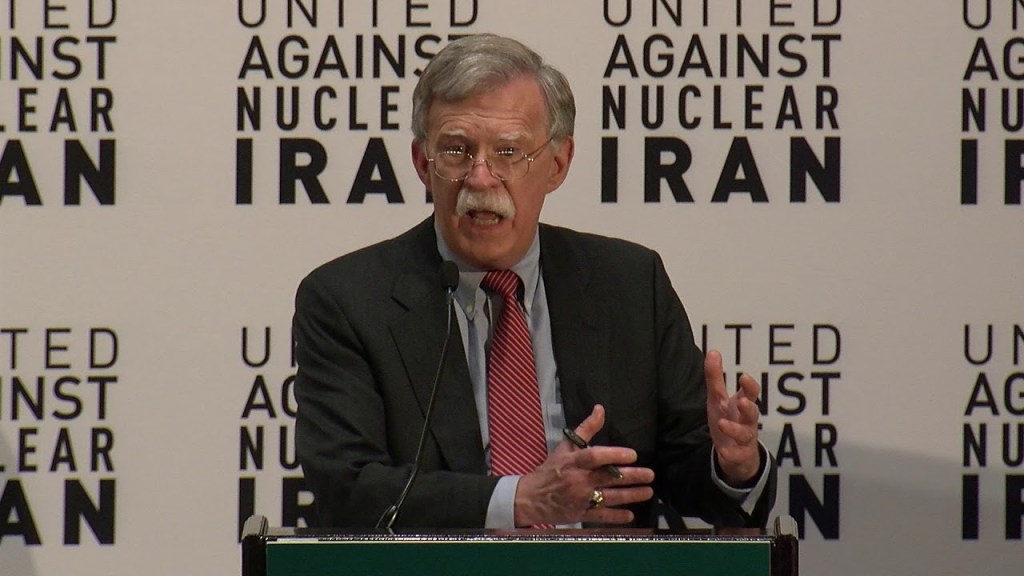
In the wake of Hamas’ October 7 assault, arch-neoconservative official John Bolton was invited on CNN, where he claimed that what we witnessed was really an “Iranian attack on Israel using Hamas as a surrogate” and that the U.S. must immediately respond. When asked whether he had any evidence, given the implications of what he was saying, he shrugged and replied, “This is not a court of law.”

On December 28, Bolton doubled down on his hawkish stance, writing in the pages of Britain’s Daily Telegraph that “The West may now have no option but to attack Iran” – a position he has held for at least a decade.

Meanwhile, in an interview with Saudi state-funded broadcaster Iran International, senior Bush official Mark Wallace bellowed that, “This is Iran’s work. Iran will suffer at the hands of retribution and will suffer the consequences of supporting this terror group and its horrific attack on Israel.” Wallace continued:

No civilized country wants further conflict. But the Iranians are forcing the civilized world’s hand. And you will see a dramatic response soon as the United States, Israel, and our allies begin to position assets around the world in preparation.”

If there was any doubt as to what sort of “dramatic response” Wallace wanted to see, he added a message to Iran’s Islamic Revolutionary Guard Corps: “I look forward to seeing you hanged from the end of one of your own ropes.”

Iran was recently the victim of a deadly terrorist attack. As mourners commemorated the U.S. assassination of Qassem Soleimani, two bombs exploded, killing 91 and injuring hundreds more. In this context, it was understandable why Iranian officials pointed the finger at the U.S. and Israel.

Warmongers, Inc

What these individuals all have in common is that they are board members of United Against Nuclear Iran (UANI), a shadowy but influential organization dedicated to pushing the West toward a military confrontation with the Islamic Republic.

Founded in 2008, the group is led by neoconservative hawks and has close ties to both U.S. and Israeli intelligence. It does not divulge where it receives its copious funding. However, it is known that right-wing Israeli-American billionaire Sheldon Adelson was a source. There is strong circumstantial evidence that Gulf dictatorships may also be bankrolling the group, although UANI has strongly denied this. In 2019, Iran designated UANI as a terrorist organization.

When asked by MintPress what he made of UANI’s recent statements, Eli Clifton, one of the few investigative journalists to have covered the group, said, “It’s very consistent with the positions and advocacy that the organization has taken since its inception.” Adding,

United Against Nuclear Iran does not miss an opportunity to try to bring the United States closer to a military conflict with Iran. And on the other side of the equation, they also have worked very hard to oppose efforts to de-escalate the U.S.-Iran relationship.”

UANI’s board is a who’s who of high state, military and intelligence officials from around the Western world. Among its more notable members include:

  • CEO Mark Wallace, former U.S. Ambassador to the United Nations and deputy campaign manager for George W. Bush’s 2004 reelection.
  • Chairman Joe Lieberman, former senator and Democratic vice-presidential nominee for the 2000 election.
  • Tamir Pardo, Director of the Mossad, 2011-2016.
  • Dennis Ross, former State Department Director of Policy Planning and former Middle East Envoy under George H. W. Bush and Bill Clinton.
  • Field Marshall Lord Charles Guthrie, ex-Chief of Staff of the U.K. Armed Forces.
  • Jeb Bush, former Governor of Florida.
  • August Hanning, President of the German Federal Intelligence Service (BND), 1998-2005; State Secretary at the Federal Interior Ministry, 2005-2009.
  • Zohar Palti, former head of the Political-Military Bureau, Israeli Ministry of Defense; former Director of Intelligence of the Mossad.
  • Frances Townsend, Homeland Security Advisor to President George W. Bush.
  • John Bolton, former U.S. National Security Advisor and former U.S. Ambassador to the U.N.
  • Roger Noriega, former Assistant Secretary of State for Western Hemisphere Affairs and Ambassador to the Organization of American States.
  • Otto Reich, former Assistant Secretary of State for Western Hemisphere Affairs and architect of the 2002 U.S. coup against Venezuela.
  • Michael Singh, White House Senior Director for Near East and North African Affairs, 2007-2008.
  • Giulio Terzi di Sant-Agata, former Italian Foreign Minister.
  • Robert Hill, former Minister of Defense of Australia.
  • Jack David, Deputy Assistant Secretary of Defense for Combating Weapons of Mass Destruction, 2004-2006.
  • Mark Kirk, U.S. Senator for Illinois, 2010-2017.
  • Lt. Gen. Sir Graeme Lamb, ex-Director of U.K. Special Forces and Commander of the British Field Army.
  • Norman Roule, former CIA Division Chief and National Intelligence Manager for Iran at the Director of National Intelligence.
  • Irwin Cotler, Canadian Minister of Justice and Attorney General, 2003-2006.
  • Baroness Pauline Neville-Jones, U.K. Minister of State for Security and Counter Terrorism, 2010-2011.

In addition, notable former board members include ex-CIA Director R. James Woolsey; head of Mossad between 2002 and 2011, Meir Dagan; and one-time chief of British spy agency MI6, Sir Richard Dearlove.

For 15 years, UANI has organized conferences, published reports, and lobbied politicians and governments, all with one goal: pushing a neoconservative line on Iran. “UANI are a force multiplier. They provide at least the veneer of an intellectual infrastructure for the Iran hawk movement. They did not invent being hawkish on Iran, but they sure made it a heck of a lot easier,” Ben Freeman, Director of the Democratizing Foreign Policy Program at the Quincy Institute, told MintPress.

Conflicts and Conflicts of Interest

For such a large, well-financed, and influential organization filled with senior officials, United Against Nuclear Iran keeps its funding sources very quiet. However, in 2015, Clifton was able to obtain a UANI donor list for the 2013 financial year. By far and away, the largest funders were billionaire New York-based investor Thomas Kaplan and multibillionaire Israeli-American casino mogul Sheldon Adelson.

Kaplan, whose $843,000 donation supplied around half the group’s 2013 funding, is a venture capitalist investor concentrating on metals, particularly gold. He is the chairman of Tigris Financial and the Electrum Group LLC. Both of Kaplan’s firms employ UANI CEO Mark Wallace as CEO and COO, respectively.

A 2010 Wall Street Journal article titled “Tigris Financial Goes All-in on Gold” noted that the company had bet billions of dollars on the price of gold rising, more than the reserves of the Brazilian central bank. As Clifton has noted, both Kaplan and Wallace have marketed gold to clients as the perfect commodity to hold if there is increased instability in the Middle East. Therefore, both Kaplan and Wallace stand to make massive sums if the U.S. or Israel were to attack Iran, making their UANI warmongering a gigantic and potentially profitable conflict of interest.

Adelson provided the majority of the rest of UANI’s funding. The world’s 18th-richest individual at the time of his 2021 death, the tycoon turned his economic empire into a political one, supporting ultraconservative causes in both the United States and Israel. Between 2010 and 2020, he and his wife donated more than $500 million to the Republican Party, becoming GOP kingmakers in the process. He would often vet Republican presidential candidates at his casino in Las Vegas, and it was often said that this “Adelson Primary” was almost as important as the public one.

An ardent Zionist, Adelson bankrolled numerous pro-Israel lobby projects, such as AIPAC, One Jerusalem and Taglit Birthright. He also owned Israel Hayom, the country’s most-read newspaper, with 31% of the national share. Relentlessly pro-Netanyahu, it was said that the Israeli prime minister asked his friend Adelson to set up a newspaper to help his political career.

Adelson and his influence have been one of the driving forces of American hostility towards Iran. In 2013, during a conversation with Rabbi Shmuley Boteach, he called for the United States to stop negotiating and drop a nuclear bomb on Iran to show that “we mean business.”

A potential third, even more controversial, source of funding is the Gulf monarchies of Saudi Arabia and the UAE. Leaked emails show UANI officials soliciting support from the Emirati royal family. Both Mark Wallace and Frances Townsend, for example, emailed the Emirati Ambassador to the U.S. detailing cost estimates for upcoming events and inquiring about support from the UAE.

Thomas Kaplan himself is extraordinarily close to the nation. “The country and the leadership of the UAE, I would say, are my closest partners in more facets of my life than anyone else other than my wife,” he told the Emirati outlet, The National News, which also detailed his friendship with Crown Prince of Abu Dhabi, Sheikh Mohamed bin Zayed.

Putting Iran in the Crosshairs

One of United Against Nuclear Iran’s primary activities, Iranian political commenter Ali Alizadeh told MintPress, is to create a worldwide “culture of fear and anxiety for investing in Iran.” The group attempts to persuade businesses to divest from the Islamic Republic and sign their certification pledge, which reads as follows:

The undersigned [Name], the [Title] of [Company] (the “Company”), does hereby certify on behalf of the Company that until the Iranian regime verifiably abandons its drive for nuclear weapons, support for terrorism, routine human rights violations, hostage-taking, and rampant anti-Americanism as state policy, that neither the Company nor any subsidiary or affiliate of the Company, directly or through an agent, representative or intermediary.”

One corporation that UANI targeted was the industrial machinery firm Caterpillar. UANI hectored the firm, even erecting a roadside billboard outside its headquarters in Peoria, IL, insinuating that they were aiding Iran in constructing a nuclear weapon. Caterpillar quickly ordered its Iran projects terminated. Wallace took heart from his group’s victory and warned that other businesses would be targeted.

These have included French companies such as Airbus and ​​Peugeot-Citroen, who were threatened with legal action. In 2019, UANI earned an official rebuke from the Russian Foreign Ministry for attempting to intimidate Russian corporations trading with Tehran. “We think such actions are unacceptable and deeply concerning,” said Foreign Ministry spokesperson Maria Zakharova. “Attempts to pressure and threaten Russian business … are a follow-up on the dishonorable anti-Iranian cause by the U.S. administration,” she added, hinting at collusion between the government and the supposedly non-governmental organization.

Some of UANI’s campaigns have been markedly petty, including pressuring New York City hotels to cancel bookings with Iranian officials (including then-President Mahmoud Ahmadinejad) visiting the city on United Nations business. Others, however, have been devastating to the Iranian economy, such as the SWIFT international money transfer terminating its relationship with Tehran, cutting the country off from the global banking system.

On UANI’s actions against businesses, Freeman said: “It’s effective, and (in some cases, at least) it’s to the detriment of the people of Iran; it’s to the detriment of these companies; and it’s to the detriment of peace in the region.”

While the group presents itself as against a nuclear Iran, UANI was strangely opposed to the Joint Comprehensive Plan of Action (JCPOA) – the deal between Iran and the West that limited the former’s nuclear technology research in exchange for sanctions relief from the latter. As MintPress reported at the time, UANI spent millions on T.V. advertisements trashing the agreement. As Wallace noted, “We have a multi-million-dollar budget, and we are in it for the long haul. Money continues to pour in.”

After the JCPOA was signed, UANI hosted a summit attended by senior Israeli, Emirati, and Bahraini officials, touting its failures. Once UANI’s John Bolton was named Donald Trump’s National Security Advisor, he persuaded the president to withdraw entirely from the deal. Bolton has deep connections to the Mojahedin-e-Khalq (MEK), an exiled Iranian political group widely identified as a terrorist organization. He has, for some time, considered them a government in waiting after the U.S. overthrows the current administration. “Before 2019, we will celebrate in Tehran,” he told the group in 2018, predicting that, with him at the helm, the Trump administration would soon cause the downfall of the Iranian government.

Bolton has long been a hardliner on regime change. “To stop Iran’s bomb, bomb Iran,” read the title of his 2015 New York Times op-ed. Yet this appears to be the dominant position at UANI. In March, Ross published an article in The Atlantic headlined “Iran needs to believe America’s threat,” which demanded that the U.S. “take forceful action to check Tehran’s progress toward a nuclear bomb.” Failure to do so, Ross claimed, would provoke Israel to do so itself – a “much more dangerous scenario,” according to him. Yet only two years previously, Ross called on the U.S. to “give Israel a big bomb” to “deter Iran,” noting that the “best way” to stop the Iranian nuclear program was to supply Israel with its own nukes, thereby taken as a given that Iran was indeed pursuing nuclear weapons itself (a highly questionable claim at the time) and ignoring Israel’s already existing 200+ stockpile of nuclear missiles.

“It doesn’t seem like UANI ever really took seriously the possibility of a diplomatic means to constrain Iran from continuing to increase its enrichment levels and moving towards a nuclear weapon,” Clifton told MintPress. “As a matter of fact, they generally fought tooth and nail against the JCPOA. They are eager to push the United States toward confrontation with Iran using the possibility of Iranian nuclear weapons as a reason,” he added.

Intelligence Connections

That UANI is headed by so many state, military and intelligence leaders begs the question: to what extent is this really a non-governmental organization? “That is one of the dirty secrets of think tanks: they are very often holding tanks for government officials,” Freeman said, adding:

The Trump folks all had to leave office when Biden won, so a lot of them ended up in think tanks for a while, four years, let’s say. And if Trump wins again, they will bounce back into government. And the same is true of Democratic administrations, too.”

The U.S. government also clearly has a longstanding policy of outsourcing much of its work to “private” groups in order to avoid further scrutiny. Many of the CIA’s most controversial activities, for example, have been farmed out to the National Endowment for Democracy (NED), a technically non-governmental organization funded entirely by Washington and staffed with ex-state officials. In recent years, the NED has funneled millions of dollars to protest leaders in Hong Kong, organized an attempted color revolution in Cuba, organized anti-government rock concerts in Venezuela, and propped up dozens of media organizations in Ukraine.

These sorts of institutions blur the line between public and private sectors. But a 2014 legal case raises even more questions about UANI’s connections to the U.S. government. After UANI accused Greek shipping magnate Victor Restis of working with the Iranian government, he sued them for libel. In an unprecedented move for what was a private, commercial lawsuit, Attorney General Eric Holder intervened in the lawsuit, ordering the judge to shut the case down on the grounds that, if it continued, it would expose key U.S. national security secrets. The case was immediately dropped without explanation.

In the past, when the Justice Department has invoked state secrets, a high-ranking state official has offered a public statement as to why. Yet, this time, nothing was offered. Reporters at the time speculated that much of the material Restis wanted to make public was possibly given to UANI by either the CIA or Mossad, which would have revealed a network of collusion between state intelligence agencies and a supposedly independent, private non-profit. Given the glut of ex-Mossad and CIA chiefs at UANI, this speculation is perhaps not as wild as it might seem.

UANI’s funders certainly also have extensive connections to Israel. Kaplan is the son-in-law of Israeli billionaire Leon Recanati and is said to be close with Prime Ministers Naftali Bennet and Yair Lapid. He has also employed a number of Israeli officials at his businesses. An example of this is Olivia Blechner, who, in 2007, left her role as the Director of Academic Affairs at the Israeli Consulate General in New York to become Executive Vice-President of Investor Relations and Research at Kaplan’s Electrum Group – a rather perplexing career move.

Adelson, meanwhile, was given what amounted to an official state funeral in Israel, one that even Prime Minister Netanyahu attended. He was buried on the Mount of Olives in Jerusalem – one of the holiest sites in Judaism and an honor that very few figures receive.

A Network of Regime Change Groups

While United Against Nuclear Iran is already a notable enough organization, it is actually merely part of a large group of shadowy non-governmental groups working to cause unrest and, ultimately, regime change in Iran. These groups all share overlapping goals, funders and key individuals.

One example of this is the Counter Extremism Project (CEP), a non-profit that purports to exist to “combat the growing threat posed by extremist ideologies.” Yet the group focuses largely on Islamist extremism – and only those groups that are enemies of the U.S., Israel and the Gulf Monarchies (about whose extremism and violence the CEP has nothing to say). Ten members of the CEP’s leadership council are also on UANI’s board, including Wallace, who is CEO of both organizations.

Another group headed by Wallace is the Jewish Committee to Support Women Life Freedom in Iran. This organization claims to be focused on improving women’s rights in Iran. It very quickly, however, divulges that this is a vehicle for regime change. On its homepage, for example, it writes:

These freedom fighters continue with no sign of relenting on their calls for regime change. Calls for “Woman Life Freedom” and the removal of Supreme Leader Ayatollah Ali Khamenei echo from rooftops, down street corridors, across campus hallways, and on government billboards. These brave Iranians have expressed their hatred for the ruling clerics not only in their words, but in their actions.”

Seven members of the Jewish Committee to Support Women Life Freedom in Iran’s steering group – including Wallace and Kaplan – also lead UANI.

Mike Wallace, second from right, poses with prominent anti-Iran figures at a lobbying event in Italy, February 2023. Photo | Twitter

Kaplan is well-known as a conservationist. However, his group, Panthera, which works to preserve the world’s 40 known species of big cats, has also been accused of being a secret regime change operation. Panthera has a number of UANI officials on its board or conservation council, including Wallace and Lamb (the ex-director of U.K. Special Forces and Commander of the British Army). Also on the council are Itzhak Dar, former Director of the Israeli Secret Service, Shin Bet, and General David Petraeus, former CIA Director and Commander of the U.S. invasion of Afghanistan.

In 2018, Iranian authorities arrested eight individuals working with Panthera inside the country. All eight were convicted of spying on behalf of the U.S. and Israel. While many in the West decried the trials as politically motivated, any organization led by these figures is bound to cause suspicions.

This is especially the case as Wallace is also a founder of PaykanArtCar, an organization that attempts to use art to, in its words, “advocate for the restoration of human rights and dignity for all in Iran.” All three team members of PaykanArtCar also work at UANI.

The final group in this Iran regime change network is the International Convention for the Future of Iran. Set up by Wallace himself, the organization’s website explains that it exists to “end the repression of the regime and bring true change to Iran.” Further purposes are to “connect the Iranian opposition in exile [i.e., the MEK] with policymakers in the United States and internationally” and to “offer program grants and technical support” to groups working to overthrow the government. However, judging by the lack of updates and the group’s Twitter profile having only 31 followers, it appears that it has not had much success achieving its goals.

In short, then, there exists a network of American NGOs with the mission statements of helping Iran, opposing Iran, preserving Iran, and bombing Iran, all staffed by largely the same ex-U.S. government officials.

Iran, however, is not the only target in Wallace’s sights. It appears that he is also trying to give Turkey similar treatment. Wallace is the CEO of the Turkish Democracy Project, a non-profit established to oppose the rule of President Recep Tayyip Erdoğan, who, it says, has “dramatically altered Turkey’s position in the international community and its status as a free and liberal democracy.” The Turkish Democracy Project denounces what it calls Erdoğan’s “destabilizing actions in and beyond the region, his systemic corruption, support for extremism, and disregard for democracy and human rights.” There are no Turkish people among the Turkish Democracy Project’s leadership. But there are seven UANI board members at the top, calling the shots.

A Lesson From History

The history of Iran has been intimately intertwined with the United States since at least 1953 when Washington orchestrated a successful coup against Prime Minister Mohammad Mosaddegh. Mosaddegh had refused U.S. demands to stamp out Communist influences in his country and had nationalized the nation’s oil. The U.S. installed Shah Mohammad Reza Pahlavi as a puppet ruler. An unpopular and authoritarian ruler, the Shah was overthrown in the Revolution of 1979. Since then, it has become a target for regime change, and its nuclear program is something of an obsession in the West.

Often orchestrated by UANI officials while they were in government, the U.S. has carried out a sustained economic war against Tehran, attempting to collapse its economy. American sanctions have severely hurt Iran’s ability to both buy and sell goods on the open market and have harmed the value of the Iranian rial. As prices and inflation rose rapidly, ordinary people lost their savings.

During the COVID-19 pandemic, the U.S. turned the screw once again, intimidating both businesses and nations into refusing to sell Tehran vital medical supplies. Eventually, the World Health Organization stepped in and directly supplied it with provisions – a factor in the Trump administration’s decision to pull out of the agency.

While U.S. actions have severely harmed the Iranian economy, a future bright spot may come in the form of BRICS, the economic bloc that Iran – along with Egypt, Ethiopia, Saudi Arabia, and the UAE – joined on January 1. American economic power on the global stage appears to be waning. However, This new reality might spur Washington policymakers to reconsider a military option, as UANI desperately wants them to.

It is perfectly reasonable to be worried about Iran – or any country, for that matter – developing atomic bombs. Nuclear weapons pose an existential threat to human civilization, and more actors with access to them increase the likelihood of a devastating confrontation. Already in the region, India, Pakistan, Israel and Russia possess them. But it is only the United States that has ever used them in anger, dropping two on Japan and coming close to doing so in China, Korea and Vietnam. And given the U.S.’ recent track record of attacking countries that do not possess weapons of mass destruction (e.g., Iraq, Libya, Afghanistan) and not touching those who do (such as North Korea), it is entirely understandable why Iran might want one. As Freeman said:

I certainly do not want Iran to get a nuclear weapon. But at the same time, you can also believe that it would be catastrophic if the U.S. were to engage in a war with Iran…And the concern with groups like UANI is that they are taking that [the worry of Iran getting a nuclear weapon] and pushing that argument to a point where it might lead to an active conflict.”

The slaughter in Gaza has been horrifying enough. More than 22,000 people have been killed in the Israeli invasion, and a further 1.9 million displaced. Israel is also simultaneously bombing the West Bank, Syria and Lebanon. The U.S. is facilitating this, sending billions of dollars in weaponry, pledging iron-clad political support to Israel, silencing critics of its actions, and vetoing United Nations resolutions.

But United Against Nuclear Iran is eager to escalate the situation to a vastly greater level, urging Washington to attack a well-armed country of nearly 90 million people, erroneously claiming that Iran is behind every Hamas or Hezbollah action. “This is not a nuclear non-proliferation organization” Clifton said, noting that there are plenty of genuine already existing peace and environmental groups worried about nuclear weapons that either supported the JCPOA or said it did not go far enough. “Their focus is more on working towards regime change in Iran rather than actually supporting efforts that might prevent Iranian nuclear weapons,” he added.

IF UANI gets its way, a conflict with Iran might spark a Third World War. And yet they are receiving virtually no pushback to their ultra-hawkish pronouncements, largely because they operate in the shadows and receive virtually no public scrutiny. It is, therefore, imperative for all those who value peace to quickly change that and expose the organization for what it is.
Biden, Israel’s accomplice in Gaza, pretends to be a bystander

While the White House claims to be “frustrated” with Israel’s conduct in Gaza, US support for the carnage continues.

By Aaron Maté

Source: Aaron Maté Substack

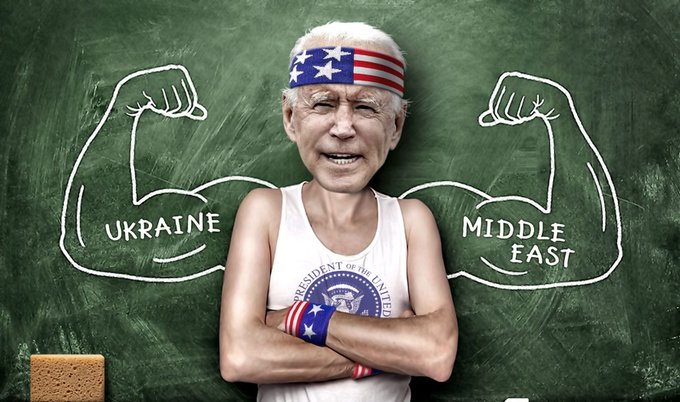
On October 15th, President Biden took umbrage at a suggestion that his administration could not back both the Ukraine proxy war and Israel’s assault on Gaza at the same time.

 “We’re the United States of America for God’s sake, the most powerful nation… in the history of the world,” Biden told CBS News. “We can take care of both of these and still maintain our overall international defense.”

Three months and well over 20,000 defenseless Palestinians slain later, the self-declared leader of the most powerful nation in the history of world now claims to be a helpless bystander.

According to four US officials, Biden is “increasingly frustrated” and “losing his patience” with Israeli Prime Minister Benjamin Netanyahu, who has rejected “most of the administration’s recent requests related to the war in Gaza,” Axios reports. “The situation sucks and we are stuck,” one official complained. “The president’s patience is running out.” Another official fumes that “there is immense frustration” in the Oval Office. According to Democratic Senator Chris Van Hollen: “At every juncture, Netanyahu has given Biden the finger. They are pleading with the Netanyahu coalition, but getting slapped in the face over and over again.”

Van Hollen is correct that the administration is getting slapped in the face by Israel. But he omits that Biden is a willing scene partner in a barely disguised performance: pretending to be up in arms about Israel’s genocidal conduct while doing everything he can to support it.

As Likud parliamentarian Danny Danon explained last month, any US demand of Israel’s military is perfunctory. “They didn’t agree to a ground invasion — we invaded,” Danon said. “They didn’t agree to [attacking] Al-Shifa hospital — we ignored their request. They wanted a pause without hostages — we didn’t accept that. We have no American ultimatum. There is no deadline from the US.”

The US not only imposes no conditions on its support for Israel’s mass murder campaign in Gaza, but has twice bypassed Congress to expedite weapons for it. After all, this administration professes to have “no red lines” when it comes to Israeli aggression, and is fronted by a president who has declared that there is “no possibility” of a ceasefire.

While Biden and his aides now pretend to have their hands tied, their instrumental role is undeniable. “Biden is president of the United States, still the most powerful country in the world by almost every measure and a country without whose support Israel has no future,” former US diplomat Patrick Theros writes. “A firm public demand to cease and desist immediately would have enormous domestic political repercussions in Israel — far less in the United States. Biden would not have to publicly threaten to cut off weapons deliveries; a few words delivered in private to Netanyahu and a few members of his war cabinet would probably suffice.”

“If you want to use your leverage, use your leverage,” former Israeli negotiator Daniel Levy says of Biden’s stance. “You’ve chosen to give Israel a blank check.”

That choice continues. In meetings with Israeli officials on Nov. 30th, Secretary of State Antony Blinken informed his counterparts that they had “weeks, not months” to “wrap up combat operations at the current level of intensity,” US officials later told the New York Times. Upon a return visit to Israel this week, Blinken again touted his push for what he called “the phased transition of Israel’s military campaign in Gaza.” That “transition” to a “lower-intensity phase,” White House spokesperson John Kirby said on Sunday, “is coming here very, very soon.”

But away from the news cameras, the posture changes. A senior US official now explains to the Washington Post that it’s in fact “pointless to urge them [the Israelis] to change.” Accordingly, “Washington’s priority has now shifted to tolerating Israel’s high-intensity operation throughout January, while insisting instead that it downgrade the tempo in February.”

In other words, the US has decided to tolerate Israel’s genocidal tempo in Gaza as normal. From Washington’s point of view, saving thousands of Palestinian lives from murder at the hands of US-supplied weaponry would be pointless.

Biden is so committed to continuing the Gaza slaughter that he has even expanded the war zone to Yemen. In a statement announcing his authorization of US strikes last week, Biden declared that he was acting to protect “freedom of navigation” and the “free flow of international commerce.” Since mid-November, the group that controls most of Yemen, Ansar Allah (misleadingly known in the US as the Houthis), has been targeting commercial ships – primarily those with Israeli links – passing through the Red Sea in a bid to compel the Israeli government to halt its assault on Gaza. By contrast with Israel’s operations, which has an official death toll of 23,000 and counting, Ansar Allah has not killed anyone. It even lost at least ten fighters in a US counterattack on December 31st. As Biden noted, Ansar Allah’s main impact has been to threaten “weeks of delays in product shipping times.” (Others estimate that the delay time can in fact be counted in days).

As in Gaza, the ultimate targets of US aggression in Yemen are civilians. While the Pentagon claims to be targeting Ansar Allah’s military capabilities, the “greater risk from the air attacks is likely borne by ordinary Yemenis,” the New York Times notes. This risk to ordinary Yemenis is consistent with longstanding US policy, specifically the current Biden team’s 2015 decision under President Obama to green-light the Saudi-led war on Yemen that has caused the ensuing humanitarian crisis. Around 21 million Yemenis – two-thirds of the country – rely on aid for survival, while more than four million are internally displaced.

In facing “one of the world’s worst humanitarian calamities,” the Times adds, Yemen faces “a dubious distinction now shared by Gaza.” Given its critical support for Israel’s assault, the US therefore has the dubious distinction of fueling two of the world’s worst humanitarian calamities.

Because of Israel’s blockade and military assault, the risk of famine in Gaza is “growing by the day,” Martin Griffiths, the United Nations’ top humanitarian official now warns. “As ground operations move southwards, aerial bombardments have intensified in areas where civilians were told to relocate for their safety.” For Gaza’s civilians – more than 90% of them displaced — “dignified human life is a near impossibility.”

According to one anonymous official with Israel’s occupation authority for Gaza (COGAT), the lack of dignity for Palestinians in Gaza is a genetic trait. “There is no hunger in Gaza,” the official told Haaretz. “…There were stockpiles of food in Gaza. Don’t forget that this is an Arab, Gazan population whose DNA is to hoard, certainly when it comes to food.”

It is apparently in the White House DNA to share its Israeli client’s avowed bigotry. In a statement Sunday night, President Biden marked “100 days of captivity” for the Israeli hostages in Gaza. Biden’s emotional message failed to even mention the hundreds of thousands of Palestinians killed, wounded, and displaced under US-backed Israeli assault over that same period.

“No one should have to endure even one day of what they have gone through, much less 100,” Biden said of the hostages. By refusing to acknowledge them, Biden is affirming via omission that he believes the exact opposite — and in fact infinitely worse — for Gaza’s two million Palestinian hostages. After 100 days of genocide, the people of Gaza are fated to endure continued atrocities as a direct result of US policy, no matter the Biden team’s ongoing effort to pretend otherwise.

War Propaganda Intensifies as US Mainstream Media Calls for War on Iran to Stop the “Axis of Resistance”

By Timothy Alexander Guzman

Source: Silent Crow News

Remember when the mainstream media especially FOX News was calling for an attack on Iraq because Saddam Hussein and the Bath Party was developing Weapons of Mass Destruction (WMDs)?  FOX News was the main cheerleader for the US and its European allies to invade Iraq and take out Saddam Hussein.  To be fair, CNN and MSNBC and other news outlets were also cheerleading for war, but FOX News was clearly, the loudest voice.  Today, FOX News is at it again with other right-wing media networks who have been also calling for the US and its allies to bomb Iran to stop the Axis of Resistance that includes Hezbollah in Southern Lebanon, Syria, Iraqi resistance groups and now Yemen, with the Houthi rebels who have been launching missile attacks against Israeli and Western commercial ships in the Red Sea in support of Gaza. 

Fox News senior strategic analyst, who a former General with the US Army, Jack Keane, a war hawk who served as an advisor to manage the US occupation of Iraq and a member of the Defense Policy Board Advisory Committee.  Keane is also chairman of AM General, a heavy vehicle and automotive manufacturer that produces military Humvees for civilian and military use.  Recently, Keane spoke on FOX News regarding the 60 + strikes conducted by US and British fighter aircraft on Yemen.  The main points he made on the FOX network was that US and its British allies already had their targets pinpointed due to Centcom, the US central command, “they were likely tracking the Houthis were trying to hide some of this capability for the last few days.  But we got excellent surveillance there, and likely we will, we are able to determine whether they are moving a lot of this, they will finish the assessment, believe me, I think if there is capability there, that is still significant, we should reattack and then we got to remind ourselves what’s really happening here.” 

Keane went on to say that Iran is “the center of gravity”, therefore it must be attacked to stop its proxies in the region:

The center of gravity for the aggression in the Middle East that we’re experiencing is Iran. We have said this time and time and time again, and to deter the proxies themselves by hitting them will not be sufficient.  We have got to go after Iran themselves by hitting them will not be sufficient.  We have got to go after Iran, they are, as I mentioned, the center of gravity, Centcom has a table of targets that they have provided to the administration in how to go about doing that comprehensively to shut down their support for these proxies that has got to be high on our list.  And what that really means Brian, we have got to re-set the strategy in dealing with Iran in the region and admit the fact that this thing has failed.  When they came in, they removed the Trump sanctions.  Iran’s flush with oil money now, as a result of it, they went after the nuclear deal.  That failed    

Keane is not the only psychopath who wants World War III, another frequent quest on FOX News, Lindsey Graham who is South Carolina’s Republican Senator and a Pro-Israel activist was quoted in a FOX News article, ‘Lindsey Graham calls for warning Iran of retaliation if Hamas escalates, tells ‘Squad’ to ‘shut the hell up’ reported that the “South Carolina Republican Sen. Lindsey Graham castigated the far left’s “appeasement” of Iran’s regime, which he said has not prevented attacks by Hamas against Israel, telling the Palestinian-friendly “Squad” contingent in Congress to “shut the hell up.”  On America Reports, a show produced by FOX News, Graham said that “The only way you’re going to keep this war from escalating is to hold Iran accountable. How much more death and destruction do we have to take from the Iranian regime? I am confident this was planned and funded by the Iranians.”

Sounding like a far-right Israeli politician, Graham also said that “Hamas is a bunch of animals who deserve to be treated like animals” he added that “Israeli forces should use this opportunity to invade Palestinian territory and “dismantle” the militant group.”  Graham used the Hitler comparison to the Hamas’ resistance as “an effort to kill Jewish people on par with that of former German Chancellor Adolf Hitler in the 1930s.” 

In 2005, a few years after Iraq was already invaded and destroyed, Pew Research found that FOX News was more biased in reporting on the war in Iraq than CNN and MSNBC, “measurably more one-sided than the other networks, and Fox journalists were more opinionated on the air” and that “the news channel was also decidedly more positive in its coverage of the war in Iraq, while the others were largely neutral. At the same time, the story segments on the Fox programs studied did have more sources and shared more about them with audiences.”  This does not mean CNN and MSNBC is innocent nor any better on the lead-up to the war on Iraq, but FOX News is surely on the frontline when it comes to war propaganda. 

Iran is the ultimate prize for the neocons in Washington and Israel.  Israel wants to get the US military into another war but this time to attack Iran.  They are using the mainstream media that they control to gain support from the US population who are clueless about what is happening in the Middle East.  FOX News is a major part of the propaganda machine, so they will continue to call for another major war to appease their Zionist masters in Israel. 

In an article published in 2003 by The Guardian that was correctly titled, ‘Their Master’s Voice’ on Rupert Murdoch, the owner of FOX News said that “you have got to admit that Rupert Murdoch is one canny press tycoon because he has an unerring ability to choose editors across the world who think just like him.”   It goes on to say how much influence Rupert Murdoch, who is a neocon at heart, has in his media empire:

Murdoch is chairman and chief executive of News Corp which owns more than 175 titles on three continents, publishes 40 million papers a week and dominates the newspaper markets in Britain, Australia, and New Zealand. His television reach is greater still, but broadcasting – even when less regulated than in Britain – is not so plainly partisan. It is newspapers which set the agenda

What was Murdoch’s agenda during the war in Iraq? In an interview in the Sydney Daily Telegraph, one of the newspapers that Murdoch owns, said that “We can’t back down now, where you hand over the whole of the Middle East to Saddam…I think Bush is acting very morally, very correctly, and I think he is going to go on with it.” He was also asked about another war criminal-at-large and former British Prime Minister, Tony Blair:

I think Tony is being extraordinarily courageous and strong… It’s not easy to do that living in a party which is largely composed of people who have a knee-jerk anti-Americanism and are sort of pacifist. But he’s shown great guts as he did, I think, in Kosovo and various problems in the old Yugoslavia”

Fox News is cheerleading for another war but this time against Iran who is not Iraq.  Iran has the capabilities to hit every US base in the Middle East especially those in Iraq and Syria. It has a formidable military that is ready to defend their territorial integrity. If the US and their Israeli counterparts decide to attack Iran, rest assured, the entire Middle East would erupt and they would support Iran and that will be the end of all US bases in the region and possibly, the end of a 75-year-old occupation of Palestine.      

FOX News has supported every war, it has supported every assassination of foreign military and political leaders, and it has supported every regime change operation on all corners of the globe.  There is nothing “Fair and Balanced” with FOX News and their paid propagandists who basically work for Military arms manufacturers, major corporations, the right-wing part of the American and European political establishment and of course, Israel. 

This is dangerous war propaganda all over again, we can call it, Iraq 2.0., but this is much worse because this coming war will involve many countries and resistance groups, especially those in the Middle East.   

Biden and Netanyahu Agree on Ethnic Cleansing of Gaza

By Eric Zuesse

Source: The Duran

The agreement, which has been arranged through National Security Advisor Jake Sullivan in the White House and Israel’s President Benjamin Netanyahu, is that poor countries with corrupt leaders will be bribed to accept forced immigrants from Gaza so as to cleanse it in order to carry out settlement of Jews into that area, after Gaza’s post-war reconstruction, which will be done by the Governments of Israel and U.S., by paying contractors from both countries to ‘make the desert bloom’ there for the incoming Jews.

On January 3rd, the Times of Israel — which was founded by the late gambling casino mega-billionaire Sheldon Adelson, who had been the chief donor to the political careers of both Netanyahu and Trump, and so the newspaper that he created has well-connected sources inside Israel’s Government — headlined “Israeli officials said in talks with Congo, others on taking in Gaza emigrants”, and reported:

The Times of Israel’s Hebrew sister-site Zman Yisrael reports that Israeli officials have held clandestine talks with the African nation of Congo and several others for the potential acceptance of Gaza emigrants.

“Congo will be willing to take in migrants, and we’re in talks with others,” a senior source in the security cabinet tells Shalom Yerushalmi.

Yerushalmi quotes Intelligence Minister Gila Gamliel saying at the Knesset yesterday: “At the end of the war Hamas rule will collapse, there are no municipal authorities, the civilian population will be entirely dependent on humanitarian aid. There will be no work, and 60% of Gaza’s agricultural land will become security buffer zones.”

Saying education to hatred will continue in Gaza and further attacks on Israel are only a matter of time, she added: “The Gaza problem is not just our problem. The world should support humanitarian emigration, because that’s the only solution I know.”

Yesterday Washington panned far-right ministers Bezalel Smotrich and Itamar Ben Gvir for advocating the resettlement of Palestinians outside of Gaza.

“This rhetoric is inflammatory and irresponsible,” State Department spokesman Matthew Miller said.

This is consistent with the news earlier regarding both Biden and Netanyahu, that Netanyahu will be ethnically cleansing Gaza while Biden will give lip-service to criticizing it but will continue to set no conditions upon the U.S. Government’s supplying of weapons and of military intelligence to Israel’s forces to carry out the ethnic cleansing there. Both Netanyahu and Biden, meanwhile, will be arm-twisting at the U.N. General Assembly to gain approval for the forced-resettled-in-Africa Gazans to receive aid from U.N. agencies, in order to keep down the refugees’ maintenance-costs in those countries, sufficiently so as to avoid rebellions by those receiving countries’ publics that might result from tax-increases for those receiving Governments to pay for those immigrants who will have become relocated there.

As I reported earlier, the previous plan by both Netanyahu and Biden was to expel the 2.3 million Gazans to either Egypt or Jordan, but on October 16th and 17th both of those Governments refused to participate. This is what has now led to the negotiations with the Governments of “the African nation of Congo and several others for the potential acceptance of Gaza emigrants.” If the Biden and Netanyahu team cannot find lands to cooperate, then whatever Gazans survive the bombardments and siege might be simply starved to death, in which case the end-result will be a genocide against the Gazans, instead of merely an ethnic cleansing of them. So: the current plan might not be the final plan, the final solution to the Gazan problem.

US-British Attacks on Yemen a Portent for Wider War

By Brian Berletic

Source: New Eastern Outlook

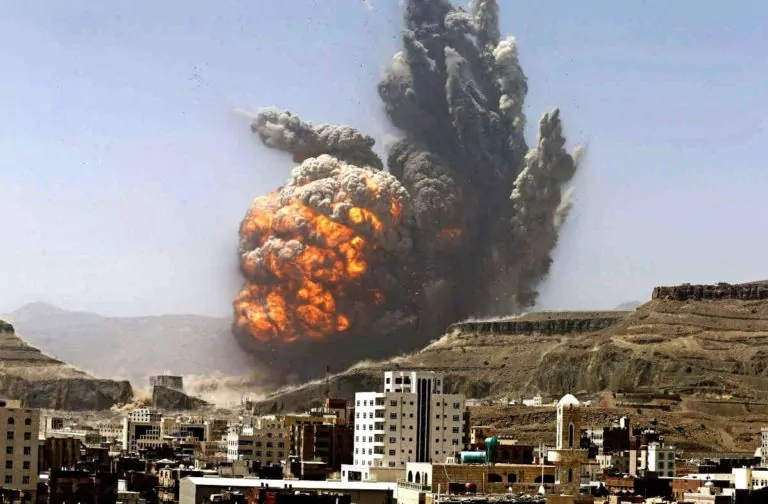
In the opening weeks of 2024, the US and British unilaterally launched several large-scale missile and air strikes on targets in territory held by Ansar Allah (referred to as the “Houthis” across the Western media) in Yemen.

The strikes follow a campaign of missile strikes and boardings conducted by Ansar Allah against commercial shipping destined to and from Israel in response to Israel’s ongoing punitive operations in Gaza.

While the stated purpose of the US-British strikes are to protect commercial shipping, hostility of any kind in the Red Sea is likely to prompt international shipping companies to continue seeking out and using alternative routes until fighting of any kind subsides.

Indeed, according to Euronews Business, despite the US-British strikes on Ansar Allah, the CEO of Maersk, responsible for one-fifth of global maritime shipping, believes safely transiting the Red Sea is still months away.

Despite the political posturing that accompanied these attacks, strategically, they will do little to impact Ansar Allah’s fighting capacity. The political movement possesses a formidable military organization that has weathered years of full-scale war waged against it by a Saudi-led Arab coalition, backed by both the US and UK.

Not only did the US and UK encourage Saudi Arabia to sustain an air and ground war against Yemen, both Western nations contributed directly to Saudi Arabia’s war efforts.

The New York Times in a 2018 article titled, “Army Special Forces Secretly Help Saudis Combat Threat From Yemen Rebels” admitted that US special forces were operating, at a minimum, along the Saudi-Yemeni border, assisting Saudi Arabia’s armed forces in choosing targets.

The same article admits that the US was also lending assistance related to “aircraft refueling, logistics and general intelligence sharing.”

The Guardian in a 2019 article titled, “‘The Saudis couldn’t do it without us’: the UK’s true role in Yemen’s deadly war,” admitted to the scope of support provided by the UK to Saudi Arabia in its war on Yemen. It included supplying weapons and munitions, thousands of maintenance contractors, pilot training, and even sending British troops to fight alongside Saudi soldiers in Yemen itself.

The scale of both Saudi Arabia’s own war on Yemen and the scale of US and British assistance to Saudi Arabia, including through the use of thousands of contractors and hundreds of soldiers on the ground, dwarfs the current missile and air strikes conducted by the US and British from the Red Sea. Even if the US and British significantly expanded their current missile and air strike campaign, it would still pale in comparison to the war that has been waged against Yemen in recent years.

Clearly then, the current US-British strikes on Yemen hold little prospect of deterring Ansar Allah, so why is the US and British carrying out these strikes anyway?

Washington’s True Motives for Striking Yemen 

CNN in an article titled, “US and UK carry out strikes against Iran-backed Houthis in Yemen,” would claim:

For weeks, the US had sought to avoid direct strikes on Yemen because of the risk of escalation in a region already simmering with tension as the Israel-Hamas war continues, but the ongoing Houthi attacks on international shipping compelled the coalition to act.

Yet, because the strikes only ensure shipping in the Red Sea remains obstructed and because the strikes themselves have little hope of impacting Ansar Allah strategically, the only other explanation as to why the US launched them was to specifically raise “the risk of escalation in the region.”

Ansar Allah’s ally, Iran, has been the target of US-sponsored regime change operations for decades. Entire policy papers have been written by US government and corporate-funded think tanks, including the Brookings Institution and its 2009 paper, “Which Path to Persia?,” detailing options to achieve regime change including through deliberate attempts to draw Iran into a war by both covert action within Iran, and through attacks on Iran’s network of regional allies.

The Brookings paper admits:

“…it would be far more preferable if the United States could cite an Iranian provocation as justification for the airstrikes before launching them. Clearly, the more outrageous, the more deadly, and the more unprovoked the Iranian action, the better off the United States would be. Of course, it would be very difficult for the United States to goad Iran into such a provocation without the rest of the world recognizing this game, which would then undermine it. (One method that would have some possibility of success would be to ratchet up covert regime change efforts in the hope that Tehran would retaliate overtly, or even semi-overtly, which could then be portrayed as an unprovoked act of Iranian aggression.)”

Preceding the US-British missile and air strikes on Yemen, the US has carried out strikes on Iranian allies across the region, including in Syria and Iraq. Israel, with US-backing, has also carried out attacks across the region on Iranian allies, specifically on Hezbollah in southern Lebanon.

There was also recently a terrorist bombing inside of Iran, likely carried out by one of several terrorist organizations sponsored by the US to carry out just such attacks, as per the Brookings paper’s own suggestion regarding “ratcheting up cover regime change efforts inside Iran.” It should be noted that elsewhere in the Brookings paper the option of using known terrorist groups to carry out US-backed “insurgency” is afforded an entire chapter (Chapter 7, Inspiring an Insurgency – Supporting Iranian Minority and Opposition Groups). 

Together, this constitutes a strategy of attempting to degrade Iranian allies in the region ahead of a wider conflict, and as a means of provoking and thus drawing Iran itself into that wider conflict.

So far, Iran has exhibited tremendous patience. Iran, as both Russia and China who face similar US policies of encirclement and containment, knows time works in its favor. Iranian patience has already served Tehran well. It has afforded it the ability to diplomatically resolve tensions between itself and Saudi Arabia through Chinese mediation. It has also allowed Iran to continue building up not only its own military capabilities, but those across its network of allies in the region, leading to a gradual shift in the balance of power in Tehran’s favor.

Washington realizes this. This time next year, if events continue to unfold as they have in recent years, Iran will only be stronger and the US more isolated in the region. The US faced a similar problem of waning primacy in Europe, using its proxy war in Ukraine against Russia as a means of reasserting itself over Europe. Washington likely imagines it can use a similar strategy to reassert itself over the Middle East while using a regional conflict to collectively weaken and thus subordinate the nations therein.

Only time will tell if the US is as “successful” in the Middle East as it was in Europe. Already many factors are working against the US, but from Washington’s perspective, it isn’t paying the price for any of these conflicts – the regions these conflicts are fought in are paying that price. As long as Washington is absolved from any direct cost in such a foreign policy, it will continue pursuing it until it is finally and fully denied the means to continue doing so.

When Yemen Does It It’s Terrorism, When The US Does It It’s “The Rules-Based Order”

We are ruled by murderous tyrants. By nuclear-armed thugs who would rather starve civilians to protect the continuation of an active genocide than allow peace to get a word in edgewise. 

By Caitlin Johnstone

Source: CaitlinJohnstone.com.au

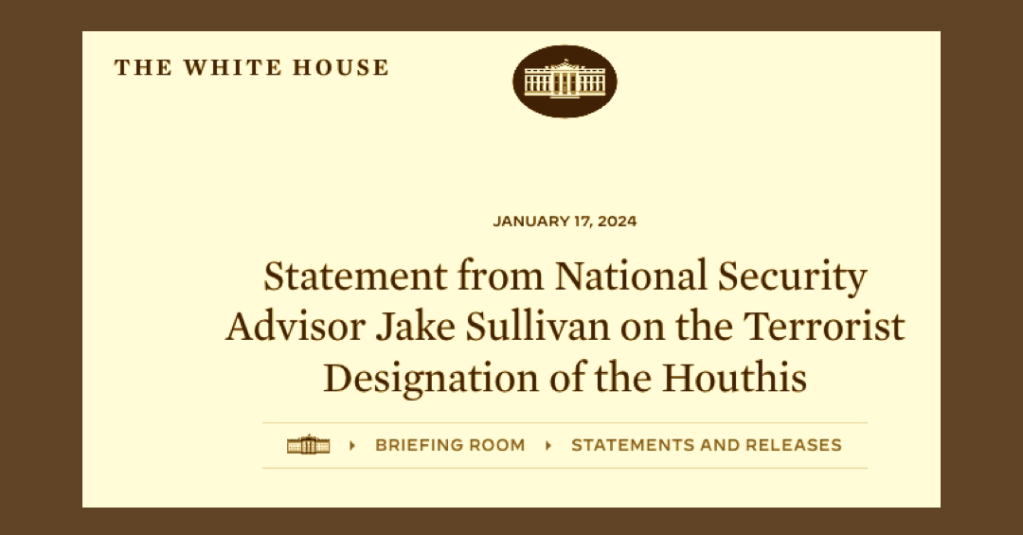
The Biden administration has officially re-designated Ansarallah — the dominant force in Yemen also known as the Houthis — as a Specially Designated Global Terrorist entity. 

The White House claims the designation is an appropriate response to the group’s attacks on US military vessels and commercial ships in the Red Sea and the Gulf of Aden, saying those attacks “fit the textbook definition of terrorism.” Ansarallah claims its actions “adhere to the provisions of Article 1 of the Convention on the Prevention and Punishment of the Crime of Genocide,” since it is only enforcing a blockade geared toward ceasing the ongoing Israeli destruction of Gaza.

One of the most heinous acts committed by the Trump administration was its designation of Ansarallah as a Foreign Terrorist Organization (FTO) and as Specially Designated Global Terrorists (SDGT), both of which imposed sanctions that critics warned would plunge Yemen’s aid-dependent population into even greater levels of starvation than they were already experiencing by restricting the aid that would be allowed in. One of the Biden administration’s only decent foreign policy decisions has been the reversal of that sadistic move, and now that reversal is being partially rolled back, though thankfully only with the SDGT listing and not the more deadly and consequential FTO designation.

In a new article for Antiwar about this latest development, Dave Decamp explains that as much as the Biden White House goes to great lengths insisting that it’s going to issue exemptions to ensure that its sanctions don’t harm the already struggling Yemeni people, “history has shown that sanctions scare away international companies and banks from doing business with the targeted nations or entities and cause shortages of medicine, food, and other basic goods.” DeCamp also notes that US and British airstrikes on Yemen have already forced some aid groups to suspend services to the country.

So the US empire is going to be imposing sanctions on a nation that’s still trying to recover from the devastation caused by the US-backed Saudi blockade that contributed to hundreds of thousands of deaths between 2015 and 2022. All in response to the de facto government of that very same country imposing its own blockade with the goal of preventing a genocide.

That’s right kids: when Yemen sets up a blockade to try and stop an active genocide, that’s terrorism, but when the US empire imposes a blockade to secure its geostrategic interests in the middle east, why that’s just the rules-based international order in action.

It just says so much about how the US empire sees itself that it can impose blockades and starvation sanctions at will upon nations like Yemen, Venezuela, Cuba, Iran, Syria and North Korea for refusing to bow to its dictates, but when Yemen imposes a blockade for infinitely more worthy and noble reasons it gets branded an act of terrorism. The managers of the globe-spanning empire loosely centralized around Washington literally believe the world is theirs to rule as they will, and that anyone who opposes its rulings is an outlaw.

What this shows us is that the “rules-based international order” the US and its allies claim to uphold is not based on rules at all; it’s based on power, which is the ability to control and impose your will on other people. The “rules” apply only to the enemies of the empire because they are not rules at all: they are narratives used to justify efforts to bend the global population to its will.

We are ruled by murderous tyrants. By nuclear-armed thugs who would rather starve civilians to protect the continuation of an active genocide than allow peace to get a word in edgewise. Our world can never know health as long as these monsters remain in charge.

The Transition

Many institutions have no convincing justification for their own existence.

By Robert Gore

Source: Straight Line Logic

Western civilization is characterized by its institutions. Its foundations have been government, organized religion, the military, science, technology, business, academia, media, art, and entertainment. Institutions have been bulwarks of order and have enabled Western civilization to reach unprecedented plateaus of achievement and prosperity. Now, they’re under assault and crumbling, which has been often noted and decried but usually not analyzed or understood as the outcome of an epochal transition.

Institutions have been the victim of their own success. The Industrial and Information Revolutions have put goods, services, wealth, data, and choices in billions of hands in what amounts to an historical blink of an eye, less than two centuries. The average American lives better and longer than royalty did back in monarchy’s heyday and has more personal power. Kings and emperors of yore could order people around and toss them in dungeons, but they couldn’t hop on the Internet and communicate with someone on the other side of the planet or hop on a freeway and journey five hundred miles in a day.

Institutions’ loss has been individuals’ gain, and many of the latter are questioning the necessity of the former. Institutions are staring into an abyss. Many, including governments, do not have convincing justifications for their own existence. They offer little to average people and in many cases they’re a net negative, imposing nothing but burdens. Their leaders are solely devoted to furthering their own prerogatives and power. Now, institutions are fighting a rearguard action to halt or slow a transition that at best will dramatically reduce their power and could mean their extinction.

COVID, climate change, foreign wars, censorship, woke, open borders, surveillance, and digital passports and currencies are Last Gasp efforts to preserve institutional status, wealth, and power. The institutions have responded to their own drum roll with what vigor they can muster, but those causes inspire vapid virtue signaling, not authentic passion. Their only wellspring of true passion is hatred for anyone who believes differently, who challenges their science, propaganda, and mendacity, and, more broadly, their right to dictate and coerce, and to cancel, punish or execute anyone not toeing their line.

Their objective failures—many of which count in their corrupt reckonings as successes—are manifest. The COVID response, particularly vaccines’ deaths and adverse events, completely discredited governments, public health, institutional medicine, the pharmaceutical companies, and social and mainstream media, while inflicting severe collateral damage on official “science,” big business, and central banks. The institutions are regrouping under the banner of climate change, but it’s clear from the pushback they’re already receiving that their agenda can only be implemented through violence and high-tech totalitarianism.

Repeated failures and ever-mounting resistance would seem to be enough to doom their totalitarian designs. Unfortunately, in their desperation and hatred, the willingness of the elite to wage actual, kinetic war on the rest of us shouldn’t be underestimated. While the COVID vaccine death toll numbers in the millions, war still has no rival for murderous effectiveness. However, offensive violence is no solution.

Nuclear weapons changed warfare in a way that’s not generally recognized. The threat that a global nuclear conflagration could eliminate humanity rendered their use a high-risk proposition. The Hiroshima and Nagasaki bombings in 1945 remain the only wartime use of nuclear weapons. Under the umbrella created by nuclear weapons’ unemployability, technological advances have fueled the development of a staggering array of armaments that has decisively shifted the military balance from offensive to defensive warfare.

World War II was the last major war in which an offensive, or, more correctly, a counter-offensive, won. The allied powers repelled the axis powers, but at huge cost. Industrial-scale, mechanized warfare’s awesome destructive power left all the major participants except the U.S. in ruins, their populations decimated.

Offensive military power has become enormously expensive relative to the defensive technologies and strategies that can be employed against it. Since World War II, there have been few successful invasions. Both sides were stymied in the Korean War. U.S. invasions have been a string of disasters since Vietnam. Afghan goat herders defeated both the Soviets and the U.S.

On the cusp of victory in Ukraine, the Russian Special Military Operation would seem to belie the trend of offensive failures. However, the Russians have actually won by playing defense. They moved through their major objective, the Donbass region of Eastern Ukraine, where the majority of the population speak Russian. Many of them want to be part of Russia and hate the Ukrainian government, which has waged war on them since the 2014 coup. Consequently, the Russians were supported by the local population.

This past year featured a Ukrainian counteroffensive that was supposed to drive the Russians back from Donbass and retake the Crimean peninsula. NATO and Ukrainian strategists refused to recognize that their offensive was akin to sending cavalry units against machine-gun and artillery emplacements. They were up against an opponent well-armed with land mines, state-of-the-art field artillery and long-range missiles, air cover, and surveillance and attack drones. The Russian military, which has a long tradition of waging defensive warfare, employed a complex three-layer defense. The Ukrainians rarely progressed through even the first layer, impaling themselves on the tip of the Russian spear and taking massive losses.

The successful Russian strategies and tactics will be, or should be, studied by military analysts in the U.S. However, what’s most important is that those tactics implicitly acknowledge a truism central to the transition in progress. High-cost offensive warfare can be stymied and often defeated with relatively low-cost defensive weaponry and asymmetric warfare.

It can be argued that an offensive against the world’s most powerful military was obviously doomed, although nobody in the Western brain trust made that argument before the Ukrainians attacked. What truly signals the dawning of a new age have been the repeated successes since World War II of guerrilla or insurgent warfare against ostensibly much more powerful forces.

The Russians learned their lesson from the Soviet failure in Afghanistan. The U.S. government hasn’t learned anything from its string of failures. In Washington, nothing succeeds like failure. Its unconditional backing of Israel’s attempted elimination of Palestinians in Gaza finds it doubling down on what hasn’t worked.

The Israelis recognize a grim reality of fighting an insurgency on insurgent territory: To win, it’s not enough to kill the guerrillas; the guerrilla-friendly local population must be eliminated as well. The Israelis’ campaign has been merciless: destroying structures, killing Palestinian civilians, and making life intolerable for the survivors. The Israeli aim is to drive the Palestinians from Gaza and Israel for good. This meets international-law definitions of genocide and has been rightly decried around the world.

What will it mean if Israel fails? The Israelis may well reduce Gaza to rubble, but that would not be mission accomplished. Rubble provides excellent cover for guerrilla strikes. Hamas’ extensive tunnels indicate that it has prepared for this war for years. In all probability, it launched the October 7 attack to get things going. Israel’s negligence detecting and responding to that attack may have been intentional, indicating that it, too, wanted the war it now has.

Hamas has a network of allies across the Middle East. Israeli and U.S. forces and maritime commerce are under attack in Iraq, Syria, Lebanon, Yemen, the Red Sea, the Indian Ocean, and the Mediterranean. Yemen’s Houthis have already bottled up the Red Sea. It would be an easy matter for Iran to do the same in the Persian Gulf. Control of maritime commerce at important choke points calls into question a plank as central to the American Empire as it was to the British Empire before it: control of the world’s seas and oceans.

What happens if an American-led flotilla tasked with keeping the Red Sea or the Persian Gulf open comes under a swarming missile and drone attack, plus electronic warfare that disrupts its command and control capabilities, and destroyers or aircraft carriers are sunk? Missiles, drones, and cyber disruption cost a pittance compared to battleships, and it would then be apparent that they make conventional surface naval power a paper shark. The vessels in their watery grave would send the same message as the tanks smoldering on Ukraine’s battlefields.

The power of governments rests on their ability to use violence to control populations. Yawning cost disparities, decentralized technologies, and asymmetric warfare have rendered much of conventional offensive power vulnerable or obsolete, marking an historic, tectonic transition in the relationships between governments and governed. This is no secret, particularly in the non-Western world.

Across the globe, insurgents are taking the measure of governments and finding them wanting. Governments that are not feared cannot govern. As they confront their limitations, they will, being governments, make their situations worse.

The American government has a problem not shared by many others. Its potential insurgents—urban, suburban, and rural—are armed to the teeth. They already control many of the cities (see “Ants at the Picnic, Part Two”). Heavily indebted Washington cannot command the resources necessary to subjugate the population. It gets stretched thinner with each new dollar of debt, each new tax, each new institutionalized corruption, each new illegal migrant, each new substitution of gobbledygook ideology for rationality, and each new foreign intervention. Recognition of Washington’s weakness is behind the talk of secession and some states’ defiance of its dictates.

Washington’s weakness is shared by many Western governments, although most of them don’t have to contend with armed opposition. They do have to contend with increasingly restive populations, which by sheer force of numbers can upend existing political arrangements. It is delusional to think that these beleaguered national governments can be replaced by a confederated or unitary global government that could then exercise effective control.

The imposition of global government would entail an invasion by an outside force of millions of globally dispersed localities. The global force would encounter the same problem Israel faces in Gaza. Overt and covert opposition could number in the billions.

The globalists would have to contend with organized insurrection, guerrilla warfare, sabotage, and terrorism, as well as random riots, criminality, and widespread disorder. They would have to resort to the Israeli “solution” in Gaza—mass extermination. While they are relying on propaganda, subversion, electronic control, and biological warfare, perhaps only nuclear weapons could achieve genocide at the necessary scale. Don’t put it past them. Don’t put it past the insurgents to acquire their own nukes.

Short of nuclear conflagration, the world will continue to devolve towards institutional failure, popular disillusionment, mounting rage, and chaotic fragmentation and balkanization. Today’s dinosaur governments are unable to exercise control, and many of them are slated for extinction. They will not be replaced by an even larger and more unwieldy dinosaur—global government—which is only the last, desperate hope of the fading regime. Instead, the vacuum created by failed governments will be filled by those proficient in decentralized violence. Those who have relied on centralized authority for their livelihoods, power, and status will find their worlds turned upside down. Many will not survive the transition.

Assume crash positions.

Ukraine and Palestine: A double threat to US hegemony

The outcome of US-led conflicts in Ukraine and West Asia will have a profound impact on the developing world order. Washington has already lost the former, and its major adversaries are vested in making sure it loses the latter too.

By MK Bhadrakumar

Source: The Cradle

Geopolitical analysts broadly agree that the war in Ukraine and the West Asian crisis will dictate the trajectory of world politics in 2024. But a reductionist thesis appears alongside that views the Israel-Palestine conflict narrowly in terms of what it entails for the resilience of the US proxy war in Ukraine – the assumption being that the locus of world politics lies in Eurasia.

The reality is more complex. Each of these two conflicts has a raison d’être and dynamics of its own, while at the same time also being intertwined.

Washington’s neck-deep involvement in the current phase of the West Asian crisis can turn into a quagmire, since it is also tangled up with domestic politics in a way that the Ukraine war never has been. But then, the outcome of the Ukraine war is already a foregone conclusion, and the US and its allies have realized that Russia cannot be defeated militarily; the endgame narrows down to an agreement to end the conflict on Russia’s terms.

To be sure, the outcome of the Ukraine war and the denouement of the Israel-Palestine conflict, which is at the root of the West Asian crisis, will have a profound impact on the new world order, and the two processes reinforce each other. 

Russia realizes this fully. President Vladimir Putin’s stunning ‘year-enders’ in the run-up to the New Year speak for themselves: daylong visits to Abu Dhabi and Riyadh (watched by a shell-shocked US President Joe Biden), followed by talks with Iran’s president and rounded off with a telephone conversation with the Egyptian president. 

In the space of 48 hours or so, Putin touched base with his Emirati, Saudi, Iranian, and Egyptian colleagues who officially entered the portals of the BRICS on 1 January.

The evolving US intervention in the West Asian crisis can be understood from a geopolitical perspective only by factoring in Biden’s visceral hostility toward Russia. BRICS is in Washington’s crosshairs. The US understands perfectly well that the extra large presence of West Asian and Arab nations in BRICS — four out of ten member states — is central to Putin’s grand project to re-structure the world order and bury US exceptionalism and hegemony.

Saudi Arabia, the UAE, and Iran are major oil producing countries. Russia has been rather explicit that during its 2024 chairmanship of BRICS, it will push for the creation of a currency to challenge the petrodollar. Without doubt, the BRICS currency will be at the center stage of the grouping’s summit due to be hosted by Putin in Kazan, Russia in October.

In a special address on 1 January, marking the start of Russia’s BRICS Chairmanship, Putin stated his commitment to “enhancing the role of BRICS in the international monetary system, expanding both interbank cooperation and the use of national currencies in mutual trade.”

If a BRICS currency is used instead of the dollar, there could be significant impact on several financial sectors of the US economy, such as energy and commodity markets, international trade and investment, capital markets, technology and fintech, consumer goods and retail, travel and tourism, and so on. 

The banking sector could take the first hit that might eventually spill over to the markets. And if Washington fails to fund its mammoth deficit, prices of all commodities could skyrocket or even reach hyperinflation triggering a crash of the US economy.

Meanwhile, the eruption of the Israel-Palestine conflict has given the US an alibi — ‘Israel’s self-defense’ — to claw its way back on the greasy pole of West Asian politics. Washington has multiple concerns, but at its core are the twin objectives of resuscitating the Abraham Accords (anchored on Saudi-Israeli proximity) and the concurrent sabotage of the Beijing-mediated Saudi-Iranian rapprochement.

The Biden administration was counting on the fact that an Israeli-Saudi deal would provide legitimacy to Tel Aviv and proclaim to the Islamic world that there was no religious justification for hostility towards Israel. But Washington senses that post-7 October it would not be able to secure a Saudi-Israel deal during this Biden term, and all that could be coaxed out of Riyadh is a door left ajar for future discussion on the topic. No doubt, it is a major blow to the US strategy to liquidate the Palestinian question.

In a medium term perspective, if the Russian-Saudi mechanism known as OPEC+ liberates the world oil market from US control, BRICS drives a dagger into the heart of US hegemony which is anchored on the dollar being the ‘world currency.’ 

Saudi Arabia recently signed a currency swap deal worth $7 billion with China in an attempt to shift more of their trade away from the dollar. The People’s Bank of China said in a statement that the swap arrangement will “help strengthen financial cooperation” and “facilitate more convenient trade and investment” between the countries.

Going forward, sensitive Saudi-Chinese transactions in strategic areas such as defense, nuclear technology, among others, will henceforth take place below the US radar. From a Chinese perspective, if its strategic trade is sufficiently insulated from any US-led program of anti-China sanctions, Beijing can position itself confidently to confront US power in the Indo-Pacific. This is a telling example of how the US strategy for the Indo-Pacific will lose traction as a result of its waning influence in West Asia.

The conventional wisdom is that preoccupation in volatile West Asia distracts Washington from paying attention to the Indo-Pacific and China. In reality, though, the waning influence in West Asia is complicating the capacity of the US to counter China both in the region as well as in the Indo-Pacific. The developments are moving in a direction where the credentials of the US as a great power are at an inflection point in West Asia – and that realization has leaked into other geographic regions around the world.

Way back in 2007, the distinguished political scientists John Mearsheimer of the University of Chicago and Stephen Walt of the John F. Kennedy School of Government at Harvard, wrote with great prescience in their famous 34,000-word essay entitled The Israel Lobby and US Foreign Policy that Israel has become a ‘strategic liability’ for the United States, but retains its strong support because of a wealthy, well-organized, and bewitching lobby that has a ‘stranglehold’ on Congress and US elites.

The authors warned that Israel and its lobby bear outsized their responsibility for persuading the Bush Administration to invade Iraq and, perhaps one day soon, to attack the nuclear facilities of Iran. 

Interestingly, on New Year’s Eve, in a special report based on extensive briefing by top US officials, the New York Times highlighted that “No other episode [as the war in Gaza] in the past half-century has tested the ties between the United States and Israel in such an intense and consequential way.”

Clearly, even as Israel’s barbaric actions in Gaza and its colonial project in the occupied West Bank are exposed and laid bare, and the Israeli state’s campaign to force Palestinian population migration are in full view, two of the US strategic objectives in the region are unravelling: first, the restoration of Israel’s military superiority in the balance of forces regionally and vis-a-vis the Axis of Resistance, in particular; and second, the resuscitation of the Abraham Accords where the crown jewels would have been a Saudi-Israeli treaty.

Viewed from another angle, the directions in which West Asia’s crisis unfolds are being keenly watched by the world community, especially those in the Asia-Pacific region. Most notable here is that Russia and China have given the US a free hand to navigate its military moves – unchallenged, so far, in the Red Sea. This means that any conflagration in the region will be synonymous with a catastrophic breakdown of US strategy.

Soon after the US defeat in Afghanistan in Central Asia, and coinciding with an ignominious ending of the US-led proxy war by NATO against Russia in Eurasia, a violent, grotesque setback in West Asia will send a resounding message across all of Asia that the US-led bandwagon has run out of steam. Among the end users of this startling message, the countries of ASEAN stand at the forefront. The bottom line is that the overlapping tumultuous events in Eurasia and West Asia are poised to coalesce into a climactic moment for world politics.