Who’s to Blame for Losing Afghanistan?

By Peter Van Buren

Source: We Meant Well

Who should we blame for losing Afghanistan? Why blame anyone?

Did anyone expect the U.S. war in Afghanistan to end cleanly? If so, you bought the lies all along and the cold water now is hitting sharp. While the actual ending is particularly harsh and clearly spliced together from old clips of Saigon 1975, those are simply details.

Why blame Biden? He played his part as a Senator and VP keeping the war going, but his role today is just being the last guy in a long line of people to blame, a pawn in the game. That Biden is willing to be the “president who lost Afghanistan” is all the proof you need he does not intend to run again for anything. Kind of an ironic version of a young John Kerry’s take on Vietnam “how do you ask the last man to die for a mistake?” Turns out, it’s easy: call Joe.

Blame Trump for the deal? One of the saddest things about the brutal ending of the U.S.-Afghan war is we would have gotten the same deal — just leave it to the Taliban and go home — at basically any point during the last 20 years. That makes every death and every dollar a waste. Afghanistan is simply reverting, quickly, to more or less status quo 9/10/01 and everything between then and now, including lost opportunities, will have been wasted.

Blame the NeoCons? No one in Washington who supported this war was ever called out, with the possible exception of Donald Rumsfeld who, if there is a hell, now cleans truck stop toilets there. Dick Cheney walks free. The generals and diplomats who ran the war have nice think tank or university jobs, if they are not still in government making equally bad decisions. No one has been legally, financially, or professionally disadvantaged by the blood on their hands. Some of the era’s senior leaders — Blinken, Rice, Power, Nuland — are now working in better jobs for Biden. I’d like to hope they have trouble sleeping at night, but I doubt it.

George Bush is a cuddly grandpa today, not the man who drove the United States into building a global prison archipelago to torture people. Barack Obama, who kept much of that system in place and added the drone killing of American citizens to his resume, remains a Democratic rock god. Neither man nor any of his significant underlings has expressed any regret or remorse.

For example, I just listened to Ryan Crocker, our former ambassador to Iraq and Afghanistan, on CNN. Making myself listen to him was about as fun as sticking my tongue in a wood chipper. Same for former general David Petraeus and the usual gang of idiots. None of them, the ones who made the decisions, accept any blame. Instead. they seem settled on blaming Trump because, well, everything bad is Trump’s fault even if he came into all this in the middle of the movie.

In the end the only people punished were the whistleblowers.

No one in the who is to blame community seems willing to take the story back to its beginning, at least the beginning for America’s latest round in the Graveyard of Empires (talk about missing an early clue.) This is what makes Blame Trump and Blame Biden so absurd. America’s modern involvement in this war began in 1979 when Jimmy Carter, overreacting to the Soviet invasion of Afghanistan to prop up what was already a pro-Soviet puppet government, began arming and organizing Islamic warriors we now collectively know as “The Taliban.”

People who want to only see trees they can chop down and purposely want to miss the vastness of the forest ahead at this point try to sideline things by claiming there never was a single entity called “The Taliban” and the young Saudis who flocked to jihad to kill Russians technically weren’t funded by the U.S. (it was indirectly through Pakistan) or that the turning point was the 1991 Gulf War, etc. Quibbles and distractions.

If Carter’s baby steps to pay for Islamic warriors to fight the Red Army was playing with matches, Ronald Reagan poured gas, then jet fuel, on the fire. Under the Reagan administration the U.S. funded the warriors (called mujaheddin if not freedom fighters back then), armed them, invited their ilk to the White House, helped lead them, worked with the Saudis to send in even more money, and fanned the flames of jihad to ensure a steady stream of new recruits.

When we “won” it was hailed as the beginning of the real end of the Evil Empire. The U.S. defeated the mighty Red Army by sending over some covert operators to fight alongside stooge Islam warriors for whom a washing machine was high technology. Pundits saw it as a new low-cost model for executing American imperial will.

We paid little attention to events as we broke up the band and cut off the warriors post-Soviet withdrawal (soon enough some bozo at the State Department declared “the end of history.” He teaches at Stanford now) until the blowback from this all nipped us in the largely unsuccessful World Trade Center bombing of 1993, followed by the very successful World Trade Center bombing on September 11, 2001. Seems like there was still some history left to go.

How did U.S. intelligence know who the 9/11 culprits were so quickly? Several of them had been on our payroll, or received financing via proxies in Pakistan and Saudi Arabia, or were inspired by what had happened in Afghanistan, the defeat of the infidels (again; check Alexander the Great, Genghis Khan, the Mughal Empire, various Persian Empires, the Sikhs, the British, et al.)

If post-9/11 the U.S. had limited itself to a vengeful hissy fit in Afghanistan, ending with Bush’s 2003 declaration of “Mission Accomplished,” things would have been different. If the U.S. had used the assassination of Osama bin Laden, living “undiscovered” in the shadow of Pakistan’s military academy, as an excuse of sorts to call it a day in Afghanistan, things would have been different.

Instead Afghanistan became a petri dish to try out the worst NeoCon wet dream, nation-building across the Middle East. Our best and brightest would not just bomb Afghanistan into the stone age, they would then phoenix-it from the rubble as a functioning democracy. There was something for everyone: a military task to displace post-Cold War budget cuts, a pork-laden reconstruction program for contractors and diplomats, even a plan to empower Afghan women to placate the left.

Though many claim Bush pulling resources away from Afghanistan for Iraq doomed the big plans, it was never just a matter of not enough resources. Afghanistan was never a country in any modern sense to begin with, just an association of tribal entities who hated each other almost as much as they hated the west. The underpinnings of the society were a virulent strain of Islam, about as far away from any western political and social ideas as possible. Absent a few turbaned Uncle Toms, nobody in Afghanistan was asking to be freed by the United States anyway.

Pakistan, America’s “ally” in all this, was a principal funder and friend of the Taliban, always more focused on the perceived threat from India, seeing a failed state in Afghanistan as a buffer zone. Afghanistan was a narco-state with its only real export heroin. Not only did this mean the U.S. wanted to build a modern economy on a base of crime, the U.S. in different periods actually encouraged/ignored the drug trade into American cities in favor of the cash flow.

The Afghan puppet government and military the U.S. formed were uniformly corrupt, and encouraged by the endless inflow of American money to get more corrupt all the time. They had no support from the people and could care less. The Afghans in general and the Afghan military in particular did not fail to hold up their end of the fighting; they never signed up for the fight in the first place. No Afghan wanted to be the last man to die in service to American foreign policy.

There was no way to win. The “turning point” was starting the war at all. Afghanistan had to fail. There was no other path for it, other than being propped up at ever-higher costs. That was American policy for two decades: prop up things and hope something might change. It was like sending more money to a Nigerian cyber-scammer hoping to recoup your original loss.

Everything significant our government, the military, and the MSM told us about Afghanistan was a lie. They filled and refilled the bag with bullhockey and Americans bought it every time expecting candy canes. Keep that in mind when you decide who to listen to next time, because of course there will be a next time. Who has not by now realized that? We just passively watched 20 years of Vietnam all over again, including the sad ending. So really, who’s to blame?

Decriminalizing the Drug War?

Calculating the Damage from a Century of Drug Prohibition

By Alfred W. McCoy

Source: TomDispatch.com

We live in a time of change, when people are questioning old assumptions and seeking new directions. In the ongoing debate over health care, social justice, and border security, there is, however, one overlooked issue that should be at the top of everyone’s agenda, from Democratic Socialists to libertarian Republicans: America’s longest war. No, not the one in Afghanistan. I mean the drug war.

For more than a century, the U.S. has worked through the U.N. (and its predecessor, the League of Nations) to build a harsh global drug prohibition regime — grounded in draconian laws, enforced by pervasive policing, and punished with mass incarceration. For the past half-century, the U.S. has also waged its own “war on drugs” that has complicated its foreign policy, compromised its electoral democracy, and contributed to social inequality. Perhaps the time has finally come to assess the damage that drug war has caused and consider alternatives.

Even though I first made my mark with a 1972 book that the CIA tried to suppress on the heroin trade in Southeast Asia, it’s taken me most of my life to grasp all the complex ways this country’s drug war, from Afghanistan to Colombia, the Mexican border to inner-city Chicago, has shaped American society. Last summer, a French director doing a documentary interviewed me for seven hours about the history of illicit narcotics. As we moved from the seventeenth century to the present and from Asia to America, I found myself trying to answer the same relentless question: What had 50 years of observation actually drilled into me, beyond some random facts, about the character of the illicit traffic in drugs?

At the broadest level, the past half-century turns out to have taught me that drugs aren’t just drugs, drug dealers aren’t just “pushers,” and drug users aren’t just “junkies” (that is, outcasts of no consequence). Illicit drugs are major global commodities that continue to influence U.S. politics, both national and international. And our drug wars create profitable covert netherworlds in which those very drugs flourish and become even more profitable. Indeed, the U.N. once estimated that the transnational traffic, which supplied drugs to 4.2% of the world’s adult population, was a $400 billion industry, the equivalent of 8% of global trade.

In ways that few seem to understand, illicit drugs have had a profound influence on modern America, shaping our international politics, national elections, and domestic social relations. Yet a feeling that illicit drugs belong to a marginalized demimonde has made U.S. drug policy the sole property of law enforcement and not health care, education, or urban development.

During this process of reflection, I’ve returned to three conversations I had back in 1971 when I was a 26-year-old graduate student researching that first book of mine, The Politics of Heroin: CIA Complicity in the Global Drug Trade. In the course of an 18-month odyssey around the globe, I met three men, deeply involved in the drug wars, whose words I was then too young to fully absorb.

The first was Lucien Conein, a “legendary” CIA operative whose covert career ranged from parachuting into North Vietnam in 1945 to train communist guerrillas with Ho Chi Minh to organizing the CIA coup that killed South Vietnamese President Ngo Dinh Diem in 1963. In the course of our interview at his modest home near CIA headquarters in Langley, Virginia, he laid out just how the Agency’s operatives, like so many Corsican gangsters, practiced the “clandestine arts” of conducting complex operations beyond the bounds of civil society and how such “arts” were, in fact, the heart and soul of both covert operations and the drug trade.

Second came Colonel Roger Trinquier, whose life in a French drug netherworld extended from commanding paratroopers in the opium-growing highlands of Vietnam during the First Indochina War of the early 1950s to serving as deputy to General Jacques Massu in his campaign of murder and torture in the Battle of Algiers in 1957. During an interview in his elegant Paris apartment, Trinquier explained how he helped fund his own paratroop operations through Indochina’s illicit opium traffic. Emerging from that interview, I felt almost overwhelmed by the aura of Nietzschean omnipotence that Trinquier had clearly gained from his many years in this shadowy realm of drugs and death.

My last mentor on the subject of drugs was Tom Tripodi, a covert operativewho had trained Cuban exiles in Florida for the CIA’s 1961 Bay of Pigs invasion and then, in the late 1970s, penetrated mafia networks in Sicily for the U.S. Drug Enforcement Administration. In 1971, he appeared at my front door in New Haven, Connecticut, identified himself as a senior agent for the Treasury Department’s Bureau of Narcotics, and insisted that the Bureau was worried about my future book. Rather tentatively, I showed him just a few draft pages of my manuscript for The Politics of Heroin and he promptly offered to help me make it as accurate as possible. During later visits, I would hand him chapters and he would sit in a rocking chair, shirt sleeves rolled up, revolver in his shoulder holster, scribbling corrections and telling remarkable stories about the drug trade — like the time his Bureau found that French intelligence was protecting the Corsican syndicates smuggling heroin into New York City. Far more important, though, through him I grasped how ad hoc alliances between criminal traffickers and the CIA regularly helped both the Agency and the drug trade prosper.

Looking back, I can now see how those veteran operatives were each describing to me a clandestine political domain, a covert netherworld in which government agents, military men, and drug traders were freed from the shackles of civil society and empowered to form secret armies, overthrow governments, and even, perhaps, kill a foreign president.

At its core, this netherworld was then and remains today an invisible political realm inhabited by criminal actors and practitioners of Conein’s “clandestine arts.” Offering some sense of the scale of this social milieu, in 1997 the United Nations reported that transnational crime syndicates had 3.3 million members worldwide who trafficked in drugs, arms, humans, and endangered species. Meanwhile, during the Cold War, all the major powers — Britain, France, the Soviet Union, and the United States — deployed expanded clandestine services worldwide, making covert operations a central facet of geopolitical power. The end of the Cold War has in no way changed this reality.

For over a century now, states and empires have used their expanding powers for moral prohibition campaigns that have periodically transformed alcohol, gambling, tobacco, and, above all, drugs into an illicit commerce that generates sufficient cash to sustain covert netherworlds.

Drugs and U.S. Foreign Policy

The influence of illicit drugs on U.S. foreign policy was evident between 1979 and 2019 in the abysmal failure of its never-ending wars in Afghanistan. Over a period of 40 years, two U.S. interventions there fostered all the conditions for just such a covert netherworld. While mobilizing Islamic fundamentalists to fight the Soviet occupation of that country in the 1980s, the CIA tolerated opium trafficking by its Afghan mujahedeen allies, while arming them for a guerrilla war that would ravage the countryside, destroying conventional agriculture and herding.

In the decade after superpower intervention ended in 1989, a devastating civil war and then Taliban rule only increased the country’s dependence upon drugs, raising opium production from 250 tons in 1979 to 4,600 tons by 1999. This 20-fold increase transformed Afghanistan from a diverse agricultural economy into a country with the world’s first opium monocrop — that is, a land thoroughly dependent on illicit drugs for exports, employment, and taxes. Demonstrating that dependence, in 2000 when the Taliban banned opium in a bid for diplomatic recognition and cut production to just 185 tons, the rural economy imploded and their regime collapsed as the first U.S. bombs fell in October 2001.

To say the least, the U.S. invasion and occupation of 2001-2002 failed to effectively deal with the drug situation in the country. As a start, to capture the Taliban-controlled capital, Kabul, the CIA had mobilized Northern Alliance leaders who had long dominated the drug trade in northeast Afghanistan, as well as Pashtun warlords active as drug smugglers in the southeastern part of the country. In the process, they created a post-war politics ideal for the expansion of opium cultivation.

Even though output surged in the first three years of the U.S. occupation, Washington remained uninterested, resisting anything that might weaken military operations against the Taliban guerrillas. Testifying to this policy’s failure, the U.N.’s Afghanistan Opium Survey 2007 reported that the harvest that year reached a record 8,200 tons, generating 53% of the country’s gross domestic product, while accounting for 93% of the world’s illicit narcotics supply.

When a single commodity represents over half of a nation’s economy, everyone — officials, rebels, merchants, and traffickers — is directly or indirectly implicated. In 2016, the New York Times reported that both Taliban rebels and provincial officials opposing them were locked in a struggle for control of the lucrative drug traffic in Helmand Province, the source of nearly half the country’s opium. A year later, the harvest reached a record 9,000 tons, which, according to the U.S. command, provided 60% of the Taliban’s funding. Desperate to cut that funding, American commanders dispatched F-22 fighters and B-52 bombers to destroy the insurgency’s heroin laboratories in Helmand — doing inconsequential damage to a handful of crude labs and revealing the impotence of even the most powerful weaponry against the social power of the covert drug netherworld.

With unchecked opium production sustaining Taliban resistance for the past 17 years and capable of doing so for another 17, the only U.S. exit strategy now seems to be restoring those rebels to power in a coalition government — a policy tantamount to conceding defeat in its longest military intervention and least successful drug war.

High Priests of Prohibition

For the past half-century, the ever-failing U.S. drug war has found a compliant handmaiden at the U.N., whose dubious role when it comes to drug policy stands in stark contrast to its positive work on issues like climate change and peace-keeping.

In 1997, the director of U.N. drug control, Dr. Pino Arlacchi, proclaimed a 10-year program to eradicate all illicit opium and coca cultivation from the face of the planet, starting in Afghanistan. A decade later, his successor, Antonio Maria Costa, glossing over that failure, announced in the U.N.’s World Drug Report 2007 that “drug control is working and the world drug problem is being contained.” While U.N. leaders were making such grandiloquent promises about drug prohibition, the world’s illicit opium production was, in fact, rising 10-fold from just 1,200 tons in 1971, the year the U.S. drug war officially started, to a record 10,500 tons by 2017.

This gap between triumphal rhetoric and dismal reality cries out for an explanation. That 10-fold increase in illicit opium supply is the result of a market dynamic I’ve termed “the stimulus of prohibition.” At the most basic level, prohibition is the necessary precondition for the global narcotics trade, creating both local drug lords and transnational syndicates that control this vast commerce. Prohibition, of course, guarantees the existence and well-being of such criminal syndicates which, to evade interdiction, constantly shift and build up their smuggling routes, hierarchies, and mechanisms, encouraging a worldwide proliferation of trafficking and consumption, while ensuring that the drug netherworld will only grow.

In seeking to prohibit addictive drugs, U.S. and U.N. drug warriors act as if mobilizing for forceful repression could actually reduce drug trafficking, thanks to the imagined inelasticity of, or limits on, the global narcotics supply. In practice, however, when suppression reduces the opium supply from one area (Burma or Thailand), the global price just rises, spurring traders and growers to sell off stocks, old growers to plant more, and new areas (Colombia) to enter production. In addition, such repression usually only increases consumption. If drug seizures, for instance, raise the street price, then addicted consumers will maintain their habit by cutting other expenses (food, rent) or raising their income by dealing drugs to new users and so expanding the trade.

Instead of reducing the traffic, the drug war has actually helped stimulate that 10-fold increase in global opium production and a parallel surge in U.S. heroin users from just 68,000 in 1970 to 886,000 in 2017.

By attacking supply and failing to treat demand, the U.N.-U.S. drug war has been pursuing a “solution” to drugs that defies the immutable law of supply and demand. As a result, Washington’s drug war has, in the past 50 years, gone from defeat to debacle.

The Domestic Influence of Illicit Drugs

That drug war has, however, incredible staying power. It has persisted despite decades of failure because of an underlying partisan logic. In 1973, while President Richard Nixon was still fighting his drug war in Turkey and Thailand, New York’s Republican governor, Nelson Rockefeller, enacted the notorious “Rockefeller Drug Laws.” Those included mandatory penalties of 15 years to life for the possession of just four ounces of narcotics.

As the police swept inner-city streets for low-level offenders, annual prison sentences in New York State for drug crimes surged from only 470 in 1970 to a peak of 8,500 in 1999, with African-Americans representing 90% of those incarcerated. By then, New York’s state prisons held a previously unimaginable 73,000 people. During the 1980s, President Ronald Reagan, a conservative Republican, dusted off Rockefeller’s anti-drug campaign for intensified domestic enforcement, calling for a “national crusade” against drugs and winning draconian federal penalties for personal drug use and small-scale dealing.

For the previous 50 years, the U.S. prison population had remained remarkably stable at just 110 prisoners per 100,000 people. The new drug war, however, doubled those prisoners from 370,000 in 1981 to 713,000 in 1989. Driven by Reagan-era drug laws and parallel state legislation, prison inmates soared to 2.3 million by 2008, raising the country’s incarceration rate to an extraordinary 751 prisoners per 100,000 population. And 51% of those in federal penitentiaries were there for drug offenses.

Such mass incarceration has led as well to significant disenfranchisement, starting a trend that would, by 2012, deny the vote to nearly six million people, including 8% of all African-American voting-age adults, a liberal constituency that had gone overwhelmingly Democratic for more than half a century. In addition, this carceral regime concentrated its prison populations, including guards and other prison workers, in conservative rural districts of the country, creating something akin to latter-day “rotten boroughs” for the Republican Party.

Take, for example, New York’s 21st Congressional District, which covers the Adirondacks and the state’s heavily forested northern panhandle. It’s home to 14 state prisons, including some 16,000 inmates, 5,000 employees, and their 8,000 family members — making them collectively the district’s largest employer and a defining political presence. Add in the 13,000 or so troops in nearby Fort Drum and you have a reliably conservative bloc of 26,000 voters (and 16,000 non-voters), or the largest political force in a district where only 240,000 residents actually vote. Not surprisingly, the incumbent Republican congresswoman survived the 2018 blue wave to win handily with 56% of the vote. (So never say that the drug war had no effect.)

So successful were Reagan Republicans in framing this partisan drug policy as a moral imperative that two of his liberal Democratic successors, Bill Clinton and Barack Obama, avoided any serious reform of it. Instead of systemic change, Obama offered clemency to about 1,700 convicts, an insignificant handful among the hundreds of thousands still locked up for non-violent drug offenses.

While partisan paralysis at the federal level has blocked change, the separate states, forced to bear the rising costs of incarceration, have slowly begun reducing prison populations. In a November 2018 ballot measure, for instance, Florida — where the 2000 presidential election was decided by just 537 ballots — voted to restore electoral rights to the state’s 1.4 million felons, including 400,000 African-Americans. No sooner did that plebiscite pass, however, than Florida’s Republican legislators desperately tried to claw backthat defeat by requiring that the same felons pay fines and court costs before returning to the electoral rolls.

Not only does the drug war influence U.S. politics in all sorts of negative ways but it has reshaped American society — and not for the better, either. The surprising role of illicit drug distribution in ordering life inside some of the country’s major cities has been illuminated in a careful study by a University of Chicago researcher who gained access to the financial records of a drug gang inside Chicago’s impoverished Southside housing projects.  He found that, in 2005, the Black Gangster Disciple Nation, known as GD, had about 120 bosses who employed 5,300 young men, largely as street dealers, and had another 20,000 members aspiring to those very jobs. While the boss of each of the gang’s hundred crews earned about $100,000 annually, his three officers made just $7.00 an hour, his 50 street dealers only $3.30 an hour, and their hundreds of other members served as unpaid apprentices, vying for entry-level slots when street dealers were killed, a fate which one in four regularly suffered.

So what does all this mean? In an impoverished inner city with very limited job opportunities, this drug gang provided high-mortality employment on a par with the minimum wage (then $5.15 a hour) that their peers in more affluent neighborhoods earned from much safer work at McDonald’s. Moreover, with some 25,000 members in Southside Chicago, GD was providing social order for young men in the volatile 16-to-30 age cohort — minimizing random violence, reducing petty crime, and helping Chicago maintain its gloss as a world-class business center. Until there is sufficient education and employment in the nation’s cities, the illicit drug market will continue to fill the void with work that carries a high cost in violence, addiction, imprisonment, and more generally blighted lives.

The End of Drug Prohibition

As the global prohibition effort enters its second century, we are witnessing two countervailing trends. The very idea of a prohibition regime has reached a crescendo of dead-end violence not just in Afghanistan but recently in Southeast Asia, demonstrating the failure of the drug war’s repression strategy. In 2003, Thai Prime Minister Thaksin Shinawatra launched a campaign against methamphetamine abuse that prompted his police to carry out 2,275 extrajudicial killings in just three months. Carrying that coercive logic to its ultimate conclusion, on his first day as Philippine president in 2016, Rodrigo Duterte ordered an attack on drug trafficking that has since yielded 1.3 million surrenders by dealers and users, 86,000 arrests, and some 20,000 bodies dumped on city streets across the country. Yet drug use remains deeply rooted in the slums of both Bangkok and Manila.

On the other side of history’s ledger, the harm-reduction movement led by medical practitioners and community activists worldwide is slowly working to unravel the global prohibition regime. With a 1996 ballot measure, California voters, for instance, started a trend by legalizing medical marijuana sales. By 2018, Oklahoma had become the 30th state to legalize medical cannabis. Following initiatives by Colorado and Washington in 2012, eight more states to date have decriminalized the recreational use of cannabis, long the most widespread of all illicit drugs.

Hit by a surge of heroin abuse during the 1980s, Portugal’s government first reacted with repression that, as everywhere else on the planet, did little to stanch rising drug abuse, crime, and infection. Gradually, a network of medical professionals across the country adopted harm-reduction measures that would provide a striking record of proven success. After two decades of this ad hoc trial, in 2001 Portugal decriminalized the possession of all illegal drugs, replacing incarceration with counseling and producing a sustained drop in HIV and hepatitis infections.

Projecting this experience into the future, it seems likely that harm-reduction measures will be adopted progressively at local and national levels around the globe, while various endless and unsuccessful wars on drugs are curtailed or abandoned. Perhaps someday a caucus of Republican legislators in some oak-paneled Washington conference room and a choir of U.N. bureaucrats in their glass-towered Vienna headquarters will remain the only apostles preaching the discredited gospel of drug prohibition.

The World Will Not Mourn the Decline of U.S. Hegemony

By Paul Street

Source: Consortium News

There are good reasons to bemoan the presence of the childish, racist, sexist and ecocidal, right-wing plutocrat Donald Trump in the White House. One complaint about Trump that should be held at arm’s-length by anyone on the left, however, is the charge that Trump is contributing to the decline of U.S. global power—to the erosion of the United States’ superpower status and the emergence of a more multipolar world.

This criticism of Trump comes from different elite corners. Last October, the leading neoconservative foreign policy intellectual and former George W. Bush administration adviser Eliot Cohen wrote an Atlantic magazine essay titled “How Trump Is Ending the American Era.” Cohen recounted numerous ways in which Trump had reduced “America’s standing and ability to influence global affairs.” He worried that Trump’s presidency would leave “America’s position in the world stunted” and an “America lacking confidence” on the global stage.

But it isn’t just the right wing that writes and speaks in such terms about how Trump is contributing to the decline of U.S. hegemony. A recent Time magazine reflection by the liberal commentator Karl Vick (who wrote in strongly supportive terms about the giant January 2017 Women’s March against Trump) frets that that Trump’s “America First” and authoritarian views have the world “looking for leadership elsewhere.”

“Could this be it?” Vick asks. “Might the American Century actually clock out at just 72 years, from 1945 to 2017? No longer than Louis XIV ruled France? Only 36 months more than the Soviet Union lasted, after all that bother?”

I recently reviewed a manuscript on the rise of Trump written by a left-liberal American sociologist. Near the end of this forthcoming and mostly excellent and instructive volume, the author finds it “worrisome” that other nations see the U.S. “abdicating its role as the world’s leading policeman” under Trump—and that, “given what we have seen so far from the [Trump] administration, U.S. hegemony appears to be on shakier ground than it has been in a long time.”

I’ll leave aside the matter of whether Trump is, in fact, speeding the decline of U.S. global power (he undoubtedly is) and how he’s doing that, to focus instead on a very different question: What would be so awful about the end of “the American Era”—the seven-plus decades of U.S. global economic and related military supremacy between 1945 and the present? Why should the world mourn the “premature” end of the “American Century”?

What Would the Rest of the World Say?

It would be interesting to see a reliable opinion poll on how the politically cognizant portion of the 94 percent of humanity that lives outside the U.S. would feel about the end of U.S. global dominance. My guess is that Uncle Sam’s weakening would be just fine with most Earth residents who pay attention to world events.

According to a global survey of 66,000 people conducted across 68 countries by the Worldwide Independent Network of Market Research (WINMR) and Gallup International at the end of 2013, Earth’s people see the United States as the leading threat to peace on the planet. The U.S. was voted top threat by a wide margin.

There is nothing surprising about that vote for anyone who honestly examines the history of “U.S. foreign affairs,” to use a common elite euphemism for American imperialism. Still, by far and away world history’s most extensive empire, the U.S. has at least 800 military bases spread across more than 80 foreign countries and “troops or other military personnel in about 160

foreign countries and territories.” The U.S. accounts for more than 40 percent of the planet’s military spending and has more than 5,500 strategic nuclear weapons, enough to blow the world up 5 to 50 times over. Last year it increased its “defense” (military empire) spending, which was already three times higher than China’s, and nine times higher than Russia’s.

Think it’s all in place to ensure peace and democracy the world over, in accord with the standard boilerplate rhetoric of U.S. presidents, diplomats and senators?

Do you know any other good jokes?

Pentagon study released last summer laments the emergence of a planet on which the U.S. no longer controls events. Titled “At Our Own Peril: DoD Risk Assessment in a Post-Primary World,” the study warns that competing powers “seek a new distribution of power and authority commensurate with their emergence as legitimate rivals to U.S. dominance” in an increasingly multipolar world. China, Russia and smaller players like Iran and North Korea have dared to “engage,” the Pentagon study reports, “in a deliberate program to demonstrate the limits of U.S. authority, reach influence and impact.” What chutzpah! This is a problem, the report argues, because the endangered U.S.-managed world order was “favorable” to the interests of U.S. and allied U.S. states and U.S.-based transnational corporations.

Any serious efforts to redesign the international status quo so that it favors any other states or people is portrayed in the report as a threat to U.S. interests. To prevent any terrible drifts of the world system away from U.S. control, the report argues, the U.S. and its imperial partners (chiefly its European NATO partners) must maintain and expand “unimpeded access to the air, sea, space, cyberspace, and the electromagnetic spectrum in order to underwrite their security and prosperity.” The report recommends a significant expansion of U.S. military power. The U.S. must maintain “military advantage” over all other states and actors to “preserve maximum freedom of action” and thereby “allow U.S. decision-makers the opportunity to dictate or hold significant sway over outcomes in international disputes,” with the “implied promise of unacceptable consequences” for those who defy U.S. wishes.

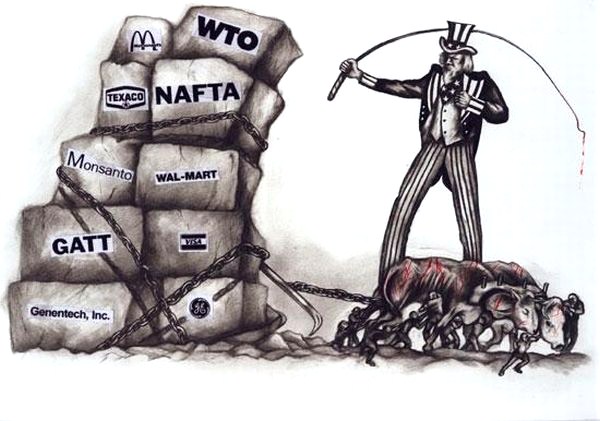
“America First” is an understatement here. The underlying premise is that Uncle Sam owns the world and reserves the right to bomb the hell out of anyone who doesn’t agree with that (to quote President George H.W. Bush after the first Gulf War in 1991: “What we say goes.”

Investment Not Democracy

It’s nothing new. From the start, the “American Century” had nothing to do with advancing democracy. As numerous key U.S. planning documents reveal over and over, the goal of that policy was to maintain and, if necessary, install governments that “favor[ed] private investment of domestic and foreign capital, production for export, and the right to bring profits out of the country,” according to Noam Chomsky. Given the United States’ remarkable possession of half the world’s capital after World War II, Washington elites had no doubt that U.S. investors and corporations would profit the most. Internally, the basic selfish national and imperial objectives were openly and candidly discussed. As the “liberal” and “dovish” imperialist, top State Department planner, and key Cold War architect George F. Kennan explained in “Policy Planning Study 23,” a critical 1948 document:

We have about 50% of the world’s wealth, but only 6.3% of its population. … In this situation, we cannot fail to be the object of envy and resentment. Our real task in the coming period is to devise a pattern of relationships which will permit us to maintain this position of disparity. … To do so, we will have to dispense with all sentimentality and day-dreaming; and our attention will have to be concentrated everywhere on our immediate national objectives. … We should cease to talk about vague and … unreal objectives such as human rights, the raising of the living standards, and democratization. The day is not far off when we are going to have to deal in straight power concepts. The less we are then hampered by idealistic slogans, the better.

The harsh necessity of abandoning “human rights” and other “sentimental” and “unreal objectives” was especially pressing in the global South, what used to be known as the Third World. Washington assigned the vast “undeveloped” periphery of the world capitalist system—Africa, Latin America, Southeast Asia and the energy-rich and thus strategically hyper-significant Middle East—a less than flattering role. It was to “fulfill its major function as a source of raw materials and a market” (actual State Department language) for the great industrial (capitalist) nations (excluding socialist Russia and its satellites, and notwithstanding the recent epic racist-fascist rampages of industrial Germany and Japan). It was to be exploited both for the benefit of U.S. corporations/investors and for the reconstruction of Europe and Japan as prosperous U.S. trading and investment partners organized on capitalist principles and hostile to the Soviet bloc.

“Democracy” was fine as a slogan and benevolent, idealistic-sounding mission statement when it came to marketing this imperialist U.S. policy at home and abroad. Since most people in the “third” or “developing” world had no interest in neocolonial subordination to the rich nations and subscribed to what U.S. intelligence officials considered the heretical “idea that government has direct responsibility for the welfare of its people” (what U.S. planners called “communism”), Washington’s real-life commitment to popular governance abroad was strictly qualified, to say the least.

“Democracy” was suitable to the U.S. as long as its outcomes comported with the interests of U.S. investors/corporations and related U.S. geopolitical objectives. Democracy had to be abandoned, undermined and/or crushed when it threatened those investors/corporations and the broader imperatives of business rule to any significant degree. As President Richard Nixon’s coldblooded national security adviser Henry Kissinger explained in June 1970, three years before the U.S. sponsored a bloody fascist coup that overthrew Chile’s democratically elected socialist president, Salvador Allende: “I don’t see why we need to stand by and watch a country go Communist because of the irresponsibility of its own people.”

The U.S.-sponsored coup government that murdered Allende would kill tens of thousands of real and alleged leftists with Washington’s approval. The Yankee superpower sent some of its leading neoliberal economists and policy advisers to help the blood-soaked Pinochet regime turn Chile into a “free market” model and to help Chile write capitalist oligarchy into its national constitution.

“Since 1945, by deed and by example,” the great Australian author, commentator and filmmaker John Pilger wrote nearly nine years ago, “the U.S. has overthrown 50 governments, including democracies, crushed some 30 liberation movements and supported tyrannies from Egypt to Guatemala (see William Blum’s histories). Bombing is apple pie.” Along the way, Washington has crassly interfered in elections in dozens of “sovereign” nations, something curious to note in light of current liberal U.S. outrage over real or alleged Russian interference in “our” supposedly democratic electoral process in 2016. Uncle Sam also has bombed civilians in 30 countries, attempted to assassinate foreign leaders and deployed chemical and biological weapons.

If we “consider only Latin America since the 1950s,” writes the sociologist Howard Waitzkin:

[T]he United States has used direct military invasion or has supported military coups to overthrow elected governments in Guatemala, the Dominican Republic, Chile, Haiti, Grenada, and Panama. In addition, the United States has intervened with military action to suppress revolutionary movements in El Salvador, Nicaragua, and Bolivia. More recently … the United States has spent tax dollars to finance and help organize opposition groups and media in Honduras, Paraguay, and Brazil, leading to congressional impeachments of democratically elected presidents. Hillary Clinton presided over these efforts as Secretary of State in the Obama administration, which pursued the same pattern of destabilization in Venezuela, Ecuador, Argentina, Chile, and Bolivia.

Death Count: In the Millions

The death count resulting from “American Era” U.S. foreign policy runs well into the many millions, including possibly as many as 5 million Indochinese killed by Uncle Sam and his agents and allies between 1962 and 1975. The flat-out barbarism of the American war on Vietnam is widely documented on record. The infamous My Lai massacre of March 16, 1968, when U.S. Army soldiers slaughtered more than 350 unarmed civilians—including terrified women holding babies in their arms—in South Vietnam was no isolated incident in the U.S. “crucifixion of Southeast Asia” (Noam Chomsky’s phrase at the time). U.S. Army Col. Oran Henderson, who was charged with covering up the massacre, candidly told reporters that “every unit of brigade size has its My Lai hidden somewhere.”

It is difficult, sometimes, to wrap one’s mind around the extent of the savagery the U.S. has unleashed on the world to advance and maintain its global supremacy. In the early 1950s, the Harry Truman administration responded to an early challenge to U.S. power in Northern Korea with a practically genocidal three-year bombing campaign that was described in soul-numbing terms by the Washington Post years ago:

The bombing was long, leisurely and merciless, even by the assessment of America’s own leaders. ‘Over a period of three years or so, we killed off—what—20 percent of the population,’ Air Force Gen. Curtis LeMay, head of the Strategic Air Command during the Korean War, told the Office of Air Force History in 1984. Dean Rusk, a supporter of the war and later Secretary of State, said the United States bombed ‘everything that moved in North Korea, every brick standing on top of another.’ After running low on urban targets, U.S. bombers destroyed hydroelectric and irrigation dams in the later stages of the war, flooding farmland and destroying crops … [T]he U.S. dropped 635,000 tons of explosives on North Korea, including 32,557 tons of napalm, an incendiary liquid that can clear forested areas and cause devastating burns to human skin.

Gee, why does North Korea fear and hate us?

This ferocious bombardment, which killed 2 million or more civilians, began five years after Truman arch-criminally and unnecessarily ordered the atom bombing of hundreds of thousands pf civilians in Hiroshima and Nagasaki to warn the Soviet Union to stay out of Japan and Western Europe.

Some benevolent “world policeman.”

The ferocity of U.S. foreign policy in the “America Era” did not always require direct U.S. military intervention. Take Indonesia and Chile, for two examples from the “Golden Age” height of the “American Century.” In Indonesia, the U.S.-backed dictator Suharto killed millions of his subjects, targeting communist sympathizers, ethnic Chinese and alleged leftists. A senior CIA operations officer in the 1960s later described Suharto’s 1965-66 U.S.-assisted coup as s “the model operation” for the U.S.-backed coup that eliminated the democratically elected president of Chile, Salvador Allende, seven years later. “The CIA forged a document purporting to reveal a leftist plot to murder Chilean military leaders,” the officer wrote, “[just like] what happened in Indonesia in 1965.”

As Pilger noted 10 years ago, “the U.S. embassy in Jakarta supplied Suharto with a ‘zap list’ of Indonesian Communist party members and crossed off the names when they were killed or captured. … The deal was that Indonesia under Suharto would offer up what Richard Nixon had called ‘the richest hoard of natural resources, the greatest prize in south-east Asia.’ ”

“No single American action in the period after 1945,” wrote the historian Gabriel Kolko, “was as bloodthirsty as its role in Indonesia, for it tried to initiate [Suharto’s] massacre.”

Two years and three months after the Chilean coup, Suharto received a green light from Kissinger and the Gerald Ford White House to invade the small island nation of East Timor. With Washington’s approval and backing, Indonesia carried out genocidal massacres and mass rapes and killed at least 100,000 of the island’s residents.

Mideast Savagery

Among the countless episodes of mass-murderous U.S. savagery in the oil-rich Middle East over the last generation, few can match for the barbarous ferocity of the “Highway of Death,” where the “global policeman’s” forces massacred tens of thousands of surrendered Iraqi troops retreating from Kuwait on Feb. 26 and 27, 1991. Journalist Joyce Chediac testified that:

U.S. planes trapped the long convoys by disabling vehicles in the front, and at the rear, and then pounded the resulting traffic jams for hours. ‘It was like shooting fish in a barrel,’ said one U.S. pilot. On the sixty miles of coastal highway, Iraqi military units sit in gruesome repose, scorched skeletons of vehicles and men alike, black and awful under the sun … for 60 miles every vehicle was strafed or bombed, every windshield is shattered, every tank is burned, every truck is riddled with shell fragments. No survivors are known or likely. … ‘Even in Vietnam I didn’t see anything like this. It’s pathetic,’ said Major Bob Nugent, an Army intelligence officer. … U.S. pilots took whatever bombs happened to be close to the flight deck, from cluster bombs to 500-pound bombs. … U.S. forces continued to drop bombs on the convoys until all humans were killed. So many jets swarmed over the inland road that it created an aerial traffic jam, and combat air controllers feared midair collisions. … The victims were not offering resistance. … [I]t was simply a one-sided massacre of tens of thousands of people who had no ability to fight back or defend.

The victims’ crime was having been conscripted into an army controlled by a dictator perceived as a threat to U.S. control of Middle Eastern oil. President George H.W. Bush welcomed the so-called Persian Gulf War as an opportunity to demonstrate America’s unrivaled power and new freedom of action in the post-Cold War world, where the Soviet Union could no longer deter Washington. Bush also heralded the “war” (really a one-sided imperial assault) as marking the end of the “Vietnam Syndrome,” the reigning political culture’s curious term for U.S. citizens’ reluctance to commit U.S. troops to murderous imperial mayhem.

As Chomsky observed in 1992, reflecting on U.S. efforts to maximize suffering in Vietnam by blocking economic and humanitarian assistance to the nation it had devastated: “No degree of cruelty is too great for Washington sadists.”

But Uncle Sam was only getting warmed up building his Iraqi body count in early 1991. Five years later, Bill Clinton’s U.S. Secretary of State Madeline Albright told CBS News’ Leslie Stahl that the death of 500,000 Iraqi children due to U.S.-led economic sanctions imposed after the first “Persian Gulf War” (a curious term for a one-sided U.S. assault) was a “price … worth paying” for the advancement of inherently noble U.S. goals.

“The United States,” Secretary Albright explained three years later, “is good. We try to do our best everywhere.”

In the years following the collapse of the counter-hegemonic Soviet empire, however, American neoliberal intellectuals like Thomas Friedman—an advocate of the criminal U.S. bombing of Serbia—felt free to openly state that the real purpose of U.S. foreign policy was to underwrite the profits of U.S.-centered global capitalism. “The hidden hand of the market,” Friedman famously wrote in The New York Times Magazine in March 1999, as U.S. bombs and missiles exploded in Serbia, “will never work without a hidden fist. McDonald’s cannot flourish without McDonnell Douglas, the designer of the F-15. And the hidden fist that keeps the world safe for Silicon Valley’s technologies to flourish is called the U.S. Army, Air Force, Navy and Marine Corps.”

In a foreign policy speech Sen. Barack Obama gave to the Chicago Council of Global Affairs on the eve of announcing his candidacy for the U.S. presidency in the fall of 2006, Obama had the audacity to say the following in support of his claim that U.S. citizens supported “victory” in Iraq: “The American people have been extraordinarily resolved. They have seen their sons and daughters killed or wounded in the streets of Fallujah.”

It was a spine-chilling selection of locales. In 2004, the ill-fated city was the site of colossal U.S. war atrocities, crimes including the indiscriminate murder of thousands of civilians, the targeting even of ambulances and hospitals, and the practical leveling of an entire city by the U.S. military in April and November. By one account, “Incoherent Empire,” Michael Mann wrote:

The U.S. launched two bursts of ferocious assault on the city, in April and November of 2004 … [using] devastating firepower from a distance which minimizes U.S. casualties. In April … military commanders claimed to have precisely targeted … insurgent forces, yet the local hospitals reported that many or most of the casualties were civilians, often women, children, and the elderly… [reflecting an] intention to kill civilians generally. … In November … [U.S.] aerial assault destroyed the only hospital in insurgent territory to ensure that this time no one would be able to document civilian casualties. U.S. forces then went through the city, virtually destroying it. Afterwards, Fallujah looked like the city of Grozny in Chechnya after Putin’s Russian troops had razed it to the ground.

The “global policeman’s” deployment of radioactive ordnance (depleted uranium) in Fallujah created an epidemic of infant mortality, birth defects, leukemia and cancer there.

‘Bug-Splat’

Fallujah was just one especially graphic episode in a broader arch-criminal invasion that led to the premature deaths of at least 1 million Iraqi civilians and left Iraq as what Tom Engelhardt called “a disaster zone on a catastrophic scale hard to match in recent memory.” It reflected the same callous mindset behind the Pentagon’s early computer program name for ordinary Iraqis certain to be killed in the 2003 invasion: “bug-splat.” America’s petro-imperial occupation led to the death of as many as one million Iraqi “bugs” (human beings). According to the respected journalist Nir Rosen in December 2007, “Iraq has been killed. … [T]he American occupation has been more disastrous than that of the Mongols who sacked Baghdad in the thirteenth century.”

As the Senate is poised to confirm an alleged torturer as CIA director it is important to remember that along with death in Iraq came ruthless and racist torture. In an essay titled “I Helped Create ISIS,” Vincent Emanuele, a former U.S. Marine, recalled his enlistment in an operation that gave him nightmares more than a decade later:

I think about the hundreds of prisoners we took captive and tortured in makeshift detention facilities. … I vividly remember the marines telling me about punching, slapping, kicking, elbowing, kneeing and head-butting Iraqis. I remember the tales of sexual torture: forcing Iraqi men to perform sexual acts on each other while marines held knives against their testicles, sometimes sodomizing them with batons. … [T]hose of us in infantry units … round[ed] up Iraqis during night raids, zip-tying their hands, black-bagging their heads and throwing them in the back of HUMVEEs and trucks while their wives and kids collapsed to their knees and wailed. … Some of them would hold hands while marines would butt-stroke the prisoners in the face. … [W]hen they were released, we would drive them from the FOB (Forward Operating Base) to the middle of the desert and release them several miles from their homes. … After we cut their zip-ties and took the black bags off their heads, several of our more deranged marines would fire rounds from their AR-15s into their air or ground, scaring the recently released captives. Always for laughs. Most Iraqis would run, still crying from their long ordeal.

The award-winning journalist Seymour Hersh told the ACLU about the existence of classified Pentagon evidence files containing films of U.S-“global policeman” soldiers sodomizing Iraqi boys in front of their mothers behind the walls of the notorious Abu Ghraib prison. “You haven’t begun to see [all the] … evil, horrible things done [by U.S. soldiers] to children of women prisoners, as the cameras run,” Hersh told an audience in Chicago in the summer of 2014.

It isn’t just Iraq where Washington has wreaked sheer mass murderous havoc in the Middle East, always a region of prime strategic significance to the U.S. thanks to its massive petroleum resources. In a recent Truthdig reflection on Syria, historian Dan Lazare reminds us that:

[Syrian President Assad’s] Baathist crimes pale in comparison to those of the U.S., which since the 1970s has invested trillions in militarizing the Persian Gulf and arming the ultra-reactionary petro-monarchies that are now tearing the region apart. The U.S. has provided Saudi Arabia with crucial assistance in its war on Yemen, it has cheered on the Saudi blockade of Qatar, and it has stood by while the Saudis and United Arab Emirates send in troops to crush democratic protests in neighboring Bahrain. In Syria, Washington has worked hand in glove with Riyadh to organize and finance a Wahhabist holy war that has reduced a once thriving country to ruin.

Chomsky has called Barack Obama’s targeted drone assassination program “the most extensive global terrorism campaign the world has yet seen.” The program “officially is aimed at killing people who the administration believes might someday intend to harm the U.S. and killing anyone else who happens to be nearby.” As Chomsky adds, “It is also a terrorism generating campaign—that is well understood by people in high places. When you murder somebody in a Yemen village, and maybe a couple of other people who are standing there, the chances are pretty high that others will want to take revenge.”

The Last, Best Hope

“We lead the world,” presidential candidate Obama explained, “in battling immediate evils and promoting the ultimate good. … America is the last, best hope of earth.”

Obama elaborated in his first inaugural address. “Our security,” the president said, “emanates from the justness of our cause; the force of our example; the tempering qualities of humility and restraint”—a fascinating commentary on Fallujah, Hiroshima, the U.S. crucifixion of Southeast Asia, the “Highway of Death” and more.

Within less than half a year of his inauguration and his lauded Cairo speech, Obama’s rapidly accumulating record of atrocities in the Muslim world would include the bombing of the Afghan village of Bola Boluk. Ninety-three of the dead villagers torn apart by U.S. explosives in Bola Boluk were children. “In a phone call played on a loudspeaker on Wednesday to outraged members of the Afghan Parliament,” The New York Times reported, “the governor of Farah Province … said that as many as 130 civilians had been killed.” According to one Afghan legislator and eyewitness, “the villagers bought two tractor trailers full of pieces of human bodies to his office to prove the casualties that had occurred. Everyone at the governor’s cried, watching that shocking scene.” The administration refused to issue an apology or to acknowledge the “global policeman’s” responsibility.

By telling and sickening contrast, Obama had just offered a full apology and fired a White House official because that official had scared New Yorkers with an ill-advised Air Force One photo-shoot flyover of Manhattan that reminded people of 9/11. The disparity was extraordinary: Frightening New Yorkers led to a full presidential apology and the discharge of a White House staffer. Killing more than 100 Afghan civilians did not require any apology.

Reflecting on such atrocities the following December, an Afghan villager was moved to comment as follows: “Peace prize? He’s a killer. … Obama has only brought war to our country.” The man spoke from the village of Armal, where a crowd of 100 gathered around the bodies of 12 people, one family from a single home. The 12 were killed, witnesses reported, by U.S. Special Forces during a late-night raid.

Obama was only warming up his “killer” powers. He would join with France and other NATO powers in the imperial decimation of Libya, which killed more than 25,000 civilians and unleashed mass carnage in North Africa. The U.S.-led assault on Libya was a disaster for black Africans and sparked the biggest refugee crisis since World War II.

Two years before the war on Libya, the Obama administration helped install a murderous right-wing coup regime in Honduras. Thousands of civilians and activists have been murdered by that regime.

The clumsy and stupid Trump has taken the imperial baton from the elegant and silver-tongued “imperial grandmaster” Obama, keeping the superpower’s vast global military machine set on kill. As Newsweek reported last fall, in a news item that went far below the national news radar screen in the age of the endless insane Trump clown show:

According to research from the nonprofit monitoring group Airwars … through the first seven months of the Trump administration, coalition air strikes have killed between 2,800 and 4,500 civilians. … Researchers also point to another stunning trend—the ‘frequent killing of entire families in likely coalition airstrikes.’ In May, for example, such actions led to the deaths of at least 57 women and 52 children in Iraq and Syria. … In Afghanistan, the U.N. reports a 67 percent increase in civilian deaths from U.S. airstrikes in the first six months of 2017 compared to the first half of 2016.

That Trump murders with less sophistication, outward moral restraint and credible claim to embody enlightened Western values and multilateral commitment than Obama did is perhaps preferable to some degree. It is better for empire to be exposed in its full and ugly nakedness, to speed its overdue demise.

The U.S. is not just the top menace only to peace on Earth. It is also the leading threat to personal privacy (as was made clearer than ever by the Edward Snowden revelations), to democracy (the U.S. funds and equips repressive regimes around the world) and to a livable global natural environment (thanks in no small part to its role as headquarters of global greenhouse gassing and petro-capitalist climate denial).

The world can be forgiven, perhaps, if it does not join Eliot Cohen and Karl Vick in bemoaning the end of the “American Era,” whatever Trump’s contribution to that decline, which was well underway before he entered the Oval Office.

Ordinary Americans, too, can find reasons to welcome the decline of the American empire. As Chomsky noted in the late 1960s: “The costs of empire are in general distributed over the society as a whole, while its profits revert to a few within.”

The Pentagon system functions as a great form of domestic corporate welfare for high-tech “defense” (empire) firms like Lockheed Martin, Boeing and Raytheon—this while it steals trillions of dollars that might otherwise meet social and environmental needs at home and abroad. It is a significant mode of upward wealth distribution within “the homeland.”

The biggest costs have fallen on the many millions killed and maimed by the U.S. military and allied and proxy forces in the last seven decades and before. The victims include the many U.S. military veterans who have killed themselves, many of them haunted by their own participation in sadistic attacks and torture on defenseless people at the distant command of sociopathic imperial masters determined to enforce U.S. hegemony by any and all means deemed necessary.

We Have Met the Alien and He Is Us

73e633dab43437b78c926c0403c06bcc

By William Astore

Source: TomDispatch.com

We Are The Empire
Of U.S. Military Interventions, Alien Disaster Movies, and Star Wars
By William J. Astore

Perhaps you’ve heard the expression: “We have met the enemy and he is us.” Cartoonist Walt Kelly’s famed possum, Pogo, first uttered that cry. In light of alien disaster movies like the recent sequel Independence Day: Resurgence and America’s disastrous wars of the twenty-first century, I’d like to suggest a slight change in that classic phrase: we have met the alien and he is us.

Allow me to explain. I grew up reading and watching science fiction with a fascination that bordered on passion. In my youth, I also felt great admiration for the high-tech, futuristic nature of the U.S. military. When it came time for college, I majored in mechanical engineering and joined the U.S. Air Force. On graduating, I would immediately be assigned to one of the more high-tech, sci-fi-like (not to say apocalyptic) military settings possible: Air Force Space Command’s Cheyenne Mountain.

For those of you who don’t remember the looming, end-of-everything atmosphere of the Cold War era, Cheyenne Mountain was a nuclear missile command center tunneled out of solid granite inside an actual mountain in Colorado. In those days, I saw myself as one of the good guys, protecting America from “alien” invasions and the potential nuclear obliteration of the country at the hands of godless communists from the Soviet Union. The year was 1985 and back then my idea of an “alien” invasion movie was Red Dawn, a film in which the Soviets and their Cuban allies invade the U.S., only to be turned back by a group of wolverine-like all-American teen rebels. (Think: the Vietcong, American-style, since the Vietnam War was then just a decade past.)

Strange to say, though, as I progressed through the military, I found myself growing increasingly uneasy about my good-guy stature and about who exactly was doing what to whom. Why, for example, did we invade Iraq in 2003 when that country had nothing to do with the attacks of 9/11? Why were we so focused on dominating the Earth’s resources, especially its oil? Why, after declaring total victory over the “alien” commies in 1991 and putting the Cold War to bed for forever (or so it seemed then), did our military continue to strive for “global reach, global power” and what, with no sense of overreach or irony, it liked to call “full-spectrum dominance”?

Still, whatever was simmering away inside me, only when I retired from the Air Force in 2005 did I fully face what had been staring back at me all those years: I had met the alien, and he was me.

The Alien Nature of U.S. Military Interventions

The latest Independence Day movie, despite earning disastrous reviews, is probably still rumbling its way through a multiplex near you. The basic plot hasn’t changed: ruthless aliens from afar (yet again) invade, seeking to exploit our precious planet while annihilating humanity (something that, to the best of our knowledge, only we are actually capable of). But we humans, in such movies as in reality, are a resilient lot. Enough of the plucky and the lucky emerge from the rubble to organize a counterattack. Despite being outclassed by the aliens’ shockingly superior technology and awe-inspiring arsenal of firepower, humanity finds a way to save the Earth while — you won’t be surprised to know — thoroughly thrashing said aliens.

Remember the original Independence Day from two decades ago? Derivative and predictable it may have been, but it was also a campy spectacle — with Will Smith’s cigar-chomping military pilot, Bill Pullman’s kickass president in a cockpit, and the White House being blown to smithereens by those aliens. That was 1996. The Soviet Union was half-a-decade gone and the U.S. was the planet’s “sole superpower.” Still, who knew that seven years later, on the deck of an aircraft carrier, an all-too-real American president would climb out of a similar cockpit in a flight suit, having essentially just blown part of the Middle East to smithereens, and declare his very own “mission accomplished” moment?

In the aftermath of the invasion of Afghanistan and the “shock and awe” assault on Iraq, the never-ending destructiveness of the wars that followed, coupled with the U.S. government’s deployment of deadly robotic drones and special ops units across the globe, alien invasion movies aren’t — at least for me — the campy fun they once were, and not just because the latest of them is louder, dumber, and more cliché-ridden than ever. I suspect that there’s something else at work as well, something that’s barely risen to consciousness here: in these years, we’ve morphed into the planet’s invading aliens.

Think about it. Over the last half-century, whenever and wherever the U.S. military “deploys,” often to underdeveloped towns and villages in places like Vietnam, Afghanistan, or Iraq, it arrives very much in the spirit of those sci-fi aliens. After all, it brings with it dazzlingly destructive futuristic weaponry and high-tech gadgetry of all sorts (known in the military as “force-multipliers”). It then proceeds to build mothership-style bases that are often like American small towns plopped down in a new environment. Nowadays in such lands, American drones patrol the skies (think: the Terminator films), blast walls accented with razor wire and klieg lights provide “force protection” on the ground, and the usual attack helicopters, combat jets, and gunships hover overhead like so many alien craft. To designate targets to wipe out, U.S. forces even use lasers!

In the field, American military officers emerge from high-tech vehicles to bark out commands in a harsh “alien” tongue. (You know: English.) Even as American leaders offer reassuring words to the natives (and to the public in “the homeland”) about the U.S. military being a force for human liberation, the message couldn’t be more unmistakable if you happen to be living in such countries: the “aliens” are here, and they’re planning to take control, weapons loaded and ready to fire.

Other U.S. military officers have noticed this dynamic. In 2004, near Samarra in Iraq’s Salahuddin province, for instance, then-Major Guy Parmeter recalled asking a farmer if he’d “seen any foreign fighters” about. The farmer’s reply was as simple as it was telling: “Yes, you.” Parmeter noted, “You have a bunch of epiphanies over the course of your experience here [in Iraq], and it made me think: How are we perceived, who are we to them?”

Americans may see themselves as liberators, but to the Iraqis and so many other peoples Washington has targeted with its drones, jets, and high-tech weaponry, we are the invaders.

Do you recall what the aliens were after in the first Independence Day movie? Resources. In that film, they were compared to locusts, traveling from planet to planet, stripping them of their valuables while killing their inhabitants. These days, that narrative should sound a lot less alien to us. After all, would Washington have committed itself quite so fully to the Greater Middle East if it hadn’t possessed all that oil so vital to our consumption-driven way of life? That’s what the Carter Doctrine of 1980 was about: it defined the Persian Gulf as a U.S. “vital interest” precisely because, to quote former Deputy Secretary of Defense Paul Wolfowitz’s apt description of Iraq, it “floats on a sea of oil.”

Of Cold War Memories and Imperial Storm Troopers

Whether anyone notices or not, alien invasion flicks offer a telling analogy when it comes to the destructive reality of Washington’s global ambitions; so, too, do “space operas” like Star Wars. I’m a fan of George Lucas’s original trilogy, which appeared in my formative years. When I saw them in the midst of the Cold War, I never doubted that Darth Vader’s authoritarian Empire in a galaxy far, far away was the Soviet Union. Weren’t the Soviets, whom President Ronald Reagan would dub “the evil empire,” bent on imperial domination? Didn’t they have the equivalent of storm troopers, and wasn’t it our job to “contain” that threat?

Like most young Americans then, I saw myself as a plucky rebel, a mixture of the free-wheeling, wisecracking Han Solo and the fresh-faced, idealistic Luke Skywalker. Of course, George Lucas had a darker, more complex vision in mind, one in which President Richard Nixon, not some sclerotic Soviet premier, provided a model for the power-mad emperor, while the lovable Ewoks in The Return of the Jedi — with their simple if effective weaponry and their anti-imperial insurgent tactics — were clearly meant to evoke Vietnamese resistance forces in an American war that Lucas had loathed. But few enough Americans of the Cold War-era thought in such terms. (I didn’t.) It went without question that we weren’t the heartless evil empire. We were the Jedi! And metaphorically speaking, weren’t we the ones who, in the end, blew up the Soviet Death Star and won the Cold War?

How, then, did an increasingly gargantuan Pentagon become the Death Star of our moment? We even had our own Darth Vader in Dick Cheney, a vice president who actually took pride in the comparison.

Think for a moment, dear reader, about the optics of a typical twenty-first-century U.S. military intervention. As our troops deploy to places that for most Americans might as well be in a galaxy far, far away, with all their depersonalizing body armor and high-tech weaponry, they certainly have the look of imperial storm troopers.

I’m hardly the first person to notice this. As Iraq war veteran Roy Scranton recently wrote in the New York Times, “I was the faceless storm trooper, and the scrappy rebels were the Iraqis.” Ouch.

American troops in that country often moved about in huge MRAPs (mine-resistant, ambush-protected vehicles) described to me by an Army battalion commander as “ungainly” and “un-soldier like.” Along with M1 Abrams tanks and Bradley fighting vehicles, those MRAPs were the American equivalents of the Imperial Walkers in Star Wars. Such vehicles, my battalion commander friend noted drolly, were “not conducive to social engagements with Iraqis.”

It’s not the fault of the individual American soldier that, in these years, he’s been outfitted like a Star Wars storm trooper. His equipment is designed to be rugged and redundant, meaning difficult to break, but it comes at a cost. In Iraq, U.S. troops were often encased in 80 to 100 pounds of equipment, including a rifle, body armor, helmet, ammunition, water, radio, batteries, and night-vision goggles. And, light as they are, let’s not forget the ominous dark sunglasses meant to dim the glare of Iraq’s foreign sun.

Now, think how that soldier appeared to ordinary Iraqis — or Afghans, Yemenis, Libyans, or almost any other non-Western people. Wouldn’t he or she seem both intimidating and foreign, indeed, hostile and “alien,” especially while pointing a rifle at you and jabbering away in a foreign tongue? Of course, in Star Wars terms, it went both ways in Iraq. A colleague told me that during her time there, she heard American troops refer to Iraqis as “sand people,” the vicious desert raiders and scavengers of Star Wars. If “they” seem like vicious aliens to us, should we be surprised that we just might seem that way to them?

Meanwhile, consider the American enemy, whether the Taliban, al-Qaeda, or any of our other opponents of this era. Typically unburdened by heavy armor and loads of equipment, they move around in small bands, improvising as they go. Such “terrorists” — or “freedom fighters,” take your pick — more closely resemble (optically, at least) the plucky human survivors of Independence Day or the ragtag yet determined rebels of Star Wars than heavy patrols of U.S. troops do.

Now, think of the typical U.S. military response to the nimbleness and speed of such “rebels.” It usually involves deploying yet more and bigger technologies. The U.S. has even sent its version of Imperial Star Destroyers (we call them B-52s) to Syria and Iraq to take out “rebels” riding their version of Star Wars “speeders” (i.e. Toyota trucks).

To navigate and negotiate the complex “human terrain” (actual U.S. Army term) of “planets” like Iraq and Afghanistan, U.S. troops call on a range of space-age technologies, including direction-finding equipment, signal intercept, terrain modeling, and satellite navigation using GPS. The enemy, being part of that “human terrain,” has little need for such technology to “master” it. Since understanding alien cultures and their peculiar “human terrains” is not its forte, the U.S. military has been known to hire anthropologists to help it try to grasp the strange behaviors of the peoples of Planet Iraq and Planet Afghanistan.

Yet unlike the evil empire of Star Wars or the ruthless aliens of Independence Day, the U.S. military never claimed to be seeking total control (or destruction) of the lands it invaded, nor did it claim to desire the total annihilation of their populations (unless you count the “carpet bombing” fantasies of wannabe Sith Lord Ted Cruz). Instead, it promised to leave quickly once its liberating mission was accomplished, taking its troops, attack craft, and motherships with it.

After 15 years and counting on Planet Afghanistan and 13 on Planet Iraq, tell me again how those promises have played out.

In a Galaxy Far, Far Away

Consider it an irony of alien disaster movies that they manage to critique U.S. military ambitions vis-à-vis the “primitive” natives of far-off lands (even if none of us and few of the filmmakers know it). Like it or not, as the world’s sole superpower, dependent on advanced technology to implement its global ambitions, the U.S. provides a remarkably good model for the imperial and imperious aliens of our screen life.

We Americans, proud denizens of the land of the gun and of the only superpower left standing, don’t, of course, want to think of ourselves as aliens. Who does? We go to movies like Independence Day or Star Wars to identify with the outgunned rebels. Evidence to the contrary, we still think of ourselves as the underdogs, the rebels, the liberators. And so — I still believe — we once were, a long time ago in a galaxy far, far away.

We need to get back to that time and that galaxy. But we don’t need a high-tech time machine or sci-fi wormhole to do so. Instead, we need to take a long hard look at ourselves. Like Pogo, we need to be willing to see the evidence of our own invasive nature. Only then can we begin to become the kind of land we say we want to be.


A TomDispatch regular, William Astore is a retired lieutenant colonel (USAF) and history professor. He blogs at Bracing Views.

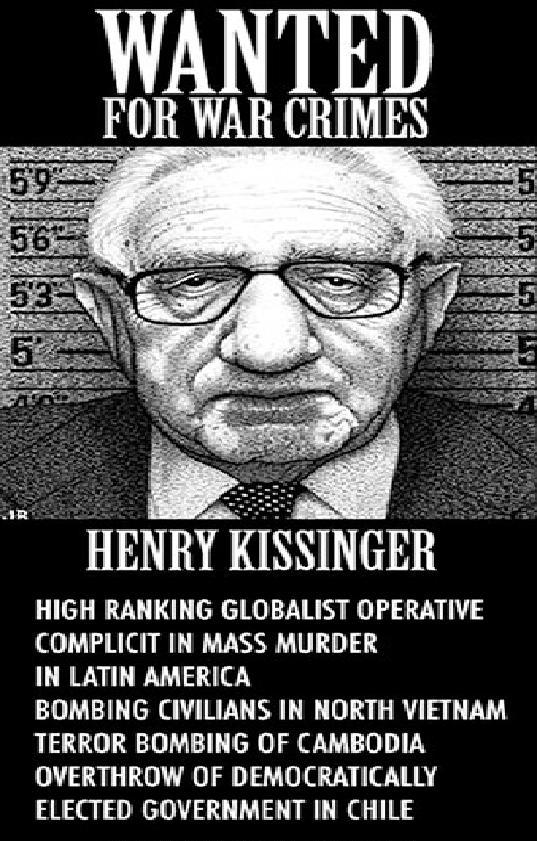
Who’s the “Low Life Scum:” Kissinger or CODEPINK?

kissinger-wanted

By Medea Benjamin

Source: Information Clearing House

A very angry Senator John McCain denounced CodePink activists as “low-life scum” for holding up signs reading “Arrest Kissinger for War Crimes” and dangling handcuffs next to Henry Kissinger’s head during a Senate hearing on January 29. McCain called the demonstration “disgraceful, outrageous and despicable,” accused the protesters of “physically intimidating” Kissinger and apologized profusely to his friend for this “deeply troubling incident.”

But if Senator McCain was really concerned about physical intimidation, perhaps he should have conjured up the memory of the gentle Chilean singer/songwriter Victor Jara. After Kissinger facilitated the September 11, 1973 coup against Salvador Allende that brought the ruthless Augusto Pinochet to power, Victor Jara and 5,000 others were rounded up in Chile’s National Stadium. Jara’s hands were smashed and his nails torn off; the sadistic guards then ordered him to play his guitar. Jara was later found dumped on the street, his dead body riddled with gunshot wounds and signs of torture.

Despite warnings by senior US officials that thousands of Chileans were being tortured and slaughtered, then Secretary of State Kissinger told Pinochet, “You did a great service to the West in overthrowing Allende.”

Rather than calling peaceful protesters “despicable,” perhaps Senator McCain should have used that term to describe Kissinger’s role in the brutal 1975 Indonesian invasion of East Timor, which took place just hours after Kissinger and President Ford visited Indonesia. They had given the Indonesian strongman the US green light—and the weapons—for an invasion that led to a 25-year occupation in which over 100,000 soldiers and civilians were killed or starved to death. The UN’s Commission for Reception, Truth and Reconciliation in East Timor (CAVR) stated that U.S. “political and military support were fundamental to the Indonesian invasion and occupation” of East Timor.

If McCain could stomach it, he could have read the report by the UN Commission on Human Rights describing the horrific consequences of that invasion. It includes gang rape of female detainees following periods of prolonged sexual torture; placing women in tanks of water for prolonged periods, including submerging their heads, before being raped; the use of snakes to instill terror during sexual torture; and the mutilation of women’s sexual organs, including insertion of batteries into vaginas and burning nipples and genitals with cigarettes. Talk about physical intimidation, Senator McCain!

You might think that McCain, who suffered tremendously in Vietnam, might be more sensitive to Kissinger’s role in prolonging that war. From 1969 through 1973, it was Kissinger, along with President Nixon, who oversaw the slaughter in Vietnam, Cambodia and Laos—killing perhaps one million during this period. He gave the order for the secret bombing of Cambodia. Kissinger is heard on tape saying, “[Nixon] wants a massive bombing campaign in Cambodia. He doesn’t want to hear anything about it. It’s an order, to be done. Anything that flies or anything that moves.”

Senator McCain could have taken the easy route by simply reading the meticulously researched book by the late Christopher Hitchens, The Trial of Henry Kissinger. Writing as a prosecutor before an international court of law, Hitchens skewers Kissinger for ordering or sanctioning the destruction of civilian populations, the assassination of “unfriendly” politicians and the kidnapping and disappearance of soldiers, journalists and clerics who got in his way. He holds Kissinger responsible for war crimes that range from the deliberate mass killings of civilian populations in Indochina, to collusion in mass murder and assassination in Bangladesh, the overthrow of the democratically elected government in Chile, and the incitement and enabling of genocide in East Timor.

McCain could have also perused the warrant issued by French Judge Roger Le Loire to have Kissinger appear before his court. When the French served Kissinger with summons in 2001 at the Ritz Hotel in Paris, Kissinger fled the country. More indictments followed from Spain, Argentina, Uruguay—even a civil suit in Washington DC.

Hitchens was disgusted by the way Henry Kissinger was treated as a respected statesman. He would have been appalled by Senator McCain’s obsequious attitude. “Kissinger should have the door shut in his face by every decent person and should be shamed, ostracized, and excluded,” Hitchens said. “No more dinners in his honor; no more respectful audiences for his absurdly overpriced public appearances; no more smirking photographs with hostesses and celebrities; no more soliciting of his worthless opinions by sycophantic editors and producers.”

Rather than fawning on him, Hitchens suggested, “why don’t you arrest him?”

Hitchens’ words were lost on Senator McCain, who preferred fawning to accountability. That’s where CodePink comes in. If we can’t get Kissinger before a court of law, at least we can show—with words and banners—that there are Americans who remember, Americans who empathize with the man’s many victims, Americans who have a conscience.

While McCain called us disgraceful, what is really disgraceful is the Senate calling in a tired old war criminal to testify about “Global Challenges and the U.S. National Security Strategy.” After horribly tragic failed wars, not just in Vietnam but over the last decade in Iraq and Afghanistan, it’s time for the US leaders like John McCain to bring in fresh faces and fresh ideas. We owe it to the next generation that will be cleaning up the bloody legacy left behind by Kissinger for years to come.


Saturday Matinee: Combat Shock

combatshock

By Oliver Hall

Source: Dangerous Minds

Frankie’s having a terrible day. His wife and infant son are starving. He’s run out of money and food. Now he’s going to be evicted. He’s got a gun. Let’s hear it for Frankie…

If this sounds familiar, it’s because the story of the 1984 Troma movie Combat Shock bears a striking resemblance to that of Suicide’s harrowing song “Frankie Teardrop.” The movie concerns the struggle of a young man named Frankie to feed his wife and child in blighted Staten Island, and if you’ve heard the song, I don’t have to tell you that it ends pretty badly for Frankie, his family, you, me, and the entire human race.
Frankie isn’t a factory worker in this version of the story, but an unemployed Vietnam vet whose days and nights are continually interrupted by flashbacks of ‘Nam and the torture he suffered at the hands of the VC. These, in turn, lead to flashbacks within flashbacks where, for purposes of exposition, Frankie relives arguments with his father, now estranged because a) Frankie has refused to carry on the family legacy of race hate and b) Dad disapproves of Mrs. Frankie. Suffering through the exposition of any movie is itself a form of torture.

However, these gestures toward the conventions of plot are mercifully few and brief, and Combat Shock soon makes with the laffs and gasps you crave from late-night horror fare. Much of the pleasure of watching Combat Shock comes from the genre detail writer, director, producer and editor Buddy Giovinazzo adds to extend Suicide’s story to feature length. For instance, because of Frankie’s exposure to Agent Orange, and because this is a Troma movie, the child looks like a cross between the Eraserhead baby and Edvard Munch’s screamer.

Until the awful climax, the movie takes its time presenting a loser’s-eye view of urban anomie. If you’ve ever lived in a place that had a TV set, you already know all these characters: Frankie’s slow descent into madness involves demoralizing encounters with small-time hoods (Frankie’s creditors), child prostitutes, junkie thieves and social workers (one of whom is missing a Ronco Veg-O-Matic). There are also one or two thrilling surprises, even for the very jaded.

And in case you somehow feel cheated of your full share of human misery after watching Combat Shock, here’s a kind of sequel to “Frankie Teardrop,” Alan Vega’s 12-minute bum-out “Viet Vet.”

Saturday Matinee: War Documentary Double Feature

large_fKiccFBjZwOKkmsDCQVVcuKgYbxhearts-and-minds

“Hearts and Minds” (1974) and “The Atomic Cafe” (1982) are two of the most chilling and persuasive anti-war documentaries ever made (at least for viewers who are not psychopaths). Though the editorial choices of both films clearly reflect an anti-war perspective, their messages are made more powerful by their lack of narration and abundance of archive footage, newsreels, and public statements from military and political officials. Both documentaries were years in the making with much time (nearly the entire time in the case of The Atomic Cafe) spent on research and editing, and the work clearly pays off by expanding the scope of the films to the political, cultural, and psychological factors behind wars. The filmmakers involved in Hearts and Minds and The Atomic Cafe, unlike most corporate news coverage of wars, both display great empathy in their inclusion of footage of “enemy” casualties of the war and “collateral damage” (ie. innocent victims caught in the crossfire). In the context of the current war-mongering from the Obama administration and corporate/government news media, Hearts and Minds and The Atomic Cafe are more relevant than ever and should be required viewing for everyone who values life.