The Q-Word: Weapon of Choice for Smearing Opponents

By Trevor Scott FitzGibbon

Source: Consortium News

One of the most effective information-operation weapons during the 2016 presidential election was to smear political targets as “Russian bots” working on behalf of the Kremlin. Journalists were de-platformed, presidential candidates were smeared, and lives were immeasurably damaged.

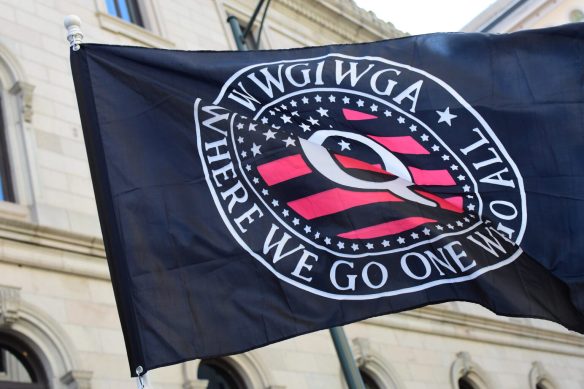
The art of attacking political targets by using open-sourced guilt-by-association is not new — nor is using Russians as foils. Joseph McCarthy and his ilk did it in the 1950s with “red-baiting” and the FBI tried to do it to Paul Robeson, Martin Luther King Jr. and others. Today that disgraceful tactic has reemerged. The smear du jour is to accuse someone of supporting the insane QAnon conspiracy — even if they don’t.

Assassinating the character of political opponents for “supporting” Q has migrated from dubious online provocateurs to television news programming. Suddenly, it seems as if every other word out of certain hosts and pundits on cable news shows begins with “Q,” and that a majority of Democrats sit around the dinner table every night discussing the conspiracy and how it is impacting Timmy’s fourth-grade class.

Ironically, according to the most recent Pew Research Center poll, while close to half the country has heard of QAnon, the majority of them are Democrats.  Awareness of Q increased dramatically from 23 percent in March to 47 percent in September.

One reason for this is that the effort to hype the fringe conspiracy group has grown quickly. Increasingly, money flows to digital mercenaries to shame and cyberstalk not only individual targets but entire voting blocs.

QAnon is an idea with no structure, no chain of command and no rules. Anybody can pick up a YouTube channel or another social media account and claim to be an anonymous insider — and exploit and project whatever insane claim they want to make. With the rise of social media and recruitment of virtual reality and “gaming” technologists, these consultants have provided new mediums and taken the art of smearing to a new level.  From slanderous TED Talks to inaccurate documentaries that defame individuals who have nothing to do with QAnon, the damage to the target can be severe.  Often, those making the allegations are reliant on discredited sources.

But we cannot outlaw people who say crazy things. Whether it’s antifa in Portland, outrageous conspiracies from Q, or the Westboro Baptist Church protesting at funerals, the First Amendment protects problematic speech.

Increasingly, and regardless of your political affiliation, if you’re not echoing the establishment narrative, you are vulnerable to attack.

Discrediting Former Intel Members

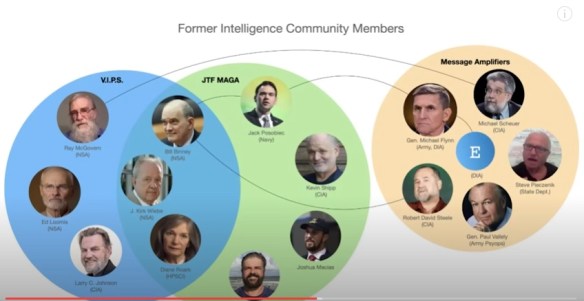
Q character assassination has also been used in an attempt to discredit some of America’s most well-respected former members of the intelligence community, including Veteran Intelligence Professionals for Sanity. The targeting of VIPS members is strategic. One of them is former CIA analyst Ray McGovern, who chaired National Intelligence Estimates and prepared the President’s Daily Brief for Presidents Richard Nixon, Gerald Ford and Ronald Reagan. Another is former NSA technologist Bill Binney, who has also been targeted as part of the “top leadership” of Q.

For a refresher, VIPS is the group that correctly debunked from the outset the bogus “Russiagate” narrative that permeated the Trump presidency. VIPS’ report was spotlighted in The Nation with a story headlined “A New Report Raises Big Questions About Last Year’s DNC Hack.” For that criticism, these leaders were accused of working with Russia.  Fast-forward to 2021 and the exact same leaders are accused of being members of the Q brain trust.

Another troubling trend is the use of foreign operatives to drive the defamation of Americans.  For example, one defamer lives in Mexico while another, who lives in Europe, is a self-described former member of a fringe group known as Anonymous. It begs the question, “Who pays them?”

And what’s the potential risk in all of this as a society?  Those targeted in this way can potentially lose their business, their home, their friends. All because some misguided or politically motivated cyber-mercenary on contract from Washington, D.C., or a foreign country decides to do it.

Many of the same powerful forces who drove Russiagate are the same operatives now driving the Q smears, colluding with YouTube, Twitter and Facebook to do their bidding.  I’ve spoken out publicly and repeatedly against Q because I believe it is a dangerous psychological operation that harms those brainwashed by it and the innocent affected by it.

But for the past few months on social media and cable TV, there has been a dramatic uptick of pundits and shady online operatives turning Q accusations into modern-day Salem witch trials. Q is now a talking point, and painting someone with that brush can completely discredit them — even those who are innocent of the allegation.

On some days, it seems that America has entered the sort of dystopia Aldous Huxley described in his classic novel Brave New World. If this doesn’t give you pause, it should.

Russiagate: The Miserable Truth

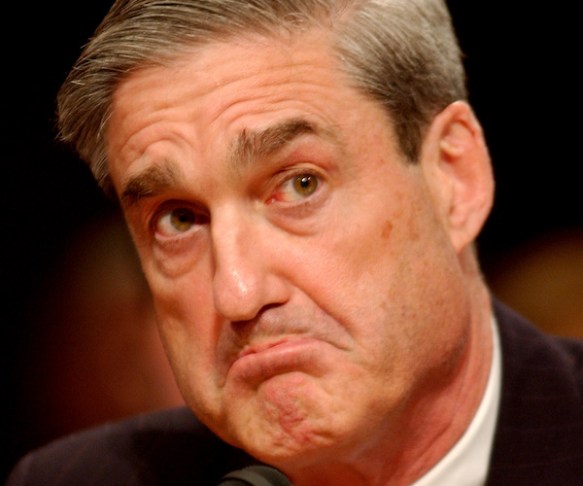
in Washington, DC on April 14, 2004. Robert Mueller named special prosecutor for Russia probe, Washington DC, USA – 17 May 2017 (Rex Features via AP Images)

By Barry Kissin

Source: OpEdNews.com

Introductory Disclaimer: I have never voted Republican for Federal office and I deplore most of what Fox News has to offer. I am currently registered Democrat in order to vote in the Presidential primary for either Bernie Sanders or Tulsi Gabbard.

Going on three years ago, on Nov. 12, 2016, my local newspaper, the Frederick News-Post, published my letter that stated: “Hillary Clinton was a terrible candidate. In an effort to deflect attention from the DNC rigging of her primary contest with Bernie Sanders, she resorted to somehow blaming the Russians. This was part of a pathological pattern, whose ultimate purpose was and is to remove the main obstacle (Russia under Putin) to neo-con schemes for global domination.”

We do not want to further demonize Russia (or Iran). This is unwarranted and dangerous to human survival. Its purpose is to aggressively assert American Empire against all limitations and to justify the astronomical sums we spend on war and weapons.

Hillary touted that all of our 17 intelligence agencies concluded with “high confidence” that the Russians meddled in our election for Trump’s benefit. False. The assessor was John Brennan, then spy-in-chief, who put together a secret panel of his choices from FBI, CIA and NSA in order to produce his miserable invention of the who, how and why the Russians did their dastardly meddling.

See Washington Post, June 23, 2017: “CIA Director John Brennan first alerts the White House in early August [2016] that Russian President Vladimir Putin had ordered an operation to defeat or at least damage Hillary Clinton and help elect her opponent, Donald Trump” based on what Brennan claimed was some source “deep inside the Russian government that detailed Russian President Vladimir Putin’s direct involvement in a cyber campaign”. Which source had supplied “Putin’s specific instructions on the operation’s audacious objectives”? No evidence has ever been produced backing up any of this.

Enter Mueller, a “deep state” hack if there ever was one. It bears mentioning that Mueller is the grandnephew of Richard Bissel, second in command at the CIA when JFK fired him after the Bay of Pigs fiasco. Mueller is married to the granddaughter of General Charles Cabell, third in command at the CIA, also fired by JFK; Mueller’s wife is also a grandniece of Earl Cabell, Mayor of Dallas when JFK was assassinated there, who was recently uncovered to have been a CIA asset. Small world.

Mueller’s career is replete with the production of disinformation and cover-ups. My community, home of Fort Detrick, got a dose of Mueller at work in the Amerithrax investigation. That investigation is the one in which Mueller framed Detrick scientist Bruce Ivins for sending the anthrax letters in order to cover up that the weaponization of the anthrax attack was a unique CIA technology.

On behalf of his current handlers, Mueller sang and danced his way into various indictments, most of which truly had nothing to do with Russiagate, but he couldn’t pull off even trying to nail Trump for collusion.

Of course, this isn’t the end of it. Pathetically, Democrats are pretending that Russiagate was nevertheless worthwhile (thus compounding the stupidity) on the basis that Trump obstructed justice, and also that we now know we have to protect our precious Presidential election from the Russians.

Obstructed what? Obstructed an investigation into the fabricated charge of collusion? Mueller just testified (on July 24) that whatever Trump did, it neither curtailed nor hindered his investigation, which after more than two years could neither find nor manufacture any evidence of collusion.

But now let’s drill down into this mantra of Russian meddling. According to the Mueller report, there were two facets: 1.) hacking of the DNC emails then sourcing to Wikileaks; and 2.) social media campaign. The social media campaign is a joke. The hacking story is more serious.

According to Mueller, it was the Russian company Internet Research Agency (IRA) that on behalf of the Russian government conducted the Facebook campaign. At page 25 of Vol. 1, Mueller informs us that this Russian company purchased 3,500 ads for a total expenditure of $100,000, which I ask you to compare to the $81 million spent on Facebook ads by the Trump and Clinton campaigns.

It’s sillier than that. According to Facebook’s testimony before Congress, most of the ads the IRA purchased were after the election and most said nothing about either Hillary or Trump. But they tended to promote “divisiveness” according to Mueller. Absurd!

We also now have a recently unsealed ruling by the U.S. District Court for D.C. that ordered Mueller to cease and desist from claiming that IRA was acting on behalf of the Kremlin – his linchpin claim — supported by no substantive evidence.

The most credible analyst of the hacking story has been completely (and deliberately) ignored by mainstream media. The implications of his analysis are so unsettling (dangerous) that even most alternative media avoid acknowledging him. But I believe “unsettling” is necessary to the process of waking up from the fairy tales Americans rely on, so I will lay out the truth about the stolen emails. This truth is simple and clear and unsettling.

The “most credible analyst” is named William Binney. He is a 32-year veteran of the NSA who, when he left the NSA in 2001, was the “Technical Leader” for intelligence, the senior technical analyst at the NSA. Binney resigned and blew the whistle when he discovered that his surveillance program was being used to spy on Americans without probable cause. Binney went on to co-found Veteran Intelligence Professionals for Sanity (VIPS) comprised of our smartest and bravest intelligence veterans whose very first effort in Feb., 2003 was to debunk Colin Powell’s UN presentation and to warn against “a war [upon Iraq] for which we see no compelling reason and from which we believe the unintended consequences are likely to be catastrophic.”

The VIPS forensic analysis of the hacking story in all of its painstaking detail can be accessed at ConsortiumNews.com. Here is a takeaway: On July 5, 2016, the intrusion into the DNC emails transferred data at an average speed of 22.7 megabytes per second, a speed that far exceeded the capability of the Internet as of July 2016. The speed of that data transfer corresponds with the speed of copying to a thumb drive (memory stick). Thus, there was no hack via the internet; it was a leak by someone with physical access to a DNC computer or server, most probably an insider.

We know who that insider was. His name, Seth Rich; a 27-year old DNC staffer who supported Bernie Sanders, and who was murdered in Washington, D.C on July 10, 2016. Two gun shots in the back. D.C. police said Rich was the victim of a “random burglary,” but nothing was taken, not his expensive watch, nor his money, nor his credit cards, nor his cell phone.

On August 9, 2016, Julian Assange was interviewed on Dutch TV in a segment available on YouTube at https://www.youtube.com/watch?v=Kp7FkLBRpKg Without violating the Wikileaks cardinal rule of never revealing sources, Assange came as close as he could to identifying Seth Rich as the source of the DNC emails. On that same date, Wikileaks offered a $20,000 reward for information leading to the conviction of Rich’s killer or killers.

William Binney informs us that in response to a FOIA request seeking records of communications between Seth Rich and others including Julian Assange, the NSA revealed that it has 15 documents, 32 pages of relevant records, but that it is all classified.

Next witness, Seymour Hersh. Wikipedia: “Hersh first gained recognition in 1969 for exposing the My Lai Massacre and its cover-up during the Vietnam War, for which he received the 1970 Pulitzer Prize for International Reporting. During the 1970s, Hersh covered Watergate for The New York Times and revealed the clandestine bombing of Cambodia. In 2004, he reported on the US military’s mistreatment of detainees at Abu Ghraib prison. He has won two National Magazine Awards and five George Polk Awards. In 2004, he received the George Orwell Award. More recently, Hersh uncovered that Obama, and Trump in 2017, blamed chemical attacks in Syria on Assad as a pretext for bombing Syria when in fact the chemical attacks were staged by the “rebels” we support.

In Nov. 2016, when Hersh did not realize he was being recorded, the recording became available months later on youtube at https://www.youtube.com/watch?v=rwMKFnzLoxQ , here’s what Hersh said: “All I know comes off an FBI report”. Paraphrasing : The D.C. police got a warrant to search Rich’s apartment. They seized his computer and turned it over to the FBI’s cyber unit. What the [FBI] report says is that sometime in late spring/early summer, [Seth Rich] makes contact with Wikileaks. That’s in his computer; [Rich]; had submitted some juicy emails from the DNC. He offered an extensive sample”, and said, “I want money; anyway Wikileaks got access.

Hersh goes on to say: “Brennan’s an a**hole. I’ve known all these people for years. I have somebody on the inside who will go and read a file for me. This person is unbelievably accurate and careful. He’s a very high level guy. It’s a Brennan operation. [Russiagate] was an American disinformation operation.”

Seth Rich had to be eliminated before Russiagate could be perpetrated.

Moon-Strzok No More, Lisa Page Spills the Beans

The meaning of a crucial text message between two FBI officials appears to have been finally explained, and it’s not good news for the Russia-gate faithful, as Ray McGovern explains.

By Ray McGovern

Source: Consortium News

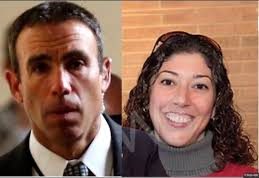
Former FBI attorney Lisa Page has reportedly told a joint committee of the House of Representatives that when FBI counterintelligence official Peter Strzok texted her on May 19, 2017 saying there was “no big there there,” he meant there was no evidence of collusion between the Trump campaign and Russia.

It was clearly a bad-luck day for Strzok, when on Friday the 13th this month Page gave her explanation of the text to the House Judiciary and Oversight/Government Reform Committees and in effect threw her lover, Strzok, under the bus.

Strzok’s apparent admission to Page about there being “no big there there” was reported on Friday by John Solomon in the Opinion section of The Hill based on multiple sources who he said were present during Page’s closed door interview.

Strzok’s text did not come out of the blue. For the previous ten months he and his FBI subordinates had been trying every-which-way to ferret out some “there” — preferably a big “there” — but had failed miserably. If Solomon’s sources are accurate, it is appearing more and more likely that there was nothing left for them to do but to make it up out of whole cloth, with the baton then passed to special counsel Robert Mueller.

The “no there there” text came just two days after former FBI Director James Comey succeeded in getting his friend Mueller appointed to investigate the alleged collusion that Strzok was all but certain wasn’t there.

Robert Parry, the late founder and editor of Consortium News whom Solomon described to me last year as his model for journalistic courage and professionalism, was already able to discern as early as March 2017 the outlines of what is now Deep State-gate, and, typically, was the first to dare report on its implications.

Parry’s article, written two and a half months before Strzok texted the self-incriminating comment to Page on there being “no big there there,” is a case study in professional journalism. His very first sentence entirely anticipated Strzok’s text: “The hysteria over ‘Russia-gate’ continues to grow … but at its core there may be no there there.”(Emphasis added.)

As for “witch-hunts,” Bob and others at Consortiumnews.com, who didn’t succumb to the virulent HWHW (Hillary Would Have Won) virus, and refused to slurp the Kool-Aid offered at the deep Deep State trough, have come close to being burned at the stake — virtually. Typically, Bob stuck to his guns: he ran an organ (now vestigial in most Establishment publications) that sifted through and digested actual evidence and expelled drivel out the other end.

Those of us following the example set by Bob Parry are still taking a lot of incoming fire — including from folks on formerly serious — even progressive — websites. Nor do we expect a cease-fire now, even with Page’s statement (about which, ten days after her interview, the Establishment media keep a timorous silence). Far too much is at stake.

As Mark Twain put it, “It is easier to fool people than to convince them that they have been fooled.” And, as we have seen over the past couple of years, that goes in spades for “Russia-gate.” For many of us who have looked into it objectively and written about it dispassionately, we are aware, that on this issue, we are looked upon as being in sync with President Donald Trump.

Blind hatred for the man seems to thwart any acknowledgment that he could ever be right about something—anything. This brings considerable awkwardness. Chalk it up to the price of pursuing the truth, no matter what bedfellows you end up with.

Courage at The Hill 

Solomon’s article merits a careful read, in toto. Here are the most germane paragraphs:

“It turns out that what Strzok and Lisa Page were really doing that day [May 19, 2017] was debating whether they should stay with the FBI and try to rise through the ranks to the level of an assistant director (AD) or join Mueller’s special counsel team. [Page has since left the FBI.]

“‘Who gives a f*ck, one more AD [Assistant Director] like [redacted] or whoever?’” Strzok wrote, weighing the merits of promotion, before apparently suggesting what would be a more attractive role: ‘An investigation leading to impeachment?’ …

“A few minutes later Strzok texted his own handicap of the Russia evidence: ‘You and I both know the odds are nothing. If I thought it was likely, I’d be there no question. I hesitate in part because of my gut sense and concern there’s no big there there.’

“So the FBI agents who helped drive the Russia collusion narrative — as well as Rosenstein’s decision to appoint Mueller — apparently knew all along that the evidence was going to lead to ‘nothing’ and, yet, they proceeded because they thought there was still a possibility of impeachment.”

Solomon adds: “How concerned you are by this conduct is almost certainly affected by your love or hatred for Trump. But put yourself for a second in the hot seat of an investigation by the same FBI cast of characters: You are under investigation for a crime the agents don’t think occurred, but the investigation still advances because the desired outcome is to get you fired from your job. Is that an FBI you can live with?”

The Timing

As noted, Strzok’s text was written two days after Mueller was appointed on May 17, 2017. The day before, on May 16,The New York Times published a story that Comey leaked to it through an intermediary that was expressly designed (as Comey admitted in Congressional testimony three weeks later) to lead to the appointment of a special prosecutor to investigate collusion between the Trump campaign and Russia. Hmmmmm.

Had Strzok forgotten to tell his boss that after ten months of his best investigative efforts — legal and other—he could find no “there there”?

Comey’s leak, by the way, was about alleged pressure from Trump on Comey to go easy on Gen. Michael Flynn for lying at an impromptu interrogation led by — you guessed it — the ubiquitous, indispensable Peter Strzok.

In any event, the operation worked like a charm — at least at first. And — absent revelation of the Strzok-Page texts — it might well have continued to succeed. After Deputy Attorney General Rod Rosenstein named Mueller, one of Comey’s best buddies, to be special counsel, Mueller, in turn, picked Strzok to lead the Russia-gate team, until the summer, when the Department of Justice Inspector General was given the Strzok-Page texts and refused to sit on them.

A Timeline

Here’s a timeline, which might be helpful:

2017

May 16: Comey leak to NY Times to get a special counsel appointed

May 17: Special counsel appointed — namely, Robert Mueller.

May 19: Strzok confides to girlfriend Page, “No big there there.”

July: Mueller appoints Strzok lead FBI Agent on collusion investigation.

August: Mueller removes Strzok after learning of his anti-Trump texts to Page.

Dec. 12: DOJ IG releases some, but by no means all, relevant Strzok-Page texts to Congress and the media, which firstreports on Strzok’s removal in August.

2018

June 14: DOJ IG Report Published.

June 15; Strzok escorted out of FBI Headquarters.

June 21: Attorney General Jeff Sessions announces Strzok has lost his security clearances.

July 12: Strzok testifies to House committees. Solomon reports he refused to answer question about the “there there” text.

July 13: Lisa Page interviewed by same committees. Answers the question.

Earlier: Bob Parry in Action

On December 12, 2017, as soon as first news broke of the Strzok-Page texts, Bob Parry and I compared notes by phone. We agreed that this was quite big and that, clearly, Russia-gate had begun to morph into something like FBI-gate. It was rare for Bob to call me before he wrote; in retrospect, it seemed to have been merely a sanity check.

The piece Bob posted early the following morning was typical Bob. Many of those who click on the link will be surprised that, last December, he already had pieced together most of the story. Sadly, it turned out to be Bob’s last substantive piece before he fell seriously ill. Earlier last year he had successfully shot downother Russia-gate-related canards on which he found Establishment media sorely lacking — “Facebook-gate,” for example.

Remarkably, it has taken another half-year for Congress and the media to address — haltingly — the significance of Deep State-gate — however easy it has become to dissect the plot, and identify the main plotters. With Bob having prepared the way with his Dec.13 article, I followed up a few weeks later with “The FBI Hand Behind Russia-gate,” in the process winning no friends among those still suffering from the highly resistant HWHW virus.

VIPS

Parry also deserves credit for his recognition and appreciation of the unique expertise and analytical integrity among Veteran Intelligence Professionals for Sanity (VIPS) and giving us a secure, well respected home at Consortium News.

It is almost exactly a year since Bob took a whole lot of flak for publishing what quickly became VIPS’ most controversial, and at the same time perhaps most important, Memorandum For the President; namely, “Intelligence Veterans Challenge ‘Russia Hack’ Evidence.”

Critics have landed no serious blows on the key judgments of that Memorandum, which rely largely on the type of forensic evidence that Comey failed to ensure was done by his FBI because the Bureau never seized the DNC server. Still more forensic evidence has become available over recent months soon to be revealed on Consortium News, confirming our conclusions.

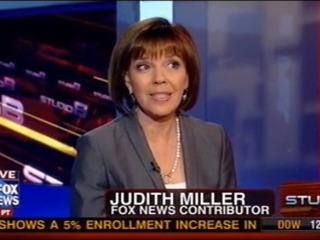
Judith Miller’s Blame-Shifting Memoir

Judy Miller 409By Veteran Intelligence Professionals for Sanity

Source: Consortium News

U.S. intelligence veterans recall the real story of how New York Times reporter Judith Miller disgraced herself and her profession by helping to mislead Americans into the disastrous war in Iraq. They challenge the slick, self-aggrandizing rewrite of history in her new memoir.

MEMORANDUM FOR: Americans Malnourished on the Truth About Iraq

FROM: Veteran Intelligence Professionals for Sanity (VIPS)

SUBJECT: A New “Miller’s Tale” (with apologies to Geoffrey Chaucer)

On April 3, former New York Times journalist Judith Miller published an article in the Wall Street Journal entitled “The Iraq War and Stubborn Myths: Officials Didn’t Lie, and I Wasn’t Fed a Line.” If this sounds a bit defensive, Miller has tons to be defensive about.

In the article, Miller claims, “false narratives [about what she did as a New York Times reporter] deserve, at last, to be retired.” The article appears to be the initial salvo in a major attempt at self-rehabilitation and, coincidentally, comes just as her new book, The Story: A Reporter’s Journey, is to be published today.

In reviewing Miller’s book, her “mainstream media” friends are not likely to mention the stunning conclusion reached recently by the Nobel Prize-winning International Physicians for the Prevention of Nuclear War and other respected groups that the Iraq War, for which she was lead drum majorette, killed one million people. One might think that, in such circumstances – and with bedlam reigning in Iraq and the wider neighborhood – a decent respect for the opinions of mankind, so to speak, might prompt Miller to keep her head down for a while more.

In all candor, after more than a dozen years, we are tired of exposing the lies spread by Judith Miller and had thought we were finished. We have not seen her new book, but we cannot in good conscience leave her WSJ article without comment from those of us who have closely followed U.S. policy and actions in Iraq.

Miller’s Tale in the WSJ begins with a vintage Miller-style reductio ad absurdum: “I took America to war in Iraq. It was all me.” Since one of us, former UN inspector Scott Ritter, has historical experience and technical expertise that just won’t quit, we asked him to draft a few paragraphs keyed to Miller’s latest tale. He shared the following critique:

Miller’s Revisionist History

“Judith Miller did not take America to war in Iraq. Even a journalist with an ego the size of Ms. Miller’s cannot presume to usurp the war power authorities of the President of the United States, or even the now-dormant Constitutional prerogatives of Congress. What she is guilty of, however, is being a bad journalist.

“She can try to hide this fact by wrapping herself in a collective Pulitzer Prize, or citing past achievements like authoring best-selling books. But this is like former Secretary of State Colin Powell trying to remind people about his past as the National Security Advisor for President Reagan or Chairman of the Joint Chiefs of Staff under Presidents George H. W. Bush and Bill Clinton.

“At the end of the day Mr. Powell will be judged not on his previous achievements, but rather on his biggest failure – his appearance before the United Nations Security Council touting an illusory Iraqi weapons-of-mass-destruction threat as being worthy of war. In this same vein, Judith Miller will be judged by her authoring stories for the ‘newspaper of record’ that were questionably sourced and very often misleading. One needs only to examine Ms. Miller’s role while embedded in U.S. Army Mobile Exploitation Team Alpha, hunting for weapons of mass destruction during the 2003 invasion, for this point to be illustrated.

“Miller may not have singlehandedly taken America and the world to war, but she certainly played a pivotal role in building the public case for the attack on Iraq based upon shoddy reporting that even her editor at the New York Times has since discredited – including over reliance on a single-source of easy virtue and questionable credibility – Ahmed Chalabi of the Iraqi National Congress. The fact that she chose to keep this ‘source’ anonymous underscores the journalistic malfeasance at play in her reporting.

“Chalabi had been discredited by the State Department and CIA as a reliable source of information on Iraq long before Judith Miller started using him to underpin her front-page ‘scoops’ for the New York Times. She knew this, and yet chose to use him nonetheless, knowing that then Secretary of Defense Donald Rumsfeld was fully as eager to don the swindlers’ magic suit of clothes, as was the king in Hans Christian Anderson’s fairy tale. In Ms. Miller’s tale, the fairy-tale clothes came with a WMD label and no washing instructions.

“Ms. Miller’s self-described ‘newsworthy claims’ of pre-war weapons of mass destruction stories often were – as we now know (and many of us knew at the time) – handouts from the hawks in the Bush administration and fundamentally wrong.

“Like her early reporting on Iraq, Ms. Miller’s re-working of history to disguise her malfeasance/misfeasance as a reporter does not bear close scrutiny. Her errors of integrity are hers and hers alone, and will forever mar her reputation as a journalist, no matter how hard she tries to spin the facts and revise a history that is highly inconvenient to her. Of course, worst of all, her flaws were consequential – almost 4,500 U.S. troops and 1,000,000 Iraqis dead.”

Relying on the Mistakes of Others

In her WSJ article, Miller protests that “relying on the mistakes of others and errors of judgment are not the same as lying.” It is almost as though she is saying that if Ahmed Chalabi told her that, in Iraq, the sun rises in the west, and she duly reported it, that would not be “the same as lying.”

Miller appears to have worked out some kind of an accommodation with George W. Bush and others who planned and conducted what the post-World War II Nuremburg Tribunal called the “supreme international crime,” a war of aggression. She takes strong issue with what she calls “the enduring, pernicious accusation that the Bush administration fabricated WMD intelligence to take the country to war.”

Does she not know, even now, that there is abundant proof that this is exactly what took place? Has she not read the Downing Street Memorandum based on what CIA Director George Tenet told the head of British Intelligence at CIA headquarters on July 20, 2002; i. e., that “the intelligence and facts were being fixed around the policy” of making war for “regime change” in Iraq?

Does she not know, even at this late date, that the “intelligence” served up to “justify” attacking Iraq was NOT “mistaken,” but outright fraud, in which Bush had the full cooperation of Tenet and his deputy John McLaughlin? Is she unaware that the Assistant Secretary of State for Intelligence at the time, Carl Ford, has said, on the record, that Tenet and McLaughlin were “not just wrong, they lied … they should have been shot” for their lies about WMD? (See Hubris: The Inside Story of Spin, Scandal, and the Selling of the Iraq War by Michael Isikoff and David Corn.)

Blame Blix

Miller’s tale about Hans Blix in her WSJ article shows she has lost none of her edge for disingenuousness: “One could argue … that Hans Blix, the former chief of the international inspectors, bears some responsibility,” writes Miller. She cherry-picks what Blix said in January 2003 about “many proscribed weapons and items,” including 1,000 tons of chemical agent, were still “not accounted for.”

Yes, Blix said that on Jan. 27, 2003. But Blix also included this that same day in his written report to his UN superiors, something the New York Times, for some reason, did not include in its report:

“Iraq has on the whole cooperated rather well so far with UNMOVIC in this field. The most important point to make is that access has been provided to all sites we have wanted to inspect and with one exception it has been prompt. We have further had great help in building up the infrastructure of our office in Baghdad and the field office in Mosul. Arrangements and services for our plane and our helicopters have been good. The environment has been workable.

“Our inspections have included universities, military bases, presidential sites and private residences. Inspections have also taken place on Fridays, the Muslim day of rest, on Christmas day and New Years day. These inspections have been conducted in the same manner as all other inspections.” [See “Steve M.” writing (appropriately) for “Crooks and Liars” as he corrected the record.]

Yes, there was some resistance by Iraq up to that point. Blix said so. However, on Jan. 30, 2003, Blix made it abundantly clear, in an interview published in The New York Times, that nothing he’d seen at the time justified war. (The byline was Judith Miller and Julia Preston.)

The Miller-Preston report said: “Mr. Blix said he continued to endorse disarmament through peaceful means. ‘I think it would be terrible if this comes to an end by armed force, and I wish for this process of disarmament through the peaceful avenue of inspections,’ he said. …

“Mr. Blix took issue with what he said were Secretary of State Colin L. Powell’s claims that the inspectors had found that Iraqi officials were hiding and moving illicit materials within and outside of Iraq to prevent their discovery. He said that the inspectors had reported no such incidents. …

“He further disputed the Bush administration’s allegations that his inspection agency might have been penetrated by Iraqi agents, and that sensitive information might have been leaked to Baghdad, compromising the inspections. Finally, he said, he had seen no persuasive indications of Iraqi ties to Al Qaeda, which Mr. Bush also mentioned in his speech. ‘There are other states where there appear to be stronger links,’ such as Afghanistan, Mr. Blix said, noting that he had no intelligence reports on this issue.”

Although she co-authored that New York Times report of Jan. 30, 2003, Judith Miller remembers what seems convenient to remember. Her acumen at cherry picking may be an occupational hazard occasioned by spending too much time with Chalabi, Rumsfeld and other professional Pentagon pickers.

Moreover, Blix’s February 2003 report showed that, for the most part, Iraq was cooperating and the process was working well:

“Since we arrived in Iraq, we have conducted more than 400 inspections covering more than 300 sites. All inspections were performed without notice, and access was almost always provided promptly. In no case have we seen convincing evidence that the Iraqi side knew in advance that the inspectors were coming. …

“The inspections have taken place throughout Iraq at industrial sites, ammunition depots, research centres, universities, presidential sites, mobile laboratories, private houses, missile production facilities, military camps and agricultural sites. …

“In my 27 January update to the Council, I said that it seemed from our experience that Iraq had decided in principle to provide cooperation on process, most importantly prompt access to all sites and assistance to UNMOVIC in the establishment of the necessary infrastructure. This impression remains, and we note that access to sites has so far been without problems, including those that had never been declared or inspected, as well as to Presidential sites and private residences. …

“The presentation of intelligence information by the US Secretary of State suggested that Iraq had prepared for inspections by cleaning up sites and removing evidence of proscribed weapons programmes.

“I would like to comment only on one case, which we are familiar with, namely, the trucks identified by analysts as being for chemical decontamination at a munitions depot. This was a declared site, and it was certainly one of the sites Iraq would have expected us to inspect.

“We have noted that the two satellite images of the site were taken several weeks apart. The reported movement of munitions at the site could just as easily have been a routine activity as a movement of proscribed munitions in anticipation of imminent inspection.”

Blix made it clear that he needed more time, but the Bush administration had other plans. In other words, the war wasn’t Blix’s fault, as Judy Miller suggests. The fault lay elsewhere.

When Blix retired at the end of June 2004, he politely suggested to the “prestigious” Council on Foreign Relations in New York the possibility that Baghdad had actually destroyed its weapons of mass destruction after the first Gulf War in 1991 (as Saddam Hussein’s son-in-law, Hussein Kamel, who had been in charge of the WMD and rocket programs assured his debriefers when he defected in 1995). Blix then allowed himself an undiplomatic jibe:

“It is sort of fascinating that you can have 100 per cent certainty about weapons of mass destruction and zero certainty of about where they are.”

For the Steering Group, Veteran Intelligence Professionals for Sanity (VIPS)

William Binney, former Technical Director, National Security Agency (ret.)

Thomas Drake, former Senior Executive, NSA

Daniel Ellsberg, former State and Defense Department official, associate VIPS

Frank Grevil, former Maj., Army Intelligence, Denmark, associate VIPS

Katharine Gun, former analyst, GCHQ (the NSA equivalent in the UK), associate VIPS

Matthew Hoh, former Capt., USMC, Iraq & Foreign Service Officer, Afghanistan, associate VIPS

Brady Kiesling, former Political Counseler, U.S. Embassy, Athens, resigned in protest before the attack on Iraq, associate VIPS.

Karen Kwiatkowski, former Lt. Col., US Air Force (ret.), at Office of Secretary of Defense watching the manufacture of lies on Iraq, 2001-2003.

Annie Machon, former officer, MI5 (the CIA equivalent in the UK), associate VIPS

David MacMichael, former Capt., USMC & senior analyst, National Intelligence Council (ret.)

Ray McGovern, former Capt., Army Infantry/Intelligence & CIA presidential briefer (ret.)

Elizabeth Murray, former Deputy National Intelligence Officer for the Near East, National Intelligence Council (ret.)

Todd E. Pierce, Maj., former U.S. Army Judge Advocate (ret.)

Scott Ritter, former Maj., USMC, former UN Weapon Inspector, Iraq

Coleen Rowley, Division Council & Special Agent, FBI (ret.)

Greg Thielmann, former Office Director for Strategic, Proliferation, and Military Affairs in the State Department’s Bureau of Intelligence and Research

Peter Van Buren, former diplomat, Department of State, associate VIPS

Ann Wright, Col., US Army (ret.) & US diplomat (resigned in March, 2003 in opposition to the war on Iraq)