That Facebook Will Turn to Censoring the Left Isn’t a Worry—It’s a Reality

By Alan Macloud

Source: FAIR

On August 6, a number of giant online media companies, including FacebookYouTubeAppleSpotify and Pinterest, took the seemingly coordinated decision to remove all content from Alex Jones and his media outlet Infowars from their platforms.

Jones, perhaps the internet’s most notorious far-right conspiracy theorist, has claimed that the Sandy Hook shooting was a hoax, the Democratic Party is running a child sex ring inside a DC pizzeria and that the Las Vegas shooting was perpetrated by Antifa. Despite or perhaps because of such claims, his website Infowars has built up an enormous following: 3 million Americans, almost 1 percent of the population, visited the site in July 2018, according to Alexa.

The reaction from the media to the decision to ban Jones and Infowarswas largely celebratory. On the Late Show (8/7/18), Stephen Colbert joked that it looked like “Infowars just lost their war on info.” The Daily Beast(8/9/18) urged readers to “shed absolutely no tears for Alex Jones,” while Salon (8/9/18) and CNN (8/9/18) put pressure on Twitter to follow suit, with the former asking, “Why is Alex Jones still allowed on Twitter?”

Some worried about a slippery slope of corporate censorship. Writing in Rolling Stone  8/2/18), Matt Taibbi warned: “The endgame here couldn’t be clearer. This is how authoritarian marriages begin, and people should be very worried.”

Yet this appeared to be a minority opinion. Media critic and news presenter David Doel shared his message to progressives via Twitter (8/6/18):

Lefties defending Alex Jones right now: I hear you, on the surface it appears to set bad precedent to give massive corporations control over who’s silenced. But if you aren’t performing hate speech, libel or slander on a regular basis, then I don’t know what you’re worried about.

Unfortunately, Facebook immediately used this new precedent to switch its sights on the left, temporarily shutting down the Occupy London page and deleting the anti-fascist No Unite the Right account (Tech Crunch8/1/18). Furthermore, on August 9, the independent, reader-supported news website Venezuelanalysis had its page suspended without warning.

The site does not feign neutrality, offering news and views about Venezuela from a strongly left-wing perspective. But it’s not uncritical of the Venezuelan government, either, and provides a crucial English-language resource for academics and interested parties on all sides wishing to understand events inside Venezuela from a leftist perspective, something almost completely absent in corporate media, which has been actively undermining elections (FAIR.org,5/23/18) and openly calling for military intervention or a coup in the country (FAIR.org5/16/18).

My latest book, Bad News From Venezuela: Twenty Years of Fake News and Misreporting, detailed the complete lack of diversity, and the strict adherence to an anti-Chavista editorial line, across corporate media. Venezuelanalysispraised by the likes of Noam Chomsky, Tariq Ali and John Pilger, offers an alternative perspective.

The abrupt nature of its de-platforming is a worrying development for alternative media. Following an appeal and a public outcry on social media, Venezuelanalysis was reinstated on Facebook. However, the social media site offered no explanation for what happened.

Facebook recently announced it had partnered with the Atlantic Council in an effort to combat “fake news” on its platform (FAIR.org5/21/18). An offshoot of NATO, the Council’s board of directors is a who’s who of neo-conservative hawks, including Condoleezza Rice, Colin Powell, Henry Kissinger and James Baker; CIA directors like Robert Gates, Leon Panetta and Michael Hayden; retired generals like Wesley Clark and David Petraeus; as well as senior tech executives.

Forty-five percent of Americans get their news from Facebook. When an organization like the Atlantic Council decides what news we see and do not see, that is tantamount to state censorship.

Venezuelanalysis (12/13/17) exposed that the Council was working closely with the Venezuelan opposition, donating over $1 million to it, part of a wide-ranging effort at regime change against multiple progressive governments in the region (Brasilwire12/28/17). That Facebook censored a news site responsible for investigating its partner is a worrying development in journalism.

Venezuelanalysis’ statement (8/9/18) on its removal noted that “Facebookappears to be targeting independent or left-wing sites in the wake of Russiagate.” As I previously argued (FAIR.org7/27/18), the utility of the Russian “fake news” scandal is that it allows corporate media to tighten their grip over the means of communication. Under the guise of combating fake news, media organizations like Google, Bing, Facebook and YouTube have changed their algorithms. The effect has been to hammer progressive media outlets. AlterNet’s Google traffic fell by 63 percent, Media Matters by 42 percent, TruthOut by 25 percent and The Intercept by 19 percent (WSWS8/2/17). Sites like these that challenge corporate perspectives are being starved of traffic and advertising revenue.

On August 13, the situation escalated as Facebookciting a clause in its terms of service barring “hateful, threatening or obscene” media,  deplatformed TeleSUR English, an English-language Latin American news network. TeleSUR is funded by a number of Latin American states, including Venezuela, and offers news and opinion from a progressive viewpoint. It was set up precisely to provide an alternative to Western corporate-dominated media. In its statement on its censorship, TeleSUR English (8/13/18) noted, “This is an alarming development in light of the recent shutting down of pages that don’t fit a mainstream narrative.”

That Facebook’s stated concern about stopping the spread of hate speech is genuine is challenged by the fact that the far-right Alternative fur Deutschland (AfD) party went to Facebook headquarters in Berlin in 2017 to discuss how it could use the platform for recruitment and for micro-targeting in the German elections, as Bloomberg Businessweek (9/29/17) reported. Through Facebook and with the help of American companies, AfD nearly tripled its previous vote share, becoming the third-largest party in Germany, the far right’s best showing since World War II.

The Russian fake news scandal has provided enormous media monopolies an avenue to try to reassert control over the means of communication. This latest action by Facebook is part of a worrying trend towards greater censorship of media. It is unlikely it will end here. Progressives should not necessarily shed tears for Jones, but they should be aware that their media is next in line, and that Jones’ deplatforming sets a dangerous precedent that is already being used against them.

Following an appeal and a public outcry on social media, both Venezuelanalysis and TeleSUR English were reinstated on Facebook, with the latter being told its suspension was due to “instability” and “suspicious activity,” though it had earlier gotten a message accusing it of “violating our Terms of Use.” As Venezuelanalysis (8/9/18) noted, “the whole thing is extremely mysterious, to say the least.”

America’s Enemies, Who’s On the List?

Prospects and Perspectives

By Prof. James Petras

Source: Global Research

For almost 2 decades, the US pursued a list of ‘enemy countries’ to confront, attack, weaken and overthrow. 

This imperial quest to overthrow ‘enemy countries’ operated at various levels of intensity, depending on two considerations:  the level of priority and the degree of vulnerability for a ‘regime change’ operation.

The criteria for determining an ‘enemy country’ and its place on the list of priority targets in the US quest for greater global dominance, as well as its vulnerability to a ‘successfully’ regime change will be the focus of this essay.

We will conclude by discussing the realistic perspectives of future imperial options.

Prioritizing US Adversaries

Imperial strategists consider military, economic and political criteria in identifying high priority adversaries.

The following are high on the US ‘enemy list’:

1) Russia, because of its military power, is a nuclear counterweight to US global domination.  It has a huge, well-equipped armed force with a European, Asian and Middle East presence.  Its global oil and gas resources shield it from US economic blackmail and its growing geo-political alliances limit US expansion.

2) China, because of its global economic power and the growing scope of its trade, investment and technological networks.  China’s growing defensive military capability, particularly with regard to protecting its interests in the South China Sea serve to counter US domination in Asia.

3) North Korea, because of its nuclear and ballistic missile capability, its fierce independent foreign policies and its strategic geo-political location, is seen as a threat to the US military bases in Asia and Washington’s regional allies and proxies.

4) Venezuela, because of its oil resources and socio-political policies, challenge the US centered neo-liberal model in Latin America.

5) Iran, because of its oil resources, political independence and geo-political alliances in the Middle East, challenge US, Israeli and Saudi Arabia domination of the region and present an independent alternative.

6) Syria, because of its strategic position in the Middle East, its secular nationalist ruling party and its alliances with Iran, Palestine, Iraq and Russia, is a counterweight to US-Israeli plans to balkanize the Middle East into warring ethno-tribal states.

US  Middle-level Adversaries :

1)  Cuba, because of its independent foreign policies and its alternative socio-economic system stands in contrast to the US-centered neo-liberal regimes in the Caribbean, Central and South America.

2) Lebanon, because of its strategic location on the Mediterranean and the coalition government’s power sharing arrangement with the political party, Hezbollah, which is increasingly influential in Lebanese civil society in part because of its militia’s proven capacity to protect Lebanese national sovereignty by expelling the invading Israeli army and helping to defeat the ISIS/al Queda mercenaries in neighboring Syria.

3) Yemen, because of its independent, nationalist Houthi-led movement opposed to the Saudi-imposed puppet government as well as its relations with Iran.

Low Level Adversaries

1) Bolivia, because of its independent foreign policy, support for the Chavista government in Venezuela and advocacy of a mixed economy;  mining wealth and  defense of indigenous people’s territorial claims.

2) Nicaragua, because of its independent foreign policy and criticism of US aggression toward Cuba and Venezuela.

US hostility to high priority adversaries is expressed through economic sanctions military encirclement, provocations and intense propaganda wars toward North Korea, Russia, Venezuela, Iran and Syria.

Because of China’s powerful global market linkages, the US has applied few sanctions.  Instead, the US relies on military encirclement, separatist provocations and intense hostile propaganda when dealing with China.

Priority Adversaries, Low Vulnerability and Unreal Expectations

With the exception of Venezuela, Washington’s ‘high priority targets’ have limited strategic vulnerabilities. Venezuela is the most vulnerable because of its high dependence on oil revenues with its major refineries located in the US, and its high levels of indebtedness, verging on default.   In addition, there are the domestic opposition groups, all acting as US clients and Caracas’ growing isolation within Latin America due to orchestrated hostility by important US clients, Argentina, Brazil, Colombia and Mexico.

Iran is far less vulnerable: It is a strong strategic regional military power linked to neighboring countries and similar religious-nationalist movements.  Despite its dependence on oil exports, Iran has developed alternative markets, like China, free from US blackmail and is relatively safe from US or EU initiated creditor attacks.

North Korea, despite the crippling economic sanctions imposed on its regime and civilian population, has ‘the bomb’ as a deterrent to a US military attack and has shown no reluctance to defend itself.  Unlike Venezuela, neither Iran nor North Korea face significant internal attacks from US-funded or armed domestic opposition.

Russia has full military capacity – nuclear weapons, ICBM and a huge, well-trained armed force – to deter any direct US military threat.  Moscow is politically vulnerable to US-backed propaganda, opposition political parties and Western-funded NGO’s.  Russian oligarch-billionaires, linked to London and Wall Street, exercise some pressure against independent economic initiatives.

To a limited degree, US sanctions exploited Russia’s earlier dependence on Western markets, butsince the imposition of draconian sanctions by the Obama regime, Moscow has effectively counteredWashington’s offensive by diversifying its markets to Asia and strengthening domestic self-reliance in its agriculture, industry and high technology.

China has a world-class economy and is on course to become the world’s economic leader.  Feeble threats to ‘sanction’ China have merely exposed Washington’s weakness rather intimidating Beijing.  China has countered US military provocations and threats by expanding its economic market power, increasing its strategic military capacity and shedding dependence on the dollar.

Washington’s high priority targets are not vulnerable to frontal attack: They retain or are increasing their domestic cohesion and economic networks, while upgrading their military capacity to impose completely unacceptable costs on the US for any direct assault.

As a result, the US leaders are forced to rely on incremental, peripheral and proxy attacks with limited results against its high priority adversaries.

Washington will tighten sanctions on North Korea and Venezuela, with dubious prospects of success in the former and a possible pyrrhic victory in the case of Caracas. Iran and Russia can easily overcome proxy interventions.  US allies, like Saudi Arabia and Israel, can badger, propagandize and rail the Persians, but their fears that an out-and-out war against Iran, could quickly destroy Riyadh and Tel Aviv forces them to work in tandem to induce the corrupt US political establishment to push for war over the objections of a war-weary US military and population. Saudi and Israelis can bomb and starve the populations of Yemen and Gaza, which lack any capacity to reply in kind, but Teheran is another matter.

The politicians and propagandists in Washington can blather about Russia’s interference in the US’s corrupt electoral theater and scuttle moves to improve diplomatic ties, but they cannot counter Russia’s growing influence in the Middle East and its expanding trade with Asia, especially China.

In summary, at the global level, the US ‘priority’ targets are unattainable and invulnerable.  In the midst of the on-going inter-elite dogfight within the US, it may be too much to hope for the emergence of any rational policymakers in Washington who could rethink strategic priorities and calibrate policies of mutual accommodation to fit in with global realities.

Medium and Low Priorities, Vulnerabilities and Expectations

Washington can intervene and perhaps inflict severe damage on middle and low priority countries.  However, there are several drawbacks to a full-scale attack.

Yemen, Cuba, Lebanon, Bolivia and Syria are not nations capable of shaping global political and economic alignments.  The most the US can secure in these vulnerable countries are destructive regime changes with massive loss of life, infrastructure and millions of desperate refugees . . . but at great political cost, with prolonged instability and with severe economic losses.

Yemen

The US can push for a total Saudi Royal victory over the starving, cholera-stricken people of Yemen.  But who benefits?  Saudi Arabia is in the midst of a palace upheaval and has no ability to exercise hegemony, despite hundreds of billions of  dollars of US/NATO arms, trainers and bases.  Colonial occupations are costly and yield few, if any, economic benefits, especially from a poor, geographically isolated devastated nation like Yemen.

Cuba

Cuba has a powerful highly professional military backed by a million-member militia.  They are capable of prolonged resistance and can count on international support.  A US invasion of Cuba would require a prolonged occupation and heavy losses.  Decades of economic sanctions haven’t worked and their re-imposition by Trump have not affected the key tourist growth sectors.

President Trump’s ‘symbolic hostility’ does not cut any ice with the major US agro-business groups, which saw Cuba as a market. Over half of the so-called ‘overseas Cubans’ now oppose direct US intervention.

US-funded NGOs can provide some marginal propaganda points but they cannot reverse popular support for Cuba’s mixed ‘socialized’ economy, its excellent public education and health care and its independent foreign policy.

Lebanon

A joint US-Saudi economic blockade and Israeli bombs can destabilize Lebanon.  However, a full-scale prolonged Israeli invasion will cost Jewish lives and foment domestic unrest.  Hezbollah has missiles to counter Israeli bombs.  The Saudi economic blockade will radicalize Lebanese nationalists, especially among the Shia and the Christian populations.  The Washington’s ‘invasion’ of Libya, which did not lose a single US soldier, demonstrates that destructive invasions result in long-term, continent-wide chaos.

A US-Israeli-Saudi war would totally destroy Lebanon but it will destabilize the region and exacerbate conflicts in neighboring countries – Syria, Iran and possibly Iraq.  And Europe will be flooded with millions more desperate refugees.

Syria

The US-Saudi proxy war in Syria suffered serious defeats and the loss of political assets.  Russia gained influence, bases and allies.  Syria retained its sovereignty and forged a battle-hardened national armed force.  Washington can sanction Syria, grab some bases in a few phony ‘Kurdish enclaves’ but it will not advance beyond a stalemate and will be widely viewed as an occupying invader.

Syria is vulnerable and continues to be a middle-range target on the US enemy list but it offers few prospects of advancing US imperial power, beyond some limited ties with an unstable Kurd enclave, susceptible to internecine warfare, and risking major Turkish retaliation.

Bolivia and Nicaragua

Bolivia and Nicaragua are minor irritants on the US enemy list. US regional policymakers recognize that neither country exercises global or even regional power.  Moreover, both regimes rejected radical politics in practice and co-exist with powerful and influential local oligarchs and international MNC’s linked to the US.

Their foreign policy critiques, which are mostly for domestic consumption, are neutralized by the near total US influence in the OAS and the major neo-liberal regimes in Latin America.  It appears that the US will accommodate these marginalized rhetorical adversaries rather than risk provoking any revival of radical nationalist or socialist mass movements erupting in La Paz or Managua.

Conclusion

A brief examination of Washington’s ‘list of enemies’ reveals that the limited chances of success even among vulnerable targets.  Clearly, in this evolving world power configuration, US money and markets will not alter the power equation.

US allies, like Saudi Arabia, spend enormous amounts of money attacking a devastated nation, but they destroy markets while losing wars.  Powerful adversaries, like China, Russia and Iran, are not vulnerable and offer the Pentagon few prospects of military conquest in the foreseeable future.

Sanctions, or economic wars have failed to subdue adversaries in North Korea, Russia, Cuba and Iran.  The ‘enemy list’ has cost the US prestige, money and markets – a very peculiar imperialist balance sheet.  Russia now exceeds the US in wheat production and exports.  Gone are the days when US agro-exports dominated world trade including trade with Moscow.

Enemy lists are easy to compose, but effective policies are difficult to implement against rivals with dynamic economies and powerful military preparedness.

The US would regain some of its credibility if it operated within the contexts of global realities and pursued a win-win agenda instead of remaining a consistent loser in a zero-sum game.

Rational leaders could negotiate reciprocal trade agreements with China, which would develop high tech, finance and agro-commercial ties with manufacturers and services.  Rational leaders could develop joint Middle East economic and peace agreements, recognizing the reality of a Russian-Iranian-Lebanese Hezbollah and Syrian alliance.

As it stands, Washington’s ‘enemy list’ continues to be composed and imposed by its own irrational leaders, pro-Israel maniacs and Russophobes in the Democratic Party – with no acknowledgement of current realities.

For Americans, the list of domestic enemies is long and well known, what we lack is a civilian political leadership to replace these serial mis-leaders.

Color Revolution Comes Home?

By Kevin Zeese and Margaret Flowers

Source: Popular Resistance

The United States has perfected the art of regime change operations. The US is the largest empire in world history with more than 1,000 military bases and troops operating throughout the world. In addition to military force, the US uses the soft power of regime change, often through ‘Color Revolutions.’ The US has been building its empire since the Civil War era, but it has been in the post-World War II period that it has perfected regime change operations.

Have the people of the United States been the victims of regime change operations at home? Have the wealthiest and the security state created a government that serves them, rather than the people? To answer these questions, we begin by examining how regime change works and then look at whether those ingredients are being used domestically.

Color Revolutions and Regime Change Operations

Almost from the start, the CIA’s role has been more than intelligence gathering. It has been a key player in putting in place governments friendly to the United States and conducting other operations, e.g. the CIA is currently involved in drone strikes.

One of the first regime change operations of the CIA was Operation Ajax conducted in Iran, and led by Kermit Roosevelt, the grandson of Teddy Roosevelt, who was president when the US solidified its global empire ambitions. The CIA was founded in 1947 and the regime change coup in Iran was 1953. Greg Maybury writes in “Another Splendid Little Coup“: “Placing to one side an early dress rehearsal in Syria in 1949, the Iran coup was the first post-War exercise in regime change upon the part of Anglo-American alliance…”  Just this month the US government released documents showing the CIA and State Department’s planning and implementation of the coup against the democratically-elected prime minister of Iran, Mohammed Mossadegh. This release supplements one from 2013 that did not reveal the full role of the US in the coup.

The Iran coup was crude compared to more modern efforts but had the ingredients that have become common – civil society protests against the government, media reports supporting the protests, agents within the government supporting the coup and replacement of the government with a US-friendly regime. The Iran coup may have been the most costly mistake in US foreign policy because it undermined a secular democratic government in Iranthat could have been the example for the region. Instead the US installed the brutal Shah of Iran, whose rule ended in the 1979 revolution, in which, as Maybury reports, the US was also implicated because it felt the Shah had overstayed his welcome.

The Iran coup was perceived as a great CIA success, so it was copied in other Middle Eastern countries as well as countries in Latin America, Africa, and the Caribbean. Regime change is still a major tool of US foreign policy. There is a long-term ongoing coup campaign in Venezuela, with its most recent episode last week in which a helicopter attack on the Supreme Court was tied to the US DEA and CIA. The US has allied with oligarchs, supported violent protests and provided funds for the opposition, which has also worked to undermine the Venezuelan economy — a tactic the US has used in other coups, e.g. the coup of Allende in Chile.

The coup in Ukraine, which the media falsely calls a ‘democratic revolution,’ was, as the head of the ‘private CIA’ firm Stratfor says, “the most blatant coup in history.” The CIA and State Department played the lead roles.

Victoria Nuland, an assistant secretary of state under Clinton, bragged that the US spent $5 billion to build civil society opposition against a government that leaned toward Russia. The government funded civil society opposition through US AID, which is the open vehicle for what the CIA used to do covertly, along with the National Endowment for Democracy. This funding was used to build oppositional civil society groups and create destabilization. They focused on the issue of corruption, which exists in every government, and built it up to a centerpiece for regime change. The US allied with extremist right-wing groups in Ukraine.

The US picked the new leaders of Ukraine. This included Petro Poroshenko, whom U.S. officials refer to as “Our Ukraine (OU) insider Petro Poroshenko” in a classified diplomatic cable from 2006 . The selected Prime Minister was Arseniy Yatsenyuk. Before the coup, Victoria Nuland told the US Ambassador to Ukraine that ‘Yats’ should be the prime minister. And, the Finance Minister was Natalia Jaresko, a long-time State Department official who moved to Ukraine after the US-inspired coup, the Orange Revolution, to become a conduit for US funding of civil society through her hedge fund. She was a US citizen whom Poroshenko made a Ukrainian on the day she was appointed Finance Minister. To top it off, fmr. Vice President Joe Biden’s son, Hunter Biden, and fmr. Secretary of State John Kerry’s longtime financial ally, Devon Archer, were put on the board of the largest private gas corporation in the Ukraine. Yet, the US media refuses to call this complete take over of the country by the United States a coup and instead describes Russia as the aggressor.

The US has perfected regime change operations from the 1950s up through today. The standard method of operation is finding an issue to cause dissent, building opposition in a well funded civil society ‘movement’, manipulating the media, putting in place US friendly leaders and blaming US opposition for the coup to hide US involvement. This approach is consistent no matter which party is in power in the US.

The Kleptocratic Oligarch Coup In The United States

Let’s apply the lessons from around the world to the United States. There is no question the US is an oligarchy. We say no question because recent political studies have proven it in multiple ways.

One difference in the US is that money plays an outsized influence in US elections. The wealthy can buy the government they want through campaign donations and by anonymous spending but the tools of color revolutions are still needed to legitimize the government. Legitimacy is getting harder to buy. Many realize we live in a mirage democracy. The Associated Press-NORC Center for Public Affairs reported in 2016 the extent of the loss of legitimacy of US government:

“Nine in 10 Americans lack confidence in the country’s political system, and among a normally polarized electorate, there are few partisan differences in the public’s lack of faith in the political parties, the nominating process, and the branches of government.”

Jimmy Carter has pointed to the “unlimited bribery” of government as turning the US into an oligarchy. The government needs to use the tools of regime change at home in order to create an veneer of legitimate government.

The Donald Trump presidency, which we regularly criticize, brings a lot of these tools to the forefront because Trump beat the system and defeated the elites of both parties. As a result, Democratic Party propaganda is being used to undermine Trump not only based on his policies but also through manufactured crises such as RussiaGate. The corporate media consistently hammers home RussiaGate, despite the lack of evidenceto support it. Unlike the Watergate or Iran-Contra scandals, there is no evidence that Trump colluded with Russia to get elected. And, the security state – the FBI and the agencies that conduct regime change operations around the world – is working to undermine Trump in a still unfolding domestic coup.

Civil society also has a strong role. John Stauber writes that:

“The professional Progressive Movement that we see reflected in the pages of The Nation magazine, in the online marketing and campaigning of MoveOn and in the speeches of Van Jones, is primarily a political public relations creation of America’s richest corporate elite, the so-called 1%, who happen to bleed Blue because they have some degree of social and environmental consciousness, and don’t bleed Red.  But they are just as committed as the right to the overall corporate status quo, the maintenance of the American Empire, and the monopoly of the rich over the political process that serves their economic interests.”

Civil society groups created or aligned with the Democratic Party are defining the new form of false-resistance as electing Democrats. The Democrats, as they have done throughout history as the oldest political party, know how to control movements and lead them into ineffectiveness to support the Democratic Party agenda. We described, in “Obamacare: The Biggest Insurance Scam in History,” how this was done skillfully during the health reform process in 2009. This new resistance is just another tool to empower the elites, not resistance to the oligarchic-kleptocrats that control both parties. In fact, a major problem in progressive advocacy is the funding ties between large non-profits and corporate interests. The corruption of money is seen in organizations that advocate for corporate-friendly policies in educationhealth careenergy and climatelabor, and other issues.

Color Revolution Tools Used In The US

Now the tools the US uses for regime change around the world are being used at home to funnel activist energy and efforts into the Democratic party and electoral activities. In order to resist this new “resistance” we need to be aware of it and how it operates. We need to see through propaganda, such as RussiaGate, and attempts to manipulate the masses through scripted events that are portrayed as organic, such as the recent “sit in” by Rep. John Lewis and Sen. Cory Booker on the Capitol steps, or through highly emotional cultural content that portrays the plutocratic parties as parties of the people. We have to remember that the root issue is plutocracy and the US has two plutocratic parties, often referred to as “The Duopoly.”

We must continue to focus on the issues that are in crisis such as the economy, health care, education, housing, racism, inequality and militarization at home and abroad. We must fight for these issues independent of political party. We must be clear and uncompromising in our demands so that we are not taken off track. And we must have a clear vision of the future that we want to see.

Popular Resistance is a co-convener of the People’s Congress of Resistance. The People’s Congress will bring people together from around the US to meet in Washington, DC this September to outline a vision from the grassroots. A draft of that vision will be circulated over the next few months so that many people will provide input. Check out the People’s Congress here and get involved however you are able.

The West Is Becoming Irrelevant, The World Is Laughing

By Andre Vltchek

Source: TruePublica

I was recently told by an Asian friend of mine who is working in Paris: “Lately I stopped following almost all that is happening politically in the United States, in the UK and even here in France. It all feels suddenly so irrelevant, a waste of time.”

Statements like this would be unimaginable only one decade ago. In the past, what came from Washington and (to a smaller extent) from London was monitored with great attentiveness and fear, all over the world.

But all of a sudden, things have begun to change, rapidly. Despite the extremely violent nature of the Western-designed-and-manufactured global regime, which has been over-imposed on so many parts of the world for decades and centuries, increasing amounts of people in Asia, Latin America and Africa stopped worrying and went leisurely to the ‘barricades’, beginning to rebel against the perverseness of the ‘world order’.

Did it all really happen ‘all of a sudden’?

Or were there various catalysts at work, for already quite a substantial period of time?

It is a well-known fact that any deep-seated, chronic anxiety cannot disappear in just a short moment. People who are enslaved, humiliated, scared into obedience, people who are forced to feel uncertain and constantly frightened, cannot reverse their state of mind without some important external factor or set of factors.

It became obvious to me, as I have been working continuously on all continents and in almost all conflict zones of our Planet, that the renewed pride and courage which is now inspiring millions of oppressed human beings, actually came from the decisive and determined stand of just several brave and determined nations, big and small.

The myth about the omnipotence of the Empire has received a few significant blows.

The fable of invincibility has not completely disappeared yet, but at least it has got fractured and gravely injured.

The gate of the terrible prison began cracking. It has not collapsed, but the fractures were wide enough for at least some sunlight to enter the dark and dreadful cavities inhabited by billions of unfortunate and shattered beings.

Some victims stood up immediately; not many but at least some did. Others raised their heads in feeble hope, still lying down on the dirty ground, still chained, and still shaking. That weak light alone entering the dungeon was actually much brighter than what most people ever experienced in their entire life. It has been strong enough to provoke wonderful, brilliant sparks of hope

Except for some temporary setbacks (like in Brazil and Argentina), the anti-imperialist coalition is now steadier than ever; it is determined and constantly expanding.

And it is clearly winning!

It is truly a ‘rainbow coalition’ of countries, big and small, ‘red’ and ‘pink’, even ‘green’.

The only unifying factor is the shared determination not to be controlled by Western imperialism and neo-colonialism.

For decades, Cuba stood against the Empire, even after the Soviet block was broken to bits, even when all mutual agreements ceased to be honored by the criminal Yeltsin administration. The Cuban people never surrendered. It is because most of them always believed, from the bottom of their hearts, in socialism and internationalism. And also because they have been convinced that the Western Empire is a morally corrupt and illegitimate entity and therefore has to be resisted.

A small and relatively poor country – Cuba – demonstrated to the entire world that while the Empire is mighty, sadistic and brutal, it is not omnipotent, and it is possible to defy it. There is no reason why one should not dare, or one should not dream about a much better world, why one shouldn’t fight for true freedom, attempting to win.

Cuba inspired the world. Its daring Revolution took place just a few miles from the shores of the United States. Soon after, its teachers and doctors went to all parts of the earth, spreading optimism, solidarity and kindness. Its heroic revolutionaries went to fight against the most dreadful forms of colonialism, which were torturing people, is such places as Congo, Angola and Namibia.

After Obama’s attempts to water down the determination of the Cuban citizens, many enemies began to predict, cynically: “Now Cuba will compromise and sell its Revolution.”

It never did! I travelled to the Island last year, driving through the countryside, and speaking to people in Havana, Guantanamo and Santiago de Cuba. Almost no one was ready to compromise. A greatly educated nation, Cuba saw through the Empire’s tricks and deceptions.

Now almost nobody speaks about the “Cuban compromise”, anymore, simply because there isn’t any on the table.

China, one of the oldest and greatest civilizations on Earth, went through the terrible period of ‘humiliation’. Divided, occupied and plundered by the West, it has never forgotten nor forgiven.

Now the Chinese Communist state and its mixed economy are helping countries in virtually all parts of the world, from Oceania and Latin America, to the Middle East and especially Africa, to survive and to finally stand on their own feet. Despite all the vitriolic propaganda regurgitated by the West (those people in Europe or North America who know close to zero about Africa or China, habitually passing ‘confident’ and highly cynical ‘judgments’ about China’s involvement in the poor world; judgments based exclusively on the lies and fabrications produced by the Western media), China has been gaining great respect and trust in virtually all corners of the globe.

The Chinese people and their government are now standing firmly against Western imperialism. They will not allow any recurrence of the disgraceful and dreary past.

The West is provoking this mighty and optimistic nation, pushing it into a terrible confrontation. China doesn’t want any military conflict. It is the most peaceful, the most non-confrontational large nation on Earth. But it is becoming clear that if pushed against the wall, this time it will not compromise: it will fight.

In the last years I have spoken to many Chinese people, as I travelled to all corners of the country, and I’m convinced that by now the nation is ready to meet strength with strength.

Such determination gives hope to many other countries on our Planet. The message is clear: the West cannot do whatever it wants, anymore. If it tries, it will be stopped. By reason or by force!

Russia is ready again, too. It is standing next to China, enormous and indignant.

Go to Novosibirsk or Tomsk, to Khabarovsk, Vladivostok or Petropavlovsk in Kamchatka. Talk to Russian people and you will soon understand: almost nobody there believes or respects the West, anymore. Throughout history, Russia was attacked and ransacked from the West. Millions, tens of millions of its people were murdered, literally exterminated. And now, the nation is facing what some consider to be yet another imminent attack.

Like the Chinese people, Russians are unwilling to compromise, anymore. The old Russian forecast is once again alive, that very one professed by Alexander Nevsky:

Go tell all in foreign lands that Russia lives! Those who come to us in peace will be welcome as a guest. But those who come to us sword in hand will die by the sword! On that Russia stands and forever will we stand!

In Russia, as in China, and as in so many other nations that were devastated by the Western plunderers, nothing is forgotten and no one is forgotten. It only appeared for a while that the memory had fainted. It never does. You cannot burn down an entire land, ruin the cities, burn the fields, and still pose as one with the moral mandate. Or as we say in Chile: “Justice takes time, but it always comes!”

And the world is watching. It is suddenly clearly registering this determined and brave, epic stand of morally strong nations. Many of those who are watching are deeply impressed with what they are seeing. Perhaps not in London or in Paris, but go and ask those in Johannesburg or Beirut, or even in Calcutta, Cairo or Buenos Aires. Perhaps you suspect what answers you’d receive there!

Throughout modern history, not once has Iran invaded a foreign country. Yet its secular, progressive and democratic government (under the leadership of Mohammad Mosaddegh) was overthrown in 1953, in a CIA-backed coup. What followed was the monstrosity of the ‘pro-Western Shah’, and then a horrendous war, an invasion by Iraq, which was also fully backed by the West and which took hundreds of thousands of human lives. Since then, Iran has been suffering from targeted killings of its scientists (by the West and Israel), as well as terrorist attacks also backed from abroad.

Instead of falling on its knees and begging for mercy, Iran defied the West. On several occasions and when provoked, it sent its battleships to the neutral waters near the US coast, and it pledged to defend its land, in case it was to be attacked.

Iran also showed great solidarity towards Latin America, working closely with virtually all of the revolutionary governments there. It stood firmly by Venezuela in a time of great crises, building social housing in Caracas and supporting the Process by all other means.

In Latin America, no one will ever forget how former Iranian President Mahmoud Ahmadinejad came to Caracas to attend the funeral of Venezuelan leader Hugo Chavez, his dear friend. During the memorial, the aged mother of Chavez suddenly approached Ahmadinejad, in tears. Breaking all religious protocol of a Shi’a country that he was representing, the Iranian President embraced her, and held her against his heart, until she calmed down.

This moment was expressing one simple and powerful reality: all of us, the internationalists and anti-imperialists, are fighting for the survival of humanity and this planet. There is more that unites us than what is tearing us apart. Once we win, and we will win, the world will be able to find a common language. The West wants to divide us, by spreading hostilities and distrust, all through ‘false news’ and fabrications. But we understand its game. We will not break our ranks, anymore.

The West is clearly losing. It knows it. It is in panic.

Its nihilism, its propaganda and indoctrination tactics will soon be defeated.

I wrote a lot about the DPRK and how it joined the list of the ‘most hated nations on Earth’. It is a well known fact that North Korea was, for years and decades, much richer and more democratic than South Korea (ROK). But it embarked on one tremendous humanist ‘project’, and together with Cuba, the Soviet Union and to some extent China, it liberated almost the entire African continent, at great cost and sacrifice. And not only that: it sent its top educators and doctors to all corners of the most devastated continent on Earth. Its pilots also flew Egyptian MIGs against Israel, during the 1967 war. These facts have been silenced by Western propaganda, but they clearly explain why the DPRK has been ostracized, pushed to the corner, hit by senseless embargos, and forced to react the way it has been reacting for at least the last two decades.

North Korea has never surrendered either, and it never will.

Neither has Venezuela, for many years the great sentinel and engine of the Bolivarian Revolution, as well as of Latin Internationalism and solidarity. Surviving coups, embargos, plots and propaganda campaigns, surviving attacks, even terror, of the foreign-backed ‘opposition’, Venezuela has been injured but it is alive. Just a few days ago I spoke to an Italian Parliamentary delegation, consisting of  the“5-Star-Movement” MPs, which recently returned from Caracas. Their conclusion was simple: “The worst is over”.

The world knows it! Venezuela, DPRK, Cuba – they never fell. No matter how many knives penetrated their bodies, despite so much pain caused by the sanctions, coup attempts and direct acts of terrorism administered by the West and its monstrous Empire.

It is becoming clear and obvious: the West is helpless against determination, true courage and patriotic love. It is powerless when confronted with humanist ideologies, and with true loyalty!

And the world keeps watching, drawing its conclusions.

I wrote about Syria, comparing Aleppo to the 20th Century Stalingrad. This is where racism, terrorism, and the lowest forms of Western imperialism were decisively stopped. The price was terrible, but the message to the world extremely clear: The people who love their country with their entire hearts can fight and win against all odds, especially if by their side stand truly great and reliable friends and comrades!

One day the world will thank the Syrian people, profusely and properly. One day, everything will be understood. One day, perhaps soon.

This is one of the greatest moments in human history, perhaps the greatest.

It has arrived without big salvos announcing monumental revolutions.

Everything is happening fast, in an organized and determined manner.

The greatest minds of Russia, China, Latin America and the rest of the world, are feverishly, day and night, trying to determine what really brought our world, our civilization, to this ludicrous downfall.

The simplified and stripped-down answer is this: Western imperialism (military, economic and ‘intellectual’/ ’cultural’), colonialism and neo-colonialism, as well as that dreadful by-product of all the above combined – a set of unchecked and savage form of capitalism.

Simultaneously, new forms of government, of economy and social systems are being, once again, planned.

The military strategists of the countries that are refusing to kneel in front of the barbaric terror of the West, responsible for hundreds of millions of murders and billions of ruined lives, are planning how to defend their countries and the world.

Once again, the world is at work! It is building trenches, educating people, preparing them for the final showdown with the culture that has been tormenting our Planet for centuries.

It is the moment of great hope and renewed enthusiasm.

Of course, if seen from Western capitals, everything is bleak and depressing. There is no ‘hope’ at all.

I agree fully: there is no hope ‘for them’.

The logic, the ‘philosophy’ with which the Europeans and the North Americans have become accustomed to analyze the world, has arrived at a dead end.

Yes, it is ‘the end of philosophy’, or as they say, ‘the end of history’. I fully agree: it is the end of their philosophy and of their history.

That’s why, reading about their elections or statements produced by their politicians, is nothing less than a waste of time. The world realizes it, more and more.

Their ‘new tricks’ are actually very old. Their entire system is outdated. It should have been retired at least one hundred years ago. It survived only because of its savagery and cruelty. It will go soon, anyway.

These days, encountering people inhabiting the West is like encountering those zombies who were living in Nazi Germany during WWII. After the war was over, they were streetwalking for years, at least many of them, repeating the same refrains: “We didn’t know!” “We never realized”. The Nazi propaganda and the one, which has been used in the West and in the colonies (as Noam Chomsky and I defined in our book “On Western Terrorism”), are based on precisely the same roots, foundations and methods. Both are extremely effective, when it comes to the total brainwashing of the population.

To follow up the last chapter of the imperialist and turbo capitalist morass of the West is embarrassing and useless.

Both Europe and the United States are suffering from a series of devastating mental illnesses, as was defined by the great Swiss psychologist Carl Gustav Jung, right after WWII.

Getting too much involved in pathological behavior, constantly studying and analyzing it, could only break and deeply depress any healthy person’s mind.

There is nothing more to understand. Hundreds of millions of victims in all parts of the world are speaking for themselves.

The only rational issue here is this: how to stop this horror, as soon as possible? How to allow humanity to return to its natural development and evolution patterns?

I don’t believe in ‘punishments’ and ‘trials’ and other vehicles of intimidation and of spreading fear. I don’t care whether the West will ‘pay’ for all that it has done to the world. I only want it to be stopped, once and for all.

I work very hard for it to be stopped.

So are others.

And the world is watching, and all of a sudden enjoying what it sees.

Suddenly more and more people are daring to laugh at the global regime. Of course not in Paris, London or New York (here they are scared and obedient, even more than before). But outside, yes!

People on all continents want to see and hear about what ‘others do’, what ‘we do’, not what the Empire and its mental conditions are producing.

They are laughing and waiting impatiently for what a new day, a new year will bring. They are waiting for the true new beginning to arrive.


Andre Vltchek is a philosopher, novelist, filmmaker and investigative journalist. He has covered wars and conflicts in dozens of countries. Three of his latest books are revolutionary novel “Aurora” and two bestselling works of political non-fiction: “Exposing Lies Of The Empire” and  “Fighting Against Western Imperialism. View his other books here. Andre is making films for teleSUR and Al-Mayadeen. Watch Rwanda Gambit, his groundbreaking documentary about Rwanda and DRCongo. After having lived in Latin America, Africa and Oceania, Vltchek presently resides in East Asia and the Middle East, and continues to work around the world. He can be reached through his website and his Twitter

Neoliberalism: Serving the Interests of the International Business Elitists

41rnwuTZinL._SX332_BO1204203200_-201x300

By Edward S. Herman

Source: Dissident Voice

Mark Weisbrot, a co-director with Dean Baker of the Center for Economic and Policy Research (CEPR), has written an enlightening book that pulls together many of the analyses that CEPR has been producing over the past several decades. The book, Failed: What the “Experts” Got Wrong about the Global Economy, is important and useful because it provides an alternative framework of analysis to the one used by establishment experts, media and policy-makers. What is more, this alternative framework and description of reality is well supported by empirical evidence and is convincing. It is marginalized in the mainstream because it runs counter to the interests of the powerful, who over the past three decades, have successfully pushed for a neoliberal world order that scales back the earlier welfare state advances and pursues trickle-down economics and the well-being of the affluent.

In fact, an important feature of Weisbrot’s analysis is his recognition of the extent to which policy failures have flowed from biased analyses that serve a small elite and punish the majority, and that policy successes have often followed the loss of power by those serving elite interests. His first chapter is entitled “Troubles in Euroland: When the Cures Worsen the Disease,” whose central theme is that the long crisis and malperformance of Europe’s economies, and especially the weaker ones of Greece, Portugal, Spain and to a lesser extent, Italy, were in large measure the result of poor policy choices. The crisis, which dates back to 2008, was not due to high sovereign debt, which was only threateningly high in Greece, but rather the refusal of the policy-making “troika,” the European Central Bank (ECB), European Community and IMF, to carry out expansionary policies that would allow the poor countries to grow out of their deficit position.

The Fed met the U.S. crisis with an easy money program which, when combined with modest fiscal expansion efforts, quickly mitigated this crisis (although the fiscal actions fell short of what was needed for a full recovery). But the ECB refused to carry out a comparable expansion policy, and there was no Europe-wide fiscal program in the EU system. So the poor countries were forced to depend for recovery on an “internal devaluation” of cutbacks in mainly social budgets, given that external devaluations for individual countries were ruled out by the use of a common currency, the euro. This didn’t do the job, so the eurozone remained in a depressed state, even up to the present.

Weisbrot shows that this policy failure was deliberate, with the troika leaders–mainly the ECB–taking advantage of the weaker countries’ vulnerability to force on them structural and policy changes that served the interests of the international business elite. These changes, including cutbacks on public outlays for education, health care, social security, and poverty alleviation, mainly harmed ordinary citizens. So did the enforced pro-cyclical monetary and fiscal policies themselves, which produced a eurozone crisis of unemployment and foregone output that extended for six years and is still ongoing. Weisbrot points out that this policy and process was a notable application of Naomi Klein’s “shock doctrine,” according to which elites take advantage of painful developments (here macro-distress) to force policy changes that could not be obtained through a democratic process like a national political vote of approval. Weisbrot shows that the troika leaders were quite conscious of the fact that they were pursuing “reforms” that the public wouldn’t support outside of shock conditions.

This process rested on the undemocratic structure of macro-policy-making in the European community. One of neoliberalism’s instruments is an “independent” central bank, where independent means not subject to democratic control. The ECB meets that standard well, more so than the Fed; and in its statute the ECB is only required to meet a price stability objective, so it is free to ignore unemployment and even deliberately increase it. Neoliberal practice is also encouraged by the 1992 Maastricht Treaty, which placed ceilings on the size of budget deficits and total public debt (3 and 60 percent respectively). These unnecessary ceilings are often breached, but provide levers to put pressure on weaker countries.

The countries victimized by the ECB’s pressure for painful internal devaluation could in theory exit from the euro and rely on expansion via currency devaluation and newly feasible monetary and fiscal expansion. But the risks in the cutoff of aid and money market access and the turmoil in any transition are severe, and although Syriza was voted into power in Greece on an anti-austerity program and pledge, it did not see fit to exit. In this connection Weisbrot discusses the case of Argentina, which, in the midst of a calamitous recession in 2001-2002 did default on its large external debt, ended its peg of the peso to the dollar, froze bank deposit accounts, and installed controls over capital movements. This caused immediate chaos and a worsened crisis, but as Weisbrot stresses, after only a single quarter of further GDP decline (5 percent), freed of its externally imposed constraints, Argentina began its recovery, taking three and a half years to regain its pre-recession level of output, but with real growth of some 100 percent over the next 11 years. Greece, which had a peak GDP loss of 25 percent, and which is still mired in a badly depressed economy, could hardly have fared worse than Argentina if it had exited years ago. Whether that option should still be taken is debatable, and Weisbrot discusses the pros and cons without coming to a definite conclusion, but that an exit might well have a positive result is suggested by the Argentinian experience.

A major theme of Failed is the negative impact of neoliberalism on the growth of low and middle-income countries and the welfare of their people. A major chapter on “The Latin American Spring” features evidence that the triumph of neoliberalism in the years from 1980 to the end of the 1990s was a dismal economic and welfare failure, Per capita GDP growth fell from 3.3. percent per year, 1960-1980 to 0.4 percent 1980-2000, rising again to 1.8 percent in the years 2000-2014. The earlier period (1960-1980) was one of widespread government intervention in the interest of rapid economic development; the middle years were dominated by the triumph of neoliberalism, with widespread imposition of structural adjustment programs under IMF and World Bank auspices, lowering trade and investment barriers, and ruthlessly cutting back development and welfare state programs. The years 2000-2014 saw a resurgence of economic growth, but not up to the pre-Reagan years.

Weisbrot shows that the new spurt in economic growth was closely associated with the victory of leftist governments in quite a few Latin American states, starting in 1998, He also presents a great deal of evidence showing that the growth spurt resulted in major improvements in a range of human welfare indicators, like reduced infant mortality, poverty reduction, more widepread schooling, enlarged pensions, and greater income equality. Thus, for example, the Brazilian poverty rate, which had remained virtually unchanged in the eight neoliberal years before the victory of the Workers Party, saw a 55 percent drop in that rate during the years 2002-2013. Similar changes in this and other welfare measures took place in Ecuador, Bolivia and other Latin states that escaped the neoliberal trap. Although these changes brought improved lives and prospects to millions, Weisbrot points out that the U.S. mainstream has played dumb, refusing to feature and reflect on the significance of this widespread improvement in human welfare and its strange efflorescence associated with the decline in U.S. and IMF-World Bank influence in Latin America.

Weisbrot stresses the importance of democratization and policy space in these growth and welfare improvements. The ECB narrowed that policy space in the eurozone, making it difficult for national leaders to expand or otherwise help improve social conditions. This reflected the weakening of democracy in the eurozone, with the ECB, EC and IMF able to make decisions that local democratic governments would not be able to make. Similarly, the loss of power over Latin governments by the U.S. and IMF following the left political triumphs from 1998, and their record of anti-people actions and other policy failures, made for policy space. So also did the rise of China as an economic power, providing a market for Latin products and loans without political conditions. Weisbrot notes that the common orthodox position that the democratic West would be more likely to help poorer countries develop democracies as compared with what authoritarian China would likely do is fallacious. China lends widely without intervening politically. The United States has a long record of support of undemocratic regimes that will serve as its political instruments and/or provide a “favorable climate of investment.” (This writer’s The Real Terror Network was a dossier of U.S. support of National Security States in Latin America and of its active involvement in many counter-revolutionary “regime changes.”)

It is arguable that an unrecognized benefit of the Iraq and Afghanistan wars was their distracting U.S. officials from major efforts to halt the trend toward democratic government in Latin America, although their participation in the attempts at regime change in Venezuela and their successful support of an undemocratic coup in Honduras in 2009 shows that the longstanding anti-democratic policy thrust of the U.S. leadership is not dead. (Mrs. Clinton, of course, fully supported the Honduras coup. So we may see a more energetic pursuit of the traditional U.S. policy of hostility to democracy in Latin America with her election.)

Weisbrot stresses throughout the importance of per capita growth for improving the human condition. A problem with this premise is that the human race may be growing too fast for ecological survival. Weisbrot confronts this issue, arguing that while population growth is a definite negative productivity growth may on balance be a means of coping by increasing food output and lowering the cost of wind turbines, solar panels and other improvements. However, increases in incomes tend to increase the preference for meat, larger houses, and other resource depleters, so that productivity improvements may, on balance, place even more pressure on the environment.

Weisbrot is possibly over-optimistic on this front. But his book is rich in compelling analyses and data that show how the mainstream live in an Alice-In-Wonderland economic world and the important things we may do to escape that Wonderland.


Edward S. Herman is an economist and media analyst with a specialty in corporate and regulatory issues as well as political economy and the media. Read other articles by Edward.

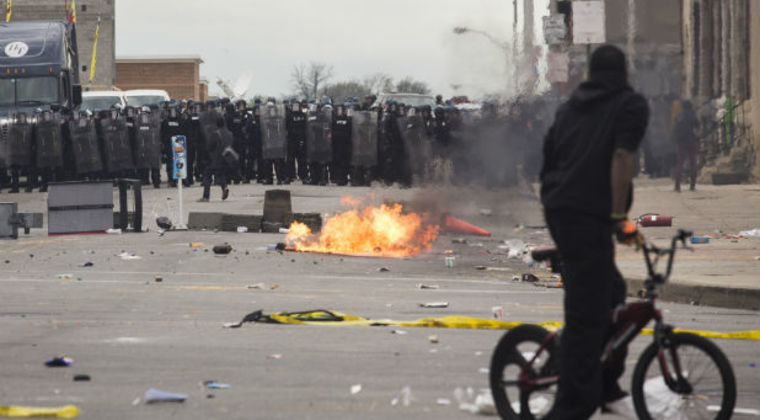
War, Repression and International Gangsterism: U.S. State Policy From Benghazi to Baltimore

Baltimore-Riots.jpg_23790e32da49a4d09d45db82b7634b69

By Ajamu Baraka

Source: CounterPunch.org

A mere two months after clashes between black youth and police in Baltimore following the murder of Freddie Gray while in police custody, President Obama’s Department of Justice (DOJ) announced the indictment of twenty-four year old Raymon Carter for his alleged involvement in the torching of a CVS pharmacy. The national government’s intervention into the case had an unmistakable message – if you engage in “unauthorized” forms of resistance – in this case, crimes against property – expect to confront the full power of the national government.

U.S. Attorney Rod J. Rosenstein made it even clearer: “Anyone in the future who participates in a ‘riot’ should know that police, prosecutors and citizens will track them down and send them to prison.”

This aggressive and speedy move on the part of the DOJ to criminalize poor, black kids in Baltimore differed sharply from the DOJ approach to high government officials, armed servants of the state at the local level and the big banks and investment firms. For the officials involved in torture under the Bush Administration, the financial gangsters who engineered the 2008 economic crisis, and the killer cops across the country who have yet to experience one indictment from Obama’s DOJ after months of “investigations,” DOJ-granted impunity has been the operative principle in practice.

But Obama’s DOJ has not been the only state institution involved in providing cover and impunity for repression and criminality in the service of the capitalist oligarchy.

Impunity for State Terrorism: the Real Story of Benghazi

What might seem oppositional and important in the game of U.S. politics is usually insignificant and diversionary. Hillary Clinton’s appearance before the House Select Committee, ostensibly established to conduct a bi-partisan investigation into the events that led to the death of Christopher Stevens and three other U.S. citizens on September 11, 2012, was a case in point.

Despite the supposed acrimony between the two ruling class parties in Congress, an ideological consensus exists around the overall strategic commitment to maintain U.S. global dominance. On that ultimate objective both corporate parties share an interest in shifting public attention away from state policies and actions that demonstrate the state’s absolute commitment to the principle of “by any means necessary” for maintaining and advancing the interests of the White supremacist, patriarchal, colonial/capitalist order.

For example, initially the Republican majority’s decision to launch another investigation into the events of 2012 was met with a considerable amount of consternation on the part of some democrats who saw the investigation as just another effort to sabotage Clinton’s run for the Presidency. However, when the republicans settled on the issue of Clinton’s emails the democrats were concerned that Clinton’s use of a private server might cause some embarrassment for her candidacy, but it was also clear that the hearings were going to be rigged and the real questions related to Benghazi would never be raised.

If the House Committee had really been committed to public accountability and surfacing the truth, there were a number of questions that could have been raised such as: 1) what was the role of the facility that was attacked? Was it a U.S. Consulate, a CIA facility or some other entity? 2) Why were those facilities set up so quickly even before a stable government was established in the aftermath of the destruction of the Libyan state? 3 ) Why were there estimated to be more than twenty CIA personnel on the ground in Benghazi just miles from the facility on the night of the attack and what was the mission of those CIA personnel? And 4) Why did the U.S. government contract with an organization to provide security for the facility that had clear ties to Jihadist groups that the U.S. considered as part of the international terrorist networks?

These kinds of questions that would have delved into U.S. involvement in Libya were not raised for two reasons: 1) The Syrian issue – Congress didn’t want the public to focus too much attention on the question of the timeline of U.S. involvement. Although many right-wing republicans were upset that the Obama administration was not more aggressive with more open and direct support for its regime change strategy, everyone in Congress knows that the narrative of reluctant and recent involvement on the part of the Obama administration in the events in Syria is pure fiction. And 2) elements in congress and the Obama administration, with the full collaboration of the corporate press, have suppressed the facts around the mission of the CIA and the role of the State Department in Libya during the period leading to the attack on the two compounds because those activities contravened both U.S. and international law.

Investigative journalist Seymore Hersh revealed that a classified annex to a report prepared by the Senate Intelligence Committee on Benghazi that was not made public, discussed a secret agreement made in early 2012 between the Obama and Erdogan administration in Turkey to run an arms supply line from Libya using arms secured with the overthrow of the Libya state to the so-called rebel forces in Syria. The operation was run by CIA director David Petraeus, and the elements that received support included jihadist groups, including the Al Nusrah Front, al-Qaeda’s official Syrian affiliate.

So even though information on the real role of the U.S. in the war in Syria is getting more coverage, the elites in Congress and the Administration were still not interested in calling too much attention to the fact that the U.S. provided material support to groups that it defined as terrorists which technically under U.S. law should have made that assistance prosecutable.

Vice President Joe Biden even stated publically that governments allied with the U.S. and their nationals were supplying arms to elements that they knew were terrorists and U.S. officials knew it:

“They poured hundreds of millions of dollars and thousands of tons of weapons into anyone who would fight against Assad. Except that the people who were being supplied were al-Nusra and al-Qaeda and the extremist elements of jihadist coming from other parts of the world. “

Yet not one of these individuals or government officials, many who travel on a regular basis to the U.S. and other Western nations have been charged or had sanctions applied to them. In fact, in a pathetic and disingenuous comment, Biden claims that even though it was pointed out to those states by U.S. officials that their support was going to extremist jihadists forces – “We could not convince our colleagues to stop supplying them.”

Obviously for the Obama Administration charging them, freezing their bank accounts, slapping sanctions on the government as was done with the governments and individuals in Iran and Russia was out of the question.

This is why for anyone whose vision is not distorted by the myopia of white supremacist, capitalist ideology, the crude class politics of the DOJ’s decision to prosecute the young resisters in Baltimore is so outrageous.

Benghazi is only a symptom of a pattern of criminal activity on the part of U.S. officials from both parties. From the illegal attacks on Iraq and Libya, subversion in Syria and Venezuela, surveillance, police state repression and mass incarceration domestically, coups in Honduras and Haiti, support for genocide in Yemen, and the continued occupation of Palestine, it is clear that what unites the elites of both parties is their unshakable commitment to maintaining the power of the U.S./EU/NATO axis of domination as the institutional expressions of concentrated white power for as long as possible.

In the meantime, Raymon Carter is facing years in prison because the state claims it has a right to hunt down and prosecute who it defines as criminals.

But the social world is not static and the balance of forces is shifting. One day using that same logic but informed by an alternative ethical framework that centers real justice, the people will be in a position to hunt down and bring to justice the international colonial gangsters who destroy our earth, torture, exploit and bring death to countless millions.

Ajamu Baraka is a human rights activist, organizer and geo-political analyst. Baraka is an Associate Fellow at the Institute for Policy Studies (IPS) in Washington, D.C. and editor and contributing columnist for the Black Agenda Report. He is a contributor to “Killing Trayvons: An Anthology of American Violence” (CounterPunch Books, 2014). He can be reached atwww.AjamuBaraka.com

Podcast Roundup

3/11: Srini Rao has an interesting conversation with animal rights activist Peter Young covering community activism, communication, survival tips, and his former life as a fugitive on the “Unmistakable Creative” podcast.

https://sitebuilderio.s3.amazonaws.com/unmistakablecreative/audios/012b5fac-3695-42b3-9a2d-ffd7d4d7f213/lessons-in-communication-from-a-fugitive-peter-young.mp3

3/11: On the latest “Guns and Butter”, Bonnie Faulkner interviews John Whitehead of  the Rutherford Institute. They discuss aspects of  “Police State America” including the Corporate State, American Legislative Exchange Council (ALEC), Offices of Inspector General (OIG), SWAT Teams, No-Knock Raids, the Schoolhouse to Jailhouse Track, the New York Prototype, MRAPs, Operation Vigilant Eagle, Atlas Four Androids, TSA and VIPR Teams, the Google/NSA connection and Fusion Centers.

http://archives.kpfa.org/data/20150311-Wed1300.mp3

3/11: Host Dave Lindorff discusses the recent coup plan disrupted by police in Venezuela with veteran journalist Alfredo Lopez — a story largely blacked out or mocked as bogus by the US corporate media despite solid evidence of a plot, and of US involvement in that plot on “This Can’t Be Happening”. Lindorff and Lopez, who are colleagues on the news site thiscantbehappening.net, also talk about why President Obama on Tuesday declared Venezuela an “unusual and extraordinary national security threat” to the US, and what that declaration means to Venezuela and Latin America.

http://s36.podbean.com/pb/0c1337348a3a2a92b0bdb73308121756/5503328c/data1/blogs18/661545/uploads/ThisCantBeHappening_031115.mp3

3/12: On the first of their recent “Media Roots” podcasts, Robbie and Abby Martin discuss the ending of the RT program “Breaking the Set”, the establishment’s Cold War resurrection, and the splintering of the left over Obama’s military policies. The second program features an interview with Mark Weisbrot, co-director of the Center for Economic and Policy Research, on current U.S. government actions against Venezuela.

Obama Incites Bloodshed in Venezuela

venezuela-us43

By Nil Nikandrov

Source: Strategic Culture Foundation

The US special services together with their “assistants” from Canada and Great Britain tried again to stage a coup in Venezuela. In the middle of February, Venezuelan President Nicolas Maduro said the national security services frustrated the plans of US embassy and put an end to its hostile actions. As a result, a number of people were arrested, including Venezuelan air force officers and activists of radical opposition. The subversive activities were guided by Western diplomatic missions. The names of those behind the plot are known but they cannot be brought to justice being protected by diplomatic immunity. The President said the plotters wanted to assassinate him. The United States embassy guaranteed that the perpetrators would be granted asylum in America.

The Bolivarian National Intelligence Service (El Servicio Bolivariano de Inteligencia Nacional – SEBIN) had been warned about the conspiracy preparations. A Super Tucano aircraft (a light, highly agile Brazilian aircraft designed principally for pilot training and counterinsurgency operations) used before for special operations by Academi (former Blackwater), an American private military company, was handed over to plotters in the United States. The plane had the insignia of Venezuelan air force. It was armed and prepared to make a flight from Columbia to the island of Curacao where a US forward operating location is stationed. The CIA-recruited pilots, who betrayed the Bolivarian regime and their home country, learned well which targets they had to strike: the presidential palace, the buildings of ministries of Defense and General Staff and TV company TeleSUR. Security agencies found caches of arms, the equipment to provide guidance to the target and a video footage showing air force officers and opposition leaders involved in the plot addressing people. The video footage was given in Miami to journalist Patricia Poleo, a fierce opponent of the current Venezuelan government. She was to make it go on air but the plan was thwarted. The video material got into the hands of SEBIN operatives.

The video showed the plotters with balaclavas on their heads announcing the beginning of insurgency in the armed forces and the establishment of interim government. It was prepared to be made public by El Nacional newspaper at the time of coup. Three key figures of the Venezuelan opposition – Leopoldo López, the mayor of Caracas, Antonio Ledezma, the leader of Voluntad Popular (People’s Will) and former member of parliament Maria Corina Machado signed and distributed a joint communique on February 11, just one day before the planned coup plot that President Nicolas Maduro denounced was to take place. All these people were known to be close to the United States. Entitled “The Call for a National Transition Agreement,” the statement calls for unification of Venezuelans behind a national plan aimed at supplanting the current socialist administration of President Nicolas Maduro. It says the country was going through hardships unparalleled in its history. It is the fault of regime that has been trying for sixteen years to impose a failed system. In the text the current government is described as a “failed” “corrupt” and “inefficient” regime, made up of an “elite of no more 100 people” who have pilfered public funds “which could have been used for the benefit of all”. It also states that Venezuela is on the brink of a “humanitarian crisis” whilst the Maduro government is “delegitimised” and in its “terminal phase”. It says nothing about the hard struggle against the United States trying to overthrow the regime fallen out of its favor. In the effort to achieve the goal, the US uses all any methods without hesitation, including economic sabotage, subversive activities against oil and energy sectors, never ending information war, organizing street protests in big cities and the use of local criminals and Columbian paramilitaries to destabilize the situation in the country. The list also includes artificially created shortages of food and basic consumer goods. The operations against Salvador Allende in Chile come to mind. The US uses the same dirty methods in Venezuela. Waiting in line has become a common occurrence in Venezuelan cities since 2013. Different prices in Columbian and Venezuelan shops are one of the reasons. Almost everything is smuggled to Columbia – from super cheap gas to corn meal and sugar. To some extent the military called by President Maduro to fight the cross border smuggling helped to control the situation.

According to the plotters’ plans, Maria Corina Machado was to head the new government. She has been patronized by former US President George Bush Jr. The Machado’s three minute meeting in the White House with the President of the United States in March 2005 attracted unusually high attention of pro-US media. Maria was painted as the most promising politician able to defeat President Hugo Chavez and become a Venezuelan President absolutely loyal to the United States. The revelations about the Machado’s ties with US intelligence services spoiled the plans. She was the founder, former vice president, and former president of the Venezuelan volunteer civil organization Sumate that used US-provided funds. When it was revealed that Machado got large sums of money from special services, she had to keep away from spotlight. Today the United States needs her again. She is ready to go to any length in an effort to overthrow Nicolas Maduro. Washington wants her to lead the country.

The planning has been done. A group of pro-US Latin American presidents is carrying out the mission. Former Mexican President Felipe Calderón, former Chilean President Sebastian Piñera and former Colombia President Andres Pastrana came to the country under the pretext of expressing their support for Leopoldo López. The real purpose was to see the real situation in the country. Nicolas Maduro never stood in their way. He only said that these people came to support ultra-right wing radicals who do not recognize the government and call for a bloody coup. Maduro warned that the visitors would have their hands soaked in blood if they hobnob with this kind of people.

Of those who signed the statement Machado is the only one who is still at large. A year ago Leopoldo López was put behind bars for inciting street protests resulting in dozens of victims. Antonio Ledezma was detained a few days ago charged with involvement in coup attempt. The conditions of detainment are not so tough; he can continue the struggle against the Bolivarian regime. Recently he sent a letter to media outlets calling for continuing protests and peaceful struggle against Nicolas Maduro to make the current President resign. In the letter he stuck rigidly to the constitution. It says “We must keep up the struggle in the street, in a civil manner with the constitution in our hands and with the truth in front of us” Ledezma wrote. “They [the government] have the weapons but we have the ideas to unite the Venezuelan people. Violence is a pointless vacuum that leads nowhere.” He wants no mercy and calls for solidarity to protect democratic values in Venezuela. He stands out among Venezuelan politicians for his aggressive style and vindictiveness. It is suggested that if the plotters won, he would have headed the Interior Ministry to cleanse the national politics from Bolivarians, Chavistas and other elements hostile to the United States.

After the leading plotters were arrested and their ties with special services and embassies of the United States, Canada and Great Britain were revealed, Nicolas Maduro could say with certainty that another coup attempt orchestrated by Washington was effectively foiled. The tension in the relationship with the United States remains. In December 2014, President Obama endorsed sanctions against top officials of Venezuela accused by Washington of human rights violations. Maduro warned Americans that arbitrary sanctions and other attempts to exert pressure would deteriorate the bilateral relationship even further. He said the United States tried to stage coups in Venezuela a number of times. The US interference into the internal affairs of other countries has become a constant factor to negatively affect the situation in the world.

Jen Psaki, the spokesperson for the United States Department of State, as usually rejected all the accusations of US involvement into the conspiracy to organize a coup in Venezuela. “Well, I think we’ve seen continued accusations, no question, that are false and baseless. And our view continues to be that political transitions must be democratic, constitutional, peaceful, and legal. We do not support a political transition in Venezuela by non-constitutional means. We’re not promoting unrest in Venezuela, nor are we attempting to undermine Venezuela’s economy or its government. And this is a continued effort – ongoing, because I do feel like we talk about these incidents once a week at least – about – of the Venezuelan Government to try to distract attention from the country’s economic and political problems and focus and try to distract and make these false accusations.”

Meanwhile, the investigation continues. Nicolas Maduro says Antonio Ledezma tried to abuse his position to organize a violent coup and destabilize the country. New arrests are to follow. The government of Venezuela is adamant in its desire to prevent the events unfolding according to a scenario worked out by the United States Central Intelligence Agency.

Related Articles:

Obama Failed his Coup in Venezuela (By Thierry Meyssan, Voltairenet.org)

US Aggression Against Venezuela (By Eva Golinger, Counterpunch.org)

Venezuela in the Crosshairs (By Coromoto Jaraba, IntrepidReport.com)