Time To Make Life Hard For The Rich

By Hamilton Nolan

Source: Splinter

It is time for polite, respectable, rational people to start saying what has become painfully obvious: It is time to stop respecting the rich, and start stealing from them. In earnest.

Inequality is eating America alive. It has been growing for decades. To say that “the American dream is dead” is no longer a poetic exaggeration—it is an accurate description of 40 years of wage stagnation and declining economic mobility that has produced a generation that cannot expect to live better than their parents did. Not because of devastating war or plague, but because of a very specific set of rules governing a very specific economic system that encourages the accumulation of great wealth among a tiny portion of the population, to the detriment of the vast majority of people. Our political and business leaders have chosen to embrace a system that favors capital over labor. A system in which the more you already have, the more you make, and the less you have, the harder it is to build wealth. It is a system designed to increase inequality. It is functioning exactly as designed. And now, it is about to get worse.

How long are people supposed to tolerate being smacked in the face? By the rich? Who already have more than enough? It is not as though the fact that inequality is a crisis is a fact that snuck up on anyone. Economists have seen the trend for decades, and the general public has been well aware of it since at least the financial crisis. Obama called it “the defining challenge of our time.” Thomas Piketty became a rock star by writing a very dry book about it. It’s not an underground thing. It is well known and well understood by the people in control of the institutions with the power to change it. The response to this dire situation by the Republican Party, which a wholly owned subsidiary of the American capital-holding class, has been to pass a tax bill that will horribly exacerbate economic inequality in this country. It is a considered decision to make a bad situation worse. It is a deliberate choice—during a time when the rich already have too much—to take from the poor in order to give the rich (including members of Congress and the President) more. That is not a metaphor. That is the reality. That is what the Republican party is about to accomplish on behalf of the donor class, calling it “middle class tax relief” in the face of mathematical proof to the contrary. Even to my cynical ass, the sheer fuck you-ness of this action towards the majority of the country is breathtaking. This is not just a failure to solve a severe problem; it is the expenditure of vast amounts of political capital to make the severe problem worse so that a tiny handful of people will get wealthier than anyone needs to be.

Ideally, in a democracy, elected leaders reflecting the interests of the people would pass taxes and regulations to reverse the growing inequality here. For that to happen, we would need to end gerrymandering and reform campaign finance and probably abolish the Senate and the Electoral College, and that’s just for starters. It is not imminent, in other words. Our broken political system, which is designed to reward money with political power, is actually moving in the opposite direction of a solution. Who is suffering because of this? Most Americans. Certainly the bottom 50% are acutely suffering—money that would have been in their paychecks has been instead funneled upwards into the pockets of the rich. Every desperate family that has found themselves coming up short for rent or food or medicine, every American who has downgraded her dreams and aspirations because they became financially implausible, has been directly harmed by the political and economic class war perpetuated by the rich, even if they cannot see the perpetrators with their own eyes. I think that people have been more than patient in the face of this slow-moving crisis. In 2009, when the markets crashed and millions were laid off, nobody rioted and kidnapped the financiers and burned their homes. The outcome of that lack of direct action is the situation we find ourselves in today.

Violence against people is morally wrong and a bad way to solve problems. But capital is different. One thing that would help to create the political environment conducive to solving the inequality problem would be to make the cost of accumulating all that capital too high to be worth it. In other words, to create a downside to being too rich. I have personally stood in a room full of hedge fund titans and billionaire investors warning one another explicitly that inequality must be addressed lest the U.S. become a place like Latin America, where rich people are forced to live behind walls, surrounded by armed guards, because of the very real risks from the rage of the poor. Rich people in this country do not want to live like that. If they see that they must stop being so greedy in order to enjoy their own freedom, they will stop being so greedy. Those conditions have to be created by people who want justice.

Our situation is absurd. Not since the Gilded Age has it been more clear that a few people have too much. Furthermore, the people with too much are investing in political clout to give themselves more. It’s just wrong. If the government won’t help, we have to help ourselves. Sticking up a billionaire on the street for $100 is not going to do it. But one can imagine other ways that angry Americans might express their dissatisfaction with our current division of wealth: A large-scale online attack against the holdings of the very rich; yachts sunk in harbors; unoccupied vacation homes in the Hamptons mysteriously burned to the ground. Sotheby’s auctions swarmed by vandals, Art Basel attacked by spraypaint-wielding mobs, protests on the doorsteps of right-wing think tanks, venomous words directed at millionaires as they dine in fancy restaurants. People have a right to life and safety, but property does not. A life spent screwing the little people so that you can acquire lots of stuff loses its allure when you know that all that stuff will be smashed to pieces by angry little people. It is not hard to put together a list of those who should be targeted—Forbes publishes it every year. Likewise, public campaign finance records give us a pretty good idea of exactly who is funding the politicians who are perpetuating this economic war on behalf of the rich.

It is nice to imagine a grand, well-targeted computer hack that would neatly transfer billions of dollars out of the accounts of, say, the Walton family and into a charity account that would disburse the money to the poor in untraceable ways. That seems far-fetched. Realistically, what people can do now is to start thinking about ways to make it uncomfortable to be too rich. Socially uncomfortable and otherwise. When the accumulation of great wealth ceases to be a praiseworthy endeavor and instead becomes viewed as a sick, greedy pastime whose only reward is the hatred of your fellow citizens and the inability to live comfortably without fear of your excessive property being destroyed, rich people will rethink their goals. Until then, inequality will keep rising, and everything, for most people, will continue to slowly, slowly get worse.

$21 Trillion of Unauthorized Spending by US Govt Discovered by Economics Professor

Source: Covert Geopolitics

he US government may have misspent $21 trillion, a professor at Michigan State University has found. Papers supporting the study briefly went missing just as an audit was announced.

Two departments of the US federal government may have spent as much as $21 trillion on things they can’t account for between 1998 and 2015. At least that’s what Mark Skidmore, a Professor of Economics at MSU specializing in public finance, and his team have found.

They came up with the figure after digging the websites of departments of Defense (DoD) and Housing and Urban Development (HUD) as well as repots of the Office of the Inspector General (OIG) over summer.

The research was triggered by Skidmore hearing Catherine Austin Fitts, a former Assistant Secretary in the HUD in the first Bush administration, saying the Inspector General found $6.5 trillion worth of military spending that the DoD couldn’t account for. She was referring to a July 2016 report by the OIG, but Skidmore thought she must be mistaking billion for trillion. Based on his previous experience with public finances, he thought the figure was too big even for an organization as large as the US military.

“Sometimes you have an adjustment just because you don’t have adequate transactions… so an auditor would just recede. Usually it’s just a small portion of authorized spending, maybe one percent at most. So for the Army one percent would be $1.2 billion of transactions that you just can’t account for,” he explained in an interview with USAWatchdog.com earlier this month.

After discovering that the figure was accurate, he and Fitts collaborated with a pair of graduate students to comb through thousands of reports of the OIG dating back to 1998, when new rules of public accountability for the federal government were set and all the way to 2015, the time of the latest reports available at the time. The research was only for the DoD and the HUD.

“This is incomplete, but we have found $21 trillion in adjustments over that period. The biggest chunk is for the Army. We were able to find 13 of the 17 years and we found about $11.5 trillion just for the Army,” Skidmore said.

The professor would not suggest whether the missing trillions went to some legitimate undisclosed projects, wasted or misappropriated, but believes his find indicates that there is something profoundly wrong with the budgeting process in the US federal government. Such lack of transparency goes against the due process of authorizing federal spending through the US Congress, he said.

Skidmore also co-authored a column on Forbes, explaining his research.

The same week the interview took place the DoD announced that it will conduct its first-ever audit. “It is important that the Congress and the American people have confidence in DoD’s management of every taxpayer dollar,” Comptroller David Norquist told reporters as he explained that the OIG has hired independent auditors to dig through the military finances.

“While we can’t know for sure what role our efforts to compile original government documents and share them with the public has played, we believe it may have made a difference,” Skidmore commented.

Interestingly, in early December the authors of the research discovered that the links to key document they used, including the 2016 report, had been disabled. Days later the documents were reposted under different addresses, they say.

This is probably where the Deep State government called CIA and State Department took their extra fund to topple uncooperative governments around the world. The bulk, of course, may have gone to the military industrial complex.

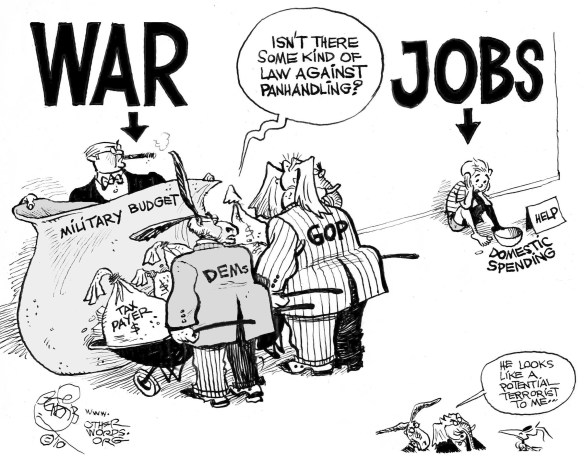
The United States has double the military budget of the combined military spending of Russia, China and G7 countries. Said military spending remains unauditable due to “widespread material internal control weaknesses, significant uncertainties, and other limitations” according to a GAO report in 2010.

So, how can a government spread its wings beyond its own borders, and demand democratic ideals elsewhere when it is not practicing the same values at home?

This Chart Defines the 21st Century Economy

By Charles Hugh Smith

Source: Of Two Minds

There is nothing inevitable about such vast, fast-rising income-wealth inequality; it is the only possible output of our financial and pay-to-play political system.

One chart defines the 21st century economy and thus its socio-political system: the chart of soaring wealth/income inequality. This chart doesn’t show a modest widening in the gap between the super-wealthy (top 1/10th of 1%) and everyone else: there is a veritable Grand Canyon between the super-wealthy and everyone else, a gap that is recent in origin.

Notice that the majority of all income growth now accrues to the the very apex of the wealth-power pyramid. This is not mere chance, it is the only possible output of our financial system. This is stunning indictment of our socio-political system, for this sort of fast-increasing concentration of income, wealth and power in the hands of the very few at the top can only occur in a financial-political system which is optimized to concentrate income, wealth and power at the top of the apex.

Well-meaning conventional economists have identified a number of structural causes of rising wealth/income inequality, dynamics that I’ve often discussed here over the past decade:

1. Global wage arbitrage resulting from the commodification of labor, a.k.a. globalization

2. A winner-takes-most power law distribution of the gains reaped from new technologies and markets

3. A widening mismatch between the skills of the workforce and the needs of a rapidly changing economy

4. The concentration of capital gains in assets such as high-end real estate, stocks and bonds that are owned almost exclusively by the top 10% of households

5. The long-term stagnation productivity

6. The secular decline in the percentage of the economy that flows to wages and salaries

While each of these is real, the elephant in the room few are willing to mention much less discuss is financialization, the siphoning off of most of the economy’s gains by those few with the power to borrow and leverage vast sums of capital to buy income streams–a dynamic that greatly enriches the rentier class which has unique access to central bank and private-sector bank credit and leverage.

Apologists seek to explain away this soaring concentration of wealth as the inevitable result of some secular trend that we’re powerless to rein in, as if the process that drives this concentration of wealth and power wasn’t political and financial.

There is nothing inevitable about such vast, fast-rising income-wealth inequality; it is the only possible output of our financial and pay-to-play political system.

Policy tweaks such as tax reform are mere public relations ploys. The cancer eating away at our economy and society arises from the Federal Reserve and the structure of our financial system, and the the degradation of our representative democracy into a pay-to-play auction to the highest bidder.

Democratic Party crisis explodes in wake of Brazile revelations

By Patrick Martin

Source: WSWS.org

The political crisis in the Democratic Party, brought to the surface with the publication Thursday of excerpts of a campaign memoir by the former interim chairman of the Democratic National Committee (DNC), Donna Brazile, erupted into mutual denunciations over the weekend.

Brazile made public an unprecedented agreement between the DNC (under previous chair Debbie Wasserman Schultz) and the Hillary Clinton presidential campaign that involved Clinton paying off the DNC’s debts and providing it a monthly subsidy in return for gaining control over the appointment of DNC officials and the right of approval over key operational decisions.

The deal was concluded in August 2015, six months before the first votes were to be cast in caucuses or primaries, when the DNC was required by its own rules to remain neutral in the contest between Clinton, Vermont Senator Bernie Sanders and several other candidates for the Democratic presidential nomination.

A further revelation from Brazile’s book was made public Saturday: she acknowledged discussions among leading Democrats in September 2016, after Hillary Clinton had collapsed at a ceremony in New York City marking the 15th anniversary of the 9/11 attacks, over whether Clinton should be replaced as the presidential candidate because of health concerns. Brazile writes that she herself considered Vice President Joe Biden as the logical replacement, but did not make the proposal.

Within hours of this report, 100 former Clinton campaign aides, headed by campaign chairman John Podesta and campaign manager Robby Mook, put their signatures on an open letter denouncing Brazile’s criticism of the Clinton campaign.

The “Open Letter From Hillary For America 2016 Team” makes use of the same Russia-baiting technique employed by the Democrats in their political conflict with the Trump White House, but this time directed against a former top Democrat. In assailing Brazile, the first paragraph of the open letter declares: “It is particularly troubling and puzzling that she would seemingly buy into false Russian-fueled propaganda, spread by both the Russians and our opponent, about our candidate’s health.”

The health questions about Clinton were fueled, however, not by Moscow, but by video broadcast over American cable television networks showing the candidate being lifted into a vehicle by aides and Secret Service agents, in visible distress. The characteristic duplicity of top campaign officials, who initially sought to conceal the incident, added to the ensuing furor.

Even more revealing is what is missing from the Clinton camp’s “Open Letter”: there is no reference whatsoever to the main revelation stemming from Brazile’s book—the secret joint fundraising agreement between the Clinton campaign and the DNC, six months before the first caucus in Iowa, giving Clinton effective control of the party apparatus. The Clinton aides do not dispute that this backroom deal occurred and make no attempt to justify it.

On Sunday morning, Brazile appeared on the ABC News program “This Week with George Stephanopoulos.” The host, himself a former top political aide in the White House of Bill Clinton, provided a platform for Brazile to repeat her exposure of the collusion between the Clinton campaign and the DNC and discuss the “Open Letter” from the former Clinton campaign officials.

She bitterly denounced the Clinton camp, both for its treatment of the DNC while she was in charge, and for their ferocious response to her new book. “George, for those who are telling me to shut up, they told Hillary that a couple of months ago,” Brazile declared. “You know what I tell them? Go to hell! I’m going to tell my story.”

Brazile also touched on a topic of intense but largely behind-the-scenes discussion in official Washington: the July 2016 murder of Seth Rich, a low-level IT staffer at the DNC, who was shot to death in what police called a failed robbery attempt. The Trump White House and ultra-right media allies, including Alex Jones of InfoWars and Sean Hannity of Fox News, have portrayed Rich, rather than Russian hackers, as the likely source for the DNC emails obtained by WikiLeaks, and his killing as a retaliatory “hit” ordered by the Clinton campaign.

Brazile reportedly suggests in her book—which will not be available to the public until Tuesday—that Rich’s death, warnings from the Obama administration about Russian hacking and repeated online threats from Trump supporters had made her extremely concerned about security issues, to the point where she had her home swept for bugs and installed multiple security devices. In her interview Sunday with Stephanopoulos, she spoke of her fears for her own personal safety. Her mention of Seth Rich, entirely unsolicited, seemed a veiled warning to the Clinton camp that more revelations about 2016 campaign skullduggery could be forthcoming.

Current DNC Chair Tom Perez was interviewed Sunday on “Meet the Press” on NBC and directly rejected the two main issues raised by Brazile. He maintained, “The charge that Hillary Clinton was somewhere incapacitated is quite frankly ludicrous,” although he did not attribute that concern to Russian propaganda.

He went on to argue that Clinton won the Democratic primary contest by four million votes, and the DNC was not in control of those elections, which are run by the state governments, while noting that the caucuses, which are controlled by the party apparatus, were mostly won by Sanders, not Clinton. Perez would concede only that “the DNC fell short during critical moments of the primary,” in terms of openly favoring Clinton over Sanders.

Significantly, neither Sanders nor any of his top aides or supporters made an appearance on any of the Sunday television talk shows. Sanders issued a statement on Brazile’s revelations suggesting that the conduct of the 2016 campaign was a diversion from the effort to mobilize opposition to the Trump administration.

The fact is that Brazile informed Sanders of the joint fundraising agreement and the takeover of the DNC by Clinton more than a year ago, and he has chosen to say nothing about it. This is part of his effort to prop up the Democratic Party and prevent the millions of working people and youth who supported his campaign from drawing the political conclusion that it is necessary to break with the Democrats in order to conduct any genuine struggle against the billionaires who dominate the US political system.

The conflict within the Democratic Party has erupted under conditions where the Republican Party is bordering on civil war, with several Republican senators denouncing Trump as a threat to American democracy—and then announcing they would retire from office rather than oppose him—and a vicious conflict developing between the party establishment and the fascist-minded elements around Trump, spearheaded by his former chief political aide and campaign manager, Stephen Bannon, now returned to his position as chief executive of the ultra-right Breitbart News.

In recent days, it has been reported that in an upcoming book titled The Last Republicans, the author cites interviews with George H. W. Bush and his son George W. Bush in which the two last Republican presidents before Trump denounce the current occupant of the White House and reveal that they refused to vote for him in 2016. In response, Trump tweeted an attack on his Republican presidential critics.

The ABC “This Week” program on which Brazile was interviewed began with the presentation of a new Washington Post/ABC News poll showing public support for Trump falling to its low point for the year, only 37 percent, with 59 percent opposing. Trump’s showing was the worst for any first-year president since modern polling began. Other polls have shown public support for the Republican-controlled Congress hitting new lows as well.

The vast majority of working people are increasingly alienated from the two-party political system in the United States, correctly regarding both the Democrats and the Republicans as tools of the super-rich and looking for an alternative. The central political question is the building of a political movement of the working class that will fight the capitalist system as a whole and advance a program to defend jobs, living standards and democratic rights, and oppose imperialist war.

The Danger Of Patriotism

By Bob Livingston

Source: Alt-Market.com

My friends, it is frightening how simple we are and how easily we are manipulated simply because we are intellectually lazy.

The U.S. establishment has confused cause and effect by and through a flag-waving mania in America. “Patriotism” throughout history has covered a multitude of mischief. We are seeing it now!

Phony patriotism is strong leverage against a population ignorant of the ways of treason by its own government. I also have no doubt that U.S. history is full of wars “for democracy” killing millions under the propaganda of patriotism with the majority support of the people and the full support of all but a small cadre of “elected representatives” — who are paid by the federal government, incidentally. In addition the millions of foreign dead, these wars have left hundreds of thousands of American military members dead or maimed physically and/or emotionally.

The whole world knows about the U.S. military industrial complex war machine and its pursuit of profits. But Americans tend to turn a blind eye.

When George Washington said “government is force,” he meant that government is force against its own people.

Since by definition government is force, then it follows that government will use any ruse imaginable to increase its power. Increased use of government force or power could backfire unless skillfully handled and justified in the public mind. Therefore governments rarely take action unless accompanied by skillful propaganda.

The brouhaha over certain NFL players’ refusal to stand for the playing of the Star Spangled Banner has erupted anew. The reaction of most Americans — who claim to believe in the Constitution and Bill of Rights — is that this expression cannot be tolerated… it is un-American… it is “unpatriotic.”

But is it? Or is it not the most American of all things to resist and rebel against what we perceive as tyranny and its symbols?

If we deny one — whether through intimidation and threats, monetary sanctions or government force — his rights, are we not creating a situation where rights are just privileges that can be denied on a whim? If we support police power to invade our homes and wallets and steal our property just because government has made it “legal,” are we not again conceding that rights are merely privileges?

You cannot say, “I believe in the 1st Amendment, but…; I believe in the 2nd Amendment, but…; I believe in the 4th Amendment, but…” There is no but.

And if that government making “legal” the assaults on our liberty is represented by a symbol, shouldn’t we conclude that that symbol is a symbol of tyranny? I wrote about the phony patriotism of flag worship when the Colin Kaepernick stir occurred last year. In light of the new kerfuffle over NFL players refusing to stand, and comments to some of our columns on preserving liberty of late, I felt it was time to run it again. Here it is:

The American golden calf

As a young boy, I enjoyed my family’s bantam chickens that laid very small eggs and hatched very small chicks. Theirs was a small and miniature world.

One day one of my bantams started sitting on eggs to hatch its chicks. Something happened to her eggs but she continued to sit, so I decided to put a duck egg under her. Duck eggs are at least three times bigger than bantam eggs and take a few days longer to hatch, but she dutifully sat on the egg several days longer. She hatched the duckling and, as you can imagine, it thought that his world was normal and that the bantam hen was his mother.

The duckling eventually grew into a full sized mallard duck, probably five or six times the size of its bantam mother. The full-grown duck would follow its hen mother around as would normal chicks. It was a funny sight to watch.

But I remember thinking, even as a small boy, that the duck’s entire reality was that the bantam hen was his mother and that was the way the world worked. He had no need to consider anything else.

This is the world of the American people today. Their perceptions of reality control them and they who control their perceptions control the American people.

Our perception of America has always been that she is the mother country and ordained by God, good and just and a beacon of freedom. This is hammered into our psyches from our early days.

From pre-school up, we are taught to worship the state. I don’t know if it is still done, but in the public (non)education system, for many years, schoolchildren across the South — and elsewhere, I suppose — recited the Pledge of Allegiance each morning. Political rallies and government meetings are still often begun with a recitation of the pledge.

People say it with patriotic fervor, with their hands placed dutifully on their hearts.

Sporting events, political rallies and other public venues are often kicked off with the playing and/or singing of the Star Spangled Banner. Before the song begins, people are instructed to rise, men to remove their hats,and people place their hands over their hearts. They don’t realize its value as a propaganda tool.

We have come to equate the flag, the pledge and the national anthem with patriotism, and patriotism with government, country and support for government, support for foreign wars and veterans. Anything less is “un-American.”

Beyond its patriot fervor is the almost religious fervor and religious symbolism of the American people’s actions when the pledge and the national anthem begin: the ritual standing, removal of hats, placing of hands and rote recitation. In the book of Daniel, Israelites Hananiah, Mishael and Azariah (Shadrach, Meshach and Abednego) refused to worship the golden image of Nebuchadnezzar contrary to the king’s decree. The king ordered them to be thrown into the furnace after it was turned up to seven times its normal temperature.

NFL player Colin Kaepernick created a stir last week when he refused to stand for the national anthem. He was not subsequently ordered into the furnace by the king, but he was burned symbolically by many football fans who torched their jerseys. Americans fumed that he should “leave” America if he can’t support the flag and that he had disrespected the flag, the nation and veterans.

What are we saying when we say that someone “disrespected the flag,”  “disrespected the country,” “disrespected the veterans” if he chooses to not stand for the national anthem? What is the flag but a piece of cloth? By the reaction to Kaepernick, it seems it has become more of a golden calf to represent mother country or the god of government.

Our mother has become a witch. Yes, same symbols, same flag, same pledge of allegiance, but a decadent spirit controlling the perceptions of the American people, keeping them on the animal farm (controlling their perceptions) long enough to impoverish and enslave them.

Time and gradualism can change a system all the way from human liberty to slavery (the animal farm) over a few generations without anyone being aware except a very few, those who ask questions.

“America, love it or leave it,” is a tired canard. One cannot leave it except at great cost. Recall that in 1860-1861 11 states attempted to “leave it” in order to preserve their liberty and rights as sovereign states. They were branded as “insurrectionists” and attacked by the War Party and the result was their economic and social destruction, subjugation and the deaths of some 850,000 people (the equivalent of about 8.5 million people today). When one talks of secession today he’s branded as a racist, crazy or a radical and told secession is “illegal.”

One can love his country but hate his government and its actions. I love America but not the people who control America and its government. I love America, but its rulers are alien to individual freedom, its government now anathema to liberty.

If the flag is symbolic of government and that government lies at every turn, enslaves its people, steals from their labor, passes laws that are an execration to their Christian faith, takes from them their liberty, mandates the murder of 1 million babies a year, imports tens of thousands of immigrants to replace American workers and drive down wages, and that makes war on other countries that have not threatened us, why should any acknowledge its presence with more than a sneer?

Wars are not for patriotism and “democracy,” as we are propagandized. And our freedom has not been threatened by outside forces in 200 years. Wars are to kill; i.e., mass ritual murder. Additionally, big business and globalist banksters in league with Satan reap massive profits for the killing and sacrifice of young men (lambs) on all sides of combat.

If the flag is symbolic of the Constitution, that Constitution died long ago — destroyed by a crony railroad lawyer and mercantilist who made war on a sovereign people to benefit monied interests.

If the flag is symbolic of freedom, that freedom no longer exists — stolen long ago by crony corporations and globalist banksters and unaccountable oligarchical black-robed satanists and idol worshippers who usurped their authority created laws out of thin air under the guise of “interpreting the Constitution” a dictate not granted them under the original document.

The phony form of patriotism instilled within the population is strong leverage against independent thinking, keeping people ignorant of the treason by our own government.

America today is a more advanced state of fascism than World War II Germany and Italy. Fascism never identifies itself as totalitarianism. It always calls itself democracy.

Democracy is the politically correct word and cover term for modern American fascism.

American fascism has all the attributes and trappings of benevolent totalitarianism. No, benevolent totalitarianism is not an oxymoron.

The word benevolent in this instance means that the general perception of the population of the American system is that it is benevolent. This is only to say that modern America is full-blown fascism with a pretty face. It is every bit as deadly to human liberty as any tyranny in history and I would add far more sinister because of its propaganda sophistication.

Any regime that can spin tons of fiat paper money with printing presses or electronically is a slave system regardless of what it calls itself or regardless of the general population’s perception of it.

Our mother has been transformed into a witch no matter how much we love her.

Ken Burns’ Vietnam War: An Object Lesson in the Failures of the Objective Lens

By Reed Richardson

Source: FAIR

If journalism resigns itself to being a “first draft of history,” Ken Burns’ popular PBS documentaries, written by Lynn Novick, have increasingly aspired to—and achieved—a coveted status as popular historical canon. This has, in part, been accomplished by Burns’ choice of cozily American subject matter—jazz, baseball, the Brooklyn Bridge—as well as the calming effect that time and distance provide when it comes to more difficult, inflammatory topics like the Civil War. His success is a rare, fraught feat.

But how would Burns’ earnest, middlebrow glosses on American history, forever panning slowly across sepia-tinted photos, treat a more contemporaneous, contentious event like the Vietnam War? The answer can be found in a 10-part, 18-hour opus that for the first time ventures outside Burns’ previous editorial and narrative comfort zones. The Cold War lead-up, decade-plus of intense air and ground combat, and subsequent years of national shame/guilt over the war affected the second half of our 20th century like nothing else.

Teasing out a coherent, honest through-line of such a momentous, highly charged topic is ambitious, to say the least, and Burns rises to the challenge in many ways. Most notable among them: a dedicated effort to include the voices and experiences of the Vietnamese who suffered and/or fought Americans, to create a much more complete, insightful portrait of the war. But in the striving to present all sides and simply lay out the facts for the viewer, Burns nonetheless pulls his punches when it comes to assigning blame and culpability for the disastrous war. As a result, he has produced a sometimes daring, sometimes schmaltzy, richly detailed yet ultimately flawed film about the tragedy and horrors that the United States brought upon itself and inflicted upon Southeast Asia.

As a Washington Post article (9/18/17) on all the behind-the-scenes detective work that went into the film makes clear, Burns and Novick did an incredible amount of research and original reporting. However, the narrative shortcomings of the documentary mirror many of the same journalistic sins one finds in the corporate media’s coverage of the far-off wars of today. Much like the mainstream press, Burns suffers from inherent biases about objectivity that affect his storytelling.

In an insightful New Yorker profile (9/4/17) of Burns by Ian Parker, one can see the tendrils of the filmmaker’s can’t-we-find-a-consensus editorial viewpoint that longs for inviolable truths sure to exist somewhere in between the ideological extremes:

Burns frequently—almost hourly—says, “Sometimes a thing and the opposite of a thing are true at the same time,” paraphrasing a remark made by Wynton Marsalis, in Jazz. Burns uses the line less to acknowledge historical uncertainty than to advertise inclusiveness: a desire to guide all but the most sectarian or jaded viewers through an obstacle course of their own biases. He is not disengaged from his material, but his sense of a subject, and his sense of an audience’s reaction to that subject, seem to be fused. He once said, “I want to bring everybody in.”

Later in that story, Burns betrays more of this tendency for false equivalence when he makes a prediction about the bifurcated political reaction his documentary would receive. Sounding very much like a put-upon, but archly centrist editorial page editor, he makes clear that he sees angering both the right and the left simultaneously as an occupational hazard, if not a proxy for having arrived closest to the truth:

After The Vietnam War, I’ll have to lie low. A lot of people will think I’m a Commie pinko, and a lot of people will think I’m a right-wing nutcase, and that’s sort of the way it goes.

While this suggests little capacity on the part of Burns to engage in past criticisms of his work—chief among them, his tendency to overindulge in hokey American splendor-ism—that’s not to say there aren’t stark departures from his oeuvre in The Vietnam War. In just the first few minutes of the first episode, “Deja Vu,” over a squawling original Trent Reznor score, Burns literally pushes the audience backwards by spooling iconic footage of the war—and protests of it—in reverse. It’s a disorienting, but shrewd gambit; a recognition of all the baggage the Vietnam War still carries in the American psyche.

Right after this jarring sequence, though, the old Burns reappears. We see languid, gauzy shots of the Vietnam Memorial in Washington, DC, overlaid with Bob Dylan’s “Hard Rain’s Gonna Fall” and former US senator and Vietnam veteran Max Cleland talking philosophically about the tragedy of suffering and surviving war. As presented, Cleland’s connection to the war is inexplicably vague—he’s only identified on-screen by his name and “Army”—and, though he is a triple amputee because of wounds suffered from a grenade blast in Vietnam, he is filmed only in close up, as if Burns still wants to ease his audience into the full violence wrought by the war. (Burns repeats this ambiguous decontextualization of his interview subjects throughout the documentary.) Then, the film’s narration, once again voiced by longtime actor Peter Coyote, offers up what journalism would call the “nut graf,” the defining leitmotif of the 17 hours and 55 minutes yet to come.

America’s involvement in Vietnam began in secrecy. It ended 30 years later in failure, witnessed by the entire world. It was begun in good faith by decent people out of fateful misunderstandings, American overconfidence and Cold War miscalculation. And it was prolonged because it seemed easier to muddle through than admit that it had been caused by tragic decisions made by five American presidents belonging to both political parties.

There is a lot to unpack in this short passage, but it is accurate in its summation of Burns’ narrative focus throughout his film: that is, long on personal perspectives and documentary evidence of the chronological evolution, but short on broader conclusions about American foreign policy, or any real condemnation of the indescribable cruelty and dishonesty among policymakers who orchestrated it. In one telling anecdote, Burns confided to the New Yorker that his team debated saying “ended in defeat” in this section, but nevertheless chose “failure” instead.

Likewise, the film’s “begun in good faith by decent people” line doesn’t merely land like a false note, it deafens like a discordant symphony. As Veterans for Peace pointed out, Burns’ own documentary refutes this claim. Nearly every episode in the film offers up myriad examples of our elected officials, the military, or CIA willfully lying to the public (or each other) about the US’s involvement in Vietnam, often for personal or political gain.

Nor can you overlook the passive construction of the language, which helps to strip agency from the war’s cheerleaders. Burns’ equivocations here represent stunning intellectual cop-outs, pure and simple, and throw doubt on all that follows.

Relevant to such a compromised take is how Burns and Novick get funding for their projects. Less than a quarter of their money is provided by government sources; the rest comes from charities and the private sector. So perhaps it’s foolish to believe any Ken Burns documentary—partly paid for by the likes of David Koch and Bank of America, among other sponsors—would offer up a polemicized indictment of US politicians and war policy.

By all accounts, Burns and Novick maintain full editorial independence, but their funding pipeline for future projects also greatly depends upon the continued generosity of those same nonprofit and corporate benefactors, who don’t ordinarily court highly controversial filmmakers. As a result of this ongoing relationship, there’s an unseen, but unmistakable gravitational pull that serves to keeps the pair from wandering too far afield from conventional wisdom. Just like Bank of America, in other words, Ken Burns has a brand to protect.

To stay safely within the bounds of convention, Burns and Novick spend a great deal of their time “in-country,” so to speak, on a simple, universal theme: War is hell. And their ability to convey the visceral fear and pathos of battle at the human level is remarkable and poignant: “In war, nobody wins or loses. There is only destruction. Only those who have never fought like to argue about who won or lost,” says Bao Ninh, a North Vietnamese soldier Burns interviews. (Bao is no random grunt—he is also the author of The Sorrow of War, a novel of a soldier’s anguish—but, again, Burns identifies him only as “North Vietnamese Army.”)

When paired with the blunt, chilling lessons that combat taught US Marine Karl Marlantes, the combination has a powerful effect. “One of the things I learned in the war is that we’re not the top species on the planet because we’re nice,” recounts Marlantes about a firefight from 1969. “People talk a lot about how well the military turns kids into killing machines and stuff, and I’ll always argue that it’s just finishing school.”

Feeding this seething killing machine on the American side was a wide-open, virulent streak of racism, which Burns, to his credit, delves into (finally) in the fifth episode. (A Washington Post podcast interview with Burns—9/22/17—delves further into this aspect of the war.) Still, the film can never quite make the leap between the countless tragedies on the tactical level and strategic policies that enabled them and then quickly metastasized.

The most famous battlefield atrocity, the 1968 My Lai massacre, which was mostly covered up and pinned on one Lt. William Calley, again shows Burns putting his directorial thumb on the scale. Rather than call the massacre “murder,” as it was originally described by Novick, Burns switched the script to read that “the killing of civilians has happened in every war.” While true, this statement is so banal that it is meaningless, and serves to inoculate My Lai and all the other atrocities committed in the war of their conscience-shocking power. In effect, the film’s stance is normalizing war crimes. And Burns all but confesses to this in a bizarre admission to the New Yorker: “‘Killing’ was the better word, [Burns] said, ‘even though My Lai ismurder.’”

These distinctions without differences betray a corrupted objectivity, one that can’t really reckon with the fact that the wanton destruction and unceasing, lawless violence seen at My Lai was more the rule than the exception. Perpetrating atrocities was, in fact, standard operating procedure for entire units on the US and Vietnamese sides throughout the war, not merely the work of a few deranged individuals. One academic who studies democide (murder by government) conservatively estimates North Vietnam killed 216,000 non-combatants between 1954 and 1975. (The Vietnamese government had been silent about the film until this week, when it issued a boilerplate response. But Vietnamese citizens have been able to watch a version of the documentary with Vietnamese subtitles on PBS online.)

To cite but one specific example of this lawless killing by the US military, the “Tiger Force” recon platoon of the 1/327th Infantry Regiment, 101st Airborne Division, committed a “wave of terror” in Vietnam’s Central Highlands in 1967. This bloodthirsty campaign was detailed in a 2003 series by the Toledo Blade (10/19/03). But for a more exhaustively comprehensive look at the tsunami of illegal killing by the US across the entire theater, you’re better off reading Nick Turse’s damning account: Kill Anything That Moves: The Real American War in Vietnam. As an American Conservative (7/30/13) book review of Turse’s book makes clear:

The relentless violence against civilians was more than the activity of a few sociopaths: It was policy. This was a war fought along Fordist principles—Robert McNamara had gone to the Department of Defense straight from the helm of the auto giant—and the slaughter was industrial in scale. Victory over the Viet Cong was to be achieved by quantifiable “kill ratios,” to reach that elusive tipping point where the insurgency could no longer replenish its troops. This approach hard-wired incentives to secure a high “body count” down the chain of command, with the result that US soldiers often shot civilians dead to pad their tallies and thereby move up the ranks.

Turse sent copies of his book to Burns’ team, and it is listed as a source in the show’s online bibliography. But while episodes two and three of Burns’ series do take time to cite McNamara’s chilling preference for quantifying enemy deaths as success (i.e., the infamous “body counts”), the film still fails to connect all the dots as to how this high-level political and military mindset—also propelled by racism—set the conditions for consistent, everyday atrocities, versus mere military operations, by combat units. (Thomas Bass’s highly critical essay covering the entire 18-hour documentary—Mekong Review, 8–10/17—discusses this.)

Ironically, Burns and Novick’s compromised framing also echoes much of the jingoistic reporting of the war as it was happening, which the film does an admirable job of debunking. Most TV media coverage of the early years of ever-expanding war, Burns notes, was almost willfully obtuse, invoking World War II newsreels that portrayed the war in terms that were “enthusiastic, unquestioning, good guys fighting and defeating bad guys.” At one point, Burns features a Marine, Roger Harris, telling his mother in 1967 that “she shouldn’t believe what she sees in the newspaper, what she sees on television, because we’re losing the war.”

There were a few, notable exceptions, however. While Vietnam was still fighting French colonial rule, on-the-ground reporters like Seymour Topping, the local Associated Press correspondent in Saigon, were warning that Western imperialist intentions in the country were doomed to fail. In 1951, Topping said as much to a young congressmember from Massachusetts, John F. Kennedy, who was visiting the nation for the first time.

Once the US began sending advisers, and then combat troops, in the early 1960s, Burns points to a handful of reporters—Neil Sheehan (who was an adviser to the documentary), the New York Times’ David Halberstam and Malcolm Browne of the AP—who dared to buck the party line. After spending time in the field, the film notes, they “were beginning to see that from the Vietnamese countryside, things looked very different than they did from the press offices in Washington or Saigon.”

But even intrepid reporters committed to telling the truth about the war were susceptible to creeping American bias. Sheehan, who had fought in Korea, acknowledges that he found riding along in US helicopters on an South Vietnamese Army air assault raid “absolutely thrilling.” Similarly, Joe Galloway, a UPI reporter who filed countless battlefield reports during the war, says in the film:

You can’t just be a neutral witness to something like war.… It’s not something you can stand back and be neutral and objective, and all of those things that we try to be as reporters, journalists and photographers. It doesn’t work that way.

Not coincidentally, when Galloway recounts a landmark 1965 battle in the Ia Drang Valley, where the Air Cavalry unit he was with faced a massive, frontal attack by the Viet Cong, he notably lapses into the first-person plural: “We had two things going for us. We had a great commander and great soldiers and we had air and artillery support out the yin-yang.” That Galloway later co-authored a New York Times bestselling book about the battle with its US commander, Lt. Gen. Hal Moore, and was later awarded a Bronze Star by the US Army for helping rescue a wounded soldier during that battle, goes unmentioned by Burns.

It’s this blindspot—the failure to see that one is adopting the point of view of one’s subjects—that ultimately dooms the film’s potential. Which is a tragedy, since the US is currently failing to learn the the same painful, sunk-costs lessons of Vietnam with its bipartisan, Groundhog Day war policy in Afghanistan. As Drake University political science professor, David Skidmore, noted in his review of the film (Military Times, 9/17/17):

Now Trump has also reneged from previous pledges to disengage from Afghanistan…the histories of US military involvements in Vietnam and Afghanistan should serve as warnings to future presidents who might be tempted to again jump onto the treadmill of perpetual war.

Burns has said he wants his film to act at as “some sort of vaccination” to war, to “get you immune to the disunion that it has sponsored.” But by denying the role and agency of the people who lied us into the Vietnam War, and then kept lying to keep us from leaving, his film misdiagnoses the real problem.

Looking for an invading sickness or outside cause for the mayhem and destruction our country unleashed upon Vietnam, and itself, is a dodge. In the end, the answer to the fundamental question about the Vietnam War, “Why?,” cannot be found in any clinical or objective analysis—no matter how many hours of documentary footage you have—that stubbornly avoids placing blame where it is so richly due.

What Country Is This? Forced Blood Draws, Cavity Searches and Colonoscopies

By John W. Whitehead

Source: The Rutherford Institute

“The Fourth Amendment was designed to stand between us and arbitrary governmental authority. For all practical purposes, that shield has been shattered, leaving our liberty and personal integrity subject to the whim of every cop on the beat, trooper on the highway and jail official.”—Herman Schwartz, The Nation

Our freedoms—especially the Fourth Amendment—are being choked out by a prevailing view among government bureaucrats that they have the right to search, seize, strip, scan, shoot, spy on, probe, pat down, taser, and arrest any individual at any time and for the slightest provocation.

Forced cavity searches, forced colonoscopies, forced blood draws, forced breath-alcohol tests, forced DNA extractions, forced eye scans, forced inclusion in biometric databases: these are just a few ways in which Americans are being forced to accept that we have no control over our bodies, our lives and our property, especially when it comes to interactions with the government.

Worse, on a daily basis, Americans are being made to relinquish the most intimate details of who we are—our biological makeup, our genetic blueprints, and our biometrics (facial characteristics and structure, fingerprints, iris scans, etc.)—in order to clear the nearly insurmountable hurdle that increasingly defines life in the United States: we are now guilty until proven innocent.

Such is life in America today that individuals are being threatened with arrest and carted off to jail for the least hint of noncompliance, homes are being raided by police under the slightest pretext, property is being seized on the slightest hint of suspicious activity, and roadside police stops have devolved into government-sanctioned exercises in humiliation and degradation with a complete disregard for privacy and human dignity.

Consider, for example, what happened to Utah nurse Alex Wubbels after a police detective demanded to take blood from a badly injured, unconscious patient without a warrant.

Wubbels refused, citing hospital policy that requires police to either have a warrant or permission from the patient in order to draw blood. The detective had neither. Irate, the detective threatened to have Wubbels arrested if she didn’t comply. Backed up by her supervisors, Wubbels respectfully stood her ground only to be roughly grabbed, shoved out of the hospital, handcuffed and forced into an unmarked car while hospital police looked on and failed to intervene (take a look at the police body camera footage, which has gone viral, and see for yourself).

Michael Chorosky didn’t have an advocate like Wubbels to stand guard over his Fourth Amendment rights. Chorosky was surrounded by police, strapped to a gurney and then had his blood forcibly drawn after refusing to submit to a breathalyzer test. “What country is this? What country is this?” cried Chorosky during the forced blood draw.

What country is this indeed?

Unfortunately, forced blood draws are just the tip of the iceberg when it comes to the indignities and abuses being heaped on Americans in the so-called name of “national security.”

Forced cavity searches, forced colonoscopies and forced roadside strip searches are also becoming par for the course in an age in which police are taught to have no respect for the citizenry’s bodily integrity whether or not a person has done anything wrong.

For example, 21-year-old Charnesia Corley was allegedly being pulled over by Texas police in 2015 for “rolling” through a stop sign. Claiming they smelled marijuana, police handcuffed Corley, placed her in the back of the police cruiser, and then searched her car for almost an hour. No drugs were found in the car.

As the Houston Chronicle reported:

Returning to his car where Corley was held, the deputy again said he smelled marijuana and called in a female deputy to conduct a cavity search. When the female deputy arrived, she told Corley to pull her pants down, but Corley protested because she was cuffed and had no underwear on. The deputy ordered Corley to bend over, pulled down her pants and began to search her. Then…Corley stood up and protested, so the deputy threw her to the ground and restrained her while another female was called in to assist. When backup arrived, each deputy held one of Corley’s legs apart to conduct the probe.

The cavity search lasted 11 minutes. This practice is referred to as “rape by cop.”

Although Corley was charged with resisting arrest and with possession of 0.2 grams of marijuana, those charges were subsequently dropped.

David Eckert was forced to undergo an anal cavity search, three enemas, and a colonoscopy after allegedly failing to yield to a stop sign at a Wal-Mart parking lot. Cops justified the searches on the grounds that they suspected Eckert was carrying drugs because his “posture [was] erect” and “he kept his legs together.” No drugs were found.

During a routine traffic stop, Leila Tarantino was subjected to two roadside strip searches in plain view of passing traffic, while her two children—ages 1 and 4—waited inside her car. During the second strip search, presumably in an effort to ferret out drugs, a female officer “forcibly removed” a tampon from Tarantino. No contraband or anything illegal was found.

Thirty-eight-year-old Angel Dobbs and her 24-year-old niece, Ashley, were pulled over by a Texas state trooper on July 13, 2012, allegedly for flicking cigarette butts out of the car window. Insisting that he smelled marijuana, the trooper proceeded to interrogate them and search the car. Despite the fact that both women denied smoking or possessing any marijuana, the police officer then called in a female trooper, who carried out a roadside cavity search, sticking her fingers into the older woman’s anus and vagina, then performing the same procedure on the younger woman, wearing the same pair of gloves. No marijuana was found.

Sixty-nine-year-old Gerald Dickson was handcuffed and taken into custody (although not arrested or charged with any crime) after giving a ride to a neighbor’s son, whom police suspected of being a drug dealer. Despite Dickson’s insistence that the bulge under his shirt was the result of a botched hernia surgery, police ordered Dickson to “strip off his clothes, bend over and expose all of his private parts. No drugs or contraband were found.”

Meanwhile, four Milwaukee police officers were charged with carrying out rectal searches of suspects on the street and in police district stations over the course of several years. One of the officers was accused of conducting searches of men’s anal and scrotal areas, often inserting his fingers into their rectums and leaving some of his victims with bleeding rectums.

It’s gotten so bad that you don’t even have to be suspected of possessing drugs to be subjected to a strip search.

A North Carolina public school allegedly strip-searched a 10-year-old boy in search of a $20 bill lost by another student, despite the fact that the boy, J.C., twice told school officials he did not have the missing money. The assistant principal reportedly ordered the fifth grader to disrobe down to his underwear and subjected him to an aggressive strip-search that included rimming the edge of his underwear. The missing money was later found in the school cafeteria.

Suspecting that Georgia Tech alum Mary Clayton might have been attempting to smuggle a Chick-Fil-A sandwich into the football stadium, a Georgia Tech police officer allegedly subjected the season ticket-holder to a strip search that included a close examination of her underwear and bra. No contraband chicken was found.

What these incidents show is that while forced searches may span a broad spectrum of methods and scenarios, the common denominator remains the same: a complete disregard for the rights of the citizenry.

In fact, in the wake of the U.S. Supreme Court’s ruling in Florence v. Burlison, any person who is arrested and processed at a jail house, regardless of the severity of his or her offense (i.e., they can be guilty of nothing more than a minor traffic offense), can be subjected to a strip search by police or jail officials without reasonable suspicion that the arrestee is carrying a weapon or contraband.

Examples of minor infractions which have resulted in strip searches include: individuals arrested for driving with a noisy muffler, driving with an inoperable headlight, failing to use a turn signal, riding a bicycle without an audible bell, making an improper left turn, and engaging in an antiwar demonstration (the individual searched was a nun, a Sister of Divine Providence for 50 years).

Police have also carried out strip searches for passing a bad check, dog leash violations, filing a false police report, failing to produce a driver’s license after making an illegal left turn, having outstanding parking tickets, and public intoxication. A failure to pay child support can also result in a strip search.

As technology advances, these searches are becoming more invasive on a cellular level, as well.

For instance, close to 600 motorists leaving Penn State University one Friday night were stopped by police and, without their knowledge or consent, subjected to a breathalyzer test using flashlights that can detect the presence of alcohol on a person’s breath. These passive alcohol sensors are being hailed as a new weapon in the fight against DUIs. (Those who refuse to knowingly submit to a breathalyzer test are being subjected to forced blood draws. Thirty states presently allow police to do forced blood draws on drivers as part of a nationwide “No Refusal” initiative funded by the federal government. Not even court rulings declaring such practices to be unconstitutional in the absence of a warrant have slowed down the process. Now police simply keep a magistrate on call to rubber stamp the procedure over the phone.)

The National Highway Safety Administration, the same government agency that funds the “No Refusal” DUI checkpoints and forcible blood draws, is also funding nationwide roadblocks aimed at getting drivers to “voluntarily” provide police with DNA derived from saliva and blood samples, reportedly to study inebriation patterns. In at least 28 states, there’s nothing voluntary about having one’s DNA collected by police in instances where you’ve been arrested, whether or not you’re actually convicted of a crime. All of this DNA data is being fed to the federal government.

Airline passengers, already subjected to virtual strip searches, are now being scrutinized even more closely, with the Customs and Border Protection agency tasking airport officials with monitoring the bowel movements of passengers suspected of ingesting drugs. They even have a special hi-tech toilet designed to filter through a person’s fecal waste.

Iris scans, an essential part of the U.S. military’s boots-on-the-ground approach to keeping track of civilians in Iraq and Afghanistan, are becoming a de facto method of building the government’s already mammoth biometrics database. Funded by the Dept. of Justice, along with other federal agencies, the iris scan technology is being incorporated into police precincts, jails, immigration checkpoints, airports and even schools. School officials—from elementary to college—have begun using iris scans in place of traditional ID cards. In some parts of the country, parents wanting to pick their kids up from school have to first submit to an iris scan.

As for those endless pictures everyone so cheerfully uploads to Facebook (which has the largest facial recognition database in the world) or anywhere else on the internet, they’re all being accessed by the police, filtered with facial recognition software, uploaded into the government’s mammoth biometrics database and cross-checked against its criminal files. With good reason, civil libertarians fear these databases could “someday be used for monitoring political rallies, sporting events or even busy downtown areas.”

While the Fourth Amendment was created to prevent government officials from searching an individual’s person or property without a warrant and probable cause—evidence that some kind of criminal activity was afoot—the founders could scarcely have imagined a world in which we needed protection against widespread government breaches of our privacy, including on a cellular level.

Yet that’s exactly what we are lacking and what we so desperately need.

Unfortunately, the indignities being heaped upon us by the architects and agents of the American police state—whether or not we’ve done anything wrong—are just a foretaste of what is to come.

As I make clear in my book Battlefield America: The War on the American People, the government doesn’t need to tie you to a gurney and forcibly take your blood or strip you naked by the side of the road in order to render you helpless. It has other methods—less subtle perhaps but equally humiliating, devastating and mind-altering—of stripping you of your independence, robbing you of your dignity, and undermining your rights.

With every court ruling that allows the government to operate above the rule of law, every piece of legislation that limits our freedoms, and every act of government wrongdoing that goes unpunished, we’re slowly being conditioned to a society in which we have little real control over our bodies or our lives.

How Fear of Russia Misleads Americans

NSA whistleblower Thomas Drake sees grave dangers in the U.S. government and media exaggerating foreign threats as a means to mislead and control the American public, reports Dennis J Bernstein.

By Dennis J Bernstein

Source: Consortium News

Russia has been made “the go-to scapegoat” for distracting Americans from the serious problems afflicting the U.S. government, says Thomas Drake, a former senior executive at the National Security Agency who blew the whistle on multi-billion-dollar waste and violations of the rights of citizens through secret mass surveillance programs after 9/11.

As retaliation, the Obama Administration indicted Drake in 2010 as the first whistleblower since Daniel Ellsberg charged with espionage, carrying a possible 35-year prison term. However, in 2011, the government’s case against him collapsed and he went free in a plea deal. He became the recipient of the 2011 Ridenhour Truth-Telling Prize.

I sat down with Thomas Drake on June 3, 2017, at the home of ConsortiumNews editor Robert Parry in Arlington, Virginia, on the occasion of the awarding of the 2016 Gary Webb Freedom of the Press Award to Oliver Stone.

Dennis Bernstein: I want to ask you about a story. ConsortiumNews has offered quite a different perspective on the relationship between the U.S. government and Russia [questioning the allegations about] Trump collaborating with Putin. What’s your take on this story? Do you think that ConsortiumNews is onto something in terms of really questioning that whole line?

Thomas Drake: Yes. This hyperbolic narrative that is posited almost to the point of hysteria. They would say that Russians are behind everything. “It’s all the Russians’ fault and you can blame Russia.” It’s just pure political pretension and there is a significant amount of propaganda behind it.

It’s intended to distract. It’s intended to keep people from really looking at some of the deeper truths of our own government and so it is very convenient for the political elites, on both sides of what has become the Democratic/Republican divide, which in fact is not a divide; it’s two sides of the same coin, with slightly different narrative – to project all the blame on Russia and particularly the hyper-conflation of the littlest thing that would appear to be that Trump is ruining the country or Trump is the worst thing that has ever happened. Just really taking this
way, way beyond the pale.

And ConsortiumNews — having written for ConsortiumNews going back several years now as a result of my case and mass domestic surveillance and government abuse of power — is one of the few – it’s surreal for me to say this right now – it’s one of the few alternative media outlets who have the courage to stand up to the elite narrative and get behind this hyper-partisan politicization of blaming it all on external entities.

And, in this case, Russia has become the go-to scapegoat, frankly. And it’s easy to simply focus on that as your excuse without having to concern yourself with the deeper trends in terms of the darker history of American politics.

And Gary Webb – I am quite familiar with his case. Remember he had his own profession turn on him because they wanted to curry favor with power and they wanted to have access to power. So it was full access press and power is an aphrodisiac. Henry Kissinger said that. …

DB: Access press, as in, if you don’t say the right thing […] they can toss you into prison.

TD: Yep, precisely. And so you’re willing to overlook what may be done under the cover or blanket of government, the government structure. And so ConsortiumNews is one of the few. …

I was sort of the pre-Snowden Snowden. …

DB: He cites you for opening that door….

TD: Well, he has said there wouldn’t have been him without me. And he has cited a number of people who have preceded him, right? And I was there at the foundation, at this extraordinary willful violation of, in secret, of what I call the subversion of the Constitution. Really, it was a silent coup against the Constitution….

DB: What are the multiple dangers of the way in which information is used now, and slanted to support policy as opposed to inform?

TD: Well, it’s self-interest. It’s largely self-interest driven. You have, what I have sometimes called Gov-Corp, which is a combination of government and corporations and it’s an extraordinarily pathological relationship because they feed on each other. One protects the other and when you have the government corrupting itself to serve very powerful interests at the expense of public interests, guess what? Something has to give and what gives is public transparency. What gives is accountability. What gives is responsible power. What gives is the promise. What gives is “we the people”, right?

Power just… generally at least, power is about the people and it’s pathological, and so unfortunately the checks and balances that have in the past – Ellsberg is eyewitness to this — he’s certainly a key person by simply standing up with his colleague Edgar Russo, standing up to power in terms of the bright and shiny light called Vietnam, right? He clearly brought into the public purview what was really going on with Vietnam and, ultimately, as we know, I was a very young teen growing up in the ’70s. He was already in his early 40s at the time. That, yeah, the government can use power… and that, yeah, power does tend to corrupt. Lord Acton was right.

So, what became known as the imperial presidency of Nixon, this era makes that era look like a hyper type of person, especially post-9/11. It’s just extremely concerning. It’s what I would call the devolution of democracy and constitutional rights following 9/11 and Ellsberg has said and I have said, what was actually unlawful and unconstitutional has been made legal from his time.

And the old, what became the infamous statement made by Nixon, “You know, if the President says it’s okay, it’s not illegal.” I heard almost those exact same words when I confronted the lead attorney in the Office of General Counsel. That was the first week in October 2001. I had already found out about the massive domestic surveillance program that had been unleashed. And I confronted him and he said, “This is great. The White House has approved the program. It’s all legal.” …. The hairs on the back of my neck were like…. I’m having major flashbacks… Wait a minute, just because the White House approves it, it makes it okay? I mean, history is not kind. He says,” Yep, we’re the executive agent – all approved. Yes. Don’t ask any more questions.”

So, because the White House approved it, then it’s okay to violate the Constitution. All those checks were put in place as a result of the … president resigning, the standing committees and intelligence House and the Senate, the Foreign Intelligence Surveillance Act and a whole lot of others, right? So that was the check and balance, right? Nah, just, hey 9/11, the failure of the government to provide the common defense. 3,000 people murdered that day. It should never have happened. It really should never have happened. And so we are going to use that as sort of a reverse false flag. We’re going to use that as an excuse, because, “Hey, after all, the Constitution is not a suicide pact… you know, we don’t know where the enemy is.”

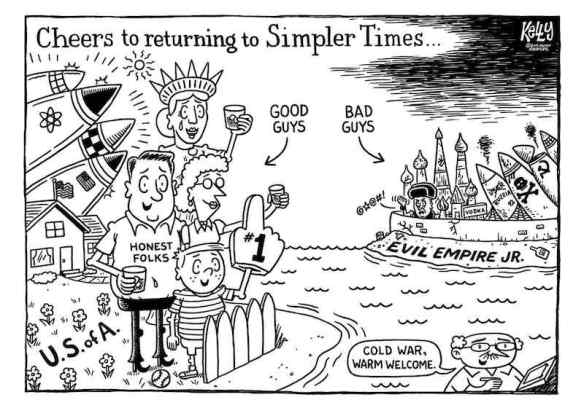
So just this weird, everything is existential now. We now know how the enemy is because of 9/11. And so it’s weird for me, having been brought up as a very young lad during the Cold War and remembering alarms going off and they’d turn off the lights and block the hall and face your lockers, right? The air raid sign drills and fears of the nuclear winter. It’s like these people want a World War 2.0.

We have far more in common with the Russians than we don’t. We have far in common than our own disputes. I assume there are some differences, right? I recognize, I am well aware, in terms of historical notes, but hey we have far more in common than we have difference.

DB: I guess what we all have in common is the state of the Earth at this point.

TD: The state of the Earth? We are the third rock from the sun. I mean, this is our home. The world is a much smaller place, in part because of technology and in part because we find out that, yeah, we really are dependent on each other.

And yet there is this addiction to conflict. There is this addiction to have threats. There is this addiction to divide. And this is not pretty. I mean, human history, the dark side of human history, and if the 20th century is not an optic lesson, then I don’t know what is….. I could go back to any of the others, in terms of written history that we know of, right? And yet here we are. And so, to me it is a sign of an empire….

The U.S. is an empire… and it is a sign of an empire that is losing it. And so, just like the Roman Empire, I mean, if you go back to the rise and fall of the Roman Empire, you know…. Those who don’t learn the lessons of the past are doomed to repeat them.

DB: Well, and the beat goes on. We’re going to let you join the party.

TD: The beat does go on. Yeah.

DB: But as we speak, there’s a major bombing, frightening bombing in Iran today.

TD: I did not know that. Wow.

DB: After the President of the United States is in Saudi Arabia. When is the last time you heard of a major suicide bomb in Iran?

TD: Not in Iran, no.

DB: So, here we go and who knows what comes next, who know what that’s going to bring in that part of the world. We thank you for all of your courage and all the suffering you did for all of us so we could know more. Thank you very much.

TD: Yeah. No. I have really become a warrior for peace. That’s what I have become. Ultimately it’s about who we are as human beings and who we are for each other and after all it is us, right? And in terms of U.S. culture and background, I think Pogo was right. We have met the enemy and the enemy is us. We are our own worst enemies.

It’s just that, for some of us, it’s critical to hold power accountable. We recognize we don’t govern ourselves very well. If you put people over others, yeah, bad things happen. But bad things tend to happen. And it’s that whole control, power. It’s all about — psychopathy is an area of study that I increasingly have as an issue, because of this idea that people gaining pleasure from the distress of others. So, it’s a disease. It really is. And some of us, at great sacrifice, weren’t going to just sit idly by and watch it all happen.

I care deeply about who we are as human beings. And I’ve spent a lot of time in front of college students and high school students and civic auditoriums and small group settings and churches and college campuses talking about these things. These are things that matter.https://consortiumnews.com/2017/06/20/how-fear-of-russia-misleads-americans/