US Backs Coup in Oil-Rich Venezuela, Right-Wing Opposition Plans Mass Privatization and Hyper-Capitalism

The US has effectively declared a coup in Venezuela. Trump recognized unelected right-wing opposition leader Juan Guaidó as new “president,” who plans mass privatization and neoliberal capitalist policies.

By Ben Norton

Source: GrayZone

The United States has effectively declared a political coup d’état in Venezuela, from abroad. Trump announced on January 23 that the US recognizes the unelected, illegitimate right-wing opposition leader Juan Guaidó as the supposed new “interim president” of Venezuela’s supposed new “government.”

Venezuela’s US-backed opposition has pledged to carry out a mass privatization of state assets and to implement harsh neoliberal capitalist policies. The opposition-controlled legislatures declared in its “transition” plans that the “centralized model of controls of the economy will be replaced by a model of freedom and market based on the right of each Venezuelan to work under the guarantees of property rights and freedom of enterprise.”

The US has also hinted at violence in Venezuela. During a background briefing after Trump’s declaration, journalist Dan Cohen heard a US official declare that if the government of actual President Nicolás Maduro responds with any violence, “They have no immediate future, they have no immediate livelihood. One way or another they have their days counted.”

Trump administration officials added, “When we say all options are on the table, all options are on the table… Let’s hope Maduro and his cronies see the magnitude of the message.”

Region’s Right-Wing Countries Join US in Recognizing Coup

Canada’s Liberal government, led by Prime Minister Justin Trudeau; Brazil’s new far-right leader Jair Bolsonaro; and the overtly pro-US Organization of American States (OAS) and its Secretary General Luis Almagro have joined Trump in endorsing this diplomatic coup in Venezuela.

Likewise, the right-wing, US-allied countries in Latin America, including Argentina, Chile, Colombia, Costa Rica, and Ecuador have joined Trump in anointing Guaidó as leader.

The region’s few remaining leftist governments, Bolivia, Cuba, and Nicaragua, have continued recognizing Venezuela’s legitimate government, as has Mexico’s newly elected left-wing President Andrés Manuel López Obrador.

Bolivian President Evo Morales warned that “the claws of imperialism again seek to fatally wound the democracy and self-determination of the peoples of South America,” adding, “No longer will we be the backyard of the US.”

The US government, its right-wing allies, and an obeisant corporate media have repeatedly referred to Venezuela’s actual president, Nicolás Maduro, as an “authoritarian dictator.” What they have failed to mention is that Venezuela still has regular elections, but the US-backed right-wing opposition, which is notoriously disunited and incompetent, has chosen to boycott these elections, preferring to call for foreign-backed military coups instead.

One of the only elected officials in the US who has spoken out against the coup is left-wing California Congressman Ro Khanna. Other progressive and anti-Trump US politicians, including self-declared “democratic socialists,” have remained silent on Trump’s effective declaration of a coup in Latin America.

Opposition Plans for Privatized ‘Free Market’ Economy

While supporters of regime change in Venezuela insist this blatantly undemocratic move is necessary to “defend democracy,” make no mistake, the upheaval is clearly not motivated by resistance to authoritarianism.

Venezuela, which has the world’s largest oil reserves and has challenged the hegemony of the US dollar, has long been a target of US aggression. In 2002, the United States supported a military coup that briefly ousted democratically elected President Hugo Chávez and replaced him with the right-wing oligarch Pedro Carmona. US intervention, including crippling economic sanctions, has only continued since then.

Elements of Venezeula’s opposition have portrayed themselves to credulous foreign observers as “social democratic,” but their real intentions are very clear: The opposition-controlled legislature has demanded mass privatization of state assets and a return to a capitalist oligarch-controlled economic system built on “property rights and freedom of enterprise.”

In 2017, the Venezuelan government declared the creation of the Constituent Assembly, to rewrite the constitution. Venezuela’s opposition refused to recognize this body and boycotted the elections. The opposition instead remained in control of the National Assembly and decided to run it as a separate parallel legislature.

The opposition-controlled National Assembly drafted a “transition” law that openly outlines what policies the opposition, led by Juan Guaidó, would pursue in its illegitimate, US-recognized “government” in Venezuela. Analyst Jorge Martín, explained what this means in an article published by VenezuelaAnalysis:

The “transition law” drafted by the Assembly National (in contempt) is explicit about the central objectives of the coup in the political and economic field:

“[C]entralized controls, arbitrary measures of expropriation and other similar measures will be abolished… For these purposes, the centralized model of controls of the economy will be replaced by a model of freedom and market based on the right of each Venezuelan to work under the guarantees of property rights and freedom of enterprise.”

In other words, the nationalised companies will be returned to their former private owners (including telecommunications, electrical, SIDOR, cement, etc), as will expropriated landed estates. It is noteworthy that there is a lot of talk of property and business rights, but no mention is made of workers’ rights, which would certainly be abolished. It continues:

“Public companies will be subject to a restructuring process that ensures their efficient and transparent management, including through public-private agreements.”

What this means, in plain language, is massive dismissal of workers from state companies and the entry of private capital into them: a policy of looting which has already proved to be a disaster in all countries where it has been applied.

The model of the opposition’s new coup regime in Venezuela — backed by the US, Canada, and Brazil — is the reimposition of neoliberal capitalism and the recolonization of Latin America. Any bluster about restoring democracy is a mere pretense at this point.

US plotting coups in Venezuela, Cuba and Nicaragua?

By Stephen Lendman

Source: Intrepid Report

The US wants all nations worldwide colonized, their resources looted, their people exploited as serfs, including ordinary Americans.

Sovereign independent governments everywhere are targeted for regime change—by coups d’état or wars.

That’s what imperialism is all about, a diabolical plot for unchallenged global dominance by whatever it takes for the US to achieve its aims, Republicans and undemocratic Dems allied for the same geopolitical objectives.

Humanitarian intervention, responsibility to protect, and democracy building are code words by both right wings of America’s war party for wanting fascist tyranny replacing governance of, by, and for everyone equitably everywhere—legitimate governments replaced by US-controlled puppet ones.

Post-9/11 alone, the US orchestrated coups in Haiti, Honduras, Paraguay, Brazil, Ukraine, Egypt, and elsewhere in the Middle East.

The so-called Arab spring was made in the USA. Uprisings were orchestrated. Nothing was spontaneous. CIA dirty hands were involved in replacing unpopular regimes with despotic ones considered more reliable.

Spring never bloomed, just the illusion of change for the better. It was pure deception. Everything changed in targeted countries but stayed the same.

In Egypt, Yemen and elsewhere things worsened, notably in Occupied Palestine. No spring bloomed there or anywhere else in the Middle East.

Plan Colombia was and remains all about Washington’s aim to control Latin America, eliminating opposition to regimes it controls, plotting coups against ruling authorities unwilling to bend to its will, along with pursuing anti-Sino/Russian regional policies.

Since Soviet Russia’s dissolution, the US escalated wars on humanity, using NATO as a killing machine. Republicans and Dems colluded to thirdworldize America, banana republicanize it, wrecking the economy, handing its wealth to Wall Street, war-profiteers and other corporate predators.

Both right wings of duopoly governance mock democratic values and rule of law principles they abhor, governing under a police state apparatus, hardened over time, risking global war to achieve its aims.

Venezuela, Cuba, Nicaragua, and Bolivia are the remaining sovereign independent Latin and Central American nations.

Trump regime hardliners want fascist tyranny replacing their legitimate governments. In early January, State Department deputy spokesman Robert Palladino turned truth on its head, saying the US “support[s] the people of Venezuela, Cuba and Nicaragua in restoring democratic governance and their human rights”—notions Washington abhors.

Venezuelan Bolivarian social democracy is the Trump regime’s top Latin American target for regime change. Pompeo made US intentions clear.

He turned truth on its head, saying President Nicolas Maduro is “illegitimate and the United States will continue . . . to work diligently to restore a real democracy to that country,” adding, “We are very hopeful that we can be a force for good to allow the region to come together to deliver that.”

Fact: Last May, Maduro was overwhelmingly re-elected by a two-thirds majority.

Fact: Scores of international observers from 30 countries monitored the election, judging it open, free and fair.

Fact: Venezuela’s political process is the world’s best.

Fact: It’s polar opposite America’s money-controlled system, one-party rule with two right wings, ordinary people having no say over how they’re governed.

Fact: US democracy is pure fantasy. Venezuelans have the real thing, why Republicans and Dems want its government toppled, their eyes on the prize—the world’s largest oil reserves they want handed to Big Oil.

On January 10, Maduro was inaugurated for a second six-year term, saying he’s committed to continue “fight[ing] for social and economic prosperity and to build 21st century socialism”—despite relentless US political, economic, financial, and propaganda war against the country’s social democracy.

Despite the Trump regime’s all-out efforts to mobilize international opposition to his legitimate rule, delegations from over 90 countries attended the inaugural ceremonies—including from Russia, China, Cuba, Nicaragua, Bolivia, Mexico, El Salvador, Iran, Turkey, and Ireland’s Sinn Fein.

Representatives from US colonized EU nations were absent, a spokeswoman for foreign policy chief Federica Mogherini lied saying that “the presidential elections were not free nor fair”—a falsified statement, serving US imperial interests.

Representatives from the African Union, CARICOM, the Arab League, the ALBA Bolivarian Alliance for the Peoples of Our Americas, OPEC, and the UN also attended.

In his inaugural address, Maduro said, “I tell the people. This presidential sash is yours. This power is yours. It does not belong to the oligarchy or to imperialism. It belongs to the sovereign people of Venezuela.”

He denounced the diabolical aims of “the most powerful empire in history,” urging dialogue to serve Venezuelan interests, including UN support for “peace, mutual recognition, harmony, (and) coexistence of different political visions,” adding: “I would like to sit down with the opposition, stop the sterile, useless, unnecessary conflict, talk about economic issues; with the experience of the UN we can achieve it.”

Trump regime hardliners falsely call genuine democracies dictatorships, how neocon John Bolton reacted to Maduro’s inauguration, saying the US “will not recognize” his legitimacy to rule.

The US-controlled Organization of American States (OAS), headquartered in Washington, reacted the same way. Most of its member states support longstanding US plans for regime change.

The US-controlled 13-nation Lima Group issued a statement, refusing to recognize Maduro’s legitimacy.

Caracas slammed what it called a “humiliating subordination” to US imperial interests—applying to all nations allied with Washington against Venezuela’s social democracy and sovereign independence.

On January 12, State Department deputy spokesman Palladino openly called for regime change, saying, “It is time to begin the orderly transition to a new government.”

Previous US orchestrated coup attempts failed—against Hugo Chavez and Maduro. Will the Trump regime try again in the new year?

If unable to succeed by coup d’etat, will an attempt be made to assassinate Maduro? If economic, financial, political, and other tactics fail, will military intervention be the Trump regime’s fallback option?

Will Iran be targeted the same way in the new year? Imperialism isn’t pretty.

Endless US belligerence and state-sponsored terrorism is virtually certain ahead, the way hardliners in Washington always operate—hostile to peace, stability, equity and justice at home and abroad.

Two New Reports Point to Further US Decline & Higher Risk of War

By James ONeill

Source: New Eastern Outlook

Two recent reports from the United States strongly suggest the United States is planning a major war with Russia and China, but are far from certain that they could in fact succeed in such a war. The reports also provide insights into how the United States will meet the budgetary demands of such war preparations, but almost zero appreciation of the social and human costs of such policies.

The first of these reports is entitled “Providing for the Common Defence” (November 2018). It is the report prepared for the purpose of assessing the National Defence Strategy document released in early 2018.

It acknowledges that changes “at home and abroad are diminishing US military advantages,” and that this diminution of these “advantages” poses a threat to “vital United States interests.”

Geopolitical shifts in the regional power structures are “undermining deterrence of United States adversaries and confidence of United States allies, thus increasing the likelihood of military conflict”. Should such a conflict eventuate, the United States could “suffer unacceptably high casualties and a loss of major capital assets.”

The report says that “America is losing its advantage in key war fighting areas such as air and missile defence, cyber and space operations, anti-surface and anti- submarine warfare, long range ground-based fires, and electronic warfare”.

It further acknowledges that “America’s edge is diminishing or has disappeared in many key technologies that underpin US military superiority”.

Such frankness is not without precedent in US strategy papers and the implications of the above quotations are a probable reason why the report has received almost zero coverage in the western mainstream media.

Acknowledgements of technological deficiency and strategic disadvantage do not sit comfortably with the image of an all-powerful America willing and able to defeat any threat to its own global interests or those of its allies. The latter prefer the comfortable delusion of an omnipotent US “umbrella.”

The Commission’s strategy for addressing this perceived falling behind and consequent loss of military omnipotence is however itself fatally flawed. The proposed “solution” is to spend vastly greater sums of money at a rate of 3-5% above inflation.

That means that a significantly greater share of the federal budget would have to be devoted to military spending. The only way that could be achieved, given that the United States government already has a huge growing deficit ($22 trillion and counting) would have to come, the report acknowledges, by cuts to social spending such as pensions, Medicare and social security. The “trade-offs” the report acknowledges will be “difficult”, a statement that seriously under- estimates the social devastation that such cuts would bring about.

This argument is put forward in a society which already spends more on defence than that spent by the next eight national military budgets combined. United States national infrastructure, in everything from bridges to schools is already crumbling; and these proposals will only accelerate that downward trend.

It does not seem to occur to the report writers that the entire premise that the United States should maintain its attempt to control the world for the benefit of the United States is neither desirable nor wanted by the vast majority of the worlds nations as evidenced by multiple UN General Assembly resolutions.

The second report is issued by the United States Government Accountability Office (GAO) and is entitled: National Security: Long Range Emerging Threats Facing the United States as Identified by Federal Agencies (December 2018.) It has received even less publicity then the ‘Providing for the Common Defence’ document.

The probable reason for this mainstream media reticence is because the GAO report actually details where the United States is lagging in military capability viz a viz its two perceived principal rivals: Russia and China.

The fact of relative military weakness is not new. Andrei Martyanov in his book Losing Military Supremacy (2018) provided a detailed analysis of why Russian military technology was superior to the United States in several important fields. What Martyanov said about Russia applies with equal validity to Chinese technology.

Martyanov’s argument was dramatically illustrated by President Putin’s 1st March 2018 address to the Russian Parliament. The initial American reaction was to discount Putin’s claims, although within days the military industrial complex was demanding more funds to counteract the superiority of Russian weaponry outlined in Putin’s speech.

The GAO Report now provides an authoritative acknowledgement that Putin was not bluffing. Under the section of the report headed “Weapons” it has this to say:

Hypersonic weapons. China and Russia are pursuing hypersonic weapons because their speed, altitude, and maneuverability may defeat most missile defence systems, and they may be used to improve long range conventional and nuclear strike capabilities. There are no existing countermeasures.

Missiles. Adversaries are developing missile technology to attack the United States in novel ways and challenge US missile defence, including conventional and nuclear ICBMs, sea launched land attack missiles, and space based missiles that could orbit the earth.

Aircraft. China and Russia are developing new aircraft, including stealth aircraft, which could fly faster, carry advanced weapons, and achieve greater ranges. Such aircraft could force US aircraft to operate at further distances and put more US targets at risk.

There is more in the same vein. The only caveat to add to those points is the use of the conditional tense. The use of such words as “may” or “could” is redundant. That technology is already operational (www.thesaker.is 1 March 2018).

A number of commentators have argued that the technology gap between Russian and Chinese systems and that of United States is now measured in decades. There is no evidence to suggest this gap could be bridged in the foreseeable future. A more likely scenario is that the technological gap could widen.

Although there are powerful voices in the United States administration and ‘deep state’ generally sufficiently delusional and frankly crazy enough to believe that the United States could “win” a nuclear war with Russia and/or China, the GAO report should act as a constraint on their wilder ambitions.

History demonstrates that it is unwise to underestimate the extent to which the United States will go to maintain its self appointed role is the world’s dominant hegemon, (see Michael Pembroke’s Korea (2018). The reality is that the era of United States dominance is now well past.

Rather than risk a nuclear war that would wreak unimaginable losses upon all the world’s peoples, including for the first time the United States, the more likely scenario will be an intensification of what Andrei Korybko calls ‘hybrid warfare.’ A current illustration of this is the campaign being waged against Huawei, ostensibly because of the potential for Chinese cyber espionage but in reality to weaken and undermine China’s 2025 program for leadership in artificial intelligence, quantum information and other sophisticated technologies, and enforce America’s allies to buy their inferior products.

Proxy wars in the Middle East, Africa, Asia and Latin America are also likely to increase exponentially.

These two reports demonstrate that the United States has lost its previous technological and military superiority, but equally, that it is willing to go to extraordinary lengths to prevent any further erosion of its world wide role and its replacement by the two emerging countervailing superpowers, Russia and China. Whether or not that American determination will tip the world into a catastrophic nuclear exchange will be one of the major questions for 2019.

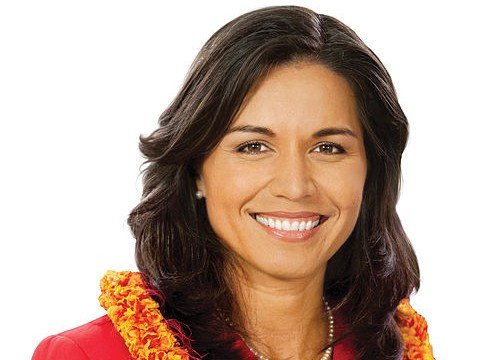
Five Reasons I’m Excited About Tulsi Gabbard’s Candidacy

By Caitlin Johnstone

Source: CaitlinJohnstone.com

Hawaii Representative Tulsi Gabbard has announced her intent to campaign for President of the United States, and the entire political spectrum is shitting bricks about it. Mainstream liberals and neocons are calling her a Putin puppet and Assad’s BFF, leftists and progressives are criticizing her associations with right-wing factions in India and anti-LGBT comments she made in the early 2000s, conspiracy analysts are criticizing her Council on Foreign Relations membership, and the Zionist elements of Trump’s base are openly promising to destroy her candidacy. A lot of others, myself included, got a lot more interested in the 2020 elections when she threw her hat in.

I’m not interested in defending Gabbard from the criticisms that have been leveled at her at this time; many articles have been written toward that end already, and if she’s going to run for the most powerful elected office on the planet it’s fair to scrutinize and question what kind of person she is. I’m also not interested in endorsing anyone for the presidency. What I am interested in is the way Gabbard’s presence in the Democratic presidential primary race is already in January 2019 upsetting the standard establishment script and forcing foreign policy debates that need to happen.

Here are a five thoughts on that subject:

1 – Gabbard will definitely be the most antiwar candidate on the debate stage by a wide margin, except in the highly unlikely event that someone steps up from way out of left field to run like Dennis Kucinich. Being the most antiwar candidate in anything associated with the Democratic Party is a very low bar, but her vocal positions on SyriaIranYemenRussiaNorth KoreaAfghanistanGaza, and previous US regime change interventions set her so far from the establishment orthodoxy that she’ll look as different from the other candidates as Ron Paul looked on the Republican debate stage.

2 – Make no mistake, it is this opposition to significant aspects of the US war machine that is the driving force behind the overwhelming bulk of the shrieking objection to Gabbard’s candidacy, not any of the more valid criticisms. We have learned from the mainstream acceptance of Bernie Sanders and Alexandria Ocasio-Cortez that some criticism of the status quo will be tolerated when it comes to domestic policy, but it’s an excommunicable offense when it comes to foreign policy. The idea that the US should forcefully control world affairs using the carrot of alliance and the stick of military violence is so ubiquitous in both of America’s mainstream parties that it takes a Washington Postcolumnist getting dismembered alive to start a debate about something so self-evidently evil as the Saudi-led destruction of Yemen.

3 – Foreign policy is undeniably the area in which the greater part of US government depravity takes place, and as far as America’s permanent government is concerned it is by far the most important. Forcing a debate on an issue you’re not even supposed to bring up on mainstream media will get a lot of ordinary Americans asking questions that very powerful individuals don’t want asked. The DNC went from scheduling over 20 debates in 2008 to trying to limit it to six in 2016 because they didn’t want Sanders’ excellent domestic policy ideas getting out to the public and making their coronated status quo candidate look bad. Gabbard could have the same impact on foreign policy in an audience that has been aggressively propagandized by MSNBC warmongering.

4 – Gabbard’s progressive positions on issues like Medicare for Allenvironmentalism$15 minimum wageWall Street accountability, the failed war on drugsmarijuana legalizationcriminal justice reform and indigenous water rights will also set her further to the left on domestic policy than anyone on the debate stage besides Sanders should he run. This is a self-evident fact, but a lot of narrative control efforts are being poured into painting her as a right-winger. She will definitely help force the debate to the left, and her position on withdrawing from expensive interventionist war policies answers the “But how are you going to PAY for it??” questions the MSM talking heads are so fond of grilling progressives with on social programs.

5 – For me the most telling thing about Gabbard is the way she resigned from her position as vice chair of the DNC in order to endorse Bernie Sanders in 2016. Other DNC operatives remained inside the Committee and actively schemed to give Clinton every unfair advantage in the primary, but Gabbard showed integrity and refused to advance a biased agenda in violation of the DNC charter. It showed that she’s a real person operating within one of the phoniest places in the world, and that she’s willing to throw a spanner in the works of the machine when it’s in the highest interest. This unwillingness to march to the beat of the establishment drum for such proceedings could lead to some very interesting things as the presidential race heats up.

And that’s good enough for me. She’s not perfect, she’s a major long shot to actually win, but Tulsi Gabbard’s campaign for president will definitely shake things up in all the right places, and good things will come from it. Which is why all the right people are outraged by her bid today.


“The War on Terrorism” is “Fake”: On the Need for Mass Social Mobilizations and Transformative Changes

By Mark Taliano

Source: GlobalResearch.ca

Myriad agencies, funded by Western governments, foundations, and NATO, continue to erect o barriers to freedoms of thought and expression in the West’s post-democratic, New Fascist, societies.

The totalitarianism implicit in these restrictions means that colonial media is monochromatic, tightly framed, and ubiquitous. There is no “free exchange” of ideas, a necessary foundation of democratic societies. Hence, messaging that promotes wars of aggression, and dysfunctional economic ideologies remains ascendant in the public sphere.

The public is led to believe that never-ending criminal wars and vast outflows of public monies to the military industrial complex are normal and necessary. Similarly, publicly bailed-out, predatory, diseconomies are presented as the only viable economic models.  Socially-oriented, (democratic) political economies, we are told, “do not work”.  The public remains unaware that Empire wages criminal economic and “kinetic”, terrorist-supporting warfare, against societies that seek to determine their own political economies.  Socially-oriented political-economies in countries such as Libya, Iraq, Syria, Nicaragua, Venezuela and on and on, are constantly under attack, and not allowed to thrive. Empire targets these countries criminally, aggressively, and perpetually.

The covert barriers which create bounded, framed restrictions on freedoms of expression create a “chilling effect” that promotes self-censorship, and disappears evidence-based truths which would otherwise counter-balance narratives from media conglomerates, all of which are unduly impacted, and subservient to “establishment” pressures from Big Oil, Banking, Military Industrial Complex, Big Pharmaceutical, and other monopolies.

Thought leaders who step outside of the confines of Establishment narratives are targeted. The University of Sydney’s warrantless suspension of best-selling author and Senior lecturer, Prof. Tim Anderson[1], from his teaching duties, is a case in point. Not only does his suspension create a “chilling effect”, and a culture of academic self-censorship, but it also restricts the amount of evidence-based research that reaches the public arena.

Military/Intelligence fronts, such as the Integrity Initiative[2]– well-funded by state agencies and even NATO[3]– add to the oppression, not only by targeting individuals for smear campaigns, but also by guaranteeing a non-stop flow of war propaganda.

Time and again, policymakers use Private Intelligence Contractors (PICS) as sources of fake intelligence that they wrap around previously planned policies, to give an air of credibility to war propaganda. Have we forgotten already the lies used to justify the West’s supremely criminal destruction of Iraq? All of the post-9/11 wars (and beyond) were sold to gullible domestic populations by means of well-planned strategies of deception.

It is an unequal battle, but the broad-based public must first free itself from foundational war lies if we are to make transformative changes. Foremost amongst these lies is “The War On Terrorism”. The public needs to understand that this War on Terror myth is cover for criminal wars of conquest. Our governments and their agencies support the terrorists. Pretending that the West is fighting ISIS and other terrorists (i.e al Qaeda) prolongs the suffering of its victims, past, present, and future. It is not a war against ISIS. It never was. The West and its allies support all of the terrorists in Syria, (and beyond), including ISIS.

If the public can be disabused of the “War on Terrorism” myth, then it will be ready for mass social unrest and mobilizations for fundamental reforms.  Incremental reforms only bolster Establishment positions by providing illusions of democratic policymaking.

For starters, Canada needs to leave NATO, cut its military budget, end its “neoliberal” diseconomy, instate a socially-oriented economy, and regain its sovereignty and democracy.

Given all of the structural barriers that we face, these goals may never be achieved, but we still “win” when we at least struggle for justice.


Note to readers: please click the share buttons. Forward this article to your email lists. Crosspost on your blog site, internet forums. etc.

Mark Taliano is a Research Associate of the Centre for Research on Globalization (CRG) and the author of Voices from Syria, Global Research Publishers, 2017.

Notes

[1] Prof. Tim Anderson, “STEPHEN GARTON’S OVERREACH: INTELLECTUAL FREEDOM AT THE UNIVERSITY OF SYDNEY.” Avant Garde, 12 December, 2018.( https://avantgarde2009.wordpress.com/2018/12/12/stephen-gartons-overreach-intellectual-freedom-at-the-university-of-sydney/?fbclid=IwAR1MpVAZX-F7LcuwbZvSzHAio1mN-L2BemweI7IVMuBrEGrjRjT-sRSRLpc) Accessed 19 December, 2018.

[2] Mohamed Elmaazi and Max Blumenthal, “Inside The Temple Of Covert Propaganda: The Integrity Initiative And The U.K’s Scandalous Information War.” Gray Zone,17 November, 2018. (https://grayzoneproject.com/2018/12/17/inside-the-temple-of-covert-propaganda-the-integrity-initiative-and-the-uks-scandalous-information-war/) Accessed 19 December, 2018.

[3] George Eliason, “A Crisis in Intelligence: Unthinkable Consequences of Outsourcing U.S. Intel. (Part 3)” Consortium News, 18 February, 2018.( https://consortiumnews.com/2018/02/18/a-crisis-in-intelligence-unthinkable-consequences-of-outsourcing-u-s-intel-part-3/?fbclid=IwAR2DKmAtaSMattb28apQZ-gCJ61stFYP3jem97t93PLm-bSpQLGp-0Z_4No) Accessed 18 February, 2018.

Tomgram: Danny Sjursen, Ringing in a New Year of War

By Tom Engelhardt

Source: TomDispatch.com

On December 9th, the Washington Post covered Donald Trump’s offhand, if long expected, announcement of the ousting of retired Marine General John Kelly from an embattled White House. Its report focused on the chief of staff’s “rocky tenure” there with a nod to his many merits, among them that he “often talked the president out of his worst impulses.” Buried deep in the piece, though, was a single line that caught my eye (and possibly that of no one else on this planet): “Kelly told others that among his biggest accomplishments was keeping the president from making rash military moves, such as removing troops from sensitive zones.”

It was admittedly neither a direct quote, nor attributed to anyone, nor elaborated on in the rest of the piece. So that’s all we know, not whether Kelly took particular pride in stopping the president from removing American troops from, say, Syria, or Iraq, or Afghanistan, or for that matter Niger. But however passing and non-specific that line may have been, it seemed to catch something striking about these last two years, a time when those in the mainstream opposition to the president have come to love so many of the retired generals and former heads of outfits like the National Security Agency and the CIA, and have turned them into the equivalent of security blankets for the rest of us. They were the men (because they were all men) intent on talking Donald Trump out of “his worst impulses” and so, in the phrase of the era, they were the “adults in the room.”

Thanks to the wars and other shenanigans that those “adults” had already been so deeply involved in and the money — more than $5 trillion of it — squandered on them, they were also the men who helped generate the dissatisfaction that gave Donald Trump his opening in the first place. And now, having been part of the problem, they are in full chorus condemnation of Donald Trump’s most recent solution: to withdraw American troops from Syria (and soon evidently from Afghanistan as well).  We — that is, the country whose actions were crucial in creating ISIS in the first place — are now the only “bulwark” against its return.  That goes without saying, of course, among Republicans, Democrats, the national security elite, America’s generals, and that last “adult” in the room, Secretary of Defense James Mattis — or at least it did until, days ago, he resigned in protest.  And as U.S. Army major and TomDispatch regular Danny Sjursen suggests in his year-ending piece, as that one Washington Post line about Kelly indicates, they worked awfully hard to ensure that President Trump wouldn’t withdraw from any part of the mess they made. With that thought in mind and withdrawals about to be under way on an increasingly grim planet, Happy New Year! Tom

The World According to the “Adults in the Room”
A Year of Forever War in Review
By Danny Sjursen

Leave it to liberals to pin their hopes on the oddest things. In particular, they seemed to find post-Trump solace in the strange combination of the two-year-old Mueller investigation and the good judgment of certain Trump appointees, the proverbial “adults in the room.” Remember that crew? It once included Secretary of State Rex Tillerson, the former ExxonMobil CEO, and a trio of active and retired generals — so much for civilian control of the military — including Secretary of Defense Jim Mattis, National Security Advisor H.R. McMaster, and White House Chief of Staff John Kelly. Until his sudden resignation, Mattis was (just barely) the last man standing. Still, for all these months, many Americans had counted on them to all but save the nation from an unpredictable president. They were the ones supposedly responsible for helming (or perhaps hemming in) the wayward ship of state when it came to foreign and national security policy.

Too bad it was all such a fantasy. As Donald Trump wraps up his second year in the Oval Office, despite sudden moves in Syria and Afghanistan, the United States remains entrenched in a set of military interventions across significant parts of the world. Worse yet, what those adults guided the president toward was yet more bombing, the establishment of yet more bases, and the funding of yet more oversized Pentagon budgets. And here was the truly odd thing: every time The Donald tweeted negatively about any of those wars or uttered an offhand remark in opposition to the warfare state or the Pentagon budget, that triumvirate of generals and good old Rex went to work steering him back onto the well-worn track of Bush-Obama-style forever wars.

All the while, a populace obsessed and distracted by the president’s camera-grabbing persona seemed hardly to notice that this country continued to exist in a state of perpetual war. And here’s the most curious part of all: Trump wasn’t actually elected on an interventionist military platform. Sure, he threw the hawkish wing of his Republican base a few bones: bringing back waterboarding as well as even “worse” forms of torture, bombing “the shit” out of ISIS, and filling Guantánamo with “some bad dudes.” Still, with foreign policy an undercard issue in a domestically focused campaign to “Make America Great Again,” most Trump supporters seemed to have little stomach for endless war in the Greater Middle East — and The Donald knew it.

Common Sense on the Campaign Trail

Despite his coarse language and dubious policy positions, candidate Trump did seem to promise something new in foreign policy. To his credit, he called the 2003 Iraq War the “single worst decision ever made” (even if his own shifting position on that invasion was well-documented). He repeatedly tweeted his virulent opposition to continuing the war in Afghanistan and regularly urged President Obama to stay out of Syria. And to the horror of newly minted Cold War liberals, he even suggested a détente with Russia.

Like so much else in his campaign, none of this was from the standard 2016 bullet-point repertoire of seasoned politicians. Sure, Donald Trump lacked the requisite knowledge and ideological coherence usually considered mandatory for serious candidates, but from time to time he did — let’s admit it — offer some tidbits of fresh thinking on foreign policy. However blasphemous that may sound, on certain international issues the guy had a point compared to Hillary, the hawk.

During his presidency, traces of his earthy commonsense still showed up from time to time. In August 2017, for instance, when announcing yet another escalation in the Afghan War, he felt obliged to admit that his original instinct had been to “pull out” of it, adding that he still sympathized with Americans who were “weary of war.”  He sounded like a man anything but confident of his chosen course of action — or at least the one chosen for him by those “adults” of his. Then, last week, he surprised the whole business-as-usual Washington establishment by announcing an imminent withdrawal of U.S. troops from Syria.  Whether he reverses himself, as he’s been apt to do, remains unknown, but here was at least a flash of his campaign-style anti-interventionism.

How, then, to explain the way a seemingly confident candidate had morphed into a hesitant president — until his recent set of decisions to pull troops out of parts of the Greater Middle East — at least on matters of war and peace? Why those nearly two years of bowing to the long-stale foreign policy thinking that had infused the Bush-Obama years, the very thing he had been theoretically running against?

Well, pin it on those adults in the room, especially the three generals. As mid-level and senior officers, they had, after all, cut their teeth on the war on terror. It and it alone defined their careers, their lives, and so their thinking. Long before Donald Trump came along, they and their peer commanders had already been taken hostage by the interventionist military playbook that went with that war and came to define the thinking of their generation. That was how you had to think, in fact, if you wanted to rise in the ranks.

The adults weren’t, for the most part, political partisans. Then again, neither was the militarist playbook they were following. Both Hillary Clinton and Jeb Bush had been selling exactly the same snake oil in 2016. Only Trump — and to some extent Bernie Sanders — had offered a genuine alternative. Nevertheless, the Trump administration sustained that same policy of forever war for almost two full years and the grown-ups in the room were the ones who made it so. Exhibit A was the Greater Middle East.

The Same Old Playbook

While George W. Bush favored a “go-big” option of regime change, massive military occupation, and armed nation-building, Barack Obama preferred expanded drone strikes, increased military advisory missions, and — in the case of Libya — a bit of light regime-changing. In Trump’s first two years in office, the U.S. military seemed to merge aspects of the losing strategies of both of those presidents.

If Trump’s gut instinct was to skip future “dumb” Iraq-style wars, “pull out” of Afghanistan, and avoid regional conflict with Russia, his grown-up advisers pushed him in exactly the opposite direction. They chose instead what might be called the more strategy: more bombing, more troops, more drone strikes, more defense spending, more advisors, more everything. And if a war seemed to be failing anyway, the answer came straight from that very playbook, as in Afghanistan in 2017: a “surge” and the need for yet more time. As a result, America’s longest-ever war grew longer still with no end faintly in sight.

Given such thinking, it’s odd to recall that those adults in the room were, once upon a time, reputed to be outside-the-box thinkers. Secretary Mattis was initially hailed as such an avid reader and devoted student of military history that he was dubbed the “warrior monk.” H.R. McMaster was similarly hailed for having written a book critical of U.S. strategy in Vietnam (though wrong in its conclusions). Both Democrats and Republicans in Washington were similarly convinced that if anyone could bring order to the Trump administration, it would be the ever-responsible John Kelly.

Let’s review, then, the advice that these innovators offered the president in his first two years in office and the results in the Greater Middle East, starting with that presidential urge to pull out of Iraq. You won’t be surprised to learn that U.S. troops are still ensconced there in an ongoing fight against what’s suddenly a growing ISIS insurgency (now that its “caliphate” is no more). Nor has Washington taken any meaningful steps to bolster the legitimacy of the Shia-dominated Baghdad government, which portends an indefinite Sunni-based insurgency of some sort (or sorts) and a possible Kurdish secession.

In Syria, rather than downsize the U.S. military mission in the interest of Trump’s stated wish for détente with Russia and his urge to get the troops out “like very soon,” his administration had more than stayed put. It essentially chose to go with an indefinite American occupation of eastern Syria, including up to 4,000 mainly Special Operations forces backing predominantly Kurdish rebels there. In fact, only recently Mattis and other “senior national security officials” reportedly tried unsuccessfully to talk the president out of his recent tweeted proclamation to end the American role in Syria and withdraw those troops from the country as, it seems, is now happening. In this, he clearly wants to avoid the ongoing risk of war with both Russia and NATO ally Turkey, not to speak of Iran. The Turks continue to threaten to invade the northern Syrian region controlled by those U.S.-backed Kurds, while Russian forces had, alarmingly, exchanged fire with U.S. troops more than once along the Euphrates River buffer zone. The Syrian mission was all risk and no reward, but the adults in the room continued to work feverishly to convince the president that to pull out might create a new “safe haven” not just for ISIS but also for the Iranians.

In Afghanistan, whatever Trump’s “instinct” may have been, after many meetings with his “cabinet and generals,” or what he called his “experts,” the president decided on a new escalation, a mini-surge in that then 17-year-old war. To that end, he delegated yet more decision-making to the very generals who were so unsuccessful in previous years and they proceeded to order the dropping of a record number of bombs, including the first-ever use of the largest non-nuclear ordnance in the Air Force arsenal, the so-called Mother of all Bombs. The results were the very opposite of reassuring. Indeed, the U.S. and its Afghan allies may be headed for actual military defeat, as the Taliban controls or contests more districts than ever, while Afghan government casualties have become, in the phrase of an American general, “unsustainable.”

Now, in a rebuke to those very experts and adults, the president will apparently remove half the U.S. troops in Afghanistan. After so many years of fruitless war, this sensible decision raised immediate alarm among the hawks in Congress and in the rest of the Washington national security establishment.  That decision, plus pulling the plug on the Syrian operation, apparently proved to be a red line for the last adult left standing and Jim Mattis promptly resigned in protest.  For the outgoing secretary of defense, it seems that complicity in Saudi war crimes in Yemen and the murder of Washington Post columnist and Saudi citizen Jamal Khashoggi were passing events.  Trump’s willingness to try to end the American role in two failing, dubiously legal quagmires, however, proved to be the general’s breaking point.

Elsewhere, the Trump team has moved ever closer to a regime-change policy in Iran, especially after the replacement of Tillerson and McMaster by the particularly Iranophobic duo of Mike Pompeo and John Bolton as secretary of state and national security advisor. Still, don’t blame any looming Iran disaster on them. Washington had unilaterally pulled out of the Obama-negotiated nuclear deal with that country well before they arrived on the scene. While the grown-ups might not have been quite as amenable to war with Iran as Bolton and Pompeo, they couldn’t countenance détente for even a second.

And, of course, all those adults in the room supported U.S. complicity in the Saudi-led terror bombing and starvation of Yemen, the poorest Arab country. They also favored sustained ties with Saudi Arabia and its increasingly brutal crown prince, Mohammed bin Salman. Indeed, despite the recent murder and dismemberment of Washington Post columnist and Saudi citizen Jamal Khashoggi in that country’s embassy in Istanbul, Turkey, and the Senate’s increasing disenchantment with the war in Yemen, Mattis remained a vocal supporter of the Saudis. Just before the Senate recently voted to pull U.S. military assistance for the Saudi war, he joined Pompeo in urging that chamber not to abandon Riyadh. In addition, key senators called Mattis’s testimony “misleading” because he “downplayed” the Saudi crown prince’s role in the murder, ignoring the conclusion of the CIA that the prince was indeed “complicit” in it.

So when it comes to outside-the-box thinking about the Greater Middle East almost two years into the president’s first term, the U.S. remains ensconced in a series of distinctly inside-the-box and unwinnable wars across the region.  Trump, however, now appears ready to change course, at least in Syria and Afghanistan, perhaps out of frustration with the ever-so-conventional mess the adults left him in.

A Militarized Planet

Elsewhere, matters are hardly more encouraging. At a global level, the grown-ups have neither tempered the president’s more bizarre policies nor offered a humbler, more modest military approach themselves. The result, as the country enters 2019, is an increasingly militarized planet. Mattis’s own National Defense Strategy (NDS), released in January 2018, represents a blatant giveaway to the domestic arms industry, envisioning as it does a world eternally on the brink of Great Power war.

On that planet of the adults, the U.S. must now prepare for threats across every square inch of the globe. Far from the military de-escalation hinted at by candidate Trump (and suggested again in a recent tweet of his), Mattis’s “2-2-1 policy” has the Pentagon ramping up for potential fights with two “big” adversaries (China and Russia), two “medium” opponents (Iran and North Korea), and one “sustained” challenge (conflicts and terrorism across the Greater Middle East). Few have asked whether such a strategy is faintly sustainable, even with a military budget that dwarfs that of any other power on the planet.

In fact, the implementation of that NDS vision is clearly leading to a new arms race and a burgeoning Cold War 2.0. Washington is already engaged in a spiraling trade war with Beijing and has announced plans to pull out of a key Cold War nuclear treaty with Russia, while developing a new group of treaty-busting intermediate range nuclear missiles itself. In addition, at the insistence of his military advisers, the president has agreed to back an Obama-era “modernization” program for the U.S. nuclear arsenal now estimated to cost at least $1.6 trillion over the next three decades.

So much for a Republican insistence on balanced budgets and decreased deficits. Furthermore, climate-change denial remains the name of the game in the Trump administration and, in this singular case, the adults in the room could do nothing about it. Despite earlier Pentagon reports that concluded man-made climate change presents a national security threat to the country, the Trump administration has ignored such claims. It has even insisted upon substituting the term “extreme weather” for “climate change” in current defense reports. Here, the grown-ups do indeed know better — the military has long been focused on the dangers of climate change — but have dismally failed to temper the president’s anti-science policies.

So, as 2018 comes to a close, thanks to the worldview of those grown-ups and the pliability of Trump’s own ideology (except when it comes to climate change), Washington’s empire of bases, its never-ending war on terror, and its blank-check spending on the military-industrial complex were more firmly entrenched than ever.  It will fall to the president — if indeed he proves to be serious when it comes to a course change — to begin the long work of (modestly) undoing a planet of war.

The Last Adult?

Looking toward 2019 in a world on edge, here are a couple of thoughts on our future. Expect that Robert Mueller’s future report will find many things to focus on, including plenty of collusion with women, but — whatever the Russians did and whatever the desires of those around candidate Trump may have been — no actual collusion of substance with Moscow in election 2016. That will undoubtedly break the hearts of liberals everywhere and ensure — despite the best efforts of a new Democratic House — a full Trump term (or two!). Furthermore, whatever “blue-wave” Democrats do domestically, they are unlikely to present a coherent, alternative foreign-policy vision. Instead, prepare to watch them cede that territory (as always) to Trump and the Republicans. Meanwhile, at least until 2021, they will continue to lament the absence of those “adults in the room” and their supposed ability to preserve a respectable foreign policy, which, of course, would have meant war all the way to the bank.

Maybe it’s time to start thinking of those adults as the tools (and often enough the future employees) of a military-industrial-congressional complex that feeds Americans ample servings of endless war, year after year, decade after decade. In truth, in this century presidents change but the failing policies haven’t.

Call it the deep state, the swamp, or whatever you like, but bottom line: during Trump’s first two years in office, there wasn’t, until now, any serious rethinking of American foreign and military policy, not in terms of peaceableness anyway. Trump’s original adults in the room set the table for endless war. Their replacements clearly intended to devour plentiful helpings of the same dishes. Make no mistake, if it were up to those adults, the United States would be ringing in this New Year with yet another copious serving of militarism.  It still may.

I must admit that I find myself in a lonely spot as 2018 ends. I’ve been serving in the U.S. Army during this period, while dissenting from prevailing foreign policy. After spending 18 years in uniform, including tours of duty in both the Afghan and the Iraq wars, and observing a slew of retired generals and policymakers who oversaw those very wars champion yet more (failed) conventional thinking, forgive me for wondering, from time to time, if I weren’t the last true adult in the room.

The Obsession with and Lies about Nicaragua

Large statue of Augusto Sandino at the central park of his hometown, Niquinohomo.

By S. Brian Willson

Source: Dissident Voice

The intense focus on the “ills” of Nicaragua completely misses the deep issues of continued US intervention – imperial neocolonialism – into the sovereign lives of other countries, as here with Nicaragua. Whether you love or hate Daniel Ortega and Rosario Murillo, their personalities and personal lives are not the issue, whatsoever.

For US Americans to be so closely scrutinizing clearly the most progressive government in Central America, ignoring the new US friendly but unpopular president of Costa Rica, Carlos Alvarado Quesada; the systematic violence in the streets of El Salvador which is directly related to the US funded death squad governments of the 1980s; the repressive and illegal President of Honduras, Juan Orlando Hernandez; and the repressive and corrupt government of Guatemala under President Jimmy Morales, is very interesting, and disturbing.

The elaborate, well-planned conspiracy behind the April-July 2018 US-orchestrated coup attempt against Nicaragua, included most of the church hierarchy, many wealthy ex-Somocistas, many NGOs including the European-funded CENIDH, the NED (National Endowment for Democracy) and USAID, and a couple thousand young Nicaraguans trained over 4 years in the use of social media to blitzkrieg an agenda-loaded propaganda campaign when the right opportunity arose. It had been in the works since at least 2011 when Nicaraguan Felix Maradiaga teamed up with Colombian narco-trafficker Julio Cesar Paz Varela to develop a drug distribution network in Nicaragua, many of the proceeds of which were to be devoted to overthrow the Sandinista government.

The facts are that the few NGOs (of over 4,000 NGOs in the country) who have recently been curtailed by the Nicaraguan government, is because of their support of various criminal activities designed to overthrow the government. Their accountability to the law was long overdue. The same goes for several TV stations (funded largely by NED), the internet news outlet Confidencial (funded by the NED), and La Prensa (funded by NED) which have openly supported opposition “terrorist” activities (yes, that is correct), something that would never be tolerated in the US or in virtually any country. Many of the hundreds participating in dozens of murders, arsons, destruction of buildings, tortures, and destruction of equipment (including over 50 ambulances), etc., committed by Opposition members, are fortunately now on trial or in jail. Over 200 fugitives remain in Costa Rica.

It is also ironical, that those people in the US who are so condemnatory of the Nicaraguan government, remain comfortably removed from the terror campaign, April-July, which was awful as I can attest as a resident, while I was forced to read and view, with rage and anger, the spew of scripted lies days after day on social media, and major media outlets, not based on any actual investigative reporting. Ironic, because the US is one of the most oligarchic, non-democratic countries on the planet, and its citizens possess no legal or moral authority to judge others. The US possesses the largest prison per capita population in the world, with 80,000 of prisoners in solitary confinement; it produces the most waste and pollution; it has military troops in 150 countries, and war planes and ships everywhere; it is the wholesale terrorist force on the Planet; it has on average 3 citizens a day murdered by US police; it has a president who has been accused by over 15 women of sexual misconduct/assault, a president who lies multiple times each day; it is a country where student debt keeps graduates in a kind of servitude for life to the banks; it has thousands of homeless living in tents and abandoned cars in virtually every city; it is a country without accessible health care for millions of its citizens; etc. It has a political election process unreliable due to systematic voter suppression, gerrymandered Congressional districts every ten years, privatization of the voter counting process, while the process itself is literally owned by the millions and billions of dollars of the rich and mighty, headed by the military industrial complex that makes obscene profits on intervening everywhere.

So, Nicaragua is an easy center of focus. If any one of us, or any other Central American government, was subjected to the intense efforts to destroy us, or any country, then one can predict the likely consequences. Neighboring Honduras has not yet recovered from the 2009 US sanctioned coup of President Zelaya. The fear and the repression there is horrendous, but it seems that with those in the US, including in the government, nobody gives a shit. The NICA Act should be the HICA Act for Honduras instead of Nicaragua. But Honduras is a safe Cry Uncle government, despite the fact that the people live in constant fear.

And the idea of name calling people as usual is not helpful in the discussion. Catherine Cusic, who has called Camilo Mejia a liar, has called me several times as an idiot – then, in the past, and now. Not too constructive for healthy debate.

When will the issue of US imperialism be taken seriously, and a recognition that the US political economy is so destructive it is on a path to destroy the planet? And, yet, the most progressive country in Central America (where there really is NOT repression) – Nicaragua – with no friends in the Senate or House of Representatives, very little support in the solidarity community, and only supported by the ALBA countries of Cuba, Venezuela, and Bolivia, is targeted for destruction. Lies, lies, more lies. Disgusting beyond disgusting. The truth as I have documented is virtually the exact opposite of what most social media and major media organs spew as if reading from a script. Joseph Goebbels, Hitler’s Propaganda Minister, is famous for saying that a lie told enough times becomes the truth. Goebbels principle has come once again to haunt Nicaragua. And the US government has spent millions of dollars through NED, US AID, NGOs, etc., at least since 2014, getting ready for the overthrow of a progressive government, primarily because it IS progressive compared to the other Central American governments. It is not a Cry Uncle government. And despite the lies, the Sandinista government remains popular with a majority of the people, similar to Assad in Syria despite intense western media propaganda against him.

So, Libya, The Ivory Coast, the Ukraine, Venezuela, Russia, and on and on, are touted as enemies, subject to the “exceptional” US to seek their overthrow to “correct” matters, if they haven’t already succeeded. It is interesting that Trump’s fanatical security adviser, John Bolton, has identified the Troika of Cuba, Venezuela, and Nicaragua (and soon Bolivia) to be targets as threats to the national security of the US. So preposterous yet it is official US policy.

Astonishing, absurd, and criminal. So continue, folks, focusing on the issues you have with Ortega-Murillo, while the US continues on an uncontrolled imperial savagery. Meanwhile, feel smug with your support of “humanitarian intervention” by the most dangerous country on Earth.


S. Brian Willson (http://www.brianwillson.com/) is a Vietnam War veteran who sacrificed his legs to fight the US war in Central America and who now lives in Nicaragua. Read other articles by S. Brian, or visit S. Brian’s website.

Send the Mad Dog to the Corporate Kennel

By Ray McGovern

Source: Consortium News

Outgoing Defense Secretary Gen. James “Mad Dog” Mattis was famous for quipping, “It’s fun to shoot some people.” It remains a supreme irony that Mattis was widely considered the only “adult in the room” in the Trump administration. Compared to whom? John Bolton, the rabid neocon serving as national security adviser? That would be the epitome of “condemning with faint praise.”

With his ramrod-straight image, not to mention his warrior/scholar reputation extolled in the media, Mattis was able to disguise the reality that he was, as Col. Andrew Bacevich put it on Democracy Now! this morning, “totally unimaginative.” Meaning that Mattis was simply incapable of acknowledging the self-destructive, mindless nature of U.S. “endless war” in the Middle East, which candidate-Trump had correctly called “stupid.” In his resignation letter, Mattis also peddled the usual cant about the indispensable nation’s aggression being good for the world.

Mattis was an obstacle to Trump’s desire to pull troops out of Syria and Afghanistan (and remains in position to spike Trump’s orders). Granted, the abrupt way Trump announced his apparently one-man decision was equally stupid. But withdrawal of ground troops is supremely sane, and Mattis was and is a large problem. And, for good or ill, Trump — not Mattis — was elected president.

Marine Wisdom

Historically, Marines are the last place to turn for sound advice. Marine Gen. Smedley Butler (1881-1940), twice winner of the Medal of Honor, was brutally candid about this, after he paused long enough to realize, and write, “War is a Racket”:

“I suspected I was just part of a racket at the time. Now I am sure of it. Like all members of the military profession I never had an original thought until I left the service. My mental faculties remained in suspended animation while I obeyed the orders of the higher- ups. …”

Shortly after another Marine general, former CENTCOM commander Anthony Zinni, retired, he stood by silently as he personally watched then-Vice President Dick Cheney give his most important speech ever (on August 26, 2002). Cheney blatantly lied about Iraq’s (non-existent) WMD, in order to grease the skids for the war of aggression against Iraq. Zinni had kept his clearances and was “back on contract.” He was well read-in on Iraq, and knew immediately that Cheney was lying.

A few years later, Zinni admitted that he decided that his lips would be sealed. Far be it for a Marine to play skunk at the picnic.  And, after all, he was being honored that day at the same Veterans of Foreign Wars convention where Cheney spoke.  As seems clear now, Zinni was also lusting after the lucrative spoils of war given to erstwhile generals who offer themselves for membership on the corporate Boards of the arms makers/merchants that profiteer on war.

(For an earlier critique of senior Marines, see: “Attacking Syria: Thumbing Noses at Constitution and Law.” )

Marine officer, now Sen. Pat Roberts, R, Kansas, merits “dishonorable mention” in this connection. He never rose to general, but did become Chair of the Senate Intelligence Committee at an auspicious time for Cheney and Bush. Roberts kowtowed, like a “good Marine,” to their crass deceit, when a dollop of honesty on his part could have prevented the 2003 attack on Iraq and the killing, maiming, destruction, and chaos that continues to this day.  Roberts knew all about the fraudulent intelligence, and covered it up — together with other lies — for as long as he remained Senate Intelligence Committee Chairman

Scott Ritter on Pat Roberts

Roberts’s unconscionable dereliction of duty enraged one honest Marine, Maj. Scott Ritter, who believes “Semper Fi” includes an obligation to tell the truth on matters of war and peace.  Ritter, former UN chief weapons inspector for Iraq, who in April  wrote in April 2005 “Semper Fraud, Senator Roberts,” based partly on his own experience with that complicit Marine.

Needless to say, higher ranking, more malleable Marines aped Zinni in impersonating Uncle Remus’s Tar Baby — not saying nuttin’.

It is conceivable that yet another sharply-saluting Marine, departing Chairman of the Joint Chiefs of Staff Joseph Dunford, may be tapped by Trump to take Mattis’s job. If that happens, it will add to President Trump’s bizarre penchant for picking advisers hell bent on frustrating the objectives he espoused when he was running for office, some of which — it is becoming quite clear — he genuinely wants to achieve.

Trump ought to unleash Mattis now, and make sure Mattis keeps his distance from the Pentagon and the Military-Industrial Complex, before he is asked to lead an insurrection against a highly vulnerable president — as Gen. Smedley Butler was asked to do back in the day. Butler said no.