Iraqi PM reveals Soleimani was on peace mission when assassinated, exploding Trump’s lie of ‘imminent attacks’

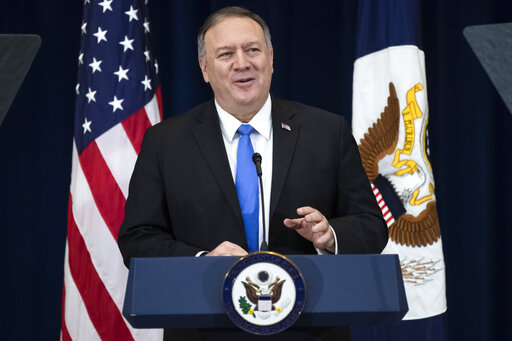
Secretary of State Mike Pompeo (AP Photo/Matt Rourke)

The Trump administration claimed Iranian general Qasem Soleimani was planning “imminent attacks” on US interests when it assassinated him. That lie was just destroyed, but not before countless corporate media outlets transmitted it to the public.

By Max Blumenthal

Source: The Grayzone

Desperate to justify the US drone assassination of Iranian Major General Qasem Soleimani, Secretary of State Mike Pompeo insisted that Washington had made an “intelligence-based assessment” that Soleimani was “actively planning in the region” to attack American interests before he was killed.

President Donald Trump justified his fateful decision to kill the Iranian general in even more explicit language, declaring that Soleimani was planning “imminent attacks” on US diplomatic facilities and personnel across the Middle East.

“We took action last night to stop a war,” Trump claimed. “We did not take action to start a war.”

Trump’s dubious rationale for an indisputably criminal assassination has been repeated widely across corporate media networks, and often without any skepticism or debate.

At a January 3 State Department briefing, where reporters finally got the chance to demand evidence for the claim of an “imminent” threat, one US official erupted in anger.

“Jesus, do we have to explain why we do these things?” he barked at the press.

Two days later, when Iraqi Prime Minister Adil Abdul-Mahdi addressed his country’s parliament, Trump’s justification for killing Soleimani was exposed as a cynical lie.

According to Abdul-Mahdi, he had planned to meet Soleimani on the morning the general was killed to discuss a diplomatic rapproachment that Iraq was brokering between Iran and Saudi Arabia.

Abdul-Mahdi said that Trump personally thanked him for the efforts, even as he was planning the hit on Soleimani – thus creating the impression that the Iranian general was safe to travel to Baghdad.

Soleimani had arrived in Baghdad not to plan attacks on American targets, but to coordinate de-escalation with Saudi Arabia. Indeed, he was killed while on an actual peace mission that could have created political distance between the Gulf monarchy and members of the US-led anti-Iran axis like Israel.

The catastrophic results of Soleimani’s killing recall the Obama administration’s 2016 assassination of Mullah Akhtar Muhammad Mansur, a Taliban leader who was eager to negotiate a peaceful end to the US occupation of Afghanistan. Mansur’s death wound up empowering hardline figures in the Taliban who favored a total military victory over the US and triggered an uptick in violence across the country, dooming hopes for a negotiated exit.

Since Soleimani’s assassination, Iraq’s parliament has voted to expel all US troops from the country and Iran’s Grand Ayatollah Ali Khamenei has sworn to exact a “severe revenge” on the “the criminals who have stained their hands with [Soleimani’s] and the other martyrs’ blood…”

Trump, for his part, tweeted a litany of gangster-like threats, promising to destroy Iranian cultural sites if it retaliated and pledging to sanction Iraq “like they’ve never been before” if it ousted US troops.

Trump’s treacherous assassination has brought the US closer to war than ever before against a country more militarily potent than any adversary it has faced since the Korean War. And as with the failed US invasion of Iraq, Washington’s casus belli for triggering this conflict was based on falsified intelligence sold to Americans by administration officials, and on a pliant Beltway media acting as their megaphone.

With its claim of “imminent attacks,” the Trump administration has essentially re-mixed Condoleeza Rice’s 2003 warning that “we don’t want the smoking gun to be a mushroom cloud.” Back then, the US attacked a sovereign state to rid it of WMD that did not exist. This time, it killed the second-most important Iranian official to prevent a killing spree that was not on the way. And Trump administration officials knew they were lying.

In fact, Pompeo pitched assassinating Soleimani to Trump several months ago, well before any attacks were “imminent.” And in the wake of the general’s killing, a US official revealed to the New York Times that the NSA had intercepted “communications the United States had between Iran’s supreme leader, Ayatollah Ali Khamenei, and General Suleimani showing that the ayatollah had not yet approved any plans by the general for an attack.”

But the preponderance of evidence exposing Trump’s basis for killing Soleimani as a titanic lie has not generated the same level of media interest as the lie itself.

On January 3, CNN assigned three reporters to disseminate the Trump administration’s disinformation about Soleimani, claiming without a hint of critical detachment that he was “planning specific attacks on US interests, including US personnel.”

After the story went live, CNN’s lead reporter, Jim Sciutto, reached out to another official US source to “confirm” his now-discredited piece of war propaganda. In Sciutto’s mind, if more than one US official says a thing, it must be true.

Sciutto is not just any run-of-the-mill national security reporter. During the Obama era, he accepted a job as chief of staff at the US Embassy in Beijing, placing himself at the center of Washington’s gathering Cold War with China. Now back behind CNN’s anchor desk, Sciutto poses as a ferocious critic of Trump while providing the Pentagon and State Department with reliable stenographic services.

No president in recent history has been despised more viscerally by the Beltway press corps than Trump. Nearly everything he says is met with disdain and suspicion, even when he is telling the truth.

But when Trump and his administration attempt to lie the public into war against a designated evildoer, a swath of the corporate media responds with reflexive trust, then shrugs when the lie is exposed in broad daylight.

In Redux of Iraq War Run Up, Media Cheers on Assassination of Soleimani

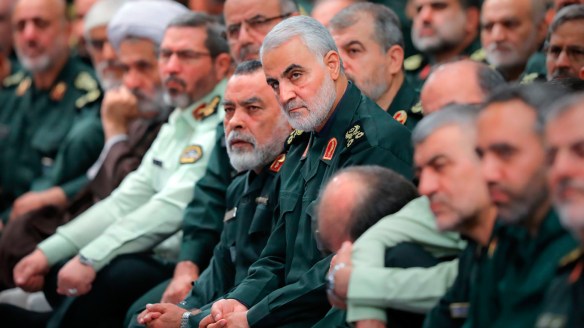
Gen. Qassim Soleimani, center, attends a meeting of a group of the Guard members with Iranian Leader Ayatollah Ali Khamenei, in Tehran, Iran on Oct. 2, 2019. Photo | AP

With echoes of Iraq, media are once again cheering an attack against a Middle Eastern country on the grounds of a supposedly imminent strike against the United States.

By Alan Macleod

Source: Mint Press News

Early Friday morning, a U.S. airstrike assassinated Iranian Lt. General Qassem Soleimani as he traveled from Baghdad’s international airport. A charismatic and capable military figure, Soleimani was widely considered to be one of the most powerful and influential individuals in Iran. Two years to the day since MintPress News reported that the U.S. government had given the green light to assassinate him, Soleimani’s convoy was struck from the air. Secretary of State Mike Pompeo presented the decision as a defensive one, claiming that Soleimani was preparing an “imminent attack” against the U.S. When pressed, he refused to give any more evidence or details. Despite claiming the strike made Americans much safer, the government immediately instructed all U.S. citizens to leave Iraq and avoid the American Embassy.

Assassinating foreign leaders is a major international war crime under international law, yet across the corporate spectrum, media applauded the bombing, or “precision targeting,” as CNN described it. Unsurprisingly, many conservative media outlets supported the Trump administration’s decision to potentially spark a huge international conflict. The Washington Examiner quoted one “expert” celebrating the killing as more important than Bin Laden’s death and a “massive blow to the regime.” Fox News quickly published an opinion piece from Christian Whiton of the strongly hawkish Center for the National Interest, praising Trump for acting “correctly and decisively,” preventing further American bloodshed by taking out a major “terrorist.” It also immediately invited major Neoconservative hawks and public faces of the Iraq War, Karl Rove and Ari Fleischer, on air to discuss the situation and inform its audience what to think.

Media with more liberal audiences ­– who claim to be leading the resistance against a dangerous fascist commander-in-chief – were no less supportive of Trump’s latest aggressive actions. Just as it had done with U.S.-supported coup attempts in Venezuela and Bolivia, resistance media lined up shoulder-to-shoulder with the president and condemned Soleimani as guilty of a myriad of crimes against humanity. CNBC’s headline read, “America just took out the world’s no. 1 bad guy,” accusing him of being the leader of the world’s “most active and pervasive terrorist army.” It claimed that Trump’s decision had “saved current lives” and represented “justice” to his many victims. It also claimed that it saved further American lives as it would “deter future Iranian attack plans.” “There’s no question Soleimani had American blood on his hands” claimed one source in USA Today; “he was an enemy.” It is worth noting, however, that the American deaths being referenced are not civilians, but members of an invading and occupying army in Iraq who were killed by locals resisting a foreign occupier.

The New York Times claimed he had “spent the last decade replicating the Hezbollah model in Iraq, Syria and Yemen, propping up local militias with precision weapons and tactical know-how” and held him responsible for “driving over 10 million [Syrian] people from their homes” not mentioning the American role in any of those warzones. Meanwhile, CNN’s Alex Marquardt claimed that, “US lawmakers are united in their support of the killing of Soleimani” and that Republicans and Democrats alike agreed that, “this is a man who deserved to be killed because of everything he has done against American forces” and were busy “congratulating” Trump for his heroism. The message from corporate media was clear: “Soleimani is a ruthless killer. He’s a horrible human being,” (CNN). The evidence presented for this claim was that “he commanded a division in the Iran/Iraq War” – a war in which the United States armed, funded and supported its then ally Saddam Hussein to invade Iran, causing around one million deaths.

In reality, corporate media are not celebrating Soleimani’s assassination because of his many (real) faults, but rather because of his qualities as an effective leader and organizer, someone who has constantly stymied American efforts to further dominate the region. In Syria, where the U.S. has all but allied with Al-Qaeda/Al-Nusra in order to overthrow the Assad dynasty, Iran has provided a significant counterweight to American-backed forces. Likewise, it continues to support groups such as Hezbollah that resist the U.S. and its allies across the region. It has also, rhetorically at least, supported the Houthi rebels fighting against a U.S./Saudi onslaught, although the extent of Iranian involvement is questionable.

The U.S. government has announced that it is preparing to increase its presence in the wake of the Soleimani assassination, sending at least 3,000 more troops to the region. With echoes of Iraq, media are once again cheering an attack and a military build-up against a Middle Eastern country on the grounds of a supposedly imminent strike against the United States. History, they say, never repeats itself. But it often rhymes.


Related Video

The Scourge of US Hostility to World Peace and Stability

By Stephen Lendman

Source: StephenLendman.org

The US is a warrior state, a global menace hostile to peace, stability, equity, justice, and the rule of law.

Its agenda is all about advancing its imperium by achieving control over nations and resources, especially their oil and gas.

Dollar hegemony is key. Maintaining it as the world’s reserve currency facilitates corporate takeovers, finances militarism, endless wars, and America’s global empire of bases.

Large dollar inflows into US Treasuries finance the nation’s budget deficit.

As long as world central banks buy US dollars and they dominate international trade, its hegemony is preserved.

De-dollarization, nations increasingly trading more in their own currencies, could undermine US imperial aims if the trend continues.

“Without the dollar’s function as the vehicle for world saving – in effect, without the Pentagon’s role in creating the Treasury debt that is the vehicle for world central bank reserves – the US would find itself constrained militarily and hence diplomatically constrained,” economist Michael Hudson explained.

Russia, China, Iran and other nations the US doesn’t control threaten dollar hegemony, the source of its strength on the world stage.

Soleimani was assassinated because of his success in combatting US-supported ISIS and other terrorists, undermining its regional imperial aims.

In Iraq on a peace mission, according to its PM Mahdi, not plotting imminent attacks on US regional interests as Trump falsely claimed, Hudson explained the following:

“(E)very indication is that he was in Iraq to work with that government seeking to regain control of the oil fields that President Trump has bragged so loudly about grabbing.”

Along with maintaining dollar hegemony, controlling Middle East and global energy resources are key US imperial objectives.

Without them, its hegemonic aims are undermined — furthered by endless wars and other hostile actions, its key strategies.

Independent nations controlling their own hydrocarbon resources are targeted by the US for regime change, including Russia, China and Iran.

For the Islamic Republic, wanting its government replaced by pro-Western puppet rule is also about eliminating Israel’s main regional rival.

Netanyahu, other regime hardliners, and their Jewish state counterparts need the US to wage its wars. Achieving Israeli regional hegemony depends on it.

Trump overstepped by assassinating Soleimani and Iraqi deputy PMU head Muhandis, connected to the country’s military.

His action backfired, uniting tens of millions of Iranians, Iraqis, others in the region and elsewhere against the menace that the US poses.

US troops occupy Iraq to control the country and its oil. Expelling them, if things turn out this way, would eliminate this lever of control.

It’s why policymakers in Washington are resisting Baghdad’s demand to leave, things uncertain so far whether they’ll stay or go.

By letter on Monday, US Task Force Iraq commander General William Seely discussed “measures to ensure that the movement (of US forces) out of Iraq is conducted in a safe and efficient manner,” adding:

They’ll “be reposition(ed) over the course of the coming days and weeks to prepare for onward movement.”

Not so, according to US war secretary Mark Esper, indicating no preparations for “movement out of Iraq…no decision whatsoever to leave” the country, adding:

Seely’s letter is “inconsistent with where we are right now.” Joint Chiefs Chairman Mark Milley said “(i)t shouldn’t have been sent.”

Trump warned Baghdad of sanctions “like they’ve never seen before” if US forces are expelled from the country — what Iraqi parliamentarians voted for, PM Mahdi supporting their demand.

According to the CIA-connected Washington Post, the Trump regime began drafting possible sanctions on Iraq, citing anonymous sources.

Separately on Monday, Russia and China blocked a US sponsored Security Council statement to condemn last week’s storming of Baghdad’s heavily fortified Green Zone by angry Iraqis in response to the Trump regime’s assassination of Soleimani and Muhandis.

This action more greatly destabilized the region already embroiled in multiple US wars of aggression.

Do its hardliners have another one in mind against Iran? Will the Trump regime strike a nation able to retaliate strongly against US regional interests and its allies?

Year 2020 began with a bang. It’s an ominous sign for what may lie ahead in the new year and beyond.

The Forgotten Past Will Always be Repeated

By Robert Fantina

Source: CounterPunch

“Those who cannot remember the past are condemned to repeat it.” So said George Santayana.

It is difficult today to look at many, many situations in the world and not see some of the worst events in history being repeated, especially as they relate to racism and genocide. Has the world forgotten Nazi atrocities against Jews, Gypsies, intellectuals and others? Do we not remember the horrific U.S. bombing of two Japanese cities? Are Churchill’s colonial atrocities no longer worth considering?

We will review some of the most egregious events unfolding in front of us today.

Israel: This racist, apartheid state, which, for over 70 years has brutally oppressed the Palestinian people, this year declared itself the nation-state of the Jewish people, and only the Jewish people. Yet 25% of people who live within the borders of the Zionist entity are not Jewish. And despite marginalizing fully one-quarter of its residents, and relegating them to second-class citizen status, government spokespeople have the nerve to proclaim Israel as a democracy.

And what international outrage does this bring? Despite flagrant and constant violations of international law, not to mention common human decency, most of the countries of the world either ignore it all, or issue gentle rebukes, at best. And the world’s media seldom reports on it.

Myanmar: For several years now, the repression and expulsion of the Rohingya people has been ongoing government policy. A United Nations study of August 2018 found evidence of widespread violations of human rights. As of that date, nearly three-quarters of a million Rohingya people have had to flee their homeland due to the brutal persecution they have experienced. The U.N. study stated that military abuses of the Rohingyas “undoubtedly amount to the gravest crimes under international law.” Yet, like Israel’s brutal oppression of the Palestinians, this gets little press in North America.

India: Earlier this year, the government of India revoked Article 370 in the constitution that allowed occupied Kashmir some limited autonomy. Since that time, tens of thousands of Indian troops have stormed into Kashmir, communications with the outside world have been cut, and news media personal are forbidden from entering. The death toll from this recent repression is unknown. Government officials have publicly announced plans to colonize Kashmir using the same model of land confiscation and illegal settlement construction that Israel has used for decades against Palestine. Again, one listens in vain for international opposition to these crimes against humanity.

Additionally, India has now passed a law easing the path for citizenship for many refugees, but making immigration by Muslims more difficult. This has caused widespread protest demonstration throughout India, which are being met with police violence.

Saudi Arabia: That nation’s brutal onslaught against the people of Yemen continues, with the Yemeni death toll in the thousands and constantly rising. A bill passed by the U.S. Congress to prevent the U.S. from selling more weaponry to Saudi Arabia (the largest buyer of weapons from the U.S.) for use in Yemen was vetoed by President Donald Trump, thus enabling the continued slaughter of the Yemenis.

United States: Undergirding all this is the United States. That nation provides huge amounts of financial support to apartheid Israel, as well as protecting it from the legitimate consequences of its action on the international stage. Government spokespeople talk of ‘monitoring’ the situation in Myanmar, and have been mainly silent about India.

But the U.S. remains busy: its decades-long sanctions against Cuba remain. Following some easing of restrictions during the administration of President Barack Obama, Trump has re-issued them all. His sanctions against Iran, in violation of the Joint Comprehensive Plan of Action (JCPOA) and international law are causing great hardship for the people there. The U.S. supports the overthrow of the governments of Venezuela, issuing cruel sanctions against that country, and Syria, going so far as to actually arm, equip and train anti-government terrorist groups in the country, where, due largely to U.S. interference, hundreds of thousands of people have died, and hundreds of thousands more have been injured and left homeless. U.S. brutality toward the Yemenis has been mentioned above. The U.S. was involved in the recent overthrow of the Bolivian government.

Yet as recently as this week, U.S. Secretary of State Mike Pompeo proclaimed that the U.S. supports the right of people everywhere to self-determination. He said this when announcing additional sanctions against Iran, the irony of it certainly being lost on him and Trump. Self-determination is all well and good in the eyes of the U.S. government, as long as certain conditions are met: the form of government the people select must not be socialist; it must be a government that will do the U.S.’s bidding; it must not be a government that thinks its country’s natural resources are its own; it must not question or oppose Israel in any way, and it must not put its people before U.S. corporate profits. It must, in all ways and at all times, be willing to do its part to satisfy the U.S.’s geo-political goals.

As we look at the results of forgetting, or not learning from, history, we should ask an important question: When similar behaviors, perpetrated by German, Italian and English leaders happened before, what was the result? Additional questions arise: Did Germany succeed in annexing its neighbors? Were Italy and England successful in achieving their political goals? No, the result of such behaviors was a war whose devastation exceeded anything that can be imagined. And it brought the United States into its role as a super-power, which has been detrimental for much of the world.

The U.S. has never been interested in human rights or international law. Those in power in that country have only coveted riches, and have been, and are, willing to obtain them in any way possible, regardless of how much blood must flow. And that blood can be of innocent men, women and children in a far-off country, or of its own citizens who it sends to war. It will attempt, however futilely, to order the world to its liking. And as people protest, all possible efforts will be made to crush them.

One thing the U.S. and many other nations have failed to learn is that people will only be able to tolerate the thwarting of their legitimate aspirations for a limited amount of time: they will not allow it to go on forever. Working to genuinely assist them will make more friends and allies, and ultimately be far more beneficial for the world than opposing them and oppressing them ever will.

Until the U.S. and other powerful nations learn this vital lesson, the suffering they cause will be unending.

The American Empire Will Fall, Not America Itself

Credit: JOEL PETT

By Gunnar Olson

Source: Land Destroyer

The collapse of an entire nation is as spectacular as it is rare. For a nation to simply cease to exist it must suffer such absolute defeat across the entire spectrum of what constitutes a nation; economically, militarily, culturally, socially and politically.

What is much more common is a transition from existing, prevailing socioeconomic, political and military orders to new ones driven by new, emerging special interests. It can happen quickly and violently, or take place as a long-term process with ups and downs and both constructive and destructive processes intertwining.

For the United States, a massive nation with the third largest population on the planet, the largest military and still currently the largest economy, for it to suffer such full-spectrum defeat is impossible.

What is not impossible is for the small handful of special interests currently directing US policy foreign and domestic, to find itself displaced by a new order consisting of entirely different kinds of special interests and, hopefully, special interests that better reflect the best interests of the United States as a whole and function more sustainably among the nations of the world rather than hovering above them.

It is a process that is already ongoing.

America’s Prevailing Order is Fading 

The current special interests driving US foreign and domestic policy are centered around Wall Street and Washington and represent an increasingly unrealistic, unsustainable, archaic network based on traditional banking, energy and manufacturing monopolies.

Many of the tools used by these special interests to maintain and expand their power and influence including mass media, extensive lobbying, networks dedicated to political subversion abroad and political distractions at home find themselves increasingly ineffective as both the American people and nations around the globe become increasingly familiar with them and as they begin developing effective countermeasures.

While US special interests dedicate a seemingly immense amount of time countering “Russian” or “Chinese” “propaganda,” it is primarily alternative media from the United States and its partner nations that have done the most to expose and diminish the unwarranted influence wielded from Wall Street and Washington. Wikileaks is a prime example of this.

As America’s elite and their networks weaken, alternatives continue to grow stronger.

An unsustainable socioeconomic and political model, coupled with equally unsustainable military campaigns abroad along with a political and media strategy that is no longer even remotely convincing even to casual observers demarks what is an irreversible decline of America’s current, prevailing order.

America’s Elite Face Challenges from Within as Well as From Abroad

The topic of Chinese corporations out-competing long-established US monopolies has become an increasingly common topic across global media. It is indeed this process that has precipitated the seemingly pointless and futile US-led trade war against China, a futile exercise that seems to only highlight the decline of America’s established elite rather than address it.

Corporations like Huawei, despite facing serious setbacks owed to US sanctions and efforts to undermine them, still move forward, while their US competitors continue to struggle. This is because despite setbacks, Huawei is built upon a solid foundation of business and economic fundamentals, while its American counterparts, despite their initial advantages owed to a lack of competition, have neglected and continue to neglect such fundamentals.

But Chinese corporations aren’t the only challengers America’s established elite face.

Within the US itself some of the most innovative and disruptive companies in the world are cropping up, challenging not only foreign competition but also long-established monopolies based in the US.

Electric vehicle manufacturer Tesla is a perfect example of this. Its breakneck pace of innovation, high-profile successes and the disruptive impact it is having on traditional car manufacturing is setting back the American car industry first and foremost. It also poses a serious threat to the petroleum-centric energy model the US has adopted and propagated globally for over a century.

American car manufacturing monopolies have spent decades developing a model of planned obsolescence and marketing gimmicks as a stand-in for genuine consumer value and innovation. The industry has become a means of simply making as much money as possible and to increase profits each year, with “making cars” merely the means through which this money and the influence it buys is being accumulated.

Tesla has for years now been growing both in terms of business and in terms of sociopolitical influence. US car manufacturing monopolies have attempted to ape the most superficial aspects of Tesla’s appeal, but have entirely failed to examine or replicate the substance that drives the new company’s success.

Just as the US elite have attempted to use what could be described as “dirty tricks” rather than direct competition to deal with competitors like Huawei abroad, similar “dirty tricks” have been employed against disruptive companies within the US itself like Tesla. Attempts by faux-unions to complicate Tesla’s US-based factories are one example of this.

US-based aerospace manufacturer SpaceX is another example of an American-bred competitor directly challenging (and threatening) long-established US monopolies, in this case aerospace monopolies like Lockheed Martin, Boeing and Northrop Grumman.

SpaceX is not only driving aerospace innovation forward at breakneck speeds, it is driving down the overall cost of access to space at the same time. It is doing this at such impressive rates that established aerospace monopolies like Lockheed, Boeing and Northrop, even with their immense lobbying networks, are unable to dissuade SpaceX customers (including the US government itself) from purchasing rides on its rockets.

Bloated monopolies who have become overly reliant on maintaining profits through lobbying and political games have little means to overhaul their massive organizations in the face of real competition as it emerges. Because of this, the prevailing order driving US policy faces an insurmountable obstacle that already appears to have resulted in terminal decline and displacement.

Those doing the displacing stand to assume the position at the levers of American power and influence, with an opportunity to set an entirely new course into the future that will have a fundamental impact on both the American nation and its people, and the nations of the world it will interact with.

America’s New Order May Seek Genuine Competition and Collaboration 

Tesla and SpaceX are prominent examples, but by no means the only examples of the ongoing transition that is increasingly evident within America. There are emerging innovations and companies threatening virtually every area America’s current elite dominate. From the alternative media targeting the deeply rooted corporate media of America, to a growing movement of local organic farmers chipping away at America’s massive agricultural monopolies, there are already many tangible examples of a transition taking place; a positive transition that those interested in truly addressing the negative aspects of America’s current role globally can invest in or contribute toward.

In what is perhaps a hopeful sign of the new America that might emerge as this process continues forward is the fact that emerging disruptors like Tesla are not afraid of collaborating with other nations, seeking to simply do business rather than construct a global spanning network aimed at dominating others. Tesla’s massive Gigafactory going into operation in Shanghai, China takes place as the US attempts to sever China’s access to the economic benefits of doing business with the US for purely political and hegemonic purposes.

Despite the apparent hostilities between the US and nations like Russia and China, the consensus in nations targeted by America’s current prevailing order is one of simply wanting to do business on equal terms. Whatever hostility may exist is reserved not for America as a nation or as a people, but toward the handful of special interests obstructing constructive competition and collaboration between these nations and the US.

In the near to intermediate future, this process will continue to resemble a bitter struggle as US special interests attempt to maintain their grip on power, fighting against inevitable decline and displacement, and against competitors both abroad and within the US itself.

Beyond that, there is a hopeful future where the US finds itself a constructive member of a multipolar world, constructively competing against and collaborating with nations rather than attempting to assert itself over them.

Because of this, it is important for nations and peoples to refrain from unnecessary, broad hostilities and to instead patiently weather current efforts emanating from Wall Street and Washington. It is important to establish ties and relations with US interests genuinely interested in true competition and collaboration and who represent America’s future, and to distinguish them from deeply rooted US interests that represent America’s abusive past and and are responsible for America’s current decline.

The foreign policies of Moscow, Beijing and even of many emerging and developing nations may seem overly passive or appeasing, but around the capitals of the world many are aware of the transition taking place in America and are attempting to position themselves advantageously for the fall of the American Empire so they can do business with those who assume the levers of power in America once it does.

As The OPCW Is Accused Of False Reporting U.S. Propaganda Jumps To Its Help

Source: Moon of Alabama

An international organization published two false reports and got caught in the act. But as the false reports are in the U.S. interests a U.S. sponsored propaganda organization is send out to muddle the issue. As that effort comes under fire the New York Times jumps in to give the cover-up effort some extra help.

The Organisation for the Prohibition of Chemical Weapons (OPCW) manufactured a pretext for war by suppressing its own scientists’ research:

OPCW emails and documents were leaked and whistleblowers came forward to speak with journalists and international lawyers. Veteran journalist Jonathan Steele, who has spoken with the whistleblowers, wrote an excellent piece on the issues. In the Mail on Sunday columnist Peter Hitchens picked up the issue and moved it forward.

Under U.S. pressure the OPCW management modified or suppressed the findings of its own scientists to make it look as if the Syrian government had been responsible for the alleged chemical incident in April 2018 in Douma.

The public attention to the OPCW’s fakery lead to the questioning of other assertions the OPCW had previously made. With the OPCW under fire someone had to come to its help.

To save the propaganda value of the OPCW reports the U.S. financed Bellingcat propaganda organization jumped in to save the OPCW’s bacon. Bellingcat founder “suck my balls” Elliot Higgins claimed that the OPCW reports satisfied the concerns the OPCW scientist had voiced.

That assertion is now further propagated by a New York Times piece which, under the pretense of reporting about open source analysis, boosts Bellingcat and its defense of the OPCW:

The blogger Eliot Higgins made waves early in the decade by covering the war in Syria from a laptop in his apartment in Leicester, England, while caring for his infant daughter. In 2014, he founded Bellingcat, an open-source news outlet that has grown to include roughly a dozen staff members, with an office in The Hague. Mr. Higgins attributed his skill not to any special knowledge of international conflicts or digital data, but to the hours he had spent playing video games, which, he said, gave him the idea that any mystery can be cracked.

Bellingcat journalists have spread the word about their techniques in seminars attended by journalists and law-enforcement officials. Along with grants from groups like the Open Society Foundations, founded by George Soros, the seminars are a significant source of revenue for Bellingcat, a nonprofit organization.

It seems that the New York Times forgot to mention an important monetary source for Bellingcat. Here is a current screenshot of Bellingcat’s About page:

Porticus, Adessium, Pax for Peace and the Postcode Lottery are all Dutch organizations. Then there is the notorious Soros organization the New York Times mentioned. But why did the NYT forgot to tell its readers that Bellingcat is financed by the National Endowment for Democracy which itself is to nearly 100% funded by the U.S. government?

Could that be because the NED, which spends U.S.government money on more than 1.600 U.S. government paid Non-Government Organizations, is a Trojan horse, a cover for the CIA?

Spurred by Watergate – the Church committee of the Senate, the Pike committee of the House, and the Rockefeller Commission, created by the president, were all busy investigating the CIA. Seemingly every other day there was a new headline about the discovery of some awful thing, even criminal conduct, the CIA had been mixed up in for years.

What was done was to shift many of these awful things to a new organization, with a nice sounding name – The National Endowment for Democracy. The idea was that the NED would do somewhat overtly what the CIA had been doing covertly for decades, and thus, hopefully, eliminate the stigma associated with CIA covert activities.

“We should not have to do this kind of work covertly,” said Carl Gershman in 1986, while he was president of the Endowment. “It would be terrible for democratic groups around the world to be seen as subsidized by the C.I.A. We saw that in the 60’s, and that’s why it has been discontinued. We have not had the capability of doing this, and that’s why the endowment was created.”And Allen Weinstein, who helped draft the legislation establishing NED, declared in 1991: “A lot of what we do today was done covertly 25 years ago by the CIA.”

In effect, the CIA has been laundering money through NED.

The fact that the NED is doing the CIA’s work is likely the reason why the NYT puff piece about Bellingcat forgets to mention its payments and also why it jumps to Bellingcat’s and the OPCW’s help:

Some journalists and activists hostile to what they characterize as Bellingcat’s pro-Western narratives have criticized some of its coverage of the war in Syria.At issue is an April 7, 2018, attack on Douma, Syria. Bellingcat reported, based on an analysis of six open-source videos, that it was “highly likely” that Douma civilians had died because of chemical weapons. In March, the Organization for the Prohibition of Chemical Weapons reported that there were “reasonable grounds” to say that chemical weapons had been used in the attack.

Critics of Bellingcat have pointed to an email from an investigator with the organization, saying that it raised questions about the findings. WikiLeaks published the email on Nov. 23. In a response, Bellingcat defended its reporting, saying the final report on Douma from the Organization for the Prohibition of Chemical Weapons reflected the concerns of the investigator whose email was published by WikiLeaks.

By playing video games Elliot Higgins learned to identify chemical attacks in dubious video sequences published by terrorist affiliates. If true it is an admirable capability. Still his assertion that the OPCW report “reflected the concerns of the investigator” who criticized it is, as Caitlin Johnstone demonstrates, utterly false:

Bellingcat simply ignores this absolutely central aspect of the email, as well as the whistleblower’s point about the symptoms of victims not matching chlorine gas poisoning.

“In this case the confidence in the identity of chlorine or any choking agent is drawn into question precisely because of the inconsistency with the reported and observed symptoms,” the whistleblower writes in the email. “The inconsistency was not only noted by the [Fact Finding Mission] team but strongly noted by three toxicologists with expertise in exposure to [Chemical Weapons] agents.”

Bellingcat says nothing about these revelations in the email, and says nothing about the fact that the OPCW excluded them from both its Interim Report in July 2018 and its Final Report in March 2019, the latter of which actually asserted the exact opposite saying there was “reasonable grounds that the use of a toxic chemical as a weapon took place. This toxic chemical contained reactive chlorine. The toxic chemical was likely molecular chlorine.”

Bellingcat completely ignores all of these points, …

In its defense of the OPCW report Bellingcat wrote:

[A] comparison of the points raised in the letter against the final Douma report makes it amply clear that the OPCW not only addressed these points, but even changed the conclusion of an earlier report to reflect the concerns of said employee.

Mail on Sunday columnist Peter Hitchens did not concur with that paragraph:

Apart from the words ‘a’, and ‘the’, everything in the above paragraph is, to put it politely, mistaken. Bellingcat have been so anxious to trash the leak from the OPCW that they have (as many did when the attack was first released) rushed to judgment without waiting for the facts. More is known by the whistleblowers of the OPCW than has yet been released …

Caitlin and Peter should play more video games. I have read in the NYT that they are the true path to learning and to the factual assessment of alleged chemical attacks.

On April 7 2018 terrorists of the Jaish al Islam group ruled in Douma. They killed 40 civilians. The bodies were shown in videos along with chlorine gas canisters to pretend that the Syrian government had killed those people. The OPCW’s fact finding team analyzed the evidence and found that the canisters had not been dropped from the air but were manually placed. The symptoms the victims showed were inconsistent with a chlorine attack and chlorinated substances were only found in extremely low concentrations. There were absolutely no “reasonable grounds” to say that chemical weapons had been used in the attack.

But the OPCW management, under U.S. pressure and despite the protests by its own scientists, put out a report that said the opposite. As the manipulation came to light the U.S. funded Bellingcat made a perfunctory attempt to muddle the issue. Thus another propaganda organization, the New York Times, had to jump in to save Bellingcat and the false OPCW claims.

It is not going to help. There will soon be more evidence that the OPCW management published two false reports on Douma, and likely even more on other issues. There will be a public recognition that the OPCW has failed.

US Again Complicit in an Illegal Coup, This Time in Bolivia

Pen and watercolor of Bolivia’s Evo Morales. (Flickr/Arturo Espinosa)

By Marjorie Cohn

Source: Consortium News

Once again, the United States is complicit in an illegal coup d’état in Latin America, this time in Bolivia. On Nov. 10, a right-wing, anti-indigenous group seized power after the Bolivian military’s removal of President Evo Morales, who had declared victory in the Oct. 20 presidential election.

The United States’ fingerprints are all over the coup. Advisers from the U.S. Southern Command have been stationed on Bolivia’s border with Argentina, Ivanka Trump made a surprising visit to an Argentine province near the Bolivian border in September, the pro-U.S. Organization of American States (OAS) cast unfounded doubt on Morales’s election victory, and the U.S.’s National Endowment for Democracy provided suspicious grants to Bolivia.

At least 32 people have been killed and hundreds injured since the coup began. Sacha Llorenti, Bolivian ambassador to the United Nations, told Democracy Now!, “We are going through not just a coup d’état, but a violent one.” Indeed, it has resulted in “the rise of a far-right regime of terror,” professor Gabriel Hetland wrote in The Washington Post.

Morales — Bolivia’s first indigenous leader in a country where 65 percent of the people are indigenous — received 10 percent more votes than Carlos Mesa, the second-place candidate who has close ties to the U.S. government. Mesa was in regular communication with U.S. officials who were trying to destabilize Morales, U.S. government cables published by WikiLeaks reveal.

The day after the election, the U.S.-funded OAS sought to delegitimize the election results. “The OAS Mission expresses its deep concern and surprise at the drastic and hard-to-explain change in the trend of the preliminary results revealed after the closing of the polls,” it stated.

But the Center for Economic and Policy Research (CEPR) published a comprehensive statistical analysis on Nov. 8 that found no evidence of fraud or irregularities in the election and determined that the results reflected highly similar patterns from past elections. Other research conducted by CELAG (Centro Estratégico Latinoamericano de Geopolítica) confirmed CEPR’s findings and identified insufficient evidence to support the assertions in the OAS statement.

CEPR Co-director Mark Weisbrot noted in an op-ed for Market Watch, “The OAS isn’t all that independent at the moment, with the Trump administration actively promoting this military coup, and Washington having more right-wing allies in the OAS than they did just a few years ago.”

The OAS was established during the Cold War to prevent the proliferation of leftist governments. USAID considers OAS a critical tool in “promot[ing] US interests in the Western hemisphere by countering the influence of anti-US countries” such as Bolivia.

The Nov. 10 military coup led to the forced resignation of Morales, who received asylum in Mexico. Right-wing politician Jeanine Añez declared herself interim president, and Donald Trump immediately recognized her illegitimate claim to the presidency. Añez then issued a decree immunizing the military from criminal liability “for carrying out necessary actions in their legitimate defense while performing their constitutional duties.” Morales supporters accused Añez of giving soldiers “carte blanche” to shoot demonstrators. Bolivia’s human rights ombudsman and reporters have documented widespread injuries and fatalities from gunshots.

U.S. Involvement

During Morales’s nearly 14 years in office, his Movement Towards Socialism (MAS) party reduced poverty by 42 percent and extreme poverty by 60 percent. It cut unemployment by 50 percent and nearly tripled the per-capita G.D.P. “It’s indisputable that Bolivians are healthier, wealthier, better educated, living longer and more equal than at any time in this South American nation’s history,” Anthony Faiola wrote in The Washington Post.

There was discontent about Morales seeking a fourth term among some sectors in Bolivia, who thought there should be space for new leadership. But Morales had a strong record of establishing policies to help the people of Bolivia, which angered the U.S. government, Western corporations and the corporate media, “who function as ideological shock troops against leftist governments in Latin America,” Alan MacLeod wrote at Fairness and Accuracy in Reporting.

The U.S. and Argentine governments helped to engineer the Bolivian coup, Stella Calloni reported in Resumen: Latinoamerico. She cited the presence of advisers from the U.S. Southern Command on the Argentine border with Bolivia.

Calloni also documented “the surprising trip of Ivanka Trump” to the Argentine province of Jujuy near the Bolivian border on Sept. 4-5. Accompanied by 2,500 U.S. agents and Undersecretary of State John Sullivan, Ivanka Trump was ostensibly there to “visit” a small NGO dedicated to furthering women’s rights, and she delivered an “aid” package of $400 million for “road works.” Alicia Canqui Condori, national representative of MAS, said that, “in Jujuy Donald Trump’s daughter had met with Gov. Gerardo Morales to plan what happened in Bolivia.”

Moreover, according to Calloni, Bolivian Gen. Williams Kaliman, who “suggested” that Morales resign after the election, traveled to the United States 72 hours after the coup began and he received $1 million from the U.S. embassy in Bolivia. Like many Latin American strongmen over the years, at least six of the top military leaders involved in the coup, including Kaliman, were trained at the notorious U.S. Army School of the Americas (now called the Western Hemisphere Institute for Security Cooperation) in Fort Benning, Georgia.

Months before the coup, Bolivia concluded a $2.3 billion deal with a Chinese consortium to mine lithium. Bolivia has 70 percent of the world’s supply of lithium, which is used in car batteries, electronic devices and weapons systems. “The idea that there might be a new social compact for the lithium was unacceptable to the main transnational mining companies,” Vijay Prashad wrote. U.S. and Canadian companies sought to make a lithium agreement with Bolivia but they could not meet Morales’s conditions. “Morales himself was a direct impediment to the takeover of the lithium fields by the non-Chinese transnational firms,” according to Prashad. “He had to go.”

Meddling in Latin America

U.S. complicity in the Bolivian coup follows in a sordid tradition of meddling in the political and economic affairs of Latin American countries. “For many years, the US government has provided overt financial support to opposition political parties and civic groups, including to many of the groups that have been engaged in violent insurrections and coup plotting since at least 2008,” Thomas Field wrote in Jacobin.

One key vehicle that the U.S. government uses as a cover for its imperialist policies is the National Endowment for Democracy (NED). After disturbing revelations of covert CIA operations in the second half of the 1970s, NED was established under President Ronald Reagan. “The idea was that the NED would do somewhat overtly what the CIA had been doing covertly for decades, and thus, hopefully, eliminate the stigma associated with CIA covert activities,” William Blum wrote in 2005. NED co-founder Allen Weinstein concurred, stating in 1991, “A lot of what we do today was done covertly 25 years ago by the CIA.” Although ostensibly a private, nonprofit organization, NED is largely funded by the United States. “In effect,” Blum noted, “the CIA has been laundering money through NED.”

Peter Haberfeld, a retired lawyer and labor organizer who has studied the “Pink Tide” governments in Latin America, documented NED grants in Bolivia. He told Truthout that “between 2016 and 2019, NED gave grants to over 30 organizations for ‘democracy promotion’ in Bolivia. The grants total $3,209,887.”

Haberfeld said the grants were officially earmarked for “lofty objectives such as expanding participation by women, youth, media and entrepreneurs in a vibrant political process, particularly in connection with elections,” but cautioned “it is wise to be suspicious.” Haberfeld cited author Neil A. Burron, who wrote in “The New Democracy Wars: The Politics of North American Democracy Promotion in the Americas,” that “democracy promotion is typically formulated to advance commercial, geopolitical and security objectives that conflict with a genuine commitment to democracy development.” Burron noted, “For the U.S., the political manipulation of democracy promotion in support of a North American-led regional order is a continuation of long-standing forms of intervention [that have been] used as a license to meddle in the domestic affairs of others.”

NED was complicit in the Iran-Contra affair in the 1980s, manipulated the 1990 Nicaraguan elections, heavily funded the 2002 failed coup attempt against socialist President Hugo Chavez in Venezuela, and supported the opposition to progressive President Jean-Bertrand Aristide in Haiti in the 1990s. Between 1990 and 1992, NED donated a quarter-million dollars to the Cuban-American National Foundation, the violent anti-Castro group based in Miami.

In 2018, under the guise of “democracy,” “human rights” and “entrepreneurship,” NED funneled more than $23 million to opposition groups in Latin American countries, including Venezuela, Nicaragua, Cuba and Bolivia.

Former National Security Advisor John Bolton called Venezuela, Cuba and Nicaragua the “Troika of Tyranny” in November 2018. A few months later, in April 2019, the U.S. government orchestrated another unsuccessful coup in Venezuela. Juan Guaidó, Washington’s chosen puppet to seize power from President Nicolás Maduro, was funded by NED.

Trump not only took aim at the progress President Barack Obama had made toward normalization of relations with Cuba, he has escalated the U.S. economic war on Cuba and unleashed untold numbers of lawsuits that threaten to destroy the fragile Cuban economy.

The Obama administration, led by former Secretary of State Hillary Clinton, supported the 2009 coup in Honduras. The fraudulent election following the coup was financed by NED and the State Department, ushering in a repressive and militarized regime. Conditions deteriorated, leading to the exodus of thousands of Honduran children fleeing north.

U.S. Complicity Is Illegal

U.S. complicity in the coup in Bolivia is illegal under both U.S. and international law. The United Nations Charter prohibits the use of or threat to use force against the territorial integrity or political independence of another nation. The International Covenant on Civil and Political Rights guarantees the right to self-determination.

The Charter of the Organization of American States, to which the U.S. is a party, forbids any country from intervening in the internal or external affairs of another country. The OAS charter declares that, “Every State has the right to choose, without external interference, its political, economic, and social system and to organize itself in the way best suited to it, and has the duty to abstain from intervening in the affairs of another State.”

The Foreign Assistance Act forbids the United States from assisting a country “whose duly elected head of government is deposed by military coup or decree.”

There has been global condemnation of the coup. Sixty-four organizations of jurists, lawyers, NGOs, social movements and trade unions from around the world, including the International Association of Democratic Lawyers and the National Lawyers Guild, sent a letter to the UN High Commissioner for Human Rights Michelle Bachelet, urging her to strongly condemn the human rights violations resulting from the coup.

Fourteen members of the House of Representatives sent a letter to Secretary of State Mike Pompeo saying they were “deeply concerned” about the contribution of the Trump administration to the “escalating political and human rights crisis” in Bolivia.

Over 800 scholars, activists and public figures published an open letter demanding that the United States and the international community halt all support to the right-wing, anti-indigenous regime that took power after the military coup.

Veterans For Peace condemned the racist coup in Bolivia and demanded an end to U.S. intervention in Latin America:

Veterans For Peace stands in solidarity with the Indigenous majority in Bolivia who are resisting the racist, right-wing takeover of their democracy. We demand that the coup be stopped and democracy restored in Bolivia. As military veterans who have been used and abused in too many unjust wars, we demand an end to 200 years of U.S. intervention in Latin America.

The situation in Bolivia is volatile and there is danger it could devolve into civil war. This is the time to urge senators and Congress members to end all U.S. support for the illegitimate regime, demand free and fair elections with all political parties represented, and insist that fundamental human rights of all Bolivians are protected.

New OPCW Leak Further Vindicates Skeptics Of Establishment Syria Narrative

By Caitlin Johnstone

Source: CaitlinJohnstone.com

On the sixth of July last year, the Organisation for the Prohibition of Chemical Weapons (OPCW) released its interim report on its findings regarding an alleged poison gas attack in Douma, Syria in April 2018. The incident, which resulted in dozens of civilian casualties, was blamed on the Syrian government by the US, UK and France, who launched retaliatory airstrikes on multiple targets in that nation.

The interim report claimed that “various chlorinated organic chemicals were found” in different locations on the scene, but strangely said nothing about the levels at which those chemicals were found. The Moon of Alabama blog highlighted this suspicious exclusion on the day the report came out, noting that levels are absolutely essential in determining chemical weapons use when you’re talking about compounds which are found virtually everywhere at some level in any industrialized region.

“The preliminary OPCW report says nothing about the concentrations in which these substances were found,” MoA observed. “Without knowing the concentrations, which may be extremely low, one can not come to further conclusion.”

“The ‘various chlorinated organic chemicals’ are unsurprising,” MoA wrote. “Chlorine is widely used for water purification and cleaning and ‘chlorinated organic chemicals’ will be found in any household.”

A new addition to the body of leaks which have been hemorrhaging from the OPCW shows that such skepticism was indeed entirely warranted. A leaked email sent shortly before the interim report was published reveals that the chlorinated organic chemicals which OPCW investigators found on the scene were as low as one or two parts-per-billion, meaning, just as Moon of Alabama speculated last year, that they were found at trace quantities you’d expect to find in any industrialized area.

The leaked email, which has been published by WikiLeaks and several other outlets, was sent by an unnamed OPCW investigator to the OPCW’s then-cabinet chief Bob Fairweather, outright accusing OPCW leadership of misleading the public with the information it was omitting from the report it was drafting. Those who’ve been following this scandal closely may remember Fairweather as the man who journalist Jonathan Steele recently reported was responsible for calling investigators into his office to be intimidated by unknown officials from the United States government.

The email was sent to Fairweather on June 22nd, laden with pointed words and phrases like “misrepresents the facts”, “selectively omitting”, “highly misleading”, “disingenuous”, “inaccurate”, and “a major deviation from the original report.” Less than two weeks later, on July the fourth, the investigators were reportedly called into Fairweather’s office for a disturbing meeting with US officials which deeply rattled them.

“On July 4 there was another intervention,” Steele’s report reads. “Fairweather, the chef de cabinet, invited several members of the drafting team to his office. There they found three US officials who were cursorily introduced without making clear which US agencies they represented. The Americans told them emphatically that the Syrian regime had conducted a gas attack, and that the two cylinders found on the roof and upper floor of the building contained 170 kilograms of chlorine. The inspectors left Fairweather’s office, feeling that the invitation to the Americans to address them was unacceptable pressure and a violation of the OPCW’s declared principles of independence and impartiality.”

It’s worth noting at this time that the US government already has a known and established history of leveraging the ostensibly neutral and international OPCW to conform to its preexisting military agendas.

Fairweather’s intimidation ploy appears to have been a response to comments made in the email, and probably other similar internal objections made by other investigators at that time. The email reads as follows (transcript and parenthetical annotations made by Daily Mail):

Dear Bob,

I wish to express, as a member of the FFM (Fact Finding Mission) team that conducted the investigation into the alleged chemical attack in Douma on 7 April, my gravest concern at the redacted version of the FFM report, which I understand was at the behest of the ODG. (Office of the Director General). After reading this modified report, which incidentally no other team member who deployed into Douma has had the opportunity to do, I was struck by how much it misrepresents the facts. Many of the facts and observations outlined in the full version are inextricably interconnected and, by selectively omitting certain ones, an unintended bias has been introduced into the report, undermining its credibility. In other cases, some crucial facts that have remained in the redacted version have morphed into something quite different to what was initially drafted. If I may, I will outline some specific aspects to the redacted report that are particularly worrisome.

The statement in paragraph 8.3 of the final conclusions ‘The team has sufficient evidence at this time to determine that chlorine, or another reactive chlorine-containing chemical, was likely released from cylinders’, is highly misleading and not supported by the facts. The only evidence available at this moment is that some samples collected at Locations 2 and 4 were in contact with one or more chemicals that contain a reactive chlorine atom. Such chemicals could include molecular chlorine, phosgene, cyanogen chloride, hydrochloric acid, hydrogen chloride or sodium hypochlorite (the major ingredient of household chlorine-based bleach). Purposely singling out chlorine gas as one of the possibilities is disingenuous. It is also worth noting that the term ‘reactive chlorine-containing chemical’ used in the redacted report is, in fact, inaccurate. It actually describes a reactive chemical that contains chlorine which itself (the chlorine) is not necessarily reactive e.g. chlorophenol. The original report uses the more accurate term ‘a chemical containing reactive chlorine’.

The redacted report states that the gas was likely released from the cylinders (in Locations 2 and 4). The original report purposely emphasised the fact that, although the cylinders might have been the source of the suspected chemical release, there was insufficient evidence to affirm this. It is possible the error was simply a typo. This is a major deviation from the original report.

Paragraph 8.2 states that ‘based on the high levels of various chlorinated organic derivatives, […] detected in environmental samples’. Describing the levels as ‘high’ likely overstates the extent of levels of chlorinated organic derivatives detected. They were, in most cases, present only in parts per billion range, as low as 1-2 ppb, which is essentially trace quantities.

The original report discusses in detail the inconsistency between the victims’ symptoms, as reported by witnesses and seen in video recordings. Omitting this section of the report (including the Epidemiology which has been removed in its entirety) has a serious negative impact on the report as this section is inextricably linked to the chemical agent identified. It either supports or detracts from the confidence in the identity of any possible chemical. In this case the confidence in the identity of chlorine or any choking agent is drawn into question precisely because of the inconsistency with the reported and observed symptoms. The inconsistency was not only noted by the FFM team but strongly noted by three toxicologists with expertise in exposure to CW (Chemical Weapons) agents.

The original report has extensive sections regarding the placement of the cylinders at both locations as well as the relative damage caused to the impact points, compared to that caused to the cylinders suspected of being the sources of the toxic chemical. These sections are essentially absent from the redacted report. This information was important in assessing the likelihood of the ‘presence’ of toxic chemicals versus the ‘use’ of toxic chemicals.

A feature of this investigation and report was the robust and extensive scientific basis for sampling plans and analysing the data collected. A comprehensive bibliography of peer-reviewed scientific literature was attached to support and enhance the credibility of the work of the mission. This has unfortunately been omitted from the redacted report.

By singling out chlorine above other equally plausible substances containing reactive chlorine and presenting it as a fact in isolation creates, I believe, a level of partiality that would negatively impact on the perceived credibility of the report, and by extension that of the Organisation. I am requesting that the fact-finding report be released in its entirety as I fear that this redacted version no longer reflects the work of the team. The original report contains facts and observations that are all equally valid. The fact that inconsistencies are highlighted or observations not fully understood does not justify their omission. The inconsistencies and observations are based on the evidence and data collected. Further information in the future may help resolve them but the facts as they stand at present will not alter and need to be reported.

If the redacted version is to be released, I respectfully request to attach my differing observations, in accordance with the spirit of paragraph 62 of part II of the Verification Annex of the CWC.

Yours sincerely

The OPCW’s final report published March of this year continued the pattern of crucial omissions even more egregiously than the interim report.

“Regarding the alleged use of toxic chemicals as a weapon in Douma, the evaluation and analysis of all the above-referenced information gathered by the FFM provide reasonable grounds that the use of a toxic chemical as a weapon has taken place on 7 April 2018,” the final report claims. “This toxic chemical contained reactive chlorine. The toxic chemical was likely molecular chlorine.”

Again, the information complained about in the leaked email remained omitted.

The unfolding scandal about the US and its allies once again deceiving the world about yet another military intervention in yet another Middle Eastern nation is a major story, and hardly anyone’s been on top of it.

Back when I published an article about the first OPCW whistleblower this past May it was shared by actress Susan Sarandon on Twitter, who captioned it with the question, “This is really important. Why aren’t we talking about it?” Click on the tweet and read through the comments if you want to see the platoon of blue-checkmarked narrative managers who converged on her post telling her I’m a crazed conspiracy theorist who mustn’t be listened to. I got this story right, and everyone who’s been ignoring it or dismissing it has made an ass of themselves.

So congratulations to me. Congratulations to Moon of Alabama for getting this story right from day one. Congratulations to Piers Robinson, Tim Hayward, and the Working Group on Syria, Propaganda and Media who published the first OPCW leak back in May of this year in the face of numerous obnoxious smear pieces from the mainstream media. Congratulations to Jimmy Dore, Aaron Maté and the handful of other alternative media figures who’ve been keeping this story alive while all the “reputable” mainstream news outlets tried to let it die.

We were right, they were wrong. Maybe going forward people should listen to us a bit more and listen to them a bit less.