Global Economic War Is Coming And The Threat To The US Dollar Is Real

By Brandon Smith

Source: Alt-Market.us

In a recent statement posted to social media, Tucker Carlson explained succinctly his many reasons for traveling to Russia to interview President Vladimir Putin. His decision, mired in an avalanche of outrage from leftist media talking heads and a multitude of western politicians, was inspired by Carlson’s concern that Americans have been misdirected by corporate propaganda leaving the public completely uneducated on the war in Ukraine and what tensions with the East might lead to.

I agree. In fact, I don’t think the majority of Americans have a clue what the real consequences of a global war with Russia and its allies would look like. Even if the conflict never resulted in shots fired and stayed confined to the realm of economic warfare, the US and most of Europe would be devastated by the effects.

Carlson specifically mentioned dangers to the status of the US dollar, and I suspect this comment probably mystified a great number of people. Most of the population cannot fathom the idea of a US dollar implosion set in motion by a foreign dump of the greenback as the world reserve currency. They really do believe the dollar is invincible.

The most delusional people are, unfortunately, those within mainstream economic circles. They just can’t seem to grasp that the west is in the midst of financial collapse already, and war would accelerate the effects to levels not seen since the Great Depression.

I have been warning about this outcome for many years. I think I have made my position clear in the past; I suspect the conflict between east and west has been carefully engineered over the course of a decade or more, and Russia is not innocent in this affair.

Russia has consistently collaborated with globalist institutions including the International Monetary Fund in the effort to create a new “global reserve currency system.” In other words, the interests of Russia and the globalists do indeed intersect in a number of ways and the war in Ukraine has not necessarily changed that.  Time Magazine even complained last year about the IMF issuing positive reports about Russia’s economy – They thought the organization was going to repeat the false NATO narrative that Russia was in the midst of fiscal implosion.  Instead, the IMF essentially praised Russia’s resiliency in the face of sanctions.

As I noted in 2014 in my article ‘False East/West Paradigm Hides Rise Of Global Currency’ in reference to the burgeoning war with Ukraine.

I would remind pro-Putin cheerleaders that Putin and the Kremlin first pushed for the IMF to take control of the Ukrainian economy, and the IMF is now demanding that Ukraine fight Russia in exchange for financial support. This might seem like irony to more foolhardy observers; but to those who are aware of the false East/West paradigm, it is all the part of a greater plan for consolidation of power.”

I also argued that:

“I have warned for quite some time that the development of East/West tensions would be used as a cover for a collapse of the dollar system. I have warned that among the American media this collapse would be blamed on an Eastern dump of foreign exchange reserves and treasuries, resulting in a global domino-effect ending U.S. world reserve status.”

From the moment Ukrainian President Viktor Yanukovych was deposed (many argue that this was done with the help of western intel agencies) the agenda for WWIII was set in motion. Both sides seemed to create the circumstances by which a conflagration was unavoidable.

Russia, strangely, supported the intervention of the IMF to secure Ukraine’s economy. The IMF then asserted that Ukraine would have to fight Russia to keep control of the Donbas or risk losing the financial aid that was keeping the country alive. Is this irony, or is there something else going on here?

NATO started arming Ukraine, and Ukraine used those arms to slaughter civilians in the Donbas. The eastern population wanted to join with Russia, and Ukraine had no intention of allowing this (IMF funding was on the line). In the meantime, the government began openly discussing the official inclusion of Ukraine into NATO. Russia then invaded, taking the Donbas. Now the entire region is a powder keg and both sides are ready to light the fuse.

But let’s look at this situation as if there was no globalist involvement in facilitating the crisis, just for a moment as an exercise in critical thinking…

If I had to pick a side that is “more right” in their position, it would have to be Russia, but not for the reasons many leftists might imagine when conservatives defend Russia.  The bottom line is that the left blindly follows establishment dictates while the rest of us are at least willing to look at the situation from both sides (which is the same thing Tucker Carlson is doing, and he’s being accused of treason for it).

Imagine if China was working to create a military alliance with Mexico with the potential for the Chinese military to stage long range weapons and soldiers on the American southern border? Imagine the chaos that this would cause in the US (maybe they would finally secure the border)? That’s what Russia was facing with Ukraine. Hell, America almost initiated global nuclear war when the Soviets staged missiles in Cuba in 1962. Military operations so close to the borders of major national powers are not a joke.

This was exact rationale for the war on Ukraine cited by Putin in his discussion with Tucker Carlson, and it makes sense.  Again, if we look at the events without the prospect of globalist interference.  But what if we start to consider who benefits the most from this war?

I certainly don’t trust Putin, but that doesn’t negate the Orwellian behavior of European and American political leaders. There is something going on here beyond the typical mechanisms of geopolitical brinkmanship. The conflict has wide ranging consequences and only serves the goals of a select group of elites.  I suspect elements of both Russia and NATO governments are either knowingly or unwittingly serving these interests.

It is undeniable. It is a verifiable reality – Many of our political leaders and elitist institutions are corrupt beyond comprehension. They are seeking an authoritarian reformation, a “great economic reset” and they are triggering multiple conflicts around the world. We saw the mask come off during covid. These people are not merely misguided; they are monsters, and they are hungry. It’s not beyond them to conjure a worldwide calamity and sacrifice the west like a goat on the altar to get the total centralization they desire.

The East/West paradigm plays into this plan perfectly. The BRICS nations are poised to drop the dollar as world reserve; some have already done so in bilateral trade. Make no mistake, if the conflict in Ukraine (and other parts of the world like Syria or Iran) continues to escalate nations like China will move to dump their dollar holdings just as Russia did. As the largest importer/exporter in the world, many countries would follow China’s lead and shift into a basket of currencies instead of the dollar for international trade.

What does this mean?

The dollar, which has been hyperinflated through more than a decade of Federal Reserve QE money printing, has continued to remain stable only because it is the world reserve and the petro-currency. Foreign banks hold trillions in US currency in overseas coffers for this very reason. With the loss of reserve status, an endless river of dollars will then flood back into the US as foreign investors diversify away from the Fed note. Result? Massive inflationary collapse.

This is what’s at stake. This is what Tucker Carlson was referring to, and far too many in America just don’t get it. Globalists benefit because this is what they have been working towards for decades – The deconstruction of US society and the economy so that the “old world order” can be replaced with their “new world order” of Central Bank Digital Currencies.  An IMF one-world currency basket and a host of other highly unpleasant socialist changes would swiftly follow.

The BRICS might be working with the IMF because they see the dethroning of the dollar as an opportunity to gain greater influence over international trade.  Or, maybe they are controlled opposition and they are scrambling for a seat at the NWO table.  In the end, the fall of the dollar would be a watershed moment for the formation of a global currency system.

And the best part for globalists is, they will be seen as the “heroes” when it’s all over. They spent the better part of the last century setting up America for economic failure through their devaluation of the dollar and the creation of a national debt trap. The system was going to break anyway, but now they can divert all blame to war and the “arrogance of nation states” and then come to the rescue with their dystopian digital money.

An east/west conflict opens the door to the Great Reset.  It is, in a lot of ways, the core of the Reset.  Everything in the new world order agenda relies on it.  Right now, the only thing holding back the tide is the public’s general refusal to fight. No one is interested in going overseas to die in a meaningless battle for Ukraine (Zelensky is truly delusional if he thinks Americans will shed blood in his trenches – Even a draft would be an utter failure). No one is interested in starting WWIII, whether it be nuclear or just economic.

I think the establishment’s outrage over Tucker Carlson interviewing Putin is based on their fear that western audiences are already skeptical of the motives behind the conflict and an unfiltered discussion on the war might galvanize this feeling.  The notion of war is becoming harder and harder for the establishment to sell.

This, however, does not negate the ability of NATO or Russia in expanding the crisis beyond Ukraine into other regions or into financial subterfuge (again, keep your eyes on Syria and Iran). Ultimately, they want us to choose sides, but only from the list of sides they approve. Liberty minded groups in the west need to choose our OWN side and fight for our own interests. It can’t be about NATO vs Russia, it has to be about free people vs the globalists. This is the only way these disaster events will ever end.
The Impending Economic Collapse – A Cause of Current Conflict

By Phil Butler

Source: New Eastern Outlook

Brazil’s Luiz Inacio Lula da Silva has called on BRICS nations to create an alternative to replace the dollar in foreign trade. Other experts suggest President Joe Biden’s policies will destroy America’s middle class for good. The news comes when China and Russia strengthen ties with Brazil and Latin America. Brazil’s leader questioned the institution of the U.S. dollar as the world’s trade currency in the first place and asked why each country could not trade in its currency.

This brings to the forefront the historical moment when the gold standard was abolished in favor of the current system. When President Richard Nixon moved to abolish the gold standard as a commitment mechanism, his administration ushered in decades of relative volatility and made hard currency.

The exchange of gold was severely curtailed through the Bretton Woods international monetary agreement of 1944. When the International Monetary Fund was established, the U.S. Dollar became the most potent currency in the world. Initially, the role of the IMF was only to assist with international transactions, but as we see today, that institution has far overstepped its original purpose. Today, the IMF is a leverage arm for the United States and a few European nations to fund countries/regimes that align with its policy. The U.S., for instance, has an almost 20% share of contributions to the fund.

The primary purpose of remaining off the gold standard is that the government can print money endlessly, with two primary goals. First, a massive defense budget and needless proxy wars would not be possible if the United States were on the gold standard. Secondly, the people who control the central banks cannot extract interest on national debts that are currently out of control. So, the fiat currency supposedly backed by the “full faith and credit” of the government, the dollar, is worth what lying politicians and finance ministers say it is.

One look at the worldwide bond market reveals a disturbing imbalance. The U.S., which now has over $51 trillion in outstanding debt, has borrowed more to finance wars and programs than China, Japan, Germany, Italy, France, the U.K., and Canada combined. The American taxpayer is responsible for almost 40% of all the foreign debt in the world. And the outlook for the short and long-term future could be better.

President Joe Biden wants to borrow even more when his administration conducts a proxy war against Russia in Ukraine. With billions flowing into Europe’s most corrupt country, Americans are on the precipice of an economic catastrophe not seen since the Great Depression.

According to the Bipartisan Policy Center in Washington and the Congressional Budget Office, the government will no longer be able to pay everyone — including bondholders, Social Security recipients, and federal employees — sometime this summer or early this fall. A New York Times report from late March outlines the situation. But the problem is far worse than many experts suggest. No matter which way lawmakers move, the U.S. has almost insurmountable fiscal issues. The ramifications will be dire whether or not they raise the debt limit. And if the BRICS countries go off the dollar as a trade currency… Well.

Many experts predict that American greenbacks won’t be worth the printed paper if the world stops using the U.S. dollar as its world currency reserve. Moreover, if the dollar loses its value significantly, every American who owes a credit card loan or a home mortgage will find it ten times harder to pay off those debts.

To make matters worse, millions of jobs will be sacrificed for the Federal Reserve to get any financial stability. Analysis from RSM International shows that the central banks must “induce” a recession to get America’s economic situation in check. And the dollar being made useless by the larger world community was not a factor in their analysis.

The bottom line is if we were still on the gold standard, this would be fine. The gold standard reduced the risks of such economic crises and recessions. Income levels were higher when we were on the bullion-backed system. More importantly, the gold standard created hard limits on printing money and limiting military spending. For more intuition on this, this Barron’s report reveals how our current failing system came into being. The information also serves as a crystal ball for what will happen.

As confidence in the dollar wanes and U.S. policy overseas gets more aggressive toward BRICS nations and others, the tipping point of the American hegemony draws closer.

America’s empire is bankrupt

The dollar is finally being dethroned

Credit: JOEL PETT

By John Michael Greer

Source: UnHerd

Let’s start with the basics. Roughly 5% of the human race currently live in the United States of America. That very small fraction of humanity, until quite recently, enjoyed about a third of the world’s energy resources and manufactured products and about a quarter of its raw materials. This didn’t happen because nobody else wanted these things, or because the US manufactured and sold something so enticing that the rest of the world eagerly handed over its wealth in exchange. It happened because, as the dominant nation, the US imposed unbalanced patterns of exchange on the rest of the world, and these funnelled a disproportionate share of the planet’s wealth to itself.

There’s nothing new about this sort of arrangement. In its day, the British Empire controlled an even larger share of the planet’s wealth, and the Spanish Empire played a comparable role further back. Before then, there were other empires, though limits to transport technologies meant that their reach wasn’t as large. Nor, by the way, was any of this an invention of people with light-coloured skin. Mighty empires flourished in Asia and Africa when the peoples of Europe lived in thatched-roofed mud huts. Empires rise whenever a nation becomes powerful enough to dominate other nations and drain them of wealth. They’ve thrived as far back as records go and they’ll doubtless thrive for as long as human civilisations exist.

America’s empire came into being in the wake of the collapse of the British Empire, during the fratricidal European wars of the early 20th century. Throughout those bitter years, the role of global hegemon was up for grabs, and by 1930 or so it was pretty clear that Germany, the Soviet Union or the US would end up taking the prize. In the usual way, two contenders joined forces to squeeze out the third, and then the victors went at each other, carving out competing spheres of influence until one collapsed. When the Soviet Union imploded in 1991, the US emerged as the last empire standing.

Francis Fukuyama insisted in a 1989 essay that having won the top slot, the US was destined to stay there forever. He was, of course, wrong, but then he was a Hegelian and couldn’t help it. (If a follower of Hegel tells you the sky is blue, go look.) The ascendancy of one empire guarantees that other aspirants for the same status will begin sharpening their knives. They’ll get to use them, too, because empires invariably wreck themselves: over time, the economic and social consequences of empire destroy the conditions that make empire possible. That can happen quickly or slowly, depending on the mechanism that each empire uses to extract wealth from its subject nations.

The mechanism the US used for this latter purpose was ingenious but even more short-term than most. In simple terms, the US imposed a series of arrangements on most other nations that guaranteed the lion’s share of international trade would use US dollars as the medium of exchange, and saw to it that an ever-expanding share of world economic activity required international trade. (That’s what all that gabble about “globalisation” meant in practice.) This allowed the US government to manufacture dollars out of thin air by way of gargantuan budget deficits, so that US interests could use those dollars to buy up vast amounts of the world’s wealth. Since the excess dollars got scooped up by overseas central banks and business firms, which needed them for their own foreign trade, inflation stayed under control while the wealthy classes in the US profited mightily.

The problem with this scheme is the same difficulty faced by all Ponzi schemes, which is that, sooner or later, you run out of suckers to draw in. This happened not long after the turn of the millennium, and along with other factors — notably the peaking of global conventional petroleum production — it led to the financial crisis of 2008-2010. Since 2010 the US has been lurching from one crisis to another. This is not accidental. The wealth pump that kept the US at the top of the global pyramid has been sputtering as a growing number of nations have found ways to keep a larger share of their own wealth by expanding their domestic markets and raising the kind of trade barriers the US used before 1945 to build its own economy. The one question left is how soon the pump will start to fail altogether.

When Russia launched its invasion of Ukraine in February 2022, the US and its allies responded not with military force but with punitive economic sanctions, which were expected to cripple the Russian economy and force Russia to its knees. Apparently, nobody in Washington considered the possibility that other nations with an interest in undercutting the US empire might have something to say about that. Of course, that’s what happened. China, which has the largest economy on Earth in purchasing-power terms, extended a middle finger in the direction of Washington and upped its imports of Russian oil, gas, grain and other products. So did India, currently the third-largest economy on Earth in the same terms; as did more than 100 other countries.

Then there’s Iran, which most Americans are impressively stupid about. Iran is the 17th largest nation in the world, more than twice the size of Texas and even more richly stocked with oil and natural gas. It’s also a booming industrial power. It has a thriving automobile industry, for example, and builds and launches its own orbital satellites. It’s been dealing with severe US sanctions since not long after the Shah fell in 1978, so it’s a safe bet that the Iranian government and industrial sector know every imaginable trick for getting around those sanctions.

Right after the start of the Ukraine war, Russia and Iran suddenly started inking trade deals to Iran’s great benefit. Clearly, one part of the quid pro quo was that the Iranians passed on their hard-earned knowledge about how to dodge sanctions to an attentive audience of Russian officials. With a little help from China, India and most of the rest of humanity, the total failure of the sanctions followed in short order. Today, the sanctions are hurting the US and Europe, not Russia, but the US leadership has wedged itself into a position from which it can’t back down. This may go a long way towards explaining why the Russian campaign in Ukraine has been so leisurely. The Russians have no reason to hurry. They know that time is not on the side of the US.

For many decades now, the threat of being cut out of international trade by US sanctions was the big stick Washington used to threaten unruly nations that weren’t small enough for a US invasion or fragile enough for a CIA-backed regime-change operation. Over the last year, that big stick turned out to be made of balsa wood and snapped off in Joe Biden’s hand. As a result, all over the world, nations that thought they had no choice but to use dollars in their foreign trade are switching over to their own currencies, or to the currencies of rising powers. The US dollar’s day as the global medium of exchange is thus ending.

It’s been interesting to watch economic pundits reacting to this. As you might expect, quite a few of them simply deny that it’s happening — after all, economic statistics from previous years don’t show it yet, Some others have pointed out that no other currency is ready to take on the dollar’s role; this is true, but irrelevant. When the British pound lost a similar role in the early years of the Great Depression, no other currency was ready to take on its role either. It wasn’t until 1970 or so that the US dollar finished settling into place as the currency of global trade. In the interval, international trade lurched along awkwardly using whatever currencies or commodity swaps the trading partners could settle on: that is to say, the same situation that’s taking shape around us in the free-for-all of global trade that will define the post-dollar era.

One of the interesting consequences of the shift now under way is a reversion to the mean of global wealth distribution. Until the era of European global empire, the economic heart of the world was in east and south Asia. India and China were the richest countries on the planet, and a glittering necklace of other wealthy states from Iran to Japan filled in the picture. To this day, most of the human population is found in the same part of the world. The great age of European conquest temporarily diverted much of that wealth to Europe, impoverishing Asia in the process. That condition began to break down with the collapse of European colonial empires in the decade following the Second World War, but some of the same arrangements were propped up by the US thereafter. Now those are coming apart, and Asia is rising. By next year, four of the five largest economies on the planet in terms of purchasing power parity will be Asian. The fifth is the US, and it may not be in that list for much longer.

In short, America is bankrupt. Our governments from the federal level down, our big corporations and a very large number of our well-off citizens have run up gargantuan debts, which can only be serviced given direct or indirect access to the flows of unearned wealth the US extracted from the rest of the planet. Those debts cannot be paid off, and many of them can’t even be serviced for much longer. The only options are defaulting on them or inflating them out of existence, and in either case, arrangements based on familiar levels of expenditure will no longer be possible. Since the arrangements in question include most of what counts as an ordinary lifestyle in today’s US, the impact of their dissolution will be severe.

In effect, the 5% of us in this country are going to have to go back to living the way we did before 1945. If we still had the factories, the trained workforce, the abundant natural resources and the thrifty habits we had back then, that would have been a wrenching transition but not a debacle. The difficulty, of course, is that we don’t have those things anymore. The factories were shut down in the offshoring craze of the Seventies and Eighties, when the imperial economy slammed into overdrive, and the trained workforce was handed over to malign neglect.

We’ve still got some of the natural resources, but nothing like what we once had. The thrifty habits? Those went whistling down the wind a long time ago. In the late stages of an empire, exploiting flows of unearned wealth from abroad is far more profitable than trying to produce wealth at home, and most people direct their efforts accordingly. That’s how you end up with the typical late-imperial economy, with a governing class that flaunts fantastic levels of paper wealth, a parasite class of hangers-on that thrive by catering to the very rich or staffing the baroque bureaucratic systems that permeate public and private life, and the vast majority of the population impoverished, sullen, and unwilling to lift a finger to save their soi-disant betters from the consequences of their own actions.

The good news is that there’s a solution to all this. The bad news is that it’s going to take a couple of decades of serious turmoil to get there. The solution is that the US economy will retool itself to produce earned wealth in the form of real goods and non-financial services. That’ll happen inevitably as the flows of unearned wealth falter, foreign goods become unaffordable to most Americans, and it becomes profitable to produce things here in the US again. The difficulty, of course, is that most of a century of economic and political choices meant to support our former imperial project are going to have to be undone.

The most obvious example? The metastatic bloat of government, corporate and non-profit managerial jobs in American life. That’s a sensible move in an age of empire, as it funnels money into the consumer economy, which provides what jobs exist for the impoverished classes. Public and private offices alike teem with legions of office workers whose labour contributes nothing to national prosperity but whose pay cheques prop up the consumer sector. That bubble is already losing air. It’s indicative that Elon Musk, after his takeover of Twitter, fired some 80% of that company’s staff; other huge internet combines are pruning their workforce in the same way, though not yet to the same degree.

The recent hullaballoo about artificial intelligence is helping to amplify the same trend. Behind the chatbots are programs called large language models (LLMs), which are very good at imitating the more predictable uses of human language. A very large number of office jobs these days spend most of their time producing texts that fall into that category: contracts, legal briefs, press releases, media stories and so on. Those jobs are going away. Computer coding is even more amenable to LLM production, so you can kiss a great many software jobs goodbye as well. Any other form of economic activity that involves assembling predictable sequences of symbols is facing the same crunch. A recent paper by Goldman Sachs estimates that something like 300 million jobs across the industrial world will be wholly or partly replaced by LLMs in the years immediately ahead.

Another technology with similar results is CGI image creation. Levi’s announced not long ago that all its future catalogues and advertising will use CGI images instead of highly-paid models and photographers. Expect the same thing to spread generally. Oh, and Hollywood’s next. We’re not too far from the point at which a program can harvest all the footage of Marilyn Monroe from her films, and use that to generate new Marilyn Monroe movies for a tiny fraction of what it costs to hire living actors, camera crews and the rest. The result will be a drastic decrease in high-paying jobs across a broad swathe of the economy.

The outcome of all this? Well, one lot of pundits will insist at the top of their lungs that nothing will change in any way that matters, and another lot will start shrieking that the apocalypse is upon us. Those are the only two options our collective imagination can process these days. Of course, neither of those things will actually happen.

What will happen instead is that the middle and upper-middle classes in the US, and in many other countries, will face the same kind of slow demolition that swept over the working classes of those same countries in the late 20th century. Layoffs, corporate bankruptcies, declining salaries and benefits, and the latest high-tech version of NO HELP WANTED signs will follow one another at irregular intervals. All the businesses that make money catering to these same classes will lose their incomes as well, a piece at a time. Communities will hollow out the way the factory towns of America’s Rust Belt and the English Midlands did half a century ago, but this time it will be the turn of upscale suburbs and fashionable urban neighbourhoods to collapse as the income streams that supported them disappear.

This is not going to be a fast process. The US dollar is losing its place as the universal medium of foreign trade, but it will still be used by some countries for years to come. The unravelling of the arrangements that direct unearned wealth to the US will go a little faster, but that will still take time. The collapse of the cubicle class and the gutting of the suburbs will unfold over decades. That’s the way changes of this kind play out.

As for what people can do in response this late in the game, I refer to a post I made on The Archdruid Report in 2012 titled “Collapse Now and Avoid the Rush”. In that post I pointed out that the unravelling of the American economy, and the broader project of industrial civilisation, was picking up speed around us, and those who wanted to get ready for it needed to start preparing soon by cutting their expenses, getting out of debt, and picking up the skills needed to produce goods and services for people rather than the corporate machine. I’m glad to say that some people did these things, but a great many others rolled their eyes, or made earnest resolutions to do something as soon as things were more convenient, which they never were.

Over the years that followed I repeated that warning and then moved on to other themes, since there really wasn’t much point to harping on about the approaching mess when the time to act had slipped away. Those who made preparations in time will weather the approaching mess as well as anyone can. Those who didn’t? The rush is here. I’m sorry to say that whatever you try, it’s likely that there’ll be plenty of other frantic people trying to do the same thing. You might still get lucky, but it’s going to be a hard row to hoe.

Mind you, I expect some people to take a different tack. In the months before a prediction of mine comes true, I reliably field a flurry of comments insisting that I’m too rigid and dogmatic in my views about the future, that I need to be more open-minded about alternative possibilities, that wonderful futures are still in reach, and so on. I got that in 2008 just before the real estate bubble started to go bust, as I’d predicted, and I also got it in 2010 just before the price of oil peaked and started to slide, as I’d also predicted, taking the peak oil movement with it. I’ve started to field the same sort of criticism once again.

We are dancing on the brink of a long slippery slope into an unwelcome new reality. I’d encourage readers in America and its close allies to brace themselves for a couple of decades of wrenching economic, social, and political turmoil. Those elsewhere will have an easier time of it, but it’s still going to be a wild ride before the rubble stops bouncing, and new social, economic, and political arrangements get patched together out of the wreckage.

A Dollar Collapse Is Now In Motion – Saudi Arabia Signals The End Of Petro Status

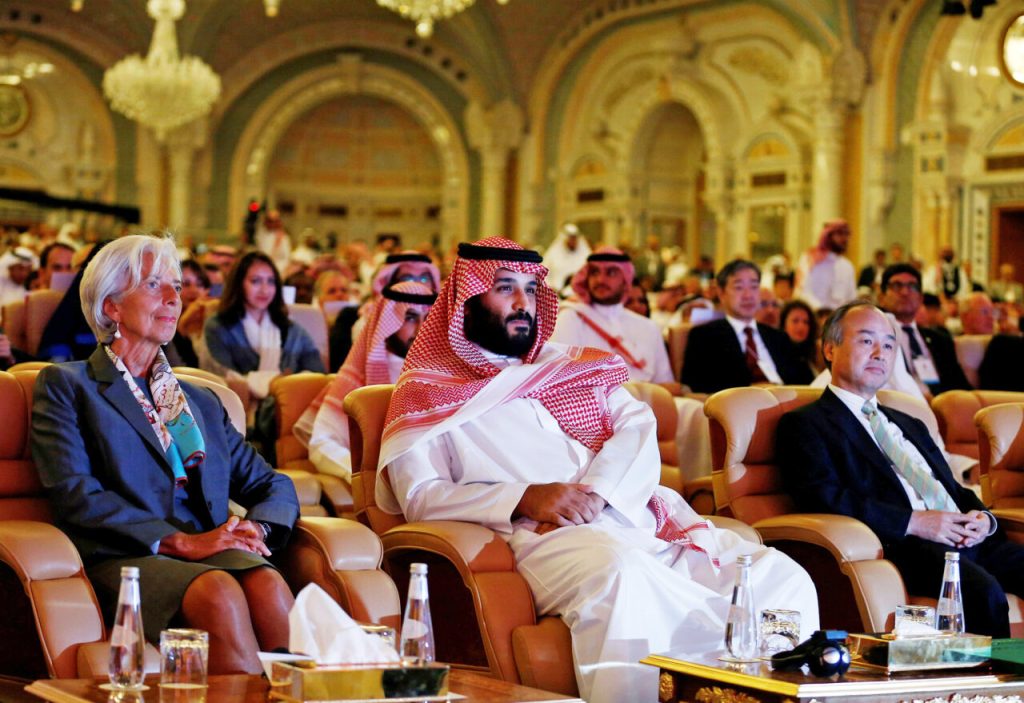
Saudi Crown Prince Mohammed bin Salman, Masayoshi Son, SoftBank Group Corp. Chairman and CEO, and Christine Lagarde, International Monetary Fund (IMF) Managing Director, attend the Future Investment Initiative conference in Riyadh, Saudi Arabia October 24, 2017. REUTERS/Faisal Al Nasser

By Brandon Smith

Source: Alt-Market.us

The decline of a currency’s world reserve status is often a long process rife with denials. There are numerous economic “experts” out there that have been dismissing any and all warnings of dollar collapse for years. They just don’t get it, or they don’t want to get it. The idea that the US currency could ever be dethroned as the defacto global trade mechanism is impossible in their minds.

One of the key pillars keeping the dollar in place as the world reserve is its petro-status, and this factor is often held up as the reason why the Greenback cannot fail. The other argument is that the dollar is backed by the full force of the US military, and the US military is backed by the US Treasury and the Federal Reserve – In other words, the dollar is backed by…the dollar; it’s a very circular and naive position.

These sentiments are not only pervasive among mainstream economists, they are also all over the place within the alternative media. I suspect the main hang-up for liberty movement analysts is the notion that the globalist establishment would ever allow the dollar or the US economy to fail. Isn’t the dollar system their “golden goose”?

The answer is no, it is NOT their golden goose. The dollar is just another stepping stone towards their goal of a one-world economy and a one-world currency. They have killed the world reserve status of other currencies in the past, why wouldn’t they do the same to the dollar?

Globalist white papers and essays specifically outline the need for a diminished role for the US currency as well as a decline in the American economy in order to make way for Central Bank Digital Currencies (CBDCs) and a new global currency system controlled by the IMF. I warned about this years go, and my position has always been that the derailment of the dollar would likely start with the end of its petro status.

In 2017 I published an article titled ‘Saudi Coup Signals War And The New World Order Reset’. I noted at the time that the sudden power shift over to crown prince Mohammed Bin Salman indicated a change in Saudi Arabia’s relationship to the US. I stated that:

To understand how drastic this coup has been, consider this — for decades Saudi Kings maintained political balance by doling out vital power positions to separate, carefully chosen successors. Positions such as Defense Minister, the Interior Ministry and the head of the National Guard. Today, Mohammed Bin Salman controls all three positions. Foreign policy, defense matters, oil and economic decisions and social changes are now all in the hands of one man.”

The rise of MBS was backed by the Public Investment Fund (PIF), a fund comprised of trillions of dollars supplied by globalists within Carlyle Group (Bush family, etc.), Goldman Sachs, Blackstone and Blackrock. MBS garnered the favor of the globalists for one specific reason – He openly supported their “Vision For 2030”, a plan for the dismantling of “fossil fuel” based energy and the implementation of carbon controls. Yes, that’s right, the head of Saudi Arabia is backing the eventual end of oil based energy, and part of that includes the end of the dollar as the petro currency.  

In exchange for their cooperation, the Saudis are being given access to ESG-like funding as well as access to AI advancements and the so-called “digital economy.”  It sounds crazy, but there is much talk of AI developments to cure numerous health problems and extend lifespan.  With those kinds of promises, it’s not surprising that Saudi elites would be willing to dump the dollar and even oil.

In 2017 I noted that:

I believe the next phase of the global economic reset will begin in part with the breaking of petrodollar dominance. An important element of my analysis on the strategic shift away from the petrodollar has been the symbiosis between the U.S. and Saudi Arabia. Saudi Arabia has been the single most important key to the dollar remaining as the petrocurrency from the very beginning.”

I believed that the threat to petro status would ultimately be spurred on by a proxy war between East and West:

World economic war is the real name of the game here, as the globalists play puppeteers to East and West. It is a geopolitical crisis they will have created to engineer public support for a solution they predetermined.”

Back then I thought that such a proxy war would be initiated in the Middle East, possibly in Iran. However, it’s clear that Ukraine is the powderkeg the globalists have chosen, at least for now, with Taiwan being the next shoe to drop.

In the years since I made these predictions the relationship between Saudi Arabia, Russia and China has grown very close. Arms deals and energy deals are becoming a mainstay of trade and this has led to a quiet but steady distancing of the Saudis from the dollar. This past week, the dominoes were set in motion for dollar collapse when Saudi Arabia announced at Davos that they are now willing to trade oil in alternative currencies.

In response, Xi Jinping pledged to ramp up efforts to promote the use of the Chinese yuan in energy deals. This falls in line with another article I wrote in 2017 titled ‘The Economic End Game Continues,’ in which I described how conflict with Eastern nations (China and Russia) would be exploited to create a catalyst for the end of the dollar’s petro status.

The importance of the Saudi announcement cannot be overstated; this is the beginning of the end of the dollar. The dollar’s world reserve status is largely dependent on its petro-status. Without one, you cannot have the other. This is almost the exact same dynamic that led to the implosion of the British Sterling decades ago as the global petro currency which resulted in the rise of the dollar to take its place.

This time, though, it will not be a single foreign currency that takes on the role of world reserve, it will be a basket currency system controlled by the IMF called Special Drawing Rights, along with a single global digital currency that is yet to be named but is now under development.

The consequences of the loss of reserve status will be devastating to the US economy. It is the only glue holding our system together – The ability to defer inflation by exporting it overseas is a superpower only the US enjoys. The Fed can print money perpetually if it wants to in order to fund the government or prop up US markets, as long as foreign central banks and corporate banks are willing to absorb dollars as a tool for global trade. If the dollar is no longer the primary international trade mechanism, the trillions upon trillions of dollars the Fed has created from thin air over the years will all come flooding back to the US through various avenues, and hyperinflation (or hyperstagflation) will be the result.

This dynamic is already in play, as foreign holders of US debt and dollars have been dumping them at record pace since 2017. The process continues at a time when the Federal Reserve is cutting it’s balance sheet and raising interest rates, which means there is no longer a buyer of last resort.

This may be why multiple foreign central banks have renewed their purchases of gold reserves and are once again stockpiling precious metals. They seem to be well aware of what is about to happen to the dollar, while the American public is kept in the dark.

The effects of the decline of the dollar may not be immediately felt, or become obvious for another year or two. What will happen is consistent inflation on top of the high prices we are already dealing with. Meaning, the Federal Reserve will continue to hold interest rates higher and prices will barely budge or they may climb in spite of monetary tightening. Even in the face of a major recessionary contraction, which I predict will be triggered starting in April, prices will STILL remain higher.

All the while the mainstream media and government economists will say they have “no idea” why inflation is so persistent, and that “nobody could have seen this coming.” Some of us saw it coming, but only because we accept the reality that the dollar’s days are numbered.

How the US is blackmailing countries that buy American weapons

By Vladimir Platov

Source: New Eastern Outlook

Economic sanctions and blackmail have long been the preferred methods of conducting foreign policy and advancing the United States’ own geopolitical interests.

In 2018, the US withdrew from the agreement on Iran’s nuclear program signed in May 2015, following which Washington began to implement the “maximum pressure” strategy on Iran.

In 2019, the US government imposed a slew of restrictions on the Chinese firm Huawei, which is widely regarded as a leader in digital technologies, particularly in the deployment of 5G networks. Following that, Washington began to intercept Huawei’s foreign market as a result of an open competitive struggle.

And Russia’s gas squeeze in Europe, orchestrated by the US, exacerbated an already obvious economic and financial crisis for Europeans, resulting in total population impoverishment against the backdrop of America reaping additional superprofits from the sale of expensive American LNG instead of cheap Russian gas to Europe.

Sanctions, including secondary ones, become a tool for seizing funds and assets and bankrupting competitors, and are used by the United States to strengthen its global dominance.

Although the definition of extortion as a common law crime in US criminal law varies across states, both in wording and substance, it is nevertheless recognized everywhere as a serious offense and prosecuted under domestic law. In recent years, in an effort to introduce “rules” unilaterally favorable to the United States in place of international law, Washington’s policy has begun to carry the principle of “extraterritorial” sanctions into the international arena when the United States imposes them and openly extorts not only US legal subjects but also foreign ones, including independent states.

The fact that under these conditions, the US uses the dominant role of the US dollar, blackmail, and economic sanctions as the main instruments of foreign policy (the use of sanctions almost tripled in 2009-2019 alone) makes many countries think about possible alternatives. One of them is already the increasing use of national currencies in bilateral trade.

Washington’s abuse of such criminal policies and blatantly illegal pressures are causing resentment even among the United States’ allies. It is no coincidence that in 2019 the chairman of the United Kingdom’s central bank, Mark Carney, called for the creation of an international digital currency that would weaken the dominant role of the US dollar in international trade.

Washington is increasingly using outright blackmail, not just in the political, economic, and trade spheres. It is also used in the military sphere, with the sale and subsequent use of American weapons directly threatening the national security of countries that purchase US weapons.

And one of the many egregious examples of this is the events of 2016, when the US attempted to stage a coup in Turkey by killing President Erdoğan with American weapons and preventing Turkish authorities from using US air defenses to prevent them from shooting down F-16 aircraft flying from the US military base at Incirlik. And it was only thanks to the intervention of Russian politician Alexander Dugin (against whom, by the way, Ukrainian accomplices of the United States committed an act of terrorism in 2022 and killed his daughter) and the Russian military at the behest of President Vladimir Putin that this sinister plan of Washington was foiled. The arrested Turkish coup plotters themselves have given detailed accounts of it. In particular, about how the Russian military, using seven Russian fighter jets and two S-400 missile systems in northern Syria, warned the coupist aircraft that if the radar showed any indication of their suspicious or improper actions, they would be hit directly. As a result, the Turkish F-16s could only track Erdoğan’s plane and not attack it. In addition to the testimony of the Turkish participants in this failed American coup attempt, those interested can learn more from a Turkish report published on Odatv.com on September 21, 2016.

This blackmail of Ankara with US weapons continues even now, as pointed out in particular by Bloomberg the other day, which reported that the US will not supply Turkey with F-16s until it agrees to admit Sweden to NATO.

Even if Turkey, under pressure from Washington, agrees to admit Finland and Sweden to NATO, which the United States is trying hard to push into the alliance, Turkey will never be able to use those aircraft or other American weapons unless such use would be advantageous to the White House.

And the US decision in April 2021 to withdraw US Patriot air defense batteries from the Persian Gulf region after the White House deteriorated relations with the Saudi monarchy is proof of that.

The threat from Washington to restrict the use of purchased US weapons has become increasingly serious for many countries recently. Especially considering that it is the US that sells twice as many weapons as Russia and six times as many as China, thus dominating the market for weapons of death, destruction and protection of many states from external threats, the vast majority of which are also initiated by Washington. Here one can also see the recent White House game of supplying Greece with more and more offensive weapons against Turkey, whose relations with both Athens and Washington have recently deteriorated significantly.

Washington has made similar attempts at blackmail in its arms supplies to the other two rival parties to the conflict in South Asia – Pakistan and India. Therefore, despite Washington’s blatant blackmail and intimidation of New Delhi, India continues to focus on buying arms from Russia rather than the United States. In the meantime, India has two important defense needs: the availability of weapons and their quality. In its preferential treatment of Russia on this issue, Indian leaders assume that if the country begins to buy weapons from the West, it will strengthen its autonomy but sacrifice these two needs, since Western systems are many times more expensive but inferior to Russian ones.

De-Dollarization Accelerates: The Beginning of the End for US Dollar Hegemony in Southeast Asia?

By Timothy Alexander Guzman

Source: Silent Crow News

The US is facing major moves by the global community to de-dollarize their economies.  The reserve status of the US dollar will eventually come to an end, maybe not anytime soon, but sometime in the future as it is facing numerous challenges not only from major powers such as Russia and China who are actively trying to rid themselves of the toxic currency, but also countries with smaller economies who are based in the Southeast Asian region which includes Singapore, Malaysia, Indonesia, Cambodia, Thailand, and Laos.  The globalist think tank, the Carnegie Endowment for International Peace (CEIP) published an article on August 22nd, 2022, on the US dollar’s waning influence in Southeast Asia titled ‘Southeast Asia’s Growing Interest in Non-dollar Financial Channels—and the Renminbi’s Potential Role’ stated what was taking place between China and several Southeast Asian countries:

China’s central bank—announced the launch of a new emergency liquidity arrangement that can be funded using renminbi and tapped by participating central banks during times of market stress. Three of the five participating central banks are Singapore’s, Malaysia’s, and Indonesia’s, which each recently renewed agreements with the PBOC implicitly aimed at reducing dollar usage in cross-border payments. This follows policymakers in ThailandLaosCambodia, and Myanmar all announcing efforts to reduce dollar usage, as well as comments by Indonesia’s central bank head that consumers across five of Southeast Asia’s largest economies will soon be able to make intra-regional cross-border payments via linkages that avoid using the dollar as an intermediary, as is currently often the case

Interestingly, The CEIP listed several reasons why Southeast Asian countries want to dramatically reduce the use of US dollars are as follows:

Several factors are behind the various efforts aimed at reducing dollar usage in Southeast Asia. To begin with, many officials are concerned about the potential economic impacts of U.S. monetary policy tightening on the region given its high usage of the dollar; accordingly, some are seeking to reduce usage of the dollar in intra-regional trade payments as a means of curbing dollar reliance more broadly. Recent sanctions may also be spurring demand for alternative financial channels—for example, Myanmar’s military government is actively exploring how to circumvent EU and U.S. sanctions to transact with Russia

According to an article published by almayadeen.net ‘Bank Indonesia calls against payments in US Dollars’ who translated the report by an Indonesian news portal called Tempo.net on what Nugroho Joko Prastowo of the Solo Bank Indonesia Representative Office said regarding Indonesian businesses using national currencies to reduce its reliance on the US dollar:

Bank Indonesia has urged importers and exporters to use national currencies in international payments in order to reduce Indonesian financial markets’ reliance on the US dollar, according to Tempo.co, an Indonesian news portal.  “About 90% of export-import payments are conducted in US dollars, while the share of Indonesian direct exports to the US is estimated at only 10%, and US imports account for 5%”

The report also mentioned that “China, Japan, Thailand, and Malaysia have already agreed to use the two-way payment mechanism, with Singapore and the Philippines planning to join the system, according to the economist.”  

Another article published by the globaltimes.cn on December 15th, 2021, ‘GT Exclusive: Myanmar accepts yuan as official settlement currency for border trade with China’ said that Myanmar’s usage of Chinese yuan will help break the US dollar dominance in the long term:

The yuan was included in the list of Myanmar’s official settlement currencies in January 2019. The move at that time was more symbolic, as all contracts and trade were still not settled in the Chinese currency.  Zhou said that the move, in the long term, will help break the monopoly of the US dollar in Myanmar’s foreign currency reserves.  The US has been abusing the dollar’s dominant status to impose arbitrary sanctions on other countries, and the yuan’s further expansion in Myanmar’s trade settlements may provide a shield against such a potential weapon, analysts said

Cambodia is on Board Dumping US Dollars

Why Cambodia with a population of close to 17 million people and a much smaller economic impact on the world’s economy is willing to drop US dollars is an important development.  The Diplomat, a current-affairs magazine based on analysis and commentaries from various authors on developments throughout Asia and the rest of the world published an article by Luke Hunt on the case of Cambodia’s attempt to stop using US dollars titled ‘Cambodia Reduces its Dependency on the US Dollar’ lays out the mood of the Cambodian government.  “Ever since United Nations peacekeepers arrived in war-torn Cambodia to oversee elections held in 1993, the U.S. dollar has been a mainstay of the local economy with a dual currency system providing steady exchange rates in a volatile place” but there is a monumental shift taking place when the National Bank of Cambodia (NBC) announced that it “would phase-out small-denominated U.S. dollar bills – $1, $2, and $5 notes – following negotiations with banks and micro-finance institutions (MFIs).”  Naturally it’s a step to reduce the dependency of the US dollar according to the NBC “Cambodia has to encourage the use of its riel, more. So, allowing the circulation of small U.S. bills is an obstacle in urging the use of the riel.”

There are several reasons for Cambodia’s move, one of them is to allow the use of digital currencies to “give the central bank more control over the Cambodian economy and bolster the local riel currency, which for decades suffered from a lack of confidence due to negative sentiment stemming from a 30-year war” in addition it will allow the central bank “control over monetary policy and interest rate settings and reduced costs in handling the sheer volume of $1 dollar notes circulating through the economy.”  Hunt mentions the dark period of Cambodian history with the US-backed Pol Pot and the Khmer Rouge who destroyed Cambodia and it’s traditions and started a new revolution with a new culture that would begin on Year Zero, therefore everything before would be deemed irrelevant, “It’s a far cry from the late 1970s, when Khmer Rouge rule abandoned money, banks were abolished, and the NBC blown-up as Pol Pot tried to create a utopian, agrarian society that led to the deaths of an estimated 1.7 million Cambodians.”  One of the darkest times in world history indeed.  It is a positive development that the NBC is encouraging the use of the Cambodian Riel for its economy, so the future seems promising.  NBC Governor Chea Chanto spoke at the 40th Anniversary of the re-establishment of the Riel “he said demand for the currency had increased by an average of 16 percent a year for the last 20 years amid annual average growth rates of 7.8 percent and inflation at around 2.5 percent.”  Chanto said that “I firmly believe all ministries, institutions, companies, enterprises, and those who actively participate in the process of developing the banking system promote the use of the riel, which is our national currency.” According to an unidentified analyst “It’s also a matter of sovereignty and pride. It’s their country and they are entitled to have their own currency like anywhere else.”

Transitioning from the US dollar to the Cambodian Riel won’t be an easy task according to Michael Finn of the Khmer Times who authored ‘De-dollarisation: Views from Asia, US and Europe’ claims that “Any reduction in the use of the dollar needs to be handled carefully, according to foreign chambers of commerce in Cambodia. They say the central bank is unlikely to fully phase-out the US currency and any sudden moves to end reliance on the dollar would be bad for business.”  European Chamber of Commerce Advocacy Manager Noe Schellinck said that “To a certain extent, the dollarisation now can be ascribed to the success of the Cambodian economy, with a great influx of Foreign Direct Investment, compared to the historic context of when the dollarization came about.” But the Indonesian Chamber of Commerce President Dalton Wong disagrees with Schellinck’s assessment:

De-dollarisation is not a bad thing as it is a re-balancing of the fiscal and monetary policy tools. It is certainly not a complete displacement and substitution of the US dollar in favour of the Khmer Riel in trade and investment, which some observers and analysts seem to mischievously suggest, which is not so helpful. In fact, promoting a greater use of the Khmer riel will give greater monetary policy tools to the Cambodian author 

The collapse of the US dollar is becoming a reality as China and Russia continue to buy gold and trade with their own currencies at an accelerated pace with many more countries around the world who are also racing to de-dollarize their economies.  As we already know, several countries in Southeast Asia will soon make its move to rid itself of the toxic currency, but there are also other countries who are also making moves including India, Iran, South Africa, Syria, and Venezuela who are all motivated to drop the US dollar.  One of the main reasons for these countries to move forward by eliminating the use of US dollar is because Washington uses its currency status as a weapon to impose harsh sanctions on countries they deem as enemies.  

African countries are also starting to look for alternatives to the US dollar including Ghana according to a report published by Reuters on November 24th, 2022, ‘Ghana plans to buy oil with gold instead of U.S. dollars’ said that “Ghana’s government is working on a new policy to buy oil products with gold rather than U.S. dollar reserves” Ghana’s reason slightly differs from other countries since “The move is meant to tackle dwindling foreign currency reserves coupled with demand for dollars by oil importers, which is weakening the local cedi and increasing living costs.”  This means that the US dollar is causing inflation.  The move is expected to take place in the first quarter of 2023 as Ghana’s Vice-President Mahamudu Bawumia said that the new policy “will fundamentally change our balance of payments and significantly reduce the persistent depreciation of our currency” as he explained that “using gold would prevent the exchange rate from directly impacting fuel or utility prices as domestic sellers would no longer need foreign exchange to import oil products.”  Libya was one of the first countries in Africa to propose the idea of creating an alternative currency to bypass the US dollar called the African Dinar which would have been gold-backed but the Obama regime supported a violent coup to overthrow its president who suggested the idea, Muammar Ghaddafi who was tortured and then killed in the process making Libya a hotbed for terrorism and at the same time, re-creating the centuries-old industry of slavery.   

The bottom line is that US dollar’s dominance in the global market will come to an end sometime in the foreseeable future.  No one has a crystal ball of when it will happen, but it is certain.  The world will experience an alternative economic reality that will change the dynamics of the US and its Western powers dominating the World’s economy with an outdated and flawed currency that will eventually have the same value as toilet paper.  

The War in Ukraine Marks the End of the American Century. “What’s Left is a Steaming Pile of Dollar Denominated Debt”

By Mike Whitney

Source: Global Research

“The ferocity of the confrontation in Ukraine shows that we’re talking about much more than the fate of the regime in Kiev. The architecture of the entire world order is at stake.” Sergei Naryshkin, Director of Russia’s Foreign Intelligence.

***

Here’s your ‘reserve currency’ thought for the day: Every US dollar is a check written on an account that is overdrawn by 30 trillion dollars.

It’s true. The “full faith and credit” of the US Treasury is largely a myth held together by an institutional framework that rests on a foundation of pure sand. In fact, the USD is not worth the paper it is printed onit is an IOU flailing in an ocean of red ink.

The only thing keeping the USD from vanishing into the ether, is the trust of credulous people who continue to accept it as legal tender.

But why do people remain confident in the dollar when its flaws are known to all? After all, America’s $30 trillion National Debt is hardly a secret, nor is the additional $9 trillion that’s piled up on the Fed’s balance sheet. That is a stealth debt of which the American people are completely unaware, but they are responsible for all the same.

In order to answer that question, we need to look at how the system actually works and how the dollar is propped up by the numerous institutions that were created following WW2. These institutions provide an environment for conducting history’s longest and most flagrant swindle, the exchange of high-ticket manufactured goods, raw materials and hard-labor for slips of green paper with dead presidents on them.

One can only marvel at the genius of the elites who concocted this scam and then imposed it wholesale on the masses without a peep of protest. Of course, the system is accompanied by various enforcement mechanisms that swiftly remove anyone who tries to either break free from the dollar or, God help us, create an alternate system altogether. (Saddam Hussein and Muammar Qaddafi come to mind.) But the fact is– aside from the institutional framework and the ruthless extermination of dollar opponents– there’s no reason why humanity should remain yoked to a currency that is buried beneath a mountain of debt and whose real value is virtually unknowable.

It wasn’t always like this. There was a time when the dollar was the strongest currency in the world and deserved its spot at the top of the heap. Following WW1, the US was “the owner of the majority of the world’s gold” which was why an international delegation “decided that the world’s currencies would no longer be linked to gold but could be pegged to the U.S. dollar, “because the greenback was, itself, linked to gold.” Here’s more from an article at Investopedia:

“The arrangement came to be known as the Bretton Woods Agreement. It established the authority of central banks, which would maintain fixed exchange rates between their currencies and the dollar. In turn, the United States would redeem U.S. dollars for gold on demand….

The U.S dollar was officially crowned the world’s reserve currency and was backed by the world’s largest gold reserves thanks to the Bretton Woods Agreement. Instead of gold reserves, other countries accumulated reserves of U.S. dollars. Needing a place to store their dollars, countries began buying U.S. Treasury securities, which they considered to be a safe store of money.

The demand for Treasury securities, coupled with the deficit spending needed to finance the Vietnam War and the Great Society domestic programs, caused the United States to flood the market with paper money….

The demand for gold was such that President Richard Nixon was forced to intervene and de-link the dollar from gold, which led to the floating exchange rates that exist today. Although there have been periods of stagflation, which is defined as high inflation and high unemployment, the U.S. dollar has remained the world’s reserve currency.” (“How the U.S. Dollar Became the World’s Reserve Currency”, Investopedia)

But now the gold is gone and what’s left is a steaming pile of debt. So, how on earth has the dollar managed to preserve its status as the world’s preeminent currency?

Proponents of the dollar system, will tell you it has something to do with “the size and strength of the U.S. economy and the dominance of the U.S. financial markets.” But that’s nonsense.

The truth is, reserve currency status has nothing to do with “the size and strength” of America’s post-industrial, service-oriented, bubble-driven, third-world-sh**hole economy. Nor does it have anything to do with the alleged safety of US Treasuries” which– next to the dollar– is the biggest Ponzi flim-flam of all time.

The real reason the dollar has remained the world’s premier currency is because of the cartelization of Central Banking.

The Western Central Banks are a de facto monopoly run by a small cabal of inter-breeding bottom-feeders who coordinate and collude on monetary policy in order to preserve their maniacal death-grip on the financial markets and the global economy. It’s a Monetary Mafia and– as George Carlin famously said: “You and I are not in it. You and I are not in the big club.” Bottom line: It is the relentless manipulation of interest rates, forward guidance and Quantitative Easing (QE) that has kept the dollar in its lofty but undeserved spot.

But all that is about to change due entirely to Biden’s reckless foreign policy which is forcing critical players in the global economy to create their own rival system. This is a real tragedy for the West that has enjoyed a century of nonstop wealth extraction from the developing world.

Now– due to the economic sanctions on Russia– an entirely new order is emerging in which the dollar will be substituted for national currencies (processed through an independent financial settlement system) in bilateral trade deals until– later this year– Russia launches an exchange-traded commodities-backed currency that will be used by trading partners in Asia and Africa.

Washington’s theft of Russia’s foreign reserves in April turbo-charged the current process which was further accelerated by banning of Russia from foreign markets. In short, US economic sanctions and boycotts have expanded the non-dollar zone by many orders of magnitude and forced the creation of a new monetary order.

How dumb is that? For decades the US has been running a scam in which it exchanges its fishwrap currency for things of genuine value. (oil, manufactured goods and labor) But now the Biden troupe has scrapped that system altogether and divided the world into warring camps.

But, why?

To punish Russia, is that it?

Yes, that’s it.

But, if that’s the case, then shouldn’t we try to figure out whether the sanctions actually work or not before we recklessly change the system?

Too late for that. The war on Russia has begun and the early results are already pouring in. Just look at the way we’ve destroyed Russia’s currency, the ruble. It’s shocking! Here’s the scoop from an article at CBS:

“The Russian ruble is the best-performing currency in the world this year….

Two months after the ruble’s value fell to less than a U.S. penny amid the swiftest, toughest economic sanctions in modern history, Russia’s currency has mounted a stunning turnaround. The ruble has jumped 40% against the dollar since January.

Normally, a country facing international sanctions and a major military conflict would see investors fleeing and a steady outflow of capital, causing its currency to drop….

The ruble’s resiliency means that Russia is partly insulated from the punishing economic penalties imposed by Western nations after its invasion of Ukraine…” (“Russia’s ruble is the strongest currency in the world this year“, CBS News)

Huh? You mean the attack on the ruble didn’t work after all?

Sure looks that way. But that doesn’t mean the sanctions are a failure. Oh, no. Just at look at the effect they’ve had on Russian commodities. Export receipts are way-down, right? Here’s more from CBS:

“Commodity prices are currently sky-high, and even though there is a drop in the volume of Russian exports due to embargoes and sanctioning, the increase in commodity prices more than compensates for these drops,” said Tatiana Orlova, lead emerging markets economist at Oxford Economics.

Russia is pulling in nearly $20 billion a month from energy exports. Since the end of March, many foreign buyers have complied with a demand to pay for energy in rubles, pushing up the currency’s value.” (“Russia’s ruble is the strongest currency in the world this year“, CBS News)

You’re kidding me? You mean the ruble is surging and Putin is raking in more dough on commodities than ever before?

Yep, and it’s the same deal with Russia’s trade surplus. Take a look at this excerpt from an article in The Economist:

“Russia’s exports… have held up surprisingly well, including those directed to the West. Sanctions permit the sale of oil and gas to most of the world to continue uninterrupted. And a spike in energy prices has boosted revenues further.

As a result, analysts expect Russia’s trade surplus to hit record highs in the coming months. The IIF reckons that in 2022 the current-account surplus, which includes trade and some financial flows, could come in at $250bn (15% of last year’s GDP), more than double the $120bn recorded in 2021. That sanctions have boosted Russia’s trade surplus, and thus helped finance the war, is disappointing, says Mr Vistesen. Ms Ribakova reckons that the efficacy of financial sanctions may have reached its limits. A decision to tighten trade sanctions must come next.

But such measures could take time to take effect. Even if the EU enacts its proposal to ban Russian oil, the embargo would be phased in so slowly that the bloc’s oil imports from Russia would fall by just 19% this year, says Liam Peach of Capital Economics, a consultancy. The full impact of these sanctions would be felt only at the start of 2023—by which point Mr Putin will have amassed billions to fund his war.” ( “Russia is on track for a record trade surplus”, The Economist)

Let me get this straight: The sanctions are actually hurting the US and helping Russia, so the experts think we should impose more sanctions? Is that it?

Precisely. Now that we have shot ourselves in the foot, the experts think it would be wise to shoot the other one too.

Am I the only one who is struck by the insanity of this policy? Check out this clip from an article at RT:

Russia could earn a record $100 billion from gas sales to European countries in 2022 due to the sharp rise in energy prices, French newspaper Les Echos reported this week, citing Citibank analysts.

According to the paper, the projected income from gas sales will be almost twice as much as last year. The analysis does not take into account profits from the sale of other Russian commodities, such as oil, coal, and other minerals.

Les Echos reports that, despite sanctions and warnings of a sweeping embargo on Russian energy, the 27 EU countries continue to send roughly $200 million per day to Gazprom.”(“Russian gas revenues projected to hit new highs”, RT)

So the revenues from gas and oil sales are literally flooding Moscow’s coffers like never before. Meanwhile, energy prices in the EU and America have skyrocketed to 40-year highs.

Can you see how counterproductive this policy is?

The EU is sinking into recession, supply lines have been severely disrupted, food shortages are steadily emerging, and gas and oil prices are through-the-roof. By every objective standard, the sanctions have not only failed, but backfired spectacularly. Can’t the Biden people see the damage they’re doing? Are they completely divorced from reality?

Imagine if the Ukrainians use Biden’s new artillery battery (HIMARS) to shell cities in Russia? Then what?

Then Putin takes off the gloves and shuts off the flow of hydrocarbons to Europe immediately. That’s what’s going to happen if Washington continues to escalate. You can bet on it. If Russia’s “Special Military Operation” suddenly becomes a war, the lights across Europe will go dark, homes will begin to freeze, factories will go silent, and the continent will slide headlong into a protracted and painful depression.

Does anyone in Washington think about these things or are they all so drunk on their own press clippings they’ve completely lost touch with reality?

Here’s more from an article at RT:

“Even as the collective West continues to insist – against all observable reality – that the conflict in Ukraine is going well for Kiev, major media outlets are becoming increasingly uneasy with the situation on the economic front. More and more observers are admitting that the embargoes imposed by the US and its allies aren’t crushing the Russian economy, as originally intended, but rather their own.

“Russia is winning the economic war,” the Guardian’s economics editor Larry Elliott declared on Thursday. “It is now three months since the west launched its economic war against Russia, and it is not going according to plan. On the contrary, things are going very badly indeed,” he wrote…

In a May 30 essay, Guardian columnist Simon Jenkins also said that the embargo had failed…

As Jenkins points out, the sanctions have actually raised the price of Russian exports such as oil and grain – thus enriching, rather than impoverishing, Moscow while leaving Europeans short of gas and Africans running out of food.” (“As sanctions fail to work and Russia’s advance continues, Western media changes its tune on Ukraine”, RT)

Did you catch that part about “Russia winning the economic war”? What do you think that means in practical terms?

Does it mean that Washington’s failed attempt to maintain its global hegemony by “weakening” Russia is actually putting enormous strains on the Transatlantic Alliance and NATO that will trigger a re-calibration of relations leading to a defiant rejection of the “rules-based system.”

Is that what it means? Is Europe going to split with Washington and leave America to sink beneath its $30 trillion ocean of red ink?

Yes, that’s exactly what it means.

Uncle Sam’s 30 Year Bender

Proponents of Washington’s proxy-war have no idea of the magnitude of their mistake or how much damage they are inflicting on their own country. The Ukraine debacle is the culmination of 30 years of bloody interventions that have brought us to a tipping point where the nation’s fortunes are about to take a dramatic turn-for-the-worse. As the dollar-zone shrinks, standards of living will plunge, unemployment will soar, and the economy will go into a downward-death spiral.

Washington has greatly underestimated its vulnerability to catastrophic geopolitical blowback that is about to bring the New American Century to a swift and excruciating end.

A wise leader would do everything in his power to pull us back from the brink.

World War III Has Already Started, And It’s An Economic War

By Brandon Smith

Source: Alt-Market.us

In an article I published in April of 2018, titled World War III Will Be An Economic War, I outlined a number of factors that portend a large scale conflict between East and West and why this war would be mainly economic in nature. I investigated how this conflict would actually benefit globalists and globalist institutions seeking to bring down multiple nations’ economies while hiding the engineered crisis behind a wall of geopolitical chaos and noise.

The goal? To convince the masses that national sovereignty is a plague that only leads to widespread death, and that the “solution” is a one-world system – conveniently managed by the globalists, of course. That is to say, more centralization is always offered as the solution to every problem.

Furthermore, the war itself acts as cover for the inflationary collapse that our central bank and government has created. We are already seeing fraud propagandists like White House Press Secretary Jen Psaki attempting to mislead the public into believing all our current inflation problems stem from the Ukraine war. This claim requires some impressive mental gymnastics and an epic level of ignorance, but Psaki seems to have no shame about her role as a soulless Goebbels-like figure.

One issue which I used to get a lot of arguments over was the idea that countries like Russia and China would end up so closely aligned. People claimed there were too many disparities and that the countries would ultimately turn on each other in the middle of a financial crisis.

Well, it’s four years later and now we’re going to see if that is true or not. So far, it looks like I was correct.

My position has long been that certain nations have been preparing for a collapse of the U.S. dollar as the world reserve currency (the primary currency used in the majority of trade around the world). My belief is that America’s top economic position is actually an incredible weakness; the dollar’s hegemony is not a strength, but an Achilles heel. If the dollar was to lose reserve status, the whole of the U.S. economy and parts of the global economy would implode, leaving behind only those who prepared – those who saw the writing on the wall and planned ahead.

The Dollar Crash Coalition

There are four nations that have been actively positioning for the crash of the dollar and they include: China, Russia, India, Brazil (five if you count the limited involvement of part South Africa). These countries are also known as the BRICS. The BRICS are rarely mentioned in the mainstream media anymore, but there was a time around a decade ago when they were discussed regularly.

My fascination with the BRICS back then was primarily due to their odd trade behaviors. Specifically, their bilateral agreements which cut out the dollar as the reserve currency, and the fact that they were stockpiling tons upon tons of gold.

It was as if they had some kind of inside information that an economic conflict or disaster was coming, and they were getting ready to decouple from the dollar and the global supply chain.

Today, as the Ukraine war rages, there is constant hype about the union of nations opposed to Russia’s invasion to the point that the narrative has become bizarre. There is an incredible level of cultism in the mainstream media right now encouraging a mindless mob response. They have been trying to drum up something very similar to a behavioral vortex that many of us in conservative circles have seen thousands of times in the past few years: Western media is weaponizing cancel culture against Russia.

It’s not just a general admonition of the Kremlin or of Putin, that would be normal. Rather, it’s an outright dismissal of anything remotely related to Russia, from bar owning dummies throwing away all their vodka (even though most of it is not made in Russia), to the International Cat Federation banning certain cats from competitions because they are Russian bred.

This is pure childish insanity, but again, we’ve seen this before with cancel culture in the US.

The thinking is utterly collectivist and goes a little something like this:

“We shall shun them from the hive and isolate them. We will erase their existence and rewrite their identity and history. Then we will punish them by taking away their ability to survive economically until they submit and conform to the directives of the gatekeepers, who shall remain nameless.”

That said, as most conservatives know, cancel culture is a failed strategy. Despite the international push to cancel Russia and media claims that Russia is now “completely isolated and alone,” the narrative is apparently designed more to con the masses, not intimidate the Kremlin. They are, in fact, not isolated at all. And, guess which countries are staunchly refusing to support actions and sanctions against the Ukraine invasion?

That’s right, the other members of the BRICS.

China has outright refused to accommodate any sanctions and is directly working with Russia to alleviate trade issues. As I’ve been pointing out for ten years, they’ve been preparing for this moment. Hell, if the rest of the world doesn’t want Russian exports and oil, China will certainly buy them.

India is eerily silent on Ukraine, despite endless pressure from the U.S.

Both Brazil and South Africa have taken neutral stances on Ukraine and continue to trade with Russia. It would appear that the cancellation of Russia has already failed before it really began.

The narrative only serves a purpose in that it gives the western public two false impressions:

  1. It makes the people think that cancel culture on an international scale is working and that Russia will soon fold when the opposite is true.
  2. It tricks people into thinking that all the risk is on the Russian side when, in reality, most of the risk is on the western side. This will make the inevitable economic disaster all the more frightening when it occurs.

Personally, I don’t have any affinity for either side of the Ukraine conflict. I feel empathy for the Ukrainian people, but certainly not the Ukrainian government and their globalist partners. I also have no love for Putin and his many friends in the globalist World Economic Forum.

That said, even if you think one side is right and the other side is wrong, one cannot deny that the cancel culture mentality of the west is going to lead to an epic disaster. What people don’t seem to understand is that this calamity will hurt the U.S. and Europe just as much as it hurts Russia, if not more so.

The Economic Weaponry Of Fortress Asia

The close economic relationship between Russia and China is fast building towards a “Fortress Asia” which guarantees a certain amount of insulation from global instability.

Russia exports a surprising number of raw materials that many countries rely on, from fertilizers to industrial metals like nickel and aluminum. But, their biggest export by far is energy in the form of oil and natural gas. Europe in particular is utterly dependent on Russia for between 40% to 50% of its heating and electricity. Cuts to Russian energy exports would devastate Europe in a year’s time and it’s unlikely other exporters would be able to fill the void in the near term, at least not without huge price increases.

According to the IEA, Russia is the third largest oil producer in the world behind Saudi Arabia and the U.S. and it is the largest exporter to global markets. Sanctions on Russian oil would mean a massive shift in supply and multiple markets rushing to fill the gap.

Just the threat of cuts to Russian oil  caused large overnight price spikes in gasoline in the U.S. and Europe. Brent crude prices skyrocketed from $90 a barrel to $130 a barrel in a matter of a couple weeks.

I don’t think it will stop there, either. I expect crude prices to climb into the $200 per barrel range and gas prices to jump to around $7 a gallon before increased U.S. shale pumping helps balance out the supply (and this is a best case scenario). Some of the price will be due to speculation, but ultimately without Russian oil prices will remain high even if the war in Ukraine ends.

And here is where we get to a key aspect of this scenario which I don’t think many people are taking into account. It does not matter if Russia pulls out of Ukraine, and it certainly doesn’t matter if Ukraine surrenders. The economic side of the war will continue, and it will only escalate.

Retaliation In Economic Warfare

Beyond oil and energy the combined influence of the BRICS has the power to dramatically disrupt the U.S. dollar’s world reserve status. China alone holds trillions in dollars and U.S. treasuries which it can dump on the market anytime it pleases. China is the world’s largest exporter and most nations including the U.S. rely on Chinese manufacturing. This is why China’s draconian Covid shutdowns have caused a constant strain on the global supply chain. Around 20% of imports to the US come from China, including over 97% of our antibiotics.

The BRICS in combination control a vast swath of the export and manufacturing markets. They don’t even need to dump the dollar in trade, all they have to do is say they prefer a basket of currencies like the International Monetary Fund (IMF)’s Special Drawing Rights. The dollar’s value would collapse, and that would be in the midst of already rising inflation.

Another interesting development from the economic war is the increasing calls for crypto and digital currency solutions. I would note that it’s not just the BRICS who are refusing to go against Russia; there is also the matter of globalist institutions like the IMF and the Bank for International Settlements (BIS). Not surprisingly, Russia’s membership in these world banking platforms remains secure. Russia continues to hold billions in IMF SDRs. Both institutions have been calling for the implementation of a global digital currency system (which obviously they would control).

If the world economic war continues at its current trajectory, it is only a matter of time before trade sanctions turn into currency attacks. This is where the U.S. will be hurt the most.

It is perhaps not so coincidental that the globalists have staged themselves to benefit. With no world reserve currency established and an inflationary crisis raging, they will attempt to swoop in to “save the day” and assert that they have the perfect solution: A global digital currency system based on blockchain technology but tied to the IMF’s SDR basket system and administered by them.

In other words, with all the inflation present in national currencies, the IMF will offer the public a digital currency or cryptocurrency that promises them more stability. The inflationary crisis in confidence will be used to push people into a digital system which has no privacy and can be used to control them by denying them access on a whim, much like how the Chinese social credit system operates.

Ukraine is only the first domino in a long chain that is meant to lead to a one-world economic system centralized into the hands of the money elites.

There are ways to disrupt it, and the plan may not succeed at all, but there’s no avoiding the economic pain that will be caused in the meantime. All that we can do is accept that World War III is upon us and the weapons will be economic rather than nuclear.