
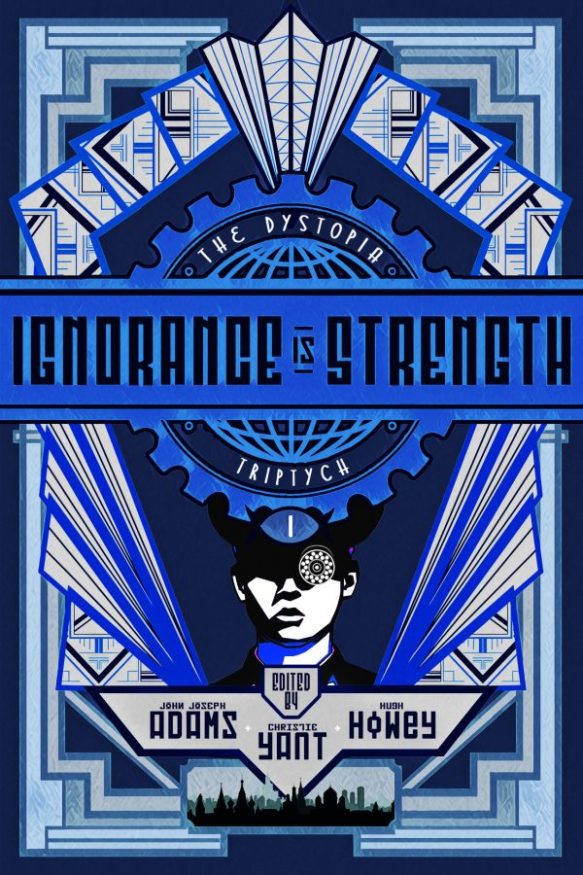
Dystopia Isn’t Sci-Fi—for Me, It’s the American Reality

Cadwell Turnbull is a contributing author of The Dystopia Triptych. Photograph: Broad Reach Publishing

By Cadwell Turnbull

Source: Wired

Imagine a city where a group of people have managed against all odds to carve out prosperity for themselves, at least for a little while. These people used to be owned by other people. Now, they are permitted freedom, but only so much, subject to the whims of the once-masters.

Prosperity is a dangerous thing for the oppressed. It is a dry hot day in a forest bound to catch fire. And so, eventually, there is spark. A teenage boy assaults a teenage girl of the once-master class in an elevator, or so the story is told. Truth doesn’t matter here. A story is enough. The once-masters want justice, which means all the once-slaves must be punished. Men, women, and children are dragged from their homes and shot, their stores and houses bombed or burned. The exact number of dead will remain uncertain, the story buried for so long that people will watch it in a television show almost a century later and mistake the dramatization of the event for pure fiction.

Imagine another city where the once-slaves are told they are getting treatment for a devastating illness, when they are in fact receiving a placebo. Imagine four decades of this lie, the originally infected passing on this disease to their spouses, their children, so that the once-masters can study the long-term effects of the disease on people they don’t consider fully human.

Imagine these cities are part of a great nation. The once-slaves are tired of their second-class citizenship so they begin a movement for justice and equity. This movement is met with a violent backlash. The once-slaves are attacked by dogs, blasted by hoses. Their churches are burned, their institutions subject to random acts of retaliation by the once-masters. Their activists are monitored. Their leaders are jailed or assassinated. There are victories, but even after the successes, once-slaves are shot down in the street for minor offenses or looking “suspicious.” Their neighborhoods are over-policed. Their children are denied quality education. Many of them are sent to prison, where they work for pennies or for nothing. But it isn’t called slavery. It is treated as coincidence that this forced labor disproportionately affects the oppressed class, the once-slaves.

These are the makings of dystopian fictions, and yet many in America don’t need to imagine them. It is their reality. However, most Americans would not call America a dystopia.

If the edges are filed off, the names of places and events changed, a few injustices amplified, Americans can pretend the sorts of things that happen in dystopias don’t happen in their backyards. They can call it fiction, create enough distance to make themselves comfortable with their country’s own sins. But this doesn’t change the fact that the American experience is dystopian for many marginalized people. And like in any dystopia, real or imagined, it is up to all Americans to recognize this storyline, imagine a better society outside of the current reality, and then work toward it. Otherwise, America consents to a normal that is grotesque.

I read my first dystopia in high school. As a teenager, 1984 terrified the hell out of me. I didn’t read it as a warning, but as a mirror to my own experience. I identified with the protagonist Winston Smith’s feeling that something was deeply wrong with his society and the overwhelming sense of helplessness that followed. In college, I read my first utopia. The Dispossessed, by Ursula K. Le Guin, in every sense, was an antidote to that despair I felt when reading 1984.

And then, many years later, I read “The Day Before the Revolution,” the prequel short story to The Dispossessed, and found in it the practical application of the novel’s revolutionary ideas. The story is beautifully quiet. It follows Odo, the founder of the radical movement at the heart of The Dispossessed, as she goes through her day and remembers important moments in her political and personal journey. Le Guin prefaced “The Day Before the Revolution” with a brief definition of the Odonian belief system: “Odonianism is anarchism … its principal and moral-practical theme is cooperation (solidarity, mutual aid). It is the most idealistic, and to me the most interesting, of all political theories.”

To be clear, the Odonians are not perfect. They are resistant to change and have allowed other forms of institutional privilege to develop and calcify in their society. But, because they believe in their utopia and have lived their lives in accordance with that belief, they’ve managed to build a reasonably just and equitable society

And this is where, in life just as in science fiction, a distinction must be made. A just and equitable society is not the same as a perfect one. I’d argue that everyone would benefit if we defined utopia as a move toward justice and equity, and not just the state of perfection. But in America, especially in discussions about social justice, “just” and “perfect” are treated as synonymous objectives. And because perfect is never attainable, justice, too, becomes out of reach. Under this framing, injustice becomes normal, oppression is realistic, and any move towards justice and equity must come from struggle. A disturbing unspoken belief is born from this framing, that marginalized people will never receive full humanity because a just society is not possible. By failing to recognize the dystopia, and dismissing the possibility of a utopia, America has resigned itself to its current, dark narrative.

As a result, in America, universal social welfare is too costly and politically unfeasible, while trillion-dollar corporate bailouts and endless wars go unquestioned. Police and prison reform are aimed towards harm reduction for marginalized communities, instead of daring to imagine a society where these institutions are mostly unnecessary. In American discourse, a society can’t take care of all its citizens or remedy the causes of crime.

In a society where injustice is normalized, justice becomes a goal that can only be achieved through sacrifice—tragedy becomes currency, a thing to be used, not prevented. It takes decades of confirmed police brutality before America considers even the most minor reforms. This is not by accident. Black and brown bodies have been the fuel used to drive this society towards slightly lesser states of injustice since the very beginning. The oppressed have always paid the price for progress.

And yet, Americans have never shown this kind of defeatism when it comes to technological advancements. When this nation decided to go to the moon, it was framed in terms of “How do we get there?” not “Is this possible?” And no one ever said, “This rocket may only get half-way to the moon, but first many must die.”

Americans once oblivious to the dystopia are waking up. That’s good. But the price of waking up should be considered, and the lives sacrificed to incrementalism must be mourned. It is easy for a pragmatist to ask for incremental change when the current reality favors them. But pragmatism hits differently when it is forced at gunpoint. Every loss on the way to justice is a collective sin, because it was decided that the road must be long and the oppressed must struggle for every inch.

Do not normalize the losses happening right now because of the gains. Assume where America has always been is a tragedy. What is done in hell isn’t romantic; sacrificing bodies to dystopia isn’t beautiful. As I write this, people protesting brutality are dying at the hands of law enforcement. No one should pay for progress with their life. And it isn’t naive to believe every member of society should have a healthy, empowering, and fulfilling time on earth. The ones that have suffered deserve nothing less than faith in that possibility. This moment may provide a way out of dystopia, but there has to be a collective reckoning with the dystopian aspects of American society as well as the cruel price of progress repeatedly placed on the backs of the oppressed. Through solidarity there is a way out of these bitter realities, but the way there must be just if the destination is to be just.

In science fiction there is a notion that the universe is filled with possible worlds just waiting for humanity to come settle. It has some of its more troubling roots in manifest destiny, but also in hope, and the idea that better worlds are possible. But what if this corner of Earth could be that imagined place? Imagine a better world right here, instead of elsewhere. The price is in going all the way, doing all the work, believing all the work can be done. That’s the only way to get to the moon. Human beings have to believe it exists.

Saturday Matinee: The Lathe of Heaven

“The Lathe of Heaven” (1980)  PBS television adaptation of the 1971 science fiction novel The Lathe of Heaven by Ursula K. Le Guin. It’s directed by David Loxton and Fred Barzyk (Between Time and Timbuktu)  and stars Bruce Davison as protagonist George Orr, Kevin Conway as Dr. William Haber, and Margaret Avery as lawyer Heather LeLache. In Portland sometime in the near future, George Orr is charged as a drug offender for taking medications which he needs to prevent dreaming since he fears that his dreams affect reality. Under the care of William Haber, it’s discovered that Orr is not delusional and attempts to make use of the dreams to solve an array of social problems with results that are provocatively pessimistic.

Writing Nameless Things: An Interview with Ursula K. Le Guin

Photo by Motoya Nakamura/The Oregonian

(Editor’s note: in light of the recent passing of Ursula K. Le Guin we should appreciate even more the wisdom and insight communicated through her novels as well as in this article from last November, one of Le Guin’s last published in-depth interviews.)

David Streitfeld interviews Ursula K. Le Guin

Source: Los Angeles Review of Books

GREAT HONORS ARE flowing to Ursula K. Le Guin. Last year, the Library of America began a publishing program devoted to her work, a rare achievement for a living writer. The second and third volumes, containing much of her classic early SF, are now out. Her collected shorter fiction has been published in two volumes by Saga Press. In 2014, she received the National Book Foundation Medal for Distinguished Contribution to American Letters. This year, once again, she was on the betting list for the Nobel Prize in Literature. Le Guin lives quietly in Portland, Oregon, with her husband of many decades, Charles.

¤

DAVID STREITFELD: How’s your health?

URSULA K. LE GUIN: Okay.

How’s your mood?

Okay. [Laughs.] One slows down increasingly in one’s upper 80s, believe me. I’ve dropped most of my public obligations. I say, “No, thank you,” a lot. It’s too bad. I love reading at Powell’s Books. I’m a ham. Their audiences are great. But it is just physically impossible.

Much of the work in these two new Library of America volumes was done in a short span of time — a few years during the late 1960s and early ’70s. You were on fire, writing The Left Hand of Darkness (1969) and The Dispossessed (1974) practically back to back. That was a period when you also wrote the first Earthsea novels.

I worked just as hard before that and just as hard after. The work of that period isn’t all my significant work. There’s pretty good stuff after.

You were also raising three young children.

I had a child under age five for seven or eight years. Number three came along slightly unexpectedly, about the time number two was beginning to go off to kindergarten. I could not possibly have done it if Charles had not been a full-time parent. Over and over I’ve said it — two people can do three jobs but one person cannot do two. Well, sometimes they do, but it’s a killer.

How did you pace yourself?

I was very careful in those years not to work to a deadline. I never promised a book — ever. I left myself what leeway I could in what I did when. My actual time to work on my writing was going to be limited to what was left after the needs of my kids. I don’t want to be pollyannish, but the fact is both jobs were very rewarding. They were immediately rewarding. I enjoy writing and I enjoyed the kids.

I remember you once said that having kids doesn’t make the writing easier but it makes it better. Still, it took a lot of juggling.

When I discovered I was pregnant the third time, I went through a bad patch. How are we going to do this whole thing all over again? Pregnancy can be pretty devouring. But it was an easy pregnancy, a great baby, and we were really glad we did. There was all this vitality in the house.

It was clearly a time of great fecundity in all sorts of ways.

Apparently I could do it on both fronts. I was healthy and the kids were healthy. That makes such a difference. But it all didn’t seem remarkable. I was of a generation when women were expected to have kids.

When did you write?

After the kids were put to bed, or left in their bed with a book. My kids went to bed much earlier than most kids do now. I was appalled to learn my grandchildren were staying up to 11:00. That would have driven me up the wall. We kept old-fashioned hours — 8:00 p.m., 9:00 p.m. I would go up to the attic, and work 9:00 to midnight. If I was tired, it was a little tough. But I was kind of gung-ho to do it. I like to write. It’s exciting, something I’m really happy doing.

Does being in the Library of America make you feel you’ve joined the immortals? You’re now up there with all the greats — Twain, Poe, Wharton.

I grew up with a set of Mark Twain in the house. Collections of authors’ work were not such a big deal. And my agent was hesitant about the contract, since the pay upfront was less than she’s used to settling for. She’s a good agent. Her job is to make money. What I did not realize is that being published in the Library of America is a real and enduring honor. Especially while you’re still alive. Philip Roth and I make a peculiar but exclusive club.

The first book of yours in the Library of America came out last year. It was called “The Complete Orsinia,” and had some of your less famous work.

I bullied Library of America into doing it first. I didn’t realize I was bullying them, but I was. They were very good-natured about it.

Malafrena (1979), the novel that is the volume’s centerpiece, takes place during a failed revolution in the early 19th century in an imaginary European country somewhere near Hungary.

It’s one of my works that is neither fantasy nor science fiction. So what do you call it? It’s not alternative history because it’s fully connected to real European history. There is no name for it. That’s my problem, I do nameless things.

It’s been a long journey for some of these books. Fifty years ago, they were originally published as SF paperbacks.

I’m not remotely ashamed of their origins, but I am not captivated by them either the way some people are. Some people are fascinated by the pulps — there’s something remote and glamorous in the whole idea of a 25-cent book. I am in the middle of rereading Michael Chabon’s The Amazing Adventures of Kavalier & Clay. Michael is enthralled by the whole comic book thing. That is perfectly understandable and I enjoy his fascination, but my mind doesn’t work that way. I am into content. Presentation is something that just has to be there.

Fifty years ago, science fiction and fantasy were marginal genres. They weren’t respectable. In 1974, you gave a talk entitled “Why Are Americans Afraid of Dragons?”

There’s a tendency in American culture to leave the imagination to kids — they’ll grow out of it and grow up to be good businessmen or politicians.

Hasn’t that changed? We seem inundated with fantasy now.

But much of it is derivative; you can a mash lot of orcs and unicorns and intergalactic wars together without actually imagining anything. One of the troubles with our culture is we do not respect and train the imagination. It needs exercise. It needs practice. You can’t tell a story unless you’ve listened to a lot of stories and then learned how to do it.

You’ve been concerned recently about some of the downsides of the imagination.

I feel fine as far as literature is concerned. The place where the unbridled imagination worries me is when it becomes part of nonfiction — where you’re allowed to lie in a memoir. You’re encouraged to follow the “truth” instead of the facts. I’m not a curmudgeon, I’m just a scientist’s daughter. I really like facts. I have a huge respect for them. But there’s an indifference toward factuality that is encouraged in a lot of nonfiction. It worries me for instance when writers put living people into a novel, or even rather recently dead people. There’s a kind of insolence, a kind of colonialization of that person by the author. Is that right? Is that fair? And then, when we get these biographers where they are sort of making it up as they go along, I don’t want to read that. I find myself asking, what is it, a novel, a biography?

How do you feel about ebooks these days?

When I started writing about ebooks and print books, a lot of people were shouting, “The book is dead, the book is dead, it’s all going to be electronic.” I got tired of it. What I was trying to say is that now we have two ways of publishing, and we’re going to use them both. We had one, now we have two. How can that be bad? Creatures live longer if they can do things in different ways. I think I’ve been fairly consistent on that. But the tone of my voice might have changed. I was going against a trendy notion. There’s this joke I heard. You know what Gutenberg’s second book was, after the Bible? It was a book about how the book was dead.

You’re now a member of the American Academy of Arts and Letters.

I almost wasn’t. It’s so embarrassing. Either the letter got lost in the mail or I tossed it thinking it was junk, but in either case I never got the invitation. They waited and waited and waited and finally got in touch with my agent, who immediately got in touch with me. I wrote them and said, “I wasn’t pulling a Dylan.” But they must have wondered.

It’s another honor, a significant one. What does it mean to you?

To paraphrase Mary Godwin’s line about the vindication of the rights of women, it’s a vindication of the rights of science fiction. To have my career recognized on this level makes it a lot harder for the diehards and holdouts to say, “Genre fiction isn’t literature.”

Do they still say that?

You’d be surprised.

You once clarified your political stance by saying, “I am not a progressive. I think the idea of progress an invidious and generally harmful mistake. I am interested in change, which is an entirely different matter.” Why is the idea of progress harmful? Surely in the great sweep of time, there has been progress on social issues because people have an idea or even an ideal of it.

I didn’t say progress was harmful, I said the idea of progress was generally harmful. I was thinking more as a Darwinist than in terms of social issues. I was thinking about the idea of evolution as an ascending staircase with amoebas at the bottom and Man at the top or near the top, maybe with some angels above him. And I was thinking of the idea of history as ascending infallibly to the better — which, it seems to me, is how the 19th and 20th centuries tended to use the word “progress.” We leave behind us the Dark Ages of ignorance, the primitive ages without steam engines, without airplanes/nuclear power/computers/whatever is next. Progress discards the old, leads ever to the new, the better, the faster, the bigger, et cetera. You see my problem with it? It just isn’t true.

How does evolution fit in?

Evolution is a wonderful process of change — of differentiation and diversification and complication, endless and splendid; but I can’t say that any one of its products is “better than” or “superior to” any other in general terms. Only in specific ways. Rats are more intelligent and more adaptable than koala bears, and those two superiorities will keep rats going while the koalas die out. On the other hand, if there were nothing around to eat but eucalyptus, the rats would be gone in no time and the koalas would thrive. Humans can do all kinds of stuff bacteria can’t do, but if I had to bet on really long-term global survival, my money would go to the bacteria.

In your 2014 acceptance speech for the National Book Foundation medal, you said, “Hard times are coming.”

I certainly didn’t foresee Donald Trump. I was talking about longer-term hard times than that. For 30 years I’ve been saying, we are making the world uninhabitable, for God’s sake. For 30 years!

And then, right after the election, you came up with a new model of resistance that elevates not the warrior but water: “The flow of a river is a model for me of courage that can keep me going — carry me through the bad places, the bad times. A courage that is compliant by choice and uses force only when compelled.”

It’s rooted firmly in Lao Tzu and the Tao Te Ching. He goes very deep in me, back to my teenage years.

Is this a notion that comes out of an earlier work?

Most of my real work was fictional, where you don’t express things like that directly. You build it in. Like in my novel The Lathe of Heaven (1971). George, the hero, is kind of watery. He goes with the flow, as they used to say. I was dubious about publishing that piece about water as a blog entry. It was so direct, and sounded like I was trying to be some sort of guru.

You are direct.

I like to hide it in fiction when I can. But I hardly ever write fiction anymore.

For a year or two, you thought you never would again.

But then I suddenly went and wrote a little story called “Calx” for Catamaran, and then in September a long story called “Pity and Shame.” I should have remembered what all good SF writers know: prediction is not our game.

Are you getting weary of being honored and lionized?

Always remember, you’re talking to a woman. And for a woman, any literary award, honors, notice of any sort has been an uphill climb. And if she insists upon flouting convention and writing SF and fantasy and indescribable stuff, it’s even harder.

And now?

I don’t think the rewards have been overdone. I think I’ve earned them. They are welcome and useful to me because they shore up my self-esteem, which wobbles as you get old and can’t do what you used to do.

War Pabulum: The Perils of War as a Master Narrative


photo posted on post-gazette.com

By W.J. Astore

Source: Bracing Views

I was reading the novelist Ursula K. Le Guin and came across the following commentary by her:

“A hero whose heroism consists of killing people is uninteresting to me, and I detest the hormonal war orgies of our visual media … War as a moral metaphor is limited, limiting, and dangerous.  By reducing the choices of action to ‘a war against’ whatever-it-is, you divide the world into Me or Us (good) and Them or It (bad) and reduce the ethical complexity and moral richness of our life to Yes/No, On/Off.  This is puerile, misleading, and degrading.  In stories, it evades any solution but violence and offers the reader mere infantile reassurance.  All too often the heroes of such fantasies behave exactly as the villains do, acting with mindless violence, but the hero is on the ‘right’ side and therefore will win.”

This passage is copyrighted 2012, and surely Le Guin is commenting in part on the American political and war scene, even if these comments came as an afterword to her novel “A Wizard of Earthsea.”

The stories we tell ourselves – our driving narratives and metaphors – are very powerful.  I learned this almost three decades ago from one of my professors at Johns Hopkins.  We were talking about the scientific revolution, the label applied after the fact by historians to the era of Copernicus, Kepler, Galileo, and Newton.  Did that era truly deserve the label of a “revolution” in thought?  On one level, yes.  A heliocentric vision replaced a geocentric one.  Newtonian physics replaced Aristotelian metaphysics.  But on another level, the label was misleading.  If you view this era only through a “revolutionary” lens, everything gets magnified and refracted through it.  You’re always looking for evidence of the “revolution” that you know is there.  The revolutionary narrative/metaphor, in other words, restricts and distorts your vision.  It also tends to answer questions before they’re even asked.  Certain historical figures get labeled as “revolutionaries,” others as “reactionaries,” some as winners, others as losers, almost without having to think about it.

That’s disturbing enough for a historian dealing with the “dead” past.  Think about how that distortion, that resort to easy categorization, applies to the living, to the present, in “wartime.”  Viewing everything through a war lens both restricts and distorts our vision.  We quickly force people to take sides, or we assign them a side regardless of their complexity (“You’re either for us or against us,” as George W. Bush noted in the aftermath of 9/11).  Just as quickly, the “heroes” adopt the violent methods of the bad guys (witness the bombing, the invasions, the use of torture, performed by the U.S. in the stated cause of “liberation”).  No ethical complexity is tolerated since “our” troops are on the right side (so we think).  Even when they embrace violence and lose control, deadly mistakes and even war crimes are readily excused as aberrations that should be forgotten, rare exceptions that do nothing to besmirch America’s exceptional and heroic nature.

The power of narratives is remarkable.  The United States continues to be driven by one that’s dominated by power, violence, and war.  Is it any wonder, then, that the two major party candidates for the presidency, Hillary Clinton and Donald Trump, fit so easily and readily into this narrative?  Hillary plans to continue to wage war even more aggressively than Obama has, and Trump is all about violent solutions and an “Us” versus “Them” mentality.  (Build a wall!  Biggest, baddest military!  Make America great again!  Punch the protesters!    Extreme vetting!  Throw the illegals out!)

Until we change our national narrative from one of constant war and violence to something more pacific and modulated, our political scene will continue to be, to borrow Le Guin’s words, puerile and misleading and degrading, with candidates serving up heroic violence as pabulum, as infantile reassurance.