Washington’s Wars Eroding its Global Clout

By Salman Rafi Sheikh

Source: New Eastern Outlook

If war is politics by other means, Washington’s ongoing wars in the Middle East and Eastern Europe are meant to buttress its global influence on the one hand and undermine its competitors on the other. But the question is: how is this politics by other means working out for Washington? Not so good. Russia’s recent military victories in Ukraine and China’s expansive inroads into the Middle East alongside the growing anti-Americanism in the region (due to Washington’s support for Israel and its inability to prevent a genocide of the Palestinians) indicate an overall American inability to shape global geopolitics in unilateral ways to the exclusive advantage of Washington and its allies in Europe and elsewhere.

Russia’s recent military gains in Ukraine, for example, have very clearly established its military credentials as a power that has been able to withstand the combined military strength of the US and its European allies assembled in the North Atlantic Treaty Organization (NATO). What does this mean for Washington’s policies in Central Asia? Most certainly, Washington cannot simply present Russia as a ‘weak’ military power that can be simply ‘isolated’. But more than that, Russia is utilising its victories over NATO in various ways.

For instance, when the NATO-backed Russia-Ukraine military conflict began, most reports in the mainstream US media began to spread false messaging about Central Asia potentially moving itself out of the so-called ‘Russian clout’. The US saw in it an opportunity to push itself into the region. But this has turned out to be a fiasco. When the US imposed sanctions on Russia, many Russian companies began to relocate their businesses to Central Asia, directly contributing to Central Asia’s impressive 4.8 percent growth rate in 2023. According to the findings of the European Bank for Reconstruction and Development, the region is forecast to register an even more impressive level of growth at almost 5.7 percent in 2024-25.

In other words, thanks to Washington’s sanctions, the Russian political economy is now more deeply connected with Central Asia than it was before February 2021, which is also strengthening the Eurasian Economic Union. Now that this integration is working for the advantage of Central Asia means that the latter have little to no incentive to pay too much attention to Washington and/or the imperatives of moving decisively to Washington. It means that not only has the Biden administration’s policy of NATO expansion via Ukraine failed so far in Ukraine itself, but the ‘new’ Central Asia policy it inaugurated in the wake of the Russia-Ukraine conflict has also failed to make any impact on the ground. Russia defeated US design also by approaching relations with the Central Asian States in ways that gave them enough space to stay neutral in the conflict. While the West saw this neutrality as a sign of Russian weakness in the region and the Central Asian States’ growing assertiveness, it failed to read how this was part of Russia’s strategy to cultivate its ties in a more balanced way. This balance is also pretty evident in the ways Russia has not objected to, or even resisted, China’s growing footprint in the region, although reports in the Western media often see China’s role in Central Asia at the expense of Russia. But the West seems to have been misreading this region.

As far as Washington’s war in the Middle East is concerned, its military support for Israel plus its inability to stop genocide has eroded its credibility. Suppose Washington has been supporting Israel to maintain its dominance in the Middle East. In that case, Washington’s excessive support is now derailing its objectives, since the Middle East is now exercising a lot more strategic autonomy vis-à-vis Washington than was the case until a few years ago.

In the past few months, a flurry of Chinese activity indicates it much more clearly than anything else. China has convened leadership summits, met with Arab delegates, supported their stance vis-à-vis Israel, and held joint military exercises with one of the US’ most important allies in the region (Saudi Arabia). The UAE, otherwise a close US ally and one of the first states to sign the Abraham Accords to recognise Israel and establish diplomatic ties with it, actually withdrew from the US-led naval task force in May 2023, indicating policy and interest-based differences.

The UAE is also a country in the Middle East that has over 100,000 Chinese living there and involved in many businesses. But when it comes to the Middle East itself, and the fact that many countries in the region are involved in China’s Belt & Road Initiative (BRI), we see the region’s trade with China registering an overall growth of almost 45 percent in 2021 and 27 percent in 2022.

Given the economic integration, the Middle East is turning out to be a region where Washington’s clout is receding fast, without any signs of recovery in the immediate future at least. Although US strikes in the Red Sea on the Houthis are meant to indicate Washington’s willingness to offer a security umbrella to the Gulf states (against Iran-backed groups), the region appears to be past the point where it must have the US on its side to ensure security. Gulf states’ perceptions of Iran as an enemy are changing, thanks to Beijing’s mediation.

As far as Washington’s support for Israel is concerned and as far as the threat of a wider war in the region it is posing, Gulf states are on the edge of a conflict that might directly undermine their modernization programmes – development projects that mainly involve China in various capacities.

Therefore, if Washington’s involvement in the Israel war was meant to bring back the era of US dominance, the exact opposite is happening, both in the Middle East and Central Asia, which happen to be two of the world’s most energy-rich regions.

Arab regimes collude with Israel’s genocide and ethnic cleansing of Gaza

By By Jean Shaoul

Source: Defend Democracy Press

As Israel’s fascist government prepares to launch a massive ground invasion to take over Rafah city, discussions are now under way about setting up 15 campsites—each with around 25,000 tents—across the southwestern part of the Gaza Strip, to house the million-plus Palestinians that have taken refuge in the city.

These tent cities are to be funded by the United States and Arab despots and operated by the butcher of Cairo, Egypt’s Abdel Fattah el-Sisi. Egypt and other Arab regimes are in effect providing Israeli Prime Minister Benjamin Netanyahu with the ability to claim he has assured the “safe passage” he said he would provide so that the planned ground invasion could take place. As Netanyahu again declared as Israel mounted a massive aerial bombardment of the city, his real goal is “total victory”—which means killing as many Palestinians as possible and driving the rest into the desert.

That such proposals could even be discussed with the Arab regimes confirms that their collusion with Israel’s genocidal offensive against Gaza, from day one, has now become direct participation in its ethnic cleansing through a second Nakba.

Israel has already killed at least 29,000 people, mostly women, children and the elderly, buried thousands more under the rubble, and displaced approximately 86 percent of Gaza’s population—1.7 million out of 2.3 million people. The majority are now sheltering in Rafah, close to the border with Egypt where they face famine, lack access to clean water and medical care and the imminent prospect of extermination.

Egypt: Israel’s border guard

Egypt, the most populous Arab state with 104 million people and the key frontline state, has for decades played a criminal role as a direct accomplice in Israel’s suppression of the Palestinians and its de facto border guard.

Since signing a peace treaty with Israel in 1979, Cairo has extended its ties with Tel Aviv, importing natural gas from Israel for refining and re-export, coordinating security over their shared border and the Gaza Strip, maintaining Israel’s blockade on Gaza, and strictly limiting the movement of people and goods across its borders after Hamas took control in 2007. Egypt stood by when Israel launched murderous assaults on the besieged enclave in 2008-9, 2012, 2014, the 2018-29 Great March of Return and 2021.

When the Gaza offensive started in October, Israel’s “wartime proposal” to push Gaza’s 2.3 million Palestinians into Egypt’s Sinai desert was met with a furious response from Cairo. However, this was not out of any concern for the Palestinians but because of what El-Sisi called “Gaza’s existential threat to Egypt’s national security.” If a million Gazans crossed the border, he warned, this would lead to a resurgence of Islamist “militancy” in Sinai.

When El-Sisi refers to a resurgence of Islamist militancy, he means a renewal of the mass popular opposition known as the 25 January Revolution, which in 2011, at the height of the “Arab Spring”, ended Mubarak’s personal rule. On July 3, 2013, the junta was able to resume power in a military coup thanks to the political bankruptcy of the bourgeois liberal opposition and their pseudo-left appendages in the Revolutionary Socialists, who provided leading personnel for the anti-Islamist Tamarod movement through which the military and its billionaire backers prepared the political ground for the coup. El-Sisi has brutally crushed all dissent ever since and the last thing he wants is millions of displaced and angry Palestinians to act as the focus for broader political opposition to his regime, to US imperialism and all its allies in the region.

The army has already fortified the concrete border wall with Gaza, installing barbed wire to prevent the Palestinians from crossing into the Sinai and deploying troops and 40 tanks along the border.

El-Sisi, speaking at a press conference on October 18 with German Chancellor Olaf Scholz in Cairo, argued that Israel could move Gaza’s Palestinians to Israel’s Negev desert instead of Sinai “until Israel is capable of defeating Hamas and Islamic Jihad. Afterwards, Palestinians could return to their homeland.”

Reports are circulating, citing the Sinai Foundation for Human Rights, that Egypt is constructing an eight-square-mile walled enclosure in northern Sinai to host Palestinians forcibly expelled from Gaza, though this is described as a “contingency plan” in the event Palestinians succeed in breaching the reinforced border.

But wherever the de facto concentration camps being discussed are eventually established, Egypt and the other Arab regimes involved are giving a greenlight for mass murder in Rafah. On Sunday, with breathtaking cynicism Egyptian officials, responding to these latest proposals for tent cities, told Israel that they would not object to a military operation in Rafah as long as it is conducted without harming Palestinian civilians. Army Radio also said that Egypt had emphatically denied reports it might pullout of its 1979 Camp David treaty if Israel attacked Rafah.

All the oil-rich despots are working openly with Israel to enable it to pursue its genocidal war, even deepening their ties to ensure Israel can continue the war without hindrance. They cover their treachery with crocodile tears over the plight of the Palestinians in Gaza, support for South Africa’s case against Israel at the International Court of Justice and appeals for an urgent meeting of the toothless UN Security Council that is subject to Washington’s veto “to prevent Israel from causing an imminent humanitarian disaster for which everyone who supports the aggression is responsible.”

Jordan: Repressing Palestinian protests

Jordan has played the most open role in repressing popular opposition to Israel. It shares a long border with Israel and is home to over 2.2 million registered Palestinian refugees driven there by wars between 1947 and 1967, and their descendants. Around half of its 11 million population are of Palestinian descent, of whom around two thirds have been granted citizenship, but they face discrimination while nearly 400,000 still live in 10 refugee camps. Jordan has maintained a “cold peace” with Israel following a US Clinton administration-brokered normalization treaty in 1994.

The Jordanian government has banned protests along its border with the West Bank and clamped down on protests against Israel’s war on Gaza. According to Human Rights Watch (HRW), it has “arrested or harassed” over 1,000 pro-Palestine protesters who have called for the Jordanian government to take action against Israel. Lama Fakih, HRW’s Middle East director, said “Jordanian authorities are trampling the right to free expression and assembly to tamp down Gaza-related activism.”

Last week, the authorities arrested activist, Khaled al-Natour, after he shared posts calling for the lifting of the blockade on Gaza, as part of the government’s heightened crackdown on pro-Palestine activists, under a controversial new cybercrime law. According to Amnesty International, the vaguely worded law, passed in August, gives the government huge latitude to crack down on free speech and has been used to arrest and charge at least six political activists for their “social media posts expressing pro-Palestinian sentiments or criticizing the authorities’ policies towards Israel and advocating for public strikes and protests.”

Arab regimes keeping Israel’s economy running

Jordan, along with several other Arab states, is also playing a central role in keeping Israel’s economy functioning during the war.

According to Israel’s television Channel 13, the United Arab Emirates-based PureTrans FZCO and Israel-based Trucknet, which provides logistics technology for the Arab shipping companies, are transporting vital goods, including food, plastics, chemicals and electronic devices and components, between Dubai’s Jebel Ali Port and Haifa port, via roads passing through Saudi Arabia and Jordan.

The route was established prior to the Gaza offensive. In June, Miri Regev, Israel’s Minister of Transportation and Road Safety, announced plans to develop the route, stating on X/Twitter that “the overland transportation of the goods will shorten the time by 12 days and greatly reduce the existing waiting time due to the wire problem. We will do it and we will succeed.” In September, Trucknet signed a shipping agreement with the UAE and Bahrain.

The plans also include a railway line, yet to be agreed, linking the UAE and Israel with a high-speed train service between Israel’s northern city of Beit She’an and southern port of Eilat on the Red Sea.

The route has assumed greater strategic significance since October and especially because of Houthi attacks on Israeli-linked shipping in the Red Sea, helping Israel circumvent the shipping blockade and cutting the 14-day sea route around the Cape to four days.

Acutely conscious of the mass opposition within its already restive population to Israel’s genocidal war, Jordan denied that goods were being transported to Israel via its territory. But television reports showing trucks from the UAE crossing Jordanian territory to reach Israel exposed this lie, sparking anger and demonstrations against Jordan’s ‘shameful land bridge’ to Israel.

The Dubai-Haifa “land corridor” was in fact first mooted in 2017 by Israel’s transport minister Yisrael Katz and highlighted at the signing in 2020 of the Abraham Accords with the UAE and Bahrain–and later with Sudan and Morrocco–that ended the participants’ long-standing economic boycott of Israel. It made apparent Israel’s economic ties with the Gulf states that had long been kept under wraps.

The Accords not only signified the ditching of their long defunct adherence to securing a “two-state solution,” even as Netanyahu threatened to annex one third of the West Bank, illegally occupied by Israel since the 1967 Arab Israeli war. It crucially paved the way for trade and investment deals with Tel Aviv, particularly in arms, technology and cyberware, and Israel’s broader economic integration into the region begun clandestinely after the 1993 Oslo Accords.

Saudi Arabia and the planned war against Iran

Bahrain could only sign up to the Accords with the tacit consent of its paymaster in Saudi Arabia. Riyadh is now directly involved in the Dubai-Haifa corridor as part of its efforts to extract as many concessions as possible from Washington, including a defence agreement, commitment of “security” support, arms and fighter jets and help with a civilian nuclear program, even as it expanded its economic and political links with China to strengthen its bargaining position.

The land corridor is a key concern for the US and European imperialist powers. It is aimed at positioning the Israeli port of Haifa as a major gateway to Europe, altering the political and economic map of the region by bypassing the Red Sea and furthering Israel’s integration into the Gulf states’ economies.

Haifa would be the linchpin of the India-Middle East Europe Economic Corridor (IMEC), a major transport infrastructure project aimed at integrating India, the Gulf and Europe while avoiding Iran, which would bring India closer to US imperialism and counter China’s Belt and Road Initiative. Oman’s Salalah Port, which has extensive ties with India, could also become part of the new network.

The project, which excludes Turkey, the largest non-oil economy in the Middle East, has aroused Ankara’s wrath, with government officials saying that the most suitable route for east-west trade passes through Turkey not Greece. It also undermines Egypt’s Suez Canal that is already suffering financial losses from the diversion of shipping round the Cape, intensifying its economic and social crisis.

The Arab regimes now account for one quarter of Israel’s $12.5 billion defence exports. Leaders from the UAE have also reiterated their commitment to the Abraham Accords, with UAE presidential foreign affairs adviser Anwar Gargash telling a conference in Dubai last month, “The UAE has taken a strategic decision, and strategic decisions are long-term.”

The bilateral flow of goods has exploded, expanding from $11.2 million in 2019 to $2 billion, excluding software, from January to August 2023, according to Israel’s UAE ambassador. The UAE-Israel partnership deal that came into force last year lowered tariffs with the aim of increasing bilateral trade to $10bn within five years. While far less than Israel’s trade with the European Union and Turkey, this is nevertheless far more than Israel’s trade with Egypt and Jordan.

As Israeli CEOs told the Financial Times, amid the Gaza genocide it has been “business as usual,” with new investment plans going ahead and the UAE’s airline continuing its flights to Tel Aviv even as others cancel theirs.

While Saudi Arabia was never a “frontline state” in the Arab Israeli conflict, in October 1973 it led the Organisation of Petroleum Exporting Countries’ (OPEC) ban on the export of oil to those countries that had supported Israel during the October 1973 Arab Israeli War. The war began after Egypt and Syria launched a surprise attack on Israel in an ultimately unsuccessful attempt to recover the territories lost in the 1967 war. Only Iraq and Libya did not take part in the oil embargo that was lifted in March 1974, by which time the price of oil had risen nearly threefold, massively increasing the oil states’ wealth and reactionary political influence in the region.

50 years later, there has been no mention of a similar embargo in defence of the 2.3 million Palestinians in Gaza, indicating the monarchies’ backing for Israel’s war, paid for and planned by the Biden administration, to assert US hegemony over the resource-rich region and suppress all opposition to Washington and its regional allies and to their own regime.

Israel’s war on Gaza has done nothing to derail Washington’s long-running efforts to broker a normalization deal between Israel and Saudi Arabia. A potential Saudi-Israel deal is a crucial part of its bid to settle the Gaza conflict with Riyadh indicating its willingness to proceed with discussions. For their part, the US and UK have consolidated the reversal of their previous opposition to Riyadh’s war to unseat the Houthis in Yemen, launching hundreds of aerial strikes on the Houthis in response to their attacks on shipping linked to Israel aimed at putting pressure on Israel to end its war and blockade of Gaza.

The Arab regimes, whose populations hold them in contempt, have made a pact with the devil: support for Israel—and by implication US imperialism—in return for Washington’s commitment to back their “security” in the event of a new “Arab Spring” or mass movement to unseat them, and to wage war against Iran, which has backed opposition forces to their rule, as part of its preparations for war on China.

UNITED AGAINST NUCLEAR IRAN: THE SHADOWY, INTELLIGENCE-LINKED GROUP DRIVING THE US TOWARDS WAR WITH IRAN

By Alan MacLeod

Source: Mint Press News

Most of the world has watched the Israeli assault on Gaza in horror. As tens of thousands have been killed and millions displaced, tens of millions of people around the world have poured onto the streets to demand an end to the violence. But a few select others have taken to the pages of our most influential media to demand an escalation of the violence and that the United States help Israel strike not just Palestine, Syria, and Lebanon but Iran as well.

“I might have once favored a cease-fire with Hamas, but not now,” wrote Bush-era diplomat Dennis Ross in The New York Times, explaining that “if Hamas is perceived as winning, it will validate the group’s ideology of rejection, give leverage and momentum to Iran and its collaborators and put [our] own governments on the defensive.”

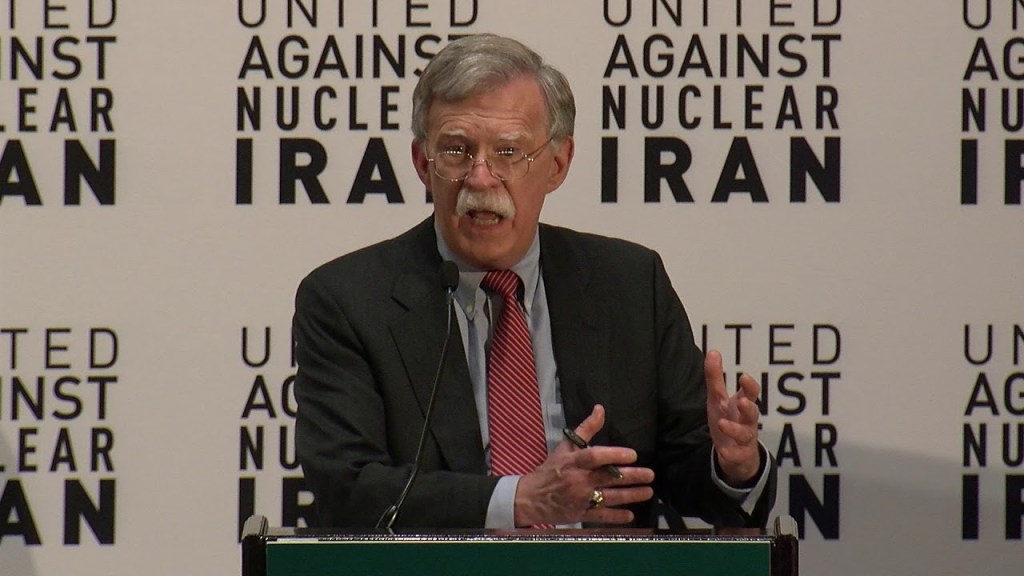
In the wake of Hamas’ October 7 assault, arch-neoconservative official John Bolton was invited on CNN, where he claimed that what we witnessed was really an “Iranian attack on Israel using Hamas as a surrogate” and that the U.S. must immediately respond. When asked whether he had any evidence, given the implications of what he was saying, he shrugged and replied, “This is not a court of law.”

On December 28, Bolton doubled down on his hawkish stance, writing in the pages of Britain’s Daily Telegraph that “The West may now have no option but to attack Iran” – a position he has held for at least a decade.

Meanwhile, in an interview with Saudi state-funded broadcaster Iran International, senior Bush official Mark Wallace bellowed that, “This is Iran’s work. Iran will suffer at the hands of retribution and will suffer the consequences of supporting this terror group and its horrific attack on Israel.” Wallace continued:

No civilized country wants further conflict. But the Iranians are forcing the civilized world’s hand. And you will see a dramatic response soon as the United States, Israel, and our allies begin to position assets around the world in preparation.”

If there was any doubt as to what sort of “dramatic response” Wallace wanted to see, he added a message to Iran’s Islamic Revolutionary Guard Corps: “I look forward to seeing you hanged from the end of one of your own ropes.”

Iran was recently the victim of a deadly terrorist attack. As mourners commemorated the U.S. assassination of Qassem Soleimani, two bombs exploded, killing 91 and injuring hundreds more. In this context, it was understandable why Iranian officials pointed the finger at the U.S. and Israel.

Warmongers, Inc

What these individuals all have in common is that they are board members of United Against Nuclear Iran (UANI), a shadowy but influential organization dedicated to pushing the West toward a military confrontation with the Islamic Republic.

Founded in 2008, the group is led by neoconservative hawks and has close ties to both U.S. and Israeli intelligence. It does not divulge where it receives its copious funding. However, it is known that right-wing Israeli-American billionaire Sheldon Adelson was a source. There is strong circumstantial evidence that Gulf dictatorships may also be bankrolling the group, although UANI has strongly denied this. In 2019, Iran designated UANI as a terrorist organization.

When asked by MintPress what he made of UANI’s recent statements, Eli Clifton, one of the few investigative journalists to have covered the group, said, “It’s very consistent with the positions and advocacy that the organization has taken since its inception.” Adding,

United Against Nuclear Iran does not miss an opportunity to try to bring the United States closer to a military conflict with Iran. And on the other side of the equation, they also have worked very hard to oppose efforts to de-escalate the U.S.-Iran relationship.”

UANI’s board is a who’s who of high state, military and intelligence officials from around the Western world. Among its more notable members include:

  • CEO Mark Wallace, former U.S. Ambassador to the United Nations and deputy campaign manager for George W. Bush’s 2004 reelection.
  • Chairman Joe Lieberman, former senator and Democratic vice-presidential nominee for the 2000 election.
  • Tamir Pardo, Director of the Mossad, 2011-2016.
  • Dennis Ross, former State Department Director of Policy Planning and former Middle East Envoy under George H. W. Bush and Bill Clinton.
  • Field Marshall Lord Charles Guthrie, ex-Chief of Staff of the U.K. Armed Forces.
  • Jeb Bush, former Governor of Florida.
  • August Hanning, President of the German Federal Intelligence Service (BND), 1998-2005; State Secretary at the Federal Interior Ministry, 2005-2009.
  • Zohar Palti, former head of the Political-Military Bureau, Israeli Ministry of Defense; former Director of Intelligence of the Mossad.
  • Frances Townsend, Homeland Security Advisor to President George W. Bush.
  • John Bolton, former U.S. National Security Advisor and former U.S. Ambassador to the U.N.
  • Roger Noriega, former Assistant Secretary of State for Western Hemisphere Affairs and Ambassador to the Organization of American States.
  • Otto Reich, former Assistant Secretary of State for Western Hemisphere Affairs and architect of the 2002 U.S. coup against Venezuela.
  • Michael Singh, White House Senior Director for Near East and North African Affairs, 2007-2008.
  • Giulio Terzi di Sant-Agata, former Italian Foreign Minister.
  • Robert Hill, former Minister of Defense of Australia.
  • Jack David, Deputy Assistant Secretary of Defense for Combating Weapons of Mass Destruction, 2004-2006.
  • Mark Kirk, U.S. Senator for Illinois, 2010-2017.
  • Lt. Gen. Sir Graeme Lamb, ex-Director of U.K. Special Forces and Commander of the British Field Army.
  • Norman Roule, former CIA Division Chief and National Intelligence Manager for Iran at the Director of National Intelligence.
  • Irwin Cotler, Canadian Minister of Justice and Attorney General, 2003-2006.
  • Baroness Pauline Neville-Jones, U.K. Minister of State for Security and Counter Terrorism, 2010-2011.

In addition, notable former board members include ex-CIA Director R. James Woolsey; head of Mossad between 2002 and 2011, Meir Dagan; and one-time chief of British spy agency MI6, Sir Richard Dearlove.

For 15 years, UANI has organized conferences, published reports, and lobbied politicians and governments, all with one goal: pushing a neoconservative line on Iran. “UANI are a force multiplier. They provide at least the veneer of an intellectual infrastructure for the Iran hawk movement. They did not invent being hawkish on Iran, but they sure made it a heck of a lot easier,” Ben Freeman, Director of the Democratizing Foreign Policy Program at the Quincy Institute, told MintPress.

Conflicts and Conflicts of Interest

For such a large, well-financed, and influential organization filled with senior officials, United Against Nuclear Iran keeps its funding sources very quiet. However, in 2015, Clifton was able to obtain a UANI donor list for the 2013 financial year. By far and away, the largest funders were billionaire New York-based investor Thomas Kaplan and multibillionaire Israeli-American casino mogul Sheldon Adelson.

Kaplan, whose $843,000 donation supplied around half the group’s 2013 funding, is a venture capitalist investor concentrating on metals, particularly gold. He is the chairman of Tigris Financial and the Electrum Group LLC. Both of Kaplan’s firms employ UANI CEO Mark Wallace as CEO and COO, respectively.

A 2010 Wall Street Journal article titled “Tigris Financial Goes All-in on Gold” noted that the company had bet billions of dollars on the price of gold rising, more than the reserves of the Brazilian central bank. As Clifton has noted, both Kaplan and Wallace have marketed gold to clients as the perfect commodity to hold if there is increased instability in the Middle East. Therefore, both Kaplan and Wallace stand to make massive sums if the U.S. or Israel were to attack Iran, making their UANI warmongering a gigantic and potentially profitable conflict of interest.

Adelson provided the majority of the rest of UANI’s funding. The world’s 18th-richest individual at the time of his 2021 death, the tycoon turned his economic empire into a political one, supporting ultraconservative causes in both the United States and Israel. Between 2010 and 2020, he and his wife donated more than $500 million to the Republican Party, becoming GOP kingmakers in the process. He would often vet Republican presidential candidates at his casino in Las Vegas, and it was often said that this “Adelson Primary” was almost as important as the public one.

An ardent Zionist, Adelson bankrolled numerous pro-Israel lobby projects, such as AIPAC, One Jerusalem and Taglit Birthright. He also owned Israel Hayom, the country’s most-read newspaper, with 31% of the national share. Relentlessly pro-Netanyahu, it was said that the Israeli prime minister asked his friend Adelson to set up a newspaper to help his political career.

Adelson and his influence have been one of the driving forces of American hostility towards Iran. In 2013, during a conversation with Rabbi Shmuley Boteach, he called for the United States to stop negotiating and drop a nuclear bomb on Iran to show that “we mean business.”

A potential third, even more controversial, source of funding is the Gulf monarchies of Saudi Arabia and the UAE. Leaked emails show UANI officials soliciting support from the Emirati royal family. Both Mark Wallace and Frances Townsend, for example, emailed the Emirati Ambassador to the U.S. detailing cost estimates for upcoming events and inquiring about support from the UAE.

Thomas Kaplan himself is extraordinarily close to the nation. “The country and the leadership of the UAE, I would say, are my closest partners in more facets of my life than anyone else other than my wife,” he told the Emirati outlet, The National News, which also detailed his friendship with Crown Prince of Abu Dhabi, Sheikh Mohamed bin Zayed.

Putting Iran in the Crosshairs

One of United Against Nuclear Iran’s primary activities, Iranian political commenter Ali Alizadeh told MintPress, is to create a worldwide “culture of fear and anxiety for investing in Iran.” The group attempts to persuade businesses to divest from the Islamic Republic and sign their certification pledge, which reads as follows:

The undersigned [Name], the [Title] of [Company] (the “Company”), does hereby certify on behalf of the Company that until the Iranian regime verifiably abandons its drive for nuclear weapons, support for terrorism, routine human rights violations, hostage-taking, and rampant anti-Americanism as state policy, that neither the Company nor any subsidiary or affiliate of the Company, directly or through an agent, representative or intermediary.”

One corporation that UANI targeted was the industrial machinery firm Caterpillar. UANI hectored the firm, even erecting a roadside billboard outside its headquarters in Peoria, IL, insinuating that they were aiding Iran in constructing a nuclear weapon. Caterpillar quickly ordered its Iran projects terminated. Wallace took heart from his group’s victory and warned that other businesses would be targeted.

These have included French companies such as Airbus and ​​Peugeot-Citroen, who were threatened with legal action. In 2019, UANI earned an official rebuke from the Russian Foreign Ministry for attempting to intimidate Russian corporations trading with Tehran. “We think such actions are unacceptable and deeply concerning,” said Foreign Ministry spokesperson Maria Zakharova. “Attempts to pressure and threaten Russian business … are a follow-up on the dishonorable anti-Iranian cause by the U.S. administration,” she added, hinting at collusion between the government and the supposedly non-governmental organization.

Some of UANI’s campaigns have been markedly petty, including pressuring New York City hotels to cancel bookings with Iranian officials (including then-President Mahmoud Ahmadinejad) visiting the city on United Nations business. Others, however, have been devastating to the Iranian economy, such as the SWIFT international money transfer terminating its relationship with Tehran, cutting the country off from the global banking system.

On UANI’s actions against businesses, Freeman said: “It’s effective, and (in some cases, at least) it’s to the detriment of the people of Iran; it’s to the detriment of these companies; and it’s to the detriment of peace in the region.”

While the group presents itself as against a nuclear Iran, UANI was strangely opposed to the Joint Comprehensive Plan of Action (JCPOA) – the deal between Iran and the West that limited the former’s nuclear technology research in exchange for sanctions relief from the latter. As MintPress reported at the time, UANI spent millions on T.V. advertisements trashing the agreement. As Wallace noted, “We have a multi-million-dollar budget, and we are in it for the long haul. Money continues to pour in.”

After the JCPOA was signed, UANI hosted a summit attended by senior Israeli, Emirati, and Bahraini officials, touting its failures. Once UANI’s John Bolton was named Donald Trump’s National Security Advisor, he persuaded the president to withdraw entirely from the deal. Bolton has deep connections to the Mojahedin-e-Khalq (MEK), an exiled Iranian political group widely identified as a terrorist organization. He has, for some time, considered them a government in waiting after the U.S. overthrows the current administration. “Before 2019, we will celebrate in Tehran,” he told the group in 2018, predicting that, with him at the helm, the Trump administration would soon cause the downfall of the Iranian government.

Bolton has long been a hardliner on regime change. “To stop Iran’s bomb, bomb Iran,” read the title of his 2015 New York Times op-ed. Yet this appears to be the dominant position at UANI. In March, Ross published an article in The Atlantic headlined “Iran needs to believe America’s threat,” which demanded that the U.S. “take forceful action to check Tehran’s progress toward a nuclear bomb.” Failure to do so, Ross claimed, would provoke Israel to do so itself – a “much more dangerous scenario,” according to him. Yet only two years previously, Ross called on the U.S. to “give Israel a big bomb” to “deter Iran,” noting that the “best way” to stop the Iranian nuclear program was to supply Israel with its own nukes, thereby taken as a given that Iran was indeed pursuing nuclear weapons itself (a highly questionable claim at the time) and ignoring Israel’s already existing 200+ stockpile of nuclear missiles.

“It doesn’t seem like UANI ever really took seriously the possibility of a diplomatic means to constrain Iran from continuing to increase its enrichment levels and moving towards a nuclear weapon,” Clifton told MintPress. “As a matter of fact, they generally fought tooth and nail against the JCPOA. They are eager to push the United States toward confrontation with Iran using the possibility of Iranian nuclear weapons as a reason,” he added.

Intelligence Connections

That UANI is headed by so many state, military and intelligence leaders begs the question: to what extent is this really a non-governmental organization? “That is one of the dirty secrets of think tanks: they are very often holding tanks for government officials,” Freeman said, adding:

The Trump folks all had to leave office when Biden won, so a lot of them ended up in think tanks for a while, four years, let’s say. And if Trump wins again, they will bounce back into government. And the same is true of Democratic administrations, too.”

The U.S. government also clearly has a longstanding policy of outsourcing much of its work to “private” groups in order to avoid further scrutiny. Many of the CIA’s most controversial activities, for example, have been farmed out to the National Endowment for Democracy (NED), a technically non-governmental organization funded entirely by Washington and staffed with ex-state officials. In recent years, the NED has funneled millions of dollars to protest leaders in Hong Kong, organized an attempted color revolution in Cuba, organized anti-government rock concerts in Venezuela, and propped up dozens of media organizations in Ukraine.

These sorts of institutions blur the line between public and private sectors. But a 2014 legal case raises even more questions about UANI’s connections to the U.S. government. After UANI accused Greek shipping magnate Victor Restis of working with the Iranian government, he sued them for libel. In an unprecedented move for what was a private, commercial lawsuit, Attorney General Eric Holder intervened in the lawsuit, ordering the judge to shut the case down on the grounds that, if it continued, it would expose key U.S. national security secrets. The case was immediately dropped without explanation.

In the past, when the Justice Department has invoked state secrets, a high-ranking state official has offered a public statement as to why. Yet, this time, nothing was offered. Reporters at the time speculated that much of the material Restis wanted to make public was possibly given to UANI by either the CIA or Mossad, which would have revealed a network of collusion between state intelligence agencies and a supposedly independent, private non-profit. Given the glut of ex-Mossad and CIA chiefs at UANI, this speculation is perhaps not as wild as it might seem.

UANI’s funders certainly also have extensive connections to Israel. Kaplan is the son-in-law of Israeli billionaire Leon Recanati and is said to be close with Prime Ministers Naftali Bennet and Yair Lapid. He has also employed a number of Israeli officials at his businesses. An example of this is Olivia Blechner, who, in 2007, left her role as the Director of Academic Affairs at the Israeli Consulate General in New York to become Executive Vice-President of Investor Relations and Research at Kaplan’s Electrum Group – a rather perplexing career move.

Adelson, meanwhile, was given what amounted to an official state funeral in Israel, one that even Prime Minister Netanyahu attended. He was buried on the Mount of Olives in Jerusalem – one of the holiest sites in Judaism and an honor that very few figures receive.

A Network of Regime Change Groups

While United Against Nuclear Iran is already a notable enough organization, it is actually merely part of a large group of shadowy non-governmental groups working to cause unrest and, ultimately, regime change in Iran. These groups all share overlapping goals, funders and key individuals.

One example of this is the Counter Extremism Project (CEP), a non-profit that purports to exist to “combat the growing threat posed by extremist ideologies.” Yet the group focuses largely on Islamist extremism – and only those groups that are enemies of the U.S., Israel and the Gulf Monarchies (about whose extremism and violence the CEP has nothing to say). Ten members of the CEP’s leadership council are also on UANI’s board, including Wallace, who is CEO of both organizations.

Another group headed by Wallace is the Jewish Committee to Support Women Life Freedom in Iran. This organization claims to be focused on improving women’s rights in Iran. It very quickly, however, divulges that this is a vehicle for regime change. On its homepage, for example, it writes:

These freedom fighters continue with no sign of relenting on their calls for regime change. Calls for “Woman Life Freedom” and the removal of Supreme Leader Ayatollah Ali Khamenei echo from rooftops, down street corridors, across campus hallways, and on government billboards. These brave Iranians have expressed their hatred for the ruling clerics not only in their words, but in their actions.”

Seven members of the Jewish Committee to Support Women Life Freedom in Iran’s steering group – including Wallace and Kaplan – also lead UANI.

Mike Wallace, second from right, poses with prominent anti-Iran figures at a lobbying event in Italy, February 2023. Photo | Twitter

Kaplan is well-known as a conservationist. However, his group, Panthera, which works to preserve the world’s 40 known species of big cats, has also been accused of being a secret regime change operation. Panthera has a number of UANI officials on its board or conservation council, including Wallace and Lamb (the ex-director of U.K. Special Forces and Commander of the British Army). Also on the council are Itzhak Dar, former Director of the Israeli Secret Service, Shin Bet, and General David Petraeus, former CIA Director and Commander of the U.S. invasion of Afghanistan.

In 2018, Iranian authorities arrested eight individuals working with Panthera inside the country. All eight were convicted of spying on behalf of the U.S. and Israel. While many in the West decried the trials as politically motivated, any organization led by these figures is bound to cause suspicions.

This is especially the case as Wallace is also a founder of PaykanArtCar, an organization that attempts to use art to, in its words, “advocate for the restoration of human rights and dignity for all in Iran.” All three team members of PaykanArtCar also work at UANI.

The final group in this Iran regime change network is the International Convention for the Future of Iran. Set up by Wallace himself, the organization’s website explains that it exists to “end the repression of the regime and bring true change to Iran.” Further purposes are to “connect the Iranian opposition in exile [i.e., the MEK] with policymakers in the United States and internationally” and to “offer program grants and technical support” to groups working to overthrow the government. However, judging by the lack of updates and the group’s Twitter profile having only 31 followers, it appears that it has not had much success achieving its goals.

In short, then, there exists a network of American NGOs with the mission statements of helping Iran, opposing Iran, preserving Iran, and bombing Iran, all staffed by largely the same ex-U.S. government officials.

Iran, however, is not the only target in Wallace’s sights. It appears that he is also trying to give Turkey similar treatment. Wallace is the CEO of the Turkish Democracy Project, a non-profit established to oppose the rule of President Recep Tayyip Erdoğan, who, it says, has “dramatically altered Turkey’s position in the international community and its status as a free and liberal democracy.” The Turkish Democracy Project denounces what it calls Erdoğan’s “destabilizing actions in and beyond the region, his systemic corruption, support for extremism, and disregard for democracy and human rights.” There are no Turkish people among the Turkish Democracy Project’s leadership. But there are seven UANI board members at the top, calling the shots.

A Lesson From History

The history of Iran has been intimately intertwined with the United States since at least 1953 when Washington orchestrated a successful coup against Prime Minister Mohammad Mosaddegh. Mosaddegh had refused U.S. demands to stamp out Communist influences in his country and had nationalized the nation’s oil. The U.S. installed Shah Mohammad Reza Pahlavi as a puppet ruler. An unpopular and authoritarian ruler, the Shah was overthrown in the Revolution of 1979. Since then, it has become a target for regime change, and its nuclear program is something of an obsession in the West.

Often orchestrated by UANI officials while they were in government, the U.S. has carried out a sustained economic war against Tehran, attempting to collapse its economy. American sanctions have severely hurt Iran’s ability to both buy and sell goods on the open market and have harmed the value of the Iranian rial. As prices and inflation rose rapidly, ordinary people lost their savings.

During the COVID-19 pandemic, the U.S. turned the screw once again, intimidating both businesses and nations into refusing to sell Tehran vital medical supplies. Eventually, the World Health Organization stepped in and directly supplied it with provisions – a factor in the Trump administration’s decision to pull out of the agency.

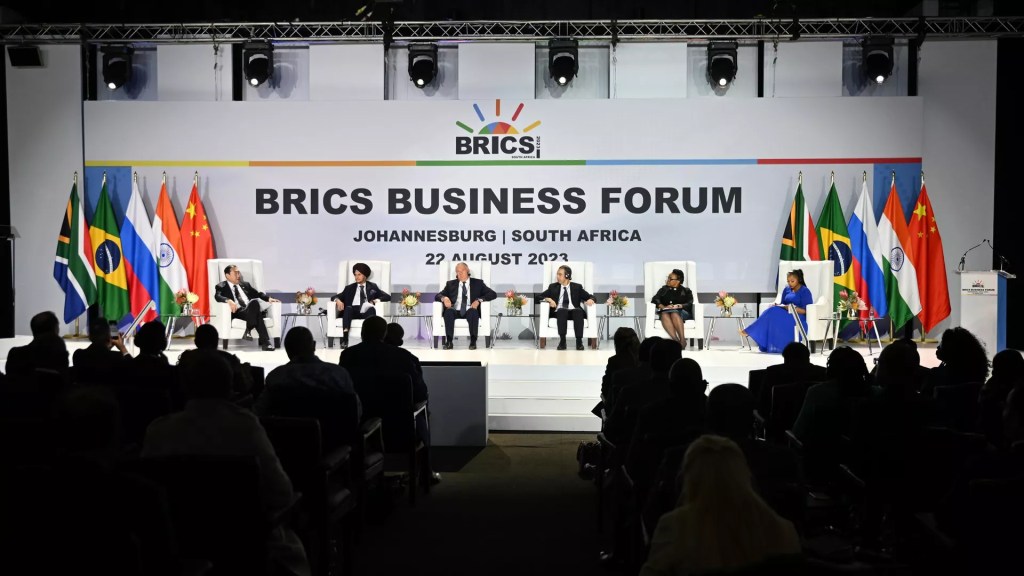
While U.S. actions have severely harmed the Iranian economy, a future bright spot may come in the form of BRICS, the economic bloc that Iran – along with Egypt, Ethiopia, Saudi Arabia, and the UAE – joined on January 1. American economic power on the global stage appears to be waning. However, This new reality might spur Washington policymakers to reconsider a military option, as UANI desperately wants them to.

It is perfectly reasonable to be worried about Iran – or any country, for that matter – developing atomic bombs. Nuclear weapons pose an existential threat to human civilization, and more actors with access to them increase the likelihood of a devastating confrontation. Already in the region, India, Pakistan, Israel and Russia possess them. But it is only the United States that has ever used them in anger, dropping two on Japan and coming close to doing so in China, Korea and Vietnam. And given the U.S.’ recent track record of attacking countries that do not possess weapons of mass destruction (e.g., Iraq, Libya, Afghanistan) and not touching those who do (such as North Korea), it is entirely understandable why Iran might want one. As Freeman said:

I certainly do not want Iran to get a nuclear weapon. But at the same time, you can also believe that it would be catastrophic if the U.S. were to engage in a war with Iran…And the concern with groups like UANI is that they are taking that [the worry of Iran getting a nuclear weapon] and pushing that argument to a point where it might lead to an active conflict.”

The slaughter in Gaza has been horrifying enough. More than 22,000 people have been killed in the Israeli invasion, and a further 1.9 million displaced. Israel is also simultaneously bombing the West Bank, Syria and Lebanon. The U.S. is facilitating this, sending billions of dollars in weaponry, pledging iron-clad political support to Israel, silencing critics of its actions, and vetoing United Nations resolutions.

But United Against Nuclear Iran is eager to escalate the situation to a vastly greater level, urging Washington to attack a well-armed country of nearly 90 million people, erroneously claiming that Iran is behind every Hamas or Hezbollah action. “This is not a nuclear non-proliferation organization” Clifton said, noting that there are plenty of genuine already existing peace and environmental groups worried about nuclear weapons that either supported the JCPOA or said it did not go far enough. “Their focus is more on working towards regime change in Iran rather than actually supporting efforts that might prevent Iranian nuclear weapons,” he added.

IF UANI gets its way, a conflict with Iran might spark a Third World War. And yet they are receiving virtually no pushback to their ultra-hawkish pronouncements, largely because they operate in the shadows and receive virtually no public scrutiny. It is, therefore, imperative for all those who value peace to quickly change that and expose the organization for what it is.

Fake Intellectuals Working For Think Tanks Funded By the Arms Industry Are Driving Support For War After War After War

By Jeremy Kuzmarov

Source: Covert Action

A few days after the October 7 attacks in northern Israel, The Atlantic Council ran an inflammatory article on its website by Jonathan Panikoff, a former deputy national intelligence officer, entitled “It doesn’t matter whether Iran planned the Hamas attack—Tehran is still to blame.”[1]

The article referenced a Wall Street Journal article that claimed unfoundedly that Iran was responsible for planning the attacks, and expressed belief that even if Iran didn’t directly plan it, Iran was still responsible because it had supported Hamas in the past.

The article went on to support an aggressive military response by the U.S. and Israel that could potentially entail bombing Iran. The latter was a long-held dream of neoconservatives who have wanted to overthrow the regime of the Ayatollahs since it took over from the Shah, a U.S. and Israeli client, in a 1979 revolution.

Glenn Diesen, The Think Tank Racket: Managing the Information War With Russia (Clarity Press, 2023) looks at the influence of think tanks like The Atlantic Council in driving gargantuan U.S. military budgets and endless wars that have no end in sight.

The Atlantic Council has been particularly hawkish with regards to Russia, helping to fuel a proxy war between the U.S. and Russia in Ukraine that has decimated a generation of Ukrainian and Russian youth and left us on the threshold of World War III.

Diesen is an associate professor at the University of Southeast Norway and an associate editor of the journal Russia in Global Affairs.

His book emphasizes the undue influence that think tank pseudo-intellectuals play because of their ubiquitous presence in the mainstream media as well as academia and because of their authorship of policy reports that often guide government policy.

Rather than being even-handed or in any way objective in their analysis, the think tank fellows follow a preordained narrative.

According to Diesen, their job is to manufacture consent for the goals of their paymasters—weapons manufacturers and oil companies who profit off of war along with foreign governments courting more U.S. military aid.

Diesen writes that “think-tanks have become a symptom of hyper-capitalism in which all aspects of society have become an appendage to the market. Even political influence is regulated by the free-market, in which think tanks are an important component.”

Diesen notes that a brilliant achievement of propaganda has been to convince the population that propaganda is only an instrument of authoritarian states—that the U.S. is supposedly combating—and not liberal democracies.

The think tanks help condition the public to fear foreign threats and support wars of aggression under the veneer of providing independent expert analysis.

Paul Craig Roberts, the Assistant Secretary of the Treasury for Economic Policy under Ronald Reagan, has called The Atlantic Council the “marketing arm of the military-security complex,” while Diesen calls it “NATO’s Propaganda Wing.”

The Atlantic Council’s financial report from 2019/2020 reveals that it received over $1 million from the United Arab Emirates (UAE), according to Diesen. It also received major contributions from the British Foreign and Commonwealth Office, Facebook, Goldman Sachs, The Rockefeller Foundation, the National Endowment for Democracy (NED), U.S. State Department, a Saudi oil billionaire (Bahaa Hariri), Ukrainian oligarch Viktor Pinchuk, Crescent Petroleum, and Burisma, an energy company owned by Ukrainian oligarchs which appointed Hunter Biden to its board along with former CIA counter-terrorism director Cofer Black.

The Atlantic Council’s close ties to the CIA were further evident when its former executive vice-president, Damon Wilson, was appointed CEO of the NED, a CIA offshoot that promotes propaganda and supports dissidents in countries whose governments have been targeted by the U.S. for regime change.

Former CIA Director James R. Woolsey is listed as a lifetime director of the Atlantic Council, while former CIA Directors Leon Panetta, Robert Gates and David Petraeus are listed on its Board, along with such war criminals as Henry Kissinger, and Condeleezza Rice.

Over the past decade, the Atlantic Council has published countless reports on Russia’s kleptocracy and disinformation being spread allegedly by Vladimir Putin, and has hosted anti-Russian dissidents and Belarusian opposition figures such as Svetlana Tikhanovskaya, who called for more aggressive intervention by the U.S. in Belarusian politics

One of The Atlantic Council’s fellows, Michael Weiss, spreads his anti-Russia invective as an editor at the popular online media outlet, The Daily Beast. He helps run a neo-McCarthyite website, PropOrNot that promotes the worst kind of fear mongering imaginable, attacking independent media outlets, including the Ron Paul Institute, for allegedly advancing Russian propaganda.

In 2015, the Atlantic Council helped prepare a proposal for arming the Ukrainian military with offensive weaponry like Javelin anti-tank missiles—the same year that it presented its Distinguished Leadership Award to Marillyn Adams Hewson, then the CEO of Lockheed Martin, which produces Javelin missiles and many other lethal weapons.

Since the commencement of Russia’s special military operation in Ukraine, The Atlantic Council has doubled down on its long-standing Russophobia, calling for bombing Russia and starting World War III.

Last February, Matthew Kroenig, the Deputy Director of the Atlantic Council’s Scowcroft Center for Strategy and Security, argued for consideration of the U.S. preemptive use of ’tactical’ nuclear weapons.[2] This would not only kill thousands of people directly but likely cause what scientists characterize as a “nuclear winter” by injecting so much smoke and debris into the air that it will block sunlight and cause a precipitous drop in global temperatures, affecting food production across the globe.

Triggering New Cold and Hot Wars

The Atlantic Council’s support for war with Russia is characteristic of think tanks which played a crucial role in pushing the decision to expand NATO after the Cold War.

George F. Kennan and other foreign policy experts had warned against this because NATO was perceived as a hostile military alliance by Russia and it would undermine new European security initiatives involving Russia. Vietnam War architect Robert S. McNamara at the time also called for a new “peace dividend” by which the U.S. would reduce its military budget and address social needs with taxpayer dollars.

The overriding imperative of the weapons industry, however, was to revitalize cold war thinking to ensure continuously high military budgets and the expansion of NATO and the think-tanks were enlisted to fulfill that end.

Diesen points out that the Brookings Institute, one of the oldest American think tanks, played an instrumental role in the Russia Gate hoax, which greatly contributed to the spread of Russophobia underlying the U.S. proxy war against Russia in Ukraine.

A primary researcher and contributor to the Steele dossier, the seminal document in Russia Gate which spread false information about Donald Trump being blackmailed because of an alleged encounter with Russian prostitutes, was an employee of the Brookings Institute named Igor Danchenko, who was indicted by Special Counsel John Durham for lying to the FBI.

Working under Fiona Hill, a senior fellow at the Brookings Institute and renowned anti-Russian hawk, Danchenko claimed to have accrued incriminating information against Trump from a meeting with Russian-American Chamber of Commerce President Sergey Millian, who said that this meeting never actually took place.[3]

The Atlantic Council was another false purveyor of Russia Gate whose revenues increased tenfold from 2006-2016 when it began demonizing Vladimir Putin and smearing politicians like Tulsi Gabbard who advocated for cooperative diplomacy between the U.S. and Russia.

Leaving out the fact that Putin revitalized Russia’s economy after the failed privatization and shock therapy initiatives of the 1990s, The Atlantic Council made people believe that Putin invaded Ukraine on a whim and would destabilize all of Europe if he was not stopped.

This kind of analysis obscures the true origins of the conflict in Ukraine and the Western role in supporting NATO expansion and a 2014 coup against Ukraine’s legally elected government led by Viktor Yanukovych, which led to the outbreak of civil war.

The Atlantic Council continues today along with other think-tanks to whitewash Ukrainian war crimes, corruption and close ties with the far-right and neo-Nazis.

Michael McFaul of the Hoover Institute even celebrates Ukrainian President Volodymyr Zelensky’s crackdown on opposition politicians and media, while hypocritically framing the struggle against Russia as one of authoritarianism versus democracy.

McFaul and others have made clear that a primary U.S. foreign policy goal is to try and delink Ukraine and the rest of Europe from Russia while expanding U.S. natural gas sales in Europe.

In 2019, the RAND Corporation, the think tank of the intelligence agencies, issued a report calling for threatening NATO expansion and the arming of Ukraine in order to draw Russia into a conflict that would facilitate its overextension militarily and economically and cause the Russian government to lose domestic and international support.

The same report advocated for intensifying the ideological and information war against Russia to weaken the legitimacy and stability of its government, and voiced support for the anti-corruption crusade of opposition leader Alexei Navalny, whom Diesen identifies as a British intelligence asset supportive of policies designed to weaken the Russian Federation.

RAND earlier had advocated for provoking civil war within Syria through covert action and informational warfare and by capitalizing on the sustained Shia-Sunni conflict in order to undermine the nationalist Assad regime and draw Russia into the conflict there.

RAND also advocated for the destabilization of the Caucuses in order to cause a fissure between Russia and its traditional ally, Armenia, hence weakening Russia.

This latter goal was achieved when Armenia’s Prime Minister Nikol Pashinyan expressed no-confidence in Russia’s ability to protect it after Azerbaijan—heavily armed by the U.S. and Israel—invaded the Armenian enclave of Nagorno-Karabakh.

RAND had also issued policy recommendations for reducing Russian influence in Moldova and undercutting Russian trade with Central Asia and promoted regime change in Belarus to destabilize a Russian ally and alter the country’s orientation westward.

Following this prescription, the NED and other U.S. agencies provoked an uprising in 2020 against Belarus’ socialist leader Alexander Lukashenko, who was demonized in western media though he helped curb inequality and poverty considerably while resisting the rapid privatization initiatives carried out by other post-Soviet leaders.

CNAS and Team Biden

One of the most influential think tanks today is the Center For a New American Security (CNAS), which received huge sums from oil companies like Chevron and BP, financial giants like Bank of America, and J.P. Morgan Chase, and Amazon and Google from Big Tech.

CNAS’s former CEO, Victoria Nuland, was a former adviser to Dick Cheney and a key architect behind the 2014 coup in Ukraine.[4]

CNAS’ founder, Michèle Flournoy, was a board member of the defense contractor Booz Allen Hamilton who as the Under Secretary of Defense for Policy helped develop counterinsurgency policy for Afghanistan and contributed to convincing Barack Obama to invade Libya. More recently, she has advocated for an aggressive military buildup in the South China Sea to counter a rising China.

When Joe Biden became president, at least 16 CNAS alumni were selected for foreign policy positions. CNAS had pushed heavily for making Kamala Harris Vice President as her foreign policy team consisted of an army of CNAS think-tankers—including Flournoy.

The appointment of CNAS alumni to prestigious positions and their lobbying influence epitomizes the so-called revolving door in which high level White House and Pentagon officials who serve corporate-military interests while in power are rewarded with lucrative paying jobs in which they continue to serve the same underlying interests.

Diesen emphasizes at the end of his book that think tanks in the modern U.S. have helped to subvert democracy and obstruct U.S. foreign policy in the interests of wealthy corporations that profit from endless wars. He sees as a solution more public disclosures about the sources of think tank funding and public pressures that could help reduce their influence.

Another more radical solution is a socialist revolution that would result in the nationalization of the weapons industry, taking profit out of war, and reorganizing research, development and production toward fulfilling human needs.


  1. Panikoff is the Atlantic Council’s Director of the Scowcroft Middle East Security Initiative. 
  2. In John Bellamy Foster, John Ross, and Deborah Veneziale, Washington’s New Cold War: A Socialist Perspective (New York: Monthly Review Press, 2023), 42. 
  3. The New Knowledge think-tank fabricated a story of Russian interference in the 2017 Alabama state election with the intent of causing the defeat of Republican candidate Roy Moore. 
  4. Nuland was also a fellow at the Brookings Institute. 

Righting a wrong: Burying decades of US-led wars

Today’s global conflicts – whether in Eastern Europe, West Asia, or East Asia – are spawned by a fading US hegemon desperately clinging to power.

By Mohamad Hasan Sweidan

Source: The Cradle

“One era is ending, a new one is beginning, and the decisions that we make now will shape the future for decades to come.”

With these words, US Secretary of State Antony Blinken defined the “turning point” of the American era, the transition from one world order to another. 

“In this pivotal time, America’s global leadership is not a burden. It’s a necessity to safeguard our freedom, our democracy, and our security,” Blinken said in his address to the Johns Hopkins School of Advanced International Studies (SAIS) in September. 

Official US documents, including last year’s National Security Strategy, underscore Washington’s conviction that waiting is a luxury it cannot afford; that it “will act decisively” to maintain its global leadership. As such, the US involvement in conflicts in Ukraine and Gaza, as well as the militarization in Southeast Asia, must be seen through this lens of international dynamics.

Broadly, tensions in Africa and Asia are interconnected with the west’s frenzied initiatives to maintain a dominant position and decisive role in the new multipolar order.

From Eastern Europe to West Asia 

Since the outbreak of war in Ukraine, the US has strategically tied its support for Kyiv to the defense of the “rules-based order.”

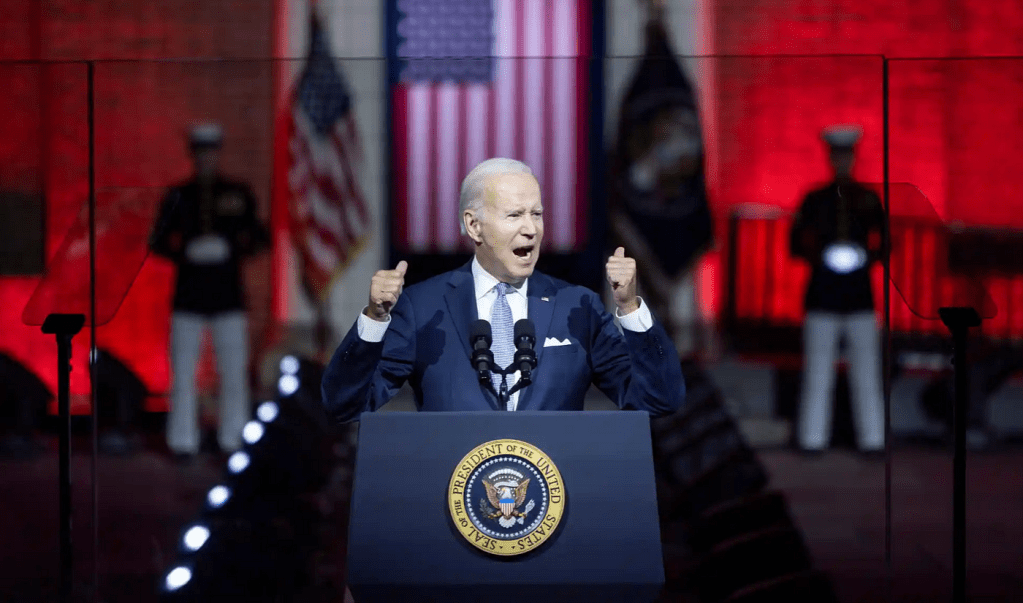
With clichéd sound bites, President Joe Biden characterized the conflict as “a battle between democracy and autocracy, between liberty and repression, between a rules-based order and one governed by brute force.”

Many Atlanticist leaders echo the sentiment that unwavering support for Ukraine aims to deter Russia from challenging a world order where the west holds sway.

Most prominently, German Chancellor Olaf Scholz articulated this perspective in his Foreign Affairs article published in early 2023 titled The Global Zeitenwende, (“an epochal tectonic shift”) in which he posits that Russian President Vladimir Putin is challenging a world order where Washington is a decisive power.

Scholz emphasizes the need for collective action by those who believe in a rules-based world order, even cooperating with countries that do not embrace democratic institutions but endorse the US-led principles for global governance. That western rules-based paradigm, it should be noted, is one in which international law and the UN Charter have long been discarded in favor of power and advantage.

Today, those dueling visions are playing out in the Ukraine war: a confrontation between the west seeking to maintain its global superiority and Russia striving to disrupt this dominance. Moscow’s rationale for the war is to prevent NATO from expanding to Russia’s borders, as confirmed by the western military alliance’s Secretary-General Jens Stoltenberg.

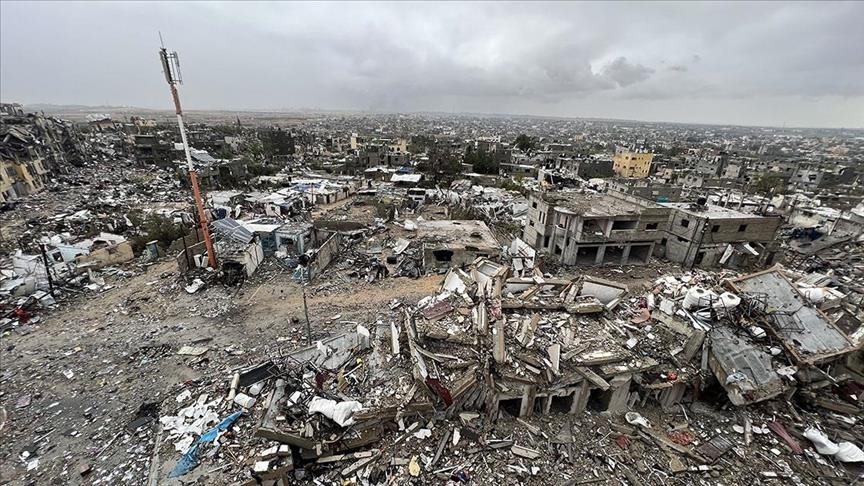
Similarly, the war in Gaza must be seen through this international lens, with Israel representing western interests in West Asia and any harm to the occupation state viewed inherently as a blow to US influence in the region. 

As Washington stands at this crucial turning point, according to Blinken, the cost of a blow to Israel is deemed too high, underscoring the resolute US defense of its global influence in the devastated towns and cities of Gaza.

Neo-colonial maneuvers

There are important nuances between these two US-backed wars, however: Ukraine is seen as a tool used by Washington to achieve its interests, while Israel is considered an American interest in itself. That Biden once famously asserted that the US would need to create an Israel if it did not exist illustrates its status as a neo-colonial outpost, protecting western interests in the region. 

This also explains the noticeable shift in US interest away from Eastern Europe to West Asia after the Palestinian resistance breached the occupied territories on 7 October to target military personnel and take prisoners. The deliberate shift of American attention from one war zone to the other was neatly exemplified by the Washington Post’s swift removal of the ‘War in Ukraine’ tab from its homepage. 

As previously mentioned by The Cradle, “Israel’s ongoing war on the Gaza Strip is best understood to be a US-backed one,” one that is being fought to safeguard US influence and interests in West Asia. However, the maneuvering room for Washington’s allies is shrinking dramatically. Unlike the diverse strategic options West Asian countries explored during the Ukraine war, Gaza offers no such latitude. It is fundamentally Washington’s war, demanding collective mobilization to defend the US position.

It is also telling that the US-led multination task force, Operation Guardian of Prosperity in the Red Sea, is already facing major set-backs since its recent inception, with some members pulling out and others choosing to remain unnamed.

White House National Security Council Strategic Communications Coordinator John Kirby had to awkwardly caveat the secrecy like this: “There are some countries that have agreed to participate and be part of the operation in the Red Sea, but they have to decide how much they want that to be public. And I’m going to leave it to them so that they can describe it somehow, because not everyone wants to be public.”

For example, the role of NATO member Turkiye has transformed into that of an energy transmission station for Israel, while the UAE, Saudi Arabia and Jordan serve as a transit bridge for goods bound for the occupation state that Yemen prevents from passing through the Red Sea.

Notably, shipments from Turkiye to Israel surged to 355 after 7 October, with many linked to the Justice and Development Party (AKP) and individuals close to Turkish President Recep Tayyip Erdogan, including his son Buraq. Even Egypt, restricted to allowing aid trucks through the Rafah crossing, could not facilitate aid to Palestinians without US approval.

How conflict spreads

In international relations, there are two main theories that address the relationship between power and the spread of peace. The first is the hegemonic stability theory which posits that the international order is likely to remain stable when one country is the dominant global power. The proponents of this theory believe that the existence of a single hegemon deters all powers in the world and prevents them from spreading tension.

However, given the reality that the United States has dominated a conflict-ridden global order for four decades, it can be argued that the presence of the hegemon did not lead to global stability. Rather, the dominant was the major source and catalyst for spreading tension around the world. It is sufficient to look at the distribution of US bases in the world and the proliferation of military agreements signed by Washington to understand how the US consistently provokes rivals and challengers, and creates strife.

The second is the balance of power theory, in which states seek to protect themselves by preventing any country from acquiring enough military power to control all other nations. If one power dominates – such as the United States – the theory predicts that weaker countries will unite in a defense alliance. 

According to this theory, a balance of power between competing states or alliances raises the cost of tension for everyone and ensures stability in the world. Thus, achieving peace today requires a rise in the level of power among Washington’s rivals, power which will provide the deterrence required to limit the spread of tensions around the world. Increasing the capabilities of Washington’s rivals is now a key requirement for all peaceful peoples and nations. And according to the balance of power theory, uniting against Israel is the most successful way to stabilize West Asia and its environs today.

Post-unipolar realities 

As the war in Gaza is unequivocally an American war, a vertical division emerges in West Asia, dividing those siding with Palestine and the Resistance Axis from those aligning with Israel and the Zionist project. Washington’s allies cannot stay neutral as the US leads the battle directly. 

This clarifies the positions of Saudi Arabia, Jordan, the UAE, Egypt, Turkiye, and other West Asian countries choosing to align with the US at the expense of Palestinian interests.

Observing Washington’s policies reveals global tensions spurred on by the pursuit of US influence. From Eastern Europe to West Asia and Southeast Asia, the US works to counter Eurasian powers Russia and China, and other influential countries, such as Iran and North Korea.

Since the end of the Cold War, Washington’s unipolar moment has resulted in more wars and destruction imaginable in decades often characterized as ones marked by peace. A more stable world order necessitates the achievement of a global balance of power by weakening the US and empowering new rising powers. Thus, peace and stability in West Asia hinges on the weakening of Israel, a colonial project so intricately tied to Washington’s hegemonic agenda.

Countering NATO’s Efforts to Destroy China

NATO’s efforts to destroy Russia’s Black Sea fleet is a practice run to destroy China’s, Declan Hayes writes.

By Declan Hayes

Source: Strategic Culture Foundation

NATO’s efforts to destroy Russia’s Black Sea fleet is a practice run to destroy China’s. Although some of the soldiers guiding those air and sea drones towards Crimea may be Ukrainians, most of them are undoubtedly British and American. As, of course, are the spy planes pinpointing their Russian targets.

Although Russia has adopted a softly softly approach to all this unprecedented aggression, our focus is on the longer game where NATO is trying to contain the Russian navy and coral the Russian army and air force. To NATO, Ukrainian sovereignty is of no account one way or the other. The main objective is to herd Russia’s Armed Forces into a strategic stockade from which they have no way to drive forward. That seems to be working a charm in this NATO naval guerilla campaign against Sevastopol where NATO has exploited the grain deal corridors in much the same way that the Israeli air force hides behind civilian planes to bomb civilian Syrian targets.

Having steadied their Russian front, NATO can then turn their attention to the Chinese front which they hope will play out in a similar fashion. Because the Chinese Army has no need to cross the Russian border, it is redundant to external calculations unless it once again crosses the Yalu River.

Should a token force of 100,000 crack CPLA advisors, with Pyongyang’s blessing, sweep southwards towards the 38th Parallel, that would considerably complicate matters for China’s American friends as more maritime waters than they could presently handle would then be in play. Given that North Korea has thrown its weight behind Russia, Pyongyang would undoubtedly welcome such military help as China could provide in upgrading their missile and related technologies.

As the war against China will undoubtedly be primarily a maritime war, the Korean peninsula may not be quite in the eye of the storm, which will zero in on breaking China’s main shipping routes. As things currently stand, North Korea is just a card China can keep in reserve until it is time to play it.

Josh Kozlov, the leader of the U.S. Army’s 350th Spectrum Warfare Wing, and the British Royal United Services Institute (RUSI) are amongst the NATO worthies who have opined on the crucial role advanced electronic warfare is playing in the Black Sea and will play in the South China Sea. Given that Hansard has British Defence Secretary Ben Wallace on record calling Ukraine a “battle lab”, a good try out for the best of British hardware and software, no doubt Wallace will enjoy a good stress test against Blighty’s North Korean and Chinese electronic warfare peers.

Unelected European Union dictator Ursula von der Leyen, meanwhile, is complaining that China produces cheap electric cars. Those Chinese cads! How dare they copy Japan’s economic growth tactics.

Japan, remember Japan, when the U.S. Occupation troops used to buy their imitation watches and battery radios as a joke during the Korean war. Seiko, Mitsubishi, Toshiba and Panasonic had the last laugh there.

As will the Chinese, unless von der Leyen’s American bosses implement a naval blockade on China and thereby cut China off from her shipping routes to protect obsolete European competitors and “the rules based order”.

Although the Yanks have proposed the alternative India-Middle East-Europe Economic Corridor (IMEC) with the backing of the United Arab Emirates, Saudi Arabia, Israel, and Jordan, the world and his mother know that is all hot air to pretend that NATO has a viable alternative to China’s various economic infrastructural initiatives and that all this shadow boxing is a repeat of the prelude to The Great War when the rise of the German Navy’s dreadnoughts and the proposed Berlin Baghdad railway were seen as fatal threats to the Royal Navy’s maritime dominance.

Saudi Arabia, the UAE and the CIA hub of Jordan, which are all signed up to Team BRIICS, can expect plenty of NATO threats to come their way if they do not play ball and abandon the Chinese and, in Saudi’s case, the Indians as well, who would also want to send cargo through Saudi waters as part of China’s BRI initiative.

And though therailroad infrastructure linking Greece with Central Europe is a part of the BRI and Pakistan’s Gwadar Port is part of the China-Pakistan Economic Corridor (CPEC), NATO would feel itself entitled to hijack them as part of their mercurial “rules-based order” just as, for the same Nordstream related reasons, the oil and gas pipes beneath the Black Sea are prime targets for NATO’s Ukrainian proxies.

This is no conjecture. Senator Tom Cotton’s report spells out in great detail that NATO need to decouple from China and the Cato Institute, the Bipartisan Policy Center and Australian nut job Dr Ross Babbage have all kindly informed us how this war with China will play out more or less as we previously outlined.

Writing for AsiaNikkei, Admiral James Stavridis, who was formerly the 16th Supreme Allied Commander of NATO, tells us that that, as in Ukraine, NATO’s key advantage is in its allies, in its Filipino, Taiwanese, Korean and Japanese cannon fodder, in other words, and Forbes tells us that the key to success would be, as we said, a naval blockade.

Assuming, of course, China was not bullied into making the same mistakes Admiral Yamamoto’s Imperial Japanese Navy were forced to make when they attacked Pearl Harbor and the American colony of the Philippines. All American bluster about their god-like omnipotence aside, the Chinese High Command has a full and comprehensive appreciation of the capabilities of America’s military industrial complex and how it has progressed since China defanged it during the Korean war.

But let’s also not forget the Indo China wars where the Viêt Minh had their HQ in a Hanoi ice cream bar and the Viêt Cong had their HQ in a Saigon noodle shop and where the great British travel writer Norman Lewis made some very pertinent comments about the Chinese, the Cambodians, the Laotians and particularly the Vietnamese when he documented his experiences in French Indo China at the start of the Second IndoChina war.

Advantage at Sea—Prevailing With Integrated All-Domain Naval Power spells out how the U.S. Navy, Marine Corps and Coast Guard will, like Britannia before Yamamoto showed up, rule the waves. Because NATO is making contingency plans to lace “the straits of Hormuz, Suez, Gibraltar, Malacca, Panama, and Dover” with mines to disrupt supply chains, so must China.

But, if we leave such primitively effective sabotage operations to one side, we can expect NATO to target the digital infrastructure which underwrites the movement of some six million containers transported in approximately 61,000 ships that comprise the world’s trade outside of oil, gas and raw materials. American puppet von der Leyen, as indicated above, has already hinted at that tactic which, given China’s disproportionate power over the infrastructure through which international trade flows, makes sense from the Pentagon’s viewpoint. As they have already run many such pilot programs in insurance and banking against Russia over Ukraine, such efforts must also be factored into China’s calculus which, given China’s geographic and economic size, will be monumentally global in nature.

But then, because all politics is local, China must entice rather than coerce North Korea and Vietnam into its orbit, leaving the Vietnamese in particular with as much ambiguity as those inscrutable masters of intrigue need to defend their own interests in the East (South China) Sea. And, after Vietnam comes the Philippines, which has suffered as much from the Americans as have the Vietnamese. As with Hanoi, so also must China quietly make major diplomatic and economic inroads with Manila, whilst going easy on the jingoism. More carrot, less stick, in other words.

As regards Taiwan, all major players know there is no Chinese hurry there and that it is America and America alone which is using Taiwan as a casus belli. Finally, as regards the long-suffering people of Okinawa and all of Japan Yamamoto, in case they have not heard, is dead, assassinated by the Yanks in 1943. Not only can Japan, with or without another Yamamoto, not prevail in another war but there is no need for Japan to engage in such adventurism as there are much easier ways to commit hara-kiri than picking an unwinnable war with China to the south and Russia to the north.

The Japanese, like the Chinese, should hone their diplomatic skills, perhaps with the help of their good friends in Hanoi and Bangkok and the good people of Taiwan, where Japan and the Japanese are both much admired.

The governments of China, Vietnam, Thailand, Korea, Japan, the Philippines and those close to them have much more important things to attend to than killing each other to enhance the bottom lines of Lockheed Martin, Northrop, and BAE Systems and ensure further kickbacks for the Capitol Hill war hawks those gangsters bribe. The way forward for all of them is to work together for mutual and mutually respectful economic development, to enhance their military capabilities as needed and to ignore, as much as they can, the tone deaf war drums the Yanks and their toadies are never done beating to death.

BRICS 11 – Strategic Tour de Force

By Pepe Escobar

Source: The Unz Review

Chinese President Xi Jinping defined all the major decisions embedded in the 15th BRICS summit in South Africa as “historic”. That may be seen as an understatement.

It will take time for the Global South, or Global Majority, or “Global Globe” (copyright President Lukashenko), not to mention the stunned collective West, to fully grasp the enormity of the new strategic stakes.

President Putin, for his part, described the negotiations on BRICS expansion as quite difficult. By now a relatively accurate picture is emerging of what really went down on that table in Johannesburg.

India wanted 3 new members. China wanted as many as 10. A compromise was finally reached, with 6 members: Egypt, Iran, Saudi Arabia, United Arab Emirates (UAE), Argentina and Ethiopia.

So from now on it’s BRICS 11. And that’s just the beginning. Starting with the rotating Russian presidency of BRICS on January 1, 2024, more partners will be progressively included, and most certainly a new round of full members will be announced at the BRICS 11 summit in Kazan in October next year.

So we may soon progress to BRICS 20 – on the way to BRICS 40. The G7, for all practical purposes, is sliding towards oblivion.

Bur first things first. At that fateful table in Johannesburg, Russia supported Egypt. China went all out for Persian Gulf magic: Iran, UAE and the Saudis. Of course: Iran-China are already deep into a strategic partnership, and Riyadh is already accepting payment for energy in yuan.

Brazil and China supported Argentina, Brazil’s troubled neighbor, running the risk of having its economy fully dollarized, and also a key commodity provider to Beijing. South Africa supported Ethiopia. India, for a series of very complex reasons, was not exactly comfortable with 3 Arab/Muslim members (Saudi Arabia, UAE, Egypt). Russia assuaged New Delhi’s fears.

All of the above respects geographic principles and imprints the notion of BRICS representing the Global South. But it goes way beyond that, blending cunning strategy and no-nonsense realpolitik.

India was mollified because Russian Foreign Minister Sergey Lavrov, at the table in Johannesburg negotiating on behalf of President Putin, and highly respected by New Delhi, fully understood that a new, single BRICS currency is a long way away. What really matters, short and medium term, is expanding intra-BRICS trade in their national currencies.

That was stressed by New Development Bank (NDB) president Dilma Rousseff in her report to the South African summit hosts – even as Brazilian President Lula once again emphasized the importance of setting up a work group to discuss a BRICS currency.

Lavrov understood how New Delhi is absolutely terrified of secondary sanctions by the US, in case its BRICS role gets too ambitious. Prime Minister Modi is essentially hedging between BRICS and the completely artificial imperial obsession embedded in the terminology “Indo-Pacific” – which masks renewed containment of China. The Straussian neo-con psychos in charge of US foreign policy are already furious with India buying loads of discounted Russian oil.

New Delhi’s support for a new BRICS currency would be interpreted in Washington as all-out trade war – and sanctions dementia would follow. In contrast, Saudi Arabia’s MbS doesn’t care: he’s a top energy producer, not consumer like India, and one of his priorities is to fully court his top energy client, Beijing, and pave the way for the petroyuan.

It Takes Just a Single Strategic Move

Now let’s get into the strategic stakes. For all practical purposes, in Eurasian terms, BRICS 11 is now on the way to lord over the Arctic Sea Route; the International North South Transportation Corridor (INSTC); BRI’s East West Corridors; the Persian Gulf; the Red Sea; and the Suez Canal.

That blends several overland corridors with several nodes of the Maritime Silk Roads. Nearly total integration in the Heartland and the Rimland. All with just a single strategic move in the geopolitical/geoeconomic chessboard.

Much more than an increase of BRICS 11 collective GDP to 36% of the world’s total (already larger than the G7), with the group now encompassing 47% of the world’s population, the top geopolitical and geoeconomic breakthrough is how BRICS 11 is about to literally break the bank on the energy and commodities market fronts.

By incorporating Iran, Saudi Arabia and the UAE, BRICS 11 instantly shines on as an oil and gas powerhouse. BRICS 11 now controls 39% of global oil exports; 45.9% of proven reserves; and at least 47.6% of all oil produced globally, according to InfoTEK.

With BRICS 11 possibly including Venezuela, Algeria and Kazakhstan as new members as early as in 2024, it may control as much as 90% of all oil and gas traded globally.

Inevitable corollary: operations settled in local currencies bypassing the US dollar. And inevitable conclusion: petrodollar in a coma. The Empire of Chaos and Plunder will lose its free lunch menu: control of global oil prices and means to enforce “diplomacy” via a tsunami of unilateral sanctions.

Already in the horizon, direct BRICS 11-OPEC+ symbiosis is inevitable. OPEC+ is effectively run by Russia and Saudi Arabia.

A ground-shaking geoeconomic reorientation is at hand, involving everything from routes plied by global supply chains and new BRICS roads to the progressive interconnection of BRI, the Saudi Vision 2030 and massive port expansion in the UAE.

By choosing Ethiopia, BRICS expands its African reach on mining, minerals and metals. Ethiopia is rich in gold, platinum, tantalum, copper, niobium and offers vast potential in oil and natural gas exploration. Saudi Arabia and the UAE, incidentally, are also involved in mining.

This all spells out fast, progressive integration of North Africa and West Asia.

How Diplomacy Goes a Long Way

The BRICS 11 Shock of the New, in the energy sphere, is a sharp historical counterpoint to the 1973 oil shock, after which Riyadh started wallowing in petrodollars. Now Saudi Arabia under MbS is operating a tectonic shift, in the process of becoming strategically aligned with Russia-China-India-Iran.

Diplomatic coup does not even begin to describe it. This is the second stage of the Russian-initiated and Chinese-finalized rapprochement between Riyadh and Tehran, recently sealed in Beijing. The Russia-China strategic leadership, working patiently in synch, never lost sight of the ball.

Now compare it with collective West’s “strategies”, such as the G7-imposed oil price cap. Essentially the G7 “coalition of the willing” self-imposed a price cap on Russian crude imported by sea. The result is that they had to start buying way more oil products from Global South nations which ignored the price cap and duly increased their purchase of Russian crude.

Guess who are the top two: BRICS members China and India.

After wallowing in several stages of denial, the collective West may – or may not – realize it’s a fool’s dream to attempt to “de-couple” the West-ruled part of the global economy from China, whatever is spewed out by Washington.

BRICS 11 now shows, graphically, how the “Global South/Global Majority/”Global Globe” is more non-aligned with the West than anytime in recent history.

By the way, the president of the G77, Cuban leader Diaz-Canel, was at the BRICS summit representing the de-facto new Non-Aligned Movement (NAM): the G77 actually incorporates no less than 134 nations. Most are African. Xi Jinping in Johannesburg met in person with the leaders of most of them.

The collective West, in panic, regards all of the above as “dangerous”. So the last refuge is, predictably, rhetorical: “de-coupling”, “de-risking”, and similar idiocies.

Yet that may also get practically dangerous. As in the first ever trilateral summit in Camp David on August 18 between the Empire and two Asian vassals, Japan and South Korea. That may be interpreted as the first move towards a military-political Asian NATO even more toxic than Quad or AUKUS, obsessed to simultaneously contain China, Russia and the DPRK.

The Collective Outstripping of the Global North

The UN lists 152 nations in the world as “developing countries”. BRICS 11 is aiming at them – as they outstrip the Global North on everything from population growth to overall contribution to global GDP growth measured by PPP.

In the past 10 years since the announcement of BRI first in Astana and then in Jakarta, Chinese financial institutions have lent nearly $1 trillion for infrastructure connectivity projects across the Global South. The upcoming BRI forum in Beijing will signal a renewed drive. That’s the BRI-BRICS symbiosis.

In the G20 last year, China was the first nation to lobby for the inclusion of the 55-member African Union (AU). That may happen at the G20 summit next month in New Delhi; in that case, Global South representation will be close to parity with the Global North.

Claims that Beijing was organizing a malign conspiracy to turn BRICS into a weapon against the G7 are infantile. Realpolitik – and geoeconomic indicators – are dictating the terms, configuring the Shock of the New: the G7’s irreversible irrelevance with the rise of BRICS 11.