The Slow, Inevitable Collapse of the Two-Party System

march_of_tyranny

By Russell A. Whitehouse

Source: Strategic Culture Foundation

In this election year, it’s clear that a seismic political shift is rumbling through America.  Widespread discontent for the status quo is surfacing from both the left and right.  A year ago, it would have been impossible to envision a card-carrying socialist and a pre-WWII style populist mounting legitimate presidential campaigns (much less without Super PACs).  Now, far-left and far-right sentiments are emerging from the underground as perfectly palatable options to Middle America.  Establishment darlings like Hillary Clinton, Jeb Bush & Marco Rubio have faced extreme pressure from the New Normal in their respective political tents.

It has become clear that the traditional 2-party system in America is starting to erode.  Sanders’ supporters view Clinton as too untrustworthy & beholden to Big Business.   Meanwhile Trump’s blue-collar base has rejected rank-and-file Republicans as being too unsympathetic to their economic concerns, while his surprising chunk of the evangelical contingent is refuting the Bush-flavored puritanism of Ted Cruz.  Conversely, Clinton’s supporters reject Sander’s bold platform as delusional and Cruz’s base is increasingly being filled by #NeverTrump neocon purists and Romey-ite country club Republicans.

One can see political parallels across the pond, in the UK’s 2015 Parliamentary elections.  The two main parties in Westminster Palace, Conservative and Labour (roughly equivalent to the GOP and Democrats), were shaken up by two popular insurgencies.  UKIP, the UK Independence Party, rose up from the rising flames of the relatively conservative British heartland’s fears of free trade in the EU and immigration, winning an eighth of the popular vote in England. To the north, SNP, the Scottish National Party, won 95% of Scotland’s seats by inspiring among other things, record youth turnout and social media support (sound familiar?), with a message of social democracy and defiance against the British status quo.

Intra-party schisms are also forming in the two Anglophone democracies.  The Tories are tearing themselves apart over the Brexit, austerity and jockeying to succeed Cameron as Party Leader, while the American neocons are assessing the fallout of Trump’s ascendance while in free fall.  Labour officials are debating whether to follow their insurgent leader Jeremy Corbyn to the far Left after 20 years of Tony Blair’s New Labour movement, which moved the party to the center to win back the support of big business and blue-collar voters.  The New Labour centrist putsch coincided with Bill Clinton (and later Obama’s) similar efforts as the face of the Democrats.   Now, Democratic voters are beginning to second-guess this political realignment, spearheaded by the presumptive Democratic nominee’s husband.  Her opponent Bernie Sanders is siphoning away the youth vote and blue-collar moderates from the Democratic establishment, two of the Party’s traditional constituencies, by railing against neoliberal policies like free trade and social welfare cuts.

Given the rise of social-democratic populism and nativist-protectionist populism to either flank of American politics, it would make sense to look at the formation of entirely new parties.  Bernie Sanders can form a Stars-and-Pinstripes version of SNP; he too has the momentum of a more secular, progressive generation reaching political maturity as the more religious, conservative Baby Boomers begin to die out.  Assuming Trump completes his takeover of the Grand Old Party at July’s convention, the neocon brain trust can form a new conservative movement; this is already being planned by members of the #NeverTrump triad. Evangelical and free market diehards can unite to mount a serious challenge to Trump’s right by fielding a Texas crusader like Ted Cruz or Rick Perry, or Mormon elder statesman Mitt Romney.

Regardless of how Trump and Sanders fare in their respective conventions, they could still operate a serious race for the White House.  Both New York loudmouths boast a gigantic wave of rabid new voters, as well as a wellspring of working-class Americans desperate to reverse Wall Street’s increasingly oligarchical dominance, mass layoffs/underemployment, stagnant wages, crumbling infrastructure & the other byproducts of the neoliberal-neoconservative economic policy alliance.  Sanders could march into November as the nominee of the new Democratic Socialist Party, with a trail of young, idealistic future leaders tweeting and live-streaming behind him.  Depending on July’s RNC, we could see a Make America Great Again Party (MAGAP, for short) trumpeting Trump’s message of putting power back in the hands of the American working class or a Romney-Cruz True Conservatives Party ticket touting Christian piety and Wall St fiscal policy.

Get used to Sanders, Clinton, Trump & Cruz.  You may see all 4 of them, come November…

It’s Not Just the Corrupt, Cronyist Republican Party That’s Imploding–the Corrupt, Cronyist Democratic Party Is Imploding, Too

Democrat-USA-logo-cut

By Charles Hugh Smith

Source: Of Two Minds

Anyone who thinks the Democratic Party isn’t imploding for the exact same reasons the Republican party is imploding is purposefully ignoring reality.

Legions of pundits are crawling out of the woodwork to gloat over the implosion of the Republican Party. Corrupt, crony-capitalist, Imperial over-reach–good riddance.

But far fewer pundits dare declare that the other corrupt, crony-capitalist party of Imperial over-reach–yes, the Democratic Party–is imploding, too, for the same reason: it too is rotten to the core and exists solely to protect the privileges of the few at the expense of the many.

Democrats need to ask themselves: if Hillary Clinton is the shining epitome of what the Democratic Party stands for and represents, then what does the Democratic party stand for other than corruption, greed, pay-to-play, Imperial over-reach, elites who are above the law, and a permanent war state overseen by a corporatocracy bent on protecting the unearned privileges of the few at the expense of the many?

How about the Clintons’ $153 million in speaking fees? Just good ole democracy in action?

How about Hillary’s “super-delegates”–you know, the delegate system that makes the old Soviet Politburo look democratic by comparison. Hillary has rigged the media coverage, a fact that is painfully obvious to anyone who is non-partisan. The New York Times, for example, couldn’t wait to announce in blaring headlines that Hillary regains the momentum after she rigged a couple-hundred vote caucus in Nevada–and barely won that.

The mainstream media fell all over themselves to declare Hillary the clear winner in the Michigan debate, and were delighted to run story after story of Hillary’s commanding 21-point lead– all designed, of course, to discourage Sanders supporters from even going to the polls.

It was obvious to non-partisan observers that Sanders won the debate–no question. And he went on to trounce Clinton despite her “commanding 21-point lead”, which was quickly finessed away by a servile corporate media.

How many pundits are commenting on the fact that Democratic voters are staying away in droves? Or that–according to one zany poll–venereal disease is more popular than Hillary among young quasi-Democratic voters?

Every American knows the system is rigged to guarantee the skim of the protected classes. Insider Peggy Noonan recently penned an essay calling out the protected class, which can only be protected by stripmining the unprotected: Trump and the Rise of the Unprotected.

The only difference between the two parties’ protected class is the Democrats protect public union employees from any market or fiscal realities, until their unaffordable pay and health/pension benefits bankrupt local governments. At that point, the party bosses will come crying to Washington, D.C. to bail out benefit and payroll costs that were never fiscally viable in the first place.

The protected classes love the Status Quo, because it exists to protect their privileges. The unprotected classes loathe the Status Quo for the same reason.

Anyone who thinks the Democratic Party isn’t imploding for the exact same reasons the Republican party is imploding is purposefully ignoring reality–a reality that threaten the protected classes’ lock on wealth and power.


Why Hillary Won the Debate (Even though She Didn’t)

images

By Gary Leupp

Source: Dissident Voice

CNN and Facebook co-sponsored last week’s Democratic presidential frontrunners’ “debate.” After the event, CNN conducted a poll. “Who won the debate?” it asked. The result: 83% Bernie Sanders; 12% Hillary Clinton.

Facebook also took a poll. “Who do you think won?” Over 79% responded, “Bernie Sanders.”

The CNN editors’ take? “CLINTON’S CONFIDANT SWEEP.”

Slate conducted a poll. “Who won the presidential debate?” asked the magazine. 75% of respondents said Bernie Sanders; 18% gave it to Hillary Clinton.

“Hillary Clinton won,” reported Slate “senior writer” Josh Vorhees exuberantly. “She just needed to be solid in the debate. Instead, she was spectacular.”

Spectacular! with 18% of Slate’s own polling numbers. Go figure.

“Who do you think won?” asked Time Magazine. The response?  Bernie Sanders: 70%, Hillary Clinton 16%.

The Time headline:  “CLINTON IN CONTROL.”

Are you disgusted yet? This goes far beyond distortion, and far beyond the tampering with facts that characterized Soviet-style reporting in Izvestia and Pravda in the decade before the USSR collapsed. This is in-your-face rejection of empirical reality, to say nothing of an insult to the viewers polled. The entire mainstream news media is complicit.

Imagine if the “free” press—free to publish whatever its corporate editors want, including even the truth, at their discretion—had sought to spin this story differently.

“POLLS SHOW BIG WIN FOR SANDERS,” CNN might have proclaimed, between commercials.

“A great night for Sanders,” Slate might have announced.

“SANDERS TROUNCES CLINTON,” Time might have acknowledged.

But no, and this is par for the course. The TV cable news anchors took ages to concede that, well, yes, maybe Jed Bush—despite his solid RNC support and Wall Street’s firm endorsement—is not the inevitable GOP candidate. They’ve had to acknowledge that (for whatever reasons) Donald Trump’s actually striking a much deeper chord than warmonger Dubya’s little brother among likely voters.

But they’re stubbornly refusing to recognize some things they don’t want to see—things that don’t follow their script.

They don’t understand that people in their twenties who constitute the 75-year-old Sanders’ support base have no problem with “socialism” but rather have lots of problems with Wall Street. These “millenials” are even—horrors!—increasingly inclined to question the national god of capitalism itself. It has fewer positive connotations to them than it did for their parents who grew up during the Cold War and were subjected to its particular brainwashing agenda.

That’s the sort of brainwashing that allows Trump, a demagogue preying on the most abjectly ignorant to tell cheering crowds that he calls Sanders “a ‘socialist, slash, communist,’ okay? ‘Cause that’s what he is!”

‘Cause that’s what he is! Sanders is a communist. End of story. End of rational thought.

I myself am not a Sanders supporter. He’s nowhere nearly left enough for me. But then I’m not a supporter of the whole bogus, skewed, money-driven two-party electoral system itself, which seems designed to hoodwink people, channel their energies into itself, and then produce disillusionment soon after the election, as the elected official reneges on promises and proved to be anything other than a harbinger of “change.” The system is wired to then hoodwink people again, re-channel their energies (again back into itself), bouncing people back and forth between two hopelessly corrupt parties that are really two factions of a single corporate party.

The system tells us, “If you don’t vote, you have nothing to say” and reduces political involvement to endorsing one of its (safe) choices. It excludes from the debate stage even the discussion of needed radical change. The electoral process is designed to keep you out of the street (where history is really made) and lead you into a box, like a confessional booth or a porno video cubicle, a private space in which you’re touched by something greater than yourself and leave with a sense of gratification. You were a good citizen. You exercised your precious right to VOTE and did your part!

Casting that ballot in private is supposed to make you feel good about yourself, as a participant in the state. It’s supposed to make you think that, since you actually participated in the construction of the existing polity, when you talk about what it does, you can accept personal responsibility for its crimes.

For example, you might say: “We shouldn’t have invaded Iraq.” In doing so you implicitly include yourself—despite your disagreement—among those who actually did the vicious deed. I prefer to say, “Leave me out of that ‘we,’ since I had nothing to do with it. I fought against it, tooth and nail, attending every anti-war demonstration I could and railing against it to all who would listen.”

“Well, our government did it,” you might correct yourself. “We voted for it.” But I will reply I didn’t; I stayed at home on election day, 2000. It’s like I was invited to a party that day, and disliking all who’d be there, I politely declined to attend.

When you vote, you vote not so much for a person as for the system itself, validating it and the rules surrounding the procedure. Casting the ballot is the state’s highest ritual, the individual’s most intimate connection with the state. It makes you feel one with it. It’s rather like taking the Holy Communion at mass. You’re swallowing something, and making a statement of faith: I believe in this system!

This (corporate) system you vote for, every time you vote at all, commands the (corporate) media to such an extent that it can do what we see in the reportage cited above. It can turn reality on its head and get away with it, whether it’s shaping public opinion about Saddam’s weapons of mass destruction, a Russian invasion of Ukraine, U.S. successes against the Taliban in Afghanistan, Syrian “moderates” gaining against Assad, or victory in a farcical televised debate.

Whatever you think about Sanders, is it not outrageous that the mass media can obscure his plain victory in that exercise as a triumph for Hillary Clinton? Even a “spectacular” win? Isn’t it clear that she was pronounced the victor not because she actually won out over Sanders but because powerful people steering the “free” press needed her to do so?

As PR/disinformation master Karl Rove once put it (and this should be repeated as often as we repeat that wonderful quote from the imprisoned Goebbels at Nuremberg about using fear to build mass support for war): “We’re an empire now, and when we act, we create our own reality.”

It’s not a sentiment unique to Republicans. Recall how, during the 2012 Democratic national convention, the crowd clearly voted down the inclusion of a line supporting Jerusalem as the eternal, undivided capital of Israel in its platform. The change required a two-thirds majority of the vote, according to party rules. At least half the delegates voted against it.

Still, the convention chairman to the outrage of many present announced (after some hushed consultation) that the “Ayes” carried the day. So much for democracy at the “Democratic” Party’s convention.

The mainstream press, by and large, wants Hillary Clinton to be the Democratic nominee for president. Wall Street’s leading candidates are Jeb Bush and Clinton; both are beloved of big money and either one will do. Sanders (even though in office he would likely buckle to their will, the same way Greece’s “socialist” Alexis Tsipras buckled to the IMF and European Central Bank) is anathema to Wall Street. And the connections between Wall Street, the Washington power elite, and the press are—to use the Chinese expression—as close as lips and teeth.

Finance capital rules the world and will do so until the “millions and millions” Bernie keeps talking about find some way to effectively challenge it.

Thus Sanders could not win the debate, even though he did. And Hillary was destined to win the debate, even though she didn’t. Get it? And isn’t it great you have the right to vote for her?


Gary Leupp is a Professor of History at Tufts University, and author of numerous works on Japanese history. He can be reached at: gleupp@granite.tufts.edu. Read other articles by Gary.

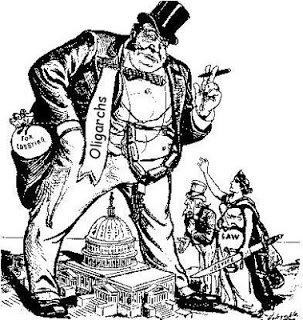
How America Became an Oligarchy

OLIGARCHY

By Ellen Brown

Source: Counterpunch

“The politicians are put there to give you the idea that you have freedom of choice. You don’t. . . . You have owners.”

— George Carlin, The American Dream

According to a new study from Princeton University, American democracy no longer exists. Using data from over 1,800 policy initiatives from 1981 to 2002, researchers Martin Gilens and Benjamin Page concluded that rich, well-connected individuals on the political scene now steer the direction of the country, regardless of – or even against – the will of the majority of voters. America’s political system has transformed from a democracy into an oligarchy, where power is wielded by wealthy elites.

“Making the world safe for democracy” was President Woodrow Wilson’s rationale for World War I, and it has been used to justify American military intervention ever since. Can we justify sending troops into other countries to spread a political system we cannot maintain at home?

The Magna Carta, considered the first Bill of Rights in the Western world, established the rights of nobles as against the king. But the doctrine that “all men are created equal” – that all people have “certain inalienable rights,” including “life, liberty and the pursuit of happiness” – is an American original. And those rights, supposedly insured by the Bill of Rights, have the right to vote at their core. We have the right to vote but the voters’ collective will no longer prevails.

In Greece, the left-wing populist Syriza Party came out of nowhere to take the presidential election by storm; and in Spain, the populist Podemos Party appears poised to do the same. But for over a century, no third-party candidate has had any chance of winning a US presidential election. We have a two-party winner-take-all system, in which our choice is between two candidates, both of whom necessarily cater to big money. It takes big money just to put on the mass media campaigns required to win an election involving 240 million people of voting age.

In state and local elections, third party candidates have sometimes won. In a modest-sized city, candidates can actually influence the vote by going door to door, passing out flyers and bumper stickers, giving local presentations, and getting on local radio and TV. But in a national election, those efforts are easily trumped by the mass media. And local governments too are beholden to big money.

When governments of any size need to borrow money, the megabanks in a position to supply it can generally dictate the terms. Even in Greece, where the populist Syriza Party managed to prevail in January, the anti-austerity platform of the new government is being throttled by the moneylenders who have the government in a chokehold.

How did we lose our democracy? Were the Founding Fathers remiss in leaving something out of the Constitution? Or have we simply gotten too big to be governed by majority vote?

Democracy’s Rise and Fall

The stages of the capture of democracy by big money are traced in a paper called “The Collapse of Democratic Nation States” by theologian and environmentalist Dr. John Cobb. Going back several centuries, he points to the rise of private banking, which usurped the power to create money from governments:

The influence of money was greatly enhanced by the emergence of private banking. The banks are able to create money and so to lend amounts far in excess of their actual wealth. This control of money-creation . . . has given banks overwhelming control over human affairs. In the United States, Wall Street makes most of the truly important decisions that are directly attributed to Washington.

Today the vast majority of the money supply in Western countries is created by private bankers. That tradition goes back to the 17th century, when the privately-owned Bank of England, the mother of all central banks, negotiated the right to print England’s money after Parliament stripped that power from the Crown. When King William needed money to fight a war, he had to borrow. The government as borrower then became servant of the lender.

In America, however, the colonists defied the Bank of England and issued their own paper scrip; and they thrived. When King George forbade that practice, the colonists rebelled.

They won the Revolution but lost the power to create their own money supply, when they opted for gold rather than paper money as their official means of exchange. Gold was in limited supply and was controlled by the bankers, who surreptitiously expanded the money supply by issuing multiple banknotes against a limited supply of gold.

This was the system euphemistically called “fractional reserve” banking, meaning only a fraction of the gold necessary to back the banks’ privately-issued notes was actually held in their vaults. These notes were lent at interest, putting citizens and the government in debt to bankers who created the notes with a printing press. It was something the government could have done itself debt-free, and the American colonies had done with great success until England went to war to stop them.

President Abraham Lincoln revived the colonists’ paper money system when he issued the Treasury notes called “Greenbacks” that helped the Union win the Civil War. But Lincoln was assassinated, and the Greenback issues were discontinued.

In every presidential election between 1872 and 1896, there was a third national party running on a platform of financial reform. Typically organized under the auspices of labor or farmer organizations, these were parties of the people rather than the banks. They included the Populist Party, the Greenback and Greenback Labor Parties, the Labor Reform Party, the Antimonopolist Party, and the Union Labor Party. They advocated expanding the national currency to meet the needs of trade, reform of the banking system, and democratic control of the financial system.

The Populist movement of the 1890s represented the last serious challenge to the bankers’ monopoly over the right to create the nation’s money. According to monetary historian Murray Rothbard, politics after the turn of the century became a struggle between two competing banking giants, the Morgans and the Rockefellers. The parties sometimes changed hands, but the puppeteers pulling the strings were always one of these two big-money players.

In All the Presidents’ Bankers, Nomi Prins names six banking giants and associated banking families that have dominated politics for over a century. No popular third party candidates have a real chance of prevailing, because they have to compete with two entrenched parties funded by these massively powerful Wall Street banks.

Democracy Succumbs to Globalization

In an earlier era, notes Dr. Cobb, wealthy landowners were able to control democracies by restricting government participation to the propertied class. When those restrictions were removed, big money controlled elections by other means:

First, running for office became expensive, so that those who seek office require wealthy sponsors to whom they are then beholden. Second, the great majority of voters have little independent knowledge of those for whom they vote or of the issues to be dealt with. Their judgments are, accordingly, dependent on what they learn from the mass media. These media, in turn, are controlled by moneyed interests.

Control of the media and financial leverage over elected officials then enabled those other curbs on democracy we know today, including high barriers to ballot placement for third parties and their elimination from presidential debates, vote suppression, registration restrictions, identification laws, voter roll purges, gerrymandering, computer voting, and secrecy in government.

The final blow to democracy, says Dr. Cobb, was “globalization” – an expanding global market that overrides national interests:

[T]oday’s global economy is fully transnational. The money power is not much interested in boundaries between states and generally works to reduce their influence on markets and investments. . . . Thus transnational corporations inherently work to undermine nation states, whether they are democratic or not.

The most glaring example today is the secret twelve-country trade agreement called the Trans-Pacific Partnership. If it goes through, the TPP will dramatically expand the power of multinational corporations to use closed-door tribunals to challenge and supersede domestic laws, including environmental, labor, health and other protections.

Looking at Alternatives

Some critics ask whether our system of making decisions by a mass popular vote easily manipulated by the paid-for media is the most effective way of governing on behalf of the people. In an interesting Ted Talk, political scientist Eric Li makes a compelling case for the system of “meritocracy” that has been quite successful in China.

In America Beyond Capitalism, Prof. Gar Alperovitz argues that the US is simply too big to operate as a democracy at the national level. Excluding Canada and Australia, which have large empty landmasses, the United States is larger geographically than all the other advanced industrial countries of the OECD (Organization for Economic Cooperation and Development) combined. He proposes what he calls “The Pluralist Commonwealth”: a system anchored in the reconstruction of communities and the democratization of wealth. It involves plural forms of cooperative and common ownership beginning with decentralization and moving to higher levels of regional and national coordination when necessary.

Dr. Alperovitz is co-founder of an initiative called The Next System Project, aimed at defining the issues in a national political debate as a first step to realizing the possible. He quotes Prof. Donald Livingston, who asked in 2002:

What value is there in continuing to prop up a union of this monstrous size? . . . [T]here are ample resources in the American federal tradition to justify states’ and local communities’ recalling, out of their own sovereignty, powers they have allowed the central government to usurp.

Taking Back Our Power

If governments are recalling their sovereign powers, they might start with the power to create money, which was usurped by private interests while the people were asleep at the wheel. State and local governments are not allowed to print their own currencies; but they can own banks, and all depository banks create money when they make loans, as the Bank of England recently acknowledged.

The federal government could take back the power to create the national money supply by issuing its own Treasury notes as Abraham Lincoln did. Alternatively, it could issue some very large denomination coins as authorized in the Constitution; or it could nationalize the central bank and use quantitative easing to fund infrastructure, education, job creation, and social services, responding to the needs of the people rather than the banks.

The freedom to vote carries little weight without economic freedom – the freedom to work and to have food, shelter, education, medical care and a decent retirement. President Franklin Roosevelt maintained that we need an Economic Bill of Rights. If our elected representatives were not beholden to the moneylenders, they might be able both to pass such a bill and to come up with the money to fund it.

Ellen Brown is an attorney, founder of the Public Banking Institute, and author of twelve books including the best-selling Web of Debt. Her latest book, The Public Bank Solution, explores successful public banking models historically and globally. Her 300+ blog articles are at EllenBrown.com. Listen to “It’s Our Money with Ellen Brown” on PRN.fm.