
Something is wrong on the internet

By James Bridle

Source: Medium

As someone who grew up on the internet, I credit it as one of the most important influences on who I am today. I had a computer with internet access in my bedroom from the age of 13. It gave me access to a lot of things which were totally inappropriate for a young teenager, but it was OK. The culture, politics, and interpersonal relationships which I consider to be central to my identity were shaped by the internet, in ways that I have always considered to be beneficial to me personally. I have always been a critical proponent of the internet and everything it has brought, and broadly considered it to be emancipatory and beneficial. I state this at the outset because thinking through the implications of the problem I am going to describe troubles my own assumptions and prejudices in significant ways.

One of the thus-far hypothetical questions I ask myself frequently is how I would feel about my own children having the same kind of access to the internet today. And I find the question increasingly difficult to answer. I understand that this is a natural evolution of attitudes which happens with age, and at some point this question might be a lot less hypothetical. I don’t want to be a hypocrite about it. I would want my kids to have the same opportunities to explore and grow and express themselves as I did. I would like them to have that choice. And this belief broadens into attitudes about the role of the internet in public life as whole.

I’ve also been aware for some time of the increasingly symbiotic relationship between younger children and YouTube. I see kids engrossed in screens all the time, in pushchairs and in restaurants, and there’s always a bit of a Luddite twinge there, but I am not a parent, and I’m not making parental judgments for or on anyone else. I’ve seen family members and friend’s children plugged into Peppa Pig and nursery rhyme videos, and it makes them happy and gives everyone a break, so OK.

But I don’t even have kids and right now I just want to burn the whole thing down.

Someone or something or some combination of people and things is using YouTube to systematically frighten, traumatise, and abuse children, automatically and at scale, and it forces me to question my own beliefs about the internet, at every level. Much of what I am going to describe next has been covered elsewhere, although none of the mainstream coverage I’ve seen has really grasped the implications of what seems to be occurring.

To begin: Kid’s YouTube is definitely and markedly weird. I’ve been aware of its weirdness for some time. Last year, there were a number of articles posted about the Surprise Egg craze. Surprise Eggs videos depict, often at excruciating length, the process of unwrapping Kinder and other egg toys. That’s it, but kids are captivated by them. There are thousands and thousands of these videos and thousands and thousands, if not millions, of children watching them.

From the article linked above:

The maker of my particular favorite videos is “Blu Toys Surprise Brinquedos & Juegos,” and since 2010 he seems to have accrued 3.7 million subscribers and just under 6 billion views for a kid-friendly channel entirely devoted to opening surprise eggs and unboxing toys. The video titles are a continuous pattern of obscure branded lines and tie-ins: “Surprise Play Doh Eggs Peppa Pig Stamper Cars Pocoyo Minecraft Smurfs Kinder Play Doh Sparkle Brilho,” “Cars Screamin’ Banshee Eats Lightning McQueen Disney Pixar,” “Disney Baby Pop Up Pals Easter Eggs SURPRISE.”

As I write this he has done a total of 4,426 videos and counting. With so many views — for comparison, Justin Bieber’s official channel has more than 10 billion views, while full-time YouTube celebrity PewDiePie has nearly 12 billion — it’s likely this man makes a living as a pair of gently murmuring hands that unwrap Kinder eggs. (Surprise-egg videos are all accompanied by pre-roll, and sometimes mid-video and ads.)

That should give you some idea of just how odd the world of kids online video is, and that list of video titles hints at the extraordinary range and complexity of this situation. We’ll get into the latter in a minute; for the moment know that it’s already very strange, if apparently pretty harmless, out there.

Another huge trope, especially the youngest children, is nursery rhyme videos.

Little Baby Bum, which made the above video, is the 7th most popular channel on YouTube. With just 515 videos, they have accrued 11.5 million subscribers and 13 billion views. Again, there are questions as to the accuracy of these numbers, which I’ll get into shortly, but the key point is that this is a huge, huge network and industry.

On-demand video is catnip to both parents and to children, and thus to content creators and advertisers. Small children are mesmerised by these videos, whether it’s familiar characters and songs, or simply bright colours and soothing sounds. The length of many of these videos — one common video tactic is to assemble many nursery rhyme or cartoon episodes into hour+ compilations —and the way that length is marketed as part of the video’s appeal, points to the amount of time some kids are spending with them.

YouTube broadcasters have thus developed a huge number of tactics to draw parents’ and childrens’ attention to their videos, and the advertising revenues that accompany them. The first of these tactics is simply to copy and pirate other content. A simple search for “Peppa Pig” on YouTube in my case yielded “About 10,400,000 results” and the front page is almost entirely from the verified “Peppa Pig Official Channel”, while one is from an unverified channel called Play Go Toys, which you really wouldn’t notice unless you were looking out for it:
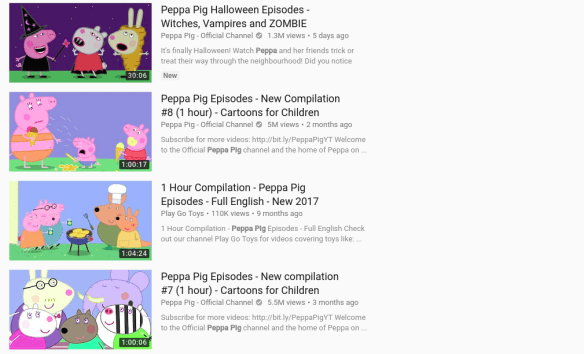
Play Go Toys’ channel consists of (I guess?) pirated Peppa Pig and other cartoons, videos of toy unboxings (another kid magnet), and videos of, one supposes, the channel owner’s own children. I am not alleging anything bad about Play Go Toys; I am simply illustrating how the structure of YouTube facilitates the delamination of content and author, and how this impacts on our awareness and trust of its source.

As another blogger notes, one of the traditional roles of branded content is that it is a trusted source. Whether it’s Peppa Pig on children’s TV or a Disney movie, whatever one’s feelings about the industrial model of entertainment production, they are carefully produced and monitored so that kids are essentially safe watching them, and can be trusted as such. This no longer applies when brand and content are disassociated by the platform, and so known and trusted content provides a seamless gateway to unverified and potentially harmful content.

(Yes, this is the exact same process as the delamination of trusted news media on Facebook feeds and in Google results that is currently wreaking such havoc on our cognitive and political systems and I am not going to explicitly explore that relationship further here, but it is obviously deeply significant.)

A second way of increasing hits on videos is through keyword/hashtag association, which is a whole dark art unto itself. When some trend, such as Surprise Egg videos, reaches critical mass, content producers pile onto it, creating thousands and thousands more of these videos in every possible iteration. This is the origin of all the weird names in the list above: branded content and nursery rhyme titles and “surprise egg” all stuffed into the same word salad to capture search results, sidebar placement, and “up next” autoplay rankings.

Play Go Toys’ channel consists of (I guess?) pirated Peppa Pig and other cartoons, videos of toy unboxings (another kid magnet), and videos of, one supposes, the channel owner’s own children. I am not alleging anything bad about Play Go Toys; I am simply illustrating how the structure of YouTube facilitates the delamination of content and author, and how this impacts on our awareness and trust of its source.

As another blogger notes, one of the traditional roles of branded content is that it is a trusted source. Whether it’s Peppa Pig on children’s TV or a Disney movie, whatever one’s feelings about the industrial model of entertainment production, they are carefully produced and monitored so that kids are essentially safe watching them, and can be trusted as such. This no longer applies when brand and content are disassociated by the platform, and so known and trusted content provides a seamless gateway to unverified and potentially harmful content.

(Yes, this is the exact same process as the delamination of trusted news media on Facebook feeds and in Google results that is currently wreaking such havoc on our cognitive and political systems and I am not going to explicitly explore that relationship further here, but it is obviously deeply significant.)

A second way of increasing hits on videos is through keyword/hashtag association, which is a whole dark art unto itself. When some trend, such as Surprise Egg videos, reaches critical mass, content producers pile onto it, creating thousands and thousands more of these videos in every possible iteration. This is the origin of all the weird names in the list above: branded content and nursery rhyme titles and “surprise egg” all stuffed into the same word salad to capture search results, sidebar placement, and “up next” autoplay rankings.

A striking example of the weirdness is the Finger Family videos (harmless example embedded above). I have no idea where they came from or the origin of the children’s rhyme at the core of the trope, but there are at least 17 million versions of this currently on YouTube, and again they cover every possible genre, with billions and billions of aggregated views.

Once again, the view numbers of these videos must be taken under serious advisement. A huge number of these videos are essentially created by bots and viewed by bots, and even commented on by bots. That is a whole strange world in and of itself. But it shouldn’t obscure that there are also many actual children, plugged into iphones and tablets, watching these over and over again — in part accounting for the inflated view numbers — learning to type basic search terms into the browser, or simply mashing the sidebar to bring up another video.

What I find somewhat disturbing about the proliferation of even (relatively) normal kids videos is the impossibility of determining the degree of automation which is at work here; how to parse out the gap between human and machine. The example above, from a channel called Bounce Patrol Kids, with almost two million subscribers, show this effect in action. It posts professionally produced videos, with dedicated human actors, at the rate of about one per week. Once again, I am not alleging anything untoward about Bounce Patrol, which clearly follows in the footsteps of pre-digital kid sensations like their fellow Australians The Wiggles.

And yet, there is something weird about a group of people endlessly acting out the implications of a combination of algorithmically generated keywords: “Halloween Finger Family & more Halloween Songs for Children | Kids Halloween Songs Collection”, “Australian Animals Finger Family Song | Finger Family Nursery Rhymes”, “Farm Animals Finger Family and more Animals Songs | Finger Family Collection – Learn Animals Sounds”, “Safari Animals Finger Family Song | Elephant, Lion, Giraffe, Zebra & Hippo! Wild Animals for kids”, “Superheroes Finger Family and more Finger Family Songs! Superhero Finger Family Collection”, “Batman Finger Family Song — Superheroes and Villains! Batman, Joker, Riddler, Catwoman” and on and on and on. This is content production in the age of algorithmic discovery — even if you’re a human, you have to end up impersonating the machine.

Other channels do away with the human actors to create infinite reconfigurable versions of the same videos over and over again. What is occurring here is clearly automated. Stock animations, audio tracks, and lists of keywords being assembled in their thousands to produce an endless stream of videos. The above channel, Videogyan 3D Rhymes — Nursery Rhymes & Baby Songs, posts several videos a week, in increasingly byzantine combinations of keywords. They have almost five million subscribers — more than double Bounce Patrol — although once again it’s impossible to know who or what is actually racking up these millions and millions of views.

I’m trying not to turn this essay into an endless list of examples, but it’s important to grasp how vast this system is, and how indeterminate its actions, process, and audience. It’s also international: there are variations of Finger Family and Learn Colours videos for Tamil epics and Malaysian cartoons which are unlikely to pop up in any Anglophone search results. This very indeterminacy and reach is key to its existence, and its implications. Its dimensionality makes it difficult to grasp, or even to really think about.

We’ve encountered pretty clear examples of the disturbing outcomes of full automation before — some of which have been thankfully leavened with a dark kind of humour, others not so much. Much has been made of the algorithmic interbreeding of stock photo libraries and on-demand production of everything from tshirts to coffee mugs to infant onesies and cell phone covers. The above example, available until recently on Amazon, is one such case, and the story of how it came to occur is fascinating and weird but essentially comprehensible. Nobody set out to create phone cases with drugs and medical equipment on them, it was just a deeply weird mathematical/probabilistic outcome. The fact that it took a while to notice might ring some alarm bells however.

Likewise, the case of the “Keep Calm and Rape A Lot” tshirts (along with the “Keep Calm and Knife Her” and “Keep Calm and Hit Her” ones) is depressing and distressing but comprehensible. Nobody set out to create these shirts: they just paired an unchecked list of verbs and pronouns with an online image generator. It’s quite possible that none of these shirts ever physically existed, were ever purchased or worn, and thus that no harm was done. Once again though, the people creating this content failed to notice, and neither did the distributor. They literally had no idea what they were doing.

What I will argue, on the basis of these cases and of those I’m going to describe further, is that the scale and logic of the system is complicit in these outputs, and requires us to think through their implications.

(Also again: I’m not going to dig into the wider social implications of such processes outside the scope of what I am writing about here, but it’s clear that one can draw a clear line from examples such as these to pressing contemporary issues such as racial and gender bias in big data and machine intelligence-driven systems, which require urgent attention but in the same manner do not have anything resembling easy or even preferable solutions.)

Let’s look at just one video among the piles of kid videos, and try to parse out where it comes from. It’s important to stress that I didn’t set out to find this particular video: it appeared organically and highly ranked in a search for ‘finger family’ in an incognito browser window (i.e. it should not have been influenced by previous searches). This automation takes us to very, very strange places, and at this point the rabbithole is so deep that it’s impossible to know how such a thing came into being.

Once again, a content warning: this video is not inappropriate in any way, but it is decidedly off, and contains elements which might trouble anyone. It’s very mild on the scale of such things, but. I describe it below if you don’t want to watch it and head down that road. This warning will recur.

The above video is entitled Wrong Heads Disney Wrong Ears Wrong Legs Kids Learn Colors Finger Family 2017 Nursery Rhymes. The title alone confirms its automated provenance. I have no idea where the “Wrong Heads” trope originates, but I can imagine, as with the Finger Family Song, that somewhere there is a totally original and harmless version that made enough kids laugh that it started to climb the algorithmic rankings until it made it onto the word salad lists, combining with Learn Colors, Finger Family, and Nursery Rhymes, and all of these tropes — not merely as words but as images, processes, and actions — to be mixed into what we see here.

The video consists of a regular version of the Finger Family song played over an animation of character heads and bodies from Disney’s Aladdin swapping and intersecting. Again, this is weird but frankly no more than the Surprise Egg videos or anything else kids watch. I get how innocent it is. The offness creeps in with the appearance of a non-Aladdin character —Agnes, the little girl from Despicable Me. Agnes is the arbiter of the scene: when the heads don’t match up, she cries, when they do, she cheers.

The video’s creator, BABYFUN TV (screenshot above), has produced many similar videos. As many of the Wrong Heads videos as I could bear to watch all work in exactly the same way. The character Hope from Inside Out weeps through a Smurfs and Trolls head swap. It goes on and on. I get the game, but the constant overlaying and intermixing of different tropes starts to get inside you. BABYFUN TV only has 170 subscribers and very low view rates, but then there are thousands and thousands of channels like this. Numbers in the long tail aren’t significant in the abstract, but in their accumulation.

The question becomes: how did this come to be? The “Bad Baby” trope also present on BABYFUN TV features the same crying. While I find it disturbing, I can understand how it might provide some of the rhythm or cadence or relation to their own experience that actual babies are attracted to in this content, although it has been warped and stretched through algorithmic repetition and recombination in ways that I don’t think anyone actually wants to happen.

Toy Freaks is a hugely popular channel (68th on the platform) which features a father and his two daughters playing out — or in some cases perhaps originating — many of the tropes we’ve identified so far, including “Bad Baby”, above. As well as nursery rhymes and learning colours, Toy Freaks specialises in gross-out situations, as well as activities which many, many viewers feel border on abuse and exploitation, if not cross the line entirely, including videos of the children vomiting and in pain. Toy Freaks is a YouTube verified channel, whatever that means. (I think we know by now it means nothing useful.)

As with Bounce Patrol Kids, however you feel about the content of these videos, it feels impossible to know where the automation starts and ends, who is coming up with the ideas and who is roleplaying them. In turn, the amplification of tropes in popular, human-led channels such as Toy Freaks leads to them being endlessly repeated across the network in increasingly outlandish and distorted recombinations.

There’s a second level of what I’m characterising as human-led videos which are much more disturbing than the mostly distasteful activities of Toy Freaks and their kin. Here is a relatively mild, but still upsetting example:

A step beyond the simply pirated Peppa Pig videos mentioned previously are the knock-offs. These too seem to teem with violence. In the official Peppa Pig videos, Peppa does indeed go to the dentist, and the episode in which she does so seems to be popular — although, confusingly, what appears to be the real episode is only available on an unofficial channel. In the official timeline, Peppa is appropriately reassured by a kindly dentist. In the version above, she is basically tortured, before turning into a series of Iron Man robots and performing the Learn Colours dance. A search for “peppa pig dentist” returns the above video on the front page, and it only gets worse from here.

Disturbing Peppa Pig videos, which tend towards extreme violence and fear, with Peppa eating her father or drinking bleach, are, it turns out very widespread. They make up an entire YouTube subculture. Many are obviously parodies, or even satires of themselves, in the pretty common style of the internet’s outrageous, deliberately offensive kind. All the 4chan tropes are there, the trolls are out, we know this.

In the example above, the agency is less clear: the video starts with a trollish Peppa parody, but later syncs into the kind of automated repetition of tropes we’ve seen already. I don’t know which camp it belongs to. Maybe it’s just trolls. I kind of hope it is. But I don’t think so. Trolls don’t cover the intersection of human actors and more automated examples further down the line. They’re at play here, but they’re not the whole story.

I suppose it’s naive not to see the deliberate versions of this coming, but many are so close to the original, and so unsignposted — like the dentist example — that many, many kids are watching them. I understand that most of them are not trying to mess kids up, not really, even though they are.

I’m trying to understand why, as plainly and simply troubling as it is, this is not a simple matter of “won’t somebody think of the children” hand-wringing. Obviously this content is inappropriate, obviously there are bad actors out there, obviously some of these videos should be removed. Obviously too this raises questions of fair use, appropriation, free speech and so on. But reports which simply understand the problem through this lens fail to fully grasp the mechanisms being deployed, and thus are incapable of thinking its implications in totality, and responding accordingly.

The New York Times, headlining their article on a subset of this issue “On YouTube Kids, Startling Videos Slip Past Filters”, highlights the use of knock-off characters and nursery rhymes in disturbing content, and frames it as a problem of moderation and legislation. YouTube Kids, an official app which claims to be kid-safe but is quite obviously not, is the problem identified, because it wrongly engenders trust in users. An article in the British tabloid The Sun, “Kids left traumatised after sick YouTube clips showing Peppa Pig characters with knives and guns appear on app for children” takes the same line, with an added dose of right-wing technophobia and self-righteousness. But both stories take at face value YouTube’s assertions that these results are incredibly rare and quickly removed: assertions utterly refuted by the proliferation of the stories themselves, and the growing number of social media posts, largely by concerned parents, from which they arise.

But as with Toy Freaks, what is concerning to me about the Peppa videos is how the obvious parodies and even the shadier knock-offs interact with the legions of algorithmic content producers until it is completely impossible to know what is going on. (“The creatures outside looked from pig to man, and from man to pig, and from pig to man again; but already it was impossible to say which was which.”)

Here’s what is basically a version of Toy Freaks produced in Asia (screenshot above). Here’s one from Russia. I don’t really want to use the term “human-led” any more about these videos, although they contain all the same tropes and actual people acting them out. I no longer have any idea what’s going on here and I really don’t want to and I’m starting to think that that is kind of the point. That’s part of why I’m starting to think about the deliberateness of this all. There is a lot of effort going into making these. More than spam revenue can generate — can it? Who’s writing these scripts, editing these videos? Once again, I want to stress: this is still really mild, even funny stuff compared to a lot of what is out there.

Here are a few things which are disturbing me:

The first is the level of horror and violence on display. Some of the times it’s troll-y gross-out stuff; most of the time it seems deeper, and more unconscious than that. The internet has a way of amplifying and enabling many of our latent desires; in fact, it’s what it seems to do best. I spend a lot of time arguing for this tendency, with regards to human sexual freedom, individual identity, and other issues. Here, and overwhelmingly it sometimes feels, that tendency is itself a violent and destructive one.

The second is the levels of exploitation, not of children because they are children but of children because they are powerless. Automated reward systems like YouTube algorithms necessitate exploitation in the same way that capitalism necessitates exploitation, and if you’re someone who bristles at the second half of that equation then maybe this should be what convinces you of its truth. Exploitation is encoded into the systems we are building, making it harder to see, harder to think and explain, harder to counter and defend against. Not in a future of AI overlords and robots in the factories, but right here, now, on your screen, in your living room and in your pocket.

Many of these latest examples confound any attempt to argue that nobody is actually watching these videos, that these are all bots. There are humans in the loop here, even if only on the production side, and I’m pretty worried about them too.

I’ve written enough, too much, but I feel like I actually need to justify all this raving about violence and abuse and automated systems with an example that sums it up. Maybe after everything I’ve said you won’t think it’s so bad. I don’t know what to think any more.

This video, BURIED ALIVE Outdoor Playground Finger Family Song Nursery Rhymes Animation Education Learning Video, contains all of the elements we’ve covered above, and takes them to another level. Familiar characters, nursery tropes, keyword salad, full automation, violence, and the very stuff of kids’ worst dreams. And of course there are vast, vast numbers of these videos. Channel after channel after channel of similar content, churned out at the rate of hundreds of new videos every week. Industrialised nightmare production.

For the final time: There is more violent and more sexual content like this available. I’m not going to link to it. I don’t believe in traumatising other people, but it’s necessary to keep stressing it, and not dismiss the psychological effect on children of things which aren’t overtly disturbing to adults, just incredibly dark and weird.

A friend who works in digital video described to me what it would take to make something like this: a small studio of people (half a dozen, maybe more) making high volumes of low quality content to reap ad revenue by tripping certain requirements of the system (length in particular seems to be a factor). According to my friend, online kids’ content is one of the few alternative ways of making money from 3D animation because the aesthetic standards are lower and independent production can profit through scale. It uses existing and easily available content (such as character models and motion-capture libraries) and it can be repeated and revised endlessly and mostly meaninglessly because the algorithms don’t discriminate — and neither do the kids.

These videos, wherever they are made, however they come to be made, and whatever their conscious intention (i.e. to accumulate ad revenue) are feeding upon a system which was consciously intended to show videos to children for profit. The unconsciously-generated, emergent outcomes of that are all over the place.

To expose children to this content is abuse. We’re not talking about the debatable but undoubtedly real effects of film or videogame violence on teenagers, or the effects of pornography or extreme images on young minds, which were alluded to in my opening description of my own teenage internet use. Those are important debates, but they’re not what is being discussed here. What we’re talking about is very young children, effectively from birth, being deliberately targeted with content which will traumatise and disturb them, via networks which are extremely vulnerable to exactly this form of abuse. It’s not about trolls, but about a kind of violence inherent in the combination of digital systems and capitalist incentives. It’s down to that level of the metal.

This, I think, is my point: The system is complicit in the abuse.

And right now, right here, YouTube and Google are complicit in that system. The architecture they have built to extract the maximum revenue from online video is being hacked by persons unknown to abuse children, perhaps not even deliberately, but at a massive scale. I believe they have an absolute responsibility to deal with this, just as they have a responsibility to deal with the radicalisation of (mostly) young (mostly) men via extremist videos — of any political persuasion. They have so far showed absolutely no inclination to do this, which is in itself despicable. However, a huge part of my troubled response to this issue is that I have no idea how they can respond without shutting down the service itself, and most systems which resemble it. We have built a world which operates at scale, where human oversight is simply impossible, and no manner of inhuman oversight will counter most of the examples I’ve used in this essay. The asides I’ve kept in parentheses throughout, if expanded upon, would allow one with minimal effort to rewrite everything I’ve said, with very little effort, to be not about child abuse, but about white nationalism, about violent religious ideologies, about fake news, about climate denialism, about 9/11 conspiracies.

This is a deeply dark time, in which the structures we have built to sustain ourselves are being used against us — all of us — in systematic and automated ways. It is hard to keep faith with the network when it produces horrors such as these. While it is tempting to dismiss the wilder examples as trolling, of which a significant number certainly are, that fails to account for the sheer volume of content weighted in a particularly grotesque direction. It presents many and complexly entangled dangers, including that, just as with the increasing focus on alleged Russian interference in social media, such events will be used as justification for increased control over the internet, increasing censorship, and so on. This is not what many of us want.

I’m going to stop here, saying only this:

What concerns me is not just the violence being done to children here, although that concerns me deeply. What concerns me is that this is just one aspect of a kind of infrastructural violence being done to all of us, all of the time, and we’re still struggling to find a way to even talk about it, to describe its mechanisms and its actions and its effects. As I said at the beginning of this essay: this is being done by people and by things and by a combination of things and people. Responsibility for its outcomes is impossible to assign but the damage is very, very real indeed.


An Open Letter to People with ‘Mental Health’ Issues

Robert J. Burrowes

As ‘mental health’ issues gain more attention, sympathetic and
otherwise, in a wide variety of contexts and countries around the world,
the opportunity for inaccurate perceptions of what causes these issues,
and how to treat them, are likewise expanded.

So if you or someone you know is supposed to have a ‘mental illness’
such as anxiety, depression, schizophrenia, obsessive-compulsive
disorder (OCD), bipolar disorder, anorexia nervosa or post-traumatic
stress disorder (PTSD), I would like to give you the opportunity to
consider an explanation and a way forward that you are unlikely to have
come across.

My first suggestion is that you ignore any label that you have been
given. These labels are an inaccurate and unhelpful way of labeling the
appropriate, diverse and complex emotional responses that a normal human
being will have to emotionally disturbing events. It is inaccurate
because words such as these imply a ‘disorder’ that a normal individual
should not have in response to emotionally challenging events in their
life and it is unhelpful because the term suggests that many different
individuals are having the same (dysfunctional) response.

Human beings have a brilliantly diverse and complex array of emotions
and hence potential emotional responses as a result of the evolutionary
pressures that shaped the emergence of hominids over millions of years.
An extraordinary emotional capacity is one of the defining features of
our humanity and, I would argue, far more important than any other
feature such as our intellectual capacity.

Our emotions or, more simply, our feelings play the central role in
determining our behaviour in any given circumstance. Whatever we do, we
are responding to our feelings. If we are doing what we want to do, we
are doing what we feel like doing. If we are not doing what we feel like
doing, it is because our fear has been triggered sufficiently to
override feelings that would otherwise have us doing something more
functional and enjoyable. Regrettably, human ‘socialization’ (that is,
terrorization) plays heavily on our fear during childhood in order to
turn us into obedient slaves in the forms of student, worker/soldier and
citizen. And this happens irrespective of our level of intelligence. For
a full explanation, see ‘Why Violence?

Unfortunately, once our fear has been utilized to suppress our awareness
of how we genuinely feel and what we want to do – which is sometimes
euphemistically referred to as ’emotional regulation’ – we are no longer
able to access these feelings readily and we live our lives
unconsciously and powerlessly submitting to the will of those we fear
and the institutions they control. But the price for doing so is that
our lives are no longer our own.

As a unique individual who has experienced the ongoing violent trauma
virtually all of us experience during childhood you have found yourself
experiencing a level of emotional response that is very appropriate
given your experience but which is both exacerbated and complicated by
the sudden release of feelings that you had been suppressing since
childhood (and which you are probably being told are inappropriate now).

The fear you feel (probably labeled ‘anxiety’, ‘nervousness’ or
something else) in particular (and perhaps virtually all) contexts is
also triggering the monumental fear (of your parents, teachers,
religious figures and other adults) that you were scared into
suppressing as a child.

The anger you feel about how you were treated and/or what happened to
others (perhaps siblings) you know is merely the peak of the volcano of
anger that you have been keeping the lid on since childhood.

The sadness you feel about what has happened to you and perhaps others
you know is only the tip of the iceberg of sadness you have been
suppressing all of your life.

The guilt, shame, embarrassment… you feel, perhaps about those you let
down or for some other reason, is only the latest addition to the guilt
and other feelings you have been suppressing since childhood.

Do you think I am wrong? Then consider this. Were you ever allowed to
show your fear as a child (and to act on it)? Were you allowed to cry
freely and openly? Were you allowed to get angry (at being ‘done over’
or in defense of yourself)? As often as you needed? Or were you
endlessly admonished and, one way or another, terrorized into behaving
blandly (with ‘acceptable’ feelings like love and happiness tolerated in
particular doses and circumstances).

So if you want to deal powerfully with all of the emotional responses
that are causing your so-called ‘mental illness’, here is my suggestion.
Focus on feeling each and all of your feelings. If you wake from a
nightmare, deliberately and consciously focus on the imagery in the
nightmare while you feel just how terrified you are. Focus on this
feeling for as long as you can. It will be horrendous and will take
enormous courage. But, after a time, it will start to fade and you will
feel some relief. When your fear arises again, in any context, pay
conscious attention to it. You have been suppressing it all of your
life; it just wants to be heard and felt so that you can let it go
forever.

If you feel angry, instead of trying to suppress it, harming yourself or
harming someone else (perhaps, even, someone you love), express your
anger fully and completely but in a safe way. How? Here are some
suggestions but you will need to decide what will work best for you. Get
an axe and chop wood (thinking about utterly destroying who/what is
making you angry: parents, teachers, religious figures, politicians,
military officers…) until your anger has been vented. Or smash a bat or
racquet into a mattress or cushion. Or scream (into a pillow if noise is
an issue). Or punch a punching bag. If you feel angry you need to exert
enormous physical effort to adequately express it. This might require
several hours for any one session and you might need to do a great many
sessions. Remember, you need to work off a lifetime of anger! If you can
set up a safe space for your regular anger sessions, do so. Whatever you
do, however, don’t waste your time saying or writing ‘I feel angry…’.
And don’t waste a moment of your life in an ‘anger management’ course.
Anger, like all emotions, needs to be expressed, not ‘managed’ (that is,
suppressed).

Another reason why it is important that you express your anger as I have
just suggested is because you will often discover afterwards that you
are projecting your anger. Projection is another of the creative ways
that your mind can use to give you a lead back to some of your
suppressed feelings. Projection occurs, for example, when it feels like
you are angry with your spouse for something she/he has done but, once
you fully express the feelings, you realize that, in fact, while your
spouse did something that unintentionally triggered your anger, most of
the anger is actually about someone or something from your childhood.
You cannot discover the source of the projection without fully
expressing the feelings first. Many people who routinely abuse their
spouse and/or children are trapped in a projection which is why their
anger cannot lead to greater self-awareness. People often project their
fear and sadness too: phobias are the result of projected fear, for
example, while sad films enable some people to access their suppressed
sadness.

If you feel sad or anxious or ashamed or guilty or in pain or despairing
or obsessive or depressed or hopeless or compulsive or self-hating or
humiliated or anything else, just let yourself feel it, deeply. And let
it manifest in its own way: cry (if that is what happens when you feel
sad), shake (if that is what happens when you feel scared), feel guilty
or hopeless, feel horrible or …. Deliberately. Consciously. For as long
as it lasts or for as long as you are able to do at the time.

If you feel a sensation in your body, such as muscle tension or a pain
or a sense of contamination, focus on where you feel it and how it
feels. Eventually, after feeling the feelings from this sensation (which
might take very many sessions), you will discover why the sensation
originated and learn what it is trying to teach you.

If you feel suicidal it will often be because you are unconsciously
suppressing another shocking feeling that feels beyond your courage to
feel consciously, such as the feeling of self-hatred for something
shameful you have done, and suicide will seem the best way out. The
suicidal feeling might also arise out a sense of hopelessness or a
desire for release from enormous emotional and/or physical pain. Suicide
is an option that no-one should ever take from you, and I would never do
so, but I gently encourage you to focus on any suicidal feeling in the
belief that the underlying feeling – self-hatred, pain or something else
– will eventually be relieved and the urge to destroy yourself will pass
allowing you to keep traveling the journey of healing.

At this point, I should add that consciously focusing on feeling
physical pain (as a result of injuries or otherwise) is an important
element of any comprehensive healing strategy too.

As you have realized by now, this process of feeling isn’t necessarily
fun and my suggestion runs directly counter to our ‘feel good’ culture
which emphasizes ‘positive’ feelings while teaching you to suppress
‘negative’ ones. However, feeling your suppressed feelings will be,
ultimately, liberating and will progressively restore you to a life of
authenticity: a superior version of the life of dignity, honour and
courage that you once had (or should have had).

If new symptoms arise as you travel your healing journey and even if
these involve difficult feelings, it will usually be a sign that you are
making solid progress in uncovering the original sources of your
emotional ‘ill-health’. These symptoms, if any, simply provide another
opportunity for you to focus on how you feel. Take advantage of them
until they fade so that you learn what they are teaching you.

Another suggestion I have is to alter your diet to the consumption of
organically-grown, vegetarian whole (unprocessed) food so that your
brain gets the nutrition it needs to heal and function well. This also
means that you should discontinue using any drugs that are supposed to
suppress your awareness of your anxiety, depression, OCD, PTSD…
particularly given that psychiatric drugs might generate new symptoms,
worsen your existing symptoms and/or even cause brain damage. If you are
addicted (whether to psychiatric drugs, alcohol or illicit drugs), you
might consider consulting a natural health practitioner (such as a
homeopath or naturopath) who is familiar with assisting people to
withdraw from drugs and to detoxify their bodies, or consider buying the
Charlotte Gerson book ‘Healing the Gerson Way: Defeating Cancer and
other Chronic Diseases’ so that you can undertake Gerson Therapy at home to eliminate all of your physical drug addictions. Alternatively, you might consult the ‘Mad in America‘ website for other methods on how to safely and easily break your addictions.

In addition, I strongly encourage you to discontinue seeing all of those
psychiatrists, psychologists, psychotherapists, counsellors and doctors
(unless they qualify as specified below) who are more terrified of the
natural expression of your feelings than are you (and probably only
offer time-limited sessions). See ‘Defeating the Violence of
Psychiatry‘. You need to feel all of your feelings which have been an appropriate emotional
response to the terror of your childhood. It is feeling our feelings
that allows us to move on from violence and trauma to lead a meaningful
life. Evolution is not stupid even if many of its human products have,
indeed, been stupefied.

If you are lucky enough to know someone (relative, friend or
professional) who feels capable of listening to you while you talk about
violent/traumatic experiences (and thus enable your feelings to surface
more readily) and you trust them to do so, I encourage you to take
advantage of the listening. Ideally, this should happen on a daily basis
with each session lasting for as long as you need it.

Talk about your experiences (or don’t talk if you find this difficult)
but spend time focusing on how you feel about these experiences. Choose
an unpleasant memory from your past and focus on the feelings – sadness,
fear, anger, shame, guilt… – that arise as you talk and then think about
that memory. Keep replaying the memory as often as it feels productive
to do so, until the feelings attached to that memory have all been
felt/expressed and the memory is no longer difficult to contemplate. If
the feelings attached to a particular memory feel too horrible for you
to feel now, choose a memory with feelings that feel manageable and
tackle them first. The more horrible memories will wait until you feel
capable of feeling them because the courage you need to feel your worst
fears will gradually accumulate.

The listener should listen in silence (even if you are not speaking)
and, if capable of doing so, occasionally reflect any of your feelings
they can hear ‘beneath’ the words you are speaking; for example, ‘You
sound scared of your mother/father’ or ‘You sound angry that your
teacher forced you to do something against your will’. If the reflection
is accurate, keep focusing on how you feel by imagining what is bringing
up the feeling. If you feel like crying, then cry. If you need to get
angry, do so in the way that works for you (as mentioned above). And so
on. You are the only one who can interpret your feelings, nightmares,
dreams and other emotional experiences and you should ask any listener
to let you do so. Discourage any listener from reassuring or advising
you; deal with the reality of how you feel, finally, and discover your
own way forward. For more detail, see ‘Nisteling: The Art of Deep
Listening‘.

If you don’t know anyone who can listen without being triggered into
feelings of their own (because they are scared by what happened to
you/them) then you are better off listening to yourself. That means
having regular sessions, preferably on a daily basis, in a safe space
you have created when you allow yourself to deliberately focus on
traumatic experiences and to feel each and all of the feelings,
sometimes in combination, that arise when you do. It will sometimes mean
that you need to abandon what you are doing because something triggers a
sudden rush of feelings that demand your attention immediately. Not very
convenient I know, but neither were your traumatic experiences as a
child.

If you want more information about the process I have described above,
see Anita McKone ‘Fearless Psychology and Fearful Psychology: Principles
and Practice‘.

How long will it take? For many of you it will take a very long time,
perhaps several years of regular sessions. I would like to tell you
otherwise but you have been lied to far too often already – there are no
quick fixes to the emotional trauma you are suffering – and I won’t
insult you by doing so again. Having said ‘it will take a very long
time’, I will add that every individual has a unique healing journey
and, whatever the difficult feelings involved, each session of feeling
is a session of healing – which might reveal an important insight about
your life – and will take you one step closer to gaining a life free of
mental ill-health and full of emotional power.

In essence, it is vastly superior strategy to provide yourself with a
safe space in which your feelings can arise naturally so that you can
feel and express them, safely and completely, rather than endlessly try
to suppress them (but have them manifest ‘out of control’ anyway).

If you have a spouse or child who has been traumatized by your
behaviour, the information in this article is equally valid for them
too. In fact, it is useful information for any person because,
tragically, we were all terrorized during childhood.

Obviously, I haven’t dealt with every issue – like ‘How do I recover
from my emotional devastation when I need to work?’ or ‘How do I recover
emotionally if I have difficult physical injuries too?’ – so I am going
to have to trust you to work out answers to any unanswered questions. I
am just explaining how you can emotionally restore yourself.

Finally, if your life experience generally leaves you inclined to
believe that humans can do better than inflict mass violence on each
other in attempts to ‘resolve’ their conflicts, then you might consider
signing online ‘The People’s Charter to Create a Nonviolent World‘.

In conclusion, I want to summarize your options, which are the options
open to any human. You stand at the fork of two paths. The first path is
the one that takes you further along the journey that you are traveling,
offering you more of what you have now.

The second path, outlined above, offers you a long journey of difficult,
frightening and painful emotional healing – with regular periods of
relief and rewarding insights about your life – which will, if traveled,
lead you to a vastly superior version of your old life.

The third path, which will only open to you once you have traveled the
second path for a considerable time, will provide an encounter with ever
deeper layers of suppressed fear, sadness, pain, anger, shame, guilt,
anxiety, dread, humiliation, self-hatred … terror, fury … until its end
many years later (although your capacity to cope with such horror will
be steadily growing all of the time). At the end of this third path,
should you choose to travel it and once your final layer of suppressed
terror has been felt, you will become the person that evolution intended
you to be on the day you were born.


Biodata: Robert J. Burrowes has a lifetime commitment to understanding
and ending human violence. He has done extensive research since 1966 in
an effort to understand why human beings are violent and has been a
nonviolent activist since 1981. He is the author of ‘Why Violence?
His email address is flametree@riseup.net
and his website is at http://robertjburrowes.wordpress.com


Robert J. Burrowes
P.O. Box 68
Daylesford
Victoria 3460
Australia
Email: flametree@riseup.net

Websites:
Nonviolence Charter
Flame Tree Project to Save Life on Earth
‘Why Violence?’
Nonviolent Campaign Strategy
Nonviolent Defense/Liberation Strategy
Anita: Songs of Nonviolence
Robert Burrowes
Global Nonviolence Network

The Courage to Speak Truth to Power

blunt

By Zoe Blunt

Source: DGR News Service

The more we challenge the status quo, the more those with power attack us. Fortunately, social change is not a popularity contest.

Activism is a path to healing from trauma. It’s taking back our power to protect ourselves and our future.

From a spoken-word presentation in Victoria BC, 2009

Thank you for the opportunity to launch my speaking career. Some of you may know me as a writer and an advocate for social and environmental justice. Others may know me as a cat-sitter, odd-jobber, and temp slave. (Laughter)

I knew when I started out as an activist that I would never be a millionaire and I was right. But I have a certain freedom and flexibility that your average millionaire might envy.

The market demand for social justice advocates is huge right now. It’s a growth industry. And the job security is fantastic – there is no shortage of urgent issues demanding our attention. Experience is not necessary, people come to activism at every age and stage in their lives. It’s that easy!

OK, it’s not actually that easy. (Laughter) But it is a fascinating time to be a “radical.”

There is a great tradition of courage and action here on Vancouver Island. There is potential for even greater future action, so we are doing everything we can to nurture that potential. Building community, linking up networks, teaching, learning, coming together, healing – this is all part of the movement.

For most of my adult life, I suffered from social phobia. I was afraid of authority, filled with self-doubt, paralyzed by anxiety. Getting interviewed live on national TV doesn’t make that go away. But hiding under the covers doesn’t cure it either. So my insecurities and I just have to get out there and do our best.

What compels me is the knowledge that we’re rewriting the script – the one that says, “You don’t make a difference. It is what it is, you can’t fight city hall, the big guys always win.” We can remember that we are not powerless. And when we choose to stand up, it is a huge adrenaline rush – bigger than national TV or swinging from a tree top. That’s the reward – that flood of excitement that comes from taking back our power and using it effectively, for the collective good.

It helps to get love letters from friends and strangers who want to thank me for standing up for what’s important, and who get inspired to take action themselves.

But it’s not all warm fuzzies and celebratory toasts. We face backlash and punishment and threats to our lives and safety.

I led a workshop for new activists this year, and I asked them, “Who are your heroes?”

They named a dozen. Gandhi. Martin Luther King. Tommy Douglas. Rosa Parks. These folks led amazing, heroic movements, but our discussion focused on the ferocious backlash they faced. British media reports on Gandhi when he was challenging the monarchy had the same tone as white Southerners responding to Rosa Parks refusing to give up her seat on the bus. It was vicious. “Uppity and no-good” were some of the polite terms. They were targeted with hate speech and death threats. We hear the same now about whistleblowers. And feminists and environmentalists. It can be terrifying.

The more we challenge the status quo, the more the entrenched powers attack us. The more effective we are, the more they attack us. As Gandhi said: “First the ignore you, then they ridicule you, then they fight you, then you win.”

The fight for justice and liberation won’t be won by popularity contests.

Every campaigner finds their own way of dealing with the counter-attacks. Some laugh it off. Some pray, some cry on their friends’ shoulders. Some go on the counter-offensive, some compose songs, some write long academic papers deconstructing their opponents’ logic. The important thing is, they deal with it, and they don’t give up.

We take care of each other as a community. Because we are all so fragile. Because there is so much trauma and despair everywhere and it affects everyone. But inside that despair, in all of us, there is a solid core of love for the earth and the knowledge that we can act in self-defense. That’s where we find strength.

It’s humbling to note that the economic downturn has done more to preserve habitat and stop climate change than all of our conservation efforts of the past years combined. We take responsibility for recycling and turning down the thermostat, but who is responsible for the scale of destruction from the Tar Sands? That project is the equivalent of burning all of Vancouver Island to the ground. It negates everything we could hope to do as individuals to fight climate change.

How do we deal with that horrible reality? I couldn’t, for the first year of the campaign. I didn’t want to look at the pictures and hear the news stories about the water and air pollution and the rates of illness among the Lubicon Cree people. The scale and the horror of it were too great.

I’ve worked on toxics campaigns and I dread them. Old-growth campaigns are inspiring, because where the action is, the forest is still standing – it’s beautiful and magical and we’re defending nature’s cathedral from the bulldozers and chainsaws. The good earth is here, and the evil destructive forces are over there. It’s clearcut, so to speak. But when a toxics campaign is underway, the damage has been done. The landscape is poisoned and people have cancer and spontaneous abortions, and the birds, the fish, the animals, are dead and dying. It is a scene of despair.

If it sounds traumatizing, it is. And we are all traumatized.

Look at this landscape – concrete, pavement, bricks and mortar, toxic chemicals, but underneath, the earth is still there. We have whole ecosystems slashed and burned without so much as a by-your-leave. We’ve lost whole communities of spruce, marmots, murrelets, arbutus, sea otters, and geoducks. These are terrible losses.

And we humans suffer on every level. Is there anyone here who doesn’t know someone who’s had cancer? Who hasn’t seen the damage caused by diseases of civilization? Who here hasn’t been forced to do without for lack of money? Are there any women here who have never been sexually harassed or raped or assaulted?

(Silence)

Something fundamental has been taken from us here. How do we deal with these losses?

I consider myself fortunate because after a lifetime of abuse from my family and male partners, I participated in six months of Trauma Recovery and Empowerment at the Battered Women’s Support Centre in Vancouver.

And I got to know the stages of trauma recovery:
Acknowledge the loss, understand the loss, grieve the loss.

And the stages of grief:
Denial, anger, bargaining, depression, and acceptance.

These steps are a natural and necessary response to the loss of a loved one, and also to the loss of our humanity and the places we love.

There are people living in national sacrifice zones, people who burn with determination to make change. They are angry, and they have a right to be. I am angry because I’m not dead inside, in spite of all they’ve done to me. Anger is part of the process of grief, and it’s useful. It grabs us by the heart when people are hurting the ones we love.

For me, part of the process is taking action – rejecting helplessness and taking back power. Stopping the bleeding and comforting the wounded.

I fall in love with places and I want to protect them. I fell in love with the Elaho Valley and some of the world’s biggest Douglas Firs in 1997. That forest campaign was a pitched battle, far from the urban centers, against one of the biggest logging companies on the coast at that time.

In the third year of the campaign, I walked into my favourite campsite shaded by majestic cedars. I saw the flagging tape and the clearcut boundaries laid out, and I realized it was all doomed. I could see the end result in my mind’s eye: stumps and slash piles as far as the eye could see, muddy wrecked creeks, a smoldering ruin.

I realized no one was going to come and save this place – not Greenpeace or the Sierra Club, no MP’s private member’s bill, or whatever petition or rally was being planned back in the city. It was as good as gone. All we had to do was stand aside and do nothing, and this incredible, irreplaceable forest would be just a sad memory.

But after that realization, and after the despair that followed, I had a profound sense of liberation. If it is all doomed, then anything we do to resist is positive, right? Anything that stops the logging, even for a minute, or slows it down, or costs the company money, or exposes it to public embarrassment and hurts its market share, is positive – it keeps the future alive for that one more minute, one more hour, one more day. It was a revelation.

Acceptance, for me, meant being able to act to defend the place I loved. It meant standing up to the bullies and refusing to let them take anything more from me.

In the third year of the Elaho campaign, it was just a handful of people rebuilding the blockades, defying the court orders and continuing the resistance. We didn’t quit when the police came, or when we were called “terrorists” and “enemies of BC.” We didn’t quit even after 100 loggers came and burned our camp to the ground and put three people in the hospital.

The attack was a horror show. People were in shock. But a crew was back with a new camp five days later. By then, the raid was national news. And our enemies had nothing left to throw at us. The loggers didn’t know what to do next. Short of killing us, what more could they do?

We had called their bluff.

We didn’t know about the negotiations going on behind the scenes. We didn’t realize that we had already cost the loggers more than they could hope to recoup by logging the entire rest of the valley. (They were operating on very slim profit margins.) We found out when the announcement came that the logging would stop. And it never started again. We won. Now the Elaho Valley is protected by the Squamish Nation — and by provincial legislation — as a Wild Spirit Place.

The violence of the mob showed the level of fear and desperation of the losing side. It was their weapon of last resort and it didn’t work. And they lost.

In the fourth year of the stand for SPAET – the campaign to stop the development and protect the caves, the garry oaks, and the wetlands on Skirt Mountain – we faced the same tactics. We were called “terrorists,” and in 2007, the developers sent 100 goons to rough up people at a small rally. And again, most of our comrades are still in shock. There’s only a handful of us still bashing away at the next phase of development.

We are winning. The other side has thrown everything they have at us and they have nothing left.

There are still sacred sites on SPAET. The cave is still there, buried under concrete.

Meanwhile, the developer’s little empire fell apart, either because of our boycott campaign, bad karma, or because it was operating on the slimmest of shady margins. We took the next phase of development to court. Our campaign, and the economic downturn, turned out to be enough to scare off investors and cancel the project, at least for now.

This work is difficult, painful, and traumatic. So the first step to courage is to acknowledge that pain and loss. We need to name what has been taken from us. Then we can cry, and rage, and grieve. We can name the ones who are doing the damage. We can reach down inside and find our core strength and our truth, and use it. That’s where courage comes from.

Martin Luther King said, “Justice shall roll down like waters, righteousness like a mighty stream.” But I’m impatient. I want to see that mighty stream now – what’s the hold-up? What’s holding us back, when there’s so much to do?

We’re not heroes, actually – none of us is smart enough, or tough enough, or connected enough, to take this on alone. We don’t have superpowers. We are only human, we struggle and suffer and sometimes, we win.

Some folks assume I have some vision, some over-arching game plan, some magic power that gives me an edge. Nope. Most of the time I am just flailing around on the political landscape, taking potshots when I see an opening. Sometimes it’s intuition, and it pays off. When we are right, it is amazing. When we win, it sets a precedent for the future.

In order for evil to prevail, all that’s required is for good people to do nothing. Don’t be one of those good people.

Activism is part of the healing. It’s taking action to protect ourselves and our future.

Thank you for the opportunity to tell these stories today.

(Applause)

Also read how Zoe Blunt moved from “flailing around on the political landscape” to strategic activism: Deep Green Resistance: Words as tactical weapons